
Uncle Bernie’s Fun Shop sold projectors, scary vent figures, odd fish bowls and naked lady voyeurism
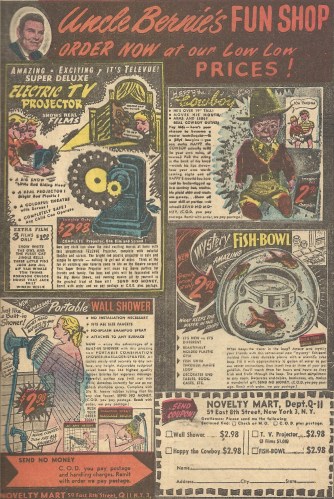
Say what you will about Uncle Bernie’s Fun Shop, but it certainly didn’t lack for variety. Where else could you get an ancient View-Master, a horrifying Howdy Doodyish ventriloquist dummy (that would surely come alive at night and stab you in the eye with a letter opener), an overly complex fish bowl (would it really make the fish happier, or would it make them loathe their confinement even more?) and a wall shower? It’s the last item that’s the most mundane, yet most striking. We’ve already seen that Golden Age comics weren’t beyond advertising improvements to the modern marvel of indoor plumbing, but this one takes it to an erotic extreme. Isn’t that one of the most nude young women you’ll ever see in a 1950s comic book? Though there’s no full-frontal (and the nipple is excised), this lady’s profile is certainly worthy of inclusion in Peter Griffin’s side boob retrospective. And is that a kid in one of the insets? THIS JUST TOOK A DARK TURN.
Are we supposed to think that Bernie got a shot of the shower lady by drilling a hole into a neighboring apartment? Was this a Porky’s scenario? An Erin Andrews level violation? Is this a felony? Did Bernie ever get a knock on the door from Joe Friday and Bill Gannon? Uncle Bernie was arrested on charges of third degree voyeurism and tried on June 14th in the Superior Court of the County of Los Angeles. In a moment, the results of that trial.
On Valentine’s Day, let’s celebrate a young woman trapping a man by faking her paralysis – Heart Throbs #25

And so begins our obligatory Valentine’s Day romance comic post. Today our subject matter comes from Heart Throbs, originally a Quality mag before moving over to DC later on in its run, and a series with a giant heart in its title logo. What does that last bit mean? It means that it’s perfect for the day. The cover story will be our senses-shattering focus, with its mixed message tale of young love corrupted and oddly redeemed. If you think of women as flighty, vapid, sinister creatures, this one’s right up your alley. Woman Haters of the world, unite.
On a more serious note, it also features stellar artwork from Ogden Whitney, one of the underappreciated gems of his time. Which is a plus. Grab your cheap box of chocolates and settle in.
The main character in “I Tricked My Man” is Doris, a young lass who knew the love of her life from childhood on. It was a youthful infatuation that never wavered — not even in the face of relentless schoolyard taunting and graffiti:

Since many of us once made similar vows of fidelity to a high school girlfriend (I was two days into my college life when I regretted my full-throated YOU’LL ALWAYS BE MY GIRL protestations), we can easily foresee the immediate future for this couple and how Jim’s feelings on the matter will evolve. Sadly, Doris doesn’t have the same level of foresight. Actually, she’s willfully blind to the distance that may or may not be creeping in between her and Jim, and she’s not the type to let go easily. Not even when Jim takes her for a drive and puts on his “Gee, I’m sorry” puppy dog face:

Doris takes this quite well GOES ABSOLUTELY FATAL ATTRACTION CRAZY, and manages to wreck the car with her neediness, which is a new wrinkle to dependency:

Jim is relatively unharmed, but Doris is banged up quite badly. Her legs will need extensive rehabilitation before she can walk again, and Jim, feeling guilty about the accident (though, let’s be frank, it was ALL Doris’ fault) stays with her all the time for support. This leads to a bit of Munchausen’s syndrome (the “real” Baron Munchausen was in a comic book once, did you know that?), as Doris, whose legs return to full strength in no time, keeps up her wheelchair-bound act. What a lady:

The young doc’s name is Bob, and you quite likely see where all this is going just by that last panel. Bob likes Doris (God only knows why), Doris still wants Jim, there’s another woman who wants Jim, and Doris is all confused about Bob. It’s a mess. Things come to a head when there’s a fire at the hospital, and as Jim springs into action to rescue patients, Doris is confronted with a dilemma:

GET. UP. OFF. YOUR. CONNIVING. FAT. ASS. AND. DO. SOMETHING.
She does. And finds new love in the span of two panels:

Yeah, she’s real swell. (If she had let the child die in the blaze, maybe Crimebuster could have used his monkey-aided legal expertise to help her out of any legal troubles.)
The story formula here, with its love rectangle and much gnashing of teeth, is your standard romance comic fare, though the fake paralysis angle puts it far toward the odder end of the spectrum. We all realize that Doris is a tortured soul, but could she maybe have spent a few panels alone on her feet before running into another man’s arms? A little penance, you know? And as an addendum, does anyone else have the suspicion that Bob might have set the fire to spur Doris’ “recovery”? In some sort of extreme physical/mental therapy? Maybe you have to read the whole story to pick that up.
Whitney’s art sets this one apart even more than the psychologically disturbed goings on. He’d go on to a certain degree of cult classic fame when he illustrated the surreal adventures of DC’s Herbie, the Fat Fury, but it’s great to see his expressive style in a less outlandish setting. I’ve read other critiques of his work that mention how marvelous his close-ups were, and you can see some of that in the scans above. Look at Jim’s face in the car. At Bob’s raised eyebrows. There’s such tremendous subtlety in his faces, a replication of the interplay of the dozens of muscles in the human visage. It’s an illustrative dexterity that you don’t often see in comics work, and considering when this book was published — 1953 — they’re ahead of their time.
There. Happy Valentine’s Day. Enjoy it with your loved one, or cry as you eat a carton of ice cream while watching TV.
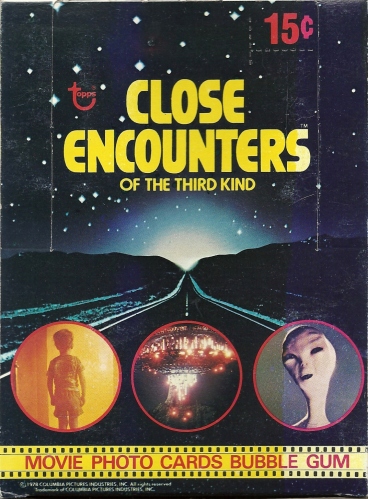
With only its second entry, the Trading Card Set of the Week feature is already straying a bit from the comics-related diktat. But Close Encounters of the Third Kind had a comic book adaptation, so we’re in the clear. The blog police aren’t going to break the doors in and raid the joint. Relax. Breathe.
Topps, the longtime kingpins of the trading card world, put out umpteen movie-related sets over the years, and a sci-fi blockbuster like Steven Spielberg’s Close Encounters was certainly ripe for immortalization. Confession: IT’S MY FAVORITE MOVIE. Of all time. Ever. I foresee no film ever coming along to knock it off the top of the mountain. And I like the flick so much, when I found out that the movie had bubble gum cards associated with it — a fact that somehow eluded me for the first 34 years of my life — well, I had to have them. And this, friends, is why God created eBay and PayPal. A quick, reasonable Buy It Now purchase later, and a whole unopened box of CEot3K was speeding toward my home.
I fully planned to spend an evening watching the movie as I slowly worked through pack after pack, building up and savoring a treasured set. But I was stopped by a bad experience that with another vintage box of cards that I found at the same time. I won’t say what it was, simply because I want to cover it in a future Set of the Week post. Suffice it to say that, to my horror, the ancient gum had fused with the card adjacent to it in every pack, ruining that card completely. This was a buzz-kill beyond words, and I thought it wiser to leave the Close Encounters box as is. So back on eBay for a complete set of the cards. (This isn’t a flaunting of wealth. These things can be found dirt cheap from multiple sellers. There’s a lesson there for people thinking mass market collectibles will be worth millions at some point.)
So I now have a set and an unopened box. I’m very happy — and I also have some thoughts on the product. Here they are:
1. The box itself (top of the post), as with many old-timey wax pack holders, is a work of pop art in itself. This one combines the old movie poster, with an empty nighttime road and a bright light over the horizon, with iconic imagery from the film itself. It’s a bit of a surprise that the mothership and the only alien we ever get a good look at are so up front, though. Granted, people buying the cards have already seen the movie, but other people who saw the display might not have. Not a big deal, and maybe I’m overthinking this, but the placement still briefly raised an eyebrow.
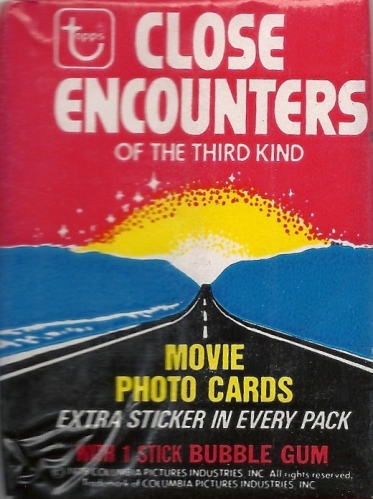
2. The box design carried over to the packs, which are bright and waxy and gorgeous:
3. Cards back in those days retold the story of the movie, with clunky captions underneath stills and publicity photos. A truly terrible job is done here, as the Close Encounters storyline is rejiggered and streamlined to condense it into 66 cardboard rectangles. It’s too much to ask for Topps to recreate the sense of fear, wonder and awe that made the film a classic, but it’s jarring to a life-long fan, someone who’s internalized every beat, to have imagery ripped from its proper context. Remember when the Neary children covered their ears because of the ear-splitting sound made by the UFOs?:
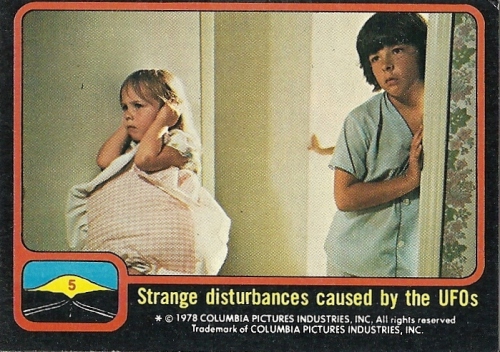

Yeah, neither do I. No, that was when Daddy was going crazy making mountains out of shaving cream and mashed potatoes and tearing the family apart. Still, the cards are pleasing visually, with nice black borders and the card numbers on — appearing yet again — the road/horizon motif.
4. The backs of the cards are either movie trivia or parts of a puzzle that when assembled forms a dim, blurry picture of the mothership. Put it this way: The classic photos of Bigfoot and the Loch Ness Monster have more resolution. The limitations of the old card stock are understandable, but be prepared to squint real hard.
5. The highlight(s) of the set are the cards featuring the friendly, sign-language-adept alien at the end, or, as I like to call him, THE KEY PART OF THE BESTEST SCENE EVER. To wit:

He’s also the first of the 11 stickers:

Greetings from the limitless universe right back at you, bud. (Ignore the neck seam.)
The cards look good, even though the content is a bit lacking. I’m sure the Topps people had no idea there would be snarky bloggers writing about them 30+ years later (nor would they know what “snarky” “and blogger” were), but everything from the box to the packs to the card design has a fun retro joy to it. They’re not up to the movie’s high threshold, but they’re nevertheless manna to hardcore fans.
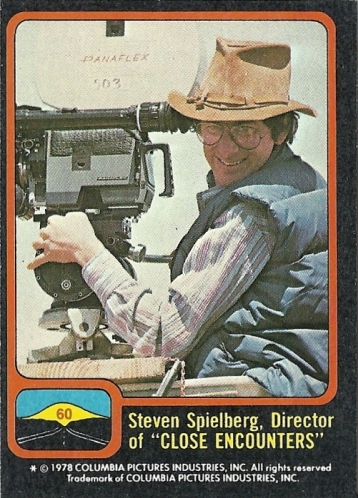
I’ll leave you with the card of the young, hungry Spielberg, using wonderfully non-digital camera technology and wearing Indiana Jones’ headgear — KEEP WATCHING THE CARDS:
No matter the decade, no matter if it’s postwar or a period of sustained peace, Army surplus never loses its charm
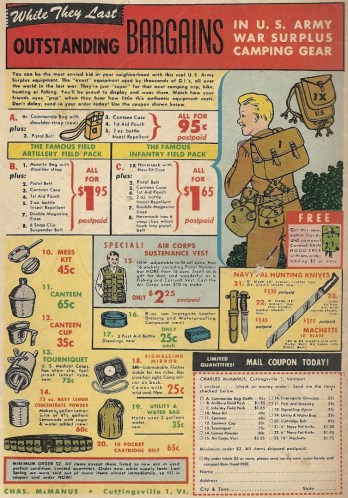
There’s something to be said for good old-fashioned olive-green Army surplus merch. Canvas galore. My father had some of his old Vietnam gear locked away in an attic footlocker, and when I was a kid I’d occasionally pull it out and have a gander. The canteen — which looked a lot like the one in this ad (canteen technology didn’t advance much between WWII/Korea and ‘Nam) — was especially neat. Why? I don’t know. It was a canteen. But it was an Army canteen, one that slaked my father’s thirst in the jungle, and hence had secondhand sentimental value. If there is such a thing.
The Air Corps sustenance vest up there looks like a Rob Liefeld costume run amok — THE POCKETS ARE TAKING OVER. (Don’t let Mother Box see it. She’ll get ideas.) And if Batman saw you wearing that cartridge belt, he’d shake his head and say “You’re trying to hard, kid.”
Smurfs. Snorks. Spider-Man. Mr. T. Pink Panther (sons?). Sober David Hasselhoff. NBC. Saturdays. 1984. BE THERE.
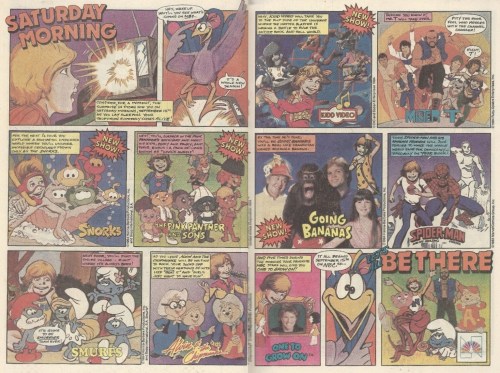
Consider this NBC lineup a counterpoint to the Richard Pryor-anchored selection over at CBS. Who you got? It’s hard to argue with a schedule that boasts the Smurfs and the Snorks (who were the same damn thing), Alvin and the Chipmunks, the wisdom of Mr. T (pre-comics) and Spider-Man with his amazing friends. Granted, Kidd Video and Going Bananas were weak links, and the less said about the Pink Panther’s dopey brood the better, but these were the days, a halcyon age when David Hasselhoff was still roaming the highways with KITT and could conceivably deliver a “One to Grow On” segment without conjuring images of wrestling shirtless with a cheeseburger:
Or maybe she’s just piss drunk, right Hoff? EXCELSIOR.
John Candy in a Charlton cameo? – The Peacemaker #1
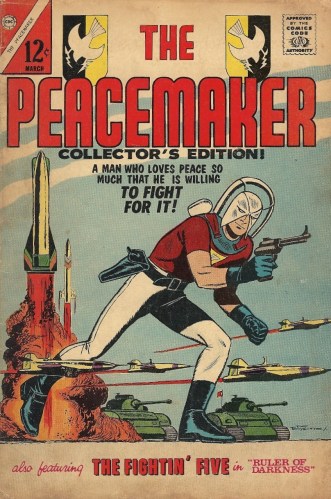
Charlton’s Peacemaker, who’d one day go through several degrees of separation and morph into the narrative-propelling Comedian of Watchmen, wasn’t one of his original company’s leading lights. It was hard to compete with the Steve Ditko-infused titles like Blue Beetle and Captain Atom, but there he was. His book had its share of goofy charm, though it was cancelled after only half a year’s worth of books. And Peacemaker wasn’t anywhere near as dreadful as Son of Vulcan. So there’s that.
The original Peacemaker finally got his own book — after backup stories in Fightin’ 5 — in March of 1967, with his former betters now in the backup role. The tables were flipped. This first incarnation was less the martial character of later decades, and more a one-man amalgam of Ditko’s Hawk and Dove. Christopher Smith was a career diplomat, one devoted to the cause of non-violence and peace, who would, when forced, strap on his rather odd outfit (with a curvy helmet that foreshadowed John Byrne’s Shi’ar Empire designs — there’s some Stilt-Man in there too) and pummel the living hell out of evildoers. And his Reed Richards gray temples looked FAN-TASTIC all the while.
The two Peacemaker stories in this first flagship issue, both written by Joe Gill with art by Pat Boyette, are, fittingly, prime examples of his goofily bifurcated adventures. In the first, a rogue submarine is preying on international shipping fleets, and when mild-mannered Smith finds himself on a ship about to be blown to smithereens, its the Peacemaker who steps in to save the day:
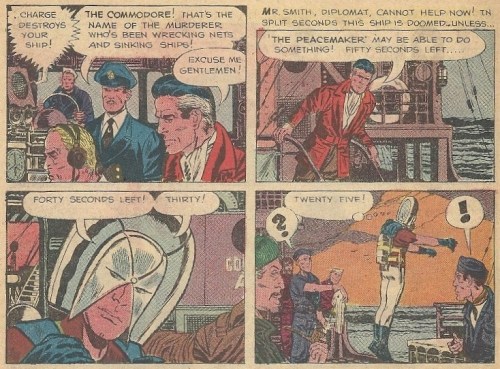
Who’s menacing the seas? An erstwhile suave, debonair Captain Nemo, settling scores in his very own Nautilus? Not quite. It’s actually Del Griffith from Planes, Trains and Automobiles:
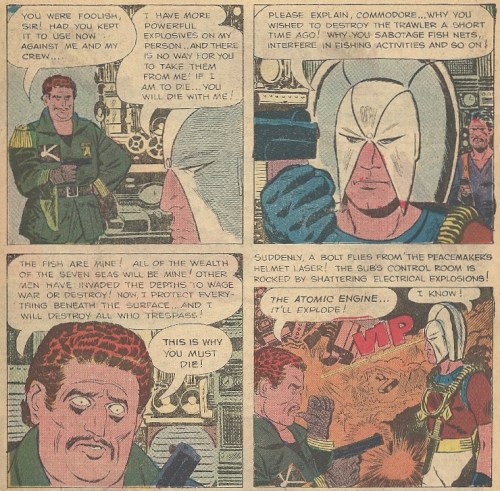
For the sake of comparison:

Del Griffith
Maybe you can white-out the Commodore’s dialogue and insert some of your favorite John Candy Planes lines. While “Between two pillows…” would top anyone’s list, “I’ve never seen a guy get picked up by his testicles before…” has to rank right up there.
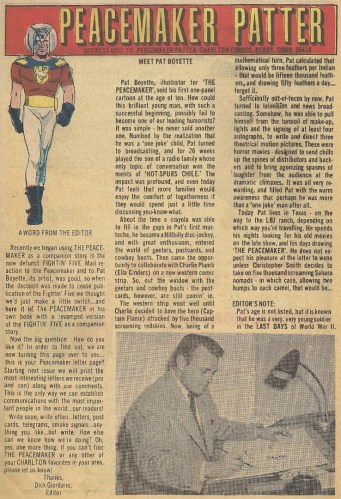
Here’s your Peacemaker Patter intermission, with a word from Dick Giordano (early in his lengthy editorial career) and some background info on Pat Boyette — with a bonus photo of the latter at work:
In the second story, Smith gets his face slapped by some mealy-mouthed little Eurotrash ambassador:

Most of us would bop this Balkan back like an enraged Moe Howard, but Smith (literally) turns the other cheek. An investigation into why this gent seems so full of himself — and his country — leads Smith, as Peacemaker, to Antarctica, where a secret base is arming this small nation. (Perhaps they’re subleasing space from the South Pole Nazi hideout.) Our hero gets in a bit over his oddly-shaped head during his investigations, and displays some questionable judgment while trying to extricate himself:

Comics once taught me that you can swim in quicksand. Now I know that, if I’m ever falling into a nuclear reactor, I should speed up if I can. Because why not? Anyway, Peacemaker triumphs, and the once-strutting ambassador has a good pants-wetting. U S A! U S A!
Thoughts: Boyette’s artwork is a forgotten component of Charlton’s golden era, which is a shame. His style was never as aesthetically pleasing as the heavyweights of his day, but it was solid, and the volume of output was impressive. Open up a second-tier book, from Korg to Space:1999, and you’ll see Boyette’s panels. There’s something reassuring about his presence. Something steady?
And Peacemaker? He wasn’t much of a character, and was undermined by his internal contradictions, contradictions that were never explored to any degree of satisfaction in his Silver Age adventures. There’s surely a deep, psychologically complex, fascinating story involved with a diplomat who sneaks out in a high-tech costume to wreak havoc on those who’d upset the delicate international balance. That’s not what we got, though. His comic book hijinks were understandably superficial, and hell, anything more might have had the book cancelled after issue one instead of a few issues later. But there was an unexplored void always hovering around the character and his good deeds, a mystery that no one seemed to care very much about.
So the Peacemaker remains in the shadow of Captain Atom and the Blue Beetle. But he once dealt with a crazed seafaring Del Griffith and triumphed in the end, so he has that going for him. Maybe he and Steve Martin can compare notes.
Nylons! Getcher Nylons here!
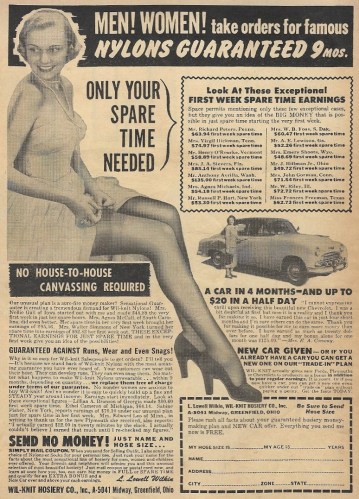
What’s more improbable, earning a car through selling nylons, or a kid in a rocketship selling salve? It’s a puzzler, I admit.
Do you really want to be the guy taking nylon orders? You want your home office to be known as the mecca of GUARANTEED nylons? Maybe you do. If so, zei gezunt. And if that’s indeed how you want to make your fortune, maybe you should consider adding girdles to your wares. Never hurts to diversify.
Deep Sea Diving G.I. Joe is also Slow As Death G.I. Joe
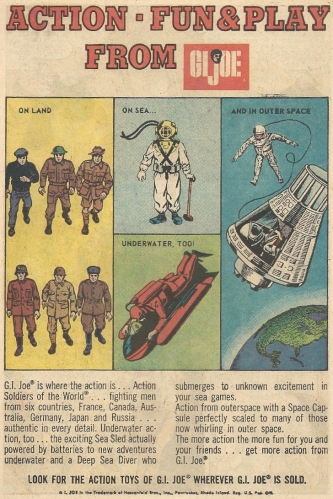
Really, how much G.I. Joeing can you do when you’re stuffed inside a deep sea diving outfit? It’s a tad constricting. And why is the deep sea gear “On sea” while the dude on the sled is “Underwater, too!”? Are a lot of sailors manning the conn in outfits like that?
Glass-eating, tough-as-nails Green Beret G.I. Joe is not amused.
And is that a sledgehammer he’s holding? Is there much call for a sledgehammer when you’re underwater? I’M SO BEWILDERED. YO JOE.
Thrill as the last drops of Kryptonian blood are drained from The Death of Superman – Superman/Doomsday: Hunter/Prey

The Death of Superman and its follow-up arcs (Funeral for a Friend, Reign of the Supermen, The Return of Superman) was nothing if not an event. Big sales, big interest. The 20/20 hindsight on the story, though, is that it kind of stunk. It was a simple sales-driven editorial decision to “kill” Superman with a character no one had ever heard of, but once the mainstream media got hold of it the thing just caught fire. A friend of mine who owned a comic store back then remembers the day the bagged copy of #75 came out, how when he came in through the back door he was startled to see people milling around the front window and pressed up against it like in that episode of Star Trek where the planet was overpopulated (The Mark of Gideon). When he opened, one guy picked up the whole stack and tried to buy out every copy, thinking that this was going to one day pay off and land him an island in the Caribbean. No, one copy per person, sir. And I’m doing you a favor.
I’ve read interviews with then-Super-Editor Mike Carlin and primary writer-artist Dan Jurgens where they talk about how the Death storyline just got too big, and how the attention that it drew made it into something that it was never meant to be: a once in a lifetime event that was supposed to be passed down from elders to generations of knee-sitting children. There are two sides to this: Yes, the mainstream media — I remember learning of Superman’s impending death from Dan Rather, of all people — should have taken this with a few more grains of salt, as comic book deaths have about as much chance of taking as do pro wrestling retirements. Superman had as much chance of going away for good as Ric Flair. But come on — the Superman brain trust didn’t realize that offing the Man of Steel and ceasing publication on his books for a few months wouldn’t be news? It’s a toss-up on who was more gullible. (As always, though, lean towards the media on that count.)
Anyway, Superman died, was buried, was impersonated (I admit, teen me was rooting for Cyborg Superman to be the real one — I liked Terminator 2, what can I say?) and then came back in the Coast City-annihilating cataclysm that, ironically, set the stage for Hal Jordan’s fall and death (one that had more legs). I ate it all up when it came out, but as they years passed, as those bagged, bloody books failed to fund real estate buys in paradise, it all became one big shrug of the shoulders. There was a remarkable lack of resonance to the fall of the first and greatest.
Then there was one day a few years later when I was going through a bookstore and saw today’s subject on the rack. Superman/Doomsday: Hunter/Prey. Or, as it should be: Superman/Doomsday: We’re Back/For More Cash. Because really, that’s what it is. Which is fine. DC is just as much in the business of selling comics as making them. And guess what? I BOUGHT IT. And still have it, for that matter. So if there’s a joke, it’s on me.
Hunter/Prey, published as a three-issue mini, fulfills (ironically) a three-fold function, in that it brings Doomsday back (he had been lashed to a rock and cast into space by the Cyborg Superman during Reign) while at the same time offering up his senses-shattering origin and delving (weakly) into Superman’s lingering psychological trauma. That it was a previously unknown force of nature that offed Kal-El was one of the big Death complaints, and this book spackles over that void by filling in Doomsday’s origin gaps. And, under the standard Dan Jurgens/Brett Breeding byline from that era, the book has Superman coming to grips with the nightmares leftover after his death and rebirth. (Let’s be frank: this would linger with anyone.) Of course, to conquer his fear he has to confront its source, and that source is the very beast that killed him. But first, Doomsday has to break his asteroid shackles, which he does with the help of a passing freighter:

Really, you didn’t see a whole ton of people getting sliced in half in Superman comics back then. Or, for that matter, disembodied heads leaving a bloody comet trail as they rocket past, as they do when the freighter makes its scheduled stop on Apokolips:

FORE.
The book isn’t just about the return of one villain. The Cyborg is back as well, and tries to use Doomsday as muscle to take over Apokolips. There’s more than Parademons and Furies standing in his way, though. Yes, within these pages we get the Doomsday vs. Darkseid showdown that we never knew we wanted. (And shouldn’t it have been someone like Darkseid to deliver the original Super-killshot?) How does it go? NOT EVEN DARKSEID’S THIGH-HIGH FASHION BOOTS CAN SAVE HIM FROM DOOMSDAY’S BONY ONSLAUGHT:

Point of order: The Omega Beams lose strength over distance? Shouldn’t Omega Beams always be at full blast? Isn’t that the point of the “Omega”? Otherwise — Psi Beams? (Overthinking this, I know. And maybe they do lose strength like that. Whatever, Darkseid is still A1 villainy.)
It’s the dire situation on Apokolips that draws Superman in as an unlikely savior, and it’s there where he confronts both the Cyborg and Doomsday in a settling of two scores. Along the way learns the origin of Doomsday from Waverider, the exposition-spouting deus ex machina of the DC Universe. No spoilers about the origin, but suffice it to say he was decades in the making (decades that saw babies repeatedly killed — CHEERY) and he shares a certain connection to Superman, one that explains (lamely) why he was drawn to Metropolis — and Superman — in Death. (Note: The head alien on the Doomsday-making team reminded me, oddly enough, of the lead actress in Attack of the Killer Tomatoes. It’s the cheekbones. Look them up. Oh, and the name of her character? Lois. Oooooo…) The one aspect of this origin story with relevance to the events at hand is Doomsday’s nature as a perfect organism (xenomorph?), one that can’t be stopped the same way twice. This of course is bad news for Superman, since mano-a-mano fisticuffs ending in a Rocky Balboa-Apollo Creed II simultaneous knockdown won’t cut it. But this is Apokolips, and guess what Superman has on his side — MOTHER BOX. And she’s been reading her Rob Liefeld X-Force/Youngblood comics!:
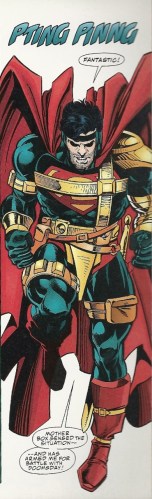
No, Superman didn’t say “Mother Box, outfit me like RuPaul dressed as a medieval knight.” But that’s what he got. And no, we never get to see what’s stored in those pouches. But the sonic gun and the sword get used in the final struggle with Doomsday, and surely that’s enough to beat the guy, right? WRONG:
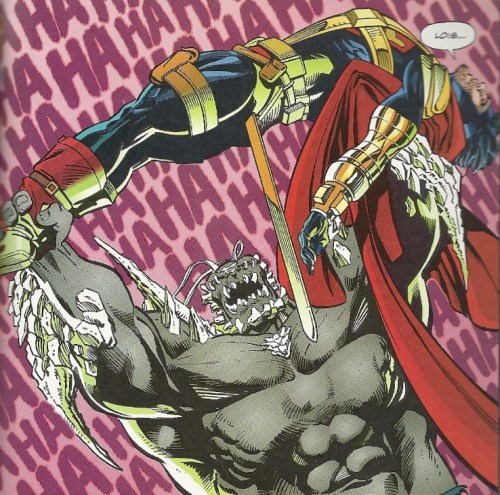
Derp.
The story ends with Superman’s fears confronted and Doomsday (temporarily) defeated, thanks to help from Waverider and his time-travel deus abilities.
If you think this all sounds like a rather hollow, unsatisfying story, you’re right.
This isn’t meant as a knock on Jurgens and Breeding, two gentlemen who together put out A LOT of Superman comics over the years, some that were damn good by any superhero plot metric. (And Jurgens will always have Booster Gold on the plus side of the ledger.) I read and enjoyed much of their output. It’s just that this isn’t the good stuff. Doomsday, despite the epochal event he instigated, was never a great villain, nor will he ever be. You know who/what Doomsday is? He’s like some pop singer who was part of a music phenomenon, one that faded and left people ashamed afterwards that they had ever liked this fad in the first place. I’m thinking any non-Wahlberg member of New Kids on the Block. Someone like that. Someone who might get trotted out every now and then on some dopey VH-1 retrospective, someone with limited public success — if any — after soaring fame, someone who will always have a lingering cachet having more to do with infamy than prowess.
It’s hard to picture Doomsday as a boy band member, but what the hell, why not?
Hunter/Prey feels forced. No, it’s not far-fetched to think that Superman would have lingering fears and doubts about the creature that pureed his face, one whose body is missing and floating around in space. Nor is it forced to bring Doomsday back into the fold, as in comics — yes, like in wrestling — no exile is forever. But throwing Darkseid into the mix feels like seeding keywords into a web page. The outlandish Super-Knight costume looks like an overly complicated design for an action figure that never materialized. Waverider does his maddening “solve all problems and wrap things up and paint our way out of corners” thing. And the thread that we learn connects Superman with the monster that bashed in his face? Maybe it’s okay. Maybe it’s crap. But it, too, feels forced, like after the fact justification, a device that says “Look, he wasn’t really out of thin air! He has just as much to do with Superman as that red-haired Lex Luthor who was really the old Lex in a new body! See, Death was actually good!”
The Death of Superman wasn’t terrible, and it wasn’t great. It was somewhere in the middle. So is Doomsday’s return. It’s part of the seven stages of storytelling grief (denial?) — part of a creative brain trust coming to terms with the fact that the character they made the centerpiece of an epic event just wasn’t up to snuff. That the Doomsday juice ain’t worth the squeezing, no matter how hard you try.
Marvel would like to wrap you up in POSTER PANDEMONIUM
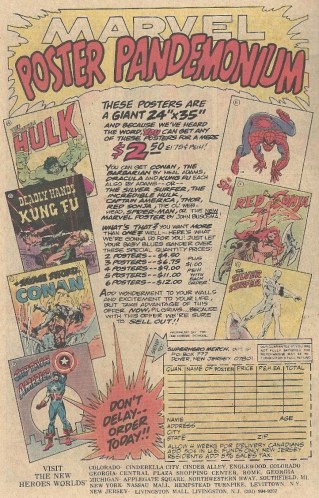
Nothing against the leading lights of Marvel’s superhero pantheon (and Conan, about to deliver one of his trademark bodyslams), but we know who the real red-tressed star of this poster lineup is. It’s a shame that a Frank Thorne Red Sonja poster never caught on quite like the iconic Farrah Fawcett poster. Because it should have.
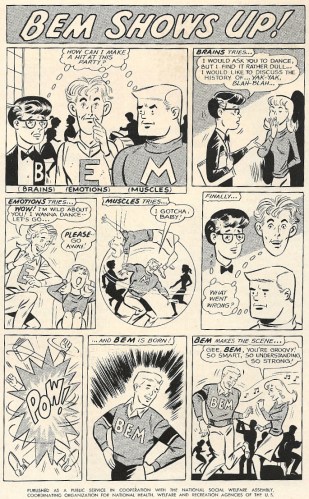
Either Emotions is thinking hard in that first panel, or he’s about to go third knuckle deep into his left nostril. YOU DECIDE.
BEM, brought to us by the fine National Social Welfare Assembly folks behind the dumb Brotherhood Quotient and the debunking of health myths, bears no relation to R.E.M. He is, however, the pinnacle of young manhood, melding the mind, the heart, and the physique into one irresistible dance floor package. Didn’t Cobra do something like this when they made Serpentor?
And it should also be noted that uniting Brains, Emotions, and Muscles apparently gives BEM the power to dance in the herky-jerky, all knees and elbows tradition of Elaine Benes. Cut that rug, Epitome of White Youth. (And, for those curious (i.e. no one), Emotions pretty much replicates the repressed, fuzzy memories of my fumbling prom experience, complete with a female wailing in acute exasperation.)
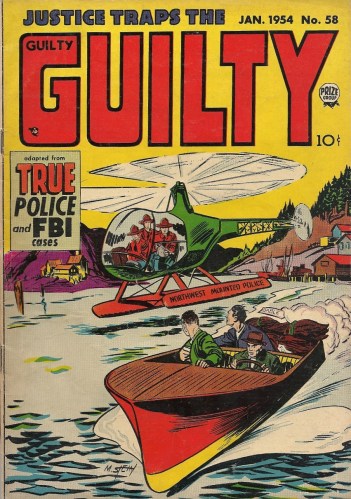
A real, live, honest-to-goodness comic that Seduced the Innocent – Justice Traps the Guilty #58
I have known many adults who have treasured throughout their lives some of the books they read as children. I have never come across any adult or adolescent who had outgrown comic-book reading who would ever dream of keeping any of these “books” for any sentimental or other reason. — Fredric Wertham, Seduction of the Innocent
There aren’t all that many comic books in existence that have incited the fiery wrath of the excitable among us. Yet, in the middle of the last century, the dreaded threat of comic books was seen as sufficiently dire to warrant congressional hearings. As if Godless communists in Hollywood weren’t enough to keep the legislative branch occupied, Estes Kefauver (D-TN) made comics the partial subject of the Senate’s Subcommittee on Juvenile Delinquency, and it was Dr. Fredric Wertham’s book, The Seduction of the Innocent, which really got the whole thing whipped into a frenzy. Wertham was the McCarthy of this minor witch hunt, and the book was his list of State Department commies. (In fairness to Wertham, his comics actually existed.) Reading through those alarmist pages with a buffer of more than half a century, his concerns about the corrupting influence of folded and stapled newsprint storytelling seem foolish at worst and laughable at best. Wertham’s shoolmarmish tome, which led to the Comics Code Authority (which in turn left harmless comics out in the cold), conjures a mental image of the man who’s the personification of “ninny.” And indeed, looking up pictures of him online, he looks like the sort of guy who’d get his knickers in a twist. He has that Woodrow Wilson knuckle-rapping elan.
Wertham didn’t just write up a broad indictment of the industry, either. He named names — comic names. Specific comics were metaphorically held up for public ridicule, clamped in the stocks, and were exhibited as hellish exemplars of all that was wrong in the filth which polluted the next generation(s). Wertham got specific with some, in a point by point semiotic dissection of the evils lurking within. They were eviscerated (somewhat clumsily) and their entrails cast to augur degeneracy.
And others, like the comic in today’s post, he tarred with a broad stroke and moved on.
Issue #58 of Justice Traps the Guilty was Illustration no. 14 in Seduction, with the somewhat vague condemnation of “Treating Police Contemptuously.” That’s it. That’s all that Wertham could muster. Which leads one to wonder: What could have been so bad? What kind of contempt could lead to this book being lumped into a “THIS SHALL NOT STAND” movement, a storming of gates that threatened the viability of an entire medium?
It’s worth a look.
Three of the multiple stories within (none have the cover’s Mounties — our loss) feature law officers. The first centers around Phil and Doc, two cons who get out of prison and start up a lucrative Ponzi scheme. This panel is typical of the interaction between the crooks and the constabulary:

Pretty tame, no?
The second story has two city hoods hiding out in the West, during the days when prospecting fever was still running high. They kill a prospector’s son, but the sheriff can’t touch them because he has no proof of what they did. And when the crooks get wind that the very same prospector has struck it rich, they do him in and thumb their noses at the local lawman — cigarettes dangling insouciantly from their lips all the while:
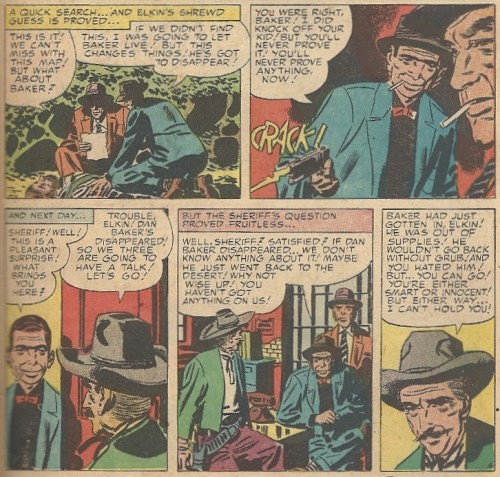
Though the disrespect is a bit more oily in this case (in the proud tradition of Edward G. Robinson in Key Largo), was there really any risk that kids would want to emulate the man with the monkey face?
In the last tale, the killing of a crook on the very first page leads to the crook’s brother taking up a life of crime in spite towards the police that killed him. Yet, even as the surviving brother is thumbing his nose at the cops, he never really rises above the tenor of these opening panels, which depict the instigating death:

And that’s it. That’s what got Wertham so riled up. Which begs the question: How are criminals supposed to act? THEY’RE CRIMINALS. CROOKS. HOODLUMS. NE’ER DO WELLS. This isn’t the realm of please and thank you, of yes sir and no sir. This is crime. And it should be noted that all the crooks die, sometimes in painful ways, and sometimes at the hands of the state in Old Sparky. These are criminals that get punished for their vile deeds. There’s comeuppance, and ultimate comeuppance at that. What kid would follow in these footsteps? Where’s the glory in frying in the electric chair? What kid dreams of getting zapped like a bug?
Wertham actually might have been on to something if he had focused on the cavalier violence within. The bad guys kill flippantly, with no compunction or remorse, and glib fictional murder seems to be something that it’s okay to raise an eyebrow at. Enough to justify outright censorship? Probably not, but there’s more meat on that bone. But no. Contempt was the charge leveled. Maybe Wertham mixed things up in his haste to fling his diatribe out to the public. Whatever the case, it doesn’t speak well for the rest of the basis for the much-maligned Seduction — not that it really needs any more death blows.
Can we get a long-delayed pardon for Justice Traps the Guilty #58? Scrub this indictment from the books? FREE #58.
Want to tell your girl that you really don’t give a rat’s behind about her? Give her a cigar band ring.

Point of order: Can an “antique” be new?
And what woman wouldn’t want to wear a ring taken from — or at least inspired by something taken from — a smelly stogie? Yeah, chicks really dig those. Here’s its great success as a conversation piece: “Wow, what an ugly ring.” There. That’s it.
Then again, if you’re Alan Moore’s Secret Santa, these might be perfect.
Tell her you’d marry her (because you got her knocked up and her father would kill you if you didn’t) all over again.

There’s a point where what you’re advertising stops being a gun, an extension of manhood, and becomes the manhood itself. And, if the stock were to be removed from the Atomic Age Air Rifle up there, you’d go far beyond that line. Seriously, cover up the stock with your left hand if you’re not convinced. What’s left is something you’d see scribbled on the wall of a truck stop lavatory — so I’ve heard. (U.S. 1 told me.)
A kid could pair that with Flying Captain Marvel and have one hell of a subliminally creepy good time.
 Jared
Jared


 blog into mystery