Roger Staubach hawking Skittle Bowl was the darkest chapter in an otherwise storied football career

Poor Roger Staubach. If he had been born a little later, he could have spent his time with the Dallas Cowboys screwing around with Spider-Man and anti-gravity devices. Instead he was forced to shill for a backyard skittle bowl set — an OLYMPIC SIZED skittle bowl set. In the middle of nowhere. And to claim that it was part of his training regimen. Yes, the man who graduated from the United States Naval Academy, Plebe summer and all, kept in shape by whirling cheap plastic at cheap plastic. I SAY THEE NAY.
The comic book that was 9/11 before 9/11 – Marvel Graphic Novel #17, “The Revenge of the Living Monolith”

After the terrorist attacks of September 11th, 2001 wiped the World Trade Center’s Twin Towers from New York’s skyline, there was a rush to similarly erase them from our pop culture memory. Remember the first teaser for Spider-Man, the one where bank robbers ended up ensnared in a towers-spanning web? That was scrubbed from the internet after the attacks. Remember the submerged, frozen pre-9/11 NYC skyline in A.I.? Excised from the DVD release. It was as if the grief was so great, America couldn’t even bear to look at those pylons of concrete and steel and glass ever again — or at least our betters thought so. One wondered whether the 1970s King Kong remake rights-holders were huddling together brainstorming ways to remove the towers from the film and the marketing.
This was all an overreaction, and more than a little bit crazy. It was like a jilted lover going through box after box of old pictures and taking the scissors to every appearance of their ex. NUTS. Yes, the loss was awful, but trying to erase memories in some dumb Eternal Sunshine of the Spotless Mind quest for a palliative wasn’t going to help anything. You can understand wanting to remove the towers from the marketing of a summer blockbuster, as that would be in bad taste. But to erase things altogether was more than a bit Orwellian. Unpersons, untowers.
But they can’t get them all. There are plenty of times where the WTC has come into play in stories of yore, and, thanks to the setting of so many comics in the Big Apple, there have been plenty of four color tales to have the gone but not forgotten landmarks.
Like this. The Revenge of the Living Monolith.
For those unfamiliar with the book (it’s underwhelming), it had the titular villain harvesting the powers of the Fantastic Four and then going on a city-wide rampage, checked only by the efforts of Captain America, Spider-Man and She-Hulk. But the story isn’t really what we’re concerned with today. Look at that cover up there. Let it sink in.
Now let me say this: GOOD GOD THAT COVER EXPOSES A LOT OF STILL-RAW NERVES. ON MULTIPLE LEVELS.
There are three factors that make this cover a more-than-usual attack on the subconscious — if not conscious — mind. To wit:
- An explosive blow to the towers — There’s so much imagery from that one day that’s tattooed on our brains, but the dubiously distinguished champion of that dark gallery has to be the second plane impact, which came when every camera lens in the tri-state area was trained on the smokey remnants of the first crash. The variants on that picture were the ones that were splashed on 9/12’s newspapers. There’s no fireball on this cover, but the Living Monolith explosively decapitating one of the towers is certainly reminiscent.
- Fleeing pedestrians — Following close on the heels of the towers being hit was the towers coming down, and this put the owners of all those sky-trained eyeballs to a full run. Had the world ever seen anything like that — people in business attire fleeing for their lives down major urban thoroughfares — outside of the movies? And how many times that day and the days and weeks and years afterward did people reflect on how it was a like a Hollywood disaster pic? Or, dare we say, even a comic book?
- The act is perpetrated by a Middle Eastern man — Ahmet Abdol, also known as the Living Pharaoh, is a mutant with the ability to harness cosmic energy, which would make him into the Living Monolith when absorbed in sufficient amounts. He’s from Egypt. Mohamed Atta, the ringleader of the September 11th hijackers and pilot of the first plane to strike the World Trade Center, was from Egypt. Do you have to say more? (This isn’t meant to tar a region or a people. Just stating a fact.)
It’s probably that last factor that grabs you, because it’s not something immediately obvious, and requires a moment or two of thought to process. Then it comes to you, and it’s a little bit creepy. Or maybe this is just an overreaction on my part — overreactions all around. Anyway, this is a striking cover in light of intervening events, and that might be an understatement if there ever was one.
Maybe the big question is this: Could conspiracy enthusiasts find a way to shoehorn a controlled demolition into a Living Monolith rampage? My initial answer would be no, but you never can tell. Alex Jones, you have your marching orders.
Next time someone tells you to go chuck rocks, say “Yes, that was an excellent mid-1990s video game, wasn’t it?”
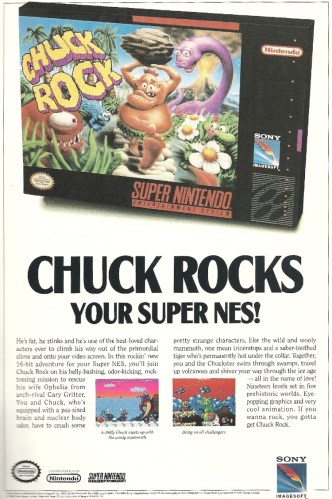
There aren’t many video games out there that make the principal character’s foul body odor a selling point, so Chuck Rock should get some points on that score alone. And not only that, it delivered what its name promised, with good old Chuck living up to his moniker by throwing hunks of stone at various opponents and obstacles. EXCELSIOR.
Personally, I always preferred Bonk’s Adventure for my side-scrolling caveman hijinks, but to each their own. Zay gezunt.

This isn’t the first time that the Easy Care Manicure Set has made an appearance on this blog, but it’s the first time that it’s flown solo. Before it was mostly an afterthought in an ad hawking the Easy Curl product, but now there’s no holding it down. Unruly cuticles beware. (Am I the only one who envisions industrial-level hand manglings resulting from faulty sanding disks? I can’t be, right?)
Anyway, lump this and the curl thingamabob in with the Easy Bake Oven and Kenner has really gone a long way towards locking girls into their futures. Really, what more does a woman have to worry about than nails, hair and cooking for her man?
Teddy Roosevelt recommends that you speak softly and carry (and read) his big comic book – The Rough Rider
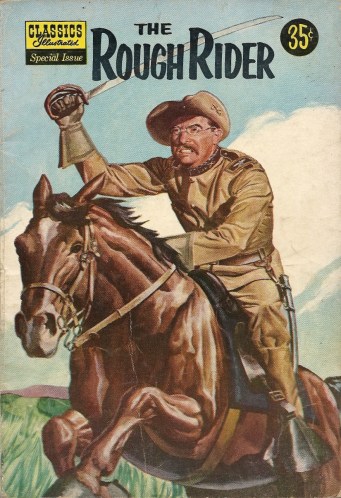
The mustache. The big teeth frozen in a warm predator-like smile. The pince-nez glasses. A face designed not only for enshrinement in stone, but loving caricature as a Charlie Brownish baseball mascot. Theodore Roosevelt: The Man, The Myth, The Legend.
If you had to choose one American President to get some special comic book treatment, you wouldn’t have to look any farther than Teddy. The youngest man ever to hold that high office, an outdoorsman, top cop, governor, soldier and scholar, he was the most renaissance of renaissance men to sit in the big chair since Thomas Jefferson. The first chief executive to combine force of personality with the stature of his office, and thereby wrest the reins of American government away from Congress, Roosevelt and his century-opening tenure was a harbinger of political things to come.
The Imperial Presidency is lamented by some, but TR couldn’t have done it any other way.
If there was ever a man who could truly be said to have “occupied” the office, it was Roosevelt. He was a whirling dervish of energy, lurching from one program to the next, from one initiative to another, always ready to wade into the arena of public debate. Being president was the culmination of a forceful life, one that came while Roosevelt was still in his physical and intellectual prime. He had packed in a hell of a lot of living into his forty-two years up to that point, and he’s rightly remembered just as much for his verve as his time at the head of American — and world — affairs.
And you can’t fail to grasp how outsized that life was when you read this comic. This THICK comic.
Another of the Classics Illustrated Special Issues (we’ve looked at a paean to atomic energy here before), 1957’s The Rough Rider was produced in cooperation with the Theodore Roosevelt Centennial Commission, which worked to commemorate the hundred years since Roosevelt’s birth by spreading the Gospel of Teddy. (It sounds like a nice organizational title people could put on their C.V. without having to do much work.) You want a mission statement from Director Hermann Hagehorn for this book? Of course you do:
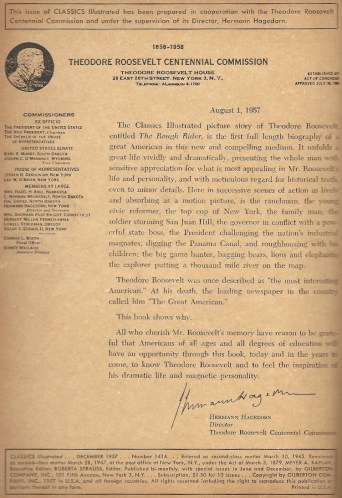
Please note his use of the phrase “picture book” to describe what follows. For me, and I think this is true of most people, a picture book is a children’s book with one picture on every page with some limited amount of simple text accompanying it. Something a school librarian would read and show to a bunch of kids sitting Indian style on the floor. Where the Wild Things Are. The Cat in the Hat. That sort of thing. This, however, is a comic book — panels, word balloons, etc. Either Mr. Hagehorn was misinformed about what he was writing about, or he shared a common layperson’s distaste for “comic” books. If so, he surely could have made use of our modern term to gussy up a popular but regarded-as-trashy medium: “graphic novel.” But I digress.
Whatever you call it — and I call it a comic book — this thing is big. It’s a 96-page monstrosity, one of those square-bound old-timey books that looks like it should collapse in upon itself like a dying star. As it is, there’s more than enough room for a running account of all the highlights of Roosevelt’s life and times, as Mr. Hagehorn’s statement delineates (I shall not discuss them all or show them all, because I don’t have a month free to do this). Let’s look at a few.
Here Roosevelt is as a weak, asthmatic child, one feeble enough to be snicker-snagged by his peers:

Of course, all that changed. Born into great wealth’s lap of luxury, Roosevelt nevertheless seized on a rugged outdoor life as the elixir to improve his frail health, and it did. As he grew up, was educated at Harvard, wrote books and entered politics, he always found time to retreat for rides, hunting and hiking in the American wilderness. He spent long stretches (sometimes to escape great personal pain, like the death of his first wife) in the Dakotas, in still somewhat lawless stretches that lived up to their Badlands appellation. BUT THERE WOULD BE NO MORE SNICKER-SNAGS FOR ROOSEVELT:

KRAKATHOOM!!!
The years as a New York City police commissioner (he and Jim Gordon do share an aesthetic, come to think of it) and the term as New York’s Governor all get their time, but nothing made Roosevelt his national name more than his service in the Spanish-American War and his combat time in Cuba. And what’s the title of his centennial comic book, after all? The Rough Riders’ charge up San Juan Hill was indeed his crowded hour:

We have to pause here to note that this book, like almost all other biographical comics, is absolute hagiography. There isn’t a great deal of Roosevelt’s dark side on display. Granted, most accounts hold that he was very much a good man, but, like all people, there were things in his life that dinged his armor. I always think back to his relationship with his brother Elliot (Eleanor’s father). They were close as children, but when Elliot developed a drinking problem later in life and entered a harrowing downward spiral, Theodore cut off all contact with him, condemning him to exile. Elliot killed himself at the age of 34. It was another time and such things were handled differently (alcoholism and depression were weaknesses, not illnesses), and it’s always touchy ground to quarterback other people’s family relationships, but it’s hard to read the letters from the future president to his younger brother and not find them cruel.
You’ll find none of that here.
Another retroactively eyebrow-arching part of Roosevelt’s life, one that gets a front and center display in the comic, is his life-long lust for hunting. Once again, it was a different time, one where a naturalist like Roosevelt would find it perfectly acceptable to kill, stuff and mount nature’s bounty in order to celebrate it. One of the more jaw-dropping elements of Edmund Morris’ masterly The Rise of Theodore Roosevelt is the tallies he offers for every hunt. Even factoring in that Roosevelt and his companions were eating much of their haul, the sheer numbers involved are jaw-dropping. That’s all well-chronicled here, as Roosevelt takes time to shoot anything that walks on four legs — INCLUDING BABY LIONS:

Our hero, ladies and gentlemen. Vegans and card-carrying PETA members are fainting as we speak.
Even with the almost totally unalloyed admiration, even with “mercy” killings of young, cute, big-pawed lions, there are more than enough special moments from Roosevelt’s life to fill out the comic and make you understand what a larger than life character he was. Like oh, say, the time he got shot and decided to go give a speech anyway:
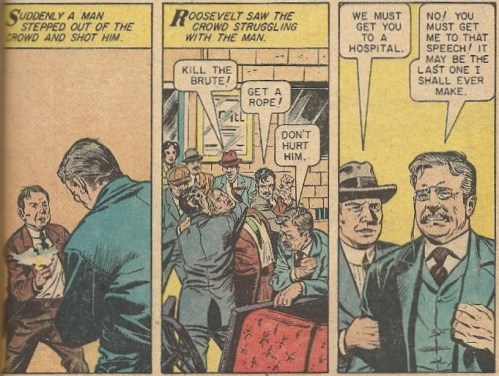
Let’s see Obama or Romney do THAT. (Actually, let’s not — no shooting of anyone anymore, please.)
This comic has its problems. It glosses over a lot. It doesn’t deeply delve into anything. But its sheer size, and that it never once breaks down into the “tell, don’t show” morass of Michelle Obama’s comic, makes it a decent read. You feel like you’re at least taking in the entire width and breadth of Roosevelt’s life, from birth to death, and that’s really the whole point of such an effort. It’s decent primer for young readers, though you have to imagine they’d lose a bit of focus somewhere around page 50. “Are there capes?”
Bottom line: I like Teddy. Most of us like Teddy. That makes perusing this comic rather enjoyable. A DEE-LIGHT, as it were.
But don’t take my word for it, take the word(s) of people you’ve never heard of from organizations you’ve never heard of:

As the man himself would say: BULLY!
Screw the ice cream truck, here’s hoping the Beer Wagon will roll through your neighborhood

I get the feeling that a life-sized version of the above Beer Wagon would be a big hit at any number of tailgate parties. And if, while people were drawing towering pints from a Beer Wagon keg, a Red Baron hot rod pulled into the parking lot, then all bets would be off. A mobile Oktoberfest if there ever was one.
Luring unsuspecting comic book readers to desolate New Mexico was once a cottage industry
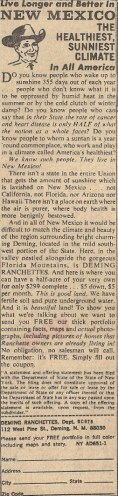
Go west, young man, go west.
We’ve seen a variant on this theme before, in another ad offering “ranchettes” to gullible city slickers (they sound like alkali versions of seafront timeshares). Call me paranoid, but I have a terrible suspicion that such schemes were just elaborate ploys to lure people out to the desert to harvest their body parts. Coma. Soylent Green. You know the drill.
Oh my God, Batman killed Robin. “You bastard,” the ca. 1998 South Park kids declare. – Detective Comics #374

Much has been made over the years of the unstinting child endangerment inherent in the Batman/Robin relationship. It’s by no means a situation unique in comics (nor is it the most bizarre), but it’s the most famous. Thanks to seventy years of publication history and campy television series that drilled it into the broader popular consciousness, there are few people left on Earth unaware of the Caped Crusader and his brightly garbed ward — maybe a dozen or so uncontacted tribesman in South America. Everyone knows about the kid that follows Batman out late on school nights, the teenager that’s caught up in his obsessive war against crime.
There have been any number of stories addressing the peril of this arrangement, most notably “A Death in the Family,” where the Jason Todd Robin GOT HIS BRAINS BASHED IN AND BLOWN UP. That’s the ultimate bad consequence of such a duo: a teen driven by the impulses of youth into a situation where he’s in over his head and then quite literally (well, almost) loses his head.
Count this comic as a dire result somewhere short of that lethal end, in a story that’s more concerned with how Batman, seeing Robin battered and bloodied, reacts to such a personal failure. And you even get several dollops of goofy thrown into the pot to fill out the recipe, as well as some clean Gil Kane artwork to make it all come to life — FOR FUN.
The structure of the plot (Gardner Fox script, Sid Greene inks) is a tad different, as it opens with Robin’s beating, goes (briefly) back in time to see how he found himself in this predicament, and then tracks Batman as he hunts down the would-be murderer. First, the beating, which is every bit as bone-crunching as any you’ll see, with an ambushed Robin never even able to muster a defense:

Batman’s approach frighten’s off the assailant before he can finish the foul deed, but the damage is done. And how did Robin find himself in a garbage and cat urine riddled dark alley, a place designed for sneak attacks? As the flashback explains, Batman had Robin guard the back entrance to a crook hideout, while he went in the front and did his Batman thing, i.e. whacking guys’ pressure points so hard they make improbably odd faces:

But while he was having a good time crushing windpipes, Robin was being beaten within an inch of his life. Sad Batman (in full “I killed da wittle wabbit” anguish) rushes him to the hospital, while Angry Batman emerges into the appropriately stormy night:

He goes into full detective mode — living up to the series’ title — and tracks down the man who he believes did the dirty deed:

Batman is a man of many talents. Crime-solving. Martial arts. Sciences. But perhaps most striking is his ability to have awkward phrases like “I’m caught up in a compulsive vendetta!” flash through his brain whilst engaged in hand-to-hand combat.
Batman hauls the guy before none other than Commissioner Gordon, but it’s this unlikely source that gives Jim Condors, a prize-fighter, his alibi. Jim Gordon — Autograph Hound:

This might be the most disturbing thing we’ve ever learned about Gotham’s top cop. The man charged with keeping a major city safe and secure, a city that’s BESET BY COSTUMED NUTJOBS PULLING OFF EVERY SORT OF BIZARRE CAPER, MIND YOU, takes time to chase down sweaty jocks to get them to sign stuff. I guess we all have to blow off steam some way or another, but gee whiz. (And call me crazy, but I wouldn’t be surprised to learn that Gordon met some grisly sort of Bob Crane end. Just a feeling.)
So Condors “can’t” have been the one to assault Robin, and he immediately starts making lawsuit threats (think Scorpio in Dirty Harry).
Oh yeah, Robin’s still in the hospital. A chastened Sad Batman goes to visit him, and we also learn why Robin’s secret identity is still safe even though he’s been unmasked:

Ah, for the blissful anonymity of another age…
Batman circles back around and checks his old case files, and learns that Jim has a twin brother, Ed, and that Robin had once hauled Ed in. Batman smells a rat, but I don’t think any of us could so easily unpack what has to be one of the most convoluted revenge plots EVER:

So the Condors boys gambled that Gordon was going to be at the fight. And that he’d have them sign a fight card. And that they’d be able to switch out the card with a pre-signed card. And that they’d know where Batman and Robin would be that night.
Oh, and Batman’s Ed disguise? IT’S PRETTY GOOD:

How did he mimic the voice? How did he get the Batman costume on so fast — was Jim’s car in a garage across town or something? Was he wearing the costume UNDER his disguise? That’s a Shazam-like transformation.
Anyway, Batman pummels Jim again, and this time no autograph-loving Gordon is going to save his bacon. All is right with the world.
And Robin? He’s on the mend and out of the hospital, free to resume his hyper-dangerous nocturnal lifestyle:

“We’ll wait a few days before putting your ass on the line again.”
This comic’s underlying premise, that Batman would so blame his own negligence for any harm coming to Robin he’d go on a rampage for justice (“a compulsive vendetta” as it were), is logical. It makes sense. But the one issue format (or half of one issue, since Elongated Man has his customary backup) means it can never rise above the usual Silver Age triteness. Robin is almost beaten to death, Batman’s overcome with guilt and grief, AND THEN THEY’RE BACK AT IT NEXT MONTH. It’s like an episode of The Simpsons with this reset. Would it be too much to ask for Batman to take a second a question whether this whole sidekick business is a good idea?
Still, Gil Kane knows how to illustrate a story. Some of his panels get a little cramped, but the look on the face of the thug getting a chop to the throat makes it all worthwhile. ALL. WORTHWHILE. I’m not at all sure that bringing a dose of the comedic sense found in, say, an Atom story is the most fitting for a “Robin killed” story. If you’re not going to delve into all the implications of such a story, though, then you might as well have some bug-eyed fun with it.
Even Neal Adams’ Deadman ads were relentlessly maudlin

Poor Deadman. It’s not enough that he’s constantly wading through depressing stories. No, he also always has to be stuck in some anguished pose, his twisted face pointing up to the heavens, wondering what God would blight him so. It’s like he should have Barber’s Adagio for Strings playing behind him at all times.
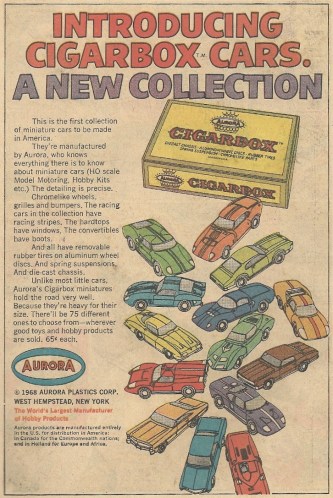
I had never heard of Aurora’s Cigarbox line, a hybrid of model kits (REMOVABLE TIRES! WOW!) and die-cast collectibles that was an obvious attempt to ape the very popular Matchbox product. This old ad remedied that void of knowledge. Perhaps it will for you too.
Cigarbox cars made their debit in 1968, the same year as Hot Wheels. I’ve heard of Hot Wheels. I’ve heard of Matchbox. Not Cigarbox. ‘Nuff said.
Call me crazy, but I have visions of people lighting Cigarbox cars with Matchbox cars. It’s like some LSD freakout.
The Silver Age Westerns that Marvel churned out tend to get lost, understandably so, in that era’s superhero shuffle. It’s hard to match up with legendary runs on Amazing Spider-Man, Thor, Fantastic Four — hell, anything with powers and colorful outfits. But just because the lonesome men who prowled the open plains might not have kept the public’s imagination like their tights-wearing kin, that doesn’t mean that it was for a lack of trying.
There were a number of gunslinging titles at Marvel over the years. Kid Colt. Apache Kid. Et al. Most of them thoroughly mined the same genre tropes that made Clint Eastwood a star: Man rides into town, Man finds town besieged by outlaws, Man saves town. But none of these title characters quite had the vivacity of the Rawhide Kid (real name Johnny Bart), the short, snazzily-garbed ginger with a habit of getting himself into hellacious scrapes and extricating himself from them with over the top action. In fact, he was sometimes so over the top, so outlandish, his fisticuffs would fit right in with the hotter-selling titles in the rack. Captain America vaulting over a taxicab was just a later iteration of the Kid doing the same over a horse.
Though the character was created in the 1950s, he reached his senses-shattering apex in the next decade. And what an apex it was.
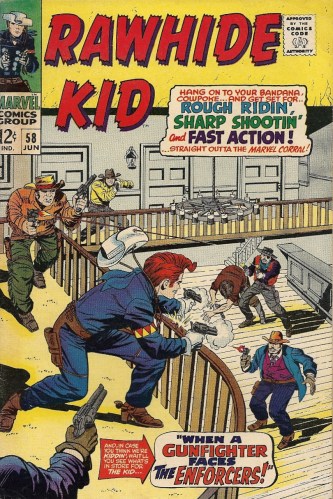
Before we get to the innards of this issue, we have to linger over the Larry Lieber cover for a moment. Why? Because it’s like an advent calendar of all the things we love so much in Western action. First, you have a gunfight in a saloon, complete with a hero vastly outnumbered by stubbly goons. Second, you have a railing, one just low enough and just flimsy enough to promise that someone’s going to crash through it. Third, you have the goons MISSING HIM FROM THREE FEET AWAY! STOP AND AIM, YOU IDIOTS! Fourth (and related to the last point), you have a bullet piercing the Rawhide Kid’s white hat. And fifth, and this is a bit of a stretch, you have the doors behind the combatants, which surely conceal bawdy whores in (or out of) frilly dresses, their bosoms billowing. WHO EVER SAID THAT LIEBER IS THE WEAK LINK IN STAN LEE’S FAMILY TREE? Great stuff — Excelsior.
The story, written by Gary Friedrich with art from Lieber and Vince Colletta, has a town terrified by a ruthless land baron, Butler Benson, and his band of crooks, the Enforcers. Benson is branching out, trying to muscle away the property of local Comanches, and to that end has corralled one of their number, Grey Wolf. He and his boys are intimidating him and tormenting him, and threatening to stuff him in a human-sized birdcage(!), until a stranger speaks up and puts a stop to all this:
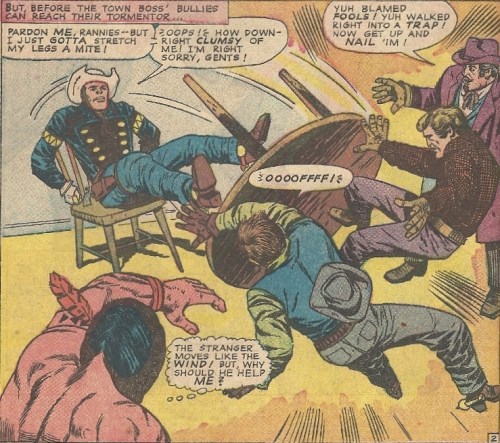
And he’s just getting warmed up. If he had been born in the next century, he might very well have made one hell of a free safety:

The Kid and Grey Wolf make it out, and both ride to meet up with the other Comanches, with the Kid planning to offer them his services to help rid them of this menace. But their towering leader, Thunder-Cloud, has an instinctive (perhaps justified) distrust of all white men, and would just as soon pummel the Kid as look at him. BUT HE DID NOT RECKON THE KID’S PROWESS WITH THE SUNSET FLIP:
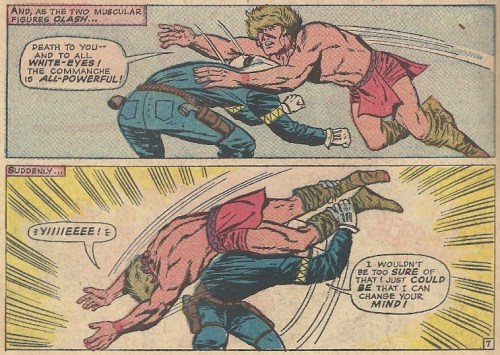
Meanwhile, Boss Benson is recruiting some hired-gun help. Patch Cooley (the gentleman with the eyepatch glimpsed on the cover) is more than happy to offer his lethal services for the right price, and also to demonstrate those skills in a most Westerny way:

That’s some mighty fine shootin’. (I personally prefer when someone tosses a coin and shoots it a few times.)
The Kid, despite his dustup with the Comanches, still feels duty bound to have it out with Benson and his thugs. He circles back to town AND YES, WE GET PEOPLE CRASHING THROUGH A RAILING JUST LIKE THE COVER PROMISED:

The last bit of action is, naturally, a showdown, with the White Hat against the Black Hat in a speed-test of death. Guess who wins (and also gets in a bonus killing for good measure):

Not to quibble with the Rawhide Kid’s logic, but his “there’s always someone faster” formula would seem to presume an infinite pool of gunslingers. Of course, if you said that to him you’d probably get a gut full of hot lead, so best to keep these things to yourself. Anyway, town and local Indian population saved. On to the next issue.
This comic has all the qualities that made Rawhide Kid a success, and maybe a few extras tossed in for good measure. Lieber’s artwork, which was at the core of the character’s Silver Age run, provided a kinetic dimension to the rote gunplay and fisticuffs that made it second to nothing else coming from the House of Ideas. Granted, it doesn’t hurt that Colletta’s inks, so much a part of many a Jack Kirby page-turner, square every man’s jaw and give such shadowy depth in a every furrow of the Kid’s shirt. Because of that, this looks like it belongs amongst the famous best-sellers that were its contemporaries, and hence does. The fact that Friedrich’s story is as original as a knockoff Times Square handbag doesn’t matter a bit, and at any rate is more than made up for by the joyous slang. It’s a fun read.
Until I started putting together this post, I didn’t realize that the Kid had been “outed” as gay a decade ago in a re-imagining. I have no feelings on that either way, and certainly the character and his title long ago lost whatever steam they had possessed, so someone can do whatever they want when trying to defribrillate him back into relevance. But to have glommed such an affectation onto the silly, unalloyed fun of this issue would have spoiled it. Of that I’m fairly certain.
ZOMG THEY FOUND A CURE FOR BALDNESS!!! Wait, no they didn’t.

As a man who first started noticing a few hairs falling out when he was seventeen (really — start the weepy violin soundtrack), I have great sympathy for the poor lost souls who would have fallen for this old snake oil ad. Losing your locks is tough, and not everyone can carry a six-inch part with the manly aplomb of Julie Schwartz.
To its credit, this is only promising to help with a very narrow subset of baldness, but I’m guessing a lot of burgeoning chrome-domes were mailing in that coupon regardless of the cause of their follicular troubles. I’m also guessing that none of them had ever heard of “keratolytic” and “rubefacient” action, which sound completely made up. Bottom line: Never underestimate the willingness of balding men to empty their bank accounts chasing a cure, even those that render them impotent mounds of flesh.
HULK HATE DISCO
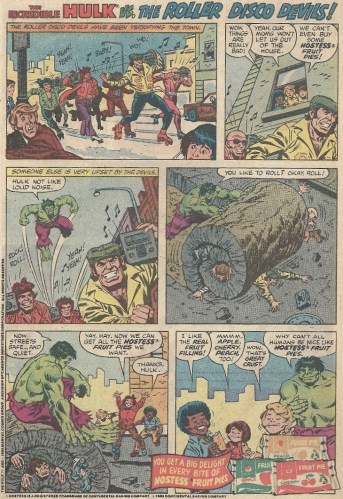
Really, who wouldn’t want to take obnoxious disco-loving toughs and roll them up in pavement? Hulk speaks for all of us, and I can’t tell you how many times I too have wondered why people can’t be more like Hostess Fruit Pies. Deep.
Spider-Man, Green Goblin, toothpaste and the standard by which all other giveaways are judged – Exclusive Collector’s Edition: Spider-Man
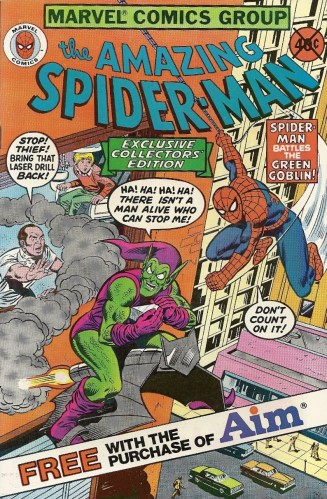
I don’t think anyone would make the claim that this Aim Toothpaste giveaway is an exemplar of storytelling excellence. It’s free, after all, and the underlying (very underlying, as we’ll see) message of good dental hygiene can’t compare to something like the Spider-Man/Power Pack molestation book, which was a comic book Afterschool Special on pathos steroids. It’s nowhere near as silly as any number of other Spider-Man freebies, whether they involve Santa-Kingpin, the Dallas Cowboys, or the horrors of reading. But the star-wattage of its villain (the A1 member of the Spider-Man rogues gallery) and the goofy subject matter (dentistry, folks, dentistry) render it some sort of measuring stick. It’s not awesome. It’s not atrocious. It’s a bit overlong. But it sticks in your head.
In full disclosure, I have to note that I had this comic as a kid. Since Aim never once made an appearance in our household (it’s the RC Cola of flouridated products), I have to think that it was given to me by my dentist from the time I had to teeth to the end of my college years. Which makes it just about the only good thing — since I never had a cavity — that he ever did for me. (A few words about him: He was an arrogant little guy, a man who never in my last few years of going to him spared an opportunity to call in his assistants to gape at and mock the extensive re-ordering of teeth that my orthodontist had done. Which, make no mistake, was a New Deal public works level affair, with concrete, steel and plenty of space-age polymers involved. He neglected to note that he never once spoke up in the years that my mouth was filled with braces, as I was making hour-long trips — I lived in the sticks — to get them adjusted. No, only after the teeth were PERFECTLY STRAIGHT did he nitpick and Monday morning quarterback. Only then did he question the work of the guy who — and I’m forever indebted to him for this — kept teeth from practically growing out of my damn forehead. What made it worse was he always did his scat and bebop stand-up routine when his hands were in my mouth, with that suction thing slurping away, and I therefore couldn’t call him on it. And then he’d leave before I could fire back. Of course, he couldn’t really tell what I was saying through the noise and obstructions, and thought I was reveling in his tremendous wit while I was really mumbling variations on “Eat me.”
Whew. Been carrying that anger around for a while. Thanks for letting me vent.)
This Marv Wolfman, Alex Saviuk, Mike Esposito affair is a lengthy read. It feels like it covers the same ground four or five times. And that’s because it covers the same ground four or five times. The Green Goblin shows up, Spider-Man confronts him, the Green Goblin makes his getaway. Ibid. Rinse, repeat. The story’s very length, however, is one of the things that sets this book apart. Maybe the quality work wasn’t there, but you have to admire the quantity of effort that went into a toothpaste tie-in. And Peter Parker makes some remarkably questionable decisions concerning the safety of a child in his charge — we’re talking criminal negligence level decisions.
Let’s take a quick look.
The story begins with J. Jonah Jameson loading poor Peter with yet another menial task, this time dragging Jonah’s (rather nice, actually) nephew, Randy, to the dentist:
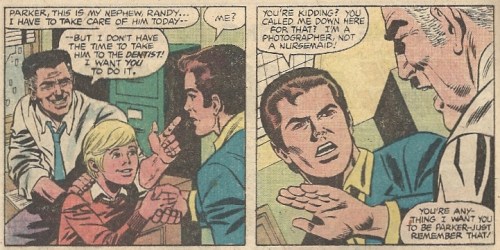
Peter balks, but Jonah dangles a “fired” in front of him, so off they go.
It turns out the dentist is working on a new dental laser (dentists with easily weaponized technology — is this something we as a society want?):
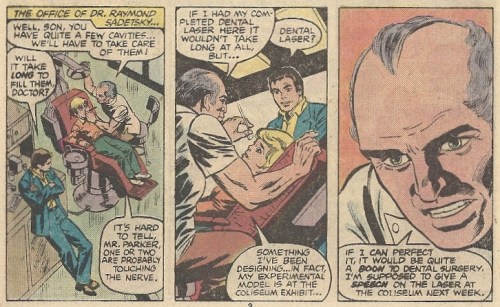
On cue, the Green Goblin crashes through the window and kidnaps him. That’s when Peter makes the first of his bad decisions, leaving a terrified kid alone to fend for himself:
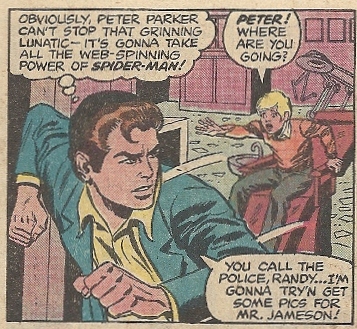
Granted, Peter has to get on the Goblin’s trail, but maybe he could find a nurse or something?
Spider-Man and the Goblin battle (if you’ve seen one of these, you’ve seen them all), but the Goblin gets away, and Peter doesn’t even get any decent pictures. This failure sends Jonah into a frothing, cigar-chomping rage, and Peter has to go out the next day to look for some shots, once again accompanied by Randy, who wants to be a photographer when he grows up. But when they overhear an alert about another Goblin crime, Peter repeats his disappearing act:

Peter left a child alone on the streets of New York City. Alone. On the streets. In New York. This is not his finest hour.
The Goblin once more escapes (Ibid.), and the next day Peter and Randy go to a dental exhibit, one complete with giant molars:
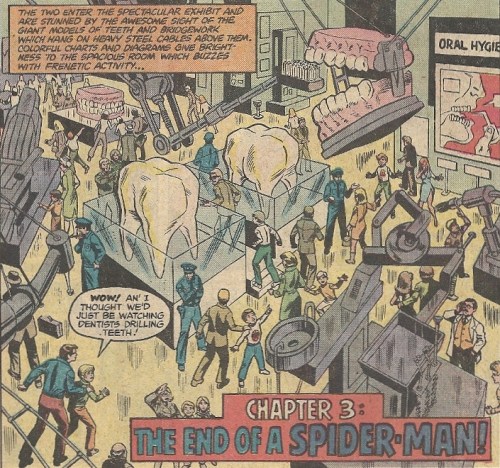
Randy seems really taken with the whole thing, whereas I think the young me would have stabbed himself in the face within five minutes.
Eventually, Peter has another confrontation with the Goblin (rinse, repeat), and once more fails to bring him down. But hey, he does get to reenact one of his more iconic moments, from The Amazing Spider-Man #33:

The two old foes have a final battle at the dental exhibit (naturally), where the Goblin is going to use a laser drill built by the kidnapped dentist to drill through the giant molars, which are storing silver and gold for low-income fillings (don’t ask). The final blow involves Spider-Man blasting the Goblin into a giant set of teeth. Of course it does:
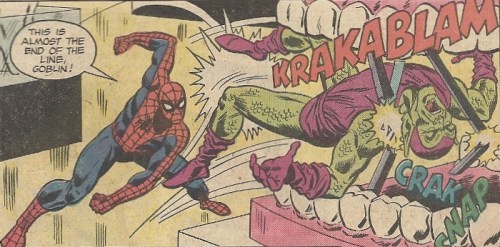
The day is saved. And hey, Randy’s life and emotional well-being was only endangered a couple of times. Winners all around!
The story ends with Randy finally getting that belated check-up, which turns out to be a real bad one:
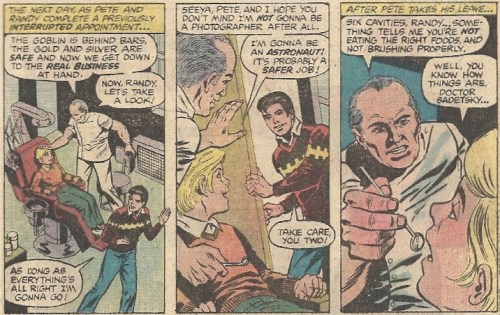
The book wraps with the de rigueur page of dental health tips. Nothing really new here, what with the usual smiling young faces and the brushing and flossing that normal children do so begrudgingly:

Please note the panel that encourages you to eat fruit and other healthy snacks, instead of sugar bomb confections, including a cake dripping with a glaze of frosting (somewhere Michael Bloomberg is nodding in nannyish approval). Pretty standard, right? Well, the only reason I point it out is that you close the comic and look at the back cover and you’re met with THIS:
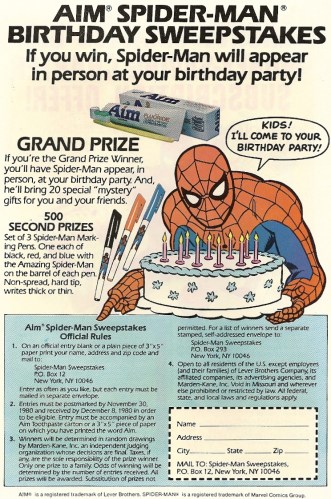
Yes, Spider-Man has a nice, sugary cake waiting for you. Yes, Spider-Man. Spider-Man will come to YOUR party with a cake. MESSAGE. UNDERMINED.
Also, he’ll probably ditch pretty quick.
As stated above, this is a meaty book (36 pages), and lot of that meat is devoted to Groundhog Day reprises of Spider-Man getting bested by pumpkin bombs again and again. This is by no means a great read, and that Peter Parker would so willingly leave a young kid to his own devices in the middle of the Big Apple is something that sucks you right out of the story. It’s just so out of character. (Maybe it’s in character, but that’s not the Parker I know.) I’m not sure what Wolfman was thinking with that.
Still, everything that goes into it — the thickness, the villain, the hero, the teeth — sets it apart from the crowd, for better or worse. It’s the center of the giveaway universe, and whether books are — indeed — better or worse, there’s at least one person that always compares them to this one.
If Magneto, Doctor Octopus and Doctor Doom Christmas caroling doesn’t get you to subscribe, really, what will?
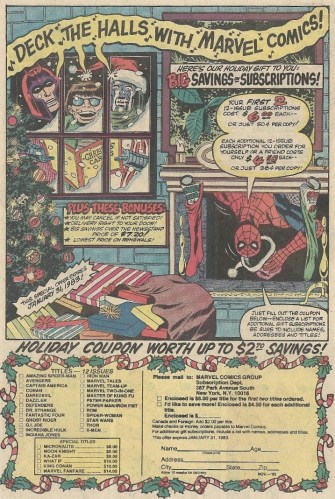
Here we have another entry in the proud tradition of Christmas-themed subscription offers. Did Erik Lehnsherr, Otto Octavius and Victor von Doom get hammered with a “go caroling window to window” community service sentence? Was Doom forced to wear the Santa hat because of some extra dollop of villainy? One wonders. (Maybe the ants/picnic incident finally went to bench warrant.)
I have to admit, I recoiled when I saw the comics rolled up in the stockings. I guess Santa-Spider-Man never heard of Mint condition. THANKS FOR NOTHING, WEB-SLINGER.
 Jared
Jared


 blog into mystery