Just when you thought nothing could be dumber than Super Skittle Bowl, HERE COMES SKITTLE BASEBALL
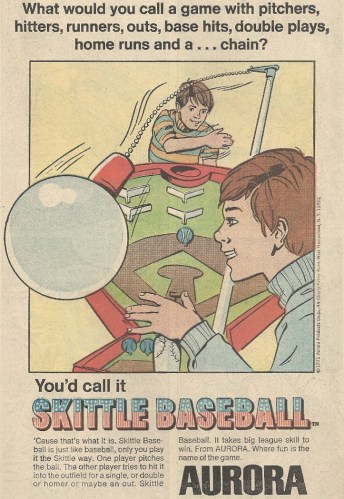
I’d call it a wide-awake nightmare, that’s what I’d call it.
Whereas Super Skittle Bowl only dragged poor Roger Staubach down into its dopey morass, here the fine folks at Aurora have decided to besmirch by association the American Pastime. I don’t know what contortions the Skittle Baseball rulebook had to go through to (very) vaguely approximate hardball, nor do I want to. I’m sure it’s awful, and the fact that Don Adams is featured on the product packaging might make this one of the signs of the Apocalypse.
I swear, if somehow this and Strat-O-Matic Baseball were combined into some unholy abomination, it might trigger a bloody worldwide killing spree.
Cancelled postage 100,000,000 years in the making

An uncareful reading of the top lines in this ad would lead you to believe that you’d be getting stamps from 100 million years ago. Which would lead you to wonder whether there was really much need for stamps in the Mesozoic Era. Which in turn conjures images of dinosaur mail-carriers delivering letters. Perhaps being chased by velociraptors. EXCELSIOR. (I readily admit, if the postal service ever issued a Devil Dinosaur stamp, I’d slap that bitch on every envelope sent out.)
Note: I scoured the internet searching for an image of a dinosaur in a USPS uniform. No luck. Turns out not everything you can imagine can be found on the web.
Kirby’s best Fourth World character? BIG BARDA. – Mister Miracle #4

Jack Kirby’s Fourth World saga is rightly venerated as a font of colorful characters, a gushing well of heroes and villains that have fueled story after story for DC Comics in the decades since their creation. Highfather. The Black Racer. Desaad. Kalibak. Metron. The list goes on. Not only did the Fourth World offer readers a new rainbow assemblage of dramatis personae, it also spawned the grandest villain that DC has to offer: Darkseid. Yes, Lex Luthor and the Joker have dibs on larger footholds in the broader pop conscience, but their puny Earth-bound devilry seems so pedestrian when compared to the galactic scheming flowing from the stony ruler of Apokolips. I don’t think I’m alone in hoping that one day, should Warner Bros. ever tire of recycling Lex and General Zod as the villains in the cinematic Superman franchise, we’ll finally get a villain in Darkseid who poses a true challenge to the Man of Steel. Maybe in that nebulous Justice League movie, the one that always looms over the horizon like a celluloid mirage. Who wouldn’t want to see the Omega Beams in a theater near you?
If Darkseid had been the only thing to thing to come out of the Fourth World, you could have called it a success. But there was a whole lot more.
That’s not to say that this new mythos was an unalloyed triumph. It was weighed down, like so much of Kirby’s work, by his charming yet hackneyed scripting. Try as I might, I’ve just never been able to get into the bulk of the tales that he wove together back then, reveling only in the eye-popping panache. The New Gods, with stiff old Orion leading the charge, just never did it for me. The Forever People, boiled down to their essence, were a bunch of hippies (we know how vile they can be — cue an Eric Cartman “HIPPIES!”). Superman’s Pal Jimmy Olsen, which spawned the great Darkseid, still had a freckled photographer as its central character, and the thick aroma of his silly Silver Age adventures lingered.
Yet…
Then there was that other book. Mister Miracle. It was the longest-running of the Fourth World titles, and ladies and gentlemen, this was not random happenstance.
Scott Free, the greatest escape artist on any world, whether that world was Apokolips, New Genesis or Earth, was by far the most visually arresting of the kaleidoscopic Fourth World army. Once you got past that eye-roller Kirby name of his, you were dazzled by his blazing yellow and red costume, and when you combined that with his green cape, it was like an actor in a Kabuki play had been fused with Evel Knievel and a circus strongman. And his stories had a joy to them, too. Yes, every issue offered more and more preposterous scenarios from which Scott would extricate himself, sometimes with the assistance of his diminutive sidekick/manager, Oberon. Yes, every issue’s cover was an over-the-top representation of the challenges facing the hero: chained to a cement block, thrown into the water with sharks all around, a torpedo sloshing toward him — or something like that. But his flight from his life on Apokolips — in the clutches of Granny Goodness — and his attempts to earn a living on Earth as a modern Houdini made him accessible to readers. Despite that retina-blasting outfit, he was the most relatable of his pantheon, the most grounded. He was just a man plying his goofy trade.
And then Big Barda showed up, and we were gifted with one of the truly great female characters in all of comics.
You really can’t say enough good things about Barda. Though a secondary character in a secondary mag, she carved out a place in the hearts of readers because she was every inch a lady, though one dressed like an alien Cleopatra draped in chainmail. She was outsized both in stature and personality, was proud and boastful and aggressive on the outside, yet sheltered a tender heart within. A product, like her friend and future husband, of the Apokolips orphanage system, she too rebelled against authority, eventually casting aside her status as the head of Darkseid’s Female Furies to be with the man she loved.
It’s possible for an ardent feminist to read tragedy into that last point, that a woman would set aside her career to be with her man (that’s not really what happened, but let’s not allow that to get in the way of a convenient generalization). This reading couldn’t be more incorrect, though, and this brings us to Barda’s great subtext. She was in many respects an unheralded feminist icon who outshone that great paragon of comic book ladies, Wonder Woman, the glorious Amazon whom x-chromosomes naturally gravitate towards like eels to a fish’s flank. Michael Chabon, comic fan and Pulitzer Prize winning author of the comic-infused The Amazing Adventures of Kavalier & Clay, published an essay a number of years ago entitled “A Woman of Valor” (you can find it in his Manhood for Amateurs collection, which I had to track down in my local library to finish this blog post — IRONY). It was an encomium to Big Barda’s many virtues, in part shredding the false god(dess) in Wonder Woman (among others). (It also has the merit of deploying the words “pop-Zoroastrian,” “Rabelaisian,” and “tergiversations” within the first two paragraphs, which aren’t usually found in articles touching on comics.) When I first read it, I was stunned with how utterly sympatico I was with its main thrust (which came out of Chabon’s youthful comic-reading days in the 1970s), as if Chabon had burrowed into my own head and tapped into my thoughts on the matter. Wonder Woman has evolved since Chabon’s early comic-loving days, but the contrast relative to Barda still holds.
On the lady with the golden lasso:
Wonder Woman’s story just never added up. It made no narrative sense. Her motivation, her purpose in life, her relations to men and their world had been formulated and reformulated by a succession of writers over the years without growing any clearer. We were told that she was an Amazon princess of misty origin, a demigoddess, heiress to Hellenic splendor and daughter of Queen Hippolyta herself, yet she dressed in a costume that appeared to have been aired previously by a burlesque dancer at the Gayety in Baltimore, Maryland, on the Fourth of July 1933…Rooted in mythology, she never generated any mythology of her own; she contradicted herself without struggling against or embodying those contradictions; in other words, she had no story.
Barda?
The world of fire that she was born into and the way she was raised obliged her to learn to be strong, vigilant, resourceful, and submissive to no one…In time she would mutiny against the might-makes-right strictures of her home and attempt to form a partnership of physical and intellectual equals — with Mister Miracle, her paramour, the love of her life. In his company, in rare moments of quiet, she doffed her armor, laid down her Mega-Rod, and made him a gift — both of them knowing full well its value — of her vulnerability, her sorrow, the pain of her childhood in youth. She was a Valkyrie with a brain and an aching heart.
Chabon’s essay is really about his wife, and how the erotic power of strong women can come in all shapes and sizes. Still, I could have saved a lot of words in this post by typing a big Ibid. underneath it. No offense intended to Wonder Woman, but Barda is in another class entirely.
And now we come to her very beginning. Though Kirby’s scripting in Mister Miracle #4, Barda’s first appearance, was as ham-handed (endearingly so, of course) as always, the groundwork was laid for all that Barda eventually became. With her very first words she was already busting balls:

Having arrived on Earth via her Mega-Rod (a device with phallic implications perhaps unrivalled in comicdom — and straight out of the classic SNL “Fresh pepper?” skit), she promptly makes herself at home, kicking back and putting up her feet as poor overwhelmed Oberon raids the fridge to placate her:

Scott is at that moment trapped in an apartment building, whose denizens have gone crazy thanks to Doctor Bedlam’s (a being composed entirely of Kirby Dots) Paranoid Pill and are bent on killing him. When Barda hears about this, she becomes a protective lioness and Mega-Rods her way over. You can see a lot lying under the surface during the reunion of these two friends who would become more in short order — and in the first panel you can perhaps glimpse the beginnings of one of those “moments of quiet” that Chabon wrote about:

Miracle and Barda, side by side for the first time.
Both of them eventually make it out of Bedlam’s house of horrors, and there’s a lot more of Barda’s fiery temper to be had when they get back to Scott’s place (not to mention clear evidence of her height advantage on her man). As usual, her quick anger always seems to be a lot for show, because, let’s be honest, if Big Barda is really pissed at you, you’ll realize it when you wake up in a hospital bed:

(I have to make an aside here: One quibble I always had with Mister Miracle was that his escapes weren’t always just spontaneous ingenuity on his part. When he gets home this time, he explains to Oberon how he made it out of a box in which he’d been tied up that had been tossed from the top of a high-rise’s stairwell. HE’S A BIG FAT CHEATER:

I know, I know, all escape artists have tricks of their trade, and Houdini himself wasn’t above a dab of chicanery. It’s just that I much prefer it when Miracle works his way out of jams with his own wherewithal and agility, not an otherworldly Swiss army knife. I mean, I could have done that.
Just a quibble. Back to our regularly scheduled programming.)
Much has also been made over the years about the reversal of the classic gender roles with Miracle and Barda, with the woman being the taller and physically stronger of the pair. In that vein, there’s a cherry on top at the end of this dinner, as Scott slaps on an apron to whip up some dinner, while Barda, um, slips into something more comfortable:

WHEN BIG BARDA DOFFS HER ARMOR SHE DOES NOT MESS AROUND. (Love the look on Oberon’s face.)
There you are. Barda’s Beginnings.
Before we go, a few words have to be devoted to Barda’s looks, and after a gratuitous bikini shot seems as good a time as any. It’s been well established that Barda’s physique was modeled on a Lainie Kazan playboy spread, and that her peppery but kind repartee with her friend/husband was based on Kirby’s with his wife (it’s right at the top of her Wikipedia entry, for gosh sake), but it ould be that Barda is the most physically appealing of any of the women Kirby ever drew. Let’s be frank — as frank as Barda would be: the man wasn’t gifted when it came to bringing winsome, pretty women to life on the page. His talents were best suited to visceral action, to fists, machinery and monsters. His most famous ladies, from Jane Foster to Sue Storm to you name her, all looked like gussied up cavewomen to me, with big brows and shady slits for eyes. Delicate flowers were not Jack’s forte, they were his faux pas.
Barda was different because she belonged more in the world of titans that Kirby was most comfortable with. If you were looking for a close equal in terms of physicality, Thor’s Sif would be the only comparable figure. But Sif lacked that great Barda personality, and might as well have been named Stiff — she was just like the rest of her straight-backed Asgard peers. Not so with Barda. Though her face and eyes really didn’t vary that much from the Kirby mold (and I don’t know if she’s and Beautiful Dreamer have ever been seen in the same room), that mold worked so much better when draped over Barda’s inner fire. Her looks rendered her all the more believable and human, big bones and all.
Okay, I’m out of breath. I could type on and on about Barda and her somewhat unheralded glamor, but I’ll stop here. Suffice it to say, I think she’s great — a woman in full. Time and time and time again Kirby was a part of wondrous doings, but one of the things I’ve always been most thankful for is the Big lady from the another world, and all the seeds of her awesomeness were planted in this first appearance.
Track down that Chabon essay if you ever get the chance (it used to be on the Internet, but I had a hard time finding it). And maybe the second volume of the Fourth World Omnibus if you want to hit the Barda ground running.
It’s still not too late to get your old-timey haunted house record for this Halloween. Okay, maybe it is…
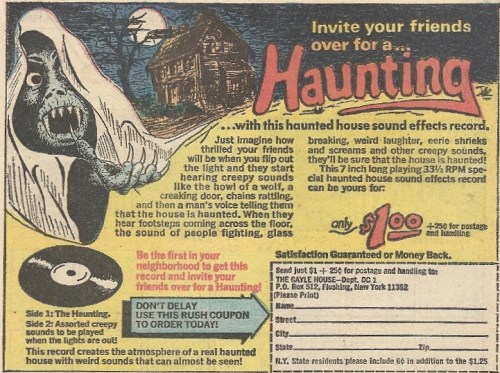
When I was little there used to be a family that put on a haunted house every Halloween, one right on my customary trick or treat route. They did a nice job with it, with ghosts, blood-stained corpses, cobwebs and black cats galore, and they always handed out plenty of candy to us kids as we walked out the door. But they had one of these records (more than one probably) playing all the time, and even in the early single-digit age range I thought the typical crackling of old vinyl undercut much of the aural menace.
Still, the thought was there. (And you could play while setting up your odd Vampirella/Frankenstein playset.)
Since Hurricane Sandy is wrecking Halloween, it’s fitting that we should revel in a ghost story set at sea – Ghost Stories #20

With the confluence of a once in a lifetime storm battering the eastern seaboard and the approach of Halloween, it seems as ripe a time as ever to yak about a tale of horror set amongst roaring ocean waves. And so we have this comic, from one of the lesser Dell titles from the 1960s. Huzzah. Eagle-eyed readers who’ve been visiting this blog for a while may be having some deja vu seeing the above cover. No, that’s not John Wayne alone in a boat about to harpoon a whale. It’s an anonymous soul framed by a gaping maw, some pantywaist afraid to bear his manly chest like John. That’s all.
There are several stories in this book, but the cover tale is the one we’ll look at. It’s actually a bit of a mind-bender, and not in the good Rod Serling way, but the “I don’t think they thought this all the way through way.” More on that in a moment.
The story (with art from Frank Springer, whose art can sometimes be dodgy, but isn’t bad here) is set on that oceanic charnel house of old, a whaler. Most everyone’s knowledge of whaling comes from Herman Melville’s Moby Dick, and that’s not so bad in this case since, though this comic isn’t about a deranged captain chasing a white whale, there’s whaley vengeance aplenty. In a storytelling inversion, it’s the whale that’s deranged and attacking a ship. To wit:
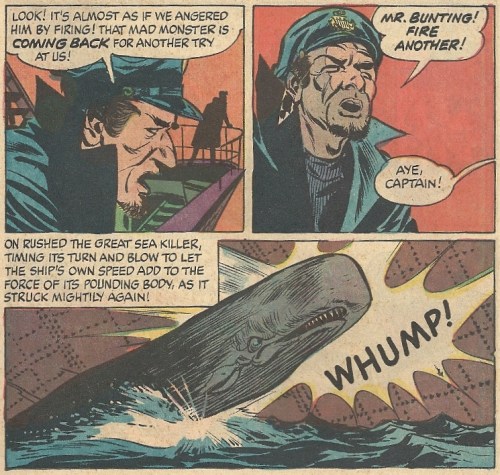
The sperm whale does mild damage before swimming off, but the pumps and repair crews are able to patch things up and keep their old hulk afloat. The captain of the vessel (Volmer) is understandably uneasy, and spends the night having odd dreams where he’s angrily pummeling a drunk crewman named Falkin:

The dream-man vows his vengeance as he drowns. When the captain awakes the whale has returned and this time be busts a hole in the hull big enough to sink this bitch:

The men scramble into the lifeboats, and a malevolent flip of the whale’s tail sends the captain into the swirling sea. There the whale makes a beeline to him:
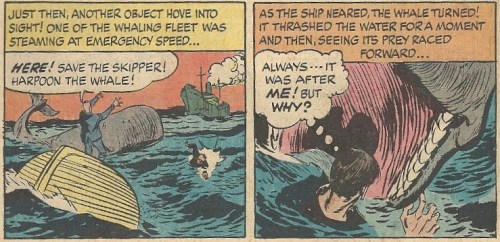
The men do wind up killing the whale, but not before it gobbles up their skipper, and when they cut it open in the vain hope of rescuing him, they find more than they expected:

Let’s unpack this. A ship is menaced by a whale. The captain has a dream where he kills a man (it could be that Falkin was real, and Volmer was replaying something he had done, but it’s implied that this is literally dreamt– this is the impression I got at least). The whale returns the next day, sinks the ship and eats the captain. Inside the whale is a tag bearing the name of the man from the captain’s dream. So the whale was possessed by the spirit of a man from a dream and was attacking the ship before the dream happened to kill a captain who never (to our knowledge) killed anyone (except for a bunch of whales). I’m confused.
A note: At no point in this comic is the whale ever called a sperm whale, though that’s obviously what it is. In fact, it’s called a “killer” whale on multiple occasions, which is correct in one sense, but definitely wrong in the taxonomical. Shamu, of Sea World fame, is a killer whale. What you see in the scans above is not. I’m wondering if there was some reticence on the part of the folks at Dell to put the word “sperm” in a comic book, no matter the context. Maybe. The tittering of children would surely be unbearable.
Anyway. This little story doesn’t really work. Oh well. Life goes on.
Hope everyone out subject to Sandy’s wrath there battened down the hatches and is riding this one out. Stay safe.
(I feel like I should add a little “If you liked this story, here are some others that might interest you” plug, like the ones Captain Kangaroo used to give out at the end of every episode of CBS Storybreak. There’s a great book out there called In the Heart of the Sea, which is about the early 19th century sinking of the whaleship Essex by an enraged sperm whale. It’s the true story that inspired Melville to pen his classic novel, and the book tells the harrowing story of the shipwrecked men and their privations as they float about the Pacific in meager launches. Spoiler: They eat each other. It’s a good read. Okay, enough whale talk.)
If you’re tired of carving pumpkins for Halloween, why not slap together Vampirella and Frankenstein model kits instead?
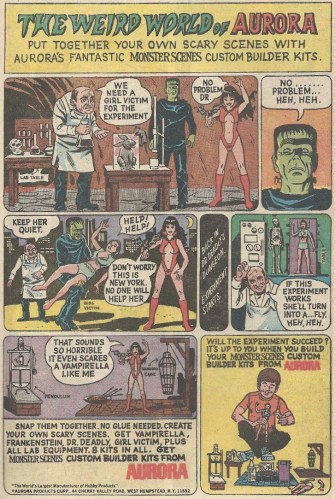
Nothing says good wholesome fun like abducting women off the streets of New York and turning them into insects. I expect much better from Frankenstein and the big-boobed Vampirella. Maybe not Dr. Deadly.
That said, it looks like Vampirella has the beginnings of a nice little sex dungeon there. Good for her.
Bellicose muscleman George F. Jowett returns to build both your body and your strategic military acumen
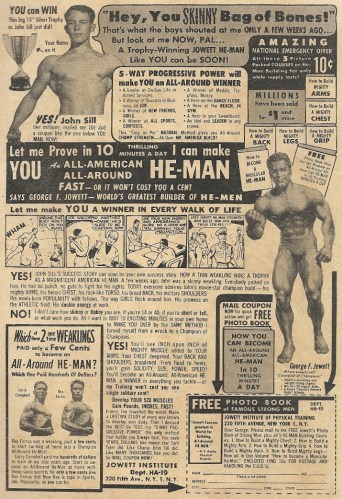
The George F. Jowett bodybuilding ads were a fixture in old comic books, and are familiar to all of us who’ve ever flipped through a yellowing old lump of bound parchment. As with many venerable Madison Avenue staples, there were a number of variants on the theme. I was struck not so much by the avalanche of copy in this iteration, or the rippling he-man abdominals of the eponymous fist-wagging Mr. Jowett, but by the strip of panels in the middle. I’m sure bulging muscles could help you win beach bully encounters (we have countless Atlas ads to attest to that), hit home runs (see Bonds, Barry) and dazzle the ladies, and hell, maybe even win a promotion at work if the boss is intimidated by your barrel chest and sinewy arms. But getting bumped up in military rank? Is this how we want to establish our armed forces chain of command? I mean, George Washington was a lumpy, misshapen mess when he was befuddling the Brits, and Andrew Jackson was a walking broomstick when he was winning the Battle of New Orleans.
I think we’ve finally explained Vietnam: The brass thought all they’d have to do was some isometrics and wave a hamhock fist, and Ho Chi Minh would go a-running. Quagmires the Jowett way!
Is the Watchmen smiley face currently negotiating its own spinoff? – Smiley the Psychotic Button #1
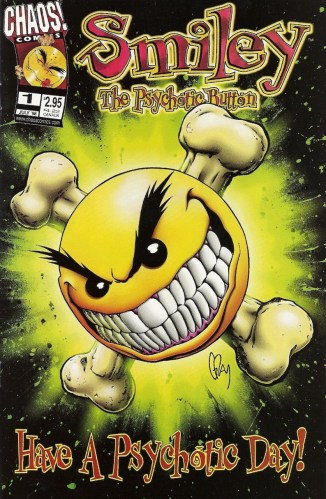
You can’t tell me that the Comedian’s trademark button hasn’t at some point called its agent to harangue him for a new deal. “You mean DC put together this whole Before Watchmen thing and you couldn’t even get me a one-shot special? I’M THE GODDAMN SYMBOL OF THE WHOLE SERIES!”
Smiley may or may not be the symbol of the Evil Ernie franchise, but yes, he did indeed have his own one-issue spinoff title. (For those unaware, Smiley is the sentient button attached to the undead Evil Ernie’s jacket, and he forms a part of that character’s extended family of oddballs, as well as being the passage through which Ernie’s dark powers are channelled. As you can see, he looks like a cross between your generic Have a Nice Day button, a skull and crossbones, and a Mr. Yuk sticker.) You might be asking “Hey, how can they make a whole comic book out of a button?” And you’d be right to question the wisdom of such a move, my sage friend. Because this comic book is loud and stupid and juvenile and crude. Those might be the things to which Evil Ernie aficionados are accustomed, but I’m not an Ernie aficionado. And you know what? Most people aren’t. So this comic is offensively awful to most everyone, right down to plankton.
The “imaginary” story in these pages (Script: Jesse McCann, Pencils: Ivan Reis, Inks: Joe Pimentel) focuses on the dream life of Smiley, who dozes and fantasizes as he’s pinned to his owner’s lapel. And what does he dream about? What all heterosexual men (and buttons) dream about — BABES:
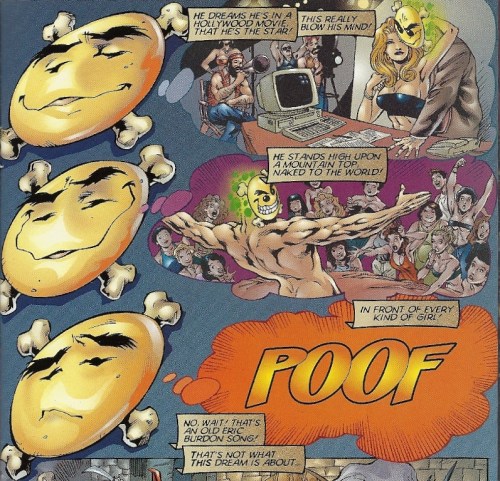
Most of the dreaming is centered on not just any babe, but Lady Death, another of Evil Ernie’s coterie. Smiley’s unconscious mind whips up a dream where he’s a dashing knight (with arms and legs) seeking to find Lady Death and win her heart. (If you’re a guy trying to impress and bed a female personification of mortality, maybe you should go the Thanos route and put the Silver Surfer in bondage. Or maybe not.) Smiley, despite this being his dream and therefore his playground, has limited success in his amorous quest. He even has to resort to cribbing some mindless muscular rage from the Hulk:
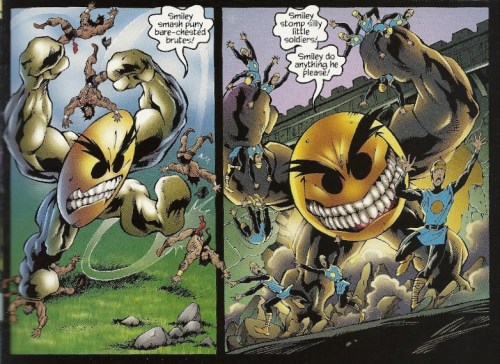
But Smiley does indeed triumph, eventually getting Lady Death alone and ready to rock and roll. Only to discover that — and I here present you with graphic evidence that I am not making this up — he doesn’t have a penis:
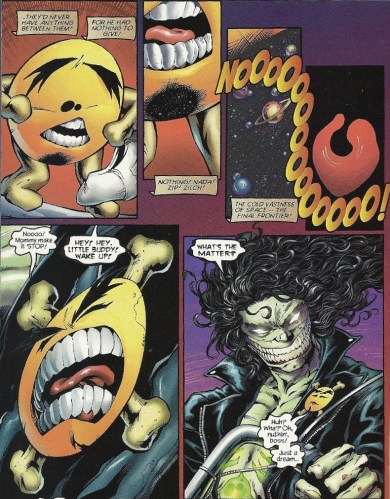
One could quibble with the notion that, since this is Smiley’s dream and he’s been able to forge himself knight’s armor and various augmented powers, not to mention arms and legs, he should be able to make himself some junk. Or maybe this is dream-symbol gobbledygook, with castration imagery that’s caused by your mother not loving you enough or some other nonsense. I have no idea. All I know is that the grand climax of this tale was a yellow button with big thick eyebrows had no dick. THANK YOU COMIC BOOK.
This comic has a five-year old mentality, yet it delves into sexual material. It’s insipid and useless — but perhaps we should expect no less from Chaos Comics, who also brought us the colossally dumb Undertaker World Wrestling Federation comic book. It’s terrible on pretty much every level. Enough said.
Apologies to all the Evil Ernie devotees out there if I’ve insulted your franchise, as I begrudge no one their fandom, and people in the glass house of comic books shouldn’t throw a lot of stones. Perhaps there’s some deeper meaning here that’s flown over my head. Barring that miracle, though, this is wretched. And apologies to the plankton for that.
The early Star Wars merchandising machine, still getting the lingo down, hoped that you would “Let the Force be with you!”

The copy in this ad is a bit of a douche-chill, like awkward keyword stuffing in an ultimately useless blog post. And all for a dopey poster magazine.
So was being a StarWarrior the same as being in the official Star Wars Fan Club? Did it make any difference that you were sending your 10 simoleons to Hicksville, NY instead of Hollywood, CA? Was Hicksville really a hotbed of Star Wars publishing in the late 1970s?
Thrill as the AAU Shuperstar pummels the Sinister Sole with his fetishy flying feet of fury
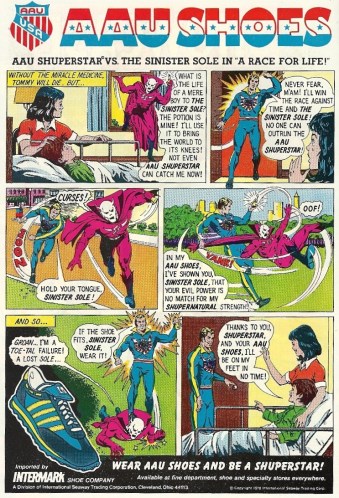
I get the feeling that closeted foot fetishists were behind many of these Shuperstar ads, whether the pedi-centric hero was battling similarly themed foes or hurling smelly hippies into outer space. It’s like he’s always a step or two away (no pun intended) from putting his foot right in some overmatched villain’s face and yelling “Smell my foot! Now suck my toes!” And thereby generating awkward Ambiguously Gay Duo stares.
The sick kid is a nice touch, though.
The thing about Superboy-Prime’s first appearance? It’s actually a nice little story. – DC Comics Presents #87
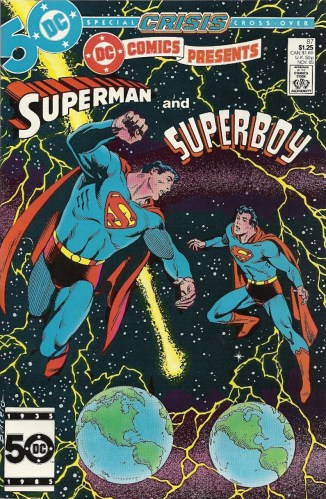
The return of Superboy-Prime in 2005’s Infinite Crisis miniseries was an example of the neat long-gestating comebacks that can only happen in comics. An extraneous, throwaway duplicate character, created twenty years before in one of the umpteen Crisis on Infinite Earths crossovers, the Clark Kent of Earth-Prime was gone in a heartbeat, slipping into oblivion with his Earth-2 brother Kal-L and Earth-3’s Alexander Luthor. Whether he was stored away for future use or never to be seen again was up to whoever held the editorial reins at DC, and lo and behold, as the company ramped up to the anniversary of the biggest event in the company’s history, the accidental Superboy was dusted off along with his fellow exiles. It was a return long in the making.
Of course, the nice aw shucks kid had become a psychotic killer, so it was quite a comeback.
What Superboy-Prime became now obscures what he was in his first appearance. Which is a shame. His introduction in DC Comics Presents #87 is by far one of the finest bits storytelling to come from the penumbra of Crisis spinoffs. Those sideshows could often devolve into stories cramming as many oddly juxtaposed characters together as the newsprint could hold (LOOK ENEMY ACE IS HANGING OUT WITH BLUE DEVIL!), and they suffered because of it. Not this comic, though. It stands as a shining beacon of good plots not being so much about what is told, but how it’s told.
Superboy-Prime’s introduction couldn’t have been in more capable hands. Elliot S! Maggin, who scripted any number of fine comics at this point, and Curt Swan, who was, well, Curt Swan, an artist that could invest anything with delight, formed one heck of a solid script/art tag team (Al Williamson contributed inks). And this was by no means their first Kryptonian rodeo, as they’d partnered to craft a stack of Superman comics over the years, including the wondrously bizarre Sword of Superman annual that I yakked about last year. With this comic they created a book that stuck in my head for twenty years, long before dragging Superboy-Prime back from the archives was a glimmer in anyone’s eye. This didn’t need any retroactive boost to make it memorable. It could stand on its own two legs without a rekindling of interest.
What gives it this cachet? It’s the air of melancholy that pervades the entire book. The story opens with a grieving Superman on the moon just after the infamous and oft-referenced death of Supergirl, as he’s pounding on the lunar surface, gnashing his teeth and silently cursing the injustice of it all, this untimely death of his last family member. That sets the tone. Then he’s zapped by some passing aliens and ends up in another reality, a common occurrence in the cosmic reshuffling that was the Crisis.
This detours us to one of the side-reasons that this comic was so memorable: it was also a generation’s reintroduction to Earth-Prime, the “real” Earth where DC’s heroes were fictional and Julie Schwartz et al. lived. The Flash had been the first hero to make it there back in the Silver Age (*The Flash #179 — Jovial Jared), but it was a largely dormant plot device (there are only so many times that you can go to the “character meets creator” well). All this was confusing beyond words to my seven-year old cerebral cortex. Imagine being a kid and trying to parse the geography lesson here:
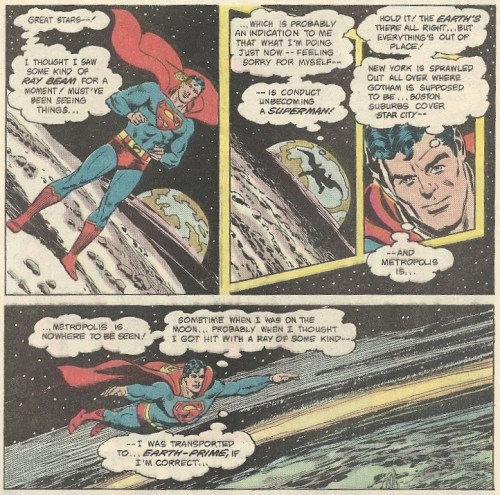
This of course dredges up the whole “Just what the hell does a map of the DC United States look like?” conundrum. I always pictured Metropolis as being somewhere in the midwest, not far from Smallville maybe, and Gotham as being in a cold northern state, maybe a Chicago proxy. But if on Earth-Prime, “our” Earth, New York is where Gotham is supposed to be, where is New York on Earth-1? And aren’t Gotham and Metropolis both New York stand-ins? BAFFLING. And if Earth-Prime is the real Earth, does that mean that the things in these comics actually happened? I’M SEVEN YEARS OLD AND SO CONFUSED ALL OVER AGAIN.
Back to the pathos. Pathos doesn’t make your head hurt.
Superman immediately reflects on how Earth-Prime is a world without superpowers, so no one is more surprised than he is to find that there’s a kid flying around in a damn Superman costume — well, actually the kid might be more surprised to find out that Superman is real:

Clark Kent of Earth-Prime, having dressed up as Superboy for a costume party (more on his name in a moment), has had till-then latent powers activated by the passing Halley’s Comet (which I looked at with my telescope as a kid — another reason to feel nostalgic kinship with this book). The two exchange pleasantries, Superboy offers his condolences for Supergirl’s death (a tender sequence), and Superman takes his leave to try to return to his reality. Despite that apparent departure, the two soon team to stop a tidal wave that threatens that beach part that Superboy-Prime had just flown away from. It’s after that that these two versions of the same man share a moment in space, with the aforementioned Halley’s Comet as a prop:
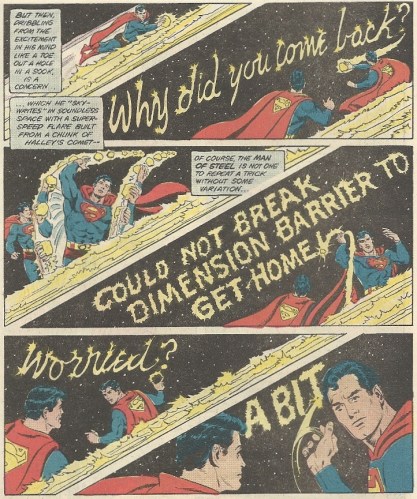
Why couldn’t we get something like this in a Superman movie? This is such a gloriously cinematic sequence, with both characters overcoming the communication difficulties of a vacuum in a most Supermanish of ways. It’s refreshingly quiet, with Maggin knowing when to back off the narration and let the words in Swan’s art do the talking. I’m probably overstating the potency of these few panels, but to me it’s one of my favorite Superman moments, with our hero in a strange world, besieged by problems, and commiserating with a fresh-faced version of himself. Love their different writing styles, too. Magnifique.
The story wraps with both Superguys repelling an alien invasion and Superboy-Prime accompanying his elder self back to Earth-1, where they’re promptly separated in a to-be-continued cliffhanger (it was the Crisis after all). But then the comic makes an odd shift, as it cycles back around to give the reader Superboy-Prime’s origin. It’s pretty similar to the one that we’re all familiar with, as the Els send their baby boy away from a dying planet, but in this reality via teleportation, not a spaceship:
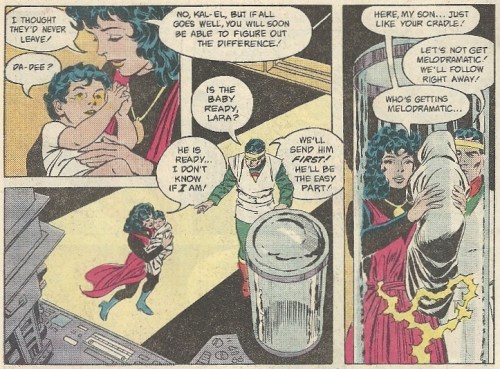
Of course, he ends up with a Kent family (not Jonathan and Martha, though), and they go through the usual — but awkward in this reality — calisthenics to name him Clark:

I knew a guy once called Bruce Bruce. He would have killed to have been named Clark Kent, for whatever that’s worth.
Of course, this version of Clark grows up a clutz, teased for his name as he skins his knees, fails at sports, and wonders why his parents blighted him so. Until that magic night of the costume party alongside his Lori-Lemaris-costumed girlfriend (Laurie), when he reaches for the stars and has his dream come true:
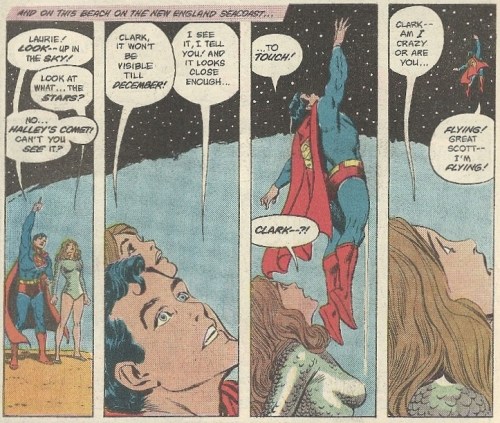
And then he runs into Superman and the story’s circle is complete.
This comic is a sterling example of all that the pre-Crisis DC universe could be, as the wide-eyed remnants of the Silver Age were molded into more mature, more refined stories. Maggin and Swan used their deft touches to so beautifully blend the two sides of the same coin, one weighed down by sadness, the other born into a new world, and forged a comic that stood out from its sillier crossover contemporaries. Comics like this make me ache for the old Earth-1 Superman, the Kal-El of my youth, and are the way I choose to remember his last days before the John Byrne reinvention (as opposed to his last embarassing appearance in his eponymous book).
Superboy-Prime, now Superman-Prime (must have missed my invitation to his Bar Mitzvah) was an uber-villain after his re-intro, flitting from scheme to scheme (Sinestro Corps, Time Trapper, etc.) in his nutjob quest to salve his shattered psyche (not to mention the somewhat dopey return to the fourth-wall stories that defined his Earth-Prime origins, which also had returns of Laurie and his parents). I followed his reign of terror at a distance, somewhat saddened at what he became, as if he were some sort of black sheep in my family. My love for his origin comic had instilled in turn some stupid love for the kid, and a hope that he’d be able to turn it around, even though he’d decapitated people and killed the Earth-2 Superman. It takes one hell of a comic book to pull off denial like that.
If you want to get to an important meeting on time, do not, repeat, DO NOT rely on your Bonkers watch

Yes, Bonkers!, the candy brand most known for a marketing campaign which featured deranged people crushed by giant fruit, peddled a watch. A transforming robot watch. Two questions: 1) Would you rely more on a Bonkers watch more than a Grit raft? 2) Would you find a Bonkers watch more or less useless than a Rube Goldberg sundial watch? Talk about your rocks and hard places.
Hostess baseball cards and the horrid idiosyncrasies of collecting all kinds of crap

I have an uncle who’s an avid baseball card collector. He was one of those lucky baby boomers who had a shoebox full of baseball cards as a kid, didn’t destroy them in bicycle spokes, and had a mother who didn’t chuck them out with the garbage when he moved out of the house. So, later in life when he got back into the hobby, he had a base that would be the envy of anyone with interest in trading cards. I have a lot of fond memories of going to card shows with him as a kid and also getting to go into his inner sanctum, a cubbyhole of a room where he kept the core of his collection. It was a paradise in many respects, with untold cardboard treasures — you half expected to have to utter an “Open Sesame” password to get the through the door. The funniest thing about it was that it was so chock full of loot, the kitchen ceiling, which was right beneath it, had started to sag. We’re talking SAG.
All this is a long way to getting to the point of this post. Every hobby has its little quirks, its little foibles and quibbles about condition that seem batshit insane to anyone on the outside looking in. In comics, I always come back to what you’re supposed to do with those old polybagged comics from the 1990s, the ones that held (coincidentally) trading cards, posters, and all that extraneous hazarai. At first blush, you’d probably think that, to preserve “Mint” condition, you’d have to keep the bag sealed. WRONG. Because polybags are volatile for long-term storage, you’re supposed to take the contents out of the bag and store them in a more archival kind of bag and board. Okay, logical enough. The kicker, though, is that you’re supposed to keep the bag too. Yes, I’ve taken comics out of their bags, put them in a new bag, and then taken the old bag and put it in the new bag.
This is a little bit nuts, I admit. But it has nothing on my dear old uncle.
The ad above got me to thinking: My uncle was happy to get any baseball cards under the sun, but he was (understandably) a stickler for not doing anything that would damage his trove. These Hostess cards (and Drake’s cupcakes cards when I was a kid collecting alongside him) were rough because, if you wanted to keep them in strictly “Mint” condition, you couldn’t cut them out from their spot on the bottom of the box. You had to keep the whole box. And if you took that a little further, you had to not even open the box.
Yes, my uncle took it that little bit further.
In that wonderfully cramped upstairs room, the one whose contents had warped the very structure of the house and threatened to come crashing down into the kitchen at any moment, there were unopened cupcake boxes, Twinkie boxes, what have you. Not a ton of them, but they were there. I shudder to think what biologic reactions are going on in the sealed plastic containers as I write this.
So when I’m taking a bag and putting it in a bag, all I have to do is think about my uncle’s 30-year-old cupcakes and I don’t feel so dumb. And if anyone is ever looking for proof of the old legend that Twinkies (which, as I’ve said before, are god-awful poison) last forever, they could perhaps turn to my uncle for empirical evidence. That is, if he’d let them open the box.
Edgar Allan Poe, Roger Corman, Vincent Price and Bono’s sunglasses – Tomb of Ligeia

When you combine Roger Corman with Vincent Price, you have the potential for some potently overcooked celluloid shenanigans. And a comic book based on them? Be still my heart!
Don’t get me wrong, Price is a screen legend, a man whose name remains synonymous with cinematic horror decades after his death. But he was a ham. Subtlety was never his forte, and every time you saw Price on screen, you were seeing more of Price up there than any character he might have been playing. Put it this way: shilling for dried apple heads was a lateral move. And Corman? The unquestioned master of the B-movie? The man who could churn out a movie in a week — not a good movie, mind you, but a movie nonetheless? The movie-maker under whose wing any number of directors and actors — from Scorsese to Nicholson to Cameron — got their start? The one who fed a steady diet of garbage to the Mystery Science Theater 3000 mockers? The one that produced the low-budget Fantastic Four movie that was never supposed to be released but that everyone has seen? Yeah, that Corman. Put them together and you’ve got, well, you’ve got something.
Theirs was actually a somewhat memorable collaboration, as they teamed to adapt a sizable chunk of Edgar Allan Poe’s gothic oeuvre for the silver screen. It was work that could easily be regarded as some of the best of their respective careers, due in large part to the Poe source material. There’s a reason that generation of generation of people latch onto Poe as the lord of things that go bump in the night — or thump under the floorboards, as it were. Corman and Price made seven Poe films together, most notably adaptations of classic works like The Raven and The Pit and the Pendulum. Some of the adaptations were of works less known to the average reader and/or moviegoer. Like this. Behold, Tomb of Ligeia.
The 1964 film cast Price as Verden Fell, a morose widower, one compelled by a sensitivity to light to wear Bono sunglasses (before Bono was wearing sunglasses) and dogged by memories of his dead wife Ligeia (a witchy sort of woman), who delved into the black arts by declaring her immortality and other ungodly things. Fell (improbably) marries a fetching young lass, but the two are tormented by the presence of the former missus, whether in dreams or actual haunted house bologna. Ligeia isn’t the worst movie in the world, and it’s not the best. It’s probably on the plus side of Corman’s ledger, though.
The film, naturally, took a number of liberties with Poe’s original story, putting it more in line with the tropes of mid-1960s cinematic horror, with all the thrills and chills that now seem so tame to our torture-porn sated eyes. And the comic book that’s the meat of this post is an adaptation of that adaptation, which means it, like a photocopy of a photocopy, is only a blurry reproduction of the original. It starts in a hole, and it never manages to dig itself out. It’s not good. It’s dull to read, which is a shame, because that wastes art from John Tartaglione (pencils) and Vince Colletta (inks) that’s actually quite decent judging by the standard of many other comics of this era. It’s smooth, flowing qualities only get to come to the fore when the script takes a break, like in this dream sequence (denoted by the frilly panel edges):

But there’s that pesky script. It’s excessively wordy, numbingly so, and it rarely shuts up. And then there’s the “exciting” conclusion, when the whole thing just spins wildly out of control and you need a flow chart to figure out just what the hell is going on. I reproduce two consecutive pages here in their entirety just to display the confusion — trust me, they don’t make any more sense if you’ve read the rest of the book:


WHAT IN THE NAME OF POE IS GOING ON HERE?
Oh, and the babe, the one that was dead and then not dead and then dead? She’s not dead:

Nothing more, nevermore. Tomato, tomahto, end your Poe as you will.
Perhaps this just works better on the silver screen. Perhaps it doesn’t. All I deal with here is comics, and all I know is that Tomb of Ligeia isn’t good one. Justice or no, I BLAME CORMAN.
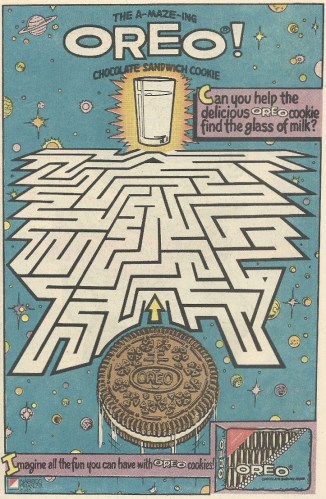
I can’t tell you how many times I’ve opened up a comic from the mid-1990s and seen this maze filled with squiggly, indelible pen marks, all in the name of getting an Orea cookie to a glass of milk. Awful. I HOPE YOU’RE HAPPY, NABISCO. At least Fig Newtons had the common decency to not invite defacement.
(By the way, Oreos are quite possibly the most delicious confection ever concocted by the mind of man, and I’ve downed many a package in one sitting in my less discriminating days. Bottom line: Oreos good, mazes bad.)
 Jared
Jared


 blog into mystery