Should you want to gird against the outdated threat of communism, these stilted Cold War PSAs have some useless tips for you
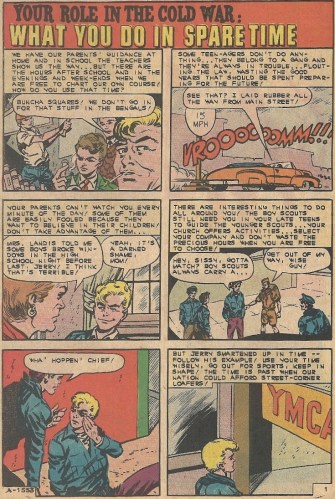
This pair of odd public service announcements (both illustrated by Rocco “Rocke” Mastroserio) were found in the Konga issue I discussed here over the weekend. What with the giant ape wrecking jet fighters and destroying missile bases, sending communists and their hammers and sickles scurrying, they both felt like overkill. But this was the early 1960s, when the Cuban Missile Crisis threatened to turn the globe into a charred cinder, so if there was ever a time to be paranoid, I guess this was it.
And yet…
Were poor study habits, leather jackets, fast cars, sassy smiles and getting beat up by Boy Scouts (?) really threats to the republic? The YMCA was our first line of defense? If so, let’s thank God that there were rugged young men around to berate their fat and skinny peers, as in the little brow-beating sequence below:
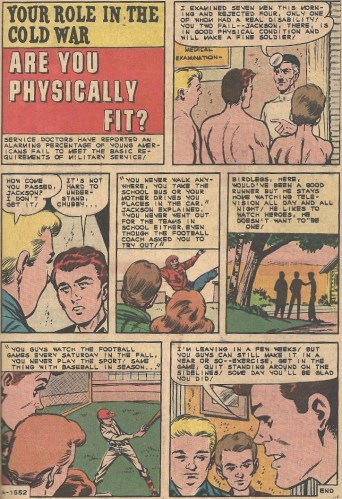
“See, now my sinewy biceps, broad shoulders and I can all die in a random Vietnam rice paddy. SO LONG, SUCKERS.”
Anyway. U S A! and all that.
(“Birdlegs” looks like a dude I once saw in an old health brochure delineating the devastating effects of masturbation. For whatever that’s worth.)
What do pimples fear most? SCIENCE, THAT’S WHAT.

It makes one feel good to know that the adolescent scourge of acne is being fought constantly by the finest scientific minds around. Men with microscopes and such. Also, judging by the diagrams buried in that avalanche of copy, pimply skin looks like the mirror image of Florida.
In honor of the Red Dawn remake, here’s Steve Ditko bashing commies with a King Kong ripoff – Konga #9

Steve Ditko’s Charlton work was nothing if not interesting. He helped forge (and rework, in some cases) a line of heroes that would years later both inspire the Watchmen pantheon and be incorporated into the sprawling DC universe. The Blue Beetle, Captain Atom et al. are still venerated for what they were: off-beat alternatives to the big two’s offerings. This was when Ditko was at the peak of his powers, coming off the unfathomably iconic Spider-Man work at Marvel, and even the oddball material he handled was invested with a tremendous energy. It was often tremendously odd energy, but energy nonetheless.
He had another, prior run at Charlton before that, though (indeed, he bopped in and out with that publisher until it closed its doors). A few months ago I talked about an issue of Gorgo, one of a number in that series to which he provided art. The Gorgo comic was a continuation/re-imagining of the Gorgo film, which was itself a blatant British Isles ripoff of the venerable Godzilla franchise. Ditko and that particular comic’s writer, Joe Gill, redid the Gorgo introduction from the film, and added a layer of anti-communist paranoia to leaven the dough. It was a silly story, but it was a pleasant surprise to see such an absurd subject combined with the great bogeyman of Ditko’s Objectivist philosophy.
That’s not the end of the low-grade Red-baiting, though. Oh no. ENTER KONGA.
Konga, like Gorgo, was a 1960s film that stole liberally from another successful property, in this case King Kong — as if you couldn’t guess be the name (hey, let’s add an “a”) and the giant primate you see above. It’s a terrible film, one that’s rightly been consigned to history’s celluloid dustbin, though it featured snappy dialogue like this: “Fantastic! There’s a huge monster gorilla that’s constantly growing to outlandish proportions loose in the streets!” (Seriously. It’s in the trailer.) Hard to believe prose like that wouldn’t play onscreen. (In a bit of trivia, the film starred Michael Gough, Tim Burton’s Alfred, who also starred in The Sword and the Rose, which itself had a comic adaptation reviewed here recently. I offer this up in case you ever find yourself playing the world’s most boring game of Six Degrees of Kevin Bacon.)
What makes the comic we’ll examine here so priceless is the overt anti-communist propaganda within. Ditko and the anonymous scripter (possibly Gill again?) managed to throw together a diatribe against the Comintern — one that celebrates the triumph of the individual over the soul-crushing collectivist state — and masquerade it as a giant gorilla story. It’s a hell of a feat, to say the least.
Let’s have a look.
The man standing alone against international communism is Stanlut Kazhov, an animal trainer with an ability to communicate with beasts. He has a stage act in the Soviet Union that, how shall we say, is not a roaring success, and his Stupid Pet Tricks routine runs afoul of a local entertainment commissar:

In defense of the heckling audience member, I too would want the dancing girls.
Kazhov is packed off to Siberia. (No word on what happens to the dog. Maybe it gets sent off to Doggie Siberia. Or gets shot in the head.) This sounds like a bad thing, but he’s actually on a collision course with wackiness, because Konga has grown tired of bathing in the ocean, and has decided to wander overland for a little while. He comes across the labor camp in which Kazhov is interned, and the guards (understandably) attack him, which sends the (quite affable-looking, actually) Konga on a camp-razing rampage. Kazhov, however, has no fear:

It turns out Kazhov really does have a heck of an ability. He understands Konga (though Konga never so much as grunts, so it’s unclear what exactly he’s understanding), and Konga understands him (though all Kazhov does is speak English — I COULD DO THAT). Konga silently recounts his tale of woe origin (in the film he was a monkey given a growth serum), and this gives Ditko a chance to deploy his trademark “splashing water” imagery:

Kazhov rides around in Konga’s shoulder, like Master and Blaster in Mad Max: Beyond Thunderdome, and the two of them generally have a grand old time. The Soviets respond immediately to this giant threat in their midst, dispatching Migs to try to take him down — planes attacking a giant gorilla, where have we seen that before? They fail miserably, and this is when the commie caricatures really take off. Introducing the fat, jowly, cigar-chomping Politburo member with a menacing black bowler hat:

Thanks to some good old-fashioned commie elbow grease, the Reds are able to track Kazhov and Konga, and when Konga goes for a swim, they’re able to swoop in and kidnap the erstwhile vaudevillian. They spirit him away to be held at a missile base, one with some delightfully inventive Americanized Cyrillic Orwellian phraseology:

Oh, Ditko. You scamp.
Of course Konga comes after his new friend, and the destruction promised by the cover follows. Kazhov is freed, and he decides to take this opportunity to rid the world of at least the missiles present at this facility:

An observation: THROWING NUCLEAR MISSILES LIKE DARTS IN A BAR AND PUNCHING THEM MIGHT NOT BE THE BEST WAY TO ENSURE WORLD PEACE.
Their work done, Kazhov and Konga find themselves a nice little island paradise, where they’ll live happily ever after. At least until the next issue, or more commies need comeuppance.
This comic is an interesting product of its time, released as it was between the soul-crushing communism-related American crises of McCarthyism and Vietnam. You could still in 1962 portray Reds as comical (literally, in this case) paper figures, an omnipresent threat worthy of being a foe in a comic, and the (justified or not) cynicism of the coming years was still in the offing. This was a perfect moment for a hulking gorilla to go on a rampage through a Soviet missile base — if there ever was such a moment. Ditko’s art, which is all straight lines and curves (all art is when you think about it, but it’s never so wonderfully noticeable as it is with Ditko) is as magnificent as ever. It’s somewhat stunning that he was crafting this comic right around the same time he was sitting in his studio creating the visual vocabulary that would define a certain web-slinger. It speaks to Ditko’s capacity for invention, and for embracing all facets of the strange. And I’m not sure how far his political consciousness had progressed at this point, but you can see the joy in the communist caricatures, almost to the point that you expect Boris Badenov to wander through a panel.
Or maybe this is just a story about a giant King Kong ripoff that pounds on communists. Whatever.
Until next time.
(Should you desire more Ditko/Konga fodder, there’s an actual honest-to-God Konga trade out there called The Lonely One, which reprints some of the Charlton series. It’s a bit light on the commie-bashing, though.)

There’s an impression, true or not, that kids today don’t have toys of the quality their forefathers enjoyed. Things crafted of substances known as “metal,” instead of molded plastic — you know the drill. I think my generation was the bridge between those two eras, as I remember my metal Dukes of Hazard lunchbox quite fondly (oh how the warm smiles of Daisy, Bo and Luke looked up at me as I prepared to dine…), and how the first metallic Transformers became plastic as the product line grew. The latter was to my chagrin, I assure you.
Let this late 1960s ad, with its leatherette sporting goods, serve as evidence that the good old days weren’t all that halcyon. A minority report, if you will, and something to keep in mind on the living nightmare that is Black Friday. Leatherette, pleather’s inbred country cousin.
(Those were also the days where kids could have thinly padded boxing gloves and hammer each other in the head to their hearts’ content. For whatever that’s worth. And incidentally, what happens when you need to compute into the hundreds of millions?)
Captain Shazam, the hero that (mercifully?) wasn’t
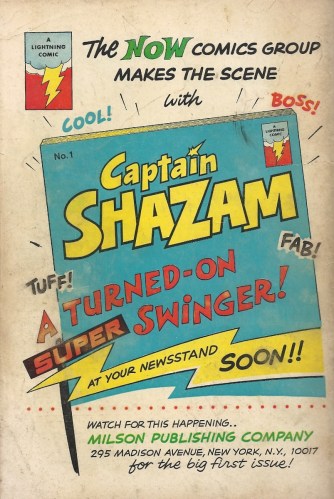
This comes from the back of the Fatman the Human Flying Saucer comic discussed here several days ago. “Captain Shazam” never saw the light of day, as Lightning Comics folded before it could ever reach the newsstands, and this cringe-inducing promo was his epitaph. It remains unclear how far out of the amorphous planning stages the character got before the plug was pulled. Was he going to be a complete rip-off of the copyrighted out of existence Captain Marvel? As a “turned-on super swinger,” would he feature a lot of popped collars, finger-snapping and whistling at the ladies? Was C.C. Beck even involved? The world may never know.
Judging by Fatman, perhaps that’s for the better.
Perhaps as recompense for Infantino’s run on his title, Nova gets to suck face with Namorita. EVEN-STEVEN. – The New Warriors #39
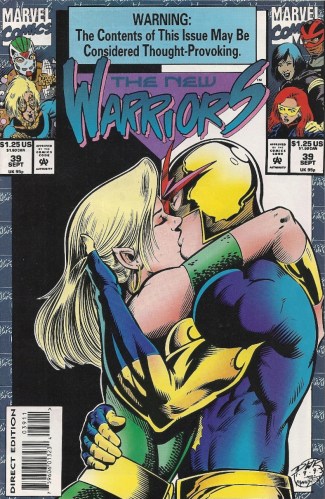
I’ve catalogued my love for Carmine Infantino’s artwork on a number of occasions, so I won’t belabor that amour again. I think his stuff is the cat’s meow, and let’s leave it at that. But a while ago I wrote about his run on Nova, during his brief 1970s sojourn over at Marvel, and how he hopped onto that title and rode it straight to hell. Not that I was against what he did artistically on the book, but a friend of mine had mentioned how much he loathed that tenure, and how Carmine had (theoretically) ruined what had been one of his favorite books.
Judging by some of the comments that the post generated, my friend wasn’t alone. And you don’t have to be a journalist to know that multiple sources can be read as a little thing known as “confirmation.” So Infantino torpedoed poor Richard Rider’s title. CASE CLOSED. I can live with that.
Yet Nova lived on.
Nova has never been in the upper echelon of Marvel characters, but he’s had a number of post-Infantino revivals over the years, and the most successful and enduring of those resurrections came in The New Warriors. A part of the comic book boom in the first half on the 1990s, which ran from the start of that decade to the industry nadir of 1996, Warriors featured a ragtag assemblage of Marvel heroes and heroines. They were a conglomeration of the company’s new blood, toiling in the shadows of their Avenger elders, and had the “us against the world” attitude present in every up and coming generation. It should be noted that “New” here is a relative term. The heroes were young, but Nova had been around for over a decade at this point, so it was more a youth thing than a novelty thing. I guess “The Young Characters That Have Been Around For Awhile Warriors” was a tad clunky.
Name aside, Nova was a key component of the team, and his cosmic abilities made him one of the powerhouses of the group, alongside such B-roll characters as Speedball, Night-Thrasher, and Namorita. Being young heroes, there was plenty of time in the series for angst and other hormonally-driven storytelling devices, and in this issue, as the cover so clearly attests (whose guns look better while kissing, Nova or Batman?), Nova got to make out with Namorita. THE WHOLE INFANTINO THING IS FORGOTTEN, at least from Nova’s perspective. Water under the bridge.
I was never much of a New Warriors fan, so I can’t really converse intelligently about the character development that occurs within (Script: Fabian Nicieza, Art: Darick Robertson, Larry Mahlstedt). The cover promises thought-provoking contents, but I don’t know that I read any of that. My brain wasn’t exactly set ablaze with philosophical conundrums, if you catch my drift. The kiss — no, the cover isn’t just a tease — is the only thing of note that happens here, and let’s be honest, a kiss between two lower-level characters isn’t exactly a “remember where you are so you remember where you were” moment.
Yet there it is.
There’s a lot of moping about here (those hormones…), with everybody sad and torn up about issues in their lives, like they’re in an IFC movie or something. Take Namorita, who’s down about tons of stuff, but still takes a few minutes to do her “jutting and thrusting amongst the clouds” exercises:

You know what? You have superpowers and you’re flying with the birds. Lighten up. (Also, it *ahem* might be getting cold up there.)
Nova is all upset about injuries his brother suffered while Nova was doing his hero thing, and is wandering through the group’s HQ while wearing THE DOUCHIEST ENSEMBLE THAT A MAN CAN EVER WEAR:

Let’s tick off this sartorial splendor. Briefs. Socks. Backwards facing ballcap, with hair thrusting defiantly out the front/back. Stubble. This is truly a bro grand slam. He looks like someone getting arrested for domestic violence on COPS. And Lord knows, the world was clamoring to get up close and personal with Nova’s batch.
If you’re making Marky Mark connections based on this look, you aren’t the only one:

There’s some yammering between the Nova and Namorita, AND THEN HERE COMES THE KISS:

The taste lingers, apparently, as Namorita leaves the team. Or something. All I know is SHAVE AND GET A HAIRCUT YOU HIPPIE.
That’s it.
A Namorita aside: She’s nice and all. She’s a super-powered babe with a tight little body whose dress code is “scantily clad.” The little wings on the ankles are a bit odd, but the pointy ears might activate some latent elf fantasies. I have to think, though, that a major impediment to any relationship with her has to be her uncle. I know he’s not her father, but Namor would make DeNiro’s Meet the Parents schtick seem tame. “What are your intentions towards my niece IMPERIUS REX!” Drop her off after curfew and run the risk of war being declared on the surface world. That sort of thing. Things to keep in mind if you’re Nova here.
There you go. Nova’s make-good for that whole Infantino business. We were finally able to move forward as a society after this.
The X-Men won’t tell you how to cook a Thanksgiving turkey, but they will hawk Pizza Hut pizza
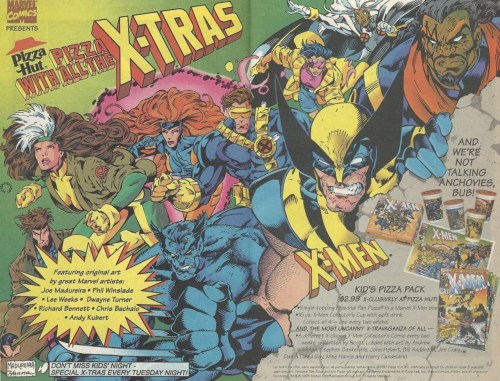
If you turn your turkey into a charred cinder Thursday, just follow the X-Men’s lead and order some light fare from Pizza Hut (with all the X-Tras). Maybe serve it with other X-Men-approved products like Hi-C and Spaghettios, and give your guests a case of heartburn they’ll remember fondly for years to come. Reflux for everyone!
I’m sure the “And we’re not talking anchovies, bub!” made Wolverine die a little bit inside.
NOW IS THE TIME ON SPROCKETS WHEN WE DO ISOMETRICS!

Usually comic book advertisements promoting physical fitness programs go with shaved, oiled-up bodybuilders as their mascots. Here? Either this guy is working out with isometrics, or, judging by the black attire, he’s doing German expressionist techno dance or something. Maybe auditioning for the Actor’s Studio. Take your pick.
Six seconds a day may be a new land speed record for achieving physical fitness. And with no effort at all! Or motion! What a miracle! Where do I sign up?! This couldn’t possibly be a scam!
The middle chapter of C.C. Beck’s and Otto Binder’s last (goofy) comic book gasp – Fatman the Human Flying Saucer #2
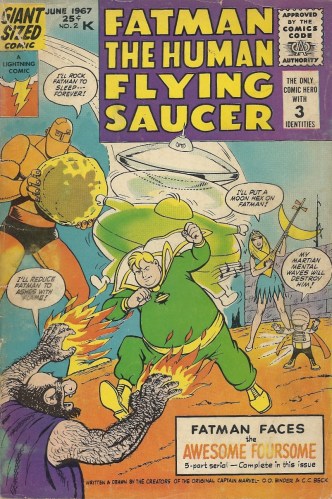
C. C. Beck had a great thing going back in the Golden Age of comics. He was a part of the Captain Marvel character from the very beginning, and established the iconic look of Billy Batson’s beady-eyed, toothy, Shazam-fueled adult alter-ego. Marvel’s stratospheric success, with sustained time at the top of best-seller lists, led to the expansion of his line, and Beck’s instantly recognizable style carried over into the other members of the good Captain’s extended family. Captain Marvel, Jr. Mary Marvel. Hoppy the Marvel Bunny. The Fawcett universe just kept getting bigger and bigger, and Beck had his own little artistic empire, overseeing the members of his studio that supplied art for the books. He could while away his leisure hours illustrating Captain Tootsie ads — why not?
And then the DC Comics lawsuit brought it all crashing down. Marvel was just too similar to Superman, and instead of fighting to the bitter end, Fawcett simply closed up shop. Beck was bereft of the property he had poured his talents into, which had to sting. He left comics, and lent his talents to other non-storytelling fields.
Then, in the latter half of the 1960s, he made his staple-bound newsprint return, at an upstart company with the appropriately defiant sobriquet of “Lightning Comics.” (With Beck’s involvement, it might as well have been called “Up Yours Detective/DC/National Whatever You Call Yourselves Comics.”) And what character did he and Otto Binder, a frequent scripter on the old Marvel books, create to spearhead the line, to be the bottle of champagne christening it as it left port?
Fatman. Fatman the Human Flying Saucer. Well.
Fatman is the stuff of legend, and not really in the good way. He’s right at the apex of any all-time comic book WTF? top ten, though in defense of other denizens of that bizarre litany (oddities like Time Beavers), they usually weren’t intended for ongoing series. Fatman was. Beck and Binder thought the world thirsted for Fatman. That readers would come back again and again, proudly plunking down their pocket change on the newsstand counter, silently declaring “Yes I read Fatman, and I am damn proud of it, good sir.” BAD IDEA.
Fatman was, as advertised on the cover above, three characters in one, though I’d quibble that the two superhero portions were part of the same dopey package. Van Crawford was the chunky, dilettante son of a wealthy businessman, and he devoted his free time to his numerous hobbies — if he didn’t live an a mansion, he surely would have made a good candidate for the next millennium’s Hoarders. Here he is going through some of his vast holdings, including, yes, comic books (I admit, I do admire his order):
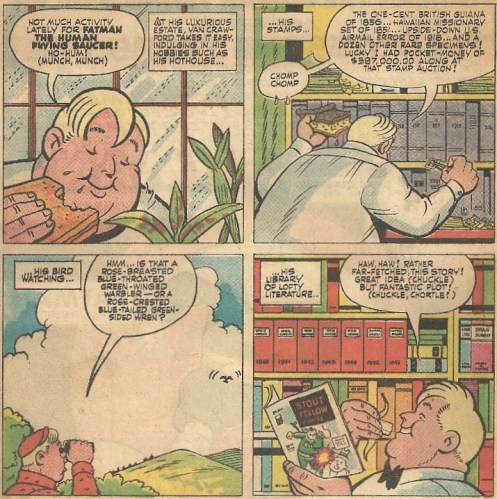
Note the “Stoutfellow” comic book. He’s Crawford’s idol, and the model for his own green costume — which, with its gold-fringed cape, is itself an homage to Captain Marvel, just as Crawford’s blond hair and wide circumference are like Marvel’s negative image viewed in a funhouse mirror.
As for Fatman himself (Crawford got his powers from an alien who himself would shapeshift into a UFO), here he is in his double transformation:

Yes, that’s it. That’s his big power. He turns into a flying saucer with big cartoony eyes on top. Is this strange? YES IT IS. Is this a great power to have? I guess it’s better than nothing. And he could shout out laser beams whilst saucering about, so that’s nice.
It’s not much help against the many foes that he comes up against, though. In this issue he battles a ragtag assemblage, including an egg-headed alien called Brainman, who has potent mental powers and prefigures the Talosians in the first Star Trek pilot, “The Cage” — and maybe a little Leader too:
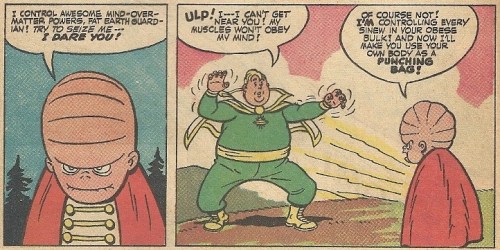
Those are either telepathic lines emanating from him or they’re stink lines. Maybe Brainman needs to launder his cape.
Fatman isn’t alone in his quest for justice. There are allies at hand, though they too are subject to Brainman’s mind-powers. Take Lucius Spindle, who utters a Sanskrit charm to become Tinman (Sanskrit? Tinman? WHAT THE HELL IS GOING ON HERE?):

I question whether that’s actual Sanskrit up there, as I’m not sure that there’s a heart symbol in that alphabet. And was Beck tempting fate, gambling that the Oz people wouldn’t sick their lawyers on him?
Just as Fatman doesn’t fight alone, Brainman isn’t the only villain in this issue, as earlier stated. There’s also the blonde, leggy Lunita, the Moon Witch, who can make obese men dance with the hypnotic strumming of her guitar:

Okay then.
Up to now, the story in this comic book has just been awful. Not offensive. Just silly and bad. THINGS ARE ABOUT TO CHANGE:
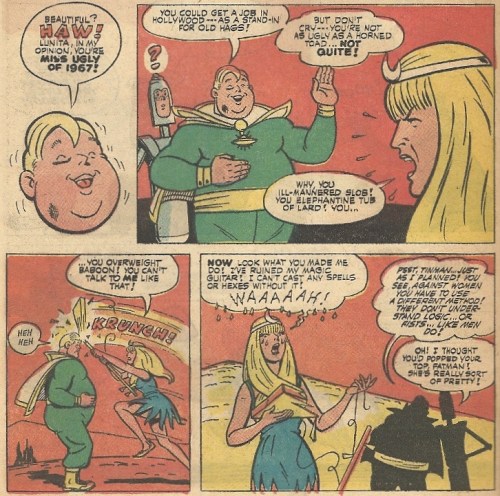
So Fatman is a sexist! Get in line ladies — what a catch!
I’m done. Tapping out.
There are 49 pages of story in this comic (68 in total), and let me tell you, you feel every single one of them. The humor is leaden, the plot is repetitive and childish, and it’s in general a total chore to read. Beck’s art is still at the level that made him a standard name in the industry, with clean figures and a keen sense for structure, but like everything else here it’s an anachronism. The whole endeavor is out of its element. “Flying Saucers” belong more to the 1950s than the next decade. The art is distilled Golden Age. The narrative is aimed at children as was the tomfoolery of the ’40s and ’50s, but I find it hard to believe that kids would ever go nuts for any of Van Crawford’s identities. It’s as if Beck and Binder were hibernating since the Fawcett line was discontinued and crawled out of their cave and started up right where they left off, paying no heed to the way the landscape had shifted in the interim. When you think of the things that Marvel Comics was churning out at this time, and had been for a number of years, it boggles the mind that they thought this was just the sort of superhero to capture the public’s imagination, whether he was satire or straight-faced or whatever.
And he didn’t catch fire. Fatman only had one more issue to fight evil in his own unique way, and then he was done. And so was the company, as Lightning Comics, which published one other title (Super Green Beret), met its doom. Beck would return to comics once more, providing art for the first ten issues of DC’s Shazam! Captain Marvel relaunch (which must have been a bittersweet reunion), but this was his last creative hurrah. Binder, whose last years were marked by family tragedy (the death of his daughter), was largely done with the mainstream comic book field after Lightning folded. SO BASICALLY FATMAN RUINED EVERYTHING FOR EVERYONE IS WHAT I’M TRYING TO SAY.
If Fatman still has any relevance, it’s in the collectibility of the comics. Low print runs, no one caring and Beck’s art have all combined to make them relatively rare curiosities with modest value, even in rough shape (as is the case with the copy used to forge this post). Huzzah.
Fatman still sucks.
Be the Confederacy at your own peril

Has modern sensitivity reached the stage where it would be grounds for extensive psychological counseling for a kid to play with miniature Confederate soldiers? Incorporating the Stars and Bars into a modern state flag is one thing, but how else is a young boy to recreate bloody epics like the battle of Antietam without his Rebel box of men?
I guess it’s okay since reenactments are okay. And so long as the Rebs aren’t winning every time.
Really, who wouldn’t want a life-size Man from U.N.C.L.E. Illya pin-up?
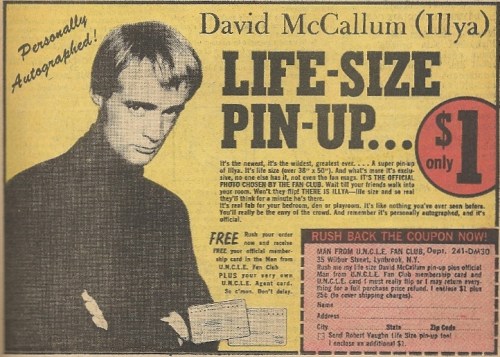
Now come on, were these really personally autographed? I guess maybe the demand for Man from U.N.C.L.E. Illya pin-ups — LIFE-SIZE pin-ups — wasn’t all that overwhelming. Or else David McCallum had very strong hands and wrists.
Not being a child of the U.N.C.L.E. generation, I have a very hard time picturing Ducky from NCIS being a pin-up-worthy sex symbol, yet here he is in all his pouty glory. So goes the relentless march of time.
Here’s the real puzzler: Which poster would you prefer, the Illya or the Vincent? A tough choice, I know.
He’s fat. He’s bald. He’s rich. He’s a sociopath. – Lex Luthor: The Unauthorized Biography
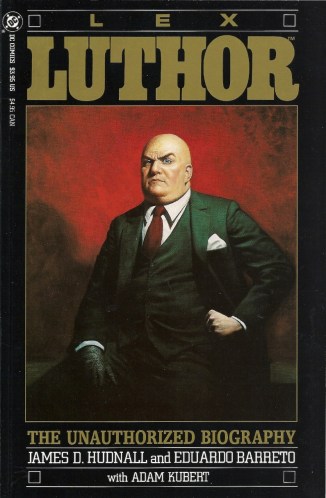
Lex is looking a bit like King Kong Bundy in that portrait. I pity the painter when he shows it to his subject.
The post-Crisis reinvention of Lex Luthor was one of the more drastic alterations in the new Earth order. Under the John Byrne-helmed relaunch of Superman, the evil genius of old exchanged his jumpsuits and war suits (oh, how I loved that old war suit) for boardroom power suits — the finely tailored attire of upper corporate echelons. The labs and beakers were out the window, as were the team-ups with the Joker to carry out ludicrous schemes, and this new Luthor — still bald, still driven to dominate — left the science to employees. He morphed into a fabulously wealthy string-puller, a type all-too familiar in the Gordon Geckko 1980s which spawned him.
The old Luthor, with his reliance on space age wonders, was a product of his time. So was this one.
The new Luthor arrived on the scene fully formed, introduced in the Man of Steel mini-series that offered up the fresh origin of his arch-foe. We understood immediately why he hated Superman — he was the one man who could outshine him and who couldn’t be bought — but where this new Lex got his start was still a mystery. If he didn’t lose his hair in a tragic Smallville accident, was it just plain old male-pattern baldness that savaged his ginger locks? What other dark secrets did he hold under those new fat layers?
Lex Luthor: The Unauthorized Biography sought to answer some of those questions, and delve into how Luthor built the business empire that made him the most dangerous member of Superman’s rogues gallery. Despite the title, it wasn’t actually structured like a biography (though the cover stole a typeface and design from Donald Trump’s autobiography, The Art of the Deal). Set several years after the character’s renovation (as indicated by the Luke Skywalker glove over Lex’s prosthetic hand — NEVER WEAR A CANCER-CAUSING KRYPTONITE RING, KIDS), the story is told mostly in flashback, with a framing story that has Clark Kent accused of murder:

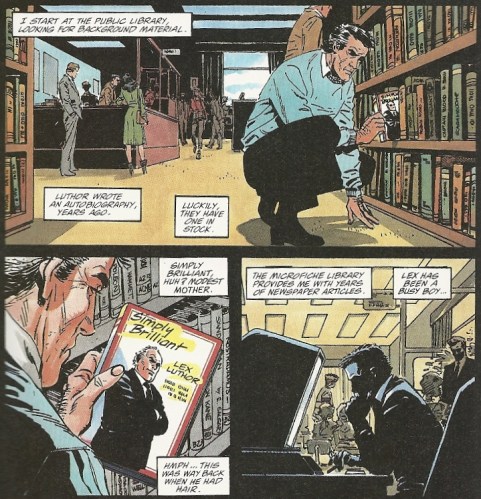
The Peter Sands that apparently wrote out Clark’s name as his dying act was a down on his luck writer (which puts him in the company of roughly 98% of that profession), and was living in a rathole apartment with bills pounding him left and right. He got his deliverance (which turned out to be his death warrant) when a publisher called, asked if he was working on anything, and he randomly plucked a Lex Luthor bio out of the ether because that tycoon was in the newspaper headlines that day. Now he just had to write the damn thing. This being 1989, he couldn’t use a laptop to do all his research, so he slapped on a Mr. Rogers sweater, rolled down to the public library and *gasp* went through stacks of books and microfiche — remember microfiche?:
Self-serving autobiographies and old newspaper articles only go so far, so he had to go out and track down people from Lex’s past, most of whom weren’t all that willing to talk. There was the insurance salesman that sold Lex’s father a lucrative life insurance policy, despite the Luthors living in the downtrodden Suicide Slum. There was the mechanic that certified that it was just an accident days later when Luthor’s parents were killed in a car accident. And there’s one of Luthor’s teachers, who had her own sepia-toned memories of young Lex:
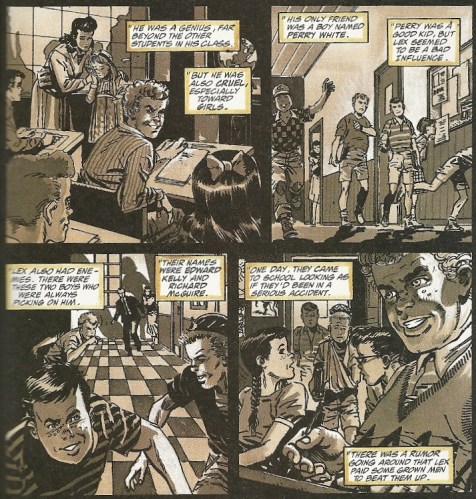
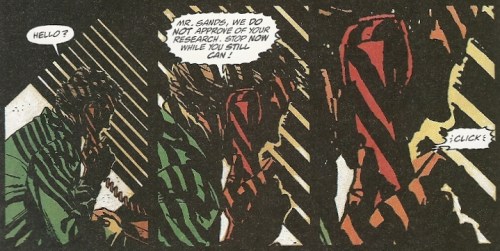
Sands kept digging, and the picture got darker and darker. Then people started dying, and the harassing phone calls began (complete with OPPRESSIVE NOIR BLINDS SHADOWS):
But there was someone out there who could keep him safe. Sands turned to the one man who seemed to have Superman’s ear: Clark Kent. Though Sands’ ravings sounded like paranoid delusions, Mr. Kent had his own hidden reasons to listen closely. He promised that Superman would help, but events have a way of intervening:
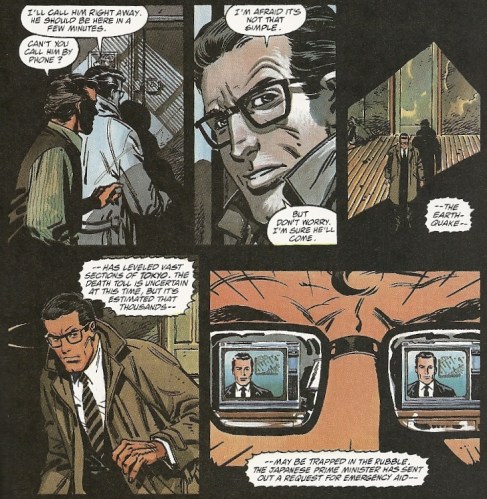
Alas, it wasn’t Superman who knocked on Sands’ door next. But he did get an interview with his subject. So there’s that.
James D. Hudnall’s script is solid, and Sands’ trek through Luthor’s seedy past is enjoyable. The major flaw — or so it appears to me — is that he actually uses two layers of framing stories to tell the tale. The plot opens and closes on Luthor, who has a videotape of Kent’s interrogation delivered to his Aspen chalet. Then there’s Clark’s interrogation. Then there’s Sands’ story, narrated by Sands himself. There’s nothing wrong with any of these things on their own, but the way their arranged jumbles the narrative a bit. The transitions aren’t seamless, and they make the story clunkier than it needs to be. It’s like a multi-layer cake of flashback, and it creaks and groans under its own weight. Again — this might just be me. Maybe I’m just too dumb.
I’ve always liked Eduardo Barreto’s art — his covers are nice to look at — and it’s solid here. Special kudos have to be given to Adam Kubert’s inks, though. They bring the grimy environs of Peter Sands to life, and there’s no shortage of opportunities for bold blacks in this shadow-filled story. (Seriously, you expect Martin Sheen in Apocalypse Now to have a place next to Sands, before he gets his assignment to track down Colonel Kurtz. Saigon. Shit. I’m still only in Saigon.) He does the Kubert name proud.
Luthor’s post-Crisis life story was fleshed out in a number of other places, but this book gave some indication of just how far he was willing to go to secure his future — and hide his past. It’s not on the short-list of must reads in the Superman mythos (and the big guy never even makes a costumed appearance in its pages), but it has its place in Luthorcana.
[Edit: This post mistakenly credits — and praises — Adam Kubert with inking the book. He handled the colors, while Eduardo Barretto tackled both the pencil and ink art chores. Thanks to Mr. Kubert for providing the correction, and apologies for my error.]
The T-800 endoskeletons that aren’t T-800 endoskeletons hope you enjoy your Rifts RPG experience.

Post-apocalyptic setting? Check.
Skeletal killing machines toting guns? Check.
Glowing red eyes? Check.
The Terminator franchise is one that invites imitation/outright copyright infringement, so the Rifts Megaverse is in good company in that regard. Roll those clunky dice!
Wendy Pini did a Beauty and the Beast book? Wendy Pini did a Beauty and the Beast book. – Beauty and the Beast: Portrait of Love
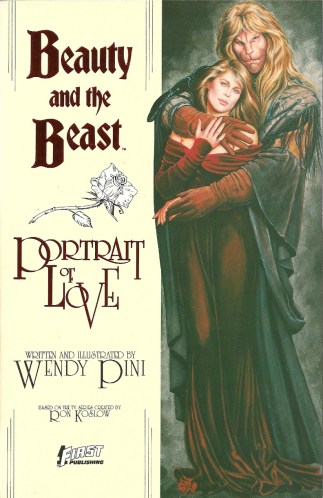
Stumbling across this is one of those This really happened? moments that make the world of comic books such a never-ending treasure trove of delight. Yes, Wendy Pini, who along with husband Richard forged the seminal Elfquest mythology, a universe that spawned epic storylines and fanzines for rabid devotees, crafted a comic based on the old Beauty and the Beast TV show. The one with Ron Perlman under layers of lionish makeup. And Linda Hamilton, post-Terminator fluffy Sarah Connor and pre-Terminator 2 buff commando Sarah Connor. Seriously. IT’S LIKE A FEVER DREAM COME TO LIFE, PEOPLE.
For those unfamiliar with that 1987 iteration of the venerable Beauty and the Beast folk-tale — as part of the never-ending cycle of retread nostalgia, the CW has updated it in a new series (a CW series — synonymous with “Awful Beyond Words”) — it set the story in modern-day New York City. (Is 1987 still modern? Or is it now part of sepia-toned antiquity?) Perlman’s Vincent lived in “The World Below,” a rather pleasant network subterranean tunnels, along with “Father” (played by Roy Dotrice), the learned, gentle man who had cared for him since he was found abandoned as a baby. A number of other colorful societal castoffs rounded out the social circle in their never-ending labyrinth of Big Apple passageways — all in all, this world seemed a pretty damn nice place to live, especially considering rents above. (Come to think of it, where can I fill out an application?) Hamilton’s Catherine, an attorney, came into contact with these underground denizens when she was attacked and beaten and Vincent (who roamed around the surface world with a cloak hiding his deformity) came to her rescue. They — surprise! — fell in love, and the series followed their budding romance and their mutual interest in helping the weak and downtrodden.
I remember liking the show quite a bit as a kid — that Vincent would savagely attack evildoers on a regular basis was more than enough to overcome pre-pubescent aversions to icky mushy stuff. The romance, however, tripped any number of alarm klaxons in my head. I seem to recall asking my mother why Vincent looked like a big ugly cat, and her answering in her typical I’ll give you an answer because I have to but I really have no idea way: “Maybe his father was a lion or something (now leave me alone so I can finish balancing the checkbook).” Even single-digit me understood this meant BESTIALITY. And this was (and is) kind of gross and disturbing, and became all the more so when Vincent and Catherine went the distance and eventually had a kid, and didn’t stick to the sanitized dancing/saccharine Angela Lansbury songs/kissing like the Disney film a few years later. I mean, I’m all for looking at the person inside, but there are limits, you know? This Beast was a Beast for good. No spells. No curses to be lifted. I understand intellectually that the character was really just a guy with a hell of a deformity, but I still have it in my head that Vincent was half-lion (thanks, mother dear), which totally ruins Hamilton’s whole hot “badass chick who shoots guys in kneecaps” thing from the first Terminator sequel. Vincent’s big cat stank is still all over her.
Alas. And I digress.
Bestiality allusions aside, the show had very ardent fans, and, though it got the ax after three seasons (Hamilton left the show at the start of the third, a death blow for OBVIOUS reasons), it remains on the fringes of the pop consciousness. (In a couple of genre asides, Perlman’s experience acting under heavy makeup couldn’t have hurt when they were casting Hellboy, and Game of Thrones uber-lord George R.R. Martin worked as a producer on the show. Impress your friends with useless knowledge!) I don’t know if there was enough of a groundswell as the show was airing to justify an ongoing comic book series, but there was certainly enough to back a couple of Why not? issues — which is what First Comics delivered with the two Beauty and the Beast comics they produced. That Wendy Pini, coming in with her established fantasy romance bona fides, was running the creative show was either good planning, coincidence or kismet. Perhaps all.
Portrait of Love, the first of the two original stories (published in 1989), is an interesting melding of the show’s cast and the Elfquest aesthetic. Pini’s style, like it or not, is certainly distinct, and it’s so closely associated with certain short, pointy-eared warriors, you half expect them to turn up in every panel. Sometimes you look at a character and your first thought is SKYWISE, THAT’S SKYWISE RIGHT THERE — and this isn’t necessarily a bad thing. The art is therefore what you would expect (i.e. good), though I’m always a bit disappointed to see Pini’s work in color. It seems so much better in stark black and white, and washed out when color comes into play. I stubbornly prefer reading the old Elfquest books in the original color-free presentation, and this concern carries over while reading Portrait. This is a personal complaint, though, and the color certainly adds a fireside warmth to the artwork here. Take for instance this shot of the (unbelievably cozy-looking) World Below:

THIS PAD IS SO MUCH BETTER THAN THE DUMP I LIVE IN, IT’S NOT EVEN FUNNY.
For any uninitiates not satisfied with my brief series summary, here’s some more detail from Pini on the senses-shattering first meeting of Vincent and Catherine:

Portrait follows Vincent as he struggles to commemorate his love for Catherine in a painting, a frustrating process that has several fits and starts. He eventually hides himself away, abstains from food, drink of sleep, and pours his soul onto the canvas, and produces a portrait that’s proclaimed a masterpiece by all who see it (except us, as the audience never gets a glimpse). The drama comes when the painting is stolen by Paracelsus, a recurring villain from the show who had partnered with Father to found the underground society, but had been exiled when he got a tad too power-hungry. He uses the portrait as a lure to trap Vincent (he’s also jealous that he can never have or feel a love like the one behind the painting), and thus brings him to his own cavernous lair:

Pages like that tempt me to retract my qualms about color, I admit.
The story’s a bit mawkish, with wheelbarrows full of yearning, gnashing of teeth and rosy speechifying, though, in fairness, the series itself, with its swelling strings and pining for a love that should not be, could also descend into glurge-ville. The comic is ever-so faithful in that regard, I suppose. But Pini’s art is a treat, make no mistake. It always is, but it’s especially nice seeing it bring a cult-show to life in the two-dimensional realm. What she does with the characters is nice, and the atmospherics she creates with the backgrounds sell this odd world. (The only roughly contemporaneous TV adaptation that I’ve covered here was the fake-Spider-Man-infused Sledge-Hammer. This is miles more successful than that. For what it’s worth.)
Speaking of odd… In a strange coda, the best part of this whole thing might be the one page of Beauty and the Beast merchandising in the back, where you could choose between a Vincent shirt and a giant Vincent poster:
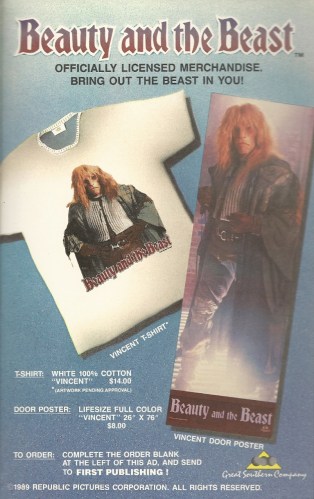
I’m really curious about what the target demographic of this merch was. It’s one thing to read a BatB novelization or comic book, but it’s a whole new ballgame to wear Vincent on your chest or broadcast your devotion with a poster. Really, who would hang that thing up? No sane adult. No self-respecting boy. Maybe a young girl? And what deranged land-whale would ever strut around in an extra-large Vincent t-shirt?
What I’m saying is that this order form
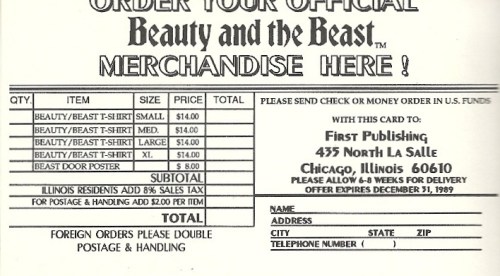
rarely — probably never — looked like this:
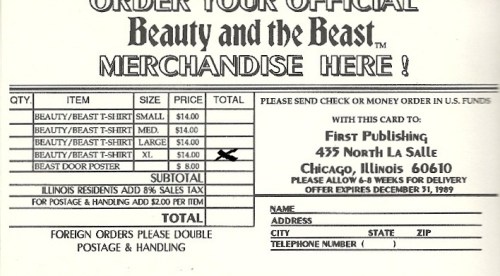
Anyway.
Finding and reading this book was like reaching into the pocket of a coat that you haven’t worn in a while and finding a crisp twenty-dollar bill folded inside. It’s not a huge thing, but it kind of makes your day — just so long as you don’t blow it on a Vincent shirt. (If anyone reading this owned Vincent stuff, I’m just kidding around. Kind of.)

Whose coffee did Jefferson piss in to get squeezed out of the Mount Rushmore foursome? Maybe the people behind this signet ring giveaway wanted to throw a wrinkle into their “name the president” contest, but U.S. Grant’s inclusion seems a bit odd. Perhaps they wanted to give a scandal-plagued administration a moment in the sun.
All that said, who wouldn’t want a signet ring? You can make dramatic Ben-Hur entrances! Pretend you’re Leto or Paul Atreides in Dune! FUN!
 Jared
Jared


 blog into mystery