Frosty the Snowman is here to spiral you into a suicidal depression with the saddest Christmas story ever – Four Color #1153
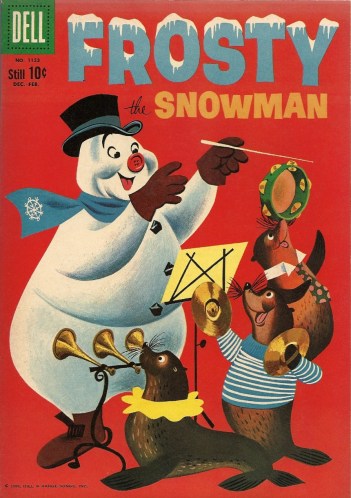
Frosty the Snowman has one of the Uber-Triumvirate of Christmas specials, alongside Rudolph and the Charlie Brown posse, and thus has a venerated place in the holiday-industrial complex. The world’s most famous snow sculpture is at third place in that trio (it’s just too hard to compete with the Rankin-Bass stop-motion figures and the Peanuts gang), but his yearly special is still on the medal stand, Jimmy Durante’s scratchy “Fros. Ty. Da Snow Man…” warblings and all. It’s a good consolation prize. At least he hasn’t been relegated to the cable backwater like former stalwarts Santa Claus is Comin’ to Town and Twas the Night Before Christmas.
Half hour television specials have never been the full extent of Frosty’s yuletide merrymaking, though. Indeed, like pretty much every property that gains a foothold in the popular consciousness, he’s had his share of comic books.
The subject of today’s post, whose crisp, sharp cover can be seen above, is one of the last of almost a dozen Frosty comics that Dell put out under their Four Color banner (all predated the famous TV special), and it’s mostly composed of standard cookie-cutter Christmas plots. There’s Frosty getting a job with a local department store so he can deliver presents to a family of seals who desperately want to celebrate Christmas. There’s Frosty negotiating with the North Wind to tone down the holiday snowfall so as not to upset the holiday. There’s Frosty visiting Santa’s workshop and finding, much to his chagrin, that Santa and his elves have the place working like a well-oiled machine sans his help. It’s the expected family friendly fare, gentle and not all that challenging.
But along the way there’s a story that would bring a tear to the eye of even the stoniest Grinch. A harrowing tale of survival. One that will haunt you as you try to sleep, as its images play across the backs of your eyelids. A tale that makes Rudolph being barred from playing any reindeer games seem like the proverbial walk in the park.
Really. You have been warned.
Still here?
Then let us begin. Brace yourselves for “The Lonely Donkey.”
The story is narrated by Frosty, as he relates events leading up to a past Christmas to a group of children gathered at his feet. Which makes the events all the more gut-wrenching, as you imagine the wide-eyed kids, their mouths agape with horror, wondering when this nightmare will stop. The story focuses on Chico, an infant donkey who’s living the fairly contented life that young donkeys do, right up until some thieving Gypsies steal him under the cover of darkness (this is the story talking, not me, so don’t report me to the Gypsy Anti-Defamation League):
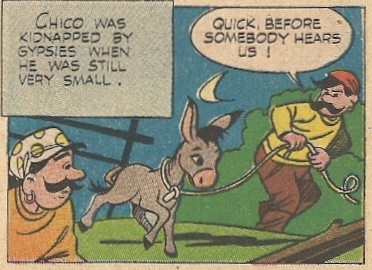
Look at little Chico. The big eyes. The thatch of black mane between his two big floppy ears. Not since the about-to-be-molested young Peter Parker have we seen such endearing youth. And guess what — CHICO IS NEVER GOING TO SEE HIS HOME OR HIS FAMILY EVER AGAIN. MERRY F-ING CHRISTMAS.
It turns out being a part of a Gypsy caravan isn’t all fun and games, as poor Chico soon discovers:
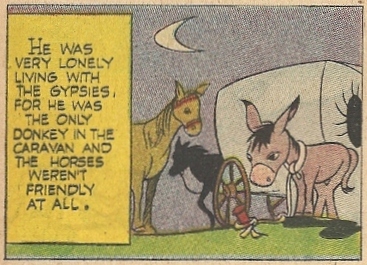
Ostracism. Crippling loneliness. Tied to a stake with a short rope. Look at him. LOOK INTO THE SAD EYES OF CHICO AND SEE THE ABYSS STARING BACK AT YOU.
And it gets better (worse):
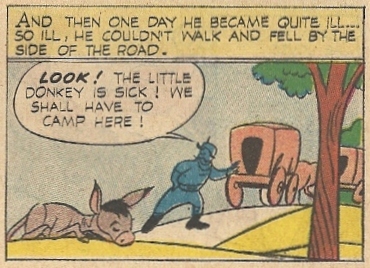
…pleasenopleasenopleaseno…
This is where the story starts to turn, right? When it starts to have mercy on the poor readers whose hearts are breaking. Right? The Gypsies are going to restore him to health in the spirit of season and we’re all going to sip our warm cocoa a bathe in rose petals and gumdrops. RIGHT?
Wrong:
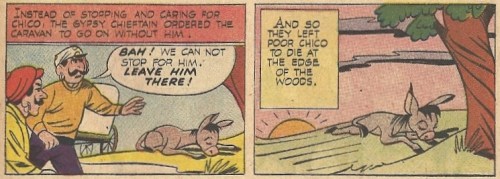
Chico is left for dead. OH GOD PLEASE STOP. Seriously, the kids in Frosty’s captive audience have to be screaming for their parents at this point. And the best part is that THIS IS ALL ON THE FIRST PAGE. As a blind and pissed off Al Pacino once proclaimed, “Oh I’m just gettin’ warmed up!”
Like a prize fight where one boxer is bloodied and mangled as the first round’s bell sounds, there’s at least a break here in the relentless pummeling. Some kind deer arrive on the scene and nurse Chico back to health:

There’s a reprieve of modest contentment, with Chico getting back on his feet and bounding about with his new deer friends. The little guy almost looks happy for the first time. But it doesn’t last:

OH GOD HE’S DYING AGAIN. They give us hope, and then they snatch it away. To quote Pacino again: “Every time I think I’m out, they pull me back in…”
Chico’s illness this time is deeper and beyond the deer’s powers of healing. Paging Dr. Frosty, M.D.:
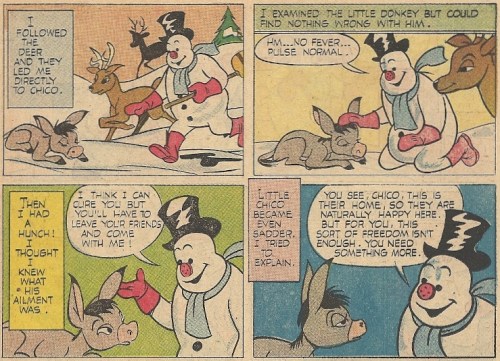
Great. So Frosty’s big cure involves yanking Chico away from the only friends that he has in the world. FROSTY, HAVE YOU NO MERCY, NO HEART? The way things are going, maybe he’ll drag him by the ears back to the damn Gypsies.
Well, I’m happy to say that the worst is over. Frosty brings Chico to a nearby homestead and stables Chico in the barn, where our beleaguered donkey immediately falls asleep on the clean straw. (Who can blame him after his endless gauntlet of misery? I mean, I’m going to need a nap after just reading this.) Meanwhile, Frosty has a fireside chat (isn’t this dangerous?) with the boy of the house:
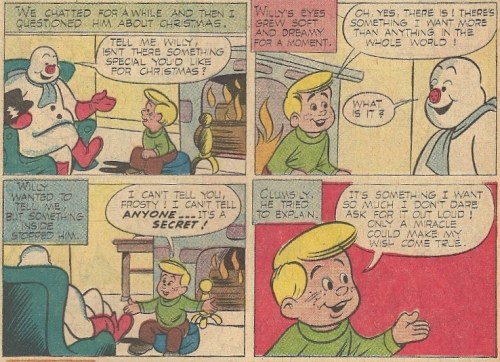
I think you see where this is going:
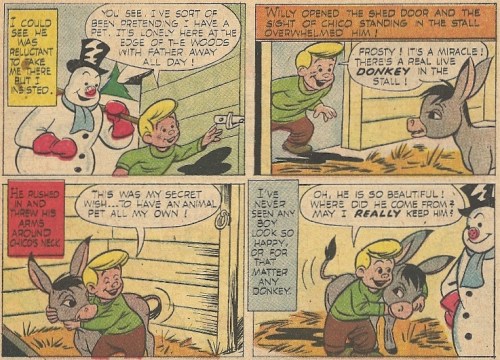
Look at how happy Chico is. I share his joy at this point, and I’d be flopping my tail back and forth too. Deliverance. (Until the boy’s father comes home and… Okay, let’s not go there.)
I’m beginning to understand why Eeyore was always so down in the dumps. The donkey’s lot is not an easy one.
I wish I could offer up credit to whoever scripted and provided the art for this thing. Whoever they (one or more ) were, they weren’t afraid to kick you in the stomach before bringing you up to the inevitable happy conclusion, and a special gold star has to be awarded to Chico’s design. It seems that drawing a undeniably cute child donkey would be one of those deceptively difficult tasks, but Chico here is the paragon of what a heart-tuggingly adorable animal character should be. The elements — big eyes, big floppy ears — are simple, but the execution is superb. Everyone can assemble ingredients, but not everyone can make the stew, you know?
There you go. Try and fall asleep tonight without thinking of sad Chico dying on the side of a road. Just try. THANK YOU, FROSTY.
Captain America had a Broadway show? Captain America had a Broadway show. (Not really.)

This advertisement is, sadly, the only artifact we have of the aborted mid-80s Captain America musical. Other places on the internet have posted the above ad and the snippet from the New York Times article that’s pretty much the only information out there about what might have been, so I won’t belabor this aborted misfire. But Spider-Man: Turn Out the Dark was a logistical disaster? I’m wondering how a mid-life crisis Captain America doing his best Mr. Peanut impersonation alongside a 10-14 year old girl moppet would have played. Not too well I’d imagine. Then again, who would have predicted CATS?
At least the song and dance number in 2011’s Captain America: The First America likely sated whatever hunger there was for a Steve Rogers musical. One hopes.
Why so serious? asks the Art Adams Wolverine
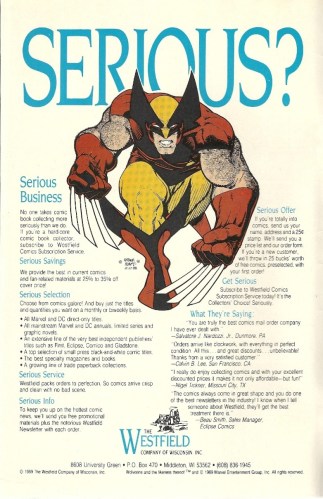
So buy your comics from Westfield or Wolverine will shred you like old newspapers, I guess. You have been warned. Good to at least see Logan shilling for comics and not selling his soul to the corporate pizza Antichrist, though.
Westfield is still in business, by the way. Should you live on the surface of the moon and be in need of their subscription services.
Santa Claus, P.I. – The Sensational She-Hulk #8
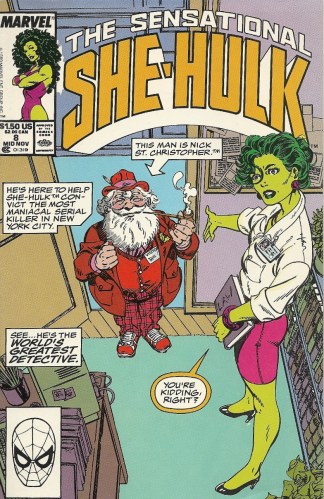
Before I type anything else, I just need to point out that never once in my years of law school or traipsing through the periphery of the legal profession did I ever see a book simply entitled LAW. Maybe I was travelling in the wrong circles. Not a criticism, just an observation.
John Byrne’s time on The Sensational She-Hulk was some of his most innovative work. Known throughout his career for straight-forward, high-quality superhero storytelling — if not outright reinvigoration of downtrodden franchises (see Four, The Fantastic) — with Bruce Banner’s law degreed cousin things went a little different. Under Byrne’s guiding hand, Jennifer Walters became a self-aware character that would talk to her audience, and one who was very much keyed into the fact that she was a green giantess in a comic book. Every other sentence out of her mouth was a wry commentary on the medium or a sassy comeback at Byrne himself for putting her in some odd predicament. It was a brand of storytelling that set the series apart from the rest of the capes and tights pack, and in so doing it helped make She-Hulk the sexy B-level star that she remains to this day.
Yet Byrne’s constant sundering of the fourth wall could be a bit much. Yes, it was different. New. But all too often it felt like you were watching a movie and boom mikes kept falling into the frame and grips kept wandering into shots. It was Byrne’s GIANT OBNOXIOUS SIGNATURE (with commentary) writ even larger. It sucked you out of the story, and now, going back to the books, you realize very much that you’re reading a comic instead of becoming one with the narrative (getting a little Zen here, I know). It’s even harder to stomach at this distant remove, as you just want to scream ENOUGH ALREADY JUST GET ON WITH IT at every other panel, like the worst Joss Whedon scripts. SHUT UP.
For those unfamiliar, here’s some of the less infuriating material, from the comic we’re about to pry open:

I’m not the biggest fan of the technique, but it’s not the worst in the world. It has its place, so long as it doesn’t spin out of control, and threaten to drag us down into an all-consuming vortex of smarmy sass.
Which it did in this issue.
Yes, this Christmas-themed installment of Sensational (one of a number of Christmasy comics we’ll look at this month) guest-starred the Right Jolly Old Elf himself.
OR DID IT?
You see, never once is the term “Santa Claus” mentioned in these pages, as the pudgy, diminutive Nick St. Christopher seen on the cover goes by that name and that name alone. Nor does She-Hulk make the connection at any point. Apparently, despite that keen legal mind of hers, she’s really an empty-headed bimbo, and accepts Mr. St. Christopher for what he claims to be: a kind of psychic detective, one who’s going to help her put a serial killer behind bars. Here he is introducing himself, after (literally) running into our heroine:
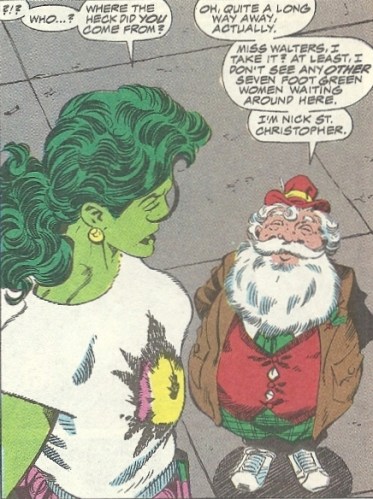
Just what is he going to bring to the dance? What powers and abilities will he graft onto She-Hulk’s crime-fighting prowess? Let’s see if you can tamp down your rage after this panel:
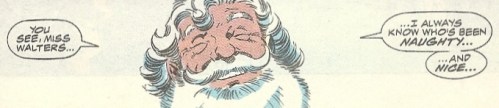
And it goes on like that. St. Christopher (who’s making gentlemanly passes at our green gal the whole time) seems to know everything, and guides She-Hulk along on her quest to dig up evidence to poke holes in a smug murderer’s alibi. Along the way — and oh so predictably — there’s a chimney that the two of them need to get down, and a touch of the nose later…:
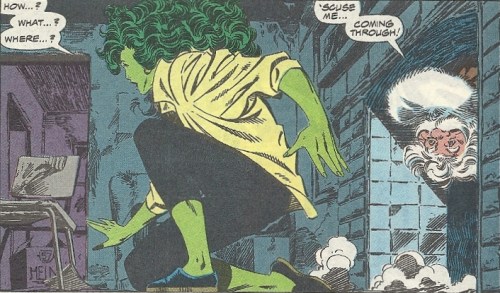
As I said: AND IT GOES ON LIKE THAT, right up to the senses-shattering conclusion. Do we ever find out if this is the “real” Claus? You’ll have to track down a copy to find out, because I haven’t the energy to pry this apart any more. And I’ve already ground my teeth down to stumps (between Santa and the wisecrack asides…). Suffice to say, it ends on a reindeer poop joke. Fitting.
Nick St. Christopher disappeared never to be seen again, yet a small boxed present he gave She-Hulk towards the end of the story would come up again years later, in another Christmas-themed issue. One that was a whole lot more heartwarming and far less infuriating. When I’ve sufficiently recovered, perhaps I’ll have a few things to say about that one. It’s going to be awhile, though.
One final non-Christmas (and non-Nick St. Christopher — thank God) note. She-Hulk always seems to be spending a lot of time at the beach, whether just laying out or playing some volleyball with the girls. At all times she evinces an alarming desire to work her iceberg lettuce skin into a nice deep olive, a quest that would make George Hamilton beam with pride. Anyway, in this issue there’s a dream sequence which find her sunning in the sand. Here’s the first panel of said sequence:
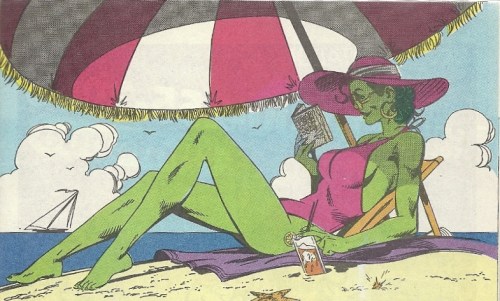
I’d just like to compliment her on yet another giant floppy Elaine Benes hat. That is all. UNTIL NEXT TIME.
Star Trek V collectible figures, now proudly decorating landfills and Goodwill bins everywhere

These figures were — and are — great for anyone who’s just seen Star Trek V: The Final Frontier for the first time, especially for a viewer who still remembers the fun romp that was The Voyage Home. They, you know, might feel compelled to have some keepsake from this Shatner-helmed sequel, and to utterly destroy said memento. Maybe by melting it under a magnifying glass. Or blowing it to hell with an M80. I, for one, would take great joy in annihilating a Sybok figure, perhaps with the croquet mallet of my choice. “Oh, so you’re Spock’s smiling, cackling half-brother? The one never mentioned before this movie and never mentioned again after it? GIVE MY REGARDS TO SHA KA REE, JACKASS.”
Thank you, San Francisco Mint, for these limited edition collectibles. We wouldn’t have been able to cope as a society without them.
Mr. Bubble’s Tub Tales… OF HORROR
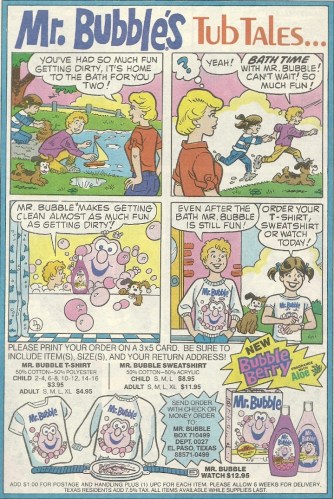
The big-eyed Mr. Bubble, a fixture of bath additive commercials in my youth and a pitchman with a Frankenberry je ne sais quoi, long begged a number of questions. Was he of any relation to the Scrubbing Bubbles clan? Did he and the Kool-Aid Man share union representation (Federated Unwelcome Product Mascots, Local 151)? Whatever the answers were, this Archie-ish advertisement (by noted Archie artist Don DeCarlo) adds another creepy layer to the mix. DO YOU WANT THIS MONSTER IN THE BATH WITH YOUR CHILDREN? I think not.
And what can you say about the Mr. Bubble merchandise available below? One thing: I’m sure if there are any vintage Mr. Bubble shirts out there that were once worn by boys, there are indelible bloodstains on them. You know, from the non-stop beatings and all. Better or worse fashion than Vincent-themed Beauty and the Beast attire? That’s one question that’s above my pay grade.
I know Rudolph. I watch Rudolph every year. This holiday special is no Rudolph. – A Boy and his ‘Bot #1
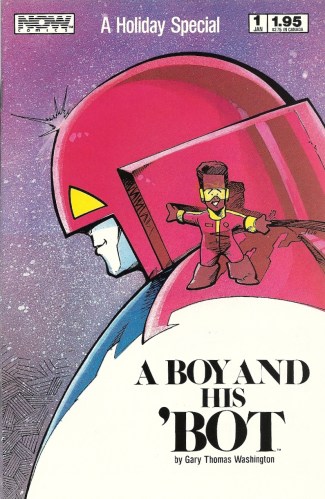
It’s fairly convenient to shorthand this 1986/87 one-shot comic book as being “The Black Iron Giant.” There’s a young African-American boy who stumbles across a hulking anthropomorphic machine, and once the meeting takes place, storytelling ensues. BLACK IRON GIANT. Yet this book was published a decade before Iron Giant came out, so if anything, that film should by all rights have been called “The White Boy and His ‘Bot.” Except there would be about five people alive on Earth who would know what A Boy and His ‘Bot was.
I am now one of the five people who know about ABaHB. I’m carrying the fire. And, racial clunkiness aside, the Black Iron Giant tag is as accurate as any, so we’ll run with it. It has the virtue of not being completely wrong. But, just to illuminate the differences, let’s have a quick summary of the book.
Written and illustrated by Gary Thomas Washington, and published by NOW Comics (of “Mr. T Smashes Everyone in the Face” fame), it was, according to notes on the inside back cover, a kind of pilot for a continuing series — one that would never come to pass, as it would turn out. Its main character is Rick, a typical dreaming youth, who’s looking at the night sky one night, much like a yearning Luke Skywalker gazing at the twin suns of Tatooine. He sees a falling star come down near where he’s at, and when he goes to investigate, he finds that it’s a big robot — and a friendly one at that:
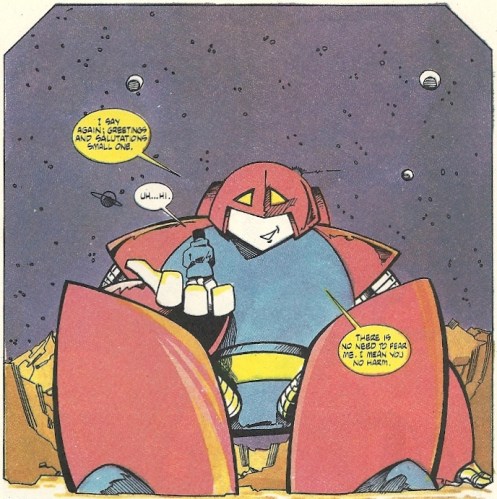
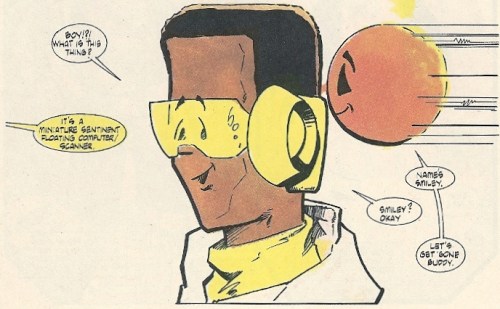
The big guy is a space exploration vehicle, one currently without a crew, and he invites Rick on a ride in outer space. Rick, not being an idiot, says yes. (Never getting into cars with people you don’t know doesn’t stretch to not getting into spacefaring robots you don’t know.) Though he’s worried about being away from home for too long, all is quickly forgotten as he gets a uniform, some spiffy specs, and starts exploring other worlds. Along the way the Explorer Bot A241 produces a little companion named Smiley (not the penis-less psychotic button) to help watch over Rick:
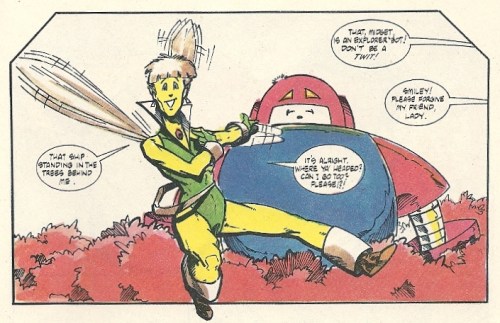
They all also meet up with a Tinkerbellish alien who’ll also become part of the crew:
All good things must end, and Rick really needs to get home, as he’s already late. But SURPRISE, some other aliens, from the race that employs the explorer robots, have arrived in the interim and told Rick’s folks all about his exploits. Not only that, they offer him a chance to be a full-time explorer with his new friends. The parents say okay, and in no time they’re waving goodbye:
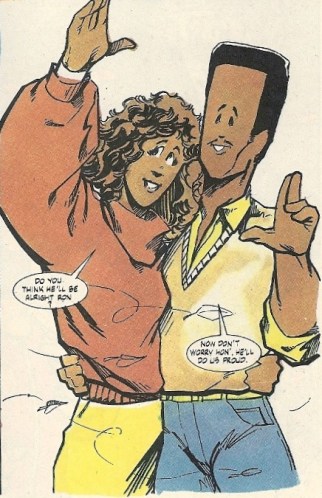
Two things: One, Rick definitely inherited his GIANT SQUARE HEAD gene from his pops. Two, these two parents are very understanding about their only child going off on interstellar missions. Maybe they want to convert his bedroom into a den or something.
You could throw a lot of demerits at this book, everything from the petty (it’s a “Holiday Special” with no connection, despite a wintry setting, to a holiday) to the justified (nothing happens — a kid finds a robot, wanders around, and everything’s fine). Washington, who put this book together while attending art school, has a distinctive style, one that’s well-suited to youth-oriented storytelling. It’s just that this storytelling, despite a kid finding a giant talking spacefaring robot — let’s be honest, every young boy’s dream, even if they don’t realize it — is a bit of a yawner. It’s surprisingly dull.
But for a maiden effort, it’s not so bad. Kind of good, actually. If that makes any sense.
A simple Google search before writing this post revealed that there was another similarly titled book released in 2011. Written by Robopocalypse author Daniel H. Wilson, this A Boy and His Bot has a kid finding a robot, though this time a machine with Native American(?) influences. Which I guess makes it, in our patented clunky shorthand, “The Native American Iron Giant.” Put it on the shelf with its white and black kin.
Cracker Jack doesn’t discriminate amongst sports, and will gladly undermine any athlete’s nutrition
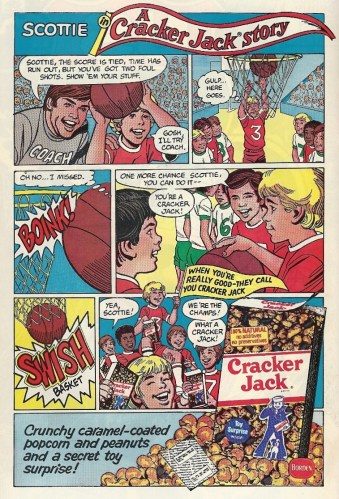
Is Cracker Jack the best food to have around a basketball court? Would the inherent stickiness of the caramel coating pose a threat to the hardwood, much like black-soled shoes, the bogeyman of every gym coach? Shouldn’t it be relegated to open-air sports, which have a county fair feel to them and where fried foods and sickeningly sweet treats (like the deviously simple fennel cake) fit right in?
And since when do coaches get to hover right behind a player as they’re about to shoot a free throw? (Also, either that kid has terrible form, or he’s starting off shooting right-handed and finishing his motion shooting left-handed. But maybe I’m being too hard on this burgeoning Jimmy Chitwood, and have devolved into the guy you just know is in the bleachers yelling YOU SUCK, KID. If so, apologies.)
At least there are no EVIL DEMON CLOWNS hanging around this ad.
The senses-shattering, Kane-infused debut of Major Mynah, Ray Palmer’s pet/sidekick/boat anchor – The Atom #37

Superman had his dog Krypto. Batman had his hound Ace. Supergirl had her horse Comet. J’onn J’onzz had whatever the hell Zook was. There was a time when a part and parcel of being a superhero was maybe having a cute animal sharing in the crimefighting hijinks. (Okay, okay, Zook was more alien than animal, and he- You know what? I don’t really want to talk about Zook right now. MOVING ON.) If you were going to have guys and gals running around in tights and capes and God knows what else, equipping them with pets that also had powers, and that would display intelligence far beyond their creature kingdom peers, wasn’t much of a leap. More of a lateral move, actually. As with most comic book editorial decisions, Why not? was the order of the day. People love their animals. Why not?
The pet partners listed above had some staying power, and get dredged up every now and again for certain stories, when a plot’s recipe calls for a little dollop of nostalgia. Krypto even had his own Saturday morning cartoon not too long ago, which featured frequent guest-spots by fellow canine Ace. Yet for every venerated pal, every (Super)man’s best friend, there were others that showed up for one or two issues and then disappeared, never to be seen or heard from again. Like the Atom’s pet bird, Major Mynah.
Yes, Ray Palmer waded into battle for a short spell riding a squawking mynah bird.
What’s that? You’ve never heard of Major Mynah? If that’s the case, allow me to make the introductions, aided by Gardner Fox’s script, Gil Kane’s pencils and Sid Greene’s inks. Pull up a perch.
Major Mynah was a native of Cambodia (he and his mimic-happy cousins are natives of Southeast Asia), and made his debut in issue #37 of The Atom, as Ray trekked there to take part in an archeological dig. Just as our hero is cataloguing an important find, the good Major pops in to swipe the goods and preview what would be his trademark “repeat what you say while flying all over the damn place” brand of mayhem:
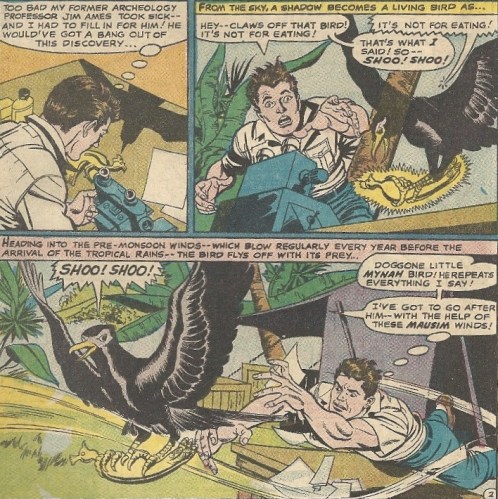
Ray changes into the Atom and gives chase, but the mission of retrieval quickly turns into one of rescue when the bandit bird is menaced by the hawk from the cover. Major Mynah is injured and plummets into a hidden temple, where the Atom discovers even more priceless relics. The bad news is that there are Viet Minh soldiers passing through the area, and they too stumble onto the temple. They get into a fight with the Tiny Titan (mistaking him for a demon), and he’s knocked unconscious at one point. That’s when Mynah first displays his penchant for nick-of-time heroism:
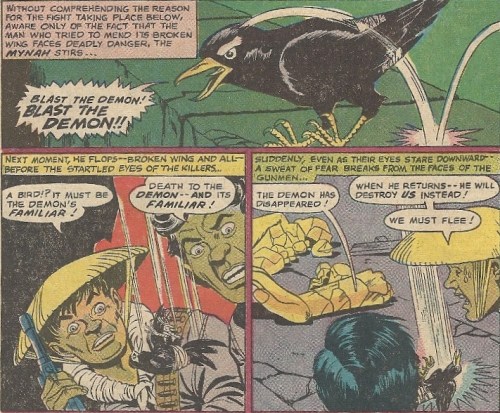
MYNAH DOWN! MYNAH DOWN!
The Atom recovers and subdues the soldiers (U S A!), and then returns to the states with the finds and the newly monikered Major Mynah. But poor MM has two crippled wings, so the Atom turns to his closest hero friend for help. It’s a good choice, because Carter Hall/Katar Hol/Whatever has a skillset uniquely tailored for such a case:
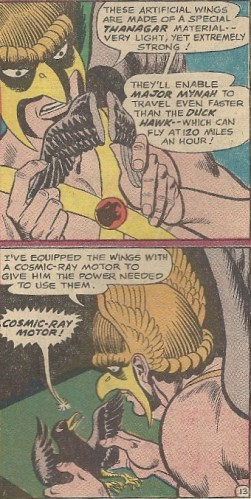
I guess there’s some light irony here that a hawk put the little guy down for that count, and a dude in a hawk outfit is the one that makes him the Six Million Dollar Mynah. Hawkman — Alien, Hero, Veterinarian. (Also, did they amputate Mynah’s useless wings? If so, OUCH.)
Mynah’s new Thanagar wings, which allow him to travel at high speed (better, stronger, faster), come in handy in no time, as thieves try to steal the newly acquired Cambodian treasures and the Atom tries to stop them:

This next sequence has nothing to do with Major Mynah, but I include it simply because it’s a fine example of a GIL KANE GOOFY FACE:

The crooks are subdued, but that isn’t the end of the action, since Mynah isn’t just a crime-fighter. He’s also a take-home pet, and here is after a hard day’s work meeting psycho hose-beast/future murderer Jean Loring, and inadvertently getting his pal in hot water:
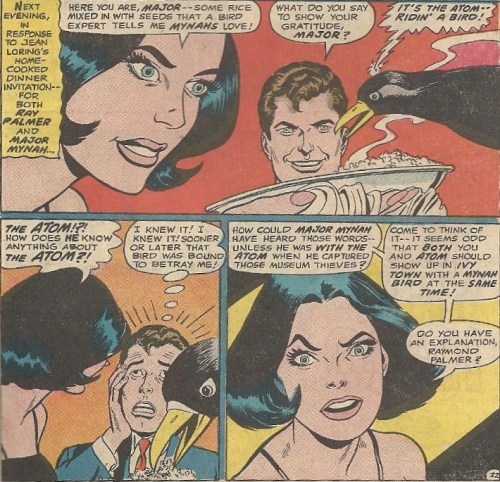
Ray explains this (rather roundabout) identity reveal away with the excuse that Major Mynah was watching The Huntley-Brinkley Report on NBC and got his Atom info that way. Domestic scene averted, and there our story ends. (Man, just look at those soul-icing eyes and that unbalanced eyebrow. Iris West is in many respects the queen of Silver Age Bitches, but Jean’s fiery displeasure can really give Mrs. Flash a run for her money. You look at that glare in the last panel and the whole Identity Crisis arc doesn’t seem too far away. HIDE THE SHARP OBJECTS. Now that I think of it, Major Mynah’s disappearance in a few issues is taking on a whole new angle. Did Jean make any unusual tasting stews around that time? Was there a Fatal Attraction moment?)
Major Mynah would make his final appearance three issues later (having in the interum gained a new crimefighting disguise activated when Ray turned into the Atom), in the newly retitled Atom and Hawkman #40. His absence was unexplained, with no ballyhoo. No doubt this stage left exit was in part a simple byproduct of the Atom title getting cancelled around the same time, wrecking any chances to bring him back, but Mynah’s continuing exile in limbo is a tad perplexing. The ranks of old characters never once repurposed are wafer thin, after all. I suppose the Atom is himself a side-character — though a core one, if there is such a hybrid — and therefore it’s clunky to bring back all his baggage.
And yet Major Mynah wasn’t so bad. He didn’t have time to wear out his welcome, granted, and that echo of his might have grated over a long run. But he fit right in with the comedic ethos of the Atom book, all driven home by Kane’s art (at its usual dependable level here), which never failed to accentuate the wide-eyed wonder of low-level crooks as they got into fisticuffs with a little guy that they just couldn’t keep track of. A mini-man riding a back-talking ball of feathers slid right into that groove. Maybe this little black bird wasn’t the greatest mynah ever in fiction, but he wasn’t an atrocious, cringe-worthy sidekick (WE’RE LOOKING AT YOU, ZOOK). He wouldn’t have to hang his head in shame around Krypto or Ace.
You mean to tell me they couldn’t have made him a Black Lantern or something? Do I have to think of everything around here?
Major Mynah, we hardly knew ye.
Here’s Cap with a great hobby hint on how to hold a drying model together (or garrote a victim, take your pick)

Yes, Cap, you could call that a tourniquet. And you could also call it by its other name, a garrote, the terminology used when it’s employed as an excruciating means to kill somebody (see Ramsey, JonBenet).
Bottom line: STEER CLEAR OF CAP AND HIS LITTLE BESPECTACLED AND NONBESPECTACLED FRIENDS.
J. Jonah Jameson and his huge fuzzy caterpillar eyebrows want you to subscribe to Marvel Age
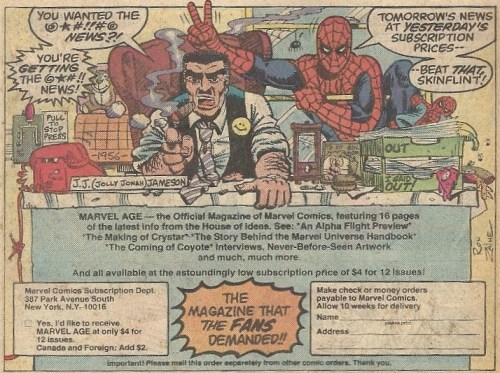
Seriously, those eyebrows are gigunda. Like somebody slapped them on with a paintbrush — the wide way.
Anyway, thank you, Jonah, for expelling your disgusting cigar fumes, cursing repeatedly, and thereby convincing us all to subscribe to Marvel Age. We wouldn’t have seen picnic covers and all the (then-)latest news about Marvel’s Star Wars adaptations without your foul encouragement.
The guillotine cigar cutter on the desk is a nice touch, too.
The glue that binds Donald Sutherland, Elliot Gould, Gerald Ford and Russell Means? Moebius. – Heavy Metal Presents Moebius
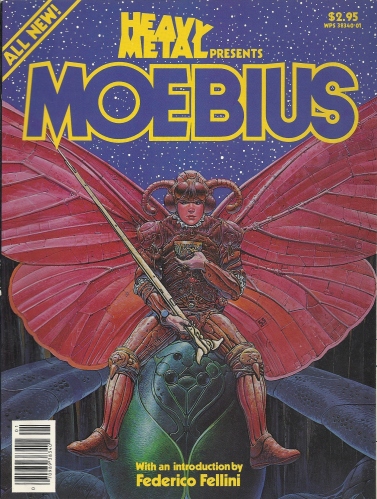
We lost a big one this past year. Moebius was one of those individuals who floated above the clouds, a somewhat distant figure of almost god-like proportions, remote and inscrutable. His very name inspired that respect and distance, as if he were someone you could only approach with head bowed, taking three steps at a time, like the King of England receiving a new ambassador. Aficionados likely wouldn’t have ben so eager to bend the fandom knee if he had gone by plain old Jean Giraud his entire career, you know? (I’ve sometimes wondered what moniker a born and bred New Yorker like Kirby might have taken. “Fisticus” or something.)
Moebius’ fame was international, his artistic reputation unassailable. He was so venerated, even other noted visionaries like Federico Fellini could send him fawning, worshipful letters (I present this reproduced missive whole just because I wish more letters started with “My dear Moebius”):
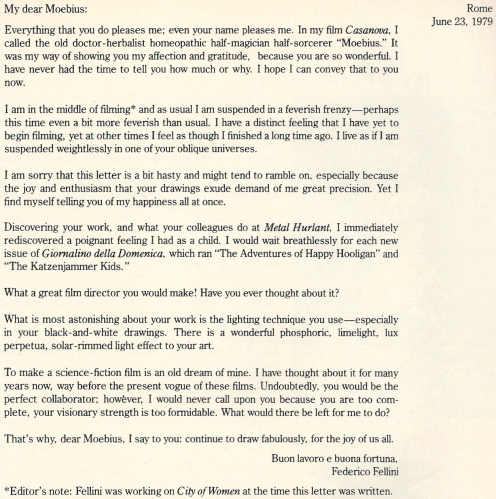
No one lives forever, and Mr. Giraud lost his long battle with cancer back in March. The all-too human flesh is gone, but the body of work remains. The former is transitory, the latter not so much. On to that latter.
One of Moebius’ most enduring contributions to the comics scene was his hand in the inception of the French magazine Métal Hurlant, which, through licensing and repurposing and simple translation, was Americanized as the iconic Heavy Metal. The adult-oriented fantasy and science fiction within every issue made its name synonymous with striking storytelling, so much so that a comic lover hears those two words in succession and doesn’t first think of shirtless skinny dudes with long hair smashing guitars over basting speakers. If anything, they’ll think of an alien chick with exposed breasts. EXCELSIOR!
The U.S. Heavy Metal of course venerated its Francophone forbear, and in turn that mag’s guiding artistic light. Which begat this career-spanning Moebius retrospective — well, up to 1981 career-spanning, at least. It reprints a heavy (no pun) amount of Métal Hurlant work, but it digs into a lot of Moebius’ nooks and crannies of output, all the way back to his Western roots. There’s much of the surrealist fiction that you’d expect, but reading through this collection of FIRST TIME PRINTED IN AMERICA work, I was struck by some of the more oddball, one-off material. Take this Donald Sutherland/Elliot Gould movie poster for the long forgotten film S*P*Y*S:
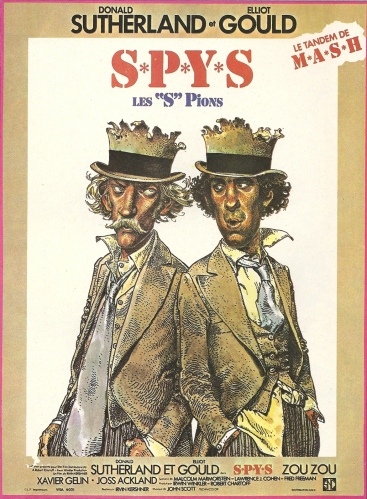
The notation in the mag points out Mort Drucker influences. I can see them, and you probably can too — if ever two ’70s actors were worthy of caricature, it was Sutherland and Gould. (By the way, Irvin Kirshner directed this 1974 film. He also, of course, directed the unspeakably awesome The Empire Strikes Back. I’m glad Lucas looked past this little hiccup when he plucked him from relative obscurity.)
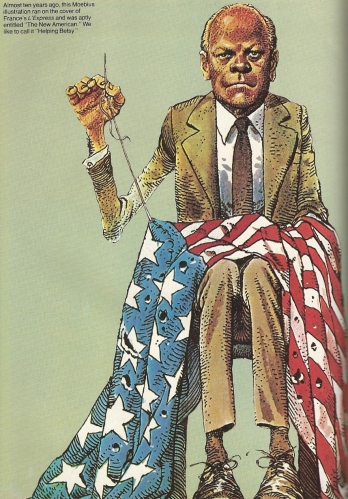
How about this Watergate era L’Express cover, which puts Gerald Ford in the Betty Ross role as he strives to mend the American psyche:
One of the bits of storytelling that doesn’t fit into the sci-fi/fantasy mold is a two page, one-sided (pure natives, evil white men) sequence summarizing the Wounded Knee incident. Here’s the final panel:

I looked around on the internet (i.e. typed “Russell Means Wounded Knee” into Google) and came up with the original image, in case you want to compare and contrast. You know, if you’re anal or something. I wonder if the guy covering his face/coughing ever thought that a legendary artist would commemorate his pose for posterity. Probably not.
And there’s a ton more.
The back and forth of the Moebius style is evident in these pages. It goes from warm realism, which would appeal to even the most plain vanilla of readers, to an edgy underground style worthy of the squirrelliest R. Crumb strip, and then back again. He could do it all, and looking through this tome only makes me wish that he had wandered into more of the mainstream American comic book scene, besides an argument-inspiring Silver Surfer tale. If only he had been healthy enough to do that chapter of Neil Gaiman’s Endless Nights as had ben intended. Oh well. There are some wonderful consolation prizes out there, though, and this old collection is one of them.
Take this painfully obvious bike safety test and try to suppress the devil inside you

I know that illustration B is supposed to show a kid pausing to let pedestrians cross the street, but I see that and can’t help but think how much fun it would be to barrel right through those people like a runaway bowling ball. I believe that’s what they call a 7-10/mother-child split. Bobby Shelby and his dorky Safety Club would not be pleased, but you only live once, know what I’m saying?
On a macro level, it should be noted that I bike a lot, and I routinely break roughly 80% of those rules. I feel like Jesse James.
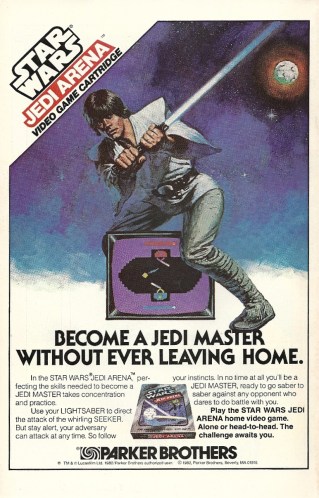
Explaining to later generations what MySpace was will one day be as awkward as mapping the ins and outs of the Jedi Arena game to the current Halo-fed crop of gamers. IT WAS LIGHTSABER PONG, OKAY? THAT’S IT. WE PLAYED IT AND LIKED IT. And they’ll think you’re Methuselah himself, an antediluvian beast with tales of strange things long dead.
In 1983, the world cried out for a trucking-based comic book hero. Marvel answered that call… – U.S. 1 #1
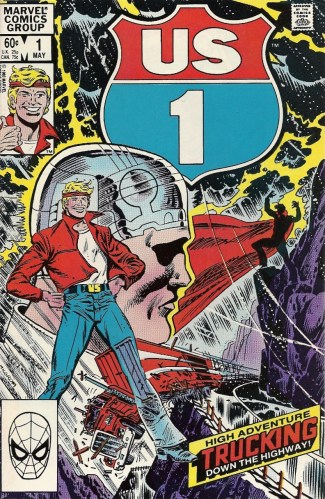
Yes, there was a truck driver superhero. A real, honest to God, fighting evil and protecting good out on the open road superhero. INCREDIBLE. And this wasn’t some rarely seen D-list guest star, like Razorback and his Big Pig truck, searching for his lost sister and battling Spider-Man. No, this was a character who had his very own comic book. He was the star. The big cheese. Let’s reiterate here: THERE WAS A TRUCK DRIVER SUPERHERO.
U.S. 1 was born in the licensing mad days of the 1980s, that most goofy of decades, when expanding a property’s brand and thereby expanding its moneymaking potential was the name of the game. In this instance, TYCO, maker of many fine models and toys, had a line of electric slot racing trucks under the U.S. 1 banner. So they knocked on Marvel’s door, the Marvel people looked at each other, shrugged their shoulders and said “Why the hell not?” And a comic series was born (and more on that inception in a moment).
U.S. 1 had a solid twelve issue run, which is roughly 11 more than you’d normally imagine such a thing getting. The first, written by Al Milgrom with art from Herb Trimpe, laid out the foundation for the main character — real name Ulysses Solomon Archer. Indeed, his complete senses-shattering origin could be found in this very issue. The book is narrated from the perspective of Ed Wheeler, a porky older gentleman who’s both U.S.’s surrogate father and cigar-chomping, overalls-wearing Obi-Wan Kenobi:

U.S. grew up in a trucking family, with both of his parents riding the roads, and he himself dreamed of a living on the highway:
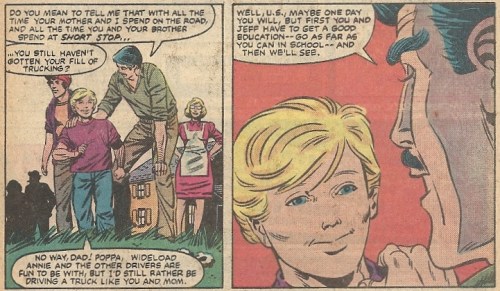
Tragedy strikes, however, when both parents are killed in an accident. Ed and Wideload Annie (!) take both U.S. and his older brother Jeff (Jefferson Hercules Archer) in, and raise them over at the Short Stop diner. U.S.’s bro grows up and starts driving his truck, while U.S. (reluctantly, since he wants to have his own rig) heads to college, where he excels academically and athletically. Cruel fate once again steps in though, as U.S. is riding along with his brother during one of his summer breaks. A black tractor-trailer runs them off the road, and that’s when U.S. gets his first look at the man who’s going to be his Lex Luthor/Joker/Red Skull:
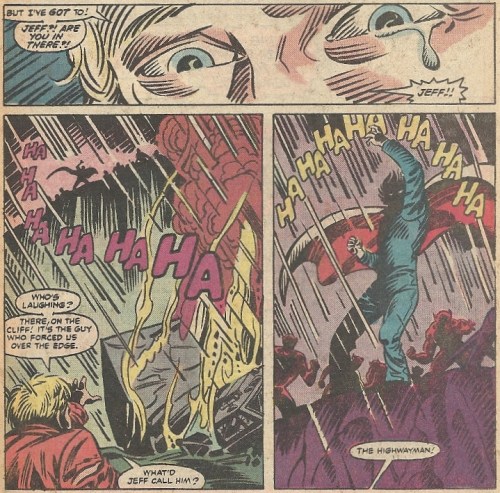
The Highwayman escapes into the night as U.S. succumbs to his injuries. He’s whisked away to the hospital, where the doctors turn to an experimental procedure to save his poor shattered noggin:
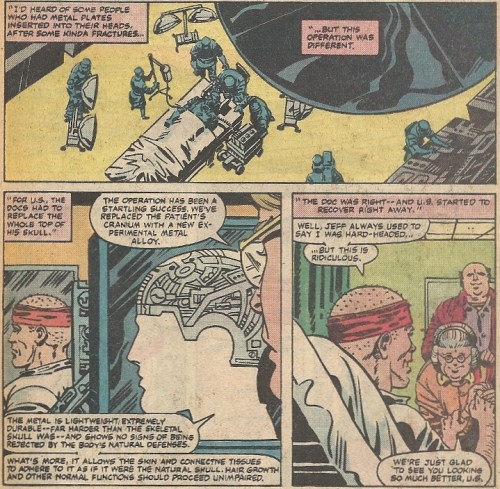
What a marvellous health care fantasy land the ’80’s were, what with random truckers getting the tops of their skulls bandsawed off and space-age craniums bolted on in their place. Is this going to be our lives under Obamacare?
The new skull is just supposed to be that: a replacement skull. This isn’t a Six Million Dollar Man upgrade. But U.S. soon discovers that there’s a new power that comes with it:
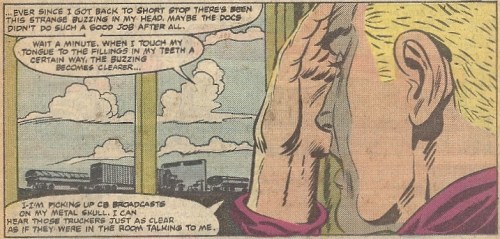
So basically he has trucker telepathy, in a twist that’s like dental fillings picking up radio stations, but on steroids.
Armed with this new ability, U.S. resolves to seek justice both for himself and his dead brother by hunting down the Highwayman. His first and last item on this hero checklist is acquiring and outfitting his own rig, the eponymous U.S. 1. With his own semi-genius know-how and Ed’s and Annie’s help, he stocks it with all the lethal gizmos that you can imagine, so much so that even Batman would peak in the cab, whistle and shake his head admiringly:
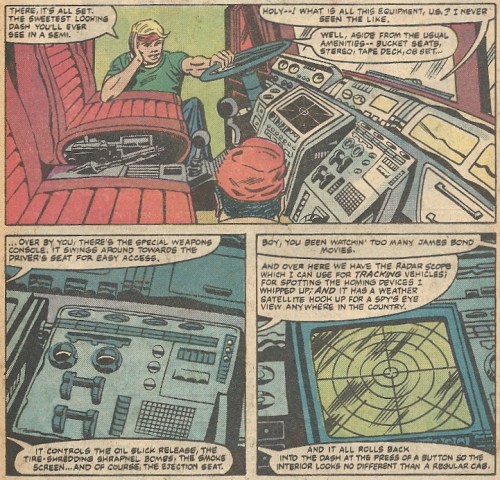
So armed, U.S. heads out onto the roads, where he in no time runs across the hideous laughter of the Highwayman:

Their rain-slicked nighttime duel ends in the Highwayman’s apparent demise, but anyone who’s ever read a comic series in their lives knows it’s really a stalemate, and his cackling silhouette will return.
And there you have it. The big premier of U.S. 1, with the marquee fully lit, the red carpet rolled out and the big lights throwing their beams up to the sky.
Your first inclination going into this comic is “THIS IS GOING TO BE STUPID, AWFUL AND EVERYTHING IN BETWEEN.” Indeed, the fine folks at Cracked, noted arbiters of all things terrible, once ranked U.S. #5 on their list of the seven worst comic superheroes ever. I’m not going to stand before you and say that this is high literature, or a crafty new (old) spin on the costumed crimefighter genre. My fingers would burst into flame if I tried. But I will say that you can detect a certain degree of mirth in the efforts of both Milgrom and Trimpe, as if they both fully grasped the siliness of the premise and decided to just run with it, Wideload Annies and cape-wearing Highwaymen and all. Indeed, Trimpe’s art here seems more inspired and engaging than art what he turned in on a number of other off-beat properties, whether Shogun Warriors or Robotix. It’s for this reason that I can’t completely consign U.S. 1 to the worst of the comic book refuse pile. The silliness is a tongue-in-cheek part of the show.
At the end of this issue, Milgrom penned a little piece about how U.S. 1 got off the ground — or pulled out of the weighing station, as it were. I though people might find it interesting, so here it is — I’m most curious about the potential U.S. 1 cartoon, and wonder if there are any unused storyboards floating around out there:

The meeting with the TYCO people went a tad better than Shooter’s meeting with the Oxfam America rep. To say the least.
Milgrom rode the book to its bitter 12th issue end, along the way partnering with a variety of artists, including Steve Ditko on the finale (which saw U.S. in outer space — RIGS! IN! SPACE!). The series offered up a rainbow of recurring villains, from a hot chick with a whip to a resurrected (surprise!) Highwayman, who was intertwined even more with U.S.’s dear departed bro. The series wasn’t great (though the covers were usualy quite nice), but it could have been a whole lot worse, and Milgrom’s scripting energy should get much of the credit for that.
When I was little my folks and I used to take the car on all of our vacation trips, including a cross-country trek from New York to California and back again. Along the way we ate at a few trucker dives, and one I remember clearly had vending machines in the (filthy beyond words) restroom, which dispensed condoms and pornographic trading cards. These are the things I’ve long associated with the trucking industry. And now, thanks to writing this post, I’ll have a comic to go along with all that. Thank you, 1980s Marvel.
Next time you’re out on the highway and a big rig roars past you going down a long, steep incline, give it a wave and pantomime yanking on the horn. In U.S.’s memory.
 Jared
Jared


 blog into mystery