The Protocols of the Elders of Amazo – Superman Special #3
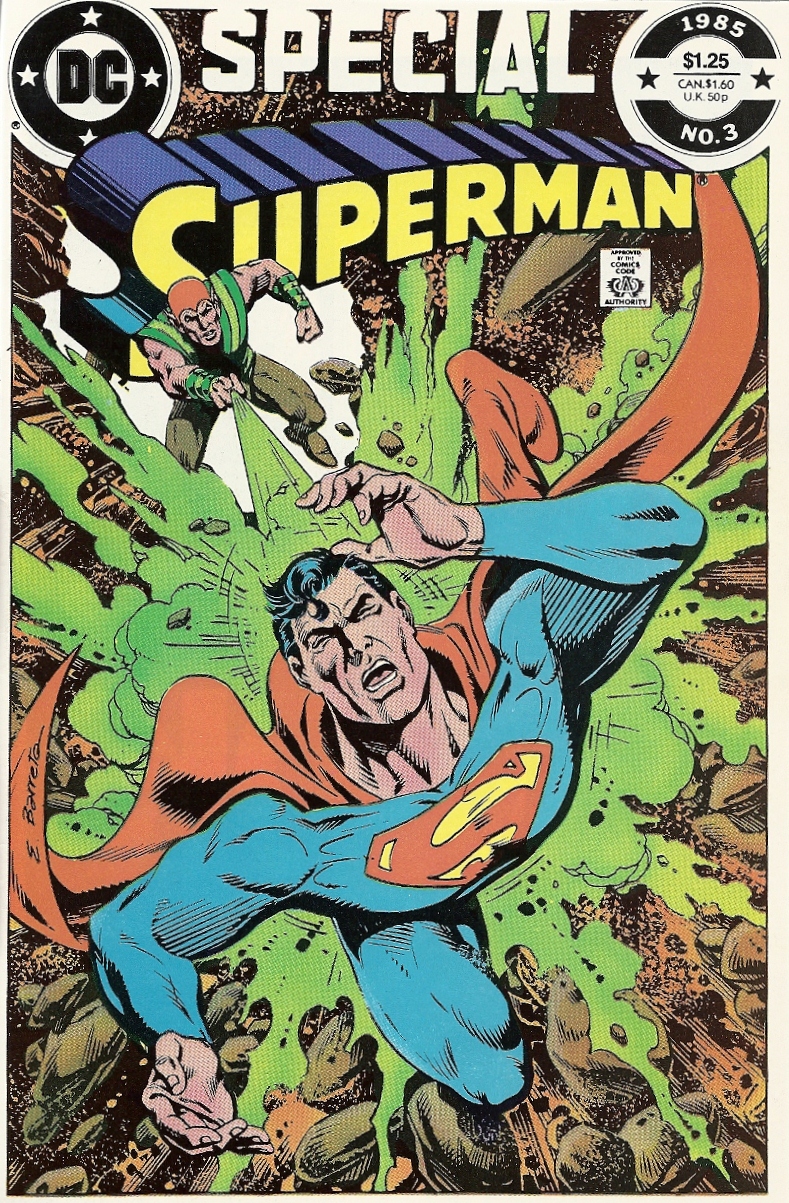
I remember quite vividly having this comic many moons ago, and it’s managed to hang around in the back of my subconscious for the last couple of decades. The contents haven’t been perused in those intervening years, which means that there was something that remarkable within had to make it tattoo itself onto the cerebellum. I can tell you that it wasn’t the standard classy cover from the recently departed Eduardo Barreto that locked this baby in (though it’s quite good). YOU’RE GOING TO HAVE TO WAIT A SECOND FOR THIS SHOCKING REVEAL. Sorry. Scumbag move, I know.
Having bought and re-read the book in recent weeks, I beg your indulgence that I might whinily complain for a moment. Lend me your eyes and ears. Here’s the moan: This comic is terrible. TERRIBLE. It’s the most unspecial Special I’ve ever read in my entire life, and believe you me, I’ve read some awful crap.
Why’s it so bad? One word: AMAZO. Don’t misunderstand me. I don’t have any issue with the character, his origins, or his appearance. That’s all fine and dandy, though the look he sports here makes me think of a half-costumed Vulcan drag queen. The problem is that there’s a storytelling trap that goes along with the power-copying ability of the Justice League’s android nemesis, and it’s a big one. He makes writers feel that they have to take a checklist of the League’s roster and go down from character to character to make sure that Amazo employs, if not all, a substantial number of the members’ powers. The end result is always like reading a plot laundry list. “Look he’s screaming like Black Canary now he’s shrinking like the Atom OH MY GOD HE’S TALKING TO FISH.” The extra page count in this “Special” exists solely so that we can run the fantastically boring “Amazo’s Stolen Powers” gauntlet. Get it all in, boys!
There are other demerits here, make no mistake. That Superman comes off as a doofus is pretty bad (you’ll see). But Amazo is the worst. The interminable checking-off stretches the Superman vs. Amazo contretemps to unbearable lengths, so far it makes the Quiet Man fight seem like Mike Tyson’s 91-second K.O. of Michael Spinks. It’s the proverbial sawdust stuffed into meatloaf. It’s like reading the phone book, all the way from Aaronson to Zuckerman.
Join me, so that you might share my vexation! Or go completely in the opposite direction! Your choice!
“Amazo Means Mayhem!” (Plot: E. Nelson Bridwell, Script: Len Wein, Pencils: Irv Novick, Inks: Pablo Marcos) starts when Superman makes his first colossal bonehead move — or the last in a series of bonehead moves, depending on how you look at it. He’s rebuilt the previously destroyed Amazo and brought him to the impregnable Fortress of Solitude, where no one could possibly steal- OH SON OF A…:
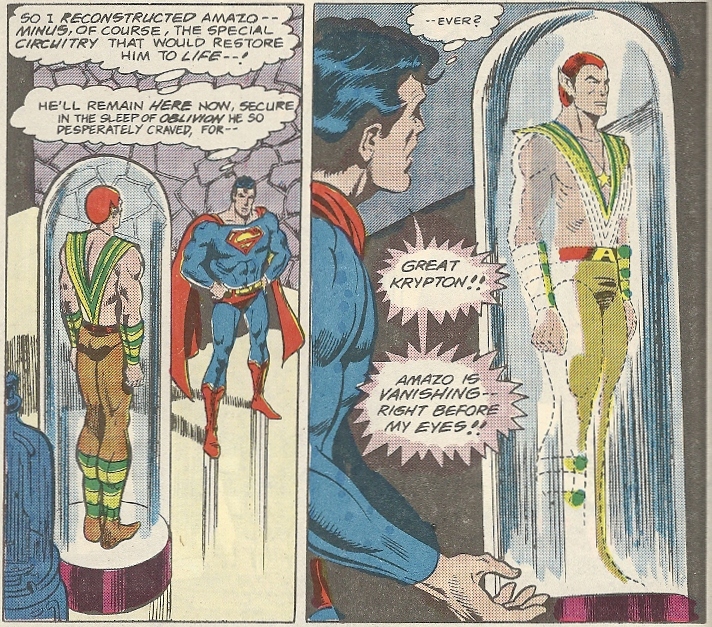
Another proud moment in the career of the big blue banana.
Who pilfered him? It’s now that we come to the reason that I remembered this book — though not it’s mediocrity — for so many years:
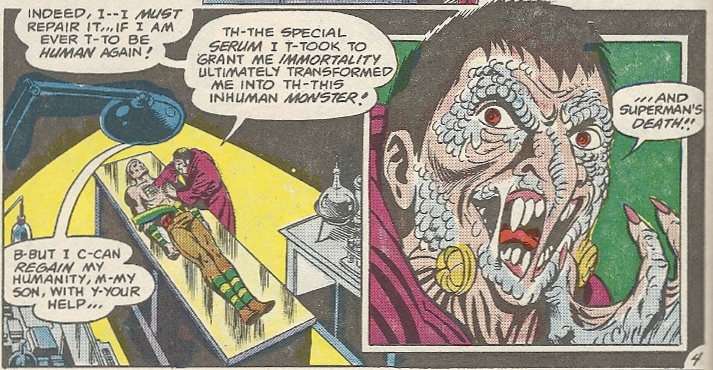
Professor Ivo, Amazo’s creator. This. Guy. Grossed. Me. Out. Still does. I don’t if the scaley crap on his skin is worse, or the way his nose links up with his lower lip. Probably the latter. THAT’S NASTY. But the sight of him makes me want to throw up (really), though I guess that’s what you have to go for with the self-loathing, desperate for longevity Ivo. Misson accomplished. Big time. Congrats all around.
One final thing about the good Professor, because, though he appears again in the story, I won’t allow his mug to appear again in this post. I’ve long thought that his look here is close to what an anti-semite sees in their foul anti-semitic nightmares. Something like that frightful visage above probably kept Henry Ford up nights (…zzzzassemblylineszzzzjewszzzz…). Ivo is like an inadvertent avatar for the International Jewry bogeyman. I admit, I’m no expert in the dark world of Jew-hatred, so I could be off-base. Just an impression.
Anyway, Ivo has stolen Amazo so that he can drain Superman’s powers to help with Ivo’s never-ending quest to cheat death and get his non-ipecac face back. And Clark has more problems than the missing Amazo, as even his Ron Burgundy day job offers him no respite:
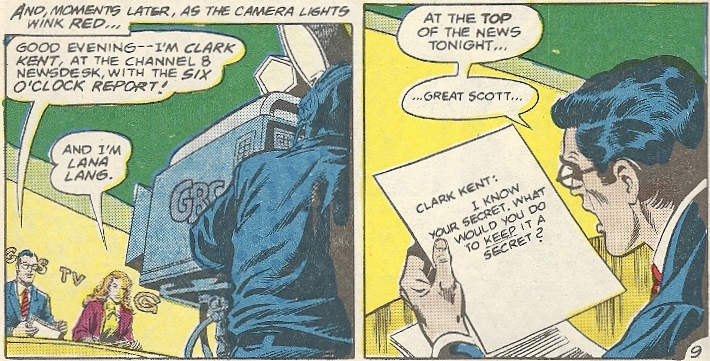
This one even follows him home after a night on the town with Lana Lang:
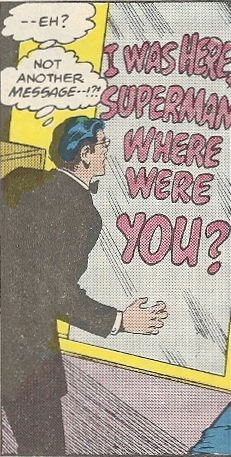
No paint left over for some extraneous “WHO WATCHES THE WATCHMEN” graffiti?
Clark opts to tackle one problem at a time, and changes into the cape and tights and to face off with Amazo (who had earlier called out the Man of Steel at the WGBS studios). This is when we get the 438 page laundry list. One. By One. We go through. The powers. Like counting sheep. In hour 47 of the battle, Superman finally immobilizes his foe when he uses Plastic Man’s (or Elongated Man’s — I didn’t really care at this stage) stretching against him. But Superman — as seen above — can also be a super-idiot:
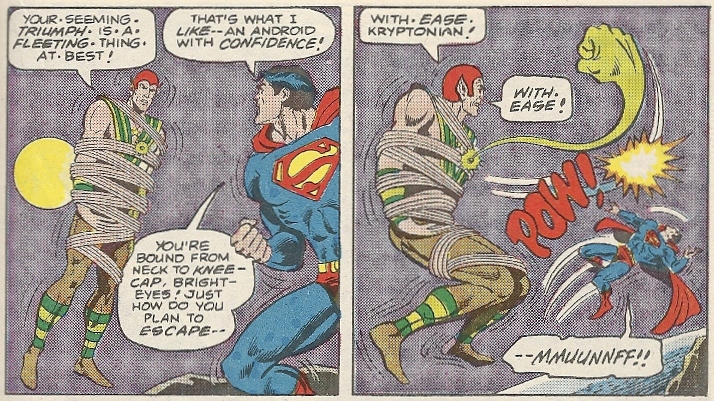
Ohhhhh. The ring. Forgot about that. Even though it was used moments before. AMAZO EVEN USED IT ON THE COVER, YOU DOPE.
The fight is one big stalemate, so Amazo dashes off to the Fortress of Solitude to re-arm, planning to syphon off the collective powers of the Bottle City of Kandor’s denizens. He’s in for a rude surprise:
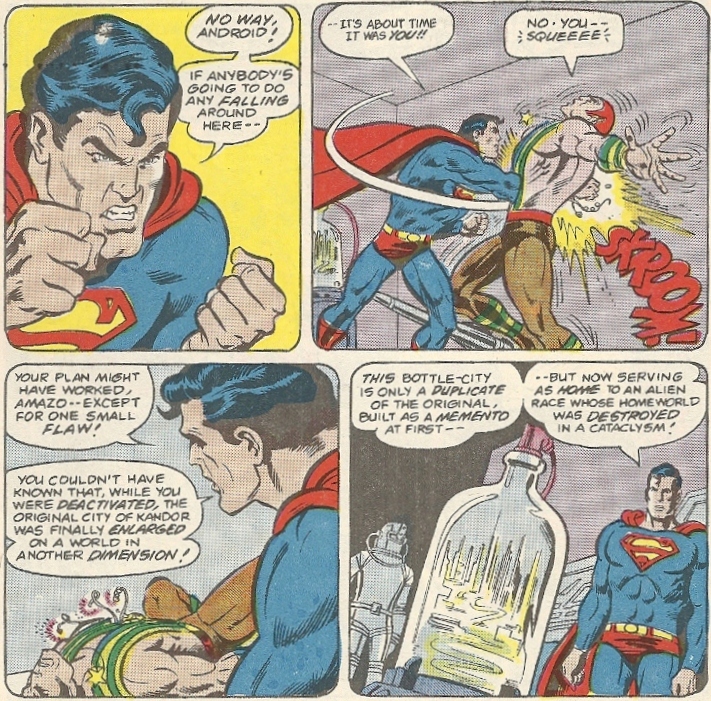
Superman has a thing about punching foes through the torso. That’s rather chilling when you think about it.
Supes then reprograms Amazo and uses him to trap Ivo, who will go on having a face that makes me want to vomit. Problem #1 solved. But there’s still the whole secret identity thing, which is the bigger logistical nightmare. Will Kal-El be outed like a superhero Rock Hudson? He’s already put two and two together and tied the notes to a magician/hypnotist named Presto, the nephew of the Daily Planet’s obituary editor, who had learned — but promised to keep secret — Superman’s identity when he hacked into the Fortress of Solitude’s computer. (I’m getting dizzy.) Here’s how that reveal went down:

So this douche was just leaving the taunting messages for a bit of “fun.” Superman resists the temptation to have a reprise of the Amazo climax and punch a bloody hole in this guy’s chest. I’m not sure I would have been so calm.
Instead he opts for one of his least used — and perhaps non-existent — powers:
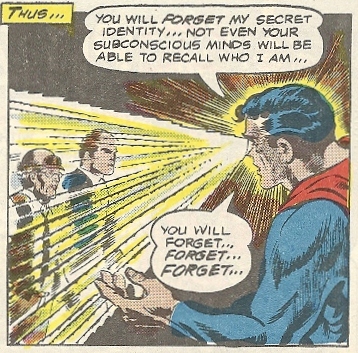
Yes, super-hypnosis, which ranks right around the cellophane S-symbol from Superman II in the “give me a f–king break” index. But who am I to mock? SEND SOME OF THAT MY WAY, SUPES. I wish I could forget…forget…forget…
Some things are better left unsaid, and it turns out some things are better left un-reread. I still appreciate the Novick/Marcos work on Ivo, which retains its retch-factor over the course of years, but this is one of the weaker “Special” efforts from that time period. I can’t help juxtaposing it with the contemporaneous Superman Annual #10 that I reviewed here a number of months ago. That was extra-long as well, and it also had one of the dumbest plot devices ever unfurled (the astral Sword of Superman). But it was a fun, grin-engendering tale. This isn’t. This is dull.
With Amazo, though, and his de rigueur checklist, “dull” might be a congenital defect, and one that’s hard to overcome.
Practice with Boaterific and one day you too can flip a cruise ship on its side and abandon it before the women and children!
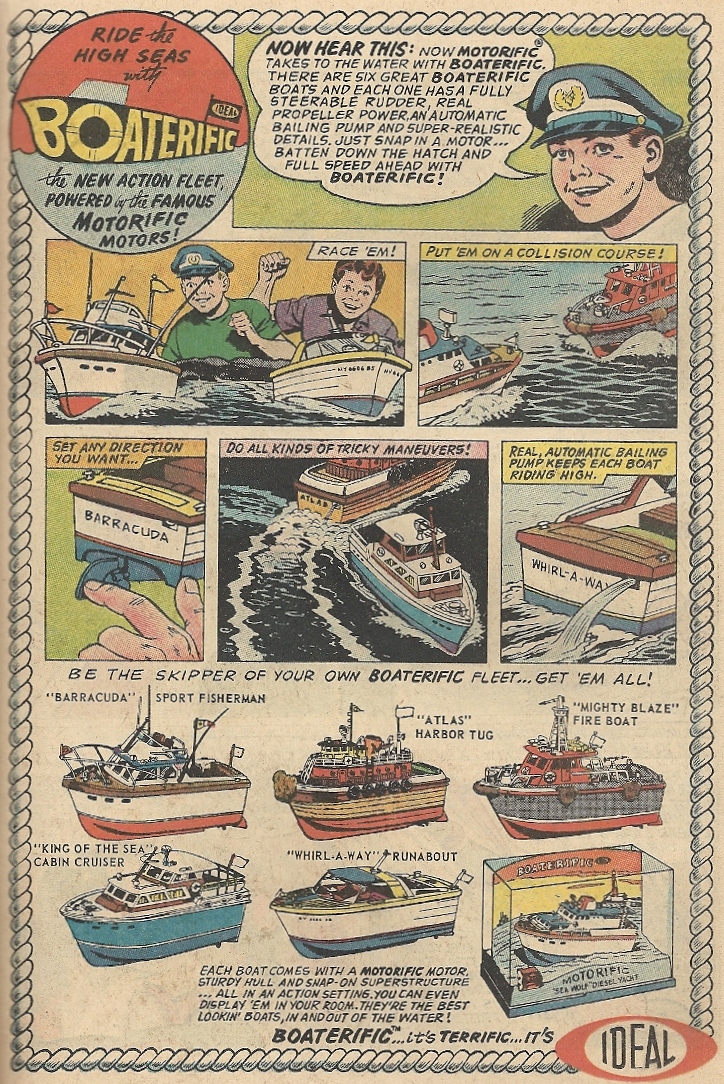
If truck stop playsets aren’t your cup of tea, then maybe you should try these Boaterific toys. Work yourself up to a Joseph Hazelwood/Francesco Schettino degree of maritime incompetence. Sink that bitch!
Young Bill Mantlo, Young Keith Giffen and Young Klaus Janson bring you the very nude debut of WOODGOD – Marvel Premiere #31

That’s one of the few character mastheads that looks like it could use some Murphy’s Oil Soap.
It’s a ridiculous feature of comic books that superbeings, godly creatures with powers far beyond mortal ken, wear undies. The Silver Surfer had two things back in the day: the Power Cosmic and tighty whities. Fin Fang Foom — a dragon, of all things — wore his Fruit of the Foom’s. Preposterous. But it was, and is, a welcome addition. None of us wants to get any more familiar with these characters’ packages.
We’re not as fortunate here. At no point in this comic do we get acquainted with Woodgod’s little Woodgod. Throughout the book it’s either shrouded in shadow or covered by his satyr body’s hair, which extends Tony Shalhoub-like over much of his body. But he is very, very nude. Man-Bat nude.
Not to get hung up on that, though. Moving on.
Woodgod. It’s hard to write that with lower cases. WOODGOD. Bill Mantlo would go on to dash off scripts for Rom, Micronauts and countless other characters. Keith Giffen would become, among other things, one of the foremost chroniclers of the Legion of Super-Heroes. Klaus Janson would one day form a great byline with Frank Miller, whose famous pencils he made his own. But for one brief, goofy moment early in their careers, these guys teamed together to create one of the strangest minor characters in the Marvel Universe, Marvel’s Pan. And Jack Kirby even did the cover for this moment, as if to further drive home that this character would surely enter the august pantheon in the MIGHTY MARVEL MANNER. Fantastic Four –> Thor –> Woodgod.
Well, Woodgod didn’t. But his debut is still worth a gander, if for no other reason than to see three comics veterans at the formative stages of their working lives. Not at their peaks, mind you. Far from it. But feeling their way around, much like their fictional chimera.
Strap yourself in.
What a way to begin — we open with this odd-looking dude wandering down an abandoned street. FULL FRONTAL wandering:

Woodgod, in a dull, absent-minded search for his pops, meets only two other living things here on this dusty lane, a man and a dog. Both attack him. He kills them both, as he goes into a red-eyed kill mode. Not much else to say besides that, but remember that Woodgod met a living man. That’ll be important in a sec. For now, though, it’s enough to note that both encounters touch off flashbacks, including one to some of his very first moments on Earth:

Yeah, doc. I’m sure he’s never going to pick up on the cloven hooves.
Woodgod is the product of some Frankenstein/Dr. Moreau/tampering-in-God’s-domain experiments by David Pace (a scientist, obviously) and his wife. It’s not clear what the motivation was for Woodgod’s creation, whether the Pace’s are a childless couple taking matters into their own crazy hands. But when do mad scientist’s ever need a reason? I’m harkening back to Dr. Mephesto in South Park, who once spliced Swiss cheese with chalk and a beard. Just because.
It isn’t long before rumors of what’s going on up in the forest filters back to the nearby townspeople. Or, more precisely, the townspeople in a bar. And what happens when liquored-up hillbillies get an inkling that there’s something unnatural happening in their neighborhood? You guessed it — METAPHORICAL PITCHFORKS AND TORCHES. Rifles in this case.
They march up, bombard Dave with some “We come fer the creecher” threats, and, well, you can probably guess what goes down:
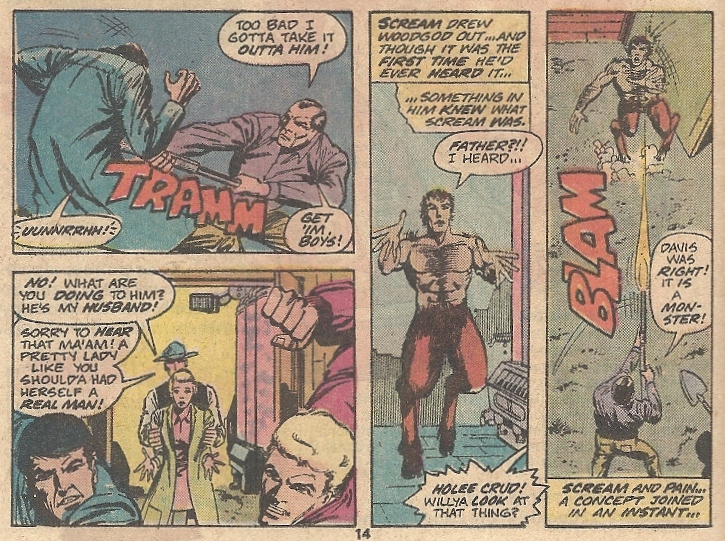
The drunk yokels then bust into the lab, where they spot giant jars of pink/purple mist (you can see the jars behind the “proud parents” in the second interior scan — and in the lower left panel above). Not understanding what they’re seeing, confused drunken yokels do what confused drunken yokels have been doing for millenia, and bust things up. This releases poisonous gas — apparently the good doctor and his wife were also weaponizing Pepto-Bismol — which kills everyone except the head-shot Woodgod.
And that brings us up to date.
Back in the present, there’s a shady organization, who sponsored Pace’s work, that’s checking up on what’s going on, and they’re more than a little curious about how the town got wiped out and what the hell that thing is that’s roaming up and down the streets like a naked tumbleweed. They decide to investigate, donning hazmat suits and mounting up on their stupid looking flying contraptions:

“Floater.” Somehow appropriate.
They move in to attack the genetically-enhanced Woodgod, who fights back and hits them with everything at his disposal, including the U.S. mail:
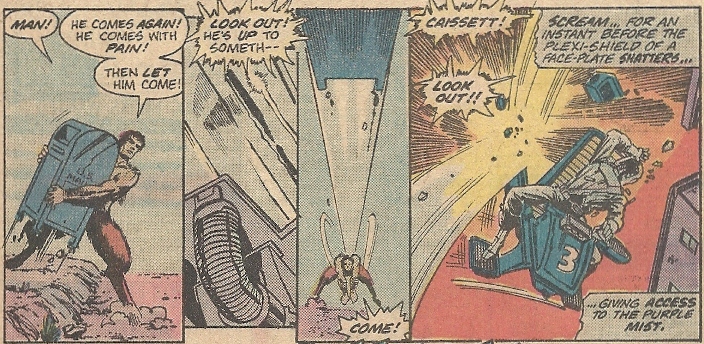
The men and their dopey contraptions are shot down in rapid succession, and one man dies instantly when Woodgod busts open his faceplate and exposes him to the toxic air. Yes, the deadly air that killed every man and beast for miles and miles around, but not that the dog and the man were traipsing about in a few pages and a few moments before. IT DOES NOT SEEM THAT THIS WAS A WELL THOUGHT OUT PART OF THE PLOT.
We end with some ambiguity, as the head g-man is spared Woodgod’s wrath:

It really makes you think. About what, I don’t know. But it sure makes you think.
And what are we to make of this? First, let’s deal with the art. It’s stiff. You can see hints of the future styles of the two artists, especially Janson’s aggressive — and some would say overwhelming — strokes, but here it just feels cramped. I’M NOT BITCHING. Just observing. It takes time for people to get their groove. Even in something as simple and dopey as writing a blog, and takes some time to get your feet. I cringe when I read some of my earliest posts, that are — wait for it — incredibly stiff. I empathize, and this blog here can by no means be considered art, much less commercial art flung out to the teeming multitudes. And you can tell that Giffen and Janson put work into this comic. Young. Hungry.
Same with Mantlo. He’s trying so hard here, maybe too hard. Take Woodgod’s “scream” verbalization, which I think is supposed to be a simple mind’s symbol for man’s inhumanity to man. Violence, that sort of thing. I think. I don’t know. The point is, Mantlo’s trying so hard to make this little comic deep, into some Rod Serling meditation on the folly of man, when really all it should be about is the silly FrankenPan that gets grown and grafted and inadvertently unleashed on the world without any pants. Like Giffen and Janson, he’s young and hungry, and probably a little over-eager. This outpaced ambition detracts from the comic’s objective quality, but it’s endearing, and that latter point matters more than the rest.
Quibbles aside, this is still a decent read. Mantlo’s Rom stories are some of the foundation cement of my comic life, and I’m always happy to see his name in the credits. I was here. And it’s fun to read him macheteing his way through an early script with Giffen and Janson at his side, even with the glaring error (or what appears to be one, I might have missed something) of the toxic, deadly, inescapable poisonous gas that kills everyone except for the man and the dog. All is forgiven.
And I could be way off-base with my observations here. Just inklings I guess, but it really seems that the exuberance of youth permeates the newsprint.
Woodgod. WOODGOD. He is what he is. FrankenPan has made a splattering of subsequent appearances over the years, including one in Marvel Team-Up that followed up on the events in this origin story. Track it down — along with this one — if you’re desperate for more of his godly wood. I’m shocked — SHOCKED — that Woodgod has never received the Omnibus/Archives/Masterworks/Absolute treatment. Who wouldn’t want to see his hairy shoulders and exposed yet shadowy crotch in a lush, oversized volume?
Hulk smile at you, BUT HULK WAG FIST AT YOU TOO.
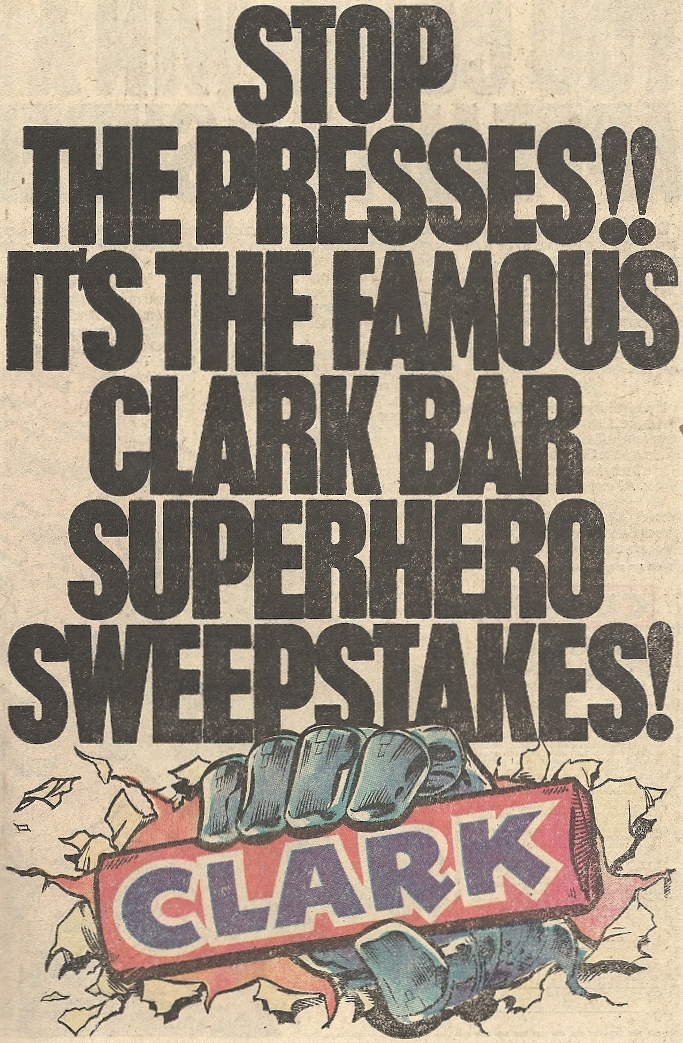
I’ve posted the DC Comics Joker/Milk Duds version of this ad before. This one lacks the negative “poison foodstuffs” associations, but if I might make one brief observation about the cheerful characters below:
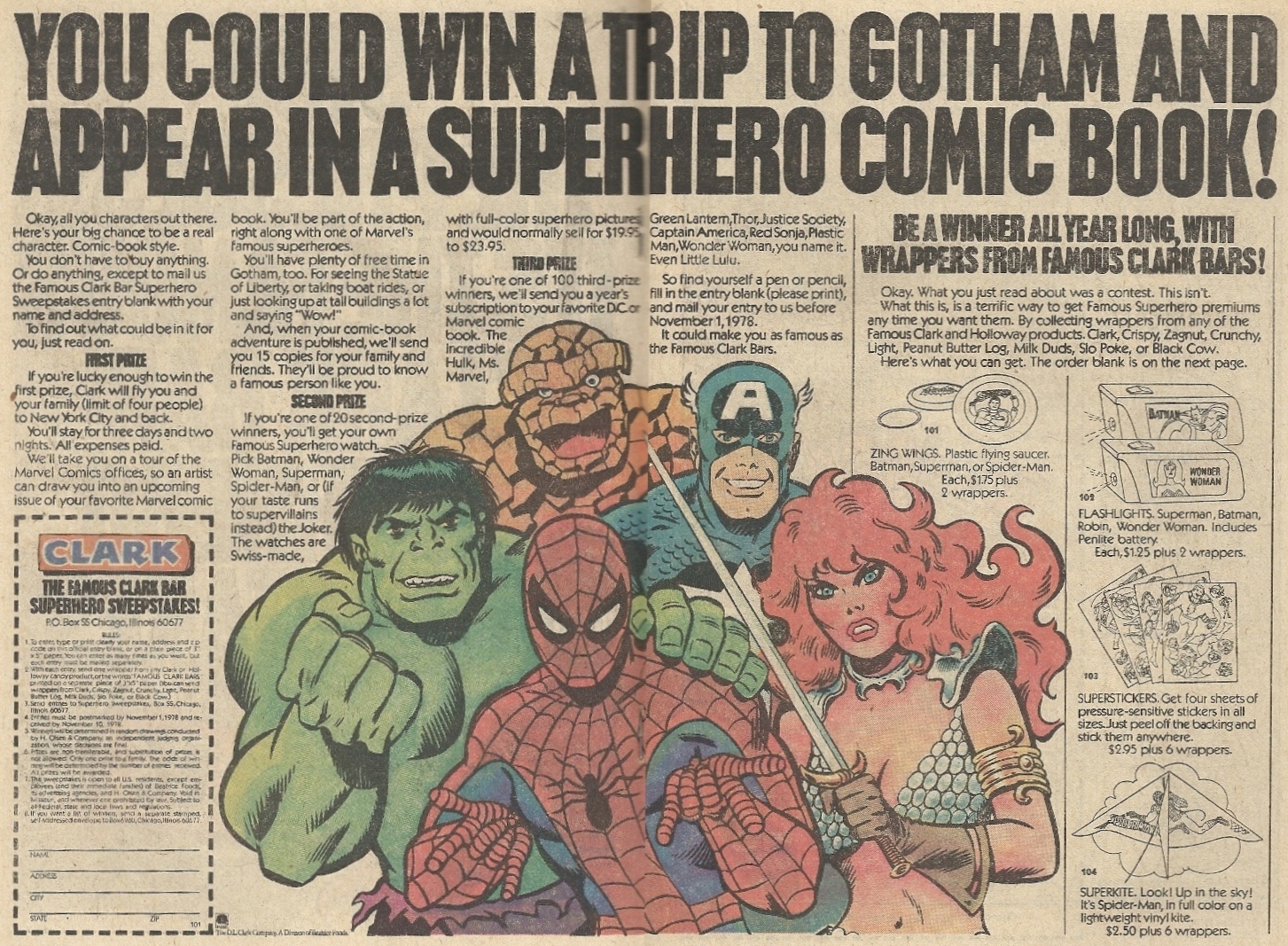
Well, a few observations. First, Red Sonja should go easier on the rouge. “Back off the red, Red!” Second, that may be the dumbest Ben Grimm has ever looked, like someone just popped him in the face and he’s seeing stars. Or he’s drunk. Third, Spider-Man’s pose for some reason (maybe it’s that the webbing print forms an optical illusion that his hands are facing the other way, I don’t know) makes me think of Liberace. “I wish my Uncle Ben was here.”
The last thing. Remember the Comedy Central cartoon Dr. Katz? In it, a psychologist would counsel a stream of comedians/celebrities that plopped themselves on his couch, all of whom did their routines or recounted stories of varying hilarity. One “patient” was funyman Lew Schneider. He had a spiel about the conflicted way that men hug, with the pat on the back that goes along with the embrace. “I’m hugging you, BUT I’M HITTING YOU.” View any episode of The Sopranos for countless examples of the man-hug.
The cheerful Hulk above, with his toothy grin and clenched ham hock fist, reminded me a lot of that routine. HULK HAVE TROUBLE ARTICULATING EMOTIONS.
Captain America is the only one that comes out of this thing unscathed. He must have a good agent.
Anyway, you could certainly win a whole lot of crap in this sweepstakes. Here’s the rest of the booty:
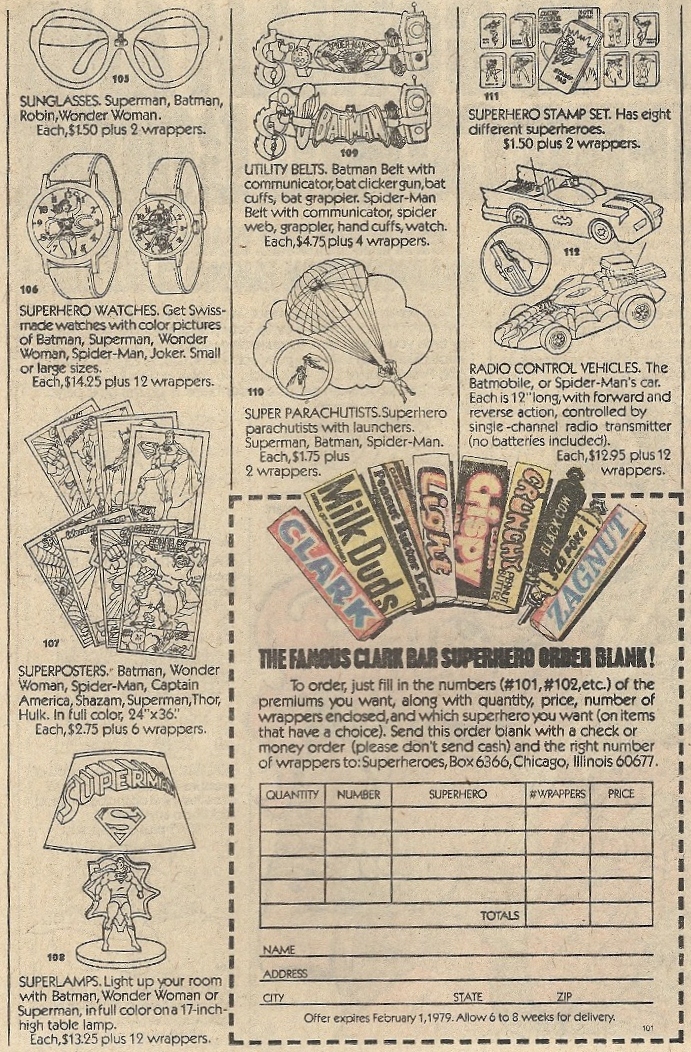
I had a couple of parachutes for my G.I. Joe and Cobra figures as a kid. They somehow violated all laws of physics by making the plummeting men fall faster than they would unaided. The parachutes were a lot of fun, that is, if you enjoyed watching your beloved toys violently corkscrew into the ground from an upper-storey window. It doesn’t look like the chute above is of vastly superior quality.
Recreate Close Encounters of the Third Kind’s opening scene in a sandbox. YOU KNOW YOU WANT TO.
Laughlin: What the hell is happening here?
Project Leader: It’s that training mission from the Naval Air Station in Ft. Lauderdale.
Laughlin: Who flies crates like these anymore?
Project Leader: No one. These planes were reported missing in 1945.
Laughlin: But it looks brand new. Where’s the pilot? I don’t understand. Where’s the crew? Hey! How the hell did it get here?

Doesn’t the whole “no glue, no paint, all you have to do is snap them together” thing take away some of the essential ethos of model building? You know, the glorious tedium? The painstaking painting? The agony and the ecstasy? Why not just buy a complete plane, one ready for action, if you’re just going to half-ass it?
I ask these questions as the grown up version of the kid who’d make a complete hash of a model and then violently chuck the glue-riddled Frankencar against a wall.
Then again, if you have to forge your own Close Encounters playset in a hurry, ACCEPT NO SUBSTITUTES.

Eat your greens!
I want to be clear before I start busting Mr. T’s balls. I like the guy. When I sat down and read this comic, it occurred to me that he might have been the very first African-American actor that I could recognize as a kid, one where I knew who they were apart from the role that they played. Between his B.A. Baracus A-Team days and his terrifying turn as Clubber Lang in Rocky III (HE KILLED MICKEY — BASTARD), he was hard to miss for a youngster. And he played both a hero and a villain. Such range. Plus, and this was the cherry on top, he wrestled in the WWF, teaming with Hulk Hogan to beat the living hell out of Rowdy Roddy Piper and Paul Orndorff. He was a human Swiss Army Knife. Versatility, baby.
While few have ever capitalized on a fearsome glower more than Mr. T, behind it there’s a guy who’s not full of himself. His growling public persona has always been ripe for satire, and he’s been more than willing to take some ribbing. He has a sense of humor about it all. You cannot not like that. Finally, he beat cancer (T-cell lymphoma — you think he and his doctor wryly smiled at that diagnosis?), or, to perhaps put it more accurately, he knuckle-sandwiched it into a bloody, insensate pulp. I tip my cap to him for these things. Truly.
I debated whether or not to include this comic among the Black History Month selections. February is a time when individuals like Booker T. Washington, Dr. King and Frederick Douglass get careful, deserved consideration, not a guy famous for grumblingly flattening people. But, if he lacks broader significance in the African-American historical scene, Mr. T has a good deal of cachet for me personally, and he assuredly has a spot in the entertainment pantheon. And, fortunately(?) for us all, he had this comic book, in which fools were pitied and jibber-jabber was not allowed. Ripe for picking.
On to said comic.
The leitmotif of this 1994 series was supposed to be Mr. T’s positive message to the world. What positive message, you ask? I wish I could tell you. Because, apart from a back cover ad that should leave T cringing in shame all these many years later (more on that in a moment) and ads for T-Force t-shirts, there’s little evidence of what the bedrock of Mr. T’s credo was. Unless said credo involved using punches and kicks to resolve all of life’s problems, because all of life’s problems devolve rapidly into S.E. Hinton gang fights. If that was the theme, than it was received loud and clear. Not just received loud and clear. It’s drilled into our heads. Over. And over. And over. And over.
Other issues, including the Neal Adams-pencilled premier (reviewed amusingly here), could get a tad far-fetched, with T displaying nigh-superhuman abilities while battling hordes of folks who seemed miles out of place in his inner city stomping grounds (no Fast Willies around, though). This selection (Script: Mike Baron, Art: Tony DeZuniga,Cover: Jeff Butler) is tame in that regard. No ninjas or cyborgs or aliens. It starts with our eponymous champion putting some of his Rocky experience to good use as the corner man — I’m sure he watched Burgess Meredith like a hawk — for a journeyman fighter stepping into the ring with a champ. But first T and his charge have to get to the ring, and in this surly crowd, ready for a racially-tinged battle of black fighter vs. white fighter, that could be challenging. Challenging for anyone else, that is, besides a guy who face-kicks first and asks questions later:

Instant orthodontia. Stay in school!
T’s fighter loses a questionable decision after knocking down his opponent (if you have to steal a premise, steal from the best). During the fight he noticed some commotion in a dark corner of the hall. When he’s done with his corner duties, he investigates and butts his nose in on a drug deal:

Respect your elders!
That face re-arranged, T heads back to his neighborhood, where he escorts a landlady on her rent-collecting rounds. Sure enough, they’re soon beset by toughs, too many for T to handle alone (as hard as that is to believe). A young acquaintance spots the trouble and (off-panel) apparently uses Jack Bauer’s 24 teleportation device to get two people across town instantaneously — the two erstwhile ring opponents, now bound by a common desire to savagely concuss scumbags:

Ebony and Ivory, punching together in perfect harmony. Drink your milk!
Finally, T confronts a local crack-dealer, one that’s further corrupting the wayward youth we saw earlier at the fight. The dealer’s in the middle of making the kid lick his (the dealer’s) shoes (licking shoes would be bad, but one imagines that a drug dealer’s footwear would have a higher than average germ count) when T comes around a corner. T engages the dealer in a Socratic dialogue concerning the relative merits and dangers of JUST KIDDING HE PUNCHES THE GUY IN HIS F–KING FACE:

Don’t do drugs!
And that’s the comic. It’s a Mobius strip of short-fuse pugilism. It’s like watching someone run errands on a Saturday, with all the attendant ennui, but with punches when they leave the Home Depot and kicks when they stop at the ATM. There’s some adrenaline, but no point, no message. Unless the message is that drug dealers are bad. If it is, THANKS VERY MUCH FOR THAT.
Oh, and then there was this:

The three faces of T (Pensive, Playful, Jolly), I guess. I still prefer the four faces of the Bat. At least he wasn’t trying to get his hand into my pocket. I wonder if anyone ever left a “Your comic blows” message for our good 1980s relic. (Seriously, if anyone out there actually had some “T-Time,” I’d love to know what his motivational message was.)
So, yeah, T trolled in the lowest of depths, the Stygian 900 number perdition, along with Dionne Warwick and Miss Cleo and their huckster ilk. Everyone has to make a buck, and I don’t begrudge T his need to make a few dollars, but it’s as lame as lame can be. And maybe this ad summed up the whole enterprise. Comics were hot at the time (though the bottom was falling out — this comic came with a stupid trading card to lose like a Secret Wars hologram shield), and you might as well make money from a Mr. T comic as anything else. Such is the logic of an industry’s boom. Still, with the “positive message” crap (don’t do drugs and sock those who wrong you?) being posited as the backbone of the title, the whole thing reeks of hypocrisy. It leaves a bad taste in your mouth, like a fabulously wealthy televangelist. A crappy bad taste.
Again, I like Mr. T. He’s a part of my childhood. Even if he was/is a goofy pop culture blip, I still don’t like to see him part of such a stupid, pointless, blatant money grab, even one from going on two decades ago. It sucks. It’s funny in an unintentional “God, this is dumb” way, but that’s about all that can be said for it.
Anyway. There you have it. A little slice of T-Force.
Mr. T, feeling that his trademark gold chains conflicted with his work with the underprivileged, has in recent years forsaken his back-breaking jewelry. The comic died a quick death a long, long time ago. The hair remains. So does the glower. I doubt that the 900 number does. I sincerely hope not.
Rommel, you magnificent bastard, Rat Patrol read your book!

I’ve never ever seen an episode of Rat Patrol. I do, however, like its premise that four G.I. dudes — an Army Fantastic Four — could pretty much take on the entire German Afrika Korps. “Take a breather, Patton. We’ve got this one.” And this hobby kit couldn’t possibly be worse than the plain vanilla “box of men.”
Shameless Super Bowl Post XLVI

There’s no SEO “what time does the superbowl start” skullduggery in this. I just wanted to put my Super Bowl pick on record. But, to semi-legitimize this as a comicy post, here are some links to football related blog hijinks:
1) Norman “Punt, Pass and Kick” Rockwell
3) Booster Gold playing football OF THE FUTURE
4) Spider-Man getting an assist from the Dallas Cowboys to foil the Circus of Crime
There. Done. And now…
Giants 30, Patriots 24. Footnote: Brady with two fumbles and a pick. The Gisele Bundchen-solicited prayer chain will go unanswered.
Now let’s see how stupid I am.
“Abandon All Hope, Ye Who Enter Here” Includes Children

These “Justice for All Includes Children” PSAs were found in DC Comics around the bicentennial, and the one above I pulled out of the Super-Sons World’s Finest from last week. They remind me a bit of the G.I. Joe post-show “Knowing is half the battle” vignettes that allowed that violent cartoon to air — “Now that we’ve spent a half-hour firing guns at each other with no apparent consequences, HERE’S A WORD A BOUT BIKE SAFETY.” Except these Superman raps lacked the unintentional humor of the Joe stuff (seriously, a Joe would give advice to kids through a bathroom window and we weren’t supposed to be creeped out by that). You can find many of the Justice blurbs on the web, including a selection here on Dial B for Blog.
I love me some Superman words of wisdom, but these were stiff as hell. Plus Curt Swan and Vince Colletta (I think) seem disinterested at best in this short, which purports to convince us that juvenile court ain’t so bad. Yeah, a foster family situation has never gone south fast.
A thousand years ago I toiled on the juvenile docket for a local prosecutor’s office. There were a lot of fine, hard-working people associated with that corner of the justice system, from the judges to the attorneys I worked with to the public defenders, probation officers and detention facility workers. They all tried. But, let me tell you, it wasn’t even the dim ray of sunshine that Kal-El is trying to sell us. You’d go home some days wanting to hang yourself.
“The Little Legion of Super-Tykes.” Adorable line of plush dolls to follow. – Adventure Comics #356

I’m sensing that there may have been a missed marketing opportunity with “Little Mon-El.”
Remember when the “Little Endless” made their first appearance, in the Jill Thompson-pencilled The Sandman #40? Remember Cain’s reaction to Abel’s story introducing them? The one told to Daniel, the future-Dream? You don’t? Then I shall quote it for you:
Children? They didn’t even look remotely human. None of us did, back then. What are you trying to feed the child — sanitized pablum? Li’l Death? Li’l Morpheus? Revolting!
Revolting. When I saw the Legion of Super-Heroes miniaturized in the above cover, that was my initial lean, despite baby Brainiac-5’s charming PLEASE ADOPT ME building block edifice.
Then again…
Remember (sorry for the “remembers”) that Star Trek: The Next Generation episode where a part of the crew (Captain Picard, Ensign Ro, Guinan and Keiko) were turned into kids? I wanted so much to hate that one, to work myself up into a Category 5 dither that a show which offered such stellar drama as “The Inner Light” would sink so low. But the sight of little Picard hugging his towering “Dad” Will Riker, and his lamentful caress of his bare scalp when restored to bald adulthood (I feel your pain, Jean-Luc), made me love it. It was a 180. A deserved one.
And I sort of love this comic. There’s something about seeing the late, great Curt Swan roll around in ridiculous Silver Age tomfoolery that gets me every time. EVERY TIME. Put him together with the Legion, a group ripe for such nonsense, whether it’s alien femiNazis or gem mines, and you have a baseline of success. There’s only so low that you can go with Swan.
That rock bottom is ever-reassuring, but there’s no reason to worry about tickling that lowest mark here, because this issue has more than enough of the aforementioned tomfoolery. Scads. And, friends, it’s of the highest order. A chunk of the Legion of Super-Heroes reduced to orphanage-bound shenanigans — that’s worth a look.
And that isn’t all that’s lurking within. There’s also a dark twist, and I don’t think the crew forging this brief tale really realized how dark it was/is. Maybe it’s just jaundiced, cynical 2012 eyes reading sinister things into 1960s innocence. Maybe. Maybe not.
We’ll get to all that in a moment.
The action in this E. Nelson Bridwell-scripted and George Klein-inked affair starts on Parents’ Day. (Mother’s Day and Father’s Day combined into one? Surely this must be THE FUTURE.) There are accompanying parades and receptions for this holiday, both of which include the superstar Legion:

That panel proves that, even in the far future, reporters can still get stuck with crummy beats.
There’s no party for the Legion orphans (Brainiac-5, Mon-El, Superboy, Dream Girl and Element Lad). For them it’s white-bread sandwiches and the call of duty:

An interstellar distress call comes through in short order. A planet’s power supply has been disrupted because their power-generating crystal has been stolen (or something, my eyes glazed over), and now it’s submerged in an ocean. The Orphanairres answer, and when half of the response team dives down to get it, they come back up tots. Superboy and Mon-El then prove that super-sense isn’t in their mutual array of powers:

The end result?:

“Little Mon-El.” THIS WOULD DRIVE CAIN STARK-RAVING MAD.
Planetary authorities, not making the obvious connection between these costumed kids and the Legion, cart them off to an orphanage. I guess we should simply be thankful that it’s not an interstellar Romanian orphanage. We then get a replay of the cover scene, and the kids are almost immediately adopted. Fortunately for them, Brainiac-5 still has his super-synapses, and when they arrive at their new homes he starts putting two and two together:

There was something in the water, if you haven’t guessed. Brainiac-5 cooks up a cure, and uses a variant on the “A Spoon Full of Sugar Makes the Medicine Go Down” gambit to get the rest of the kids to swallow it:
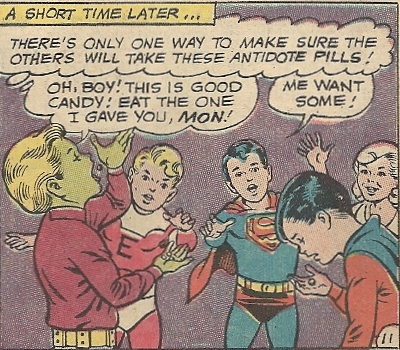
Restored to their normal sizes and cognitive capacities, the Legionnaires confront their new parents, who have some ‘splanin’ to do:

Dying children. Cheery. And could there be a more depressing image than the UNUSED AIR-BIKE?
This might reverse your sympathies (enter the mild darkness):
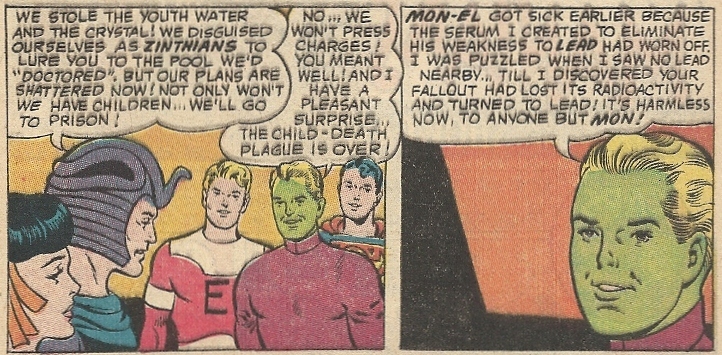
“So you’re a step — a step — above those people who kill pregnant women and rip the babies from their still warm wombs. But hey, no harm, no foul.” Not to diminish the pain of a lost child, and call me Draconian, but maybe a short stint in the hoosegow (of THE FUTURE) might be in order? A fine? Some community service? SOMETHING?
I’m probably making too much of this. Or maybe I’m not. Whatever.
Curt Swan. THE MAN. I’m racking my brain right now, and their isn’t an artist on the planet, passed on or living, that I’d rather have illustrating this story. The image of that little scamp Brainiac — with his ENORMOUS head — running around trying to find a cure is going to stick with me for a good long while, and in a good way, not in an awful Skateman way. It’s enough to help a reader overcome that ickiness about the forlorn parents ruining the lives of others to fill their empty hearts.”MEANT WELL” MY ASS.
This comic was reprinted in DC’s Legion of Superheroes Archives Volume 6. Maybe track down a copy. Silver Age Swan — the most nourishing of brews.
Do your Spider-Man action figures yearn for hot zip-line action? MEGO HAS JUST WHAT THEY NEED.

This ad got me all curious about what the hell the “Supervator” was. All I could think of was the time Superman took a moment during plunging elevator rescue to toss rescuees some Hostess cupcakes, which was not his proudest moment. But this is oh so much more. Click here for a more in-depth look at the Supervator and its operating manual — hours of gravity-induced non-electronic fun.
After the dopey Fast Willie, a dash of Martin Luther King, Jr. should cleanse the Black History Month palate
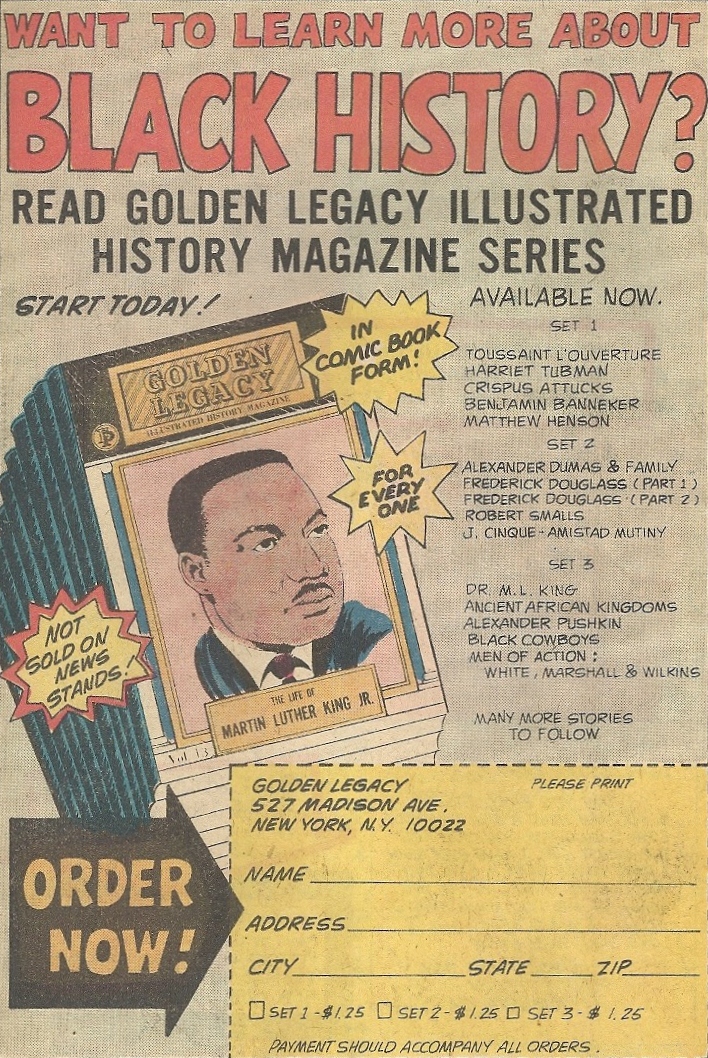
It seemed wise to sequester this from the Fast Willie Jackson comic in which it was found. The Golden Legacy line of books are on a different level from a cheap Archie ripoff, though they shared a publisher.
If you want to do some reading this Black History Month, perhaps sequential art would be the way to go. You can still order these things direct, and you’ll find nary a Fast Willie in sight.
Would Tony Hawk be caught dead shredding on this?
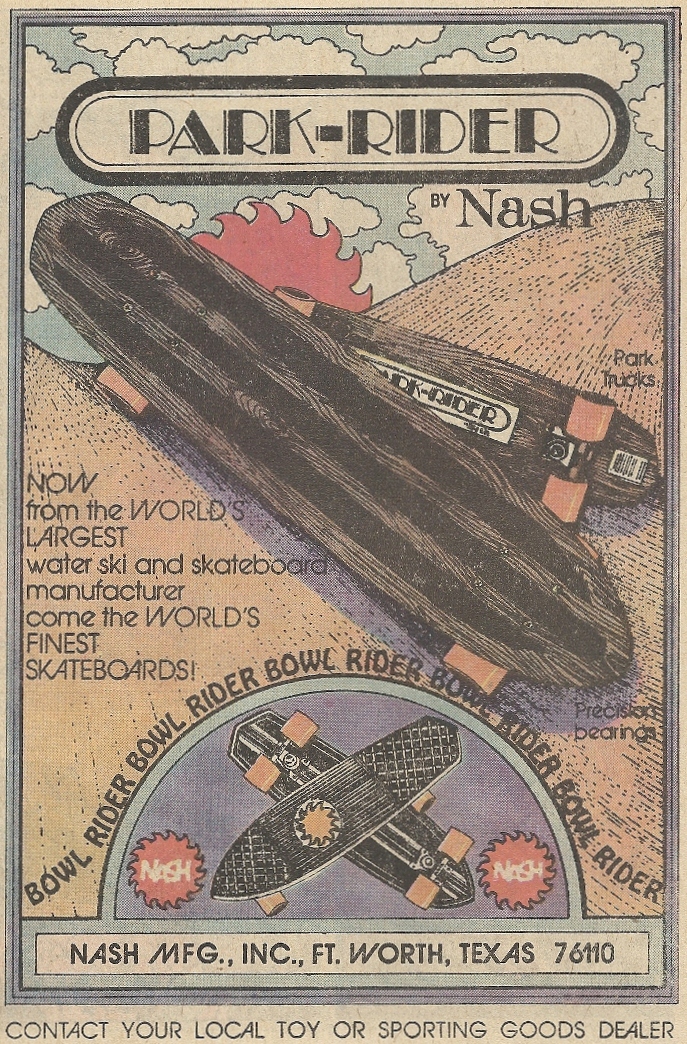
Is a wood-grain skateboard a good thing? Does it have a “back to basics” authenticity about it? Just wondering, because to me it calls to mind wood-panelled station wagons, trips to Costco, picking up the kids from soccer practice, and Mom jeans.
“Can you dig Black Archie?” No. No I cannot. (Black History Month Begins) – Fast Willie Jackson #5

The Black Archie. That’s it. That’s all you have to say or write. You don’t need to waste any more words than that to sum up Fast Willie Jackson, a largely forgotten gem(?) from the 1970s. Published by Fitzgerald Periodicals, and written in spurts by company owner Bertram Fitzgerald (who likely wrote the whole series, including this uncredited issue), it was an urban transplantation (into “Mo City”) of the Riverdale set, an intellectual property strip-mining with a multi-ethnic, primarily black cast. The series artist was Gus Lemoine, who had, no surprise here, a number of Archie credits to his name. (I’ve read speculation that Lemoine is an alias for Henry Scarpelli. I’m not sure of the worthiness of that conjecture, as I’m no Archie archeologist. IF ANYONE OUT THERE HAS SEEN BOTH IN THE SAME PLACE…)
The book reads like Archie. It looks like Archie. ARCHIE ARCHIE ARCHIE CITY ARCHIE BLACK ARCHIE. But it’s not even up to that level. Granted, I don’t like Archie, period — unless, of course, he’s being menaced/protected by the Punisher. But this is derivative Archie. It’s even worse.
Here are the dramatis personae of the Fast Willie-verse, from a back cover subscription solicitation:

The “next 6 issues” promise is sad (or maybe not) in light of the book’s cancellation two issues later. The best laid plans of mice and men… (Officer Flagg — related to Reuben Flagg?)
When I bought this, I had no history with the title. I didn’t know what to expect. I was hoped for some jive-talking, full-fledged, giant-afro-in-your-face blaxploitation. So blaxploitative that you might expect to see Pam Grier or Isaac Hayes come strutting around any and every corner, know what I mean? At least that, though amusingly offensive to overly sensitive 21st century eyes, would be interesting. Sadly, this brief interlude with Jabar, a local professional protester (whose dudgeon dexterity would fit right in with today’s Occupy folks), is the only hint of in-you-faceyness:

But what lurks within these pages is just the pure distilled dreck that was the guiding principle of the title. RIP OFF ARCHIE. That’s what you get. That’s all you get. It makes you yearn for the richly layered characterization of Mushmouth.
It’s so bland. There’s nothing to even get upset about. And that’s the most upsetting thing.
In most other cases, even when you hate an unfunny punchline you can at least appreciate the effort that went into setting it up. You can see what the author was going for, and there’s an architectural appreciation for the structure. There isn’t any of that here. Everything in the short vignettes is so obvious. So unbelievably obvious. And unfunny. It all reads like the “jokes” on the backs of the old Spidey Super Stories books.
At one point Willie and his Uncle Isaac find themselves in the bayou, where they meet the black Dr. Frankenstein and Igor, and the only thing that interlude makes you realize is how much more fun Blackenstein is compared to this:

Roosevelt Franklinstein. Can Roosevelt Franklin or, dare we hope, Franklin Delano Bluth be far behind?
If I can give credit to Fast Willie for one thing, it’s that the multi-cultural cast, with Latino restauranteurs and Jewish delicatessens, hits modern eyes a bit easier than the Whitey McWhite-White world of Mr. Andrews. That’s a prerequisite in today’s P.C. world, so Fast Willie was, if only in that regard, ahead of its time. Oh, and I liked the letters pages — though I GET THE IMPRESSION THAT THESE MIGHT NOT BE REAL GENUINE AUTHENTIC LETTERS:


Anyway, Fast Willie Jackson is lame. End of story. What a way to kick off Black History Month here on the blog!
In a final interesting note, not all that long ago Fast Willie Jackson made a kind of/maybe/not really return in the pages of Erik Larsen’s Savage Dragon, all grown up and down on his luck. But it wasn’t really Fast Willie, as Erik Larsen made VERY CLEAR in the comments section of this post. Check that out if you care to learn more. IF YOU CAN DIG IT.
Doctor Doom looks nude without his cape, and that crappy hologram shield isn’t helping.
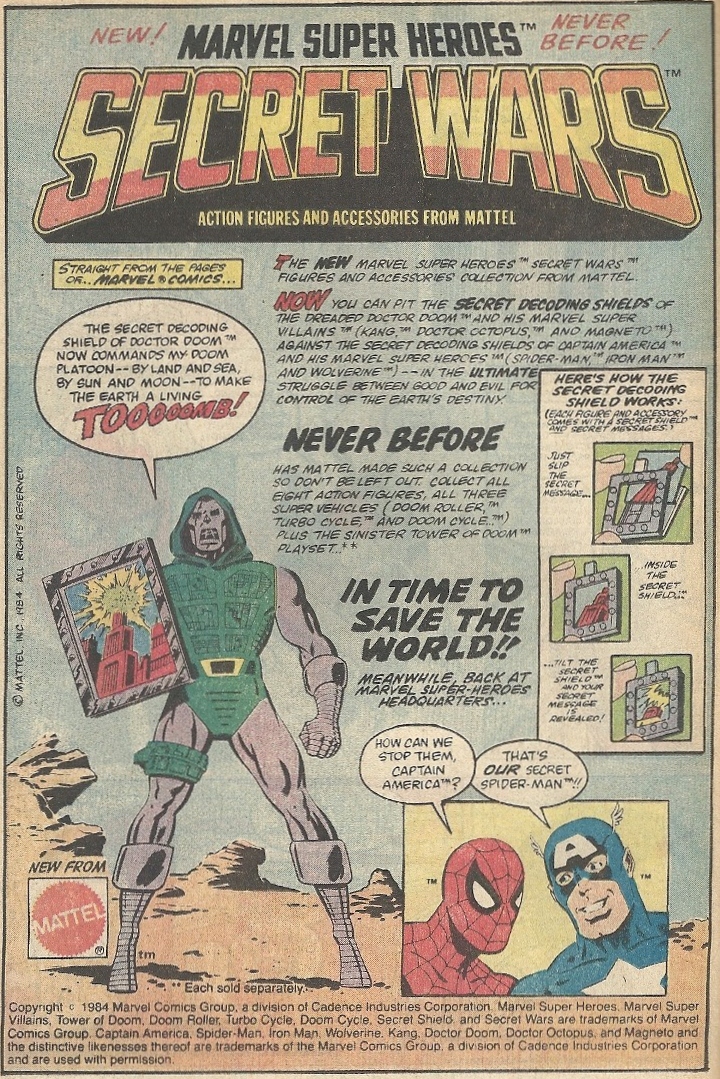
Spider-Man and Captain America look like they’re in love. Next they’ll be drinking one milkshake with two straws. “Oh Cap, you got strawberry. That’s my favorite.”
The Secret Wars action figures from Mattel were one of the signature lines of my youth. They couldn’t hold a candle to DC’s Super Powers toys (If you squeeze the legs the arms move MY GOD WHAT WILL THEY THINK OF NEXT), but they had a welcome bendable dexterity to them. Nigh unbreakable. They held up well under the rigors of virtual combat.
The holograms were unbelievably lame. Never understood them. They were dim, they bewilderingly showed absolutely nothing (turn it one way, nothing, turn it the other way, MORE NOTHING), and they were promptly separated from their parent figures and scattered. You found them later and wondered “What the hell is this thing? What did it come with? He-Man?” Or the family dog ate them and crapped them out. One or the other. (And Wolverine’s removable claws were especially edible.)
 Jared
Jared


 blog into mystery