This may make you yearn for the days of Emo Peter, Topher Grace and Sad Sandman – The Amazing Spider-Man

A lot of people are going to go into The Amazing Spider-Man with a pre-installed bemusement. A reboot of a film franchise that started 10 years ago seems prima facie stupid, forcing the core fans who have Peter Parker/Spider-Man’s origin and motivations woven into their very DNA to sit through another rehash of events internalized years before. Even moviegoers with passing familiarity with the character have to go into it thinking “Didn’t we already go over this spider-bite stuff? Do these people think we’re that dull?” (Answers: Yes and Probably Yes.) No matter the reasons behind it — the sour taste of the last entry of the Sam Raimi trilogy, recalibrating with a younger actor behind the mask — the back-to-square-one retread factor is vexing. It’s hard to get around. It is for me.
And make no mistake, I wasn’t madly in love with the Raimi films. I liked the first two quite a bit, and thought they captured the timeless spirit of the Spider-Man comics about as well as they could. Unlike most of the rest of the planet, though, I thought the first entry, Power Ranger Goblin and all, was superior to the second. Spider-Man 2 focused more on the stillborn romance of Peter and Mary Jane, and it just left me cold. Kirsten Dunst seems like a nice girl, but she has all the spark of a mud puddle, and Tobey Maguire, while grasping the charming dorkiness of our mild-mannered New Yorker, never had the right verve. It was a trilogy where, for me, the movies diminished with each volume. In that sense, I had no problem with the reboot. Not married to the work of the past ten years.
So. Here we are. The Amazing Spider-Man is upon us, released on the big stage of the Fourth of July holiday and into the impossible-to-match wake of the Avengers success.
Verdict? It’s not that good. It really isn’t, and I’m sad to say that. I wanted this film to succeed, if only to get back on track with the franchise, and avoid sitting through another setup story in the near future. But it’s a dud. It’s actually kind of awful. As I walked out of the theater, numb from the experience, I found myself coming to the realization that I’d rather revisit Spider-Man 3, which I still have seen only once, than this film. I think that might say it all.
But, if that doesn’t say it all, here are some observations, the bad and the good, with the mildest of mild spoilers thrown in:
- The script plays as if written as a cobbled student project in an “Introduction to Creative Writing” class. It’s ham-handed, careening from one scene to the next with clumsy characterization and obvious, at times cringe-worthily so, dialogue. It’s hard for me to believe that much of the crap thrown onto screens these days is the best that Hollywood has to offer, and this is part of that downward spiral. Director Marc Webb does nothing to enhance the meagre tools at his disposal, and he’s just as much to blame for there being no driving force holding this together, no animating principle that shows us that this is a story that needs to be told, and that established continuity had to be flushed down the tubes to bring it to us. Is George Lucas running screenwriting workshops out at the Skywalker Ranch?
- I had no problem with the Raimi films using organic web-shooters. When the first was conceived, it was going to be hard enough for movie audiences to buy into a boy spider without him inventing a substance that 3M and a trillion-dollar grant wouldn’t be able to conjure. But really, they were gross. A young man’s wrists shot out a milky, sticky fluid. THAT IS DISGUSTING. If that Spider-Man webbed me up to save me as I plummeted from a building or wandered in front of a bus, I’d be initially grateful, then I’d vomit, because GROSS. Now that we have a decade of super-hero shenanigans to build on, with Tony Stark crafting a flying suit, a God of Thunder descending from some cosmic plane and Super-Soldiers freezing in ice, the old shooters don’t seems so outlandish. They’re a not-too-significant but welcome addition to this party. NO MORE WRIST-SEMEN. Rejoice.
- If you had told me twenty years ago, as my friends and I were sitting in one of our bedrooms listening to a third generation dubbed cassette tape of No Cure for Cancer, that Denis Leary would one day play Captain Stacy in a Spider-Man movie, and that he’d be one of the brighter lights in said movie, I might have slapped you for being stupid. But there he is, in all his doomed NYPD glory. Sadly, and I don’t think I’m really spoiling things here, he won’t be around for a sequel. Nor will Martin Sheen’s Ben Parker, who feels fleshed out thanks to a fine, gentle performance by an old pro. (Sally Field as Aunt May seems too un-gray, and we barely get to know her before she’s into her weepy, “Oh, Peter” shtick. Though, to her credit, she at no point holds a condom aloft, keeping her from being the worst May Parker ever.)
- Rhys Ifans, the skinny guy from Notting Hill who made a Euro-trash ass of himself at Comic-Con last year, steps into the white lab coat of Marvel’s one-armed Dr. Jekyll. He seems disinterested, and that pesky script keeps him mired in the clumsy “let’s get to Point B” motivations that are the megalomaniacal fare of the summer movie season. He goes from wanting to regrow his arm to wanting to banish weakness by making people lizards. Or something. Mazel. Oh, and after he starts getting all scaly, he has the presence of mind to leave behind Exposition Vlogs in his well-appointed sewer laboratory for Spider-Man to find. LAZY. WRITING.
- On a lighter note, Peter Parker utilizes Bing as his search engine of choice. BULLSHIT. They might as well have him browsing with Netscape Navigator.
- Andrew Garfield and Emma Stone are genuinely winning as our two leads. Stone’s Gwen Stacy is by far the best onscreen paramour for Spider-Man to date, while Garfield takes the Peter of the 1960s and makes him a shy, awkward young genius for the new millennium. But, like everyone else, they’re weighed down by the leaden script. (One of its few contributions to the superhero genre comes when Peter first gains his powers. There’s some comical material as he tries to perform everyday tasks, like hitting the snooze button and squeezing out toothpaste. They’re logical speed bumps for a newly empowered teen, which is more than can be said for most everything else in the film.) With both Garfield and Stone, I almost feel like I did with Brandon Routh after the microwaved casserole that was Superman Returns. I wanted to see him in a Superman movie that didn’t suck. I feel that way with these two. In fact, if you yanked Maguire and Dunst out of the first Spider-Man and plopped them in, then that first film might have been perfect. PERFECT, I SAY.
- Note to Spider-Man filmmakers: Spider-Man zipping around New York has lost most, if not all, of its wow factor. A climactic scene has our hero using conveniently arranged construction cranes to swing his way to save the day, but no matter how slick the CGI, no matter how many generic, swelling strings are in the score, it doesn’t move the needle at this point. Even throwing in that he’s injured, making him some mask-wearing, vigilante Kerri Strug, doesn’t help.
- There’s, of course, a post-credits scene. This trope is getting a bit tired by now, though it can still be effective. See: Thanos. But this one may be the most insulting of them all. Introducing a shadowy character tied into the stupid WE ARE MAKING A TRILOGY plot about the parents, it will leave all audiences asking “Who was that, and why should we care?” and not getting any answer. I have no idea who it’s supposed to be. It may be Future Guy from Star Trek: Enterprise for all I know. And you know what, movie? I never want to find out who it is. That’s how much I was bored with this thing. I really don’t care if there’s ever a sequel. Take your shadowy Parker family secrets and cram them.
- The most damning indictment? It doesn’t feel that there’s much SPIDER-MAN in the movie. Not only that, but every time he appears, the mask comes off pretty quick, as if Sony wanted to show us that YES INDEED, ANDREW GARFIELD IS PLAYING SPIDER-MAN AND WE ARE GETTING OUR MONEY’S WORTH. A part of the absence comes from that goddamn origin crap, which delays everything, but still… I paid for Spider-Man, and I feel I didn’t get sufficient Spider-Man for my dollar. Or time.
- To end on a positive, the action sequences, brief as they are, have energy. Spider-Man battling the Lizard (I won’t even start on the Lizard design — stay positive) is frenetic, with the hero twisting and contorting and using his webs to launch himself all over the place. It’s like a faster, more bone-crunching take on the deliriously wonderful Doctor Octopus fights in Spider-Man 2. But not as good.
This film is a misfire. Some people are going to like The Amazing Spider-Man just fine. The adolescents in the audience during my screening did, guffawing at the script beats which caused me to shake my head with acute chagrin. Good for them. And there’s a floor to Spider-Man movies. They can only go so low, because, at the end of the runtime, you’ve still just seen a Spider-Man movie. A bad Spider-Man movie is like a bad hot fudge sundae. But this feels more like the last Ghost Rider movie than it does anything in the Avengers universe. It might be most comparable to the Green Lantern flick. It’s aimless, like a high school senior who doesn’t know what he wants to be when he grows up.
I give it 2½ non-organic webshooters out of 5:

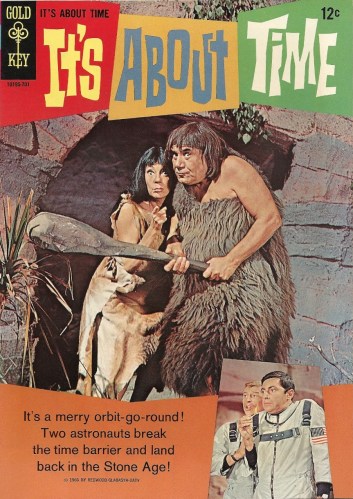
Beefy middle-aged guys with Ernest Borgnine arms wearing fur and showing a lot of shoulder. JUST WHAT THE WORLD DEMANDED.
Most of America has probably never heard of — or doesn’t remember — It’s About Time. I certainly hadn’t. Didn’t know if it was a movie or what. Turns out it was a TV show, which lasted but one year, on CBS’s 1966-67 broadcast season. I think this is one of those cases where a small segment of the population might remember the show fondly. “Oh yeah. It’s About Time. That was the show where astronauts accidentally went back in time to caveman days, and wackiness ensued. That show was kind of fun.” But now, thanks to the wonders of YouTube (not sure of the rerun status of this series — can’t be all that hot a commodity) people can refresh their recollections with brief clips and come to their senses. “My God. This thing blew HARD.”
I’m not going to pass judgment on the show. Never saw it, though its contemporary cousin, Gilligan’s Island, was a syndicated childhood favorite of mine, so I can’t hold the Goofy Laugh-Tracked Garbage Television genre against it too hard. Idiot entertainment has its place in all eras, and perhaps IAT was a forerunner of our time’s Snooki. (I don’t know what epoch gets the worst of that juxtaposition. Probably ours.) Also, its posterity is hamstrung by having no huge stars whose names echo down to the present day. Imogene Coca (Your Show of Shows) and Joe E. Ross (Car 54, Where Are You?), the cave-folks (Shad and Gronk) on the above cover, had their degree of fame, but not transcendent levels. (Incidentally, I can’t fathom that they were 100% thrilled to be a part of this. I imagine a constant murmured chant of “in it for the money in it for the money” could be heard all around the set.)
As stated, I have no first-hand knowledge of all this. Can’t judge the series. All I can comment intelligently upon is the comic that sits on my desk.
You know what? It’s not terrible. Yes, the stories are simple-minded drivel, outstripping the usual lowest common denominator situations and wordplay. But it’s the art where one finds the pleasant surprise. Dan Spiegle, no stranger to adaptation work (having handled, just to name a couple of books featured on this blog, The Shaggy Dog and Sea Hunt), brought a light, deft touch to the illustrative chores. Take this early scene, as the astronauts dig themselves out of a sticky introductory situation:
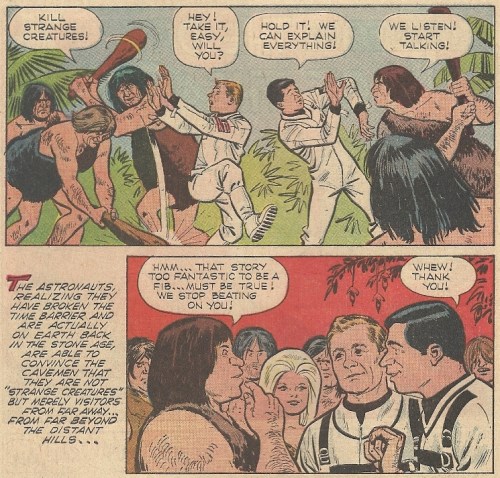
We won’t worry about Prime Directive/Butterfly Effect concerns about rupturing the timeline. Or that the cavemen speak English. MOVE ALONG.
Even the script (scripter unknown), which is pretty dreadful, creates an amusing situation or two. Everyone’s familiar with the classic caveman proposal: bonk a woman on the head and drag her back to your cave. Well, when our astronaut friends try to modernize the courtship rituals of their new compadres, things don’t go all that well:
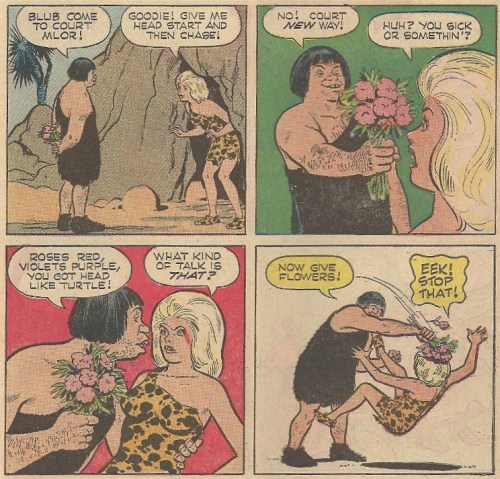
Okay, that’s sort of funny.
Spiegle’s art is clean. It isn’t overly busy, and it doesn’t have pretensions. It amazes me how much better it is than the work in something like the Girl from U.N.C.L.E. issue reviewed here recently. One would think that an established franchise (granted, a show that was also cancelled in one year) would have better craftsmanship within, but no. Gold Key had other ideas, it seems. Hell, I even find it — in a limited way — more visually appealing than “superstar” art that I grew up with. It doesn’t do too much, and that’s more than enough.
It’s About Time, in a bid to save itself from the network axe, apparently went through a reinvention midway through its solitary year on the air, retransplanting the characters back into the modern era, and making the cave-dwelling friends and family the anachronistic ones. The comic never had the chance to get that far. One and done. And there was much lamentation…
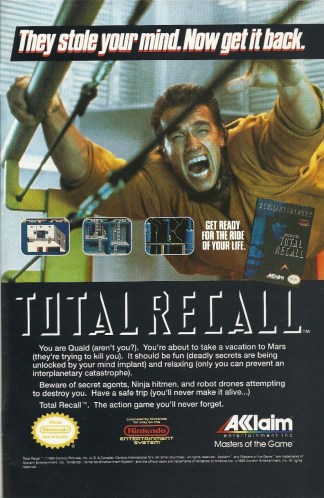
For unknown reasons, Hollywood has decided to remake Total Recall, a sin I find far more mortal than any seemingly needless Spider-Man reboot (review forthcoming). TR may be Arnold Schwarzenegger’s best movie — or at least the one I find myself enjoying the most in my old age. It’s a film with great action, great set pieces, a genuine sense of humor, a Chucky-looking alien that pops out of a dude’s belly, and more fantastic one-liners than you can shake the proverbial stick at (see “SCREWWWW YOOOOUUUUU!”) Even in a CV that contains The Terminator, Predator and Conan the Barbarian, it sticks out. Lest we forget, the image in the ad above comes from the scene where the head of Arnold’s fat lady disguise explodes (after delivering its own one-liner) and part of the containment dome is shattered, and people start getting sucked outside into the airless Martian landscape. Easy to love.
But Total Recall also had one of the worst looking video games in history, one that used the rote Double Dragon punch/kick scroll engine that drove/plagued so many games in the late eighties/early nineties. It featured such things as baddies popping up out of garbage cans (like Oscar the Grouch) and glory holes. You know, just like the movie.
When you combine Blackhawk with Dorian Gray’s portrait and Bugs Bunny cartoons, you get, um, this – Blackhawk #187

Blackhawk. The man. The team. The leather. The logos.
One thing that’s always been a bit odd about the old Blackhawk comics is that they drifted so far from their ace pilot roots. After their original Quality run came to an end and their DC run started to drag on, the Blackhawk Squadron’s adventures were more and more tied to the ground and more and more fantastical. This was inevitable as their World War II environs faded more and more in the rearview and geographic diversity and acute accents were no longer enough to keep things lively, but it was nevertheless a sometimes awkward transition. Relatedly, it’s astonishing that the Blackhawks lasted as long as they did. I mean, their title lasted a FOREVER in comics terms, while supposed members of DC royalty like Aquaman had relatively short-lived titles yanked out from underneath them. And all the while the gang were listing further and further from what had brought them their first rush of popularity.
Perhaps it was canny reinvention, or maybe it was just God-awful crap. I’m not certain. But, like I just pointed out, the book must have sold, so therefore there must have been something getting kids to fork over their dime and two pennies.
Maybe the cover story here is the type of thing that held the audience (at least until they had to break out the red biker jackets). It welds classic literature (The Picture of Dorian Gray) and Looney Tunes shorts (specifically the one where and unseen artist — Bugs Bunny, the ultimate troll — keeps screwing with poor Daffy Duck) to the Blackhawk mythos. It’s not great. It’s not terrible. But maybe it was just goofily good enough to keep raking in the loose change.
First, there are a couple of preliminaries to clear out of they way (and all three stories feature art from Dick Dillin and Charles Cuidera, btw). In one, the Blackhawk boys head south of the border (perhaps to recruit a thick Mexican accent for their polyglot club?). Chop-Chop isn’t enough of a hideous racial caricature for you? Try these Speedy Gonzales Mexicans on for size!:

Thanks to material like this, I think entire generations of Americans would be forgiven for thinking that the majority of Mexican men wore bandoleros. “Queek” indeed.
The second story features a porcupine man. It delivers what it promises. “The Porcupine” looks like an amalgam of Nite Owl from Watchmen, the Floronic Man and a burdock, and surely ranks as one of the lamest villains ever to come from a major comic book publisher. They were running out of animals, I guess. And no, I shall not sully these digital pages by reproducing him here. I have standards.
And now we come to the main event. The catalyst for this Silver Age nuttiness is the unveiling of a life-size Blackhawk portrait at a metropolitan art museum. You can see it up there on the cover, with a hyper-masculine Blackhawk posing in front of a gigantic — surprise of all surprises — black hawk. I think it’s safe to say that when a giant oil on canvas reproduction of you looking all serious and stuff is hung up in a big marble building in a city, a place where society fêtes are held with white gloves and tails in full effect, YOU HAVE ARRIVED. Congratulations, Blackhawk. Things get a little weird, though, when some minor injuries that Blackhawk sustains while battling crime are mirrored in paint flaking off those areas of his portrait. Hmm. And this seeming coincidence takes a sinister turn when the painting is stolen and the thief leaves what feels like THE LONGEST NOTE IN HISTORY:

When people have to tag team to read your note aloud, it’s a clue to maybe make use of some editing next time.
A little sleuthing and the Blackhawks track down the evil painter (a con who learned this odd trade in prison) and his mystic oils, and turnabout is fair play:

So Andre Blanc-Dumont, the French member of the Squadron, has a career in rapid boardwalk portraiture to fall back on when the whole crimefighting business dries up. Good to know. And who doesn’t love that there are “Anti-Mystical-Neutralizing-Paints.” Of course there are.
One note: Only once in this book do the Blackhawks fly planes, and then only on a training mission. Actually, two notes: Never do they utter their “HAWKAAA” battle cry. I FEEL GYPPED.
And there you have it. Silver Age Blackhawk nuttiness. Honestly, I’m not sure if it’s good or bad, or even if I like it or not. It could have been worse. Much worse. Someday we’ll take a trip down the “New Blackhawk Era” memory lane. (If you’re unfamiliar, that was quite possibly the most stupendously stupid remodeling of a comic book team ever.) This stuff could never stack up against the Man of Steel’s somewhat similar canvas adventures, but Kal-El was/is so much more at home in such stage-dressing. Having the Blackhawk Squadron battle porcupine men and magic paintings (and Mexicans, don’t forget the Mexicans) feels a bit like having the Beach Boys breakdance. Each are a poor match, but each have a strange “this is weird” appeal.
Once again, I don’t know if I like this or not. But somebody did. So somebody knew what they were doing.
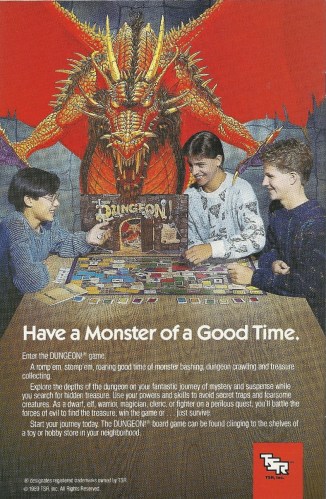
Dungeon! was a board game created completely separate from the Dungeons & Dragons RPG. One has nothing to do with the other. Except that they were produced by the same company. And Dungeon! had a dragon in the marketing. And on the box. And probably in the game. NOTHING TO SEE HERE.

Nothing says eco-friendly heroism like a neon-green “business up front, party in the back” hairstyle. POLLUTERS BEWARE.
Do you think any of the Planeteers every pulled Captain Planet aside, maybe after they all summoned him with their rings for an intervention? “I realize Joe Dirt won’t be released for years, sir, but you’re looking like a blue, muscular Joe Dirt. Yes, that’s a bad thing.”
When OMAC can give you tips for your coiffure, you have a problem.
Todd McFarlane DOOMDOOMDOOM Lizard DOOMDOOMDOOM This Still Sucks – Spider-Man #1-5, “Torment”
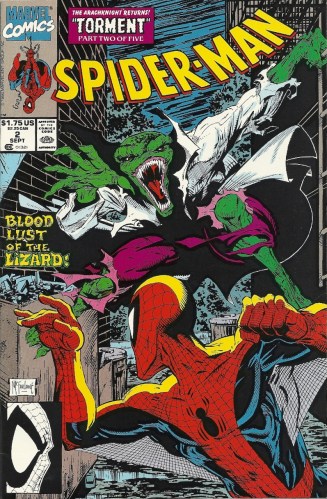
The Spider-Man film reboot is hitting theaters next week. It features the Lizard, and a version of that character that may or may not be awful beyond words. Will Curt Connors’ Mr. Hyde persona have the same resonance without a white lab coat and purple pants? WE SHALL SEE. And today, to honor that classic villain’s first silver screen appearance, we’re going to go back in time and look at one of the more memorable stories featuring the character (at least for people who came of comics-reading age in the late-80s, early-90s). Yes, boys and girls, we’re going to reach twenty+ years into the past, to the much ballyhooed launch of the Todd McFarlane-infused Spider-Man. Brace yourselves for “Torment.”
I come to praise “Torment,” not bury it. JUST KIDDING. There’s going to be a fair share of burying going on here, but, surprise, I actually have one or two nice things to say about what was McFarlane’s first attempt at doing everything on a major series. (Others have written more than enough about this subject over the years, so I’ll be brief.) And we’re not going to touch on the thousands of money-grab variant covers that the premier issue had. Again — JUST KIDDING. To clear that topic from the table, I’ll say only this: It seems that people are, if not uncovering new versions of that iconic bestseller, at least still tabulating the print runs for each of the different covers, and then calculating their values based on relative scarcity and plenitude. Who knew that there could be so much sweat over a simple pic of a crouching, web-enshrouded Spidey?
Look up that first issue in Overstreet sometime. It’s a section unto itself.
Spider-Man. It took Marvel almost three decades to drop the adjectives and the nouns, but they finally did in 1990. It’s really no surprise that the House of Ideas decided to hand the reins to the new flagship title for the company’s flagship character to McFarlane. His run on The Amazing Spider-Man remains one of the most commercially successful eras in the character’s history. He brought a new kind of comic energy to the book, and the way he’d twist and contort his friendly neighborhood subject was like something out of a Chuck Jones Looney Tunes cartoon. It fit the character like a glove. On a personal note, I always loved the detail he put in into Spider-Man’s costume’s web-pattern. I know that whenever I’d try to draw him, I’d get about halfway through putting in those endless intersecting wavy lines and loudly proclaim “You know what? F–K THIS.” Patience is a virtue, and I admire those who possess what I lack. So pick your reasons for it, but his books were fun to look at, and they sold accordingly. And that last reason is, literally, the bottom line as to why McFarlane got the keys to the new Porsche. To quote a white guy quoting Wu-Tang: “Dollar dollar bills, y’all.”
McFarlane was a superstar. He was profiled in People, for crissakes. And this was before he got all caught up in buying steroid-tainted baseballs.
But, for all his box-office appeal, he was an awful, awful writer, and that was especially true in “Torment,” his maiden effort. That it was his first attempt at scripting something of this magnitude — a new, instant best-seller Spider-title — might normally counsel that we temper our criticism. Give the guy a break. It’s not easy to start out with that blazing spotlight on you. But it was such a loud, dumb, over-hyped waste of time, all that reticence is (rightly) thrown out the window. Because this series-opening yarn sold so many copies means we as a a society have collectively purchased the right to dunk it in the tank over and over and over again.
The five issue “Torment” arc told the story of a relentless, even more beastly than normal Lizard and his murderous return to the streets of New York. Calypso is the grand manipulator in the tale, controlling the Lizard and driving Spider-Man close to madness.
And that’s pretty much it.
It’s the thinnest of paper-thin plots, and it’s stunning how little transpires over the course of the five issues. I say stunning, because McFarlane never knows when to shut up, and that makes the whole story seem to drag on interminably. His narrative text drones on and on and on, stepping on the art in every single panel. One of the hardest things to learn when smithing words is when to step back and let what’s already there do the talking. I get that, and I certainly have a hard time checking my own blathering. Nevertheless, it’s an inescapable truth that, once the story train is moving, you don’t have to keep throwing more coal on the fire. This page, part of the first of 57 fights between Spider-Man and the Lizard, features one of the few dialogue-free panels. ENJOY IT WHILE IT LASTS:

(On the subject of verbiage: I’ve read other critiques that note McFarlane’s mixing of first-person and third-person narration. This is valid, as sometimes the voices can get all jumbled. It’s Peter. Wait, now it’s McFarlane. Now it’s Mary Jane. No, wait, is it Calypso? Now it’s back to Peter. It’s like being inside the head of a lunatic.)
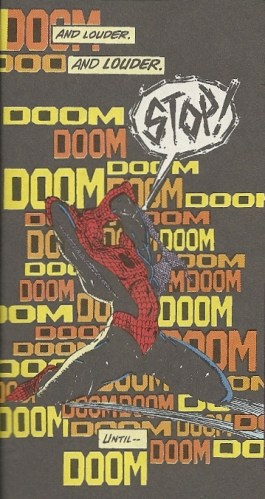
The biggest beef I have with this arc is its volume. It seems like it’s yelling at you from start to finish, assaulting your eyes and inner ear with an unstoppable barrage of flashy art and text. And the recurring DOOM DOOM DOOM theme, as Calypso plays with our hero’s head, doesn’t help any. Spider-Man may be speaking for all of us in this panel:
Even the art, which was the sole reason anyone bought this title and would ever return to it in subsequent years, suffers from compression. The great Carmine Infantino often used narrow, vertical panels in his page layouts, and in his hands they were a stylish affectation. They were engaging, and you never lost track of what in God’s name was going on. McFarlane uses them too, but in sequences like this, featuring our primary players in a church, you just get a headache. Or vertigo. Or motion sickness. Something:
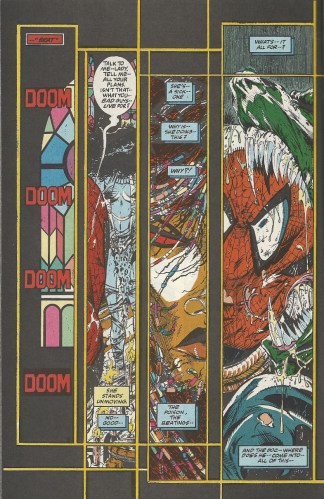
And Mary Jane is in this. Her sequences are useless, as she goes through the vapid, good-time-loving stages of her life, hoping poor Peter is okay. It’s clumsy filler. Sawdust in meatloaf. Like everything else here.
Is there anything good about the story? Yes. Spider-Man, when you can see all of him and he’s not obscured by dopey narration, looks good. All those tiny web-lines are present and in full effect. And the Lizard, with his tattered but magically intact and clean coat and pants, looks terrifying. His rows of teeth seem like they could reach right out of the page and bite off your goddamn arm. You should feel fear when you see this man-sized, muscular Godzilla. You’d feel fear here if McFarlane would just zip it for a page or two. Still, even the selling-point art feels sloppy and confused, much like that scan above. Perhaps this gives us the greatest lesson we can take from the story: McFarlane’s work was at its best when it was bounded by the confines of someone else’s script. When it was disciplined, and couldn’t indulge every whim.
Some would say McFarlane improved as a scripter over time. I’m not sure of that. Spawn certainly read better than this, but it played too much like the crappy ideas I’d have for stories in junior high. Hey, he’s a black man who comes back from the dead with great powers, but get this, he can only turn into a white guy COME ON, TODD. (Maybe that’s why I liked it so much when I was in junior high. Man, this is awesome — it reads like something I’d write...) And McFarlane brought a bunch of heavyweight writers in for a few issues, and we know how that worked out. He was damned either way. But you know what? The HBO Spawn show was all kinds of superb, so there’s that.
There you go. McFarlane. “Torment.” Lizard. It doesn’t seem that it’s been twenty-plus years since this came out, but it has. And it hasn’t improved with age.
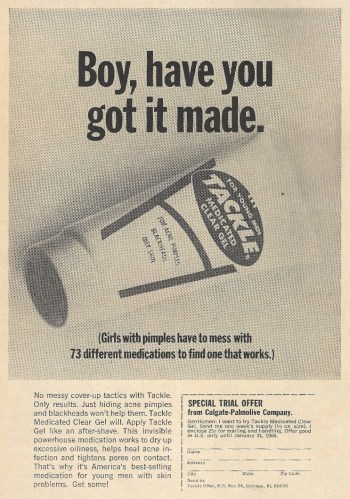
Could they have picked a more MANLY name for this acne medication? “Tackle” suggests both fishing and football, two noted MANLY sporting pursuits. Surprised it didn’t come with a bottle of whiskey and a gun. Even the no-frills marketing suggests Spartan masculine simplicity.
You certainly wouldn’t mistake it for one of the 73(?) girly meds.
Use the dialogue to hone your James Mason, Peter Lorre and Kirk Douglas impressions – 20,000 Leagues Under the Sea
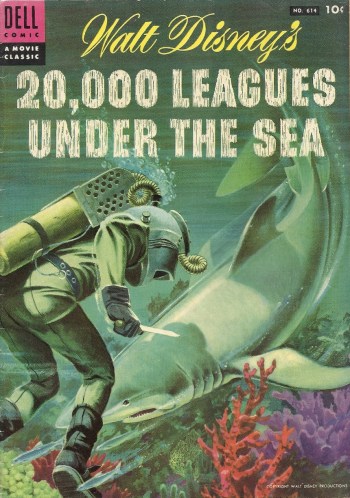
You can tag this movie with a nice robust “They don’t make ’em like that anymore.” Growing up, Disney’s 20,000 Leagues Under the Sea was superb entrée into the world of classic movie magic. When it came on TV it was an event, much like the yearly (was it yearly?) airing of The Wizard of Oz. Everything about the film, from the excellent cast (which introduced this once-young kid to Kirk Douglas) to the simultaneously terrifying and thrilling design of the Nautilus, combined to forge a film that holds up extremely well to this day. Not only that, but it also holds up better than movies that were made ten years ago. Nothing ages faster than digital effects, and it’s a blessing that this flick was made in a day when a person would think of a “digital effect” as a stubbed toe or a hangnail. Look at the digital Nautilus in 2003’s The League of Extraordinary Gentleman and tell me which is awesome and which looks big and stupid (just about the only thing those two movies have in common quality-wise is that “League” is in both titles).
Jules Verne’s Nautilus was Steampunk before there was such a thing as Steampunk, which makes it awesome, unlike pretty much everything that’s called Steampunk.
On another level, perhaps no film ever assembled more impersonatable(?) actors. Granted, there aren’t that many people to do a killer James Mason (Captain Nemo) impression anymore, and now it feels like whenever you do the Kirk Douglas (tight-shirted Ned Land) voice you’re making fun of his stroke (my favorite Douglas impression was coincidentally from the late Phil Hartman in a 20,000 Leagues SNL sketch). But Peter Lorre (chubby, timid Conseil), though the less well-known of the movie’s star troika, and an actor who’d never be mistaken for a leading man, is one of those guys you’re imitating even when you don’t know who it is exactly that you’re imitating. Everyone on Earth has done a forced, nebbish “Riiiiiiick…” at some point in their life, as Casablanca is in our cultural DNA.
And all three of these guys shared the screen in this flick. And it had a fearsome Victorian submarine monster. GLORIOUS OVERLOAD, BABY.
So the comic book has a lot to live up to. Does it?
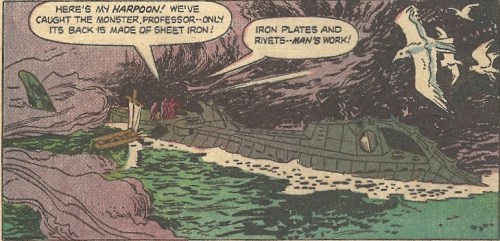
It does. Kind of. While nothing could really match the cinematic goings on — putting this very much in a Raiders of the Lost Ark/The Empire Strikes Back/Close Encounters of the Third Kind no-win scenario — a valiant attempt is made. The script (unknown scripter, though it’s adapted, of course, from Verne’s original novel) moves along well, never plodding into the stiff, hokey territory so often traveled by contemporaries. This is assuredly helped by the source material, so I suppose we shouldn’t press any medals for that. The art, though, is where this book makes its mark. Frank Thorne, long before his career-defining work with Red Sonja and her fetishistic affinity for mail and metal, provided the pencils and pens here, and his work stands out amidst the 1950s backdrop. It’s — forgive me — leagues better than most art you’d find in comics of this time. His layouts and scene construction are excellent, and he turns the smallest parts of a sequence into the most compelling and enjoyable. Take this following panel. Yes, the clear view of the upper portion of the partially submerged Nautilus is what draws the eyes at first, but hell, aren’t those the best seagulls you’ve ever seen?:
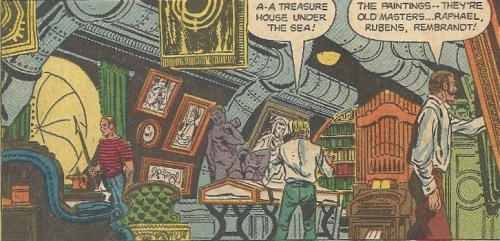
I was especially taken with the detail (and color) of this look inside Nemo’s lush private rooms — the refined man cave of all refined man caves:
And, without doubt, we have to stop by the famous giant squid attack for a quick peak (since it’s up there with the Ben-Hur chariot race in the Indelible Action Sequences category). It knows when to shut up and let the the image speak for itself:
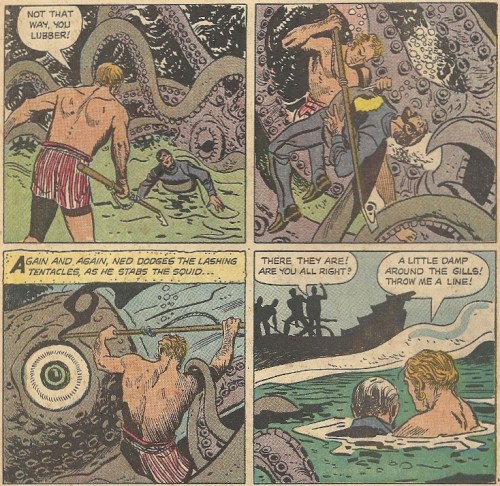
And it goes on like that. If there’s one distracting bit, it’s that the comic’s Conseil — thin and blond — looks absolutely nothing like Lorre’s chunky guy with a Curly Howard haircut. Not a big deal, just something you’d notice.
Anyway, this a nice little two-fer: A nostalgic trip through a great movie hand-in-hand with early work from a noted artist. Thorne’s Red Sonja is definitive for all the right reasons, and you can see whispers and hints of that future success in this. That’s a good thing, and you can’t ask for a lot more. And you shouldn’t, or Nemo will ram your ship and send you straight to a watery grave.
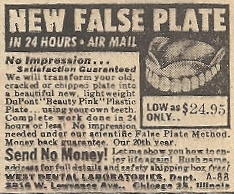
This was in yesterday’s Sgt. Fury book. You know what? Why not just weld a horseshoe into your mouth? Air mailed dental plates… Really…
Longtime listeners of The Howard Stern Show will remember the time Jackie Martling had his fungus-infected toenails torn off by a doctor he found in the local Pennysaver. This is a bit like that. I’m not sure if it’s more bizarre than mail order monkeys. It might be.
Nazis can be tricky subjects for fiction. Steven Spielberg once used them to great cinematic effect in his Indiana Jones films, but in his post-Schindler’s List, Shoah foundation days he swore off using them as foils. To deploy them as such, he argued, made light of the evil of Adolf Hitler’s Nazi regime. Sure, nothing could ever take anything away from that mountain of transgressions, but having them as somewhat comical punching bags might be seen as some as making light of those who suffered under National Socialist tyranny. The Holocaust isn’t something to be trifled with, even tangentially. Nowadays, it’s best not to go down that road at all, or so the argument went — and goes.
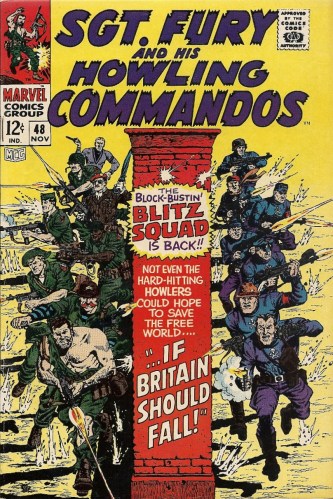
Not to quibble with that line of thought, but if there’s anything that proves that Nazis getting knocked around can be wondrously, GLORIOUSLY absurd, tickling every funny bone in the human body, it’s this thing. It’s enough to wash away any potential trivialization, because it’s JUST. SO. FUNNY. If you’re unfamiliar with the Blitzkrieg Squad, let this comic be your introduction to their brand of wartime nuttiness. Gary Friedrich wrote it, while Dick Ayers and John Severin provided the art, and they managed to produce what may be one of my favorite bits of Silver Age Marvel storytelling. And there isn’t a single superpower on display, which makes the achievement all the more spectacular. Granted, Howling Commandos tales of this period are generally good, but this one is acutely so.
Originally gathered by all-around douche Baron Strucker, the Blitzgrieg Squad — sometimes shortened to Blitz Squad — were like Mirror Universe counterparts of Nick Fury and the Howling Commandos (as if the cover up there above didn’t sell that reflective quality enough). Eventually Colonel Klaue, a a German Nick Fury with — of course — a facial scar, came to lead the team, whose individual talents were honed to counter everthing in the VERDAMMT Commandos’ arsenal. We’re talking right down to choices in accessories here, people. I mean, they worked all the way down to an allemand eqivalent of Dum Dum Dugan’s bowler hat. THAT’S THOROUGH. You can see it up there on the cover. Dum Dum has a bowler? Well, Siegfried has a traditional alpine hat. Percival Pinkerton has an umbrella and a scarf? Manfred has a cane and a scarf. Gabe Jones has a trumpet? Otto has a flute. And it goes on. And on. And on. Here’s a brief primer:
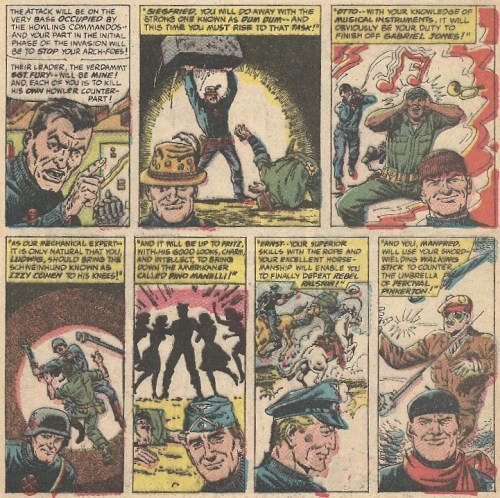
In this utterly delightful World War II tale, Fury and his Howlers are at a base in Britain, which comes under attack from the Blitz boys. These invaders are out for blood, at the orders of der Fuhrer himself. In a domino-ish theory, if the Fury and his Commandos can be beaten, Britain will fall, et cetera, et cetera. The two sides hence engage in a pitched, back and forth battle, with one side capturing the other, then the tables being turned, and then back around again. But at every juncture the Howlers get to pound the holy hell out of the Krauts in splendid fashion. I mean, you could not make this any better. I present you now with a few samples.
Everyone has heard the phrase “Never tug Superman’s cape.” Well, add a codicil to that: “Never flatten Dugan’s hat, especially if he’s wearing it at the time.” A lesson Siegfried could have used:
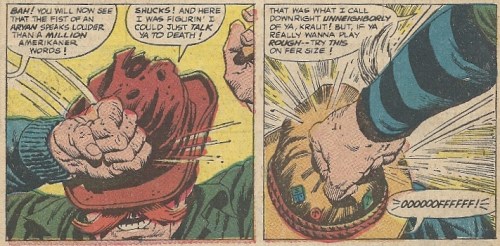
Magnificent.
Rebel Ralston is known for his mastery of all things horseflesh. One might be unsure as to whether his skills would translate to being ridden like a horse himself, but, lo and behold, they do. Yes, he can buck a German right off, but not before he splats him against a wall and electrocutes him in a light fixture:
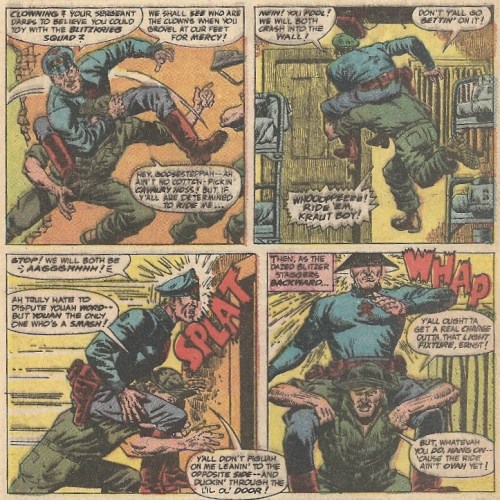
Yes, Ralston just zapped poor Ernst. AND HE QUIPPED WHILE HE DID IT.
What about the British contingent of the Howlers? Did Percival Pinkerton hold up his limey end of the bargain? Well, his battle with his counterpart lacks some comedic panache, but he does get to squeeze in a line about tea:
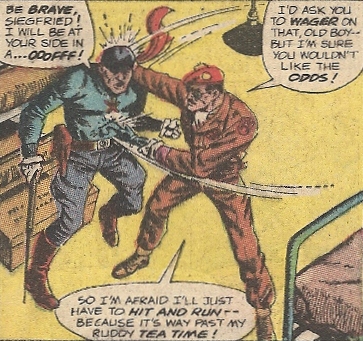
And he said “ruddy.” I love it when Brits say “ruddy.”
Ah. Yes. Gabe Jones. The African-American Howler who can play a mean trumpet. He might take the cake in this goof-off, because a blast from his horn not only subdues Otto and his flute, but ACTUALLY MAKES OTTO BITE THROUGH IT:
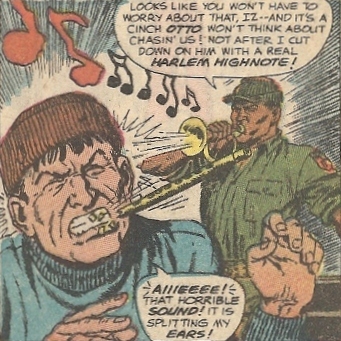
So a Mariah Carey high note could have won the war. No need for the atom bomb. If only she’d been around.
Pretty great, no?
As much joy as we might get out of this utter embarassment of the supposed master race, Uncle Adolf was unamused. Here he is in his messenger-shooting, rug-biting rage:
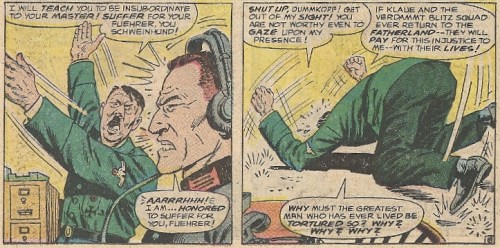
(Of all the weird crap about Hitler — screwing around with his niece, the farting, everything about the bunker — the craziest thing for me is that when he was pissed he’d literally do that bit above. He’d drop to the ground like a madman (well…) and pound the floor and gnaw on a rug. He did it before the infamous Munich talks with Neville Chamberlain. Yes, poor Neville returned with a pledge from that guy and thought it was a solid guarantee of peace in his time.)
All this ends with the Blitzers captured and Nick Fury making them dance in a manner that’s sure to make devotees of human rights cringe:
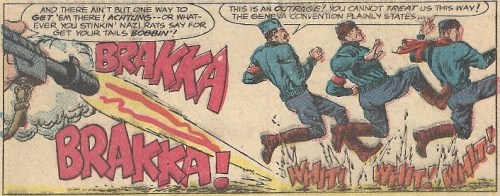
I’m not big on firing a gun at subdued prisoners’ feet, but come on, it’s Nazis, you know? The Geneva Convention goes out the window with them. And besides, Fury had both eyes at this point, so his aim must have been doubly as good.
This was by no means the first appearance of the Blitzkrieg Squad, as they had cropped up in this series many times before, but this might be one of their most entertaining turns. Ayers and Severin may never have been happier in their work than with this. You can see the joy in each and every panel, from Dugan flattening his enemy’s chapeau, to Gabe Jones hitting a note that makes a guy bite through metal. I realize artists don’t exactly clock in like employees doing a shift at a paper mill or something, but I can see these guys punching their cards, lunch pails in hand, with big smiles on their faces, both as they’re coming and going, a “we get paid to do this” satisfaction in their expressions. Ayers, whose work could be less than stellar when the material was likewise, may have reached some high water mark with this effort. Teamed with Severin’s inks, his art never looked more detailed or expressive. And funny. There’s sequential art comic timing on display here. This is great stuff.
And yes, I’d like to thank Friedrich for putting “ruddy” in this.
There you have it. Nazis. Funny Nazis. Three Stooges Nazis — if this comic had sounds, you’d get a nice hollow coconut foley every time they were struck in the noggin. I hope that anyone hyper-sensitive about anything making light of the Nazi regime could recognize this for what it is: STELLAR SATIRE. After-the-fact propoganda, if you will. If we can’t laugh at Nazis, especially when mocked with such eloquent visuals, then just who can we laugh at?
The Miami Heat of Saturday morning cartoon lineups?
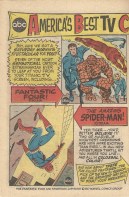
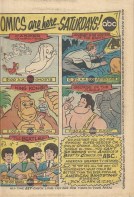
Apparently, 1967 was a good time to turn your dial to ABC and its solid block of Saturday morning cartoonery. Not only did you have the original H.E.R.B.I.E.-less Fantastic Four show and Spider-Man doing whatever a spider can, but Casper (well, Casper sucks, but still…), George of the Jungle, the Beatles (Featuring 100% More Ringo Nose!), and some Journey to the Center of the Earth action were in there as well. (I remember watching reruns of that last cartoon when I was little. Loved how they kept finding carved initials of the explorer that blazed the trail before them.) Oh, and King Kong is in there too. Until seeing this ad, I had no idea that there was ever a Kong cartoon. Despite the awesomely deep baritone in the opening song (TEN TIMES AS BIG AS A MAAAAAAAN), it looks pretty dopey. If, like me, you enjoy the inherent menace of the original King Kong property, his family-friendly adventures with a young boy and his folks might not be for you.
Everyone thinks that their youth was the Golden Age of cartoons, and I have a great fondness for Spider-Man and His Amazing Friends and the like. But this assemblage — even with King Neutered Kong — wasn’t too bad.
Cheap oil, an American sheik, a wheel of pain and a harem – The Girl from U.N.C.L.E. #5

If you’re like me, you have two different reactions when you see the cover for this book:
1. There was a Girl from U.N.C.L.E.?
2. Matthew Broderick was in it?
The answer to the first question is “yes.” There was indeed a distaff branch of the U.N.C.L.E. family tree, and Robert Vaughn had some female company in the onscreen secret agent business. The answer to the second is “no.” That’s not Ferris Bueller in the Starfleet-looking knit turtleneck sweater (a temporal impossibility), but series co-star Noel Harrison. (And he actually looks nothing like Broderick. Trick of the light I guess.)
The success of The Man from U.N.C.L.E. spawned this short-lived spinoff, starring Stefanie Powers as the titular April Dancer, and Harrison as her partner and guy Friday (mixing my old stuff, I know), Mark Slate. Nowadays, from our lofty, politically correct perch here in the new millennium, we can spot some feminist problems in the series. The biggest would be that April, the star and lead partner, was always getting her ass in a bind, one that Slate would have to bail her out of. Empowering. Hell, even the title — GIRL from U.N.C.L.E., not WOMAN — might raise an eyebrow. After all, Napoleon Solo wasn’t the Boy from U.N.C.L.E., NOW WAS HE? You can almost feel the blood pressure rising in folks who like to spell “woman” with a “y.”
Not that any of this had a hand in the series’ one season cancellation. Just observations.
Anyway, the show crossed over with Vaughn’s parent series on several occasions, and the short-lived spinoff spawned an even more short-lived comic book series, which only lasted five issues. Hey, wait, this post is about issue #5 of that series. Does that mean that the comic we’ll put under the microscope today is the grand finale? You betcha. AND WHAT A FINALE IT IS. The Post from S.A.R.C.A.S.M.
In the feature (Paul S. Newman — script, Bill Lignante — art), April and Mark are flying over Lawrence of Arabia territory, in the midst of investigating an American sheik with a dubious business model, when they’re downed. It’s then that they dial up exposition headquarters:

So this American sheik guy might be producing cheap oil. FIEND. VILLAIN. THIS MUST BE STOPPED AT ALL COSTS. Yes, the days when a glut of inexpensive oil was an actual concern, and when a tank of gas didn’t make your eyes pop out of your head every glance at the pump. What a magical fairyland that must have been. And what a peace-loving, bucolic place the Middle East is with expensive oil, I might add.
Whatever — April and Mark are double super-duper extra on the case now.
Remember Conan the Barbarian’s Wheel of Pain? Well, after April and Mark are captured by their sheik quarry — proving conclusively that they aren’t the uppermost wrung of U.N.C.L.E.’s spy ladder — Mark gets dispatched to the Middle East version of Conan’s hamster wheel. Also, the sheik goes all Jabba the Hutt on April and makes her part of his harem:

In an odd twist in light of the energy-theme of this comic, that wheel/treadmill/dynamo looks to me what some hardcore environmentalists have in store for us. “Oh, you want to spend your Sunday watching football? WELL GET WALKING.”
It all works out in the end, though, as April escapes the harem and potential incineration in a vat of crude (thanks to Mark’s help, natch). They then dodge old biplanes and men riding camels, et cetera, et cetera, and get their man. And the sheik’s cheap oil? Which we would like very much to have, if you don’t mind, old comic book? Turns out it was all a house of cards:
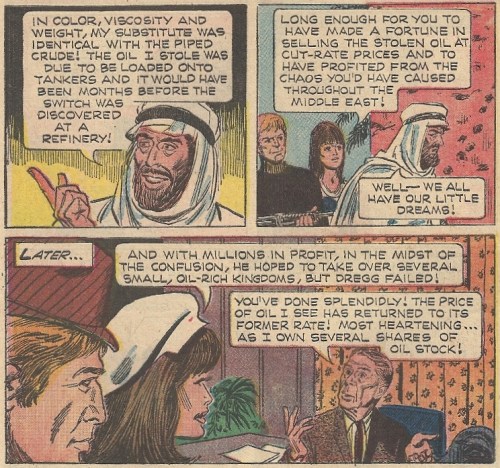
So gas goes back up to the astronomical price of about a dime a gallon or whatever. And Alexander Waverly makes an insider trading buck. The rich get richer. Yeah, we’re all glad you’re stock is going through the roof, gramps.
The series lasted longer than the comic, and one can see why the latter failed to reach the low bar set for it. The script is dopey, only entertaining in a bad, unintentional sort of way, and the art looks choppy, rushed and wooden. If you’re searching for quality comics based on old TV shows, get to this after you’ve gone through I Spy, Adam-12 and the like.
Before I end this post, I have to mention that there’s a backup feature, one that features the senses-shattering adventures a gentleman named Leopold Swift has in getting crap from Point A to Point B. This can only be described as The Transporter meets Mr. Rogers:

His one-dimensionality is a bit like the Shoveler in Mystery Men. “I carry things. I carry things well.” The crazy thing about this laundry detergent caper? The story has no ending or To Be Continued indicia. It ends with Mr. Swift diving into a lake to recover the key to the briefcase. And that’s it. Was this some artsy statement? Careless editing? Missing pages? Aborted due to the parent series’ demise? The world may never know. And since this isn’t the last episode of The Sopranos going black, no one really cares. I know I don’t.
The Girl from U.N.C.L.E. was finally made available on DVD last year (through Warner Bros.’ Manufacture-on-Demand service), but I doubt we’ll be seeing any reprints of the comic any time soon. No Omnibus on the horizon. Dry your tears.
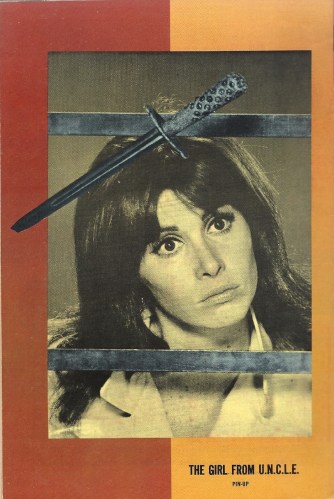
But hey, Stefanie/April was attractive, and there were a number of pictures of her within each issue. So there’s that.

This Superman quiz was found in the Giant reprint tome profiled here last Friday. The Golden Age trivia is obscured by over half a century of intervening Superman chicanery, but perhaps some of you want to bash your head up against the impossible and try to ace this bitch. If so, HOP TO IT. The answers, glimpsed above upside down, are rendered right side up in the scan below.

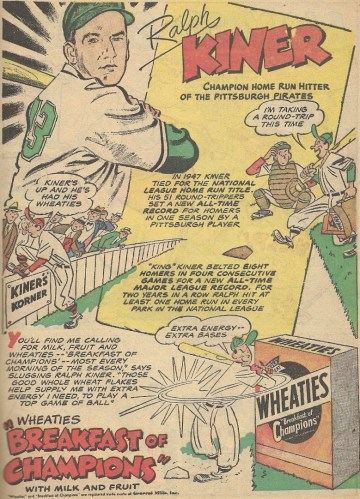
Stan Musial’s plain shoes gave us a break from the never-ending string of Golden Age baseball player Wheaties ads, but with the still-kicking Ralph Kiner we slide back in headfirst. Go ahead and put Kiner up in the Breakfast of Champions pantheon alongside Hank Greenberg and Frank McCormick. The one-time Pittsburg Pirates slugger and long-time New York Mets broadcaster is still going strong, and that might be the best testament that Wheaties has to offer. Not only can it help you knock the ever-loving hell out of a baseball, but it can also MAKE YOU LIVE FOREVER (when combined with milk and fruit, natch).
 Jared
Jared


 blog into mystery