One tiny book can help fulfill your dream to carry polka-dot-bikini-clad women in your sinewy he-man arms
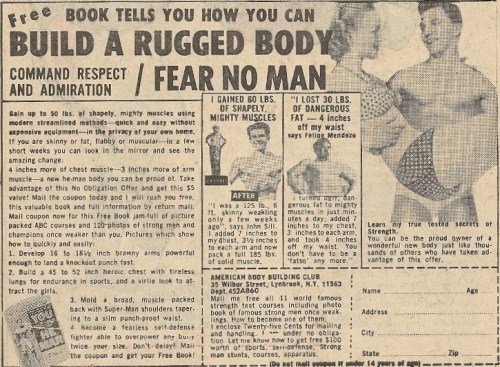
What’s better, hoisting a woman up and her loving every minute of it, or fearing no man (the corollary of which is surely bashing said man’s face with your rugged, shapely fists)? Maybe they go hand in hand, like peanut butter and jelly. Either way, you will COMMAND RESPECT AND ADMIRATION.
I’d like to point out that the skinny dude still looks skinny, no matter the pose or amount of chest grease involved.
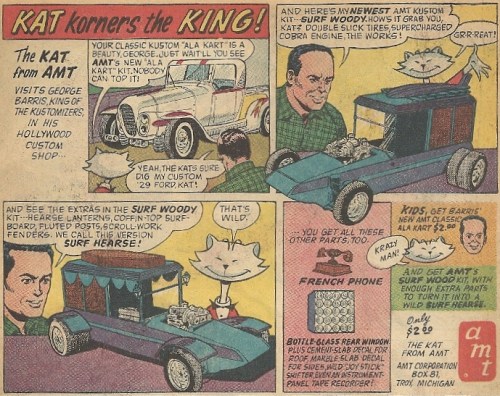
Putting a loved one in the ground is always a rough time. Funerals are dark, tear-stained affairs, and only respect and solemnity keep things together for the bereaved. So can you imagine if some idiot mortician schlepped the casket in a “Surf Hearse”? Even Grandpa Munster would shake his head.
Also, George Barris appears to have a shifting hairline. It’s receding. No, wait, it’s not. No, there it goes again.
Annie Oakley and the phallic implications of an itty bitty bullet – Annie Oakley and Tagg #8

Sometimes a bullet is just a bullet. And sometimes it’s a little tiny baby carrot of a weewee held by a bemused gun-toting heroine. So Freud, what’s one to make of this?
I confess to being no great aficionado of Annie Oakley, either the real or fictional make. Or comic book Westerns, for that matter. But you have to respect any woman who delves into the largely male-dominated sphere of marks(wo)manship, and a lady whose skill with a rifle was so profound Edison recorded it with his early Kinetiscope motion picture device. And I quite clearly recall a remark made by a guy next to me when I pulled this rather immaculate comic out of a box. He was an older gentleman, old enough to remember the 1950s television show that this series was based on, and more specifically the star, Gail Davis. He said something like this: “I saw her once. Most beautiful woman I’ve ever seen. Broke my heart.”
The memory lingers, apparently. The above image isn’t the most flattering, but others out there bear out his affection. And really, who doesn’t love a fiery cowgirl? Little phallic bullets and all.
The big difference between the real Oakley and the fictional was the TV Annie’s crime-fighting ways. A woman traipsing from town to town shooting playing cards and coins out of the air wasn’t enough to sustain a weekly television program, so they made her the niece of an Arizona sheriff, a lawman that was almost always absent when trouble was a-brewin’, and gave her a deputy sheriff and a younger brother (the Tagg of the title) as sidekicks. But there were, natch, plenty of opportunities for firearms displays, and the comic spinoff aped that as much as it could.
Well, almost.
There are two Annie Oakley stories in this particular book, and one of them has zero — ZERO — gunplay from our heroine. You go into an Annie Oakley show, comic, cave painting, whatever, and you expect guns. Jaw-dropping sharpshooting. Without it, it’s like getting Robocop Versus The Terminator and having the titular cyborgs sip coffee like they’re in Waiting for Godot or something. “Nothing to be done.” WHAT THE HELL IS GOING ON HERE.
Fortunately, the first (capable artwork by Dan Spiegle, who adapted properties as diverse as this, Sea Hunt, The Shaggy Dog and It’s About Time) has plenty of fancy shootin’, including my favorite trick of all, shooting another gun out of somebody’s hands. BLAM!:

Hey, the dumb son of a bitch is a recidivist, and she has to do the same thing again later in the story. BLAM!:

God, I love it when someone teases an opponent by shooting an object out of reach. (The highest exemplar of this art form is the Clint Eastwood/Lee Van Cleef showdown in For a Few Dollars More.)
Lest we get bored with that — really, how could you? — she rings a bell with her pistol, which doesn’t seem all that challenging to me, but whatever:
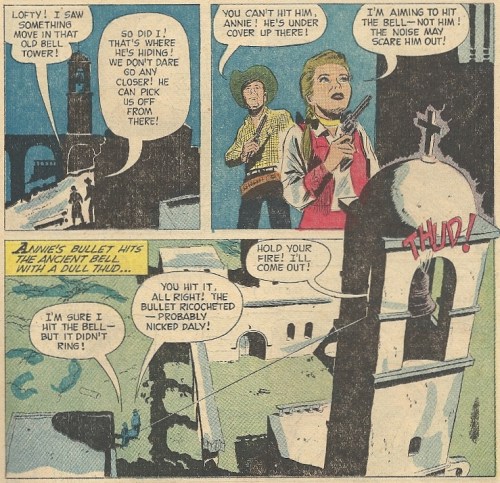
EVEN WHEN SHE MISSES SHE HITS.
And those are pretty much the highlights. Like most comics of this genre, whether based on real figures like Davy Crockett, or fictional personages like Hopalong Cassidy, they leave a lot to be desired. They aren’t my thing. If they’re yours, great — I’ll at least grant that the artwork focusing on western landscapes and architecture (like the night-shrouded bell tower above) can at times be pleasing to the eye.
Now, to circle back to that cover. Someone smarter than me could I’m sure generate a deep, scholarly paragraph or two about how whatever phallic symbolism contained is part and parcel of Annie Oakley working with weapons that are widely seen as misguided extensions of manhood. (See Pearl Jam, Vs., “Glorified G.”)Maybe throw in some yack about castration/emasculation symbology. I’m far too stupid for all that. I’ll just toss this out there, in case anyone wants to dedicate a doctoral thesis to parsing it. Your move, academe.
On behalf of Juicy Fruit, Bill Wisdom has some obvious, useless advice for the waning days of your summer

Labor Day, summer’s last fling, is upon us. And by the time you’re done checking off the various safety preconditions that Bill Wisdom has for you, it’ll be over. “Encase yourself in a foam bodysuit.” “Travel with an armed guard and a triage team.” “Never leave the house without a sweater.” “Be sure to chew Juicy Fruit.” “And stay away from minorities” — this is from the 1950s, after all.
If Bill ever saw U.S. Royal and his helmetless daredevilry, he’d faint dead away.
Here, have some of the cheapest, ugliest luggage in the world

When they refer to this clunky junk as “NOT FANCY,” they’re not messing around. Luggage is by its very nature boxy and unsvelte, but for some reason this assemblage looks like its destined for a family of destitute refugees fleeing a European war.
I’m reminded of the time on Mystery Science Theater 3000 (they’re on my mind lately) when Joel gave Tom Servo a car and got Crow a pair of “sensible pants.” Imagine your parents telling you that they bought you something from an ad in a comic book. Could it be a Thor pillow? A t-shirt? Hell, even Gre-Gory would be great.
No. Luggage.
Then again, you can stack them like in the ad, so that they look like some abstract representation of a matryoshka doll. Fun.

The great Steve Ditko has gone down many different paths in his highly varied and productive career. He steered a Spaceknight home. He gave life to one of the few heroes who could get away with wearing a feathered boa. He teamed with Wally Wood to put together a comic that mostly sat in a warehouse for years. And so, so much more.
But this, part of his tenure at Charlton, is one of the odder digressions. Gorgo. The monster, the myth, the legend.
Not familiar? Gorgo was a 1961 MGM production, which had for its star power William Sylvester, who’s known to most audiences as Heywood Floyd in 2001: A Space Odyssey. It saw an American salvage ship discover and capture Gorgo off the coast of Ireland, and subsequently bring him to London to be displayed in a carnival. Little did they know, the Gorgo they captured was actually an infant, and Mama or Papa came a-calling to get him back. Much HO scale destruction ensued, as miniatures of London were wiped out by dudes in suits and military stock footage was deployed with abandon. Eventually Gorgo is “rescued” and monster and parent swim off into the sunset.
Yes, it’s the Godzilla of the British Isles.
The film got a bit of a revival in the latter half of the 1990s, as the late, great Mystery Science Theater 3000 mockfest got its hands on it. It’s definitely one of the more enjoyable entries, and worth tracking down if you get the chance. (Hint: It’s easy to find on YouTube.) I’m a huge fan of that show, and it fills me with untold delight that a few movies riffed on during its ten year run had comic books. (Namely The Sword and the Dragon and The Phantom Planet, both of which will one day be chronicled here.) But only one of the movies that was ever picked apart by Mike/Joel, Crow T. Robot and Tom Servo had its own series. And a series that was primarily illustrated by an in his prime, fresh off of The Amazing Spider-Man Steve Ditko. And that, my friends, is Gorgo.
Gorgo the comic book was a rather loose adaptation, not really following onto the events of the film — as we’ll see in a moment. Instead it generally focused, much like the Marvel Godzilla series, on a vaguely hero-ish monster battling other more diabolical creatures. It wasn’t the most compelling material, and only Ditko’s presence elevated above the more easily dismissed Charlton offerings (I’m looking at you, Son of Vulcan…).
This particular issue is worthy of note for two reasons: 1) It has several similarities to the movie plot, but substitutes idiot Americans for the idiot Brits, and 2) Commies. Commies are always fun fodder — just ask Thor.
The story, scripted by Joe Gill, opens with a film crew managing to snag some underwater footage of young Gorgo, which they then release as part of a feature film. Said film is seen by a New York professor and his lovely assistant (of course), Jan. The prof gets the bright idea to capture and bring Gorgo to the Bronx Zoo(!), not so much for profit, but for prestige:
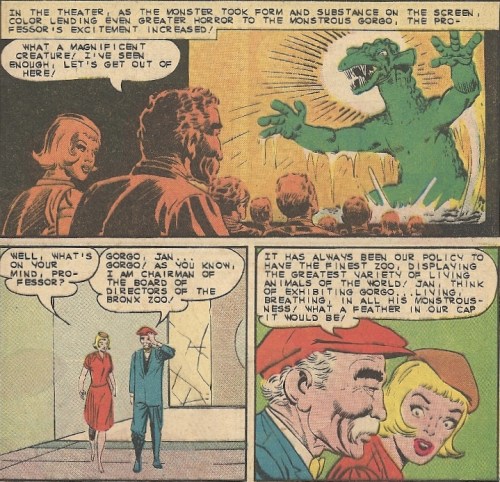
He sets out to put together an expedition to snag this potential sensation, but others are onto him. COMMIES. And what do Commies hate more than anything? Americans succeeding at whatever, that’s what:

A few things: First, the Vulture apparently ran the Soviet Union’s Politburo. Second, this comic was published in 1963, so the reference to Mother Russia’s “space triumphs” is quite timely. They had first dibs on the heavens at this point, and Neil Armstrong (RIP) was years in the offing. Third, I have to imagine Ditko, he of the rugged Ayn Rand Objectivist school, had to love drawing evil Communists. I’m a bit surprised they didn’t have horns coming out of their heads. And could you get a more Ditko-y hammer and sickle?
Anyway, the Professor builds his team, which includes Henry, a veterinarian with an aversion to, of all things animals. This makes him quite unpopular with shrewish Jan:
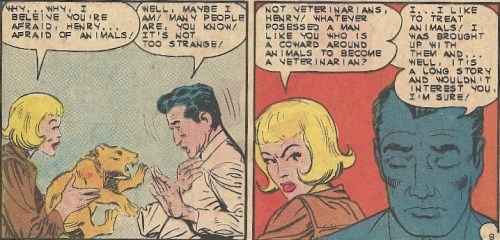
He’s right about not being interested. I could care less. But man, what a bitch.
Off they go, hunting Gorgo. And what’s our eponymous monster doing? Menacing ocean liners? Eating dolphins? Smushing islanders? Nope. He’s napping like a cute-a-saurus:
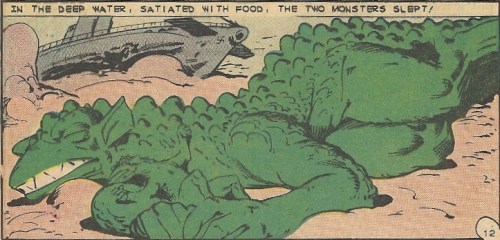
Awww.
Gorgo awakes and wanders off to play (yes, play), and MAN ASSERTS HIS DOMINANCE OVER ALL BEASTS OF THE EARTH:

Man’s inhumanity to monster.
Gorgo is subdued and netted. But we’re not out of the woods yet. On the voyage, Jan had befriended one of the swarthy crewmen, who looks sort of like a ginger Clark Gable, and this was much to poor Henry’s fist-biting chagrin. But — SHOCKER — he’s a Soviet agent. This gives Henry a chance to reclaim his manhood, one knuckle sandwich at a time:

U S A! U S A!
Gorgo is brought back to New York and chained up in the Zoo. At this point it becomes clear that no one in a position of responsibility has seen the MGM Gorgo movie, or for that matter King Kong. Gorgo snaps his chains and Mama (I guess?) shows up — the cover panels are lifted from the interior — and they return to sea. Oh, and we get some really dopey last words from Professor Ill-Conceived Plan:

It’s always great when a nice guy falls in love with a miserable, life-draining woman.
One of the worst problems in this book is how summarily Gorgo’s escape at the end is handled. It’s pretty much one page. Maybe Gill figured that people had seen the movie, and it would just be rehashing that. But I submit that this concern might have been better dealt with in an earlier draft. Or maybe Ditko was steering this boat. Quite possible. Whatever the case, this things ended too fast, and the conclusion is so abrupt, you lurch like a crash test dummy.
Still, this was Ditko doing what he did. The Professor, with his bushy white mustache and dark brows, is as Ditko a character as they come. And even Gorgo, especially in that capture panel, takes on some of the classic Ditko characteristics (though his fingers were a bit to thick to get the trademark curvature). Storytelling problems be damned.
Finding out that Steve Ditko, of all people, illustrated the comic series based on a terrible movie that got taken apart on my favorite TV show of all time, well, it was one of those unexpected delights that makes wading through all the good and bad of comics worthwhile. Ditko’s Gorgo work has seen scattered reprints, and, while I can’t say that it’s the best storytelling you’ll ever see, if you share similar MST3K proclivities, they might be up your alley. Maybe go on an expedition to hunt them down, but if you do, beware of ginger Commies.
Questionable history from the fine folks at Whoppers

What’s the biggest takeaway from this ad? That Richard III wore a sweatshirt which had “KING” written the front. Who knew?
Whoppers — your lie-based chocolate candy. Enjoy.

In my first weeks of college, back in the sepia-toned summer/fall of 1996, I got on the internet for the first time. A couple of shaggy dorks from the university’s computer science department went from dorm room to dorm room, installing ethernet cards in computers and hooking us into an archaic e-mail system. This was the first time that I’d ever been on THE WORLD WIDE WEB, and I’ve been a slave in its thrall ever since. So it was a momentous day.
I bring this up because the guys, after they had completed the installation, watched to see what I’d go to first on the information superhighway. Why’d they want to see that? They explained that it was because something like 90 percent of the guys typed “PORN” into a search engine right off the bat. A christening. I forget what I typed in, but it wasn’t porn. I don’t know what that says about me, for good or ill (I think sharing a tiny room with three other guys put me off immediate sexual gratification), but I remember the moment. Lesson: At eighteen, all men are testosterone-addled horndogs.
Anyway, the above boob projector reminded me of that. Your own Home Chestular Screen Display Device. Less family friendly, but assuredly more titillating, than the Tru-Vue projector.
Set aside Daredevil, Doctor Strange and Dracula. This man could make A FIREPLACE visually compelling. – The Gene Colan Treasury
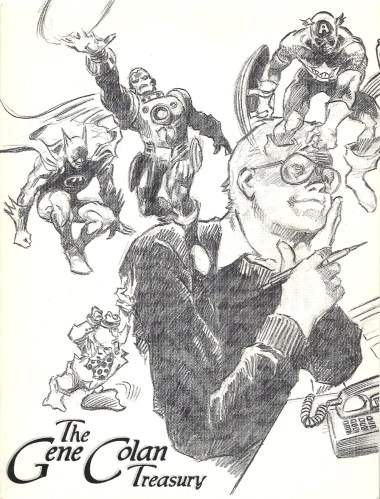
What you see before you is a rather hard to find little gem from 1996. The Gene Colan Treasury was created to help that at the time financially strapped artist, who had been laid low by health problems. Indeed, the magnificent cover that you see above was created especially for this book, and because of glaucoma that was robbing him of his sight, Colan had to sketch it with the aid of magnifying glasses. It’s humbling (and somehow cheering) that he could create something while half-blind that’s light years better than anything my fumblenut hands could ever scratch out. EXCELSIOR.
It doesn’t seem like a year+ has gone by since his passing, yet here we are. Let this serve as yet another cord on this blog’s bonfire of Colan praise.
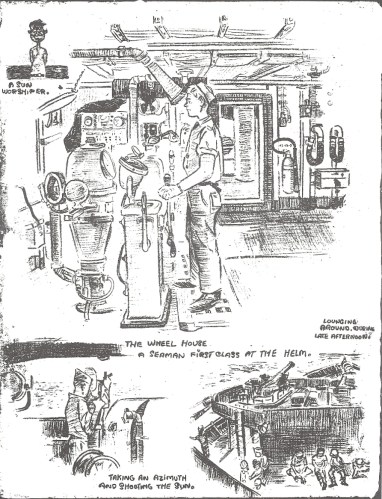
Though it also has black and white contents, the Treasury lacks the thick, expensive-feeling paper of the Flash Gordon Heritage fanzine. That said, the eclectic selection of unseen oddities within are utterly fantastic, and, for Colan devotees, they’re a playground, more than compensating for any presentation sizzle deficit. Unpublished newspaper strip idea from the 1950s? Check. Elvis? Check. Archie? Check. Stunning sketches of anonymous people? Check. Perhaps the best of the old-timey treasures — you can almost catch a whiff of an attic smell rising from this — are several pages from Colan’s military service, when he was stationed in the postwar Philippines did illustration work for the Manila Times. Here’s one:
For me, the high points are unpublished character sketches from Night Force, Colan’s mostly forgotten (but not here) ’80s DC horror title. And it wasn’t the characters themselves that stood out — though the distinctive Colan fluidity was everywhere. Instead, it was two architectural studies. The first is an exterior:

I want the demon/gargoyle things for my front door.
The second, the show-stopper, is an interior:
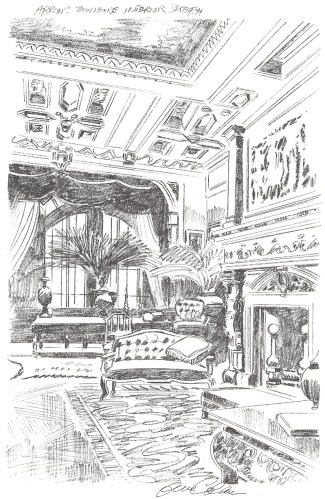
That second one — Mama Mia… Where do you start, you know? Where the hell do you start? The fireplace? The ceiling? The drapes? The settee? Where?
What I said before about half-blind being 100 times better than my best? I wish I could crawl into that sketch and read a book on that settee. What the heck, maybe The Gene Colan Treasury.
[Tips figurative cap.]
There’s also a fairly meaty interview within, one conducted by Clifford Meth, who put together this book and helped Colan pull through his financial straits. There aren’t any great revelations within that you couldn’t find these days on Wikipedia (well, there is Colan’s youthful/creepy fascination with — and brief stalking of — Gary Cooper). One snippet though, concerning his admiration for Jack Kirby’s abilities and the important advice gleaned from one encounter with the King, I found interesting (with a bonus Namor-t0-Captain-Marvel haymaker):

I’ve always had this mental image that the folks working at Marvel in the 1960s were like some Algonquin Round Table. Even Ditko. That they’d all sit around the bullpen, at their typewriters and drawing boards, ribbons and ink pots at the ready, bantering back and forth as they bent to their work. Occasionally pinching Flo Steinberg on the bum when she walked by. Then getting together when the whistle blew at a local restaurant or bar to gab until the wee hours of the morning. That sort of thing. This fancy has long ago fallen by the wayside, but that Colan had so few interactions with Kirby surprises me. But I have to say, he got some good advice out of the limited contact. Words to live by.
I’m still sad about Colan’s passing. He was an artist whose prime I missed out on, but I’ve grown to admire his work more and more as I get older. It’s reassuring to know that there’s a lot of material of his out there for me to stumble into. This book was like a little mother lode.
Stare at the rhythmic pumping of your miniature oil well for hours. And hours. And hours.

“Is that all it does?”
“Yes, Junior, that’s all it does.”
If Gre-Gory, the Big, Bad Vampire Bat is the “World’s Grossest Toy,” then this might be the most boring. Or boringest, take your pick. Unless you’re a young J.R. Ewing. Or a lover of sexual metaphors.

Wanting to own a Gre-Gory (GET IT?) toy as a child is surely one of the serial killer precursors, and if it isn’t, it needs to be added post-haste. Someone check Jeffrey Dahmer’s father’s attic.
There’s a definite Slim Goodbody vibe at play here, and that ain’t helping things (maybe a dash of Woodgod too). Really, who in God’s name had this monstrosity on their Christmas list? The fact that bats are the most nude of mammals — and always look like streakers spreading the flaps of a soiled trenchcoat — not enough for you? Well now you can see their guts!
Even Man-Bat is blushing with associative shame. But hey, if you had a younger sister, or, let’s be honest, any female family member whatsoever, this was to little plastic spiders what an H-bomb was to a blunderbuss.

Marvels was one of the biggest comic book events we’ve ever had. That 1994 Kurt Busiek/Alex Ross jaunt through the heyday of the Marvel Universe was a nostalgia-tinged prism that helped both fans and novitiates relive an age of comics, as if seeing it for the first time. For dopes like me, who didn’t have the wherewithal to, you know, BE ALIVE in the 1960s, it was in many respects the first time, and gave immediacy to the Marvel Age of Comics like no reprint trades ever could. The realism of Ross’s painted art had us looking at characters and their costumes in a new light, as suddenly tights and goofy headgear seemed real and appropriate. Like you could walk down a busy Manhattan street and actually see Captain America vaulting over a taxicab or Spider-Man scaling a glassy tower. Maybe in a small way it paved the way for the live-action film crop that we’ve reaped for a number of years now — or at least got the wheels spinning (pick your metaphor).
But if Mad has taught us anything over the years, it’s that the more popular something is, the more ripe it is for satire. So Marvels could stand a bit of ribbing. I don’t know that Ruins, which was released in 1995, hot on the heels of that always-in-print bestseller, counts as satire. But it’s something. And that something is the hellish mirror image of Marvels — right down to the style and acetate overlay of the covers.
Springing from the oft-acerbic pen of Warren Ellis, it followed the central eye-patched voyeur of Marvels, Phil Sheldon, as he wandered through an alternate Marvel, one where everything that could go wrong did go wrong, looking for answers as to why things are so messed up, and battling an unshakable inkling that things shouldn’t be this way. How screwy is this different reality? Let me sum up the first issue’s action in one long, breathless Faulknerian sentence. Ready?
The Quinjet is shot down killing the remaining Avengers then Sheldon meets Wolverine in a bar but his adamantium bones have given him some god-awful disease then Sheldon goes to a Kree concentration camp where they’re all dying from radiation cancer from nuclear missiles that destroyed their fleet after it was exposed by the Silver Surfer’s energy after he ripped open his chest in a desperate attempt to breathe again(!) and it’s Captain Mar-Vell who tells him all this and then Sheldon meets Nick Fury who’s a jaded old cannibal who kills himself but not before murdering a prostituting Jean Grey and then Sheldon goes to see a strung out and abusive Rick Jones (who beats on his bitch, an equally strung out Marlo) who tells him all about the doctor who saved his life but then became a big green mass of exploding tumors oh and then Sheldon trips over the bullet-riddled body of the Punisher as he leaves.
Pant. Pant.
AND THIS IS JUST THE FIRST ISSUE. IT GETS EVEN BLEAKER IN THE SECOND.
I mentioned “parody” up above. Parody usually entails laughs, and one might wonder where the laughs come into play here. If there are any, they only come from the most ebon of dark humor — like laughing at the gory carnage of the last Rambo movie. But, as Ellis himself remarked when the series got a 2009 reprint, it was indeed intended as a comedy. There’s only the thinnest of plots, nothing more than an excuse to go from one nightmare station to the next, and that’s one of the things that marks it as satire. Like those Mad skewerings, all that really matters is the twist.
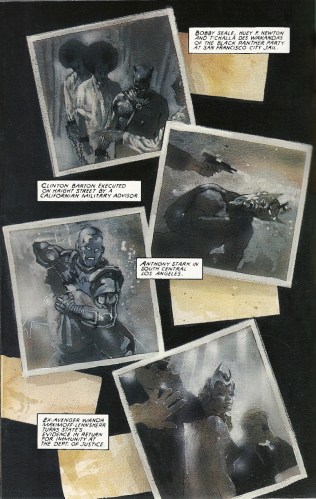
The two-part series was illustrated by the one-time husband and wife duo of Terese and Cliff Nielsen, as well as Chris Moeller on the latter half of the second issue. Their work is a counterpoint to Ross’s art just as the desolate storyscape of the plot is a counterpoint to the unfolding era of wonders in Marvels. It’s rough, abstract art that makes one think of Bill Sienkiewicz and his more rough-hewn figures. It looks like blood spatter, which is fitting. Here are a couple of pages — the first features afros and swipes of famous pictures:
Okay, this second one is kind of funny — if you can get past the blood:
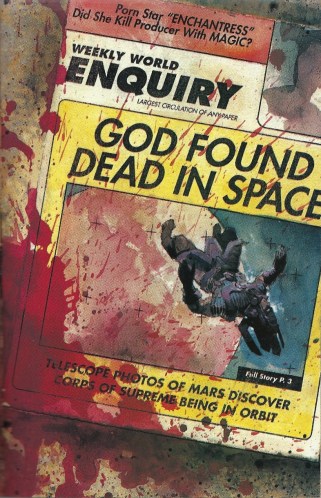
Why can’t Curiosity deliver anything like that?
I can’t say that the art is pretty — and most of the time you don’t even know what it is you’re supposed to be looking at — but for the material it works. And, as appealing as Ross’s watercolors were back when they were fresh, they’ve grown so stale in recent years I welcome anything different, and this adds another dimension when reading the story at a decade and a half remove.
If you want a more overtly comedic destruction of Marvel, try Fred Hembeck Destroys the Marvel Universe. (Which is sitting around here somewhere. Fodder for another day.) If you want a grim, hopeless meat-grinder of a story, one where the laughter comes from over-the-top deconstruction, go ahead and fumble about these Ruins.
This takes the old “Shamed By Your English?” ad to a whole new soul-crushing dimension
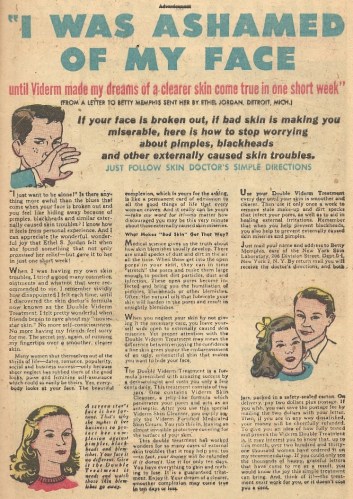
It’d be bad enough to have English skills so awful that you’d have to turn to a skeevy instructor who held his glasses out at odd angles. To be blighted with horribly pimpled skin — so bad you have to slink away like the tobacco-smoked Cosmo Kramer — would be a final nail in the teen social life coffin. THANK GOD FOR VIDERM, WHICH PRESERVES THE PRECIOUS EPIDERMISES OF YOUNG WHITE REPUBLICANS.
Cheerios once dabbled in the “compare our cereal to telecommunications satellites” business
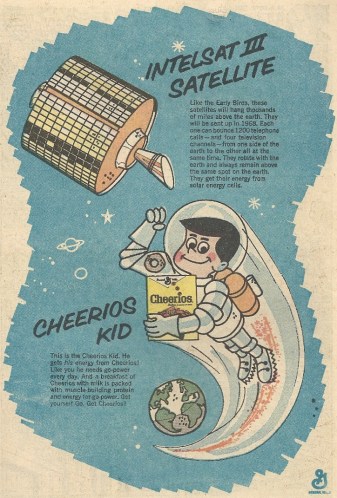
We’ve met the Casey Kasem-looking Cheerios Kid before. This time Cheerios hasn’t given him and his Cheerios-engorged bicep “faster than a steaming locomotive” powers, but instead has propelled him into outer space. It turns out Alan Shepard and John Glenn and Neil Armstrong et al. weren’t the real American space pioneers. The rocket-packed Cheerios Kid and his clunky Intelsat III satellite pal were.
Frank Miller and Walt Simonson at least delivered a crossover that, well, delivered – Robocop Versus The Terminator
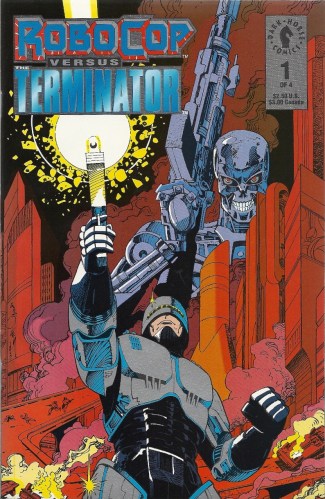
There are few dicier propositions in comics than the inter-property crossover. It can be a recipe for unmitigated storytelling disaster, and only in rare instances will it work on any meaningful level. Clashes like Superman vs. The Amazing Spider-Man can fall flat, despite the star power of those putting the treasury-sized epic together, and then you can get down to the really bad. We’re looking at you, Green Lantern vs. Aliens. Oil and water don’t mix, and sometimes, no matter what puree setting you have the blender on, neither do certain IPs. The fictional calisthenics that you have to put your characters through just don’t work. (Like, oh, I don’t know, having a Green Lantern lose his omnipotent ring so drooling xenomorphs pose an actual threat.)
Robocop vs. The Terminator, one of 1992’s more anticipated minis, had some inherent advantages. Both fictional universes revolved around cyborg nonsense, so it was no stretch to create a unifying arc that would intertwine the Detroit crime-fighting career of Alex Murphy and Skynet’s post-apocolypse. Perhaps having both licenses under the Dark Horse umbrella — after the Marvel Robocop and the Now Comics Terminator series — not only made the match possible, but also made it a little more seamless. And there was no stinting in the talent department, as Frank Miller, who was bound up with the Robocop film franchise as screenwriter of the second and third films, teamed with Walt Simonson. This was back in Miller’s pre-millennial days, before his work largely became self-parody, and of course Simonson has always been great. So this was a potential match made in heaven.
POTENTIAL.
Is it great? Transcendent? No. But, unlike many of its crossover kin, it at least knows enough to swing for the fences, because the only way that these things ever work is for them to go all out. ALL. OUT. And Miller and Simonson aren’t the type to pull punches, with words and pictures that are always right in your face. So much the better.
The story shifts some of the paradigms of the Terminator films, with a female resistance fighter our link to humanity’s future, and the one who confirms the all-important linkage between Murphy and Skynet’s army:
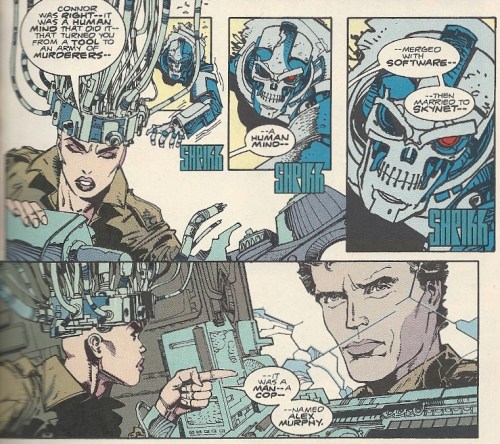
This babe is the one who goes back to her past, our present, this time not on a protective mission but to kill. GET ROBOCOP. This means we get some neat-o naked lady calisthenics when she warps in. HUZZAH!:
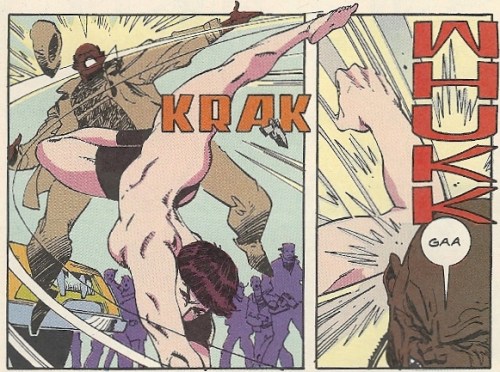
The Moe haircut is a nice touch.
The plot, naturally, is time-travel-laden, with waves of Terminators, including kid Terminators and dog Terminators (oh the irony), sent back to protect their figurative Papa, Robocop, at least until he can be plugged into Skynet’s mainframe. Miller has a somewhat unique take on fiddling with time, one that might not hold up on closer examination: that, when the past is altered, there are ripples felt in the future, and help can be sent back through time to fix the alteration. It makes your head hurt (and also reminds one of the dreadfully low-budget A Sound of Thunder, which gives you a full-on migraine). This sets up much of the action, as the past is changed, it’s unchanged, as Skynet is toppled, and as it reigns supreme. It’s never confusing, and there’s always cyborg-on-cyborg action to be had, but it does jump around a ton.
The art stands out. Skynet in one alternate future completes the eradication of humanity, which leads to the following two-page Borg-ish splash. Simonson must have grinned from ear to ear while this was on the drawing board:
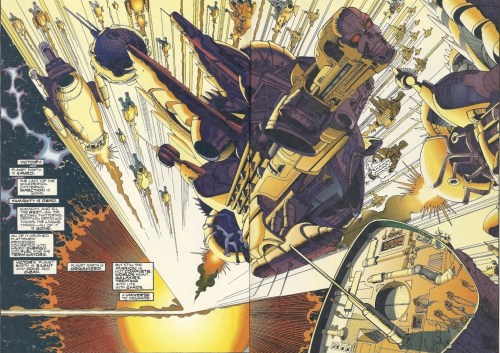
I don’t know whether to rejoice or roll my eyes at a starship with a Terminator head on the prow. I’m inclined towards the former, though.
Miller’s script often delves a little too deeply in that staccato noir that made him famous, so much so that you expect Marv to pop out of a corner and start shooting things up at any moment. A Robocop to Kill For. And, in line with the aforementioned time travel conundrums, obvious plot developments that readers would expect are conveniently overlooked or glossed over. The action reaches giddy heights when Robocop reconstitutes himself in the future to combat the robot dystopia that his human mind helped create. He creates a new body for himself and starts kicking unholy titanium ass, and while he’s in dock for repairs, his fetching female future-partner (who meets a grisly demise in the past but lives on in the future) STATES THE OBVIOUS:

“Why indeed?” indeed.
For all the flaws, for all the gaping time travel plot holes that dot the narrative like bunkers on a poorly planned golf course, it’s still all worth it when you get images like the following, which simultaneously summons — for good or ill — The Phantom Menace, A Chorus Line, Jason and the Argonauts, with a dash of Mars Attacks thrown in for seasoning:
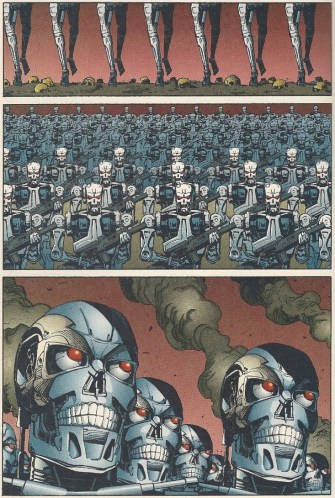
We’ve had four Terminator films, but none have ever delved into the Terminator-army promise in the Terminator 2 prologue. We wait, Hollywood. We wait. Thankfully, there are effervescent panels like those three to keep us going. (Incidentally, the bottom image there almost makes me think that Miller was handling some of the art chores. It looks a hell of a lot like some of his work on the Joker in The Dark Knight Returns. The inside front covers offer special thanks to other artists, such as Art Adams, John Byrne and Lynn Varley, who may or may not have pitched in. Maybe that’s what my eyes are picking up. Or maybe I’m just seeing things. Quite possible, I admit.)
A part of me wishes that it had focused on a showdown between Robocop and a Schwarzeneggerian T-800. Oh well. As it stands, it’s worthy of the better portions of both franchises (and good enough to get a bloody video game, too). It’s loud and often dumb, but it’s never dull and it never feels forced, which makes it good — and a relief. And hey, every issue had pop-ups inside for the kiddies! Should you want to decorate your desk with high-quality Walt Simonson art/junk as mementos of this cyborg throwdown, here are a couple:

Thank you for cooperation. I’ll be back.
 Jared
Jared


 blog into mystery