I disapprove this message (just the message, not necessarily the person, so please hold the hate) – Michelle Obama

It’s October, I’m an American, and it’s a year that just had a Summer Olympics. What does that mean? That I’m being bombarded with stupid, unwanted political advertising, that’s what. While I’m watching football. While I’m listening to the radio. Even YouTube has political ads now — I swear, I was trying to watch the trailer to goddamn Konga the other day, and had to wade through some ad that might as well have had Mitt Romney with horns coming out of his head. YOUTUBE!
It’s the worst. It’s the pits.
I don’t know whether the advertising has become more fetid, or if my palette just rejects it more and more. Probably the latter. As a man gets older and more crotchety, he comes to the realization that people who run for President of the United States aren’t half as smart as they think they are. Not even a quarter. I include Barack Obama and Romney in that. And you also realize that there’s such a requirement for preening douchebaggery in modern politics, a prerequisite of vanity, that the mere act of seeking the presidency should be a Catch-22 disqualification from said office. Bring back the smoke-filled room and cut the crap.
Democracy: it’s an unruly, sacred mess.
I try very hard to keep this blog apolitical (though that doesn’t stop the unhinged masses from occasionally firing arrows this way). I don’t like to mix comics with politics because comics are an escape (sports are the same thing). Four years ago I went into a comic book store, a place that had some really nice old stuff that I lusted over, and the owner was offering his pro-Obama harangue to everyone within earshot. I walked out and have not returned there since (and that result would have been the same if it had been a Tea Party harangue). Comics, like sports, are a refuge that people go to to get away from it all. When I’m at Nationals Park this Wednesday for the first D.C. postseason baseball game in 79 years, I don’t want any of this crap either. No Romney. No Obama. These are places we enter so as to reshuffle our normal allegiances, to take a vacation from ourselves. The wedges in these sanctums divide us in ways less important than those outside — though I question the importance of some of those outside political wedges — and any intrusion feels like a violation.
This is all a long-winded way to say that I dislike very much comics with a political bent. And when they’re poorly conceived and executed, they’re toxic. Today’s offering, published by the hasty-bio division of Bluewater Comics, is toxic.
I have no beef with Michelle Obama — or her husband for that matter. The only reason her dopey biocomic is the centerpiece of this post is because it’s the one sitting on my desk. She seems nice enough, and God knows being the wife of a politician can be a layer of Dante’s hell. But maybe it’s her tangentialness (is that a word?) that makes this comic all the more stupid.
What makes this comic so bad is that it isn’t as much the Michelle Obama story as it is Michelle Obama, as Told to Us by Scripter Neal Bailey. It’s a lecture, and a lecture not delivered by the learned Prof whose gray hairs signify the wisdom of age, but by a schlubby guy sitting in the dark on his couch in shorts and socks. No, really:

And the first black president is reduced to this. IT’S ALL ABOUT YOU AND YOUR POTATO CHIP ADDLED PHYSIQUE. (I can’t help but be reminded of Edmund Morris’ long-awaited biography of Ronald Reagan, Dutch, and how horrified the political cognoscenti were when they discovered that he had inserted himself as a “character” in the Gipper’s life story.)
Every aspect of Michelle Obama’s life is bookended by useless, simple commentary from Bailey. Like a formula for a bad mixed drink, it’s always one part Michelle, two parts Neal (it’s nowhere near that prevalent, but the obnoxiousness of the interjections makes it feel that way). And don’t worry, there are plenty of opportunities for conservatives personas to get the horns and fangs treatment, rendering protestations of impartiality laughable. Know your audience, I suppose. Here’s Bill O’Reilly yakking about her thesis, complete with BLACK, SOULLESS DEMON EYES:

You want more? HIDE THE CHILDREN, HERE’S ROBERT BORK AND HIS TERRIFYING WHISKERS ABOUT TO ATTACK:

The comic tells Michelle’s — frankly, rather humdrum — story from humble beginnings as the daughter of a janitor, to law school and a promising legal career. All well and good, and that’s a path that anyone would be well-advised and proud to follow. But Bailey, who seems determined to defend every thought and deed in her life, even things that don’t need defending, takes things too far too often. When Michelle takes a job at the prestigious corporate law firm of Sidley & Austin (actually Sidley Austin LLP, but we’ll go with the formulation here), it’s depicted as some sort of sacrifice, like her life has gone down a horrible detour. As a one-time graduate of law school, let me offer my own commentary: No one in Michelle Obama’s day joined Sidley & Austin with a gun to their head. Such a job was highly sought after and very, VERY highly compensated. It wasn’t a sacrifice. But we digress.
Much of the comic focuses on Michelle meeting Barack, their courtship, and the juggling that has to be done to lead — and support — a political life. Which is stone cold boring. And much of the latter portion of the book is spent going over the ill-advised “For the first time in my adult life I am proud of my country” campaign gaffe:

(Let me add my own asterisked notation to that smug one: Barack Obama, in 2012, still hasn’t closed Guantanamo Bay. For whatever that’s worth.)
It’s here that the book really runs off the rails, with Bailey doing everything he can to say that this was no big deal. He offers up all the bad things that happened in her adult life (and none of the myriad things that she should have taken pride in), and pounces on the people who pounced on her, like EVIL CRUELLA DE VIL CINDY MCCAIN:

His arguments in the defense of her statement, and his attempts to draw it out into some commentary about modern American discourse, read like a student paper in an introductory political science course. They carry the taint of pretentious insufferability (much like this blog). Let me offer my own defense of Michelle: WHO CARES? I mean, really, who cares? She was, not a First Lady, but a potential First Lady at that point. No one was going to be voting for her for a damn thing. Why do people even give a hoot about what a political spouse says? Unless it’s Heil Hitler or something similar. Which this wasn’t.
Maybe that’s the ultimate critique of this book. Who cares? It’s a dull read, and the art (from Joshua LaBello) is, somewhat appropriately, flat and two-dimensional. Bailey and LeBello might be nice people, and I hate that this critique might seem so personal, but it’s hard when people inject themselves into a narrative. This book stinks, though. It’s bad, a tell, don’t show bore. What they produced seems so pointless, a craven desire to cash in on anything associate with the first African-American Commander-in-Chief (it was published right around the inauguration). Lump it in with the Chia Obama, I guess. (There was a sequel — Michelle Obama: Year One. Whatever.)
I’d rank this thing right around Reagan’s Raiders. They’re both awful for vastly different reasons. Bipartisan garbage — EXCELSIOR.
Let me reiterate, nothing personal against the Obamas.
I can’t leave you without a gratuitous — deserved or not — kick to Sarah Palin’s gut. Here’s she is, complete with BLOOD-DRENCHED KNIFE, from the last page of the comic:

Also, here are some other comics in this “Female Force” series, and I double dog dare you to try to figure out which would be the worst read:

Boy, I bet that Caroline Kennedy biocomic would be a real page-turner. You know?
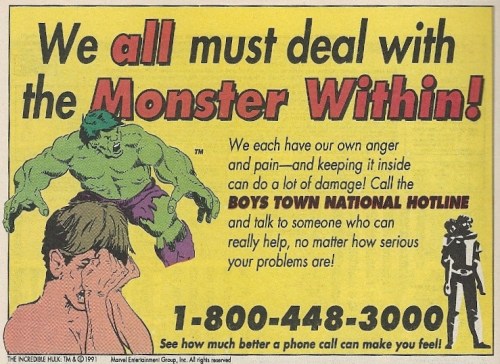
This ad has its heart in the right place, and there’s certainly no more anger-centric character than the Hulk. But to associate this beloved comic book icon with whatever god-awful struggles a kid would have to be going through to have need of the Boys Town National Hotline, well, that seems a bit much. The Hulk is (often) portrayed as a monster that busts out when Bruce Banner gets angry, and then wreaks havoc on those who’ve harmed his puny human alter ego. With tremendous, destructive violence. Like here. And here. And here. And about a million other times. This is something the reader roots for and looks forward to. Is this the message we should send to angry young people, those with a “monster within”? That they should smash and smash and smash until they doze off in some secluded glen? All I’m saying.
Then again, maybe this is pitch perfect. What the hell do I know.
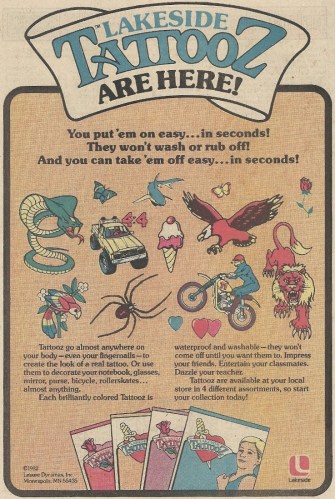
I’ll never forget this one time that my high school girlfriend came to visit me in college during my sophomore year. It was an on again, off again relationship that I won’t bore you with (mostly off-again), but on this particular visit, she proudly told me — before “hello,” before “how’re you doing?” — that she had just got a tattoo. She was so happy. And then she pulled up the back of her shirt to reveal the lamest, ugliest lower back tattoo that the world has ever seen. It was some dopey yellow and blue butterfly that looked like a bruise, like she had been in a car wreck on the drive over and the wounds were still fresh. Like someone had punched her tailbone the day before. I had to rub lotion on it for her all goddamn weekend, and its profound, untrammeled stupidity mocked me. I’ve hated all tattoos ever since.
The butterfly in the above ad, the one right next to the cobra, reminded me of it. A lot. Lesson: If you’re going to get a tramp stamp, don’t get a blue and yellow butterfly. Or at least make it a temporary one. (Note: Tattooz were also inserts in any number of comic books, including the highly desirable first appearance of the Hobgoblin in The Amazing Spider-Man #238. They were often removed, rendering the comics “incomplete” for collectors. Which gives us a reason to hate temporary tattoos/Tattooz as well.)
Mac Tavish isn’t Magnus, Robot Fighter, despite his looks and robot fighting (also: Chewbacca?) – Eerie #96

There’s really not much to say about that Eerie cover up there (artist: Jordi Penalva), other than this: IF THAT IS NOT MAGNUS, ROBOT FIGHTER, THEN I DO NOT KNOW WHAT MAGNUS LOOKS LIKE. Let’s catalog all the things that go into making this a magnificent example of loving homage/copyright infringement:
1. Appearance
Magnus, the karate chopping warrior from 4000 AD, is known for two bits of sartorial splendor: his red jumper and his white go-go boots (here are roughly 1,000,000 images of it). Either the unisex clothing of the far future has grown much more inclusive, Magnus is very comfortable in his masculinity, or he just likes dressing like a young Nancy Sinatra (Ghost Rider 2099? NANCY SINATRA 3999).
Our new friend Mac doesn’t have all of that, but he does have a red shirt hugging his lithe, sinewy frame. Combine that with the brown locks and the tight slacks that could pass for bare legs (Wait, is he wearing shorts? No, he’s not. Wait…), maybe even some suggested white footwear, and you have Magnus-lite. Magnusish.
2. HELLO, HE’S FIGHTING ROBOTS
Not only is Mac Tavish kicking a robot right in its robot balls, an editor at Warren Publishing was kind enough to give us a little “Robot Smasher!” copy, you know, just in case potential readers were literate but stupid. How did Magnus dispatch his robot foes? That’s right, he chopped, punched and kicked the bolts right out of them with his steel-smashing hands. Fought them, smashed them, whatever. Like what Mac is doing up there. Well, kind of doing. He has his hands (and feet) full, so it’s a good thing that Chewbacca is charging in with his bowcaster to…
So it’s only two reasons, but they’re two big ones. Looks and actions — they make the man.
Just so you know, Mac, one of the endless serials that made Eerie so beloved by its fans, doesn’t occupy the same Jetsons-like cityscapes that Magnus does. Instead, he’s more at home in a seedy underworld, a place of smugglers and black markets and futuristic schemers and gangsters. Now that I think of it, a lot like Han Solo. Which just added a new layer of confusion. Also, he has far less success battling machines (which are owned by an antagonist/acquaintance, indeed the very Chewbacca proxy glimpsed on the cover — who speaks, and not in grunts) in the story than the cover suggests (Jim Stenstrum words, Pepe Moreno art):

Magnus would not be proud.
I did a little digging before I threw this post together, and found that I’m by no means the first person to notice and comment upon these blatant, surely intentional similarities. Check here for someone else’s brief commentary on the subject, and also some more discussion of Mr. Tavish himself.
If you’re G.I. Joe and you have a Jeep, are you really going to drive around WITHOUT a gun mounted in back?
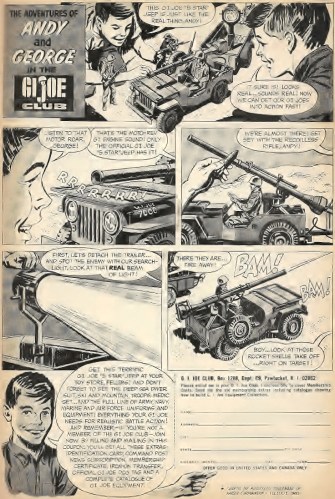
If you have an uncapped four-wheeled motorized transport, you have two manly choices: you can either use a giant spiked German helmet for a top, or you can mount a huge gun in back, like G.I. Joe up there. That’s it. Those are your options.
Really, isn’t the latter the primary reason, even if it’s a subliminal desire, that a person buys a Jeep?
In India, lollipops are marketed with monkeys and an unsettling amount of licking terminology

There’s perhaps no greater line of demarcation between parts of the world than the kinds of food that people eat. You don’t have to stop with sacred cows, octopi and dogs, either. You can go all the way to the snack foods devoured, the guilty little pleasures that people sneak one, two or a bag at a time.
This is from one of the Amar Chitra Katha books that I posted about a few days ago. Well.
I loved chocolate eclairs when I was growing up. My mother used to buy a five pack of them at the grocery store once a week, and they’d be lucky of they saw another sunrise. I’d even peel off the bits off spillover chocolate that had slopped onto the plastic container that held them. (The whole process was like Barney Gumble sucking spilled beer out of a shag carpet.) I liked lollipops, too, especially the Tootsie Roll Pops with the chewy center. But Chocolate Eclair Pops, a confection largely limited to the other side of the world (a Google search points to lot of sites located in Africa), sound absolutely revolting. And I have to say, the juxtaposition of the monkey (nice bow-tie, Mr. Pops) and the talk about wrapping your tongue around things (and licking the ever-loving hell out of them) is a bit off-putting. A lot off-putting. I DO NOT WANT TO THINK ABOUT LICKING MONKEYS, CREATURES MOSTLY KNOWN FOR THEIR FILTH-THROWING DEXTERITY.
Drunk Iron Man fighting Machine Man? Drunk Iron Man fighting Machine Man. – Iron Man #168
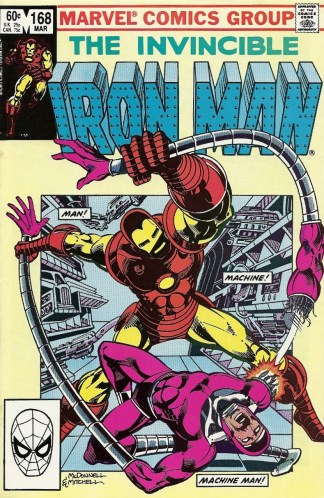
The Iron Man movie franchise, which now is so established it seems like a given, a money-making no-brainer that only the dullest of Hollywood execs would fail to greenlight, was long-gestating. The potential screen adaptation of Tony Stark and his armor-clad adventures went through any number of permutations over the decade leading up to the actual greenlight, with names like Quentin Tarantino and Tom Cruise bandied about at points along the road. There was one constant about all those variations and the fan anticipation around them, though, and that was that they’d have to — HAVE TO — do “Demon in a Bottle” at some point. If not in the first movie, then within the first two minutes of a sequel, Stark would have to be disheveled and drunk, slurring his words as he tries in vain to tuck in his shirt. The most famous storyline of the Iron Man mythos would have to be shoehorned in no matter what.
There was a problem with this line of thinking. A movie is a movie, and a comic book series is a comic book series. They’re different animals. “Demon” didn’t play out overnight, but had stops and starts, which it made it so much more powerful. It was like real life in that regard, with Stark not becoming a railroad-car-hopping hobo overnight, but spiralling downward slowly over the course of time. Once again — LIKE REAL LIFE. Cinema can of course handle such an arc, but it’s not as long a form. There wouldn’t be as much room for the story to breathe. And, most importantly, for the crippling alcoholism of an industrial magnate to be given full vent, the whole, you know, IRON MAN part of the story would have to take a back seat. You think the Ang Lee Hulk (which I admittedly liked quite a bit) had audiences squirming in their seats? Wait until hour two of the Stark sad-fest rolled around. GET BACK IN THE GODDAMN ARMOR AND DO WHAT WE’RE PAYING YOU TO DO.
And it’s not so much Stark’s initial descent that offers the most dramatic power, but the relapse, which would be even harder to put in one two-hour+ film. But comics? They can handle it quite nicely. And that brings us to our topic of discussion for today, which finds Tony deep in the throes of a hellacious relapse, one that will eventually see him lose his company to arch-foe Obidiah Stane.
But what makes this one comic truly special? He fights Machine Man, baby, that’s what.
A few words about Mr. Man… The character has a special place in my heart, primarily because he was in one of the earliest comic books that I ever had as a kid, from a three-pack of Incredible Hulk comics bought in a dusty general store in the early 1980s. In it he fought the Green Goliath (he apparently has a habit of crossing popular heroes) and the story had one of the most striking Hulk scenes I’ve ever seen in my life. While battling, the Hulk grabbed the sod that he and Machine Man were fighting on, and, like a rug, pulled it out from underneath his foe. That still ranks as one of the greatest moves I’ve ever seen the big guy pull off (as long as you don’t worry too much about the physics and agronomy involved), and Machine Man basks in the reflective glow for having been a part of it. So not only is he a great Jack Kirby creation with a classic Pinocchio obsession with understanding humanity, but he has this feather in his cap. A charmed life.
Of course here he gets his arm ripped off, so it ain’t all that charmed.
This issue (Script: Denny “Black Turtleneck” O’Neil, Pencils: Luke McDonnell, Inks: Steve Mitchell) is right a the beginning of Stark’s rock bottom, a nadir that he’d only triumphantly overcome in issue 200 when he donned the new silver armor. How low is this trough? Here he is, passed out drunk in his office, a tableau complete with a spilled liquor bottle:
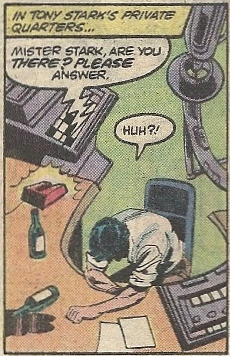
When you wake up next to pools of things, you have a problem. (I suppose that wet spot could be barf he projectiled across his desk, but it just doesn’t look chunky enough. BARF TALK.)
Like any good drunk, Stark thinks he can pull himself together in a few minutes with some cold water and a jolt of black coffee. But he has one other ace in the head-clearing hole, one unique to his double life. He thinks slapping on the armor, his hard outer shell in an emotional as well as a physical sense, will make everything all right. Not only does it not, BUT PUTTING ON A HIGH-POWERED WEAPON IS PERHAPS THE WORST THING THAT COULD BE DONE:

This takes “Do not operate heavy machinery…” warnings to the next level. And potential DWIs.
But before we get to any more of this ugliness — ENTER MACHINE MAN, who’s stealing Stilt-Man’s gimmick while scaring the living bejeezus out of a secretary:

Oh, come right in why don’t you.
As you may have picked up, Mac is on the Stark International grounds in search of Iron Man, who he thinks might be a kindred android spirit, one he might be able to compare notes with in his relentless Lieutenant Commander Data quest to be more human. But he’s in for a rude awakening when his quarry walks through the door:

Piss-drunk and paranoid Tony thinks Machine Man is one of Obidiah Stane’s henchmen. Oops. What follows is a drunken Quiet Man brawl across the company campus, with Tony slurring his words (many “lissens” on display), endangering mortals (swinging a steel girder like a baseball bat and nearly decapitating some suit) and making poor Machine Man fight him and try to save lives at the same time. He even manages to completely ruin a complex multi-million-dollar project in his angry drunk rampage:
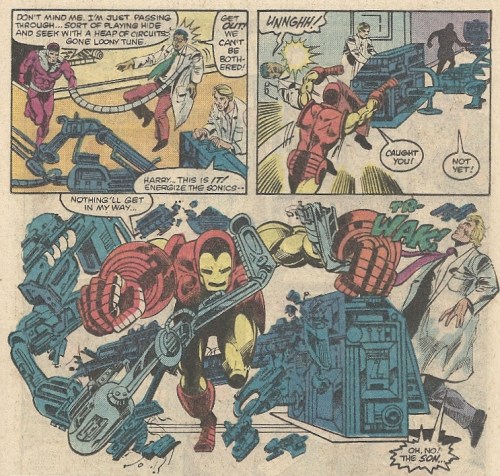
(Son… is cut off “sonics,” in case you’re wondering.)
Finally Machine Man, who’s still under the impression that he’s fighting a machine, if forced to use a Vulcanish mind meld on Iron Man, and it’s only then that he realizes what he’s up against:
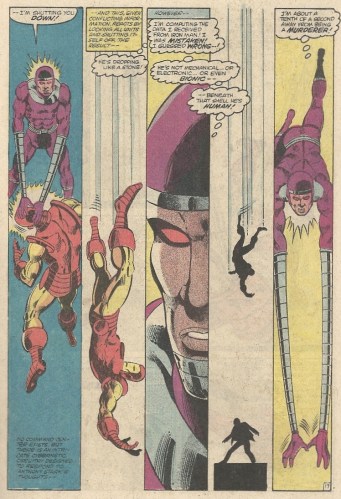
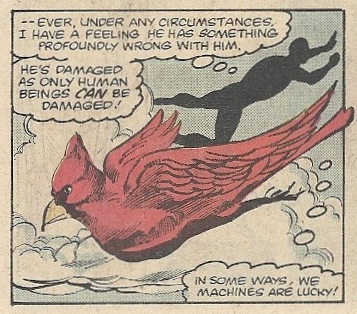
He saves Tony from the freefall (much like Hulk in Avengers, now that I think of it), and then beats a hasty retreat. Here we have a dash of his postgame ruminations, complete with a GRATUITOUS CARDINAL CAMEO:
Stark comes to, perhaps having urinated in his suit, perhaps not, and returns home to change. If you’ve ever wanted to know whether Tony Stark wears boxers or briefs, now the story can be told:
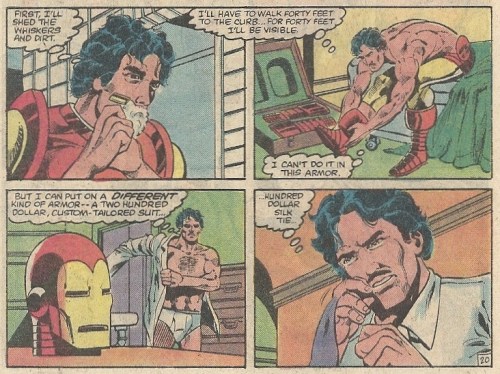
This downer of a story ends on an even bigger downer:
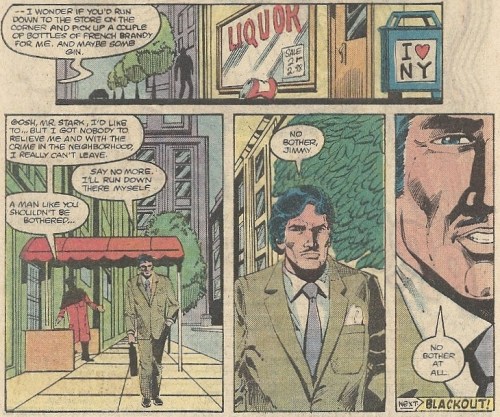
No bother at all.
This issue is one of the stones on the path of Tony Stark’s long battle with the bottle, but it’s a significant one. The fight with the well-intentioned Machine Man represents his darkest hour, when he’s no longer able to reason, to think clearly, and hence becomes just the kind of armored menace that he so often battled. He’s an unaimed missile with Rebel Yell (okay, something a little pricier) on his breath. Would anyone really be all that depressed about Jim Rhodes climbing into that suit with carnage like this? Anyone? Bueller?
You also have to recognize that O’Neil’s deft script hits notes that wouldn’t be possible in a Hollywood blockbuster. Think back to the drunk Iron Man/Rhodes fight in Iron Man 2, which had armored friends pounding each other (rather harmlessly) all through Stark’s (ridiculously desirable) oceanfront mansion. Even if we admit that there was a different emotional baggage because of the friendship between the two combatants, the hooha was over before it began and Stark was soon enough sober and back on his feet. Did that have much impact, beyond the craters left in the floorboards? Could it really compare to this, where there’s no happy ending — for another month, at least — and Tony Stark ends his day slinking off to the nearest liquor store?
That Malibu dustup and the Samuel L. Jackson/Nick Fury pep talk that followed it are probably going to be the extent of the “Demon” presence in the movies. If there’s any point to this post, it’s that that’s not such a bad thing, because comics like this, which are part of that storyline’s sad reprise, are so much better. Throw in poor Machine Man finding out that the “broken” robot he’s battling is actually a “broken” man, and you have a level of pathos that’s hard to replicate.
Don’t confuse Gary LarsOn of The Far Side with Gary LarsEn, the befuddled, bespectacled gamer

So playing Riddle of the Sphinx on your Atari reduced you to a quivering, brain-dead mound of flesh. Even if you were poor Gary Larsen, he of the 162 IQ. Huh. Good to know. (He must have an IQ of 162, because LOOK HE HAS BOOKS. SO MANY BOOKS HE ACTUALLY HAS SHELVES FOR BOOKS.)
Oddly enough, that look on his defeated mug is one I’ve had before, after hours of trying to figure out some of the more opaque Far Side cartoons. It all comes full circle.

I can see RPGs igniting the imagination, what with the vast adventures based on nothing but dice and sourcebooks. But static scenery? “Action” Scenes? Maybe not. But they’d surely rank right up there with insect collections as things that would get women to crash through a wall, leaving only a Looney Tunes outline of themselves as they made good their escape.
Let’s travel to India, where the comic book pantheon has pre-installed blue guys – Amar Chitra Katha, “The Gita”
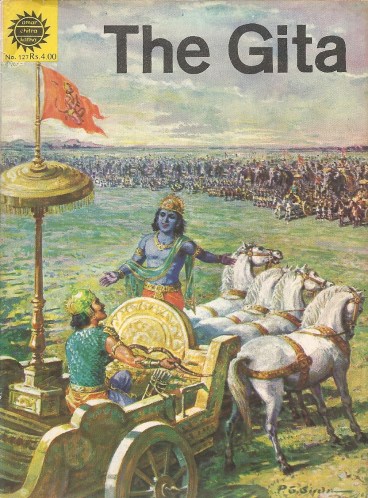
Comics from other lands have occasionally been highlighted here, but they’ve been European interpretations of American comics. The spread of Yankee iconography is ever-gratifying to the ego of American nationalism (U S A! U S A!) as much as it’s assuredly galling to natives who lament any Americanization of their culture, no matter how minute. Some people see McDonalds golden arches in every bit of imported Americana, and to them it’s like the Visigoths riding over the hills of Rome. You have to imagine that comic books, though low on the cultural ladder, would generate such a reaction.
None of that today. Today we’re going to take a brief trek to the Asian subcontinent and dive into one of the most popular of Indian comic books, a series that, ironically enough, was created to help gird the fading culture and myths of old native Hindu traditions. Behold, Amar Chitra Katha.
Disclaimer: I’ve never been to India. Most of my exposure to the country has come through Gandhi, in which an Englishman of Indian descent played the Indian who ended English colonial rule, and a smattering of books. My knowledge of that nation’s myths and traditions is limited at best, non-existent at worst.
But that’s kind of the whole point of Amar Chitra Katha.
It was a series born of one man’s desire to preserve and propagate Indian cultural heritage (or so the story goes). The founder of the line (and scripter of the comic reviewed in this post), Anant Pai, found himself shaking his head at the utter lack of awareness by Indian children of hallowed stories that stretched back to time immemorial. They could more readily answer questions about the European mythical deities than their own, and THIS WOULD NOT STAND. Hence ACK was born. (This version of the genesis may be legend itself. Another has a publisher cobbling together the series to make some money, and bringing Anant Pai on board to helm it. Perhaps the truth is somewhere in the middle.)
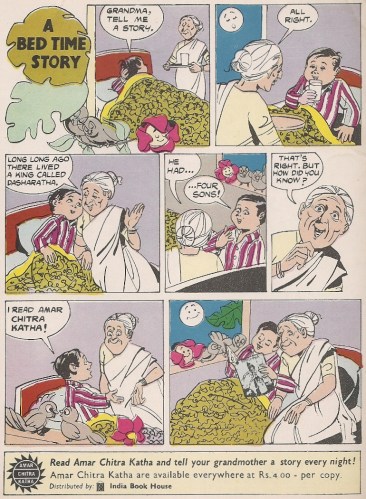
The resultant series, begun in 1967 and published in English almost from the beginning, reads like a cross between Classic Illustrated tomes and children’s books about the Bible. Life lessons are taught in a manner that’s easy for young readers (or young kids being read to) to digest, and the traditional folklore of a vast, populous nation is passed on to a new generation, all with pretty pictures to help drive everything home. The series was and is a best-seller, and how could it not be, with backpage ads like this to promote it?:
The issue that I decided to highlight (I bought a few at a local library’s book sale, if you’re wondering where it came from) is a perfect example. The Gita (or the Bhagavad Gita) is a Hindu scripture. A part of the vast Mahabharata epic, it tells the tale of a warrior’s crisis of conscience and the divine advice that salves it. It’s a heavy pill to swallow, with a great deal of extensive philosophical exposition. To shorten the buildup to the real meat of the tale (adapted here by Pai and artist Pratap Mulick), the Pandavas are swindled out of their kingdom by their cousins, the Kauravas, and they opt to settle the resultant dispute on the battlefield (complete with rules like an Anchorman rumble). It’s there, after the conches have blown to signal the combatants to array themselves for war, that we come to the crux. Arjuna, the great Pandava archer prince, has a crisis of conscience: how can he kill his kinsmen?:
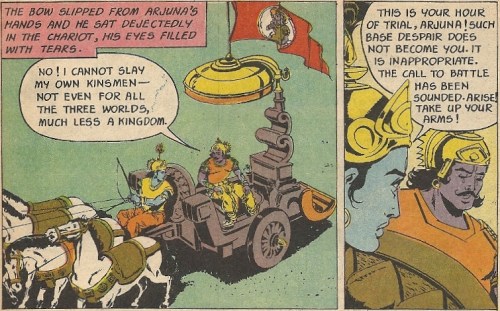
The driver of his chariot, in case you can’t tell by the blue skin, is Krishna. As both armies wait patiently, he gently instructs Arjuna in all manner of philosophy, first telling him that, to fulfill his dharma, or duty (a rough translation, but the one offered by the comic), he has to fulfill his role on Earth as a warrior. He’s going to have to fight and kill. But killing a man’s body does not kill the man:
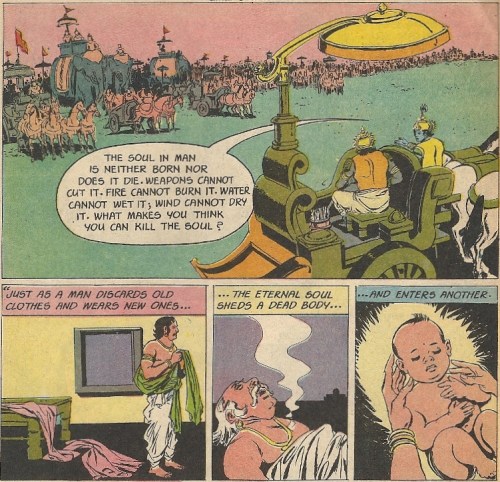
Reincarnation and the immortality of the soul is all pretty confusing to poor Arjuna, so Krishna branches off on a new tangent, telling him about how the mind must be clear to see the true path before it, and how this enlightened state can be achieved through meditation:
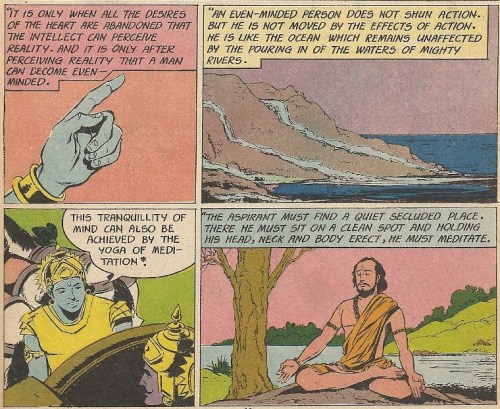
Much of what Krishna talks about can be boiled down to equanimity, i.e. taking life as it comes, staying medium and not sweating the small stuff. Or so says my Western McDonalds interpretation.
After a while, Arjuna has a variant of the “Hey, how do you know all this?” moment so prevalent in such stories (the blue skin apparently wasn’t a clue). It’s then that Krishna reveals his true nature as no mere charioteer, but the avatar of Vishnu:
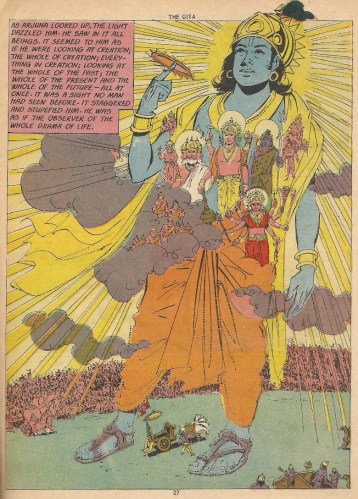
Arjuna is humbled and at peace. Then there are some final words of encouragement:
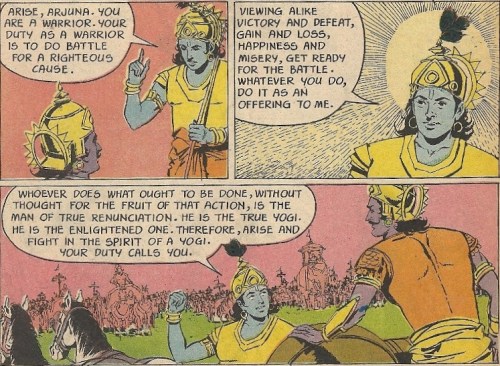
Now, his mind clear and focused, Arjuna is ready to fulfill his duty. And that duty is? Killing as many of his relatives and his relatives’ soldiers as he can. Religion: it’s a strange and wondrous and terrible thing.
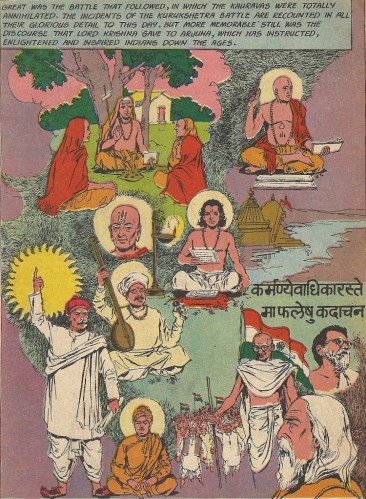
The Gita is a fundamental Hindu text (should you want to read more about it, or at least further than this gloss of its comic book interpretation, the Wikipedia entry for it is as good a place to start as any). Its emphasis on how to negotiate the moral conflicts of life and of selfless duty (minus the odd juxtaposition with imminent bloodshed) has helped it stand the test of time, and has influenced countless individuals great and small. One person who took to heart its lessons was Mahatma Gandhi — hey, wait, that’s him right there, in this comic! On the last page! What a coincidence!:
From the perspective of a not-well-travelled white American male of a certain age, the Amar Chitra Katha books, including this one, appear to be well done, even when Krishna is at his wordiest. And they’re certainly a lot better than when folks in India muck around with U.S. icons — I’m looking at you, Bollywood Superman. “The Gita” is fairly easy to understand, even for befuddled Westerners, and the art is solid — the cover painting to this one is what sold me on discussing it here. The books have been translated to any number of languages, and have been reprinted countless times since the series began (the cache I pulled a few out of were from 1985). Should you ever be in that neck of the woods and see one, and have some few spare rupees in your pocket, why not pick one up? Or maybe save the air fare and just go to the website.
So ends this all too short blog vacation, one that didn’t require a Marco Polo-like journey to the ends of the Earth. The joys of reading, people. The joys of reading.
Even if your name is Lenny, don’t put Lenny on your personalized Clark Bar All Pro Sport Shirt
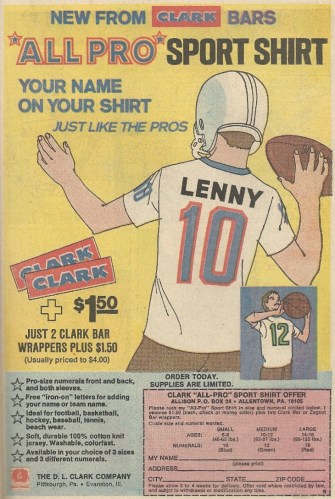
The modern trend of wearing sport jerseys is a tough for some people to get behind. They would hold that there are only two types of humans who shoud be allowed to wear the replica jersey of a professional athlete: children and women currently in a sexual relationship with that athlete. For everyone else, it’s incredibly schmucky, especially for middle-aged men with potbellies. That said, people who feel this way (like me) are in a distinct minority. One glance around an NFL stadium on a Sunday confirms that.
This old Clark Bar offer is an obvious exception because it’s your name on the jersey. But, though there’s nothing wrong with “Lenny” being the name standard-bearer, for me it conjures up images of fat, hairy plumbers with their ass cracks showing while they work on the kitchen sink’s clogged pipes. Once again, maybe this is my problem, but there you go.
Would anyone really punch their Golden Ticket to get Willy Wonka’s Chewy Crunts? I mean Chewy Runts. Whatever.

There are certain names that lend themselves to slips. Sometimes this is done intentionally, as with the oft-used album title “Cunning Stunts.” Make a casual switch of a consonant here and there, and voila, you have a word you can’t say on television. Then there are times like this. I see “Chewy Runts” and my brain automatically jumbles it into “Chewy Crunts.” “Crunt” as in “Andy Rooney, may he rest in peace, was a miserable crunt.” I don’t think that’s what they were going for here.
By the by, did the real life Wonka people license Gene Wilder’s image to use in these ads? They probably had the rights stemming from the first movie, but I ask because that’s a reasonable cartoon facsimile of him, and the Willy Wonka that you saw in ads back in the day didn’t always look like that.
The X-Men would like you to make Hi-C your boxed fruit(ish) juice drink of choice
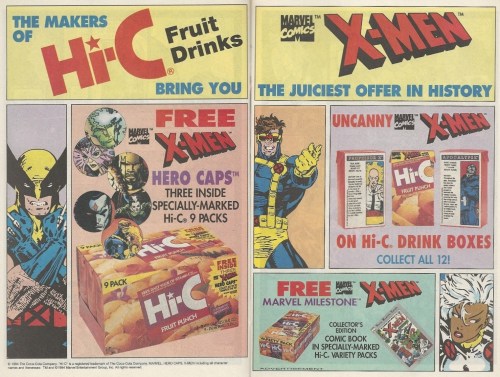
Hey, not only could you get some useless pogs and a reprint comic, you could pair your X-Men Hi-C with your X-Men Spaghettios and have yourself one hell of a heartburn-inducing meal. A real five alarmer. Delish.
I haven’t had Hi-C or any other boxed beverage in decades (I was a Ssips boy), but the lasting memory I have of them is that sometimes that little straw just wouldn’t pierce the foil hole that it was supposed to, and would end up broke, blunted and useless. And then you’d have this impenetrable box of juice that was impossible to open otherwise, and your blood sugar would get dangerously low, and suddenly you were Tom Hanks trying to crack a coconut in Cast Away. It was those moments when you wished you had some adamantium claws welded to your skeleton. And there’s your tie-in, I guess.
Final thought: Maybe Hi-C boxes are what Cyclops kept in those dopey uniform pouches of his. He just wanted to make sure that his team waded into battle sufficiently sugared up. “Colossus, you all set? You’re good? Good — and don’t forget your Fruit Roll-Ups. How about you, Jubilee? Okay. No, Bishop, I told you to go before we left the mansion.”
Let’s have some fun and compare and contrast terrible derivative characters (Part 2) – Ghost Rider 2099 #1
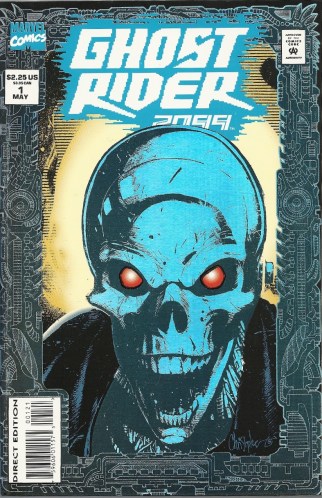
Before we get to anything else, let me apologize for the blue sheen in the above cover scan. There are two variant covers to Ghost Rider 2099 #1, and I happen to have the foil-“enhanced” — and hence more expensive — one. When the scanner light passes over it, it activates the hologram effect of the foil, negating the normal silverish coloring and — you know what? I give up. I hate variant/enhanced covers, and the early to mid 1990s belonged to them. Anyway, SORRY.
Okay. Let’s not beat around the bush. Let’s dig right into this, like Laura Dern going elbow deep on a pile of Jurassic Park dinosaur dung. The preliminaries of this hard-hitting two-part series were laid out in the previous The Punisher 2099 post, which presented us with the futuristic awfulness of Jake Gallows and his skull kneepads. That title didn’t exactly cover itself with glory in its premier, and one can only imagine what’s in store for us with Ghost Rider 2099. Just think of this: it was published a year later, so Marvel had a full turn of the calendar in which to hone its suckocity. And we know how bad Ghost Rider stories, whether on a page or on a screen, can be. MY GOD THIS COULD GET UGLY.
Well, there’s a shocker coming our way. Folks, Ghost Rider 2099 #1, while pretty damn bad, actually has some good points to it. And I cannot believe I just typed that. But there you go. (Don’t get me wrong. It’s still an ungood comic.)
Before we get to the good, let’s go over the general outline of the character. This iteration of Ghost Rider was, unlike the Johnny Blaze and Danny Ketch models, a non-supernatural being. There was (will be? — I hate this future crap) no spirit of vengeance possessing a motorcycle-loving mortal. Instead, the new Ghost Rider was a machine, with the consciousness of a hacker (Kenshiro Cochrane) — who’d downloaded his mind into cyberspace after a lethal poisoning — for a brain.
And yes, as the cover suggests, the new Rider had a lot of a Terminator in him. Remember that scene in the original Terminator movie, after the semi had crashed and the flames had burned off the T-800’s flesh, and it climbed out of the wreckage surrounded by flame? That’s what you think of, subliminally at the very least, every time you see this guy. Those red eyes really seal the deal. It’s not the most blatant Terminator endoskeleton ripoff ever by any means (at least this guy has the decency to wear a jacket), but it’s pushing it. Hell, with a human brain inside a machine body, you’re getting deep into Robocop territory too. So maybe someone read Robocop vs. The Terminator and got themselves an idea.
Whatever. Let’s get to what’s good — or less bad — about this thing. It comes down to one factor, and that’s that the artwork isn’t terrible. Chris Bachalo pencilled and Mark Buckingham inked this first issue, and their style, why not my normal cup of tea, is at least visually interesting. Here’s our new Rider as we first meet him, riding his future-bike with a full head of fire, a scene so explosive it needs two pages:
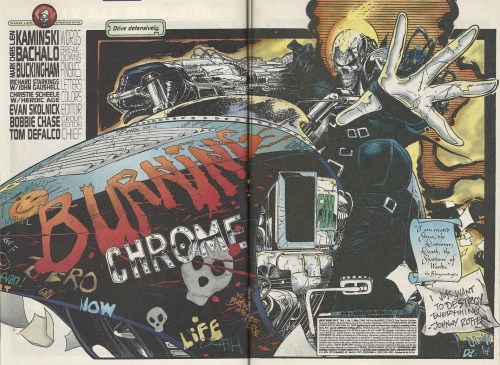
There’s detail which at least makes it appear like someone actually gave a damn. I mean, Punisher 2099 looked like it was drawn on napkins at a TGI Fridays.
You want more Rider? Here he is scaring the piss out of some poor sap (and looking a bit like Simon Bisley’s Lobo):
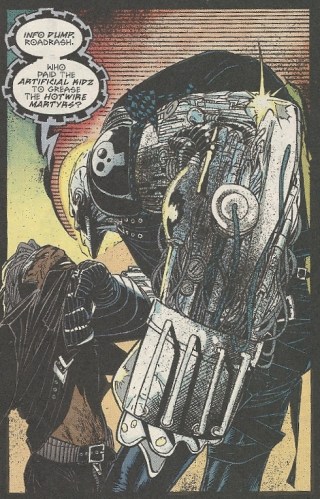
There aren’t many certainties in life, but I’m certain of this: I don’t and never will give a rat’s ass about “who paid the Artificial Kidz to grease the Hotwire Martyrs.” This gets us into the big problem of the first issue: Len Kaminski’s script is laden with cyberpunk language, and instead of giving an edge to the corporate espionage infowars that form the Rider’s milieu, there a forced clunkiness to it. Writing future dialogue is a tricky business. I get that. But it’s one that, like high-wire acts, should only be performed by trained professionals. You can count the number of times a writer has successfully crafted future-speak, without it sounding dumb to we primitive past-dwellers, on one hand. Anthony Burgess with A Clockwork Orange is a prime of example of it being done well. Hell, maybe that blew too, but I seem to remember the “droogs” and such working.
What you read in this comic does not work.
This first issue, much like the Punisher introduction, tells the origin story through flashback. Which is probably just a coincidence. OR IS IT? Whatever the reasoning, this sequence is moderately entertaining, as our hacker hero’s brain takes a Lawnmower Man trip and finds its way into a corner of cyberspace populated by sentient programs called the Ghostworks. They make the man who was once Kenshiro (I almost typed Zefram) Cochrane an offer he can’t refuse (a chance for righteous vengeance on his killers that will help the Ghostworks cause as well), and use some familiar faces, including David Letterman and Jean-Luc Picard, to do the convincing:
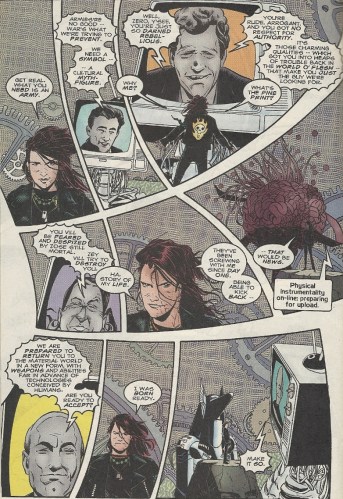
Cochrane is downloaded into a souped up robot, and the new Ghost Rider — the moniker is bestowed because of the reminiscent look — is born. In case you haven’t had enough of him yet, here he is on the final page:
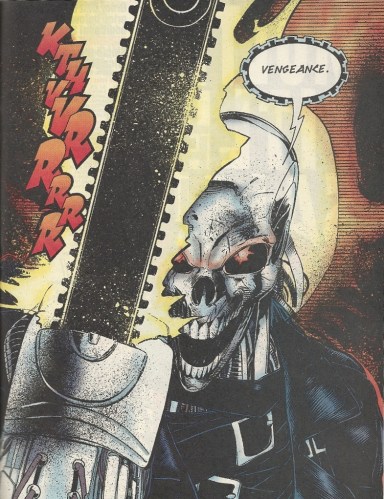
I think he might be giving us the finger with his arm-mounted flaming chainsaw. Not sure.
And that’s that.
I went into these two comics wondering which one I’d wind up hating more. I fully expected both to be abominations, and the new Punisher certainly didn’t disappoint, or did disappoint, depending on how you look at it. It was a flat, silly affair, one that could insult the intelligence of plankton. The artwork had all the zest of sauceless pasta. This first installment of Ghost Rider 2099 was no great shakes either, but at least Bachalo and Buckingham gave the eyes something to look at. Artwork is always less important than story, because the latter can rescue the former, but the former can never truly salvage an awful latter (is that formulation confusing enough?). The artwork here can’t lift the script off the ground, but at least the effort is there.
So GHOST RIDER 2099 WINS THE BATTLE! HUZZAH! And I am officially done with Marvel 2099 for what will hopefully be a very, very long while. Perhaps until 2099 itself.
Just so you know, if we had needed a tiebreaker, this comic came with BOUND-IN SPIDER-MAN MARVEL MASTERWORKS TRADING CARDS:

Collect them all! Put them in your future-bike spokes to make it sound like Ghost Rider 2099’s future-cycle!
[Edit: When I first posted this, I forgot to include something that a comic shop owning friend of mine told me when I mentioned that I was writing a couple colums about the old Marvel 2099 line. He said that lately he’s noticed a few more people here and there buying cheap-o 2099 comics out of the bargain bins, with them saying that they remembered reading the books when they (the readers) were young. Which would seem to indicate that there’s no accounting for the bounds of nostalgia. “Gosh, I remember when I used to get kicked in the head before school every day. With a steel boot. In the mud. Man, THOSE WERE THE DAYS.”]

Comic book subscription advertisements tend to be fairly straightforward affairs. There’s usually some verbiage letting you know what a great deal you’ll be getting and how you’d have to be a mouth-breathing, slack-jawed, banjo-plucking simpleton not to take advantage of it, and then there’s a simple list of the comics that you can have magically mailed to your mailbox on a monthly basis (or some other regular interval). Maybe there’s some Christmasy themes mixed in to get you in a buying mood. You know the drill. And then there’s this thing. Granted, it’s not all that complex once you dig into it, but at first glance it looks like something that’s going to have a lot of wheretofors and heretofors, like a document for a house-closing, one of those wordy monsters that’s printed on legal paper that’s longer than regular paper and looks like an unfurled edict from the King.
One question: WHO THE HELL WOULD ONLY WANT GROUP III?
Bottom line? Just give us our damn comics, DC, and cram the “charter membership” hooey. Now that I think of it, Superman snapping chains in the upper left-hand corner might as well be a metaphor for readers saying to hell with this crap, we’ll take our chances at the newsstand.
 Jared
Jared


 blog into mystery