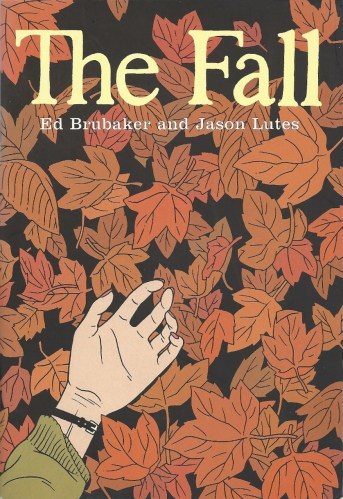
The Fall was published at the end of Ed Brubaker’s independent years, before he dug his hands deep in the mainline Marvel and DC properties. His wheelhouse has always been crime fiction — a poorly exploited corner of the comic book genre — even when in the capes and tights playground, and Fall, while suffering from the occasional hiccups of a still-developing scripting repertoire, delivers gritty mystery cloaked in suburban camouflage. Together, Brubaker and artist Jason Lutes put together a short tale that pushes some of the same “Look Closer” buttons as American Beauty, a contemporary crime story that dealt with the darkness lurking behind finely manicured lawns.
The title has a tripartite meaning — the season in which the story is set, the tragic event that spurs on much of the action, and the protagonist’s plunge into the hidden truth behind someone else’s death. Originally published serially in Dark Horse Presents, Fall was repackaged in 2001 in one volume, the cover of which is seen above. The story follows Kirk, a going nowhere night clerk at a gas station, and his slow immersion into a decade old mystery. One night a customer hands him a credit card that she found on the ground by the pumps, and Kirk tells her that he’ll put it in the lost and found. He doesn’t. Instead, he embarks on a one-night spree of illicit retail therapy — patching over a recent break-up, a crappy apartment, etc. — and thinks that’s the end of it. But it turns out that the lady who turned in the card (June) wasn’t just a customer, but was also the boss’s wife. Instead of turning him in, she ropes him into doing chores around the house while her husband is at work. Kirk, in spite of the power dynamic, enjoys her company, but makes an odd discovery one day in the garden:
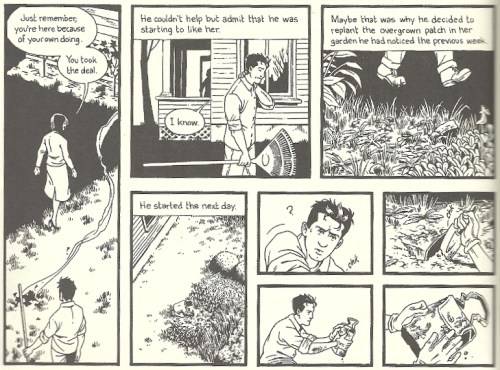
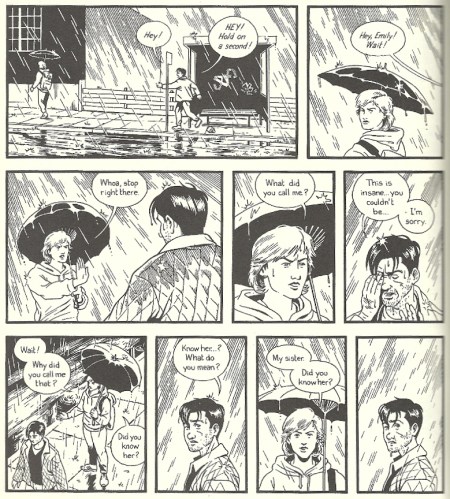
He doesn’t tell June about the purse, and instead takes it home and goes through its contents: day planner, driver’s license, loose change, the usual. It belonged to a woman named Emily Keating, and he starts to puzzle out who this woman was by checking out her old address, calling phone numbers from the planner, and even going to the library to look up newspaper articles on microfiche. (This is the second comic in a number of months where microfiche has come into play. This can’t be a too common occurrence. Is there a database someplace where these things are cross-referenced? An Elias Sports Bureau for comics?) It isn’t long before he learns that Emily died ten years earlier, in 1988. Strike that — she didn’t just die. She was murdered, thrown off of an overpass. A lot of the details are filled in after a chance, rain-soaked meeting, when Kirk spots a spitting image of the dead woman at the core of his obsession:
It’s after this that the connections — between the purse, June, Emily — start to fall into place. The glue is a corrupt policeman, one who gives chase to the nosey Kirk in one of the few bits of action in the book:
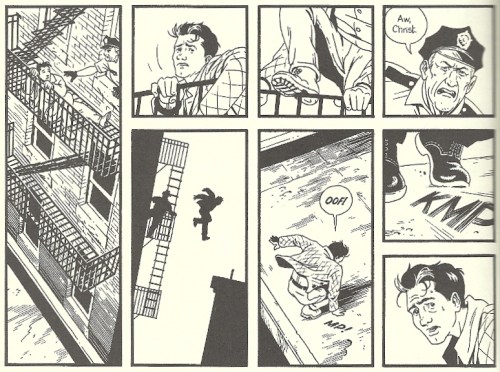
I’d like to thank the 1970s film industry for making fire escapes and rooftop chases de rigueur elements of crime stories. Seriously — no sarcasm.
Everything spins towards an end confrontation that’s overly melodramatic. Indeed, many of the character motivations feel forced, shoehorned into the story to get the plot from one stage to the next and bearing no relation to real world behavior or logic. This lack of organic momentum robs The Fall of any chance at becoming a classic of the field, but Brubaker’s script and Lutes’ art pair nicely with one another, the latter providing the blasé, generic streets and lawns of Middle America with a deceptively rich texture. You won’t carry the story with you for the rest of your days — you won’t develop a Kirk-like obsession over it — but you won’t be sorry you read it. It’s not a waste of time.

First General George C. Marshall would conquer the world, then Secretary of State George C. Marshall would rebuild the conquered nations. THE MAN.
For the original picture (no, Marshall wasn’t really playing Risk, and the board game wasn’t miraculously photographed in color while everything else stayed in black and white), click here — the full shot includes the luckless officers cropped out so the image would fit on the back of a comic. All the original photo sources I found on the web only labeled the officers surrounding the seated, Risk-loving Marshall with the generic “general staff” nomenclature, so I had to dig around to confirm some of my ID suspicions. If any military/WWII buff out there wants to name all of the brass in this pic (including the man behind Marshall’s left shoulder who looks like a thin(ner) Churchill), there’s an imaginary gold star for the first to list them. Have at it. (To get you started: “Hap” Arnold is among the onlookers — I think.)
All due respect to Heathcliff, Strawberry Shortcake and the Ewoks, but this Star Comics ad lacks porcine wattage
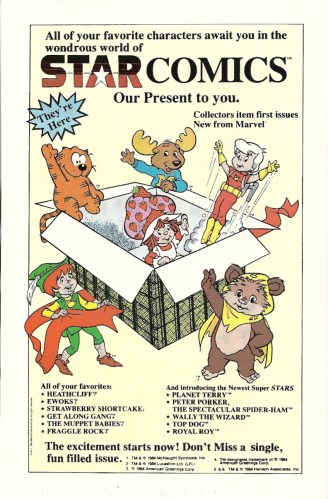
An ad for Star Comics that lists Peter Porker, the Spectacular Spider-Ham as one of the “Stars” of the line, yet doesn’t have said Porker amongst the assembled characters, is a FAIL. Period. Get off the stage, Wicket, and take the dopey Get Along Gang with you. And while we’re at it, just who in the blue hell is Royal Roy, and why does he feel the need to dress like a Peter Pan/Robin Hood amalgam?
A Kitty becomes a Cat, and Logan isn’t just along for the ride – Kitty Pryde and Wolverine

With a new Wolverine movie coming out this summer, one hopefully of enough quality to scrub from memory the last underwhelming Hugh Jackman solo affair, now seems a good a time as any to take a look back at one of Logan’s seminal moments. Help get us revved, you know? But which one? Maybe we can take another cue from Hollywood. Since the primary X-Men film franchise is going whole hog nuts in the best of senses, bringing elements of the orignal cast and the First Class troupe together in a cinematic adaptation of one of the top X-arcs of all time, Days of Future Past, let’s make this post a two-fer. In the spirit of that collision of worlds, why don’t we take a retro look at a limited series that featured Wolverine and Kitty Pryde, the lynchpin of Days. It seems natural, and so be it: Kitty Pryde and Wolverine it is. (Granted, the post title and the cover image above take some of the suspense out of these deliberations. Forgive one the need to bloviate.)
There are few characters that on the one hand generate more affection among comic fans than the young, fresh-faced, somewhat naive Kitty, and on the other gin up a nuclear inferno of fandom like Wolverine. Kitty, with her modest power of phasing in and out of corporeal existence, is a metaphor for the shrinking shyness in so many of us, especially an adolescent reading audience. Taciturn Logan, all claws and teeth and indestructibility, is a symbol of the animal that we all at times wish we could unleash. As polar opposites, it’s no surprise that narratively, not to mention realistically, these two would be drawn to one another. The affection that was developed in these pages and Uncanny X-Men proper was simultaneously filial and paternal, and it was one of the best elements of what was the X-Men’s brightest extended hour of storytelling. A lot of what made up the heart and soul of Professor Xavier’s School for Gifted Youngsters came from the makeshift family dynamic. From the very start it was misfits — all square pegs in a world of round holes — finding one another, and no mutual discovery was more unlikely than Miss Pryde and Logan. Yet there it was. And here it is. This is the magic of the X-Men, the beauty of the whole damn thing.
Putting the two in a miniseries, one that kept them isolated from their teammates, made sense both in a financial sense (mo’ books, mo’ money) and in terms of demand (give them what they want). And Chris Claremont — the don of all things X — and the ever-capable Al Milgrom gave it life. (Mr. Milgrom only handled the art duties here, so we aren’t treated to the senses-shattering scripting skills that brought us Marvel’s trucker hero. Our loss.)
It all takes place shortly after Kitty’s breakup with Cyclops in issue 182 of Uncanny. She’s wading through the angsty internal contortions of youth while spending time with her father at home, but she discovers that her father is in over his head with some rough and tumble Japanese businessmen, gents who are clearly Yakuza. One especially gives her the willies, but, when her father accompanies them (somewhat unwillingly) to Japan, Kitty stows away on a plane and follows. Like father, like daughter: Kitty too soon finds herself a bit overwhelmed in a strange culture (even if it’s one whose language she knows, in a country she’s visited before, and hey, she has superpowers). This prompts an anxious call back to her other (real?) home:

She hangs up before saying a word, but this isn’t some run of the mill superhero on the other hand whose just going to let a hang up slide. Logan is on the trail. (We get to see a rather amusing little sequence as he and his adamantium bones try to pass through metal detectors during his travels. It’s tough when the Blackbird isn’t available and he has to fly commercial. Does he prefer the window seat?)
Meanwhile, Kitty gets in deeper. The shadiest of the men who had harassed her father turns out to be a rogue ninja named Ogun, who was one of Wolverine’s mentors. He’s gone over to evil and has also developed a penchant for wearing demon masks — fun! He makes Kitty his prisoner, and breaks her down both physically and mentally in an extended sequence reminiscent of V’s surreptitious brutalization of Ivy in V for Vendetta:

If there’s one thing we’ve learned from reading comics, it’s that you break a woman’s will by cutting off her hair. It’s not a lesson you get to put into much practical effect, though, unless you’re a serial killer.
Kitty emerges a mere extension of Ogun’s evil soul, one who battles Wolverine and almost kills the poor guy, healing factor and all. Thanks to some timely assistance from old friend Yukio, both are brought to safety (along with Kitty’s father), and there Logan begins the painstaking process of rebuilding Kitty from the ground up. He also takes a moment to give a scant bit of backstory doubling as a parable — this is also a chance for Milgrom’s art to change up a bit:

The most lasting significance of the mini is Kitty’s maturation. It’s in these pages that she makes the shift from the baby of the X-Men, the kid who others are comfortable calling Sprite, and takes on her more grown-up moniker:

Catwoman likely saw that last panel and thought about how imitation is the highest form of flattery. Or resolved to scratch Kitty’s/Shadowcat’s eyes out, one or the other.
Everything builds to a Shadowcat-Wolverine-Ogun confrontation at the end, with the mentor and pupil dueling for the last time, and Kitty struggling to excise the last vestiges of Ogun’s meddling. Are there panels of Wolverine and Ogun in a Leone-esque staredown, with a reprise of the nicely rendered parable sandwiched in between? YOU BET THERE ARE:

The series is solid, and that’s by no means a backhanded compliment. There’s something to be said for a story that paces itself well, delivers a plate of art that’s long on steak if modest in sizzle, and fulfills its narratives goals. That Claremont scripted this is evident in the care and craft of every page, and Milgrom’s art goes far in evoking the edge of a young woman losing herself, finding herself and coming of age all in six issues. His use of broad brushstrokes is especially effective, and their use in the border of the parable scan above is a nice touch. And in a broader continuity sense, all the bases of Wolverine’s Japanese orbit — Yukio, Mariko, etc. — are touched, satisfying those taken with that part of his backstory. (Indeed, Japan will be the setting of this summer’s film.) Building on the steak metaphor, this series is a full meal.
There are complaints that can be made. There’s too much interior dialogue in the first issue, and Kitty’s ability to phase through walls and walk on air of course plays a part in the story, yet in the climactic battle, moments after doing those very things, she completely forgets about HER INCREDIBLE POWERS WHAT IS WRONG WITH YOU ARE YOU STUPID. Occasionally too much time is devoted to restating the events of the previous issue, something that would make more sense in the original monthly release format, but feels clunky when all are read in one sitting.
Yes, these are problems, but considering the fantasy subject matter, they kind of pass by without rippling the waters too much. And this too is a testament to what Claremont and Milgrom did.
I wasn’t the biggest fan of the X-Men back in the day. It seemed that they were jammed down readers’ throats at every turn (in the case of X-Men Spaghettios, quite literally), and there was a natural anti reaction. Stories like this make a person realize what was missed. But hey, they’re still around in back issues, and this series was collected in a hardcover several years ago. (You can also find it among Marvel’s digital comics, if that’s your thing). It might be worth a look if you’re unfamiliar, especially in light of the coming twists and turns of the extended film franchise.
Richard Pryor: Educator, Humanitarian, Friend to Children

Much of the non-Harbaugh lead-up to next weekend’s Super Bowl is going to (nauseatingly) focus on Ray Lewis and his journey from accused accessory to murder, under still-cloudy and unforgiven circumstances, to a respected (somewhat) first-ballot Hall of Famer — a Gospel-spewing legal crusher of skulls. Mazel. This ad struck a similar chord while doing some scanning the other day. No one would say that the late Richard Pryor was ever as dopey as RayRay, but his evolution — from an incredibly funny, raunchy comedian with a penchant from setting himself on fire while freebasing cocaine (Accidental Ghost Rider!), into a (short-lived) Saturday morning cartoon block fixture — is similarly remarkable. Sid and Marty Krofft + Richard Pryor + Sesame Street = Pryor’s Place. It’s a crazy world we live in, truly one where anything is possible.
Incidentally, does Pryor’s Place rank above or below Pryor’s turn in Superman III? Or are they both equally august accomplishments?
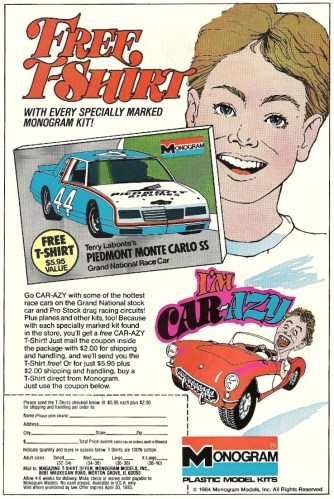
After yesterday’s Flying Captain Marvel post, we might as well keep rolling with the mildly to severely grotesque.
Haven’t we seen this face before? If not the same face, then at least a similar visage? Maybe the “CAR-AZY” kid above is a descendant of the jiu-jitsu throwing 1940s lad. Perhaps hideous corpse-like smiles are passed down from generation to generation. Recessive gene?
The most disturbing old-timey Captain Marvel flying paper toy you’ll ever see (a.k.a. THE BATSON WITH TWO BACKS)

There were a number of Captain Marvel toys back in his halcyon Golden Age days, as indeed there were for a variety of popular characters. Mr. Shazam’s publishing popularity made put him near the top of the volume pyramid, though. Some of the “toys” marketed to youngsters were paper products, more involved variants of the standard two-dimensional figure you could lay different outfits on (a mainstay of any young girl’s entertainment arsenal). These were cheap items in the financial sense — hard to get less expensive than pieces of paper — but reasonably well made, in spite of unavoidable flimsiness. There’s a charm to the ingenuity involved that outstrips mass-produced plastic of today.
Yet very few toys, paper or otherwise, reach the bizarre heights of Flying Captain Marvel.
There’s nothing the matter with the envelope front that you see above. What child in 1944 could resist plopping his dime on the counter for the promise of Captain Marvel soaring around his house? (It’s always heartwarming to know that a society could still think about such things when World War II was still raging.) Who cares that it cost the same as a whole damn comic — this was CAPTAIN MARVEL HIMSELF. And there’s nothing all that wrong with the end product, the Captain Marvel facsimile that would be the result of the origami folding and coupling of the some-assembly-required materials within.
No, the overwhelming weirdness comes when you slip the sheet of paper out of the above envelope and see the flattened out Marvel and OH GOD KILL IT KILL IT KILL IT:

So basically Marvel is making the beast with two backs. With himself. The strained look on his face isn’t helping matters, nor is the unifying element of his genital bulge, pointed out quite clearly by the lightning bolt — the Big Dipper to its North Star. I could have quite happily gone through life never having seen Billy Batson’s O-face in profile, but there we go. Remember in Watchmen, during a Rorschach flashback, when young Walter Kovacs saw his prostitute mother having sex with one of her johns? And the resultant inkblot on his mask? Yeah, that’s basically what we have up there. MERCY.
Here’s the rest of the parts — the arms and cape:

And here’s the instructions from the back of the envelope, which give you some idea of what the assembled Captain would look like. They’re also offered in case you want to assemble your very own Marvel — or maybe you’re just a complete weirdo and want to print up a life-size image of the self-loving World’s Mightiest Mortal. Whatever:

Not only was there a Captain Marvel solo version, you could also get a three-fer with the entire Marvel Family. I think there might even have been one for Hoppy, the Marvel Bunny — could be mistaken there. Whatever the case, you could have your own little paper Flying Walendas. Yet, though they all have the same mirror effect on the flat paper, none quite live up to the big man’s unsettling design.
Incidentally, I could have sworn that Alex Ross, in his unabashed love for all things Shazam, once did a painting of this item, yet for the life of me I wasn’t able to track it down on the internet. Maybe I dreamed it up (or nightmared it up, as it were), but if anyone out there has seen it or can find a scan of it, I’d be grateful. Just for the sake of my tottering, Marvel-onanism-shaken sanity.
Thanks for all this, Fawcett. I’m glad DC sued you into oblivion.
Learn to cutomize vans in the comfort of your own home

It’s always good to know a trade, and gussing up dumpy motor vehicles seems to be as decent as any. Capitalize on your correspondence school art training by putting charming desert sunset scenes on the sides of cargo vans — the kind normally used by serial abductors. Make your own Mystery Machine. Turn your garage into a chrome tattoo parlor. The detailing possibilities are endless, and a limitless artistic horizon stretches out before you and your airbrush.
Only use “Spot Reducer” as a weight loss tool of last resort
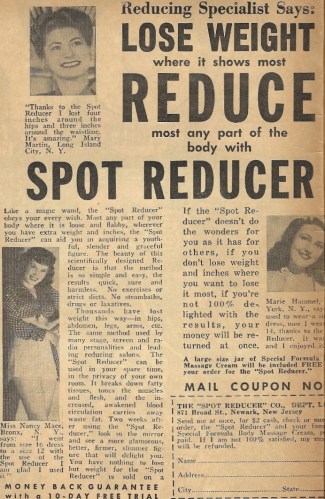
If you were a Rubenesque gal in the 1940s and didn’t want to cram your ample flesh into a girdle any more than you wanted to stop eating, then this crap might have been perfect. Judging by the sometimes vague text, the “Spot Reducer” (never a good sign when even the purveyor puts quotes around a product) was some manner of cream that you rubbed on your problem areas, and your flab melted/burned away. It sounds like you’d find it on a shelf right next to what Bugs Bunny rubbed into Elmer Fudd’s scalp to make flowers grow. Also, I’m reminded of an old SNL fake commercial for a product that would dissolve excess fingers. In short: HORRIFYING.
Infantino instructs Gorilla Grodd on “No feet where we eat!” table etiquette – Amazing World of DC Comics #8
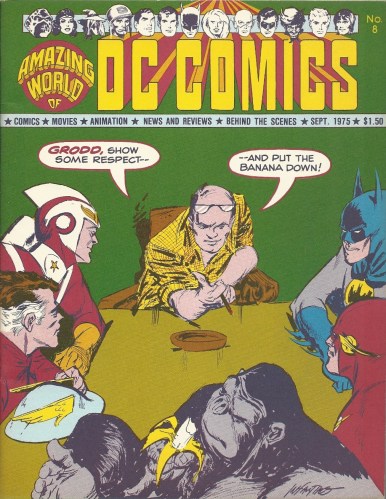
Of the in-house fanzines published by the big two in the 1970s, Amazing World of DC Comics is the unquestioned master of the field. It wipes the floor with FOOM, doing the publishing equivalent of what a young, rampaging Mike Tyson once did to the aging Michael Spinks. Did it have better production values? Yes. Was it thicker? Yes. Were the features better? Yes. Was the paper of a better quality? Yes. Though the contents are similarly black and white, they’re more colorful, if that makes sense. The four corners of one unman the other. It’s domination, pure and simple.
To make clear the undisputed champeen status of the title, there’s no better single issue than this one, which mostly revolved around legendary artist and then-editor Carmine Infantino. There are few artists more closely identified with DC’s characters than Infantino — his art is glued to the Flash mythos like green on grass — and why the hell not, you know? (He was actually the focus of the first issue of the magazine as well, a point made rather humorously in a brief interior note about the image you see above — always good to see Jay Garrick with a seat at the table, btw. Infantino’s response to again being the centerpiece was “So I guess this means you want me to do the cover.” Yes, Carmine, yes they do.) There’s no new ground plowed in the multiple features inside, though if you’re keen to get more dope on his time illustrating the Scarlet Speedster, Adam Strange and Batman, you’re in luck. By this point the laurels heaped at Infantino’s feet are legion, twigs on a bonfire, but when you get sketch pages like this, the contemporary encomiums don’t seem so gratuitous:
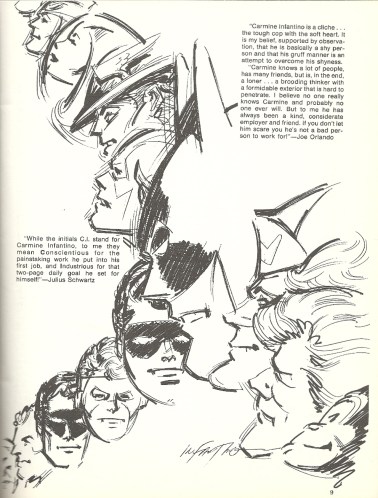
It was once said/typed here, when digging though a Gene Colan tribute mag, that Colan’s sketches were preferable to most artists’ finished products. The same applies in this instance. BOW DOWN BEFORE HIS GLORIOUS POINTY NOSES.
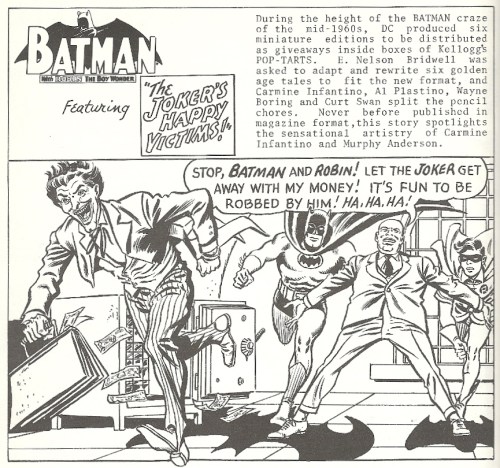
All the Infantino stuff is great, but the side features are truly fantastic in and are what put it over the top. I actually learned something, and anything that makes me less stupid has performed a great service for all humanity. Did you know that there were rejiggered Golden Age stories, redone with new art, that were included in Pop-Tarts boxes back in the 1960s? If not, don’t feel dumb — we can wallow in our former ignorance together. Here’s the brief explanation, along with the first panel of an Infantino/Murphy Anderson Batman/Joker story that’s reprinted in its entirety:
And there’s more! For the intense nerds among us, the pre-Internet days were a time of frustration, as there was no Google or Wikipedia to sate a quest for useless knowledge. Back then, things like this centerfold Map of Rann were a great boon:
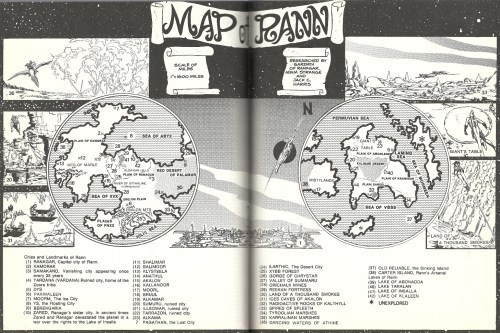
Get going with your Adam Strange fan fiction, 1970s time-wasters! Also, perhaps the Thanagarians used just such a map in their war with Rann. We can hope.
Surely a map of an entire fictional world is enough, right? Not even close. There are made-up parole index cards for Flash’s superb Rogue’s Gallery, voluminous previews of upcoming books (including one for the significant if disappointing Superman vs. The Amazing Spider-Man), stills from an old Superman serial with “humorous” word balloons, and more. Perhaps the greatest bit of old reproduced ephemera comes on the last page, at the close of a feature looking at assorted fan clubs that branched from the characters at DC, from the Golden Age to the (then) present (Supermen of America, etc.). Just check out the name of the ten-year old on this membership certificate for The Junior Justice Society of America:

Is is any surprise that Mr. Thomas had such success retconning the Justice Society and the World War II champions of Earth-II, or hell, any story with the heroes of old? Who wouldn’t be proud to hang that on their wall? (An aside: How typical that Wonder Woman, perhaps the biggest name in the Justice Society and its foremost female member, gets stuck being the secretary — yes, I realize this is an organizational secretary, not a get-me-coffee secretary, but still. What, Black Canary didn’t know shorthand? And would it have really killed Diana to use as her “seal” a red lipstick smooch? GIVE LITTLE ROY SOMETHING TO DREAM ABOUT, WOMAN.)
There you have it. A knockout punch of a fanzine, one that, unbelievable as it is, outdid Stan Lee in the arena of self-promotion. No number of contests to create new character which will (never, at least, not for a long time) be in a comic could ever keep up. The P.T. Barnum of comics was for once out-Barnumed.
Fruit Stripe Land has no affiliation with Candy Land, though they may share a border
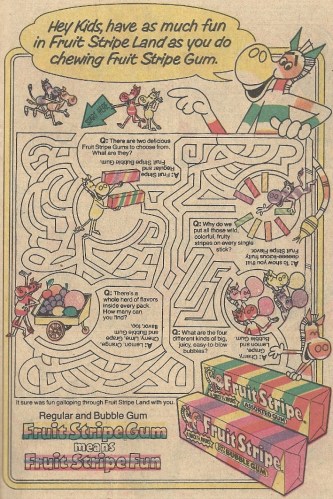
Here’s another mid-80s excuse to destroy a comic, to go right alongside Oreo mazes and Striped Chips Ahoy! flip books. Fruit Stripe Gum (stripes again — coincidence?) wasn’t one of my preferred youthful cuds, so I can’t personally comment on the quality of the advertised merchandise. Love the “Fruit Stripe Gum means Fruit Stripe Fun” sell point, though. And here we just thought it meant stained teeth, early cavities and rapidly evaporating taste.
The Fruit Stripes zebra mascot is named Yipes, by the by. Did you know that? I didn’t. File that away in the things not to bring up on a first date.
Spider-Man writhes in agony because of sold out Marvel comics. Don’t let this happen to you.

I never knew that Peter Parker was such a big Shogun Warriors fan that missing an issue would give him a case of the bends. I stand enlightened. And come on, Marvel, did Thomas Jefferson REALLY write the Declaration of Independence with a Spider-Man pen? Don’t make us call shenanigans.
Also, someone tell that “newstand” operator that most people put an extra “S” in there. Unless he’s an outlier, and is trying to be some American English trailblazer — if so, newstand on, sir!
A relic from the brief ascendancy of The Blair Witch Project – Blair Witch: Dark Testaments #1
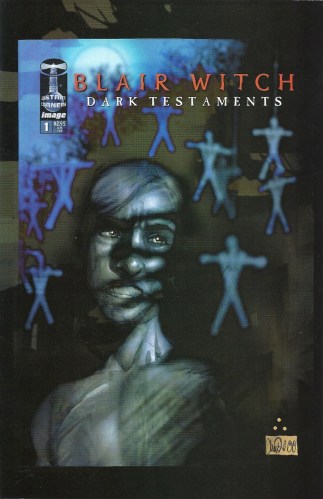
More than ten years on, it’s interesting to look back with some perspective on what a phenomenon The Blair Witch Project was. Produced on a shoe-string budget, with no-name actors dropped into the woods, isolated, and given vague instructions about where to go and what to do, it wound up a cinematic touchstone. It was an early indicator of just how effective the internet could be in spreading a hype brush-fire, while its 200+ million dollar gross made every Hollywood bean-counter push up their green visor and take notice. The jumpy tale of three amateur filmmakers lost in haunted woods was viciously effective storytelling and gripping horror, and that’s not even bringing in the fleeting, delicious moment when people didn’t know whether it was all real or not. These are things that sometimes get lost now that the whole enterprise has become the foundation for tired cliché, right alongside the take-away moment of Heather Donahue’s snotty camcorder confessional. The producers didn’t originate the concept of found footage, but they took it about as far as it would go, as the successors to Blair Witch have mostly been unworthy (Cloverfield, though you could never for a moment believe it was real, shared a number of marketing/quality points). And the less said about the standard, rushed, run-of-the-mill studio sequel, Book of Shadows, the better.
Blair Witch and its direct and indirect progeny aren’t the only offshoots to the mystical underbelly of the real-life (with fake witchcraft backstory) Burkittsville, Maryland. Several comic books were produced during the brief two-year ascendancy of things Blairy Witchy, before people grew tired of it all, moved on and Book of Shadows hammered the last nails in the coffin. There was a concurrent comic that built up to the original film’s release, as well as a four issue mini-series in 2000. Then, later that same year, in the final lead-up to Book of Shadows, Image released the comic featured here today. Is Blair Witch: Dark Testaments as groundbreaking as the first film? No, but how could it be? The good news is that it’s far better than the muddled sequel, and a decent story.
Written by Ian Edgington with art by Charlie Adlard, it has as its narrator Davis Crane, a retired(?) teacher in Burkittsville, a decent man with a connection to his hometown’s dark past. The tone is set on the first page, which has him about to smother twin babies with a pillow — cheery!:
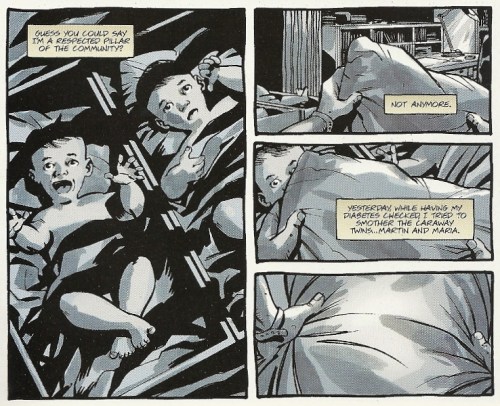
He fails (phew), and the book’s narration comes as he sits in a prison cell, waiting for whatever fate awaits people who try to kill infants in cribs. He looks back on his childhood (his Dark Testament, as it were), when he was friends with the Parr twins, Dale and Rustin. Devotees of the film(s) will recall that Rustin Parr was the murderer whose forest cabin was part of the quest of both films’ dopey youngsters. He’d take kids to his basement, kill one while the other stood in the corner, then kill that one. Again — CHEERY. We learn here that in childhood it was actually Dale who had the serial killer precursors (violence to small animals, much like Jeffrey Dahmer), as well as the ominous connection to the Blair Witch. But gentle, genial Rustin had his share of creepy, too:
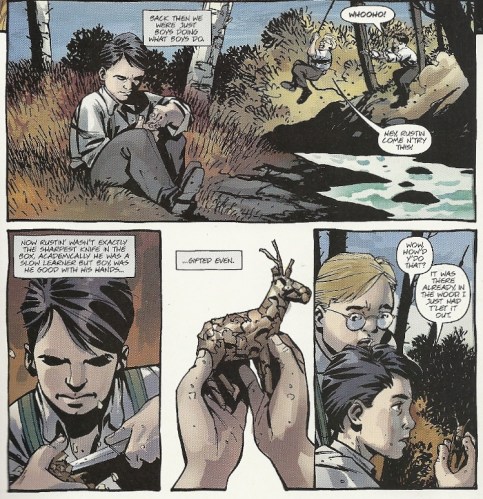
A kid with shadowy eyes carving a deer out of wood. Is that creepy? Maybe?
We’re shown how darkness settles on the Parr boys, how the curse of the Blair Witch transfers from Dale to Rustin, how Dale haunts from beyond the grave, and how poor Davis, even when he tries to get out, gets sucked back into the whole mess. Oh, and why killing babies seemed like a sane thing to do at the time. Lest you’re worried that there’s an acute lack of blood and sticks tied together in a sinister manner — trademarks of the franchise — let me assure you, they’re here too. Hey, here they are! Both!:
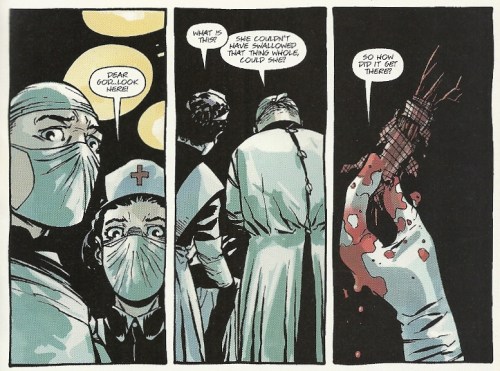
There’s violence. There’s gore. There are kids getting killed. But make no mistake, this is actually solid storytelling for a one-off comic. There’s a fine balance maintained between answers and ambiguity, and some of the imagery used is genuinely effective. (A disembodied shadow clinging to a man’s leg is surprisingly hair-raising.) The studio execs that made a hash of the film sequel could have learned some lessons, if not from this comic’s material, then at least from its sensibilities. Sadly, they don’t seem to be of the lesson-learning breed.
There have been rumors bouncing around for years about a rebirth of the Blair Witch franchise, and it’s a surprise that no one has come along to wring the last bit of spilled juice out of that dish rag. We live in the age of dopey reboots, and all the filthy lucre of old has to be tempting. It could very well be that the success of the first film was an alchemy that can never be replicated. Possible. Yet old comics like Dark Testament argue that there might still be some evil seeping through its closed coffin lid.
Invasion of the Body Snatchers (1978) could easily have been retitled “Leonard Nimoy’s Poor Fashion Sense”
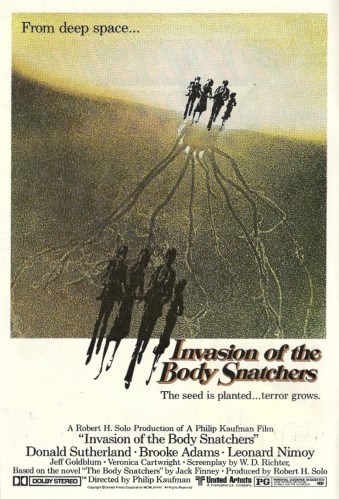
The 1970s Invasion of the Body Snatchers remake has a lot going for it, including a lot of takeaway scenes, any of which can be brought to the mental fore by seeing the poster above. Maybe you remember the odd Robert Duvall cameo in the beginning, Donald Sutherland dozing off and being slowly replicated or the bleak, gutsy ending. Me? The first thing I think of is Leonard Nimoy’s god-awful ’70s jacket, which looked to have been tailored from couch upholstery. Or really awful curtains that smell like stale cigarette smoke. That was the real horror. (The red turtleneck that went with it — or didn’t, as it were — wasn’t much help.)
Striped Chips Ahoy! were awesomely awful
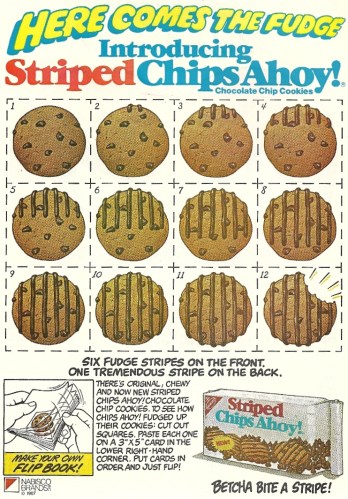
Not to be gross/scatological, but could “Here comes the Fudge!” also be used in regards to certain other striped things?
Remember Striped Chips Ahoy? A part of America’s never-ending quest to blimp up to even grander porcine proportions, they were a 1980s alternate edition of the beloved Chips Ahoy! brand. A confection forerunner of stuffed-crust pizza, they sought to cram more calories into a diabetes-delivery device. I remember them quite fondly, right alongside the long-defunct Fruit Roll-Ups Bars.
I’ve passed over this ad a number of times in looking through old comic books, and I never noticed that the stages of cookie construction could be clipped out and made into a flip book. Another excuse to destroy a perfectly good comic book — great. Mutilate while you masticate!
 Jared
Jared


 blog into mystery