Grendel, Grendel’s mother and the dragon not enough monsters for you? DC Comics to the rescue! – Beowulf #6
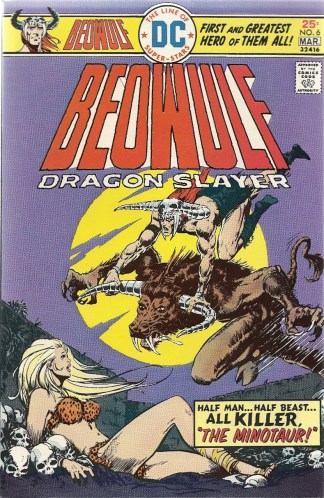
Beowulf, the Old English epic poem that most people read because they have to, not because they want to, is nevertheless one of the more mined of the classic, anonymous, ancient works of literature. More accessible to a modern audience than The Epic of Gilgamesh, and more narratively interesting than The Song of Roland (which reads like a never-ending series of people chopping one another with swords), it’s been the source of a number of derivative works. Michael Crichton’s Eaters of the Dead is one of the more recent and famous, while John Gardner’s Grendel is perhaps the most delicious, giving us the ages-old saga through the eyes of the monster. Plus you had the straight, creepily animated (not in a good way) Beowulf film several years ago. A fertile field indeed.
And, in the 1970s, DC Comics flung this series before audiences, one of the many shooting star titles that littered that company’s Explosion/Implosion.
It took the straight-forward Beowulf (town harassed by Grendel and his mama, Beowulf shows up, kills them both, in the end gets killed by a dragon) and threw another complicating layer of story on top. In this issue, in addition to the minor cameo of a rather thinly drawn Dracula(!), and appearances by Grendel, his mother and Satan, you have Beowulf crimping from the Twelve Labors of Hercules (no Golden Girdle, though) by going toe to toe with the Minotaur. In the Cretan Labyrinth.
OVERLOAD, BABY.
You can say that there are problems with the original Beowulf text. Many people find it a chore to read, after all. But I don’t know if anyone ever read it in some introductory Western literature course at college and thought “Geez, I wish there were some vampires in this bitch.” Adding wheelbarrows full of extras to the proceedings strikes me as a bit like trying to streamline government by adding another layer of bureaucracy on top. Eventually the supporting structures that held the original framework in place are going to buckle and collapse, right?
Jack Handey perhaps put it best with one of his Deep Thoughts:
If you’re a circus clown, and you have a dog that you use in your act, I don’t think it’s a good idea to also dress the dog up like a clown, because people see that and they think, “Forgive me, but that’s just too much.”
Forgive me, but this is just too much.
Here’s the Labyrinth (Beowulf and his Rima-looking companion are led there by the Peeper, who you can tell is Satan in disguise LONG before he reveals himself to our out-of-his-element hero):
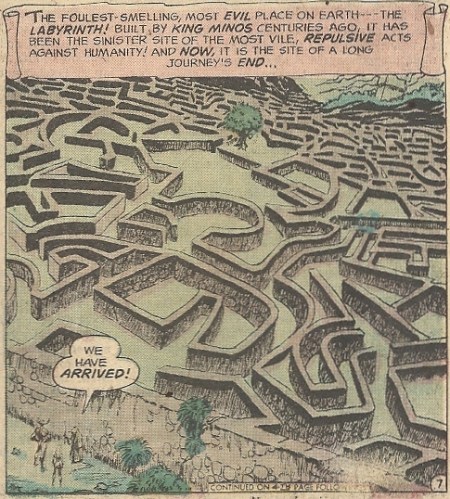
I spent several minutes staring at that maze, trying to find some hidden image or “DRINK MORE OVALTINE” message, mainly because the surrounding story was so bewildering. No luck.
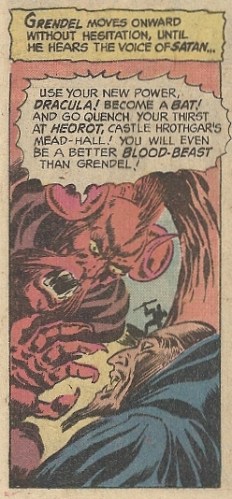
Here’s Satan giving his marching orders to “NOT THE COLAN” Dracula — “Destroy Heorot and grow goofy facial hair!”:
And, of course, Beowulf has to fight the Minotaur, who’s doubly enraged because Beowulf is wearing horns from his cousin or something. Oh, and this Beowulf lets his babe do a lot of the work:
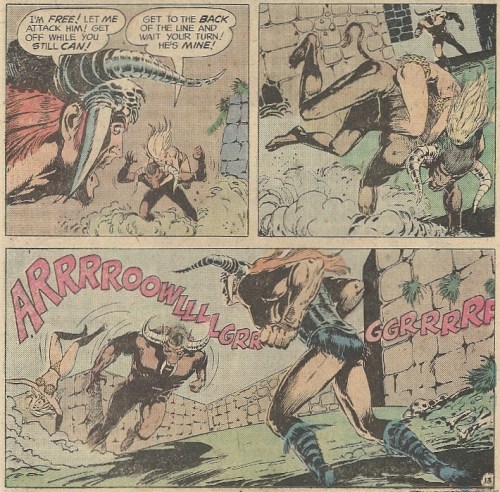
Stop hiding behind your woman’s skirt. Hero.
While we should all appreciate these storytelling efforts from scribe Michael Uslan and artists Ricardo Villamonte, Ric Estrada, and Liz Safian, the DC Beowulf saga was a bridge too far. If Domino Pizza’s Noid had been around when this was published, he might very well have found his way into the story. Oh, that sounds farfetched to your delicate ears? Do I have to remind you that GODDAMN DRACULA WAS IN THIS?
Contemporary audiences were underwhelmed, and this issue — which ended with Beowulf gaining Grendel-matching strength by chomping on the mystic Zumak Fruit — was the last of the series, leaving the big Man vs. Monster showdown unresolved. Humanity survived this hanging chad. Somehow.
Beowulf has reappeared in recent years. No one cared. Personally, I’d be more interested in knowing what happened to his scantily clad babe. Any chick who’ll hop on a man-bull’s back while wearing a leopard print bikini is all right by me.
“Hi, I’m selling useless, pointless crap door to door. Oh, I’m going to need your Social Security number.”

I don’t know if Social Security plates would fly in today’s identity theft-conscious world — giving up your vital digits and all. Hell, I doubt it flew back in the 1970s. I find that keeping my vital papers stored in a cigar box in a hallway closet does just fine, thank you very much.
This even makes GRIT look good.
Jack Kirby would like you to get acquainted with Big Jim’s P.A.C.K., which sounds V.E.R.Y. perverse
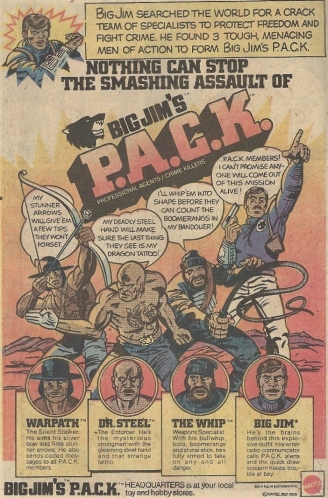
What’s the first thing you spot when you see this ad? If you’re like me, it’s the distinctive square-tipped fingers of a Jack Kirby character. Hard to miss. His influence didn’t just extend to the above Kirby-infused promo art, either. Big Jim, a popular, G.I. Joe-esque line of Mattel toys back in the 70s, had multiple waves of figure releases, and the first four figures of the second P.A.C.K.-themed wave had packaging featuring original art by none other than the King himself. Mazel. You can see a picture of three here.
I have to imagine those shoddy old boxes would be unbearably desirable for the most devoted Kirby collectors, sending them into a frothing, acquisitive lust.
Big Jim and his compadres were more diverse than their military-themed Joe contemporaries, and in that regard they sort of remind me of the jack of all trades milieu of Buckaroo Banzai and his entourage. And that’s probably a big part of the reason why I don’t care all that much about them, though Big Jim’s deflating leadership style, with its “I can’t promise anyone will come out of this mission alive!” defeatism, is the biggest negative.
Hey, there were also some short comics that came with some of the later figures, and you can check those out, as well as more looks at the line if you dig around a bit, here. No Kirby art in the comics, though. Some bum named Buscema, who also tackled some of the package art. Oh well.
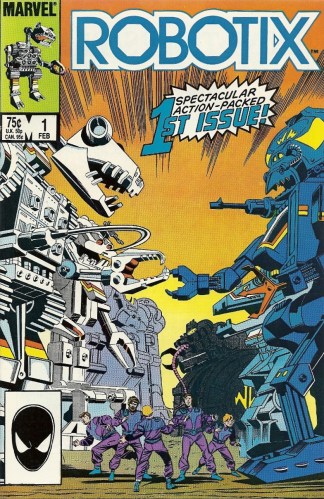
Remember Robotix? Yeah, neither did I. A toy ship passing in the 1980s robot craze night, they were rather shoddily made transforming robots that you could put together yourself (every child’s — and parent’s — dream). Like their more famous Transformers and Gobots kinsmen, they also had de rigueur cartoons and comic books to help develop the line and get kids invested in the lumps of plastic. Actually, “comic” (singular) would be more apt for the Robotix book, which only made it through the first tentative issue before fading into the four color mist.
The cartoon was a bit of an oddity in that it eschewed the standard half-hour format in favor of shorter chapters broadcast in the midst of Saturday morning cartoon blocks. The intro (narrated by the same guy he did the Transformers cartoon stuff) does yeoman’s work in giving you the cliff notes mythology of Robotix (a YouTube commenter points out that it’s also one of the few intros where the good guys lose every fight — VALID):
Herb Trimpe, who wasn’t unfamiliar with being saddled with man-meets-robot comic book translations (see Shogun Warriors), was the one man writer/artist band on this comic, slamming the drum, strumming the guitar and puffing the harmonica like a newsprint Neil Young. It’s good Trimpe too, and his shining beacon of hope burst through the “don’t really care” tripe that was the Robotix universe.
The story starts out when a band of space-faring Earthmen crash on a distant planet (Skalorr). While they’re trying to figure out a way to get their crippled craft off the ground, they find themselves caught in the middle of some juvenile turf war, with Terrokors and Protectons standing on for Greasers and Socs (try to guess from the names which are the good guys and which are the bad):
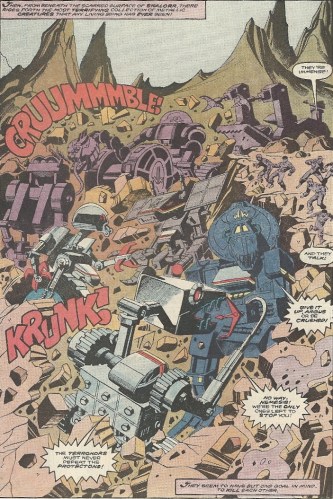
When things settle down and about twenty seconds pass, the humans find out that they can bond with these sentient machines:

THEY TRANSFORM. HOW ORIGINAL. (If you squint real hard that kind of looks like Brainiac’s skull ship. Okay, REAL hard.) Also, if I might quibble, I don’t understand how a human pilot would make things work better for the Robotix. They’re functional people in a sense, and it seems that putting another individual in charge of certain functions would mean they’d both be tripping over one another. This isn’t Voltron, where goofy teens are piloting lifeless lion-bots. I move about fairly well, and I don’t know whether putting a little dude inside my skull when I’m walking to the grocery store would help me all that much. Then again, maybe it would make everything easier. Forget I said/wrote anything.
Battle lines are further demarcated when the Protectons take the humans into their confidence and start explaining how they used to be flesh and blood beings and how they came to be locked inside giant machines (coming global catastrophe/put aside our Protecton/Terrokor differences to save lives blah blah blah). And some of the less trustworthy men start getting evil ideas:

I don’t want to judge a book by its cover, but that may be one of the least trustworthy faces I have ever seen. EVER.
Perhaps the finest moment of Trimpe’s forgotten contribution to a forgotten property came on this page, as the Protectons further detail the process and cataclysm that put them in their current predicament:

The rest goes along just as you’d expect, with the bad humans joining up with the bad Terrokors and setting up many more installments to come, which are teased in the last question mark punctuated panel. Incidentally, it looks like Argus would be the type of man/machine to score very high on the Brotherhood Quotient:
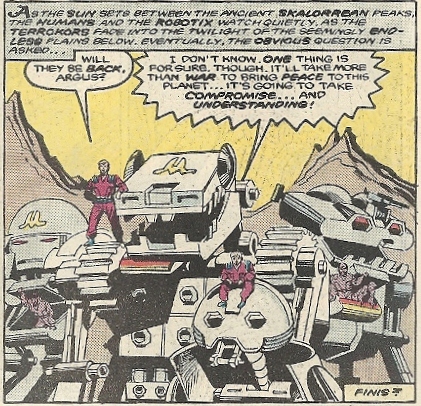
Let me answer you, comic book. Yes. Finis.
Despite Trimpe’s best efforts — and his best efforts are better than most — nothing can keep this from reading like a watery ripoff of the Transformers saga, what with the crash landing and ancient hatred and human friends. I’m surprised one of the guys wasn’t named Witwicky. “Hey Optim- I mean Argus. Argus.”
Some of the art is nice, though. Can’t take that away.
All the brief segments that formed the cartoon series were eventually glued together and released on the home video market as Robotix: The Movie. Apparently the first several of those chapters are replicated to various degrees in this comic. I can’t vouch for that, because I’ll be damned if I sit through any 1980s animation which lacks even the barest hint of nostalgia.
There you go. Robotix. Your transforming robot world is more complete than it was a few minutes ago. YOU’RE WELCOME.
Test your Brotherhood Quotient this Easter Sunday with a patently insulting questionnaire
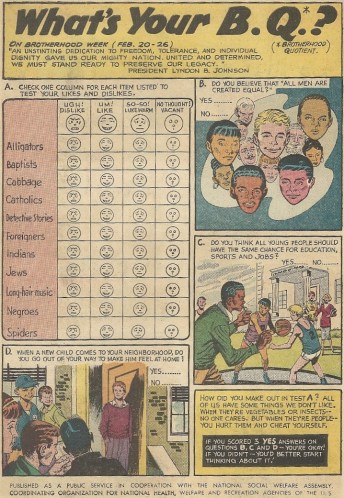
You can thank non-profit bureaucracy for lumping Jews, “Negroes,” Indians and other groups of people in with cabbage and alligators, on a scale that looks like it uses the Four Faces of Charlie Brown to quantify likes and dislikes. We’ve seen similar obtuseness in other settings, but never before from a do-gooder association. I realize that the people behind this were trying to make the point that people don’t deserve to be judged just by what broad demographic they fall into, but the ham-handedness undermines the message a tad, don’t you think?
I have a feeling 99% of all children answer “NO” for D. It’s a primal survival instinct to shun the newcomer, after all.

It should come as no surprise to us that, as 1940s boys were trying to bulk themselves up, ladies were trying to slim themselves down. The surprise here comes when you realize what dames were ingesting to keep their trim figures. When I read what the brand name was for this diet product — Kelpidine — my first thought was “It sounds like it was made out of seaweed.”
It was.
“Fucus” is seaweed. And these pep pills — they were also marketed as chewing gum, and God only knows what they were laced with — had one heck of an exercise-free guarantee. I’m sure it was recommended to wash them down with snake oil.
Superman’s flagship title is hijacked by a plot so stupid you’ll want to punch it right in its ugly face – Action Comics #336

Hey, is Supergirl’s word balloon up there an early ancestor of the “All your base are belong to us” internet meme?
There are times when a story is so wonderful, so delightful, you want to roll up your sleeves and dig into it. To pick it apart piece by piece, to really get in there and see what made the thing tick, what made it sing to you. Those are wonderful moments, when you’re fired by a desire to see something wonderful from the inside out.
Then there are times like this. This is more like the scene in Jurassic Park when Laura Dern, trying to figure out what was making a Stegosaurus sick, plunged elbows deep into a heaping pile of Stego-dung. Lesson: sometimes you have to squint, scrunch up you nose and wade into the muck and mire to get to the bottom of things.
Yes, this edition of Action Comics is the equivalent of dinosaur feces. IN MY HUMBLE OPINION.
It’s a double shame because there’s a wonderful Curt Swan pencilled Phantom Zone story in the other half of the double feature, but it’s eclipsed by the awfulness of the cover tale (Swan and inker George Klein handled said cover). There are roughly 142 things wrong with it, but we’ll only focus on a few, because I frankly don’t want to turn this into a post of Proustian length. I have neither the time nor the patience, and neither do the fine people who frequent or browse through these parts. Nor do I want to castigate scripter Otto Binder or artist Jim Mooney too severely, as comic folks lay an egg now and again, just like every great golfer sometimes falls apart on a hole and posts a quadruple bogey, a snowman (8) on a par 4. This isn’t a raking over the coals of their professional reputations, and they did good work both together and on their own. It’s simply that this steaming pile needs to be aired out in the light of day.
And it’s not even Superman that’s the fulcrum of this Silver Age abomination, but Supergirl. I few weeks ago I posted another story that didn’t exactly paint Supergirl/Linda Danvers in a positive light, as she jealously pouted while her Super-Friend pals got all the attention. This could be seen as piling on with a, well, pile. But we gotta do what we gotta do.
Brace yourselves. Take a deep breath, like you’re about to go into the airplane lavatory after the fat guy.
Things get off on the wrong foot when we come upon Supergirl in an intergalactic beauty pageant — beauty pageants are inherently stupid and deserve nothing but our everlasting contempt, after all:

What was the big prize for this colossal waste of time? Well, that photon torpedo that Supergirl is about to doze off in is actually a gas chamber, one that renders its occupants as ugly as the horrifically scarred pageant sponsor, Prince Jak-Thal (what you see above is a mask) and the prior winners you see in the second panel. Supergirl beats a hasty retreat, but she received a strong enough dose of the ugly gas to render her thoroughly hideous the next day. We’re talking a short step away from Rocky Dennis. ACK. Her first stop for help? Her cousin and his Fortress of Solitude, where Superman makes a complete hash of things:

Hey, in the upper right panel, is that a kind of Red Kryptonite that cures baldness or causes baldness? Because if it’s the former, MY SHAVED CUE-BALL COULD SURE USE SOME.
Whatever. Thank God for the handy mask rack. Sometimes the low-tech solutions are the best you can do.
The masked Girl of Steel still has good deeds to do, and she helps out part-time nurse Lois Lane (You didn’t know Lois was a volunteer nurse? I forgot/never knew — she was indeed in a number of stories though.) with a wounded soldier’s facial reconstruction, a procedure that OH THE HUMANITY WOUNDS SUPERGIRL SO DEEPLY:

She goes back home to change into her Linda Danvers guise and cry and wallow in front of her frilly mirror, but is interrupted by a rocket that drops in her backyard like a wayward baseball:

She thinks this is just more taunting from the disfigured Prince, and tosses the Miss Cosmos crown aside. She does have duties, after all, including going off to save Bizarro World from a collision with another planet and the resultant high-stepping chaos:

As you might guess, the Bizarros are quite taken by Supergirl’s “beauty”, and want to make a duplicate of her. Not realizing that their device makes imperfect copies like them, it actually makes a perfect imperfect perfect imperfect (I think you can take this to infinity) duplicate. The beautiful imperfect duplicate is immediately shunned by the revolted Bizarros, and Supergirl, not wanting to further depress her, destroys a mirror and uses a Benny Hill/Looney Tunes puerile ruse to trick her into thinking that she’s ugly/hot:

Are you wanting to kill this story yet? Put out a Gregg Williams bounty on it? No? LET’S KEEP GOING.
The duplicate Supergirl then goes to do a good deed for Superman because the Bizarros hate him and this would get her in their good graces. (If they hate him, wouldn’t they say that they like him? And wouldn’t that mean that they would want to do a good deed, but mean a bad deed? I HATE THE BIZARROS.) Her good deed includes using poor Comet the Super-Horse to help bar Superman from the Fortress, as seen on the cover:

I like to imagine that Comet thinks in a Mr. Ed voice. “Wilbur…” and the like. That, my friends, is the only thing keeping me sane right now.
“Good” deed done, imperfect Supergirl departs. And after that narrative cul-de-sac, Linda Danvers is visited by a boyfriend (Dick Malverne) she’s refused to see because of her disfigurement. He begs her for one last picture of her in her Miss Universe crown (Wait, I thought Supergirl won the Earth pageant. You know, whatever. If the story doesn’t care, why should I?), but she accidentally puts on the Miss Cosmos version. And:

Yes, the evil, disfigured Prince, now rotting in an outer space hoosegow (I wonder if it’s dragon-shaped like the outer space graveyard), saw Supergirl help the disfigured soldier on a “prison space monitor.” He subsequently realized the error of his ways and sent the crown with a radiation cure via special rocketship delivery. And Linda/Supergirl? SHE HASN’T LEARNED ANY LIFE LESSONS AT ALL IN THIS EXPERIENCE:

Yeah, all that matters is you’re pretty again. Being pretty is the key to happiness. Bitch. Lack of Moral Theater.
[Clenches and unclenches fists.]
Outer space pageants. Ugly gas. Red Kryptonite cures. Ready-made masks. Nurse Lois. A rocket gently landing in a backyard. Bizarros. An imperfect perfect imperfect perfect ad infinitum duplicate. Mirror tricks. GODDAMN BIZARROS. “Prison space monitor.” Radiated Miss Cosmos crown. Linda Danvers not learning a thing about inner beauty or anything, because she got her Miss Universe looks (yeah, right) back.
None of these things on their own sink a comic. Indeed, singly they can form a part of any perfectly harmless and charming Silver Age story. But together, they’re deadly poison. This is a terrible story, one that makes your head hurt, and not just from trying to parse the bewildering logic of the Bizarros. The Superman-iverse can be easily susceptible to tomfoolery (see: Sword of Superman), but this takes, if not the whole cake, at least a big heaping slice of it.
You’ll notice that I didn’t list Comet amongst the litany. The Super-Pets, as preposterous as they are, are actually one of the more charming features of Superman’s Silver Age. Krypto, Comet, Beppo the Supermonkey, and yes, Streaky the Supercat, have their charm. Even with poor Comet’s appearance in this dud, he retains his version of dignity.
Let me be clear: One of the dumbest things of this comic book era was one of the least dumb things on display in Action #336.
Once again, no disrespect intended for Binder and Mooney. Seriously. Since it’s Masters weekend, I might as well go back to the golf metaphor to make this clear. Phil Mickelson, a two-time Masters champion and one of the premier golfers of his generation, is a man known for taking risks. He’ll blast the ball around a tight corner, daring hanging branches or sand traps or water hazards to try to stop him. While he has enough talent to pull of these daring gambits, just as often they’ve come back to bite him in the ass, and he’s suffered charges of being reckless and careless on the course with championships in the balance. But he’s an all-time great golfer, and none of the flubs can take that away from him.
With this comic, Binder and Mooney tried to hook a ball around a dog leg turn, and wound up plopping the ball into a lake. They tried to dodge around about a dozen hazards too many. In the grand scheme of things, no big deal. No shame. Take a drop, eat the strokes, and move on to the next hole.
Nevertheless, this is a stupid miasma of a story, and ain’t no Miss Cosmos. Beware.
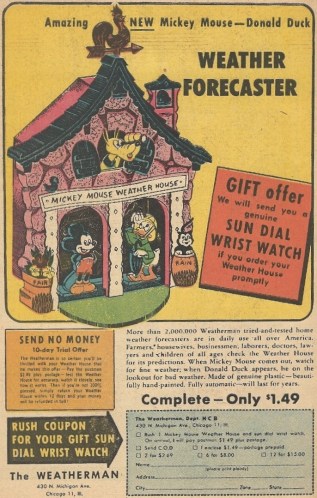
Either Donald is getting worked over by Chip and Dale or those no account nephews of his, or he’s getting figuratively rained on in this odd little toy. He just can’t win. I’ll never understand why the sun shines only on the incredibly unentertaining Mickey Mouse and why the Disney people scat and bebop all over Donald’s feathery behind. I realize he’s a tad confrontational, but let the duck have a good day now and then, you know?
Also not sure about the actual forecasting abilities of this lump of plastic — a lump of plastic back when plastic was a selling point, judging by the above ad. Best to consult your local newscast, newspaper, or stick your head out the window. (In its defense, the Mickey Mouse Weather House was an actual functioning barometer. You can find pictures of one here.)
Let’s not get started on the sun dial wrist watch.
Love to fish? Bored with the old bait and tackle? Not ready to go all the way to dynamite? Try the Powerline!
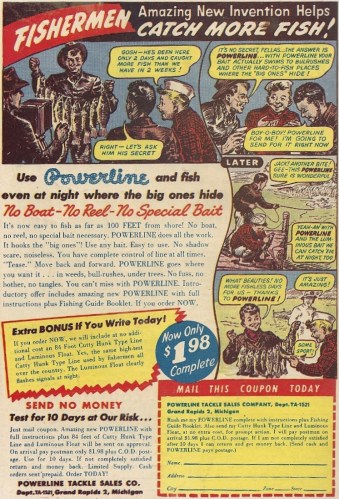
I’m not a fisherman, but it seems to me that, unless you’re fishing for your livelihood, using anything more than a rod, a reel, a hook and a worm would be cheating. Like hunting a deer with an RPG. This thing (from the comic in yesterday’s Ty Cobb extravaganza), which sounds like the water equivalent of a heat-seeking missile, would be a bit much.
Fishing aficionado Spider-Man would not be amused.
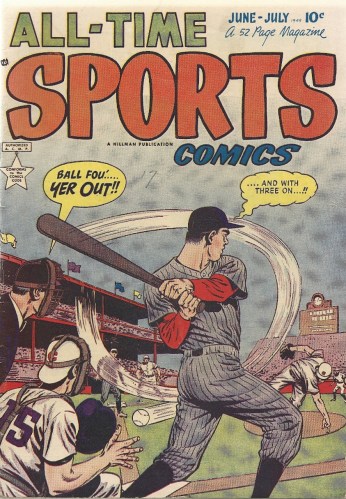
Ty Cobb wanted to play, but none of us could stand the son of a bitch when we were alive so we told him to stick it. — “Shoeless” Joe Jackson, Field of Dreams
Having grown up rooting for the New York Yankees, and now having adopted the Washington Nationals as a transplanted Arlingtonian, I have no rooting interest in the Detroit Tigers. But this Golden Age sports-themed comic has been sitting on my desk for a while, and it has a nice little Tigers feature within, so the they might as well be part of our Opening Day festivities. PLAY BALL and all that jazz. (Plus the Tigers were the favorite team of the greatest television private investigator of all time, Thomas Magnum, so that makes them doubly copacetic in these quarters.)
It should ne noted that the publication year of this comic is 1949, which means that another century-plus of the Tigers organization’s history was still coming. Sparky Anderson and Kirk Gibson and Lou Whitaker turning double plays with Alan Trammell all feel like they were a hundred years ago, but they were still thirty years away from this comic. Even by the mid-century mark, though, the Tigers still had a number of famous names and legendary ball-players among their pantheon. Here’s some of their smiling faces (with Bob Powell — who worked on the Man in Black story featured here recently — art), including Wheaties spokesman Hank Greenberg at 1 o’clock:
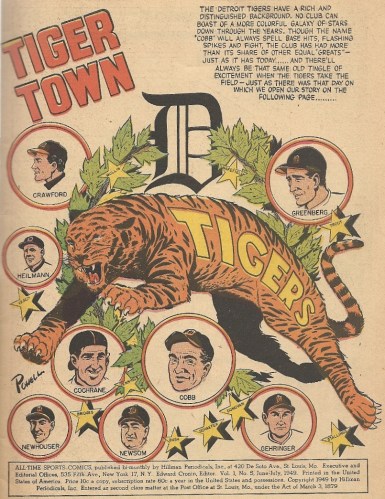
All well and good, but Ty Cobb, whose grim sepulchral visage rests underneath the Tiger’s belly, is the real star of this show. Yes, Ty Cobb, the man who once climbed into the stands to beat a heckler that had no hands, the Cobb who, when this little fact was pointed out to him, proclaimed “I don’t care if he got no feet!” The Cobb that was a rotten husband and father. The Cobb that had issues with black people. And the Cobb who may be the greatest pure hitter ever to play the National Pastime. The Cobb that had the most votes in the Baseball Hall of Fame’s first year of inductees — more than Babe Ruth. The Cobb whose biopic, Cobb, starring Tommy Lee Jones, portrayed him as one of the worst human beings ever to walk the Earth. Yeah. Him.
Four of the ten story pages available are devoted to the man, and after the early days and early leading lights of the Tigers are presented, we start on Ty. A jerk who pissed off just about everyone he came into contact with, his story starts off as you’d expect, with him disregarding a bunt sign, hitting a game-winning home run, and getting chewed out and booted by his bush league manager (back when he played for the Augusta Tourists of the South Atlantic League):
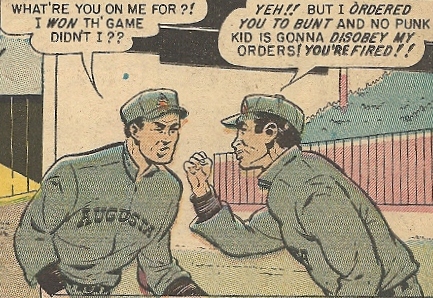
His dickish ways could never keep him pinned down in the lower rungs of hardball, at least not with that irrepressible talent of his. Soon he’s in the Show, where he hits singles, steals bases (with those deadly spikes of his), gets slugged by Honus Wagner and has his gear sabotaged by vexed (jealous?) teammates:
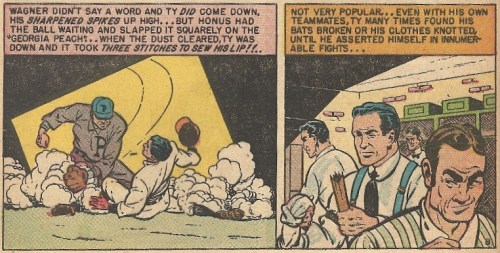
Wish there was a Walt Simonson KRAKATHOOM in that first panel.
All good things come to an end, even for the greats. Turns out Cobb, with a face that was well-primed for chasing kids off a lawn, retired (with the Philadelphia Athletics) on a date that would take on a terrible significance in 73 years:
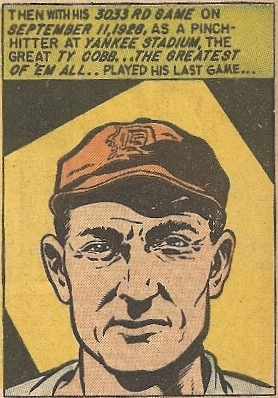
The man carried a lot of tension around the eyes. You can’t take that away from him.
You want stats? How he matched up against his great contemporary, Babe Ruth? Here you go:
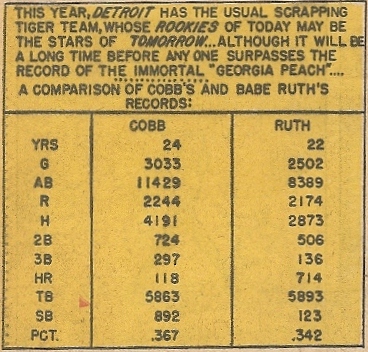
(That Lou Brock, and African-American, would one day break his career record for stolen bases quite possibly had him spinning in his grave.)
If all that wasn’t enough Cobb for readers, one of the other features within (there’s also a story with a lacrosse coach telling a horrifically violent tale about the Native American origins of the sport to his team) has a brief panel to further drive home the “TY COBB WAS GREAT” point:
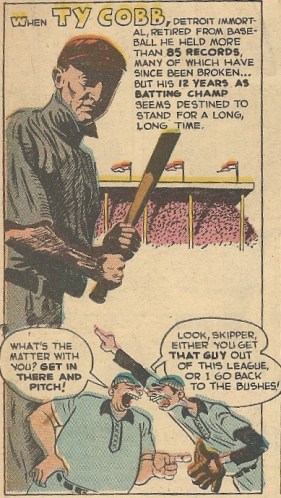
I think a part of Cobb’s intimidation factor is the collar in the old-time uniform. It makes him look like Barnabas Collins from Dark Shadows or something. “I’ll pound you with this bat and then gore you with my cleats and then suck your blood. AND GOD HELP YOU IF YOU’RE NOT WHITE.”
There you have it. Ty Cobb, a Baseball Man in Full.
Above I alluded to one of the strangest things about reading this comic. So much of baseball history was still in the future back in 1949. I mean, the comic may be Golden Age, but the Golden Age of baseball — Willie Mays, Mickey Mantle, etc. — was in the offing, and the Dead Ball Era, of which Cobb was a part, was still well within living memory. It gives you an odd sort of feeling while you’re reading it, and you can’t help but put yourself in a 1949 boy’s shoes.
I don’t know what kind of artifact all that makes this short little story, but it’s something. And it’s a nice way to throw out the first pitch for the baseball season.
Before he tried to be New York’s Governor, Grandpa Munster was a bizarre model kit spokesman

I had no idea who George Barris was before I saw this ad. A brief internet search and a Wikipedia entry later and I’m edified. Creating TV’s Batmobile is at the top of his resume, but I’m not sure where Grandpa Munster’s DRAG-U-LA ranks amongst his career highlights. AMT’s Kat looks pleased with it, though. (All customized TV cars take a back seat to KAR 120C from The Prisoner.)
With groaner puns like the ones above, Al Lewis would have been a real hit in Albany.
Punisher. Daredevil. Black and White. Rashomon. Jesse “The Body” Ventura? – The Punisher Magazine #8

Let’s consider this cover for a moment. Before we’ve paused to ponder, ruminate over and generally admire lovingly crafted and mantel-worthy paintings such as “Apes in Coonskin Caps” and “Conan with Gun.” Granted, this Punisher painting by Joe Jusko lacks a strange juxtaposition to weigh in its favor. But… I think the sheer absurdity of Frank Castle dangling out of a wildly out of control bullet-riddled helicopter as another bullet tears through his pectoral as he looks for someone to stab with his blood-dipped push knife as a gut shot dude plummets to a watery grave as cash flies all around them (pant pant) IS PRETTY DAMN GOOD. All that’s lacking is a squealing baby tucked under Mr. Castle’s arm, and it would get an A+.
Hell, I’d give it credit just for all those little buildings in the background cityscape and the nicely detailed — though not up to legal tender levels — cash. Jusko has greater patience than most of us.
Yeah. It’s pretty great.
It’s almost enough to overcome the disappointment of The Punisher Magazine not being a gritty version of such glossy publications as GQ and Elle. It’s straight-forward Punisher storytelling, and you aren’t going to find any features like “Hot Spandex Skull Fashions for the Spring,” “Is Your Micro Falling out of Love with You?” or “Ways to Turn Your Family’s Murder into a Positive (And Unlock the New You)” inside. OUR LOSS.
Still, the black and white reprints within (there’s some Jim Lee action as well, as the Punisher gives a tutorial on how he cracks bones and snaps backs) are surprisingly entertaining. “Surprisingly” because I can’t possibly care less about the Punisher (as detailed before). But, in the ultimate compliment I can give this mag, my loathing went down a tick while reading it — more on that in a moment. The two main stories in this magazine are from the regular Punisher and Daredevil series — issues #10 and #257, respectively. They tell the same story from their two different worldviews in a half-hearted, but still good, comic book take on Rashomon. Actually, there are three perspectives. The Punisher half centers mainly on his thirst for lethal retribution, while the Daredevil side focuses on both the Man Without Fear’s quest for justice and the criminal motivations of the muscled up idiot (Alfred Coppersmith) caught between the two heroes.
We begin with the Punisher chapter, “The Creep,” written by Mike Baron with art from Whilce Portacio and Scott Williams.
What’s all the fuss about? Alfred’s a weightlifter guy who looks a lot like Jesse Ventura ca. 1986, complete with a balding mullet, and he’s been poisoning medicinal supplies like aspirin and reveling in the resultant chaos from his crappy apartment. Here’s a three-panel sequence that sums up their personalities well:

So the Punisher starts hunting this sumbitch down, a search that occupies much of his half of the story. What does he do when he finds him? It’s a big surprise, actually. Inspired by Daredevil’s even-tempered words on the boob tube, he has a polite, soft-spoken sit-down with the poor lost soul that’s been harming all those innocent people.
BELATED APRIL FOOLS. There’s no jibber-jabber. The Punisher went to the Mr. T school of problem solving, which means he likes to kick guys in the face — HARD:
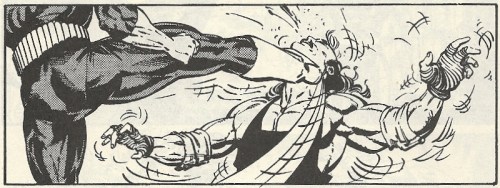
The bigger they are, the faster their teeth fly out.
Daredevil, also on Alfred’s trail, shows up just in the nick of time, right before the Punisher’s about to defenestrate the big guy and his all-show muscles. MORE FLYING FEET OF FURY:
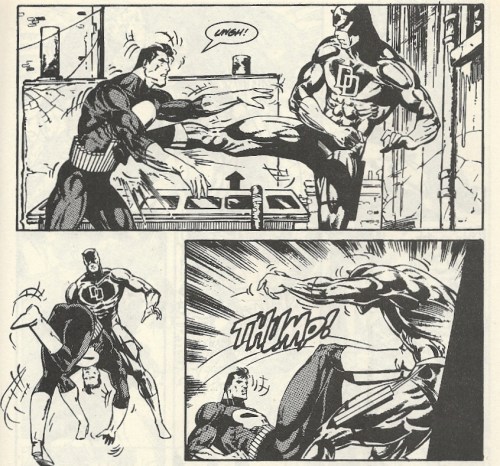
Daredevil’s arrival has put the Punisher in an awkward spot. He can’t kill the poisoner without going through Daredevil (i.e. killing him), so he “lets” Hornhead win. And Daredevil gives him one to grow on:

Now we move over to the Daredevil half — “The Bully,” written by Ann Nocenti, with art from John Romita, Jr. and Al Williamson. Here’s our Ventura proxy multitasking by 1) filling us in on his motivations, 2) getting some military presses in, and 3) airing out his hairy armpits:

His computer skills were lacking, and he got fired because of it. So a little vocational training and this guy wouldn’t have cyanided unsuspecting citizens? THIS IS THE BEST AD THE DEVRY INSTITUTE HAS EVER HAD.
We follow Daredevil’s sleuthing (he’s more above-board than the Punisher), as he tracks the medicines to a factory, gets the lowdown on a disgruntled employee, and goes to said disgruntled employee’s residence. Our stories converge as he comes upon the Punisher holding the guy aloft about to splat him David Letterman-style on a NYC sidewalk. This time around we see their fight from the eyes of the criminal, complete with his dumb narration. Romita the Younger was made to draw stuff like this in black and white, no?:

Visceral, baby. Love the simple Daredevil shadow inks on the top pages-spanning panel.
We know how that fight ends, and Daredevil does indeed bring the creep to justice. And hey, he happens to know a really good lawyer:

I remember one Christmas dinner back in my law school days when an aunt challenged me on how a lawyer could represent someone accused of a heinous crime, someone whom the lawyer knows is guilty (I think a guy who admits poisoning medicine with cyanide qualifies). I gave the stock long-winded, high-minded answer about “innocent until proven guilty,” how keeping the government prosecutors on their toes by making them prove a case beyond a reasonable doubt keeps the justice system as a whole strong and fair, how the American legal system would rather a guilty man go free than an innocent man go to jail, blah blah blah etc. I confess that at no point do I recall the magic word “rehabilitation” worming its way into my long-winded answer. I probably just wanted to get back to the stuffing and cranberry sauce.
I don’t know if Matt Murdock’s do-goodery and his dabbling his social work makes him a better man than me. I think that it might.
Anyway, the reason this thing overcomes my usual Puno-phobia is the black and white reproduction — a reprint format that I usually rail against, so maybe there’s a double amelioration taking place. The lack of color works extraordinarily well with the Punisher character. It suits him (no pun intended — and no pun intended on the “pun” either). His stark black and white take on crime and life in general goes well with the Oreo shades. And, all respect to Portacio, but it’s Romita Jr.’s half of the magazine that really takes off. That two-page spread above is a fine example of the quality on display that’s only enhanced by the black and white and the enlarged size. His gritty work with Daredevil, with its forays into slums and the Kingpin’s underworld, was worthy of the Frank Miller era, and his style gives a voice to the Punisher that he so often lacks. [Edit: A commenter pointed out that I should have mentioned Williamson’s inks here. 100% correct. I meant to, but forgot. Williamson’s inks are big and bold and great. There.]
And there’s the North Star that is that cover. Suitable for framing, people. Suitable for framing.

I never knew as a kid, when I was doodling awful drawings of my Basset Hounds and their floppy-ass ears, that untold riches could have been mine. That the lucrative “Beefo” account (Beefo looks like dog crap, not dog food btw) was there for the taking. Where was the Famous Artists School when it was needed most?
“I’d rather kiss a Wookie.” “I CAN ARRANGE THAT.” – Marvel Super Special #16, “The Empire Strikes Back”

The Marvel Super Special March wraps with this, a delightful foray into what may be the greatest sequel ever forged. All due respect to the other books covered, from Krull to the Beatles, but that The Empire Strikes Back could take what had been the greatest blockbuster of all time and up the dramatic ante on it is a towering achievement. The only thing it lacks is Michael watching silently as Fredo is killed out in the fishing boat. If it had that it would be the unquestioned champion of sequeldom. But hey, The Godfather II didn’t have a comic book, NOW DID IT?
Empire has taken on an odd personal distinction for me in this strange new century: it’s the only Star Wars movie that I ever watch anymore. The Return of the Jedi, the sole entry of the first three that I was old enough to see in a theater during its original run, used to be my favorite (in spite of, and perhaps in a twisted way because of, the Ewoks) and I used to watch it was alarming regularity. I loved the three-tiered cake of drama that was the last act, with Han and co. battling the Stormtroopers and their gangly biped Walkers on the Endor Moon, Lando and the gruff “IT’S A TRAP!” Admiral Ackbar holding out against the Empire and the Fully Armed and Operational Battle-Station in orbit, and the tripartate pull of the throne room duel, as the Emperor tried to turn Luke, Luke tried to turn Darth Vader, and Vader wrestled with what remained of his charred soul.
And then George Lucas came along and threw that cringe-worthy dance number in Jabba’s palace (which still makes me want to scour my eyes with sandpaper), and then years later jammed Hayden Christensen into the finale’s ghosts (he’s not even looking in the right direction, George) and I gradually fell out of love.
But Empire remains. Tampered with but not felled, nicked but not stricken. Thanks to Irvin Kershner’s delicate direction it contains the best performances of the original trilogy (I never for one moment lose faith that Mark Hamill is sitting in a mud hut with a two-foot tall green dude), and its driving energy still compels decades on and after countless viewings. Its unquestioned splenditude perhaps functioned as a “keep your grubby paws off” buffer against Lucas’s compulsive meddling. (Though the insertion of Ian McDiarmid as the Emperor still briefly threatens to vacuum me out of the action. I miss the old lady with the monkey eyes.)
Still, Lucas’s continued assault on all that people once held dear continues apace, and perhaps one day Empire too will fully succumb to his Midas suck-touch. I recall an interview of his while we were still suffering though the decade long disappointment that was the prequel saga. George was hyping the stillborn “romance” between Christensen and Natalie Portman as the real love story of Star Wars. Okay. He was bloviating. I get that. But then he had to aggrandize that stalker-themed snooze-fest by belittling what had come before, referring to what Han and Leia went through as a mere flirtation (or words to that effect). I never wanted to reach out and grab the man by his dopey flannels and shake some sense into him more than at that moment. It was then that I truly realized how far out of touch the man was — and is. The veil fell from my eyes, as it were. And now that baggage is there every time I watch the Empire that I still, in spite of it all, cherish. I remember how Lucas deems Han and Leia and the way they look at each other as Han is about to be carbomited as the inferior love, and shake my head like a parent whose child just had a meth relapse.
We can’t even fall back on the untrammeled IV-VI. With Lucas’s stubborn refusal to release the unmolested original films in a satisfactory, high-quality form, all that’s left are decaying, unplayable VHS copies, non-anamorphic unrestored DVDs, a slightly corrupted but still enjoyable Empire, and memories.
And comics like the one highlighted in this post.
Yes. The Marvel Super Special for Empire is still part of what was good about the good old Long Time Ago days of Star Wars.
You see, not only did the film universe become a sanitized CGI mess, but the accoutrements of Star Wars became a pasteurized mish-mash (a fault not unique to Star Wars, and one I touched on in the Raiders of the Lost Ark post a few days ago). For instance, I dare you to compare the posters for the original films — the original posters, mind you — and the pablum force-fed us now. No offense to Drew Sturzan, but his lens-flared amalgamated headshots could never compare to the original Empire poster.
The Expanded Universe is nice for fans, don’t get me wrong. I haven’t dabbled in any of it, but I did read the excellent Timothy Zahn Thrawn trilogy back when they were first released, and enjoyed it immensely — far more than the fleeting thrills afforded by the prequels. But it strikes me that there’s such a strong corporate presence gluing the whole thing together. It’s nice that things jibe from book to book and comic to comic, but a part of me misses the days when the comic books went off in all kinds of weird directions. Back before we found out that Stormtroopers were all Maori dudes that were related to Boba Fett and not regular guys that Leia knew in a former life.
Now God forbid if an adaptation of a movie doesn’t have the same look, the same feel, the same bad breath as what’s onscreen. But that wasn’t always the case, as clearly shown by the mag featured here (which was also split into multiple parts for the regular Marvel Star Wars series). This comic is Empire, but because of the art, the script, and some different choices along the way, it’s a different Empire. Like it’s vibrating on another plane or something. And that’s not such a bad thing.
Written by Archie Goodwin, with art by Al Williamson and Carlos Garzon, it’s a nice romp, and if you’ve never read it before, it’s truly like seeing the movie again for the first time. Let’s have a look.
There are of course the straight-forward interpretations of the action, which nevertheless give you a different vantage of the things you now know by heart. Here’s an AT-AT getting brought down like an elephant — like the rest of the comic, as advertised by the cover, presented IN DAZZLING FULL COLOR:

Is it just me, or does it look like there might be an extra leg flying out of there?
One of the things I was most looking forward to here was seeing how Yoda was presented. The striking thing about him is that you get to see his gams — that comes with the territory when you don’t have to hide Frank Oz with his hand up the guy’s ass, but his legs are more spindly here, conforming a bit more to some of the early designs for the character:

(I used to spend a lot of time with my paternal grandmother, and she — especially as she got older — reminded me a lot of Yoda. Short. Hair a bit wispy. Eyes magnified behind thick glasses. A cane. OLD. Wise beyond even her advanced years. Seeing Yoda above with his little stick legs reminds me of the very few times in my youth I saw her in a robe.)
Like the Raiders comic, certain key scenes play out differently. The first I’ll show here is a key part of that “inferior” romance, as Han and Leia share their first kiss. Now, though, there’s no C-3PO cockblock:

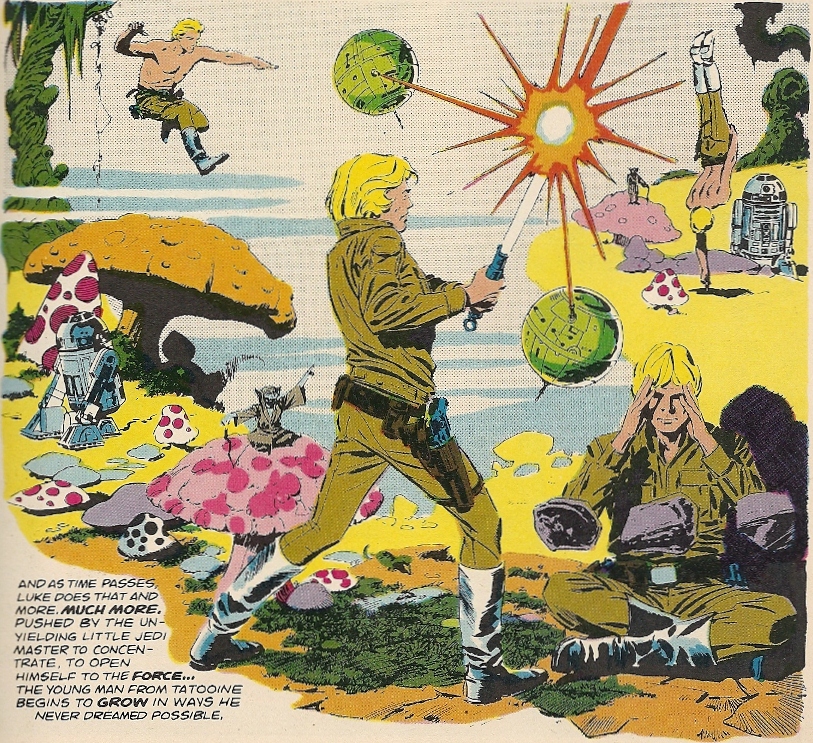
On a more light-hearted note, while I treasure the Luke/Yoda scenes, I wonder if perhaps they could have used more GIANT POLKA-DOTTED TOADSTOOLS:
Last, there’s the great reveal of Vader on Cloud City. (My college roommate loved this scene because for years he only knew the movie from a tape dubbed off TV, and Han shooting Vader had been edited out — never asked him what the censors did with Luke’s handectomy.) The sequence of events is changed up a bit, taking away some of the sudden action, but still leaving Han as a man not willing to go down without a fight:

(If I may, I have another beef with Lucas. The whole baneful business of clumsily re-editing the original Star Wars to make it so that Han — with his magically shifting head — didn’t pre-emptively shoot Greedo was all about making it so that our non-Force hero isn’t a cold-blooded killer. Never mind that, for all Han knew, Greedo was about to take him to Jabba and the big fat Hutt was going to filet him and feed him to the Rancor. (Though, admittedly, much of Jabba’s menace is deflated by the subsequent inserted scene in front of the Millennium Falcon, where he seems like a fairly amiable slug, one who only wants to have a little chat with his wayward pal. So maybe the insertion of that scene was what made the terrible, clumsy edit necessary. If so, JUST LEAVE OUT THE GODDAMN JABBA SCENE.) We can’t have our dear Solo be a decisive man of action, willing to shoot first and ask questions later in that wretched hive of scum and villainy, now can we? The kindly, trusting smuggler. “No, you shoot first. I insist.” Well, what about the above scene? A door opens on Cloud City (which seems on the surface to be as threatening as a gas-mining Club Med), Chewbacca growls, Han sees Vader and starts blasting away. Wouldn’t that run afoul of Lucas’s retroactive morality? Wouldn’t Han have to wait until Vader Force grips his throat before drawing his blaster? “Vader’s a more potent threat, and it was pure instinct” Lucas might reply. And “Hogwash!” would be my rejoinder, but with much more vulgar terminology.
You see? This is why I hate Star Wars now. Why I can hardly watch them anymore. I used to go to them to escape my frustrations. Now they are my frustrations.)
We would be remiss without including what may rank up there with Rhett Butler’s “I don’t give a damn” as the most (mis)quoted line in film history:
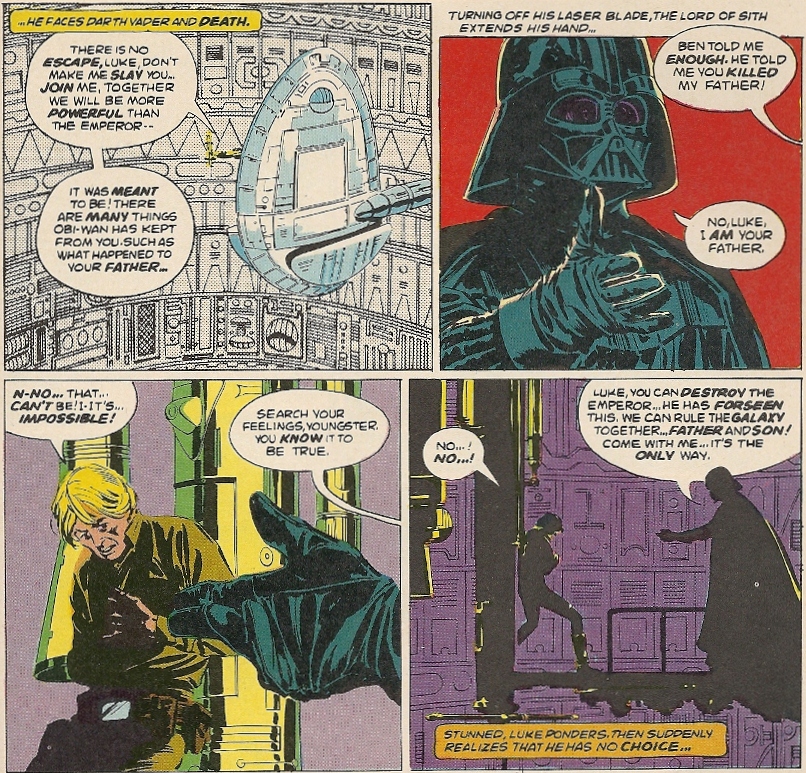
“I am your father” has become such a cliché we tend to forget just how great a slice of drama it is. The terrifying villain, who for the last act has operated as an articulate movie monster, bursting out of the shadows with homicidal and unstoppable rage, reveals himself to be the boy hero’s pappy. THERE IS A REASON PEOPLE QUOTE IT ALL THE TIME.
Reading this thing is a thoroughly enjoyable experience. The art, while not flashy, while not clean-cut, has a quality to it that’s most welcome. It’s different, and for that you appreciate it all the more. Ralph McQuarrie, the recently passed Star Wars conceptual artist whose design work gave shape to a universe, didn’t have drawings and paintings that exactly matched what wound up on the silver screen. He defined the essence of Star Wars, though, and the art here, while nowhere near the aesthetic power of McQuarrie’s, captures the spirit of adventure that propelled that first glorious trilogy. There was a novelty to what was revealed in theaters in 1980, as effects boundaries were pushed and audiences were amazed that it was possible to double down on the movie that had people coming back again and again.
The comic is a spiritual kinsman of the film, and one that stands as a pristine artifact of what it was like to be right in the middle of gen-u-ine movie magic. The comic may be rough, and may be a bit off-kilter, but it fits.
I first watched Empire in my elementary school. This was back before VCRs became commonplace, and sometimes the school would show a movie after the day was over on the crappy TV that was kept in the cafeteria. I can still remember seeing the Hoth battle with the walkers and being simultaneously terrified by those mechanized behemoths and completely transported out of that den of lunch ladies and sloppy joes. The celluloid tether that bound me to that magical moment has sadly been frayed by Lucas’s fussing. (I’d say tragically, but it’s just a movie, folks.) Comics like this one, though, are able to take you back to that time, when everything wasn’t painted over and corporate. When everything wasn’t Special Editioned and varnished with a cookie cutter CGI sameness.
Super Special indeed. It’s been an enjoyable month.

Miss Buxley, take a letter while I chase you around the desk. Use the Doctor Doom stationery. And mail it in a Spider-Man envelope.

The character images above may have been enlarged for enticement purposes, but it seems to me that, like someone who dumps a ton of milk into their coffee, you’d be getting some stationery with your comic book character.
Use whatever white space you can find to write your letter — maybe a fan submission to FOOM. Post it with a Marvel sticker. Cancel it with a Marvel hand-stamper. Might as well make it a 100% Marvel affair.
 Jared
Jared


 blog into mystery