
Note: The bipedal bear known as Smokey has gone by either Smokey Bear or Smokey the Bear during his illustrious fire-prevention-awareness career. Whenever his second moniker is put into play in this post, it will be in the Smokey THE Bear format, because that’s how modern, civilized people refer to him. Though, yes, it’s Smokey Bear in the comic and, indeed, Smokey Bear officially.
Smokey the Bear is one of the most venerable of public service mascots, outdistancing his Forest Service co-worker, Woodsy Owl (“Give a hoot! Don’t pollute!”), and perhaps running neck and neck with, if not a bit ahead of, McGruff the Crime Dog (“Take a bite out of crime!”) in the pop consciousness marathon. This giveaway comic, the last (1969) of several editions(1960, 1964), tells his tale of woe and stardom, at the same time drilling the evils of forest fires into the minds of young children. The blaze that sent Bambi scurrying for safety not terrifying enough for you youngsters? Then the U.S. Department of Agriculture has just the thing for you! With an ursine twist!
Before we get started, we should all be clear that Smokey was created by the Forest Service as a mascot in 1944, while the events that brought the real Smokey into the public eye happened in 1950. It’s the latter that forms the meat of this comic, in a case of art imitating life imitating art. Got it? Good. Let’s proceed to the tale — narrated by a falcon, of all things. (The writer and artist are uncredited.)
Smokey’s life starts innocently enough, with playful romps through the forest, though hints of danger lurk under his very paws:

And wouldn’t you know it, some disgusting human comes along and ruins it all, using any one of the myriad conflagration-spawning techniques — take your pick:

You ready for some sweet wildlife death, kids? HERE YOU GO:

Cheerful.
Thanks to the efforts of countless firefighters and guardsmen, the fire is finally put out (no sign of Thumper smothering flames with his huge foot), but not before a giant swath of forest is swiped away. And lo and behold, some of the soldiers find a little somebody hugging a tree with his burned paws:

Instead of putting him out of his misery, they take him back to be tended by the best vets. Good for them. He makes a complete recovery, and gets his stage name:

And so begins his life as a mascot, with kids and hats and posters:

A stick in the mud might point out that the humane thing to do might have been to release him back into the wild instead of making him a travelling carnival act. But maybe he was too tame by this point. Or maybe his wounds hampered him. Who among us can judge? After all, the green-clad men and women of the Forest Service are blameless, holy creatures.
Here’s the point in the narrative where the lines get a little blurred. I don’t think anyone believes that the real Smokey the Bear grew up, started walking on two feet and wearing jeans (in fairness, according to Lee denim has fire-fighting properties), and also grew opposable thumbs, but this comic makes that leap. It also brings our beloved comic books into play as one of the reasons that woodsy infernos are so awful:

IF I WASN’T BEFORE, I AM NOW CONVINCED OF THE EVILS OF FOREST FIRES.
How else should the book end but with some handy tips about prevention?:

I’ve been wracking my brain trying to remember if I had a copy of this book as a kid or not — the image on the cover has stirred the soil over long-buried memories. I have no idea where I would have obtained one (School? Campground? Were they still being handed out in the 1980s?), but the iconic image of young Smokey clinging to tree in a charred landscape is familiar. Not only that, it has some personal resonance, as there was a bad fire at my house when I was a kid (5 or so). I grew up in a small town in New York’s Adirondack Mountains, and our house was surrounded on all sides by dense forest, with only our long driveway connecting us to the main road. Long story short, my father was using a roto-tiller, hit a rock, threw a spark, some dry brush caught fire, cut us off from the nearest road, and things got out of control quick. The fire department got there fast and put things out, though there wound up being a lot of blackened earth and cindered trees. At no point were we in mortal danger, as we could have simply fled into the woods and come out at another road a few miles off, but it was a terrifying experience, one that I’ll carry to my grave. At the time it felt like Smokey’s tree fate awaited us all.
Anyway, the real Smokey wound up with a cushy pad at the National Zoo in Washington, D.C., where he died in 1976. There was a short-lived ongoing comic book series published by Gold Key in the 1970s, but it was focused more on generic misadventures rather than public awareness. Let this old comic stand as one of the real, singed Smokey’s monuments to the dangers of not dousing campfires.

Some 1940s bodybuilding ads look like the sort of thing that would have turned Oscar Wilde on
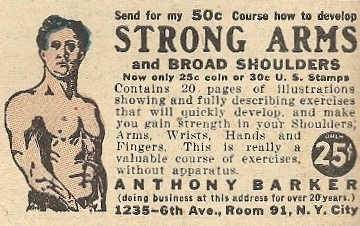
All bodybuilding ads with shirtless musclemen have, like pro wrestling, the tinge of homo-eroticism to them (Seinfeldian disclaimer: nothing wrong with that), and this little one is no different. What sets it apart is the Victorian feel, like it’s something that would have been among the exhibits at Oscar Wilde’s infamous sodomy trial. Old-timey strongmen’s barrel chests and rather underdeveloped biceps call out for sepia tones and hair tonic, and always look to be fed by a large number of egg yolks.
What exactly, sir, are you doing with all that strength in your fingers? Just what is your right hand doing down there?
An art school ad featuring people with dots for eyes might not be putting the best foot forward

This is one of the many ads from Art Instruction, Inc. (or one of its other iterations) to grace comics over the years. Usually they had the classic “draw this” test that potential customers students could submit to get an evaluation of their latent artistic ability. Here you had to send away to get the test, but same difference, you know? A hundred bucks says that the “plain-spoken opinion” was something along the lines of “MY GOD! THIS SHOWS SOME OF THE GREATEST POTENTIAL I’VE EVER SEEN! (Now give us money to help you fulfill said potential.)” Indeed, marks got a high-energy in-home sales pitch.
The school had some famous names pass through its virtual halls, as listed on its Wikipedia page, and it’s still going (strong?) today. All respect to the Fatman-fueling art of CC Beck, and other simple, clean styles, but it’s doubtful that anyone would think the material above represented the pinnacle of the profession. Maybe they wanted to set the bar low so as not to scare of potential customers students. I’d like to know what some of the tests were. “Draw a squiggly line of smoke coming out of a chimney.” “Draw stick figures.” “Draw birds that look like stretched out Ms.”
Boardwalk Empire’s Eddie Cantor and his Golden Age comic book life story – Super Magician Comics #6
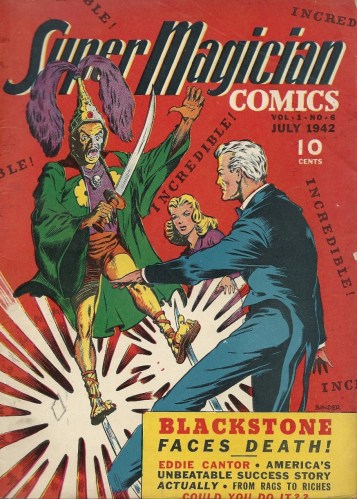
Comics have always had their subgenres that come and go, burn bright and then fade away, sometimes to return, sometimes never to be heard from again. Horror, UFOs, pirates and Westerns have all had their run, and have been resurrected at different times and to varying degrees over the past eighty years. Magic and the men and women who work it has swerved in and out of the comic consciousness in those decades as well, hence the comic that gives us today’s fodder.
Super Magician Comics was a 1940s showcase for, you guessed it, magicians. And not just fictional magicians, mind you, but fictionalized versions of real life (fake) magicians. The main star of this particular comic was Harry Blackstone, who was also a highly regarded touring magician outside of the printed page. Just going by his fearsome name surname in books and comics, he fought menaces terrestrial and supernatural with sleight of hand and earth-shattering incantations, while he did the usual cache of illusions (sawing people in half, floating things, etc.) in his stage act. Of another era than the open-shirted Copperfield and Blaine showmen of today, he brought a stately tie and tails to his performances. In sum, his flesh and blood persona was pretty much what generations grew up thinking of when they heard or read the word “magician.”
His fictional exploits could verge into the ridiculous, though perhaps that was both justifiable and necessary to sustain readers’ interest. He displayed a range of powers that bordered on terrifying, as witnessed by the pre-Code image on the cover, with spectral swords impaling a native’s feet (conjuring up comedian Bob Odenkirk’s bit about how life would be hell if magicians had actual powers). Yeesh. Yet no matter how much pain and destruction that was wrought in Blackstone’s quest for justice, water still returns to its level, as seen in in this panel with Jack Binder art:
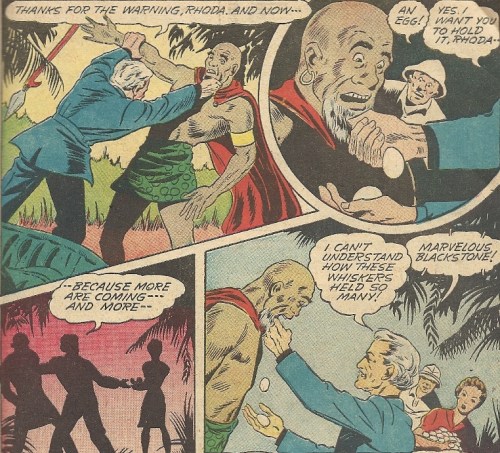
Yes, he’s subduing a giant guy holding a spear with the egg trick that Leslie Nielsen did in Airplane.
There are other magic themed stories in this comic, as well as some sequential how-tos for amazing your friends with your own illusions. (Illusions, not tricks. As Gob Bluth once said: “Illusions, Michael. Tricks are something that a whore does for money. Or cocaine.”) Yet things veer a bit off-track towards the back of the book, though they still, if we mix metaphors, stay in a stage’s lights. As advertised on the cover, the rags-to-riches story of early 20th century singer/actor Eddie Cantor is told within. Here’s his glowing name to prove it:

Cantor, though once one of the most famous names in America, may be unfamiliar to many readers here, though he’s had a bit of a boost the last few years thanks to a recurring presence on HBO’s sterling Boardwalk Empire. I could write out his life story, but what fun would that be? Especially when we have a (half) life story in comic form, featuring art by George Marcoux.
Cantor is born in New York, and at a young age discovers that he has a love for performance. He masters his stage fright (which appears to have made him almost wet his pants) and is a rousing success in his first treading of the boards:
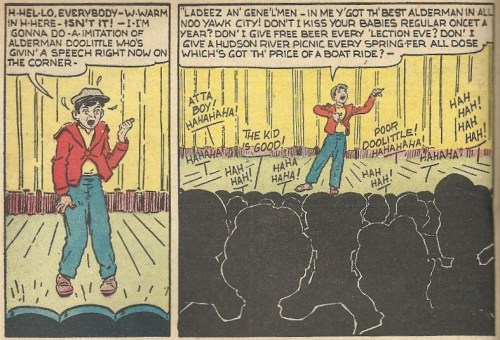
When he gets real hard honest American currency as recompense for his little act, his future is set. Like so many performers at the turn of the last century, he has his time in Vaudeville:
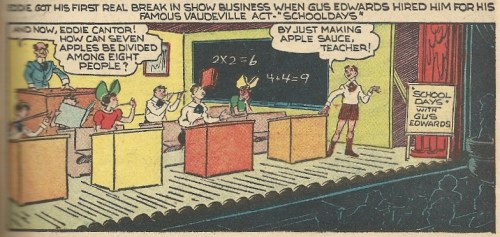
Boy, with scintillating humor like that, it’s a wonder how Vaudeville ever died.
One of the odd features of this biocomic is the framing story of the present day (at the time) Cantor waiting for the arrival of his newest child, and his fervent hopes that it will be his first son after a number of baby girls. It’s not the birth of his child he’s waiting for, though, but delivery by a stork, as shown here where the boy shows up just a little too late:
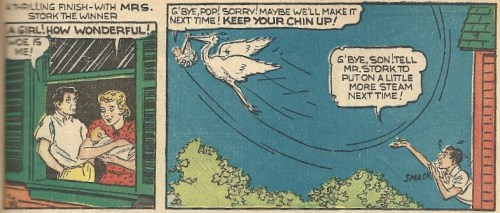
If you’re like me, this nonsense is making you doubt the vérité of the rest.
The mileposts of Cantor’s career are briefly but well chronicled, in much the same manner as the similarly structured (though lesser in quality) biocomic of his contemporary, Will Rogers. Hey, speaking of Rogers, he’s in this! Right here! During their time in the Ziegfeld Follies!:
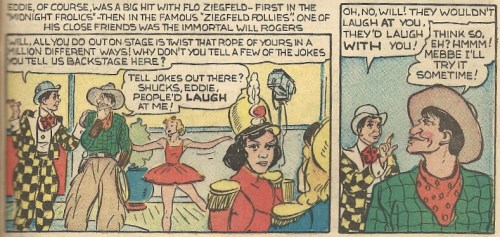
It’s hard to recreate the song and dance numbers that were Cantor’s claim to fame, but the comic tries. Here he is in blackface, singing his big hit “Making Whoopee”:
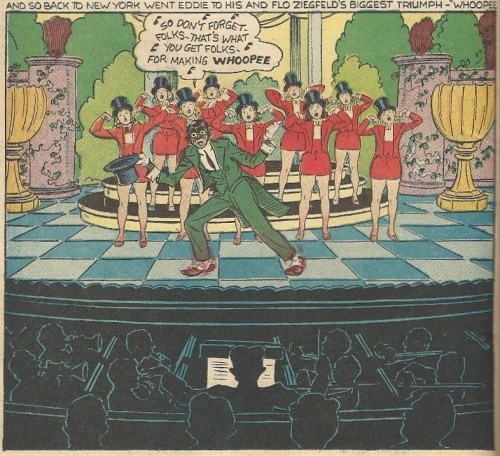
Lest you think the Al Jolson bit was integral to his act, here he is performing another version of the song — which makes that panel an odd choice (though it may have been a simple effort to condense things, as Cantor did perform in blackface at times):
Things wind up with Cantor meeting the fellow performers — Rudy Vallee, Bert “The Mad Russian” Gordon — with whom he’d find some of his greatest success. It ends with his discovery of songstress Dinah Shore — and a wish for what Luca Brasi would call “a masculine child”:
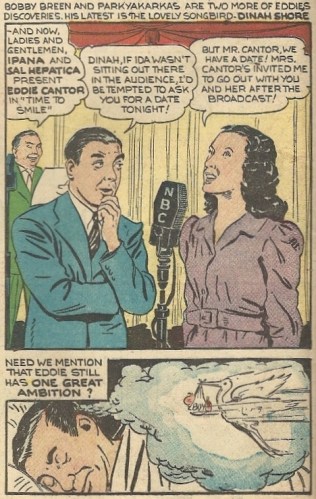
The writing may be pro forma, but the Marcoux art in the Cantor story outshines everything else in the book, including the Blackstone main feature. The blackface scene is nice in spite of itself, and the blue outlines of the pit orchestra and the white glow of the conductor’s sheet music are a nice touch that you don’t often find in early 1940s comics. Overall, not bad.
Stephen DeRosa’s portrayal of Cantor on Boardwalk Empire has at no point been integral to the central plot (though he figured more in the events of one episode this past season), yet it has been one of the factors that has helped suspend disbelief and convince viewers that yes, they are indeed looking at Prohibition-era Atlantic City and its environs. The depiction of Cantor veers into making him out to be 24/7 gay — if you type Eddie Cantor Boardwalk Empire into Google one of the first potential results to pop up adds “Gay” to those keywords — which is odd, given the reality of his family life, which is so out front in the odd side-story here. I have no idea if he was deeply closeted or not (always possible considering the era, even if he travelled in more bohemian circles), nor do I really care, but that prominent aspect of the BE Cantor deserves mentioning in light of what we see here.
And it should be noted that he never had a son, stork-brought or otherwise.
As an intense gun control debate roils America, here’s an old ad that should ignite emotions on both sides

The tragic events in Newton, teamed with other mass shootings that helplessly fade in collective memory as more are added to the pile, have kicked up an understandable ruckus over the Second Amendment. One side wants to impose strict limits on the types of weapons that can be purchased, and perhaps impose registration requirements on all firearms. The other recoils from an apparent infringement of bedrock freedoms, falling back on the people kill people defense and fearing a new weapona non grata mindset that will make home defense the province of cudgels and harsh language. Maybe justice is in the middle, or maybe it’s somewhere at one of the extremes. That’s something beyond the bailiwick of a comic book blog.
What does a 1943 Daisy Defender air rifle ad have to do with all of this? Not much. Yet its cheerful juxtaposition of youth, soldiery, Uncle Sam, Red Ryder and “1000 shot military” models feels like it comes (and indeed it does) from a different millennium, a time that could produce an American Boys Bill of Rights with no twinge of cynicism or irony. It’s presented to you here without comment, condemnation or endorsement. Make of this Rorschach ink blot what you will. (And look elsewhere if you want more painful pairings.)
Do you want your police officers getting their training from companies that advertise in comics? Me neither.

I don’t want to cast any belated aspersions on what was surely fine mail order classes offered by the Police Sciences Institute, but the Paul Blarts likely produced by their courses wouldn’t exactly fill one with a brimming sense of security. And, in fairness to the saps that signed up for this, it sounds like you got a whole lot of nothing at the end of your long-distance instruction. “Congratulations! Now you can go get real training!”
Stick to your electronics correspondence courses, and their rock-solid guarantees of fame and fortune.
Spider-Man and a mind-controlled Human Torch renew their ancient teenage rivalry – The Fantastic Four #207
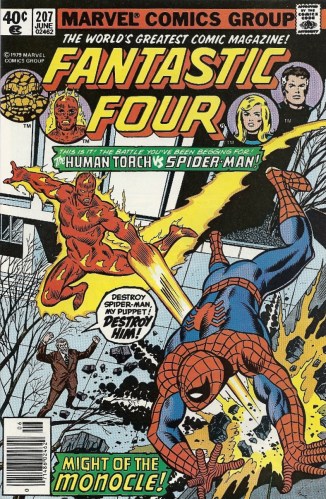
Amongst the Marvel pantheon, Johnny Storm has always been the fellow hero to bring out the worst in Peter Parker. Maybe it’s something about them both being testosterone-addled young men. Maybe it’s that the New York City megalopolis isn’t big enough to hold two youthful super-powered egos. Whatever it is, the most incongruous of Spider-Man’s early Silver Age appearances were his brief dealings with the Fantastic Four and their hot-headed junior member. Here was this generally mild-mannered youngster, raised well by his salt of the Earth aunt and uncle, a kid who may have wisecracked his way through the more death-defying moments of his crime-fighting career, but didn’t do so with a chip on his shoulder (not after poor Uncle Ben). And you put him in the same room with Johnny Storm, and things got hot, pun intended.
Look no farther than some of their earliest meetings. The first came, of course, in the very first issue of The Amazing Spider-Man, but subsequent encounters amped things up. They fought due to a misunderstanding in the second Strange Tales annual (though they teamed to take down a villain) and their battle in ASM #8 was pure spite. Spider-Man sees how socially successful Storm is, with hot cars and hotter babes, and horns in uninvited at a party to strut his own stuff. Butted heads ensue, and the rest of the Four have to settle things down. The Torch, no shrinking violet, almost seems the rational easy-going sort in the exchange, the aggrieved party, whereas Parker evinces some variant of the Napoleonic complex, an irritated struggle to answer questions that no one is asking. He was nothing short of a prick in that backup story, and it always sticks out like a sore thumb whenever I yank the 500 pound ASM Omnibus off the shelf. It’s a different Spider-Man than the one we know and love, and Johnny is the catalyst.
The tension even carried over into over-and-done cameos in their by-day guises, as we’ve seen here before. It just never ends with these two. In light of all that, we may as well subtitle today’s comic “HERE WE GO AGAIN.” Though the two heroes aren’t at each other’s throats throughout, there’s definitely something boiling under the surface.
And their renewed contretemps isn’t the only attraction here. There’s also the Monocle, the reason for this story’s events, an evil-doer who has the dubious distinction of being one of the lamest villains ever to slime his way into the ranks of Marvel villainy. Doctor Doom and Magneto don’t have a lot to worry about from his corner, put it that way. He’s a German scientist who can hypnotize and fire energy burst with the single, eye-cavity-clenched lens that gives him his name. And he has a beard. This comic marks his last appearance (I think) in the Marvel U., and that should tell you something about the quality of his characterization. He’s a stinker. (His presence does bring up an interesting question, though: Why aren’t there more villains out there named after clichéd appurtenances of evil? The Waxed Mustache. The Bisecting Eye Scar. The White Cat on the Lap. The Beetled Brow. Yes, these sound silly, BUT THIS GUY IS CALLED THE MONOCLE. Why not?)
Marv Wolfman , Sal Buscema and Joe Sinnott bring us this fight- and Monocle-infused tale. The Monocle gets things going in the story by brainwashing well-off youths at Security College to do his bidding (and in turn the bidding of the Enclave, the organization he’s working for), including the young Johnny Storm. Surely the following scene parallels what certain right-leaning people see as the conditioning imposed on students by left-leaning academe):

Meanwhile, Peter is out pounding the pavement, having been fired by J. Jonah Jameson. He turns to venerable but minor Spider-verse character Barney Bushkin for a job, at the Daily Bugle’s blood rival, the Daily Globe — the MSNBC to their FOX, the New Republic to their National Review. It’s an experience that has to have Peter wondering why he didn’t piss in Jonah’s coffee sooner:

His first assignment? Infiltrate the secretive Security College campus by posing as a student, and snap some pics of the goings on. Peter naturally runs into Johnny, and after being in comics together for close to twenty years by this point, Johnny still doesn’t have a clue about Peter’s second calling:

(Technically, I’d like to point out that, since Johnny still doesn’t realize that Peter is Spider-Man, the last time both parties would have knowingly met might have been the Fantastic Four issue I linked to above, and not the meeting in ASM #21, which had the Torch battling Spider-Man. They were both published in the same month, so this a bit of a gray area. — Jolly Jared.)
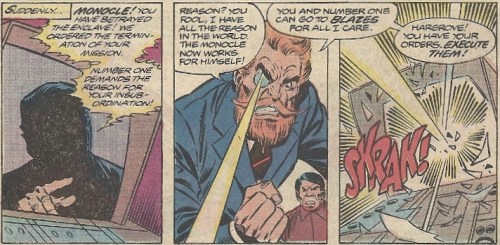
Hey, even guys named Monocle suffer under the yoke of middle management:
The Monocle’s plans for assembling weaponry and plans for the same are foiled by Spider-Man’s presence. Not even a mind-controlled Human Torch is enough to stop his do-goodery — here’s Spider-Man using a web-slinger’s take on Rock/Paper/Scissors to extinguish his momentary foe:

Now they both team up and nab that dopey Monocle, right? Wrong. Monocle, like all goofy comic super-villains in suits, has an escape rocket hidden in the campus ivy, one that repels the best efforts to stop it:
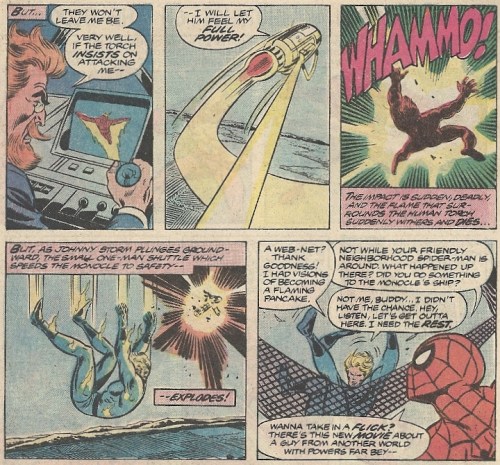
So the Monocle blows up for no damn reason. What a villain. We hardly knew ye. (Nice bit about Spider-Man and the Torch going to see Superman: The Movie, though.)
This was one of the few Fantastic Four comics I had as a kid, and I’d like to thank the Monocle for likely being the thing that poisoned that well for me until I was well into adulthood. The Fantastic Four were always passed over on the newsstand rack, and I hold Wolfman, S. Buscema and Sinnott totally blameless in this, placing the weight of shame solely on Monocle’s padded shoulders. As for Spider-Man and the Torch, at least they seem to be getting along here at issue’s end, and not geared up to slam heads like horny goats.
Still, in light of their history, the cover image seems like a natural state of affairs.
Trons (plural) have absolutely nothing to do with Tron (singular)

Are these “Robot Clowns That Make You Laugh”? Or are they things that if they were flesh and blood beings you’d take out back behind the woodshed to put them out of their misery? I’m betting on the latter. They’re reminiscent of the robot that Homer Simpson made and abandoned, the one that he accidentally pulled from behind a box in the garage one day and it pleaded “FATHER, GIVE ME LEGS!”
That they “hop” seems a bit of a stretch. “Limp” would be more accurate. And there’s nary a Bruce Boxleitner to be found.
Marvelites! Here’s some stuff you actually might like for a change! (Like a Thor stein. A THOR STEIN.)
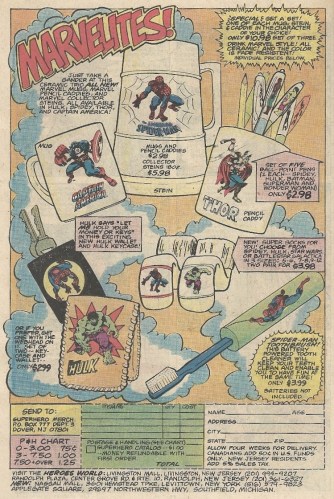
A Thor beer stein has a certain inescapable logic to it, an inevitability. One should quaff mead from no less, even if it’s likely made of plastic and not the ceramic or engraved metal that the subject demands. Where’s our Odin flagon? (And why not Thor on the advertised stein? No offense to Spider-Man, but did Marvel realize the goldmine they were sitting on here?)
Often ads for comic book hazarai are filled with clunkers. Dopey looking squirt guns, crappy “costumes” (See, I’m Superman! I’m wearing a terrible mask and a shirt with his name on it!) and all that jazz. But everything in this ad one could readily use in daily life. Who wouldn’t want to pull greenbacks from a Green Goliath wallet? (That blows away the Old West variety, btw.) Or cleanse their chompers with a Spider-Man toothbrush? Or sip their morning coffee from a Captain America mug, becoming a caffeinated Super-Soldier ready to bound into the day?
You don’t know where to start with this one, and for once that’s a good thing.
Bambi’s twitterpated second banana gets a moment in the sun – Thumper Follows His Nose (Four Color #242)
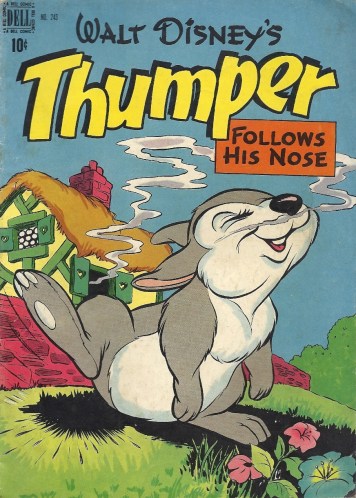
This is one of two Golden Age Thumper offerings published by Dell under their Four Color banner. Bambi’s little scene-stealing rabbit got a chance to step out of his young deer pal’s shadow in this 1949 book (Bambi never appears in these pages, though others from the Bambi-verse drop by), and made the most of his time, in several short features and multiple one-page strips. It’s your typical kid mag fare, with cute, fuzzy animals with big eyes going through the daily hijinks of their forest lives — at least until the last of the features, where things take a somewhat darker twist, though nothing that would send children into hours of therapy. We’ll get to that in a moment.
(I should pause to confess that I have some affection for Thumper, as that moniker became the family nickname for our dog and his loud scratching. That’s probably something that’s played out in other households over the years. So, though most Disney crap outside of Donald Duck is revolting, Thumper is okay.)
The first story is a play on the old Goldilocks and the Three Bears trope, and is what gives the book its rhinal title. Thumper wanders into a cottage with bowls of warm porridge on the table, has an internal debate with the devil and angel inside him on whether or not to eat it, opts not to, meets the Big Bad Wolf (in a collision with Little Red Riding Hood’s tropes), goes back to the cottage to hide, eats the porridge, and accidentally locks himself in the bears’ freezer. His discovery there could have gone a whole hell of a lot worse (art by Jim Pabian):
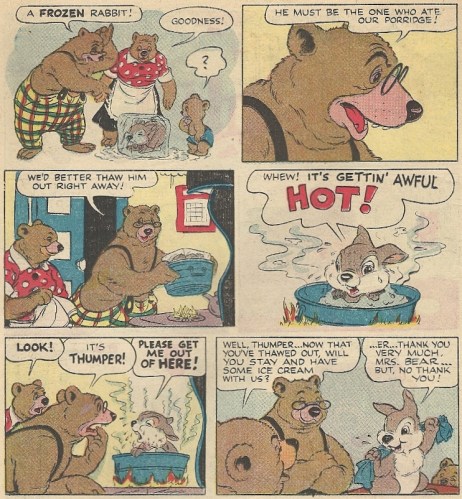
Are we supposed to believe the bears saw Thumper thawing in a warm broth and didn’t think about saying to hell with it and making stew? I CALL SHENANIGANS.
The second story (art by Ton Strobl) has Thumper coming to terms with his diminutive size, thanks to some psychological help from new, even tinier pals (is Jiminy Cricket in there?):
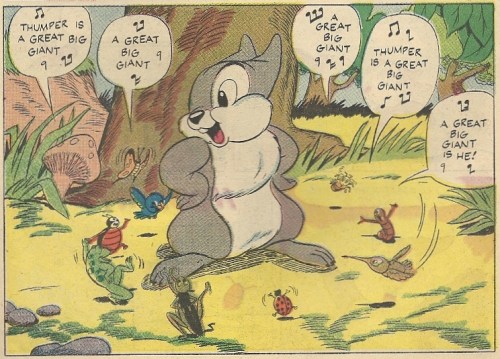
I imagine this would have subconscious — or conscious — resonance for young readers.
The last entry gets a bit hairier (figuratively). MAN IS BACK IN THE FOREST AND HE’S READY TO KILL AGAIN (Strobl art once more):
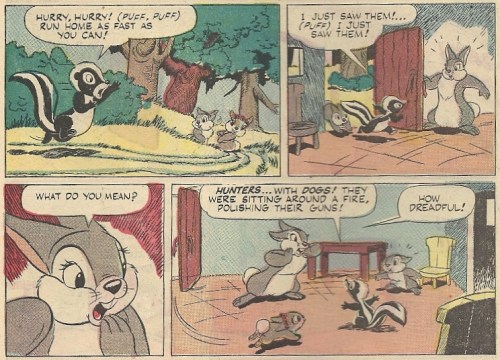
With hunters invading the forest, all the woodland critters take refuge chez Thumper. (Hey, wait, Thumper has a house? With a roof, four walls, a table and chairs? Must have been a deleted scene.) Our eponymous coney has his own ideas about courses of action, and hops out to meet the danger head on. In his wandering he extinguishes a carelessly tended fire in his own special way, one left burning by the hunters:
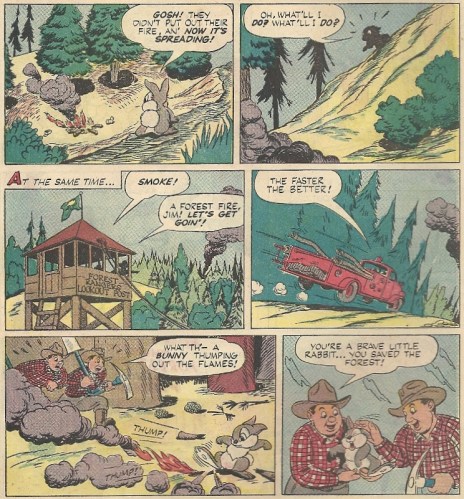
I’m reminded of George Costanza’s lament, after he fled a fire at a child’s birthday party, knocking down old ladies in his panic, that Eric the Clown (played by young Jon Favreau — Iron Man connection!) stomped out the flames with his big red shoe. And now, back to our regularly scheduled programming.
Thumper’s act of heroism touches the hearts of the forest rangers (wearing their matching Stan Lee flannels), and they make the forest a wildlife preserve, barring hunters from ever again bloodying it up and orphaning fawns. At this point, millions of children breathe a sigh of relief.
Though no comic could ever dream of capturing the awesome fluidity of early Disney animation, the magic that was so new in its day and still electrifies in a new millennium, the comic does its best to transfer what it can. It’s cute animals in cute situations doing cute things. Children will love this crap until there aren’t any more children. And so what if the last story is a watered-down retread of the harrowing hunting/fire scenes from the film?
So endeth our Thumper post. Sometime today, slam your foot on the floor repeatedly in his honor.

I think “genuine” in the above copy is used less in the “items actually from the Old West” sense, and more in the “these items exist” way. Maybe it’s just touting in a sideways manner the use of leather instead of leatherette. Regardless, have people ever circled around a belt and wallet to gape at their magnificent craftsmanship, as the illustration in the lower left-hand corner suggests? Doubtful.
Definitely beats the island girl wallet, though.
Use fireworks responsibly, i.e. don’t ride them like Dr. Strangelove’s Major T.J. “King” Kong
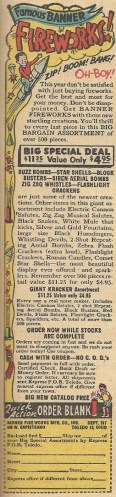
The Fourth of July is the day when so many mothers spend the twilight hours clucking and fretting like hens, terrified as fathers set off fireworks with their brood, annual news reports of vaporized hands dancing in their heads. I know mine was nervous enough about me holding so much as a sparkler, looking at it like it was a lit stick of dynamite. One summer, as my old man and I lit off a trove we had bought on the drive back from a Florida vacation, illegal-looking contraptions acquired at the famous South of the Border fireworks emporium, she almost died of fright. Bottom line: they make indoor shooting ranges seem like board games.
I imagine seeing their child straddling a rocket to a fiery doom would be most mothers’ worst nightmare. Yet for kids, it says “HOT DAMN THAT LOOKS LIKE FUN. BUY ME THAT.” Incidentally, some of the product names above sound like euphemisms applied to modern-day weapons — bunker busters, etc. I fully expect that “star shells” are used to root Taliban fighters out of mountain redoubts.
Just a story about a boy and his dog (getting eviscerated by Martians) – Mars Attacks #2

The Mars Attacks franchise had seeped into America’s pop consciousness long before Tim Burton’s film came along, with its comedic take and The Greatest Story Ever Told cast of thousands, and cemented it for a new generation. It’s amazing that a set of trading cards — trading cards! — could be so memorable, but the Mars Attacks set from Topps were that and more. There was the tinge of infamy to them: the allure of the rebel, the outlaw, the scent of danger. Originally banned for their content and then reworked into more palatable (but still boundary-testing) imagery, their graphic, sensational depictions of a violent alien invasion of Earth (some crafted by the great Wally Wood) tapped right into the post-McCarthy, pre-Vietnam Cold War zeitgeist. But even after they were tamed, they were still deemed too much for sensitive American youths. Production was halted, and a sought-after collectible was born.
This past year was the 50th anniversary of the original set. When something is still thought enough of to have its 50th anniversary remembered, much less commemorated, then it’s a success.
There have been many attempts to build upon the Mars Attacks brand, most coming after the sports card boom of the 1980s and the reflective glow that spread over into all things once wrapped in wax paper and sealed in alongside a stick of gum. The cards were reissued, with more added to the pot, and the aforementioned movie was released (which, appropriately enough in light of this post, performed the admirable service of returning Sarah Jessica Parker to her natural state: a dog). And in the 1990s, with Topps delving into the comic book industry, which was going through a concomitant boom, there was little doubt that a comic book series could be far in the offing. In 1994 a limited series was produced, the first of several volumes that would tell the story of the skeletal, exposed-brain aliens and their attempts at conquest.
Which brings us the subject of this post. The first mini-series, along with the Keith Giffen-helmed main story about the aliens frying humanity, also had a back up feature exploring events depicted in the original cards. The books were of the flip variety, meaning you could turn them over and pretend the back cover was the front cover (or maybe the back cover WAS THE FRONT COVER…). Now, one of the most outrageous of the Mars Attacks cards was #36 — this one:

Image Courtesy martianlit.com
I think we can all agree that even with cities vaporized and humans dragged off into slavery or barbecued outright, when some bug-eyed alien fries Fido, THAT’S WHEN THINGS GET REAL. Thus “Destroying a Dog” may be the most harrowing of the whole pile of cardboard, and, considering its inherent sensationalism, it should come as no surprise that this soul-searing event became the subject of this comic’s back-up feature:
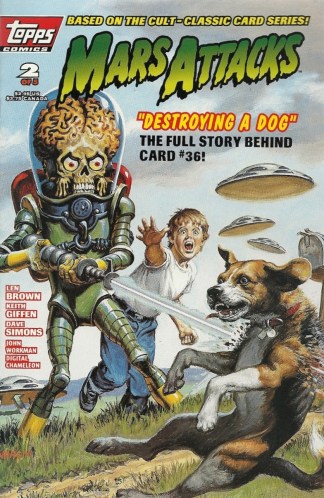
CHEERFUL.
Giffen, who scripted the main feature in this series, provides the pencils here, joined by Len Brown’s script and Dave Simons’ inks. In an entertaining twist, the story is told from the dog’s — Pepper — perspective, complete with staccato internal dialogue. To wit:
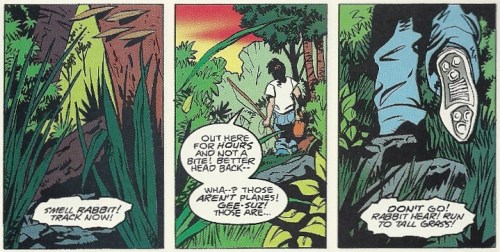
I don’t know if the fungal disks on the tree trunk were intentional or just accidental dressing, but they’re noted here. And approved.
Quibbles aside (like how the story should probably be in black and white), this is a short, pleasant read, mainly thanks to sizzling repartee like this:
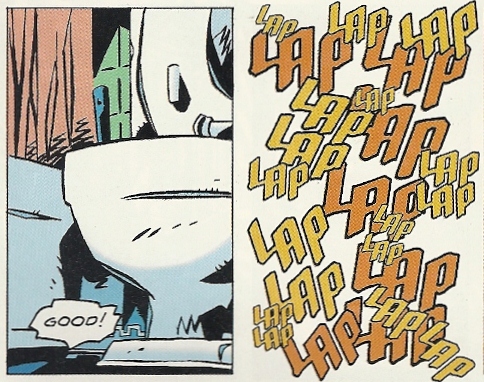
Well, okay, maybe not like that. But he’s a dog — what’s he supposed to do in his spare time? Split the atom?
Before you know it, the flying saucers glimpsed in the opening panels land and start a small-scale rural holocaust, as seen through the eyes of little Pepper. Though he knows what these visitors from outer space are capable of (they zapped another house, almost killing a dog friend of his), he’s unable to warn his human family. And unluckily for him, his master’s first thought isn’t “Let’s get the hell out of here (with the dog)!” Instead, it’s “Hi. How are you? You look friendly, what with your bared teeth and glowing red eyes”:
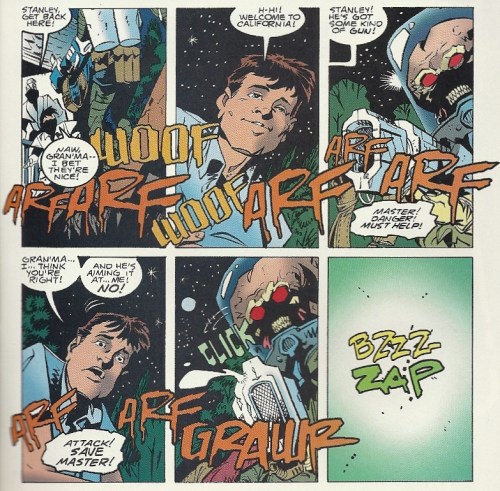
As you see, Pepper makes the ultimate sacrifice. Lest there be any doubts about him surviving this, the fact that he sees his own intestines held before his eyes isn’t the best sign:
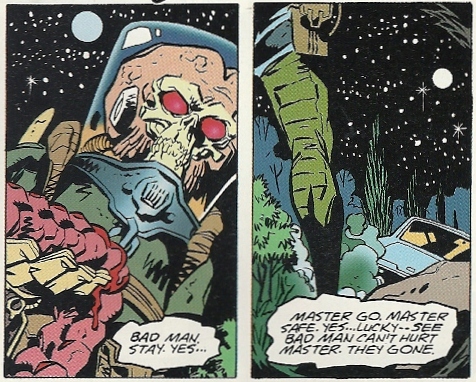
While this isn’t the sunniest fare, it’s more than faithful to the subject matter. You can’t ask for much more than that. Giffen’s art, with its narrow panels and (paradoxically) ample room for deep blacks, is a perfect fit, though it’s usually a good fit for pretty much anything, whether we’re talking the Legion or the Creeper teaming with Superman. Keeping the story completely through the eyes of the dog, and never once going for the cover money-shot of a pup shot through the guts, is a solid choice. You can tell that the people involved here appreciated how ludicrous the whole premise is/was, and ran with the guiding pulp ethos. And if they didn’t get it, at least the end result was the same as if they did.
IDW currently holds the Mars Attacks license, and they’ve taken great pleasure in crossing over the Martians with their other properties, as is their wont. Not sure that they’ll ever reach these lofty canine heights, though, where we got literary support for dogs being the loyal champions of the pet universe. Also, we learned that dogs think like Bizarro talks. Knowledge for life.
Me am happy. (Or sad. Whatever.)
I now present you with the ugliest, most overdesigned clock in the history of the world
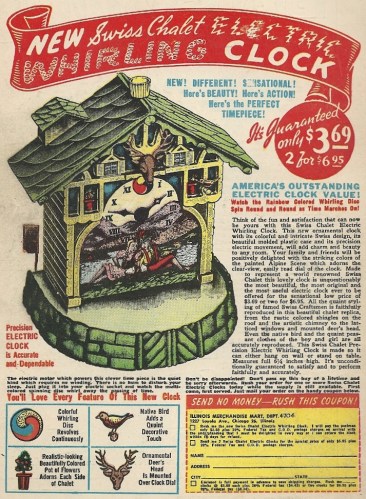
Maybe this is just old-fashioned stubbornness talking, but it would seem that all you need for a good, solid clock is a roundish backdrop, two hands — maybe three if you’re feeling saucy — and twelve numbers or Roman numerals arranged sequentially around the dial. And voila — clock. Not a swirling psychedelic disk. And a bird. And flowers. And a deer’s head. And a young couple posed like they’re pulled straight from a Swiss Miss ad campaign. Yet that’s what you get from the Swiss Chalet Electric Whirling Clock. It looks like the type of thing that makes odd noises unbidden, even after you’ve unplugged it and removed the batteries. ZOMBIE CLOCK.
This is supposed to be a timepiece, people, not a weather forecaster of either the Disney or depressed peasant variety.
Dying to hear the inside Doctor Who dope from Brigadier Lethbridge-Stewart himself? Then this Nicholas Courtney VHS tape is for you.

Nicholas Courtney has a certain trenchcoated Inspector Clouseau elan up there, no? Do you have a leesance?
I’ve been watching a lot of the Jon Pertwee Third Doctor serials lately, the only iteration of Doctor Who that I count myself a true fan of. The warm, bantering relationship between Courtney’s Brigadier Lethbridge-Stewart and the dandified, Venusian-karate-chopping Doctor is a big chunk of why this period of Earth’s favorite Time Lord gets the nod over the others, even the definitive Tom Baker regeneration. It’s hard not to love watching the Brigadier’s straight-arrow worldview clash with the eccentricities of UNIT’s scientific advisor, and how, in moments of bemused consternation, he had to often restrain from beating himself into unconsciousness with that omnipresent swagger stick of his. There was always a flicker of sadness, at least in these quarters, when it became clear that the Doctor’s newest adventure would be off-world, and the man with the mustache likely wouldn’t be making an appearance. No one would ever confuse Lethbridge-Stewart with a damsel in distress (though he ran and fought at times like a man not in full control of his limbs), but he has to sit near or at the top of any ranking of the Doctor’s companions, a designation at which he would surely bristle.
That said, there’s something so depressing about old VHS tapes floating around out there with a fine actor reminiscing about times gone by, memories preserved on a defunct format. Something about the world going round and round and leaving us all behind. Ugh. That Mr. Courtney passed on two years ago doesn’t help. R.I.P.
(It should be noted that the original Myth Makers tape has seen a reissue on DVD. Track it down if you crave hearing from the Brigadier in a format that’s somewhat less defunct.)
 Jared
Jared


 blog into mystery