
This is going to be the first of a weekly (when possible) feature here, looking at the best and worst of the comic book related trading card sets to have come out over the years. Mainly they’ll be from before both industries went through their simultaneous bust in the mid-1990s, though there may be a few here and there that come from more recent times. Emphasis on “few.”
Drumroll, please.
We might as well start with DC’s Cosmic Cards, which came out just as the popularity of both comics and cards was cresting in 1992. An “Inaugural Edition” seems fitting to inaugurate a new feature, so that clinches it. Impel, the company that produced them, had already put out two sets of Marvel Universe cards, which were runaway hits (and will one day be featured here), and DC surely had to have been chomping at the bit to get in on this action. What held them up? Well, take another look up at the top of the empty box lid up there, which once held 36 glorious packs of 12 cards each. Look at the characters. Flash. Green Lantern. Superman. All well and good, and each fine to be the face of the product.
Now gaze upon the four variant packs themselves:

Superman? Fine. Wonder Woman? Fine. Green Lantern? Fine. Deathstroke? Wait, Deathstroke? He has his following, but there’s something off here. It feels like there’s something missing. I can’t quite put my finger on it. A character that they’re forgetting. Someone with a cape. Ears. It’s on the tip of my-
BATMAN.
Yes, boys and girls, Batman appears nowhere in the 180 cards of the base set, nor amongst the harder to find holograms. Nor does Robin appear. Or Alfred. Or any of the villains who’d be incarcerated in Arkham when not menacing Gotham. Joker. Penguin. Riddler. Catwoman. Hell, Clayface.
THIS IS A GAPING HOLE, PEOPLE.
It also explains why DC waited so long to fling these out to the market, and where the “Cosmic” came into play. (Though, to be honest, many of the characters have about as much to do with space as I do.) I’m not 100% sure on this, but I’d think that the rights to produce Batman cards were still at this point in the hands of Topps, the most venerable manufacturer of this kind of collectible. They had produced sets for the first Tim Burton Batman movie in 1989, and for Batman Returns two years later (a regular set and one under their prestige Stadium Club brand). DC had to count themselves as lucky that the last set of cards for the Superman film franchise had come in 1983, and the rights had lapsed in the interim. (In an odd way, this roughly mirrors how Marvel, which had to farm out its properties, has established a combined cinematic universe, while DC, which has a studio under the same corporate umbrella, has had fits and starts towards the same.)
I’d say going Batman-less is akin to having a Marvel set without Spider-Man, but even that wouldn’t measure up to the omission of the premier rogue’s gallery in the business. So, basically, the set is DC No Batman Cards: Inaugural Edition.
Yet, once you get over that (you never do completely), it’s not a terrible product. Though the gray borders that surround every card are as drab as a prison hallway, there was some care taken in the art and execution. Each individual character card has text and trivia on the backs centered on its subject, an inset of an item associated with that character, as well as handy small print identifying the artist(s) behind what’s seen on the front. Also, characters that have had distinctive versions in the different comic book ages get different cards. Here are Superman’s, done by Steve Rude, Curt Swan/Murphy Anderson and Jerry Ordway:

Really, who else but Swan? (Incidentally, are we on the Post-Post-Post-Modern Age Superman now?)
Another of the classic cards that tickled my fancy was the Golden Age Wonder Woman card. Trina Robbins, who teamed with Kurt Busiek to forge the criminally forgotten The Legend of Wonder Woman, did the honors:
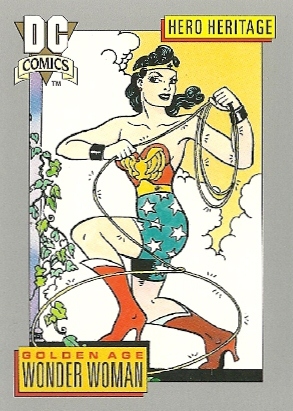
Love the twinkle on the lasso. (Robbins also did the Golden Age Cheetah.)
Keith Giffen tackled Legion cards, Simon Bisley did Lobo’s, Carmine Infantino did the Silver Age Flash’s and Adam Strange’s, et cetera. Kevin Maguire did some of the core Justice League members from his run, including DC’s great romantic power couple, Big Barda and Scott Free:

The Mister Miracle card wasn’t the only one to break the fourth wall and incorporate the cards themselves into the art. Low-level villain Manga Khan got in on the act:

Kudos to artist Ty Templeton for making a guy in a frozen mask look like he’s smiling.
I was grinning much like Mr. Khan when I got these cards recently. I wound up buying three unopened boxes for a ridiculously low price on eBay, and resolved to form up a set or two from one of the boxes, see how many holograms I could get, and maybe save the other two for rainy days. I figured I could maybe sell one of the sets for a low price, and recoup some of the already low price paid. EVERYONE WINS.
A few things:
- When I opened the first box, I touched the first pack to my head, like Johnny Carson doing the Great Carnac bit, trying to will a hologram into it. And when I opened it, there was a hologram. I did the same thing with the next. Another hologram. And the next. And the next. Two more holograms. At this point I was wondering if I had developed actual powers, and, when I found another hologram a few packs later, I was debating whether or not to form my own super-team. But there were no more in the first box. It turns out that they just threw four hologram packs on the top layer and one underneath, for a total of five in each box. Which is lame, and gives lie to the “randomly packed” puffery.
- The cards were reasonably well collated. I was ten or twelve packs in before I got my first double, a complete set was easily obtained, and there were only a few cards needed for a second. So I thought, what the hell, I’ll fill out a second set from the second box and then leave the remainder for those rainy days.
- The second box (which confirmed the hologram placement) rapidly filled out the second set. Except:
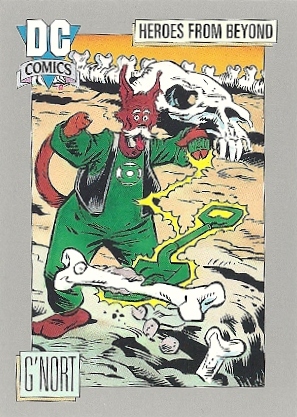
- Yes, folks, I was missing G’nort, the dog Green Lantern. Ch’p I could live with. Better yet, Salaak. But G’nort? This was vexing to no end, and it grew even more awful as pack after pack was torn open in a desperate search for card #117. But no G’nort, all the way down to the bottom of the box. Terrible. So there I sat, with useless cards all around, and one set to show for it. And there was the third box.
- So much for the rainy day. The good news: more G’nort cards were found, and four complete sets were eventually made. The bad: no more sealed boxes, and the four leftover packs you see above are all that remains of the trove. (It was a bit like the guns going down to zero in the director’s cut of Aliens. All I needed was Bill Paxton freaking out over my shoulder.)
- On the hologram front (all done by Walt Simonson, btw), there were fifteen in total (3×5, for all the mathematically challenged like me), which produced eight out of the possible ten. There were two extra Deathstrokes, three(!) extra Hawkmans (dopey modern armor Hawkman, too), and one each of Green Lantern and Superman. Only Wonder Woman and Waverider were left out. (Nothing dates this set more than Waverider being in the DC Hall of Fame.) Here they are — put on your sunglasses:

Even as a kid I was never that taken with holograms as a chase card. Wow, awesome, a card that almost kind of looks like a beloved character if you hold it just right!
Despite the drab borders, despite the void of Batman’s absence, and despite the marginal characters thrown in to fill out the depleted roster, the set is fun. There are also cards depicting famous crossovers of the past, as well as some reproducing famous first covers of major characters, and overall it feels like there was at least a modicum of thought put into the production. They weren’t up to the level that Marvel had established with their first two editions, but the cards feel nowhere near as chintzy as what was to come in subsequent years, as both comics and cards circled the overproduced dreck drain. Going through the boxes was a lot of fun (except for DAMN G’NORT), and for a couple of hours I was again a kid sitting on his bedroom floor, sorting cards into piles and scribbling out checklists.
Nostalgia of course tinges this opinion, but what other reason would there be to buy cheap cards twenty years on?
More to come.
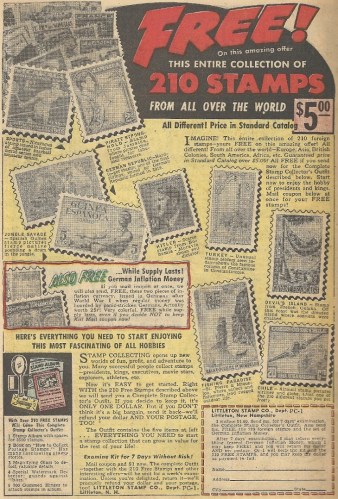
Leave it to Adolf Hitler to be the Debbie Downer of a stamp collection. No surprise that he’s right in the middle of the ad, though. If the History Channel has taught us one thing, it’s that there’s an insatiable appetite out there for all things Führer. He’s that station’s never-ending Shark Week. Hell, comics have had more than their share of the guy, too.
I used to have a tiny stamp collection back when I was a kid, in the gas-lit days when letters could be mailed for twenty-two cents. No Hitlers, though.

“Salve” isn’t something that you hear about much any more, though it’s still sold, and indeed, many of the myriad skin ailments in alleviates — dry skin, chapped lips, etc. — have products aimed at them that we all know by rote, and are pretty much the same thing by different names. “Salve” as part of a brand name has gone the way of bicarbonate of soda and castor oil, though. Tinctures. Poultices. That sort of thing, like what the Three Stooges would cure themselves with in a 1930s short.
And children selling salve door to door? That’s another matter entirely. When’s the last time that a kid knocked on a door trying to interest a domicile’s occupants in the healing wonders of White Cloverine Salve? Did they ever? Did Captain O and his Olympic scammers learn at White Cloverine’s knee? Kids must have once lugged around boxes of the stuff to justify a back page ad like this one — which seems to imply that selling it would get you not only the finest toys that the mid-1950s had to offer, but a delightfully retro rocketship. I can be George Jetson (even though the Jetsons haven’t been dreamed up yet)? Where do I sign?
You can still get White Cloverine Salve, by the way. Still comes in a nice old-timey container. Give your awful skin a present. (And maybe call it Wolverine Salve, just to make it a little more fun.)
What time does the Super Bowl start? RIGHT NOW, BABY! (Post includes a real 49er.) – Treasure Chest of Fun and Fact #1 (Vol. 5)
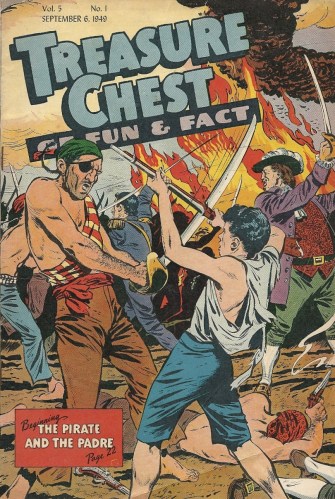
Treasure Chest of Fun and Fact was a bit different from other comics during its lengthy run — a publication history that started in the heart of the Golden Age. It was distributed through parochial schools and by student subscription, and much of the content within had a religious bent aimed at promoting the good works of the Roman Catholic Church. There were also serialized stories running alongside the one-off features: The Pirate and the Padre was your stirring swashbuckling fare, while the more mundane and school-centric Chuck White focused on the doings amongst besweatered teens. A sample of the latter:
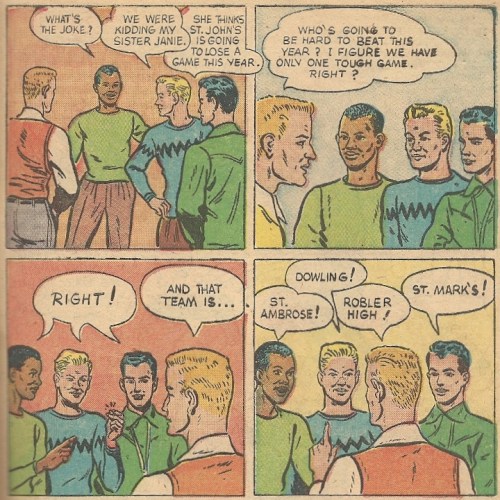
As you can see from these 1949 panels, Treasure Chest was somewhat of a trailblazer in integrating the races, at least on newsprint. Worthy of note.
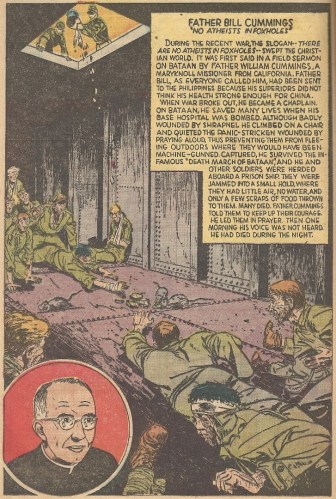
In this particular issue you also had your usual Catholic exhaltation, focused this time on the Maryknoll organizations. Roman Catholic overseas mission services, they’re given a primer in the obviously titled “The Maryknoll Story.” Individual missionaries are also highlighted for their service, including some, like Father Bill Cummings, who made the ultimate contribution in the field of battle:
Enough of that, though. This is Super Bowl Sunday, and you can’t go anywhere without something that touches on football. Yes, even churches take note. (And even the people holding their noses in the air, loudly proclaiming that they care naught for the NFL or its helmeted gladiators, make themselves part of the machine with their obnoxious protestations.) Yes, within these very pages, right next to pirates, pubescents and priests, is the (brief) life story of an American gridder. Ladies and gentlemen, Norm Standlee:
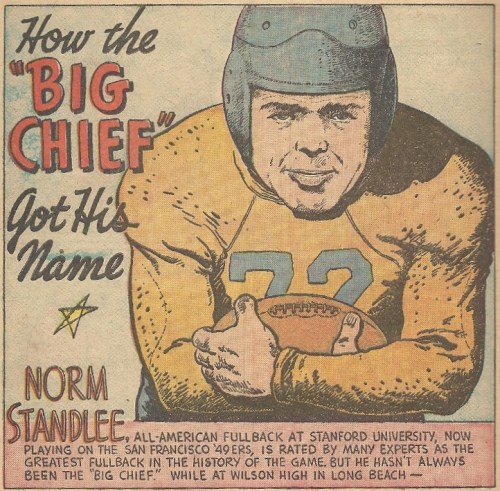
The story is only four pages long, but it captures the few highs and lows of Standlee’s life to that point. (He was 29 at the time.) Then a fullback with the San Francisco 49ers, he had previously filled that position for the Chicago Bears, and before that had been a part of the football squad at Stanford University (sharing resume stops with current Niners coach Jim Harbaugh). And before that, he was snapping bones with a mere swipe of his mighty limbs:
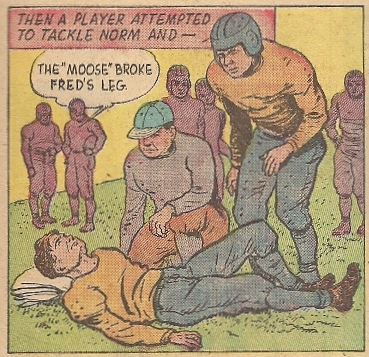
How did he get his “Big Chief” nickname? One would think that it just came from being on the Stanford team, whose old moniker, the Indians, would afford ample reason. It turns out that it’s also from his sideline employment with the local fire department:
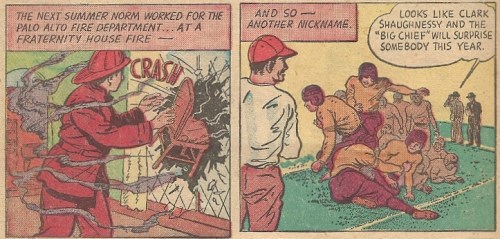
Norm, like many athletes of his era, had his career interrupted by World War II, and, according to his comic bio, he enlisted and saw service in India, building pipelines to help fuel cargo planes. Mazel. And, lest we doubt his Olympian stature, GASP IN AWE AT HIS MEASUREMENTS:
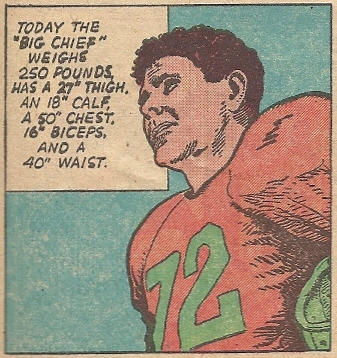
Twenty-seven inch thighs? Sayyyyy…
There you are. Norm Standlee. The man, the myth, the 49er, all thanks to Treasure Chest and its sometimes religious content. Enjoy the game. (Niners 34, Ravens 24. RUN TO THE OVER.)
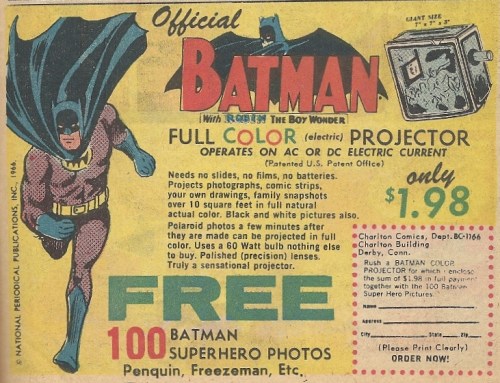
Already this thing is blowing the lame-o Caspar Tru-Vue projector out of the water.
So basically it’s an overhead projector. Could you pair it with the Batman Magic Photo Kit? Do you dare? And really, who wouldn’t want to project a stunning photo of Batman’s great enemy “Freezeman”? (Also, is that a Q? Penquin?)
If you want to walk around with Lorne Greene and/or Dirk Benedict on your chest, these old shirts are for you
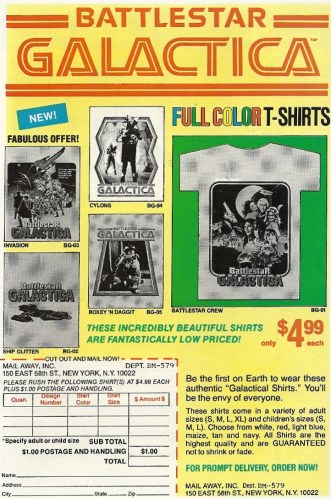
No one’s asked me, but I think someone’s missing the boat by not marketing an “I’m with Adama” t-shirt, where Lorne Greene’s outer space image is rendered in black and white, perhaps in the style of the “Andre the Giant Has a Posse” viral campaign. Or you could just stick with this generic stuff. Your choice.
Would filling out the order form with a Cylon pen cause some sort of rift in the space-time continuum? JUMP.
Even Thomas the Tank Engine would be bored insensate – Railroads Deliver the Goods!
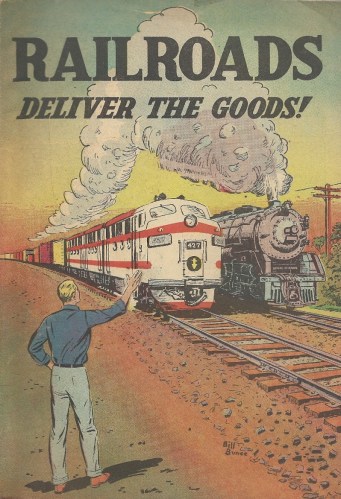
The American love affair with railroads has been a l0ng and warm one. They were the first technological innovation to truly shrink the world that we live in, and in that regard were a forerunner of such things as telephones, radio, television and the internet. People and cargo could be moved at UP TO 35 MILES PER HOUR, over terrain rough and tumble, through weather fair and foul. Miraculous. And when the last Golden Spike was driven into the First Transcontinental Railroad (a moment worthy of Big Fancy Painting commemoration), one could travel from the Atlantic to the Pacific without worrying about Capes or Horns ever again. It was like people were given Nightcrawler-like teleportation abilities.
It was a really slow BAMF, but still.
Because of this well-grounded affection, it would seem that railroads in the middle of the 20th century would be the last things in need of lobbying or informational propaganda. But the proliferation of automobiles and air travel might have led to some nervous Nellies amongst the executive class, so in stepped the Association of American Railroads with that most wondrous of things: a comic book. Not just any comic book, but an informational brochure masquerading as sequential art. Strap yourself in and get ready for the ride of your life!
Railroads Deliver the Goods was a giveaway originally published in 1954 (or 1956, I’ve seen conflicting information), with newsprint front and back covers instead of the slightly glossy stock you’d normally find sandwiching the contents. It was one of a series of comics touting the various wonders of rail travel and transport. (Another highlighted the synergy between railroads and the Boy Scouts, of all things.) There were variant covers to the two different editions of this comic. This is the earlier of the two, and shows a diesel engine and a steam engine, while the later edition has two diesel engines. The march of progress even carries over into railroad depictions, it seems.
With art from Bill Bunce, the story follows a father and son duo — Cap and Randy — through the son’s first run on a train. Randy is learning the family business, as it were. Here they are arriving at work — and please note the box of text:
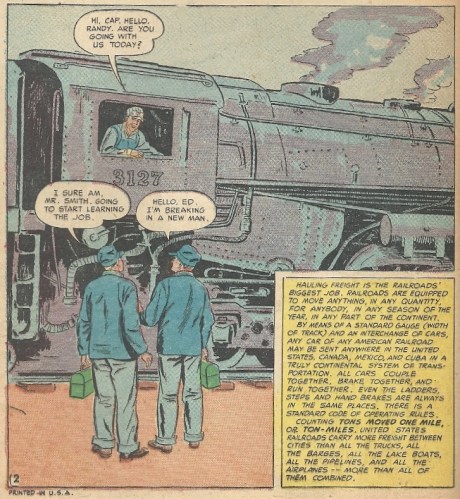
I’m not sure about including Cuba in the web of standard gauge accommodation. Unless my geography is rusty, there’d have to be some cooperation by other means of shipping (emphasis on the ship) to get a train car from Florida to Havana, right? But maybe there’s a chunnel that I’m unaware of. Anyway.
The comic is filled with the broad mechanics and logistics of a modern railroad network, everything from how they run to how switches are switched and messages relayed. Did you know that notes were passed to moving trains by lasso-like hoops? I didn’t:
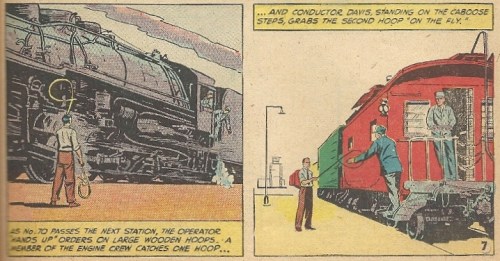
What’s the over/under on how many guys were accidentally yanked off the train using that method?
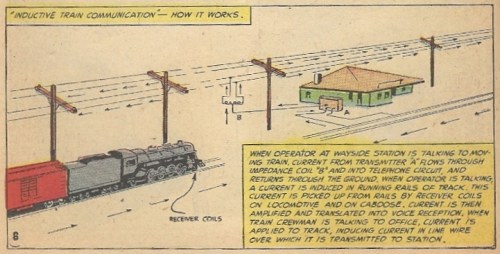
Randy soaks it all up like a sponge, even the dullest, most mind-numbing information, and Cap is all-too willing to drone on. Even about a train’s “Inductive Carrier System.” To wit:
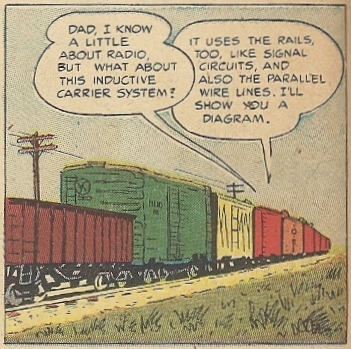
NO, NOT THE DIAGRAM. PLEASE, DON’T. (He does:
 )
)
There’s also some toeing of the company line/political chest-puffing to be had:
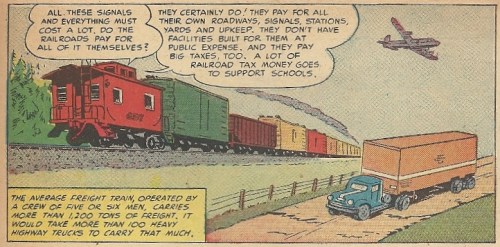
I’m thinking Cap wrapped himself in the American flag when he delivered that spiel. (I’m only familiar with the modern state of train travel, where certain passenger lines would have been extinct years ago without government subsidies. Freight trains are less dependent on the public purse, but still rely on it. So no comment on whether Cap was completely blowing smoke up his son’s keister.) (Also: UP YOURS, TRUCKS.)
Tanks!:
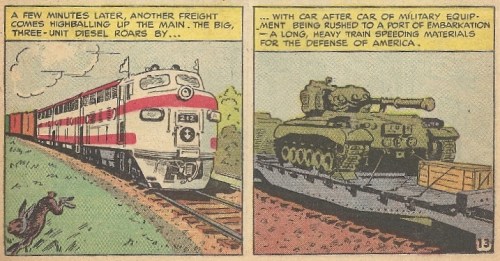
Get the hell off the tracks, rabbit! Go tell Thumper and all the other woodland critters that the tank-train is coming through! U S A! U S A!
When they reach the end of the line and unload their cargo, you expect Randy to make a run for it, fleeing towards a better, non-coma-inducing life. Nope. He’s still taken with the whole thing, and is spouting platitudes like one thoroughly brainwashed (complete with vacant stare!):
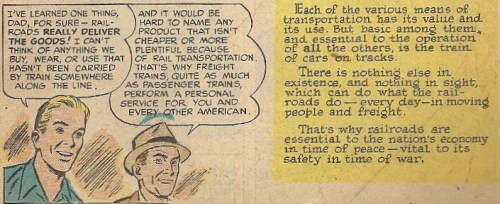
After reading this, you’d expect to walk into a church and see a steam engine in stained glass. And the Wabash Cannonball was assumed into heaven… It is what it is. Trade associations aren’t in the business of publishing minority reports on what’s wrong with the industries on whose behalf they advocate, and the unalloyed positivity here (RAILROADS ARE AWESOME, GIVE YOURSELF TO THEM FREELY) is part and parcel of that. Things could have been a bit less expositorily dry, though. We’re not asking for a yearning, wistful tale of homey steam replaced by new-fangled diesel, but maybe a smidgen of drama would enliven the proceedings. Something. Anything.
Put it this way: Being stuck in the seat next to Cap on a long Acela ride from DC to Boston would be like sitting next to Ted Striker in Airplane!, and fans of Airplane! know what I’m talking about.
Yet, even taking all that into account, credit has to be given to Bunce for his depictions of the locomotives throughout, which tickle the toes of the model train fetishist that lies latent within us all. And the love affair continues…

Hey, at least this Oreo ad didn’t invite kids to deface the comic, like the maze. Oh wait, they told you to color it. Never mind.
If you’re willing to sit still and count (Spoiler!) ALL 62 DAMN OREOS, you’re a more patient person than I am. Though, in fairness, the idea of an Oreo lamp is an underexplored concept.
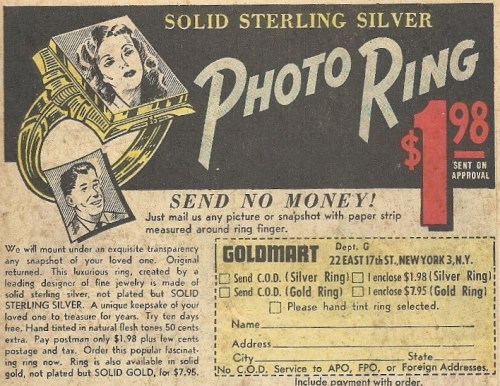
It’s the Gipper! It would seem the years between his acting heyday and his political year saw Ronald Reagan model for “came with the frame” portraits. Our gain. Who wouldn’t want to stare into the loving eyes and shellacked hair that stared down Soviet communism?
Get one of these for your Republican loved one! Pair it with a copy of Reagan’s Raiders! (On second thought, maybe you want to hold off on the latter.)
Plastic Man bulldozer? Good. Pretty much everything else Plastic Man? Bad. – Plastic Man #4

Sometimes comics are magnificent specimens of all that can be wonderful when text meets artwork and greatness is achieved in the fusion. Other times, they’re fit for nothing but lining birdcages. This? This is a case where the good and the bad are both present under one roof. For Plastic Man, by far the creepiest of the superhero pantheon, a man who exudes a Slim Goodbody oddness from every stretched pore, that there can be anything of quality slithering out of any of his books is a minor miracle.
Yet there up above is that cover. And what a cover it is.
Leaving aside the text at the lower left hand corner — does anyone really want to contemplate great gobs of Plastic Man’s goo? — this is a scintillating bit of Carmine Infantino magic. He predated the heavy-machinery-comes-alive appeal of Killdozer by about a decade, and in the process forged a Plastic Man disguise that’s actually moderately cool. Well, it is if you can put aside how blindingly dumb the crooks would have to be to both climb into the driver’s seat and the bucket of a bulldozer THAT IS PAINTED LIKE PLASTIC MAN, THE VERY HERO THEY ARE TRYING TO AVOID. LOOK, THERE’S EVEN A GIANT HAND ON THE SIDE.
Great cover. Thank you, Carmine. (One question, though: Where’s the exhaust coming from? More pertinently, what is the exhaust? Is that literally Plastic Man’s tailpipe? Is that Plastic Man flatulence billowing skyward?)
Unfortunately for those suckered by the Plasdozer into plopping a dime and two pennies on the counter, the story within is a complete, utter, mind-numbing meltdown. And no, there’s no Plasdozer in evidence anywhere within. False advertising at its finest.
Arnold Drake and Win Mortimer wrote and artified a tale that’s typical of Plastic Man’s insipid repertoire. The two primary villains are Doctor Dome (Victor Von is crossing his arms and muttering “BAH!” right now) and Madame Merciless, who concoct a scheme to hypnotize Plastic Man and use him for their nefarious ends:

While a reader might be able to read some racially offense visual subtext in Dome’s disguise, panels like this leave little room for the imagination — the story has African witch doctors! For no reason!:

The less said about the plot the better, but, in the most improbable development in a story centered around a man who can bend and morph his body at will, three women vie for Plastic Man’s love within. Madame Merciless, Doctor Dome’s daughter and Plastic Man’s regular girlfriend, Micheline de Lute, all find him irresistible. Seriously. He’s like George Clooney catnip to these ladies (maybe it’s the goggles?), and they all set to eye-scratching to be the one to know the joys of his love. Which leads to this:

I, for one, could have gone through life quite happily without knowing the status of Plastic Man’s undergarments, but now we’ve seen this, a sight that cannot be unseen. Better or worse than Sasquatch groin fur? That’s above my pay grade.
And there you have it: a prime example of how a comic can hug you with awesome one moment, and punch you in the mush with awful the next. Excelsior!
Spider-Man knows Firelord. Spider-Man has fought Firelord. You, Hotshot, are no Firelord.
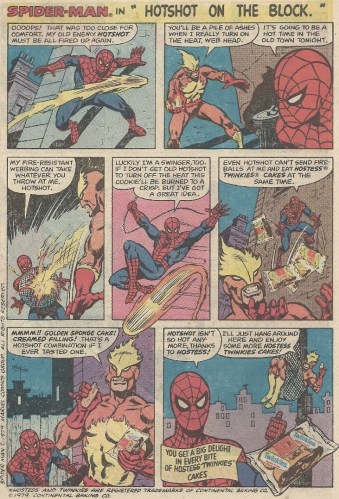
There’s just something about fire-based characters that sets Spider-Man off. The Twinkie-loving Hotshot should be thankful that he got away with only an ignominious web hammock, and wasn’t almost pummeled to death by the wall-crawler’s fists of fury. Firelord is still a little woozy after his beating.
Oddly enough, this ad was pulled from the very same Spider-Man vs. Torch comic linked to above. The juxtaposition may have been solid flame-centric synergy, but it was deeply confusing to my four-year old mind.
Your Whoppers Candy Sailplane: Hindenburg or Spruce Goose?
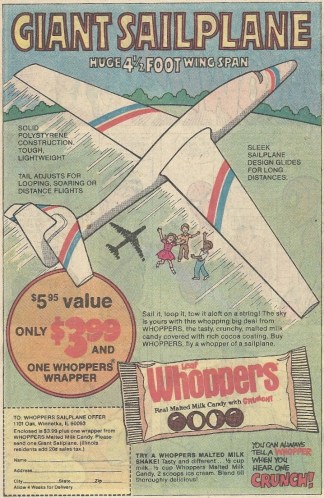
I had a variation on this styrofoam/polystyrene sailplane thing growing up. Somewhere in the family VHS archives there’s a tape showing it gliding majestically through the air, gently soaring upwards, then back towards the ground, and, just as it touched the surface of the Earth, catching a gust of wind and rising once more. On its own. As if by magic.
Unrecorded was the tragedy that occurred moments later, when I chucked it up for another flight and it augured down into the ground with vicious force, snapping the wings. Even if it had a little styrofoam black box, that too would have been obliterated.
I don’t know whether the Whoppers Candy iteration was more durable, but somehow I doubt it.
A horse is a horse, of course, of course, and no one can post on a horse, of course, that is of course, unless the horse is the famous… – Mister Ed #1

This is the 1,000th post here on the blog. [Forlorn solitary noisemaker blows.] In lieu of confetti and streamers, I had envisioned — as the countup took place over the last couple of weeks — that I’d devote this output milestone to something truly worthwhile, a comic that defined the medium and transcended the artificial boundary between “funnies” and “serious literature.” Something like Art Spiegelman’s Maus. Or Alan Moore’s and Eddie Campbell’s From Hell. I was actually just about ready to pull the trigger on the latter, and had scribbled down some notes on what surely would have been the finest bit of comic book criticism ever to grace the World Wide Web concerning Moore’s Jack the Ripper opus.
Then I realized that the 1,000 marker was one of quantity, not quality. And I thought back to much of the dreck that’s been covered here, and the all-too-frequent failure on my part to say anything of value about, well, anything. Odd, middling material seemed appropriate. So, seeing as I already had scanned selections from a Mister Ed comic, a talking horse book it is.
The Mister Ed premise really needs no setup, but, in the unlikely event that there are novitiates to this TV classic out there, here’s the Cliff Notes: Wilbur Post (played by Alan Young), an architect, owned a horse named Mister Ed, who had the power of speech for reasons unknown. (Lightning strike? Mutant? Aliens? Freemasons?) Ed (a Palomino, which wasn’t obvious in black and white) would only talk to Wilbur, which got the poor guy into any number of sticky situations with his wife, friends and neighbors. The show ran for six seasons from 1961-66, and along the way Ed ran up against no lesser stars than Clint Eastwood and Mae West.
There. That’s pretty much it. Oh, and the theme song so permeated the American pop consciousness that, though I never once saw the show growing up, I still knew the tune and the words. Go figure.
Gold Key published six issues of their Mister Ed comic book (Dell also produced one under their Four Color banner), and they happily kept the horseshoe font on the logo. That’s about all that carries over, though. Here in the first installment, the art on all the Mister Ed stories (there’s a Lucky the Dog one as well) is provided by Joe Certa, who’s perhaps best known to comic audiences for drawing some of the most painful J’onn J’onzz House of Mystery stories. The good news is that his art plays much better when it’s not cursed by the orange sidekick blight known as Zook (J’onn’s nude, antennaed friend with — the less said the better). The bad news is that there’s no bad news. There’s nothing in Mister Ed’s comic misadventures to really get worked up over, for better or for worse. It’s middling material aimed at kids, long form versions of what could be found throughout the Sunday funnies.
That said, Ed is still imperiling poor Wilbur’s social and physical well-being in these pages as well, so if you’re a fan of that, you get your money’s worth. Here he is getting his owner into hot water (as they’re on their way to a barbershop quartet engagement, hence the mustache) and out of it all in three panels:

Here he is cracking wise on the Posts’ stuck up, well-to-do neighbor, Roger Addison:

Cue the canned laughter!
Maybe the “best” of the stories here — if we can truly use that term — is one where Ed’s big mouth puts himself and Wilbur in a man-and-horse versus machine matchup with a bellicose general and his tank. Shades of John Henry, the Steel-Drivin’ Man:

Do Wilbur and Ed triumph over the tank? Does Ed die in the process and get sent to the glue factory? You’ll have to read the comic to find out.
There’s an odd dynamic at play here, where the magic of seeing a horse talk (which still has its charm, even fifty years on) gets neutralized on newsprint. Talking animals are so common in comics, there’s little to separate Ed from the pack. There’s no peanut butter or strings working his lips? Then what’s the hook? Without that goofy Ed voice, it’s perhaps no surprise that the comic failed to find much of an audience.
In that vein, and in a bit of a twist, the most effective of the Ed tales is this silent, one-page short that comes towards the end of the book:

There you go: Mister Ed. The horse, the myth, the legend — the comic book. Was there a Francis the Talking Mule comic? (Answer: Yes.) Maybe that will be post #2,000.
Wear your official Stuntmen’s Association of Motion Pictures t-shirt and turn yourself into a walking optical illusion
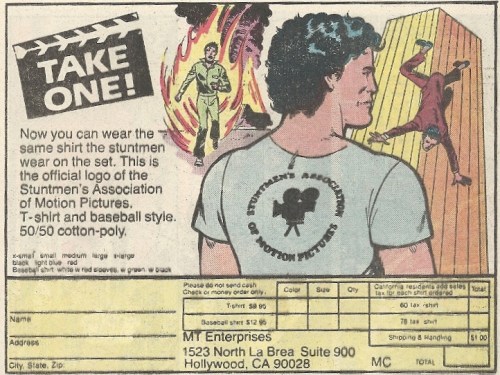
Perhaps wearing this t-shirt gave its wearer the power to run through flames and plummet head-first from skyscrapers (in haunting 9/11 imagery) unharmed. Sort of like an elvish Cloak of Invisibility. For all we know, that might be how Dar Robinson and Yak Canutt made it through their years of celluloid death defiance.
At the very least you could probably sneak onto a set wearing it and get thrown from a moving car, and who wouldn’t want that?
Also, is it just me, or does it look like the shirt’s model has his head on backwards? It could be something to do with the logo being on the back, the position of the arms or the angle in profile of the head, but I look at that guy and it’s like someone torqued his melon 180 degrees. It’s like the “Is it a vase or two faces?” thing. (And is he the Beyonder? Maybe he’s using his infinite powers to trick readers’ eyes.)
Let’s all pause a moment to give thanks for Sasquatch’s groin fur
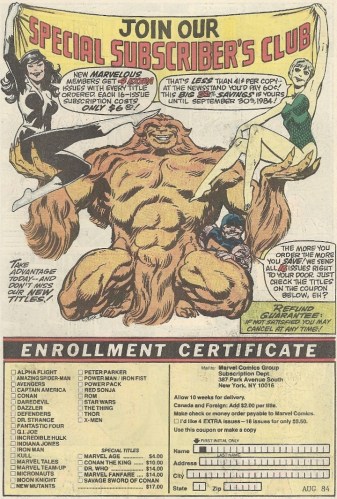
There have to be times when Puck thanks his lucky stars that he’s a member of Alpha Flight. There aren’t many other teams where he wouldn’t be the hairiest member (Beast has much better grooming), but thanks to Sasquatch he can walk up to the ladies with his head held (not too) high. “I’m not that hirsute. And I can do cartwheels!”
On a related note, couldn’t Sasquatch squeeze himself into some pants? Even Fin Fang Foom wears briefs. As much as we like staring at his loincloth-like pubic hair (because, let’s be frank, that’s what it is), there are limits, you know? I mean, it’s not like we’re not grateful that it blocks his fuzzy junk, but come on — it couldn’t possibly be more front and center than it is here. We’re talking about a Woodgod level of exhibitionism.
Maybe he does wear underpants and they’re just covered by the hanging fur. Or maybe that’s really a furry set of BVDs. I’m sure there are people out there who can answer these questi- ALL RIGHT WE’VE THOUGHT ENOUGH ABOUT THIS.
 Jared
Jared


 blog into mystery