Dear parents, buy your boy a Daisy OR WE WILL KIDNAP HIM
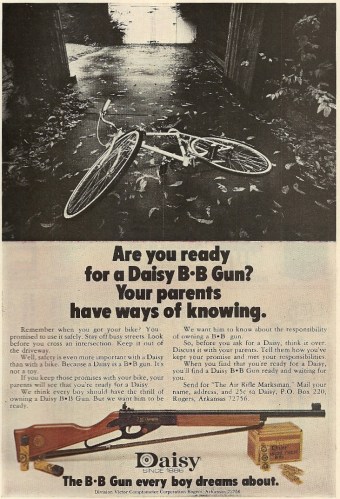
BB gun ads are no strangers to odd imagery juxtapositions, but the messaging behind this one seems a bit off. Yes, they’re trying to say that Daisys are so unbelievably awesome, kids will forsake their bikes on chilly autumn streets to go off a-shootin’. But when I see a bike cast down like that, I think A kid has been thrown into the back of an unmarked van and is being whisked away to an unspeakable fate. A milk carton portrait shall be his epitaph. If that’s want you want your relatively harmless weaponry to be associated with, then by all means, Daisy, be my guest.
In fairness, I guess an armed child is an un-kidnapped child.
John Byrne gets in on the Scourge kill-fest, and Norm Breyfogle breaks into the biz – Marvel Fanfare #29
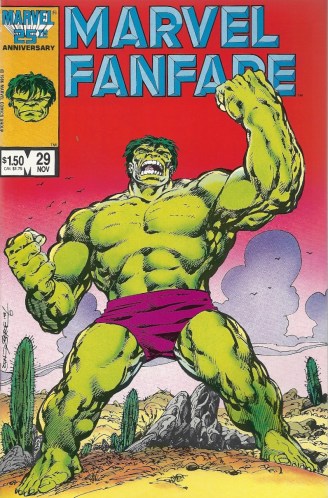
I wish there was still a place in the world for things like Marvel Fanfare. Anthologies used to be everywhere. On television. In print. They’ve largely gone the way of the dodo. I can understand why people might not be interested in a series whose characters change on a weekly/monthly basis, but that’s the format that gave us stellar material like The Twilight Zone — would we really want a world that didn’t have William Shatner yelling about monsters on the wings of planes?
Fanfare was the finest of Marvel’s anthologies, far outpacing the storytelling quality in the later Marvel Comics Presents. An early foray into direct sales, with no ads and high-end paper to further cement the “ooh ain’t this slick” desirability, it functioned as a front window display for the best that the company had to offer. Like the Mighty Marvel Boutique Shop or something. Going though old issues, I’m often struck by the quality of the brief — sometimes continued over multiple issues — stories inside. At times they dealt with lesser lights, for instance a rather delightful Warriors Three Asgard story illustrated by Charles Vess that I’d love to yak about here one day. They could also focus on big stars, the titans of the line.
This issue has heavyweights. Plural. Both on the pages and behind them. Some John Byrne Hulk and some [Special surprise! Unless you read the title!] Captain America, making this one of the more noteworthy Fanfares that I can think of.
Byrne at this point was at the peak of his powers. His tenures on The Uncanny X-Men and The Fantastic Four had established his reputation both as an artist and someone who could right a listing ship. His artwork, though, was perhaps never more suited to a character than the Hulk. A behemoth who’s a mountain of muscle, his look was tailor-made for Byrne’s sinewy pencils. Byrne’s writer/artist run on the Hulk’s title was eventful, seeing the Green Goliath separated from Bruce Banner, and therefore becoming nothing but a rampaging beast, without the usual “Hulk wish humans were nicer” pathos. (I recall one panel where the mindless Hulk came upon a deer in the wilderness, and proceeded to backhand it and break its neck. Nothing says “mean” LIKE KILLING BAMBI.) It was a good read, and one of the titles the young me looked forward to every month.
The Byrne-crafted (script and art) Hulk story here falls right in the midst of that arc (it was originally intended for the Hulk series proper, but got left out). Told all in splash panels (a gimmick that feels less wasteful here than in the death of Superman issue (#75), which needlessly rushed what was the biggest comic story ever), it also falls in the midst of another memorable storyline from the 1980s. Remember the Scourge of the Underworld? The cross-title housecleaning, which had an anonymous villain offing lesser evil-doers and thus clearing out the basements and attics of the Marvel Universe? Yeah, that Scourge. The one that obligingly murdered useless baddies that hadn’t been seen since appearances in Omega the Unknown or some other D-list book. For fun!
The story has Hulk coming upon a Native American shaman in the desert, one who’s sitting on a rock and contemplating whatever people contemplate in deserts. Hulk’s about to liquefy him, until the shaman makes nice:

It’s as easy as that. The shaman keeps repeating “friend” over and over again, until Hulk sits down in front of the fire, inhales some fumes and starts remembering faces from his past (the mindless Hulk has rudiments of a mind after all). While he’s in this trance, we find out that the shaman isn’t who he appears to be, but has technologically advanced equipment and is tracking the approach of two targets. He goes off to hide as they make their appearance:

Yes, Hammer and Anvil. You don’t remember Hammer and Anvil? Neither did I until I read this, hence the reason that they were shoehorned into this Scourge plot (they made their debut in Hulk’s title, so it’s somewhat fitting they should meet their end alongside Ol’ Greenskin). They were convicts (a white racist and a just plain angry black man) who escaped from a chain-gang The Defiant Ones-style, and were (preposterously) given powers by an alien, though they remained tethered together in their newfound super state.
They were kind of lame. So Scourge — OMG SCOURGE WAS DISGUISED AS THE INDIAN — shoots Hammer in the face, and then we get The Tearful Lament of Anvil:
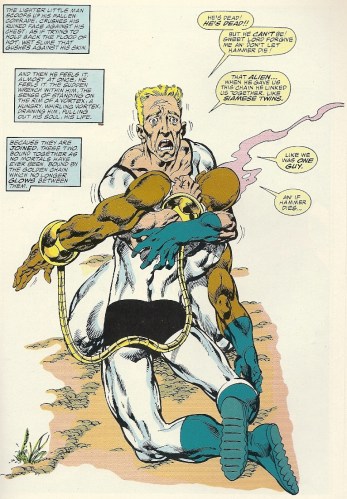
Two for the price of one.
Scourge — who never shows his face — disappears, and poor dumb(er) Hulk is left all sad and stuff:

Nice.
The second of the two shorts was a bit of a surprise. It’s a largely silent story, centered on Captain America, and once again it’s scripted, pencilled and inked by the same person. The twist here is that that person is Norm Breyfogle. Yes, the Norm Breyfogle who made a name for himself in a memorable Batman run that bridged the eighties and nineties. The story represents some of his earliest work at a major publisher — though not THE earliest — and it’s interesting to see the early stages of the dreamy, angular style that would be so perfectly suited to Gotham’s champion (and would make the Breyfogle Batman a personal favorite).
Things open with bullying (more culturally relevant than ever) and book-dumpings:

Events escalate when a crook crashes his car (you see it VROOMMing into sight above), grabs both the kids for hostages (preventing the inevitable snicker-snag), and hides out in a classroom. Captain American is hot on his tail, and, as the kids take shelter, he proceeds to kick the ever-loving piss out of this thug. It’s a beating that involves everything from punches to fire extinguishers set off in the guy’s face Three Stooges style — here’s the finale:

Yes, watching Captain America thoroughly outclass this dolt brings the two erstwhile enemies together. They awake the next morning in their differently appointed bedrooms, and start on new regimens:
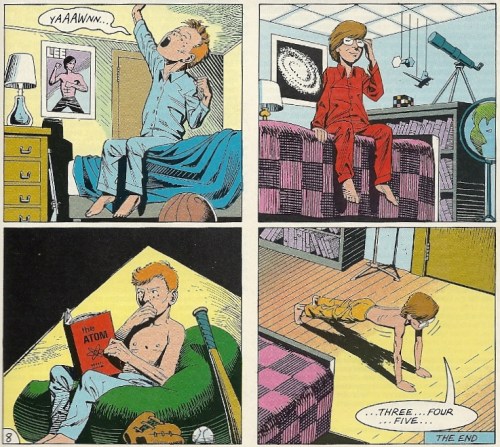
Captain America: His fists have the power to make the brawny smarter and the smart brawnier. Like a superhero Tony Robbins.
Stories like this don’t really have a place in regular comics, which is a shame. Losing the trees for the forest or something — mangle whatever metaphor you want. So it goes. But make no mistake, Fanfare was excellent and fun — the Al Milgrom “Editori-Als” were always neat — and it offered opportunities for established creators like Byrne to burn (no pun) off material that didn’t fit into their regular assignments. Perhaps more importantly, it gave a chance for up and comers like Breyfogle to strut their stuff. Quite a one-two punch. Both entries here are small gems, and it’s good to see Breyfogle’s distinctive style — very much fully formed at this stage — tackling a character not from his usual repertoire (though the message from his scripting — violence heals societal wounds — might need refinement). A treat, to say the least.
Marvel Fanfare: We hardly knew ye.
Note: The Hulk/Scourge story is a part of the Byrne/Hulk Visionaries book, which is worth a gander.
Here’s a magic kit ad that looks like it came out of Mrs. Johnson’s third grade class
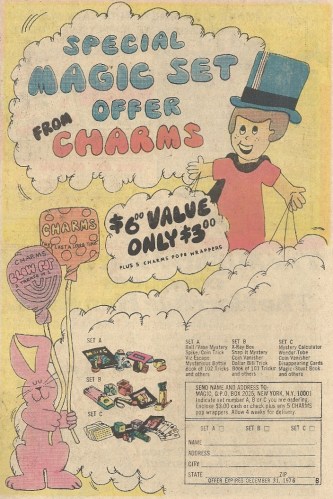
You expect a certain amount of professionalism in your comic book advertisements. Not all of them have to feature art from Norman Rockwell or Neal Adams, but it’s nice when they’re at least clean and spiffy. This one looks as if it should be hanging on a refrigerator door, with a gold star in one corner. Like it was drawn on construction paper. I WOULD NOT TRUST ANY OF THE MAGIC THAT ISSUED FORTH FROM ANY OF THESE SETS, THE GOOD NAME OF CHARMS BLOW POPS NOTWITHSTANDING.
Maybe this ad was hastily assembled by the artist behind the worst Spider-Man ever. You never know.
Plaid shirt + bad boss = TAKE THIS JOB AND SHOVE IT
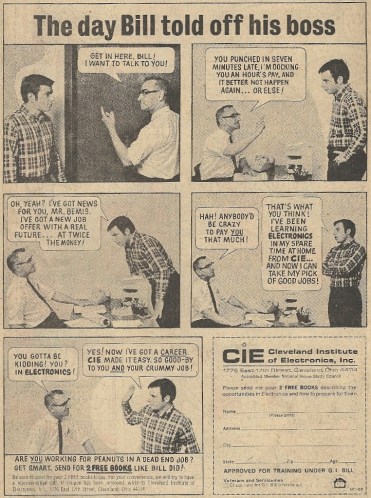
We’ve seen variants of ads for the Cleveland Institute of Electronics before (the DeVry of its day), but never has the “Oh yeah? CRAM IT!” element been so much at the fore. In other instances it’s been the self-improvement angle and the promise of untold (actually, modest) riches that have drawn potential students into the CIE fold. Here, though, we have a nice taste of CRUSH YOUR ENEMIES revenge. To tell the truth, I’m a bit surprised that good old Bill didn’t punch his boss’ Barry Goldwater glasses (all people from this era wearing ties look like they worked for NASA) right off his sour face.
By the way, Bill, nice shirt.
When you have a mustache, no shirt and are clinging to rigging, you really need a dagger in your teeth to complete the look – The Sword and the Rose
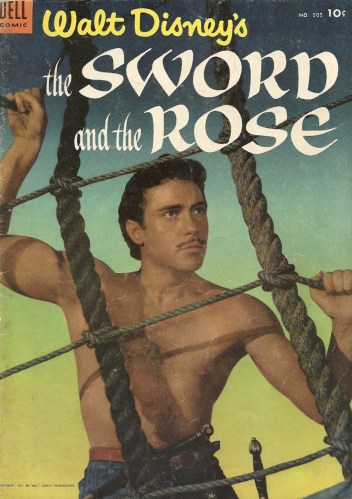
At no point in this comic book is the character seen on the above cover, Charles Brandon, on a seafaring vessel for more than a few panels, and while there, never once does he doff his shirt. Not that I’m complaining. I don’t have a shirtless men quota that I need to meet or anything. But I will admit, I went into this expecting swarthy ocean-going adventures, with an ample supply of shoulder-borne parrots, eyepatches, peg-legs, treasure chests, et cetera, et cetera. And what did I get instead? A long, drawn out costume drama where pretty much nothing happens. I mean nothing.
1050s Disney! Sanitary and uneventful!
The Sword and the Rose (an adaptation of the 1898 novel When Knighthood Was in Flower) was an early foray by the animation-centric Disney folks into the realm of flesh and blood cinema (and was an immediate predecessor to the somewhat more interesting Rob Roy). It chronicled the semi-historical travails of Charles Brandon at the tumultuous court of Henry VIII, as he tried to stay in the King’s good graces while juggling a budding romance with one of His Majesty’s sisters. In retrospect, looking for love within Henry VIII’s family circle, where wives were exiled, divorced and beheaded at a rapid clip, seems like a minefield, but hey, at least Brandon wasn’t aiming to bed the man himself (though that would at least have been interesting).
What’s the story? Brandon is a hero of the war in France, and returns to his homeland bearing a message to the King from his superior officer. But at the palace he encounters that most British of barriers — class — and has a hard time being admitted into the royal presence. This does not sit well with a man accustomed to settling disputes with a blade:
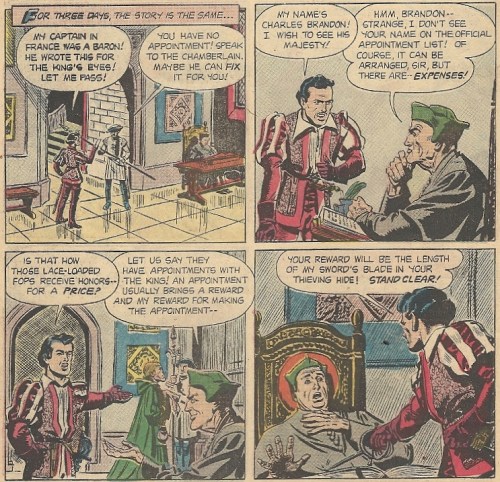
Brandon is eventually granted access, and through a series of events becomes a captain in the King’s guard. He catches the eye of Mary Tudor, the King’s younger sister of marrying age. Once again, however, he rams his head against the invisible wall that divides those of the realm from commoners. COCK-BLOCKED BY THE QUEEN:
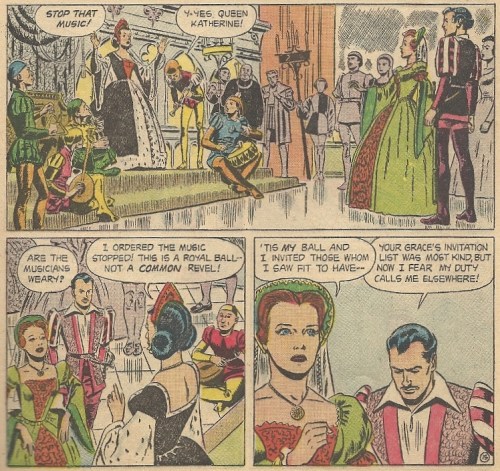
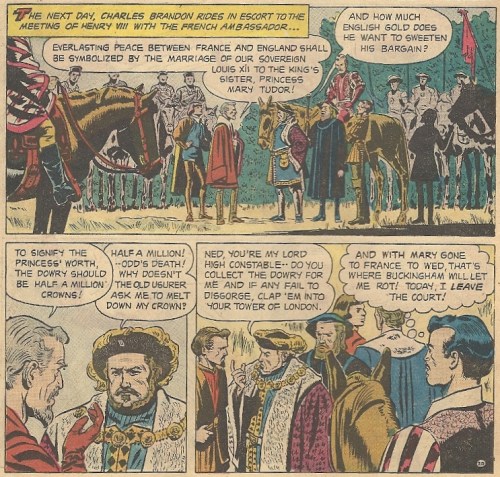
Though Mary is quite infatuated with this dashing commoner, Brandon rightly sees the peril involved. The powerful Duke of Buckingham is also keen on her (he’s also a deadly swordsman), and the King is looking to marry her off to the aged King of France:
Brandon gets out while the gettin’ is good, and books passage to the New World. It’s on this vessel (our brief sojourn into the setting suggested by the cover) that he discovers the extent of Mary’s romantic persistence:
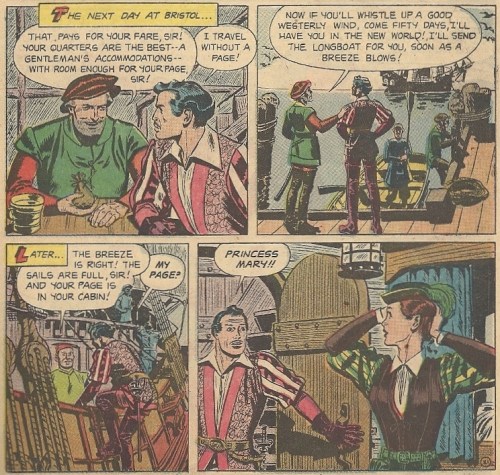
D’OH! (Brandon seems to be a walking dose of Spanish Fly — women can’t resist!)
Brandon, knowing that war is in the offing if Mary stows away with him, does the honorable thing and returns her to London. He’s clamped in irons for his troubles, Mary is sent off to her new husband, who promptly keels over, Brandon makes an escape, but it’s a double-cross from Buckingham, he’s assassinated, BUT OH WAIT HE’S NOT DEAD, Mary returns from France, and Brandon has it out with Buckingham before he and Mary finally settle into wedded bliss:
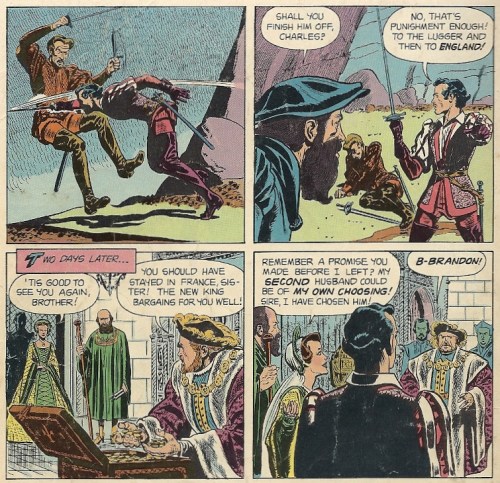
Henry elevates Brandon to the nobility so that everything is nice and proper, and the two live happily ever after.
And I didn’t care about a bit of it.
It felt like it took forever to wade through this comic. It’s weighed down with dialogue and meandering court intrigue, and even when swords clank against one another it never gets off the ground. I can’t really speak for how closely this hews to the dramatic quality of the film (which, in a bit of trivia, co-stars Michael Gough — Alfred in the Burton/Schumacher Batman movies), but I imagine the material works better on a screen than a page. Nothing the matter with that, except when you force yourself to read the comic so you can write a dumb blog post.
A bright spot is the art from Dick Rockwell (yes, related to the famous artist and endorser of the Famous Artists School — his nephew). It’s expressive and detailed. You can see the disappointment, surprise and anger on the characters’ faces, and can tell when someone is conniving. This is a good thing. But it’s nowhere near enough to pull this one out of its dive.
Bottom line: Henry would have lopped this thing’s head off within seconds.
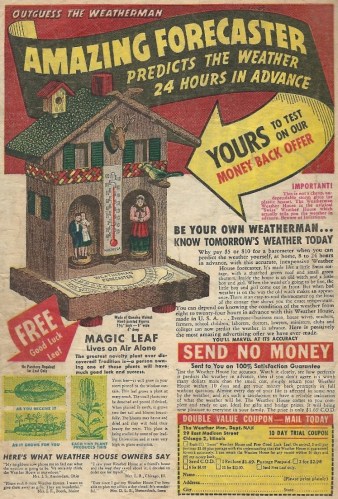
I once mocked the Disney iteration of this old-fashioned weather forecaster, mainly because it (as was Disney’s inexplicable wont) had poor Donald Duck getting rained on while the utterly useless Mickey Mouse basked in glorious sunshine. This one is a bit more striking, though. Why? Well, according to the copy, the lady on the right is a witch, and she’d signal bad weather, while the kids on the left would signal fair skies. But the lady doesn’t look like a witch. In fact, she looks like she’s probably the two kids’ mother, and they all, even in this small detail, look very depressed. Perhaps she’s widowed and now struggling to make ends meet, with a thin harvest not enough to fill her childrens’ bellies and the lord of the manor threatening to evict them from their meager lodgings. At least that’s what I see.
Bad weather all around is what I’m trying to say.
Also, I’m pretty sure the Magic Leaf would turn out to be an advance scout for the Triffids.
The Frontier Cabin is all fun and games, right up until your parents make you live in it
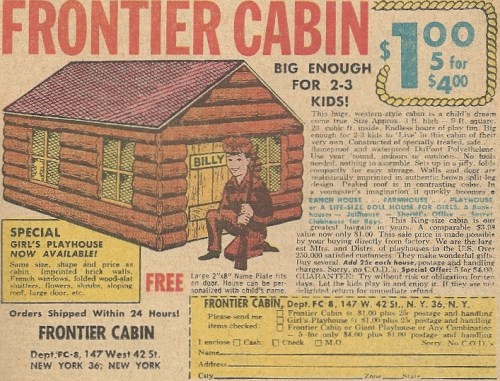
Dad won’t build you a treehouse? Maybe he’ll shell out the cash for this fake, miniature log cabin, one that purports to be able to hold 2-3 children, though only if they hunch over like they’re working on Floor 7½ in Being John Malkovich. Once inside, you can fulfill all your wildest Davy Crockett fantasies.
Basically this is a doghouse for kids. Look, it even has “Billy” in the place of “Fido.” “I know it’s cold out there, Billy, but your mother and I need our alone time now. We left a full water bowl for you, what more do you want?”
Five for four bucks is an irresistible bargain, though.
Daniel Craig’s James Bond is back to punch, shoot, outdrink and outdress us all – Skyfall

The James Bond franchise has had its ups and downs over the years, and Ian Fleming’s dapper, deadly secret agent has had his share of missions where the ludicrous drowned the realism. The new cycle of Bond films have returned the character to his more grounded roots, but with the arrival of Skyfall, director Sam Mendes and Daniel Craig have embraced the glorious oddness that made the Roger Moore tenure, if not high cinema, at the very least interesting. The resulting film comes apart at the seams a bit in the final act, but in so doing it takes us to the personal side of Bond, into 007 territory never before explored on screen. No, Skyfall doesn’t offer up on a platter the senses-shattering origin of Bond, but it does give a look into what went into making the man behind the shaken martinis (hint: the title has something to do with it).
Skyfall, despite some of the hype, isn’t great. But it’s very, very good.
Thoughts (in honor of the hero, we’ll stick to seven):
- The successor to the criminally misused Pierce Brosnan — who seemed so perfectly suited for the role, but was hamstrung by silly fin-de-siecle plots — Craig now fully inhabits Bond. He’s by far the most aggressive of any iteration to date, and I think it’s safe to say that, in a cross-universe rumble with the Lazenbys and Moores and Connerys and all the rest, he’d be the one standing at the end. Badass. With this film, though, the mileage is showing. The punches hurt more, dangling from things stretches the arms more than their owner would like, and there’s the shadow of doubt that this might be an agent who needs to be put out to pasture — Bond has taken some hits, and retirement beckons (though his vacation diversions, as we see here, carry the threat of death). He even has trouble passing the MI-6 fitness requirements, like some beat cop who’s eaten one too many donuts. This is some of the same territory explored this summer in The Dark Knight Rises, as that other gadget-armed champion came up against the greatest villain of them all: time. It’s handled a lot better here, though, and includes some needly repartee with a new Q young enough to be Bond’s son. No matter the march of years, there’s still something so magnetic — timeless, even — about a killing machine who rips the roof off a train car, leaps to its floor, and then pauses to make sure he’s showing the proper amount of cuff.
- There’s a motorcycle chase though Istanbul (not Constantinople) early in the film, and at one point both bikes are ridden up stairs. Any time a motorcycle goes up or down steps in a movie, I’m enthralled. You had me at hello.
- Adele is dangerously close to an acute case of over-exposure (and I live in fear that her lyrics of women wronged will lead to a violent estrogen revolution), but her title song, which plays over wonderfully produced opening credits, harkens back to all the great song/sequence combos from the Golden Age of Bond. The silhouettes never looked so good, as we’re given an artsy taste of all that’s to come.
- Javier Bardem’s Raoul Silva is larger than life and straight out of the Goldfinger playbook of hammy villainy (my ears heard has name as “Silver,” perhaps adding to this metallurgical pull). He’s a man consumed by a vendetta, one whose reach is global, but whose goals are ever so personal. A former agent himself (one wonders if he had a double-0 number), he enters the action bearing a grudge against M (Judi Dench, who has been one of the bright spots in the franchise ever since joining up), and viewing Bond as one part brother, one part mortal enemy. His first appearance is one of the many moments of the film where Mendes’ skills are readily apparent. It’s a long, unbroken shot, as he walks slowly towards a bound Bond, unravelling a long tale about rats and survival with every drawn out step. Many people will focus on what comes after, as he engages (an unwilling) Bond in not-so-vaguely homosexual banter, but the bit with the rats is the true takeaway. (It’s a great story even on its own.) He’s campy is the classic Bond tradition, a tad funny, and very deadly, as a hot chick roped into a William Tell scenario will testify. All he’s lacking is a cat to stroke — perhaps Bond was his substitute for that.
- Have you ever wanted to see Bond and M go on a road trip? THEN, MY FRIEND, I HAVE JUST THE MOVIE FOR YOU.
- Ralph Fiennes brings his usual professionalism to the film, as a cabinet minister with intelligence oversight, one who at first appears to be the typical oily bureaucrat, but soon evidences reserves of guts and gumption. He’ll be back in future films, one expects (this seems obvious, judging by the final scene), and he’ll be a welcome addition.
- The babes aren’t as at the forefront in this film as they’ve been in others, but yes, they are hot. HOT HOT HOT. Would you expect any less? And one even winds up having a very familiar last name.
The first half of the film is your typical rocket ride, and it’s handled with aplomb, with settings that are a feast for the eyes. Mendes is an assured, accomplished director, and his strong hand is evident in scenes crafted with a deft touch. But the shift in the second half (after some VERY predictable developments), is jarring. Exchanging exotic locales for grey, cold Scotland is a rough trade, but the problems have more to do with you knowing what’s coming. There are no surprises left, and every turn in the road is readily seen from miles away. It leaves the viewer wanting something more — or at least it did me. Others will disagree (judging by other reviews, you might change “others” for “most”).
Negatives aside, this is a fun, well-done entry in a durable franchise, and caps a three-picture cycle that has thoroughly reinvigorated the Bond machine. Skyfall ends with you ready for the next round, and a lot of us are going to be looking forward to what Craig and company deliver next.
Three and a half martinis out of five.

Want to watch Richard Dragon and Lady Shiva beat up Paul Bunyan? Sure you do. – Richard Dragon, Kung-Fu Fighter #10

Every generation and every decade has its fads, its crazes and pop-entertainment fetishes that catch fire and then look ridiculous years later. We’re currently in the midst of one, a sustained zombie/vampire nor’easter. Walking Dead, Twilight, Vampire Diaries, True Blood, World War Z — they’re all a part of the storm surge, and sometimes it feels like we’re going to all drown in an overflow of hacky storytelling. Don’t get me wrong: blood-sucking and brain-eating beasties are all well and good, and I have no objections about either. They can both be part of stories that grab the reader/slash viewer. Conversely, I can watch a British drama that’s all about class and manners so long as it’s done right. But when things suck, they suck, no matter the subject matter. and there seems to be a lot more suck in the current crop.
This brings us to the nub. The problem with fads is that there’s such a rush to get product out to the public before the mass hypnosis wears off, the material suffers. This is most acute with fiction. I mean, some of the properties I listed above are downright awful. Painful. Maybe you can assembly line pet rocks and hammer pants, but quality stories are a different animal altogether. Things can go really wrong.
But that’s not going to stop anyone.
The 1970s had their fads too (oh, did they ever), and disco wasn’t sucking all the air out of the room. One of those brightly-burning crazes made a big-time migration into the world of comic books. Two words: KUNG. FU.
It’s sometimes hard to trace the source of a these things, the flap of the butterfly’s wings that builds to an Atlantic Hurricane. Maybe the kung-fu mojo started with Enter the Dragon — there was certainly no better martial arts paragon to follow than Bruce Lee. Whatever the source, martial arts took off. I mean, it TOOK OFF. Store-front schools, movies, television shows, you name it. And when karate and its cousins become such a potent entertainment theme that people are willing to swallow David Carradine as a lethal chopper and kicker, no matter his legitimate skills, things have gotten real.
The comics transition wasn’t relegated to omnipresent self-improvement advertisements, but found expression in character after character. It was a rainbow assemblage — black, white, asian, and everything else — that bridged the major publishers. To list all the characters, from the big guns right down to the Sons of the Tiger, would take a long time. So would covering every one of the characters here on this blog (though, who knows, we might get there someday).
So let’s pick one. Let’s pick one of the white guys traipsing in the stereotypically Asian world of martial arts — but a guy with an inclusive supporting cast. Let’s go with the guy with the most kung fu of last names. Let’s go with Richard Dragon.
Dragon, a young thief stealing from a dojo who wound up being instructed by its sensei in the martial arts, and then teamed with another student, Ben Turner, to fight injustice wherever it occurred (under the auspices of the poorly acronymed G.O.O.D.), was one of the many ass-kicking clones of the Me Decade. A part of the DC Universe proper, he mainly fought a unique assemblage of side-villains, and never really came up against the big guns of Earth-1 devilry. Hence this Denny O’Neill written, Ric Estrada and Jack Abel illustrated issue, where he fights an evil Paul Bunyan proxy. Paul “Infected” Bunyan, as it were. Ladies and gentleman, I give you Hatchett:

What brings these two irresistible forces (hands of stone, axe of steel) together is Ben inheriting a lot of woodsy acreage. This, combined with recent threats on Ben’s life, is enough for Richard, Ben and gal-pal Lady Shiva (a woman very serious about her craft) to helicopter up there, where they face, of all things, highly refined bigotry:
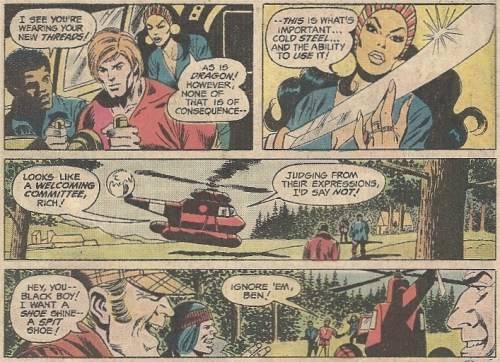
Good old-fashioned stupidity isn’t the only thing that they find. There’s also a wandering orphaned nephew of Ben’s, whose mother was the former owner of the woodlands:
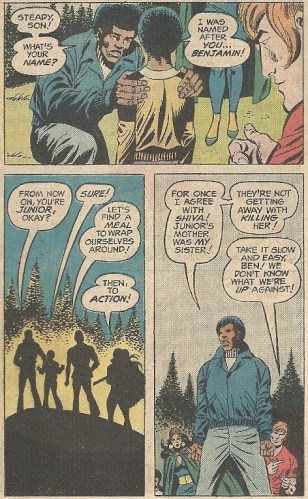
Am I the only one that finds Ben’s gallantry in this instance a bit showy? I mean, he must have been real close to this sister to know nothing about her owning logging land and having a son. His vowing revenge on their behalf now sounds a lot like the absentee father who shows up with an armful of toys, takes the kids out to ice cream and then disappears for another month. But that’s just me. (Also, how did this young child survive in stone cold murderous racist country for however long it took for Ben to be found and arrive?)
The ass-kicking commences soon, as Hatchett and his flannel-wearing army of lumberjacks (they appear to share a tailor with the very macho Stan Lee) match their fighting prowess against the highly trained trio. It does not go well for the men of the north:

Eventually our heroes and their new ward find themselves in a cabin, and Hatchett gets the bright idea to torch that sumbitch (hey, is that a gahoon or a flamethrower?):
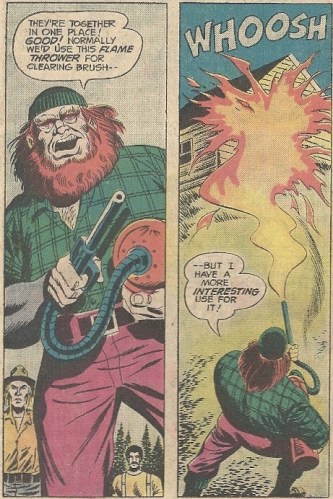
Are flame-throwers actually used for brush-clearing? Is this a good idea? Has Smokey the Bear been consulted about this practice?
The good guys make it out the back door while Dragon, like the true badass he is (or wants to be) goes out the flaming front to distract Hatchett’s men. Lady Shiva still has her own problems in back, though. Have you ever wondered what would win a matchup between a sword and a chainsaw? If so, this comic has a datapoint for you:

Man, it’s so hot when a chick kicks you in the face and calls you a pig at the same time. Or so I’ve been told.
As for Dragon? He has his final, shirtless (naturally) confrontation with Hatchett, and chucks all that fancy training to the side and relies ON A GOOD OLD AMERICAN JOHN WAYNE PUNCH:
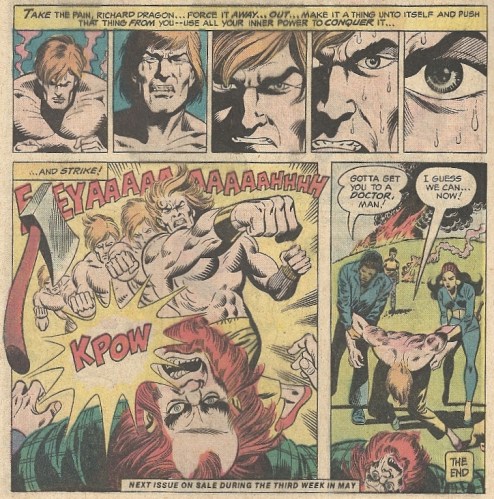
Hatchett, we hardly knew ye. (Lame last lines, btw.)
You can’t say that this book is heavy on story. The situation is silly, the execution is predictable, and the wordplay is wooden. O’Neill has been a part of more fantastic stories than I care to count, but this isn’t a part of that august resume. Also, kung-fu is one of those things that’s so hard to translate to the comic medium. Yes, comics are able to recreate movement through artsy trickeration, but it’s nevertheless a static artform. The martial arts craze was built on speed and foley, and “wow I can’t believe a human can do that” wonder. Bottling that on a page is beyond Estrada’s abilities, and, in fairness, the abilities of most every artist out there, at least to my eyes.
All that said, if you were a kung-fu-addled reader in the 1970s — a real true believer — the flying feet of fury were probably all you could ever ask for. This would have been an adequate fix.
You don’t see Richard Dragon all that much anymore. Lady Shiva has far outpaced him over the years, glomming onto the Batman gravy train and thus eclipsing the man in whose title she made her debut. This staying power proves one thing: fads come and go, but ladies in tight clothes holding swords never ever goes out of style. EXCELSIOR.
I highly doubt that party crashing is a juvenile scourge, but apparently Superman thinks otherwise

The other entries from this Curt Swan illustrated series of bicentennial Superman PSAs are, even if a bit clunky, at least (arguably) worthwhile. We can all agree that child abuse is a serious topic, and hell, maybe there really does need to be a little more awareness about what goes on in juvenile courts. But party crashing? This is a big concern, big enough to make Superman stop and rap on the stoop with some urchins? It’s going to lead you down a dark path toward a lengthy stint in the hoosegow? There’s no dope in Metropolis to worry about? Am I missing something here? Did Superman give Wedding Crashers minus-five stars?
Nothing gets a party going like someone whipping out their gahoon

The term “gahoon” sounds like an insult, as in “You filthy, dirty gahoon, get your paws off my wife!” Or maybe it sounds like a little floating alien bedevilling the residents of Bedrock, one that symbolizes the terminal decline of a classic animated sitcom. Pick your poison.
Or it could be a musical instrument. One that looks like’s it’s assembled with colonoscopy equipment and a saxophone mouthpiece. Or hookah gear.
All I know is this: I’ve never seen a symphony with a gahoon section, and the words “1st chair gahoonist” have never been strung together in the history of the world. Stick to your mail-order harmonicas, kids.
Whatever you do on this election day, do not, DO NOT, accidentally vote for Prez Rickard – Prez #1

Our long national nightmare is almost over. Today Americans go to the polls, gathering in school gymnasiums, community centers and other centrally located voting stations, not so much to elect a chief executive and other lesser officials, but to put a merciful end to the never-ending barrage of insultingly stupid advertisements.
I mean, really. I swear, I don’t think I could stand to see another ad from either party. Even the ones from the side I generally go with make me roll my eyes at best, turn red with anger at worst. Their just so, so dumb.
But they’re nowhere near as dumb as DC Comics making a teenager the President of the United States of America.
The story of Prez Rickard is known to many thanks to Neil Gaiman dragging from the dustbin of history for one of the numerous Sandman one-offs. (And many assuredly, like me, later had a “This was a real series? You’re kidding…” revelation.) This inclusion in that legendary comic book series, eighty issues that transcended the industry’s boundaries, has given good old Prez the patina of respectability. Hey, maybe Prez was a thought-provoking title, one offering incisive satire of political mores and the tumultuous culture war. Gaiman wouldn’t be shining up crap, would he?
Make no mistake folks, the short-lived Prez was one of the lamest things to come out of DC in the 1970s, and in that profoundly silly decade, that’s really saying something.
It’s doubly painful to contemplate because Prez was co-created (along with artist Jerry Grandenetti) by a man who, if he isn’t on the comic book Mount Rushmore, at least might be chiseled into the margins at some point. The recently passed Joe Simon is a legend, and someone who was a kindly influence in the comics world from the Golden Age to his death last year. His partnership with Jack Kirby, which spawned no less a figure than Captain America (and lesser properties like the Boy Commandos), is one of the great bylines we’ve ever seen. Period.
Prez, though, is a colossal miscalculation. Perhaps intended to be some surreal prism through which readers might parse the burgeoning political consciousness of youth, a consciousness buoyed by the recently ratified 26th Amendment, it instead was as tine-eared as your typical Teen Titans hip-fest. All the more grating was its sheer goofiness, with symbolically cartoonish characters that made you set your comic down, stare at the wall, and ask it “What the hell is this crap?”
Prez was a dud. Prez is a dud. But there’s no better day than one of our once-every-four-years elections to yak about him. And here we are.
Why should we loathe Prez so much? What’s so bad about the earnest, sweater-wearing kid from Steadfast, the teen with an affinity for clock repair? Well, for one he’s an idiot, as this right off the bat confab with his mother and sister will attest:

This boy is one vapid, empty-headed, big-eyed Troy Tempest looking moron. What, are the —-ing calendars broken too? Young man, you never get a second chance to make a first impression.
Like many a moron that has entered politics, Prez has his uses as a tool. Boss Smiley, the absolute ruler of a downtrodden burg (Central City, though the Flash in nowhere to be seen) and a cross between Boss Tweed and Smiley the Psychotic Button, finds himself looking for a way to ride the wave of newly empowered — and more importantly, enfranchised — teenagers. Because otherwise they’ll take over the whole show:

HE HAS BATGIRL COMICS. SURELY THIS AMPLIFIES HIS EVIL. (Also, always love it when Hitler is equated with anyone, as he subtly is with Nixon in this panel’s two autographed pictures. Yes, Nixon had his many bad points, but he didn’t barbecue a chunk of Europe. Get a grip.)
Smiley’s big solution is to co-opt Prez and run him for Senate, a decision he arrives at after meeting with a Mr. Misery, an election consultant whose headquarters is on a ship at sea. Here we get cameos by Mussolini, Ghandi (or, if you want to spell his name as the rest of the world does, Gandhi) and Lincoln:

Senator Prez is a willing stooge, at least until a ground-breaking ceremony for a new wilderness-annihilating highway is sabotaged and Prez is enlightened by the saboteur — and here’s where the awful really takes flight:

Eagle Free, our token and patronizing “Natives are great!” presence, may be the character I hate most in this first issue, and the series as a whole. Just read that dialogue. “How could you, a savage, understand all this?” Eagle Free’s the man who teaches Prez combat skills(!) and clues him in on Smiley’s malfeasance, but the way he’s handled is so dopey you can’t help but hate him. He lives in a cave filled with books. He’s surrounded by animals that respond to his every command. His every step is nails on a chalkboard, and his dialogue rolls like a bag of bricks. Clumsy. By trying to come off as enlightened with this “noble savage” (ugh), the script fumbles its way into being the exact opposite.
Long story (mercifully) short, Prez gets elected president (Boss Smiley had decided to run him for that office, with a lowering of the eligibility age, before the awakening) thanks to all those young (and stupid) voters. The final page of the comic breaks the fourth wall in the most cloying, irritating way imaginable (even worse than the Flash doing it):

Please, Prez, don’t drag me down into your private hell. No one cares. (And by the way, his VP is his mother. Yet ANOTHER reason to hate this guy.)
Prez is one of those crazy ideas that, if honed with defter hands (like Gaiman’s), can work. But Simon, his countless contributions notwithstanding, was not a man with that skill set. He was a mason, not a surgeon. His sensibilities belonged in the formative years of the Golden Age, when things were cut and dried and black and white and nuance was a thing rarely seen, when straight-forward entertainment was the name of the game. It was neither a time nor a place for allegory, and that’s what Prez needed to be. And what happened? The book stunk. Big-time. And Grandenetti’s art, while perfectly acceptable in a big-eyed sort of way, was nowhere near enough to rescue it.
Prez has cropped up over the years since the fourth and last issue of his quickly torpedoed series, in a previously unpublished story intended for that original run, a confusing appearance in Supergirl’s title (Was he the president of Earth-1? Was there a Supergirl on Earth-Prez or whatever?), a one-shot and the aforementioned Sandman apotheosis. Not exactly a lengthy resume, yet his odd legacy lives on. Once every four years, long-time comic readers pause, recall Rickard, Eagle Free, Boss Smiley and all the rest, shake their heads and then go on with their lives. And they thank God, no matter how awful the current Oval Office occupant might be, that there isn’t a teenager sitting in the big chair. ONE WHO, WHEN THE CLOCKS DIDN’T WORK RIGHT, DIDN’T KNOW HOW TO TELL WHEN ELECTION DAY WAS. I CAN’T GET OVER THAT.
Tom Jones (not that Tom Jones) surely ranks as one of the jowliest Wheaties endorsers of all time

Poor old Tom Jones is giving Frank Thomas a run for his beefy money. Really, how many track coaches do you see out there that have countable chins, i.e. more than one? “Do as I say, not as I do. Eat your Wheaties. And pass me the bacon.”
No offense intended to Mr. Jones, who clearly knew what he was doing on the track. He was no Sex Bomb, though, that’s for sure.
According to 1950s romance comics ads, women back then worried about their weight, appearance, lips and *ahem* lady business
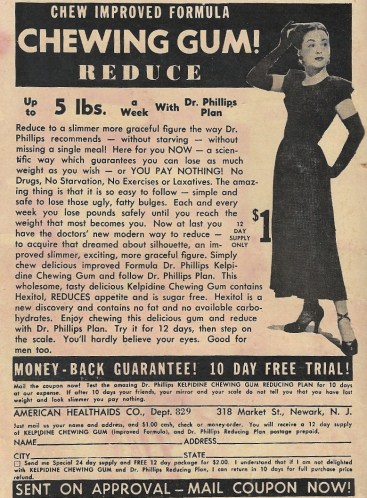
There’s no greater marker for a man reading a romance book that he’s a pilgrim in an unholy land than the advertisements that greet him with nearly every flip of the page. It’s a bit like channel-surfing into a soap opera and being bombarded by bright, flowery commercials talking about “freshness” and other such things, euphemisms that don’t get down into the nitty-gritty of the feminine issues dealt with. Yesterday’s issue of Love Diary is no exception. Indeed, it’s a paragon of Oh wow this is Bizarro World. The gauntlet of wares being hawked in this case was so unique, so potent, the collective assemblage was worthy of a separate post. So here we are.
Take the ad above (which we’ve seen a variant of before). Diet pills. For slimming down. Whereas men are obsessed with bulking up into rugged sand-kicking he-men, women are obsessed with the reverse, or so this Kelpidine promo would have us believe. You can’t be fat if you’re a woman — as this next ad makes very clear:

HEY! FATTY!
If you’re not worried so much about body shape, but more about general appearance and comportment, maybe Anita Colby’s Beauty Book would be for you (though I see she too is hawking her own “lose weight you fat cow” services):

All this isn’t to say that women are vain, superficial creatures, only concerned with the flighty trivialities of their looks. After all, they have really important things to worry about — like keeping their lipstick sharp while they’re swimming:

(The shadow-shrouded guy behind the bathing beauty above looks a tad creepy, no? Start playing the Jaws music…)
There are even some homemaking topics addressed. Maybe the lady of the house would like to save a buck or two on haircuts, and wouldn’t mind butchering their progeny’s scalp with an electric hair trimmer:

And now comes the pièce de résistance, the ad that truly marks its comic out as being a foreign land, like some far-flung empire visited by Marco Polo. Ladies and gentlemen — but mainly ladies — I present you with a new, space-age sanitary shield:

Vaginal overflow checked.
And this concludes our feminine product broadcast day. NOW I’M GOING TO GO WATCH TEN HOURS OF FOOTBALL.
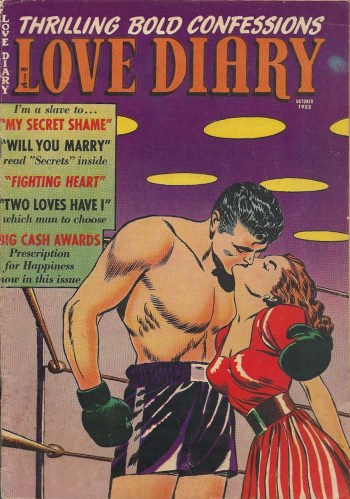
Before anything else, a couple things have to be said about the cover. One, it seems like everything about the poses of the two featured players is positioned to draw our eyes to the chestular and groinular regions. Two, it looks like a boxing ring has been set up on the U.S.S. Enterprise’s transporter pad. And now that that’s out of the way…
I don’t often delve into the romance genre here on the blog, preferring to leave that field to specialists like our fine colleague over at Sequential Crush. Why? It’s not that the books have cooties, or are chock-full of mushy girly stuff. It’s just that the stories — whether they’re about girls from the wrong side of the tracks, nurses falling in love, teenagers going through puppy-love heartache, what have you — are all cut from the same cloth. It seems like the same ground is plowed again and again and again. You can say the same thing about the superhero books that are the normal fare around here, but hey, what can I say, I’m more in tune with that. (Let’s not talk about when romance crosses over into superheros. Please no.)
But hey, this 1953 comic has boxing, which involves men hitting other men in the face. WORTH A LOOK.
We’ll only deal with the cover story here, which means we’re not going to take a look at the other stories inside the book (the “Secret Shame” is alcoholism, btw) that feature early art from the great John Buscema. As consolation, the feature is illustrated by Mort Leav, the creator of the classic Heap character. And his art is pretty nice. So there.
Our main character and narrator in “Fighting Heart” is Sheila, whose boyfriend, Davey Brock, is a journeyman prizefighter. She’s utterly devoted to him, but after a big victory, she soon discovers that a successful boxer’s lady friend is the first thing to get squeezed out of the posse, and has to content herself with watching him devour a post-fight steak:
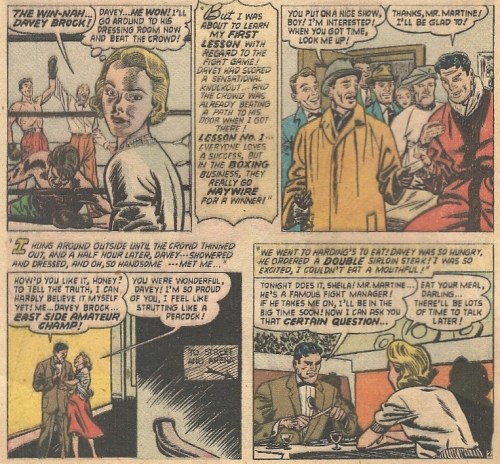
Davey goes under the management of (the, let’s be honest, sleazy-looking) Al Martine, and subsequently starts a big winning streak. Flush with success, he gets a little too frisky after one fight that leaves him looking like a Champion-tenderized Ben Grimm:
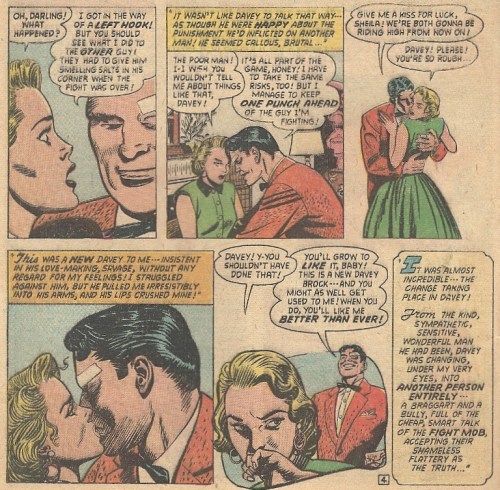
Is that behavior that qualifies one as a “masher”? Were they still using that term in the 1950s, or was that more of a turn of the century thing?
Sheila and Davey’s relationship becomes more and more strained as Davey comes gets closer and closer to a championship bout. At a dinner party, while Davey has a Martine-picked strumpet draped all over him, Sheila strikes up the acquaintance of Hank Strong (great name), a sportswriter. He has some disturbing insights for her — and Davey:
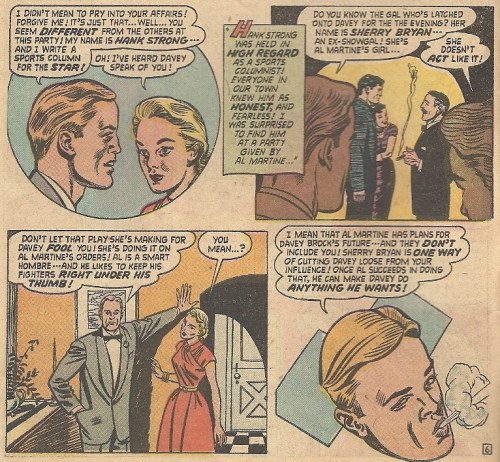
I mean, he’s blowing smoke rings. It has to be true.
What happens when Sheila tells Davey this? He brushes it off as he continues to get fresh (and crude):
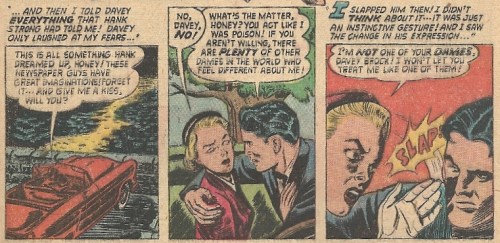
That slap signals the end of their relationship. And who moves in to pick up the pieces? HANK STRONG, BABY. He and Sheila start dating in a whiplash-inducing rebound and are engaged in no time, but is Sheila really over Davey? It’s put to a test when they gather around the newfangled “flickering” television to watch Davey in his big championship fight:
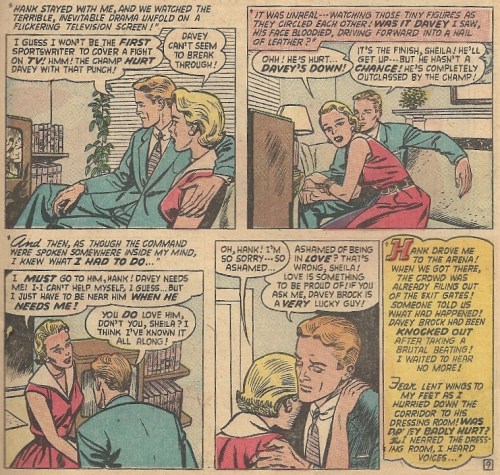
The willing cuckold, ladies and gentlemen. It’s so rare to see one in the wild. (The cuckold cuckolded by the original cuckold. BREAK OUT THE FLOW CHART.)
Poor Davey. Martine had been feeding him a steady diet of bums to puff him up for the bout against the champ (also managed by Martine), who would in turn feast on him. Maybe Don King read this as a kid and found inspiration in it. Sheila runs to Davey’s side, and they make punch-drunk amends and walk off into the sunset — or night, whatever:
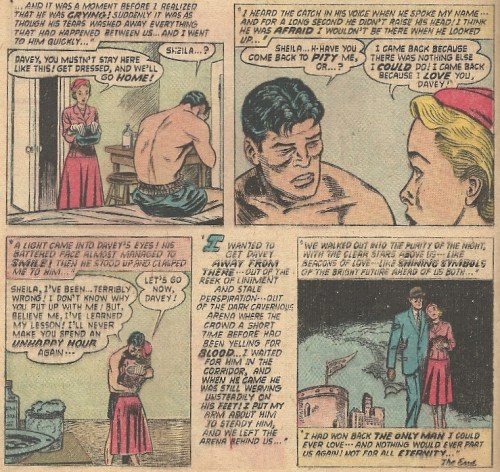
Fin.
If it wasn’t for the boxing, there’d be nothing in this story to separate it from the rest of the romance pack. The “caught between two lovers” angle has been strip-mined bare over the years — though people return to it constantly — and the same goes for the contrast between the physical paramour and the intellectual. The one thing that might give a reader pause here is the willingness of Strong to let his girl go. This noble relinquishment of love is something else that crops up all the time (most memorably in the Mr. Garrison/Mr. Hat/Mr. Stick “Do you love him? Then run to him.” South Park triangle), and it never ever sounds like something that happens in reality. At least not so cleanly. It seems that there’d be a lot more gnashing of teeth involved — and maybe a few punches thrown.
Story concerns aside, there’s a great deal to admire in Leav’s art here. I’m especially fond of the second to last panel in the “masher” scan, which has Davey cackling, hands on hips, like a super-villain. A little like an evil Captain Marvel, come to think of it. Worth the price of admission.
There you go. Love in the world of cut-men and spit buckets.
 Jared
Jared


 blog into mystery