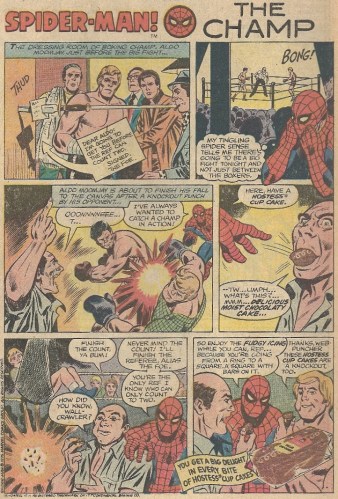
We’ve seen the magnificent crime-fighting properties of Hostess products before, right up to Twinkies stopping a uranium-seeking madman dead in his tracks. But who knew that Spider-Man and a two-pack of cupcakes could clean up the notoriously dirty sport of boxing? I’m sure Roy Jones, Jr. wishes he had a crate of these at the Seoul Olympics.
These Hostess ads aren’t known for their gem-like story structure, but this one seems more haphazard than most. Maybe it’s just me.
V’Ger vs. Shatner’s new toupee, with Earth in the balance – Marvel Super Special #15, “Star Trek: The Motion Picture”

In just over two months audiences are going to flock to the theaters for the follow-up to 2009’s Star Trek Babies, and then fans’ questions about that sequel will finally be answered. Who is Bernard Cumberbatch playing? Is he a British Khan Noonien Singh? Khan Winston Montgomery III, Earl of Suffolk? Will James T. Kirk, fresh off his promotion last time around from cadet to CAPTAIN OF STARFLEET’S FLAGSHIP, be made Emperor of the Known Universe (Padishah Emperor Tiberius IV) by film’s end? Will this Star Trek follow the unfortunate gravitational impulse of most of its forbears and set much of its action on Earth — Earth Trek? Are the filmmakers actually going to put the Enterprise under-bleeping-water, as the trailers and released footage seem to suggest? Isn’t that really profoundly stupid, a prime example of the Michael Bay School of Just Because Filmmaking?
Well, say what you will about the new J.J. Abrams version of Wagon Train to the stars, at least the first injected color and, yes, sex back into the franchise. Though there’s always been a baseline of success for every Star Trek film, a bedrock of built-in fandom that guarantees a certain level of box office take, the latter Next Generation efforts verged far into the bland, unremarkable aesthetic that seemed to rope in every single one of Hollywood’s celluloid Trek entries. In some respects this was understandable, as The Next Generation was always a show that relied more on themes and actual gen-u-ine thought than swashbuckling and bedding alien babes. And the movies centered on the original Enterprise crew? They had much to do with the inevitable doom of us all, even in the 23rd century: aging. The older movie-Kirk carried more than just that curly T.J. Hooker dead groundhog toupee of his. He was a man confronted by what he had missed during a life of adventure, and the emptiness that faced him now that he was stuck behind a San Francisco desk was tougher than anything stared down during the five-year mission.
Bottom line: These movies could be kind of depressing. (The Voyage Home being a notable comedic exception.)
And it all started with the first big screen adventure for the old gang. Star Trek: The Motion Picture, in its quest for gravitas worthy of the different format (as if new, expensive FX wouldn’t be enough), became stuffy somewhere along the way. Though, in fairness, it was the only film to inject a bit of awe into the proceedings, with a big threat to Earth that felt like A BIG THREAT TO EARTH, it scrubbed so much from decks. Gone were the blue, gold and red uniforms (hell, even the orange doors), and in their place were tight, drab, itchy-looking jumpsuits, tailored in the finest millennial death cult colors — Marshall Herff Applewhite would have been proud. (The poster even had more color.) As alluded, Kirk was less a charmer, more a starship fetishist keen to get back in that big comfy chair, desperate to make himself whole. Spock, having gone back to Vulcan to cast off the last remnants of human emotion (why, we never knew, as he had settled into a fine groove during the show), was a cold bore, devoid of the wry wit that had made him a verbal sparring partner for his shipmates. Leonard “Bones” McCoy, the folksy country doctor, the human face of Trek, was pissed-off and grumpy at first, with a beard that would make Yukon Cornelius green with envy, and he never really climbed down off his scold perch. The whole cast, from Shatner to Nimoy to Kelley and everyone in between, walked around like they were drugged — mainly because they didn’t have much to do.
In short, director Robert Wise (whose West Side Story was a polar opposite) and the rest of the behind the camera bunch took Oz and made in Kansas. The Motionless Picture is an epithet that stuck.
This isn’t to say that the film they made was bad. It was almost/kind of/sort of good, with moments that verged into spectacular. And the film has the strange distinction of being one of the only films given a Special Edition that actually improved the original. Newly refined effects that aren’t intrusive — who woulda thunk it? (You reading this, Lucas?) The new version may even have added a half a star to the film’s ranking, whatever the original stellar consensus was. (I’d give the SE version three out of five, and find its first 75 minutes to be worthy of the best franchise entries, small screen or big. After the Ilia probe comes onboard? Well, then it’s downhill at warp speed.)
Of course, none of this was helped by having the cinematic yardstick for sequel badassery be the follow-up. There’s a lot of company in that cold Wrath of Khan shadow.
The Super Special adaptation, like others of its ilk, is interesting for its divergences from the story and the way it handles some of the more static, into-the-cloud “action” at the heart of the film. Scripted by Marv Wolfman, with art from Dave Cockrum and Klaus Janson, it does its level best. And in a strange twist, the slow, meandering space FX sequences, which feel the most like things rendered inert by a comic panel’s four sides, are the hardest to translate.
TMP has one of the best opening space scenes of the whole big screen run, with the three Klingon battleships, their nifty flyby, and their shoot-first diplomacy with the V’Ger cloud. (Not to mention our first encounter with that great electric V’Ger riff, which sounded like strings slapped on the world’s largest unplugged bass guitar — so great, it was brought back for the V’Ger-less sequel.) In the comic, it all plays out on one page, and takes on an odd Book of Genesis bent:

Admiral Kirk gets the Enterprise back early on, and his, as well as our, first lingering look at her gussied-up refit takes just under thirty minutes. The new Jerry Goldsmith theme that plays over his shuttlecraft flyaround might as well be replaced by “The Stripper,” and at times you want to tell James T. to get a damn room instead of ogling in front of us like that. It’s like he should have a fistful of folded dollar bills clutched in his hand. And the moment when the shuttle joins with the Enterprise’s inviting docking station? Sometimes a shuttlecraft isn’t just a shuttlecraft, if you know what I mean. Wink wink, nudge nudge, say no more.
It goes a lot faster (mercifully) here:

She will be mine. Oh yes, she will be mine. (They really still use paper in the 23rd century? In San Francisco, home of acute, refined liberalism? THE ULTIMATE FAILURE OF THE GREEN LOBBY.)
The long journey of the Enterprise into the gigantic V’Ger vessel is simultaneously awe-inspiring and dull, a monochromatic trip through the 2001: A Space Odyssey star-gate. If you’re invested in the story, it’s transfixing. If you’re not, it’s soporific, like some endless “It’s a Small World” boat ride from hell. The comic lacks the grandeur, and could have used Jack Kirby’s unique gigantic machinery touch:

One of the planned scenes jettisoned early on in the production would have had Kirk accompanying Spock on the EVA rocket-ride deep into the V’Ger interior, and not just waiting for the unconscious Vulcan to be spat out like a watermelon seed. The comic, produced from a script that was honed right up until the end of filming, has this earlier version:

In the next panels Spock is, of course, zapped. Kids, here’s a lesson: Never mind-meld with a glowing bead in a homicidal alien vessel that’s throwing off lightning bolts left and right.
(An aside: Gene Roddenberry once commented that V’Ger’s planet of living machines, which Spock glimpses on his one-man journey, might have been the Borg homeworld. It’s my understanding that this has been incorporated into some of the penumbral Trek fiction, and indeed, it really does put a more interesting spin on it all. And Spock does at one point say that “Any show of resistance [to V’Ger] would be futile.” Oooooh.)
The comic follows the rest of the beats, right up until the ending with Commander Decker and Ilia (early prototypes of the Starfleet officer/alien babe Riker/Troi dynamic) having a threesome with Voyager 6 and becoming a new life form (or something — the wheels were coming of the script bus at this point). There’s even another Bible reference to bookend it all. And the final analysis? The Super Special — also reprinted as the first issues of the dreadful and relatively short-lived Marvel series — is a capable adaptation, but one that doesn’t live up to the few things that the film did really, really right. The main problem is that there just wasn’t all that much for the crew to do in this one, and few opportunities for an adaptation to ride a narrative wave. Extended scenes of a bridge crew staring with slack-jawed wonder are hard to move to the realm of sequential art, and the combined capabilities of Wolfman, Cockrum and Janson, talented as they are, weren’t enough to climb that mountain. What we’re left with is a capable if underwhelming adaptation of a capable if underwhelming film.
No great loss to humanity, and what else were we expecting? But still, like the film, it’s a bit of a letdown.
The extra features at the back of the book chronicle the long, strange return journey of the U.S.S. Enterprise to fans’ eyeballs, from an animated series, to a TV show that was supposed to anchor a new network, to the film. There’s also a two-page shot of Miss NCC-1701 (half on paper, half on interior cover paper), which we’ll end with. Take a good, long, leering Kirk look at her nacelles and curves:


My God, we’ve found it.
For a very, very long time, I’ve been searching for one single episode of the old CBS Storybreak Saturday morning cartoon anthology. For those unfamiliar, Storybreak, hosted through most of its run by Bob “Captain Kangaroo” Keeshan, was a half-hour show that pimped the joys of reading by adapting children’s books for the small screen. It was a bit like Reading Rainbow, if you’re more familiar with that Levar Burton-infused program. Usually broadcast in the noon hour, its rocking opening intro still sends my brain the Pavlovian signal that the cartoons are over and it’s time to ditch the pajamas and go outside. Though episodes of the series could be hit or miss in regards to quality, they had the merit of covering the broad subject spectrum of kid-friendly literature, with talking animals or regular humans as leads in limitless fields of imagination.
It was a nice but rather unremarkable series, since there was no unifying force tying it all together week after week — other than the avuncular, be-sweatered Mr. Keeshan. But there was one episode that singed itself into my cortex like a cattle brand: Dragon’s Blood.
Adapted from the first of Jane Yolen’s Pit Dragon series of books, the story follows a young slave named Jakkin, who steals a baby dragon (Heart’s Blood) from the pits — where dragons are raised for competition in arena combat — and raises it in the wild. The episode was notable for its outer space setting, THE PRESENCE OF DRAGONS, BABY (Vermithrax Pejorative they aren’t, but still), a solid story, and a synthesized musical score that I totally fell in love with. It’s that last thing that has haunted me most over the years since the cartoon’s 1985 debut. I remember liking it, REALLY liking it, but I could never remember the tune. Whenever this episode would come on in repeats, I’d get all excited to hear it again, but these were in the years before we got the first family VCR, so I could never tape it. And the tune would vanish like a fog each and every time. And then Storybreak was off the air, and it seemed to be gone forever.
But along came the internet. A few times a year, going back pretty much as long as there’s been a web to surf, I’d get the impulse to do a search for Dragon’s Blood. A clip. An embed. A torrent. Hell, a .wav of the music. Anything. But there was nothing to be had. Which was just as maddening as the forgotten theme music that had danced in and out of my ears. Keep in mind, everything is on the internet. You can find every deranged, out-there kind of pornography with a few keystrokes and the click of a mouse (so I hear), but Dragon’s Blood, despite page after page confirming its existence, was a phantom.
Then along came YouTube, with vintage ads and bumpers and shows from days gone by in abundance. Even, yes, some episodes of Storybreak. But still no Dragon’s Blood. The funny thing was, in the comments sections of those select posted episodes, many a person asked, hat in hand, if the uploader had Dragon’s Blood., like little waifish cartoon-seeking Oliver Twists. Please, sir, can I have Dragon’s Blood? So it turned out I wasn’t alone in my desperation, and that this short filmlet struck a nerve with people who had seen it. This was comforting, but no solace.
Then, a couple nights ago, fully expecting to once again come up empty, I typed “dragon’s blood storybreak” into the YouTube search field. And son of a bitch, it was there. So I sat at my desk in the home office watching it, chin resting on joined hands, like a kid plopped in front of the TV(OldTube) on a lazy weekend morning. Here it is, in all its VHS-to-Flash glory:
Does it hold up to youthful memory? I’ll say this: I’ve often gone back and watched episodes of The Transformers, G.I. Joe and He-Man, shows that I was once convinced were of the highest assayed quality and not the rotters of brains that my parents insisted, and I’ve come away wondering how in the hell I could have watched them over and over again as a kid. There’s a whole lot of awful in them. But Dragon’s Blood, despite being over in a blink, before you ever get a real chance to know the characters, and in spite of rushed, one-off animation, was a fun watch. Granted, a lot of that’s because this was, literally, a decade long quest, minus the treasure maps and surly natives. But still, the character arcs were simple but adequate, and that of Likkarn, the embittered slave overseer busted back to being a stable boy, stood out in its brief time. And who can hate training montages of a boy training his dragon for combat?
And that theme — though its frequent reprise may make some of us drill a hole in their head, the 1980s synthesizers straight from a Michael Mann film are still catchy to these ears (despite the occasional audio drops from the old VHS tape). The story rides the music like a surfer on a wave.
Anyway, I just wanted to vent my small slice of joy, and maybe inform any closeted Dragon’s Blood-aholics out there that the grail has been found. Have I oversold its merits? Probably. Also, I seem to recall seeing somewhere in those interminable searches that Yolen lamented some of the changes from the source material. I haven’t read the books, so I can’t speak to that. But if you’re a child of the 1980s open to a dose of nostalgia, there are worse ways to spend twenty-five minutes. For the rest, please forgive me this non-comic digression — though I hope you understand it’s a branch from the same wistful tree. Also, thanks to the uploader, and hopefully that embed box up there won’t go dark for a very long while. My month has been made. EXCELSIOR.
Here’s an advertisement for a vintage Babe Ruth tobacco advertisement. Advertisement advertisement.
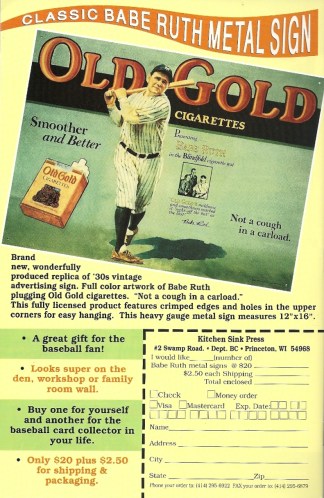
Ah, the good old days, when professional athletes could promote cigarette brands without any hint of shame or irony. Hence this ad for a vintage ad, from the back of yesterday’s reprint of Will Eisner’s Golden Age baseball failure. It recalls those sepia-toned days when your tobacconist was ranked someplace close to your doctor on the hierarchy of important people in your life. And really, could there be any ballplayer better tailored to endorse a cigarette brand than George Herman Ruth? The man’s appetites were so voracious, chain-smoking would barely register on the seismograph. Old Gold Cigarettes? What the hell — why not?
By the look of the ad-within-the-ad’s inset, either Ruth is participating in a blind taste test, or he’s taking a last drag before facing a firing squad — which is appropriate. “Not a cough in a carload.” Yeah, those carloads are saved for an emphysemaed ripe old age, should you make it that far before cancer kills you. Like it did Ruth. (It wasn’t lung cancer that got him, but still…)
Will Eisner was a living legend in his field, a man who pioneered territory in comic book style and format like few others. Since his passing eight years ago, he’s entered into, like many of his creations, the realm of venerated memory. Is there any doubt that, if there was a Mount Rushmore for the industry, his bald mug would be one of those dynamited out of the granite? After all, The Spirit will stand for all time as an early benchmark for what the superhero genre and comics in general can – and should — be, and if he had rested on that one laurel he’d have more than done his bit for king and country.
Hell, the comic book equivalent of the Academy Awards are named after him. He’s the Cy Young of bound newsprint.
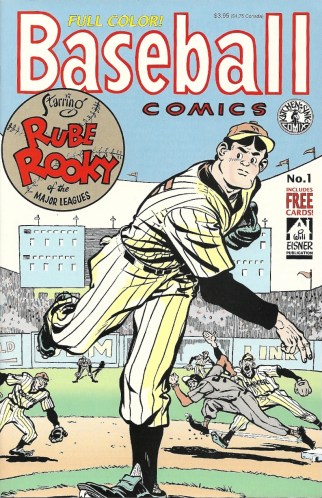
And on that baseball segue, we come to one of Eisner’s most short-lived comics, one largely forgotten because of its blink and miss run: Baseball Comics. With spring training in full bloom, will there ever be a better time to tackle it?
Coming out of Eisner’s studio in 1949, smack dab in the midst of the glorious decade-plus Spirit run, Baseball Comics only lasted one issue before getting the cancellation ax. The underlying reasons behind its one and done termination were a bit of a mystery for Eisner, as detailed in the book’s 1991 Kitchen Sink Press reprint (which is the comic scanned for this post — the cover above is slightly cropped from its original Golden Age size, removing a breeze-tussled pennant from the left side). There was one factor, though, that was all-too clear: it didn’t sell. Sports comics had their share of popularity back in the day, as borne out by the long-running and very successful Joe Palooka. One would expect that this, coupled with Eisner’s style and the then-unquestioned sports supremacy of the National Pastime, would be more than enough to get the book over the hump. No dice, though. It was gone before it ever got a chance to rev up, after the first issue had languished unbought on newsstands.
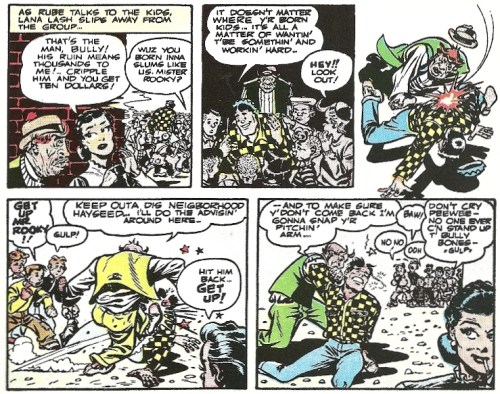
Eisner, scripting alone and drawing with the help of Tex Blaisdell, tried to replicate that lovable lug Palooka dynamic with the would-be star of this series, Rube Rooky, a simple ice truck driver of Babe Ruthian proportions who could fling a baseball with the best of them. Rooky was backed by a supporting cast of friends and enemies, categories respectively headed up by grizzled manager Pop Flye and evil team owner Lana Lash. Here they are in an early sequence, just after Rube tears apart the big league crew in a spring training exhibition, getting Lash all riled up and Flye fired:

A note about Pop Flye: Is it coincidence that he shares both physical and syllabic traits with Popeye? Probably not. And you have to love (or not, as it were) his old-timey sexism. AIN’T NO SKIRT GONNA TELL ME WHAT I CAN AND CAN’T DO.
The opening multi-part feature follows the pattern familiar to any number of sports movies, with a young talent’s improbable rise against all odds, one aided by a crusty, curmudgeonly mentor. In this case, the fired Flye forms a team around Rooky to compete in the bigs, complete with characters straight out of central casting:

If this gives you a Major League vibe, you’re assuredly not alone in picking it up. A team of ne’er do wells united against an evil owner never gets old, whether it’s Eisnerian lines delineating the faces, or whether it’s Charlie Sheen, Tom Berenger, Corbin Bernsen and Wesley Snipes doing the acting honors. But Lana Lash goes a bit beyond the sabotage that the Cleveland Indians owner in that film wrought, delving into Nancy Kerrigan/Tanya Harding kneecapping territory — just check out the phrenologically superb mug on her hired goon:
Rube triumphs over all comers, winning games and his girl (Sunny — really, what other name?), and sets up future installments that were never to be. The rest of the debut flop was fleshed out by text articles from sports reporters of the day and another real-life feature about an actual game, written and drawn by Jules Feiffer. Decades later, there would be another edition of the Kitchen Sink comic, one which reprinted some more unused material, and then this flicker of Eisner’s imagination once more disappeared into the comics ether.
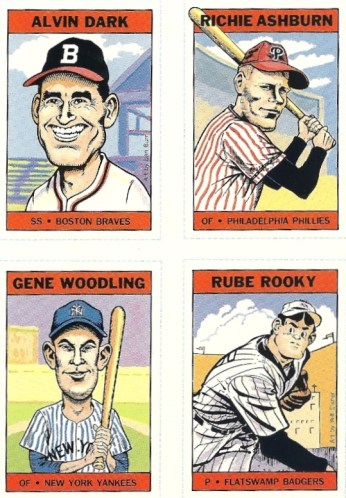
Since this reprint was published in 1991, the midst of the mutual comic book/baseball card boom, there are of course baseball cards bound into the book (drawn by Eisner and Dan Burr). Get a good look at them now, because I doubt I’ll be circling back around to squeeze a Trading Card Set of the Week out of them. There are four, three of real, mostly forgotten ballplayers (Alvin Dark, Richie Ashburn, and Gene Woodling), and one of the fictional Rooky — collect and trade them with your friends (or something):
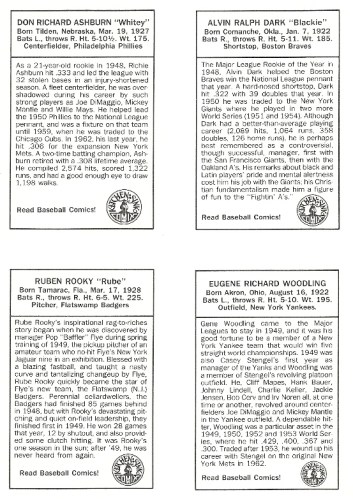
Here’s their stats, should you want to know Rube’s imaginary height and weight (you know, maybe to start up a fictional wing of SABR stat-nerdery):
And what are we to make of this radar blip from an industry titan? Though the reprint quality is a bit dodgy at times, with washed out colors and lines that at times look to be from third generation photocopies, the quality of Eisner’s composition and art shine through. There’s such vivacity in his character faces, from the somewhat vacant goodness of Rube, to the puffy jowls of Pop (maybe there’s more Poopdeck Pappy in him than Popeye), to the evil seductress look of Lash and the absurdly primitive skull of Her Guy Gillooly. Eisner’s stuff is still oh so readable, so the failure of the book — sales so poor a second issue couldn’t be justified — is hard to peg. I can’t say that I would have gone back week after week to read about an imaginary sports star, but Eisner’s vim might have warranted a second look, at the very least. Oh well.
But there was no joy in Mudville that day — Mighty Eisner had struck out.
Holo-Man and his amazing technicolor vomit dreamcoat hope you buy his crappy adventure kit (comic and record)

Holo-Man, not to be confused the Kevin Bacon-infused Hollow Man, has what might be the most nauseating costume in all of comic book history. I never realized that holograms implied tie-dyed tights that cause seizures, but there you go. And is he related to Yipes, the Fruit Stripe gum zebra by any chance?
Should you want to know more about Holo-Man and his sole comic book/record appearance, here’s his senses-shattering Wikipedia page. Go nuts.
A major part of the sports card arms race referenced here two weeks ago was Topps’ Stadium Club brand. It made its debut in 1991 with baseball cards, issuing a premium, glossy set with no borders, excellent photography and an incredibly high price point. I recall seeing packs of this beautiful merchandise and marvelling at the (sometimes) $4.00 per pack (!!!) price point, all the while cursing my own poverty — there just weren’t enough lawns to gin up sufficient cash to make Stadium Club affordable. The brand was an early brick on the road to post-boom hell, and left kids like me, long the bicycle spokes backbone of the market, out in the cold. The Public Park Club, as it were. And soon — as in next year — Topps had spread this beautiful virus (totally gorgeous, totally out of a juvenile’s financial reach) to all four major American sports: Baseball, Basketball, Football and Hockey.
Oh, and Batman. Can’t forget Batman.
Yes, Topps had the license to produce cards for Batman Returns, the much-anticipated sequel to the runaway train that was 1989’s Jack Nicholson-infused Batman. (Remember, it was this proprietary interest in Trading Card Batman that kept the Caped Crusader from appearing in the first company-wide set of DC cards from Impel.) And, not only did they put out a run of the mill regular set, they also decided to issue an extra 100 card Stadium Club parallel series. Which was overkill in the extremis, and a nightmare for the velcro wallet of my youth. Why? Because I loved comic books and I loved cards, and putting the two together made any product irresistible. And the Stadium Club cards, despite being way out of my league, were still — like the hot girl who wouldn’t touch you with a ten foot cattle prod — all the more desirable because of their unattainability. I couldn’t rationalize spending too much on them, and only managed to scrounge together a few packs before the summer of 1992 was over and everything to do with the Tim Burton Batman vanished from convenience store shelves forever.
So a couple of months ago, I had my revenge, like Daniel Day-Lewis smashing Paul Dano’s head with a bowling ball in There Will Be Blood. I bought a box of the vile temptresses on eBay, both chagrined and amused that what was once as out of reach as Fort Knox gold new sells in single dollar digits. (Glut exhibit 14Z, ladies and gentlemen of the jury.) And I tore that box open, and made myself MULTIPLE sets. It was a psychic Up Yours to what had once had once vexed me so greatly, what had once pushed me away from two hobbies at once.
And now for the post-mortem on Batman Returns: The Senses-Shattering Stadium Club Edition.
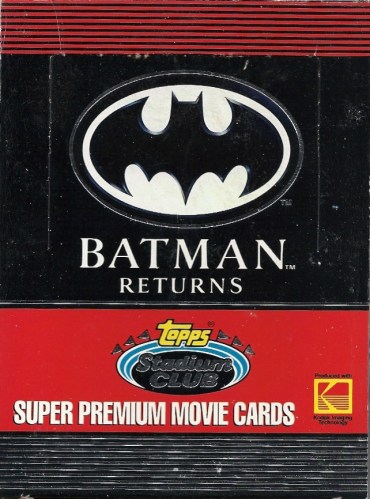
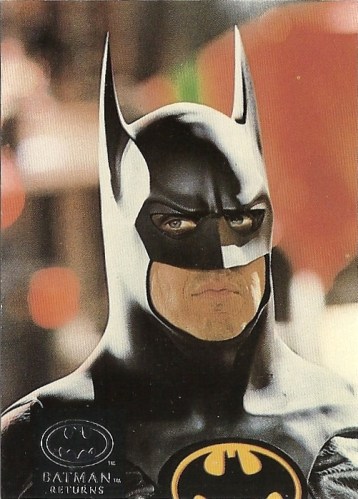
The packaging and card design carried over the simplicity of the sports offerings. As you can see from the box top above, Topps wasn’t relying on flashy packaging to catch buyers’ eyes. It was the ultimate in cool, catch-me-if-you-can showmanship. “See, we don’t even need bright colors and pictures and all that jazz to put asses in the seats.” That sort of thing. And the design of the cards followed the same understated pattern. Full bleed fronts, foil stamping and Kodak photography were the name of the game, as card #1, of the stern Michael Keaton Batman, will attest:
The card backs featured another pic with a bit of text on the production and plot goings on. An aside: the oval border around the card number gave me clammy-skin flashbacks to interminable standardized tests — I can’t be alone in that. Here’s the back of the second card, focused on Danny DeVito’s Penguin, with a special Burton cameo:
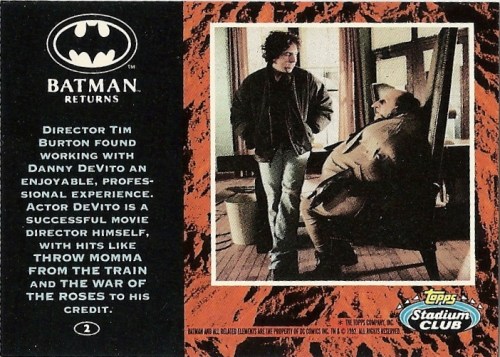
This is off topic, but seeing Throw Momma from the Train mentioned up there reminds me of that quick bit where DeVito wallops Billy Crystal over the head with a frying pan, which makes me laugh every time I even think about it. I’m laughing right now, in fact.
If there’s one complaint about the set, it’s that the gloss, which gives the cards their pretty shininess, gets lost amongst the dark palette that made the film feel like it was shot in black and white. Batman’s List. An exception is the Selina Kyle card, which features Michell Pfeiffer in all her fire-lit glory, and makes her tresses look like Ghost Rider’s:

And yes, she was a much more convincing Catwoman than Anne “I’m Wonderful” Hathaway.
It’s unfortunate that the human experience doesn’t offer up many chances to see Christopher Walken in a tux with a gigantic Carnac the Magnificent turban on his head. I’m happy to report that this set preserves just such a moment for future generations:
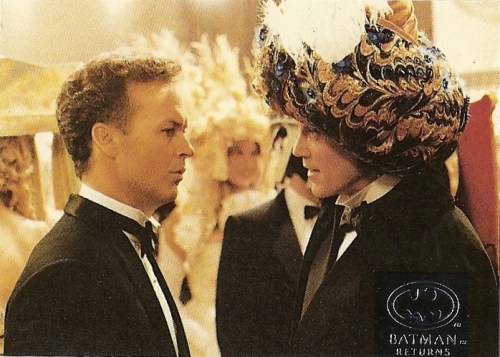
I hid this uncomfortable hunk of fabric up my ass two years…
You get the (full bleed) picture. The cards still look great, but nothing will ever wash away how extraneous they were. How expensively extraneous. Indeed, Batman Returns would be the only non-sport product to ever come from the brand, and the number of unopened boxes readily available online provide a good reason why.
And, once more, in case they didn’t hear me the first time: UP YOURS, STADIUM CLUB. I WIN.

A number of years ago I was over at a friend’s house and he and I were going through his DVDs, deciding which we’d watch as we guzzled a case of beer. I found one that was still in the plastic wrapping: Reign of Fire. “How come this one isn’t open?” I asked. “Just haven’t got around to watching it,” he answered. There followed a discussion on the checkered history of dragon movies, a genre with plentiful lows and scant, negligible narrative highs. We both agreed that neither one of us had ever seen a great dragon movie. So we popped in that Reign of Fire DVD, a fresh field for both of us, and settled into comfy chairs to swill brews and eat crap, each hoping against hope that we would be transported by the dragon-battling hijinks of pre-Batman Christian Bale and post-playing-bongos-while-naked-high-and-sweaty Matthew McConaughey.
My friend passed out half-way through — whether from boredom, booze, or over-consumption of nacho cheese, I never knew. I made it all the way to the roll of the credits. And at the end of that day, we had still never seen a great dragon movie.
The point of this wandering opening — other than to zing the underwhelming Reign ten years on — is that dragons are rarely done right. Which, by implication, sweeps 1981’s Dragonslayer into that dismissal.
But this isn’t to say that Dragonslayer doesn’t have a good dragon. In fact, its dragon borders on the spectacular. The improbably and gloriously named Vermithrax Pejorative (I mean, really) looks great and moves great in that old-timey stop-motion sort of way, and the life-sized models, with rubber and air bladders and multiple controllers, give her a degree of reality because — guess what? — they’re real. When she rears up to breathe/belch/vomit fire, it looks like a biological function of this dreadful species. Her tremendous reveal in her lake of fire lair plays beautifully, whether accompanied by dopey music or not. And it needs to be said again: her name is Vermithrax Pejorative. Is there an Oscar for best name? Shouldn’t there be?
Yet the movie around her isn’t all that. Peter MacNicol, though capable (and made famous by his odd Ghostbusters II museum curator), is too small a peg on which to hang sweeping fantasy. Stage actress Caitlin Clarke is pretty, medieval page boy hairstyle and all, but she’s not enough to raise the romance beyond the genre mean. Ralph Richardson, bless him, isn’t Alec Guinness. And Dragonslayer lacks that final, determining mark of greatness: being greater than the sum of its parts. It has a great dragon, but it’s not a great dragon movie. Yes, in the years since its release, Dragonslayer has accrued that hard to define, harder to predict “cult classic” moniker. Yes, the film makes some bold moves, including the death of one character — one kind of character — that you don’t see all that much in fantasy. It was edgy for a Disney film. People who like the genre seem to go for it. Hell, I we all have our weaknesses — I love Krull for God’s sake. But no amount of amulets, dead mentors or imperilled princesses can pull Dragonslayer up.
Dragonslayer is not considered great in this dojo.
But Vermithrax. Dear, sweet Vermithrax. She’s magnificent. Which begs the question as we look at her through our comic book prism: Is she as beautiful on the page as she is in motion?
The Marvel Super Special adaptation of Dragonslayer, scripted by Denny O’Neil, pencilled (and colored) by Marie Severin and inked by John Tartaglione, follows most of the film’s beats, and is heavy on the Pejorative. Which is good, because GAH HERE SHE IS:

For those unfamiliar with the plot, here’s the Cliffs Notes outline: There’s a kingdom where an uneasy truce exists between the people and a dragon. They provide her with human sacrifices (bound to a pole like Fay Wray in King Kong) chosen by lottery, and in return she doesn’t roast villages (normally). A square deal. A wizard’s assistant, a young man named Galen, takes up his master’s mantle when the latter suddenly dies, and resolves to put a stop to this never-ending cycle of death by chance. Along the way he’s aided by Valerian, a young woman masquerading as a young man, and he’s opposed by the king and others clinging to the status quo. Things go all haywire about halfway through, and all agreements, and many enmities, go out the window.
When Galen enters Vermithrax’s realm, he finds her brood, which he immediately hacks up with the special spear that gives the whole enterprise its name. And that leads to this:

Let’s review: this punk mucks up an agreement bargained long before (granted, under duress), invades Vermithrax’s lair, skewers her kids, and, for the cherry on top, hops onto her neck with murderous intent (Dracocide?). And we’re supposed to hate her? Even if we can ignore the fact that she’s the most compelling character in the whole story?
Ironically, the dragonslayer doesn’t do a lot of dragon slaying, and the film’s denouement features a back-from-the-dead return, which feels a bit like Ben Kenobi coming back at the end of Star Wars and, instead of being a voice in Luke’s head, delivering the Death Star coup de grace himself. It’s disappointing on film, and it’s disappointing on paper. And, unfortunately, it’s all to clear that a great dragon from the not great dragon movie cannot make a great dragon comic book.
Yet Vermithrax. She will never be forgotten. Her design, with a slim, wormy body, leather wings and horns and spines poking out all over, is the very definition of what this mythical, inarticulate beast should be. He body and face say it all. The artwork in the adaptation (which verges into garish Prince Valiant territory at times, abandoning the bleak Welsh greys of the film) doesn’t quite capture the Vermithrax’s majesty. Following the adaptation there are the usual behind the scenes articles, and, no surprise, much of the text here focuses on the dragon star, a mixture of model work and animation from the fine folks at Industrial Light & Magic — before computers and their generic CGI peeled the “special” from effects. This two-page spread, though dark and apparently shot through a purple washcloth (it’s actually easier to make out thanks to the bright light of a desktop scanner), represents the full majesty of the 1981 film’s practical effects dragon porn:

The adaptation was also published both as two regular-sized comics and in the rarely used/defunct paperback novel format. The only selling point for any of them? Ms. Pejorative. A standard for dragon-lovers anywhere, her glorious name even found its way into the current onscreen standard-bearer for mythical fire-breathers, Game of Thrones. Though I’ve still yet to see a great dragon movie, thanks to Dragonslayer we’ve met perhaps the greatest movie dragon, and the Super Special at least renews the acquaintance.
Maybe Smaug will knock her off her throne this December, but the first Hobbit invites only skepticism on that count.
Dan Majerle’s armpit would like you to make Topps your basketball card brand of choice

Now Dan Majerle is known for catching ground rule doubles with one hand while holding a plate of food in the other, but “Thunder Dan” was once a hell of a gunner during the Phoenix Suns’ mid-90s run. He teamed with current Sacremento mayor Kevin Johnson and renowned raconteur Charles Barkley to push Michal Jordan’s Bulls as hard as close to the NBA Finals brink as they’d ever get, and I can still see in my mind’s eye his ripped arms raining down threes on helpless opponents. He was like a Baywatch lifeguard with mad hoops skillz.
And, as seen above, such exploits were enough to make him the advertising face of Topps’ 1993 basketball card offering. Well, actually his armpit is the frontman, which reminds us all that basketball, with its (usual) lack of sleeves, is the most armpit-laden of all major professional sports. And in this, Mr. Majerle is no Kevin McHale, a man who was 2/3 pit, and the all-time record holder in this statistical category. But Thunder Dan did his best.
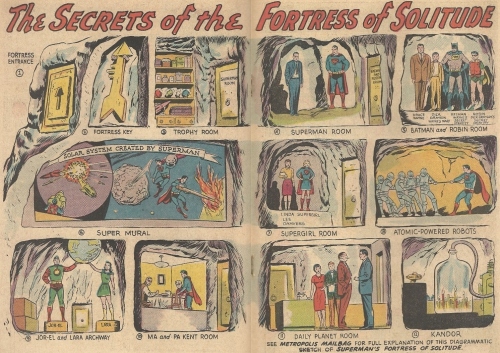
According to this Wayne Boring centerfold from yesterday’s Superman book, the big guy is a little bit nuts when it comes to life-size dioramas. I’m reminded of helping clean out my grandparents’ house after they both had died, and feeling bad about throwing out some of Gramp’s old basement den tchotchkes. (There was a giant portrait of a deer that was particularly large and acutely useless.) And thanks to this illustrated tour, I’m picturing Superman’s future offspring rummaging through his crap, exhibit after exhibit, mannequin after mannequin, deciding what to junk, mumbling “What was the old man thinking? Jeebus…” all the while.
Also, yeah, Batman has always struck me as the type to totally not mind someone revealing his secret identity in a dopey museum. Granted, the Fortress of Solitude seems like a secure facility — after all, it’s a fortress — but it’s been penetrated on multiple occasions. Would Batman come over to his World’s Finest pal’s pad, maybe to borrow power tools or something, and be stunned to see this stuff? Um, Kal? Isn’t all this the sign of a very lonely, very disturbed man? Or are these rooms nothing more than the super equivalent of family photos?
Speaking of Batman, every one of these exhibits is trumped by the giant penny.
Here’s Kal-El rendered powerless by a red sun and trussed to a pole for the 517th time. Awesome. – Superman #184
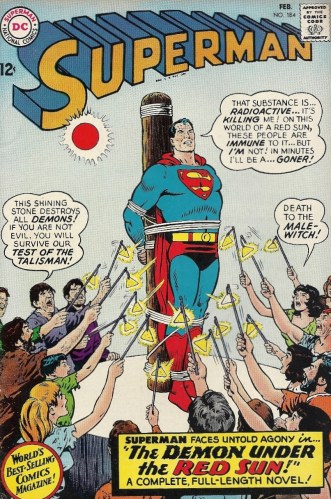
The largest subset of Superman story templates is the “temporary loss of powers” yarn. If you’ve read through more than three Superman plots in your life, the chances are that you’ve stumbled across one — or more — of these putative gems. If we’re using our old biological classification hierarchy (remember it with the mnemonic of your choice), Superman is a kingdom, De-Powered Superman is a phylum.
Or something.
Anyway, the point is that there are piles and piles and piles of Superman stories where he loses his powers for the briefest of spells, only to regain them by issue’s end and going on his merry Kryptonian way. They’re repetitive. Worse, they’re usually not very good. Yes, for a little while they relieve the storytelling handicap of having an invulnerable, nigh-omnipotent protagonist, but they have the uniform aftertaste of bromides. Repetitive. Hackneyed.
And here, as promised by the cover, we have Superman powerless, tied to a pole that only lacks a fire burning at his feet, menaced by primitives holding sticks with glowing solid musical triangles (the things kids get in elementary band when they’ve gone beyond finger cymbals and wood blocks) dangling from the ends. Marvellous. And Rao help us, we’re going to look inside. Are the innards more insipid than the phylum average?
The impetus for the storytelling action in this Otto Binder/Al Plastino saw is an early manned space launch, one of those fleeting jaunts that were the stage just after launching monkeys into orbit. (Otherwise known as The Stage Iran Just Reached.) Imagine if Alan Shepard or John Glenn had returned to Earth and started blabbering on about weird stuff — these Right Stuff heroes would have become objects of ridicule, right? Well, when poor Major Burke spins yarns about a rogue planet bopping about the stratosphere, all he gets in return is disbelief and mockery:

(Perhaps Zecharia Sitchin was lurking somewhere off-panel, taking notes.)
Fortunately, do-gooder reporter Clark Kent is there covering the return, and resolves on the spot to clear the astronaut’s good name and save the pert missus from social ostracism. (Think poor Ronnie Neary in Close Encounters, when her husband had a tan on half his face and was making mud mountains in that dreadful living room of theirs. You’re out of work, you don’t care…) He hides behind a corner and uses his Super-Ventriloquism to fake “Clark” telling “Superman” about the astronaut’s plight, thereby giving Clark an alibi and facilitating Superman’s getaway — remember this, because this won’t be the last time in the comic that this most infuriating of powers will be used.
Lo and behold, there is such a thing as a rogue planet out there, and it has a chewy center, which the Man of Steel immediately penetrates, like a Super-Sperm breaching a planetary ova. There he finds advanced tech, a control room and a “telepathy tape,” which is pure, unfiltered exposition:
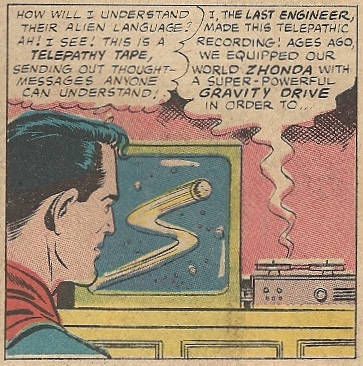
It details the senses-shattering origin of the wandering planet — Zhonda — which was once populated by an advanced culture, advanced enough to craft a planet that could wander its way through space. One day, though, the denizens of Zhonda got their brains zapped and lost all their knowledge, devolving into mere primitives. Though this happened a good long while ago, they’re still dressed in raggy remnants of their old clothing, like an extreme version of the cast of Lost — picture Jack still wearing his tattered black suit in Season 5. The taped explanation ends by going a bit too far for Superman’s hard science tastes:
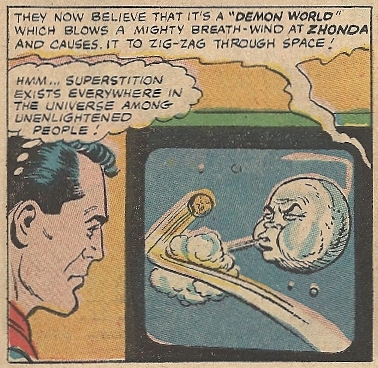
Yes, it’s too bad all things can’t be firmly grounded in reality. You know, like super-ventriloquism. (The huff and puff planet looks like Don Rickles, btw.)
Superman investigates the surface, rescues a raft-bound young couple from a sea monster, delivers them to a village and safety, is accused of being a demon, and, when he’s attacked, discovers he’s no longer super. UH OH, RED SUN. Keep in mind, there’s been no diminution of light as the planet has traveled from one sun to the next. Superman mocks Zhonda getting blown around by Big Bad Wolf planet breath, yet this escapes his Bill Nye-ish science mind.
Cue up the scenes of Superman getting pummeled, though he’s not averse to this chance to flex his muscles without pureeing someone’s face. Plus he can do drop kicks reminiscent of the wrestler Sting, ca. 1993 WCW:
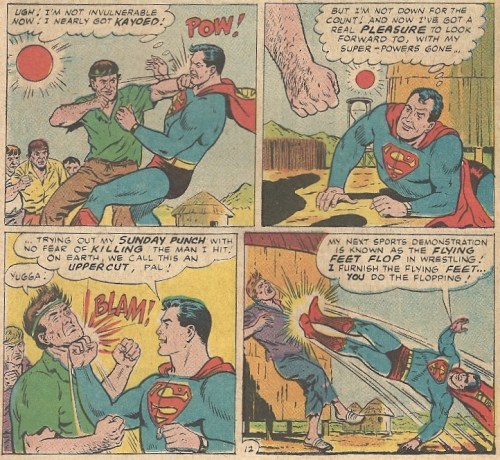
Drop kick, flying feet flop. Tomato, tomahto.
It’s good to see the big guy actually fighting back when de-powered, and not fainting away and getting his ass kicked like he did 238 issues later, in the last “real” story in his eponymous title. Remember that one? Where he got stripped nude? Well, he at least keeps his clothes on here. WAIT, NO HE DOESN’T:
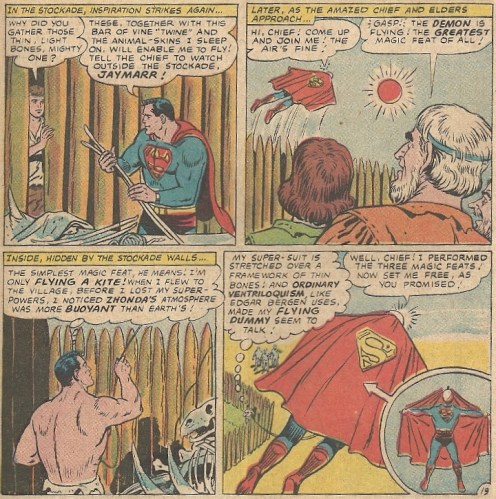
AGAIN WITH THE VENTRILOQUISM. At least it’s simple ventriloquism, and not the vague super brand. And who the hell is Edgar Bergen? (This is Edgar Bergen.) AND HE MADE A KITE OUT OF HIS SUIT. I DON’T KNOW WHETHER TO BE IMPRESSED BY THIS MACGYVER ACT OR DOUBLY INFURIATED. (In fairness, that kite could fool anyone. So long as they don’t look at it.)
It goes on like that , and ends with Superman escaping when the planet once more travels close to a yellow sun — again, with no change to the broad daylight — and he also manages to prove the astronaut’s (Remember him? At this point I didn’t.) sanity.
Even the five Superman films produced in the last 35 years have gone to this de-powered well three out of five times. Granted, in the first Christopher Reeve film and the blasé Brandon Routh continuation, Superman was only briefly weakened by Kryptonite, but they still count. Yet in the KNEEL BEFORE ZOD-laden second Reeve effort, the big guy surrendered his powers and wound up getting roughed up by a surly trucker — a regular trucker, not even the cyborg Marvel kind. Who knows what the Zack Snyder reboot has in store for us? (The Man of Steel trailer does have a snippet of Superman on all fours coughing something up, so maybe he gets de-powered there, too. WE CAN ONLY HOPE.)
Once again, it has to be said: The impulse to go this route is understandable. You have a tights-wearing god as your central character, so what can you do but occasionally rob him of said godhood and make him merely mortal? It’s just that it happens SO. OFTEN. It doesn’t help that so many of these stories occur in the alternately delightful/maddening Silver Age, when telepathy tapes, super-ventriloquism and bone-vine-stick-tights kites were de rigueur elements. Combine these trinkets with a trope, and you more often than not wind up with a big mess.
Or, this complaint could simply be the result of having read far too many comics, and could be a “seek professional help immediately” symptom of a broader malady. And the de-powered Superman tales could be awesome beyond words. Decide for yourself.
Behold, visual evidence that Andy Panda and Charlie Chicken may be the worst dog groomers in recorded history

As if the cringe-worthiness of mush-mouthed pickaninny Li’l Eight Ball wasn’t enough to turn readers away from Walter Lantz’s New Funnies, here’s Andy Panda imperilling a pup’s long ears with scissors. Apparently he got his beautician degree at The Lyndon Baines Johnson School for the Torture of Floppy Dog Ears. What kid wouldn’t want a poster that makes them flinch in vicarious anticipation of pain every time their eyes pass over it? You know, to go with a subscription to the racist comics. GO BACK TO CHINA, ANDY.
And thanks, Charlie Chicken, for shining the dog’s paws. Yeah, that’s a big help.
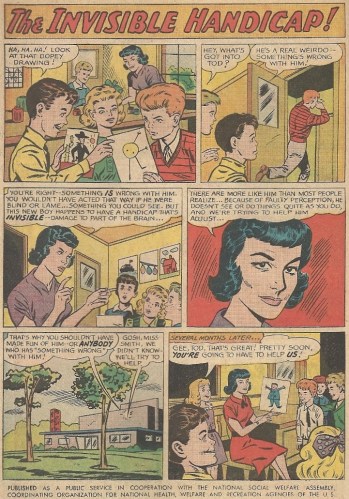
Here’s an old PSA on bullying and disabilities that might shame you into long-delayed contrition
When I was in the fifth or sixth grade, can’t remember which, our science class had a unit where we learned about the rudiments of weather. A component of that was doing our own weather reports, where the teacher would videotape us doing the typical evening news forecast (against construction paper backdrops, with angry clouds and happy suns, you get the picture), and then we’d watch all of us doing the schtick and have a good laugh. Get the kids up and involved, enhance the learning, that sort of thing.
Well, there was one kid in our class — we’ll call him Justin — who had a bad stutter. BAD bad. Spitting, choking on words, the whole gamut, and you can imagine the infantile teasing that accompanied it. Well, he had to do the tape thing too — I suppose including him was better than ostracizing him, though hindsight, as we shall see, would disagree. Anyway, everyone’s snickering was suppressed as Justin muddled through his minute on high pressure systems and cold fronts, but when his turn came in the playback, all hell broke loose. I’ve probably never laughed as hard and my life as I did when he made his odd upward whirring sound while trying to force out words (I can still hear it), and the whole classroom suddenly looked like the church scene in The Blues Brothers. It was like being on video had distilled what was a casual source of teasing and distilled it into a 150 proof bottle of mockery. Desks were pounded, knees were slapped, and no one was in control of their body’s convulsions. The worst: I remember looking over at the teacher and seeing him with his face buried in his hands, covering up the fact that he was laughing too. He was a nice guy, but being in a roomful of chortling kids was too much for him. And, God help me, it was a contagious burst. Believe me, this video was the sort of thing that, twenty years later, would have had a billion views on YouTube.
Justin ran out of the classroom, crying from his humiliation. And I still feel ashamed of laughing like I did. Because guess what: I used to stutter. Not as bad as Justin’s, and it was something I overcame in my early grade-school years (mainly through a Porky Piggish selection of alternate words), but I understood what it was like to know what you want to say and not be able to say it. Yet there I was, laughing like a hyena, like all the rest.
I’ve dismissed and gently mocked some of the National Social Welfare Assembly’s dopier PSAs, but the one above (despite its vague “I’m a bad artist” disability — could it have something to do with his odd head?) hits home. I feel like I’ve just had my knuckles rapped with a ruler from the distant past. Wherever you are, Justin, I’m sorry.
I will tell you three things. If I tell them to you and they come true, then will you believe me?
Twin Peaks was one hell of a phenomenon. Though it only lasted two seasons, David Lynch and Mark Frost’s brainchild burned as brightly for its short life as any television series ever has, and anyone alive and pop culturally aware at the dawn of the 1990s knew the question of the day: Who killed Laura Palmer? The mystery surrounding the death of the eponymous town’s All-American Girl — the homecoming queen, the A student, the deliverer of Meals on Wheels — gripped a vast swath of the viewing public, and that was even before the mystery deepened. The darkness that lurks inside even freshly painted houses was famously explored again at the end of that decade, in 1999’s American Beauty, but it was never as scintillatingly detailed. Was there a Log Lady in Beauty? I THINK NOT.
Has any other show ever had a backwards-talking Man from Another Place? One-Eyed Jacks? The Bookhouse Boys? Riddle-telling giants that may or may not moonlight as decrepit bellhops? The world’s first completely silent drape runners? Thugs that suck on white dominoes? Owls that are not what they seem? One-armed men? (Okay, maybe that one…) The assassination of a mynah bird? Psychologists that walk around wearing 3-D glasses? Sherilynn Fenn proving her whorehouse mettle by tying a cherry stem into a bow with her tongue?
And honestly, what opening musical montage could ever hope to compete with Angelo Badalamenti’s soaring theme, which pulled us into that universe’s inviting arms each and every week:
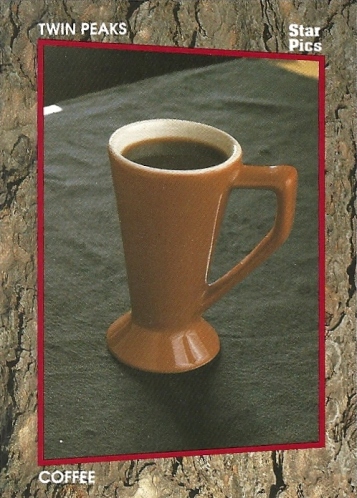
Boutique card publisher Star Pics capitalized on the raging maelstrom of popularity by putting out a 76-strong set of cards in 1991, just as the second season started to come off the rails, dooming the show to an end of season cancellation. (Heather Graham joining the cast was like a herald of Galactus showing up on your doorstep. Oh ——.) Lesson: When a mystery is the driving force for your program, think twice about solving said mystery before the production has run its course. At least Peaks lasted long enough to gestate this nice little stack of cards. Indeed, they’re a must have for anyone so enamored by Twin Peaks that they’ve scoured eBay trying to find old RR Diner mugs like the one seen gracing the card at the top of this post. (Yes, I’ve done that.) They don’t break any fresh ground, but they offer an attractive package, with tree bark borders (The wood holds many secrets…), character cards, several (sometimes humorous) cards commemorating various quirky objects that gave the show much of its vim, and biographical details and trivia on the backs.
And now, a few for your viewing pleasure.
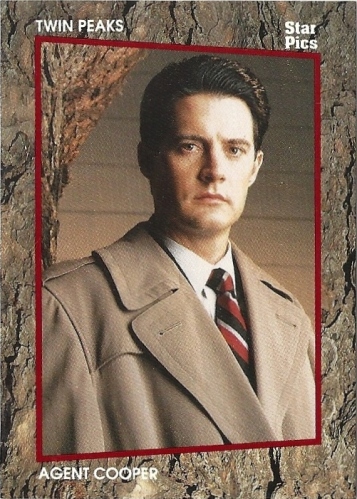
Here’s FBI Special Agent Dale Cooper (played by Lynch veteran Kyle MacLachlan), series lynchpin (…) and he of affinities for coffee, cherry pie, Tibet, hair gel, odd dreams and tape recorded dictation to the never glimpsed Diane:
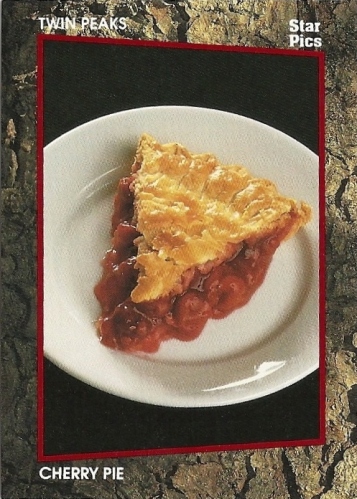
Here’s his favorite snack:
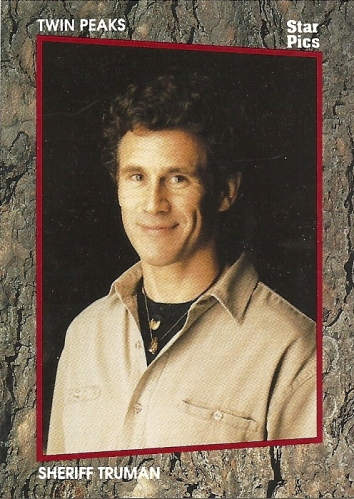
Cooper shared one of the more endearing lawman bromances in television history with the memorably named Sheriff for Twin Peaks, Harry S. Truman (played by Slapshot veteran Michael Ontkean):
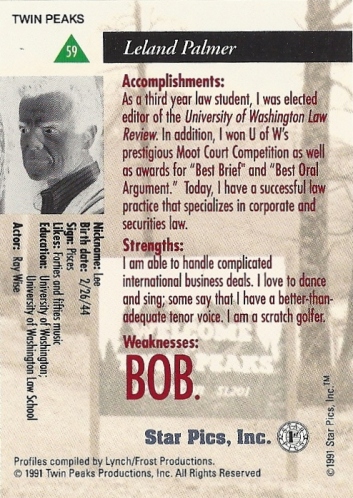
The card backs for the characters, with their bios and backgrounds, have a creepy quality to them generated by incorporating a negative of part of the card front’s photo — negatives are always off-putting, yet they’re very much appropriate for a show where nothing was as it seemed. There are no great spoilers on Leland Palmer’s card back, but Laura’s grieving father does get the most innovative Weakness of any of them:
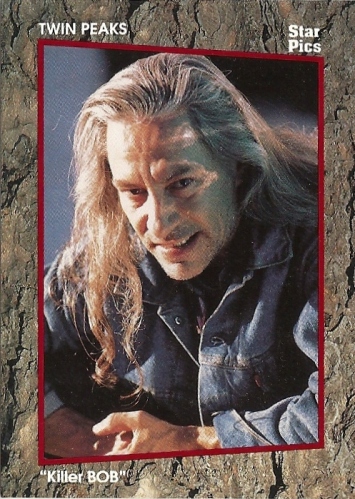
Speaking of Bob (played by the late Frank Silva), he was maybe the most terrifying creepizoid in television history, and, though the character’s creation was one of those happy accidents embraced by genius, he overcame his happenstance origins and seared his way into fans’ nightmares. Read any reminiscence about the show, and you’ll always find references to how “Bob scared the hell out of me that one time.” I was no different. There are several scenes where, even though I’ve seen the who series multiple times and know what’s coming, I have to suppress the urge to cover my face and peak at the screen through tightly compressed fingers. And without further ado, here he is, the bogeyman of Twin Peaks, in all his stringy-haired, denim-wearing glory:
To this day I still fear that Bob will come along and put me in his Death Bag.
These cards weren’t the only bit of authorized marketing that Peaks had in its heyday. Before there was such a thing as going viral on the internet, there were tie-in books like Agent Cooper’s tape transcripts and Laura Palmer’s secret diary. (In an odd twist, Frost’s son wrote the former, Lynch’s daughter the latter.) Thanks to the quality of the show, which was ahead of its time (it still is), all escape the chintziness that dooms so many TV tie-ins. They also came out before the prequel/kind of sequel movie follow-up, Fire Walk with Me, which shed much of the cast and bewildered more than it entertained, so there’s no Chris Isaak or Keifer Sutherland presence amongst the assemblage, for better or for worse. As they are, the cards stand as an interesting outgrowth of the show that, with all due respect to Eraserhead, Blue Velvet and Mulholland Drive, may be the finest exemplar of Lynch’s unique vibrational plane of creativity.
The cards can be found fairly easily online, and special factory sets come with one card autographed by a member of the cast. As stated above, any fan would be happy to have either a basic set or the deluxe, autograph-laden version. Strangely enough, if I had an autographed card, I’d want it to be Bob’s. Despite my fears.
Oh, and one more thing. I’ve got good news. That gum you like is going to come back in style.

If you ever want to wind an environmentalist up, just say the word “Monsanto” and watch them go. Not to imply that they don’t have grounds to loathe a liberal bugbear company that treads in GMO territory (like the horrifying sounding “terminator seeds”, which they promise they’re not developing, but still think might be a good idea) and has become an all-encompassing conglomerate only rivalled by Halliburton and Eric Cartman’s Trapper Keeper. It’s just that the visceral hatred of them might verge over the top from time to time.
So show your green friends this ad, which touts Monsanto’s plastic prowess and puts them only one degree of separation away from children so happy with their toys they can’t even open their eyes from smiling so hard. (It’s a simple formula: Color + Plastic = Irrepressible Euphoria.) See if your tree-hugging pals’ response is something along the lines of “That’s just what they would do.”
 Jared
Jared


 blog into mystery