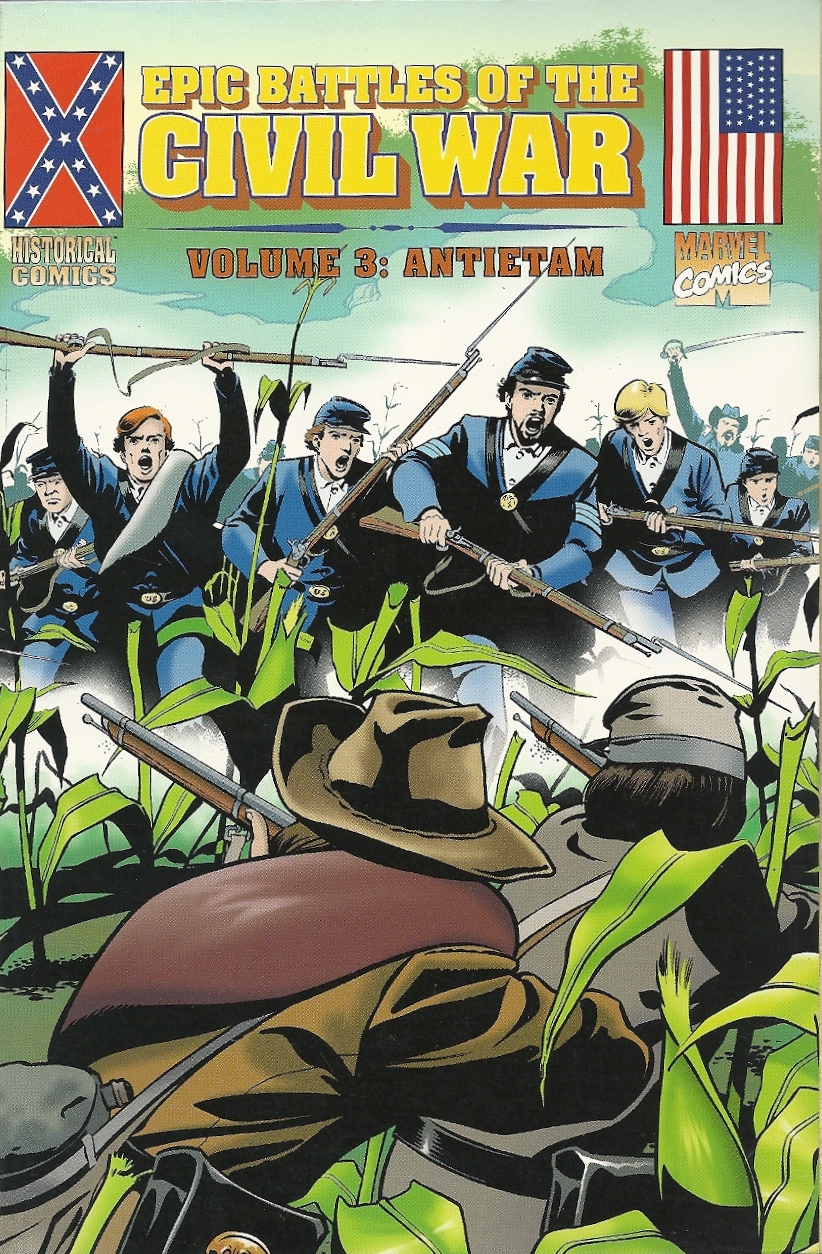
Comics as educational tools, as repositories of important historical fact, can be a dicey proposition. We can all endorse a serious use of the medium that we love, and the easy-going combination of words and pictures can open doors to younger audiences. They can be a step up from the storybooks that are read to you when you’re little. But condensing immense and weighty events into one single normal sized comic is difficult from a storytelling perspective. Events are glossed over, there might be a lack of a unifying narrative thread, and that glosses our eyes over.
We see some of that here, in a well-intentioned and professionally crafted square-bound comic that fails to make much of an impact. This isn’t a vicious indictment, because more power to folks who try to bring something different to a medium built on capes and tights. But it’s truth.
This comic was part of a four issue series (all published under the Marvel banner) that told the story of significant Civil War engagements, the others covered being First Bull Run, Shiloh, and, of course, Gettysburg. Antietam was scripted by John Ford, with Angelo Torres (of Mad fame — more on that in a moment) tackling the pencils and inks. All installments featured different writing and art talent, so I can’t extrapolate any successes or failings here to the broader effort. But I do have several observations to make on this volume.
First, a few words on Antietam from the guy who always dozed off in the back of the class. It was the bloodiest day of battle in American history — granted, it’s easier raise the sad tally of casualties when there are Americans killing Americans, but the sanguinary record still stands. Over 20,000 men were killed and wounded. Ugly. When I was a kid there was a bad fire on our property, and to this day you can still find charred bits of wood in fields. I honestly wouldn’t be surprised if I were told that those fields in Western Maryland were still stained red.
Antietam also made possible one of the seminal milestones in American history. On the micro scale the battle drove Robert E. Lee’s Army of Northern Virginia back into the Confederacy. A battle that was a stalemate could thus be translated into a Union victory, and that solitary chit finally gave Abraham Lincoln the political cover to issue his Emancipation Proclamation.
Antietam screams THIS IS BIG STUFF.
On to the comic, and a few brief selections (I apologize for the blurriness at the edges of the scans — the perils of square bindings) to illustrate the contents. Some of the work with the fighting — like this rebel yell soundtracked charge — works well:

There’s a dash of gallows humor within:
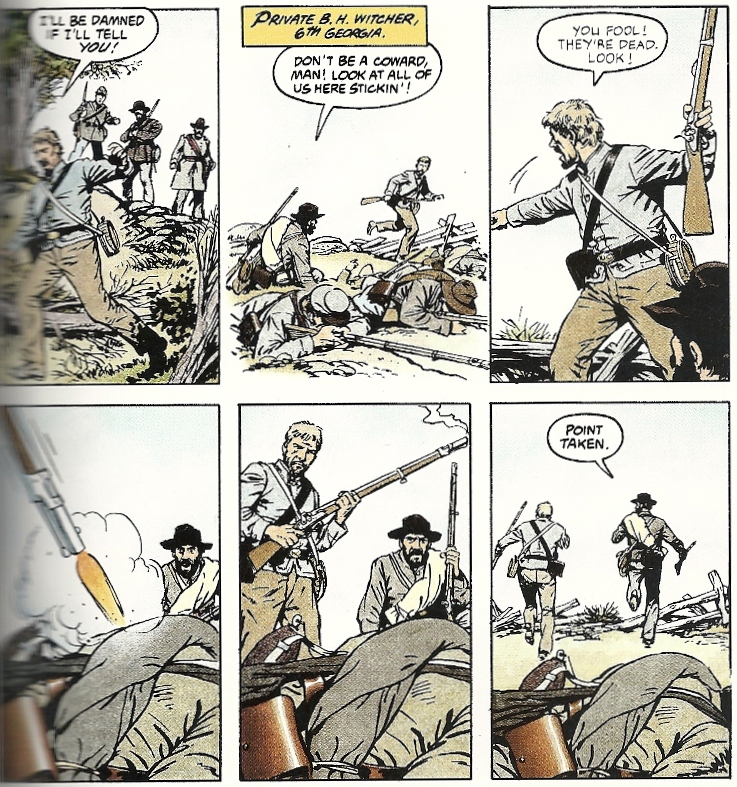
General George B. McClellan, whose organizational competence forged the eventually triumphant Army of the Potomac, but whose timorous dithering kept him seeing hordes of Confederates where there were none, has taken a retrospective drubbing over the last century and a half. He deserves much of it — most Americans’ blood boils when they read quotes from him referring to Lincoln, his (and our beloved) commander-in-chief, as a “baboon” and “the original gorilla.” That carries over to here. The following panel, coming after Little Mac had fought Lee to a bloody draw — but then failed to capitalize on it before the Confederates could recross the Potomac — conveys his vain disconnect:

Speaking of Lincoln, here he is in his natural habitat, as opposed to walking amongst talking beavers and poorly talking dogs:
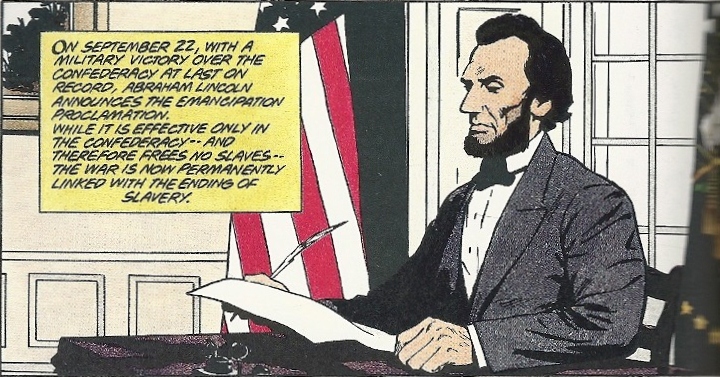
There you have it.
The entire affair feels haphazard. Familiar faces and names flit in and out, with brief bits of characterization to illuminate these marble models of history (Stonewall Jackson chomping on a lemon, etc.), while the rank and file are presented in blink-and-you’ll-miss-them vignettes. There’s never much to latch onto. The geography and topography of battle, the movements of troops, and the personalities of the commanders all jumble together. It’s a morass. As I alluded to before, there’s no thread. It’s as if the most boring college lecture you ever had to sit through were rendered in graphic form.
Also — I suppose you could call this a side-criticism — when I see Torres’ art all I can think of is his Mad oeuvre. Torres does a fine job with likenesses and action, but at every turn you expect to be outflanked by a double entendre or a fart joke. When you’re dealing with hallowed history, THIS IS A PROBLEM. I realize that this is horribly unfair artistic typecasting for someone who’s no one trick pony, but it’s unavoidable, at least for this reader, and I can’t imagine I’d be the only one to suffer this infirmity. My apologies to Mr. Torres for saddling him with a failing that may be (far) more mine than his. But nevertheless…
The bottom line here is that there simply isn’t enough space in a slim comic to do such a time and such an event justice. It winds up being a lame and tame recitation of events, and that just doesn’t do the job. These Civil War comics can be found in a variety of places, including Amazon. I can’t exactly recommend the series based on this sampling, but a Civil War buff may get a charge out of them.
The Clarence Oveur “You Ever Seen A Grown Man Naked?” Model Plane

When I saw this ad, the Peter Graves “Have you ever been inside a Turkish prison?” exchanges from Airplane!, with little Joey marveling at his new toy, roared into my cerebral cortex. I’m probably not alone in this.
Ah, the days when a small child being physically menaced by a seven-foot tall professional athlete and hearing sexual innuendo from a gray-haired pilot could be sources of high amusement. Where have you gone, America?
The Seduction of the Innocent: Hysterically Misguided 2012 Edition
This past weekend, as I was watching the Giants drive the Packers into the ground like tent stakes, my local Washington, D.C. Fox affiliate kept running promos for a feature story that was going to appear on the Wednesday news. What was the story going to be about? SEX AND VIOLENCE IN COMIC BOOKS AND HOW THEY ARE CORRUPTING OUR YOUTH. The spirit of Fredric Wertham is alive and well, my friends.
It aired last night. Here’s a link to the story and the accompanying article.
Putting aside my high dudgeon about not being interviewed (no, the “Jared” mentioned in the article isn’t me), this can be dismissed as your typical local news scare report. “These common household products, products you are probably using at this very moment, can kill you and your entire family. FIND OUT WHAT THEY ARE AT 11.” I’ll leave it to you to come up with the assorted devastating rejoinders that cut the legs out from underneath the piece. They only talk about DC Comics, which seems half-assed. No longer aimed at kids. Etc. At least the homosexuality and communism bogeymen didn’t come into play.
If the critique had been “Most comics now are garbage…” I think would have been more onboard.
I took some delight in the knickers in a twist child psychologist who was interviewed. “Fictionalized Playboy.” AND WHAT EXACTLY, SIR, IS WRONG WITH PLAYBOY? Insulting my comics is one thing, but when you bring my pornography into things, well…
Anyway, can hearings before Congress be far behind? Will the ‘Mazing Man-hating Comics Code Authority rise like Ra’s al Ghul from his Lazarus Pit? Let the hysteria begin!
Robin Hood is down to his last three arrows. THIS IS WHEN PRINCE JOHN AND THE SHERIFF SHOULD FEAR HIM MOST. – DC Special #12
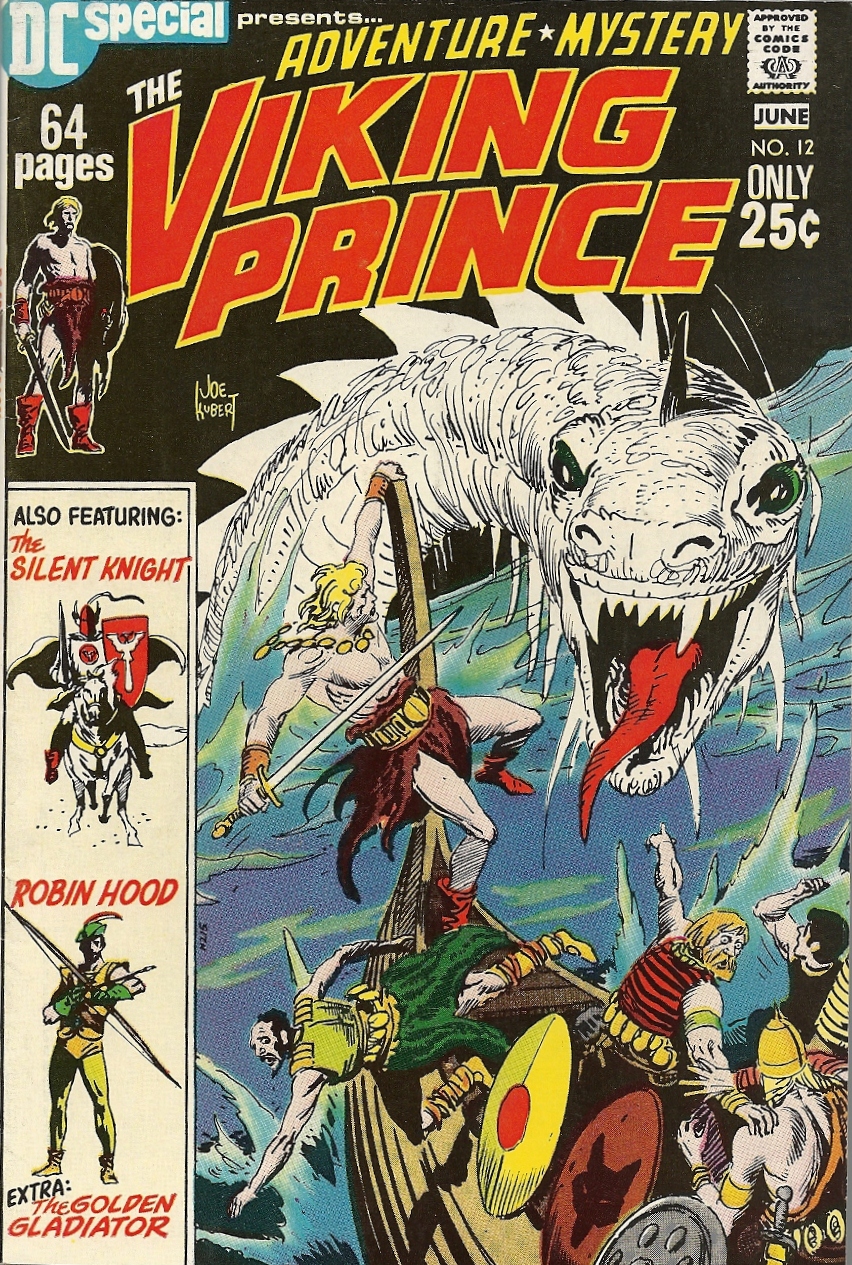
Fair Warning: The Viking Prince, the Silent Knight (ha…) and the Golden Gladiator will not be making appearances in this post. You may commence with the wailing and gnashing of teeth. Be consoled that I was sorely tempted to delve into one of this oversized comic’s three Viking Prince reprints, which featured superb Joe Kubert art from the late 1950s. But I’ve spent time in the past worshipping at that Kubertian altar, and, being a good Anglo-Saxon, I couldn’t pass up a chance to yack about the great hero of my breed, that forest-dwelling, money-bag stealing maid-masher known to us all as Robin Hood. WAIT YOUR TURN, NORDICS.
Robin, the first soak the rich Occupier — though he used quiver-based bad-assery for his “Occupy Nottingham” movement, instead of the tents, slogans and poor sanitation favored by our contemporaries — had a nice (if brief) run in comics back in the day. I’m not sure when the last good Robin Hood comic was. I’m not even sure when the last passable adaptation of his semi-historical life was produced in ANY medium. Was the Russel Crowe/Ridley Scott movie at all good? I confess to having been Hood-weaned on the embarrassing Kevin Costner/Morgan Freeman crapfest from the ’90s (which wasn’t rescued by Alan Rickman’s evil-dripping Sheriff) — Errol Flynn did not exist in this dojo. There was the Mel Brooks satire, Men in Tights, but that wasn’t all that stellar either. Maybe the last good Robin Hood flick was that Disney movie where he was a fox. Robin Hood and Little John walkin’ through the forest…
Whatever his later fictional (mis)fortunes, Robin was a mainstay in the very early Brave and the Bold comics, a title that was perfectly suited to his medieval derring-do. The story reprinted here (Script: Bob Haney/Art: Russ Heath) comes from TBatB #9. I like it. It’s short. It’s fun. It can fulfill whatever Robin Hood hankering you might have. IT WILL PLUNGE AN ARROW RIGHT THROUGH YOUR HEART OH WAIT THAT’S CUPID.
It all starts when an itinerant hawker of memorabilia draws the attention of the nefarious Prince John:
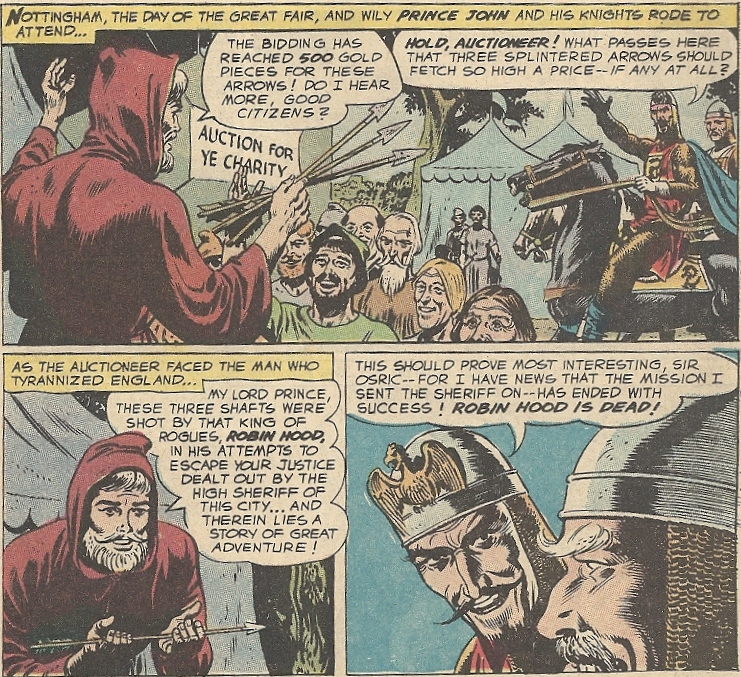
I’m sure if Todd McFarlane was alive back in those days, he would have been slobbering all over those arrows just like he did over his (tainted — HA) home run balls. And do you like the “AUCTION FOR YE CHARITY” sign? Just because you put a YE in a phrase doesn’t necessarily make it Middle Ages-friendly, folks. Lessons for life.
Our traveling salesman begins spinning his yarn about how Robin Hood managed to 1) escape a host of enemies, 2) free his Merry Men, and 3) rescue Maid Marian, all with the use of only three arrows. This gets you curious, right? About how he managed such frugal archery, right? Maybe not. It did me.
To defeat the attacking horde, Robin opts for a variant on the “Moses and God drowning Rameses” gambit:
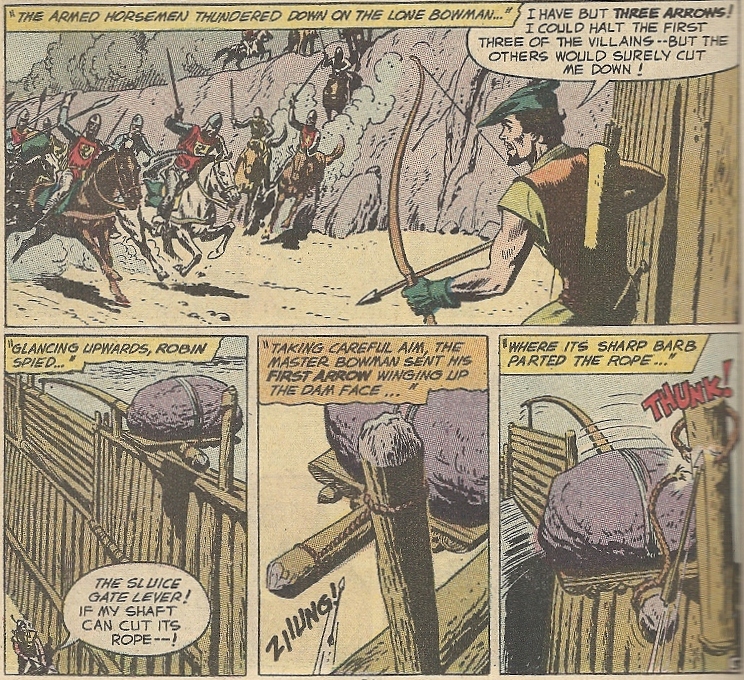
The Sheriff’s men are washed away and so is Robin, but he’s not chopped down by mounted foes. Just a little wet –that’s what one calls a damn good bargain. And he still has two arrows. He has not yet begun to fight.
Next up is rescuing his men, who are being held in a heavily guarded house. The riddle to this one is how Robin made smoke go down a chimney. Stumped? After revelling in the befuddled faces of his rapt audience, the storyteller clues them (and us) in:
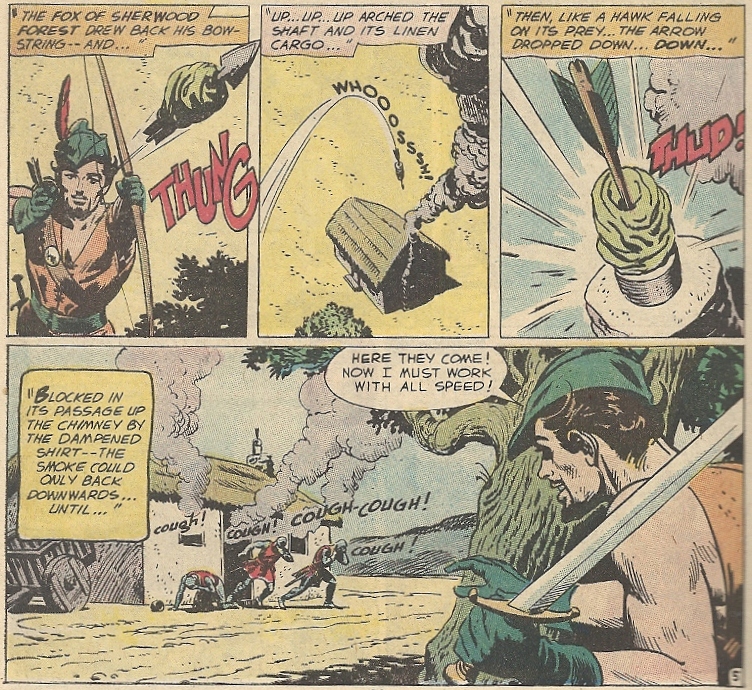
The smokey guards are no match for his bunghole arrow of doom and HEY WAIT A MINUTE HE HAS A SWORD. This sort of takes away from his great three-arrow achievement, but I suppose it’s grandfathered in with the rest of his outlaw raiment. Like the feather.
Last up is pulling Marian out of a castle tower, one surrounded by snarling beasts. The riddle here is how Robin made a whole castle surrender. A bit of rope and he’s almost done:
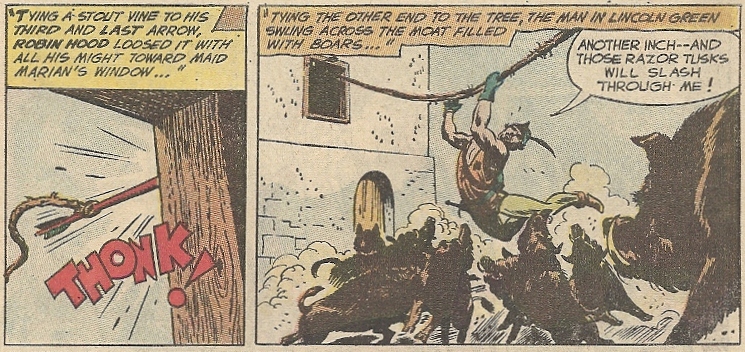
He frees the wild boars which chase the guards away (this is a bit like the first arrow solution) and then the rest is child’s play. I must admit, a boar-filled moat is a new one for me. No alligators? Sharks with laser beams? Just plain water?
And there’s your tale. Like all royalty, Prince John is a prick with a limited imagination, so he cries shenanigans on this whole thing, and then MY GOD, THE AUCTIONEER WAS REALLY ROBIN HOOD ALL ALONG:
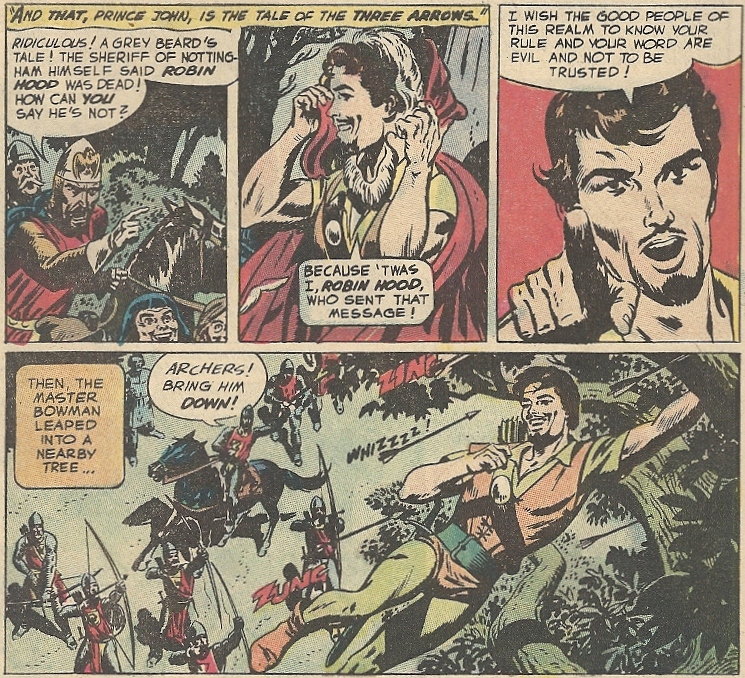
They’re using arrows against him. Will they never learn that all arrow’s are his friends and respond to his commands? It’s a bit like attacking Aquaman with a school of fish, no?
In a broader observation, Robin Hood can at times come across as a bit of a taunting prick. A little bit of this can be glimpsed in these last panels. He laughs and teases his way into the protective shroud of Sherwood Forest, and Prince John is left to fume and wag his mailed fist. The sequence could be subtitled with a simple NYAH NYAH. Whatever Robin’s virtues, I’d say that he sometimes lacks the cognizance to know when to quit rubbing it in, like Shazzang in that old TV Funhouse skit. If he shot the Sheriff in the ass with an arrow, he’d then moon him just to show that his own cheeks were still pristine and UN-arrowed.
You know what? Now that I think of it, maybe his three arrow exploits were completely made up. Résumé padding. Propoganda. So he might be a bit of a liar too on top of the showboating. Maybe it’s more about being a dick and less about the robbing the rich to give to the poor stuff. Maybe there’s a touch of Walter White in him. Something for us to mull.
Back to the story at hand. As I stated, it isn’t much, but it’s a brief, pleasant diversion, and the art, if not Kubertian, invests Robin with the roguish charm that we’ve come to expect — if not outright demand — of the character. The whole affair is far superior to watching Costner muddle through Price of Thieves with an American accent, and surpassing that low standard is all that my generation could possibly ask. HUZZAH.
In the days of yore, when there was no Facebook with which one could discreetly stalk people from great distances…
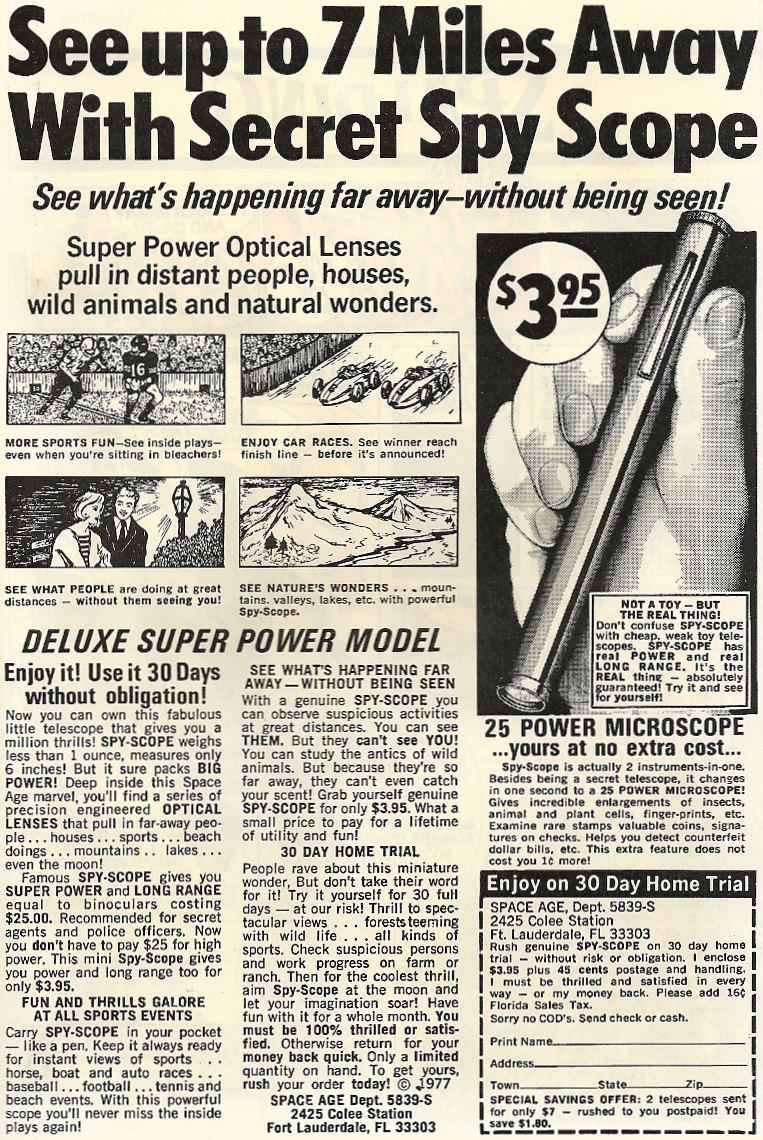
It’s “only 6 inches,” but “sure packs BIG POWER!” I can think of other things that could make that claim.
Speaking of numbers, color me skeptical on the “7 miles” boast. But, if true, you could pair this Secret Spy Scope with some x-ray glasses and become CREEPY VOYEUR EXTREME.
Four score and seven Scooby Snacks ago… – Scooby-Doo #2
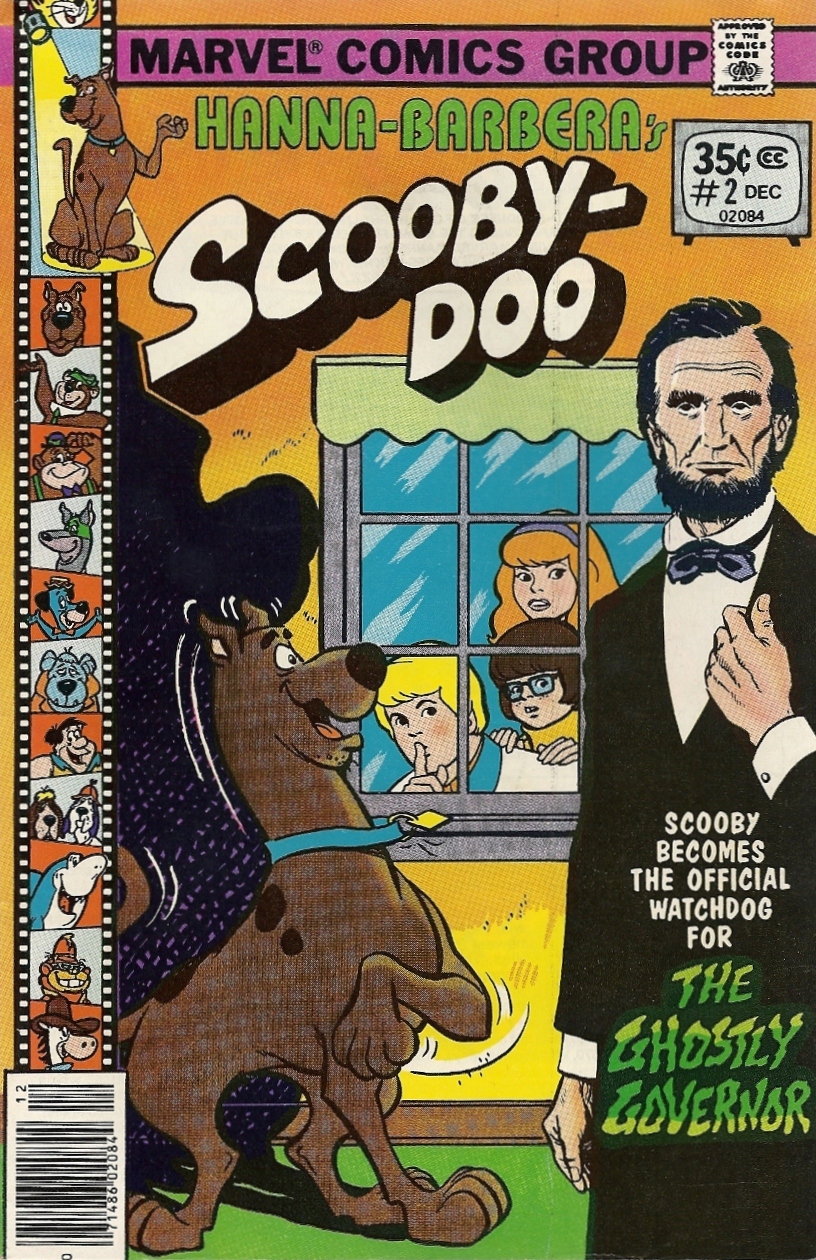
If you’ve ever fantasized about the Mystery Machine’s nosey teens meeting the Great Emancipator, BOY HAVE I GOT A COMIC BOOK FOR YOU.
Yes, Abraham Lincoln, no stranger to the sometimes bizarre environs of a comic booky world, kind of, sort of (not really) makes an appearance in these pages. Yes, he interacts with a giant talking dog and his hashish-addled friend. No, the story (sadly) doesn’t involve Scooby, Shaggy, Fred, Velma and Daphne travelling back in time and getting blown to pieces in Pickett’s Charge. There are trade-offs in this comic just like there are in real life. YOU CANNOT HAVE YOUR CAKE AND EAT IT TOO.
In a story somewhat appropriate for this politically charged primary season, Honest Abe, one of the few Presidents that we can all agree on (well, perhaps not all sections of the South,) seemingly comes back to life so he can run for public office. He certainly looks the part:
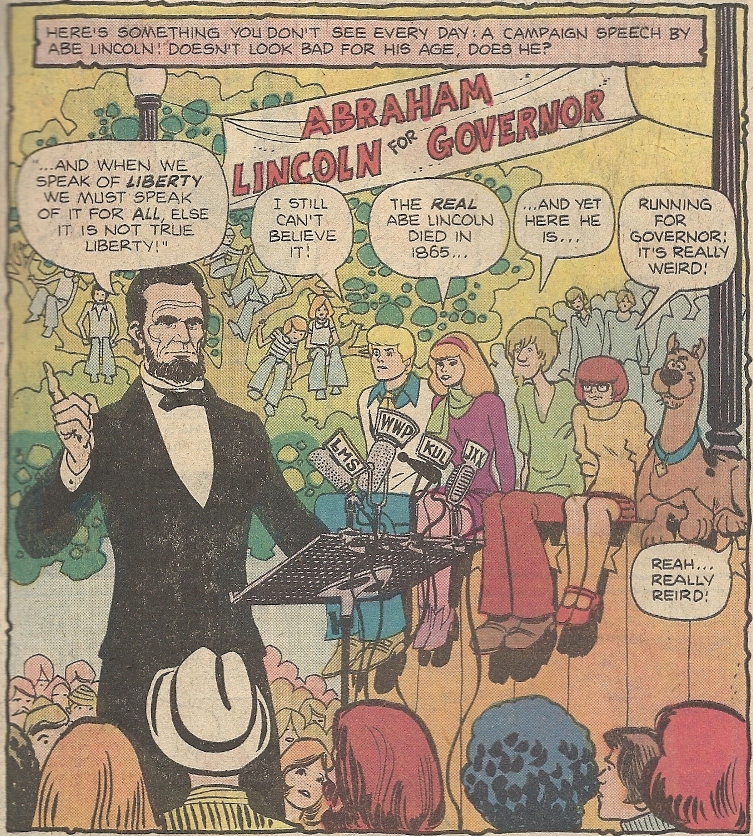
In the race for Governor in an anonymous state, the previous Republican candidate was felled under suspicious circumstances, and Lincoln threw his stove-pipe hat into the ring. The story makes clear that a candidate in this jurisdiction doesn’t have to be alive to run, which seems more than a tad nonsensical (Charlemagne for State Assembly!), and perhaps indicates that this gentleman is ZOMBIE LINCOLN. And no one questions what happened to a certain gigantic cranial entrance wound. Whatever. Our teens smell a rat (Dishonest Abe) and infiltrate Lincoln’s campaign headquarters (incidentally, his campaign manager looks a lot like Gabe Kotter). To get to the bottom of things, Shaggy and Scooby become “Lincoln’s” bodyguards, while the rest go deep undercover. Here’s Fred, MASTER OF ESPIONAGE:
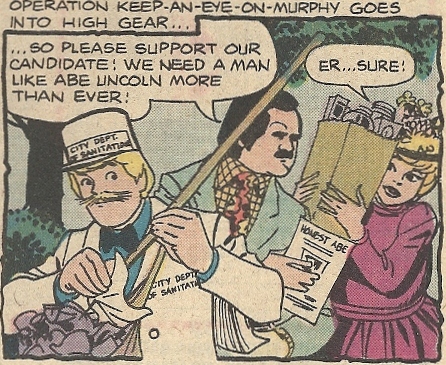
Tinker, Tailor, Soldier, Fred.
We may mock the disguise dexterity of the gang (Velma hides in bushes disguised as what looks to be a lesbian softballer), but they do manage to spot the manager (Murphy) hooking up with a shady character. Danger-Prone Daphne follows up by doing some sleuthing through books (a woman after my own heart), and finds the most conveniently titled book EVER for a person trying to find information about the real Lincoln — a tome called The Real Lincoln:

It turns out that “Lincoln” is actually a scatter-brained Lincoln aficionado that’s being run as a stooge of organized crime. Organized crime is in this case personified by a crook who shares a haberdasher with Warren Beatty’s Dick Tracy, one who spirits the weak-minded cipher away and takes Scooby and Shaggy hostage. Where exactly does one shop for a canary-yellow suit?:

The whole fiendish plot is undone when the tethered Scooby pulls that lamp around and works over the two goons like Darth Maul with his double-bladed lightsaber. Crouching Tiger, Hidden Scooby. And since the fake Lincoln’s whiskers fell off overnight, we’re deprived of seeing a “Let’s see who you really are!” finale with Velma ripping off his beard. As I said earlier, you can’t have everything.
The tone of this book is what you would expect. Of course aimed at kids, it reads a lot like the Easy Reader-sanctioned tales in Spidey Super Stories. It’s a decent story for young readers. No more no less. I wish I had a Lincoln/Scooby crossover for the ages to give to you. I do not. This will have to do.
One last item of note is the content of Scooby’s thought balloons. His dialogue is your typical garbled blather, but his thoughts prove to be surprisingly erudite — meaning clear and grammatically correct:

So, but for his speech impediment, Scooby could have given the Shaggy D.A. a run for his canine brain-power money. And here I’ve always thought of him as a bit of an idiot. Who knew?
Bedrock Jones and the Fructosed Breakfast Cereal of Doom

Posting a Flintstones Fruity/Cocoa Pebbles ad so soon after another feels a bit like a DJ playing two songs by the same artist in an hour, but here you go. It’s Barney Rubble as a Modern Stone Age Indiana Jones, and a parody/homage that joins the tributey ranks of The Muppet Babies’ “Raiders of the Lost Muppet” and Magnum, P.I.’s “Raiders of the Lost Art.” And lesser ripoffs, like Kingdom of the Crystal Skull.
“We named the town ‘Bedrock.'”

There are moments in human history when a corner of mankind is briefly blessed with divine inspiration. Mozart. Beethoven. Da Vinci. Tolstoy. Faulkner. This is one of those moments. It’s as if the squirrel on water-skis was combined with the monkey riding a dog. Hell, throw dogs playing poker into the mix. THE ABOVE COVER SERIOUSLY RANKS AS ONE OF THE MORE SPLENDIFEROUS THINGS I’VE SEEN IN YEARS. It should be in the National Gallery of Art. The French should jealously maintain that it belongs in the Louvre. C’est magnifique.
Thank you, Bob Larkin, for crafting this gem. Thank you very much.
When my father bought a pool table years ago, the very first accoutrement that he equipped our basement with was a framed picture of dogs playing pool (to my mother’s eye-rolling chagrin). It was requisite schlock, but it was glorious. BIG TIME. It was my father’s leg lamp. In a similar vein, if that cover were to be offered as a large-scale print, I’d give serious thought to hanging it in my living room. I’m single. These are the privileges afforded to a man who is single. And I would not shack up with any woman who would make me get rid of it. “What kind of vicious harpy are you?”
Sometimes as I was chalking my cue next to that old basement Olhausen, I’d pause and stare at the dogs shooting pool. It was pointless and dumb “art,” but someone had clearly put a lot of effort into its composition. Someone labored over it. And Apes in Coonskin Caps? Did Mr. Larkin take a step back after his final stroke, put his hands triumphantly on his hips, and think to himself God damn I have outdone myself this time? One hopes.
Just look at it. Flaming metal dart arrow things. Man and ape poling and blasting away side by side. Snowy mountains and verdant foliage rising behind our beleaguered primates. An unseen menace. The faces. They eyes. You can almost hear the rapids.
My oh my.
This magazine-sized series ran concurrently with the underwhelming and mostly forgotten Planet of the Apes TV show. In addition to the cover story and part 4 of the adaptation of the first Charlton Heston-infused film, there are some features within, like “Ape Fashions” (!) and an interview with a star of the show (Ron Harper, and not the one that played for the Chicago Bulls. Heard of him? Neither have I.). Said interview is conducted by none other than Chris Claremont, still in the “paying dues” phase of his career.
When I was buying this book, the owner of the store saw it on the top of my pile and called it, without sarcasm, “the greatest series ever.” I can’t speak to that. “It’s the Davy Crockett apes that got my attention” was my reply. And that’s where the conversation ended. It’s hard to process that word sequence, much less argue with it.
And what about those Davy Crockett apes? The accompanying story is called “A Riverboat Named Simian.” There are times when I’d want to scissor kick a title like that. Not here. The cover scene bears little relation to the events inside. To make a long story (Script: Doug Moench, Pencils: Mike Ploog, Inks: Frank Chiaramonte) short, human and ape companions escape gorilla pursuers only to find themselves in a strange frontier-style town, one with, well:
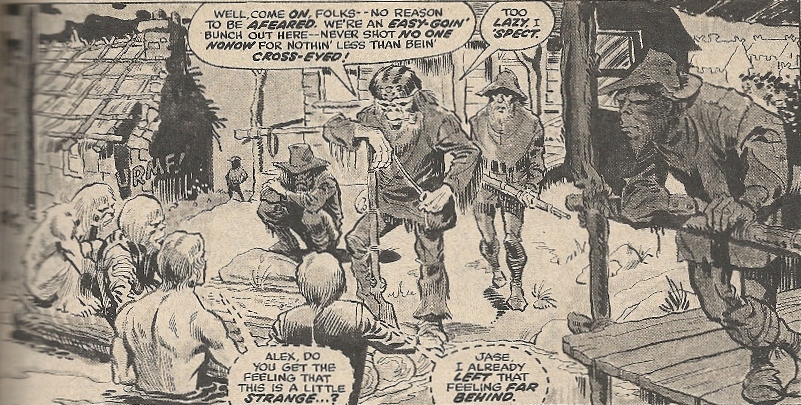
When I first saw that marvelous cover, a blog post flashed before my eyes, fueled by a primal need to share something so delightful with those who’ve yet to experience it. I thought of some Yosemite Sam language that I could incorporate in a (lame) attempt at humor. Dagnab it. Consarn it. The rootinest tootinest. You get the picture. BUT THE COMIC BEAT ME TO IT:
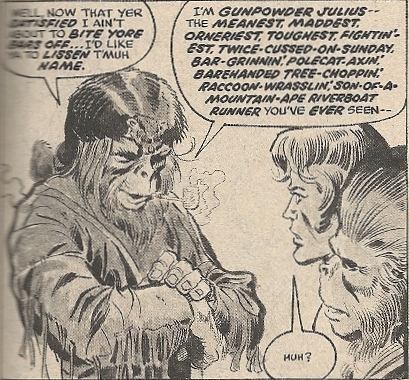
Gunpowder Julius. We have a new hero, America.
You know how it seemed that in every John Wayne movie his character would fight another character and then they’d become better friends for it?:
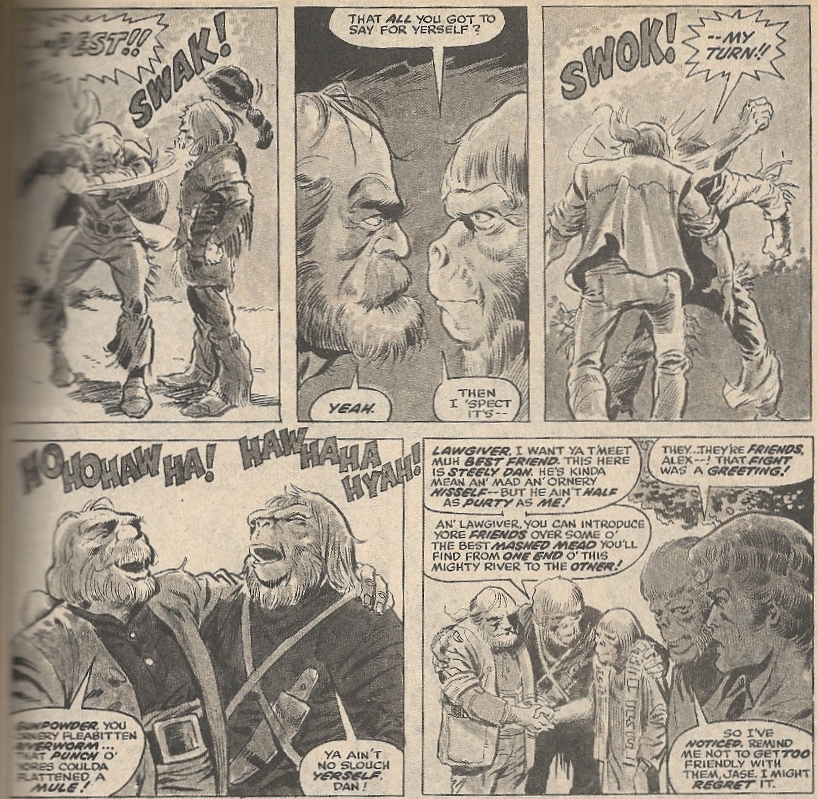
THIS THING HAS EVERYTHING. Wait, it lacks is an ape using a spittoon. So there’s that. And yes, I went back and double-checked.
I can’t offer much in the way of criticism on the story. My familiarity with the Apes mags is just short of nonexistent, and I can’t speak intelligently about mutants, Inheritors and Lawgivers. I will say that the content offered inside, despite the Gunpowder Julius grandiosity, fails to live up to that cover. After its vibrant colors, the black and white feels like Dorothy going back to that crappy little Kansas farmhouse after her Oz adventure. This is a dumb criticism that I have of most black and white books, one that’s doubled here.
But then, what could match the cover? Really — what?
Me Tarzan. Me like Joe Kubert art. But me no like being used in cheap commercial ploy.

Could you really blame Tarzan if he broke character for a moment, dropped the pidgin English, turned to the reader and inquired as to what the hell he was doing braving dinosaurs and saber-toothed tigers to sell model kits and Pom Poms? SOMEONE GET THE EDGAR RICE BURROUGHS ESTATE ON THE LINE.
You are cordially invited to join Gumby and Pokey on a hot air balloon trek to Gum Dinger Land. RSVP.
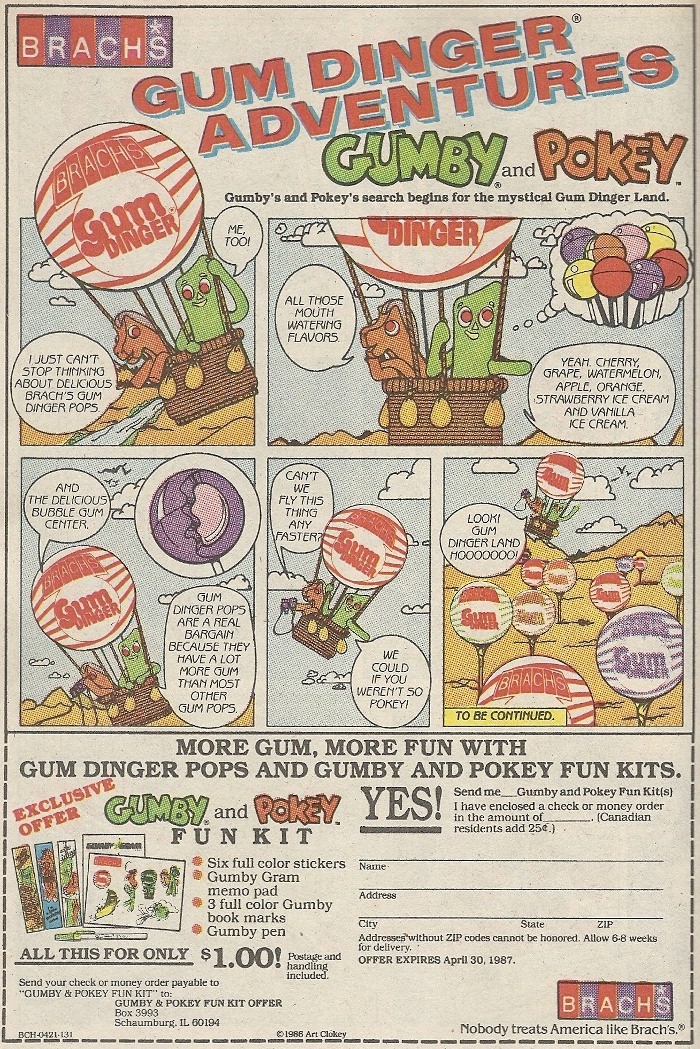
This 1980s candy ad was the sum total of my youthful exposure to Gumby. I’ve never felt that I missed out on too much. And I’m referring to Gumby proper, not the Eddie Murphy version.
Why Walter White from Breaking Bad is a Comic Book (Anti)Superhero: A Half-Ass Analysis in One Part

If you’re not watching AMC’s Breaking Bad, you should be. Easily one of the premier television shows in recent memory, it contains a performance that ranks as one of the single best turns that I have ever, EVER, seen. Believe you me, I’ve watched a lot of TV in my more vegetative moments. I have a more than passing familiarity with the medium. And this… This is something to behold. There are some critics that have already put the show at the top of the boob-tube pyramid, proclaiming it the pound for pound all-time champion of the small screen universe. I don’t know if I’d go that far. I don’t know if it’s the greatest show ever. We’ll see how it all ends. But whatever extreme laurels are flung its way rest largely on the shoulders of one man, one character.
The performance in question belongs to Bryan Cranston, known to most people as from his comedic role as the idiot father on Malcolm in the Middle. I remember him fondly for his recurring role on Seinfeld as the creepy dentist Tim Whatley, a D.D.S. who may or may not have molested a drugged Jerry, and a Catholic who converted to Judaism just so he could tell Jew jokes with impunity. He had comedic bona fides, but Breaking Bad has been something else entirely. For those unfamiliar, Cranston plays Walter White, a meek high school chemistry teacher and family man largely passed over by life. Everything changes when he’s diagnosed with terminal lung cancer. Then, in a bid to secure his family’s financial future (a family with a disabled teenage son and a daughter on the way), he puts his brilliant but largely wasted chemical acumen to use cooking meth. GREAT meth. Meth far superior to the biker crank out on the streets. Meth that people will pay handsomely for. Meth that people will kill for.
Watching Cranston is a 13 times a year delight. There’s so much going on behind his eyes every time he occupies the screen. There’s humor. There are good intentions. And there’s something growing inside of him, something other than the cancer that’s one day soon going to claim his life. As the series has progressed, the meth cooking has become less about getting cold hard cash for his wife and kids, and more about, well, that something else. Something dark. The evolution is harrowing. The magnificent finale of this past season, the show’s fourth, contained scenes of Leone-esque lyric potency, and a gut-wrenching — but sadly unsurprising — final twist, one that flushed much of the scant moral bedrock that remained in this world of lies, crime and murder. Walt has truly broken bad.
Make no mistake, Breaking Bad is not an easy watch. I’m unable to scarf down episodes like Garfield inhaling a pan of lasagna, something that can be done with shows like The Sopranos and Game of Thrones. You need time to catch your breath with this program. And, while the writing team and supporting cast all deserve heaps of praise (this is an 18-wheeler firing on all cylinders), without a convincing White at the center of it all the whole enterprise would flop about like an empty sock. Cranston has won multiple Emmys, but that seems woefully insufficient. Mere baubles at the feet of the king.
HEY, ISN’T THIS A BLOG ABOUT COMIC BOOKS?
Yes. Yes it is.
It occurred to me while watching early episodes and catching up on the past season that Walter White is very much a comic book superhero. I’m reluctant to call him that because of his seedy second life, but the moniker might fit. Perhaps an anti-superhero. Anyway, there are certain qualities that go into the superhero template. A character can lack some, and they can have them in varying degrees, but taken in totality these things are the primordial mud of which a four color hero is sculpted. I think there’s a mountain of evidence to back me up. Perhaps you’ll agree. Perhaps you won’t. Read on.
And there are no grand plot details revealed here, so read without fear of significant spoilers. Of course, if you want to stay fresh as a daisy before you queue up the show, then maybe you should peek through your fingers at the following paragraphs.
Here we go.
1. NAME
This is an obvious start. Walter White. It’s an alliterative name, by no means a prerequisite to a comic book hero, but a factor that certainly gets a foot in the door. Clark Kent. Billy Batson. Peter Parker. If you want to stick with the Ws, Wally West. This one’s pretty self-explanatory.
2. ORIGIN
There’s usually something cataclysmic that gives a comic book hero the impetus to embark on his rather strange career path. Bruce Wayne had Crime Alley. Peter Parker had a radioactive spider and Uncle Ben. With Walt it’s the aforementioned cancer diagnosis and the mounting bills that threaten to crush the family that he’s going to leave behind. It forces him to take drastic surreptitious action.
3. SECRET IDENTITY
Walt operates in secret. His entire family (at least at the start) has no clue as to what he’s up to, including a DEA brother-in-law. He even adopts a moniker for his criminal escapades — Heisenberg. Heisenberg becomes somewhat of a bogeyman amongst law enforcement and the underworld, with few knowing who he truly is. Sound familiar? Like 99.9% of comic book heroes?
4. COSTUME
Walt doesn’t where a cape. There’s no cowl, nothing emblazoned across a spandex-encased chest. But at times he’s worn a simple outfit in his “Heisenberg” persona. It consists of a pork pie hat, sometimes with sunglasses thrown into the mix. IT’S MORE BADASS THAN IT SOUNDS:

I know, it’s not much. But if we’re going to let the Phantom Stranger into the club…
5. POWERS
Walt can’t shoot lightning bolts out of his hands or crush a lump of coal into a diamond, but he has an uncanny, MacGyver-like ability to improvise chemical compounds, whether it’s explosives out of consumer products or a battery literally made from loose change. He has a gift. Maybe he’s a mutant or something, like Forge.
6. SIDEKICK

Jesse Pinkman (played by Aaron Paul) is a twenty-something addict (paging Speedy…) well on his way to an early grave when he comes into contact with Walt, his former chemistry teacher. Jesse, who has a good heart underneath all his emotional scars and baggage, becomes Mr. White’s (he always calls him Mr. White) outlet into the Albuquerque drug scene. They become partners, often antagonistic ones, but nevertheless a duo with a vague father-son dynamic. Jesse subconsciously craves Walt’s approval, and neither can bring themselves to betray the other, something that gets harder and harder to avoid as their activities escalate up the drug hierarchy. Paul is Cranston’s match when it comes to bringing humanity to the dark corners of existence. And the way things are going, when the whole show wraps up Jesse may be the true hero.
(There’s a scene in the second season where Jesse shows his childhood comic character creations to his girlfriend. That’s when the first germ of this whole comic book idea was planted in my head. I often need a kick in the ass to have even the dumbest idea.)
7. VEHICLE
There’s no Batmobile here, nothing with flames shooting out of the back or weapons springing out of the grill at the push of a button. But Walt and Jesse do have a camper which they use as a rolling meth lab. The Heisenberg-mobile, if you will. For the first half of the series they travel out into the desolate New Mexico hinterlands to cook their meth without fear being caught. A part of the show from the very first minute, the RV is the setting for some of the best drama in the series. Here it is:

8. LAIR
Remember in the Adam West Batman series when Bruce Wayne and Dick Grayson would access the poles to the Batcave by pushing the bust of Shakespeare? Cool, right? Didn’t you want something like that in your house? Walt has a similar arrangement, but there’s no giant pennies or playing cards in his man cave. Later in the series, after the camper becomes passé, a rather terrifying drug lord constructs a state of the art lab for Walt and Jesse to brew their meth. It’s in the basement of an industrial-sized laundry facility, with the entrance hidden behind a giant washing machine. Flip a hidden lever and the washer tilts forward, revealing the door. HE HAS AN UNDERGROUND LAIR WITH A HIDDEN ENTRANCE. WHAT MORE DO YOU NEED?
And that’s it. Eight criteria that I think make Walter White fit right in with the capes and tights crowd. As they say in the legal world, there’s a preponderance of the evidence. I think it’s a fairly convincing case, and one that others have probably made. I just thought I’d write it into the record — spending a little time musing on this show is no chore, believe me.
Breaking Bad has one more season left in the tank. If you’re not on the bandwagon, then you’re more than welcome to join the fun. Heisenberg would want it that way.
Lozer Tag
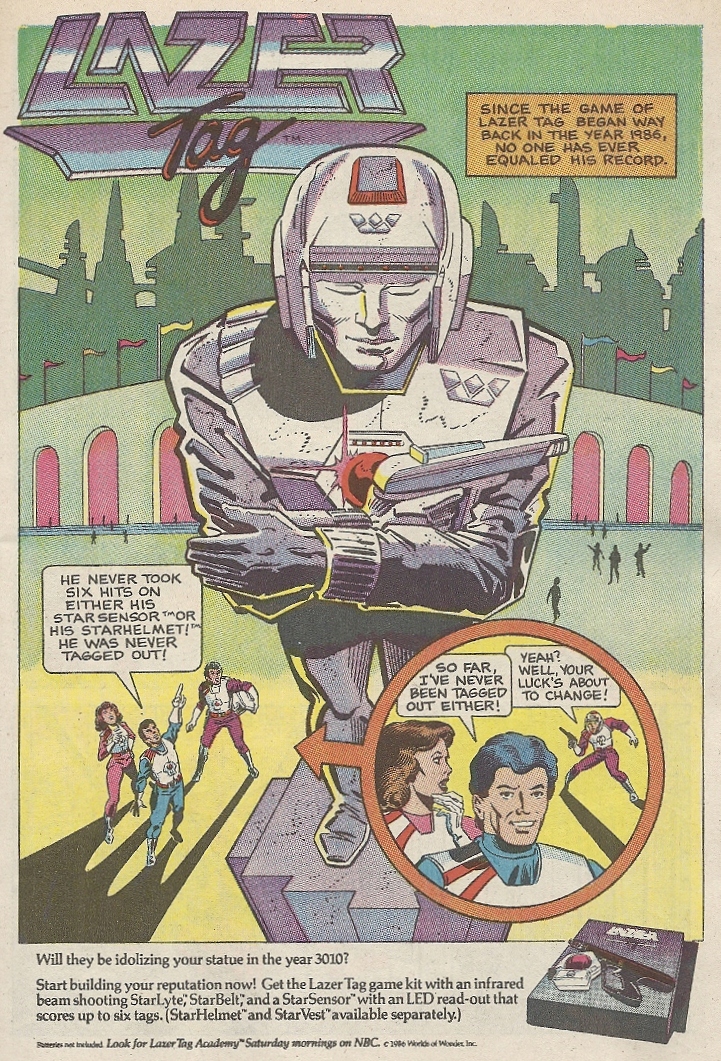
A buddy of mine had one of these things when we were kids. It was pure junk. You had to have the gun right next to the target doodad to register any sort of hit. Maybe he got a lemon, I don’t know. Whatever the case, it sucked. Lazer Tag actually spawned a short-lived animated series, but I don’t think we’ll be building any statues to talented practicioners any time soon.
Kids, stick to the guns that can shoot your eye out.
Batman’s pectorals, Nightwing’s cleavage and Geo-Force’s abs are proud to accept these crappy awards
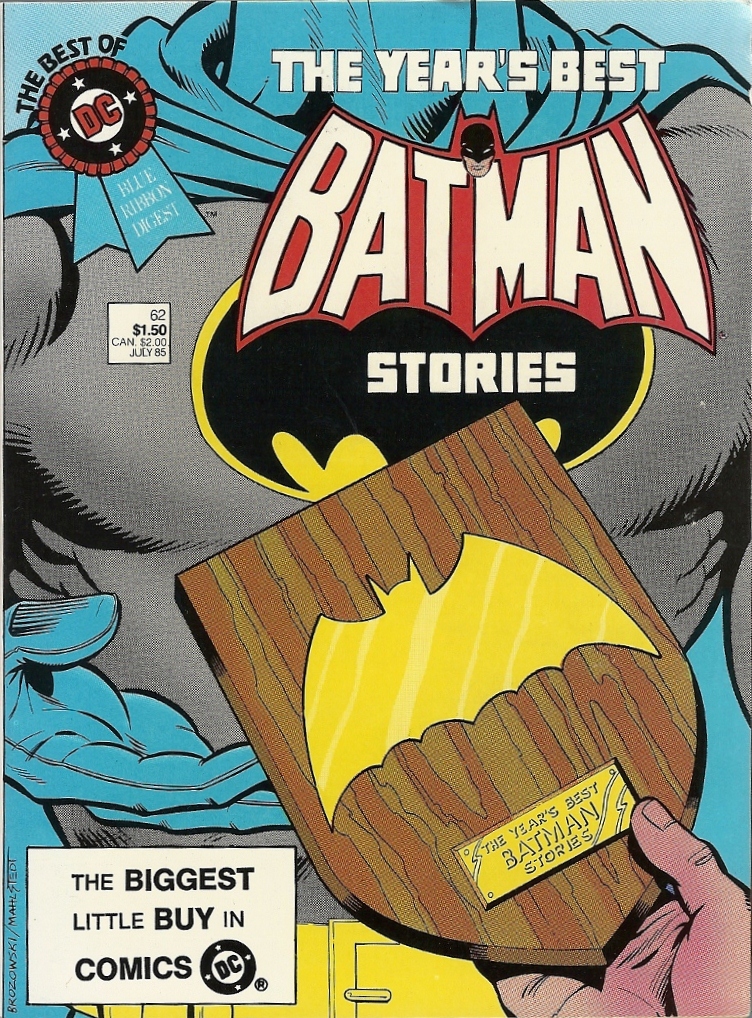

Bought these the other day. I love digests. Small. Compact. Like the Russian phrasebooks/Bibles on Slim Pickens’ Dr. Strangelove checklist.
The above plaques look like the ones I used to get as a kid for winning the local Knights of Columbus free throw competition or something similarly dopey, “major” awards that were immediately consigned to a dark corner of a closet. I can’t imagine these would have fared better in the Batcave or Titan’s Tower.
There’s also a Year’s Best Superman Stories edition, with a similarly chestular cover. The store didn’t have that one. You can’t win them all.
“See, he’s a pig with all the powers of a spider and WHY ARE YOU LOOKING AT ME THAT WAY?” – Peter Porker, The Spectacular Spider-Man #14

I have a confession to make. I like Peter Porker. I like him a lot. A like that borders on love.
There’s no shame inherent in this. I read his book as a kid. I was right smack dab in the middle of the target demographic for a short Spider-Ham. But there’s this odd impulse amongst many men to never admit to ever having delved into the frivolities of youth. I include myself in this class. You know how in Greek myth the goddess Athena was “born” by shooting out of Zeus’s head fully formed? I feel like I should always give off the aura of one who burst out of my mother’s womb smoking a cigar and clutching a straight bourbon. “Where’s the dames?”
Granted, I make no bones about having loved comic books and still treasuring them well into adulthood. But a kiddie book about a short and cute Spider-Ham, under the kiddie Star Comics imprint no less, well, that might be a bridge too far. I feel like the Man Police are going to kick in my front door. WE HAVE A WARRANT FOR YOUR ARREST, PUSSY.
Nevertheless.
I hadn’t cracked open an issue of The Spectacular Spider-Ham in years until the other day, after I picked this one up while spending far too much money in a New Year’s sale. And I was more than a little surprised by how well the whole enchilada holds up to my early-30s eyes.
For the noninitiates, Peter Porker started life as a spider, one that was bitten by a radioactive pig (up is down, down is up) and thereupon began fighting crime in a critterfied Marvel Universe, one where every character you can imagine is shoehorned (quite easily, actually) into a furry counterpart. Here’s a selection, conveniently printed in this issue, including an alarmingly buxom Mary Jane Waterbuffalo:

If you don’t love Mooseterio…
There was a distinct, fun visual component to the title (including the design of Spider-Ham — every time I see Brian Griffin on Family Guy I think of those stubby limbs and that snout). An identity all its own. It reminds me of modern 3D animation in that respect. There’s a Pixarity to it — that might be overstating things, but there you go. A variety of artists worked on the title (Joe Albelo and Pierre Fournier pencilled and inked this installment), and they all built on this unique aesthetic. And the writing wasn’t puerile (Mike Carlin scripted here). It was miles better than your similarly aimed Looney Tunes or Disney tripe.
This issue is a decent example.
It’s no ordinary animalified foe that our virtuous Spider-Ham foe that our hero tussles with here. It’s a character in the vein of the above Sylvester Stallion. It’s a rocker character who bites the heads off chocolate bunnies. Not Ozzy Osbourne. It’s Ozzy Ostrich, and Ozzy Ostrich’s decibels do not agree with poor picture-snapping Peter’s piggy ears:

The Marmosets. IT NEVER LETS UP.
Spider-Ham is as often in over his head as his human counterpart. Even gangly rock star birds can kick his ass, as Ostrich does after a misunderstanding about (not) stolen gate recepits:

Porker’s work life isn’t much better, just like Parker’s:

If you’re wondering why Porker is all flattened, it’s because he was caught in the Daily Beagle’s (…) printing press while changing out of his Spider-Ham attire — CAN SPIDER-MAN GET MASHED UP LIKE THAT YEAH I DIDN’T THINK SO.
The real villain of the piece isn’t Ostrich, but a sinister pawnbroker who sells him a guitar that hypnotizes listeners to do his (the pawnbroker’s) bidding. Porker, with his cotton-stuffed ears, is immune to its effects while on his second photog assignment, and through porcine pluck he’s able to free Ostrich from its grip. They team up to deliver a (literal) El Kabong to the malefactor:

I’m not claiming that this stuff needs to be studies with Talmudic intensity, nor am I claiming that it’s the best material in the world. If I was force-fed a steady diet of Spider-Ham, I’d probably grow tired of his act quite quickly. Maybe even puke. But an occasional dip into Peter Porker’s little world is inordinately enjoyable. If you’ve never given it a try, dive right in. You might be pleasantly surprised.
Spider-Ham still shows up occasionally on variant covers and in one-shots. That seems about right. Always leave them wanting more. And there’s still plenty of room in the world for a Spectacular Spider-Ham.

I’m leaning toward Vincent Price lending his name and image to the Shrunken Apple Head people as being a sad interlude, Mort Drucker drawing notwithstanding. The world of perishable food art — catch the wave!
I did a brief Google search about these monstrosities. Not to be an a-hole, but I thought the broad talking in the following clip WAS the shrunken apple head, not the sculptress — TELL ME YOU DON’T THINK THE SAME THING:
 Jared
Jared


 blog into mystery