The Undertaker has a great WrestleMania unbeaten streak, but he had the Barry Horowitz of comics – Undertaker #1

Spring is in the air, and it’s bringing with it its retinue of co-travellers. The NCAA Tournament. Allergies. And the Undertaker piledriving an opponent into unconsciousness on the greatest stage that the pro wrestling universe has to offer.
For those of you familiar with the oeuvre of the glowering man glimpsed above — and pro wrestling for that matter — please bear with me as I provide a brief and disjointed biography of today’s subject for uninitiates. The Undertaker (real name: Mark Calaway) has been wrestling in the WWF/WWE since the early 1990s, having before that wrestled in WCW under the name “Mean Mark.” A mountain of a man, with long hair and pale, tattooed skin, he’s known as the Deadman, and he has always (except for a brief interlude when he took on more of a renegade biker personality) been portrayed as a dark, forbidding, largely silent and somewhat otherworldly figure. He started out as a heel (villain), but over they years he’s toggled back and forth with being a fan-favorite, though due to his popularity most of his time has been spent as the latter. For a long time he had a manager, Paul Bearer (nyuk) who would carry an urn with him to the ring, an urn that supposedly gave the Undertaker supernatural endurance and powers. (Seriously. Both the Undertaker and his storyline brother, Kane, have at times displayed actual superpowers, like hurling fireballs, which would make an X-Man proud. And it begs the question: Why are they dicking around wrestling and not ruling the world like Golgoth? And on the urn thing, one of my favorite storylines ever had a guy called Kama Mustafa, “The Supreme Fighting Machine,” steal the urn and melt it down into a gold chain for himself. But I digress.)
Because of his size, the Undertaker has never been the most agile of wrestlers, but he’s always been a hell (no pun intended) of an entertainer, with great entrances and number of go to moves, like the chokeslam and his patented rope-walk, that have endeared him to fans. His finishing maneuvers (the ones that put an opponent permanently down for the count), while show-stoppers themselves, have always looked acutely sexual. The Tombstone Piledriver is essentially him 69ing his opponent, at least until he piledrives them into the mat, and the Last Ride has him lifting a guy onto his shoulders crotch-first before slamming him to the ground. BUT HEY, WHATEVER WORKS.
He’s been going for over twenty years now, in a career that’s spanned matches with everybody from deceased stars of yesteryear like Yokozuna, to leading names like Hulk Hogan and the Rock, to the current John Cenas of the world (Captain Lou Albano is a bit before his time, though.) My personal favorite match of his is the legendary Hell in the Cell bout with Mick Foley, which had obscene falls from the roof of an enclosed steel cage that can make anyone with a pulse, even non-wrestling fans, say nothing but WOW:
What makes him most unique is that he’s never lost a match at WrestleMania. Yes, pro wrestling is scripted. But it’s a mark of the respect people in the industry have for him that he’s never been on his back when the bell rings there on pro wrestling’s marquee night. The streak has made his matches at this event special — Will he or won’t he do it again this year? — and despite his advancing age and the fact that he doesn’t wrestle a whole lot anymore, they’re worth the price of admission. He’s back this year to try to push it to 20-0, and I’m looking forward to it. It’s the dumbest of dumb fun, but it’s fun nonetheless.
However…
He had a comic. It was released in the late 1990s, when professional wrestling (thanks in large part to the rivalry between the WCW and WWF promotions) was at its absolute peak. It was on TV every night of the week, the shows drew pretty darn good ratings, and folks like Vince McMahon missed no chance to squeeze every last drop of cash out of a rabid fanbase that just couldn’t get enough. (I went to plently of wrestling shows — RAW, SmackDown, etc. — with buddies, and let me tell you, rabid is an apt adjective. The closest you ever come to The Island of Dr. Moreau is a pro wrestling crowd.) There was always plenty of crap to buy.
And, friends, let me tell you, this comic is crap.
Granted, I only have the first issue in front of me, and there’s of course the slim chance that the series got its footing after the initial growing pains and turned into an incisive critique of the human condition at the turn of the millennia. A comic book Dekalog. Maybe, BUT I DOUBT IT. If I had to describe this book in comic book/pro wrestling terms, it’s like a dumbed down version of Todd McFarlane’s already dumb early run on Spawn, with a dash of the Ultimate Warrior’s comic book thrown in for seasoning. (I’ll one day give my full critique of the Warrior’s sublimely dreadful foray into comics, but to satisfy your current curiosity, feel free to do some Google searching. The special Christmas issue where it was strongly suggested that he sexually assaulted Santa Claus is a MUST READ.) It looks and feels a lot like a junky Spawn fill-in. Giant, sloppy full-page panels. A lot of fire. A dumb plot about a battle for hell with Earth-bound proxies. I think I even saw Malebolgia in there.
Maybe McFarlane can file a belated lawsuit and recoup some of that money he lost in the Neil Gaiman/Angela kerfuffle.
Anyway. You get the picture. And if you don’t get the picture, here’s a small sampling of what could be found in these hallowed (hellowed?) pages. There was a Wizard-released issue #0, and I dare you to read the synopsis below once and then explain what’s going on:

The script within is kindergarten finger-painting with words. It’s sole purpose, and this is silly but I guess understandable, is to sell the fact that the Undertaker is in a war for Stygian/Hell and the squared circle is the chosen medium for the contest. Here we see this preposterous take on single combat first hand, with the Undertaker’s storyline brother, Kane, in a cameo:

You know, it was more believable when Bill and Ted played Battleship, Electric Football and Twister with Death.
Not only do you have to get the wrestling worked into the “plot,” you also have to slap in some recognizable moves. I mentioned the Tombstone Piledriver above, and its slap-you-in-the-face 69 implications. The comic was kind enough to provide a graphic depiction of it during one of the Undertaker’s Stygian pro wrestling battles — complete with flaming ring ropes and demonic turnbuckles, natch — for YOU KNOW WHAT I DON’T REALLY CARE:

GET A ROOM.
Beau Smith wrote, Manny Clark pencilled and Sandu Floria inked this premier issue (which had variant covers — please don’t collect them all). While I can’t say I’m smitten with their efforts, perhaps there was corporate influence from above. WWE chieftain McMahon is known for his low-brow, juvenile tastes, and this may very well have been doctored to meet his perception of what a great comic book should be. If not, it’s still right up his alley.
The ten issues of the series, plus the extra 0 and 1/2 editions, have been partially collected in trade paperbacks released by the WWE. (Chaos Comics, the original publisher, has since declared bankruptcy.) I can think of no reason why anyone would ever want to read the entire run, but if any of you out there have an unquenchable thirst for all things Undertaker, you at least know where to start. And, heaven help us, they’ve gone back to the well for more in the last couple of years. So perhaps the hunger for Undertakery fiction really is insatiable.
We’ll see if the Deadman can push the streak to twenty this Sunday. On the day between the NCAA Tournament semifinals and final, as my allergies drive me to the brink of insanity, I’ll be following closely. REST. IN. PEACE.

Comic book pages like these (this one came from Amazing Adventures #7) were truly the adolescent Amazon.coms of their day. Under what other roof could you find your model rockets, hypno-coins, bodybuilding courses, magic kits and OH GOD THEY’RE SELLING SQUIRREL MONKEYS.
I have to say, that’s a new one for me, one that I’ve never noticed before — more due to my inattention than its oddness. “If you want to watch a creature with a more developed consciousness than a Sea-Monkey wither and die before your very eyes, HAVE WE GOT A PRODUCT FOR YOU.” Did they come wearing little suits? Did the seller make sure to poke air-holes in the shipping containers? Was this legal? The cup runneth over with questions.
For more verbiage devoted to the thriving 1970s squirrel monkey market, there’s a good little piece here. The article contains actual honest-t0-God tragicomic tales of real-life mail-order simian pets (including, yes, monkeys riding dogs like horses), and some answers to the questions posed above. EXCELSIOR.
Throw me the comic, I throw you the whip – Marvel Super Special #18, “Raiders of the Lost Ark”

So far the Marvel Super Special March has trudged through a lot of lesser lights. Films to comics like Krull, The Last Starfighter, Buckaroo Banzai and their ilk are interesting landmarks, but they aren’t must see tourist attractions. They aren’t the Coliseum. They aren’t the Great Wall.
The best have been saved for last.
There are only two more Super Specials that I’ve lined up for this month. It was a toss-up on which would be the penultimate and which would be the ultimate. It just so happens that today’s post falls on the two-year anniversary of this blog’s senses-shattering origin. Since there was no great difference in the pre-eminence of the two books, it really didn’t matter which fell where — which was the anniversary, which was the grand finale. And, as you could tell by the title and the cover scan above, I’ve decided to sip wine (well, down whiskey actually) and celebrate the two-year mark in the fedoraed company of one Indiana Jones.
Now. Raiders of the Lost Ark.
I really don’t think I have to sing its praises too much, but I will, because I just can’t resist. The film was a perfect marriage, an unabashed “One of the Best Films of All Time” chunk of awesomeness, one that has defined the cinematic ACTION genre. It’s five-star cinema, and forces all review star systems that use only four to add another. Spielberg when he shone the brightest. Lucas before he was embarrassing. Ford in his rugged but vulnerable prime. (I’m a big Magnum, P.I. fan, and I’ve always wondered how Raiders would have worked out if scheduling conflicts hadn’t arisen and Tom Selleck been Indiana Jones as originally intended. I think it would have been damn good, but it would have lacked a marked degree of the sublimity.) Williams at his buoyant best.
For me, it boils down to this: When I was little my father made me a makeshift whip to give a little more vérité to the backyard Indy make-believe. It was just a fairly thin length of rope that he had cut to whip length and then glued at one end to a short rod of wood. I don’t think it could have tamed a lion, but it made a hell of a nice snapping sound as I hummed the Raiders theme and tried futilely to wrap it around railings. And in the hierarchy of cherished childhood toys, it ranks far above any store-bought treasures. (As I sit here I wonder where it is, and hope it hasn’t been thrown out in a “What the hell is this?” cleaning. I’d love to crack it one more time.)
I grew up loving Indiana Jones, and I grew up loving Raiders. And now we come to the comic.
It’s an extraordinarily fun read for a number of reasons. First and foremost is the talent behind it. The bottom of the barrel was not scraped with John Buscema (pencils) and Klaus Janson (inks — and inking Indiana Jones is a much more vital task than embellishing Ringo), nor with Walt Simonson (script) or Howard Chaykin (cover painting — which ranks behind “Conan with Gun” and “Apes in Coonskin Caps,” but a creditable effort nonetheless). Buscema’s and Janson’s styles, both of which have a masculine quality to them, meld to make Henry Jones Jr.’s stubble rise right off the page. They do a great job here of taking the onscreen action, with its fist-to-face foley and relentless (Check that. RELENTLESS.) pace, and putting it in two dimensions. And they’re able to pull back when the situation demands it. Here’s Marion Ravenwood, with that nice dress so recently given to her by Belloq, getting tossed into the Ark’s snake-filled chamber by those mean Nazis:

“Once again you see that there is nothing you can possess which I cannot throw thirty feet down into a sea of asps.”
Another winning feature of the comic is discovering how iconic scenes are handled differently, either because of medium constraints or because they were unsettled in the script and altered on the set. Marion’s drinking bout against the fat guy that kind of looks like Benny Hill is a treasured moment for many, and it’s one that gets a lot more wordy in the comic:

Another is Indy’s battle with the giant bald Nazi in front of the flying wing, the one that ends with propeller puree. There’s no such gore in the book, though the big guy still struts about with his shirt off:

And the flying wing explodes because of plain ol’ dumb luck:

D’OH.
Last, it’s necessary to note that the this adaptation took the time to explain one of the more maddening omissions in the film. Everyone scratched their heads when Indiana climbed up on top of the German sub, the sub dove, and the next thing we knew — after a red line was traced on a map, natch — the sub and Indiana wound up at a hidden Nazi base. (When I was younger I assumed that the sub coasted along the surface and Indy hugged the hatch — sort of like Han Solo’s gambit to stick on the side of a Star Destroyer and float away with the garbage. Hey…) The long and deleted bodysurfing adventure of our hero is here presented in all its unlikely glory:
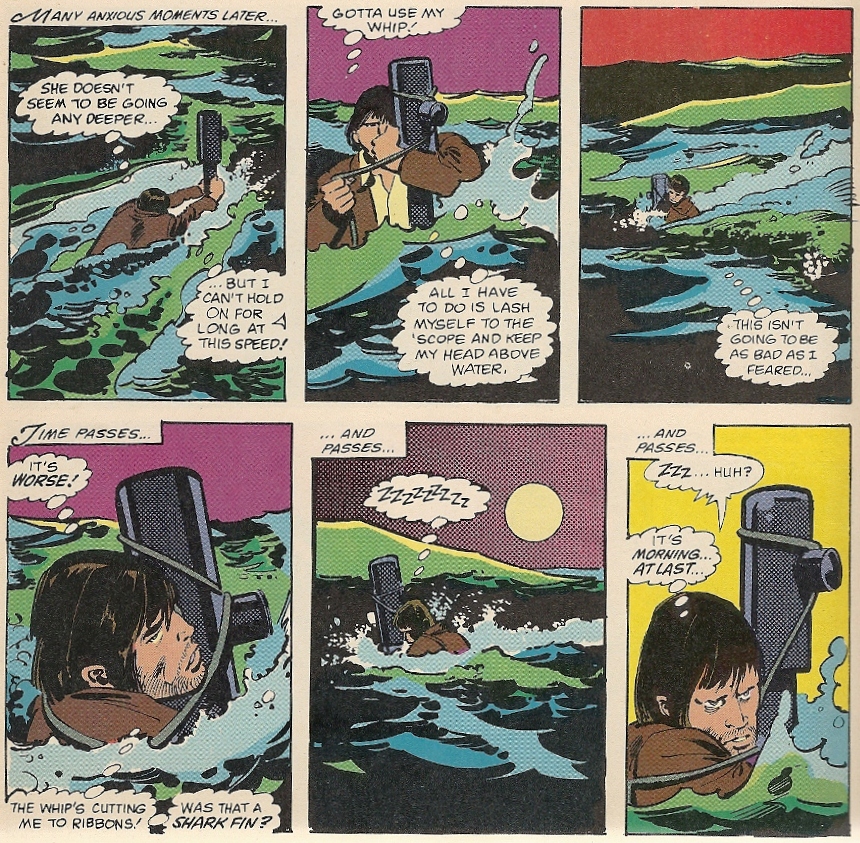
In a tale centered around the globe-hopping pursuit of an Old Testament relic that melts people’s faces, that may be the biggest imagination stretcher of them all. And it looks like Jones is turning into Conan in that last panel — and that he might see the crazy castaway from “Tales of the Black Freighter” floating the other way.
At this late date, I deem the Raiders of the Lost Ark comic a rousing success. It’s a different look at, or an alternate aspect of, something that’s been chiseled into the architecture of our collective consciousness, and it stands high above the other offerings thus far profiled in this month-long retrospective. I’ll grant that a good deal of the work was done before pencil ever touched paper. A rising tide raises all boats, and Spielberg et al brought the water level up to undreamed of heights. Still, there’s an unbridled fun to the comic, something only possible before blockbuster marketing machines really got ramped up and sanitized all movie paraphernalia. My long-overdue thanks to all involved for throwing this log on the Bonfire of Awesome.
One more Super Special to go. It matches Raiders, but it could never surpass it.

Vacation slides not rendering your guests insensate fast enough? Try a Casper the Friendly Ghost Tru-Vue projector!
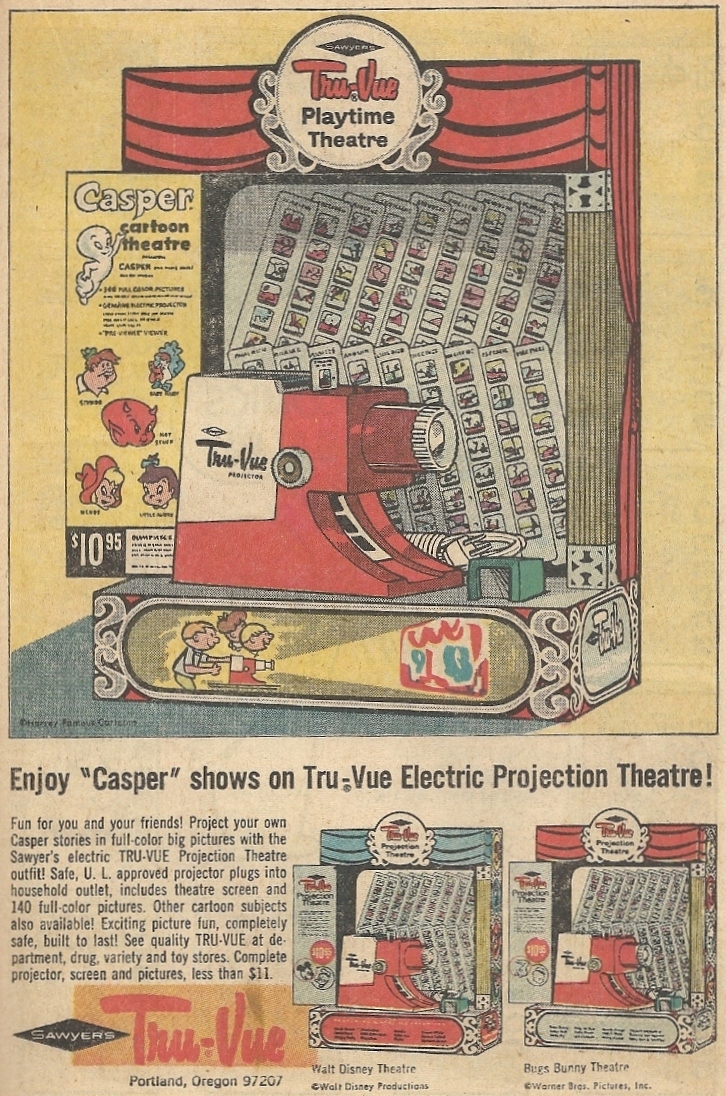
If there’s one thing that I can guarantee would get a person to self-immolate like Ted Striker’s Indian seatmate, it’s Casper slides. The above Tru-Vue Electric Projection Theatre, which was sort of a communal View-Master, could very well have been substituted for the Kool-Aid in Jonestown.
The Joker meets the Creeper in the Crazy Laughing Outhouse Rat Nutcase Olympics – The Joker #3
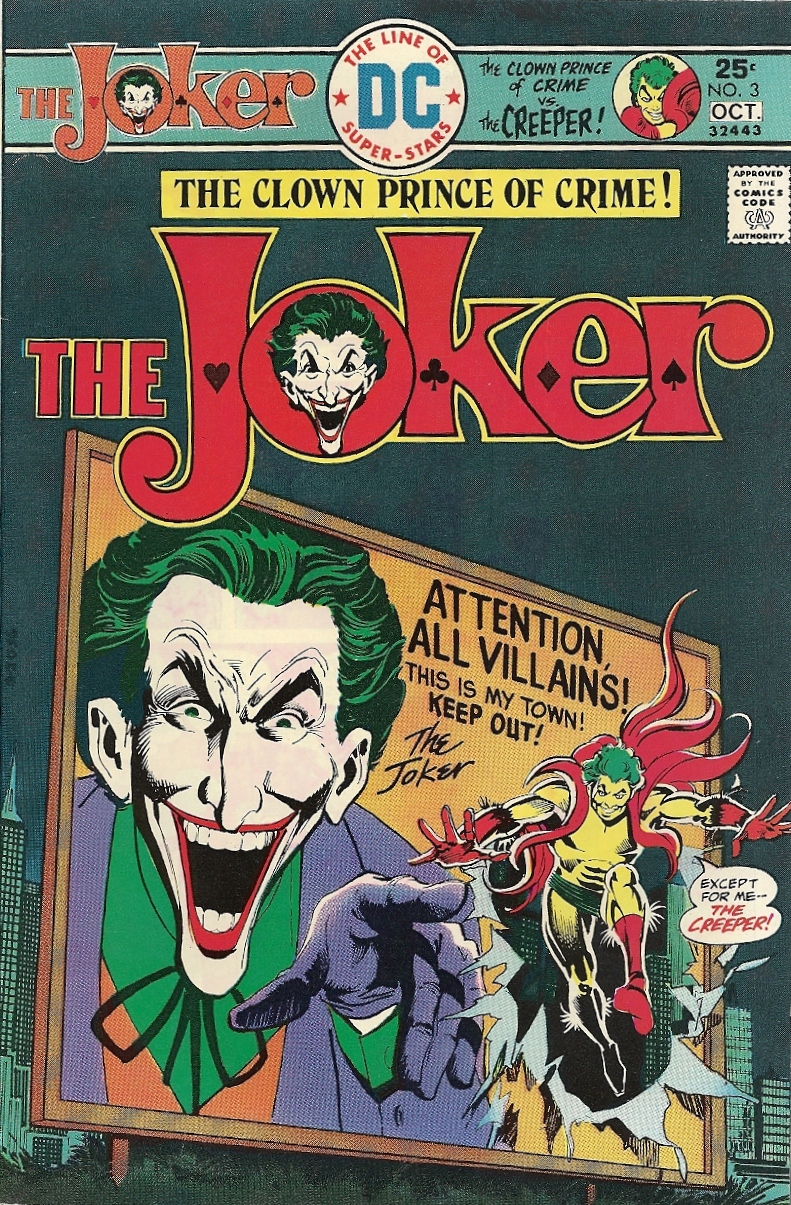
Okay, who wants to bet which of these fruitcakes is the first to start cartwheeling around in a Daffy Duck WOOHOOWOOHOO conniption? And what’s the over/under going to be on how many pages before it happens?
Any time a villain is the star of the title, there’s a built-in interest factor. Instead of the hero foiling the baddie of the week, it’s the baddie getting foiled by the hero of the week. HEY, THAT”S DIFFERENT. There’s perhaps no more pronounced exemplar of this sub-genre than the Clown Prince of Crime’s short-lived (nine issues) 1970s series. The Joker is the comic book villain of comic book villains, so if there’s one to occupy the top of the marquee, it’s him. (Some might say that dubious villainus supremus honor belongs to Lex Luthor, but he doesn’t have green hair or red lips, now does he? “Sit down, baldie. And get some lipstick.”) And this series continued the Denny O’Neil and Neal Adams updated interpretation of the character as a crazy killer, a trip back to scarier roots that made him more John Wayne Gacy and less Bozo.
There are no murders in this installment (Cover: Dick Giordano, Script: Denny O’Neil, Pencils, Ernie Chua (Chan), Inks: Jose Luis Garcia-Lopez) , which has the Joker matching wits with Jack Ryder’s alter-ego loony. In fact it’s very silly, more worthy of the Joker capers of an earlier time. I’m not sure what to make of it. But hey, the two leads can compare green hair rinses in quieter moments. There is that.
The impetus for their meeting is, no surprise, a Joker crime-spree, stealing various goofy yet valuable objects. In the first he pilfers a yellow clown mask and does away with Armed and Dangerous rent-a-cop rejects using, naturally, laughing gas and oversized gavels:
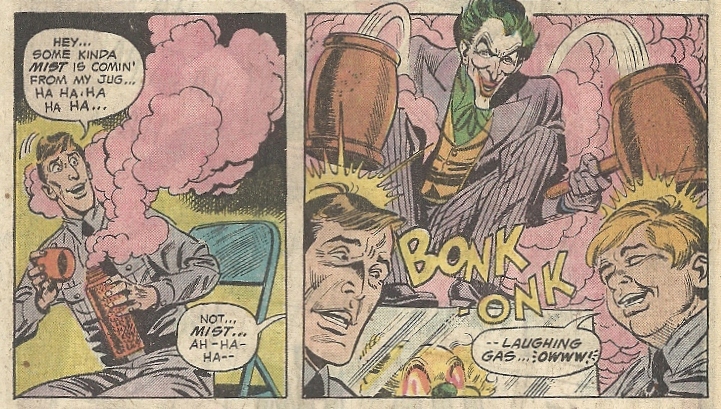
POINT OF LAW.
In the second crime, the theft of an ancient joke book — Latin jokes, which one imagines must be real knee-slappers — it’s a scrap-yard magnet that does the trick. Apparently these Paul Blarts thought a nighttime detour through such a known crime hangout (construction sites and scrap-yards are the Wi-Fi hotspots of the underworld) would be a good idea:
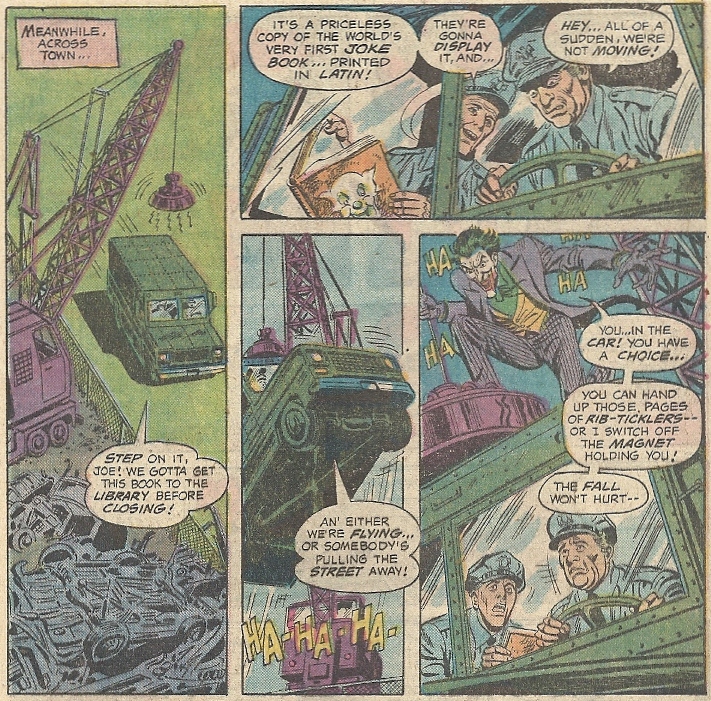
The Creeper is on the case, though — he was blamed for the first crime because someone saw the yellow clown mask that a gas-obscured Joker was holding and thought the Creeper was behind everything — and they engage in asylumish banter and insane fisticuffs:

The Joker is presenting. YUCK.
Whenever I see the Joker fighting, my first instinct is to roll my eyes and think There is no way in hell that this skinny bitch could go toe to toe with anyone. Okay, maybe Arnold Stang. Then I think back to all the fights I had as a kid with my dumber peers, and how they were always the scariest people to tangle with. Too stupid to know any better. And that’s the case with the Joker. Here, just when he looks like the Creeper is about the give him the Ned Beatty Deliverance special, he turns the tide, garrotes the Creeper into unconsciousness (and amnesia) and wins the day — or night.
He makes the Creeper his slave and goes back to his goofy lair, where he relaxed by reading the most transparent Peanuts parody that the world has ever seen:

I wonder what the Cashews universe’s Snoopy-proxy is like. Would they make a pencil-sharpener in his image? The mind runs wild…
The Joker’s such a fan of the strip, he enlists the Creeper’s help in kidnapping Cashews artist Sandy Saturn, which is accomplished with little difficulty. Oh, and look, the Joker has a Batman punching bag! (You know what? OF COURSE he does.):

The odd Billy Batson cameo above begins activating the Creeper’s old memories, while the Joker unleashes Saturn’s dark side in some commission work — it turns out being kidnapped by Gotham’s worst criminal can be a bundle of joy:

And a deep, abiding friendship is born.
Then comes the final showdown between our two stars (one that’s interrupted when the Creeper turns back into Ryder and then back into the Creeper in a plot device that is far beneath Mr. O’Neil — let’s leave it at that.) The great Russian writer Anton Chekhov once said this: “If in the first act you have hung a pistol on the wall, then in the following one it should be fired.” Applying this to comics, if your comic has a Batman punching bag, it must be used to KO the villain by the end of the issue. CHECK AND MATE:
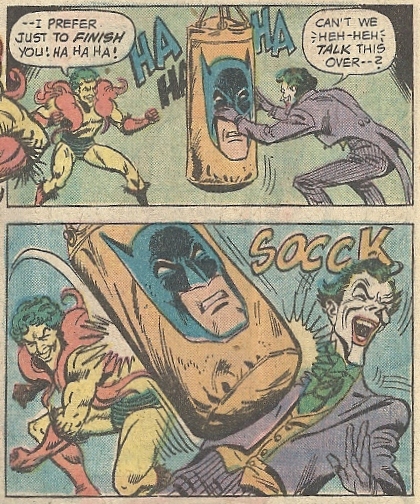
And that’s it.
Both these guys are too crazy to care. Like boxers that charge at one another with no bobbing, no weaving, and start windmilling punches and don’t stop until one of them collapses either from a beating or exhaustion. And when the Creeper is the sane one in any equation, you have an overabundance of cuckoos on your hands. I suppose their mixture could make for good reading, but it doesn’t here. This plays like filler, and O’Neil, who’s great, could and can do much better. And the Creeper, in the right artistic hands, can make for striking visuals. Not so much in this instance.
That said, the secondary items that make this story worth the read. “Charlie Cashew.” Billy Batson, the nervous WHAM-TV newsreader. The Batman punching bag. These are the garage sale selections that can turn comics into an enjoyable experience even when the comic book proper is a bit of a bore.
This story was reprinted in the Greatest Joker Stories Ever Told collection released almost a quarter of a century(!) ago. I’m not sure how it made the cut. If it had been the Greatest Batman Punching Bag Stories Ever Told, well…
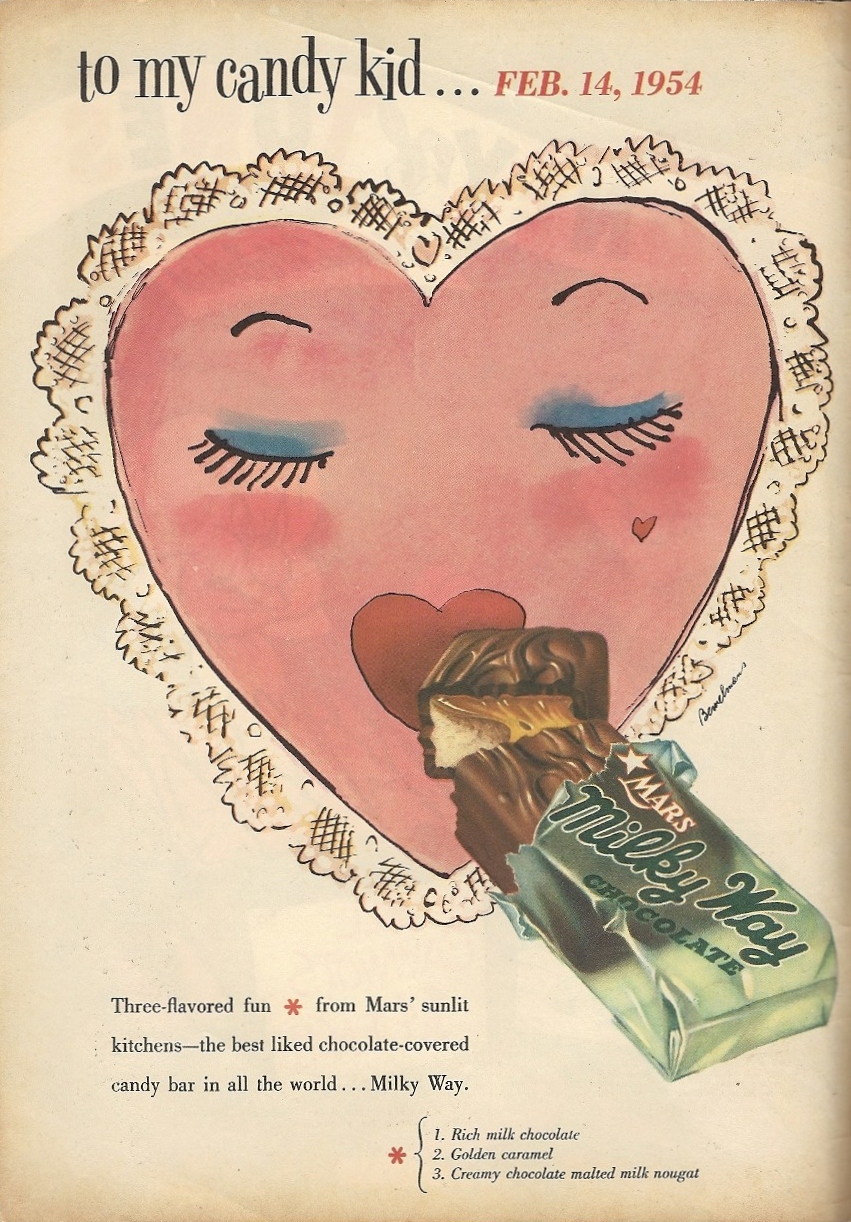
The pink heart. The flushed cheeks. The heavily lashed eyes closed to better savor the ecstasy. A chocolate bar meeting the red, luscious lips….
Your not-all-that-subliminal blowjob imagery of the week, ladies and gentlemen, courtesy of 1954’s Madison Avenue. You don’t have to be Don Draper to decode this one.

The kid looks like his father just came home drunk and yelled at him. Or his dog died. Or he’s moving soon and never going to see his friends again. Or he’s in a Spider-Man PSA comic. I think his face says it all, though the rumpled shirt and sweater are certainly adding their voices to the chorus. Whatever you do, keep this kid away from his Daisy BB gun.
Maybe playing with toy trucks and toy tanks and toy boats and what have you isn’t the childhood joy that it’s cracked up to be. “Daisy/matic: THEY MAKE YOU WANT TO DROWN YOURSELF.”
Maybe the Jet Car can phase us out of here – Marvel Super Special #33, “Buckaroo Banzai”

We move into the Marvel Super Special March homestretch with this adaptation of a true cult classic, one that carried its loyal fan following from the 1980s well into the next millennium. Starring Peter Weller in his pre-RoboCop days, The Adventures of Buckaroo Banzai Across the 8th Dimension (often mercifully shortened, as in this adaptation, to Buckaroo Banzai) was a film with an ambitious mythology, a movie that sought to lauch a film franchise by throwing every wild idea at the screen that could be mustered. The eponymous lead is a scientist, a rock star, a philosopher, a fighter, a lover, and whatever else you can think of, a Renaissance man amongst Renaissance men, with a loyal cadre of fellow-travellers (the Hong Kong Cavaliers) and followers (the Blue Blaze Irregulars) to spackle in whatever quirky holes are left over after taking into account his eccentricities.
The movie’s a mouthful, and it was a nerd buffet.
Confession: I’m not a fan. I’ve only watched the film once, about eight or nine years ago when I was tearing though the Netflix red envelopes at a ferocious pace. I’d heard so many good things about Banzai. Its energy. Its ambition. And I was COLOSSALLY disappointed. I’ve only been put to sleep by a few films in my day (Fritz Lang’s Metropolis was like a bottle of NyQuil, a late night screening of The Thin Red Line ended with me waking up in an emptying theater), but Banzai sent me down for the count. I couldn’t invest anything in any of the characters. ANY of them. And I love Clancy Brown, and perk up any time he and that terrifying baritone of his boom show up. But no dice. There was nothing on which you could gain a foothold. And that’s one of the biggest problems.
There are roughly a hundred characters in Banzai, all with obviously dense backstories of their own somewhere out in the ether, which all tie together into some supposedly awesome sci-fi/pop culture fictional extravaganza. Supposedly. Unfortunately, none of those histories are explicated anywhere. The movie hits the ground running, and prior events are left unexplained, which, granted, could mean that you’re skipping a lot of horrid exposition. But for the viewer — at least for this one — that means you feel like the doofus loitering at a party where everyone else is friends and they’re laughing at inside jokes that have been cultivated for years, and you’re left laughing along at things that are apparently funny but you have no idea why you’re laughing and that leaves you pissed. The Red Lectroids are the followers of John Lithgow (hey he was in that crappy Santa Claus movie too) who is an old partner of the Asian guy who worked with Banzai’s parents who were killed by the evil Hanoi Xan who is Banzai’s arch-enemy but he isn’t in this movie and the red guys are the rivals of the Black Lectroids which are Rastafarians and look here comes Jeff Goldblum in ridiculous cowboy attire GET ME OUT OF HERE.
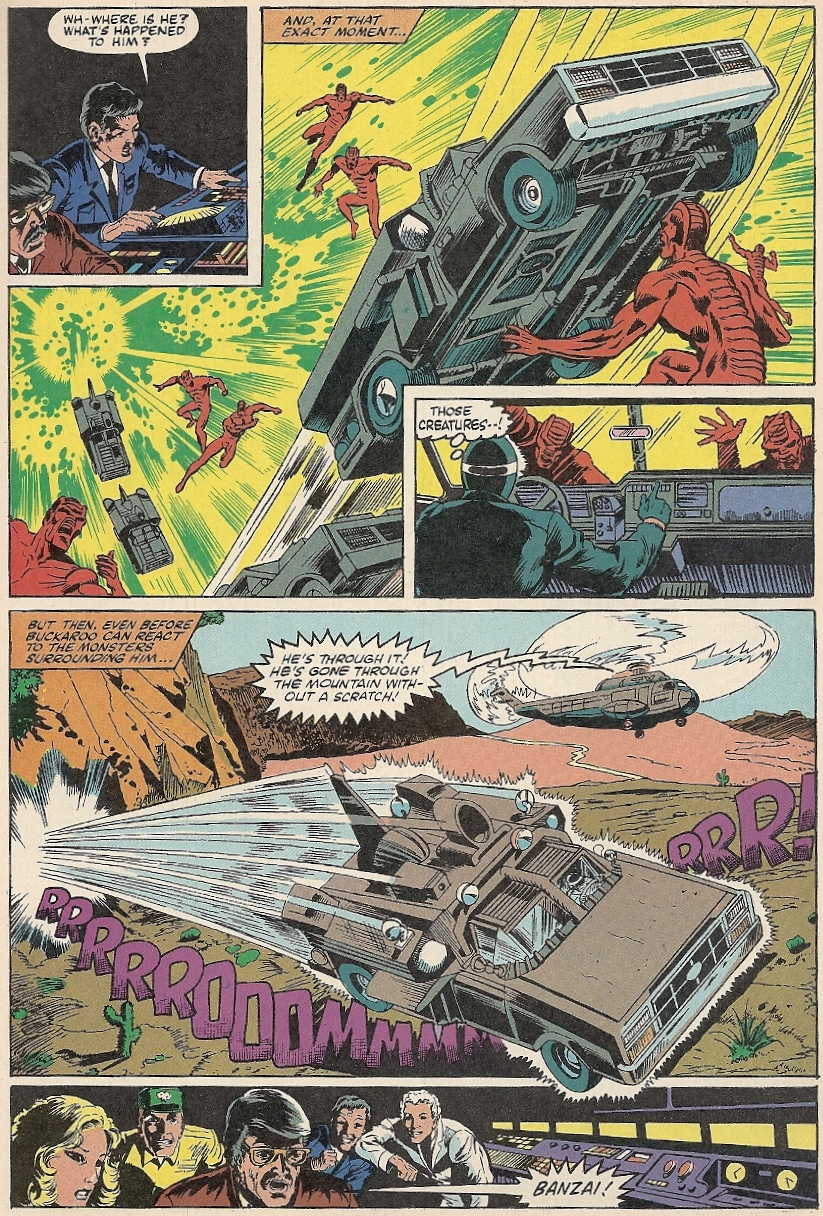
The comic is faithful in this regard: it was a chore for me to read, despite scripting from the normally reliable Bill Mantlo and pencils — and a nice painted cover — from a young Mark Texeira (Armando Gil contributed inks). Yes, there are the chunks that might intrigue, like Banzai test-driving his rocket car, phasing through a mountain and seeing monsters along the way:
But then you get eye-glazing dialogue like this that makes you set down the mag and pinch the bridge of your nose — and down a scotch:
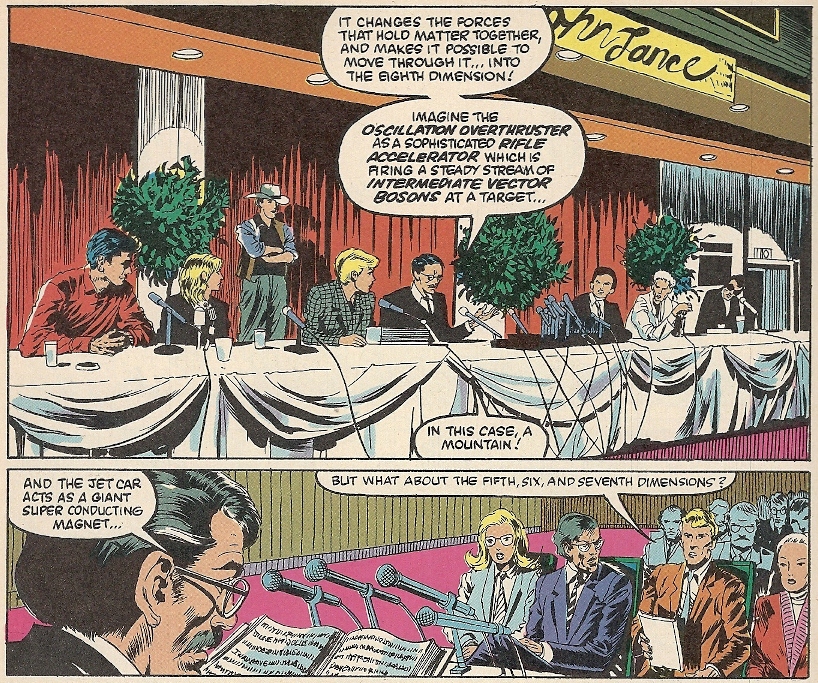
Both the movie and the adaptation jump around so much you can never get your bearings, or, even worse, care. It tries to do too much. Just because you can build a phone that makes toast doesn’t mean that you have to build a phone that can make toast, you know? There are too many plates spinning, and what’s worse, a lot of them are spinning offscreen. It feels like the better story happened back in the fictional past, and we’re getting the leftovers.
That said, I certainly don’t begrudge others their fandom for the Banzaiverse. To each their own, different strokes, and all that jazz.
In the back there are the rote behind-the-scenes photos and interview, though it’s all a tad more intriguing in this instance because of the feeling that this movie could be the tip of a fictional iceberg. The film’s director/producer/éminence grise, W.D. Richter, is the interviewee, and it’s a bit heart-rending as his passion and hopes for the future seep through the black and white. Perhaps this paragraph, towards the end, sums it all up best:

There have been no further Buckaroo Banzai films. ‘NUFF SAID.
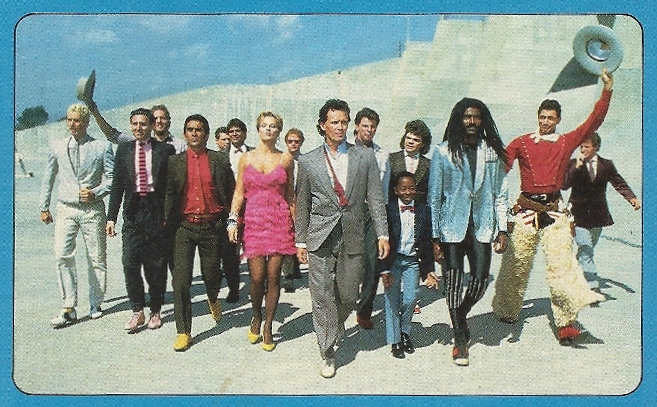
Despite the general lethargy from this corner about the film and the comic, there was one screen sequence that I truly, genuinely adored. It came in the end credits — and there’s no I WAS JUST HAPPY THAT IT WAS OVER HAHAHA dig here — as the Hong Kong Cavaliers et al made their curtain call. It had a fun, straight-forward and light-hearted energy. And focus. I liked it, and was glad to see a photo of it reproduced on the back cover of the Super Special. I offer it here so that this post can end on a positive note:
Neal Adams, Flash Farrell and their wide-eyed journey through the Defense Department publicity machine

There was a whole series of these Neal Adams “Flash Farrell” Goodyear ads back in the 1960s, which appeared both in comics and in other youth-oriented publications. I found this one noteworthy, not so much because of Flash’s Jimmy Olsen élan, but for the redundant “guided tour aboard a nuclear submarine” phraseology. Is there such a beast as an unguided nuclear sub tour? Could camera-toting tourists with thick Slavic accents come onboard in the 60s, clipboards and sketchpads in their hands, and aimlessly wander from stem to stern? “Vhere is the reactor on this vessel? As a simple bourgeois American, I vould like to sketch it. Rock-n-Roll! Elvis Presley!”
Anyway. This ad seems like a long way to go just to advertise a Wingfoot 175 bike tire. “We can blow up enemy subs, so please put your baseball cards in our spokes.” But other companies have gone to odd lengths in similar promotions, so…
The Man in Black Called Fate (Sucks) – Thrill-O-Rama #1

I recall years ago reading an article about the old Harvey character of Fate and his eponymous title. It was in Comic Buyer’s Guide or some similar publication — can’t remember which one exactly. Anyway, it was a laudatory summation, one that praised the shadow-shrouded gent, and it was even suggested that he’d be ideally suited for a modern (re)interpretation from Neil Gaiman or a Gaimany substitute. I can’t remember what the basis was for that. But it was in there.
I filed away those positive words, and it was only a few weeks ago that I stumbled across this first issue of the inaptly titled Thrill-O-Rama, which rehashed the sporadically appearing 1940s and 1950s character for a 1960s audience. That earlier praise had me going in thinking that I’d be getting some watered down Wolfman/Colan Tomb of Dracula excellence. (I expected this for no other reason than Fate and Dracula have similar sartorial predilections and Tomb of Dracula was pretty darn good. I am stupid.)
I was WAY OFF.
Don’t get me wrong. Fate could be a cool character in a limited, well-crafted dose. But as he is, he’s pretty bad. Fate and his lame cohorts as shown in this comic — the Weaver and Cupid and Venus — formed a kind of reality TV cast before reality TV, fighting and arguing in a most undereducated manner. When I say “Reality TV,” I mean the current trend of reality TV that’s centered around an offbeat business, since Fate, at the behest of the Weaver, tampers and manipulates people’s lives — which is their family(or whatever)-owned enterprise. Think the American Chopper idiots. Hardcore Pawn. What have you. Though really the dumb reality dynamic could draw from the entire genre. Weaver and Fate Plus 8.
Witness this bickering panel from the first page (Bob Powell art, Otto Binder(“?” according to the GCD) script):
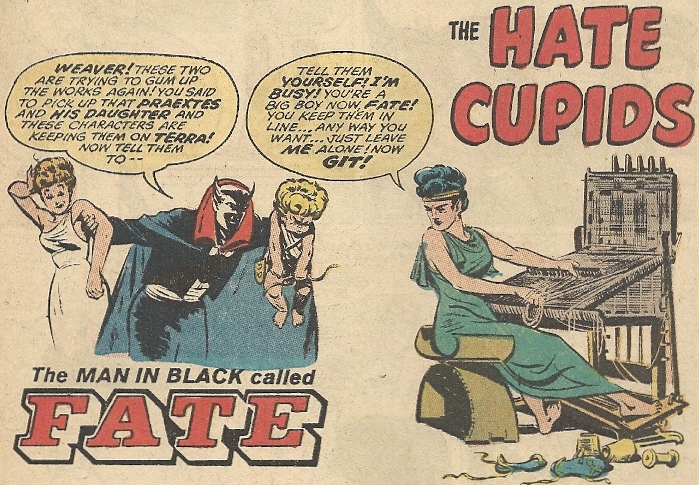
Fate, Venus and Cupid (the Joe Simon cover — and THE TITLE OF THE STORY ITSELF — advertises Hate Cupids, but all we get is one of the regular brand) in this mercifully short story play games with the destiny of a poor, hapless Greek sculptor. Entangled in the court of Saladin, it’s decreed that if he strikes a statue wrong and shatters it, he and his daughter will be condemned to death. If he strikes it right and it remains intact, their lives will be spared. SEEMS FAIR. Of course, this sap has no idea that juvenile morons can arbitrarily steer him to his doom, or that his existence is cause for much levity among these vaguely defined deities. What makes it all the more insulting, it’s an occasion to break out phrases like “dirty pool” and “THASS RIGHT, HONEY CHILE!” I am not exaggerating:
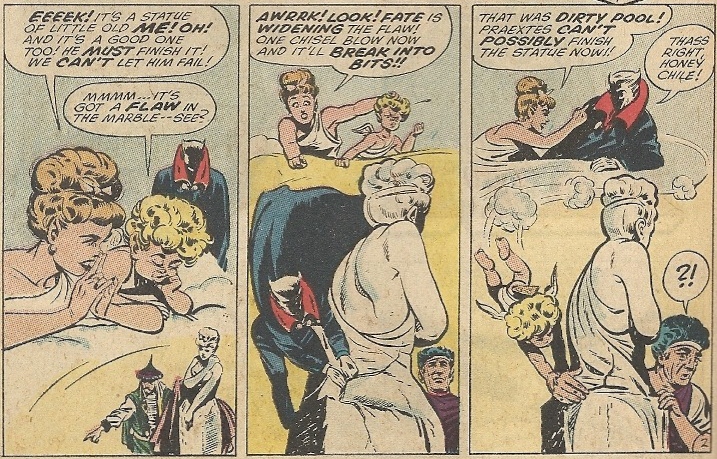
I’m glad to report that, despite Fate’s best efforts to send this poor mortal bastard to his death, a stray slap on an ass spares his life:
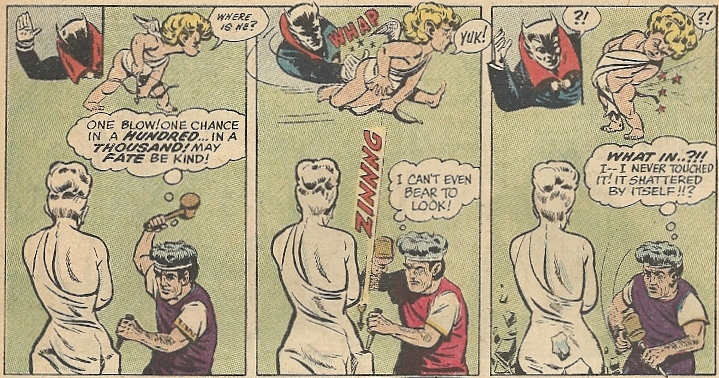
And he lives to chisel another day.
There is no way to adequately quantify what a douche-chill these five pages are. You wince when you read them. “Honey chile.” Yeesh.
In fairness, this isn’t the only context in which we see the Man in Black. Fate works much better as a presenter of short “What if?” vignettes — think Alfred Hitchcock and/or Rod Serling:
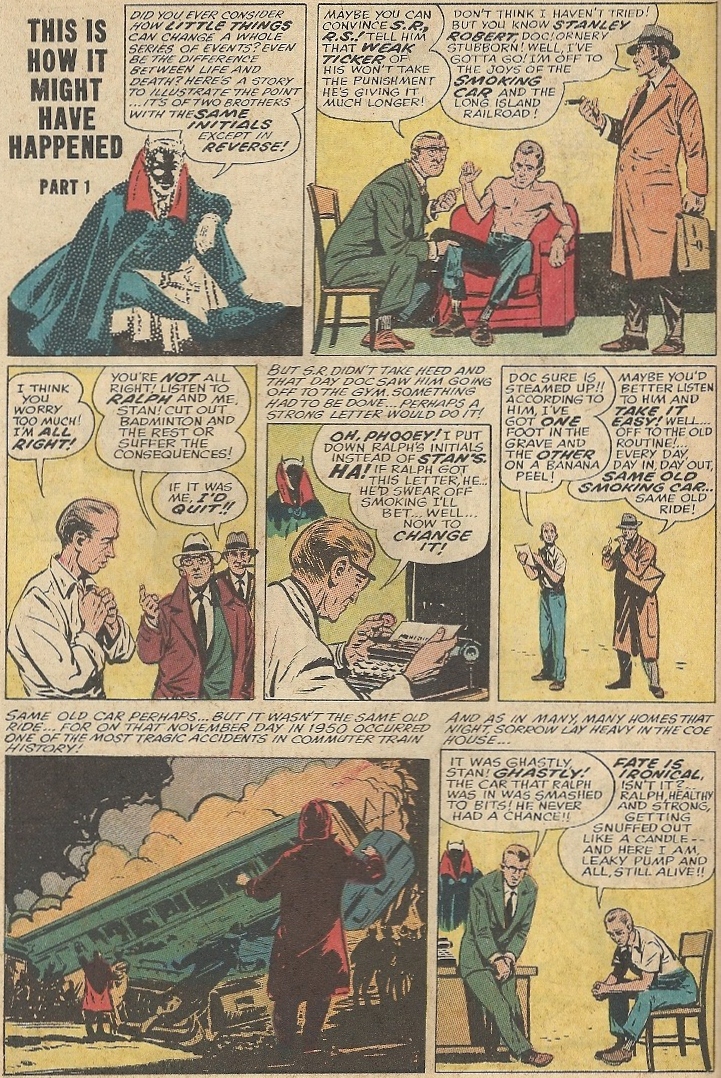
If the book just kept Fate to this, a Night Gallery without the paintings, he’d work. As the star of his own show, with a supporting cast akin to feeble-minded Kardashians, he’s a dismal, wretched failure. Despite his FANTASTIC clothes. And despite whatever that years old article was yammering on about. THASS RIGHT, HONEY CHILE.
Bob Davies of the Rochester Royals recommends that you eat your Wheaties and wear a giant belt with your basketball shorts

Did you know that there’s a whole kernel of wheat in every Wheaties flake? No? Well now you do.
I have more than a passing interest in the history of the NBA, but I had no clue who the hell Bob Davies was. I’m sure he was a real mensch, but I couldn’t have picked him out of a lineup of one, and I’ll forget the little I’ve learned about him writing this post as soon as I’m done with it. He’s immortalized in this 1954 Wheaties ad, though. That’s something. (However, with all due respect, he’s a definite fame downgrade from Bob Feller and Hank Greenberg, his old-timey baseball cousins. )
Edify yourself at his Wikipedia page if you’d like to learn more about him and the game of basketball after nets replaced peach baskets but before drawstrings were invented.
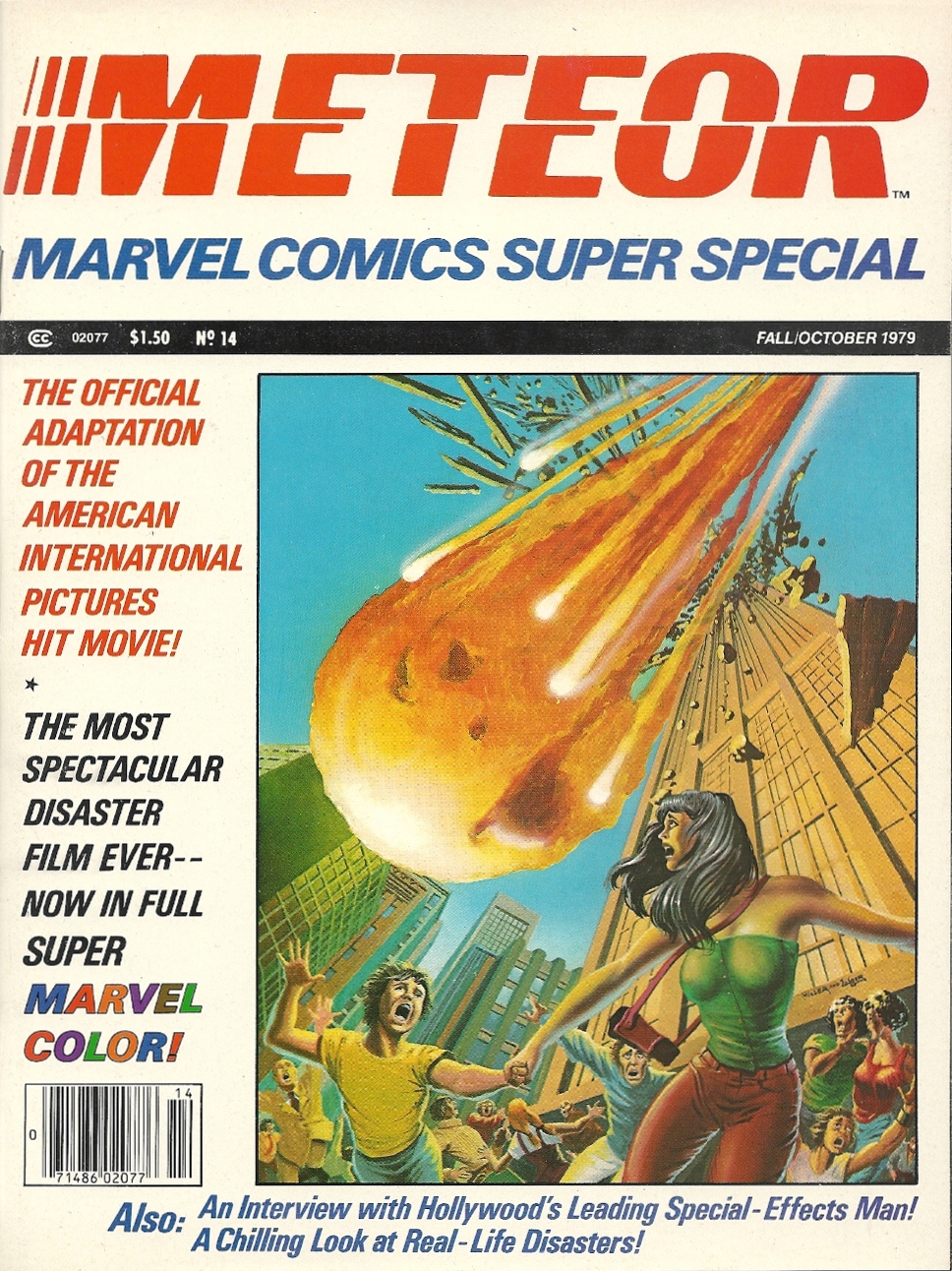
That’s a Frank Miller pencilled cover. I wanted to put that out there, because there’s not a whole lot about it that says “Frank Miller.”
Marvel Super Special March chugs along with this 1979 adaptation of one of the disaster movie genre’s worst duds. If you watched Deep Impact and Armageddon in 1998 and thought that they were terrible — well they were, but Meteor was worse. It lacked everything. Thrills. Excitement. Decent effects. Actors that seemed to care. Starring Sean Connery, well into the career trough that would only see true resurrection with The Untouchables and the accompanying Academy Award, it had scientists and Cold War rivals coming together to try to avert an extinction-grade collision with only nukes and excruciating boredom in their arsenal. It also had a small role for Henry Fonda, who seemed to show up to collect a check in all these crappy disaster flicks.
The last entry in this Super Special month was The Last Starfighter. I suggested that, in light of that film’s poorly aged special effects, the comic had a chance to carve out its own identity, to have more staying power than the original. It didn’t. But since Meteor was so unspeakably blasé, this mag has a similar opportunity, but with a door that’s wide, WIDE open . And we’re helped that the late, GREAT Gene Colan pencilled this Super Special (from a script by Ralph Macchio, and embellished by Tom Palmer).
I’m happy to report that Colan makes the most of the chance. He goes wild with the scenes of destruction in the always imperilled New York City, and his visual sense gives scope that was inexcusably absent from the film. HOME RUN, BABY.
Before we get a taste of success, let’s get something out of the way. In every movie like this, the strapping hero, no matter how dire the Earth’s plight, has to carve out some time to get laid. Mr. Connery’s character is not excepted from this Hollywood diktat:

There. Done and done.
Nothing says “from a different time” quite like seeing the World Trade Center wiped out in a fictional conflagration. How many of us thought or uttered aloud the “It looked like a movie…” line on September 11, 2001 and the days — and years — afterward? This splash page, with a meteor decapitating the Twin Towers, bears a haunting resemblance to that terrible day:
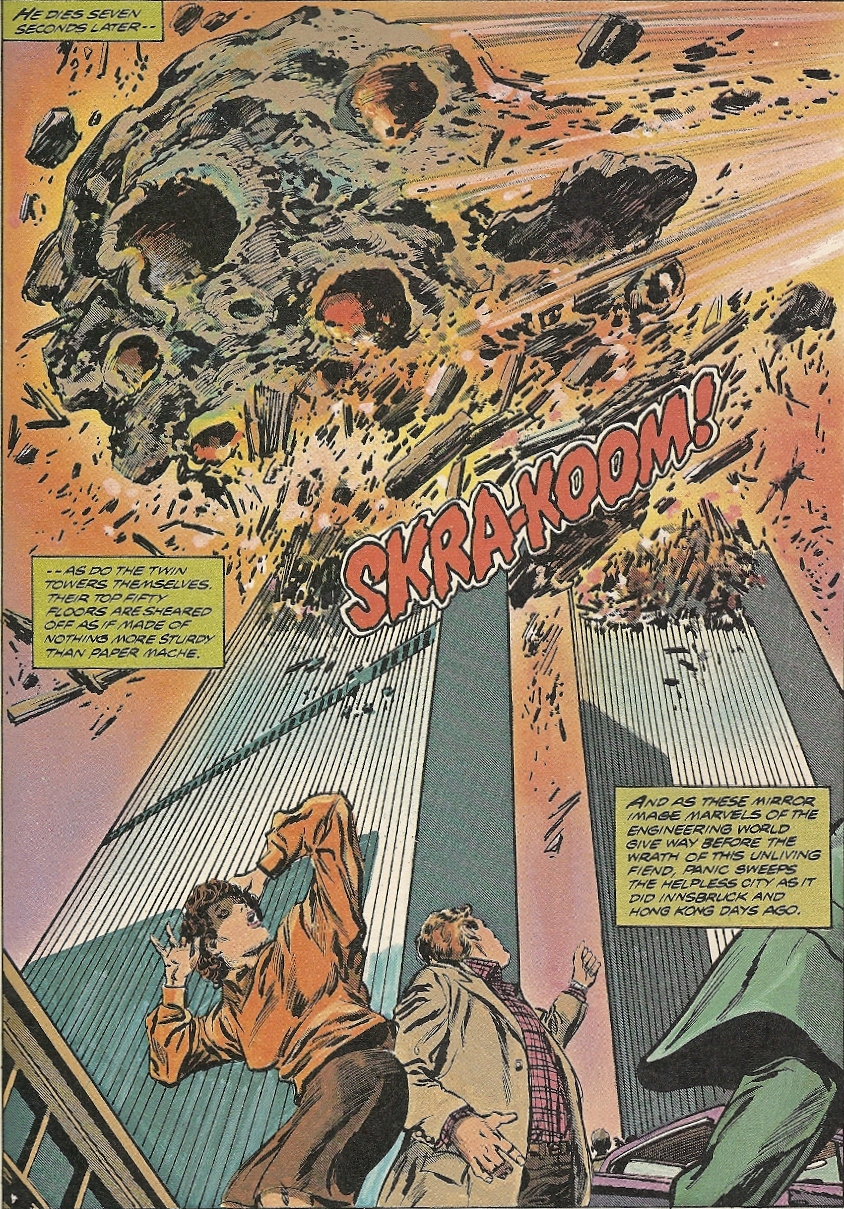
The Empire State Building gets a similar, if less retroactively painful, treatment, though the greater affection in which it has always been held means it gets TWO splash pages:
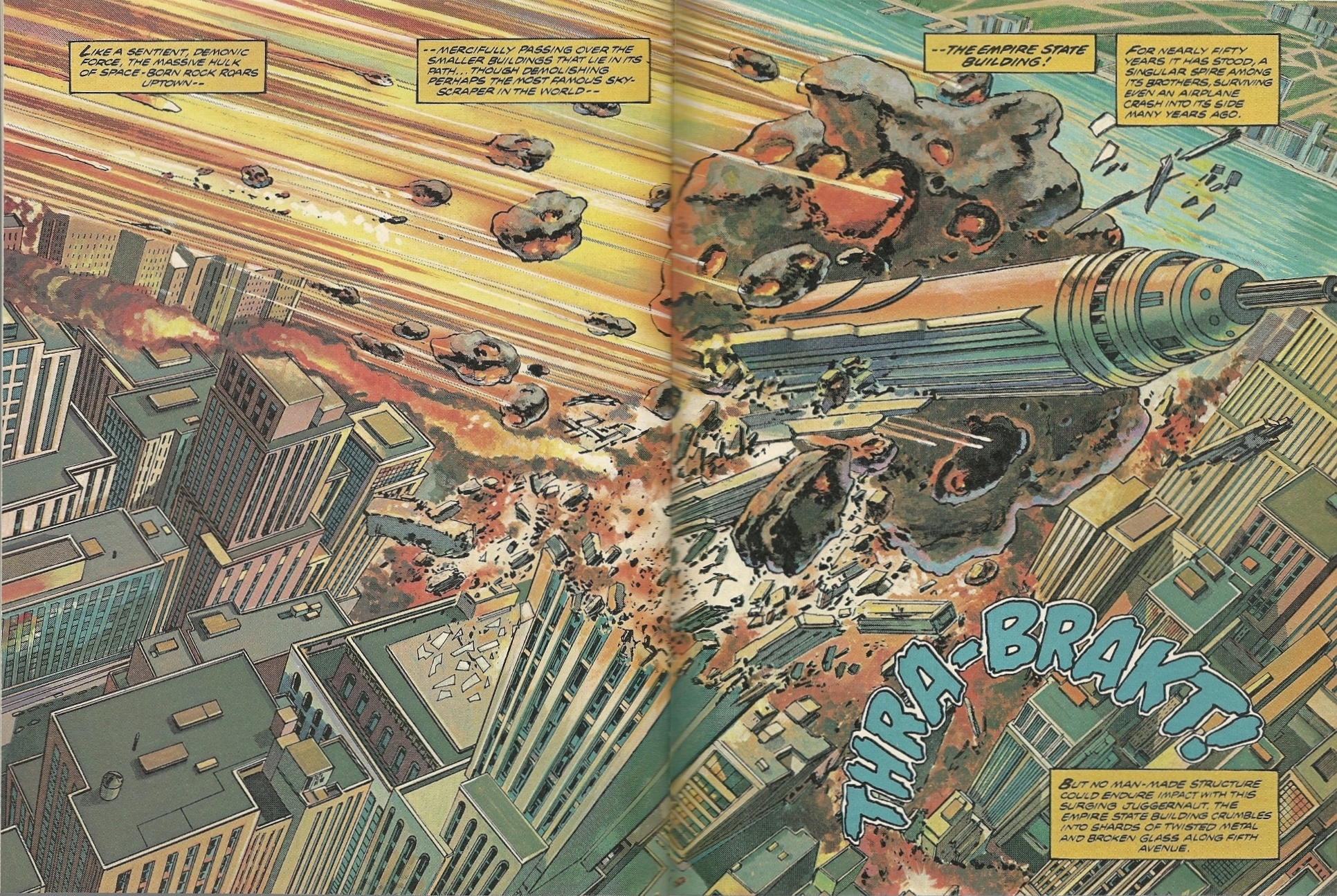
THRA-BRAKT! indeed.
If I have one quibble with this stellarly illustrated sequence, it’s that the meteor appears to be as nimble as the “magic bullet” in the Kennedy assassination, making the circuit of every NYC landmark whether they’re perfectly aligned or not. Here it is at its Rockefeller Center tour stop:

No sign of Omega the Unknown on the premises.
Colan is superb, as usual, crafting panels that make you feel like you’re craning your neck to look to the sky even though you’re staring at an open book in your lap. It’s a vertiginous skill he so often deftly employed in his Daredevil days, as the Man Without Fear battled foes high above the same New York streets. It’s a gift, and it’s all that’s needed here to elevate the mag above the movie.
The usual Super unSpecial junk in the back includes a chat with the special effects head on the film, fluff about actual catastrophes and a catalog of disaster films. This last item, a simple list of movies with blurbs about each, really makes some stretches about what films are included (Star Wars makes the cut because Alderaan went kablooey). The last entry is noteworthy simply because it reminds the reader that, if Meteor was at a low point in Connery’s career, it wasn’t THE low point:

Oh, you don’t remember Zardoz? Here’s a refresher:

Aggressive red suspenders diaper camel toe. HAVE A NICE DAY.
Corgi Boy: The Most Interesting Boy in the World

“I don’t often build models, but when I do, I build Corgis. Stay gluey, my friends.”
Aquaman’s HUGE RACK, Supergirl’s jealousy, and obligatory St. Patrick’s Day material – The Super Friends #37

When I first bought this comic, here’s the progression of thoughts I had as I looked over the cover’s personalities:
“Okay, Superman is doing his circus strongman ‘check out my guns’ routine. Wonder Woman apparently spent time in the American Southwest twirling her lasso in rodeos. The Wonder Twins conducting an impromptu séance– barf. Batman signing an autograph is a hell of a get — like getting Pynchon to sign your copy of V. And HOLY GOD AQUAMAN HAS BREASTS.”
Look at him. Yeah, maybe it’s just an optical illusion. Maybe he really has his arms crossed — that’s what I think is supposed to be going on, but his left “arm” looks too bulbous down at the elbow. Maybe one of his puffer fish friends taught him a thing or two. But check out the girl’s face. She’s staring right at the chestular area with wide, utterly amazed eyes. “I want to have high beams just like yours when I grow up.” And Aquaman looks so proud. So satisfied.
I DO NOT KNOW WHAT IS GOING ON HERE.
Alas, there’s no solution to this mystery (not the first Super Friends Aquaman head-scratcher) within, though there is some nice Supergirl superhero envy in addition to the Irish backup story. In the E. Nelson Bridwell-scripted and Ramona Fradon/Vince Colletta-artified feature, Linda Danvers brings a bunch of her “New Athens Experimental School” (her place of employment in the 1970s) students to Gotham City for that burg’s Nostalgia Convention, a field trip that may make her the greatest teacher in history. She arranges for her Justice League pals to meet them there and make the kids’ day, which would definitely make her the greatest teacher in history.
She soon comes to regret her largesse, though, as the Weather Wizard shows up, tries to pull a series of capers, and Linda realizes how low her Supergirl alter-ego ranks on the young idol hierarchy. To put it in NCAA March Madness terms, her RPI is low, and she’s a bubble team at best.
Wonder Woman is the first to draw the admiration of the youngsters, though Linda had made a quick change into Supergirl to help save the day:

And it only goes downhill from there.
At the convention (which features a nice selection of comic books, I might add — and no know-it-all John Byrnes to kill the buzz) the kids only have eyes for the bigger Super Friends:

Aquaman apparently exchanged his Jayne Mansfield knobs for an utter lack of wit. (And someone page Jacque Nodell — I’m sure she’d like to go through the 1950s romance comics behind the pissed off Linda.)
Can’t get any worse, right? RIGHT?:

Okay, I’m with her on this one. If Zan and Jayna are stealing the limelight from you, then you, my friend, have every reason to be livid. ACTIVATE MY ASS.
The kids never do give a crap about Supergirl, even after she helps foil the Weather Wizard as he (*gasp*) tries to steal many of the valuable comic books on display. But she does get the newspaper headlines, which sets everything right in her self-centered worldview:

Linda Danvers does NOT come off looking the best in this. Like a spoiled brat. Let’s leave it at that.
Ah. Yes. The St. Patty’s day Irish stuff. When I started pulling out the few scans to illume this post, I had every intention of giving Jack O’ Lantern all the respect he so richly deserves as an Irish superhero on the most “KISS ME I’M IRISH” of holidays. I was even going to leave out the obvious jabs at an “Irish Superhero” — the power to be thrown through a plate-glass window, the ability to at will change your skin color to red, et cetera. But Daniel Cormac, whose powers derive Green Lanternishly from a pumpkiny lantern, has stuff like this in his life:

I don’t want to have to deal with leprechauns that look like Madame. Neither do you. Go enjoy a beer instead. First round’s on Aquaman’s cover boobs.
Either put together a Gobot model or jab a butter knife into your skull. YOUR CHOICE.

“Hey Timmy, you know those crappy B-grade Transformers wannabes? The clunky ones devoid of personality? Well, now you can get models of them, so that you’ll have to snap and glue them together before they can bore you to tears and you throw them in the garbage!”
Turns out the real “Challenge of the Gobots” was relevancy, as they were the Betamax/MiniDisc/HD-DVD of 1980s transforming robot toys. There was no bigger fan of the Transformers fan than me, but I looked upon the Gobots as shadowy interlopers that probably carried some dreaded disease on their fetid rags. And if someone had set a Gobot model kit in front of me, I might have immolated myself in protest.
 Jared
Jared


 blog into mystery