Let’s be honest: Most of the world totally wanted Cyborg Superman to rip Leather Superboy’s head off

Other than that it was a colossal waste of time (much like the interminable “Knightfall” saga), the only other lingering memory that I have from the post-“Death of Superman,” post-“Funeral for a Friend” “Reign of the Supermen” was that I wanted someone — ANYONE — to put the earring-wearing Superboy over their knee and spank the living hell out of him. This ad (and the cover that followed it) was a decent substitute. THE GENOCIDAL CYBORG SUPERMAN SPEAKS FOR ALL OF US.

Robert Crumb. R. Crumb. Crumb. There has never been an artist in the comic book industry — under or above ground — who has had such a capacity to simultaneously inspire and repulse. To know his work is to at once marvel at the all-encompassing expression of his talent, while at the same time lamenting his art’s degradation of women and minorities — hell, anything with a pulse. As you sit in awe of a deft hand that could turn cross-hatching, because of the fetishistic intensity with which it was wrought, into something more than just the illusion of shadow, you stifle the gag reflex when confronted with sexual perversion that looks like what would happen if Escher were a sex fiend and had a thing for the funny pages. There’s a vicious yin and yang to the work.
R. Crumb. The man, the myth, the legend.
Like many people not of the counter-culture generation, or who grew up in the sticks and wouldn’t know an underground comic if it bit them on the ass, my first sampling of his world came in the unspeakably compelling 1994 documentary Crumb. (I’m sure I spotted a Keep on Truckin’ mudflap or two during any of the interminable family car rides of my youth, but we won’t count that.) Crumb has the distinction — along with Schindler’s List — of being a film from which I quite literally could not tear myself away. I first saw it on cable in the ’90s, back in the days before DVRs that let you pause what you were watching, and it didn’t matter how bad I had to piss or who thirsty I was, there was no chance in hell that I was getting up and missing a second. If you’ve seen it, you know of what I speak. You start delving into the world of this small, strange, shy, but disarmingly sweet man (with glasses so thick it’s like he’s looking at you through an aquarium), you start thinking he’s the weirdest goddamn son of a bitch you’ve ever come across in all your born days, and then you meet his family. The brother that sleeps on a bed of nails and the other one that never leaves the house and talks openly about his suppressed pedophilic inclinations. And the mother. And then your head feels like it’s going to explode. It’s the very definition of engrossing.
A sequence in the film always stuck in my head. It was a simple, non-sexual part that burrowed in there — yes, even more than that one brother who swallowed a string bit by bit so he could pass it bit by bit. And I’m probably not alone. The dark cloud that hung over the movie’s runtime was Crumb’s dissatisfaction with American culture, and his impending move, wife and child in tow, to the south of France. There are any number of times where he talks about the bankruptcy of modernity, the sameness of everything, the hideousness of the urban landscape’s power lines and fast food joints. And then, in one charming minute, some of his old art drives the point home, as we witness the concomitant decay that comes with progress in “A Short History of America”:
You know, I have a hard time understanding or getting behind women with no heads being gang-banged. But this, this I understand. And admire. It’s not overly complex. It’s a simple conceit. But it’s powerful. (Maybe the piano helps a little, too.)
And this brings me to this post’s comic. Mr. Natural #1 is the oft-reprinted (the one I have is the 10th reprinting or later — the Grand Comics Database tapped out of listing them after the 9th) first solo book of one of Crumb’s most venerable creations. The book has a number of the short-form strips that Crumb did oh so well (including one where the philosophy-spouting Mr. Natural drives fellow Crumb character Shuman the Human to distraction), but also has some deliciously different content. An illustrated text feature written by Crumb chronicles the fictional biography of the not-so-great sage, and he also cooks up some fake fan-art submissions in a phony “draw Mr. Natural” contest. It’s a fun read.
Of course, the last story has Mr. Natural fellated (twice) by a huge, large-breasted baby…
Now, to tie this all back in with the “Short History” sequence. “Mr. Natural’s 719th Meditation” is the first multi-page strip in the book, and it’s an earlier and slightly different view of the march of progress that we watched above. It opens with Mr. Natural picking out a stretch of desert ground and having a road built in front of him:

Then a city (complete with a Denny’s) springs up all around him, until a policeman appears and triggers an Earth-shattering yoga chant:

The last page has a post-apocalyptic waste swirling around him, and then, once things are back to where they were in the beginning, Mr. Natural whistles his way back from whence he came:

Is this deep? Shallow? Is Crumb wishing he was Mr. Natural? Would he want to tear it all down? Is it a comment on the transitoriness of human existence? Does the police officer, with his threatening phallic club, symbolize the oppression and the sanitized savagery that inevitably come with modernity? Is Mr. Natural, with the robe and big beard, God?
I don’t know. I don’t care. I just like it. A lot. It’s a companion piece to the later “Short History.” Maybe it’s not the objective peak of Crumb’s oeuvre, but it is for me. And it made this old underground book all worthwhile. More than worthwhile.
I realize I haven’t exactly furthered Crumb scholarship in any way with this post. I just wanted to put my two cents of homage in.
An addendum: One of the most endearing things about Crumb is how his comics career started in his youth, as he and his brothers drew lessons from the funny books they read (including the Carl Barks Donald Duck comics) and ported them over to their own homemade books. (Even his infamous X-rated creation Fritz the Cat was based on a family feline that was the subject of inter-house storytelling.) If the back cover proves anything, it’s that you can never get very far from your roots. Here’s Crumb, giving us an update on the latter days of Terrytoons veterans Sourpuss and Gandy Goose:

The man has always had his charm. The good thing about Crumb nowadays is that, if you like his stuff, there’s no shortage of collections to delve into. The Book of Mr. Natural contains this comic’s material as well as a whole lot else, and in 2010 it had a new printing. You might have to look at some pages through your fingers, but that’s the price you pay. Because it’s worth a look.
Spider-Man’s stocking was hung by the chimney with care…
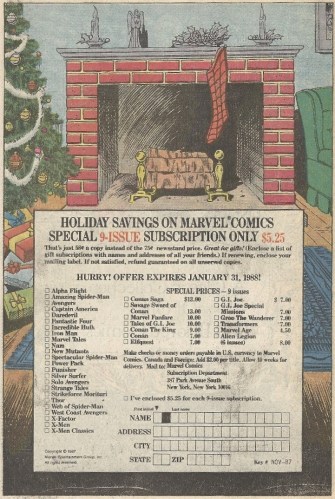
…in the hopes that subscriptions soon would be there. (Though hopefully not delivered by Santa Kingpin.)
I don’t know what it says about my powers of perception that it took me far too long to figure out what it was about this ad that made it Marvelish. Then I saw the stocking. Ah. Yes.
This begs the question: Does anyone make Spider-Man socks like what you see up there? Answer: If they do, they’re not the easiest things to track down. (Admission: I didn’t exactly go on an Indiana Jones-esque quest to find them.) Corollary: If I could find some, there’s a good chance I’d buy them. If you teamed Spider-Man socks with a dancing-chick wallet, you’d be an unstoppable fashion-plate Lothario machine.
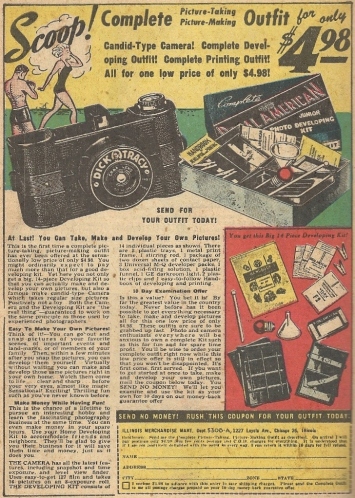
You’d be forgiven if you completely missed that this old-timey camera and developing kit was under the Dick Tracy merchandising tent. After all, his name appears nowhere in the copy. But there it is, along with his little tiny square-jawed mug, right there on the front of the camera in question (here’s a look at a real one). This name-drop reticence seems odd when viewed from today’s saturation bombing of brand names in advertising, but it was probably par for the course back in the 1940s. A SIMPLER TIME. When men were men and women loved them for it. And when said men took really crappy bathing beauty pics of their best girls with cheap novelty (Dick Tracy) cameras.
And then again, maybe Tracy just wasn’t someone to toot his own horn. We have old Captain Tootsie ads to support that.
Revel in the antics of hooligans, hoods, gangsters, bootleggers, pimps, pickpockets, rakehells… – Crime Does Not Pay #77
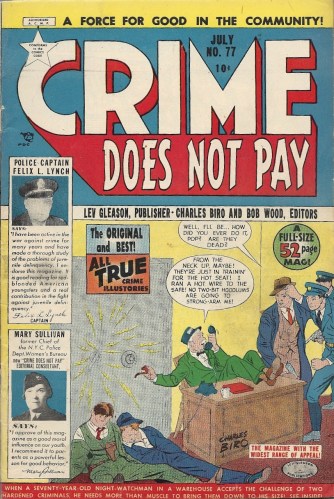
Look at the mug on Mary Sullivan, the Crime Does Not Pay Editorial Consultant pictured in the cover’s lower left-hand corner. Man, does she have the fierce mien of a born ball-buster. That cinder-block jaw looks like it could crack nuts — maybe yours. If stern Irish morality ever took human form, it was hers.
Crime, like the Golden Age Daredevil a Lev Gleason publication, was the brainchild of that superhero’s creator, Charles Biro, and Bob Wood. It had violent pre-Code stories that luridly told tales of gangsters and petty criminals going on rampages and then, thanks to their own stupidity and the relentless efforts of law enforcement, meeting justice. While the gangsters and murderers and petty thieves all got their just deserts at the close of each story, that these shady characters were the stars of the show was inescapable. The earnest, dogged cops that hunted them down like dogs could never compete. This it’s-good-to-be-bad aspect was surely what gave the book its sustained run of success (we’re in issue 77 here, after all), but was what led to its downfall when the Wertham’s of the world got their panties in a twist. (And this subtext was something that probably flew over the heads of the Mary Sullivans of the world.)
Though the cast of characters changed with each story, some still had a spectral narrator. Mr. Crime was an apparition that would pop in and out to comment on the goings on in tales now and again. He was the only character that carried over from issue to issue in this anthology (itself an innovation) series, and his leanings seemed to vary. Sometimes he’d approve of the wanton criminality, sometimes he’d marvel at the ultimate stupidity of the criminal mind. I’ve seen others compare him to the Man in Black Called Fate, and those comparisons aren’t off base. He’s in this issue, but I didn’t pull any scans of the story in which he appeared. Trust me, you’ll survive. If you want to know what he looks like, he’s out there on the internet. LURKING.
Now. Some samples…
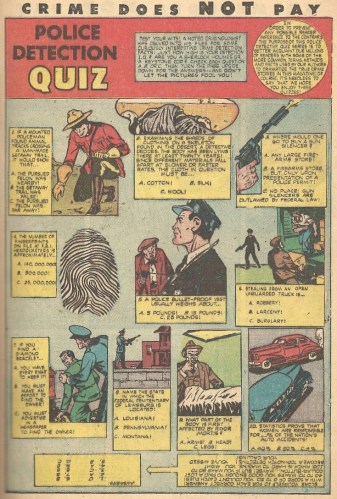
I liked this full-page C.H. Moore bit, which is a nice little window into 1940s crime-fighting advances:

Ever seen Michael Mann’s original Hopkins-free Hannibal Lecter (Lektor) film, the magnificent Manhunter? There’s a great scene in there where FBI agents race against time to work over a scrap of (unused) toilet paper that has a secret message from one serial killer to another. The take it from station to station, from special lights to everything else, but no fancy whiz-bang computers. It was all state of the art in the 1980s when it was filmed, but now it all looks rather quaint. WHERE ARE MY FLASHY CSI EFFECTS AND CARUSO’S SUNGLASSES? This isn’t really anything like that, but it reminded me of it. “Television — The Greatest Threat Evildoers Have Ever Known.” (Also, if you’ve never seen it, do yourself a favor and watch Manhunter.)
The cover story is interesting for some of its violence and a stunningly glib ending (and above-average artwork). Some teenage hoods break into a packing company and rough up the wizened old watchman (complete with pipe and potbelly stove):

They scared the pipe right out of him.
After this their spree hops to a new level, as they try to rob a grocery store, only to have their crime interrupted by the grocer’s younger brother. SHOTS FIRED:

Ned, though looking like a goner, lives. But the hood who gets hit dies. His father is contacted by the cops — who’ve been tailing this gang — and he tearily fills them in on his son’s friends. This gives the gumshoes the clues they need to track them, which is right back to the packing company and our night watchman pal. But the old s.o.b. has a trick up his sleeve — shocking them with live wires attached to the safe. Which ties in to the glib ending:

I’m not a strident opponent of capital punishment, but the old man’s a little to happy for my taste, especially as two young lives are condemned. WAIT TILL YOU GET TO THE COURTHOUSE STEPS FOR THAT, GRAMPS. (Also, the hoods are wearing the same clothes they were on their rampage. Maybe they have something in common with Twilight Zone hippies.)
Dark Horse has started reprinting the old Crime books in lush hardcover tomes. I don’t know that they’d be something that I’d personally go out of my way to buy, but if you can take a heavy dose of Lurid in each sitting, they might be something to check out. The stories are neat, and a step above the standard Golden Age fare.
Back to Mary Sullivan. I opened this post mocking her grim visage, but now I should pay some homage. A cursory scan of internet entries on her (thinly sourced ones, granted) reveals that she was a quite accomplished policewoman back in the days when there was no such thing — they were patronizingly called “police matrons” back then. She was a homicide detective, an undercover operative, a crusader for the rights of women within the cop fraternity, and any number of other stew ingredients. She even wrote an autobiography documenting her rather remarkable career, one published in 1938 and reprinted in the earl 1980s.
Anyway. No offense intended, Ms. Sullivan. Please don’t rise from the grave and whack me over the head with a nightstick.
Finally, should any young or youngish readers stumble across this post and want to one day grow up to be like Mary Sullivan or any other police officer, here’s a “Police Detection Quiz” to test your mettle:
Grab an instrument and sit in with Woody Woodpecker on saxophone and Bugs Bunny on banjo

Two observations:
1) Of course Daffy Duck is taking a premature bow after not playing any instrument at all.
2) It seems dubious that Woody Woodpecker would be able to sit still long enough to play even this short little Gold Key house ad ditty. NO PLAIN 4/4 TIME SIGNATURE CAN CONTAIN THE WOODPECKER.
Chicks dig it when a guy pays for dinner with cash from his dancing-native-girl-embrossed billfold
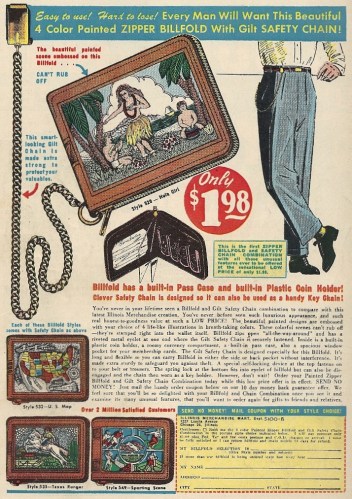
I noticed the other day that my old wallet is getting pretty ragged, with stitching frayed to such an extent it looks like credit cards and IDs are going to go flying out at any minute. I don’t think I’ll be procuring one of these old 1940s doozies as a replacement, though. Never was fond of the chain thing, zippers are only slightly less offensive than velcro, and having a hula dancer on your billfold would seemingly necessitate you paying (or trying to pay) for all your meals with a Players Club card. CLASSY.

Remember Captain Power and the Soldiers of the Future? The late 1980s show that “interacted” with the accompanying toy line, as seen above? It passed me by — I actually had a Captain Power action figure, but the syndicated program wasn’t on any of my local channels. This left Mr. Power a poor orphan with no backstory, and whenever I’d try to meld him with my G.I. Joes, I couldn’t help but think they were looking at him like “Who the hell is this douche? HEY, NICE OUTFIT, CAPTAIN EO!” The show itself had an intriguing style, with live action melded with primitive computer animation, but from what I’ve seen at this distant remove, the combination was pretty clunky. No Reese’s chocolate/peanut butter team-up here.
Still better than Robotix.
There was actually a comic to go with it — written by J. Michael Straczynski (a story editor on the show) and drawn by Neal Adams — that will one day (in THE FUTURE) be featured here. For now, let’s content ourselves with the show’s sensationally cheesy opening:

So here we are at last, at the end of both this summer’s blockbuster genre slate and the terminus of the wildly successful and enormously profitable Christopher Nolan/Christian Bale Batman trilogy. The season started out with the Avengers bang, slid into a Prometheus funk, and then wallowed in a pointless Amazing Spider-Man. Will The Dark Knight Rises triumph over all, or find itself somewhere in the in rank and file? Or, gasp, will it be the worst of the bunch?
Before that, though, some context for the series, so you all know from what standpoint this review is coming from.
Batman Begins was good, but somewhat lackluster. Nolan got a lot of credit — and justifiably so — for distancing the franchise from the Joel Schumacher years, which had taken the engaging oddness of the Tim Burton films and the colorful camp of the Adam West television series and fused them into some hideous Frankentein’s monster of afwulness. But it was the entry of the trilogy that didn’t quite fit with the look and feel of the other two (like Star Wars with is successors). It felt like a standard Hollywood movie, replete with generic scenemaking, and it was better than serviceable, but wasn’t great. Then along came The Dark Knight, which was in many ways excellent, a professionally crafted film with a Joker performance from Heath Ledger that etched itself into the annals of moviedom. The film’s craft somehow elevated our retroactive evaluations of Begins, a promotion by association — a rising tide raises all boats. Gone were the Narrows and that dopey Simpsons monorail that cut through the heart of Gotham, gone was the horribly out-of-place Katie Holmes (though Maggie Gyllenhaal, her replacement, didn’t set the world on fire either), and so were the flashbacks to Thomas Wayne, who was played by an actor turning in a brief but singularly irritating performance.
That said, even in Knight there were some problems (problems never acknowledged by the most ardent of the Nolan jihadists). It thought it was much smarter than it was, using the slick action sequences to three-card-monte a plot that wasn’t all that masterful. The Joker’s omniscience spackled over far too many holes. And, in an offense that probably bothered few, but did me, the movie explained itself too much (at least too much to be considered truly transcendent). The characters spent a lot of time standing around telling the audience what BIG IDEAS (that I didn’t find all that big) they were seeing on screen, and that wore thin. That wasn’t helped by the fact that BATMAN’S VOICE MADE ME LAUGH EVERY TIME HE OPENED HIS MOUTH. It had been altered a bit from the stunning goofiness of Begins, but it still at crucial moments left a lot to be desired. Audiences shouldn’t giggle when a fearsome vigilante speaks, okay? This is a small thing but a huge problem, one that you really can’t get around.
But let me be clear, before I start getting death threats, that I LIKED BOTH MOVIES AND THOUGHT THE DARK KNIGHT WAS PRETTY DARN EXCELLENT. I mean, the “bad cop” reveal and aftermath alone will stand the test of time like few other superhero scenes. So stow the Molotov cocktails.
And now we come to it. The verdict. And it is?
Rises, while once again showcasing Nolan’s mastery of crafting films that propel the viewer forward, suffers from a script that leaps and hops and isn’t at all focused, and is stabbed in the side (somewhat literally) by a twist that almost makes the whole thing collapse under the weight of flashback exposition and dramatic pretensions. Plus there’s like an hour in there where nothing really happens and Batman is AWOL. It’s a thrill ride with deep lulls, but performances by series veterans and newcomers keep it from veering off the rails.
Some observations follow. Light spoilers, and I’ve tried to scrub anything severe. But tread lightly.
- The action starts eight years after the death of Harvey Dent at the close of the Joker’s rampage. Our hero has been gone since, in part due to new laws passed to honor Dent’s law and order spirit, but more so for the crushing death of Rachel. I have a problem right off the bat (no pun intended, but what the hell, there it is). That Bruce Wayne would go into retirement over the loss of a woman undercuts the believability of a man driven enough to go through hell to fight evil. In a franchise that’s made a big deal about staying grounded and believable, and not incorporating the supernatural elements of Batman’s universe, this is troubling, because that Rachel broad must have cast a spell over poor Bruce to do this to him. Was she really Zatanna? “uoY lliw hsirehc em revo lla srehto!” Whatever. I never bought Rachel as the big love of his life, so I guess I wouldn’t be in the market for this. Moving on.
- Of the returning stars, Michael Caine and, yes, Christian Bale have to be singled out for praise. Caine shows what a pro he is, taking limited screen time and generating more emotion in a few minutes than entire movies usually do in hours. When those old eyes tear up and when those sweatered shoulders start to sag, there isn’t a soul watching who won’t be moved. Maybe Caine isn’t the perfect Alfred Pennyworth, but he’s an acting treasure. And Bale, who I’ve never bought in on 100% as Wayne/Batman, finally made me fully care about him this time around. He’s more haunted, and his journey from beginning to end outstrips anything else we’ve seen from him in this role, even Batman’s origin journey in Begins. He goes from a limping recluse to a restored vigilante to a broken shell to something more than he was before. He vanishes for much of the middle of the film, and his absence is noted. You can’t wait for his return. As it should be.
- The one dud amongst the new arrivals is Anne Hathaway’s Catwoman, who never once dons that sobriquet in the film’s runtime. I’ve read a number of reviews that say hers is only better than Halle Berry’s take on the character (that I had honestly blocked from my memory until the last couple of days), and I can’t disagree. It’s not all her fault. She feels somewhat extraneous to the film, an add-on that the script, messy as it is, could have done without. She delivers some key goods and information, but never seems all that necessary to advance the plot. And don’t get me started on her fighting prowess. I realize there are such principles as leverage and counterweight, but her wafer-thin frame is a tad too good at tossing around people double her size.
- Tom Hardy’s Bane is a worthy successor to the Joker, not up to that level, but charismatic and engaging in ways that the Clown Prince could never probe. Though his voice at times veers into an unintelligible ADR morass (it sounds, deliciously, like if Sean Connery played Darth Vader), his menace and physical presence present Batman with a foe unlike any faced before. You’ll recognize some of the iconic “Knightfall” beats, but this character is someone that the Venom-addled behemoth of the comics never was. Underneath that pain-killing mask of his (which looks like a spider in its death-curl) there’s depth. He’s more than just a back-breaking madman. Unfortunately, all this is ruined in the final reel, as he transforms into some cuddly teddy bear (a homicidal one, granted) while the suddenly exposition-laden plot spins out of control, and then he’s gone. We hardly knew ye.
- If there’s one character that steals the show, it’s Gotham cop John Blake, played by Joseph Gordon-Levitt. He carries much of the heroic burden of the film, defending Gotham as the police force is immobilized and Bane unleashes his reign of terror on a trapped populace. That he does it without all of Batman’s high-tech gizmos makes him all the more noble. He has genuine gravitas, and his little (but big) reveal at the end doesn’t feel forced like the big plot-heavy one does. In an odd way, it’s a relief.
- Much has been made about the film’s commentary on modern concerns of the urban psyche, as we find ourselves caught between plutocracy on the one hand and a surging, increasingly agitated underclass on the other. Bane generates nothing short of anarchy as he takes over Gotham, and what follows is one part French Revolution (complete with a storming of the Bastille) and one part Occupy movement run amok. His assaults on finance and the privileged seem to want to say something, but you’re digging in a dry well if you look for any message in there. Unless the lesson is to wait for a guy in a batsuit to show up in a flying bottle opener to punch our way out of societal trouble. If that’s the case, then MESSAGE RECEIVED. A round of fascism for everyone.
- The Hans Zimmer score follows in the throbbing footsteps of its predecessor. Look, it’s great and all. It puts you on the edge of your seat, even when people are just walking around. But I can’t help but think of South Park’s parody of Inception whenever I hear it. They’re right on. It’s intense, but when it comes down to it, it’s obfuscation. It drowns out a lot of the plot holes. Hey, it’s night now, but wasn’t it daytime just a minute ago, look there’s even a timer on that computer that OH WAIT THERE GOES THAT MUSIC YEEEAAAAAHHHHH.
- Mathew Modine is in this, following in the Eric Roberts scrap-heap salvage tradition. And so, once again, is Batman fan and United States Senator Patrick Leahy. Wonderful.
- The action scenes, which Nolan perfected in The Dark Knight, are splendidly kinetic, and they’re the true bread and butter of this entire series. While they’re not as constant as that throbbing score would trick you into believing, they don’t disappoint when they’re happening. Many will find these alone worth the price of admission. They wouldn’t be wrong.
- I’m not sure to make of where the film leaves us, as characters assume new roles with the series coming to an end. Could there be more? Yes. Would I want to see more? I would. Will we? Probably not. Would I want tighter scripting, which doesn’t take convenient shortcuts? Definitely. (I think Bruce Wayne may have walked from the Middle East to Gotham. Exhibit 4E, your honor.)
Everyone says that it’s unfair to compare this to The Avengers, and they’re right. They’re different kinds of filmmaking, with this Bat-series sharing more with the Jason Bourne universe than fellow comic book properties. But you have to compare them. It’s unavoidable. And all I can say is this: I enjoyed The Avengers more than Rises, and I think it’s a better film. No, Avengers wasn’t genius filmmaking, and yes, it had flaws. But it pushed every button of delight in my moviegoing soul, and at no point did I want to leap at the screen and slash it with my keys. When there’s that big reveal in Rises — and oh, you’ll know it when you see it — I almost rolled my eyes right out of my head. I kind of knew it was coming — most knowledgable Bat-fans will — and I was still unprepared for how derailing it was. Perhaps others won’t be so vexed by it. I hope so. I want people to have fun at the movies, and I think that they will here. But there are some hiccups along the way.
It’s been an interesting ride. Here’s hoping that next year’s Man of Steel, which has an artsy trailer attached to this, gets the broader DC ball rolling. And maybe somewhere down the line we’ll finally get to see the cowl meet the curl on a real genuine movie screen. Wouldn’t that be something.
For the craft and some marvellous performances which overcome most of the things I didn’t like, I give The Dark Knight Rises three and a half Bane masks out of five:

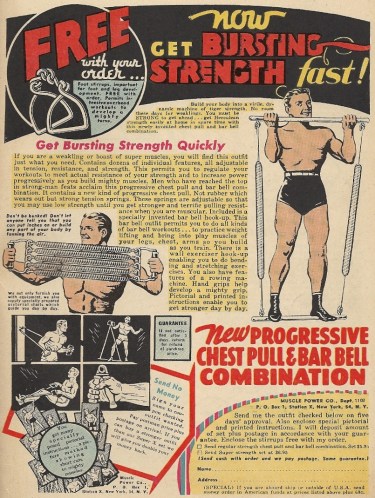
All old-timey workout gear looks like implements of medieval torture, and no exception here. RACK HIM. Did this stuff come with safety goggles (if they even had safety goggles back then)? If not, THEY SHOULD HAVE. My father had something similar to the chest-expansion doohickey on the left, and even though his was made from rubber and plastic and not fearsome metal, it snapped while I was using it once and almost maimed me. Also, it should be noted I was a 90-pound weakling back then when I started with it, and remained so after using it. I only became the rugged, virile he-man that I am/imagine myself to be after free weights. Draw your own conclusions as to effectiveness from that. You might be better off going with any of the Charles Atlas regimens.
I remember a Benny Hill skit where the little bald guy that Benny was always slapping on the head tried to toughen up with the one you see up there. It tore off all his chest hair. Lesson? If you ever use this stuff, dress like you’re going to ride a motorcycle, not like you’re going to the beach.
The Batman Returns video game, which included the Michelle Pfeiffer Catwoman, was nevertheless dull beyond words
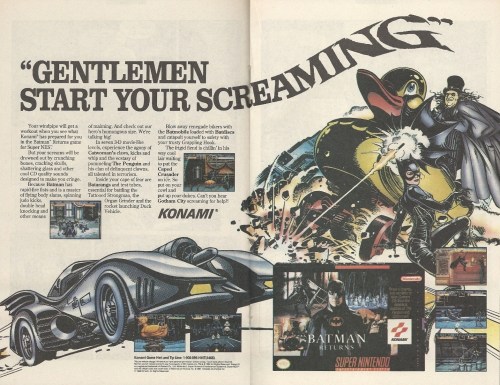
Though Michelle Pfeiffer’s Catwoman costume defined fetishistic lust for a generation of teenage boys (I can attest to this), the Batman Returns game for the old Super NES was a left to right punch-kick borefest (sadly, no spine-ripping fatalities). I don’t think people are jumping though hoops to hook an old system bought off of eBay up to their HDTV so they can play this thing, catch my drift? And you have to love the part of the copy that salivates over “our hero’s humungous size. We’re talking big!” In a franchise replete with codpieces, this is verbiage I could do without, thank you very much. Fifty Shades of Batman.
Not even a gun-wielding Spider-Man could save Sledge Hammer’s doomed comic book – Sledge Hammer! #2

I suppose you could put this opposite The Twilight Zone on the spectrum of television shows turned comics.
What’s that? You don’t remember Sledge Hammer!? One of the more bizarre little slices of comedy to ever grace/pollute network airwaves? FOR SHAME. In fairness, though, it came and went so fast, it may have slipped past many of you. Or others — and this is depressing — might not even have been alive during the 1986-88 window when it was on the air. We therefore need some explaining before we get to just how Spider-Man got entangled in a comic book adaptation of said series. JUST WHAT THE HELL IS GOING ON HERE?
I’m not expert on the show, but it had few bigger fans than single-digit me when it first came out. To my refined eight-year old sense of humor, the law enforcement exploits of Inspector Sledge Hammer, a Dirty Harry clone with no sense of P.C. and little regard for Miranda rights, were the height of prime time comedy. David Rasche filled the title role, deadpanning his way through his buffoonery in the same way that Leslie Nielsen did in the much zanier, much funnier, similarly punctuated, and much more rapidly cancelled Police Squad!. He had a big, sexually suggestive gun. He had an exasperated Captain. He had an attractive female partner He had terrible sports coats that looked like they were tailored from the fabric of a couch that had been sitting on a fraternity’s front porch. So all the cop show boxes were checked off, and the show was filled with commentary on the entertainment tropes and societal shifts of the time.
But it barely held on after its first season, and at the close of the second it was kaput. To put it in some wordplay worthy of the show: The hammer fell on Hammer. Maybe it was the Friday scheduling (the infamous Friday Death Slot) that killed it. Maybe the world just wasn’t ready for Sledge. Or maybe it just wasn’t all that funny. Looking back now, I have a hard time finding a laugh while sifting through random (and purportedly hilarious) clips. It’s NO LAUGH DEATH. But that’s just me looking at out of context material. Hopefully others can still find the humor in it. If so, great. More power to you if you can.
Then there was this comic series. I’m not sure what made Marvel think that a half-hour comedy show, one that barely made it into season two, would be ripe for porting over to the print realm, but someone had the bright idea. And so it was greenlit, and saw the light of day in the midst of the show’s second season. There were only two issues, both fairly awful reads (more on that in a moment) and forgettable, but the second had the merit (or demerit) of the cover you see above. Yes, the good name of Spider-Man was webbed in to help defribrillate this bitch. To their credit, the Marvel folks made it fairly clear (as if the gun didn’t clue folks in at first blush) that this wasn’t the real Spider-Man that was guest-starring. But still…
Jim Salicrup wrote while Alex Saviuk and Sam de la Rosa provided the art here. I don’t want to bash them over the heads, because this is one of those Impossible Task books. Who in God’s name wants to read a Sledge Hammer! comic book? What was the audience here? These poor souls were exiled to the desert and told to grow watermelons. It was a Herculean task to take the comedy of the show and faithfully carry it over. An uphill slog.
They were set up to fail, and make no mistake, fail they did.
The comic is horrible. If you found the show dull, then the comic might have been enough to knock you into a fugue. Most of the problems come from the script. Once again, not to bash Salicrup, who could turn in fantastic stuff (like the monstrously potent Spider-Man molestation tale), but the writing here fails like the proverbial lead balloon. This thing chokes with dialogue. You need to keep humor short. I mean, the TV show was a half-hour sitcom, not Roots. We don’t need giant James Joyce blocks of words to glaze our eyes. Stately, plump Sledge Hammer… Brevity is the current through which wit flows, and this is far from that. FAR. I literally had to set this comic down multiple times and then return to it to wade my way through. It was a slog, like hacking through a jungle. Take, for instance, this one page, which finds a recently de-gunned Sledge pulling a Mel Gibson from Lethal Weapon with a potential suicide:

The word balloon ratio seems excessively high, no?
The wordiness would be one thing if there was a story, if this was an installment of Alan Moore’s From Hell or something. But this is a Sledge Hammer! book. Come on. We have things to do, you know? Said (un)story has a lady wrestler (who somehow comes back from the dead after falling about forty stories onto the hood of a car, leaving — one imagines — a puddled corpse that would make even the most jaded coroner retch), a prison warden named Warden (Warden Warden), and, of course, a crook disguised as Spider-Man (with little dots in the whites of his eyes to help differentiate him from the real thing). Here’s Sledge giving the imposter his final comeuppance:

I suppose we shouldn’t really complain about the appropriation of “Spider-Man” for this. It loosely fits into the pop culture commentary that the series strove for, even if it makes little to no sense in a story that makes even less sense. I mean, there’s absolutely no reason for a crook to dress up like Spider-Man. Is he trying to go unnoticed? One thinks that a Spider-Man costume would be easily spottable. JUST MAYBE. Is he trying to masquerade as the real Spider-Man? Despite some confusing dialogue, the comic Sledge Hammer! universe doesn’t appear to cross streams with the Marvel reality, as Sledge at one point refers to the switch to the black costume in Secret Wars. Unless this is a pocket universe where comics, heroes and Hammer all coexist in a OKAY ENOUGH ALREADY. I really don’t care.
This isn’t a comic book that’s supposed to be taken seriously. It isn’t Maus. I get that. But it’s nevertheless dreadful. Light-hearted humor isn’t supposed to be so wordy, so choked with junk. If the young me — the same one who LOVED the show — had come across this comic, I/he would have flung it out the window. Or fed it to the dog. Some grim fate. If I want Spider-Manish humory comics, I’ll stick with Spider-Ham, thank you very much.
Sledge Hammer! is out of DVD. I don’t think I’ll be buying it any time soon, but if you were a fan at one point and forgot all about it, maybe check it out again. But if you see this comic in a back bin, it’s perfectly safe to flip right past it. Nothing to see here.
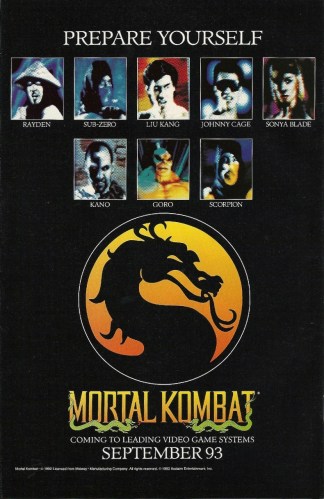
This understated ad might fail to capture how insanely popular the comically violent Mortal Kombat video game was, but it’s somehow fitting, seeing how quaint its fatalities and two-dimensional punches and kicks seem in today’s immersive console world. Ah, the halcyon days when Sub-Zero would rip out a beaten foe’s spine and triumphantly hold it aloft, and we’d all laugh and high-five each other. Never to return.
The remarkably different pictures of Rob Liefeld and Jim Shooter beckon to all comic book fans

Rob Liefeld, whose work I generally loathe, has a picture that looks like your typical “douchebag high school portrait special,” complete with generic backdrop. Jim Shooter, whose work I generally admire, has one that makes him look like a contented South American cartel hitman (or Razor Ramon, take your pick). I don’t know what this signifies for the cosmic balance. Probably nothing. Just keep this in mind if you want to travel back in time to help grandly open another Mile High Comics store.
Also, Defiant may have opened and closed in the time it took Shooter to sign autographs and conduct his seminar.
 Jared
Jared


 blog into mystery