It’s a Mad, Mad, Mad, Mad Month, Part 2 – Mad #204 (The Incredible Hulk)

I’m going to skip the Jaws II material in this, though someday I’ll have to take a closer look at the Marvel Super Special adaptation (featuring some uninspired art from the usually sublime Gene Colan) of that needless sequel. Captain Neuman in the mouth of a great white shark kind of rules, though.
Since the first part of this month-long retrospective looked chiefly at a Mad spoof of one of the great films of my youth, it seems natural to slide over to a cherished small-screen gem of yore getting similar treatment. Enter “The Incredible Bulk.”
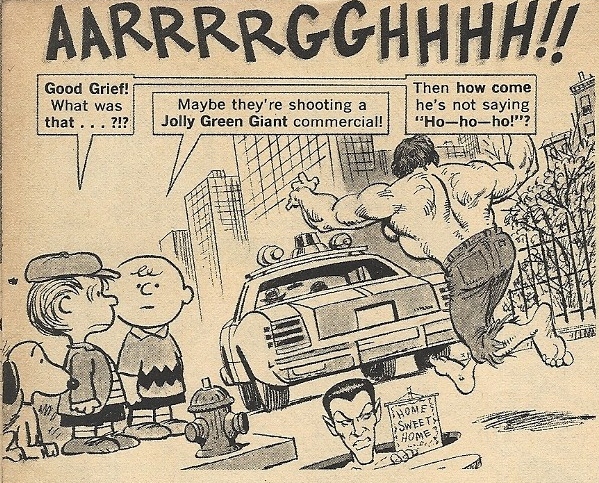
This one (Artist: Angelo Torres, Writer: Lou Silverstone) hits all the expected beats in tackling that fondly-remembered Bill Bixby/Lou Ferrigno series, but the best part of it by far is the series of cameos by comic book/strip characters, some of which are utterly out of left field. Take this title page scene, as the “Bulk” rampages down a city street:
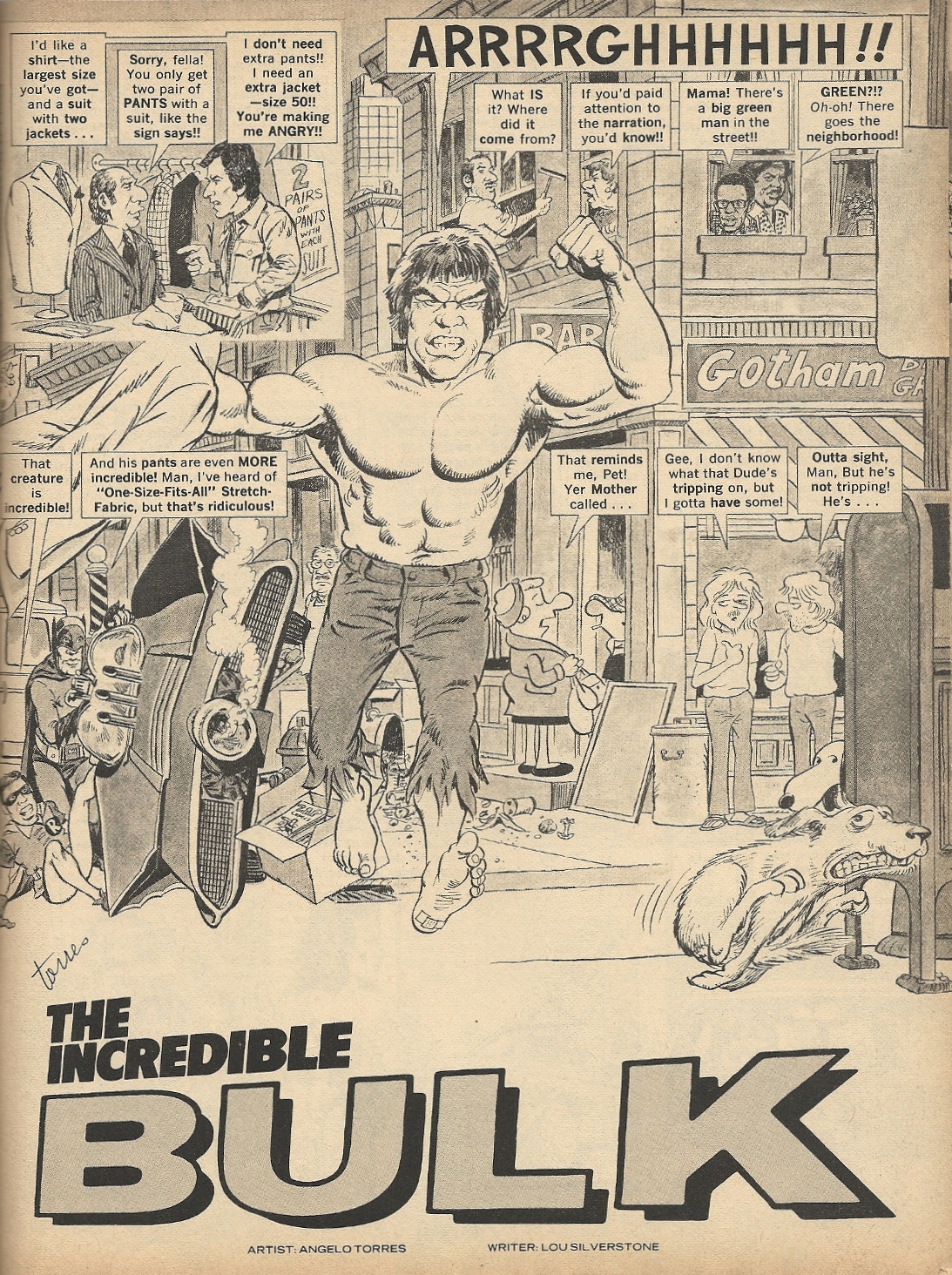
Batman and Robin, Andy Capp, Doonesbury characters and Snoopy, all sharing a stage. Only in Mad.
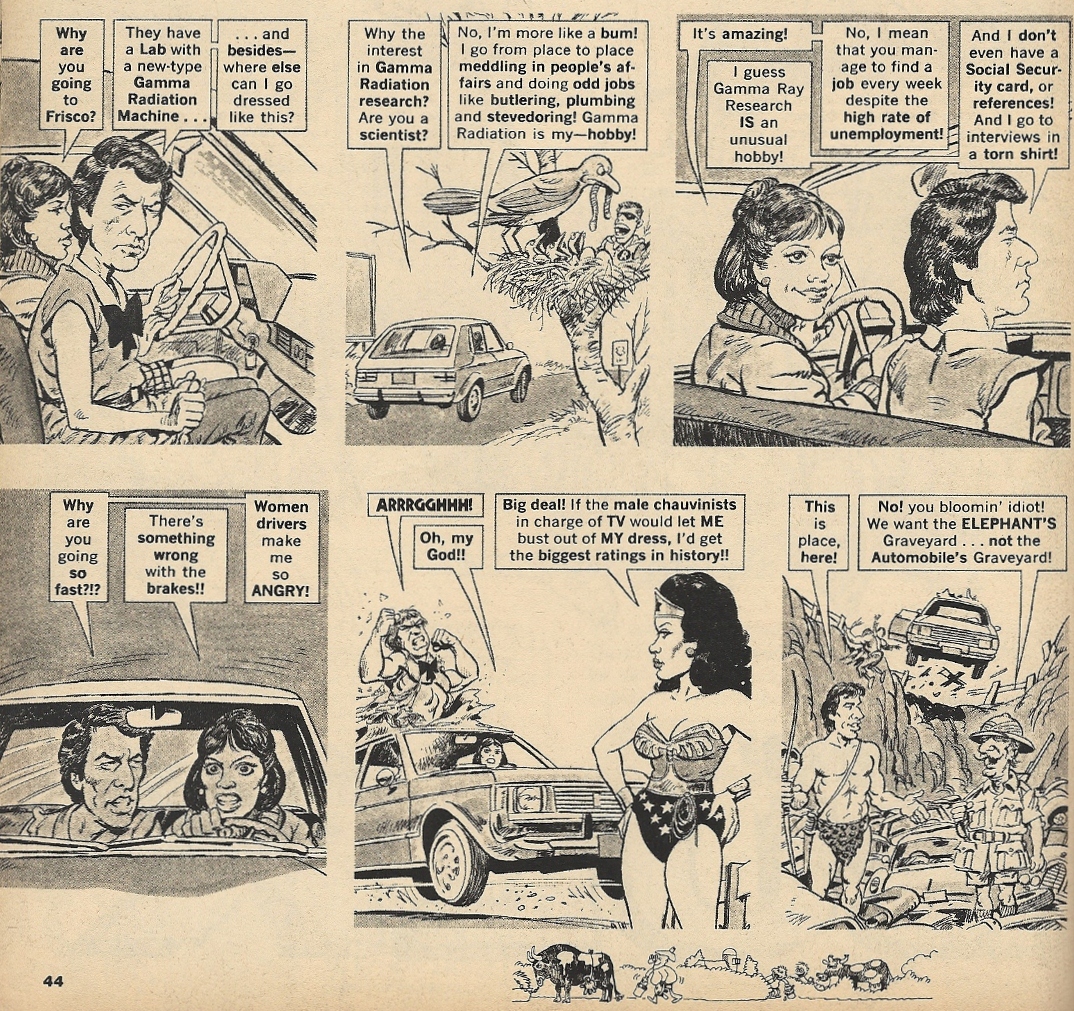
It goes on, as this sequence will attest (with a Sergio Aragones margin sketch thrown in for good measure):
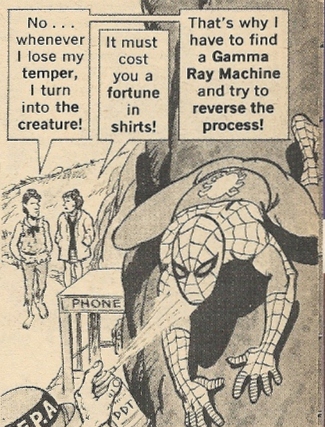
And there’s more. This wall-crawler sighting would have had the five-year old me tittering:
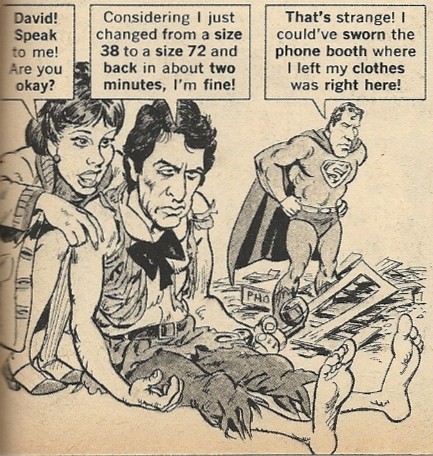
Maybe not so much the Man of Steel having his changing room destroyed:
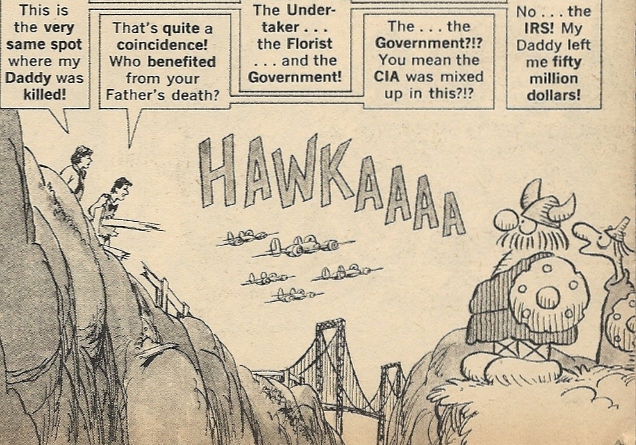
Hagar the Horrible and long-suffering pal Lucky Eddie are obvious in this panel, but Blackhawk and his squadron, with their distinctive HAWKAAAA battle cry, almost (literally?) flew right over my head:
Let’s be honest, one Snoopy appearance just isn’t enough, and why not throw the Hulk’s old Tales to Astonish pal into the mix:
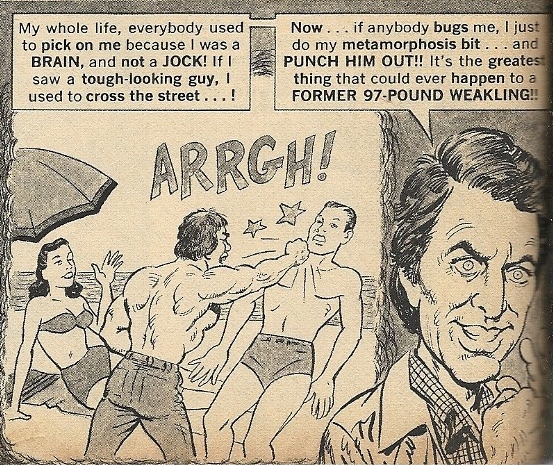
Finally, if not a reference to a comic character, at least a comic mainstay, with the Charles Atlas “Made a Man out of Mac”/Flex Mentallo beach incident used to illustrate a question I often pondered as a kid, why Banner never made lemonade out of lemons:
Amen.
“Don’t make me Mad. You wouldn’t like me when I get Mad.”
Is that a Supermobile in your pocket or are you just happy to see me?

I was aware of, owned, and posted an ad for the Corgi fist-equipped Supermobile and the Super-van, but I didn’t know that there was an entire line of DC-themed vehicles. I do now. So Captain Marvel has a race car. Okay. And Wonder Woman zips around in a car that screams “Beverly Hills kept bimbo” (though it’s still not as femme as Wildcat’s pussy-cycle). Okay again. Perhaps the Penguin’s ride — with its (of course) umbrella — is the best of the bunch.
VROOOOMMM!
I blogs what I like and I likes what I blog – Popeye the Sailor #152
I bet one legend that keeps recurring throughout history, in every culture, is the story of Popeye. — Jack Handey
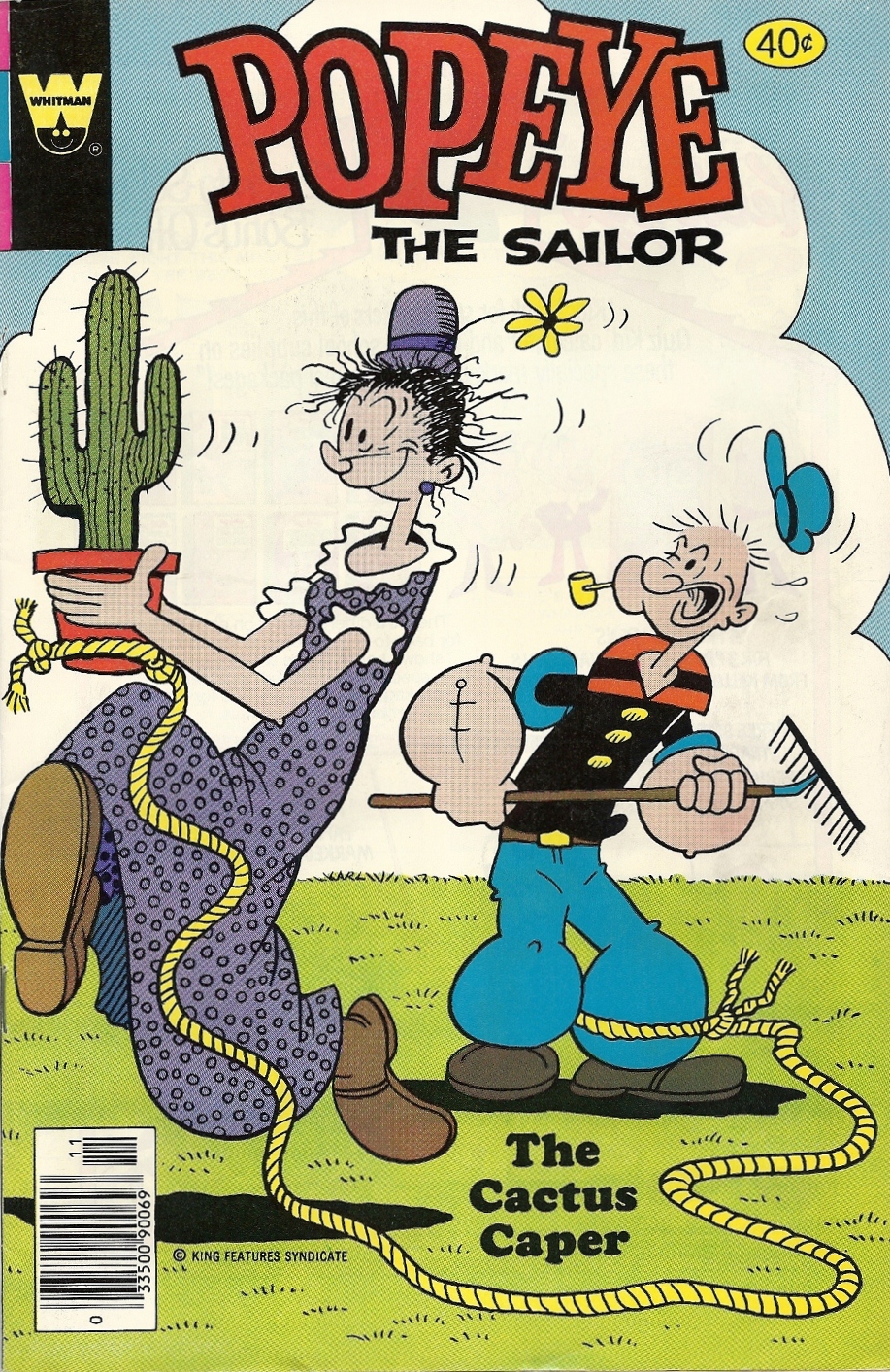
This guy is such a ripoff of Captain Strong. It’s almost as bad as when the Beatles stole the Monkees’ original, distinctive sound.
I like Popeye. I’ve always found his cartoons endlessly amusing, and I’m gratified to know that his printed form hijinks are very much on par with their animated kin. Unlike Bugs Bunny or Donald Duck books, he’s every bit the character in them that one expects, not surprising since, unlike those other icons, he had his origins in the funny pages. His garbled verbiage and syntax translate remarkably well into word balloons. Once again, they had their origins there, but since I’m much more familiar with his audible output that came as a pleasant surprise.
I’m a Popeye comic book/strip neophyte. Sue me. I know enough, though, to proclaim that this late-1970s issue is amusing.
In it, Popeye has taken on nocturnal gardening, having bet Wimpy a hundred hamburgers (a weighty bet for Wimpy, to be sure) that he can grow a desert cactus in his backyard, more specifically a prickly-pear variety. He’s nursed and cared for the thing (including installing heat lamps to generate equivalent desert sunshine), but then one night the spindly, frazzled old broad on the cover makes off with it:
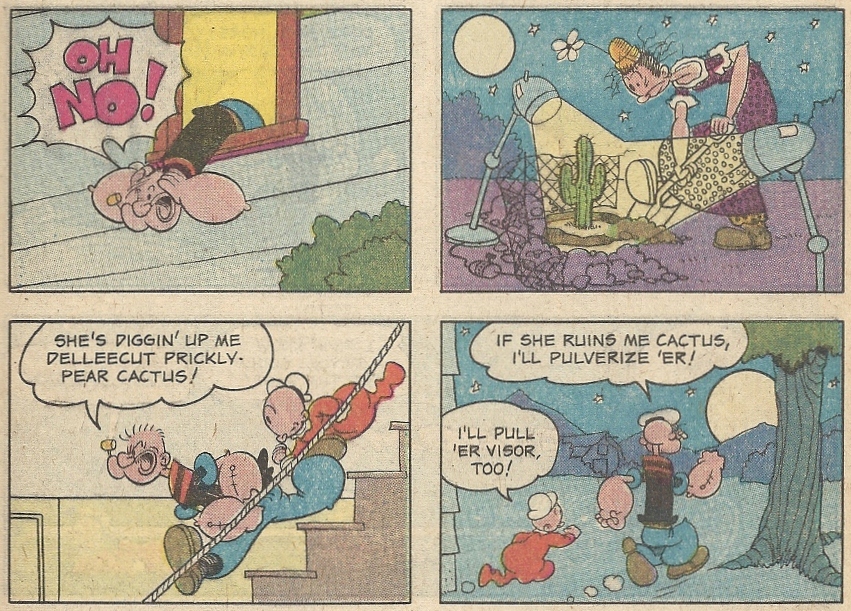
“Pull ‘er visor.” Well played, young man.
Despite the best efforts of Popeye and Swee’Pea, she makes a clean getaway. Popeye’s crestfallen, but Olive Oyl recognizes the description of this thief as being Amy Loony, a plant-raising local eccentric. Hot on the heels of this realization, Olive gets an invitation to a party that Loony’s holding soon. Popeye accompanies her to get his beloved cactus back, and party start times and metal gates mean nothing when confronted with his engorged/enraged forearms:
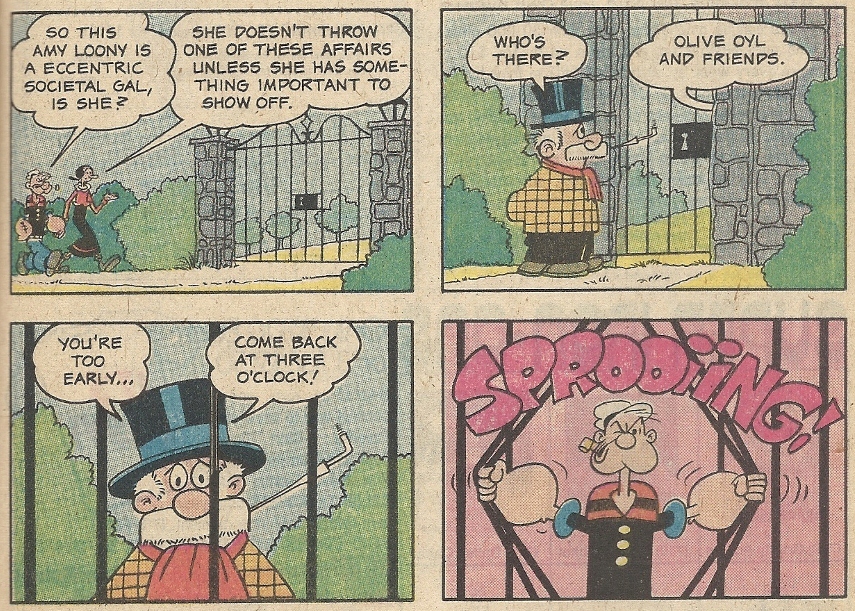
Popeye’s cactus is the centerpiece of the party, as this is Loony’s unveiling of it as her prize new plant. Poor Popeye — no one believes that this salty guy could have a green thumb:

Soon Popeye’s old friend Axel shows up and reveals his relation to the accused plant-pilferer:

All that’s well and good, but Popeye wants his damn cactus back. As we all know, he fights to the finish, and he finally exposes the fraud by asking a simple question: What blooms on a night blooming cactus?:
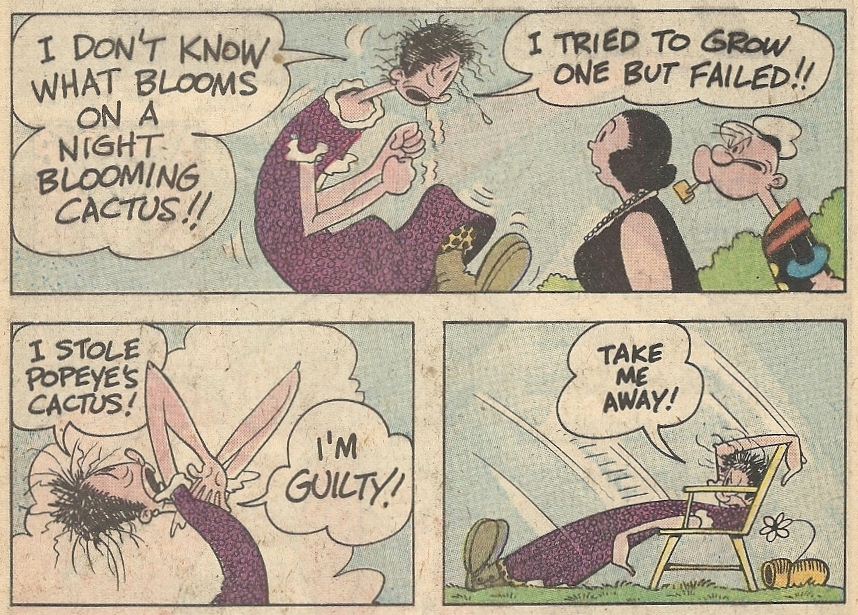
(Answer: A little bitty flower. I don’t know if this was supposed to be funny in some way or not.)
Our beloved sailor man proves to be magnanimous in victory, though still a bit wary of Loony’s produce:
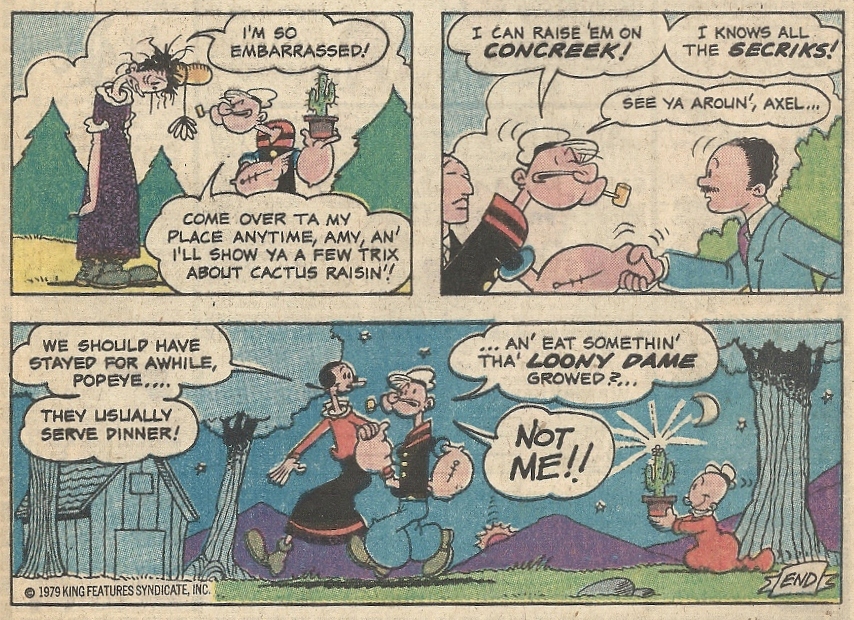
Can’t say as I blame him.
The content of this book, and by that I mean the plot, isn’t all that engaging. As with most Popeye material, my default response is “Needs more Poopdeck Pappy.” But just looking at Popeye and listening to his voice in your head as you read his words — and you can’t help but hear his voice — makes it very enjoyable. A smile inducer. And he didn’t even have to pop open a can of spinach to crack this caper. Avast!
Spider-Woman, Spider-Woman, does whatever a Spider-Woman, um…

Okay, I of course knew about The Super-Friends, and the Plastic Man show sort of sounded familiar. But a Spider-Woman cartoon… I had no clue that such a thing had ever been thought of, much less aired. Color me clued in. Good for Miss Drew, though I can’t say that I like the overblown music in her opening sequence.
No word on whether the Brothers Grimm made an appearance.
By the power of Krypton! I have the power! – Superman Annual #10

It looks like Superman picked up some pointers during his stay on Eternia.
Let me get one thing out of the way. I continue to adore Curt Swan, even when he’s roughing it with questionable content. I thank Rao that he pencilled roughly 1.5 billion Superman comics in his career, so many that it sometimes seems that he’s still churning them out. He’s the best (and even better when teamed with, as he is here, Murphy Anderson). And that shall be the extent of my Swan adulation for the day.
The comic? This is a good one. Silly. Utterly unlikely. Maybe even stupid. But good.
The genesis (perhaps that should be capitalized) of this Elliot S! Maggin-scripted tale (“The Day the Cheering Stopped”) goes back to the very beginning of the universe, when astral bodies were formed, including a chunk of rock that eventually makes for one of the largest coincidences ever:

Yes. A sword congeals out of the cosmic dust, complete with S-symbol. And we also learn that it becomes known as “The Sword of Superman.” Even though there wasn’t a Superman yet. Just go with it I guess.
Somehow, someway, Superman has to get to space for this collision course with wackiness. To that end, an arrogant Donald Trump wannabe stows away in a space shuttle, and Supes goes to retrieve him. I’m gratified to learn that not all Kryptonian encounters with at-work astronauts were disastrous:

Long story short, the stow-away mogul gets possessed by an old foe of Superman’s (King Kosmos) and gains powers in the process. He soon bests the Man of Steel, who in turn stumbles onto the blade he was apparently born to wield:

Things got a little Aeon Flux-y there in that last panel.
The sword doesn’t really do all that much for him, and to top it all off, poor Superman is now an outcast on Earth. See, Kosmos has hypnotized humanity to see him as a disgusting, dangerous alien (surely dinging deep sections of Kal-El’s id). So what does the sword do to help the big guy? Why, take him to the library, of course!:

Somewhere on the Reading Rainbow, LeVar Burton is smiling. That said, there isn’t very much of a reason for this little narrative cul-de-sac, other than to point out that King Arthur was the only one who could use Excalibur, and the same goes for Superman and his new toy. Thanks. Got it.
Whatever the motive for that little jaunt, the sword still isn’t helping him with his image problem:

Okay, that’s kind of funny.
In the face of this scorn our hero retreats like a picked-on little girl. He’s developed some Grade A anxiety issues over his rejection (perhaps an Amish shunning could be added to the Kryptonite and red sun weaknesses), so he spends a little time meditating on the moon. While Superman is getting in touch with his inner hero, Kosmos (still in the guise of the mogul) arranges to address a joint session of Congress to help further his Earthly power. Not so fast, buster:

Superman has hypnotized himself to overcome his feelings of rejection, and the sword (finally) does something useful by breaking Kosmos’ psychic hold over humanity. A brawl ensues on the National Mall (almost toppling the as-I-write-this earthquake-cracked Washington Monument) which Superman wins. Then he starts getting a little carried away:
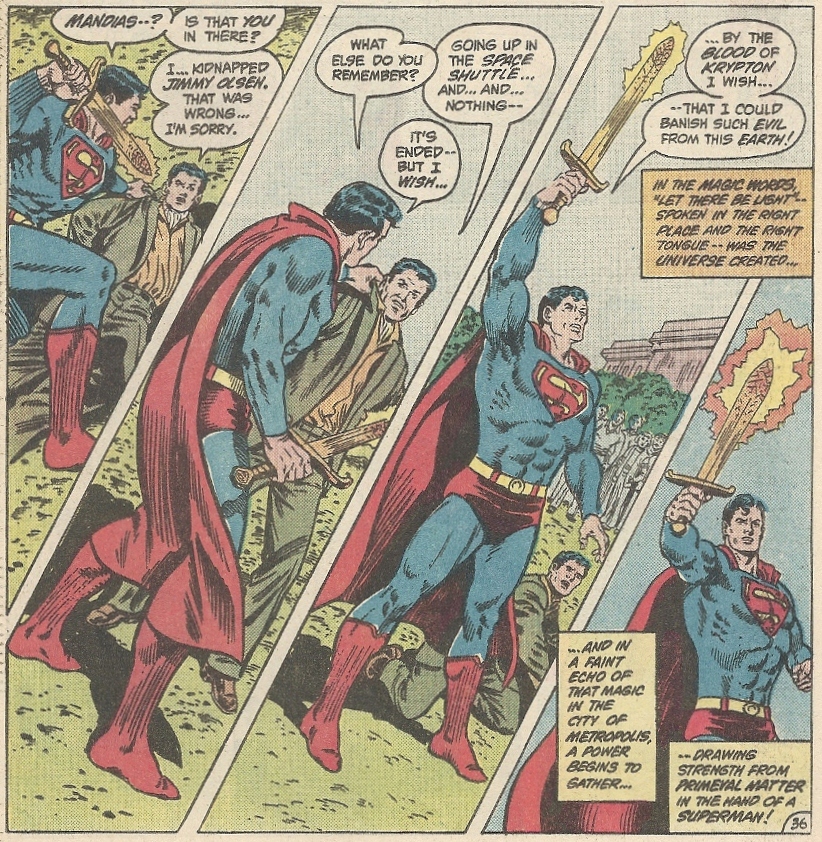
He actually did come really close to the He-Man line. Huh.
The sword begins to fill him with nigh-limitless energy and power, but Superman reacts as we would expect him to when offered omnipotence:
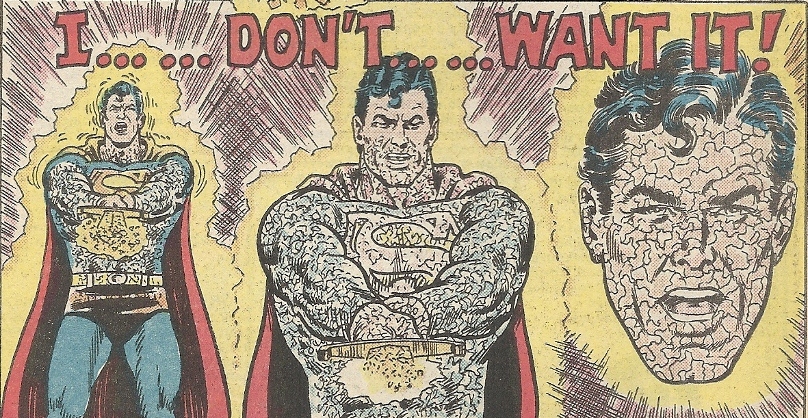
The jigsaw effect fades and the blade of the sword disappears. Superman casts the hilt into space, and there the Earth portion of our story ends. Then we have an epilogue, as a future storyteller recounts the story of the Sword of Superman, and this gives us a little more insight into what happened when Superman renounced its power:

I guess the voice could be Jor-El, but I’m pretty sure we’re supposed to think it’s God. So Superman is Space-Sword Jesus or something.
There are times when I love comics with every fiber of my being.
Maggin spun many a fun yarn, and this one is no exception. The thought of a Superman-themed sword — one forged at the beginning of time, mind you — floating around in space like the 2001 monolith is so preposterously silly, one can’t help but love it. Or maybe one can. I can’t. And I truly appreciate his willingness to back off (as in the sequence where Superman grabs the sword) and let the art tell the story. Not feeling the need to do it all is the mark of someone who knows what they’re doing, know what I mean?
This was a good time. And here’s hoping the Hubble keeps its lenses peeled for any drifting swords out there among Carl Sagan’s “billions and billions of stars.”
It’s a Mad, Mad, Mad, Mad Month, Part 1 – Mad #200 (Close Encounters of the Third Kind)

So many of us grew up on Mad. I know that, for me, I couldn’t fully digest films or television shows until I had read the accompanying Mad parodies. Come to think of it, I’m still chuckling twenty years on about — of all things — a Regarding Henry spoof. That, my friends, is STAYING POWER. Put that in caps. Mad is also a book that not long ago engendered the question I ask more and more as the years wear on: “Is that still being published?”So often the answer is a sad negative. I was happy to learn that Mad is still going. Maybe not strong, but it’s going.
Anyway. I bought a handful of late-’70s/early-’80s Mads a couple of weeks ago, so I thought it would be fun this September, as summer rolls into autumn, to take a quick look at a bunch of them. Let’s make this a Mad, Mad, Mad, Mad month. Why not?
And why not start with this, an anniversary issue from 1978 and one that features the film that stands at the top of my list of favorites. I’ve expressed by unalloyed devotion to Close Encounters of the Third Kind before, and it’s a love strong enough to withstand (and appreciate) a good ribbing. Roast away, Mr. Neuman!
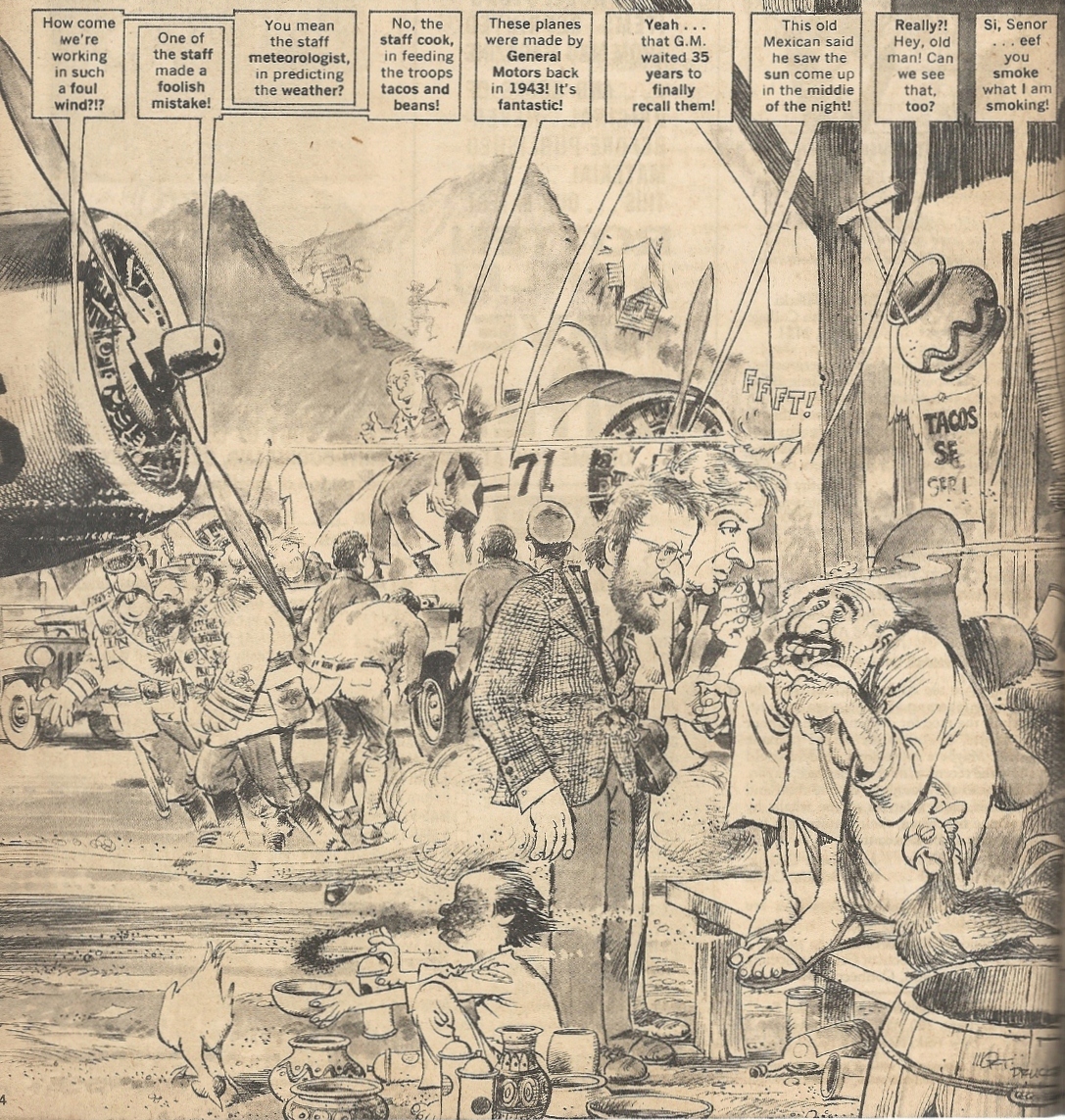
Here we have the first scenes skewered under the ministrations of Stan Hart’s script and Mort Drucker’s pencil and pen. There’s the windy WWII plane discovery in the desert, complete with flatulence and marijuana jokes:
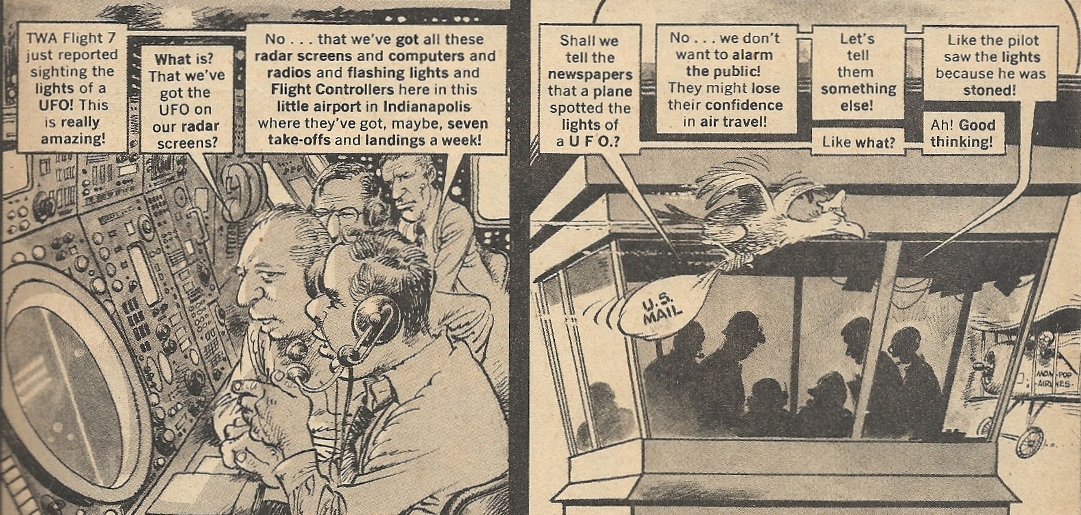
The mood-setting air-traffic controller scene also gets a body-blow — for some reason I especially like the mail-carrying bird:
Even the sundering of a family unit gets the mighty Mad treatment:
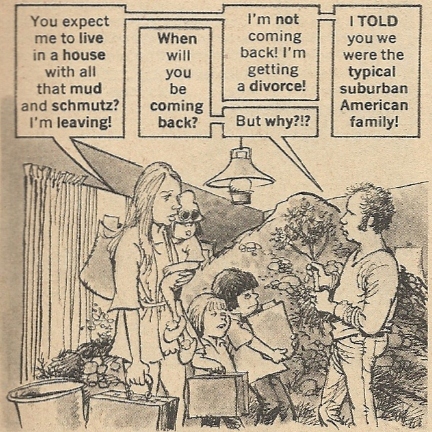
And what does child-man Roy Neary get when he finally reaches the promised land of the mothership?:
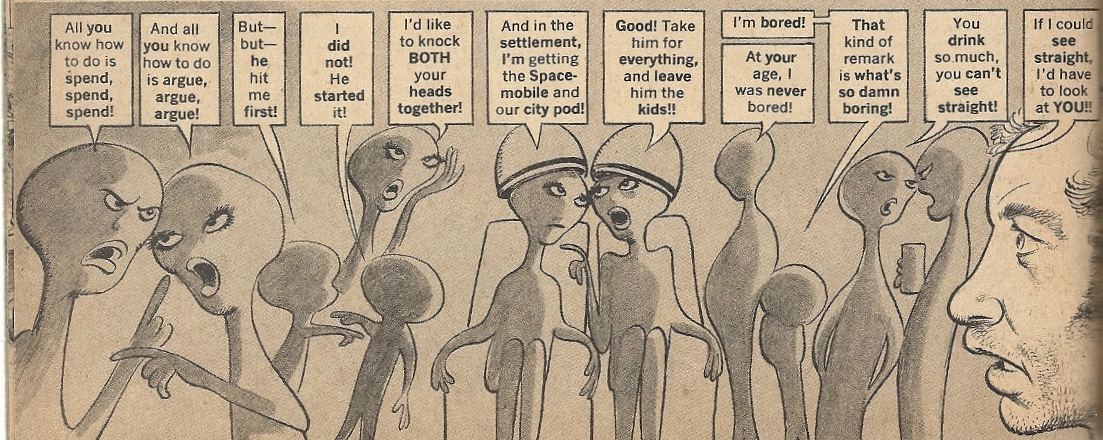
The more things change…
There were also some nice side features in this issue, including a Jack Davis-drawn/Tom Koch-written catalogue of stress-causing stimuli. This one tickled my political funny bone:
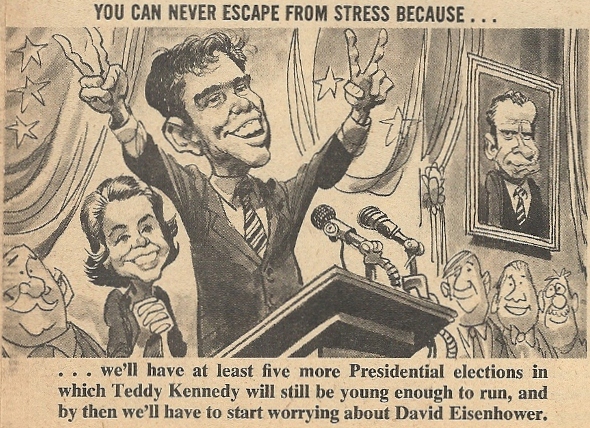
Yes, something involving David Eisenhower made me chuckle. That’s the power of Mad, people.
There was also a nice bit (Jack Rickard art, Frank Jacobs script) that had your everyday comic strips (Beetle Bailey, Dick Tracy, et al.) crafted with the intellectual posturing of Doonesbury. Here’s one with Blondie and poor Dagwood Bumstead reflecting on their social obtuseness:
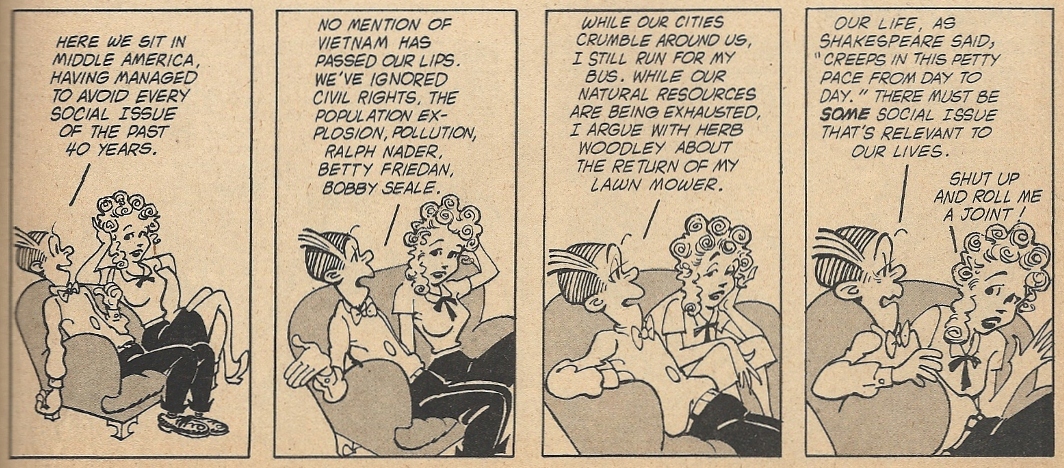
More marijuana humor. I sense a theme.
There you have it, and I didn’t even get to all the Sergio Aragones goodness and the fold-in picture. Next time. Like I said, I have a few more Mad mags that I’d like to share, some of which touch upon the beloved comic book genre. Check back in over the next several weeks if you’re so inclined.
My bedroom floor, ca. 1984

I haven’t had a nostalgic tingle rattle my sternum like the one I had when I stumbled across this centerfold a few days ago. It’s like someone snuck into my bedroom when I was six years old and snapped a picture of the comic book portion of the carnage. I can almost hear my mother screeching at me to “CLEAN THAT MESS UP!”
The thing is, it’s not the big titles that key the trip down memory lane, not the Star Treks, Supermans, Batmans, etc. It’s the lower-tier books. Blue Devil. Vigilante. Atari Force. Jemm, Son of Saturn (God yes, Jemm). Books that were from that little slice of time, that had their moment and were very much forgotten as the wheel kept on turning. They came and went like childhood itself.
Respect your elders – Marvel Team-Up #106

I have my issues with the next Spider-Man movie being a rehash of the origin story that we got less than 10 years ago, but I don’t take exception to Sony making Peter Parker a teenager again. That was always one of the greatest strengths of the original character, that a person blessed with extraordinary abilities and a drive to help others would nevertheless be in over his head and scared out of his ever-loving gourd on most occasions. Like a teen. Like a kid.
A nice corollary to that was the he’d so often interact with other, older and more established character in the hero-ridden New York of the Marvel Universe. Those folks that he’d run into weren’t in on the secret. They couldn’t see through that full mask of his and see the scared kid underneath. All they saw was the super-strong, super-fast web-slinger who could zip around Manhattan like no other. And they couldn’t see the awe that Peter held them in.
It was a nice touch. And, depressingly, thanks to rights issues and all that crap it’s something we’re never going to get — at least not for a good long while — with the silver screen Spidey. Oh well.
But lovers always have Paris. And fans always have comics.
Marvel Team-Up would sometimes saddle us with an underwhelming combo, like Spidey rolling with the Sons of the Tiger. Not in this case. This issue presents us with an encounter between Spider-Man and the hero of heroes, Captain America. If there’s a guy that could get the wall-crawler all starstruck and stuff, it’s Cap.
In “A Savage Sting Has — the Scorpion!” (Script: Tom DeFalco, Pencils: Herb Trimpe, Inks: Mike Esposito, Cover: Frank Miller) the threat that brings them together is that resident Marvel nut-job. Locked up in an asylum, he plays mental possum and dupes some unbelievably gullible doctors into letting him back into his suit as a form of therapy. This has the expected result:
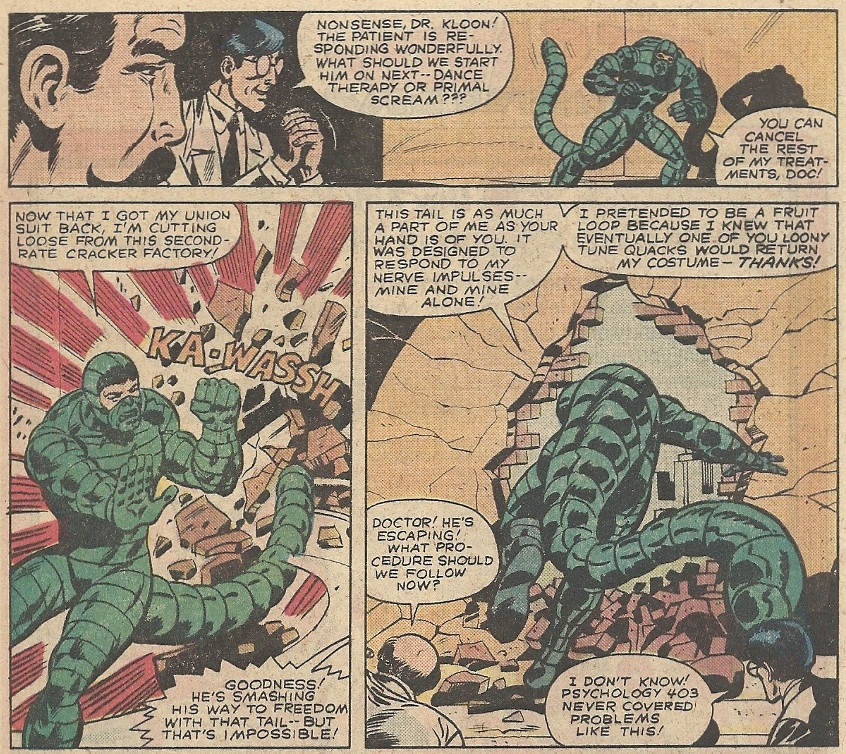
Kind of reminds me of those doofs that let the “reformed” Joker out in The Dark Knight Returns.
Word of his bust-out spreads, and Spider-Man heads out to hunt him down, carrying his usual physical and emotional baggage. The girl problems, work issues and web-fluid refills never cease for our beleaguered champion:
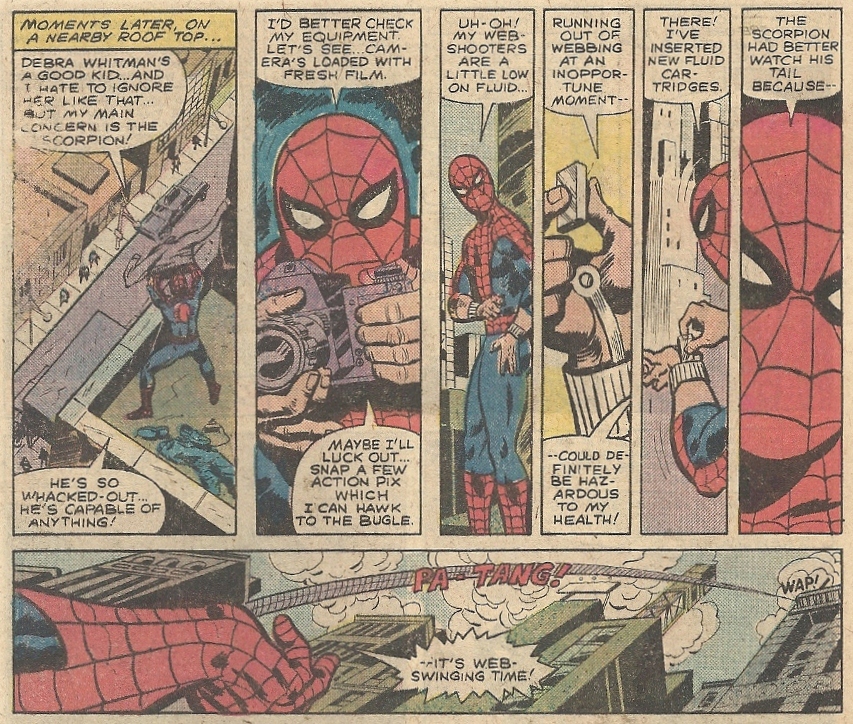
He has no luck on his search, but does manage to snap some shots of himself corralling other crooks. Later,when he heads to the Bugle to hawk his photographic wares, he runs into a certain broad-shouldered blond gentleman also plying his trade — Steve Rogers, who just finished showing Robbie Robertson some of his sketches:
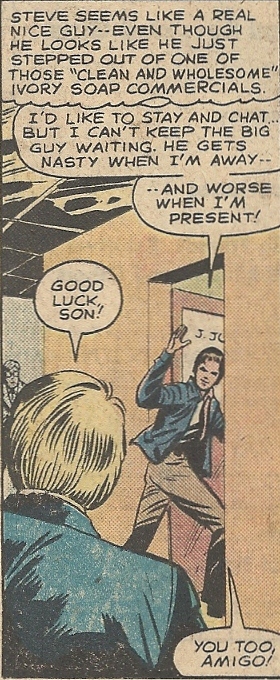
I so love it when out of costume heroes don’t recognize each other. And when Rogers/Cap calls someone “son.”
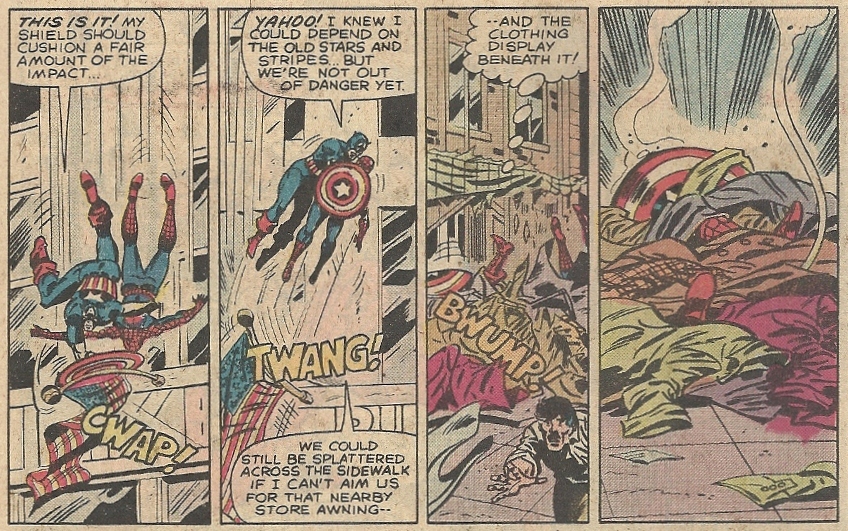
Scorpion, meanwhile, is on a collision course. He’s all pissed at J. Jonah Jameson, whom he (rightfully) blames for his mental plight (see: origin). He kidnaps him, which gets the attention of Cap and Spidey. Both make quick costume changes to meet this threat, but the younger of the two gets smacked, knocked out cold and bumped out of a smashed window. Captain America to the rescue!:
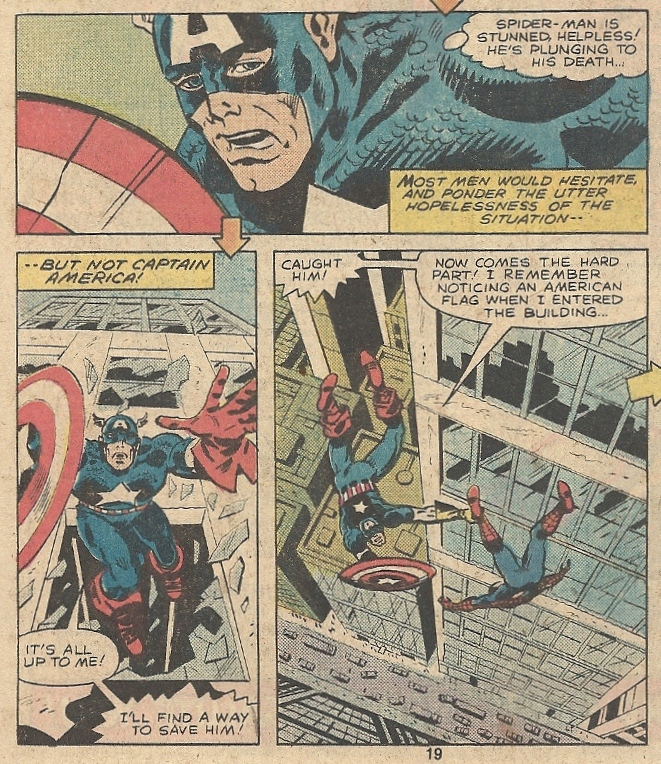
Thank God for cheap clothes:
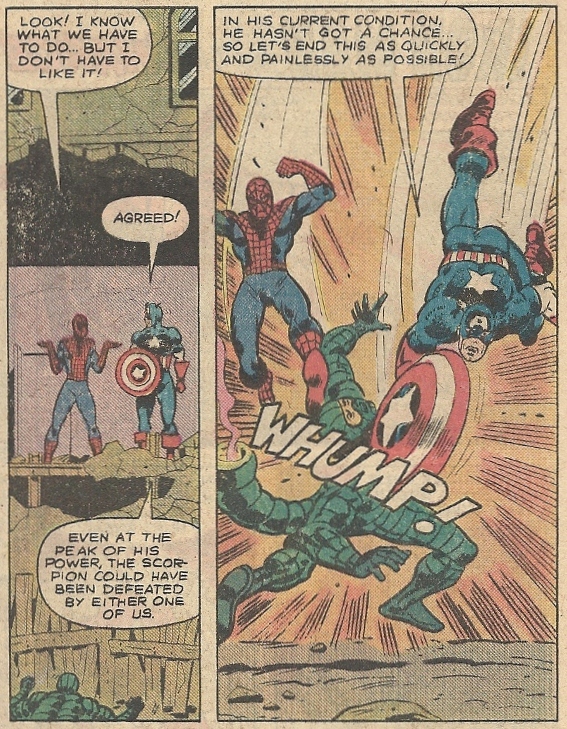
Spider-Man comes to and our impromptu duo gives him battle. Their two-on-one odds overwhelm the addled villain, and they finally wipe him out with the most merciful ass-kickery that they can muster:
They can even share a little joke about a certain bound and gagged publisher:
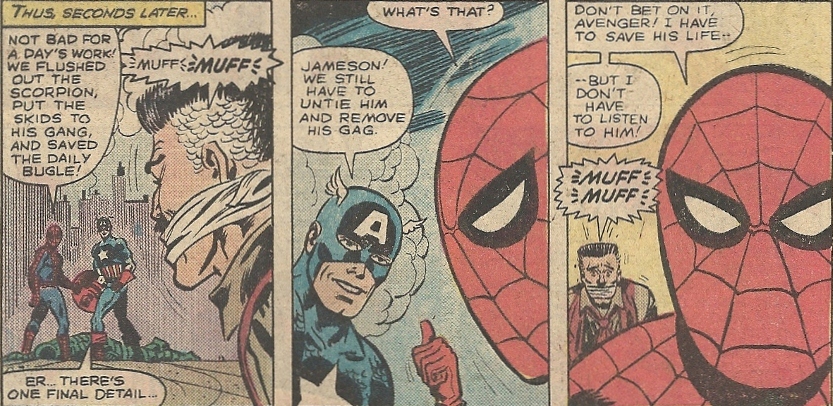
Spider-Man. That scamp.
This is very much a by the numbers story, but the “son”-drenched interaction between the two heroes makes it a good read. There’s also a rather nice little bit with Captain America telling pissed street vendors with property damage to “submit a bill to Avengers Mansion.” That’s it, Cap — let Jarvis sort it out.
I should also add that, as much as I like Trimpe’s Silver Age art, I’m less enthused about some of his later output. This includes his stuff here. It’s still solid, but there’s a certain stiffness to it that holds it back. Perhaps a disconnect with the inks, I don’t know. That said, I can’t take anything away from his staging of Cap and Spider-Man tumbling out of a high-rise. It’s a great little sequence.
And it’s one that Hollywood may never give us. Make Mine Comics!
When Brooke Shields breezed through the DC offices

Brooke Shields was a tad before my time and was never really my thing. She could be quite striking, but the eyebrows were too Neanderthal for me. I can easily imagine, however, that she cut quite a figure in this visit to DC back during the early ’80s peak of her post-Blue Lagoon fame. And I’m sure more than a few ink-stained wretches looked up from their desks and drawing boards to catch a glimpse as this barely-legal/not-quite-legal starlet posed awkwardly with a Superman comic.
Admiral! There be whales here! – Star Trek Movie Special #2, Star Trek IV: The Voyage Home

As the winds and rain of the hell-bitch Irene lashed my little corner of the universe yesterday, my brainwaves stretched to one of the more enjoyable films of my youth, one that had the Earth’s oceans whipped into an extinction-level frenzy by a singing space-stogie. Star Trek IV is neck and neck with The Wrath of Khan in the race for being the best film in the series, and with that predecessor forms a delightful trilogy within the overarching franchise. After the harrowing, sad events in II & III — the death of Spock, the destruction of the Enterprise (the only lady James T. Kirk ever truly loved) and the murder of David Marcus — the lighthearted journey back to primitive 1986 was a welcome relief, and the humor (unlike some of the frivolous douche-chills in the next two movies) rang true throughout. I could go on and on about how good The Voyage Home is, and how well it holds up in our brave new iPhone world.
By God, I will go on and on about it — though not for too long — by highlighting the DC adaptation that accompanied it, brought to our eyes by the long-running Trek comic book creative team of that era.
A note about said team. Mike W. Barr wrote his share of Star Trek comics in his day, but when one harkens back to 1980s Star Trek comics, i.e. the comics that helped shape my perceptions of that universe, it’s the art of Tom Sutton (pencils) and Ricardo Villagran (inks) that springs to mind. I don’t know that I’d call their art pretty. I don’t know that I’d call it articulate, and later teams may have hewn closer to the character likenesses. But it works. It has an edge. When I think of those splendidly apocryphal stories they helped craft, tales that would be wiped out whenever the next movie came out, I can’t help but smile, and a big part of that joy is the visual vocabulary they brought to the table. If you ever want a true romp, then go pick up the trade that collects their “Mirror Universe Saga” (also scripted by Barr). The return of Evil Kirk and Evil Spock (with goatee!) is an utter delight.
Sutton and Villagran bring their best to the table here in translating ST IV (aided by Howard Chaykin’s artsy cover, as well as Ric Estrada, who did uncredited work pencilling the second half of the book). Even though the movie pissed all over what they had been working on up to that point.
One of the first things the strikes me about any comics adaptation is the amount of variation with the film itself. It all depends on what the adapting team has to work with, whether it’s storyboards, stills, or what have you, and how far along in the production they get it (see the Close Encounters post). With effects-laden efforts like this one, it can be an impossible chore to match up with the finished product, try as they might. This is most glaring here with the central plot point of this whole thing, the Probe itself. In the film it’s a slow, craggly black tube with a glowing blue testicle (that’s what it always reminded me of, sorry) descending on a shaft of light. Here it’s, well, it’s just about the complete opposite of that:

Okay, so in this version it’s a bolt of lightning or a magic wand or something. Just roll with it.
At least the memorable bits of humor are all intact. There’s Spock adopting his “too much LDS” disguise:
There’s Kirk using his first “colorful metaphor” on the voyage (though without the whole crew tagging along):

And there’s Spock dealing with a loud punk in a way I’ve fantasized about many times while riding D.C. public transit — and note he delivers the nerve pinch of sweet justice from behind, not from across the bus:

Kudos to DC folks for including the “metaphors” and middle fingers. It adds some welcome, I don’t know, truthiness to the proceedings.
I kind of closed my eyes a little when coming to one of the more beautiful and transcendent moments of the film, when the temporally transplanted humpback whales talk to the Probe and get Earth out of its pickle. I read or heard somewhere, perhaps on the DVD commentary, that studio execs gave a note to Nimoy and co. that it might be a good idea to have subtitles during the whale song. This bad idea (one that offers further proof for my theory that studio note-givers are little more than ambulatory semi-sentient plankton) was, thankfully, ignored, and that quiet, searing moment, where you can understand and interpret what’s being said on your very own, was preserved. I was relieved to find that the comic stuck to that preservation (though without the touching bit with the whales and the Probe matching positions):

Sadly, the buoyant (in more ways than one) scene that followed, with the Enterprise crew, whales George and Gracie and whale-gal Gillian all frolicking in the water, and Kirk dragging the desert-born Spock into the drink, undergirded by the lilting score, was omitted. Perhaps this was necessary for the sake of brevity, and perhaps the joy of that scene was a spontaneous outburst that was thrown in during the editing process and wasn’t in the script. Whatever the case, it was the happiest onscreen moment the original crew ever shared, and I kind of miss it.
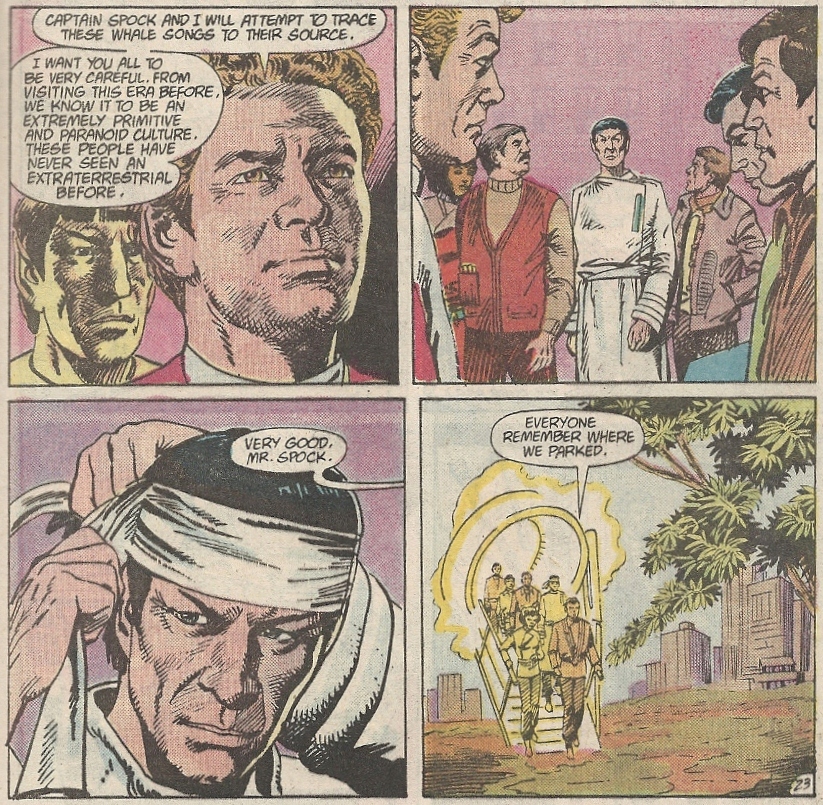
Finally, it wouldn’t be an adaptation without a two-page blast. Here’s Kirk and crew coming home:

So endeth the comic.
There’s a rather fascinating little bit of follow-up to IV which I can’t resist making folks aware of. Four or five years after it came out I saw some ads in book stores for a novel that would be a sequel to the events in the film, called — you guessed it — Probe. I eagerly awaited its release, but its publication date kept being pushed back. And back. And back. Then finally it came out. I read it and kind of liked it, especially its thinly veiled connection of the Probe to certain uber-villains that warped around in cube-shaped ships. Then, many years later, I read about why the book, whose authorship was credited to Margaret Wander Bonanno (always thought that was a great name), was held back for so long. It’s an interesting little tale of the clash of franchise licensing and artistic prerogative and how things can go sideways fast. Look into it if you’re interested.
Anyway. I realize some may not like The Voyage Home. They may find it too silly. I don’t. I like it quite a bit. Perhaps not to Khan levels, but pretty damn close. It never fails to pick me up. And seeing the Barr/Sutton/Villagran trio adapting it is a double nostalgic whammy. It helped me ride out Irene.
And I still — STILL — can’t figure out for the life of me how Shatner’s toupee stayed on underwater. 23rd-century glue, I guess.

This is a stick up! Your Conan medallions or your life!
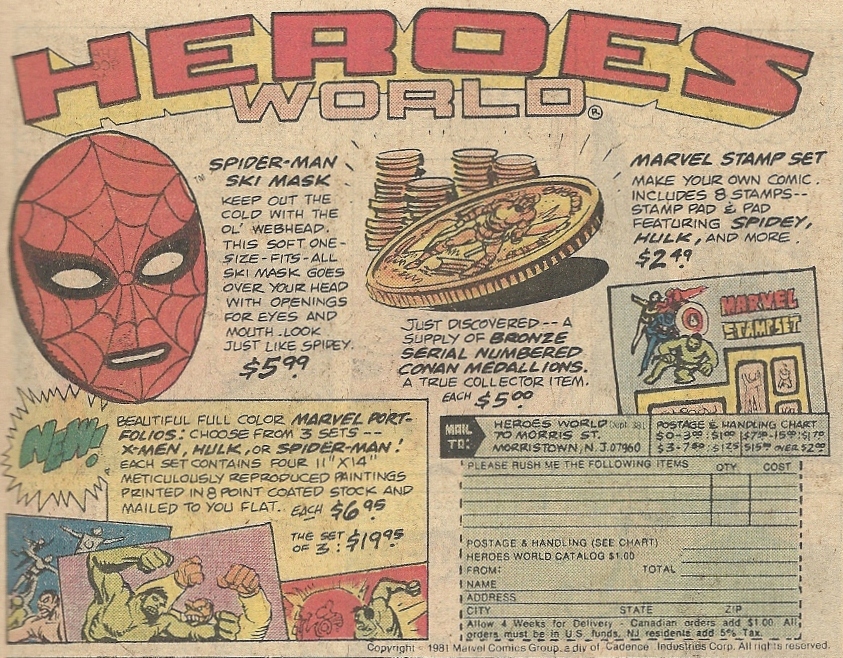
The Spider-Man ski mask is so natural an idea, I’m stunned I hadn’t conceived of one until I saw this. I’d be happy to fork over my cash to a robber sporting one. Or at least a tad less upset and terrified.
The Conan medallions? I’m always a bit chagrined to see anyone pay real money for fake money or money-like junk.
Ditko. Death. Destruction. All under one roof. – Eerie #10

I have a stupid aversion to black and white comics. There are exceptions to that rule, resplendent works like From Hell and some of the better alternative underground books. More mainstream material rendered without colors, well, it just doesn’t fly. This is dumb, I know. When people tell me they don’t watch black and white movies just because they’re in black and white, I call them morons. Ignorant, filthy morons. Yes, I see the irony there.
Enter Eerie. It’s a title much beloved by many, treasured as a showcase for funky horror tales crafted by many industry heavyweights. I recognize its significance as such, but I’ve never been able to get into it all these years after its initial publication. It’s just not my thing. Again, I recognize this is likely more a failing on my part. And I do very much like the oft-stunning cover art. But nevertheless…
Still, it’s nice to see work from artists that I love in a different setting. Shakes things up, shifts the capes and tights paradigms, you know? And we have a prime cut here. There’s some Neal Adams in this particular issue, but I’ve never been able to get into his stuff. Fear not, though, because Steve Ditko contributes the cover story. Now there’s a guy I can get behind.
Let’s have a gander.
Here’s the Alfred E. Neuman of Eerie giving you the low-down on Ditko’s and scripter Archie Goodwin’s “The Warrior of Death!”:

This Zahran is a bad dude, a Genghis Khan on crystal meth, steroids and 5-Hour Energy. A killing machine. A bipedal Jaws with delusions of grandeur. But, as we all know, even crazed megalomaniacal killers eventually come to the end of the line and face death (or Death, as it were):

Few, however, have the stones to bargain with said Reaper, but that’s just what Zahran does. Seeing how he’s sent a lot of business Death’s way, he questions why one would want to ruin a good thing. Death mulls it over and agrees, granting Zahran immortality and freedom from injury. Keep ’em comin’!
A deal with Death. This couldn’t possibly go wrong, right?
It starts out well(?) enough, with Zahran first annihilating nearby enemies and marvelling at the Wolverine-esque results:
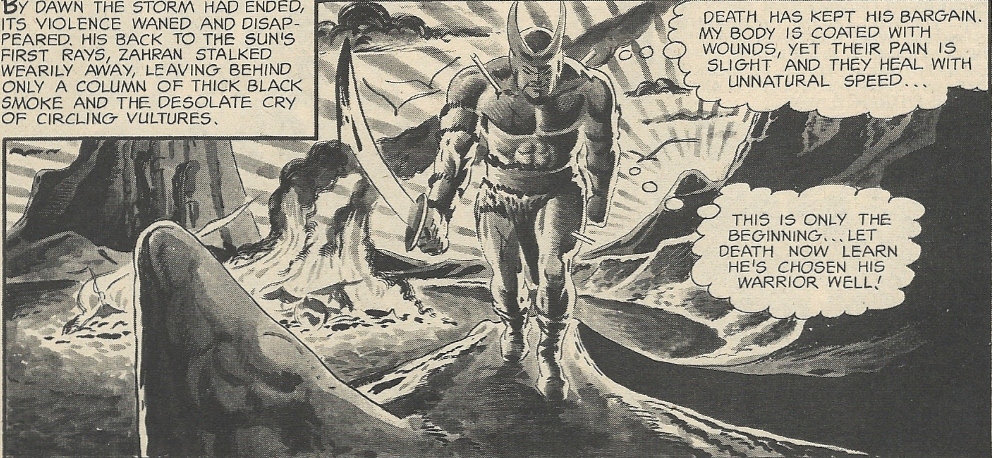
Off this bare-chested juggernaut goes, amassing armies and conquering everything in his path, with his own invulnerable husk as the spearhead:

Finally he comes to the great cities of the West, and outside one a champion challenges him to single combat — a valorous knight named, fittingly, Valric. Zahran scoffs at his bravery and picks up the thrown down gauntlet, but gets a rude awakening as he’s about to deliver the killing blow:
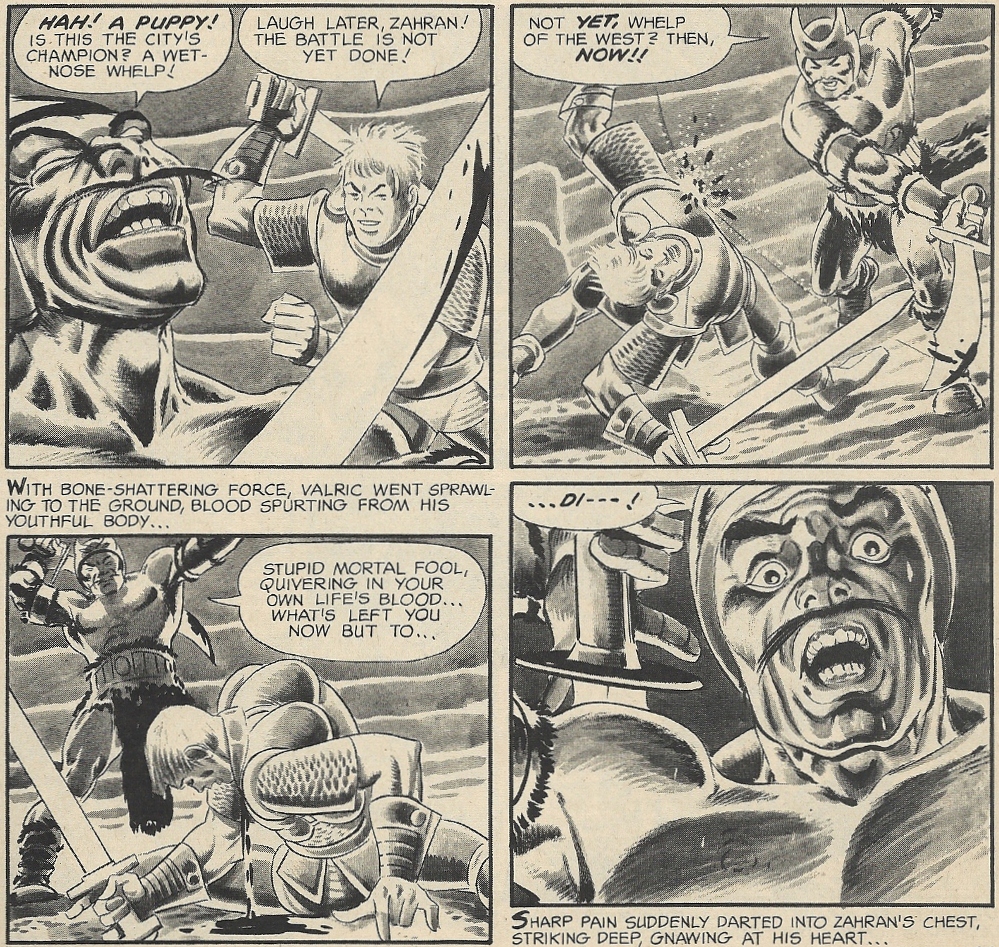
Apparently there were unwritten and unspoken codicils to the Death-deal:
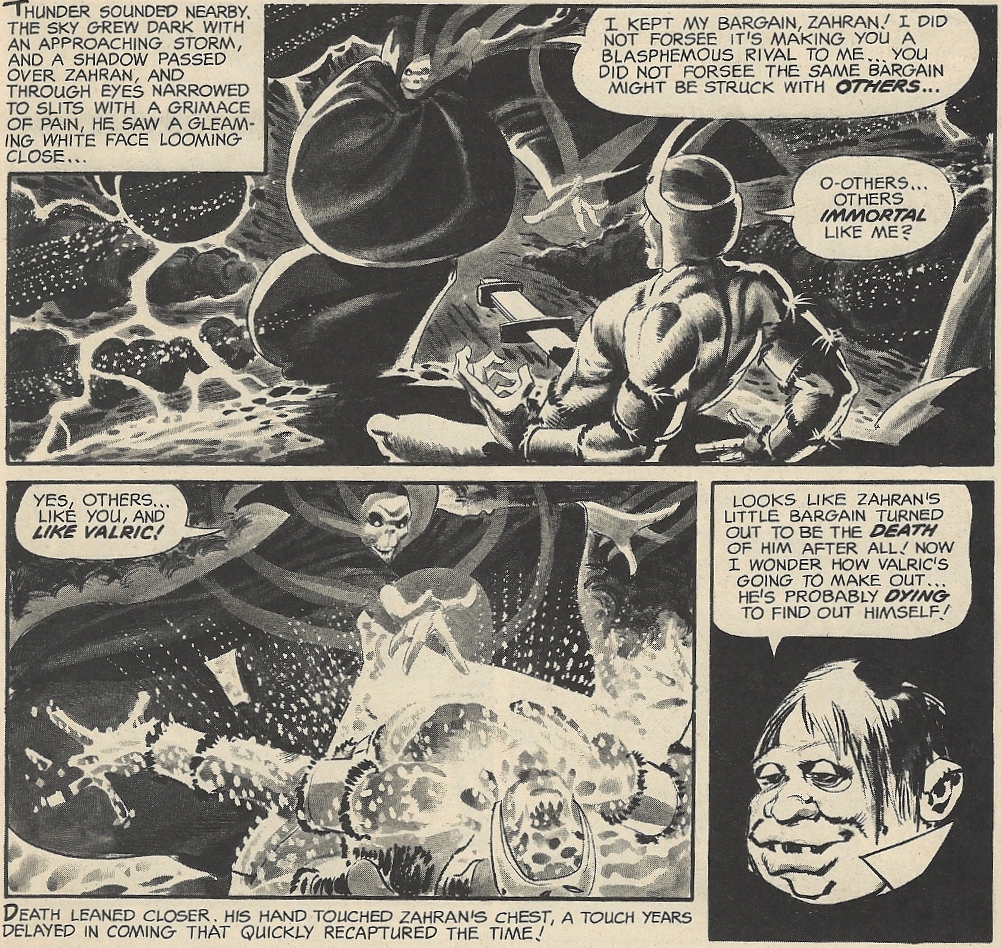
So immortality cancels out immortality. File that knowledge away, it could come in handy some day.
And that’s that.
The brevity of this tale, like so many others in these mags, keeps it from elevating to a truly top-notch read, no matter how much I may like it. It’s just a constraint of the format, and not really a comment on Goodwin (though the “immortal can kill immortal” bit seems a bit trite). Ditko’s art is quite pleasant — even Death gets the classic curved-back fingers — and the shading makes it more appealing to the eye than a lot of the starker black and white works. It’s also far superior to the reprint shades in those cheap, heinous Essentials trades and their loathsome kin. God, how I hate those things.
I’m going to keep trying with Eerie. I hope to grow to, if not love it, at least like it a bit more. I shall persevere. Unstoppable. Like Zahran.
Batman’s dreadfully dull home movies

Ah, the days when home entertainment was sold by the foot. Like cloth. Or Sheetrock. “I’ll take a hogshead of Batman, please.”
It took me a sec to process what exactly was being offered in this ad, which I saw as I was scanning a story in an old Eerie magazine (stay tuned…). The Adam West/Burt Ward series? Actual Batman home movies, with Bruce and Alfred looking on approvingly as Dick opens his presents on Christmas morning? I had completely forgotten about the ancient Batman serial from 1943, the very first screen appearance of the Caped Crusader, one that contributed much to the Bat-mythos (the Batcave and thin Alfred’s pornstache).
These 8mm prints lacked sound (God, how I remember watching my grandfather’s lovingly captured and incredibly boring family movies on a couch in his basement), rendering — I can only imagine — the charmingly corny original work nigh-unwatchable. I’ll stick with my read-along records and storybooks, thank you.
Then again, seeing 1943 onscreen-Batman getting his ass kicked by cheap thugs can be enjoyable with or without aural accompaniment:
I hope I live long enough to see Blu-Rays look this archaic.
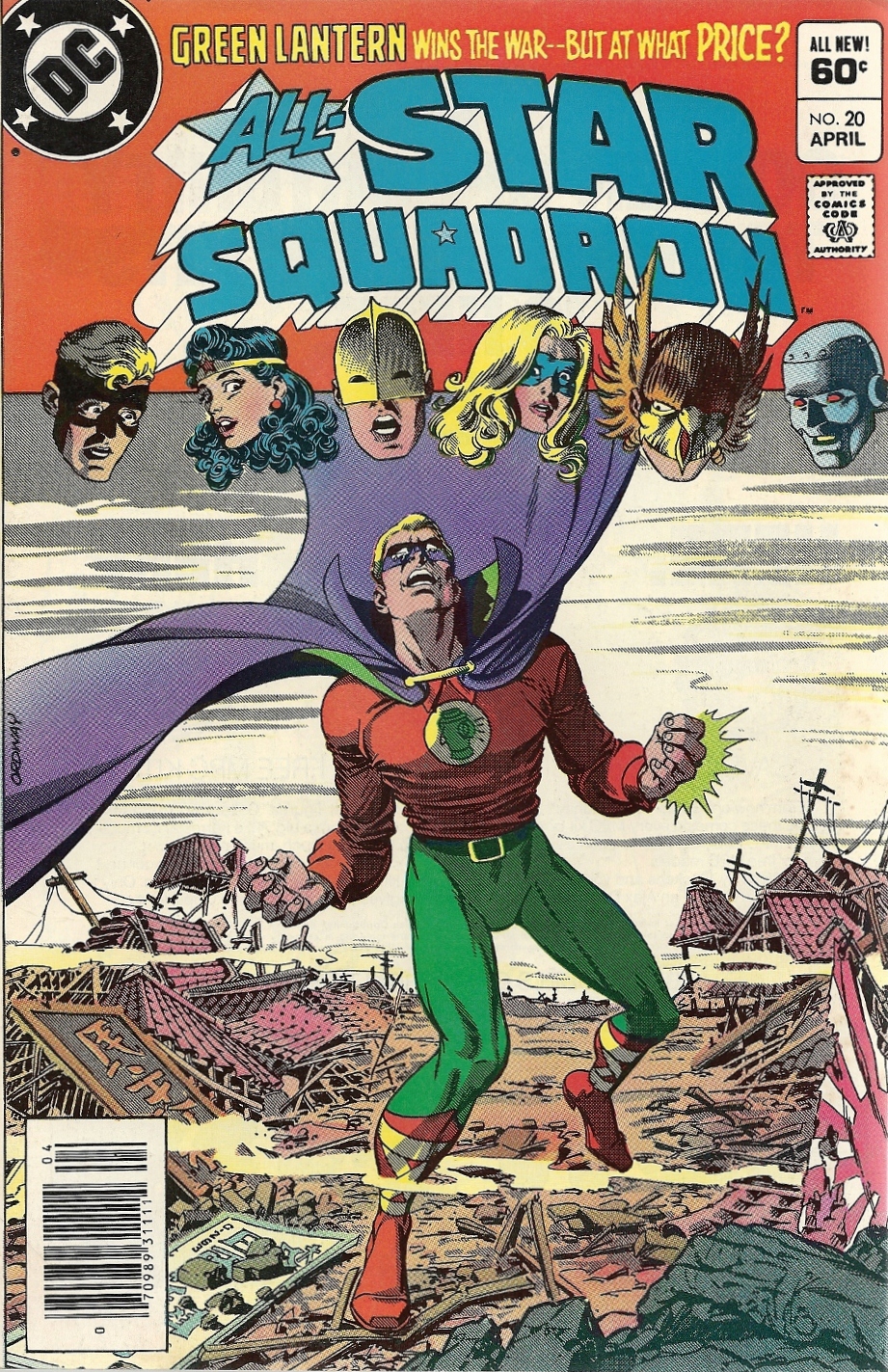
The Roy Thomas-penned adventures of the Justice Society of America are a treasure of the 1980s. He brought a reverence for the characters to the table, one that helped forge the somewhat disparate quality of the old-timey Golden Age material into a powerful, modernized narrative. This issue is one of the better examples of that scripting dexterity, as Thomas combines some “where the other characters are” snippets, the early days of America’s World War II involvement (1942) and the harrowing tale of an angry god.
You think Hiroshima, Nagasaki and Fukushima were/are bad? Japan never came up against a pissed off Alan Scott.
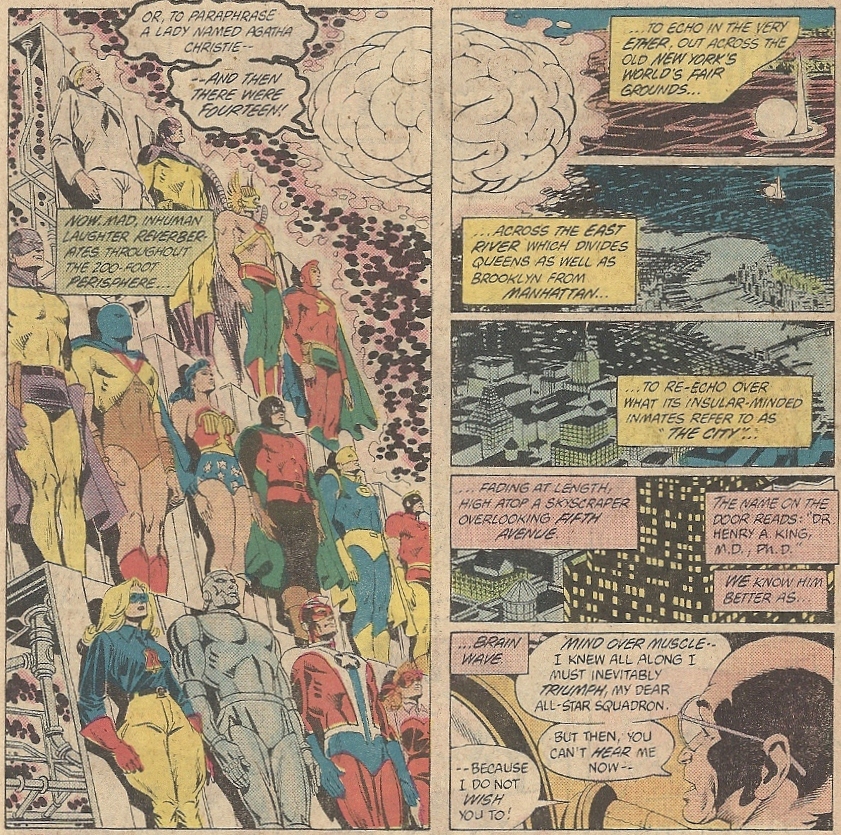
The impetus for this issue’s (art by Jerry Ordway) imaginary disaster is a diminutive Mr. Magooey villain named Brain Wave, who’s taken the bulk of the Justice Society and manipulated their minds so that they all think they’ve been offed by the Japanese military (and this also helps explain away events from the old All-Star Comics #11). They’re left helpless and entrophied (is that a word?):
While all this is going on, we get a taste of authentic Golden Age goodness. Here’s Superman battling a fully-follicled Luthor, from issue #17 of that hero’s eponymous book:

Meanwhile, the younger half of the Dynamic Duo has been tied to a post by the Joker and gassed, followed by a narrow escape from death (all from Batman #17):
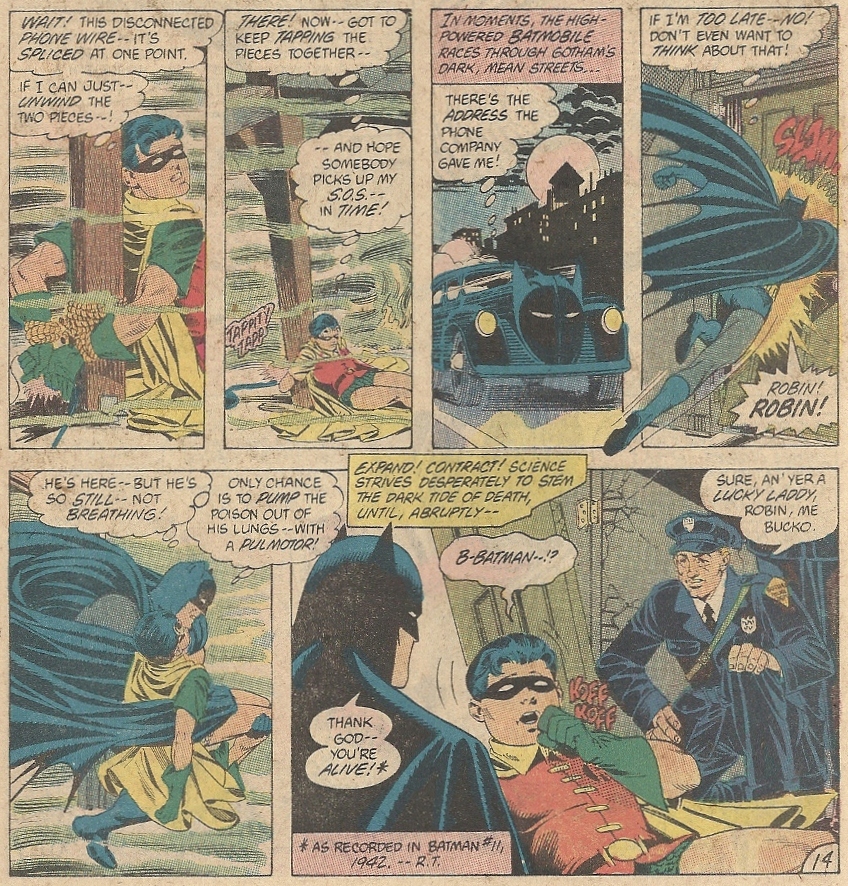
Ah, the days when the Joker wouldn’t beat the Boy Wonder to a pulp with a crowbar before leaving him to die.
Back to the core stuff. Brain Wave had summoned the trapped heroes with a Morse code challenge (hence the reason for showing what the other leading lights are up to), and the Green Lantern responds belatedly. Before he can free his friends, he too is trapped in this virtual shared dream. When he finds his pals and allies dead, he does not react well:
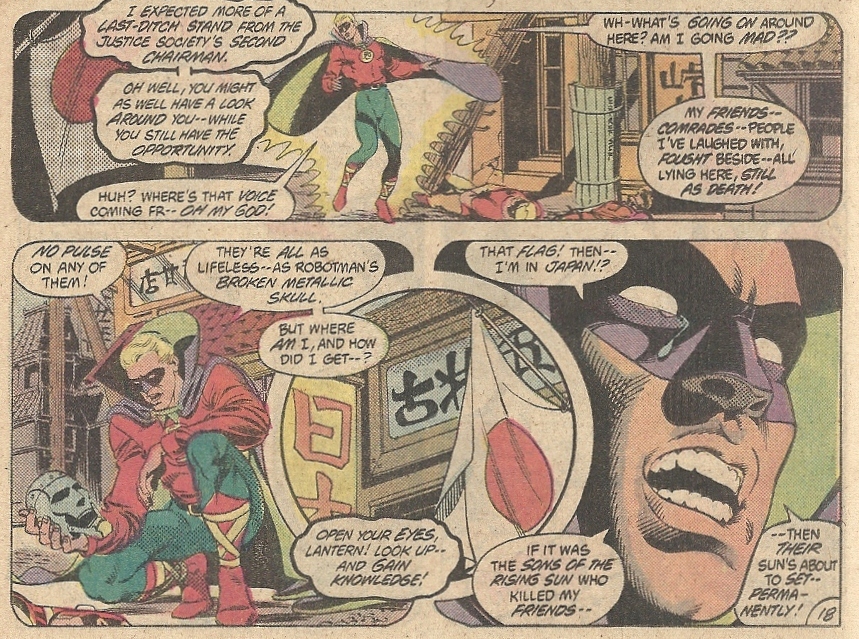
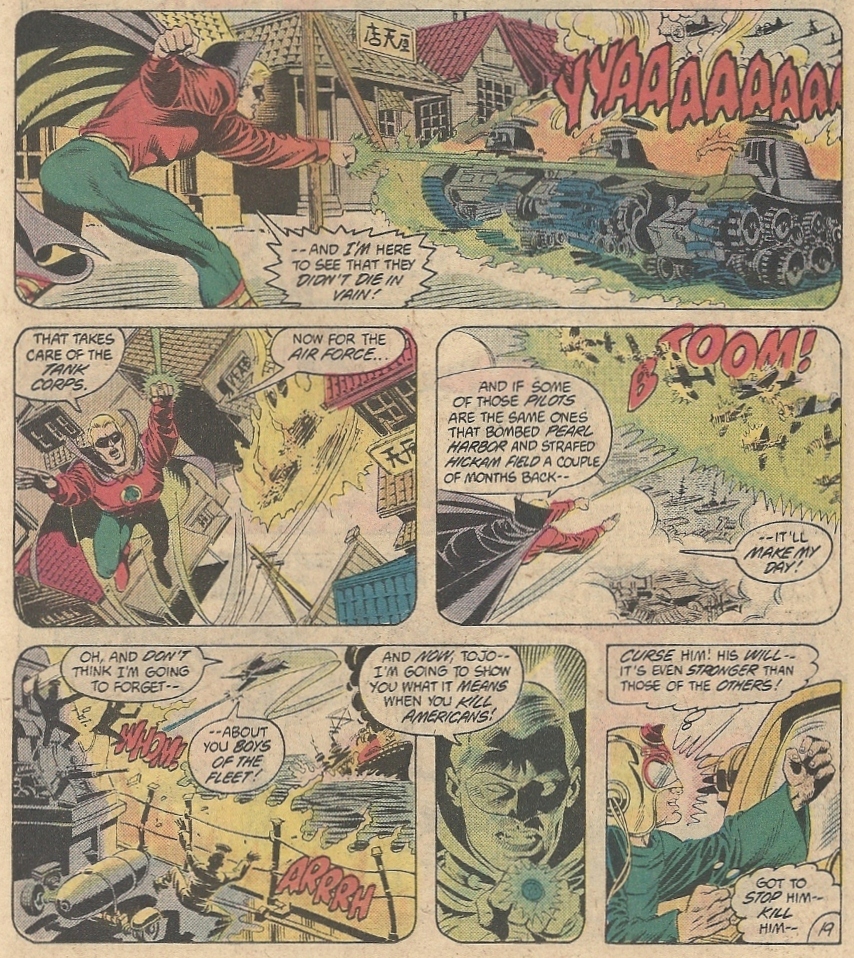
Scott’s a man of his word. The Japanese military is the first to fall before his verdant fury:
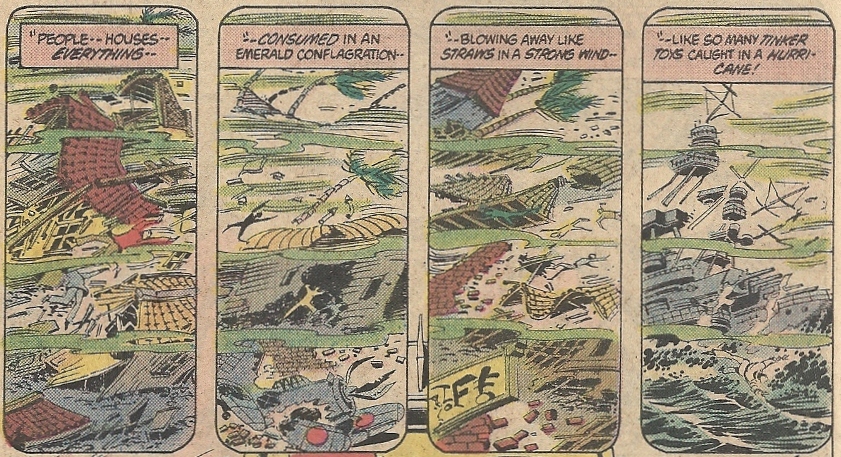
He doesn’t stop there:
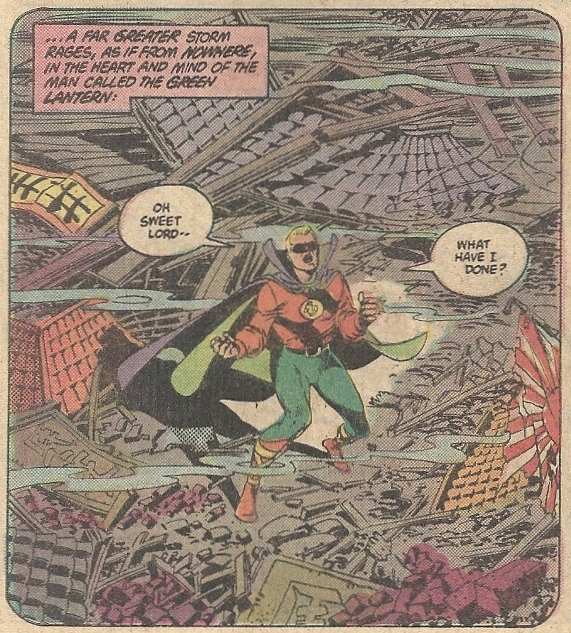
Then comes the guilt:
The strength of his anger and will has overwhelmed Brain Wave and his machinery, freeing the other members of the Society from his clutches. But there’s some “rule” that if he dies, then all the other formerly brain-zapped heroes will die as well (a weak point in the story, but I’m willing to let it slide). This is a problem, because his dreaming consciousness comes close to offing himself with that murderous ring. He’s pulled back from the brink by his cohorts in the nick of time:

He may have backed away from the abyss, but it’s still staring back at him. Only the Golden Age Wonder Woman, with her hair and her bloomers, can comfort him:
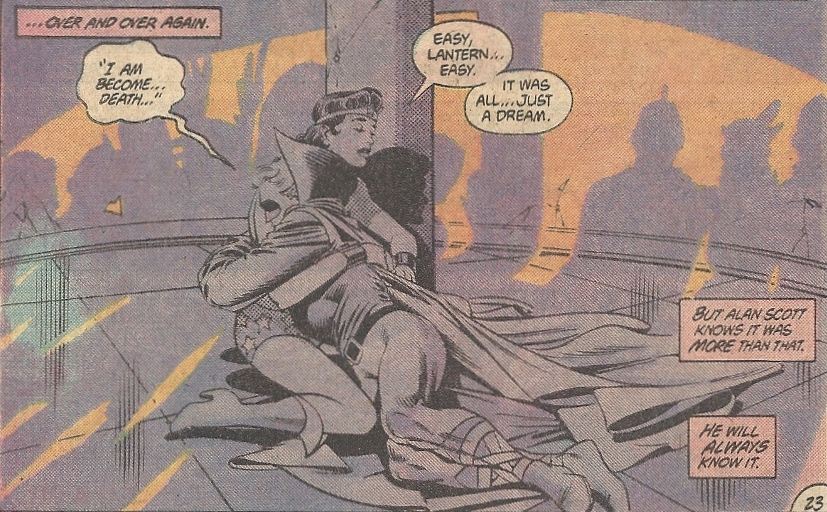
Good stuff.
This reminds me of that episode of Star Trek: The Next Generation, the one where Picard lived a whole other life inside his head before he returned to his normal self. The Inner Light. That sort of thing sticks with you. Come to think of it, I’m also reminded of another episode, where a godly being lives with the guilt of having, in one single moment of rage, wiped out an entire race of beings (The Survivors).
It’s true: All roads lead to Star Trek.
These Thomas All-Star Squadron issues are a joy to read (a joy solidified by Ordway’s sold art). Whenever I go through them, I’m struck by how well he wove in and out of established continuity to create something fresh and eminently readable. It only makes me cringe even more whenever another half-ass reboot is flung out into the public. According to Wikipedia, the concept of “retroactive continuity” was coined in the letters page of this very issue (and even the letters pages, with Thomas explaining his thought processes, are a good read). Fitting. Retcons can be cans of worms, but Thomas mastered the art in Squadron.
And keep in mind, the Alan Scott Green Lantern has it within him to kill entire nations. Knowledge for life. It turns out Hal Jordan/Parallax was only following in his predecessor’s dreamy footsteps.
It’s a bird! It’s a plane! No, it’s a PAPER airplane!
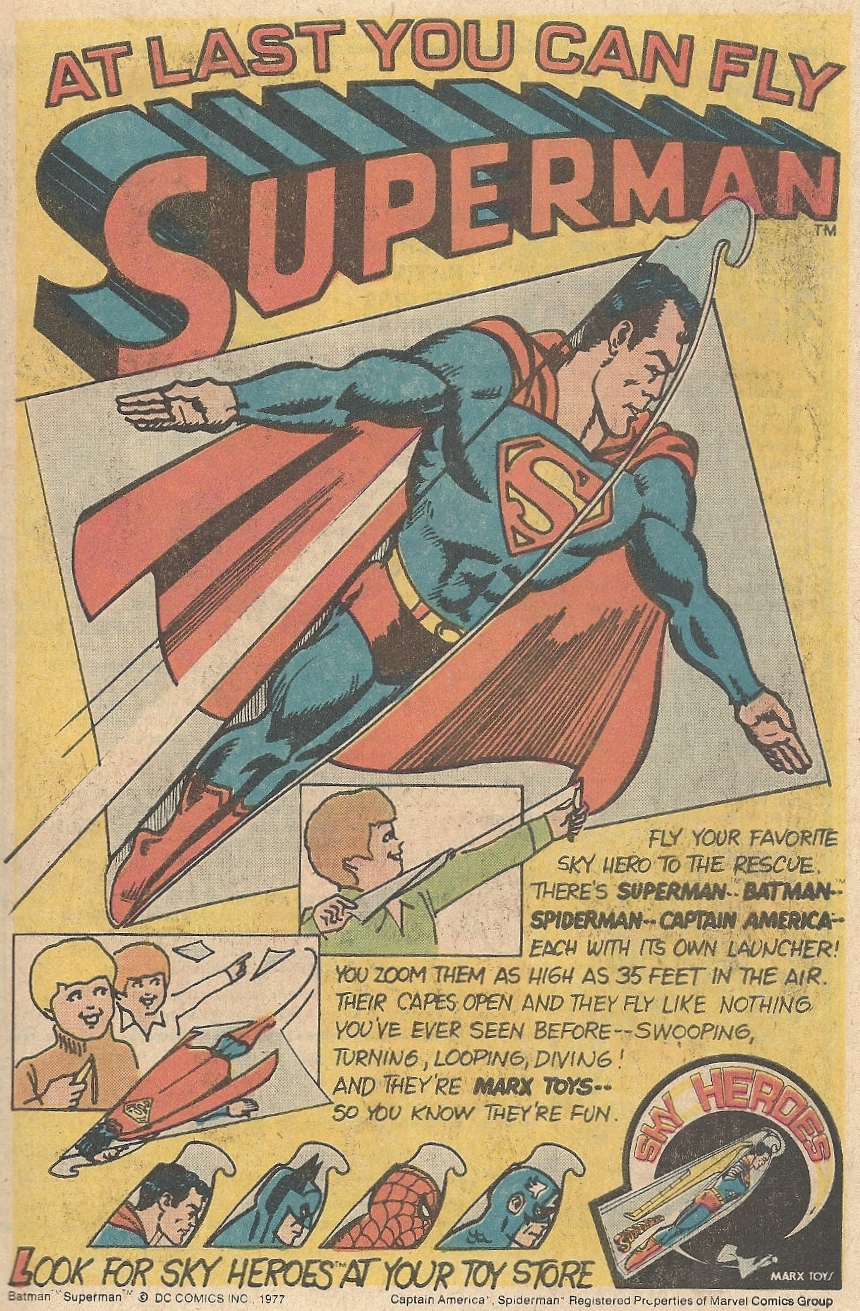
There’s another variant of this ad that has Spider-Man in the lead role. “Yes. It flies. Just like Spider-Man.” Whatever. I have a feeling that this toy would last about two minutes before it was in tatters.
That said, I have to tip my cap to any huckster who can make a paper airplane and a rubber band into a marketable product.
 Jared
Jared


 blog into mystery