Righteous Produce of Justice – Flaming Carrot Comics #7

I’m of the opinion that one thing could have saved 1999’s Mystery Men from the depths of box office bomb ignominy, from clinging to the tattered old “cult classic” rags. Well, maybe this one thing wouldn’t have saved it. But it would have been a nice addition. And that would be adding the Flaming Carrot to the Shoveler and Mr. Furious et al., fellow members of the original D-list comic team. Picturing folks pitching the idea of a talking vegetable hero to bottom-line minded studio execs with their nice suits and expensive lattes and empty heads is something that can get you through dark times, let me tell you.
Created by Bob Burden, the Flaming Carrot was/is a character whose title that felt like a drawn out strip that one would find in an urban alternative newspaper. That can be good, with all the quirky humor that you’d expect from funnies back near the want ads and phone sex adverts. “Man Seeking Man For SEXY EROTIC JUNGLE FANTASY” (and check out this new strip by Derf!). That can also be bad, with the attendant “Huh?” obtuseness that leaves readers scratching their heads like Rock Hudson walking out of the 2001 premier.
The Flaming Carrot’s adventures are nuts, but they aren’t obtuse. There’s nothing sailing over a reader’s head. So relax.
Here’s the “Previously on L.A. Law” summary to get you up to speed on the character and this issue:

Kind of says it all.
In this one little comic the Flaming Carrot is overcome while rescuing a kitten from a sewer, found in a catatonic state by fat polygamous junk collectors, sold at a flea market, turned over to an anti-Flaming Carrot gang, rescued by pro-Flaming Carrot bicycle-riding youths, and revived by a mad scientist. That’s a whole pile of surreal bang for your buck, and that’s not even including the side-stories of cellulite-collecting madmen and baby-headed politicians. It all works, in spite of everything that screams it shouldn’t.
I was particularly taken with the trippy way that the Carrot is brought back to life after his brush with death, which includes Mars Attacks trading cards and busty strippers:

I’m still in that stage of life where I can’t process that I’m not going to live forever. I don’t have a living will or any of those other trappings of mortality. If I ever do make out such a document, when specifying what resuscitation methods may be employed on my person I’m going to include ample cleavage amongst the licensed arsenal. And hell, throw in some Magnum, P.I. cards, like ice cream after a tonsillectomy.
I had forgotten that the “carrot” of the Flaming Carrot was a mask (it’s been a while) and that there was a dude underneath. A mystery man indeed:

“Dr. Heller, am I a root or tuber?” Is that deep?
Among kindred independent books that’ve been featured here before, Burden’s material is leagues better than the insipid Reagan’s Raiders, and a more nuanced effort than the Boris the Bear charnel house. And it doesn’t get as wordy as the worst of Cerebus, which is a series rightly regarded as a pinnacle of independent publishing but one that could at times make you want to shoot yourself in the face with cobra venom bullets. The Carrot is sometimes funny. His title often makes you smile.
Long live the Carrot.
“Come into my parlor,” said the company to the kid
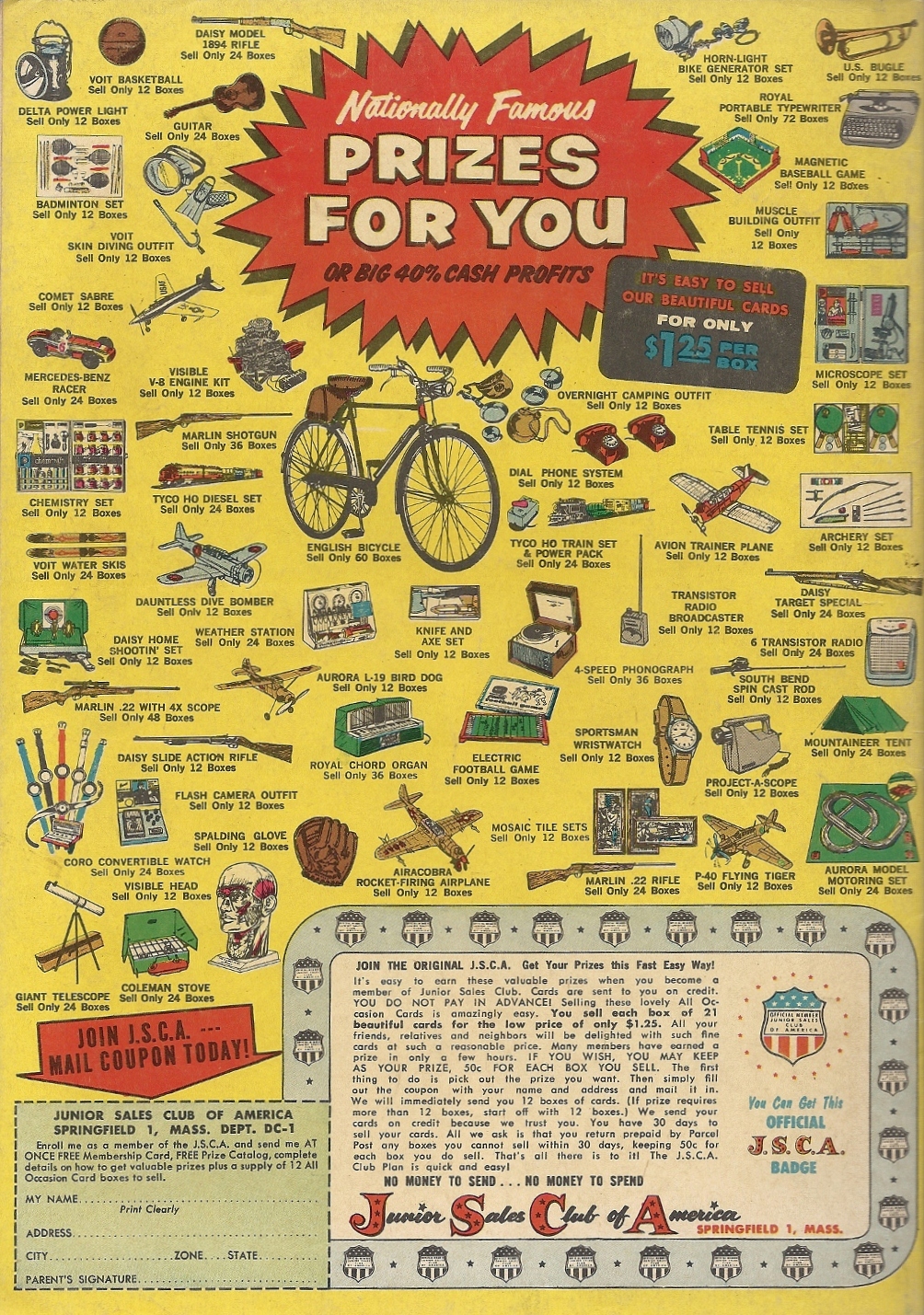
Consider this ad (taken from yesterday’s 1963 Sea Hunt comic) a forerunner of the “Captain O” ilk of my own youth. I’m more and more coming to the realization that these things are windows absolute evil, getting kids to do grunt work (selling cards) for the promise of bikes, toys, sports gear, and other accoutrements of youth. This isn’t on the same level as a pedophile luring children into his house with video games. It isn’t Gordon Jump plying Arnold with ice cream, comic books(…) and cartoons. But it’s pretty low.
Maybe joining the “Junior Sales Club of America” gave kids gumption and taught them the value of hard work. Maybe I’m being a skeptical prick. I don’t think so.
Lloyd Bridges and his shrink-wrapped batch. IN COLOR. – Sea Hunt #13

My favorite professor back in college had a nice one-liner about the mummified Strom Thurmond (this was in the late 1990s): “Strom Thurmond ran for President against Harry Truman in 1948, and he wasn’t young then.”
I’ve always felt something similar for the late, great Lloyd Bridges. My generation came to know him as the glue-sniffing airport chief in Airplane and Seinfeld foil Izzy “It’s go time!” Mandelbaum, but this acting family patriarch had a long and varied career. He starred alongside Gary Cooper in the all-time great film High Noon, guested as Cain in the original Battlestar Galactica, had roles in madcap farces during the ’90s, and everything in between. His greatest star turn, though, came at the end of the 1950s and into the next decade with the syndicated scuba diving adventure show Sea Hunt.
Late 1950s. Early 1960s. And he wasn’t young then.
Sea Hunt is a strangely hypnotic series. It features some nicely shot underwater sequences (granted, many were filmed in back lot tanks, but still…) and calm, even-toned narration from the very-fit-for-a-middle-aged-man Bridges. And oh, we always saw how fit he was, since he often eschewed full diving gear for the tightest, shortest shorts the world has ever known, perfectly tailored for accentuating his Jeff- and Beau-siring bulge. Look into my area. You’re getting very sleepy…
Some might take issue with the repetition in the scenarios that would get Bridges’ character (Mike Nelson) underwater, and that he suffered a deadly crisis with his air tanks in almost every episode. The latter would even spawn a recurring quip in Mystery Science Theater 3000‘s mockfests. “At this point, my lungs were aching for air…” I’m not one of those detractors. I enjoy the show. I see it on in reruns now and again, and I can’t help but watch. It’s soothing, like watching fish swim in an aquarium. That doesn’t sound like a ringing endorsement, but it is.
This comic, published in 1963 after the show ended (this is the last issue), is quite faithful to the original material. Comic book Nelson looks like Bridges, genial facial lines and all. The narration is in there and the diving adventures are (of course) present, though I’m relieved to note that the form-fitting crotch-huggers aren’t. Phew.
The first Mike Nelson story (Script: Eric Freiwald, Robert Schaefer, Art: Dan Spiegle) finds him having his R&R interrupted by murderous shenanigans. You get some underwater knife-play (which always reminds me of the Magnum, P.I. intro):

Again with the oxygen!
Amphibian Nelson can also kick ass on land:

The second tale has Nelson trying to locate some lost fossil bones in an underground lake (rank that as one of the last jobs in the world that I’d ever want to do, up there with changing the light bulb at the top of the Empire State Building). I like a lot of the shadowy cave artwork in this one:
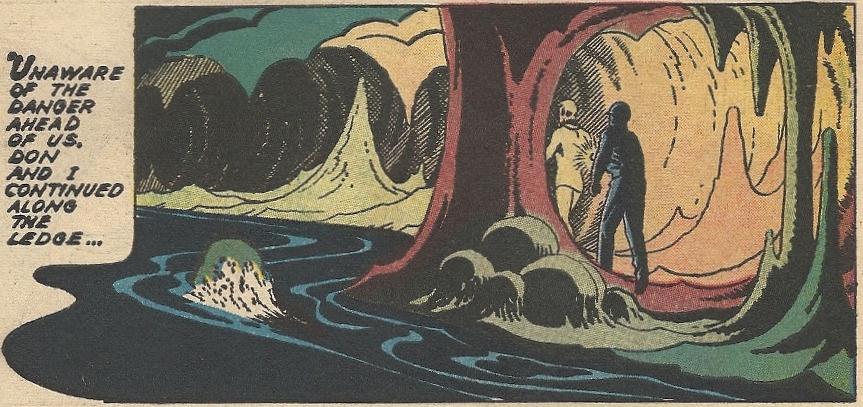
There’s a collision course for wackiness when two children get lost on a tour and a couple of convicts dig their way out of prison and into the caves (displaying a Bugs Bunny-like tunneling ability). Never fear, because Nelson finds the bones, rescues the kids and subdues the cons. The day is saved and the rugged gentlemen can smile and smoke their pipes:
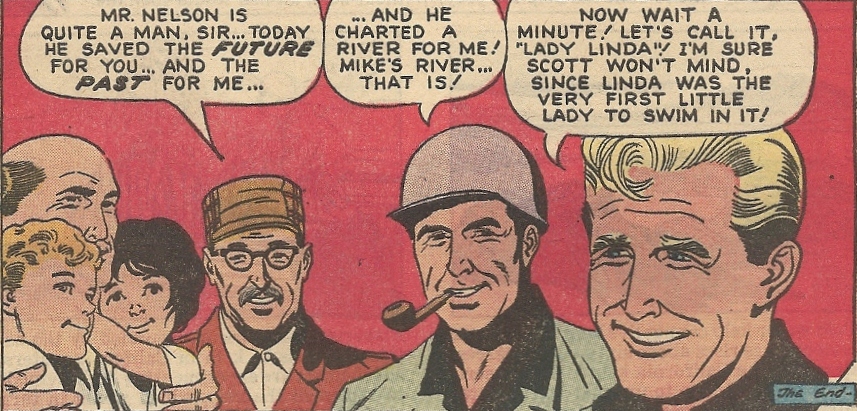
When men were men!
As far as old-timey comics based on old-timey TV shows go, I’d rank this one towards the top of the I Spy, Adam-12 and Dark Shadows pile. It’s really not a bad read, especially if you like the show. And if you’ve never seen the show, check it out. It just might put a smile on your face.
“At this point, my fingers were aching from typing…”
We are Spider-Man kids, ten million strong and growing…

These Spider-Man vitamins would have had a whole lot more appeal to young me than the old Flintstones chewables. Wouldn’t you rather grow up big and proportional-strength-of-a-spider strong than big and able-to-stop-a-car-with-your-bare-feet strong?
Coming soon: The Incredible Hulk suppository.
The Braggadocio of Braggadoom (An Ever-Lovin’ October Continues) – Marvel Two-In-One #13
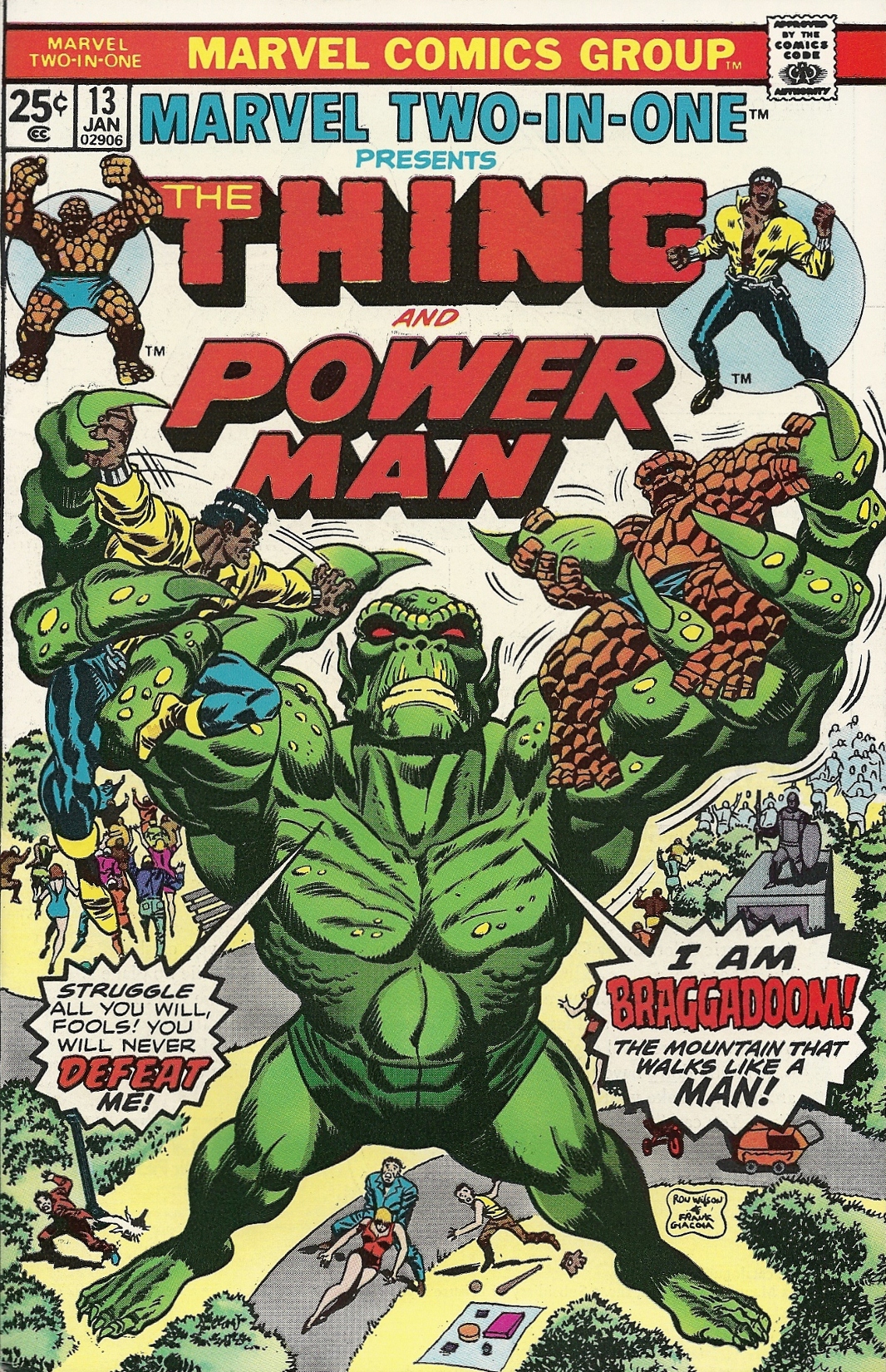
One would think that Man Mountain Marko and his brass knuckles would have something to say about Braggadoom’s cover boast.
Our half-assed Two-In-One retrospective continues this time around with Ben Grimm battling alongside another blue-collar hero (for hire), Luke Cage. It’s a working-class-hero-palooza. And Power Man isn’t some low-class guy who’s developed powers and now lives in a high-tech highrise. No, he’s a guy who actually has to earn money, who has to hustle and take out ads in newspapers and rent an office next to the Mike Hammers of the world. You go into this issue half-expecting Cage to start sounding like Robert Shaw mocking Richard Dreyfuss in Jaws, calling Ben “college boy” and all that jazz with his unique urban tinge.
There’s no time for that, though. There’s a monster to fight.
The format of this ish (Script: Roger Slifer/Len Wein, Pencils: Ron Wilson, Inks: Vince Colletta) is a bit different from what we’ve seen. Instead of opening with Mr. Grimm wading through some of his daily befuddled escapades, we start with a wormy looking fella (Arnold Krank) coming to Power Man to hire his services. This lab worker accidentally created a new form of life, but, as with all such happy discoveries, there are some awful consequences:
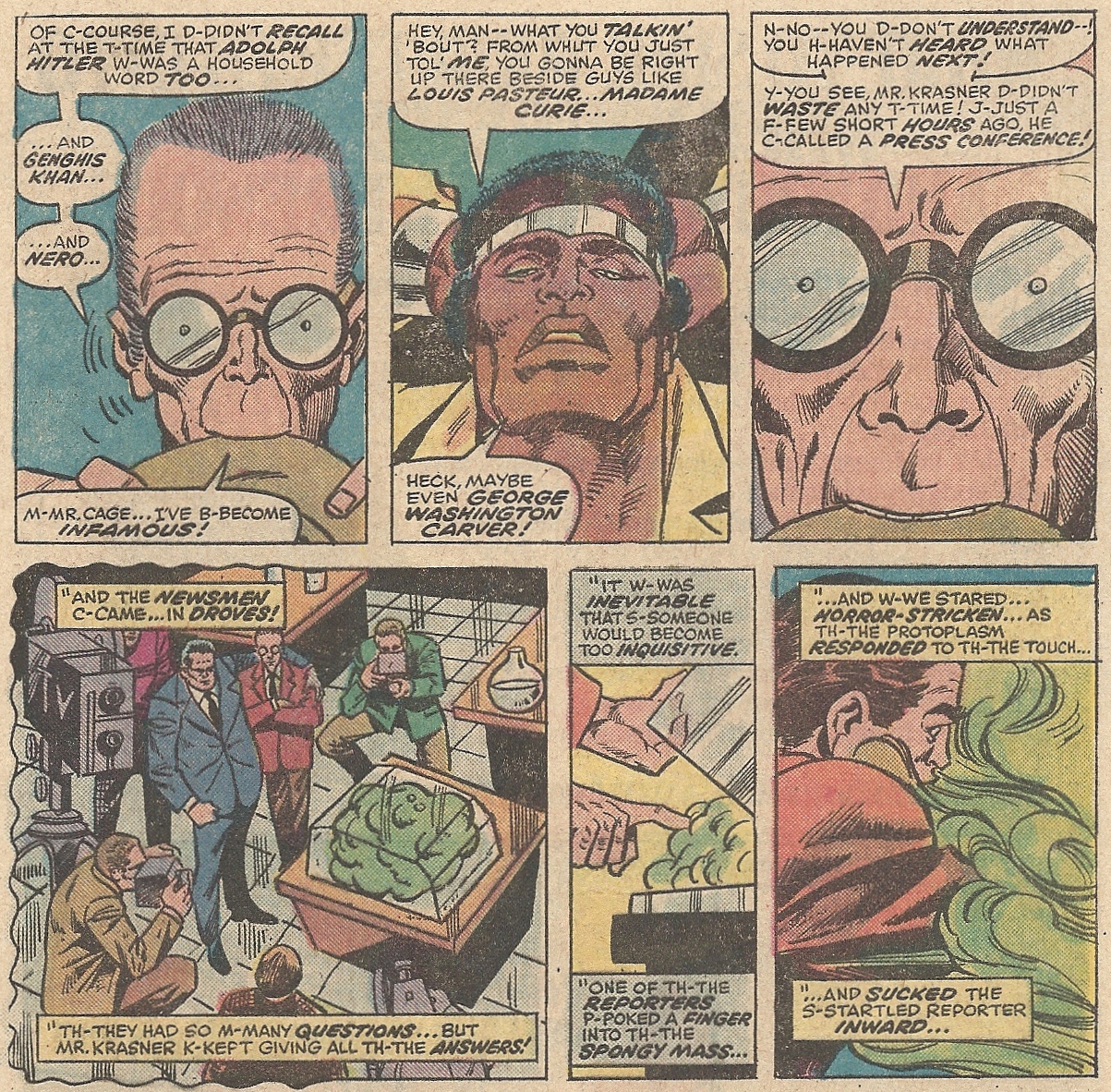
The green slime sucks up the head of the lab as well as that poor reporter, and morphs into the scaly beast seen on the cover. And yes, this monster, like so many others, wears undies. Just like Fin Fang Foom. Fruit of the Foom.
Cage asks the question that every reader would ask: Why the hell are you coming to me with this, a guy good at beating up wimpy vampires and rescuing hapless Moon Knights, and not going to the heavy-hitters and teams? Answer? Krank’s seen them!:
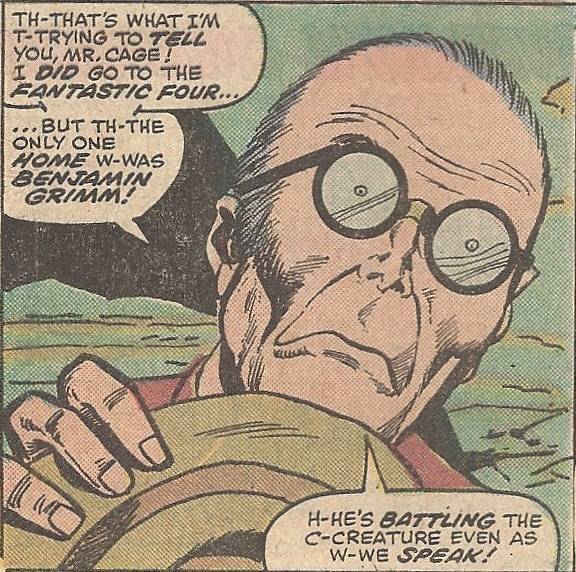
D’oh!
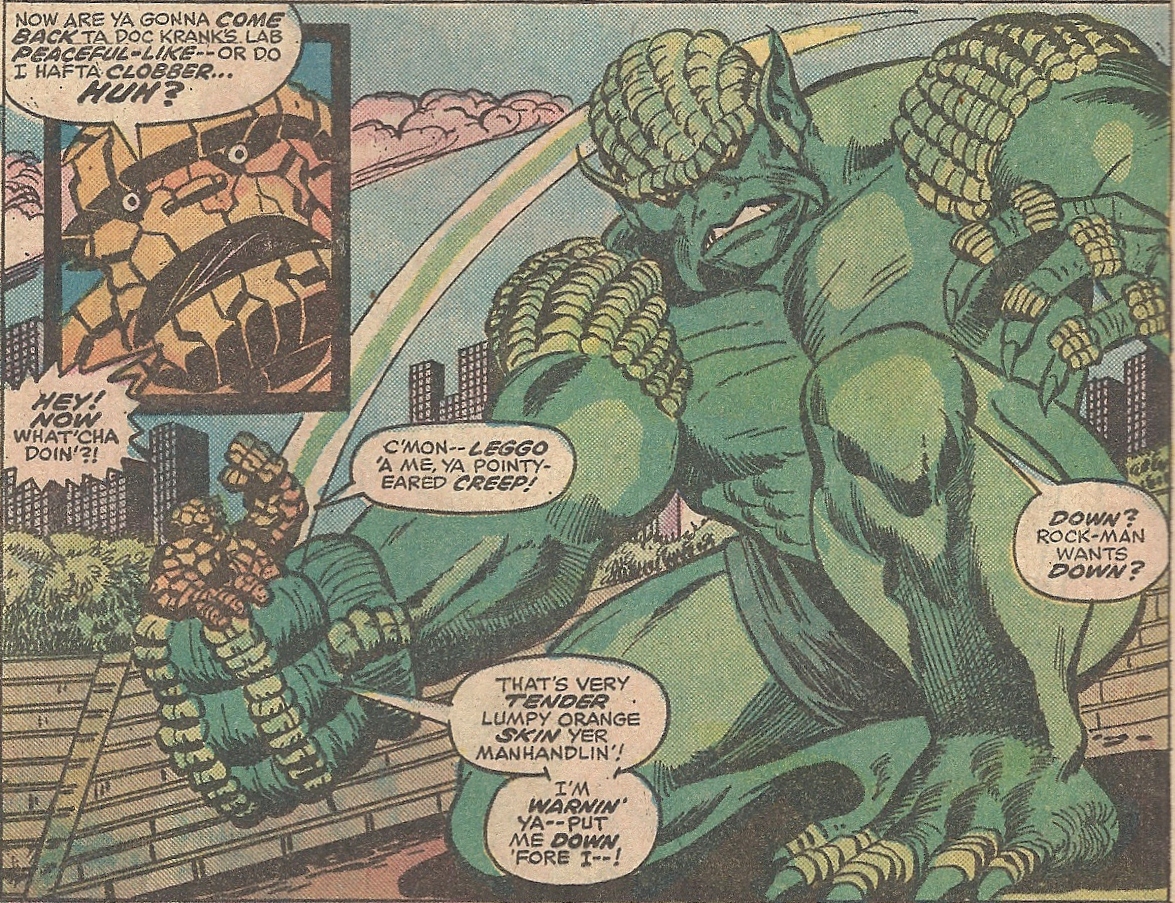
Don’t worry, the Thing has matters well in hand. Well, not exactly, though he is doing his best Fay Wray impersonation:
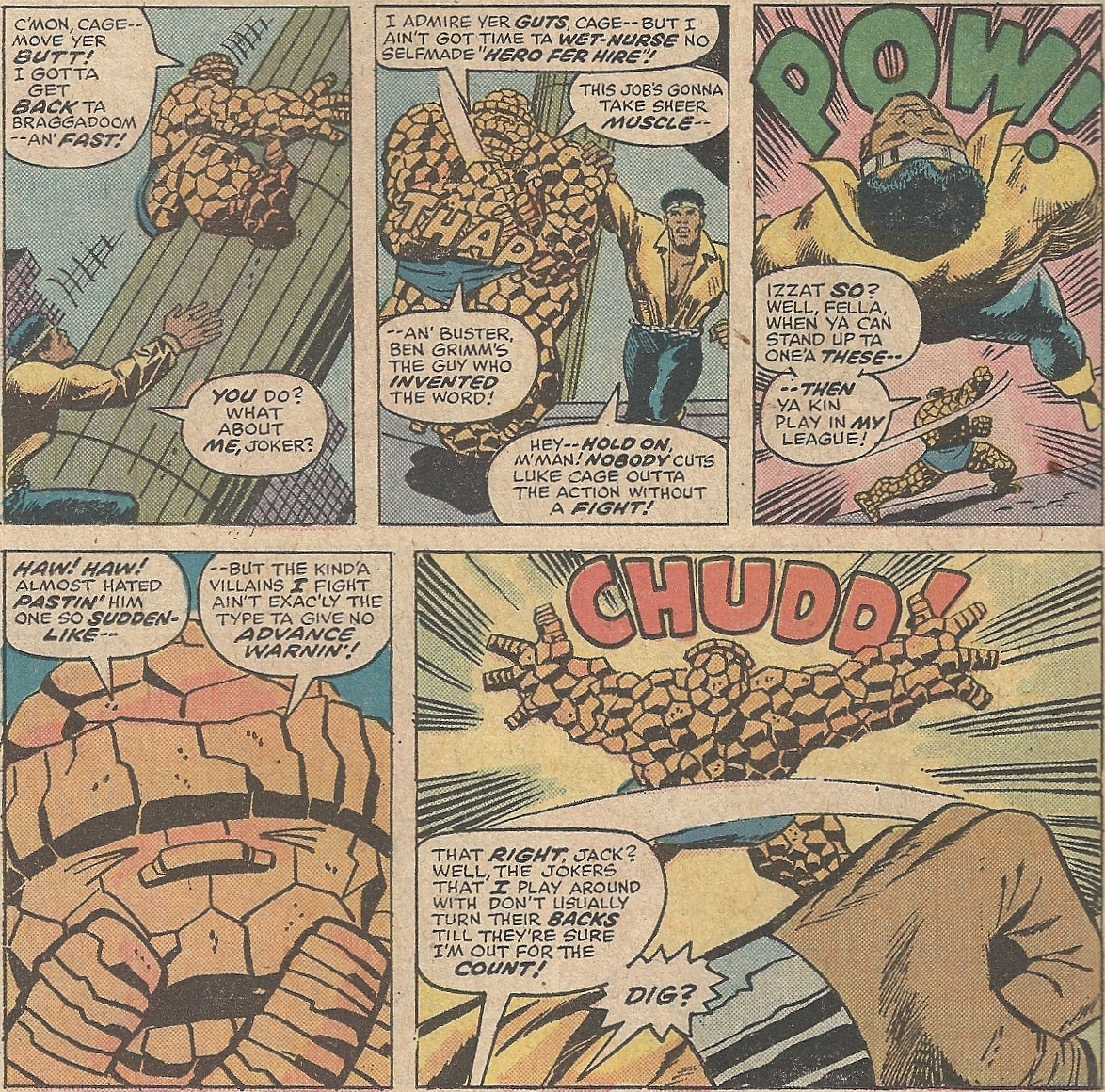
Power Man enters the fray, and he and the already engaged Thing get along about as well as you’d expect, which is not at all. Strong personalities. They’re bested at every turn by Braggadoom (what the monster names himself after he hears the sound made when Ben crashes into a wall — too bad Walt Simonson wasn’t on this book or we might have had a Krakathoom in the Marvel U.) and our improvised duo even does the I’ll-keep-you-from-danger-by-punching-your-lights-out vaudeville routine:
The lopsided battle with the growing Braggadoom spills over into one of New York’s rivers, and it’s only then that the good scientist pipes in with his Egon Spengler “crossing the streams would be bad” warning:
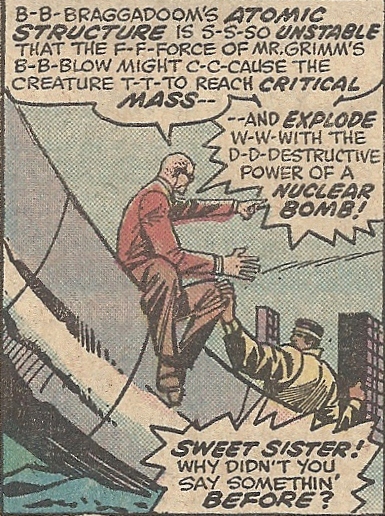
Once again, something that should have been BROUGHT TO THEIR ATTENTION IMMEDIATELY. Before the guys whose primary offense is knocking the stuffing out of things got warmed up.
The carnage only ends when Braggadoom tuckers himself out and shrinks down so that he’s small enough to fit in the palm of your hand. For cute. Cage is pleased, but Ben makes the grim (hey…) observation that the two gents consumed in the monster’s creation are gone forever. So we don’t end on that down note, we’re left with this image of the now infantile Braggadoom in a cage/crib playing with a beach ball:
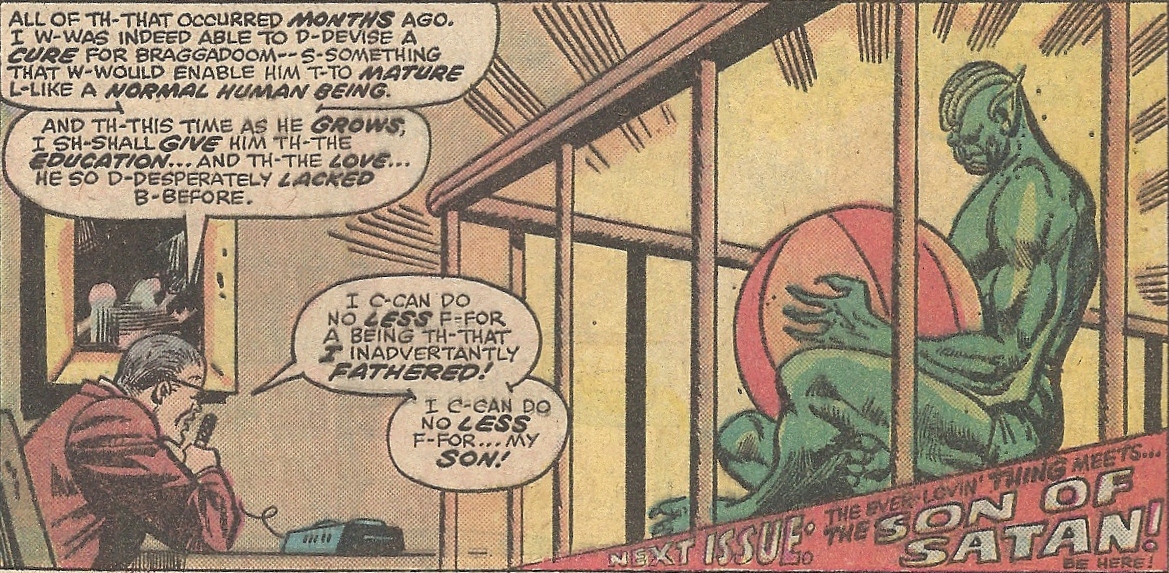
Let’s hope Krank never suckled the creature. Excelsior!
At first glance this is a rather weak effort with a one-off underwear-sporting monster of the week, but the shift in the storytelling, with the star of the book being the second hero to make his entrance, gives it a unique flavor. It’s also mercifully free of any self-loathing schlock from Mr. Grimm (apart from his depressing observation at the end), which is a big part of his charm but grows a little shiny at the elbows at times. I love the mirth on Ben’s mug as he knocks Cage into next week — it’s good to see him happy in his work. And though he and Cage accomplish absolutely nothing in their battle with Braggadoom, it’s still fun to see them struggling against an oversized foe and impossible odds. Heroes don’t always have the answers.
Braggadoom has never returned. He may still be in that crib.
Don’t worry kids, you can just put ’em back together!

Judging by some of my misadventures cycling in downtown D.C., many people used these Smash-Up Derby cars as a juvenile drivers ed. It was imprinted on their brains like a mama bird’s face on a baby chick’s.
Steve. Lighten up. – Steve Ditko’s The Avenging World

I’ve made no secret of my love for the artwork of Steve Ditko. It’s a comic book comfort food, the peanut butter and jelly of newsprint. Just thinking about it makes me smile. The faces. The curved fingers. The fluid movement. S’all good.
Then there’s that other stuff.
Have you ever dated someone for a while, long enough to know that they’re hot as hell, good conversation and a good lay — all the important things — and then one night, as you’re thinking “Man, this chick/dude is awesome,” they launch into a political diatribe, quoting with gusto either the acidic ramblings of the Glenn Beck or Keith Olbermann sets? And you want to scream at the top of your lungs “NOOOOOOOOOOOOOO!” because you know you can’t live with that crap? It’s too much. It’s not that it’s against what you believe in. It’s that they’re so crazy about it. Squirrelly. Rigid.
That’s in your Ditko sandwich, mixed in there with the peanut butter and jelly.
The Avenging World, the independently published 1973 semi-sequel to the equally lunatic Mr. A., takes things to the next level. That earlier work, while also laying out Ditko’s individualized understanding of Ayn Rand’s Objectivism, at least had the glue of its eponymous hero holding it together. You could almost pretend that you were reading a real live gen-u-ine story, though you had to squint your eyes real tight and disengage most of the cognitive centers of your brain to make that leap. This one is a whole other ball of wax.
Just a warning: If you want a detailed analysis of Slingin’ Steve’s worldview, look someplace else. I don’t have the energy, being a weak non-Objective man, to offer that. Maybe you should read Atlas Shrugged. Go ahead. I double dog dare you. More importantly, I don’t begrudge anyone opinions that don’t harm anyone else, and Ditko’s thinking doesn’t cross that line. I’m not assailing his beliefs. It’s the presentation that I take issue with.
On to that presentation, with some observations along the way.
Here’s the publisher’s mission statement on the inside of the front cover, backed by the trademark black and white of Ditko’s worldview:

The book opens with that reliable old newspaper-headline-collage chestnut, spread over a full page. The world’s going to hell in a handbasket, and said world is none too happy about it. Hence his bandages, crutch, and fired up frown. If nothing else, at least Ditko got some practice here in drawing facial features on anthropomorphized celestial bodies, a skillset that would come in handy many moons (ha) later when he sketched a mean, moustached Ego the Living Planet:

Yeah, Steve, the world was in a mess in ’73. The world is in a mess now. The world’s always in a mess. That times are currently worse than ever, enough to suck everything into a black hole of decrepitude, is the jumping off point for every “End is Nigh” street prophet (Alan Moore’s Rorschach may have been hatched in this very comic). It’s always a good thing to want to make the world a better place. No one would argue otherwise. But an Armageddon-fueled pissed-off diatribe isn’t normally the best way to go about it.
Nevertheless, a pissed off diatribe is what we get.
Ditko launches from one source of frustration to the next, setting up his straw men and then burning them down with his Charlie Sheeny Torpedoes of Truth. The first pages are filled with caricatures of those he deems responsible for the dire straits of the world. The Mystic. The Pragmatic Businessman. The Neutralist. Should we be shocked that one of the first to get lanced is that constant spittoon of abuse, the academic in his ivory tower?:

Now I’m going to offer some belated advice to anyone thinking of penning their own manifesto. Here it is.
Use capitalization sparingly.
Nothing says “This dude’s nuts” like randomly capitalized words or strings of words. I do it here myself, not much, and generally for the sake of my wan simulacrum of humor. When you’re using it in straight advocacy, in turns mere text into a guy shouting at an elementary school board meeting. Something off-putting and uncomfortable. It can undermine every point that you’re trying to make.
I have a quick illustrative story. A good long while ago I interned in a Congressman’s Capitol Hill office. Anyone who’s filled similar shoes knows that one of the chief tasks of those lowliest of lowly wretches is sifting through bags of constituent mail. You have to weed through the usual complaints about roads and services, getting one of those flags that flies over the Capitol for two seconds, mass-mailed postcards provided to voters by interest groups, and the like. But now and again you come across that most precious of gems, that pot of gold at the end of the rainbow — a letter from a crazy person with a shed full of axes to grind. While I worked there, every week I’d anxiously await the arrival of a regular letter from some nuts old broad whose name I can’t remember. Let’s call her Mabel. That sounds like a good name for a cranky old bag. Anyway, Mabel would send these single-spaced, small-fonted, devoid of paragraphs multipage rants, which would leap from subject to subject with neither rhyme nor reason, and she’d pepper her points by frequently exclaiming “Shameful! Just shameful!” And she’d throw in some RANDOM CAPITALIZATION as well. All this was back around the time Clinton was impeached, so as you can imagine she was in the highest of high dudgeons. She LET the CAPS LOCK run WILD.
A lot of my memories of my Congressional days are fading, but not those letters. You’re told to take every constituent missive seriously (votes!), but you could not look at these and keep a straight face. I wish I’d made some copies.
Capitals. Titanic-sized blocks of text. Comes across as loony. Ditko’s Avenging World reminds me a lot of Mabel. A lot.
The depressing thing, or maybe it’s the happy thing, is that there are respites where Ditko’s striking artwork is given room to breathe. He shuts up on occasion, stops pounding on the lectern and lets images do the talking. Take this splash page, which looks to be inspired a bit by the aesthetics of Fritz Lang’s Metropolis:

One gets the impression that, if Ditko just let his pencil and brush do the talking, a lot fewer eyes would glass over and he might actually get more people to listen. Speak louder by saying nothing at all, if you catch my meaning (sounds like something Sun-Tzu would say).
Ditko ends the book with that standby of so many busybody complaints. Brace yourselves, because I’m going to employ some capitalization. Here we go. WON’T SOMEONE PLEASE THINK OF THE CHILDREN?:

Reading The Avenging World recalls arguments I used to have with a very, very devout Christian friend of mine. We’re talking Creationism, people living to be hundreds of years old, Adam and Even were real people and not metaphors, the whole nine yards. The good-natured debate would break down when I’d ask, “If I don’t believe, I’m going to suffer eternal torment?” She’d answer yes. I’d respond with a genial “Well screw you!” or something more profane. No hard feelings, but geez…
Here Ditko pushes forth his my-way-or-the-highway philosophy, a no middle-ground way of thinking about good and evil and freedom and individualism that by its very nature brooks neither compromise nor nuance and mocks all willful non-adherents as rubes, charlatans, dupes and malefactors. It’s insulting. Worse, it’s insulting in a wild-eyed, raving sort of way, an uncomfortable nuttiness that overwhelms almost all attempts to find the beauty in the artwork (beauty which is assuredly there, when you can wipe away the froth and spittle).
I still love Steve. I do, and not in a condescending “You’re so cute when you’re crazy! Let me pinch your coocoo little cheeks!” way. I can always respect that art, but I can still throw out a genial “Screw you!” to him and his comic.
Evel Knieveling right into your living room
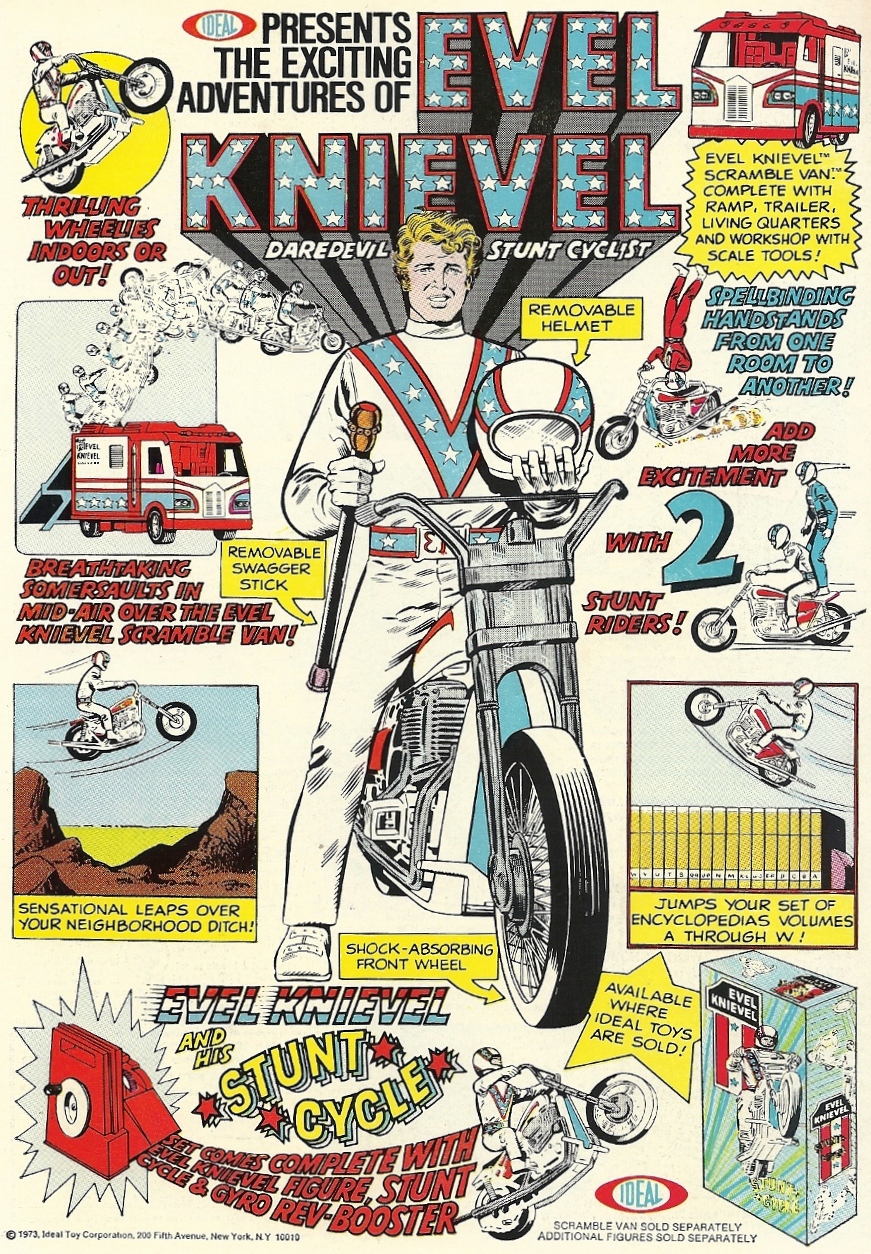
My amazement at the variety of latter-day Evel Knievel toys never ceases. Daredevilry and death-defiance (with maybe a dash of anti-Semitism) certainly had their moment in the sun. Could you buy a life-size replica of the swagger stick?
La Lanterne verte – Green Lantern (Pop Magazine) #1

I like seeing comics from foreign lands, in this case France (or Quebec or some other French-speaking realm). They take me back to my early youth watching francophone episodes of The Incredible Hulk beamed out of Montreal. I’m a bit ashamed to admit that my French, despite multiple years of instruction back in high school, has withered into a pathetic state of atrophy. I try now and again to hone it by picking up a Camus novel, but I always end up feeling like Kevin Nealon as the world’s worst Russian translator.
I think French comics might be the way to go. The pictures help. They’re how so many of us learn our first language, aren’t they?
This 1973 comic is (I think) Hal Jordan’s self-titled premier in the nation of vin et fromage. The Gil Kane cover is an edit of the cover from the stateside Green Lantern #61, with some re-coloring and the removal of a batch-obstructing Alan Scott. The Lantern story inside is “Green Lantern’s Wedding Day” from issue #32. In case you’re curious.
If you’ve ever wanted the Green Lantern oath rendered in French, here it is:

My French may be rusty, but that’s a really, really loose translation.
I can’t offer much in the way of insight about the contents of the comic, though I did find it slightly interesting that the character names aren’t translated, i.e. Green Lantern doesn’t become La Lanterne verte, Aquaman doesn’t become L’Homme de la Mer or some other nonsense, etc. I suppose that’s not that surprising, but I wonder how common it is to switch things up.
Speaking of Aquaman, here’s a truism: Aquaman sucks in any language. To wit:

There are certain things that you can say in French that don’t quite come out right in English. They lack the requisite verve in the Anglo-Saxon tongue and only French cuts the mustard. Je ne sais quoi, as it were. Take this Frenchification of The Flash #205’s cover. Describing the Flash as “L’homme le plus rapide du monde présent, passé et futur” might outstrip “The Fastest Man Alive”:

That’s all I’ve got. Au revoir.
We Are the World: The Comic Book – Heroes Against Hunger
“We Are the World” is a musical touchstone of the 1980s. The Michael Jackson-penned hit — back when Michael Jackson was still cool, long before Jesus Juice — was a well-meaning attempt to alleviate the genuine suffering of that decade’s (literal) cause célèbre, the Ethiopian famine. It seemed like every recording artist that was anything back in those days found their way to that one studio to solo a few words or lend their cords to the chorus. As with most supergroups, artistically it was a complete clusterfuck. I still laugh every time I hear Bruce Springsteen screaming his line — it’s the voice approximation of Mr. Kool-Aid crashing through a wall. And one wryly smiles at the thought of these fabulously wealthy celebrities recording a song to raise money through album sales to VASTLY less affluent ordinary folks. The song generated a lot of cash for famine relief, but one imagines that the same amount could have been found in the couch cushions of their assorted mansions.
Those folks tried to do something nice, so I’ll lay off.
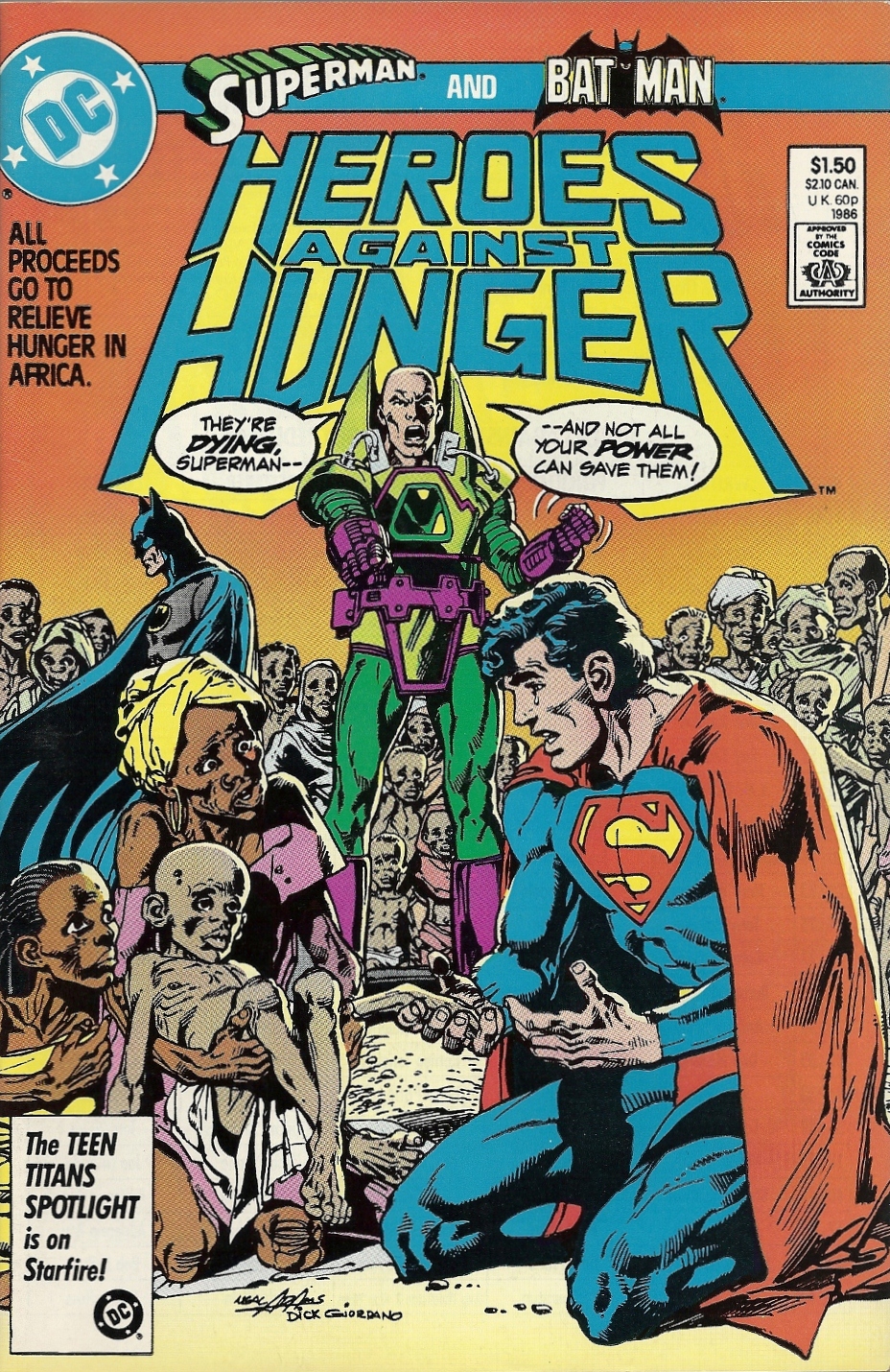
Musicians weren’t the only ones to pool their good intentions in one unified bazooka blast. Enter Heroes Against Hunger, a 1986 comic that brought together a cast of thousands to script, pencil, ink, letter and color one little book:
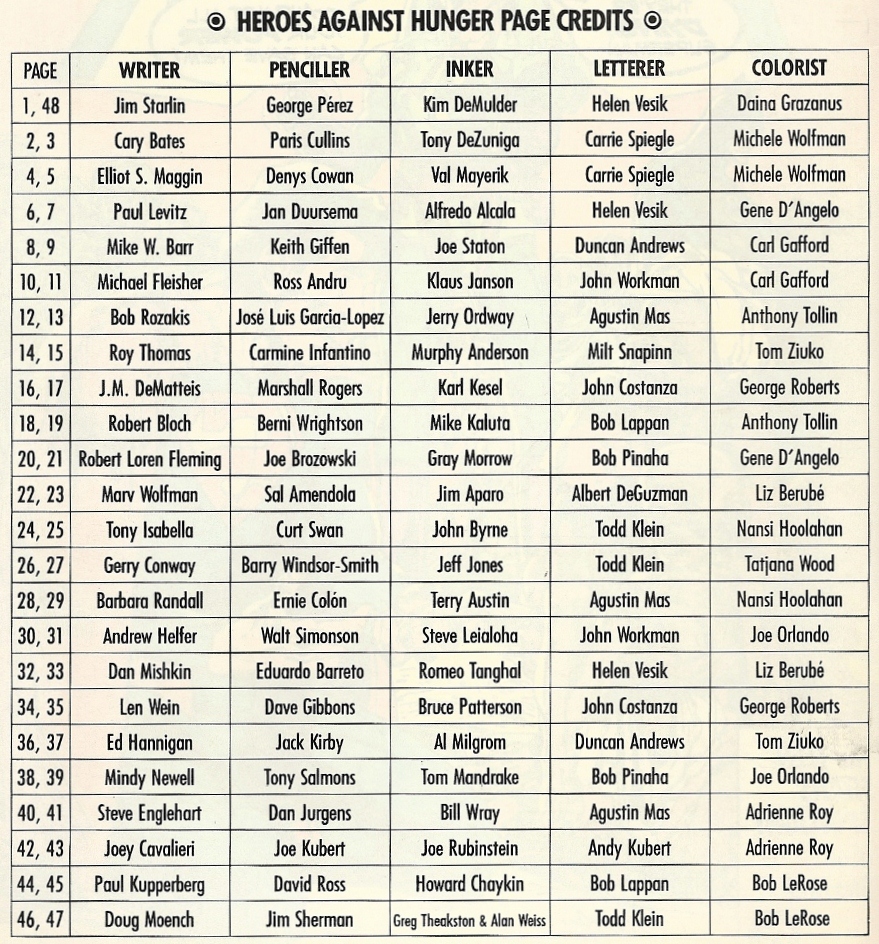
As can be seen, most of the leading names of that time pitched in, and even with the biggest stars in the lineup one can’t make the same couch cushion critique as you could with “We Are the World.” But how did it play? Was there a Springsteen screaming into your ears at any point?
The story opens with Superman doing what he can to stop the famine, one freshly top-soiled field at a time. It’s hard work, even for a Man of Steel, and it’s not made easier when a mouthy Peace Corps volunteer (Lee Ann Layton) gives him an earful (Denys Cowan pencils — I’ll give you the penciller for selections and let you determine the script, inks etc. from the above spreadsheet):
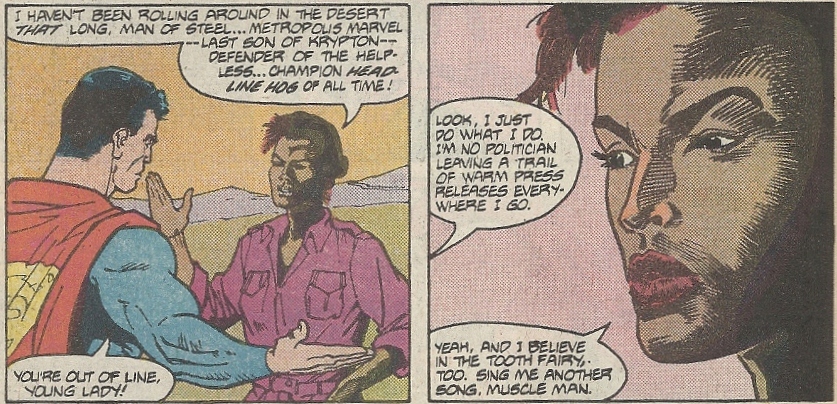
Would anyone blame the big guy if he told this bitch off? “Ain’t got no time fo’ ya hos!” Peace Corps people… Khakied sanctimony. They can be the absolute worst. Let’s just say I had a bad experience once.
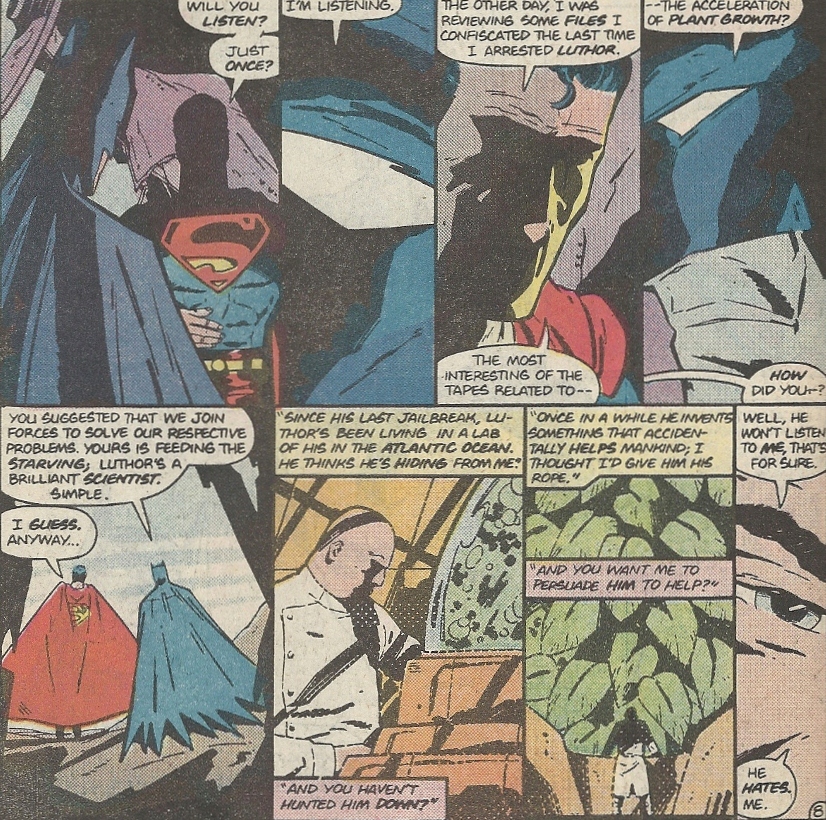
The next load of life-giving dirt is blasted out of his hands, so Superman hooks up with Batman, who’s on the continent investigating a downed Wayne Foundation relief plane. They decide to pool their efforts and look for help in a most unlikely place (Keith Giffen, whose way of drawing capes I can’t help but like):
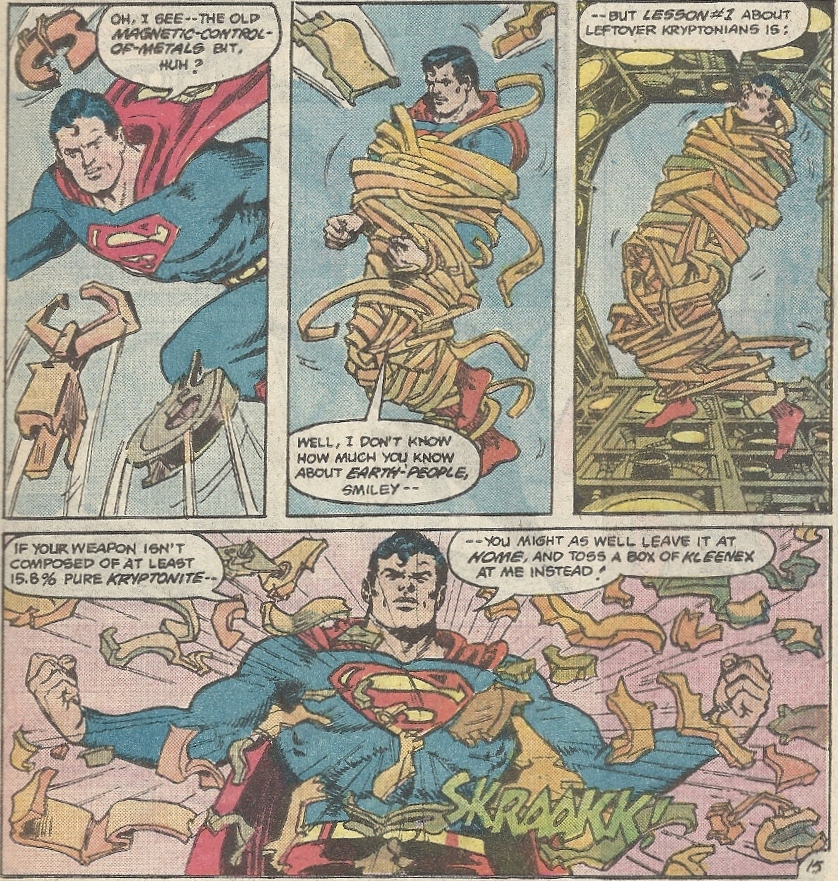
Here’s my personal favorite artist and it seems everyone else’s personal bane, Carmine Infantino, giving us Superman’s first confrontation with the extra-terrestrial menace that’s foiling relief efforts:
Power-Suited Lex (God, I’ve always loved that outfit, even when Superman was punching a hole in it), who agrees to help fight the famine so that he can make Superman look ineffectual, has his motivations change when confronted first-hand with its horrors:
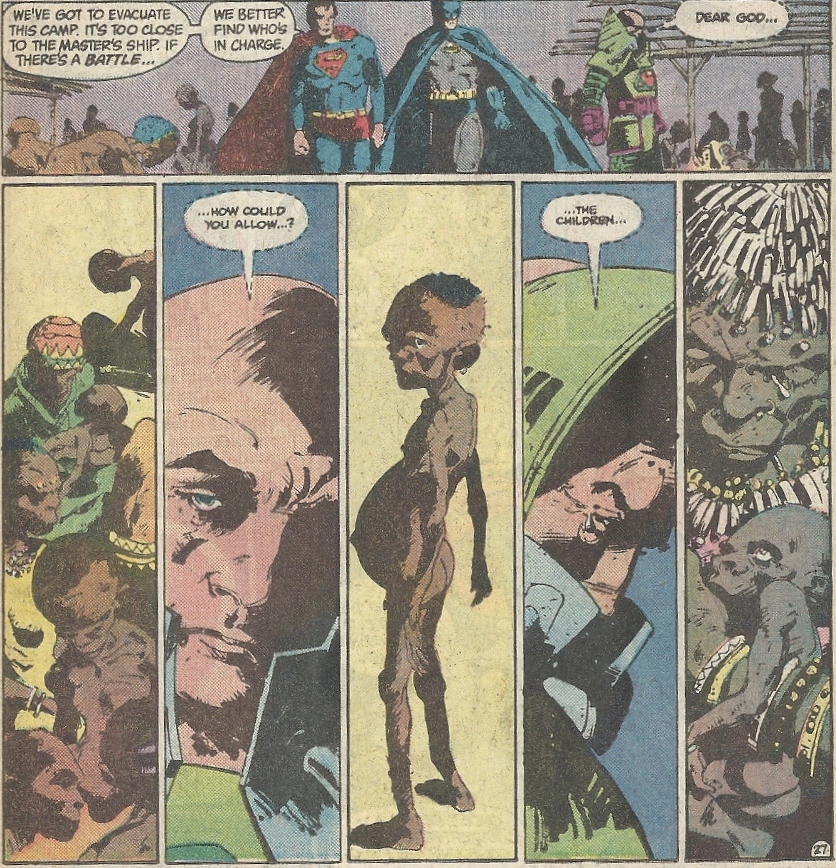
His Grinch moment, no? And I don’t think they could have given those depressing panels to anyone better suited to them than Barry Windsor-Smith.
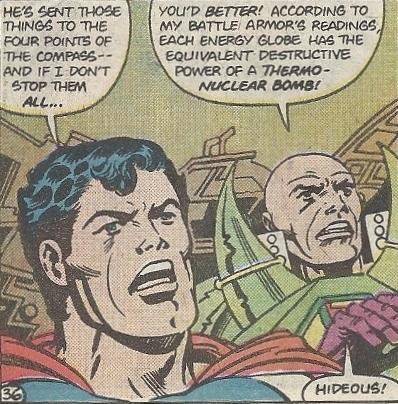
Latter-day Jack Kirby — in his Super Powers phase — lent his talents to the cause (as well as some Kirby dots in previous panels — and Curt Swan didn’t draw over Superman’s face this time):
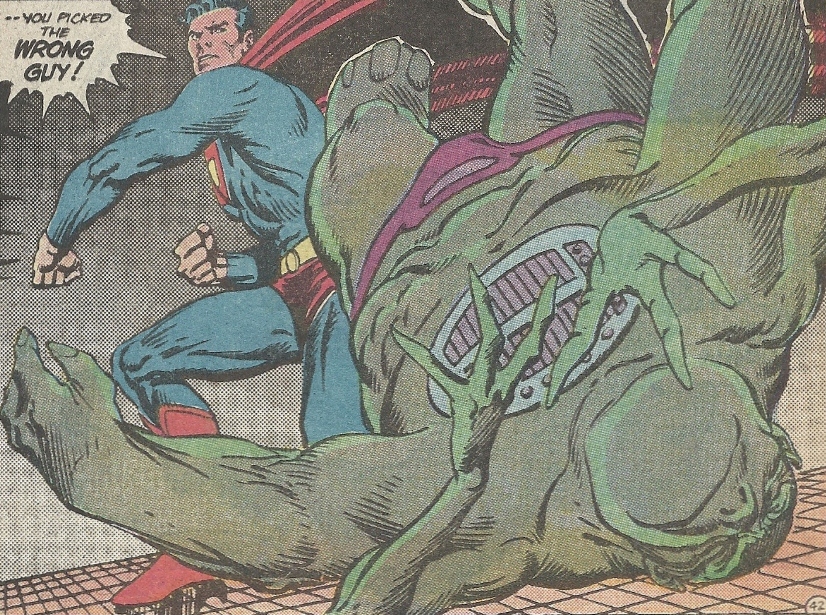
Remember that alien meddler? Would you want anyone other than Joe Kubert depicting his comeuppance?:
In the end, though, not even the combined resources of our three principals are enough to rejuvenate the soil. Lex’s earthy Helsinki Formula fails, and Human Shame Factory Layton stops by:
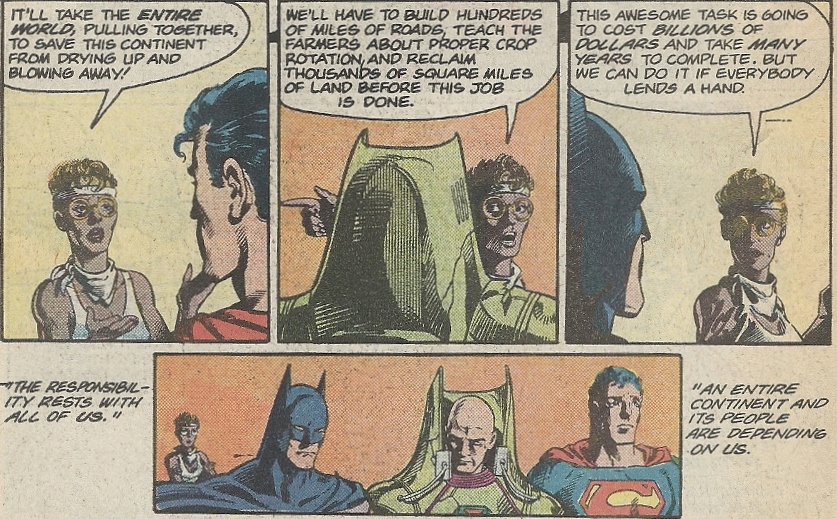
The thesis is that we all have to do our part, but after watching Superman, Batman AND Lex Luthor take a swing and miss, would it be off base to wonder just what the hell it is that mere mortals are to do? Besides open their wallets and throw money at the problem?
Let’s ignore the charitable message for a moment. The layout of the book is simple but effective. With the George Perez group handling the first and last pages, that leaves it so that every time you turn one, a new team is handling the two pages laid out before you (no ads). Does that overcome the too many cooks in the kitchen effect? Not really, but it’s the best way to go about it, and it helps. You don’t get the impression that there were dozens of scripters banging away at typewriters, and the assortment of artists makes it fun visually. It definitely stands head and shoulders above that derivative Paul Dini/Alex Ross Peace on Earth pablum.
Plus you could devise some manner of drinking game out of the myriad changes in the length of Batman’s ears. That alone makes it worthwhile if the “money for charity” aspect isn’t enough for you, you cold-hearted bastard.
Did this thing do any good? Some scratch was raised, that we know. While the crisis long ago passed the acute phase, Ethiopia and many other spots in Africa are still prone to devastating droughts. I guess that means that Layton bitch is somewhere wagging her finger in people’s faces. We can’t win ’em all.
Vodpod videos no longer available.Never fear, Captain O is here! And his bag of crap!

No, Captain O isn’t a servant of personified conglomerate/retired talk show host/Gayle King’s best friend Oprah Winfrey, nor is he a hero whose power is finding a woman’s G-Spot. He was the tights and rocket-pack mascot of Olympic, a peddler of the kind of junk that was a staple of many a comic book ad. Only, in this case, you could get in on an Amway pyramid scheme and make it so friends and relatives would dread seeing your face.
To be fair, it looks like this stuff here was a bit better than the standard fart gum and x-ray glasses fare.
I always wondered if Amy was a real person and if she looked anything like her friendly depiction, or whether she was fat as a house with hairy moles and a lit cigarette always held in her free hand. “Hello. *cough* Thank you for calling *hack* Olympic.”
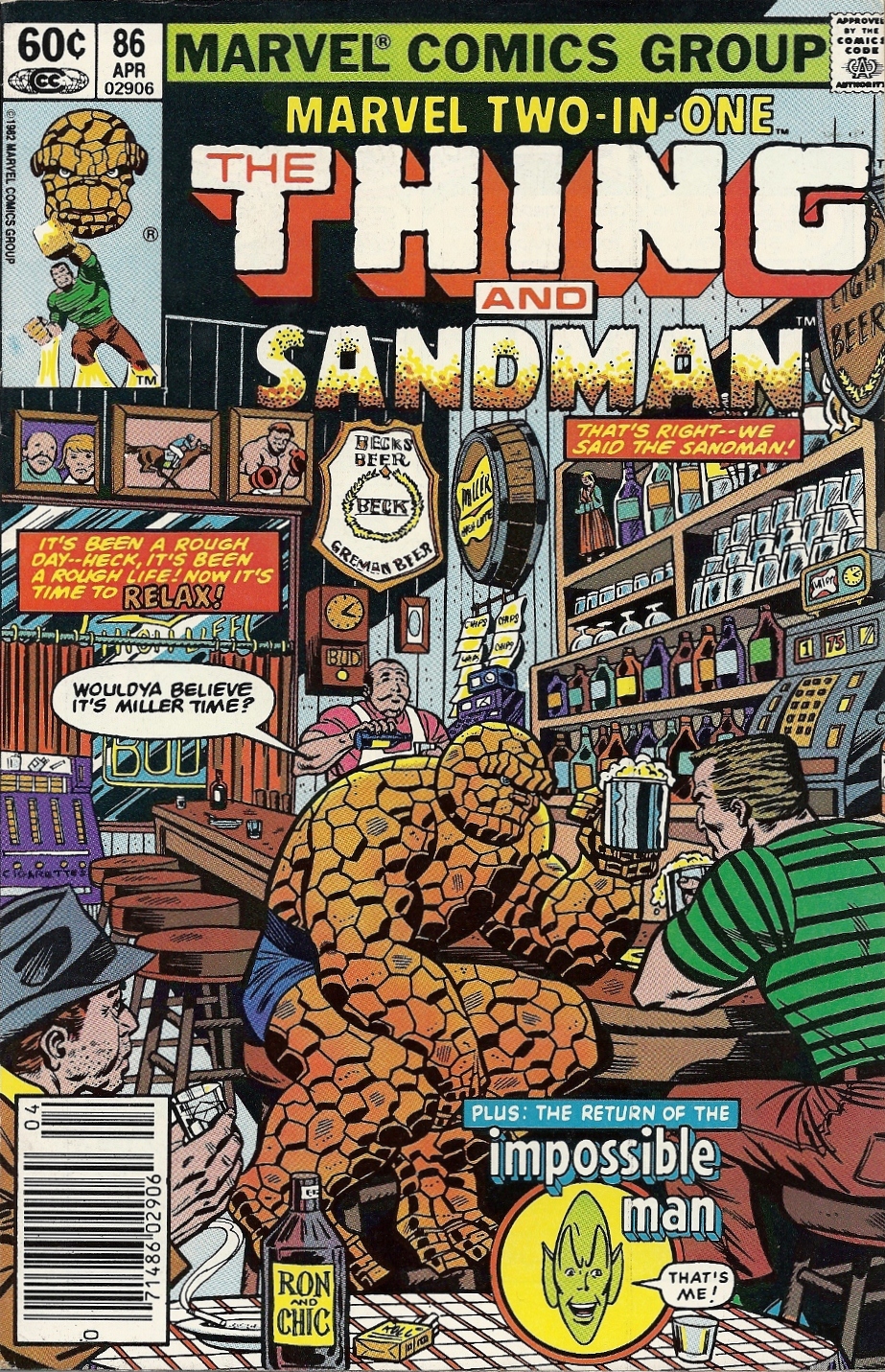
The month-long romp through the world of Ben Grimm chugs on with this split doubleheader issue. The cover promises a lot. The Thing downing a frosty beverage with *gasp* a villain. What could be behind this up is down, down is up chicanery? And will the Impossible Man be so insufferable we’ll have to suppress the urge to choke the life right out of him? We must have answers!
The first half (Tom DeFalco, Ron Wilson, Chic Stone) opens with Ben aiding relentless genius Reed Richards with some Baxter Building spring cleaning. I have some sympathy for the big guy here. Being the only six-footer in a family of short people, I was always being called on to get things off of top shelves (and was left wondering why my short relations didn’t just store things on lower ones). Ben has to stop and wonder on occasion why the hell Reed doesn’t either A) build smaller or B) build his own moving crap.
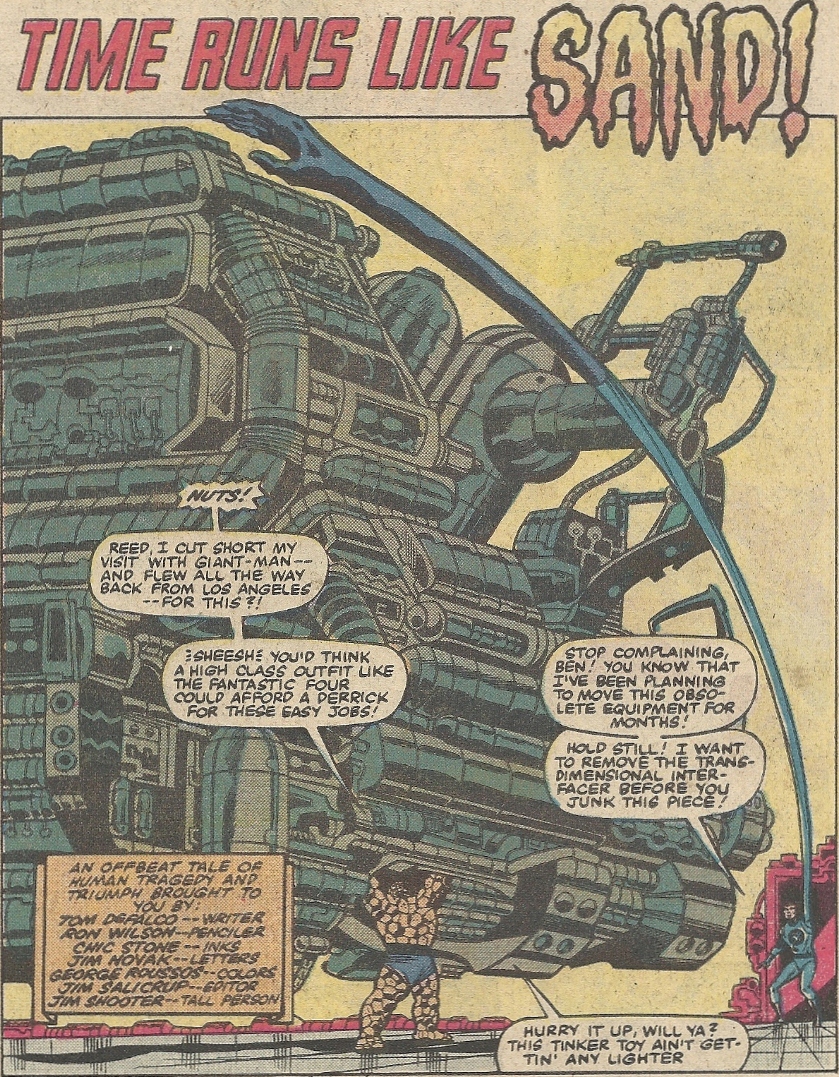
It looks like Jack Kirby left behind some of his gigunda machinery.
While Ben is playing pack-mule, Flint Marko and Hydro Man separate themselves after their muddy union in The Amazing Spider-Man #217-218 — and after the world’s dumbest scientists dump their radioactive sludge:
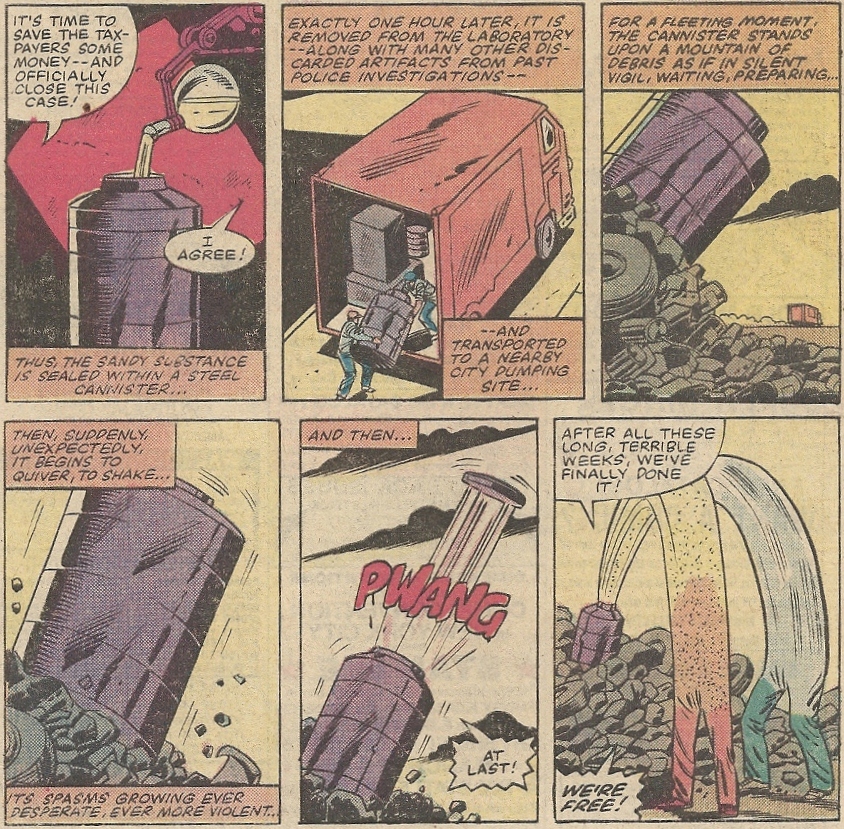
The two villains part (somewhat awkwardly, reminding me of when Steve Martin woke up next to John Candy, whose hand was “between two pillows”). Marko, still not fully up to snuff, heads to a nearby watering hole, where a nervous bartender makes a quick call to superhero 911:
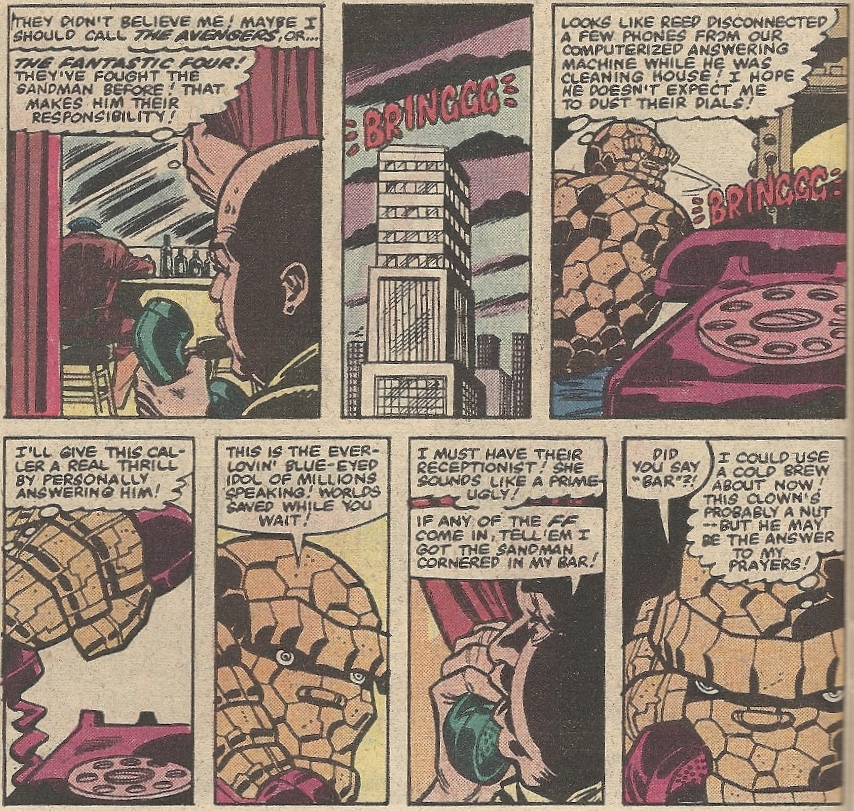
In the early days of telephones you could place a call to the White House and there was a good chance the sitting Chief Executive would answer personally. Having the Thing pick up the receiver is, oh, I don’t know, about a bajillion times awesomer. Awesome enough to use “awesomer.”
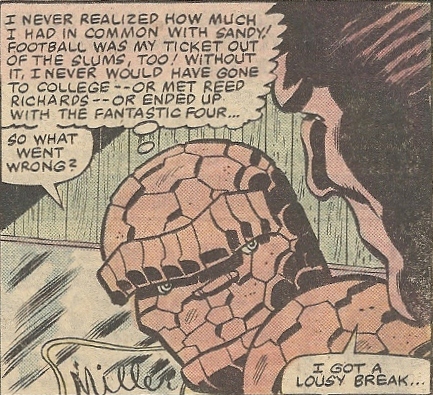
Ben shows up expecting a fight (the plate glass shattering, chair smashed over a head, opponent dragged over the bar kind), but is stunned to find the poor Sandman and his ridged hair and green-striped shirt all down in the dumps. He’s certainly not spoiling for a tussle. Ben pulls up a (hopefully steel reinforced) stool as Marko regales him with his hard-scrabble life story, replete with a rough upbringing, assaults, larcenies and failed romances. When he gets to his athletic prowess on the football field, that’s when the sympatico bells start going off in our hero’s head:
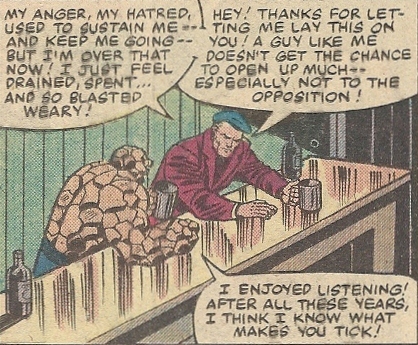
After the sad, down-the-wrong-path recounting of the Sandman’s life is finished, including the nuclear accident that forever welded him to beach sand, these two guys almost sound like Norm Peterson and Cliff Clavin:
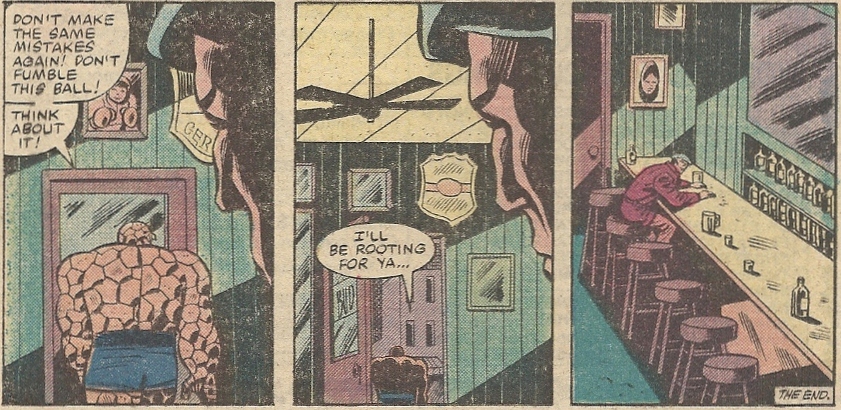
The Sandman says he’s done with crime. He’s crimed out, as it were. Does Ben run him in? Nope. He picks up the tab (with money presumably stashed in his crotch) and we’re left with a dash of hope for Marko’s future:
The second story is a decidedly more light-hearted affair. Franklin Richards, with his parents getting a much needed night on the town (seeing Annie), is left in the hands of one whom you’d imagine would be the greatest babysitter of all time:
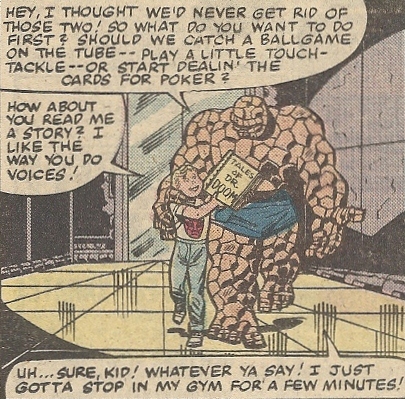
Ben reading to a kid a (even Tales of Dr. Doom) conjures up images of Moe Syzlak reading Little Women at the children’s hospital. At least for me.
Their quiet night is ruined when Marvel’s green pointy-headed imp, their less malicious Mr. Mxyzptlk, shows up:
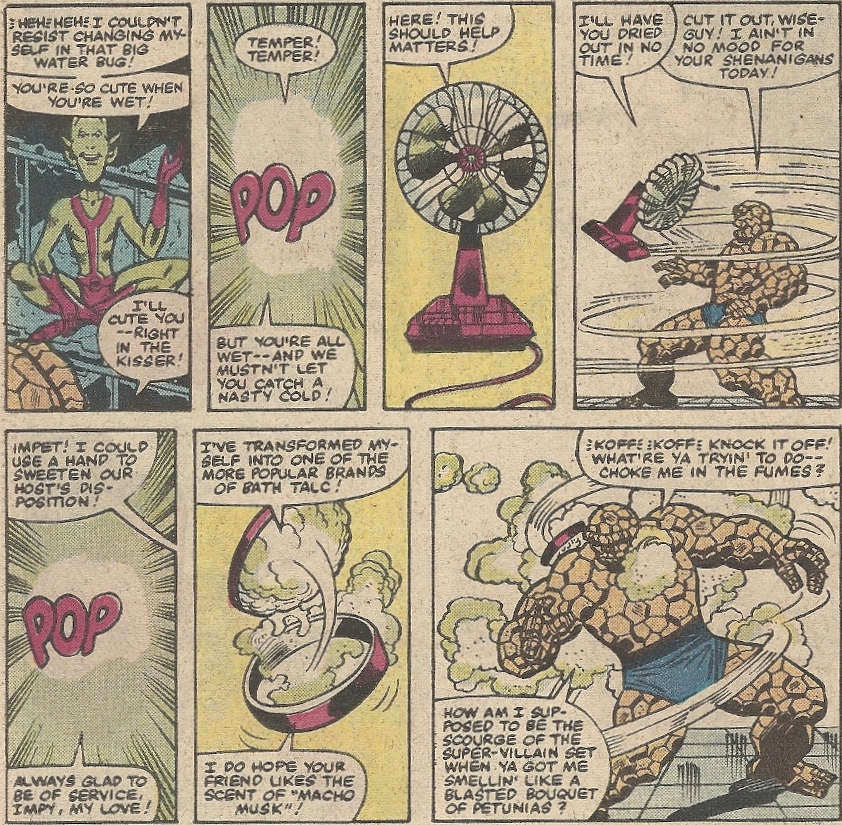
The Impossible Man, the guy that makes every hero pinch the bridge of their nose. Ugh. What’s worse, he’s sired children, a Kate Gosselinish litter. While the he uses Reed’s equipment to find them a new home planet to settle on/infuriate, Ben is beset by their miscreant monkeyshines. It’s a mercifully short ordeal, though, and before he goes with his scamps in tow, Impy can’t resist one final zap:
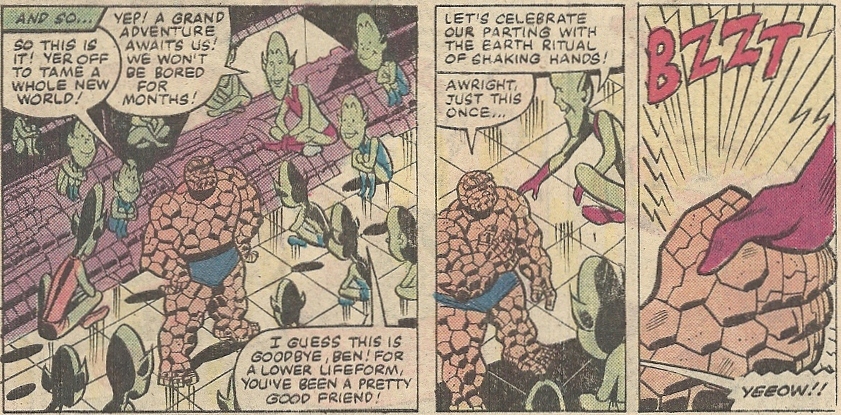
A joy buzzer. Classy.
Watching the Thing get all frazzled by the Impossible Man and his bratty brood is nice, but the more interesting part of this twin bill is the first half. Once again, as with the Ghost Rider and Morbius pairings, we see Ben confronted with someone whose plight touches him (a pattern?). In this case it’s an outright villain, a two-bit thug with a bizarre power that’s driven him even further from the world he was never a part of in the first place. Cue the violins.
The Sandman has always had lower ambitions, far from the world-threatening megalomania of Victor von Doom and the like. He’s more prone to crack a safe than rip a hole in the Earth’s crust. That small scale makes him more petty, but it also makes him more relatable to all us little people (incidentally, he was just about the only thing that I could stand in the cinematic gang bang called Spider-Man 3). Others might see his tale of sorrows as a load of crap, another manipulation from a career criminal. Maybe I’m gullible (and judging by his recidivism I am), but I want to believe the guy, and it’s not hard to buy the Thing doing so.
Marko’s crying in his beer highlights once again the fire and ice combo that made TIO so successful, a mixture of fun and pathos. Hokey? Yes. God, yes. In any other title all this woe is me malarkey would have everyone, including yours truly, rolling their eyes. But it’s the Thing. Hokeyness is wound up in his rocky chunks. It works. A beer summit in the Mighty Marvel Manner!
There are few heroes, outside of Logan, who look so comfortable in the dim, neon sign-accented environs of a dive bar. And I think Ben, with those blue eyes, makes for more pleasant company. Who wouldn’t pour their heart out to the guy?
Cracker Jack Redux

At the opening of this baseball season I posted a Cracker Jack advertisement. It’s fitting that, as the postseason winds to its inevitable conclusion, it’s bookended by another, this one from the 1940s.
I like the old-timey unadorned packaging. From back in the days when men were men, and kids walked uphill both ways to get to and from school (and, by the looks of things, promoted caramel coated popcorn by wearing sandwich boards). Back when peanuts and Cracker Jack were peanuts and Cracker Jack.
Free Freeze – Batman #121 (Toys ‘R’ Us Special Replica Edition)

Consider this a companion to the Pizza Hut Batman reprint. Only, instead of getting it along with the pepperoni and anchovies, presumably Geoffrey the Giraffe himself handed this one down to you.
Where does Mr. Freeze rank amongst Batman’s robust rogues gallery? Is he top tier? A year ago I posted bits from a 1980s digest, one page retellings of Batman villain origins. There were five of them: Joker, Penguin, Riddler, Two-Face and Catwoman. It’s a rough measure, but I’d say their inclusion — and Freeze’s exclusion — is telling. Those five are the creme de la creme. No one would argue with any of them being at the top of the bad guy mountain, with the Joker sitting with his yellow teeth and red lips at the absolute summit. But Mr. Freeze? Maybe a case can be made that he’s at that level, but at best I’d put him in that second tier, with the likes of Poison Ivy, Scarecrow and their B-squad ilk. And he might even be slumming down with Scarface and the Mad Hatter.
Hell, I like Captain Cold more than I like Mr. Freeze.
No love for the bald guy.
This complimentary issue, offered up in 1998, is a nice little reprint of Freeze’s senses-shattering origin (Script: Dave Wood, Pencils: Sheldon Moldoff, Inks: Charles Paris, Cover: Curt Swan), when he was called (perhaps fittingly) Mr. Zero. It’s a fun little romp, showcasing such tomfoolery as the Dynamic Duo doing their best Keystone Kops imitation, slipping and sliding along behind Zero’s ice-slicked getaway:

Jet skates. Silken lasso. Time to go back to the Batcave drawing board.
Origin time:

Zero’s looking a bit like John Locke on Lost, no? Where’s Jacob?
Batman and Robin eventually track Zero to his hideout, where they’re immediately encased in ice. Batman breaks them out by using a strategy that’s often employed by others in a similarly improbable predicament, a solution that really, really pisses me off:

A person’s frozen in a block of ice. Repeat that: FROZEN IN A BLOCK OF ICE. Yet they rock their personal ice cube (Your own. Personal. Ice cube.) back and forth until it tips over and shatters. How do they get it to rock? Shifting their internal organs? Kegels? How?
Anyway.
Finally:

He looks so happy. Mr Magoo at a Rutgers football game happy. An allergy sufferer gulping Claritin happy.
I’m not a lover of the toothy square-jawed Batman, nor of his diverse and stupid old-timey gizmos. I’m not Mr. Freeze/Zero’s biggest booster. But for a short intro to a character that has hung around for a very long time, this comic could do a hell of a lot worse. And it’s free. I couldn’t bitch even if I wanted to. Thanks, Geoffrey. Go eat some leaves from the top of the tree.
There are some puzzles and word games included for the younger set. If doing the New York Times crossword makes you feel like a moron, I present you with this Freeze-centric cousin to give you the illusion of not being such a dull, dismal simpleton:

“My name is Freeze. Luhn it well. Foah it is da chilling sound of yoah doom.”
A one way ticket to Palookaville – Joe Palooka #18
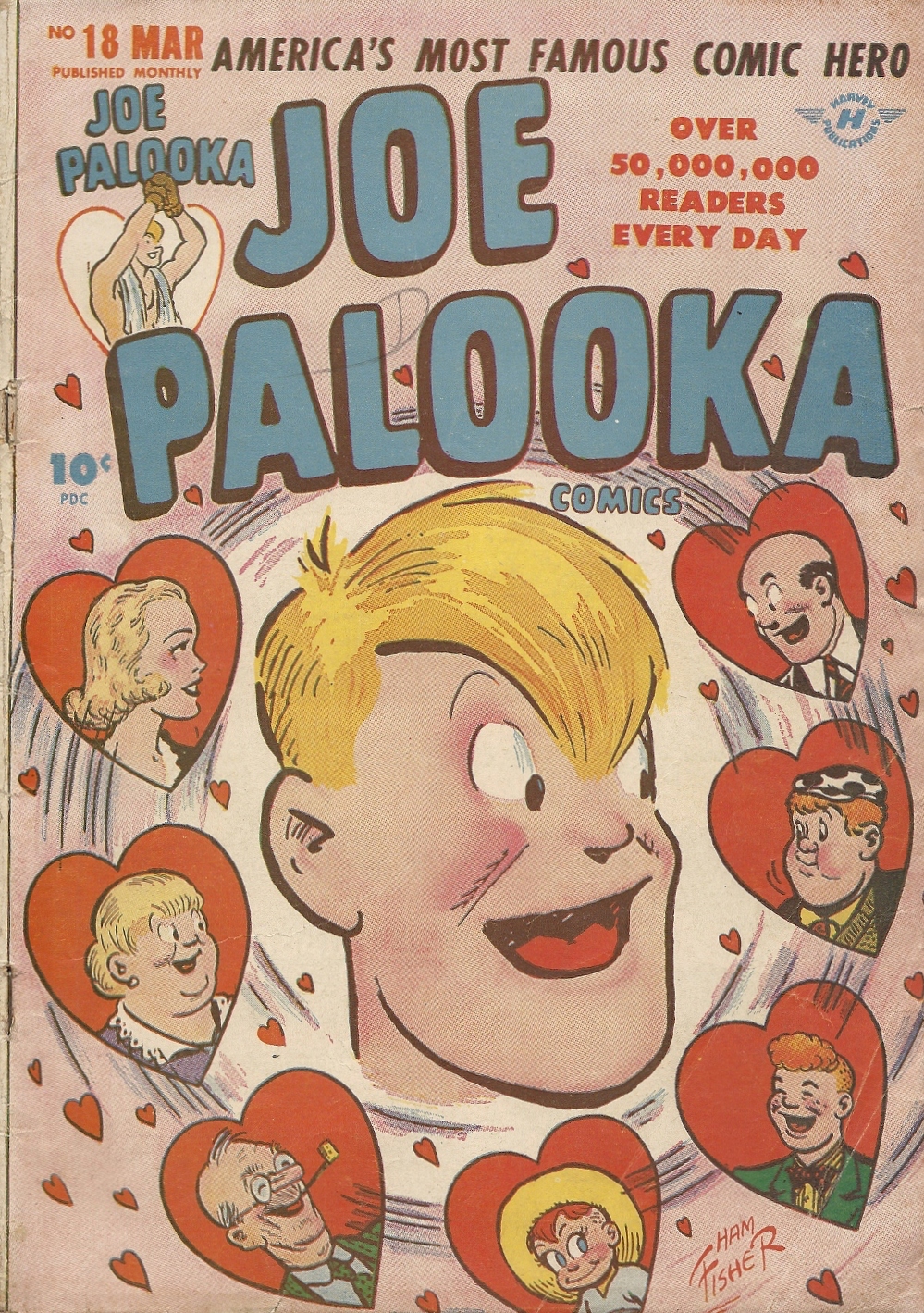
I was going to do this post a couple of weeks ago, but I had just completed the “Thing getting his stony snot pounded out of him by the Champion” entry. I thought it best to spread the boxing out a bit. You’re welcome.
There are characters that were before my time. Then there are characters that were before my father’s time. Joe is partially the latter, though this particular comic came out after my old man’s birth (but before, unless he was a Doogie Howser-like prodigy, he learned to read). I confess to knowing little or nothing about Joe Palooka. When I read/hear his name I think of Bazooka Joe and incredibly hard, impossible to chew gum. I hear Palooka and I think of Brando in On the Waterfront. So, if nothing else, I now have a face to put with the name (though it’s not the first time his face has appeared here). And what a guileless, toothless face it is.
In case you’re equally ignorant, Joe Palooka was an upstanding newspaper strip boxer of old who most of the time dealt with sport-related hijinks, and occasionally, as every comic book character did in the early 1940s, battled Nazis and Japs. Think of him as sort of a good-natured American Ivan Drago, one surrounded by a predictable cast of pals, fiances and scamps. And the cover puffery seen above wasn’t idle boasting. He was enormously popular, with a broad, loyal readership. He was no Zippy the Pinhead, but…
Also, if there’s one thing that clearly puts this comic back in antiquity, it’s that Joe is a non-bum white heavyweight not named Klitschko. Nowadays you’d have more luck finding a dodo.
This issue, crafted by creator Ham Fisher, centers around Palooka and his Alfred Pennyworthish trainer, Knobby Walsh, heading out to Hollywood to work on a movie. Go West, young man, go West. But before they fly the final leg Joe has to take a bath in a horribly undersized oaken tub and Knobby has to polish his bald head:
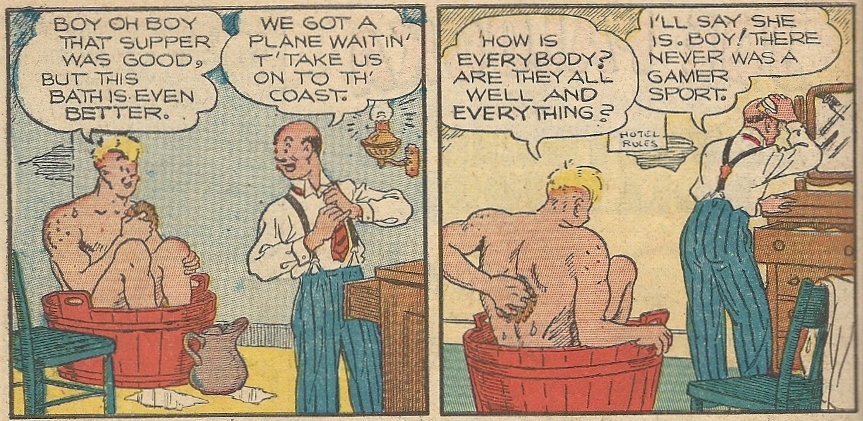
There might be some homoeroticism in there, and I don’t think you have to scrape away too much to find it. It looks like Knobby’s staring right at Joe’s cock. Knobby’s ogling the knob, if you will. “Hey, Knobby, come scrub my back.”
Once they’re out in that den of iniquity known as Tinseltown, both are swept up in the overwhelming magic of movie-making. The nebbish Knobby even has himself a woman, the lead actress in Joe’s movie, that is, until Joe discovers her making out with the male lead:
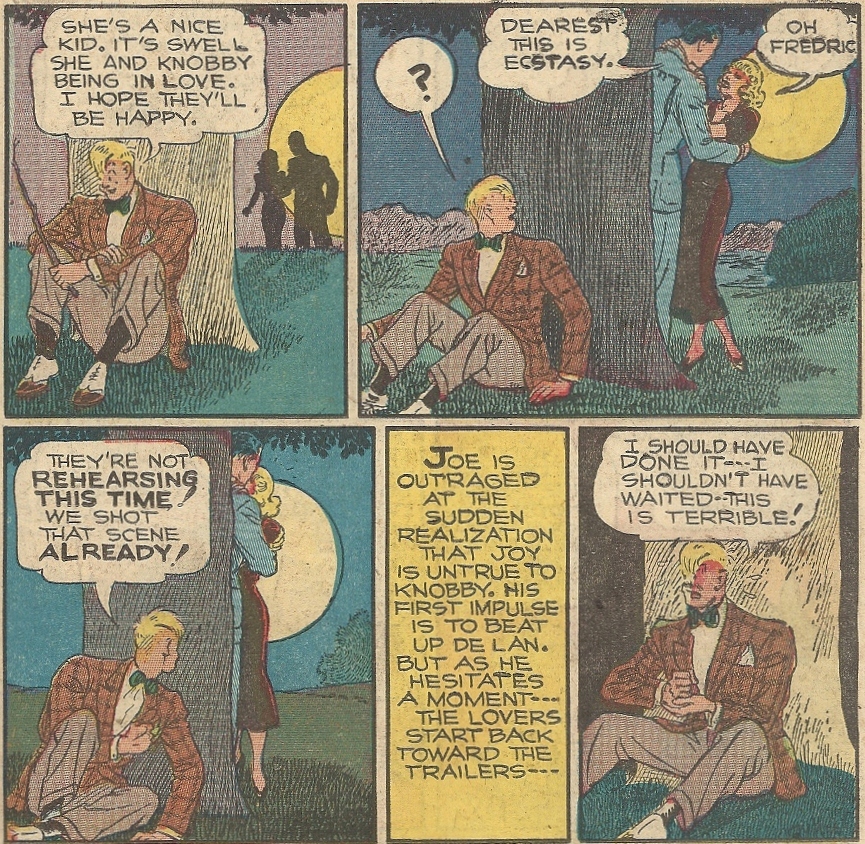
Scandalous! Poor Joe. Poor Knobby. And what a quandary. How does JP give that deceitful tart and her sleazy man what for without breaking poor Knobby’s heart? How does he set about untying this difficult romantic knot? How does he STOP THE GIANT RUNAWAY MOON FROM CRASHING INTO THE EARTH?
There’s no solution to that last problem, but there is one for the romantic chicanery — boxing, of course!:
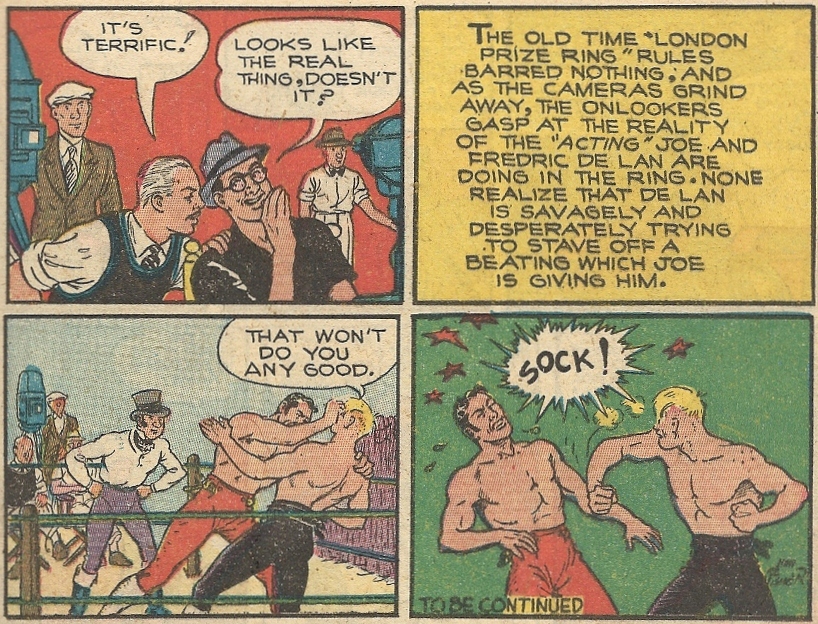
I’d never heard of “London Prize Ring” rules before. A nice way of saying “stomp a mud-hole in him and walk it dry,” I guess. A chance for a good drubbing.
The story gets continued into the next issue (and this issue was itself a continuance from the previous entry). And that’s related to one of things that impressed me about this book. There’s a depth to the story that’s a bit lacking in most of the Golden Age material that I’ve perused. The thick reamy comics of those days are usually filled with multiple stories featuring the central character and a number of smaller shorts with others. While this one has several quickies, the central feature takes up most of the mag and gives you the impression that you’re reading A REAL STORY. ONE THAT AT LEAST HAD A MODICUM OF THOUGHT AND EFFORT PUT INTO ITS CREATION. I can’t say that this book is a page-turner, or one that would take someone who couldn’t care less about Joe Palooka and magically morph them into a rabid fan. But you can see the effort, which is perhaps a result of the character’s serialized newspaper origins. A thank you to Fisher for that.
The Joe Palooka strip came to an end in the 1980s and poor Joe has been forgotten by young(ish) slobs like me. But he had his day, one that included radio serials, television, and a James Bondian number of feature films. If he’s up in fictional boxer heaven (with the likes of Apollo Creed, Jake LaMotta et al.), here’s hoping he isn’t too punch-drunk.
 Jared
Jared


 blog into mystery