Monsters Looking to Get Laid? – Monsters on the Prowl #16
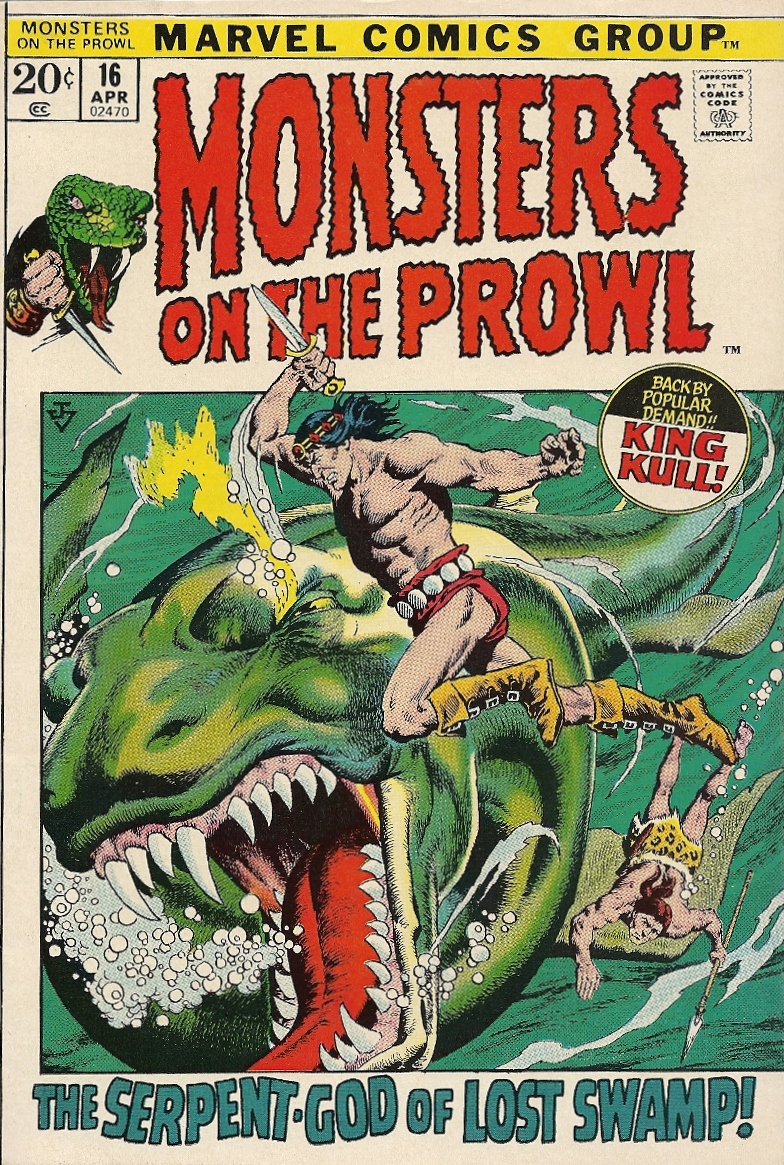
Kull isn’t just a conqueror. He’s a man. A MAN. Sit back and admire a Valusian king who has the wherewithal to STAB A GIANT SEA SERPENT IN THE EYE. Eat your heart out, Quint.
This issue is one of the earliest appearances of Robert E. Howard’s Kull during that character’s 1970s Marvel run (predating an issue from his own series that was examined here). Written by the ever-dependable Roy Thomas, with splendid art from the sister and brother art team of Marie and John Severin, it also contains Kull’s first encounter with that classic Howard bête noire, Thulsa Doom. And along the way he battles lizard-men. There’s a lot going on in here, people.
To set the stage:
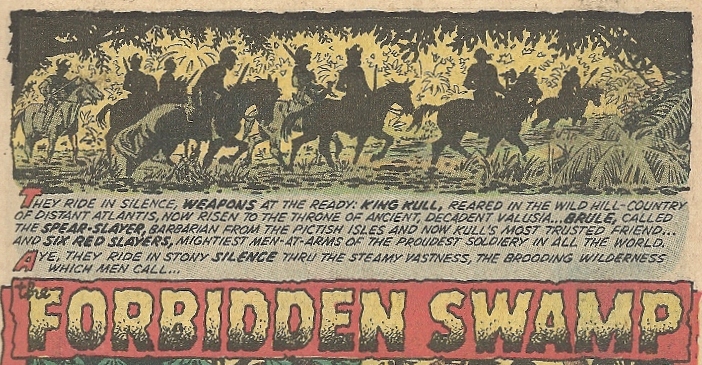
Did I mention Kull being a MAN? Well, he’s a very generous MAN, because when a loyal soldier needs a mercy killing, Kull is more than willing to do the Kevorkian honors (while speaking of himself in the third person):

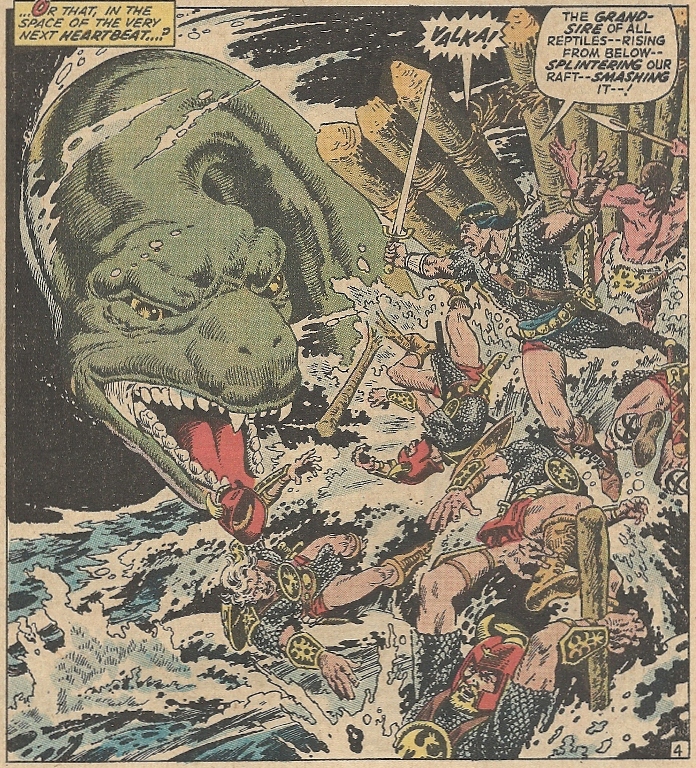
As alluded to earlier, the art in this issue is wonderfully colorful and detailed. Even the chainmail pops off the page. Look at the work done in this close encounter with the cover’s sea monster (said Monster on the Prowl, one supposes):
When Kull enters the evil temple that is his goal (he goes in alone, like a MAN), he meets a not yet familiar face:
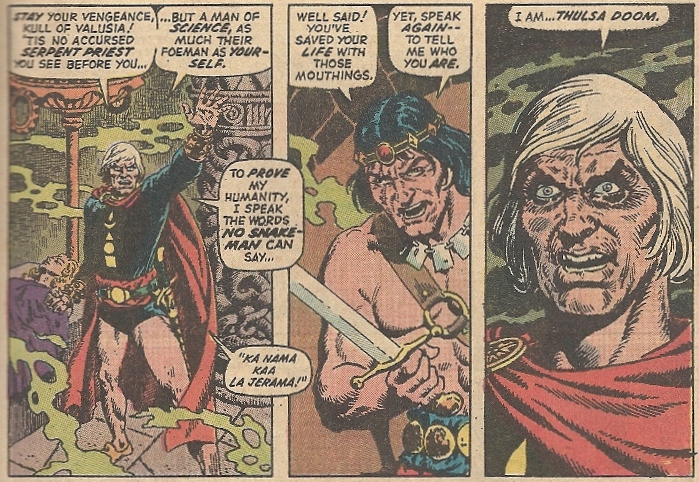
Count me as one of the people forever tainted by the James Earl Jones Thulsa Doom — I’ll never shake that. WHO THE HELL IS THIS WHITE PHIL DONAHUE-LOOKING IMPOSTER?
Doom manages to convince Kull that he’s a nice guy in this ish. But some ominous signs and a “Next Time” blurb would indicate otherwise:

“Next: No Kidding.”
This is classic comic book merry-making. I’m no Kull fan, but even I can get into this. The Severin art has me smitten, and to say that art generates interest in otherwise uninteresting material is perhaps the highest compliment that can be given. Such praise from these quarters isn’t exactly an Eisner Award, but it’s the best I can give.
There are also two classic Ditko and Kirby pre-hero tales reprinted at the back of the comic, a practice that I wish more series followed over the years. There isn’t all that much to say about these shorts, but two points need to be made. One, there are few better suited to drawing a classic ghost shape than Steve Ditko:
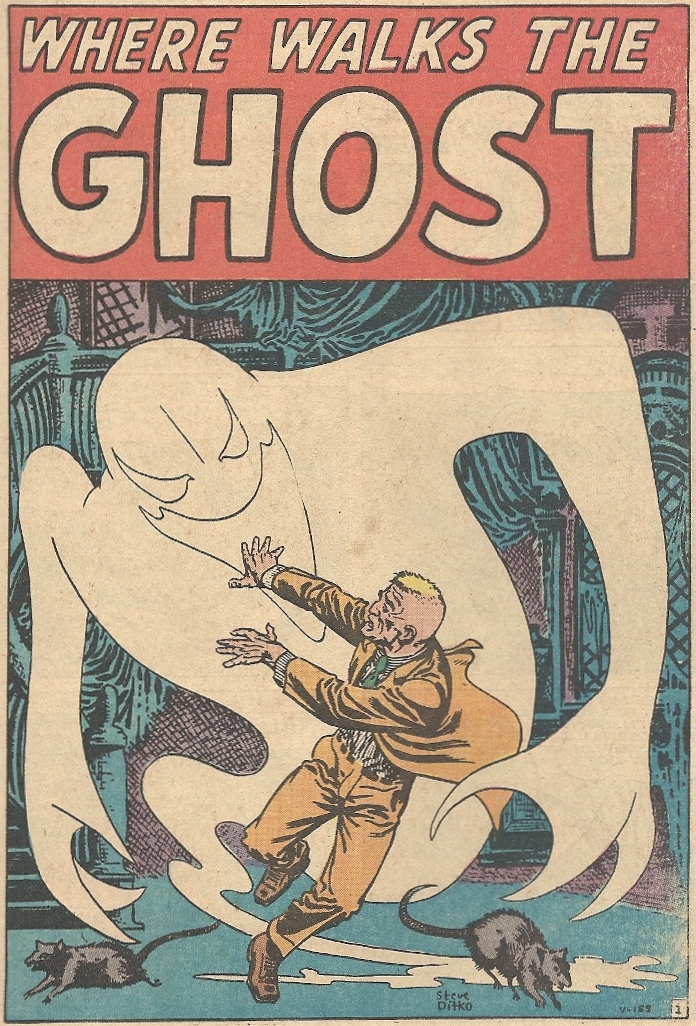
Two, merely reading the phrase “Jack Kirby draws a giant robot baby in a blue diaper pushing a vacuum” can make you smile. The execution can do the same:
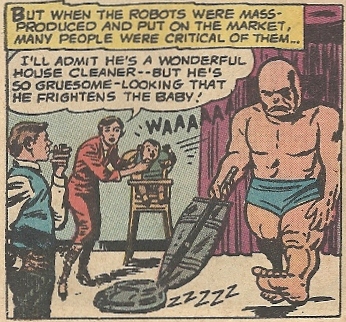
If Kull pushed that vacuum, he’d push it like a MAN.
Never fear. Tigerboy is here.

I could of used some of Tigerboy’s tire expertise when I got a flat on my bike this weekend. DAMN YOU, TIGERBOY. WHERE WERE YOU?
Lo, There Shall Be a Phallus! – The Incredible Hulk #115

The Leader’s head doesn’t look like a penis. It wouldn’t make Deadspin’s Unintentional Dong Submissions. But if Joe Camel can be considered phallic, then BY GOD we can label the Leader’s enormous cranium thusly. He’s in a proud line of comic book huge-noggined freaks, some of whom have skulls that veer into the elongated, roughly cylindrical penile realm. Like the Leader.
Maybe it’s the David Niven moustache that sexualizes him. When he frowns he’s ribbed for her pleasure, that’s for damn sure.
This is one of the least interesting of the Stan Lee/Herb Trimpe Hulk issues (with Dan Adkins inks), and the only thing commending it is the triumphant return of ol’ Greenskin’s fellow gamma-irradiated foe. A moment on that: I’m tempted to hate the Leader because of his origin. It’s so trite. Yes, Bruce Banner, a brilliant scientist, was bombarded with Gamma Rays and turned into a green rampaging beast. But Samuel Sterns, a dim-witted plebian, was turned into a green big-headed megamind. The smart man became dumb. The dumb man became smart. Bro, that’s all Shakespearean or something! Opposites! Ooooooooh!
So I’m tempted to loathe, but my first encounter with the character was on an old Viewmaster disk (I feel like my grandmother when she used to talk about going to silent movies with a guy sitting in the back banging on a piano, though I guess Viewmasters are still around), so I let him slide (no pun intended). He’s crossed over with some heavy duty nostalgia. (Nostalgia that might be completely made up. I scoured the internet looking for info on that Leader Viewmaster set, and found only references to a Hulk/Absorbing Man adventure that I also remember. This fond memory may be a figment of my imagination.)
Anyway, the Leader’s head looks especially profane in these pages. I don’t know if it’s Trimpe’s lines or what. I don’t know if I want to know.
A few notes… There are some nice artistic references to earlier Marvel works within, including the original Leader arc from Tales to Astonish. I was most smitten with this cue to a concurrent storyline, the classic Jim Steranko-infused Death of Cap, from Captain America #113 (only here it’s IN COLOR):

SHAMELESS SALESMAN STAN.
The Leader comes back in this issue to help General Ross contain the Hulk. Here he is bursting into Thunderbolt’s office (penetrating it, as it were) — RECEPTIONISTS MEAN NOTHING TO HIM:

There are few characters that can compete with Doctor Doom in the “Hurled Imprecations” category. The Leader is one of them:

The above scan is also the dongiest looking that his head gets here.
I never liked some of the Leader’s more modern designs, where his skull ballooned like a mushroom cloud. I always missed the old widow’s peak and attendant phallic implications. I don’t know what that means for me, but so be it. Beauty is in the eye of the beholder, and so is the dong.
I need a cigarette.
The fattest, hairiest, unsexiest pin-up model EVER

When I think pin-up subjects, buxom beauties in old-timey undergarments spring to mind. Mae West et al. Not so much Santa Claus. Or Rudolph. Or Santa’s Elves. BUT IT’S GLOSSY.
Let the Holiday Season begin.

It would have been nice to post this Thanksgiving comic on, oh, I don’t know, THANKSGIVING. Sometimes life gets in the way. Whatever. We can pop it in the microwave now and it’ll be just fine.
The all too current topic of haves and have-nots is the name of the game in this Denny O’Neil/Mike Grell/Terry Austin issue. On Thanksgiving, the downtrodden have-not denizens of Coast City are stuck with soup kitchen fare, including poor stubbly Abner:

And then we have the 1%. Or the .1%, as the case may be, preparing to sup on a sumptuous feast in an ornate mansion:

Are protesters with unclear goals going to have to camp out in front of Ferris Aircraft? Are they going to start pitching tents and banging drums? Will Carol Ferris, Oliver Queen, Dinah Lance, Pieface and Hal Jordan tell them to eat cake? #occupyCoastCity
We’ll never know, because Hal is called away like an on-call doctor to deal with a galactic crisis. The hemorrhoid cushion (or whirling torus — pick your poison) from the cover is using a rainbow (?) to suck up unfortunates all over the Earth, including lost soul Abner:

Thanks for the narration, Hal.
The cushion takes the raptured folks to a rocky, barren world, where their dog-faced alien kidnappers reveal themselves and the reason for the abduction — slave labor for a new colony:
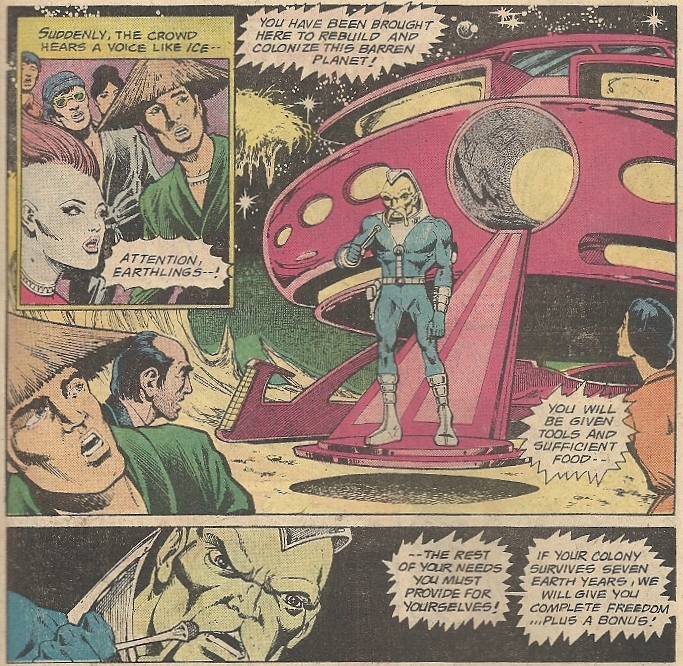
Hal disguised himself and hitched a ride, using a power I either didn’t know a Green Lantern would have or didn’t realize they’d need:
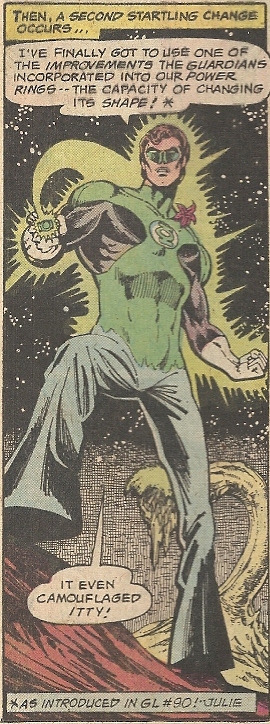
Yeah. Thank God Itty made it.
Interstellar fisticuffs ensue, but the head dog-face takes refuge inside a yellow bubble. Foiled again! Hal pulls a George Kennedy in The Naked Gun 2 1/2 and takes off his ring to give this coward what for (let’s hope it ends up better for him):
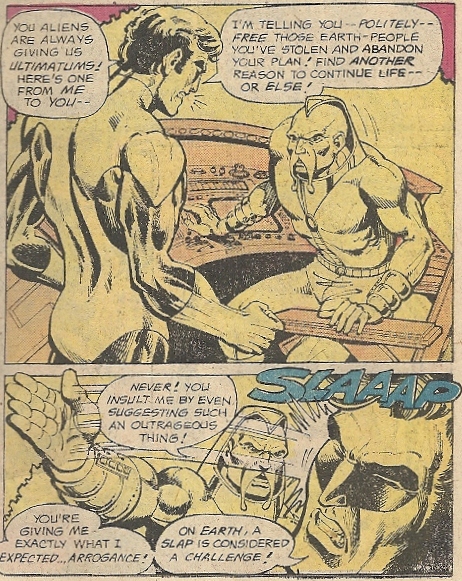
HAL ACCEPTS YOUR CHALLENGE, MUTT-MOUTH:

Ass. Kicked.
All the people are now free to leave, but some, including in-desperate-need-of-a-shower-and-shave Abner, want to stay and make a go of it — hard work on an alien world is better than a soup kitchen. Can’t say that I disagree. Hal assents, and now everybody has something to be thankful for. And Hal gets his Thanksgiving dinner after all:

Mangia!
I like the O’Neil/Grell Lantern. It’s not the best run on the character, but it’s far from the worst. There’s a frivolity to it (example: rainbow-spewing hemorrhoid cushions) that they manage to pull off. That’s particularly true when it’s mostly sans Green Arrow. Not a fan. And for pointless little sidekicks, you can’t go wrong with Itty (well, until he morphed into a monster — see previous link). At least he keeps his mouth shut, unlike others. He also lacks a bare ass-crack. I’M LOOKING AT YOU, ZOOK.
Enjoy your leftovers.

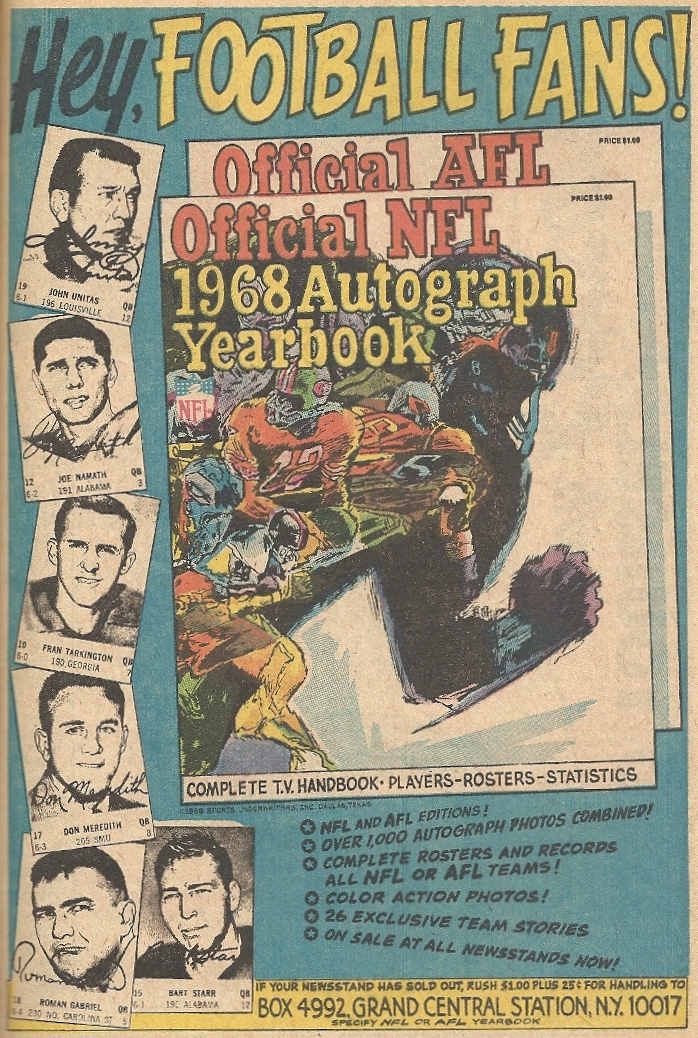
I’m sure your local Ford dealer would never even think of giving your folks a quick and aggressive sales pitch while you’re signing up for the Punt, Pass & Kick competition. Perish the thought.
I consider myself a decent athlete. In my day I could (sort of, with a running start) dunk of basketball, I could hit home runs, and I could slide-tackle with the best of them. But I could never throw a football. Apologies to the fairer sex, but I threw the damn thing like a girl. A little girl wearing a pink dress with pink ribbons in her hair. A GIRL girl. So whenever I see kids at NFL games during halftime getting recognized for their Punt, Pass & Kick achievements, I view them with a terrible mixture of respect and envy. These children can throw a pigskin better than me. I HATE MYSELF.
The rugged faces below stare at me in judgment. The macho crew cut of Johnny Unitas mocks me, as does his manly signature.
Evelyn Cream? Is that you? – COPS #14

C.O.P.S. (Central Organization of Police Specialists, if you missed that on the cover) rolled out in 1988, right when I was at the tail end of my cartoon consumption. A couple of years later the splendidly imagined Pirates of Dark Water would be the absolute last hurrah, but C.O.P.S. marked the end of the line for my after-school viewing. Organized sports came to occupy more time.
The show only lasted one year. Fitting.
It was a melding of He-Man and futuristic law enforcement, following a well-equipped police department as it did battle with a motley crew of equally super-powered baddies. Not to go too wild with the comparisons, but there was also a tinge of 1980s G.I. Joe in there as well, with a metropolitan constabulary receiving a tech upgrade instead of the military. The most memorable character was Big Boss, an obese Kingpin-esque crime lord with an Edward G. Robinson voice. I used to love imitating him. It would be years before I realized I’d actually been doing a Robinson imitation all along (and a damn good one, if I do say so myself — though who can’t do that imitation?).
The show had — of course — an accompanying action figure line (why else would it exist if not to market something?), along with a kinetic opening montage. The latter and the “Yeah, SEE?” were the only good things about it. It kind of blew. I hadn’t realized until recently that there was a comic to go along with the televised shenanigans. It’s not all that good, either, and thus faithfully adheres to its parent’s mediocrity. This particular issue, though, has a nice/terrible hook. That makes it worth a gander.
In “Buttons on a Vess” (ugh), written by Doug Moench, with art from Alan Kupperberg and Robert Campanella, Drago, a low-level hood who knew head COP Bulletproof (the Evelyn Cream-ish gent on the cover, whose real name is Baldwin P. Vess — hence the “ugh”) when they were both young, is out for revenge. Revenge for what? It’s all about “Lucille,” and Drago wants some help from Big Boss:

Lucille Bluth, perhaps? Whatever the point of contention, Big Boss gives the little fella the services of Buttons McBoomBoom, a hired gun with a penchant for automatic weaponry (including some built into his torso) who looks like he shares a tailor with Orko.
Bulletproof is having concurrent ominous nightmares where he’s a kid again, yet with his adult cyborg body and also a shocking fear of, yes, bullets:

There are many useless skills that I’d like to have, but being able to trace patterns with a machine gun has to be near the top of the list. THE LITE-BRITE OF DEATH. Impress your date!
Before long the bad dreams come true, and Bulletproof is hounded by Buttons to that terminus of so many pursuits, a warehouse. But Mr. McBoomBoom shows that, if there isn’t honor among thieves, there is some sort of half-ass code:

Time for some “I’LL SQUASH THAT BUG!”:

Now for the coda, which is either God-awful or mildly amusing, depending on your mood going in:

The missing piece of the jigsaw puzzle. I’m sure of this: Orson Welles is punching something in heaven right now. Oh, and I’m also sure that Bulletproof used to deliver papers while mostly nude.
I never got what the deal was with Bulletproof when I was watching the show as a kid — his shirt didn’t come off (no more papers to deliver, I guess), so I thought his gimmicks were his shades and the Jheri curl. Then one episode I saw his metal skin and realized he was a Cyborg rip-off. Fantastic. That about sums it all up. It was a fairly diluted universe.
The comic, despite the best efforts to Citizen Kane it up, is equally underwhelming. It’s a nice memento of another time, when I finally came to a “I’m getting to old for this shit” realization, but that’s not much to hang your hat on. FOR DEVOTED C.O.P.S.AHOLICS ONLY.
Check Your Fifty-Year-Old P.K.J.S. (Pre-Kardashian and Jersey Shore) Local Listings
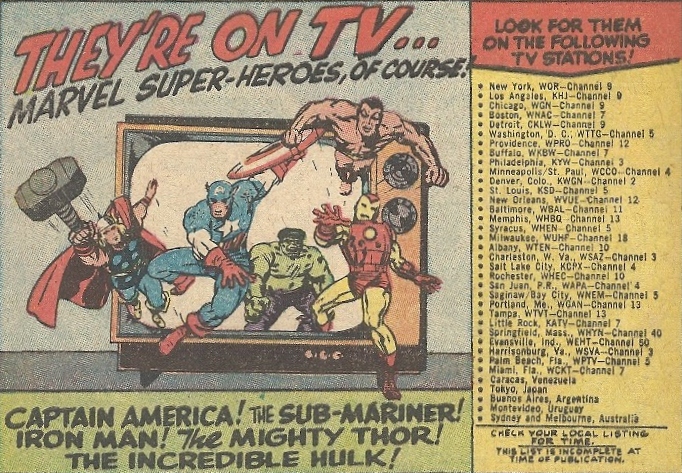
I’m disappointed that none of the local stations of my youth can be found in the above list. If I’d been alive when these shows aired and I was denied seeing them, THERE WOULD HAVE BEEN HELL TO PAY. Except for Namor. They could have kept him.
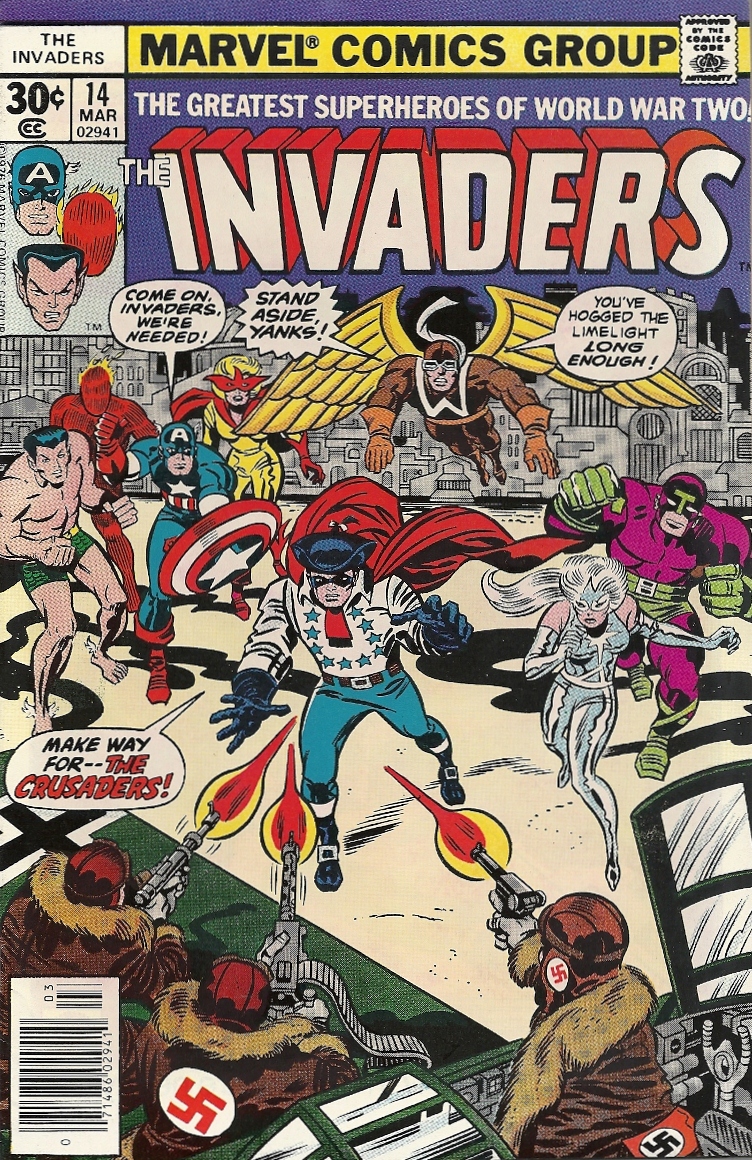
Slap a Mr. Yuk sticker on this sumbitch. It has some Grade A story-killing poison, and we’re not talking about the dull, static cover from an apparently disinterested Jack Kirby.
I have no beef with Frank Robbins. I’ve enjoyed much of his scripting output (including a Superman tale examined here mere days ago). He was that special switch hitting combo of artist and writer, a dexterity that I’ve always admired no matter who possesses it. But this comic book’s visual component is so off-puttingly grotesque, it must be made known so that it can be quarantined like the last remaining strands of smallpox.
Some of the fault might lie with inker Frank Springer, or maybe it’s a toxic combo of the two pencil and brush collaborators. Whatever. I’m going to lay this one at Robbins’ feet. BURN THE WITCH!
The deficiencies are a particular shame because the issue’s script comes from the master of the World War II retcon, Roy Thomas. No one was better at melding the disparate worlds of tights and swastikas. Here he introduces a British counterpart for the “American” Invaders, the Crusaders. Have a gander at a few of the team members, including the token Yank (IF YOU DARE):
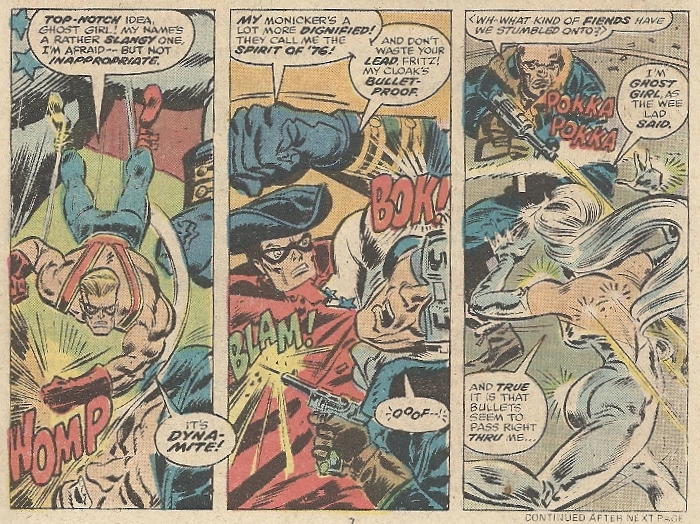
As an aside, I realize the U.S. of A. and perfidious Albion were tag-teaming against the Axis, but I can’t help but get a whiff of Benedict Arnold from the Spirit of ’76. JUST WHOSE SIDE IS HE ON?
You might see some artistic problems with that above scan. Maybe not. Let’s ramp things up with a close encounter with Namor’s batch:
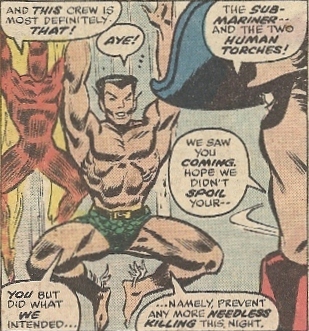
Remember that scene in Patton when the rowdy Russian soldiers are stomping and prancing on the table in front of a victorious George C. Scott and the Soviet generals? Remember the look on Scott’s face? That’s the look I have now.
Now we come to the pièce de résistance:
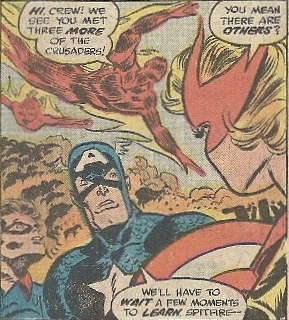
Cap looks like goddamn Sloth from The Goonies. Worst. Captain America. Ever. The Worst Spider-Man Ever now has some company.
And Bucky ain’t looking all that hot, either.
Once again, no beef with Mr. Robbins. No one bats 1.000, and art is, of course, subjective. One man’s trash is another man’s treasure. Different strokes for different folks. The length of his career would indicate that there were plenty that found his art fine, dandy and delectable (though a simple Google search would turn up plenty of opposition). A lot depends on context, I’m sure. Yet, all that granted, I subjectively loathe the art in this book. I subjectively find it utterly hideous. It looks stupid. FOUR COLOR CLOWN VOMIT.
And on that gastronomic note, enjoy your Thanksgiving.
The lack of truck stop prostitutes takes away from the authenticity…

Maybe they’re in the “Mystery Warehouse.”
“Faster than a locomotive.” Will you settle for that?

So what if it doesn’t make you faster than a speeding bullet or more powerful than a locomotive. Take what you can get, planet Earth.
We’ve already learned that Cheerios can get a dim-witted moose to dunk himself in a basketball hoop. Now we know that it also helps you outrun high-speed Japanese trains (not to mention superimpose a solitary Cheerio over your engorged left bicep). Huh. Suck on that, Wheaties.
The Man of Steel as Douchey Frenchified Artiste – Superman #211
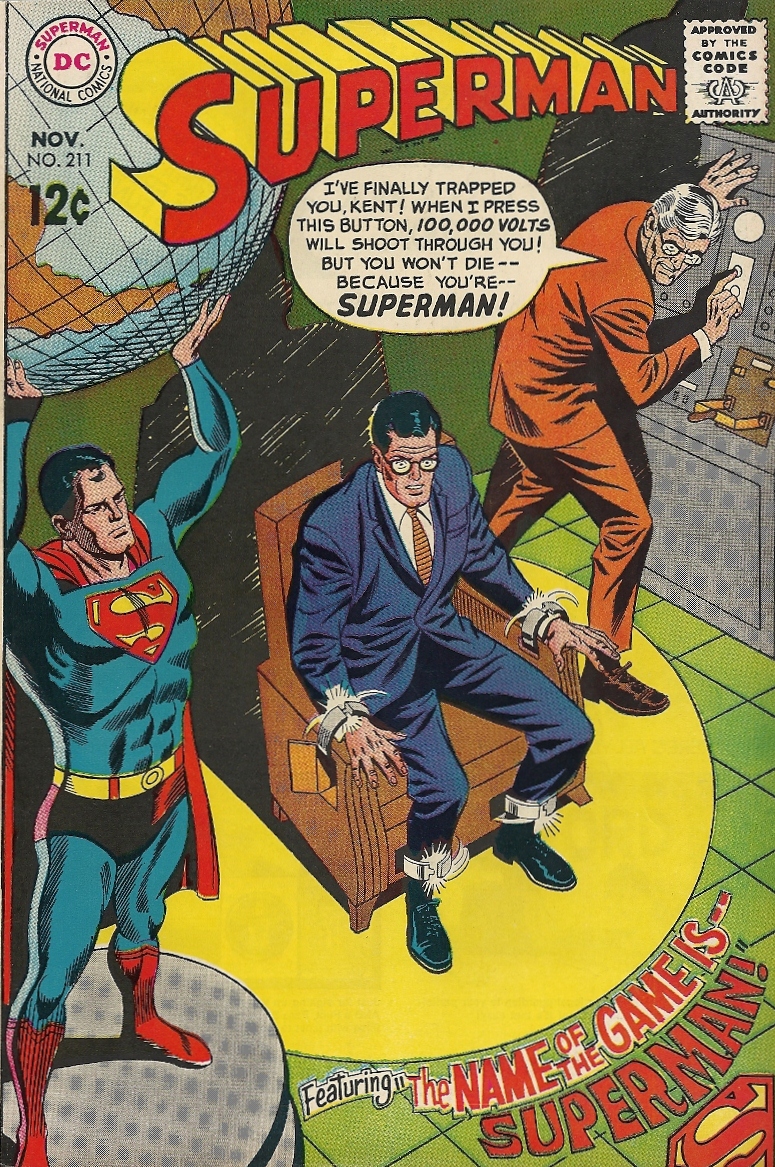
The old Silver Age Superman double features can be a bit problematic in that, instead of providing double your pleasure, they all too often are weighed down by a stinky half. Or, if you’re really unlucky, two stinky halves. My math isn’t great, but if I remember my fractions THAT’S ONE WHOLE STINK. It can be a dicey proposition.
I’m pleased to report that this issue, while brimming with the stupidity of the day, is fun. No stink in either half. I might be overselling its virtues. I’m frequently left banging my head on the home office desk when confronted with Silver Age contradictions and conundrums (of which this comic is not immune — see some of the parentheticals below). Here, though, the positives outweigh the negatives. Maybe it’s more accurate to say that the stink is well-covered with pleasant perfume.
What made it fun? Art and glasses.
Half #1…
Thrill as Frank Robbins, Ross Andru and Mike Esposito prove that “You, Too, Can Be a Super-Artist!” and turn the World’s Greatest Hero into a self-absorbed Eurotrash prick!:

I remember as a kid owning instructional booklets that had that line method of how to draw comic book characters. I followed them exactly and my stuff always looked like shit. You either have it or you don’t.
Clark Kent gets alerted to a con when a young kid comes to the Daily Planet offices to sell a comic strip that he’s created, and Clark gets saddled with the task of letting the poor kid down gently. What complicates matters is that the youngster is brandishing a real, authentic, gen-u-ine certificate stating that he’s an accredited artist. Clark, while of course being kind to the feelings of a child, is less than convinced about his “incredible” talent:
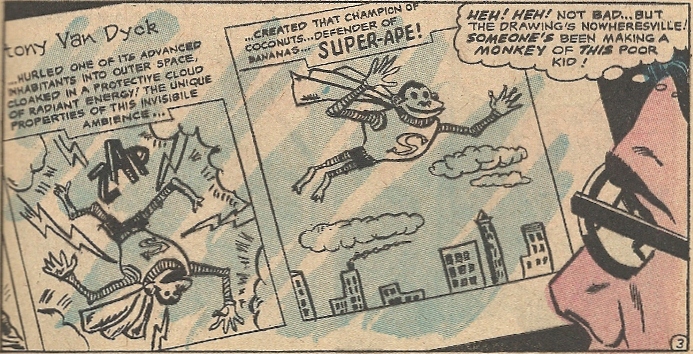
“Nowheresville.” We dig, man. We dig. (And is this Super-Ape some cousin of Titano’s?)
Someone’s obviously been taking advantage of the kid, and there are probably others out there who’ve suffered a similar duping. This con works up the big guy’s ire. Lex Luthor is assuredly out hatching some world-destroying scheme. Likewise for Brainiac. BUT THIS SINISTER CORRESPONDENCE COURSE MUST BE STOPPED AT ALL COSTS.
Clark begins his deep undercover operation by mailing in his own sample:

Still better than Liefeld.
Clark gets accepted into the program, and a little eavesdropping and x-ray vision at their main office later, he confirms that, sure enough, it’s all a scam. That criminals are raking in wheelbarrows full of cash from an artistic course requires a greater suspension of disbelief than anything else in this issue, but roll with it we shall. Clark starts taking classes (with the beret) under the tutelage of Professor Da Fony (one of those times…), and uses his super-powers to make himself a genuine portrait-painting prodigy. When he shows an ability to copy the masters with exact precision, the crooks see his talent as a chance for them to make even more money (swapping phonies for the real McCoys). To be a better copycat, Superman heads back in time to study with the masters that he’s going to be mimicking. First up, Thomas Gainsborough. When travelling through the time-stream he passes through Halley’s Comet’s trail and inexplicably gets made younger and blue (another of those times…), but this makes him an oddly appropriate model for The Blue Boy:
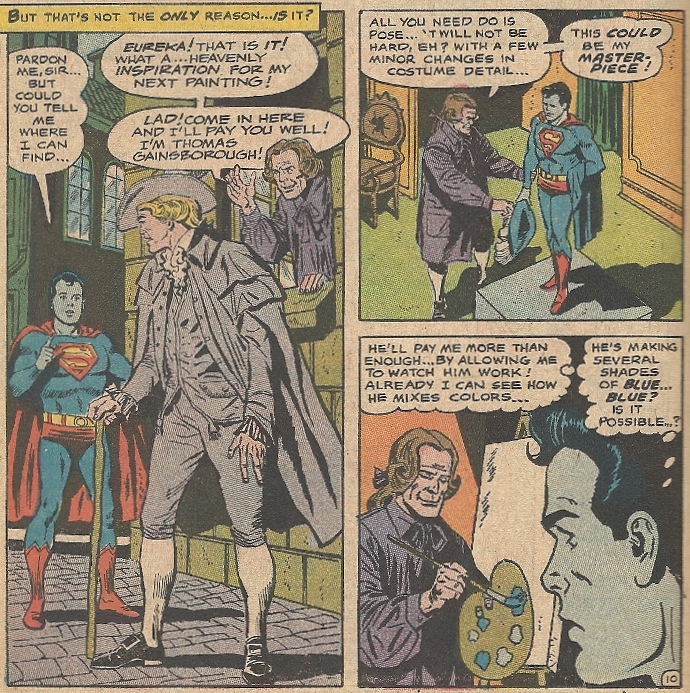
Next up is Rembrandt van Rijn and Superman modeling for one of the characters in The Night Watch:

All this invaluable experience helps Supes make detailed, but slightly flawed, forgeries, and in turn helps him expose the ring and its moustache-twirling head:
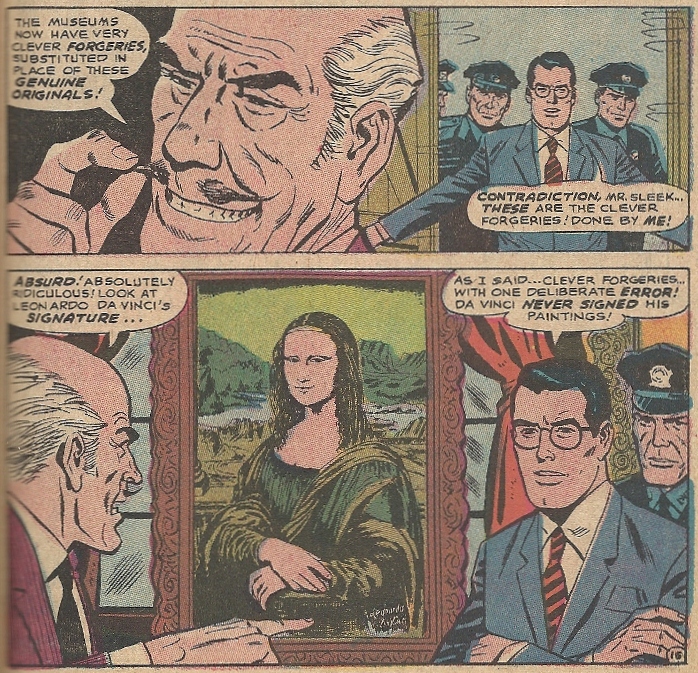
A-HA! How about that, Mr Fung? (The thought of the Mona Lisa with a giant Todd McFarlane LOOK AT ME signature makes me chortle with fiendish delight.) The certificate-issuing syndicate is busted up. WE ARE SAVED.
Last, but not least, Clark gives the young artist that started this whole thing a boost:

The Doogie Howser of comic strips.
The second half of the issue — the cover story (Dave Wood, Curt Swan and Jack Abel) — is yet another in the long line of I KNOW CLARK KENT IS SUPERMAN NOW WATCH ME (FAIL TO) PROVE IT exposés. Homer Ferret (another of those times…) lures Clark back to his (Ferret’s) Smallville home with the promise of a big Superman scoop. Once there he takes the intrepid reporter into his back room:
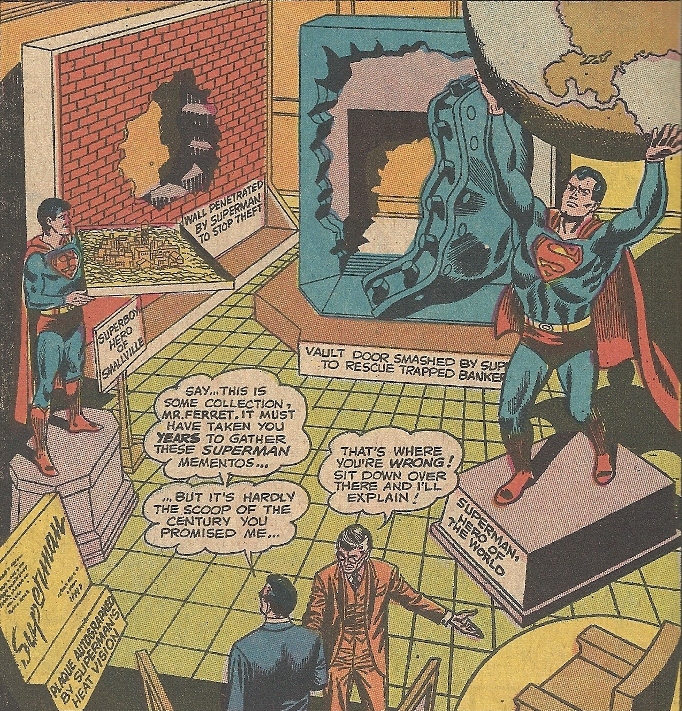
Am I the only one getting a “creepy stalker shrine/sex dungeon” vibe?
Ferret latches dopey Clark into his chair, and then lays out his big scoop. It all comes down to Clark growing up in Smallville at the same time as Superboy, and, well:
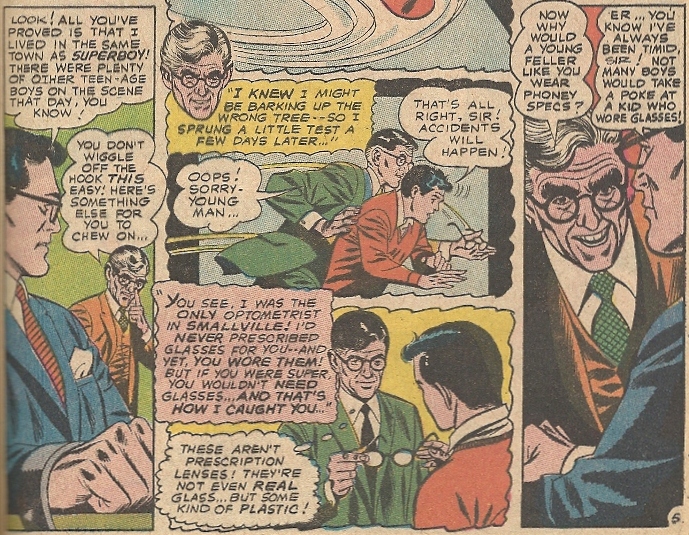
Undone by an optometrist. How embarrassing. Now the eye doc is going to zap his prisoner, and if Clark survives it proves he’s Superman.
Clark calls his bluff:
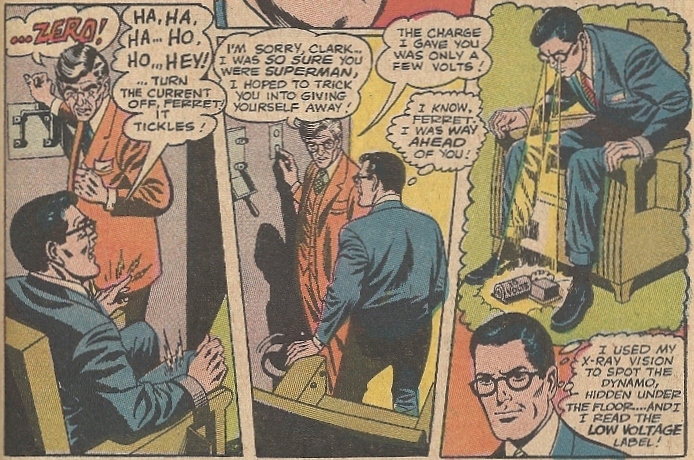
So Ferret had no balls to go along with his poor planning (off the top of my head I can think of roughly a forty-five holes in his master plan). Well played. This not-so-close call has one lasting effect, though — Clark decides to upgrade that splendiferous disguise of his:
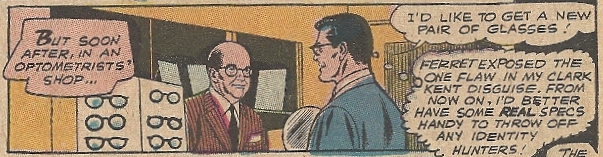
Yeah, that’ll do it.
What makes this comic rise (modestly, I admit) above the rest, especially when there are so many elements that threaten to send a reader into a towering, forehead-slapping rage? When blue boy time-travel side effects, Professor Da Fonys and Homer Ferrets conspire against our good sense? And apart from the Curt Swan contribution, which never ceases to comfort and entertain Superman devotees?
It’s pretty simple. I confess to being a sucker for art within art, so Superman taking up the bush and easel and studying with masters strikes a chord, as does the sly slap at the art class advertisements that dotted many a comic book in those days. You sense that Andru and Esposito thoroughly enjoyed reproducing classic works of art as a modest homage.
More importantly to the comics universe, it’s great to read even the tiniest little story that confronts head on Clark Kent’s stupid glasses. That Superman hides behind the flimsiest of disguises — if you can even call it a disguise — has long been a source for fanboy bemusement (and letters column fodder). It’s hard to get around. The most famous man on the planet working with investigative reporters and maintaining his secret identity with only the aid of a comb and frames is a lot harder to believe than heat vision or super-breath. It’s kind of fun, but it’s kind of frustrating, too.
This comic doesn’t explain that discrepancy, nor does it resolve it. But at least it grapples with it, and it surely gave readers in 1968 the reassurance that they weren’t crazy, and that other people noticed those dumb glasses as well, AND THAT THEIR VOICES WOULD BE HEARD. Strength in numbers. This comic was a lot of fun to wade through.
He wore a raspberry beret…
JHOON RHEE MEANS MIGHT FOR RIGHT!
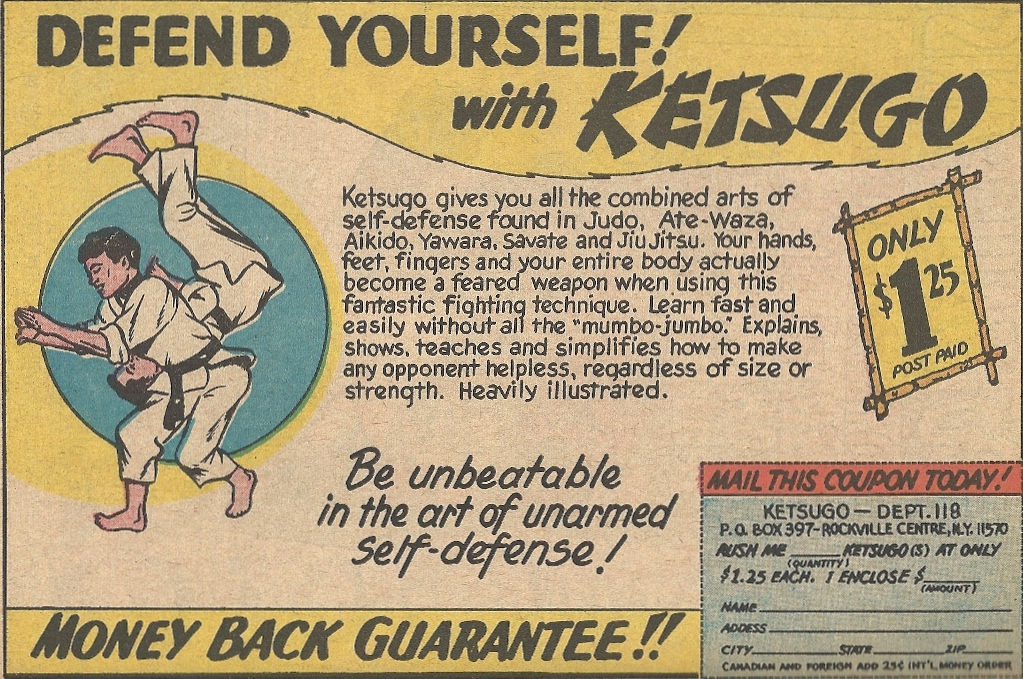
Judging by the scads of bodybuilding/self-defense adverts in comic books over the years, Madison Avenue deemed that the folks in the comics-loving demographic were a weak, mouth-breathing lot, always under the looming threat of getting the ever-loving shit kicked out of them. Little Barney Fifes in dire need of certified lethal weapons. Not sure if I dispute that.
Digression time. Whenever I see a martial arts ad like the generic one above, all I can think of is the classic Jhoon Rhee commercial:
“Nobody bothers me, either.” WINK.
A fixture of local 1980s Washington, DC television, this ad long ago passed into the realm of legend (an indicator of its lasting reach is that I wasn’t living in the area when it aired, but even I know it by heart), and said legend includes a codicil about the apparently unstoppable Rhee being mugged and beaten at various points in his career.
Not sure if Mr. Rhee, a true, honest to goodness martial arts legend, had a money back guarantee with his course.
T and A, South American Jungle Style – Rima the Jungle Girl #6

The scantily-clad-jungle-babe-she-warrior-animal-lover comic genre has to be one of the worst. It seemingly exists for one reason and one reason only — to satisfy erotic fantasies involving girls dressed in animal skins (not saying that’s unworthy…), and it’s not even all that good at that. The stories are usually SO UNBELIEVABLY BAD they work like a saltpeter, like an incredibly hot woman who’s dumb as a brick. Queen of the Jungle and Potent Anaphrodisiac.
Then again, if you really want to check your brain at the proverbial door and do some heavy-duty four color ogling, they’re perfect. To that end, if you were left unsatisfied by the primitive attire sported in a recent Anthro post featuring two catfighting Paleolithic babes, perhaps Rima, the white-haired (her tresses are positively Kona-esque) jungle girl, will float your boat. Hell, all us men could use a dose of “lithe bombshell” after being bombarded in recent days by that Toyota commercial starring Kelly Clarkson’s arm fat (her flapping limbs are apparently to her voice what Samson’s hair was to his sinews).
Rima deserves a little background, as she’s not the product of later, more outwardly titillating times. Created by W.H. Hudson back in the days of horseless carriages, she’s a fictional contemporary of Rudyard Kipling’s The Jungle Book and Edgar Rice Burroughs’ Tarzan, into which modern audiences read any number of messages about white men and burdens. Rima began her fictional life more a creepy sprite than a goddess, and a healthy dose of VAVOOM was added to Rima’s comic book broth, making her more visually appealing (read: voluptuous) than her original 1904 description.
Robert Kanigher wrote and Nestor Redondo provided the art for this issue’s “Safari of Death.” Sounds fun. Let’s start out with dear Rima’s physical attributes, because that’s why people paid hard American currency for this flimsy publication.
Ooh, look at her eyes — more mesmerizing than a cat’s!:
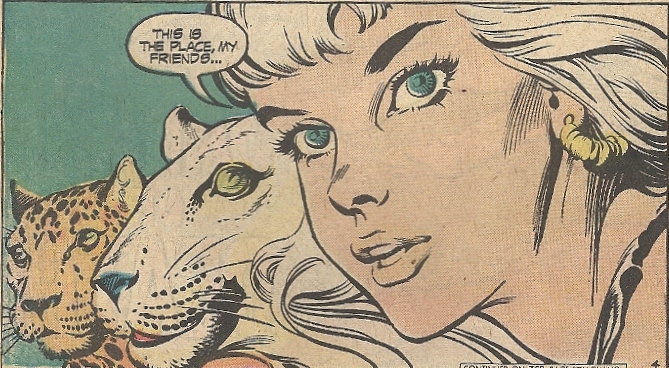
“Eyes? Who cares about eyes? What about the rack, ass and legs?” Your wish is this comic’s command:
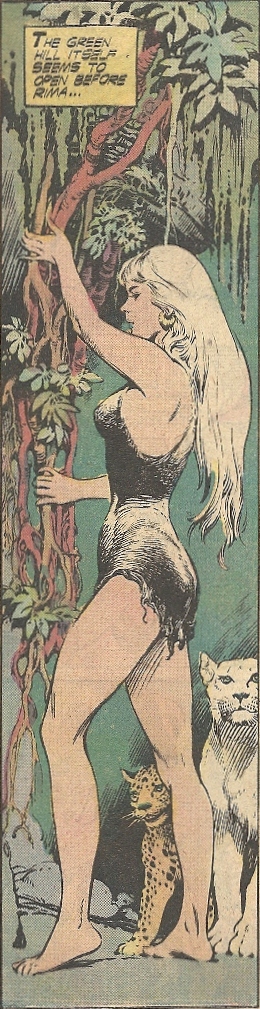
Not bad, I have to admit.
Showing a maternal sympathy present in females of all species, Rima’s trying to find a good spot for her husband and wife jaguar pals (seen above) to settle down, since the regular-coated cat is very, very pregnant. Ready to explode pregnant. Before she can play midwife, though, Rima’s dopey normal boyfriend (Abel) leads a pack of hunters into the jungle, and they IMMEDIATELY cross paths with the expectant parents. The leader of the intruders, an Anton LaVey-looking douchebag, wants that white jaguar:
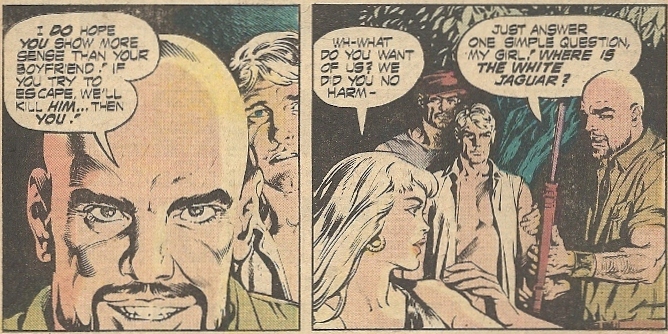
THE CHURCH OF SATAN NEEDS WHITE JAGUAR BLOOD! DON’T ASK WHY!
After roughing up Abel and duping poor Rima, he gets his prize, in a tooth and claw be-careful-what-you-wish-for sort of way:
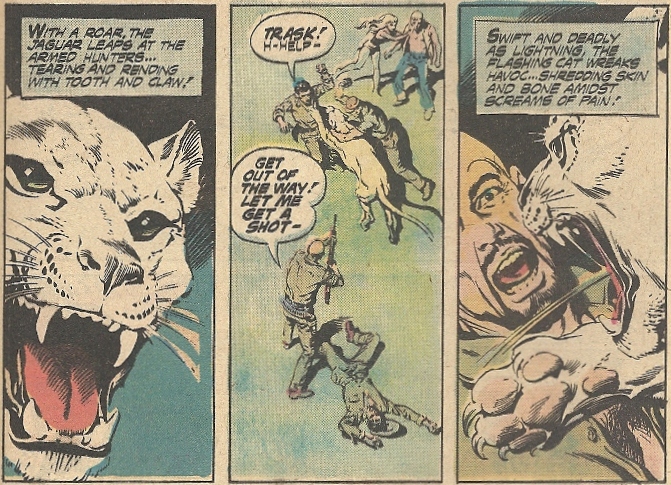
The white jaguar, protecting both his mate and his human friend(s), is shot and killed as he tears through every last one of the hunters. No more white jaguar. But wait…:
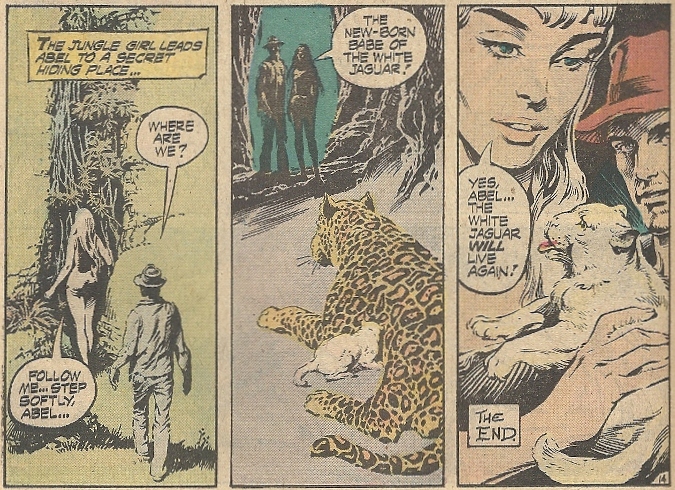
The Circle of Life doesn’t only apply to lions. Fin.
This short tale could be a whole hell of a lot worse. The plot is your typical “white hunters profaning nature’s chapel” tripe. BARF. I do, however, doff my cap to Redondo’s art. It’s always hard for anyone to live up to a Joe Kubert cover, and I’m not saying that he does, but his work with the cats is striking. The claws and fangs leap off the page — I’m a sucker for handsomely drawn animals. And, as I noted above, Rima ain’t too bad either. If you like that sort of thing.
This version of Rima showed up a few times in the Super Friends cartoon, but the character’s most prominent screen appearance came in the film version of her original story, Green Mansions. It starred Audrey Hepburn and Norman Bates, and it took one of the last century’s most beautiful women and surrounded her with a story so insipid you wanted to pitch her off a cliff.
It was awful, and therefore worthy of the genre.

The brother is once again stuck playing second fiddle, but at least he has his driver’s license at the age of twelve. Take that, Steve “Cracker” Scout.
No Helping Old Ladies Cross the Street playset?
And so ends my two cents on the Steve Scout Universe. There were actually some associated comic strips — if you can’t get enough of Steve and Bob and their overwrought accoutrements, click here.
 Jared
Jared


 blog into mystery