The Meteorbs have arrived on Eternia. There goes He-Man’s neighborhood. – Masters of the Universe #2

Sometimes I forget how much I loved the He-Man toy line as a kid. It gets lost in the shadow of the Hasbro twin towers, Transformers and G.I. Joe, which dominated 1980s toydom. But Masters of the Universe kind of ruled, with colorful characters (Stinkor, who actually stunk, was a particular favorite — he was scented with patchouli oil, and to this day hippie B.O. sets my STINKOR IS NEAR klaxon blaring), a damn fine cartoon (with a catchy theme tune) and a rich mythology.
If there’s one complaint I can file with the toy gods, it’s that He-Man’s physique has left me playing muscle catch-up my entire life. I didn’t know what an Adonis Complex was until I got older, but I’ve always had a mild case of it, and every push-up and pull-up I’ve done over the years has probably been due to some deep-rooted attempt to match the bare-chested He-Man’s pectoral prowess. IT HAS BEEN AN UPHILL CLIMB.
Anyway. He-Man was great. Established. But I abandoned ship rather fast when the Autobots and Decepticons and Joes and Cobras arrived on the block. And this comic is Exhibit A of why I headed for the lifeboats.
The Meteorbs.
Someone decided that it would be great to combine two of the things that young boys love so much: warriors and, um, hard-boiled eggs. THESE BLOBS WERE THE LAMEST LUMPS OF PLASTIC EVER GRAFTED ONTO AN ESTABLISHED PROPERTY. They generate loathing in the He-Man fan community to this very day. They were so stupid, they are so stupid. So unbelievably stupid. So needlessly stupid.
What kid wouldn’t want an eggish thing that transforms into a rough approximation of a blind man’s impression of an elephant?
The Meteorbs weren’t originally intended for the MOTU line, but instead were transforming oblong doohickeys that were relabeled and flung under that banner in its later days. They were cheaply made, and — no surprise — they wound up sticking out like sore thumbs. If there was a saving grace, it was that the Meteorbs came along too late to be included in the wrapped-up cartoon, and only made a brief, tangential appearance in the sequel/spinoff She-Ra. But, thanks to this comic, they did get an introduction into the He-Man comic book cannon. And what an introduction it is. FANTASTIC. Under Marvel’s kiddie-oriented Star imprint, which gave us the comic stylings of Alf, it arrives all the more puerile. (Though, to be fair, Star did manage to churn out the sublime Spider-Ham, so the imprint isn’t congenitally awful.)
The instigator for this introduction (Script: Mike Carlin, Pencils: Ron Wilson, Inks: Dennis Janke) is that other bemoaned member of the Masters line, the Jawa-like Orko. He’s playing elf-wizard-idiot grabass one day in the palace when he collides with one of Man-At-Arms’ many lethal contraptions:

A stray bolt strikes a meteor in a passing shower, which then crashes to the ground, and Orko, Prince Adam and Cringer go to investigate. They find more than just a smoking hole:

Adam suppresses the urge to laugh at this Easter egg assemblage, the dopiest motorcycle gang to ever exist. Clowns of the Universe. But they obviously have ill intent, so something has to be done. And the evil Meteorbs have no idea who they’re messing with, as Adam is no jug-eared, slack-jawed Prince Charles wannabe. He’s, well, you know:

One of He-Man’s best features was that his heroic transformation didn’t only turn him into a muscley champion of justice, it also heroed up his cowardly pet. If only I could have done the same for my Basset. Battle-Hound.
Before the Eternian turf war rumble starts — “Rule #1: No touching of the hair or face!” — the cavalry arrives:

More of them. The Meteorb Legion. GREAT.
The dividing lines are now clearly drawn. The meteor that crashed to Earth was actually named Rokkon, who was himself playing a little grabass, absolving Orko of a dash of responsibility (contributory negligence and such). Rokkon’s buddies, led by Stonedar (ahem), team up with He-Man — good has an easy time sniffing out good, apparently. And Skeletor, in a constant quest for allies in his battle against both He-Man and Hordak (remember him?), shows up and takes sides with the bad eggs. Their battle prowess, despite some damage that they do to the palace, has him regretting his decision in short order:

When your opponent is using you as the ball in his own personal batting practice, you are losing BIGTIME.
Skeletor has nothing to do but beat a hasty retreat alongside his worthless new minions. If he had lips he’d be dong that thing where you flap them with your index finger.
After the heat of battle, Stonedar and He-Man look as if they’re about to have themselves a little Brokeback Eternia interlude:

TELL ME YOU DO NOT THINK THE SAME THING AFTER THAT LAST PANEL. It looks like He-Man’s checking to make sure the coast is clear, as Man-At-Arms probably strictly adheres to the “Don’t ask, don’t tell” policy of the Eternian armed forces. “I wish I knew how to quit you, Stonedar.”
Alas, no. They’re simply appreciating the renewed grabassery of their dimwitted pals:

And that’s it. The Meteorbs, ladies and gentlemen.
I often wonder how creative staffs feel about working on a title like this, one that owes its existence primarily to the movement of related merchandise. I’m sure they’re happy to have work, especially in an industry that’s hard to break into and in which it’s a constant struggle to remain fully employed. And this is a mag for your young readers, not The Decalogue. But when the word comes down that you have to cram transforming Easter eggs into your storylines, you have to wonder about your career trajectory.
And if He-Man were real, he’d be lamenting going from a DC Comics Presents crossover with Superman to consorting with talking rocks. It’s like Al Pacino busting up parking meters in Donnie Brasco. LOW.
One would think that James Bond “role playing” would involve a lot of bondage and sadomasochism. AND PERHAPS IT DOES.

Which James Bond would you like to be? The dashing Sean Connery? The campy Roger Moore? The forgotten Timothy Dalton? The more forgotten George Lazenby? The spindly Pierce Brosnan? The icy killing machine Daniel Craig?
Once you decide, then you can pick your Bond Girl. For the guys, that’s when the fun begins. Pussy Galore FTW. Or Octopussy. As long as it’s a broad with a vagina-centric double entendre name, you’re good.
There was more to this In Her Majesty’s Secret Service game than I thought when I first saw the ad. It doesn’t exactly trump the Dungeons & Dragons nonsense, but it might fire its Walther PPK in that direction.
One last thing: I’ve never before come across the “World’s Most Famous Secret Agent” phraseology. Fame seems like a bad thing for a secret agent, no?
Come worship Atomic Energy at the Church of 1950s Science – Classics Illustrated Special Issue: Adventures in Science
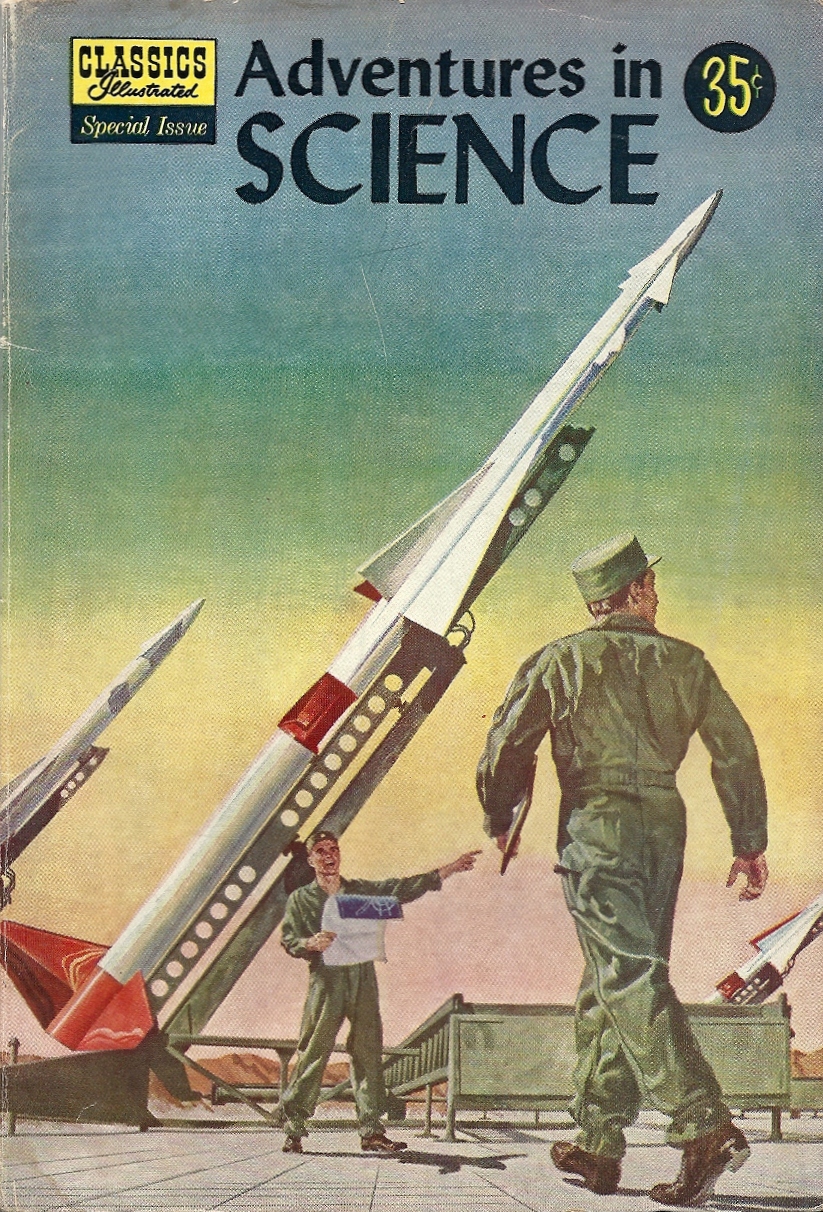
With that great cover, and all the erection symbolism that a ready-to-fire missile entails, how can we possibly go wrong?
It’s always nice to go back in time and read some slavering, outdated propaganda about the wonders of science and the unbounded potentiality of progress. Remember flying cars? Commuting to work on your personal hovercraft? Moving sidewalks along every street? Robot butlers? Yeah. That sort of thing, the kind of stuff that made up so many Mystery Science Theater 3000 opening shorts. (I’m looking at you, “Design for Dreaming.”)
This 1957 comic, one of a series of specials put out by the fine Classics Illustrated people, contained original, science-centric material that wouldn’t fit into their normal adaptations of Dickens, Sherlock Holmes and the like. Among the features in this large, square-bound tome are a history of flight (presented as a rather straight-forward Icarus –> Da Vinci –> Wright Brothers –> Charles Lindbergh –> Chuck Yeager continuum), an incredibly dull Louis Pasteur life-story that will batter into unconsciousness any brave soul who dares to read it, and some brief one-page vignettes. But the real gem is a long, naive infomercial for the wonders of atomic energy, some aspects of which will cause the arching of many a modern eyebrow. (Apologies for the blurriness in some of the scans. Blame the square binding.)
Let us open our hymnals and begin.
Our vehicle through this wide-eyed trip through an irradiated world is Andy, a young cap-wearing lad who lives with his Mom and Dad perilously close to a nuclear testing ground. How close? Close enough to stumble into a heap of trouble when his dog, Spot, runs off after a rabbit:
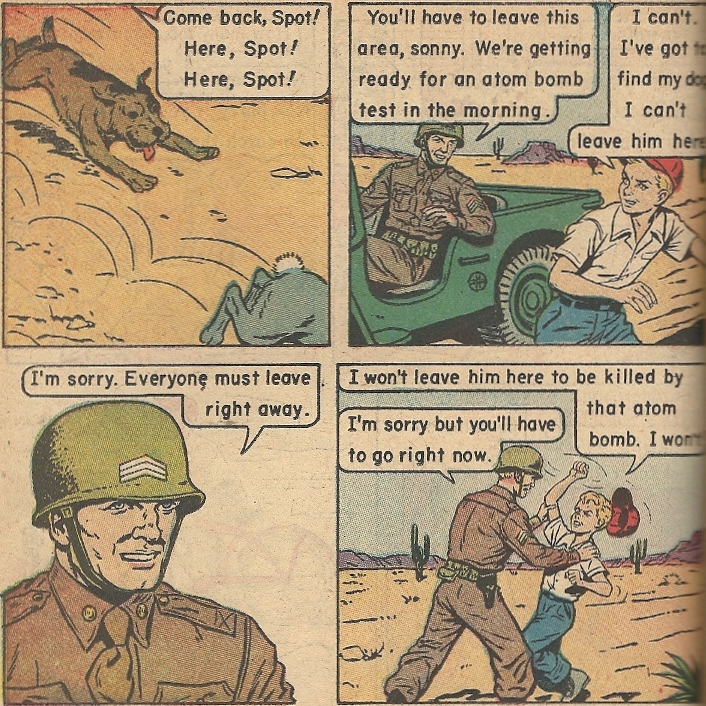
We have a puppy about to be nuked. AND WE’RE OFF AND RUNNING.
Spot doesn’t turn into a Hulk-dog, nor does a bespectacled Bruce Banner arrive just in the nick of time to toss him into a ditch. But Spot is missing, and when the bomb goes off the next morning (thank God that soldier was there to chase Andy out dogless a full day in advance) Andy assumes the worst, blaming the damn dog-killing bomb for all the world’s ills. That’s when Dad steps in to set him straight:
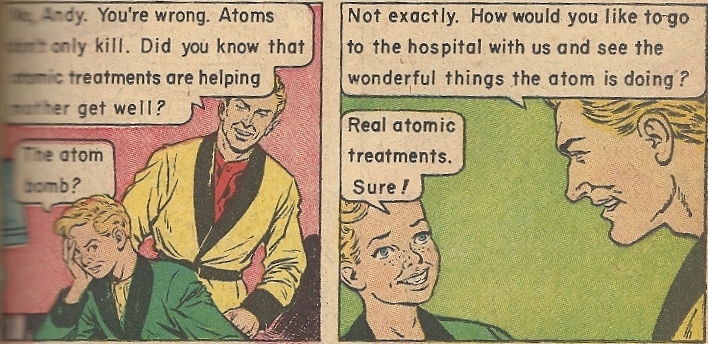
“I won’t have the Almighty Atom disrespected in this household, son.” (This 1950s had to be one of the most robed decades in all of history. Babies must have worn robes. Andy looks like he should be smoking a pipe and reading the newspaper.)
Andy and his father go to the local hospital, where the missus is undergoing radiation treatments for an undisclosed ailment. A fetching blonde lab technician appears on cue to explain the healing powers of the atom, and milks a peach metaphor for all it’s worth, first by telling Andy that “if an atom were as big as a peach, then a peach would be as big as the whole, wide world.” AND WHAT A WONDERFUL AND JUICY WORLD THAT WOULD BE, I might add. Then she takes it a step further:
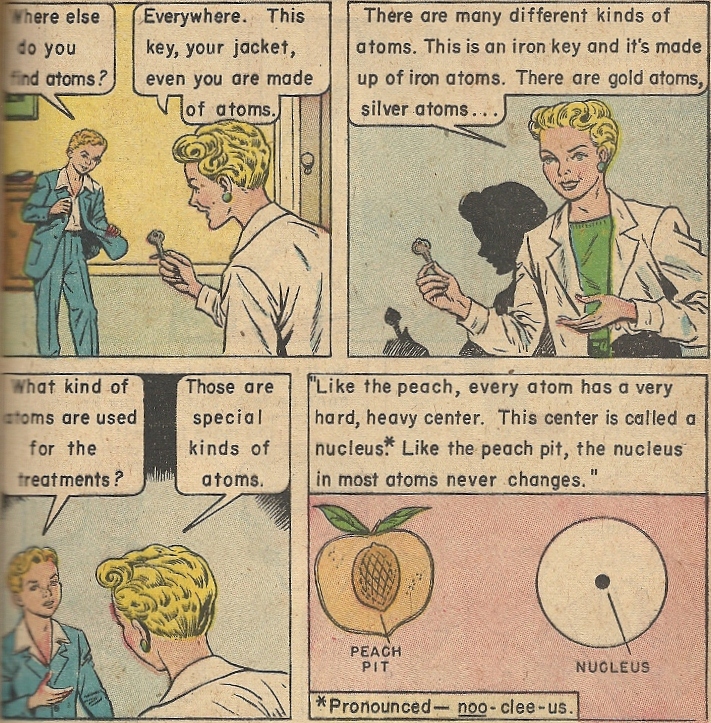
Sound it out, everyone: noo-clee-us.
Mom is miraculously healed by the wonders of radiation, and when Andy and his parents arrive home, he gets a note in the mail from the Army base, telling him that Spot has been found alive and well. They hop back in the car and make a mad dash out to see him, but when they arrive there’s a catch:
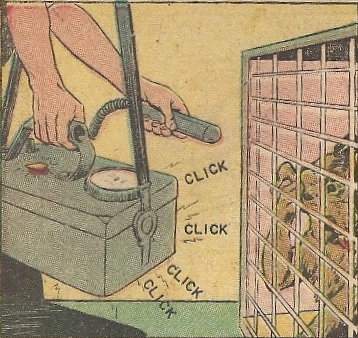
Yes, according to the Geiger counter Spot should be glowing like Clark Griswold’s house at Christmas. Fallout’s a bitch, and she’s back in heat. But:
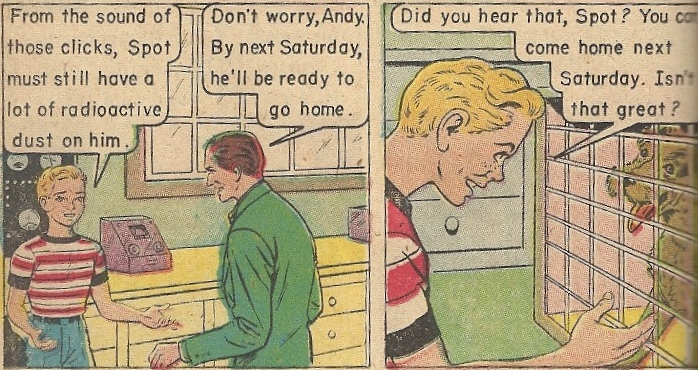
Apparently fallout, enough to cling to a dog’s fur and make him dangerous to be around, can be shrugged off in a week’s time. GOOD TO KNOW.
Since Andy’s there in the lab, he might as well get himself a lesson on how an atom bomb works (from a Norman Osbourne-looking scientist, no less):
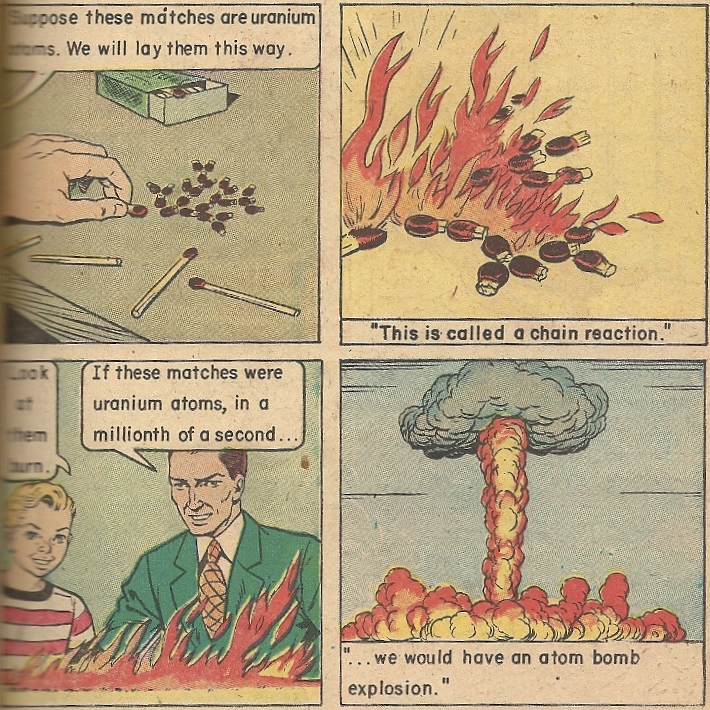
“Now throw the sticks into the blaze, Andy. They represent your entire family and all that you hold dear, vaporizing in one terrifying instant.” I now take back the snark about the peach stuff. Can we go back to that? Please?
“I have become death, destroyer of matchbooks.”
Andy leaves with a big smile on his face, not crying in mortal fear like you might expect, but his day of atomic education isn’t over yet. The family then makes a trip to the local power company, where a friend of Dad’s is the head engineer. He makes an “It takes X bowls of this cereal to equal one bowl of Total” sales pitch:
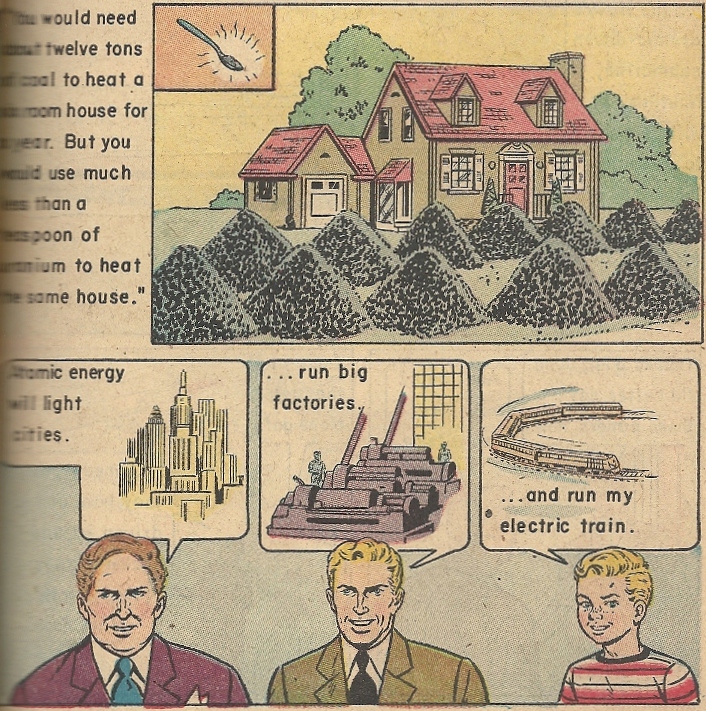
I’m getting a real Colon Blow vibe. (And way to aim high, Andy.)
After this whirlwind tour through the pomp and majesty of the atom, the nuclear (HA) family retires for a quiet meal at home, where they can fantasize about the boundless irradiated future spreading out before them:
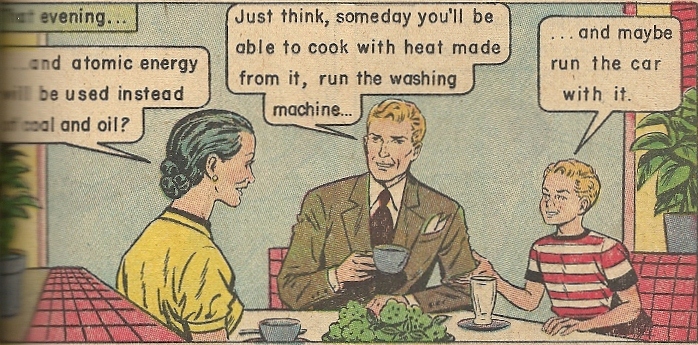
“And perhaps radiation will somehow replace the missionary position as our preferred love-making position, dear.” (I’d like to point out that none of the improvements Dad envisions will let Mom out of the house.)
A week passes, and then the big day comes:
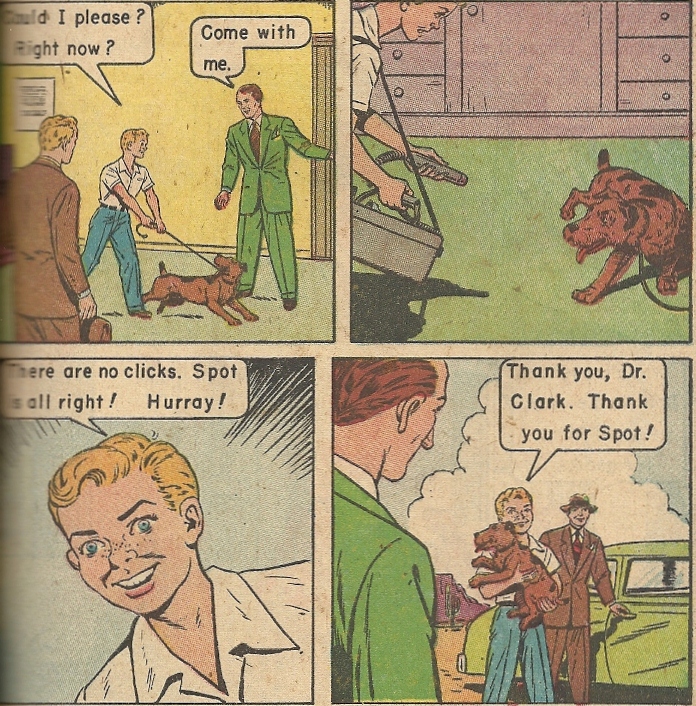
A dog can shuck off radiation like a bit of rain. Again: GOOD TO KNOW.
Finally, Dad, his hat, Andy and Spot all ponder the bomb on the ride home:
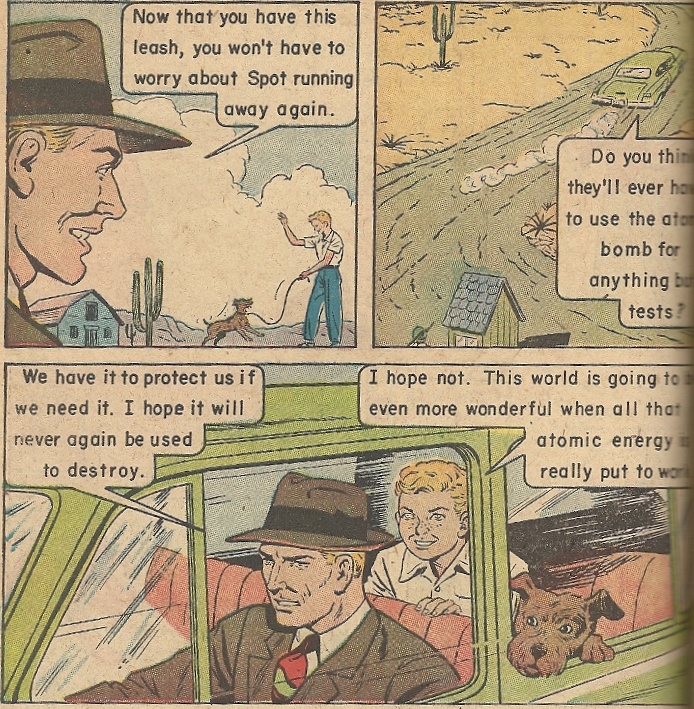
“Let’s just hope a pack of Orientals never again refuses to surrender. And while we’re at it, let’s also hope that the term ‘Orientals’ never falls out of favor.”
And they ride off into a golden atomic sunset.
What to make of this? To be fair, this “story” was written long before Three Mile Island, Chernobyl and Fukushima became buzzwords, and no one disputes the benefits of atomic energy. And this is obviously directed at younger readers, with all the simplification that comes with that. But this thing is writing checks it can’t cash. Its sunny optimism is too much, and it has all the multi-faceted impartiality of a cult brochure. I found myself waiting for the bomb-worshipping mutants from Beneath the Planet of the Apes to spring out of the woodwork at any moment.
Oh, and SPOT SHOULD BE DEAD. DEAD. DEADDEADDEAD. Either that, or the classic British anti-nuke scare-fest Threads was waaaaaaay off base about the dangers of fallout.
I’m sure a scientist will come along and tell me that an irradiated small dog — who makes a Geiger counter click like one of those fake lawnmowers with the popping balls that kids push around — can make a full recovery. Maybe so. But I will still find that very hard to believe.
In a bit of kismet, someone in the last couple days posted a series of brief shorts from the 1950s extolling –you guessed it — the wonders of atomic energy. The first one you can find here, though it’s the third part that you’ll find the most similar to the above material. It takes much the same tone as this comic, but without the wide-eyed “aw shucks” curiosity of the aggressively freckled Andy. Check them out. Misery loves company, and so does infoganda.
Amen.

The juxtaposition of Spider-Man with fishing gear may seem like an odd pairing, but it’s one that has been made more than once. Throw in a cash-clenching, poofy-trucker-hat-wearing Santa Claus, and you have — well, I don’t know what you have. Something.
Batman, Robin, Bruce Wayne, Dick Grayson and Henry Kissinger’s doppelganger request the pleasure of your company – Detective Comics #357

This is yet another of the countless imposter stories that have cluttered up the comic book landscape over the years. “You’re Deathstroke? But I’m Deathstroke!” You know the drill. Though it may get tired, it’s still an effective way to pique interest, and it does in this instance. Decades after publication, Bruce Wayne and Dick Grayson sitting across from their costumed alter-egos got me to open up this issue’s cover. You go with what works, you know?
There was a Flash version of the trope presented here not too long ago. That one also featured the art of Carmine Infantino, who’s always a welcome addition to any party. Again: Stick with what works. The script here comes from John Broome, with inks from Joe Giella — the “Plus 2” on this party invite. And how do we get to the “Huh?” cover? Well, it all starts when Bruce and Dick are invited to be panelists (for inexplicable reasons — I can see wealthy industrialist Wayne as having things to say, but who in their right mind gives a crap about some doofus kid’s opinions) on what has to be THE MOST BORING SHOW IN THE HISTORY OF TELEVISION:
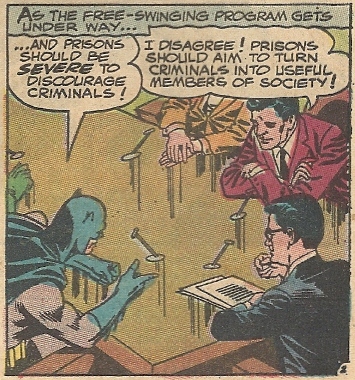
It makes The McLaughlin Group seem like 24. (The host, William B. Williams, looks like the bastard love-child of the aforementioned Mr. Kissinger and Phil Silvers of Sgt. Bilko fame.)
The program has at least two viewers, dim-witted hoods left behind while others go out on a caper, and whose lumpy skulls would be a phrenologist’s dream study:

The guy with the dark hair reminds me of a sweaty, sexually aroused Hector Hammond. Believe me, I wish he didn’t.
They get the bright idea to sneak down to the studio, drop some handy gas down a ventilation shaft (they have it just hanging around their ratty apartment), knocking everyone out and kidnapping Batman and Robin. Which they do, leading to some remorse on the part the show’s host:
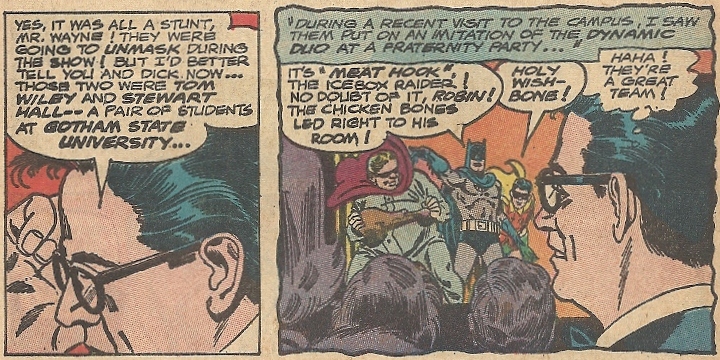
Quite the eye for talent.
The hoods, now that they have the Dynamic Duo, and not having thought through Stage 2 of their master plan, are perplexed as to what to do with them. They unmask the still unconscious pair, but, of course, have no idea who they are (or that they’re frat boy fakers). They get the bright idea to let them wake up and go home, and they (the hoods) will follow them back to wherever the Batcave is. The kids go back to a frat house, which doesn’t seem at all remarkable to these knuckle-heads. Then their crime boss gets wind of this whole thing, has an apoplectic “YOU DIDN’T KILL THEM?” fit (he’s the Moe to their Larry and Curly), and has them take him to the “lair” so that he can finish the job. They find the boys doing what fraternity brothers have been doing from time immemorial — yes, sitting in their underwear, eating sandwiches:
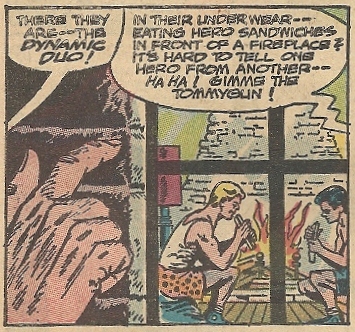
When I was in college fraternities were more about having sex with goats and group vomiting, but I suppose things change.
By this time Bruce and Dick have gotten away from the studio and, as Batman and Robin, have gone to the frat house themselves to follow up on the kidnapping. They arrive just in time to prevent the mistaken assassination, with Robin handling the boneheads and Batman tackling the head idiot with flagpole gymnastics:
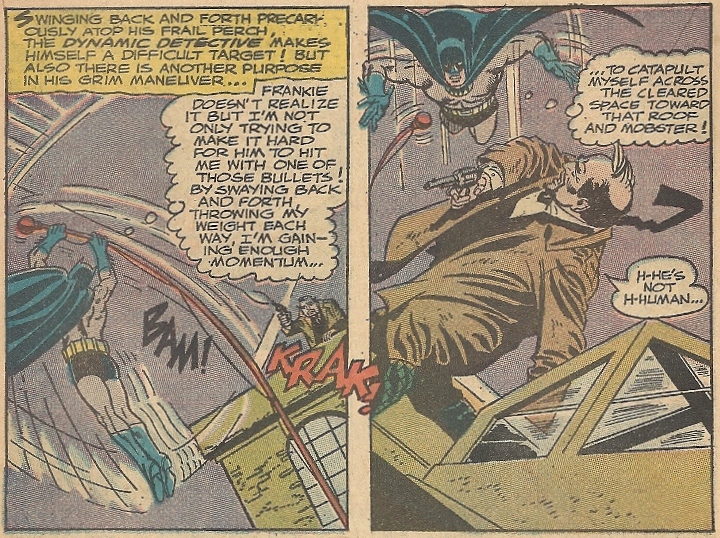
I think Chris Farley pulled a similar high-risk maneuver (with a palm tree) in Beverly Hills Ninja. Great minds…
The final coup de grâce comes when these two combatants crash into a research facility, one with a convenient wind tunnel. I can think of no better artist than Infantino to illustrate the resulting chicanery:

When you incorporate a wind tunnel into your final blow, you have earned — earned — a KAZOWIE. (Look at the stiff, parallel to the ground body of the hood, and Batman stepping into his final blow — really, who would be better than Infantino at this? This sequence was made for him.)
All is well, and the scheduled television unmasking can finally go off without a hitch, with Dick stating/thinking the obvious:
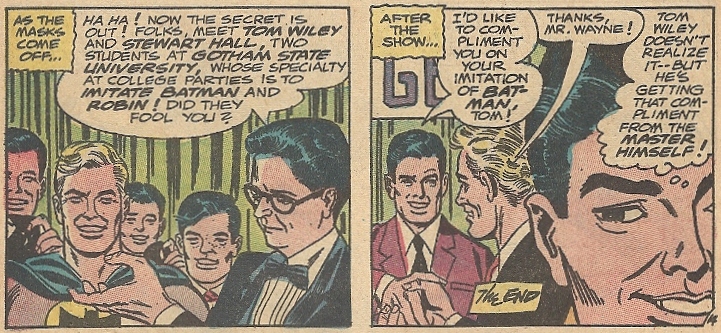
Yeah. Thanks. Never would have got that on my own.
This is standard Silver Age fare, but I have to think — though I certainly have a Carmine-centric bias — that the wind-aided KO elevates this issue above many others. The image of the ugly con launching backwards like a human bullet is good for a laugh. (The frat boys dining in their boxers is funny as well, though for other reasons.) The “unmasking” angle? Whatever. In this case, it’s a means to a goofy end.
This comic was reprinted in one of the cheap, dreadful black and white Showcase trades (Showcase Presents: Batman Vol. 2). If there’s any justice in the world, someday we’ll get some shiny, full color love for this era. THE BATMAN WIND TUNNEL PUNCH DEMANDS IT.
The Cosmic Cube can eat a Twinkie without barfing. It is truly the most powerful object in the universe.

Twinkies must be the most mocked of all foodstuffs. Need to make a painfully obvious joke about the apocalypse and the things that will survive it? Twinkies are there! There was even a Twinkie knee-slapper in the most recent (and God-awful) Ghost Rider film, a dash of “humor” that fell, the same as the rest of the flick, like a lead balloon.
The unmitigated stupidity of this Hostess ad, one of the many that over the years have humiliated co-opted heroes and villains, is truly something to behold. It might even trump the Wonder Woman “pussy” experience. Here the Cosmic Cube, one of the great hyper-powered devices in the Marvel Universe, one prominent enough to be the binding agent of the cinematic Avengers series, has dumb thought balloons and falls in love with a Twinkie. Huzzah. And I don’t mean “love” in the “enjoys eating — a lot” sense. I mean it in the “dry-hump the living hell out of that cream-filled confection” sense. Look at the little bugger in the second to last panel. HE IS HAVING THE TIME OF HIS CUBE LIFE.
So Captain America carries Twinkies around with him. Good to know. Too bad he had his Bicentennial training interrupted, whatever the hell his Bicentennial duties were. And the Red Skull can go wallow in shame for all eternity after that last line of his.
SHIVER ME PIGGY BANK
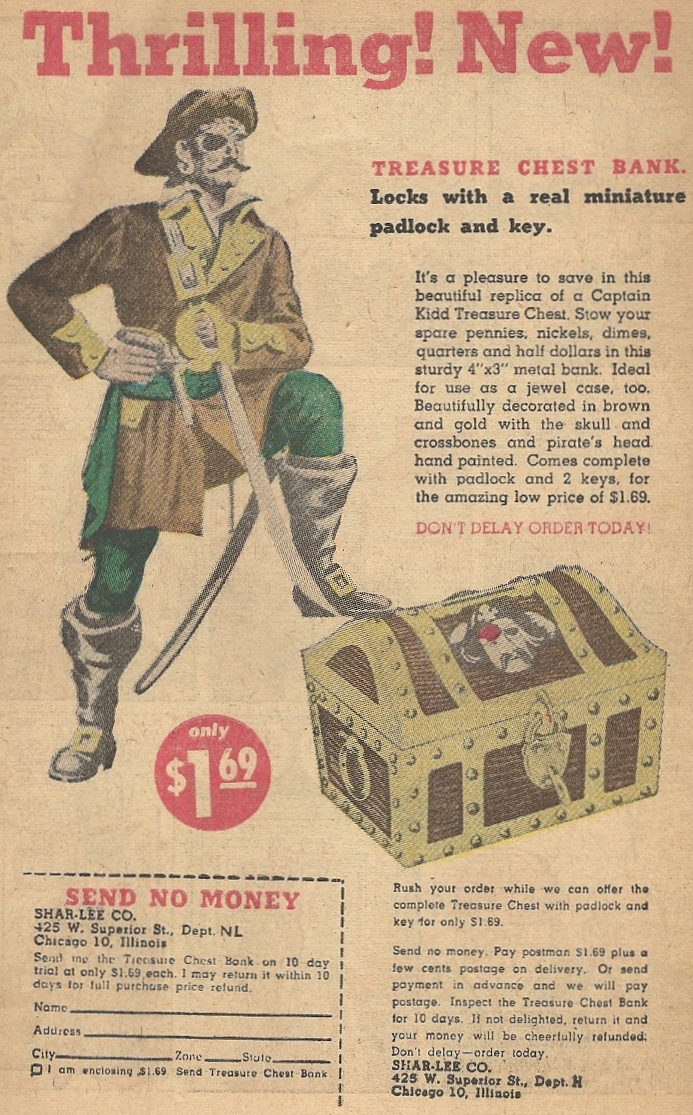
“Avast! Swab the decks! Hoist the mainsail! A penny saved is a penny earned!”
This is the last of the delicious 1940s ads from that Golden Age Daredevil book. If this treasure chest bank came with a hollowed out pegleg in which you could keep a stash of rum, THEN MY WORLD WOULD BE COMPLETE.
The Avengers flashmob Cloak and Dagger’s book (Special Cameo by JOHN BYRNE’S GIANT OBNOXIOUS SIGNATURE) – Cloak and Dagger #9

There are times when you forget that Cloak and Dagger are a rather remarkable crime-fighting duo. They can easily appear as just another lackluster pairing that you don’t really care all that much about, one whose titles have relied on heavyweight guest stars to move copies — much like this issue. The only Cloak appearance that I can remember from my younger days is when he managed to wrap up the Infinity Gauntleted Thanos, only to have the Mad Titan blow him up like the Hindenburg. OH THE HUMANITY.
When I was younger I didn’t know that interracial couples were once a big deal. I wouldn’t even have been able to tell you what an interracial couple was. Then comes the time when we grow up and learn about racism and bigotry and all those other things. (Yeah, thank God for growing up, we really couldn’t get by without knowing about that.) It’s only then when this pair of crazy crime-fighting kids become sort of kind of maybe significant.
Cloak and Dagger, though they’re more platonic than romantic, are trailblazers. There had, of course, been other cross-racial pairings in comic books, whether you take the something like the noted Captain America/Falcon pairing, or even the Gold Key adaptation of the television barrier-buster I Spy. But C&D were cross-gender, a situation that in earlier decades — and residual fumes of this still exist — would have dredged up all the old “Get your hands off the white woman” awfulness. And they were headliners. They had themselves a regular title, a place of their own, though all incarnations of it haven’t had much staying power.
(If I might carve out a moment to semi-relevantly daydream… Ever read much of William Faulkner’s work? His bibliography has long been a nourishing stew for so many, and whenever I see C&D, I wonder what the Mississippi laureate, with his life-long chronicling of the South and its ante- and postbellum travails over race, would have made of this funny book “miscegenation.” In his (utterly magnificent) Absalom, Absalom, the Southern psyche was so torn up over men with even a drop of black blood mingling with the flower of white womanhood, incest was easier to accept. With the African-American Cloak’s insatiable hunger for light, a need so easily satisfied by Dagger’s light powers and one into which readers could easily find a sexual subtext, unreconstructed Southern heads might have had Scanners explosions.
Faulkner spent some time his writing scripts in Hollywood. I confess to allowing myself a fantasy of him penning a comic or two. Meltzer who?
Anyway. Daydream over.)
If Cloak and Dagger boldly went where no comic characters had gone before, they still have had a hard time getting a solid footing in the star-studded Marvel U. (I could care less about them, but I’ve always liked that Cloak’s power was his cloak, and Dagger’s power was light-daggers — I enjoy costumed vigilante onomonopia.) Their origin (two runaways linking up on the streets), their powers and their anti-drug milieu could be a bit trite, and Marvel had to resist the never-ending temptation to sawdust the meatloaf with a revolving door of noted guest stars. It was often a temptation too powerful to resist. Take this issue (Script: Terry Austine, Art: Mike Vosburg, Don Cameron), which transpires during the “Acts of Vengeance” storyline, one of the umpteen forgettable cross-overs that have come and gone over the years. Cloak and Dagger are recruited by a variety of D-level villains to help attack the Avengers, to which they agree, secretly planning to help the Avengers when the time is right. Fine and dandy. But those Avengers are the true stars of this issue, as even a Captain America-chaired civic meeting is more worthy of notice:
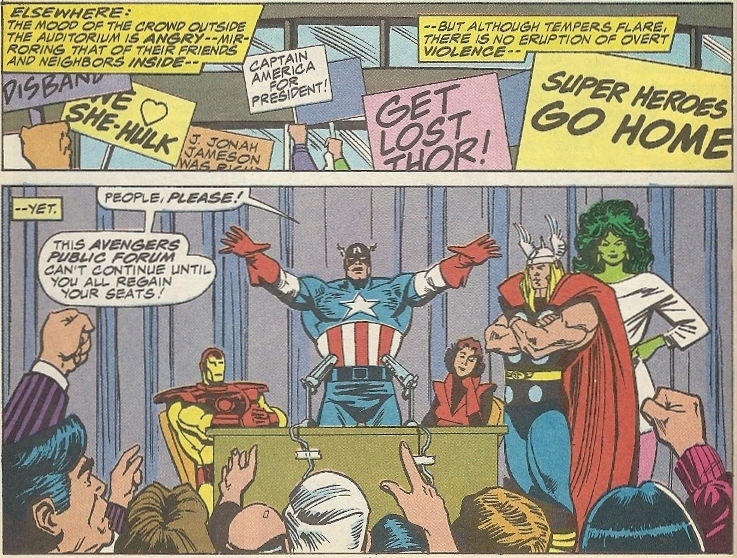
“Thor, please read the minutes from the last meeting.” “Verily.”
New Yorkers are in one of their semi-regular uprisings over the super-powered beings in their midst, and apparently only Robert’s Rules of Order can calm them. Then the “Who?” villains bust things up — “And you are? And this is regarding?” — and they have one very familiar face in their ranks. Have you ever wanted to see She-Hulk battle a gas-spewing robot Hulk with novelty gags popping out of its mouth? Yes? Then this comic, my friend, has just what the doctor ordered:

A lot of civilians get caught in the middle of the big fight between the villains and the heroes, and it falls to Cloak and Dagger to evacuate them. When I was reading this, it occurred to me that the reluctance of some to accept Cloak’s help — by entering his shadow realm and passing through it to safety — could be a metaphor for bigotry. Or maybe they’re just a bit leery about walking into the creepy guy’s abyss-cape. YOU DECIDE:

The two of them do manage to employ their powers in the actual defeat of their erstwhile doofusy villain partners, as witnessed by Cloak acting like a drain and sucking the (LAME) Hydro-Man down:

The issue ends with C&D sharing a quiet moment in their abandoned church digs. Cloak reads the blind Dagger a story. I don’t know if that’s a nice ending or a super-trite one. Again: YOU DECIDE.
There are also some pin-ups in the back of this slightly over-sized issue. I found this one interesting:

It’s nice. John Byrne is nothing if not a reliable, gifted artist. And his signature box isn’t quite as GINORMOUS this time around. BUT IF I MIGHT QUIBBLE FOR A MOMENT. Do we really need to the “second time I have drawn Cloak” commentary? Really? Do we care? Is this another example of Byrne injecting himself into his art? I admit to being predisposed to seeing obnoxious in many of the things that Byrne does, but I’d like to point out that the other pin-up artists featured in this issue — Charles Vess, Mark Texiera, Howard Chaykin and Walt Simonson — felt no need to annotate their work. Maybe if it was the first time I could see slapping a footnote on there (eh, maybe not), but this seems silly.
I know, it’s just a pin-up. It rubs me the wrong way, that’s all. Maybe I should relax. Fine. Whatever the case, I look forward to seeing the 17th time that Byrne drew/draws Cloak. I’ll know it when I see it, because he’ll tell me.
Back to the stars. It’s perhaps too much to say that these two young heroes were fictional trailblazers. Maybe it’s more accurate to say that Cloak and Dagger, and their unremarkable title, were a sign of the (improving) times. Maybe it’s that they were the first casual strollers on a trail that had already been blazed. Still, that a dumb 1980s kid like me could see their book, not find anything strange about it and pass it right on by, might be a small, odd — but welcome — marker on the continuum of progress. We’ve come a long way from Faulkner’s fictional Mississippi. Pat yourselves on the back America.
If you want to see this forgettable issue from a forgettable cross-over reprinted in a lush, over-sized volume, “Acts of Vengeance” has an Omnibus, the existence of which proves that there is ABSOLUTELY NOTHING that can’t be crammed into a big fat expensive hardcover. It features some of the Todd McFarlane Cosmic Spider-Man, so there’s that. I’m don’t know whether or not the John Byrne annotated pinup made the cut. MY GOD I HOPE NOT.
Right now John Elway is strapping Tim Tebow to a couch and dusting off his Nintendo.

I saw some recent reports that Tim Tebow, three years into his professional career, is finally seeking remedial training for his dreadful throwing mechanics. I wonder if head Bronco John Elway has considered pulling his eponymous John Elway’s Quarterback off the shelf and going full Clockwork Orange on Jesus Christ Quarterback, propping his eyes open with toothpicks so he can get a look at how quarterbacking, albeit 16-bit quarterbacking, is done. You know, shame him like a dog that just pissed on the floor. Tebow can take bespectacled Danny Wimpasinger’s (surname purchased at Surnames ‘R’ Us) place on the sofa.
Get the eye-dropper ready.
Eva Mendes for flaming urine. Seems like a square deal. – Ghost Rider: Spirit of Vengeance

I can’t remember much about the first Ghost Rider. Peter Fonda played the devil, I remember that. (Ooh, he was Captain America in Easy Rider — how META!) Sam Elliot and his great voice were in there too. Eva Mendes was a vapid Cleavage Delivery System. There were evil elemental henchmen whose powers consisted of floating around and standing still while Ghost Rider dispatched them without a whole lot of effort. And Wes Bentley, the boy whose piercing eyes stormed the entertainment world in American Beauty, was well on his way to career and personal rock bottom. I thought he looked drugged. Turns out he probably was.
I kept a movie journal back in those pre-blog, pre-Facebook 2007 days, in which I wrote down thoughts about the films I watched. I pulled it off a dusty shelf when I got home from the theater last night, just to see what I thought of the first film back when it was fresh (I haven’t seen it since). I was bored and disappointed. That’s all you need to know. The bar was set quite low for this redo/sequel/requel.
I was curious about whether Ghost Rider: Spirit of Vengeance would succeed. I wanted it to. I wanted Neveldine/Taylor to bring their Crank mindset to Johnny Blaze’s asphalt world, to whip out the defibrillator paddles and maybe zap Nicolas Cage back to life.
Do they?
No. This movie blows. Hard. That’s the short of it. Some thoughts, with the mildest of mild spoilers mixed in:
- First, a gripe about general moviegoing conditions. The theater was mostly empty when I saw this, not a good sign at 7:00 on a Friday. One of the clusters of people was a four person family, with the two children, a boy and a girl, being in the “barely able to walk, ‘Daddy can you carry me?'” age bracket. Yes, these model parents apparently thought that a loud, stupid movie about a flaming skeleton that kills people would be charming family fare. The girl mewled and cried throughout. Hollywood needs to understand that it’s not piracy that’s killing the movie experience, it’s garbage like that.
- The movie has the barest semblance of a plot, a boring “END OF THE WORLD” tissue of prophecies and rituals and devil-children that was done to death about twenty years ago. It’s like a Michael Bay movie, but without the lovingly crafted grandiosity and glistening boobs. While I appreciate the film’s willingness to hurl us right into the action without laboring over hours of exposition, the breathless pace could use a few more quiet moments. Well, maybe not, because the few times this thing slows down it’s only to throw in the lamest cliché or joke that you can imagine. If you’ve seen the trailers, the film is merely an extended director’s cut of those.
- Yes, the flaming pee stream from the first preview is in the movie. And there’s also a reprise. EXCELSIOR.
- The Nicolas Cage we get here is more the Wicker Man “NO NOT THE BEES” Cage than the Wild at Heart Cage. He’s palpably disinterested, and rarely rouses himself into any semblance of caring. When he tries to be crazy and dangerous, it’s laughable. The man is in financial straits and has piles of bills to pay, and “in it for the money” underlies his performance — or the lack thereof. You can almost hear the creditors dunning him as he somnambulates his way around.
- There are brief, crudely animated interludes that provide backstory, which are blandly, badly narrated by Cage. They’re quite forgettable. One also contains an atrocious joke, whose punchline you can see coming from miles away, though you’re unsure of the form it will take until it hits you in the face. It’s patently, cringingly unfunny. When you see Jerry Springer, you’ll know what I mean.
- Ciarán Hinds plays Roarke, the stand-in for the first film’s Mephistopheles. He was a pleasant distraction, not for anything that transpired onscreen, mind you, but because I thought back to his time as Julius Caesar in HBO’s Rome, and fondly remembered what a great show that was. Then I thought of how that series’ notoriously expensive production led to its cancellation after two seasons, and I got sad. We never even got the movie that we were promised. Then I thought how studio execs managed to scrape together enough cash to finance this steaming pile, and that got me all irate. IT WAS A HELL OF A RIDE.
- There’s a hot gypsy broad with a lot of eye-shadow in this, one who fathered the son of the devil because of a bargain with him to save her life or YOU KNOW I DON’T REALLY CARE. She’s fetching, though. She can pick my pocket any day. And Idris Elba, fresh off his dignified turn as Heimdall in Thor, plays a French priest facilitator (when your belief system includes angels that turn into motorcycle-riding demons it’s time to lay off the Communion wine) who sets Blaze/Ghost Rider on the trail of the devil-kid who has to be saved. Elba’s dignity is still intact, but it’s a bit dinged after being in this. It’s like going into an airplane lavatory after a big fat guy drops a deuce — you carry some of that stink out with you.
- Part of this movie was lensed in Turkey, and I swear to God some of the scenes were set in the same spots where the Turkish Star Wars training scenes were shot. Fitting. Could Kemal Atatürk have foreseen what his country’s Westernization would entail?
- Christopher Lambert. Remember him? The Highlander guy? Who waaaaaants to liiiiiiiiiiive foreveeeeeeeeeeer? Princes of the Universe? Yeah, him. He’s in it too, providing graphic evidence of why men with full facial tattoos cannot ever — EVER — be trusted. His presence also serves as a final confirmation that we are ass deep in B-movie territory.
- Ghost Rider. The only times this movie remotely resembles a real, authentic, gen-u-ine movie spectacle is when the Zarathos pops his flaming head out and does that Ghost Ridering thing. His design is darker and more angular than it was five years ago, and there are a few small but delightful character touches to go along with it, like the creepy swaying he does in his first appearance when deciding who to kill. Also, he can now turn any motorized conveyance into a hellish approximation of his motorcycle, which I’m betting will lead to endless audience musings about him in flaming Go Karts and John Deere riding lawnmowers. There’s a lot of forced stupidity (see: flaming pee), but there’s still lingering appeal to seeing his flame-wreathed cranium on a silver screen.
I hated last summer’s Green Lantern. This could be worse. Most of the reviews I’ve read for Spirit of Vengeance, even the (majority) negative ones, have said that this is better than its predecessor. I’m not so sure that it is. I doubt it. The first was recognizably a film, and Cage had more invested in what he was doing. This is a watery mess.
I’m done. I don’t want to think about it anymore.
Because of the not-saving grace of Ghost Rider himself, the movie is rescued from a shutout. I give it one flaming urine stream out of five:

I’ll take the Buck Rogers Ray Gun. He can keep his dopey helmet.

This proud solicitation was found in the other day’s Daredevil book. Coming from a much later decade, I’m far more familiar with Duck Dodgers in the 24½th Century than his old-time inspiration. But all of us — ALL OF US — can get behind a nifty Buck Rogers Sonic Ray Gun, one you can proudly point at imaginary foes while making preposterous, spittley approximations of what you imagine a ray gun would sound like.
It has a Cyclotron Chamber, people. A CYCLOTRON CHAMBER.
There’s a Yancy Street playset, right? There better be a Yancy Street playset. – The Superhero Catalog #1

Every year when the Super Bowl rolls around there are breathless news stories announcing how much the 30 second ads during that year’s telecast are going to cost. The number goes up and up and up. There’s always some angle in the coverage that the amount paid is out of step and obscene, that we should all bow our heads in collective societal shame. “At a time when there are children starving in the world blah blah blah.” Maybe so, though worrying about the price tag on Super Bowl ad space is the most First World of First Word Problems.
But you can’t say that the ads are overvalued. It’s the one time of the year when people give a crap about commercials. They’re actual content, not something begrudgingly tolerated at best or at worst completely missed with DVR skipping and convenient piss-breaks. If anything, the brief blocks of Madison Avenue time are vastly undervalued. People want to see these ads. They’re part of the show. They can’t get enough of them. At the party, when dopes like me are trying to listen to Chris Colinsworth’s caustic analysis of the last 3rd and 1 stop, the yentas are still yakking about the talking E-Trade baby.
Ads as content. That brings us to The Superhero Catalog.
I’ve managed to acquire several of these “comics” over the years (including a couple this past weekend). The Super-Hero Catalog and The Heroes World Catalog — and other iterations –are ads. All ads. All GLORIOUS ads. They’re so glorious, the 50 cent cover price is like the Super Bowl business. Undervalued. This is like when a kid was little back in the day and flipped through the department store Christmas catalog, but in this case the Christmas catalog is 100% toys and games and comics and I’M ABOUT TO LOSE MY MIND OH MY GOD. It’s muffin tops. It’s pudding skins. It’s all the good stuff. Not a vegetable in sight. It’s content.
I realize that this was published in 1976, and that the offers and order forms have long ago expired. I wasn’t even born in 1976. The secondary market for many of the gadgets and gizmos is exorbitantly expensive, and sadly, I’m a grownup now and can’t have toys cluttering up my single-guy-still-trying-to-bag-broads domicile. But flipping through this mag is like a dreamy FAO Schwarz shopping spree. There’s a “Just imagine…” element at play, and a strong one at that.
Here’s the mission statement from inside the front cover — note some of the recognizable names on the production crew, including Jim Salicrup and Roger Stern:

Most of the ads reproduced within are regurgitations (or perhaps they’re predecessors — gurgitations?) of ads that have been featured here before. A few: the Mangler, Ricochet Racers, Rock Reflections of a Superhero, Marvel Mirrors, Medallions, Pillows, and Mood Rings. And oh so many more. There are also a number of fresh presentations that caught my eye, including this eye-popping two page spread of early, pre-movie revival Star Trek goodies:

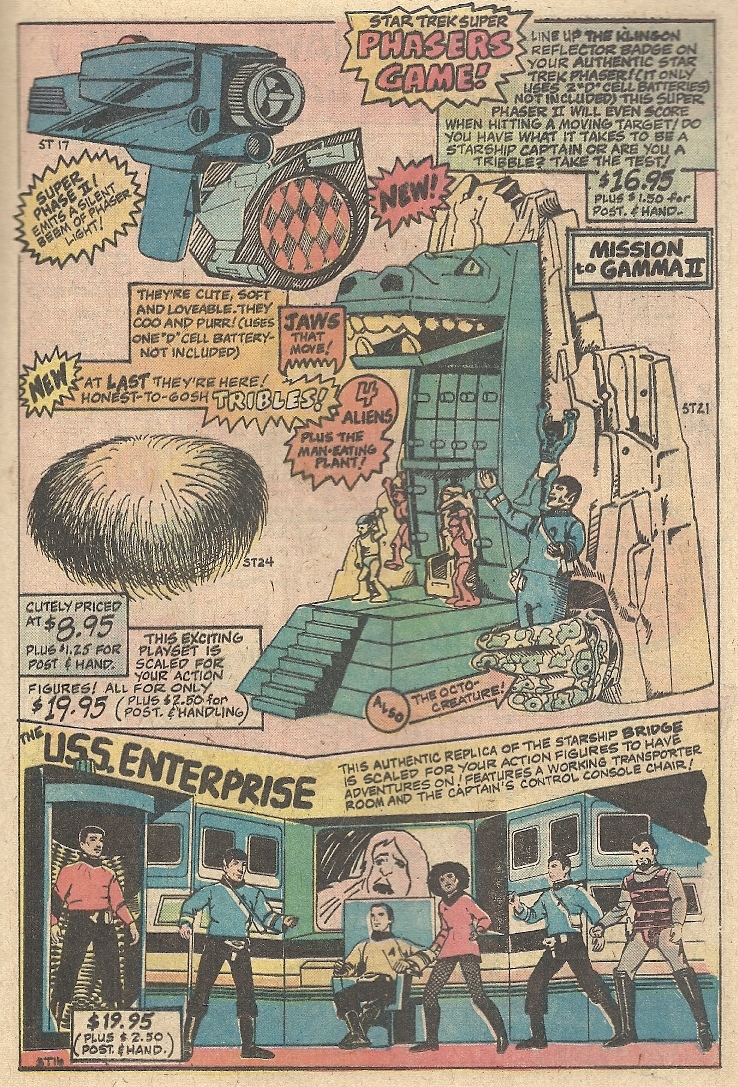
So one of the half and half cookie bigots from Cheron got an action figure. But what about the other 50% of that planet’s population, the ones that looked like Lokai and not like Bele? Where’s their representation? DAT’S RAYCISS. (And the “Mission to Gamma II” playset was actually released as a “Gammy VI” playset. Whatever. With it you could quite nicely approximate Vaal from “The Apple,” that’s for damn sure.)
There are roughly 1.5 billion t-shirts within, including the patriotic offerings shown here. Screw “Fonzie for President” — can I get one of the devilish Stan Lee “Excelsior!” shirts? Please? PLEASE?:

There are also — surprise — a number of genuine comic offerings, like the classic Son of Origins trade seen on the cover. The bouquet of treasuries was acutely painful. It taunted me. They. Are. So. Hard. To. Find. Nowadays.
Though it’s hard to uncover a clunker product in these pages, a few snuck through, as demonstrated by the terrifying dolls on the top half of the back cover. Baby Wonder Woman’s dwarf arms are disturbing IN THE EXTREMIS:

I admit to having a bit of a doll-phobia, but those are particularly repulsive. (The Super Friends placemats might make up for it. They’d definitely make any big dinner party special.)
You may see one of these Catalog books in back issue bins sometime. You’d probably flip right past it. “Ads? I’m supposed to buy ads? Pshaw!” But if the price is right, it’s money well spent. Trust me on this. I swear on the Red Stan Lee Excelsior T-Shirt.
A shy Rick Barry would like you to consider making Spalding your basketball of choice

“While I’m shooting underhanded free throws and sporting my 1970s floppy dog ears General Madine haircut, there’s no basketball I’d rather have in my hands than a Spalding.”
I came across this Rick Barry Spalding ad the other day — sadly lacking a Jack Davis caricature — and couldn’t help but contrast his long, successful career, one without any fan love, with the Jeremy Lin Linsanity that’s swept the American sports landscape in the past week. It’s amazing what not being a Grade A jerk can get you.
Barry has to be grinding his Grade A jerk teeth somewhere. And blow drying his hair.
Daredevil. Not that one. The other one. The unblind guy with a boomerang. – Daredevil #53
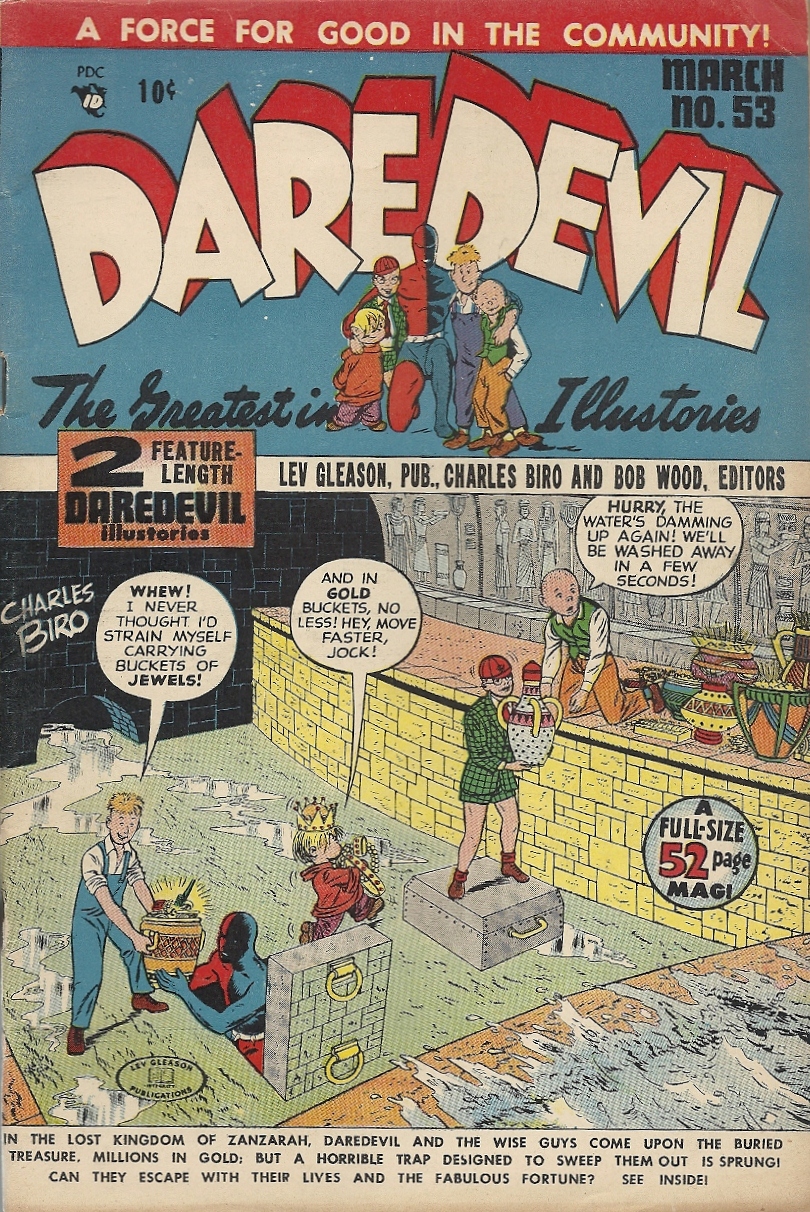
What’s that? You came in here looking for the horned Matt Murdock? Or, God help us, Mike Murdock? Sorry to disappoint. But perhaps you’ll be pleased to make the acquaintance of this red and blue togged gentleman. Myself, I was always a little curious about him. I always saw his title when I turned to the Daredevil section of the Overstreet guide, and got all confused by the seemingly inflated prices before the “oh, the Golden Age one nobody gives a fig about” realization set it. I vowed to one day purchase one of his books and peruse its old-timey pages. I have now done so. THIS IS A PROUD DAY.
For the equally uninitiated, the original Golden Age Daredevil, created by Jack Binder, was one of the earliest costumed superheros, making his Lev Gleason Publications debut as a backup in Silver Streak. His origin was revamped immediately after his introduction, and the change left him a costumed hero whose boomerang skills were honed by Aborigines in the Australian outback. Crocodile Dundee, eat your heart out. This particular issue, in the middle of his comic’s run, also featured his young sidekicks, the Little Wise Guys, a not-so-Little Rascally, Boy Commandoish group of kids who shared his “Illustories.” The Wise Guys’ popularity eventually led to them taking over the series, booting DD out of his eponymous mag (they have sole possession of the second feature in this book, which was a taste of things to come). Ouch.
Charles Biro, who carried most of the story and art water on the series and turned Daredevil into one of the finer titles of the era, tackled the art chores on this issue’s cover and the scripting on the Daredevil-infused feature within. Norman Maurer pitched in with the interior pencils and inks. And that Daredevil story? I was pleasantly surprised by the quality of the read. Biro’s writing rolls along nicely, at the breakneck, golly gee-whiz speed that makes the Golden Age so (sometimes maddeningly) special. Where else can you go from a museum office to Egypt in the space of one panel?:
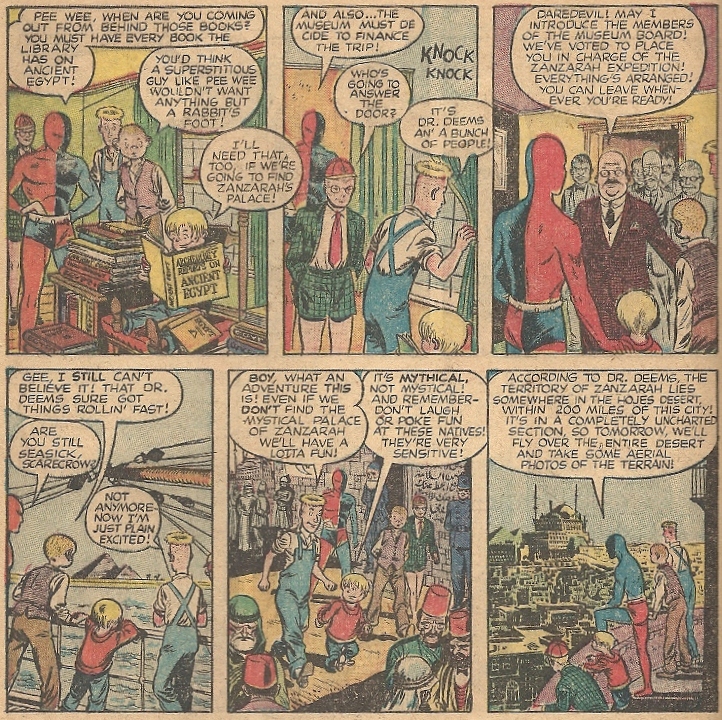
That’s like the graphic cousin of a 2001 jump cut.
The crux of the story is that they’re all off to find some lost treasure, so that it can find a happy home — away from its native land — in a North American museum. “White Man’s Burden, Lloyd my man. White Man’s Burden.” There are, of course, a number of lethal obstacles in their way, and Daredevil and his fellas tackle them with a mixture of cunning and brawn. (And as for their made up Pharoah’s tomb quarry, all I could think of was the Three Stooges when they’d go off in search of King Rootin-Tootin’s cache.)
Maurer’s art is the real star of the tale. It’s magnificently detailed, though perhaps it plays for favorites with me by employing my preferred 3×3 panel layout format. I LIKE ORDER. I was particularly taken with this page, which features Daredevil trying to rescue himself and the boys from the cover’s onrushing water predicament:

I love the last panel in the middle row. No dialogue. The shadows behind the Wise Guys. The detailed hieroglyphics on the tunnel walls. This is quality work, no matter the decade. I’d say it wipes the floor with most of the flash and sizzle of modern garbage. “How am I supposed to read a comic book without blood and cleavage? ANSWER ME!”
And there’s action, too — don’t go thinking that this is a dull archeological dig, or like the last half hour of Kingdom of the Crystal Skull, which had all-man Indiana Jones taking no positive action and simply fleeing assorted threats. Is it dull to root a scoundrel out of an armored truck by making a firebomb — MacGyver-like — out of a shirt, sand and gas? YEAH, I DON’T THINK SO:
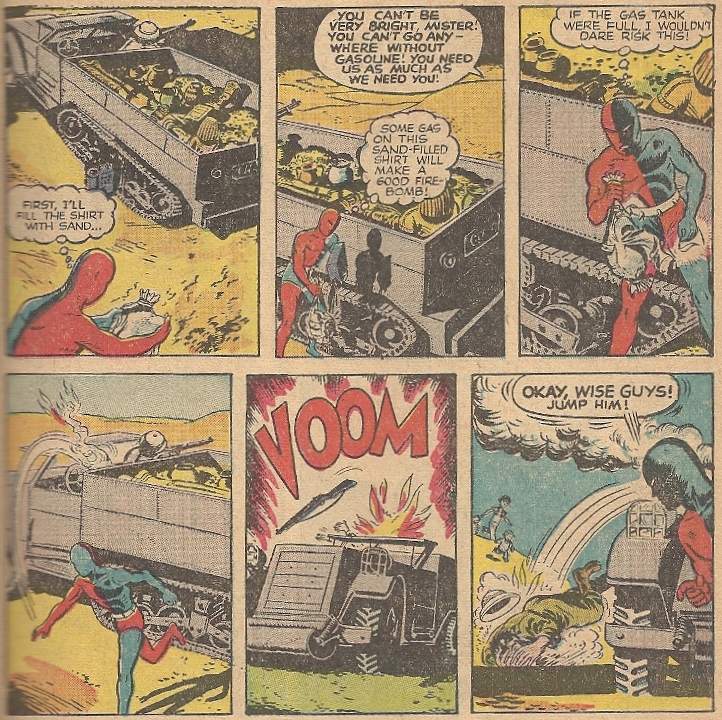
Would I still rather read a Gene Colan Silver Age Daredevil book? Yes. But this material holds its own. It really does.
Daredevil and his companions have passed into the public domain, allowing current publishers to incorporate their into their respective universes. The most prominent of those modern appearances occurs in Erik Larsen’s Savage Dragon, where DD and the boys may have crossed paths with Fast Willie Jackson. (And watch out, Dragon, because the Wise Guys have been known to boot people out of their own digs and move in like hermit crabs. You have been warned.) Also thanks to public domain, you can find full Daredevil issues on the internet without guilt or fear of SOPA persecution. Many Golden Age books are dated dreck, but I can’t say that about Daredevil. He’s worth a look.
Get this, a jaw harp, a stone jug and a washboard and you could form the world’s most depressing hillbilly orchestra

I pulled this out of a Golden Age book that will be featured here in the near future. You know, the Golden Age, i.e. that sepia-toned time when all a young man needed for happiness was a girl, a v-neck sweater and an ornately detailed harmonica. Gosh!
 Jared
Jared


 blog into mystery