This Joe DiMaggio autobiography appears to suffer from an acute lack of Marilyn Monroe boffing
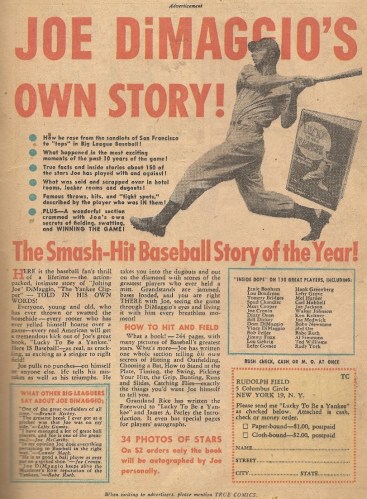
Athlete autobiographies are almost uniformly dreadful, and I can’t imagine this Joe DiMaggio book, surely a glossy lump of fluff, would be an exception. And one couldn’t expect the Yankee Clipper, who kept much of his private life — except for that Marilyn Monroe business — close to the vest, to write a Jim Bouton Ball Four. And that’s especially true since he was still in the midst of his playing career when this came out (1947). There’s no looking back and settling scores at play here.
That said, I’m certain that young boys like my father would have devoured this book, scrutinizing it with a Talmudic intensity. And lo, unto thee shall come a Joseph, and he will hitteth in fifty-six straight games.

If the Atari 2600/Intellivision era proved anything, it’s that the thinnest of premises could be turned into a simple two-dimensional time-waster. ENTER THE KOOL-AID MAN. Yes, the loud, fat, sugary mascot, to whom WALLS MEAN NOTHING, was turned into a dreadfully dull video game.
Also, not sure what the price of Kool-Aid was back in the day, but the 125 proof-of-purchase threshold seems to take some steam out of the “FREE.”
Tommy Kirk, Annette Funicello and some crappy Baby Boomer nostalgia – Walt Disney’s Shaggy Dog (Four Color #985)
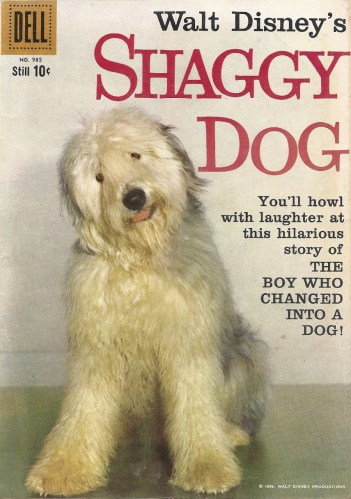
Perhaps one of the more puerile Walt Disney live action offerings, The Shaggy Dog was a substantial box office success for the Mouse. This 1959 talking dog flick featured turns from child stars Tommy Kirk and Annette Funicello, as well as My Three Sons padre Fred MacMurray, one of those 1960s fathers who had a pipe glued to his mouth and a closet full of bathrobes. Several sequels and remakes have followed the shaggy original over the years, including one in 2006 that had Robert Downey Jr. in a supporting role, amidst his pre-Iron Man, post-57th rehab walk of shame.
It’s had a long shelf life. Huzzah.
Let’s not mince words here: ALL VERSIONS OF THIS TALKING DOG PREMISE ARE STUPID BEYOND THE POWER OF WORDS TO DESCRIBE. Yes, they’re family movies, but there are plenty of kid-friendly movies that don’t make everyone who’s old enough for a driver’s license want to lop off their own head. Like a story about a sex-starved teenage Aunt May, I’m not in the target demographic for fiction of this sort, but I can’t help thinking of Artie Lange’s mocking critique of this genre on The Howard Stern Show. “How can a dog be a district attorney? And where did it learn sarcasm? YARYARYARYAR!”
In an odd twist, the comic adaptation comes off as less obnoxious than the source material. The wan Tommy Kirk smirks are less egregious on the printed page, I guess. But it’s still dopey as all get out.
Kirk’s character, Wilby Daniels, is a whiz kid whose schemes, with brother “Moochie” (a recurring Disney character, played by Kevin Corcoran) at his side, often run afoul of their curmudgeonly father (MacMurray). And Dad is, get this, allergic to dogs. In fact, he hates dogs. Wait, but this is a story about a dog — it says so in the title. OH MAN THIS IS GOING TO BE GREAT. Wilby moons over Funicello’s young lass, who’s also pursued by Wilby’s best friend. Things get crazy when a father and daughter move in across the street, they have a dog, and Kirk accidentally carries away a cursed ring from a museum, and said ring puts him in the body of the new pooch on the block.
Got that? Good, because that’s all the setup that I can stomach.
Here’s the first transformation sequence, as Wilby becomes the dog that just moved in next door:

Perhaps the most annoying aspect of the storyline is that the new “father” neighbor isn’t really the girl’s father at all (some loosely explained adoption or something), but a spy set on stealing sensitive missile information. And, of course, Wilby’s new canine persona is perfectly suited for eavesdropping:

It all builds up to a final chase, with, yes, a dog driving a car. Films with great vehicle pursuits, like Ronin and Bullitt, have nothing to fear rankings-wise from this one:
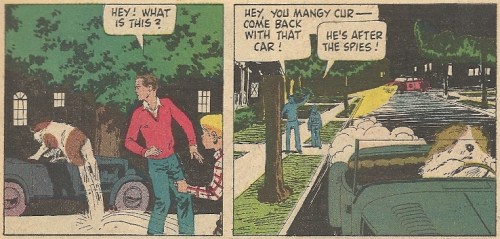
This adaptation was scripted by Eric Freiwald and Robert Schaefer, while Dan Spiegle handled the art. No complaints on this front, as they couldn’t exactly have gone to town creatively while boxed in by the screen shenanigans. You know what? The art is actually half-decent. So there’s that.
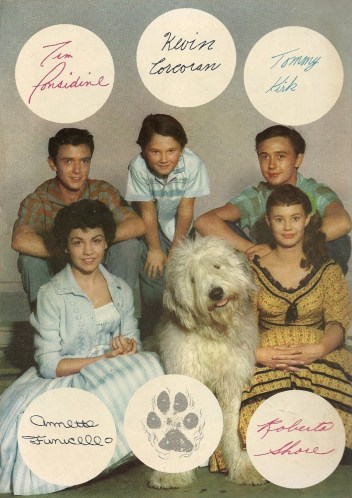
I love dogs. I hate movies like this. I’m not fond of this book. Maybe I’m a stick in the mud. Always possible. If there are any Baby Boomers out there reading this for whom The Shaggy Dog is a fond walk down memory lane, here’s a pin-up with the young stars of the film and their senses-shattering autographs (Annette’s is appropriately bubbly). Feel free to tack it to your bedroom wall:
Just to be clear: “FREE!” does not apply to the ice cream. Just the Dairy Queen coupon. Which is worth ten cents.
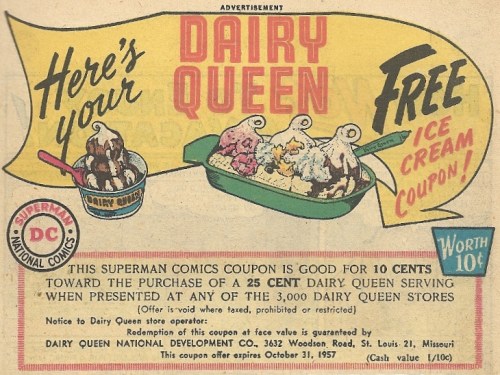
This is the big coupon advertised on the cover of Detective Comics #248, which was featured here a couple of days ago. The redundancy of the “FREE!” — is there ever a coupon you pay for? — surely confused some ice cream craving youngsters out there. “You still owe me a dime and a nickel, kid.”
Also, is Dairy Queen ice cream more or less healthy today, or is it a push? It was probably more loaded with fat back in the ’50s, but had less preservatives, and was therefore less deadly. That’s my gut feeling. Whatever the case, KEEP STUFFING YOUR FAT GOBS, AMERICA.
It took several hours of me staring at this Angelina Jolie/Lara Croft picture to realize there was milk on her lip

That milk really has to work to get above Angelina’s big lips, no? It’s the dairy version of climbing Mount Everest.
I had a friend in college who was in love with playing his Tomb Raider game. Literally in love. Whenever he could, he’d work Lara Croft into some perverse position, where he’d get a good look at her virtual ass, virtual crotch or virtual rack. He’d chortle like Butt-head, controller in his lap, a look on his face like a lion sizing up a gazelle. If he ever saw this ad, his head probably exploded.
Anyway. Superman and Batman, eat your milk-loving hearts out.
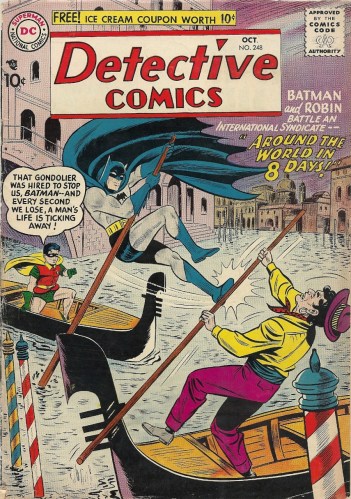
Look at that Sheldon Moldoff cover. Batman just pole-vaulted his way out of a gondola to kick an evil gondolier right in his face. Already I have a feeling this comic will be much more entertaining than the Christopher Nolan Bane/Catwoman dirge that’s coming out in July.
Batman morphed into something a whole lot more goofy after his dark initial days as a pure crimefighter. He ditched the night and the shadows for ever-escalating preposterous scenarios, until finally he was put on more conventional, gritty footing heading into the 1970s. This 1957 comic doesn’t exactly have him on the moon fighting aliens, but oh, is it ever goofy. And I mean that in the most flattering sense imaginable. Because if you have a bucket list that includes reading Batman stories in which he rides a windmill’s blades, takes a gondola ride in Venice, and uses his cape to fight a bull, then friend, you have some checking off to do.
Seriously, this short story (12 pages) has all the fun of a good miniature golf course. Every turn is a dumb but enjoyable surprise, and all that’s lacking is a clown on the last hole whose mouth is the ball return. (Joker? Where are you?)
The impetus for all this Bill Finger (script)/Dick Sprang (pencils)/Charles Paris (inks) hullabaloo is a theft at a hospital, where an experimental drug has been stolen. Batman and Robin are called in, and — predictably — learn that the drug is the only cure for a dying man, and that they’re about to find themselves LOCKED IN A RACE AGAINST TIME. And it further turns out that the stolen goods have been split up and fenced around the world, which sets our heroes on a globe-hopping chase, one whose “Around the World in 8 Days” title is an obvious allusion to H.G. Wells’ Around the World in Eighty Days. (This one’s a lot faster because, instead of relying on rail and steamers, they have that Batplane thing.) They have a busy few days ahead of them. (We could pause and ask why in hell the thieves stole the cure and how the pilfered supplies were split up and spread across the world instantaneously, but to do so would undermine the fun. And also, if you carry that questioning far enough, you get back to the fact that you’re reading about a guy dressed as a bat who has as his chosen companion a garishly attired half-naked teenage boy. What I’m saying is, turn off that inquisitive portion of your brain before stepping onto this thrill ride.)
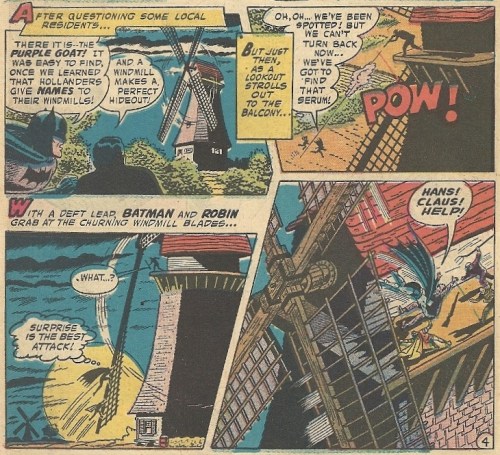
Various clues at each point of their journey guide them to their next destination. First up is Holland, the proud nation that gave us a classic translated Green Lantern comic profiled here a few days ago. Being a 1950s comic book, the story has to make use of the most obvious, stereotypical features of each location visited. For Holland, that means windmills. And, whadaya know, some of the cure-holding hoodlums are cooped up in one. What are the odds of Batman using this windmill’s blades to help tackle the toughs that are hiding on said windmill? About 1:1, right? RIGHT:
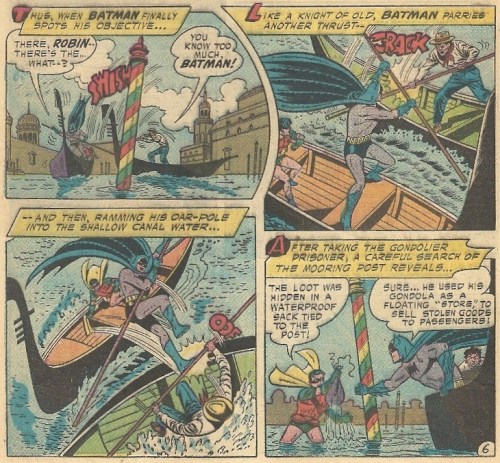
Next it’s off to Venice (where maybe the Dynamic Duo will cross paths with the I Spy boys). Despite the amorous locale, there’s no time for romance, so Fredric Wertham couldn’t use this for an updated edition of The Seduction of the Innocent. There’s ass-kicking (or face-kicking, as it were) that needs doing (as seen on the cover):
Next up is the Orient, back in the days when you could still type “Orient” without worrying whether you’re committing some sin against political correctness by doing so. (I think I’m okay. Aren’t I? Yeah, I think so.) How can you tell you’re in Asia? Well, there’s a giant dragon statue and perfidious guys in sarongs. At least Batman gets a chance to work his abs on this leg of the journey:
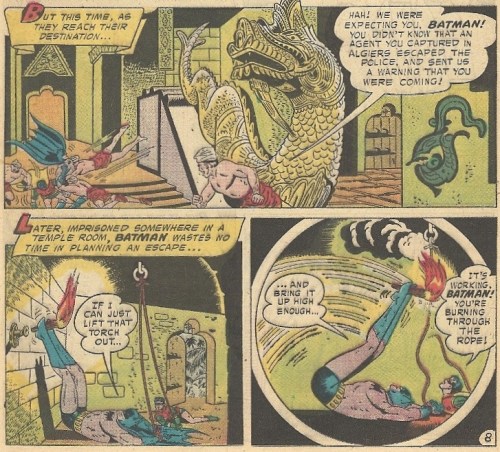
There’s a very, um, dainty quality to Batman’s foot positioning in that last panel. Granted, there’s no set masculine way to hold a burning torch between your feet, but still… Maybe ballet (complete with tutu) was part of Bruce Wayne’s pre-Batman training.
Last up is Mexico. And BULLFIGHTING. Yes, Batman pulls off his cape to dabble in the cruel, savage bloodsport that Ernest Hemingway so lovingly chronicled. There are no cheering crowds to shower him with roses, but our unCaped Crusader does an admirable job of mimicking a matador’s moves:
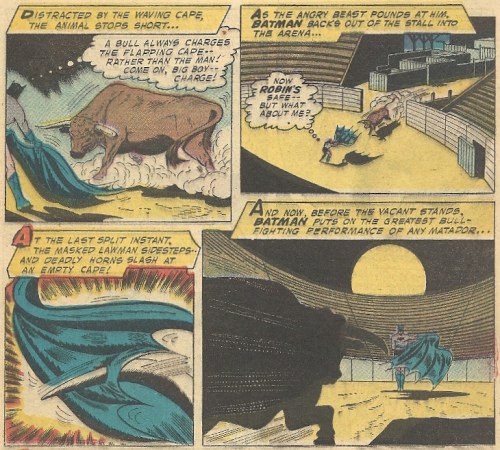
Does Batman get gored? Does he display bullfighting panache that outshines that of the great Bugs Bunny? YOU’LL HAVE TO READ THE BOOK TO FIND OUT. And also, of course, to learn whether or not they get the cure back to the hospital in time. (Hint: THEY DO.) Sadly, though, I don’t think this issue’s Batman tale has ever been reprinted in any of the numerous trades that have come out over the years, falling in a dead zone after the introduction of the character and the prime Silver Age hijinks. Patience will have to be a virtue in this instance. Someday.
It would be worth the wait. Some old Batman stuff is just awful. Putrid. This is good, and a quick, gratifying read. You can almost picture Finger twirling a pen in his writing hand while staring at a blank sheet of paper, an architect’s lamp his desk’s sole illumination, probably a lit cigarette in his hand waiting to join its extinguished brothers in the ashtray, and finally saying to himself “Let’s have some fun with this goddamn thing.” And all due praise goes to the artwork. Just from the scans posted above, I was quite taken with Sprang’s use of perspective and point of view in the windmill sequence, as well as the lonely desolation of the empty stadium in the bullfighting scene. Paris’ inks made a haunting contribution to the deep moonshadows of the latter.
This story only takes up 12 pages, but provides more pleasurable bang than many more drawn-out affairs.
So get off your ass, DC. Get a Justice League movie made, and bring toreador Batman to the reading public. You have your marching orders. Now step to it.
When a dog looks down on your preparedness, skin care, driving and overall cleanliness, it’s time to take stock
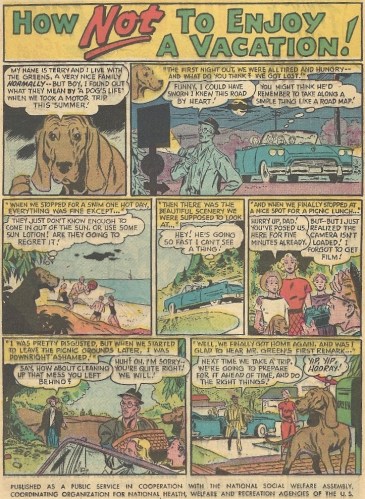
Oh, lighten up, Fido. Or Terry, if that is your real name. After all, you could be the Griswold’s dog in National Lampoon’s Vacation. (And please, no Mitt Romney jokes.)
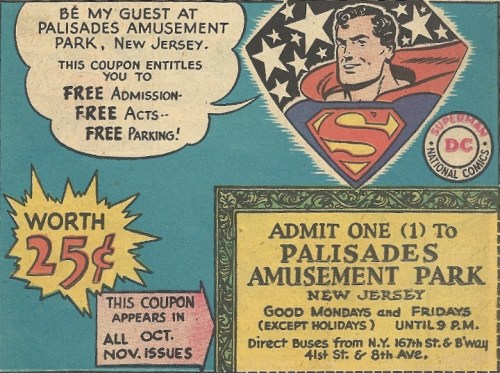
I posted a later iteration of this ad last year, one that also featured Batman (with a HUGE bat-symbol) and Wonder Woman. The Superman in this 1950s version looks like he has a bit more of the “leap tall buildings in a single bound” blood in him.
Also, a decade’s worth of amusment park inflation apparently took a 25 cent value up to $1.10. File that in your mental economic database.

The upcoming Amazing Spider-Man film isn’t content to merely frustrate fans of the character with another origin story only a decade after the first film hit. No, it also seems set on changing the dynamic of the titular hero, substituting some DARK SECRETS hokum about Peter Parker’s parents for the Uncle Ben/With Great Power Comes Great Responsibility foundational ethos. FANTASTIC. For any number of reasons (*cough* Lizard design *cough*), and no matter how much more lively Andrew Garfield is when compared to the dead-eyed Tobey Maguire, I just can’t get myself worked up for this flick. Do you hear that, Sony? I, a person who writes a blog focused on nothing but comics, can’t get worked up over an upcoming Spider-Man movie. Your brand might have some issues.
With this potential train wreck on the horizon, it seems like as good a time as any to look at another odd take on the early days of Spider-Man. In this case, one when he was merely a gleam in his parents’ eyes.
I missed the Mark Millar-scripted, Terry/Rachel Dodson-artified Trouble when it first hit (2003), but I had a co-worker around that time who used to give me his copies of Wizard, and I recall reading an article about this series, a thinly veiled re-imagining — or just plain imagining — of the nubile youths of May, Ben, Mary and Richie. Yes, those are some familiar names. They’re meant to be. It was hoped that the book would re-vitalize the Romance genre, taking defibrillator pads to that long-cool corpse by cramming young versions of the Parker forbears into an ill-suited narrative. In the first issue we meet brothers Ben and Richie and best friends May and Mary as they head off to spend the summer working at a Hamptons resort and MEET THEIR DESTINIES. The premier is bookended by May (the wild child) stealing some of her father’s hooch, and, well, and then making me want to punch a hole through the comic:

Yes, a young Aunt May held a condom aloft as she purloined a hideously overused Spider-cliche. AND WE’RE OFF.
What follows is a story set in the 1970s — though nothing about it really said “70s” apart from the cars — as our young leads have their sexual awakenings. Couples are formed, surreptitious switcheroos happen, May is willing to give it up while Mary wants to wait a while, and the senses-shattering topic of teen pregnancy is addressed in a most useless fashion.
Oh, and it’s also posited, quite needlessly, that May is actually Peter’s real mother. Yes, the guilt-trip broad with the tight gray bun is a real ho here. This in particular seemed designed to generate a loud, hearty, John McEnroe “YOU CANNOT BE SERIOUS!”
I realize I’m giving away the store with the whole Mother May thing, but it’s a safety concern. Now you’re prepared if you ever want to read this, and you won’t karate chop the nearest karate choppable object when you come to this “revelation.” One that really means absolutely nothing, since this storyline has been thoroughly forgotten, but one that feels all the more of a waste of time because of it. (Also, don’t get me started on Aunt May apparently having aged HORRIBLY in the intervening years between Peter’s birth and his being bitten by the radioactive spider. Was she a meth addict? Did they have meth back then?)
And really, who cares about Peter Parker’s parents? Is there a more useless mother and father combo for a major character? Batman’s were murdered in front of him. IMPORTANT. Superman had two pairs, with the birth set never met but remembered, and the adopted set forming his moral worldview. IMPORTANT. Peter never knew Richard and Mary, and their only big in-continuity “appearance” came in the 1990s as android doppelgängers, an awful plotline that, fortunately for those who conceived it, was overshadowed by the roughly contemporaneous and doubly asinine clone nonsense. Again: WHO CARES?
But here we get to see teenage versions of them acting like doofuses, with interminable dialogue about sex and life and blahblahblah. Wonderful. I’ll give Millar this: he did a decent job of capturing teen-speak, in that no one with any degree of maturity can stand listening to a teenager yammer on about anything for more than ten seconds, and every two pages of this mini you’ll want to fling the installment in your hands across the room.
A guy in his mid-thirties reading the book ten years after its publication probably isn’t the demographic Marvel was hoping to tap. Granted. But Trouble was a chore for me to read, and it’s a misfire on many levels.
As repugnant a reordering as the parentage twist was, and as puerile as Millar’s script felt, it was the photo covers that are the most memorable part of the series. The girls on them — though it was assured that the models weren’t minors — looked all of fifteen years old. With the bikinis, the bare flesh and the sunglasses, it was painfully obvious that they folks behind them were going for a forbidden Lolita vibe, and every issue seemed hell-bent on out-creeping its predecessors, with pubescent oral fixations the centerpiece of the first impression everyone would get of the book in their hands. (That uber-scummy douchebag teacher that recently brainwashed and ran off with one of his students probably owned a whole stack of these comics.) You had the first one, seen up there at the top (it had a conventional variant), with its coquettish lowering of shades (the broad on the left looks a bit like Paris Hilton, but without the lazy eye). Then you had the HEY SHE’S PUTTING THE SUNGLASSES IN HER MOUTH OOOH second issue:

Then the SHE’S BLOWING A BUBBLE I WONDER WHAT ELSE SHE COULD BLOW OOOH HOT third:

The fourth was a comedown “whispering of secrets” cover, but the fifth is perhaps the most disturbing, as OH GOD ONE OF THE GIRLS LOOKS LIKE MACAULAY CULKIN:

There. Trouble. If you’ve never read it, don’t take the trouble to. HA. A lame joke for a lame book, and a perfect way to wrap this up.
Voltron’s accompanying universe was much more involved and insufferable than I remember

For a boy in the 1980s, there was no greater amalgamated transforming robot toy than the original lion-based Voltron. BAD. ASS. Not only was he gigantic with a huge sword, but all the component lion pieces that went into his multi-part assembly were well made. I’m a confirmed Transformers partisan, but the Autobot/Decepticon teams that would join up as larger robots — Devastator, Superion, Blahblablahion — fell apart at the first hint of play. You could barely pick the damn things up without them coming apart at your feet. Not so with Voltron. That big sumbitch was made for action.
Not even the overall crappiness of his lame and mostly forgotten kinsmen, Vehicle Voltron and Gladiator Voltron, which also wormed their way into my childhood toychest, could temper his greatness. But I don’t remember garbage like Haggar the Witch or the Doom Blaster. Wasn’t a big fan of the cartoon, I guess (the Transformers have an eternal trump in that arena). If I had had a greater familiarity with them, then maybe my enthusiasm would be doused a bit.
Anyway, I’ve always thought that the staying power of the Voltron mythos was mostly due to the sturdiness of the lion-based toy, not so much the quality of the series or the snot-nosed kids that piloted the arms, legs, and torso. The dopey sidebars in the above ad only gird that impression.
Dumb side characters or not, Voltron is still better than Robotix. ON THIS WE CAN ALL AGREE.
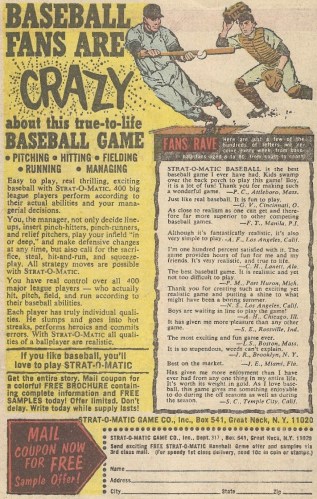
Combine Dungeons & Dragons with Major League Baseball! Bore people insensate with statistics and mind-numbing rows of figures! Strip the game of all the things that make it beautiful, not excluding crotch-scratching and tobacco juice!
Dick Williams would use this crap for BB bun target practice.
A comic begat by the TV show that also begat John Travolta. YOU’RE WELCOME, EARTH. – Welcome Back, Kotter #2

Welcome Back, Kotter was on the airwaves before my TV watching days. My first encounter with this 1970s John Travolta launching pad was a decade-plus later sketch on Saturday Night Live, where an all-grown up Barbarino was hosting that show and was in a great sketch called “Quentin Tarantino’s Welcome Back, Kotter.” (A sketch worth seeing mainly for Adam Sandler’s goofy grin as Epstein during the Reservoir Dogs-inspired intro.) I recognize that the show had a following and a number of breakout characters and catchphrases, but my limited viewing of it left me cold. Sitcoms — unless their name is Honeymooners — have the hardest time holding up over time, and Kotter was/is no different.
So maybe the show isn’t up in the stratoshpere of greatest shows ever. But hey, did M*A*S*H have a comic? No. No it didn’t. And this site would be incomplete without a brief trip through the comic series’ pages.
The main reason I chose this issue (Script: Elliot (S!) Maggin, Art: Jack Sparling) over any of the other nine that formed the series’ limited run is that, within its confines, the renowned Sweathogs defy the laws of New York and gravity to play a prank on the curmudgeonly principal, Mr. Woodman. Remember in Animal House when Flounder, Bluto and D-Day put Niedermeyer’s horse in Dean Wormer’s office? Well, the boys here decide to do the same, but substitute Woodman’s car for the equine prop. You might think to yourself, “Wow, I’d sure like to know how regular teenagers could get a car into a cramped little office without the benefit of superpowers. I’m sure it was an elaborate scheme, complete with Mr. Science-ish levers, pulleys, weights and counterweights.” WRONG. You’ll find no such answers here, as Newton’s Law can apparently be disengaged at will on Earth-Kotter:

I used to work with my father — a home-builder — in the summertime, and when we’d put siding on a house he’d set up this rickety staging with ladders, braces and long wooden planks like the ones seen above. The wood had a lot of give, to put it mildly, and it always felt like I was one step away from plummeting into the welcome arms of a Worker’s Comp claim. Perhaps the planks the Sweathogs use are hewn from petrified trees. Or Woodman drives an Adobe. Whatever.
Apart from that, things follow a cookie-cutter trajectory seen in countless episodes of this show and others — sans of course the laughtrack. In addition to Horshack’s guffaws and Epstein’s notes, much of the standard situational comedy is replicated within:

IT LOOKS LIKE HE HAS BREASTS! HARHARHARHAR! (Not sure if those are typos or puns or inside jokes in there or what. I’m sure that I don’t care, though.)
I was impressed with this bit, as a catchphrase of the time was repurposed so that Kotter could essentially tell Woodman to cram it up his ass:

Ass-allusions aren’t often found in comics, especially comics from this era. Just saying.
Finally, I thought readers might like some “Sweat Hog Scratchings,” with brief bios of the cast. It would have been eerie prescience if whoever wrote these had incorporated “Will be dogged by rumors that he is gay throughout his career” in the Travolta blurb — and LOGO BORDERS MEAN NOTHING TO EPSTEIN’S UNTAMABLE HAIR:

I’ll give Sparling — who did adaptations as disparate as Adam-12 and The Dirty Dozen — his due for providing reasonable likenesses of the familiar faces of the show. Barbarino’s gigantic mug looked like Travolta’s gigantic mug, for whatever that’s worth. And Maggin, credited without the S! here, does what he can in giving the world of James Buchanan High a degree of Riverdale elan. Problem is, I just don’t care that much about the source material. Others who were around to enjoy the show on its first run around the block might feel differently. If so, mazel. Go with God.
There. Welcome Back, Kotter. Done and done.

I remember this pre-release ad for Mr. Gold quite clearly. It seemed to my young eyes that he had it made — the Magnum, P.I. of comic book champions. (His spotty, at times lackluster heroing was still in the future.) Usually you don’t see piles of cash and accoutrements like those unless rap or cocaine is involved. “Booster Gold: Women Love Him, Men Respect Him.”
Something tells me that there’s a gold-plated bidet in Booster’s pad. Just a hunch. THE 99% WOULD NOT BE PLEASED. Not sure if he’s ever fired a gun in a nightclub, though.

I can picture this arraignment:
Judge: “So, Mr. Knievel, you’ve chosen a career in death defiance.”
Knievel: “Yes, your honor.”
Judge: “And you thought it would be a good idea to have your son stand on the back of your ROCKET-POWERED bike as you launched it over trucks, cars, and assorted natural and man-made landmarks?”
Knievel: “Yes, your honor. I even let Robbie do the ‘Look, no hands!’ bit.”
Judge: “…”
Hey, Superman — you seem to think that juvenile courts can work wonders in any family situation. How about this one?
You’ll become so good at playing the guitar, hearts will magically appear above your girl’s head

Do all guitar lesson ads carry the implied promise of getting laid? Let me rephrase that: Shouldn’t all guitar lesson ads carry the implied promise of getting laid? Because I think that’s the reason most nascent strummers take up the instrument in the first place.
Thank you, Ed Sale, for helping many a young man learn both chord progressions and the touch of a woman.
 Jared
Jared


 blog into mystery