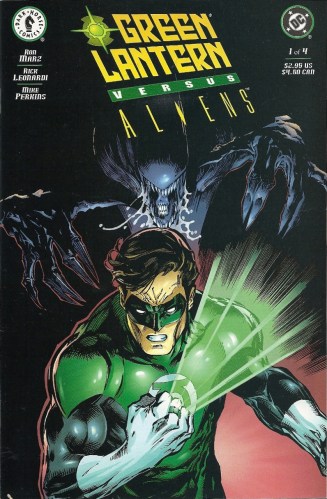
Prometheus is almost upon us. The Ridley Scott-helmed Alien prequel that isn’t a prequel, but yeah, really is kind of a prequel, opens here in the U.S. on Friday (it’s already out in parts of Europe). That means that now is the perfect time to pull one slice of the Aliens comic universe out of the archives and drag it into the light of day.
Choosing a slice from the multitude is the problem.
The Alien franchise is venerable but lacking something, and that something is characters. Voiceless, squealing black-carapaced killing machines make for good antagonists, but they’re weak when they have to carry a book, and most of the interesting characters from the films get killed off as a requisite of the genre’s butcher’s bill. This has meant that the xenomorphs have been paired with a never-ending series of opponents over the years. Perhaps too many. There’s been a glut. And it’s not just the comics. The cinematic brand has clearly undergone a dilution (possibly starting with the first, excellent, but maybe overkill sequel) and by the end of the second Aliens vs. Predator abomination we waved goodbye to the last remnants of mysterious dread from Sir Ridley’s sci-fi benchmark. Just think about where we are with Prometheus: The xenomorph stars have become so devalued, THEY ARE NOT EVEN THE SELLING POINT OF THEIR OWN PREQUEL. They may or may not even be in the damn thing. Whatever the case, they’re not even figuring in the marketing. Granted, some of that might come from other “prequel” letdowns leaving that descriptor meaning little more than “steaming pile,” but still…
I’m digressing — back to the comics. The endless crossovers always ramped up and up and up, and the inter-company encounters between DC and Dark Horse were probably some of the most intriguing/bewildering of the lot. Batman, whether he was battling Aliens or Predators (or, in well-conceived fan films, Aliens AND Predators) always felt natural in the personalized combat required by both those foes. His World’s Finest partner, Superman, was also put in conflict with these nasties, but there was another layer of disbelief that had to be suspended in his case. When the Man of Steel comes up against our beloved xenomorphs, there has to be some power-capping chicanery involved, because, well, THEY ARE NOTHING TO HIM. “Oh, hello. You have acid blood and little stabby mouths within mouths? And an ability to hide and make sudden, heart-stopping appearances? That’s cute. Excuse me for a moment while I fly through a goddamn star.” He has to be depowered or stuck under a red sun or other such nonsense, you know? (I realize this criticism can be extended to most Superman foes. But for some reason it’s more of a sore-thumb in these crossover things.) This means the Superman vs. Aliens material feels forced, which also carried over into his team-up with Batman against the Alien/Predator death-combo.
And now we come to our selection for the day. (My apologies for the rambling preamble — the preramble.) Yes, Green Lanterns were thrown up against the xenomorphs too. And boy, does the series feel forced.
This four-issue mini came out at the turn of the millennium, deep in the midst of that awful interregnum where Hal Jordan was dead, having gone out a villain, and poor Kyle Rayner was saddled with being the only GL left. But fret not, Jordan-lovers, because Hal gets a fair amount of page-time in this split production. (It always felt like DC knew they screwed the pooch when they killed Jordan so clumsily, so they had to cram him into every flashback that they could. WE’RE SORRY, OKAY?) In fact the entire first issue is all Hal, as the Corps, investigating a dead Lantern (who hasn’t passed on his ring), has their first close encounter with the toothy drooling monsters. Jordan leads an all-star team — including Tomar Re, Kilowog and (my personal favorite) ladies-man Salakk (I prefer the Salaak spelling, but he’s Salakk here, so…) — on the investigation, and, after getting ambushed (Tomar Re gets a dose of acid), Jordan makes the key observation that should end the whole shebang:

Basically it’s no problem to hold them at arm’s length and let them flail away like a little runt swinging his arms while a tall dude holds his head. GOOD TO KNOW.
So Jordan vaporizes them, right? No. Not being killers, Jordan and his buddies ferry them to planet-Lantern Mogo, where they’ll be able to live happy lives without brutally killing anyone, in the outer space version of (actually) taking a dog to a nice big farm in the country. The xenomorphs will get to run and play and salivate to their hearts’ content.
Flash forward ten years to Rayner botching everything, which can all can be traced back to Jordan’s humanitarian soft spot for hideous bioweapons. A freighter crash lands on Mogo, obvious complications arise, and Rayner gets hooked in by former Lanterns — including Salakk — to go put things right. You’d thing Salakk would maybe clue Rayner in about the whole “form a protective bubble and they can’t hurt you at all ever” strategy, but no. If that were the case, then we wouldn’t have a story stretched over four issues, with all that wan dramatic tension. Instead, Rayner leads an Aliens-esque commando squad in — perhaps Salakk fills the Bill Paxton GAME OVER, MAN role — and quickly gets overwhelmed. What does Rayner go and do?:
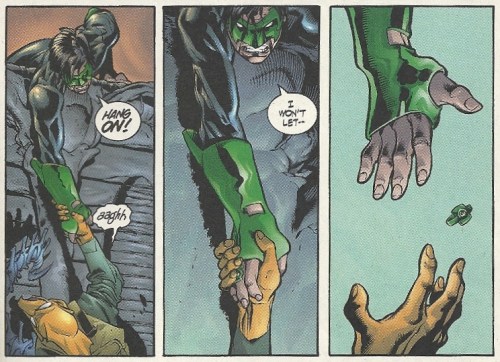
Yes, Rayner whizzes it in record time. Cheap. CHEAP. I don’t know, Kyle, maybe form the ring so that it has a smaller diameter than your knuckle. SO IT DOESN’T FALL OFF WHEN YOU USE YOUR HAND FOR SOMETHING. “Could you pass me the peas? Thanks so mu- OH GOD MY RING.” Even the sainted Hal has had trouble keeping track of his jewelry, but man oh man…
Rayner and the one surviving member of the freighter’s crew go in search of the ring, encounter an Alien queen, and the story spirals to its inevitable conclusion. An aside: How do Aliens reproduce without a Queen? Because here they don’t have one — that I could see — when exiled, and next thing you know there are eggs and face-huggers galore. Has this been addressed in any of the comics? I have not the energy to look for myself.
Ron Marz (Silver Surfer) scripted and Rick Leonardi (Spider-Man 2099)and Mike Perkins provided the art for this series. I have no quibbles with the latter, as Leonardi and Perkins do what they have to, breathing sequential life into Giger’s classic designs. And even Marz gets a pass for the painfully obvious, flat-as-week-old-soda plot. What else could he do? You get the Lanterns, you get the Aliens, and you have to blend up a story around their suddenly mixed universe. It’s an impossible task, and he might very well have done the best he could under these straight-jacket circumstances. It’s a gimmick to sell books, not an attempt to forge a truly memorable story.
And hey, now that I think of it, an exiled nasty getting uncovered by bumblers and wreaking havoc was the plot of last year’s terrible Green Lantern. Not the best association to have.
So. IN CONCLUSION. If you like the Alien(s)-verse, maybe check out Prometheus. It looks to have little to do with the xenomorph vehicles of the last two decades, which in turn means it’s doubly removed from hokum like this. Enjoy!

Was there a more ’80s television show than Miami Vice? With all-due respect to long running behemoths like Dallas and Dynasty, they really don’t keep up with Florida’s high-octane Testarossa. If you were putting together a time capsule to be buried until the year 2212 or thereabouts, and wanted our cyborg descendants to have an idea of what television circa 1986 was like, and there was only room for one DVD box set, you couldn’t go wrong with a season of Vice. Once they figured how to play the damn things, they’d probably be as fascinated the show’s its opening credits sequence as anything else, since it so masterfully fused palm trees, flamingos, windsurfing, breasts and jai alai in its jumpy first seconds:
The underworld South Beach adventures of Sonny Crockett (Don Johnson) and Rico Tubbs (Philip Michael Thomas) were ratings gold for NBC. I was too young to watch Vice during its original run, but I tried. It aired on Friday nights, and not being a school night, I was allowed to make a valiant effort to stay awake as long as I could. To cross into those mythical, magical hours where only adults dwelled. But the 10:00 PM airtime was usually too much, and I’d often doze to the dreary monotone of Edward James Olmos before getting hustled off to bed. (To this day Olmos’ voice is like an elephant tranquilizer to me.) My drowsiness notwithstanding, the neon, the pastels, the fast cars, the faster women, and — most importantly — the white jackets with the sleeves rolled up, all defined a decade, for better or for worse. And I’m convinced the show was one of the reasons that Lebron James took his talents to South Beach. HE PUT SONNY CROCKETT IN A NIKE COMMERCIAL FOR CHRISSAKES.
The show’s success and its violent, in your face look at drugs and prostitution made it ripe for satire, as ripe as any other IP we’ve ever seen. ENTER MIAMI MICE. The brainchild of Mark Bodé, perhaps most known to comic audiences for his work on The Teenage Mutant Ninja Turtles, Mice was and is a delicious send-up. (Hamster Vice was a contemporaneous rodent Vice comic. Another post for another time.) Most parodies of this sort lose their steam within minutes. You see the comedic HAHA versions of the characters you know (in this case, Rocket and Stubo), you go through a nutty situation or two, and then it’s “So, what’s on TV…” There’s some of that here, but every page or two you get a panel like this one:
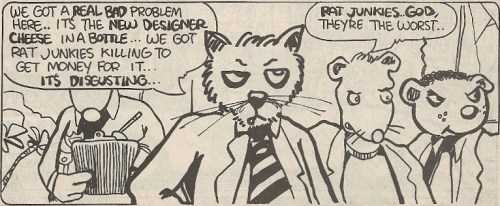
I’m not going to delve into the fact that a cat is the boss of the mice. Obviously Bodé didn’t follow the Maus species schism. But that there’s an Edward James Olmos cat with dark, world-weary eyes should fill us all with untold delight. And yes, cheese is the cocaine proxy in the Mice universe. IT IS VERY EASY TO LOVE THIS COMIC.
Some more art hors d’oeuvres… It wouldn’t be Miami Vice/Mice without a speedboat, now would it:

Remember what I said about something always coming around to re-capture your interest? Case in point:

THESE MICE MEAN BUSINESS. Before cobbling this post together I did a little background reading and saw that Bodé is a tattoo artist. It’ll probably be a cold day in Hell/Hades/Perdition/Whatever before I get a tattoo, but if I ever do, I think I’d like to have that panel etched across my back. And then I’d DARE chicks to try to resist my charms.
The stories within, taken in the abstract, aren’t much to hang your hat on. The first has Rocket and Stubo taking down (bloodily) a cheese ring, and the second is a comically violent version of the last standoff in Scarface. Not much meat. But deep ruminations on the meaning of life weren’t what audiences sought when picking up this mag, nor (obviously) were they intended. This was meant to be stupid fun, and it’s stupid fun.
What might be the greatest indicator of the love the series shows to the source material — always a sign of healthy parody, as opposed to outright and mean-spirited mockery — is the following one-page short. Sonny Crockett lived on a boat and had a pet alligator. Rocket lives on a boat and has a pet roach:

At the very worst, Miami Mice — which only lasted a handful of issues — is visually arresting (no pun intended). There’s more than enough to keep the reader interested, elevating this above kindred parodies and lesser independent books, and placing it on par with the better entries of the latter. If, like I did, you run across a copy or two in a quarter bin, it’s hard to go wrong.
To end this post in the most insufferable way I can: Loving this comic is no vice.


Yes, chicks dig nothing more than a dark, fakey goatee that doesn’t match your hair. And if you’re trying to go unnoticed, I don’t know that a LOOK AT ME Van Dyke is the look you should go for.
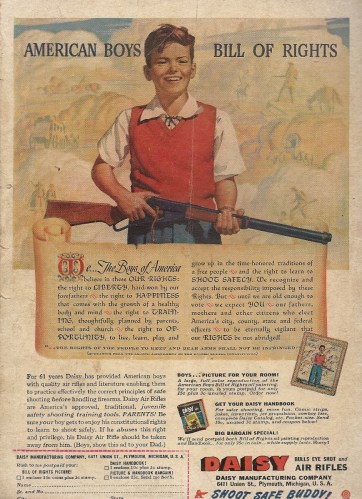
What, no codicil about the inalienable, Creator-endowed right to wear a Jim Tressel sweater vest?
You can almost hear strains of a patriotic fife and drum tune as you read that yellowed parchment. “Don’t tread on me, Mom and Dad. Or I’ll shoot you in the ass with my air rifle.” Love the verbiage in the copy, too. This late-forties backpager may very well trump endorsements from salty baseball managers and indoor shooting ranges for the top spot on the BB gun ad Mount Olympus.

Who among us hasn’t yearned to return to the stomping grounds of yore, the scenes of our youth, and battle a fire-breathing dwarf-armed dragon?
Count this as one of the more enjoyable and unique slices of Silver Age stupidity. It has it all. Mr. Fantastic and the ever-lovin’ Thing taking a trip down memory lane. The Thing roughhousing with collegiate gridders. Snarky cameos by out of costume Marvel superstars. A lesser villain and the first appearance of a dumb beast character who thinks he’s people. Sue Storm, as usual, saying one of the dumbest goddamn things a sentient creature has ever uttered. The lesser villain trying a speed skating getaway. Odd allusions to Jayne Mansfield. And Stan Lee and Jack Kirby (and Dick Ayers and Chic Stone doing the respective cover/interior inks) proving that they could take a situation as mind-numbingly mundane as someone else’s campus visit and turn it into some manner of comic book gold. There’s a newsprint alchemy at play here.
The set up is Reed making a triumphant return to State University (where he met Ben) as one of the great scientific minds in the world. He’s invited to come back and make a speech. WONDERFUL. And the Fantastic Four arrive on campus with their Fantasticar piled so high with luggage it looks like the Beverly Hillbillies’ jalopy — where’s Buddy Ebsen and Granny?:
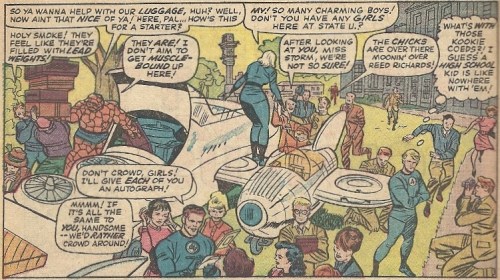
I guess we shouldn’t be surprised that the coeds are nestling up to Reed like he’s Professor Indiana Jones. After all, he had the George Clooney gray temples before George Clooney had gray temples.
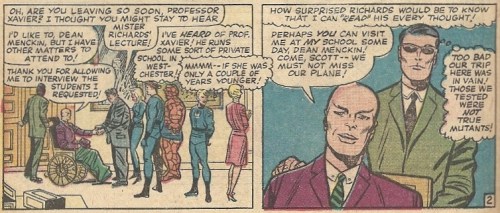
One of the nice little quirks in this issue is that it has a couple of cameos by leading Marvel figures, unrecognized by the Four but ever so obvious to devoted Marvelites. (Marvel was knee-deep in cross-pollination at this point — to their financial benefit and the augmentation of our enjoyment.) Professor X at least has the stink of academe all over him, making his presence on a college campus somewhat organic, and the wheelchair-pushing Scott Summers is along for the ride (so to speak), too-cool ruby shades and all:
And lo, there shall be a Parker. Peter is scoping out State as a potential home for his web-fluid-inventing genius, and he and the Torch, well into their early rivalry — you have to hand it to Peter, he managed to piss off Johnny both in his Spider-Man guise AND his civilian togs — exchange pleasantries:
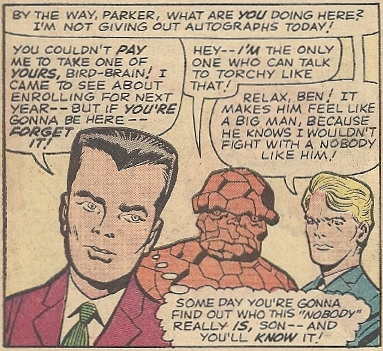
Kirby really brought out the egg-head in Parker. His cranium looks positively Leader-ish. Though not quite as obscene.
While Reed is getting ready to address a teeming throng of students (having waded through enormous globs of Mr. Fantastic expositionary dialogue over the years, I cannot imagine that any human being could sit still under the barrage of his droning for more than five minutes), Ben plays grabass with the State U. football squad (no sign of Bert LaBrucherie or his bowl of Wheaties). It’s hogpiles gone wild, at least until Sue butts in:
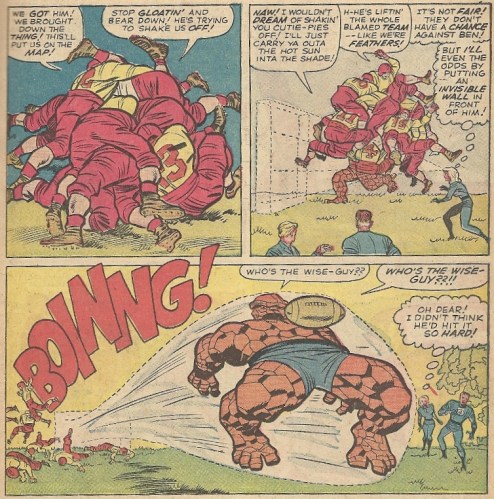
MIND YOUR OWN BUSINESS, WOMAN.
The comic’s action comes pre-installed with the misappropriated Dragon Man, a ghoulish sculpture developed by a scientist at the University, one that stands in a long, proud line of monsters wearing underwear, and one that’s eventually animated and unleashed by Diablo. (Such a Diablo thing to do, too.) He rampages through Reed’s speech, forcing the Four into action. They manage to get the creature off campus — though not before precious ivy-coated masonry is harmed — and, when away from the student body, Reed whips out some dubious science as Sue confirms that she’s an absolute f–king idiot:
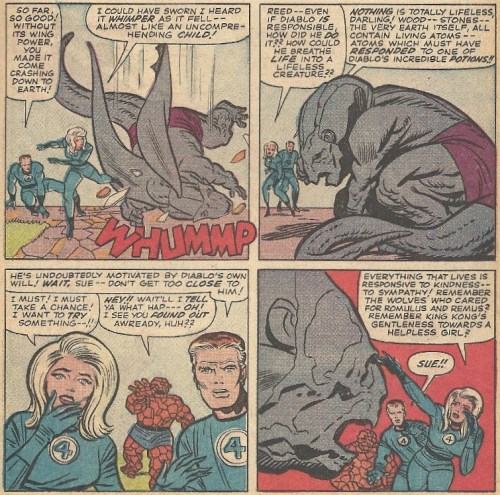
Sue, you are really stretching, and I’m not talking about the kind that Reed does. Very few times in human history has a person confronted an out of control monster with hard behavioral science culled from myths and old movies, but there Sue goes. Oh, and by the way, the King Kong of the original film, which I’m pretty sure was the ONLY King Kong film at this point, kidnapped the blonde broad on multiple occasions and imperiled her life at every turn. When he wasn’t casually hurling other people to their deaths. Sue, what I’m saying is, STEP AWAY FROM THE DRAGON MAN.
Turns out I’m the idiot, because her loony kindness pierces Dragon Man’s simple mind, and he turns on Diablo. Diablo, whose freezing potion (yes, he had a freezing potion, as well as a nice white lab coat) was knocked out of his hand and froze a lake. Diablo, whose general ineffectiveness gives us this wonderfully silly panel, as he tries to Dan Jansen his way out of danger:
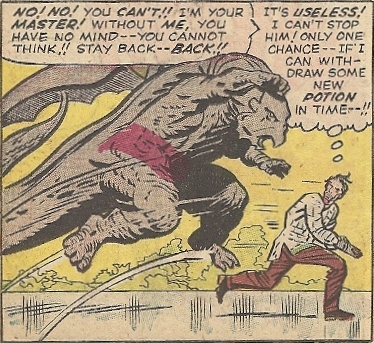
Insert high-pitched Curly Howard “WOO-WOO-WOO” sound effects as desired.
Dragon Man and Diablo are sucked into the bowels of the Earth in one of the more preposterous of all possible fates for them, and then we come to our conclusion. While Reed and Sue are off canoodling in Lover’s Lane or some other nonsense, the students and school administrators make some odd Jayne Mansfield references to the other half of the departing four:
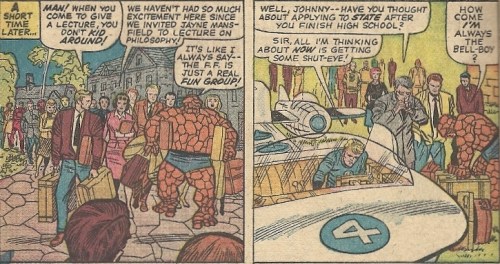
What, no “Thanks for saving our school and trashing it in the process!” banners? AND WHAT WAS WITH ALL THE LUGGAGE? A four hour visit doesn’t require a Catherine the Great baggage train, at least not in my experience.
This is yet another of the many instances in Silver Age Marvel where even the faults only add to the lustre. Lee’s script is goofy in the extreme, but which of his weren’t back then? People lapped this stuff up. Still do. And could Kirby do any wrong at this point in his career? He was finishing off pages of art at such a clip I have a mental image of him throwing completed pages over his shoulder like shovelfuls of dirt tossed by a dude digging a hole. He worked faster than John Henry, the Steel-Drivin’ Man. Yet the art could be so expressive. Look at those panels in the “Sue’s a moron” scans above. Dragon Man looks like the sort of creature that could whimper like a kid. WAAH.
Anyway, thanks, Stan and Jack. Thanks for showing us that even comic book characters can go home again and TOTALLY OWN the haunts of old.
This comic, like all of the classic Silver Age Four books, has been reprinted dozens of times, including in the Marvel Masterworks collections and the mammoth Omnibi. As always, it comes highly recommended.

I was ready to castigate the hyperbolic blurbs on this comic, then read closer and discovered that, yeah, they’re fake. The Rolling Pebble, The Boston Orb and Morley Unsafer indeed.
I’ll leave it to you, the discerning Bond consumer, to decide if this is better than the James Bond RPG.
“Hey gang, pose next to the fireplace so my Kodak film can preserve our dopey wizard hats for posterity!”

Here we have a rather quaint gathering, scanned out of the 1947 Will Rogers True Fact from a few days ago. I’m not certain that youths of today have evolved very far beyond this, with cell phone pictures taken in restroom mirrors, young chicks doing the “duck face,” people extending the middle finger to look cool, and what have you. Maybe there’s de-evolution going on. But, I ask you, WHAT IS THE DEAL WITH THE WIZARD HATS? Is this the image you want for your product, 1940s Kodak?
Their grandkids would find these pics after they died and wonder of they’d been in a Fantasia sex cult or something. I shudder to think what they’d do with the brooms.
XYT7PV42FXYH
Do we still have terror alert levels? Wouldn’t this ramp things up? – Dennis the Menace in Washington, D.C.

Every Memorial Day, Rolling Thunder screeches into D.C. If you don’t know, that’s a big motorcycle rally meant to honor fallen veterans and raise awareness of POW/MIA issues. There’s a big ride around the Mall, with a never-ending river of bikers with rides of varying severity, crazy facial hair, old ladies riding bitch and leathery skin. It’s the noisiest parade/Sons of Anarchy cosplay fanfest you could possibly imagine, and it’s cool for a while in the days leading up to the rally, as you start to hear the roar of the engines being opened. There’s a rhythm of life to it, like the birds returning to Capistrano (if the birds, instead of chirping, belched exhaust at high decibel levels). Then, after about the 500th ear-piercing acceleration, it starts to wear thin. Like relatives that you love but stay too long on Christmas, you just want them gone. God bless them honoring veterans, but I want my ability to hear back.
This year, they made me think of this Dennis the Menace book. Because he’s a thousand times worse on the annoyance scale. I swear, if I ever see this kid in my town, I will not be held responsible for my actions.
This comic, one of a number of Dennis Mitchell travelogues published during the Silver Age, has Mr. Wilson’s nemesis accompanying his parents on a “vacation” and wreaking his unique brand of havoc upon the Capital of the Free World and its surrounding environs. LEAVING TERROR IN HIS WAKE. There’s a lot of the standard Menace humor, and it wears thin in a giant-sized, square-bound book like this one, even with the unique setting. Wears thin FAST. Better for kids, I’m sure, though I have my doubts of whether youngsters of today would take to Dennis’ shenanigans. Maybe they’re timeless. I’ll say this though: A great job was done illustrating many of D.C.’s landmarks. There isn’t an overload of education value in a tome like this (once again, maybe it would be better for youngsters especially those not able to make a trek to Washington, though I’m not fully sold on that either), but seeing familiar or should-be-familiar places lovingly illustrated is some manner of treat. I thought I’d share a few scans to give you a feel for the proceedings. Let it be your virtual vacation.
One of the first things that the Mitchells do when they arrive in town is ascend to the top of the Washington Monument, so that they can get that great panoramic view of the city. I liked this full-page look to the east, towards the Capitol, mainly for the curvy outlines of the then-D.C. stadium at the top (now RFK Stadium, as Robert Kennedy had yet to meet his tragic Sirhan Sirhan-authored end by this book’s 1963 publication date) — you can also see the D.C. Armory right next to it:

I couldn’t find any solid information on who scripted or did the art on this book (could be creator Hank Ketcham for all I know, though I doubt it), but I’d like to compliment the anonymous artist(s) for what they did in panels like this one, as Dennis takes a second to splash away in the fountains outside the Library of Congress. The detail in the masonry and sculptures is marvellous:

So many hats in this comic, relics that were on the way out when it was published. It’s like watching Mad Men.
There’s, of course, a visit to the White House, with a chance run-in with a Kennedy clan member (Caroline). This drawing of the East Room captures the gilded splendor of that space (I like the chandeliers), and our little brat can’t resist reminding his housewife mother that she is, indeed, a housewife:

One of the more spectacular things to see in D.C. is the Capitol Rotunda. I recommend making it a priority, even if the Capitol tours are pedantically dreadful. You really feel like you’re somewhere special when you’re under that dome. The center of it all, if you will. Which, of course, Dennis misses COMPLETELY:

There are sojourns out to Mount Vernon, Williamsburg and other rustic neighboring locales (and some Dennis dream sequences), as well as visits to the Smithsonian museums and government agencies. Some of the tours go to places that might not make most tourist itineraries, like the Pentagon (where Dennis is mistaken for a midget spy) and the F.B.I. It’s at the latter that Dennis has a close encounter with the power-mad, maybe cross-dressing, and utterly terrifying J. Edgar Hoover:

I WOULD NOT KNOW WHO TO ROOT FOR IF THEY WERE TO DO BATTLE.
On the inside of the back cover there’s this map of the various spots that Dennis visited in the District. You know, if you’re keeping score at home:

Apart from the memorials that have been erected since this book’s publication (Korean, Vietnam, FDR, the new MLK), I couldn’t help but notice that the stops in Arlington National Cemetery — Iwo Jima and the Tomb of the Unknown Soldier — omitted one that’s now a requisite. As I said, this book was published in 1963. The Summer of 1963 to be precise. JFK’s assassination was mere months away, and soon there would be an Eternal Flame amongst the sea of white markers. And in a matter of years, President Kennedy’s brother, who’d have that curvy-rimmed stadium named after him, was buried there as well.
A depressing way to end this post, but what are you going to do.
Dennis, don’t you dare set foot in my town again.

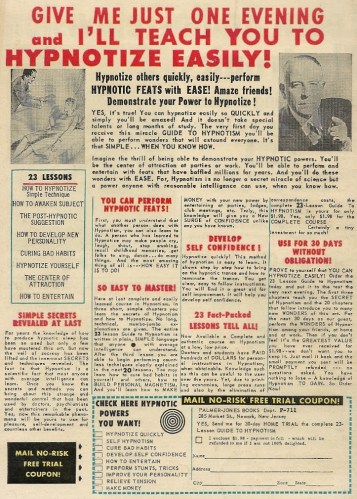
To me, any master of hypnosis who advertises in comic books is right on par with dentists who put patients under and grope them. Unsettling.
Like guitar lesson ads that carry the implied promise of a bounty of women swooning to your melodious chords, this one, with the recumbent babe in a diaphanous robe submitting to hypnosis, carries the promise that you’ll be able to overcome a woman’s conscious “get away from me, you pig” barriers. You know, like a “YOU ARE GETTING SLEEPY” date rape drug. WONDERFUL. Look at the guy up there. It appears that he’s at least getting ready to fondle her breasts.
There’s also some of the “Shamed By Your English?” dude in here as well. I wish there was a name for the anonymous, serious, finger-pointing hypnosis professional whose picture accompanies the ad (maybe there is — is there another version?). He reminds me a bit of Orwell’s Big Brother. Always watching, always making you obey his commands.
For Memorial Day, the senses-shattering origin of Combat Kelly. (But not his Guy Gardner haircut.) – Combat Kelly #3
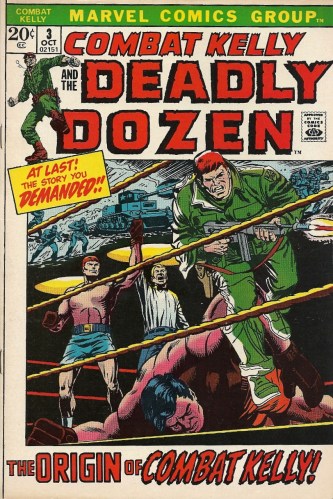
It’s Memorial Day, and that means a stateside comic book blog is duty bound to honor the fictional soldiers who fought for this country, who in turn honored the real soldiers that made the ultimate sacrifice for this country. That means that this post is a roundabout tribute to the real men and women who fought and died for their country. Nevertheless, it’s heartfelt. An honor to honor, if you will. On this day (if you’re in the United States), take a moment to remember sacrifices, and, if so inclined, rip off your shirt, wave it above your head and chant an appropriate jingoistic slogan. Oh, and take a second to read about a dopey comic book character.
So. Combat Kelly.
For those of you unfamiliar with this burly red-head and his unflattering bowl cut, here’s a primer. Like much of fictional co-traveller Nick Fury’s early run, he spewed from the typewriter and pencils of Gary Friedrich and Dick Ayers (and, in this issue, Mike Esposito inks). Unlike Fury, who’s had a long, LONG shelf-life, and just made an appearance on the big screen in The Avengers, Kelly’s title only lasted for a run of nine issues in the early 1970s. Also like Fury, he had a squad of colorful grunts at his side (the Deadly Dozen), but in this case they were rough parolees getting a second chance at life by robbing Nazis of theirs. Got all that?
Deadly Dozen. Hm. Sounds like “Dirty Dozen.” THAT’S THE POINT. This comic stole from two places (Fury and film) and created a rather forgettable combination in the process. A product that’s less than the sum of its parts. Not to say that it’s bad, but…
This issue has a fairly entertaining look at how Combat Kelly got into his wartime predicament. (Sort of. More on that in a moment.) And it has boxing. Boxing from the days when no one gave a rat’s ass about concussions. “Rub some dirt on it and take a salt tablet.” And not only boxing, but boxing against a towering, devious Nazi opponent, dredging up shades of the Cold War’s Rocky IV and its gloriously stupid fight. (Not to mention a slice of the real life Baer/Schmelling and Louis/Schmelling fights.)
It’s not often that you get a senses-shattering origin that actually lives up to that sobriquet, but this one does. Will Kelly triumph over whatever impossible odds are thrown in his path? Will he prove to be more resilient in the ring than the indomitable Ben Grimm? LET US SEE.
Kelly, during a break actual “tanks, guns and bullets” combat, submits to the appeals of his comrades to tell them all about his past (I get the feeling they were all curious about him, like Tom Hanks’ squad in Saving Private Ryan). He gives in, and starts telling the tale, which starts with him in the ring pounding the living hell out of some tomato can — but there’s something sinister afoot:
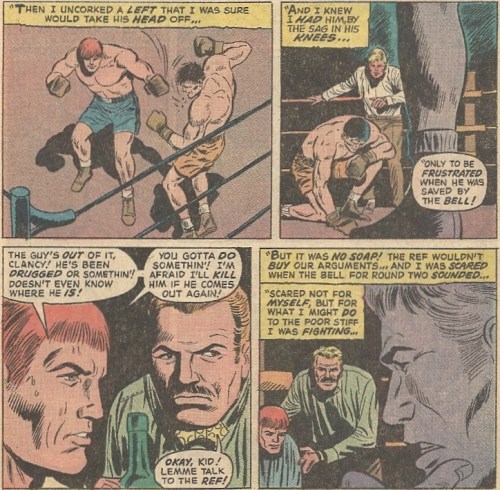
You have to love his corner man’s bow tie. Boxing folks have the wackiest — and best — sartorial sense.
Kelly succumbs to his baser instincts and inadvertently puts his foe down for the permanent count:
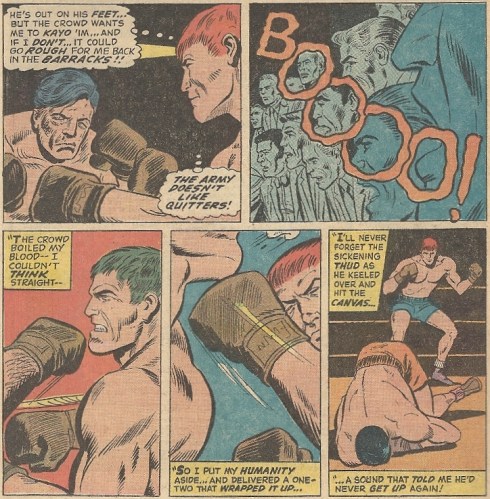
Bad enough to die, but to die in that position. IGNOMINIOUS, to say the least.
Then:
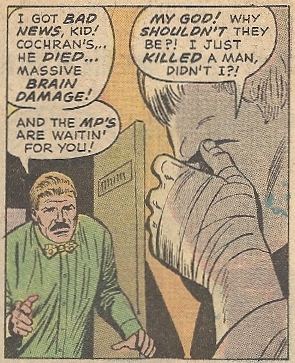
A quibble: The man died in the ring from the blows he sustained to the head. In a boxing match. This happens in boxing. If Kelly had been the one to drug the guy, then that would be a different story. But he didn’t. So this doesn’t really make sense.
Dubious legality or no, Kelly soon gets a reprieve when the Army finds itself in need of his boxing skills. The German forces champion, Schroeder, has issued a challenge, and Kelly is let out of the clink to fight him. But — surprise — the Nazis don’t play fair, and when an attempt to bribe Kelly to take a fall goes awry, Schroeder and his goons work him over like a slab of meat:
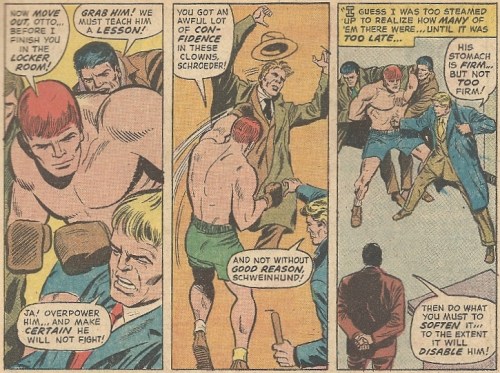
BUT THEY ONLY MADE HIM MAD. (Also, not often you see a non-blond Nazi champion. Different.)
The fight goes on as planned, and Kelly, bruised ribs and all, and despite a first round knockout, goes for the kill in the second. Kelly at last puts an end to this sumbitch, laying his opponent out so that he looks all but coffin-ready:
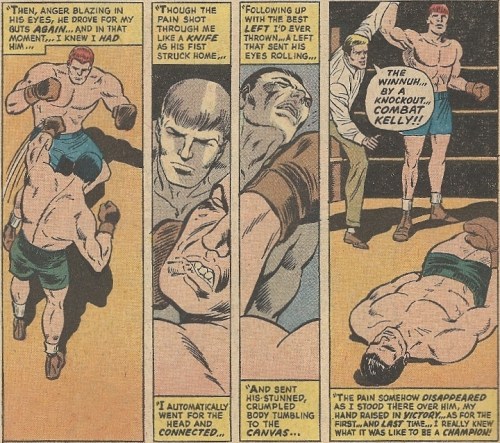
Look at Schroeder’s right hand. Having read any number of articles about the concussion issues that are roiling the NFL and the sports world in general, I know that one of the signs for a severe concussion is that an arm will stand erect as the concussed individual lies prostrate. It’s called the “fencing response.” Long story short, Kelly really rang this Nazi’s bell. U S A! U S A!
All well and good. A decent story. But, I need to point out, NOT an origin story. Kelly (back in the non-flashback World War II present) indicates that he was acquitted of that earlier boxing-related manslaughter charge and that it was another crime that had him run afoul of the Uniform Code of Military Justice, which was what subsequently put him in his Dirty Dozenish predicament. An origin story has something that directly leads into the our hero being a hero. This doesn’t. This therefore isn’t an origin story. It’s more like a “random something that happened to the main character in the past” story. I get the feeling between this and the whole manslaughter business that there wasn’t a lot of editorial proofing going on when this book came out.
Whatever. Combat Kelly, we salute your fictional service, including savagely liquefying a dirty rat Nazi’s brain pan. And we salute those who have made the ultimate sacrifice at the call of a grateful nation. Happy Memorial Day. Don’t eat too much.
U.S. Royal rides his jet-propelled bike in a car race, sans helmet, safety be damned, to peddle some tires

Bike tire comic book ads can verge into the bizarre, whether it’s Flash Farrell waltzing unescorted around a nuclear submarine or a kid wearing a cape as he rides his tiger-tailed bike. This one lacks such eccentricities, but you have to love the helmetless devil-may-care days of the 1940s. Maybe U.S. could have borrowed a leather helmet from the guys driving open-top racecars. WHY NOT JUST WRAP A WET TOWEL AROUND YOUR HEAD?
If you see some bike-riding idiot on the track at the Indy 500 today, you’ll know who it is.
A Golden Age Will Rogers story that’s also a very poor Will Rogers story – True Comics #66

The only Will Rogers influence that reached down to me was the choking commercial that George Peppard — during the peak of his A-Team fame — did in the 1980s for The Will Rogers Institute. To this day I think of Hannibal extolling the virtues of the Heimlich Maneuver, and how to apply it to an adult, a baby(!), or yourself, and his plastic bottle/cork analogy. Here it is if you can’t remember it, or never saw the damn thing:
If only Peppard smoked a cigar while taping it… (And I’m not making fun, because once, while I was scarfing down a cheesy frozen pizza during my earliest days of living alone during law school, I started to choke, and a vision of the dude leaning over the back of the chair leapt to my mind. I hacked out the menacing cheese glob without benefit of the chair, but it was nice to have that as a weapon of last resort.)
So all I think of with Will Rogers is goofy but useful PSAs. And this comic will do nothing to drive that out of me, or anyone else that has such associations.
Not to give Mr. Rogers short shrift. Though he wasn’t born in poverty, his unlikely rise to great fame and fortune as one of the pre-eminent humorists our nation has ever seen has more than a tinge of Horatio Alger in it. He’s uniquely American. A favorite son of Oklahoma, Rogers went from being a cowboy to Vaudeville, films, radio, newspaper columns and any other medium through which he could communicate with a rapt national audience. The only individual who shared a similar talent set (that I can think of) was Mark Twain, and he never had the benefit of the silver screen or airwaves to spread his raconteurism (I don’t think that’s a word, but it applies to these men). Rogers was an entertainer and national conscience whose like, thanks to the fracturing of the cable-turned-digital age, we will never see again.
Not that this old-timey comic would clue you in on any of that.
Published only twelve years after Rogers’ untimely death in an airplane accident, this 1947 anthology book has several extraordinarily uninteresting features, not the least of which is this perfunctory Rogers bio. It will teach you next to nothing, and contains not a scintilla of the humor that made the man famous from sea to shining sea and beyond.
His switch from lassos to microphones is handled as quickly as possible, with stilted dialogue to fill the requisite balloons:

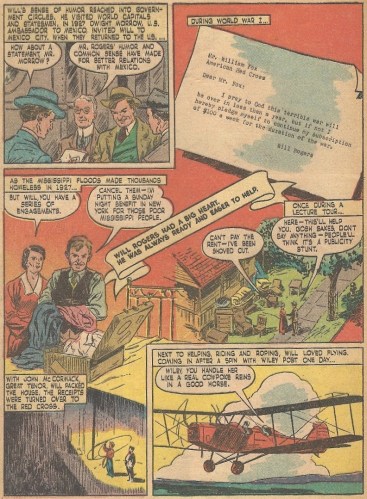
The meekest bright spot here is this full-page montage highlighting the man’s good works, which has a design sense that at least holds the eye for a second or two:
In a sad end, Rogers, an early enthusiast for aviation, died as a rickety plane crashed in Alaska, which left only memories and monuments:
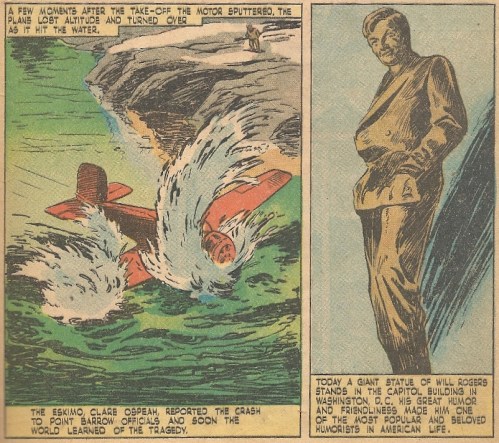
I’ve seen that statue. It has more life than this book.
Chalk this comic up with other lesser Golden Age books which seemed to be all filler, like meatloaf featuring 100% sawdust. I’m always amazed how the ads in these things (the Bert LaBrucherie Wheaties ad, and others to come, came from this comic) so often have more verve and interest than the cobbled-together stories. They can be like a lop-sided Super Bowl in that regard. This definitely could have used George Peppard, a plastic bottle and a cork to spice things up.
This reminder of the Len Wein/Dave Gibbons Green Lantern will make you want to slap Ryan Reynolds with a fish

I genuinely enjoyed the Wein/Gibbons run on Green Lantern. Maybe it wasn’t the best Lantern ever, but it was — at worst — good. I loathed the loud, dumb film Green Lantern. This is an unavoidable mental juxtaposition when I see the above ad. Yin and Yang.
There’s no stopping the Green Lantern.* (*Excepting a terrible movie.)

One good season at UCLA was apparently enough to get you a full page spread hawking Wheaties back in 1947. Frank McCormick and Hank Greenberg, they of sustained diamond excellence, are still shaking their heads up in baseball heaven over this.
I’ll say this for the handsome Mr. LaBrucherie: He was at least less jowly than contemporaneous football coach Frank Thomas. Perhaps he didn’t wash his bowl of Wheaties down with a hearty plate of eggs and bacon.
Peter Parker was molested as a boy. FACT. I got misty-eyed reading this. FACT. – Spider-Man and Power Pack
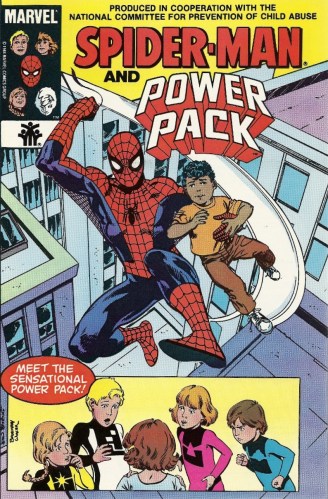
I’ve referenced this comic on multiple occasions, and I figured it was time the Spider-Man/Power Pack sexual abuse comic was highlighted here on the blog. It’s definitely one of the most important and venerable of the many free PSA comics that have been put out over the years, and for a long time I thought I had read it. Turns out I never have, and I’m sure of that. Why am I so sure? Because an event happens in this thin little tome that is UNFORGETTABLE, and mind-numbing in a sad, searing way. One that would be burned into my consciousness had I ever flipped through these pages in the days of yore. Yes, as alluded to in this post’s title, young Peter Parker, the skinny bullied boy with the big spectacles, whose sweaters and ironed pants were like catnip for schoolyard book-dumpers, was molested. And he was molested by someone he trusted, someone who brought a little bit of light into his nerdy, bleak, lonely, orphaned, library-dwelling childhood. Someone who for a little while made him feel like he belonged.
This may ruin your day. You have been warned.
This comic is broken up into two different sections, one centered on Spider-Man, the other around Power Pack, and each talking about a different kind of sexual abuse and the challenges a kid would face in trying to deal with it. I don’t want to belittle the Pack half, because it’s equally well done, but it’s not the show-stealer. That distinction goes to the Parker portion, for the aforementioned reason.
The instigator for the heart-rending Peter flashback is a confrontation Spider-Man overhears in a neighboring apartment, one between a babysitter (Judy) and her charge (Tony), which is prompted by these events:

Spider-Man breaks things up after Judy threatens Tony with violence if he ever tells. And this is when our hero — and Tony’s hero — opens up to the kid, with an “A Boy I Know” flashback:
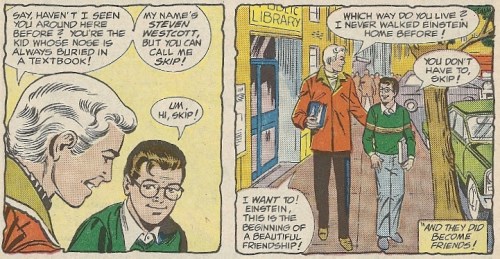
Coud Peter look any sweeter? And any more unaware of what’s about to fall on his head?
Skip and “Einstein” become best pals, hanging out, doing projects together, and in general giving poor Peter a slightly older friend he so desperately needs. And then:

We never see what was done to Peter. We only know that something was done. A bad something, and, as always, our imaginations are fearsome things when it comes to filling in blanks. I’m imagining bad stuff, and I don’t think I’m off base at all. THERE IS NO LIGHT, THERE IS NO JUSTICE.
Peter told his Aunt and Uncle about this, and when Spider-Man finishes his story, he tells Tony that this kid was him. Now empowered, Tony’s webslung to his parents, and things feel a little righter.
More on all this in one moment.
The Power Pack segment is just as (if not more) harrowing, as the kids come upon a runaway in an alley, a little girl with good reason to have fled her home:
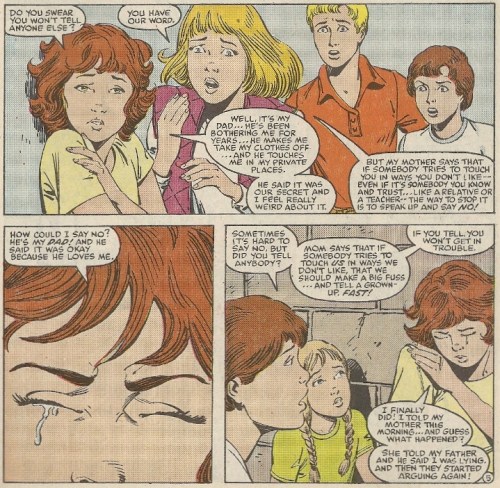
Jesus, you know? Just Jesus. What more can you say?
Back to Peter. I’m man enough to confess that reading about his rough patch brought a few tears to my eyes. Seriously. The tears may not have broken the eye barrier and streamed down my cheek, but the eyes weren’t dry, that’s for sure. The story — stories, actually — are so, SO well put together. (Here’s the talent list: John Byrne, June Brigman, Bon Wiacek — Cover/Nancy Allen, Jim Salicrup, Jim Mooney, Mike Esposito — Spider-Man/Louise Simonson, Brigman, Mary Wilshire, Wiacek – Power Pack.) On the inside front cover there’s a long list of professionals who advised in the making of the book, and in this case there’s no whiff of having to many cooks in the kitchen. Whatever editorial input they had went into honing the message to children, and to that end the job was done masterfully. The story educates without condescension. But it grabs (no pun intended — GOOD GOD no pun intended) on an adult level, too. The art in both stories captures the pain that only a child can experience, that sense of not knowing what’s happening to them and whether they’ve done something wrong to bring it upon themselves. Art is supposed to make you feel. This book made me feel. That the ostracized kid who found a little bit of happiness could have it snatched away so grotesquely speaks to the bullied in all of us. There but for the Grace of God… Peter’s flashback made me want to wrap my arm around him and tell him it was going to be all right. Look at him up there in that panel where he says “Um, hi, Skip!” That’s what got me. There’s young hope in those eyes. Put this together with what comes after, and you want to cry, punch a wall and hang yourself all at the same time. (I only did a little of one of those. The other impulses were there, though, I assure you.)
This comic makes dopey books that clumsily try to encourage reading and interest in the sciences seem horribly glib by comparison. Trite. It operates on another level entirely. Seeing something so terrible happen to the whole-world-in-front-of-him Peter hits home because we know him. The other two victims in this book, though fictional, matter too, but Peter Parker/Spider-Man is a part of our lives. He’s a national myth, hence there’s a reality to him, and that elevates his story into something that truly matters. It’s all just statistics and campfire ghost stories until it happens to someone you know. Peter is part of all our blocks, all our cul-de-sacs.
In that vein, good for Marvel for letting Spider-Man, their flagship, their biggest icon, be a victim of the abuse upon which the comic is trying to shine a light. Nothing could better drive home that this could happen to anyone, and that having it happen to you doesn’t make you a bad person, quite like a real genuine superhero going through the same thing. There was probably a suit somewhere that cautioned against this choice, arguing that doing something like this would damage the almighty brand. Maybe not. But the fact is, Spider-Man is presented here as a victim of sexual abuse in his youth, and he made it through. That’s a powerful message to the people with single-digit ages that make up the target audience, and a good one. (And editorial balls like this makes the artificiality of DC’s OMG WE’RE HAVING A CHARACTER COME OUT OF THE CLOSET LOOK HOW GREAT WE ARE OH AND BY THE WAY WE’RE DOING INSULTING WATCHMEN PREQUELS TOO feel even more off-putting.)
The inside of the back cover has some follow-up on the contents, as well as outdated contact information. If I have one complaint about the book, it’s that the epilogues to the two stories are a bit too sunny. (Actually, two complaints: The “MEET THE SENSATIONAL POWER PACK!” blurb on the front is jarring in a serious work like this one.) I guess you need a ray of optimism here and there in life, and kids would need a bit of encouragement if put in similar situations:
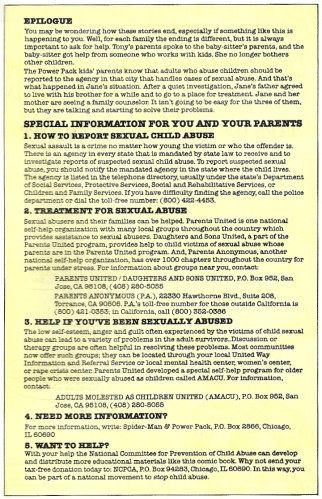
No word on what happened to Steven “Skip” Westcott, his Steve Martin hair, his stacks of dirty magazines and his genital-fondling hands. Maybe Uncle Ben beat him to death with a tire iron. Maybe he got some totally ineffectual treatment. Or maybe be grew up, changed his name and became a long-time Defensive Coordinator at Penn State. CHEERY OPTIONS ALL.
Anyway. This book was published in 1984, but its message still has force today. Kids should read it. Adults should read it. The cap is belatedly tipped to all who put it together. This is quality, even if its subject is dark as a moonless night. Excelsior.
 Jared
Jared


 blog into mystery