
This is the first issue of Marvel’s short-lived Groovy, a 1968 humor magazine that utterly failed to tickle America’s funny bone. The cover makes it look like a comic book, since it has the dimensions of a comic book and the classic Marvel 12 cent font from that company’s classic 1960s era. But there’s no Comic Code Authority seal to sanction the contents (potentially exposing 1960s youth to all manner of *gasp* perversion and, horror of horrors, zombies — WON’T SOMEONE PLEASE THINK OF THE CHILDREN?). There’s zero sequential storytelling within.
So it has the silhouette of a comic book, but it’s not a comic book.
It plays as a wan simulacrum of any issue of Mad. As such, there are brief text/pictorial pieces within, like this one, a “Freak-Out Funnies” celebrity piece which may as well come with an accompaniment of crickets:


The only time when this premier issue (there would SHOCKINGLY only be two more) picks up any sort of steam is when Johnny Carson pops in to say hello. Yes, that Johnny Carson. In the first decade of his lengthy tenure on The Tonight Show, Carson published a couple of books to a) entertain and b) make some damn money. One of them was 1967’s Misery is a Blind Date, which consisted of one-liner jokes illustrated by artist Whitney Darrow Jr. Some of them are reprinted here, in what you might call a Reader’s Digest selection of the choicest (one assumes) cuts, and they’re a bit more ribald than what you’d normally find in a mag from this time and of this shape and size. Take for instance this opening salvo, which tackles the age-old awkward father-to-son gauntlet that is the birds and the bees talk:

It’s like a semi-dirty Family Circus.
Are there jokes about topless lady beanpole sunbathers? YES THERE ARE:
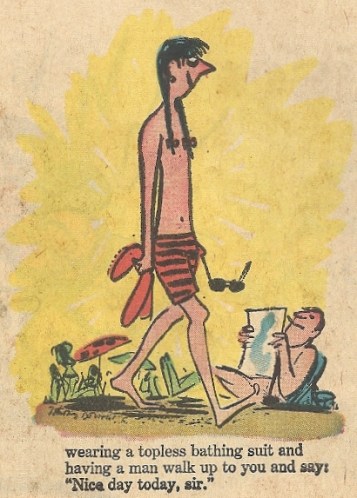
Looks like Paul Reubens. EXCELSIOR.
And it goes on like that. To Carson’s credit, his part of this is the only time that I even threatened to crack a smile. There are other similar features, but they lack a certain something. Don’t get me wrong, the Blind Date stuff isn’t knee-slapping, but it doesn’t make you want to tear the mag/comic/whatever to shreds. All that was needed was a chortling Ed McMahon to seal the comedy deal, I suppose. (Incidentally, the reprint status of this section means history was robbed of some mythic Stan Lee-Carson collaboration. OH WELL.)
Apart from Carson’s refried segment, Groovy was/is unfunny in as cringe-worthy as you can get from with the printed page. Now that I think of it, it’s like a Jay Leno monologue, but with printed words and pictures.

I posted a kinsman of this ad a couple of weeks ago. The kids have swapped the bizarre wizard hats for a guitar (Hey, guitar lessons really do get you babes!), but it seems like the common denominator in all old-timey Kodak advertising is fire. There has to be fire. Fire apparently equals “great pictures with friends.” SWELL.
And there closes my exhaustive investigation of the Eastman Kodak Company’s pyromania. Two random samples. AIRTIGHT POINT PROVEN CASE CLOSED. Updates as developments warrant.
C.C. Beck’s Captain Tootsie returns to bring grizzled pioneers Tootsie Rolls and slaughter bears indiscriminately

Before we’ve thrilled as Captain Tootsie punched a devious Frenchman, but this C.C. Beck-drawn ad takes his sugary “heroism” to a new level. Not only does he bring the pep of Tootsie Rolls to the deep forest (I can’t imagine that the aged coonskin cap-wearing pioneer’s teeth can handle their rugged chewiness), but he also uses A GODDAMN INFARED SNIPER RIFLE TO TAKE OUT A BEAR. AND THEN STRINGS UP ITS CARCASS FOR ALL TO SEE. “Humble mortals shall tremble at the approach of the Almighty Tootsie, and let none dare cross him, lest this be their fate.”
He apparently took the American Boys Bill of Rights to heart. With extreme prejudice.
Superman taunts us all with an old comic and a mouth-wateringly low price – Superman #183

I’ve never before thought ill of Superman. Others might find his straight-laced Truth, Justice, and the American Way passé and off-putting in today’s snarky iPhone age, but not me. He stands Zeus-like atop my personal Mount Olympus of heroes. But, that said, no other character has ever trolled me as viciously and needlessly as he does on this cover. I realize the $30.00 price he’s quoting is in 1966 dollars, but it’s still a bargain. I’d probably jump over cars like a Silver Age Captain America, through walls and sheets of flame, maybe punching old ladies in the throat along the way, to get my hands on a pristine pre-1945 Superman comic at that amount, one that mercifully wasn’t obliterated in a wartime paper recycling drive. WHERE IS MY TIME MACHINE?
We’re (or maybe I’m) being trolled from beyond time by the Man of Steel. Go figure.
The cover’s a little bit confusing, because it appears at first glance that the two stories Superman is holding come from distinct comics. Not so. They both come from 1943’s Superman #19 (here’s that issue’s gentler riff on Action #1’s iconic imagery) and they’re both rather entertaining trips through the looking glass, as it were, graciously reprinted here in one of the mammoth old 80-Page Giants. (We’re not even going to get to the origin of the old-timey Mr. Mxyzptlk. Another time perhaps.) What makes them so entertaining? In the first — the one in his right hand — characters within fictional newspaper strips come alive and menace Metropolis. Comics within comics — BRACE YOURSELVES. It’s almost like Last Action Hero, except this story didn’t derail Superman’s run, whereas that film began the downward slope of Arnold Schwarzenegger’s career. In the second, which is the most mind-bending of the pair, Clark Kent and Lois Lane go to see one of the contemporary Fleischer cartoons (which are still-stupendous to this day), and Clark has to engage in some Stooges-worthy hijinks to keep Lois from seeing too much of it. It’s a real mind-bender, and for all the wrong reasons.
Let’s take a quick look at these two corkers.
In the first (Jerry Siegel, Ed Dobrotka, John Sikela), we learn that Clark and Lois both have a weakness for the funnies — once a ritual for so many, but one that’s now dying with the rest of the dead tree newspaper business:

Who doesn’t indeed.
Things get crazy when (fictional — but aren’t they all?) comic characters come to life, including a giant, pink, club-wielding giant named Torgo (and not this Torgo):

Check out Superman’s stride, from back in the days when he was a lot more Earth-bound. Even when he was flying he sometimes looked like he was running.
The man behind the mischief, Funnyface, is eventually revealed as man wearing a big round mask who looks a lot like Mr. Smiley from the first issue of the short-lived 1970s DC series Prez (and his brief Neil Gaiman revival in The Sandman). Here he is working unique mayhem on Lois (reminiscent of that one Looney Tunes cartoon), and getting a face-pounding from Superman and, in a karmic twist, various good-guy characters he’s unleashed:

When Superman does the Scooby Doo unmasking of Funnyface, he apparently looks a lot like Jerry Siegel. Another layer on the cake.
In the second story (Siegel, Joe Shuster, Ed Dobrotka, John Sikela), Clark and Lois take a break from their jobs as ink-stained newshound wretches and head for a movie. Not just any movie, but a Superman movie, and Clark is a bit reluctant to take it in:

Now here’s where it gets a little crazy: The Superman on the screen — and in the comics that Lois has never read, for that matter — is the exact same Superman as the one in the comics that we know and love. So the Superman within the fictional Fleischer short is the same as the fictional Superman that’s going to watch him. And EVERYTHING is the same. Including the fact that his real identity is Clark Kent, that he works with a rival named Lois, he’s barrel chested with glasses yadda yadda yadda. THERE ARE OBVIOUS PROBLEMS HERE.
Now, if I were Superman (sounds like a fourth-grader’s essay), the first thing I’d do upon learning that both comic book writers and cartoonists are completely onto me is maybe, you know, try to get to the bottom of that. Maybe change identities. Crack some skulls. Something. It seems like any one of those options would be priority numero uno. After all, there are a lot more people reading/watching these Clark/Superman stories than just Lois. But he seems content with ruining Lois’ movie and thus keeping his secret safe from at least her, using puerile ruses like a knocked over purse to distract her at various key points:

I’m about to stand up and shout “WOULDN’T SHE HEAR THE NAME LOIS AND PERK UP, EVEN AS SHE SEARCHES FOR HER PURSE?” But you know what? As roughly 1.5 billion people have pointed out in the last 70+ years, she’s a renowned investigative journalist who’s fooled by eyeglasses. This is par for the course.
Anyway, there’s a whole ton of that, and Lois emerges from the theater pissed at Clark and none the wiser. And Clark seems happy with that, so I guess we should be too.
And there you go, a couple Golden Age Purple Rose of Cairo moments in the long career of the Man of Tomorrow. They’re kooky but good, they stand as early exemplars of the long lineage of proudly preposterous Superman stories, and maybe, just maybe, they make up for Superman holding a valuable comic before my eyes like a carafe of ice-water in front of a man dying of thirst. If you’re interested in them, they’re reprinted (again) in the fifth Superman Archives volume. Without the taunting, of course.

Is it just me, or does the bottom image of the kid (in his Stan Lee/Brawny Lumberjack flannel) have a very Ditkoish look to it, what with the open-mouthed smile and eyes shut tight? No one did — and does — cherubic mirth quite like Ditko. And really, who wouldn’t be thrown into rapturous joy at the prospect of a Petticoat Junction Electric Train?
Also, not to quibble, but the parenthetical pluralization of “Santa Claus” might have an “e” in there.
A lady wearing a barrel. Hey, how about that.
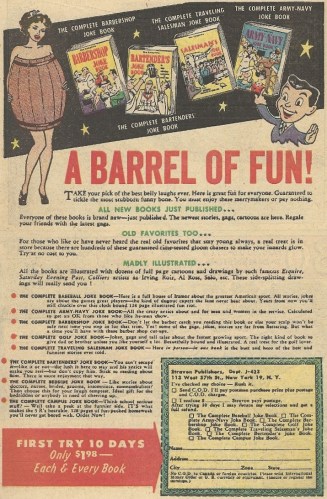
Nothings says “gales of uproarious laughter” like a lady in a barrel. I guess. I thought that sort of thing only happened to the chronically downtrodden and degenerate gamblers after a terrible string of bad luck, but what do I know. Apparently it’s ideal for peddling joke books. Who ever knew that the old barrel poor/bankruptcy barrel trope could be so versatile?
Also, enjoy the special guest appearance by what looks to be Big Boy‘s cousin.
Presenting the most unscantily clad jungle girl in jungle girl history- Nyoka the Jungle Girl #24
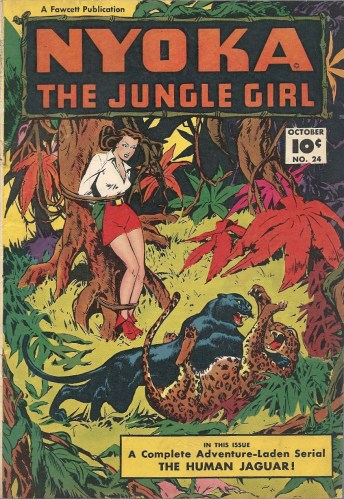
When you think, “Jungle Girl,” you think of babes cavorting in dense underbrush while garbed in various states of undress, from the leopard-print bikinis of Sheena to the wispy gowns of Rima. Now, I’m not saying that Nyoka, the star of her own little eponymous series, dresses like a Mayflower pilgrim. Far from it. But the plunging neckline of her blouse and her short little red skirt are rather prudish in the TITILLATE ME world of juggy jungle vixens. I mean, she even has footwear. She might as well be wearing a burka when placed among her peers. Granted, a lot of this comes from her origins: Nyoka, a daughter of a man of science, has an affinity for the jungle, but she’s not a true jungle denizen like the aforementioned dames. She hasn’t “gone native,” as it were. But still.
Nyoka’s fictional debut came in a 1941 film serial entitled, surprise, Jungle Girl, which was loosely based on the works of Edgar Rice Burroughs. (Emphasis on “loosely.”) It was your standard “white people go to Africa and meet white people dressed as black people” 1940s screen fare, and has perhaps rightly been relegated to the dustbin of history and clips on YouTube. But the serial spawned a sequel, and, of course, there are still these musty old comic books kicking around, keeping the Nyoka flame alive. This particular issue has a three-part story that’s about as stereotypical an old-timey jungle adventure as you can get. It features a witch doctor. A witch doctor with a big old pot above an open flame. Will he roast Nyoka? Is he up to some unknowable witch doctor scheme? Let us investigate.
Nyoka’s giving a couple of men in pith helmets a guided tour of the jungle when one of the gents (Dwight) strays and comes upon the aforementioned witch doc, who’s brewing up an evil “human jaguar” potion (said doc also has the standard trouble with articles and pronouns):

Dwight and his pasty, knobby knees get captured, and the witch doctor, who had to force the brew down a fellow jungle-dweller’s gullet Mola Ram-style, finds a much more willing subject in poor Dwight — but not before Dwight gets in a “White Man’s Burden” thought balloon:
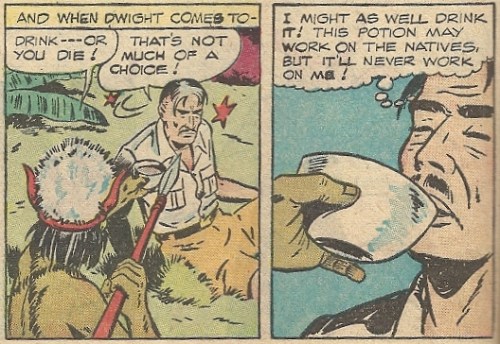
Yeah. Guess what — IT WORKS, and soon Dwight is menacing Nyoka in goofy fashion from the tops of trees:
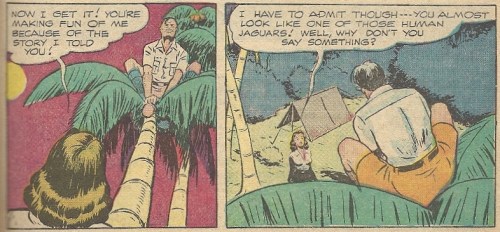
Even though Nyoka might not have the best jungle girl wardrobe, human jaguars aren’t much of a threat to her, and in no time she’s knocking Dwight out with a rifle butt and tying him up with vines:
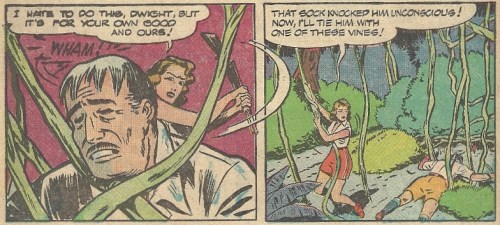
So there’s a little bondage — I hope that makes up for the clothes thing for all the fetishists out there.
Nyoka ends up getting captured by the witch doctor, her other male companion comes to the rescue, and they eventually use the witch doctor equivalent of waterboarding to learn the antidote:

AND ALL IS ONCE MORE RIGHT WITH THE JUNGLE WORLD.
This a relatively enjoyable little story (no clue on the creative staff behind it), and a decent example of the old jungle tropes. The visual sense of humor displayed as Dwight perches on top of a tree has a quality that you don’t often find in contemporary fare. There’s also — thankfully — an utter lack of bones through noses and large rubbery lips. And that’s about all you can say about this comic. It is what it is. (I prefer my ancient comics to have a dose of John Wayne punching people or something similar, thank you very much. But that’s just me.)
The Nyoka character, who had her comics start at Fawcett (which published this book), has passed through a number of publishing houses over the years. She most recently wound up at AC Comics in the 1980s, and has languished since. Perhaps the world is ready once more for her unique jungle babe fashion sense. Would she be tarted up a bit more? Would her more Europeanized underbrush wardrobe find a welcoming home in the new millennium? We may never know.

If you want a break from 1940s baseball player Wheaties ads (like the ones here and here ), then this 1948 father-and-son Stan Musial ad for Winthrop shoes is right up your alley. Stan the Man definitely makes a better “in retrospect” shoe pitchman than O.J., and you have to love the days when it was plausible for a young boy to desire regular non-sneaker footwear.
If you want to see Dick Musial in the present — or as close to it as I could find in a good frontal shot — check out this article, which talks about him accompanying his father when Stan received the Presidential Medal of Freedom. The smile looks the same.
Learn to play the harmonica in eight minutes, never in your life know the touch of a woman

I’d like to point out that, unlike guitar ad lessons that feature nubile women, there’s no implied promise here that newfound harmonica skills will increase your potency with the ladies. You’re welcome to try though. (And not all harmonica ads are devoid of feminine influence.)

I have bones to pick with this movie.
Before I break out my flail, let me say that Prometheus isn’t a bad film. It’s actually gripping in parts. Director Ridley Scott’s long-awaited return to his old science-fiction stomping grounds has a number of visually stunning scenes within its runtime, and several sequences that will have even the most grizzled theater-going veteran squirming in their seat. The early tension in the film is thick, and the build into the roots of the Alien mythos is fraught with all the awe and scope you could hope for.
But there are so, so many problems. This is not thinking man’s science fiction, despite the promise of “big ideas” coming our way. In fact, the film is surprisingly stupid at times, as if Scott took a class at The Michael Bay Institute for Just Because Filmmaking. It pains me to say that, but it’s true. Not to sound like a dick, but the people who think this is a smart movie may be imbeciles.
I took some random notes as I was watching. What follows is the general gist of them, mixed in with other thoughts and expanded a bit. There are spoilers within. BE WARNED. It’s impossible for me to gripe (and praise) without going into some detail. If you have plans to see this film, by all means go and do it, and if you’re so inclined come back here later to agree with me or call me some manner of moron. But if you don’t want to know anything, skip the paragraphs with the numbers next to them.
- There are several homages to classics of the past in the film. The opening scenes of a world aborning are almost lifted right out of Dave Bowman’s acid-trip voyage at the end of 2001: A Space Odyssey, and there’s actual honest to goodness footage from Lawrence of Arabia to be found early on. To put a five star epic like that within your own work is a risky move, and is done at your own peril. It can easily backfire whatever the intention is, because there’s an automatic juxtaposition that comes with the inclusion. The viewer puts things side by side. In this instance, it backfires. To appropriate Lloyd Bentsen’s most famous line: I’ve seen Lawrence of Arabia. Prometheus, you are no Lawrence of Arabia.
- Much was made in the long build to this film of how Scott and the rest of the Prometheus team were trying to distance the project from Alien, despite the “DNA” connections. I think this may have filtered into the dialogue, because the crew of the titular vessel, in discussing the “Engineers” of humanity that they’re looking for, are fond of semi-jokingly referring to them as Martians. I don’t know if the word “alien” is mentioned once, despite that being the OBVIOUS descriptor for the dramatic quarry. (Maybe it’s in there, but I don’t recall hearing it.) Most of this film’s action is set in 2091. Right now it’s 2012, and no one uses the term Martian to describe people from outer space. Everyone under the age of 70 would say alien. Unless there’s a Martian revival in 80 years, this strikes me as odd. I realize this seems to be a minor thing, but it irritated me. A lot.
- Michael Fassbender plays David, an android valet/scientist/creepizoid who carries much of the load in this film (and is also the one with the fondness for Lawrence, modeling some of his behavior after Peter O’Toole’s eponymous hero). Fassbender was delightful last year as young Magneto in X-Men: First Class, and here he follows that with another fine summer genre movie turn. He’s sometimes chillingly malevolent, sometimes achingly human, sometimes ambiguously motivated, and always a joy to watch. Noomi Rapace and Charlize Theron, the two female leads, also do fine work, but Fassbender steals the show just as he did last year. (In other cast news, Idris Elba is utterly wasted and Logan Marshall-Green plays a character I wanted to punch in the face.)
- Memo to Hollywood: If you’re going to have a really old guy in your movie, and you at no point are going to be showing that really old guy as a younger man, than go right ahead and cast a really old guy. Don’t cast a younger man in the prime of life and stick stupid rubbery makeup all over his face and let said younger man “act” like an old guy. It makes about as much sense as casting a white man to play a black man — or vice versa — and it looks just as foolish. Guy Pearce is unrecognizable as an elderly gajillionaire who finances the Prometheus mission, and for the life of me I can’t fathom why they felt the need to hire him, apart from the notion that Guy Pearce is some SERIOUS FILM darling that would bring a cachet to the cast. If so, SHAME ON YOU, MOVIE. (Don’t get me started on the third act “surprise” he’s involved with.)
- There are slimy, viscous, violent scares in the second half of the film that are sure to satisfy those craving such things, and there’s one bit that’s about as disgusting (in a good way) as you can get. Put it this way: I was a caesarean birth, and I now have much more sympathy for my mother’s plight. (I’m guessing she had some medical assistance, though.) Be assured, this single minutes-long section — you’ll know it when you see it through your fingers — is what got the R rating from the MPAA.
- The last act of this film is a cliche-riddled mess. Lame “surprise”? Check. A silly reveal of a family connection? Check. A giant, highly advanced alien — oops, forgive me, MARTIAN — who’s adept at slugging people? Check. Groan-inducing Team America-esque “We’re with you to the end, Captain” lines from characters you’ve barely met? Check. Gaping holes in the plot left unfilled? Check. Damon Lindelof, most known as a cock-tease showrunner on Lost, clearly brought his “leave everyone hanging with mysteries and trick them into thinking the hacky crap they’re seeing is great characterization” A-game to scripting this affair. At least I didn’t spend a year watching people fart around in God’s waiting room or whatever this time around.
- There are times when Marc Streitenfeld’s score, which is generally not good at all, assumes a pounding intensity that reminded me, of all things, of the opening music in John Carpenter’s Prince of Darkness. I love Prince of Darkness, so this is far from a bad thing.
- There are holograms present in the Engineers’ digs that give our explorers much sought after exposition. It’s unclear how these holograms are accessed so easily and why they would immediately show information that would be so key. What I said above about Just Because Filmmaking? Yeah.
- We’ve waited 30+ years to meet the Space Jockeys, and they’re by far the most intriguing aspect of the film, though it’s a bitch that their origins and motivations are still up in the air by the end. I’m so frustrated by the dumbness of this supposedly intelligent film, I’m not sure that I want to learn any more. Let sleeping dogs lie, you know? I’m tempted to tell Sir Ridley to take his potential prequel-sequel and cram it.
- Ah. Yes. Xenomorphs. Chest-bursters. Face-huggers. You won’t have to be eagle-eyed to spy their cousins, though it might be another layer to the frustration for you to wonder at… Actually, I’ll shut up. Though I haven’t spoiled all that much, I’ve said enough. (Well, not quite: After all the protestations from Scott/Lindelof et al. about how this isn’t an Alien film, the last image almost comes across as a middle finger to the Alien-loving audience.)
Scott has long been considered a great director. I think it’s time we re-evaluated that. He’s made numerous films, and they always have a technical competency to them that’s assuring in a world where there’s so much tripe. But what are his great, GREAT films? Alien? Yes. Blade Runner? Yes — the director’s cut, at least. Gladiator? Ehhhh – maybe not, despite the Best Picture Oscar. Other than that? Thelma & Louise? Black Hawk Down? There are crowd-pleasers in there, but transcendent works whose artistry helps define a medium? You have to go back a long way to find a surefire candidate for that.
That’s where a lot of my frustration comes in. This was Scott’s return to the universe that gave him his one true out of the park grand slam, one that never needed a director’s cut to iron out kinks (and excise awful narration). That this film, which starts with such promise, peters out so poorly is hard to swallow. Maybe you can’t go home again. But I had hoped that Scott could. He didn’t. Maybe he didn’t even want to.
Despite all the flaws, I can still recommend this movie to people. You could do a lot worse. But lordy lordy, this could have been so much more.
I give Prometheus three GAME OVER MANs out of five, and that’s probably too generous.

Star Trek generations collide for the first time (with all the pop of week-old soda) – The Modala Imperative


Star Trek has had ups and downs since its very inception. It was a cultural sensation in the late 1960s. It dodged cancellation once, only to fall before that blade after its third season. It found new life in syndication. It had a feast or famine movie franchise. Multiple television spinoffs occupied the airwaves from 1987 to 2005. And, in 2009, we went back to the beginning, rebooting the original primary color adventures from forty years before. A HELL OF A RIDE.
There were multiple high points along the way, but Star Trek perhaps had its most potent era at the beginning of the 1990s, right around the 25th anniversary of the franchise. The film series was still chugging along with the original crew, and the last crowd-pleasing adventure with the old folks was just around the corner. Star Trek: The Next Generation was hitting its stride, and its touchstone cliffhanger, “The Best of Both Worlds,” had recently left fans hanging for a long, painful summer. There were the earliest brainstorming sessions of a concept that would one day coalesce into Deep Space Nine. There were new paperback and hardcover novels published seemingly daily, and DC had two well-crafted ongoing comic books, each featuring one of the respective generations.
I confess to a degree of chauvinism here, because this was when I was most into Star Trek. I mean, I was into it. I never went to a convention, I never sewed my own costume, I never learned Klingon or anything, but I couldn’t get enough of the fiction. I devoured every last bit of the stuff that I listed above. And I had friends who were into Trek too. It was a moment where the dorkiness of Trek fandom was almost a selling point. I wouldn’t say being a Star Trek fan was hip at that point, but it was easy, perhaps the easiest its every been.
And there were few things that got me quite as ginned up as The Modala Imperative, two intertwined 1991 miniseries that promised fans the first semi-crossover between the Kirk/Picard eras. It wouldn’t be a crossover proper, with Kirk’s and Picard’s crews mixing and mingling, but OMG SPOCK AND MCCOY WOULD BE ON THE ENTERPRISE-D. Leonard “Bones” McCoy had already had a one-scene uncredited cameo in the TNG pilot, “Encounter at Farpoint,” but here he’d be back in full. And Spock, a Vulcan whose long lifespan would put him easily in the decades-later 24th century timeframe, would be along for the ride (before his onscreen return later that year in Season 5’s “Unification”).
Then I read the series, eagerly anticipating every installment — and was vastly underwhelmed. It was a case of “it has to get better,” and one of those soul-crushing times when it never does. And reading it again at this relatively distant remove doesn’t make it any less of a disappointment, either.
Pablo Marcos tackled the art chores on both halves of the project, while Michael Jan Friedman and Peter David, veteran Trek scribes both, scripted the respective original and Next Gen portions. Things get off on the wrong foot (with me) on the very first page of the very first issue of the very first mini, as Montgomery Scott and Pavel Chekov vie to see whose written accent is more obnoxious:

This is a personal critique that may be limited to my little corner of the universe, but here goes: Lay off the accents when writing for these guys. If someone is picking up a Star Trek comic, there’s a good chance they’ve internalized the vocal patterns of every single character long ago, and throwing in assorted didnas and sairs is overkill. And yes, obnoxious. An occasional wessel or canna might be acceptable, but I’d rather see none than open the door, you know? I recall reading somewhere, I think in The Elements of Style, that one should be careful when rendering accented dialogue, as it can be really distracting for the reader. Good advice.
The first half of the tale is your standard Prime Directive-laden away mission, as Kirk and a still-learning-the-ropes-and-growing-as-a-person Chekov inspect the planet Modala for potential first contact and Federation membership. But, like roughly 50% of the televised episodes, things go awry when they’re caught in between to warring factions and the Enterprise crew struggles to extract them. HOW ORIGINAL. The pedestrian “been there” framework of the story aside, there’s still some decent character work between Spock and McCoy, the Ego and the Id of their mutual friend the Captain and the stars of both chunks of this bifurcated crossover. Witness:

It fits like an old glove. You can almost hear DeForest Kelley and Leonard Nimoy. (And no dopey accents!)
Another complaint I have with this first half is that moments are carved out for the most minor of minor characters among the original Enterprise crew. This is one of the things I always hated in the Next Generation movies: Getting our story derailed so that lesser characters we don’t give a rat’s ass about could get some time under the lights. I’m looking at you, Beverly Crusher and Deanna Troi. This pattern is an unwelcome addition to the original crew’s comic, and unjustifiable since there are no actors making demands for a chunk of the pie. I mean, DOCTOR M’BENGA gets a page here, and it does nothing to move the story forward. But hey, we get a chance to wave and say hi, so that’s fantastic. Mazel. And who hasn’t wanted a dose of the Transporter Tao of Lieutenant Kyle?:

Long story short, Spock and McCoy themselves beam down to he planet to rescue their comrades, and Kirk and Chekov in turn lay the seeds for the Modalan good guys to triumph over their oppressors. This all feeds into the later Enterprise-D reprise, as McCoy is invited to tag along with the new crew to now Federation member Modala to help commemorate the 100 year anniversary of the events of the first series, which spawned that planet’s liberation.
But first, here’s some standard “Data in goofy attire on the holodeck” nonsense:

Now that that’s out of the way…
Much of the (second) first issue revolves around the puckered old McCoy, with his stoop and grandma hair, interacting with the Enterprise-D contingent. I’ll give David credit in that most of his Trek stories, whether book or comic, touch all the requisite characterization bases, but some of the dialogue in these Modala Imperative “get to know you” scenes feels forced, as if there was some quota at play. But hey, McCoy is on Picard’s big bridge, with its Gateway Arch, so there’s that:

As with the first four issues, the big selling point is the play between McCoy and Spock, the latter of whom makes a “surprise” rendezvous at the end of the first issue. The presence of the two of them overwhelms the story to a degree, and most of the Next Generation contingent are afterthoughts in their own time. One piece I genuinely enjoyed, though, involved the two of them giving voice to a debate that’s raged amongst Star Trek fans for decades now: Who’s the better Captain, Kirk or Picard?:
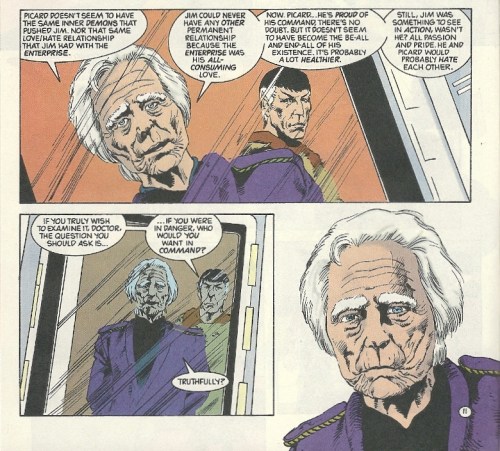
If you want to know McCoy’s answer, you’ll have to read the book. And the answer might surprise you.
Any guesses as to what the big drama is in this century-later rehash? If you said “PRETTY MUCH THE SAME DAMN THING AS THE FIRST SERIES,” then you win a prize. Picard, Troi, McCoy and Spock beam down for the planetside celebration, the Enterprise gets duped away, trapping them on the planet as the Ferengi show up. Yes, the Ferengi, who had a surreptitious hand in that earlier conflagration and have now come to claim their due.
The Ferengi suck as villains (I’m surprised McCoy never uttered a disbelieving “We fought Klingons and Romulans and you get these ass-clowns?”) and this second four issue cycle is very much “McCoy, Spock and the Enterprise-D Babies.” The “youngsters” get short shrift, even, to a degree, Picard. Nothing sums both these things up more than this sequence, amidst the confusion after the Ferengi make their explosive entrance:

A round of Disdain for the house.
It all works out (storywise) in the end. And our two original crew guests never once talk about what happened to their toupee-wearing friend. Which was perhaps for the best.
I remembered little about this “event” apart from my youthful disappointment, and reading it again I’m not surprised, since there’s not much to hang your hat on. Neither of the two halves feels right. In a way it’s forced like the Green Lantern Versus Aliens mini profiled here several days ago (this is better, though). The only selling point — it might be a saving grace — is the Spock/McCoy interplay. The aged doctor’s reaction when he sees his old sparring partner for the first time in years is heartwarming no matter the context. If nothing else, David and Friedman got that dynamic right. And that might be more than enough for some. If so, great.
Of course, none of this really “happened” thanks to the aforementioned “Unification,” which wiped this non-canon stuff off the map. Oh well. Still, it could have been better.
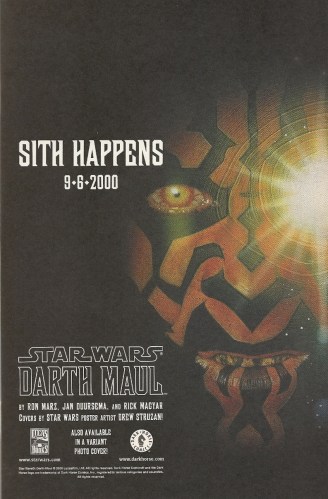
After the yawner that was Episode I, it either takes balls, stupidity or obliviousness to allow a reader to associate excrement with your product. Darth Maul was, granted, one of the few bright lights of The Phantom Menace, but the one-note brevity of his screentime was part of the problem. And some of that stink carries over to the printed page (as poor Ron Marz gets saddled with another albatross).
Yes, shit does happen.
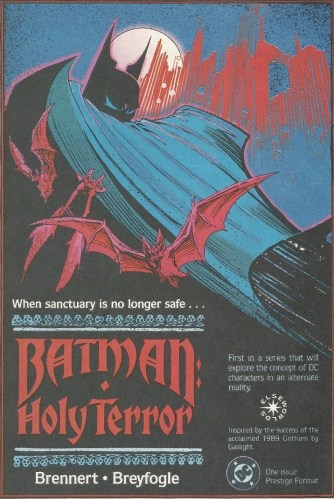
Batman: Holy Terror (not to be confused with Frank Miller’s abandoned Holy Terror, Batman!) was the first book to bear the Elseworlds imprint, and in that sense it, along with forebear Gotham by Gaslight, is responsible for a lineage of vastly divergent quality. Thank you for some of it. Damn you for most of it — holy terror indeed.
Love that Norm Breyfogle Batman, though. One of the Batmen of my youth. If you’re in the market for a stylized, nightmarish Caped Crusader, you need look no further. A Breyfogle return to the character might be the one thing that could force me to shell out the three dollars for a new comic book.
JOHN WAYNE FIGHTS WHALE!!! JOHN WAYNE FIGHTS WHALE!!! – John Wayne Adventure Comics #20
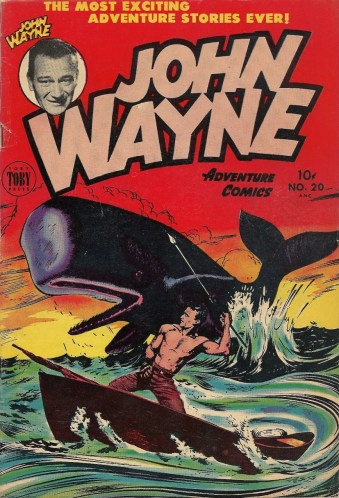
Let me point one thing out before digging into this book like a fat guy at a buffet: It’s only fitting that, in a bare-chested display of manliness, it’s a sperm whale that Wayne is getting ready to spear. Natch.
John Wayne. American screen legend. Icon. He was a movie star whose sometimes (read:often) cornball movies, with their dripping sentimentality, endeared him to a generation of moviegoers. He bestrode decades of filmmaking like a swaggering, irascible colossus, only to have his work’s quaint groove, changing times and his archconservative love-it-or-leave-it, my-country-right-or-wrong politics alienate him from the youth of the sixties and seventies. He was a man in full, a tall guy with broad shoulders and a toupee whose resume runs the gamut from classics like The Searchers to all-time duds like The Conqueror. And, incidentally to that last point, I think it’s safe to say that no actor ever had a better last role than he did, in a film and performance that was just as much about his mortality as that of the character he played. If you’ve never seen The Shootist, put it on your TO WATCH list.
I like Wayne. I like his movies. (I’m prone at odd moments to burst out a random CHISUM, JOHN CHISUM.) I like them even more because my grandmother absolutely adored Wayne (I sometimes wonder whether she would have thrown my grandfather, her husband of 50+ years, aside if Wayne ever looked her way) and I see a little bit of her whenever I watch one of his flicks.
And somehow I never knew that he had a comic book. Until I stumbled onto this bad boy this past weekend. Totally missed it. KNOCK ME OVER WITH A FEATHER. Where have you been all my life, John Wayne Adventure Comics?
This series (from the short-lived Toby Press imprint) is part of an old comics genre where famous actors, as themselves, were plopped down into outlandish adventures. John Wayne isn’t playing a character (not that he would in a comic book, but…). John Wayne in this series was John Wayne. For a modern audience, think of Jerry Seinfeld in Seinfeld, playing a fictionalized version of himself. Or hell, if you’re an older person, Jack Benny playing Jack Benny. But these early comic books were more outlandish than those TV cousins, with scenarios that were much more varied and kooky than a comedian and his pals (I’d cite Jerry Lewis as an example, but his book was a bit too outlandish, and I loathe him with the heat of a thousand suns). Which means the strutting, drawling Wayne was plopped into some nuts situations. This particular issue has three stories, including a de rigueur Western, but, obviously, we’re going to focus on the cover story. You know, the one which has Wayne out to sea face to face with a big ass whale. Just to warn you, though: At no point in the story does Wayne challenge a whale with only a rickety little boar, a spear and his bare pectorals. COMMENCE GNASHING OF TEETH. This is one of the seemingly infinite number of bait and switch covers/stories. But, as a consolation, this short features madness, lust, planes ditched at sea, perfidious whalers, multiple elaborate attempted murders and, of course, JOHN WAYNE. Strap in, pilgrim.
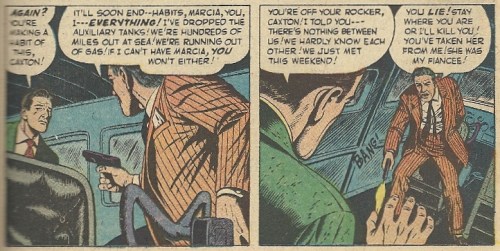
The trouble starts in “Mad Man’s Whim” while Wayne is staying at a millionaire’s hunting lodge. In the first panels we learn that Edmund Caxton III — one of the most millionarey monikers you’ll ever come across — is seeking some pretty blonde bipedal game (Marcia), and that Wayne is having none of it:
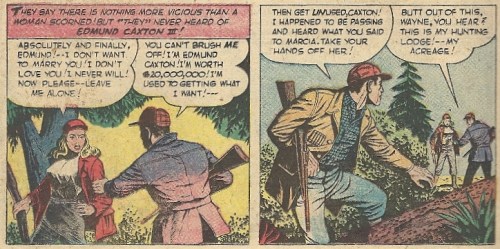
Note: This dialogue reads much better if you have Wayne’s voice in your head.
Wayne’s manliness triumphs. Rock may not beat paper, but here it beats gun — and head:
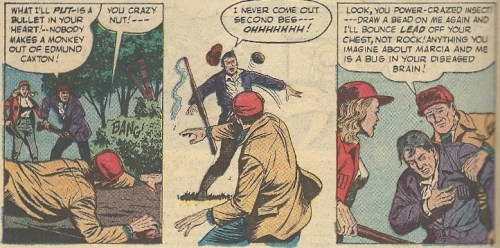
Back at the lodge, Caxton is apologetic, though he still harbors suspicions that John and Marcia (oh John, oh Marcia?) are secret lovers. He offers to fly them out, but — SURPRISE — he’s in full IF I CAN’T HAVE YOU, NO ONE WILL mode:
They crash at sea but miraculously survive, and fortunately a ship comes to their rescue. And not just any ship, but an old timey whaling ship. And when I say old timey, I mean old timey. We’re talking “wood and sails” old timey. (This comic was published in 1953, and the story seems to be set in that “present.” Were there ships whaling in the Ahab/Moby Dick fashion at that point? I confess, I’m not terribly familiar with whaling history.)
It turns out this deliverance isn’t the ticket out of danger that it seemed — at least for John and Marcia:
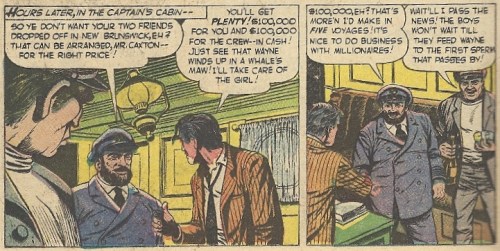
Sperm whale, sir. Not just sperm. Sperm whale. Please.
True to their word, the evils salt dump Wayne (who can’t resist an invitation to go out in a tiny boat to harpoon a whale — MANLY), but they get more than they bargained for when this big bull (not a sperm whale, btw) turns on them:
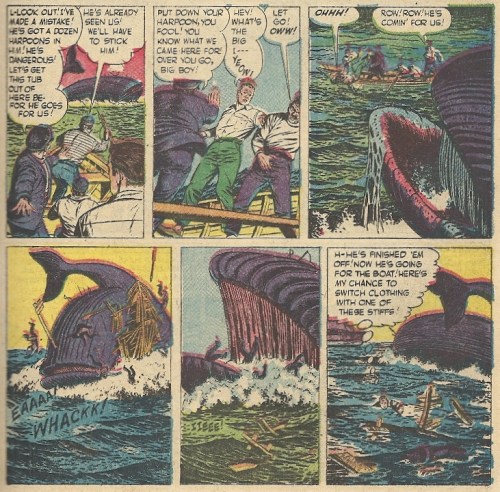
And when the whale is done with this snack, he goes after the whaler. IRONY. (About a month a go I read a book called In the Heart of the Sea. It’s about the whaleship Essex, an early 19th century vessel from Nantucket that was sunk in the Pacific by an enraged sperm whale — the true story upon which Moby Dick was based. It features cannibalism. RECOMMENDED.)
The whale’s attack is enough diversion for Wayne to get back on board and settle some scores. And how does Wayne serve up the ultimate comeuppance? With, what else, fists — and a dodged harpoon:
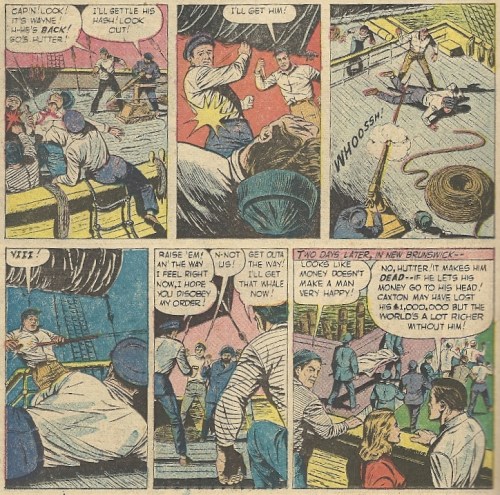
That’s it. And I’d like to point out that Wayne perhaps did do battle with the whale, but off-panel. I feel gipped. Let me suggest some potential dialogue for this unseen sequence: “I wanted to do some hunting, and by God I’m going to kill something before this vacation is over!”
I couldn’t locate any writer/artist information for this book, so I can’t give credit where it’s due. But it’s hard not to enjoy this all-over-the-place storytelling, and it’s an added treat that Wayne’s distinctive features — the skeptical, somewhat sad expression that he always wore — can be so clearly seen throughout. Though the art isn’t quite on par as that found in, say, an issue of the Golden Age Daredevil, it’s reminiscent of it, which isn’t bad. The whale sequence is especially cool.
In summation, discovering the newsprint adventures of John Wayne was a treat, and actually digging into them was no letdown. I can picture Wayne chuckling warmly if he ever saw that cover and read the accompanying story, and maybe that’s the most important seal of approval of them all. PILGRIM.
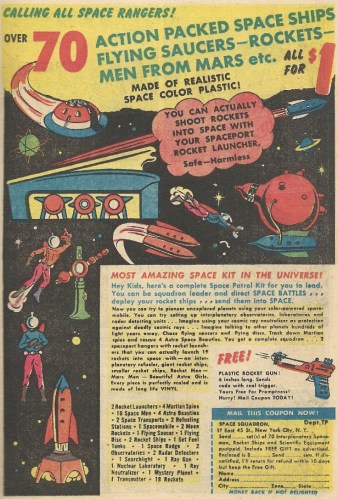
I find this ad’s claims of launching rickety plastic toys into space right on par with Yubiwaza’s assertions that the smallest, slightest person on Earth can become a self-defense killing machine. The copy is — forgive me — out there. Love the old curvy rockets, though.
Hey, call those thirty-year-old virgins from that dumb commercial, the ones who bought a weather balloon with credit card points. They’d lap this right up.
 Jared
Jared


 blog into mystery