The Flash! Batman! Infantino! Together! I’m in hog heaven! – The Brave and the Bold #67

I always used to associate the alliteratively-named The Brave and the Bold with the daytime soap opera The Bold and the Beautiful for no other reason than the double B barrage of both titles. The latter was (and is, I guess) a CBS confection that revolved around an assortment of babes and hunks in the fashion industry with (sort of comic book-y now that I think of it) names like Sally Spectra and Ridge Forrester. My grandmother loved that show — which is somewhat disturbing in light of its amped-up-even-for-a-soap-opera sexuality — and could update me on its developments as if she were reading the news section of a relative’s Christmas card. I’ll say this for it — it had a hell of an upbeat sax-fueled opening:
I, thankfully, have shaken the association between The Brave and the Bold and this spectacularly overwrought drama, but that had to be said.
I learned in my brief research of this issue that it marked the beginning of the long run of Batman team-ups in the title. And, in light of this issue’s publication date of August/September 1966, I was a little shocked by the cover puffery having Flash and Batman teaming “for the first time.” I guess without others around them, that’s true. Let’s not get too picky.
“The Death of the Flash” is brought to us by Bob Haney, Carmine Infantino and Charles Paris, and please note the open plaza with the ginormous tiles on the cover — an Infantino trademark that I’ve pointed out before.
This issue gets right to the point:

Nice work, Caped Crusader.
Batman runs up against a gang of high-octane hoods, and one crook outmaneuvers him so badly he crashes the Batmobile:

Later, the Whirly-Bat fares little better:
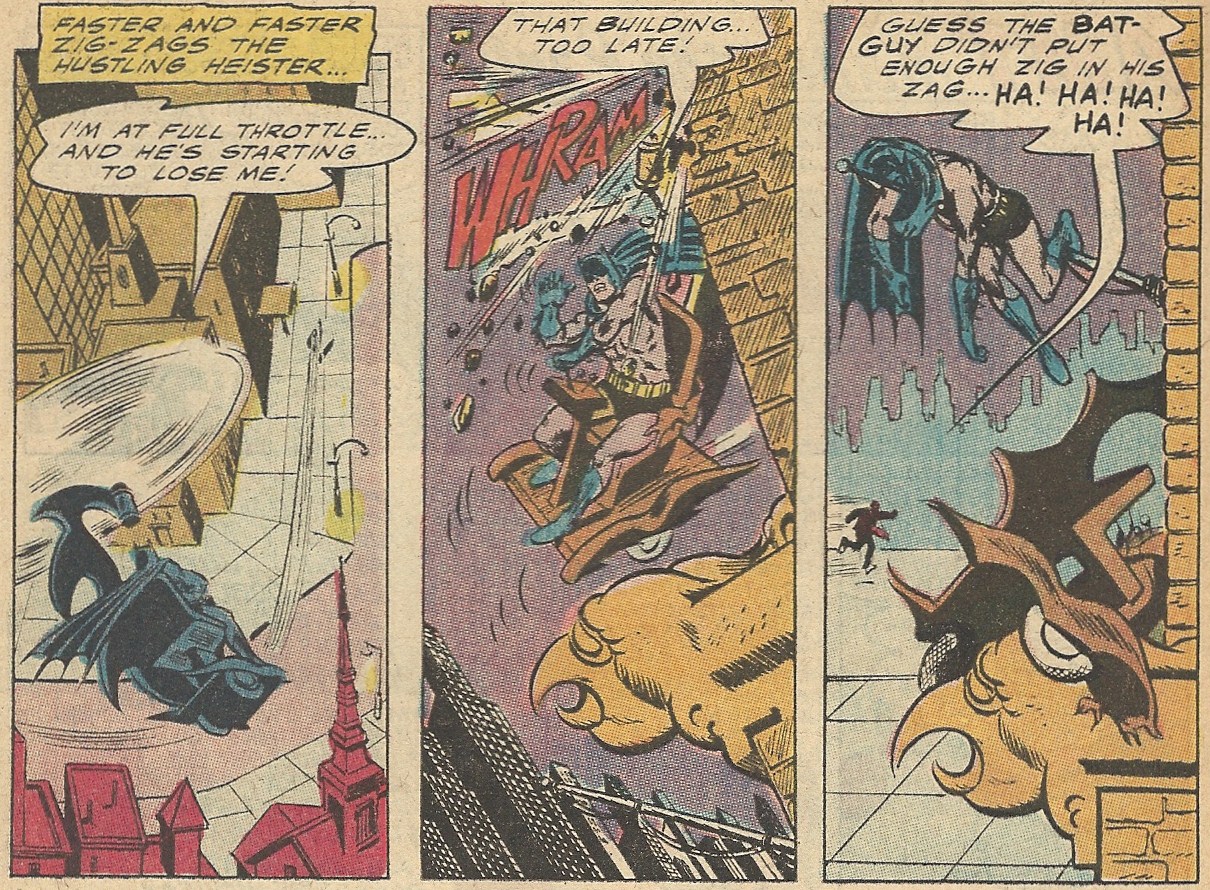
Even a simple “Bat”-less jet pack fails in the face of a simple smokescreen:
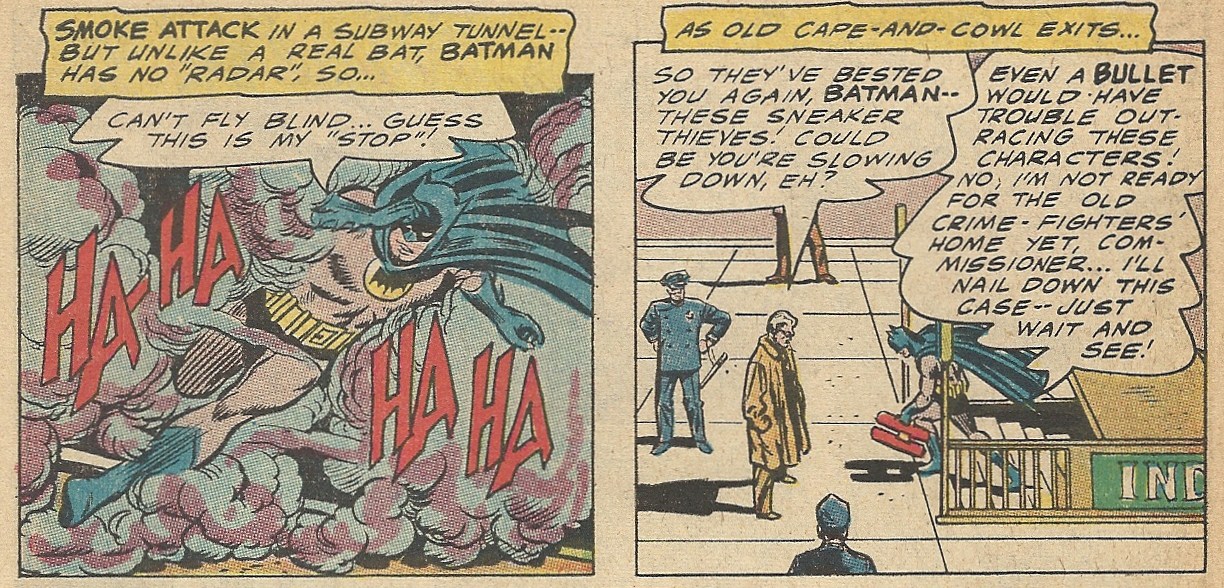
For shame.
While all this is going on, Flash has his own problems — he discovers that his super-speed is slowly killing him. Still, when Batman calls him on the ol’ Justice League ham radio, he answers the call and manages to catch one of the speedy thieves.
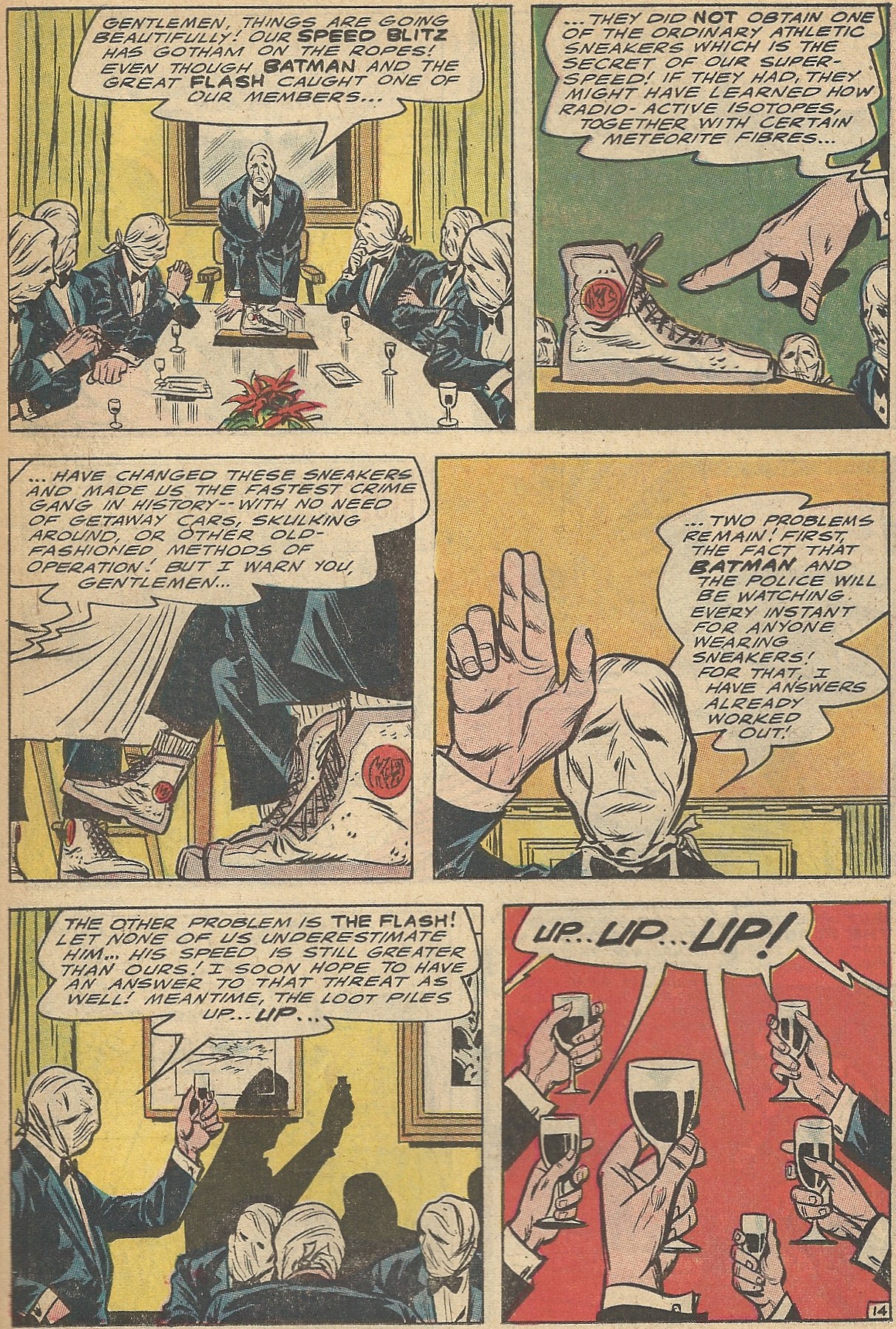
The “Speed Boys” hold a secret meeting where they revel in their villainy and talk about the source of their super-sneakers — meteors, radiation and Chuck Taylors!:
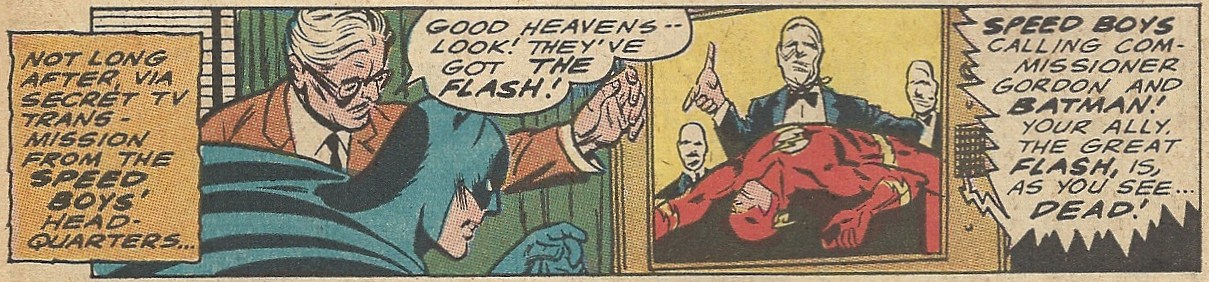
Flash continues helping Batman even after the Caped Crusader discovers Flash’s condition, and for his troubles the Scarlet Speedster soon apparently gives up the ghost:
Batman redoubles his efforts to catch the goons and soon springs a Santa-like surprise on them in their brownstone hideout:
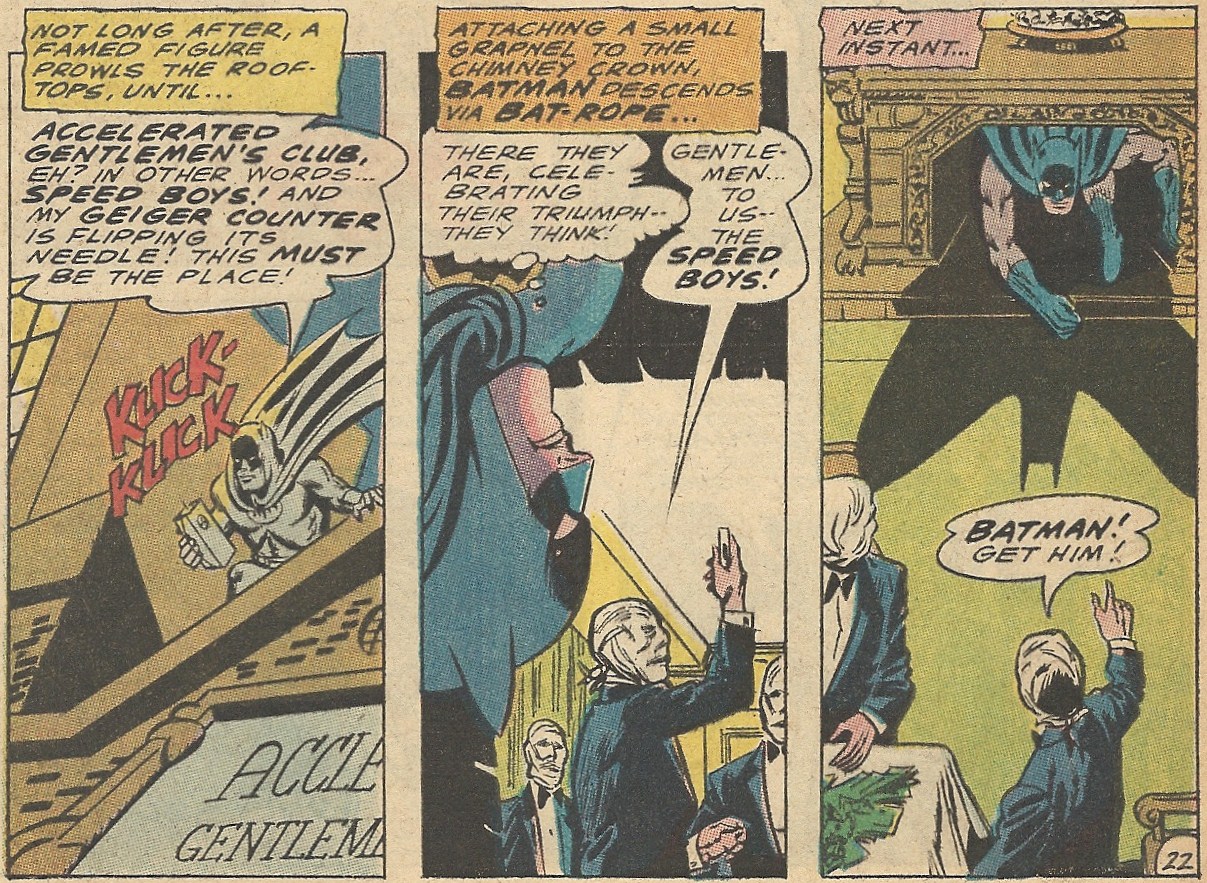
He gets some unexpected help in rounding up the final Speed Boy — a living non-zombie Flash! This deserves an explanation:
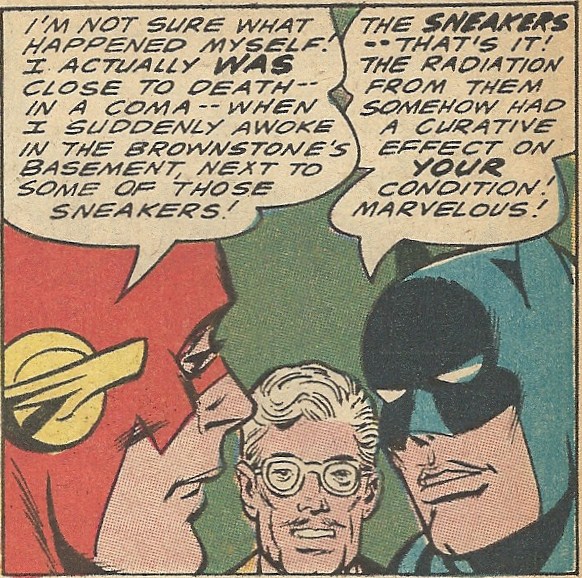
Thank God for radiation, the miracle cure-all of yesteryear. Or maybe it was just that the sneakers’ funk acted as smelling salts. Whatever the case, Flash is once more healthy and all is right with the world.
This was a real fun story, mainly thanks to the principal actors and the deft lines of a favorite artist. It was different to see Batman fail miserably with his usually overwhelming technology — his body draped over a flagpole was a highlight (or lowlight, as it were). And whenever radiation finds its way into a Silver Age story, merriment and wackiness ensue.
I’ll stop here. I’m feeling a little off. Maybe I’ll go lay down next to my running shoes and see if that helps.
I’ll help, Meat Loaf! – “Heroes Helping Heroes”
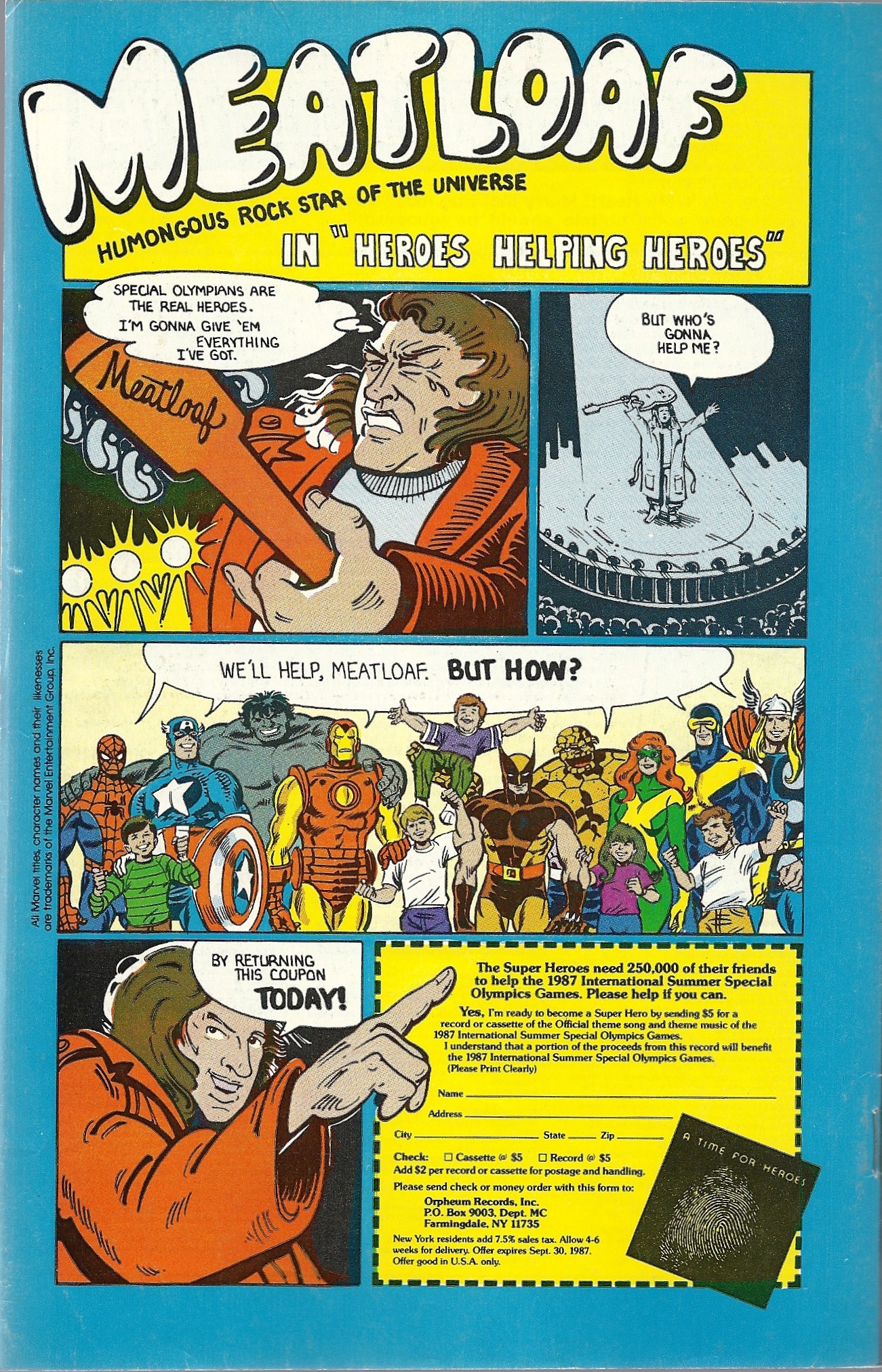
I remember seeing this ad in my youth and not knowing who the hell Meat Loaf was. Meatloaf was the thing that my grandmother would sometimes cook when I stayed with her and my grandfather (and her meatloaf was really good), not a rock star. At least the ad managed to convey that he was a heavyset sweaty man with a guitar.
It’s a fairly accurate portrayal, now that I think about it. That’s about all you need to know about him. Though I should note that they made his name one word, when he usually has it as two. Or maybe he had it as one word back then.
You know what? I really don’t care.
I’m not making fun — this was an ad to raise some funds for the Special Olympics. That’s a cause you can’t mock. Well, unless you’re South Park.
Go ahead, Meat Loaf. Give ’em everything you’ve got.
Get that boy some pants! – Kamandi #2
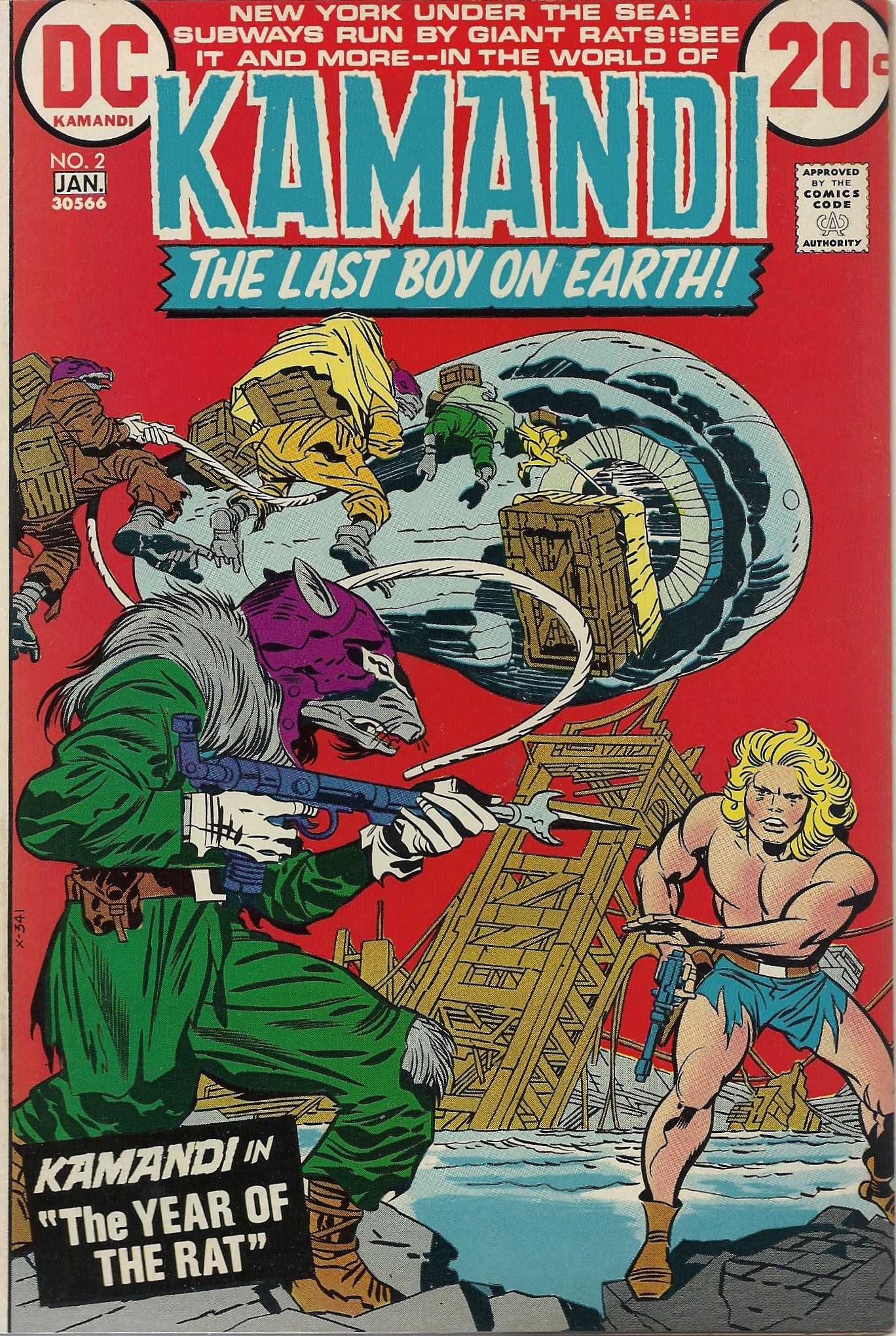
Kamandi may be my favorite title from Jack Kirby’s DC oeuvre. I like what the New Gods (mainly Darkseid) became in later years, but Kirby’s original take on them never really grabbed me. Don’t get me wrong — it’s good, but it doesn’t separate from the pack for me. Kamandi I like quite a bit (in spite of the perpetually half-naked male lead) and readers from back in the day must have agreed with me — it’s the only DC Kirby work that really had any legs and the only one that he was actually able to hand off to successor writers and artists.
They’re always enjoyable reads. The post-apocalyptic Earth after the Great Disaster was well-matched with Kirby’s fertile aptitude for creatures and machinery. The various now-sentient animals that populated this new Earth were quite wonderful, and it seemed like Kirby went to the zoo one day and just developed a checklist of what animals he would gift with the powers of reason and speech and good and evil.
Enter Doctor Canus:
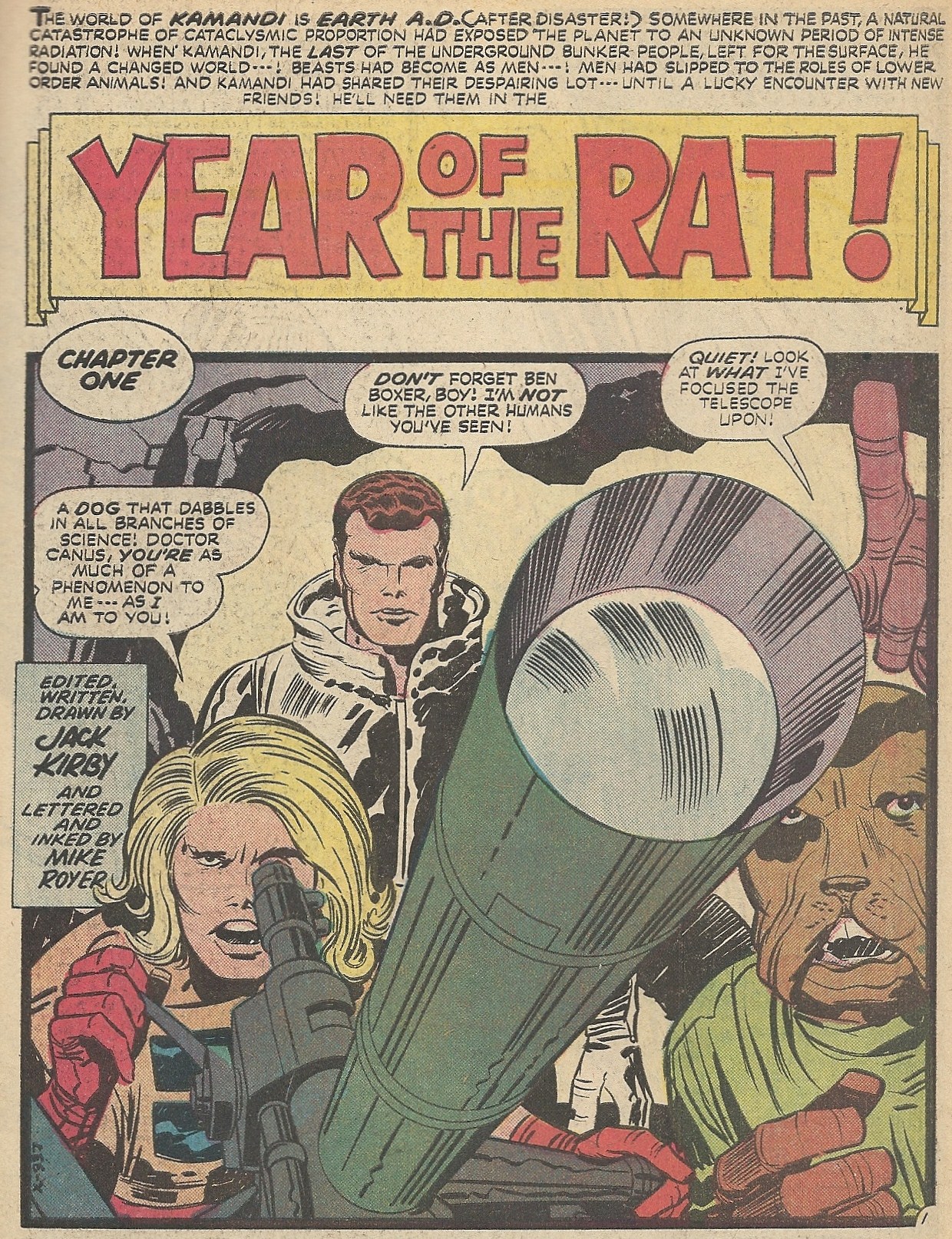
I love dogs, and I love talking dogs even more, and I love talking doctor dogs even more, but everytime I read Professor Canus’ name I think of this (somewhat disturbing) commercial parody:
Vodpod videos no longer available.
Sheesh.
This second chapter of the Kamandi saga is chock full of Kirby goodness (with helpful inks from Mike Royer). In “Year of the Rat!” we early on learn the true nature of Ben Boxer:

He and Kamandi make their escape from the Tigers (with the help of kindly Doctor Canus) and travel through an underwater New York City:

They soon fall into the clutches of big ugly rats. I guess it makes sense that grimy rodents would take over a New York City that’s been submerged and devoid of humans — hell, with the cockroaches they almost run the place today. Kirby does a nice job designing the rats, making their eyes beady and their fur so matted and ugly you can almost smell the damn things. Their crass dialogue helps too:
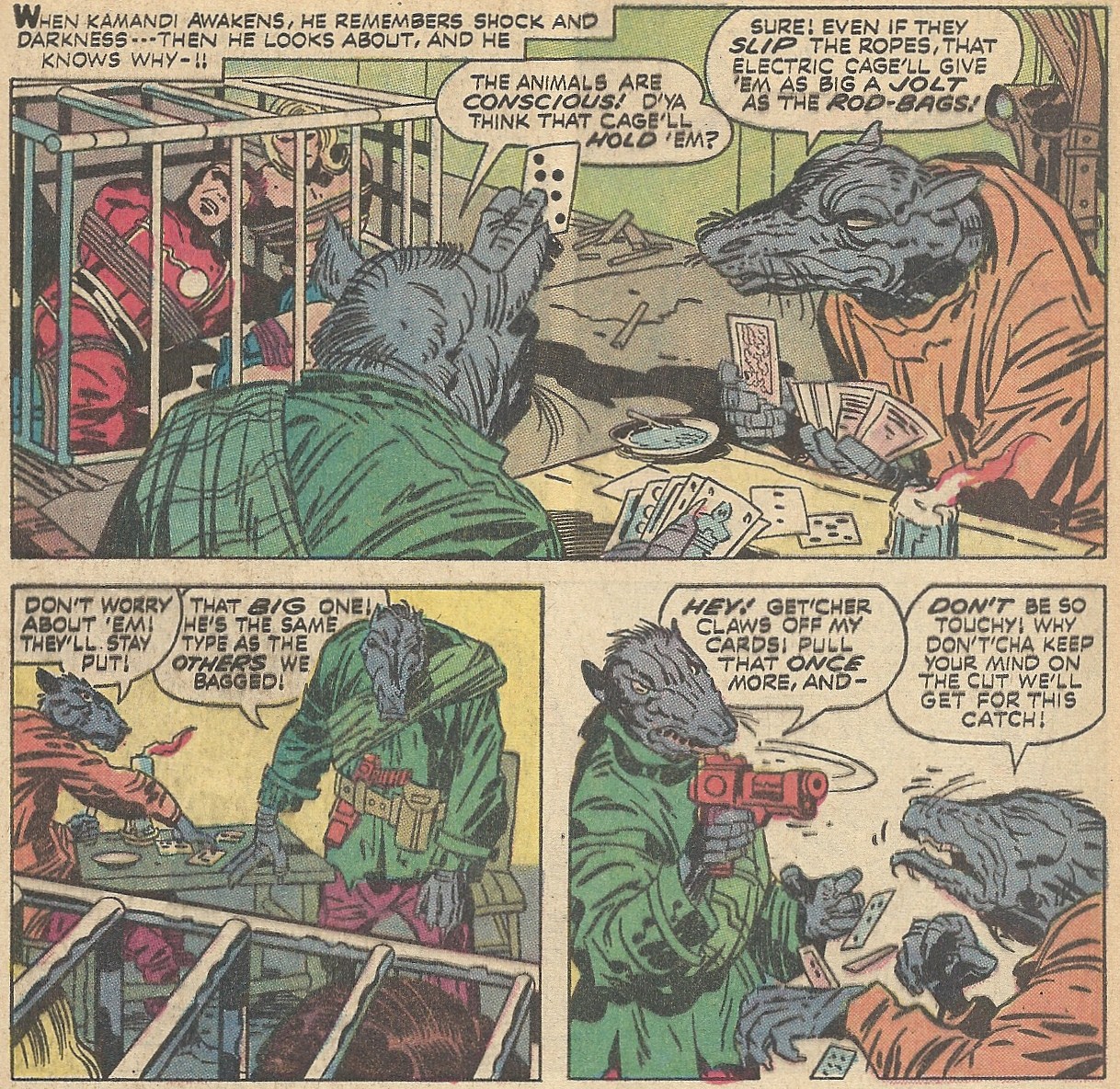
They’re definitely not cute and cuddly like Rizzo and his compatriots:
Though at least they’re not working in the kitchen and swimming in the coffee — you have to give them that.
There might be an element of the Skeksis from The Dark Crystal in Kirby’s rats (or maybe that should be vice versa):
Ben and Kamandi rescue some of Ben’s buddies and Kamandi joins up with this small group of fellow humans. That’s the simple summation of the rest of the story, but it belies the pleasure of this particular comic, which is watching Kirby slug away unfettered at the height of his powers. Here’s a few final words from the King himself about the end of the world:

It’s always fun to read some pseudo-scientific speculative kookery.
Whatever. The Apocalypse never was never more fun than when it flowed from Jack’s pen.
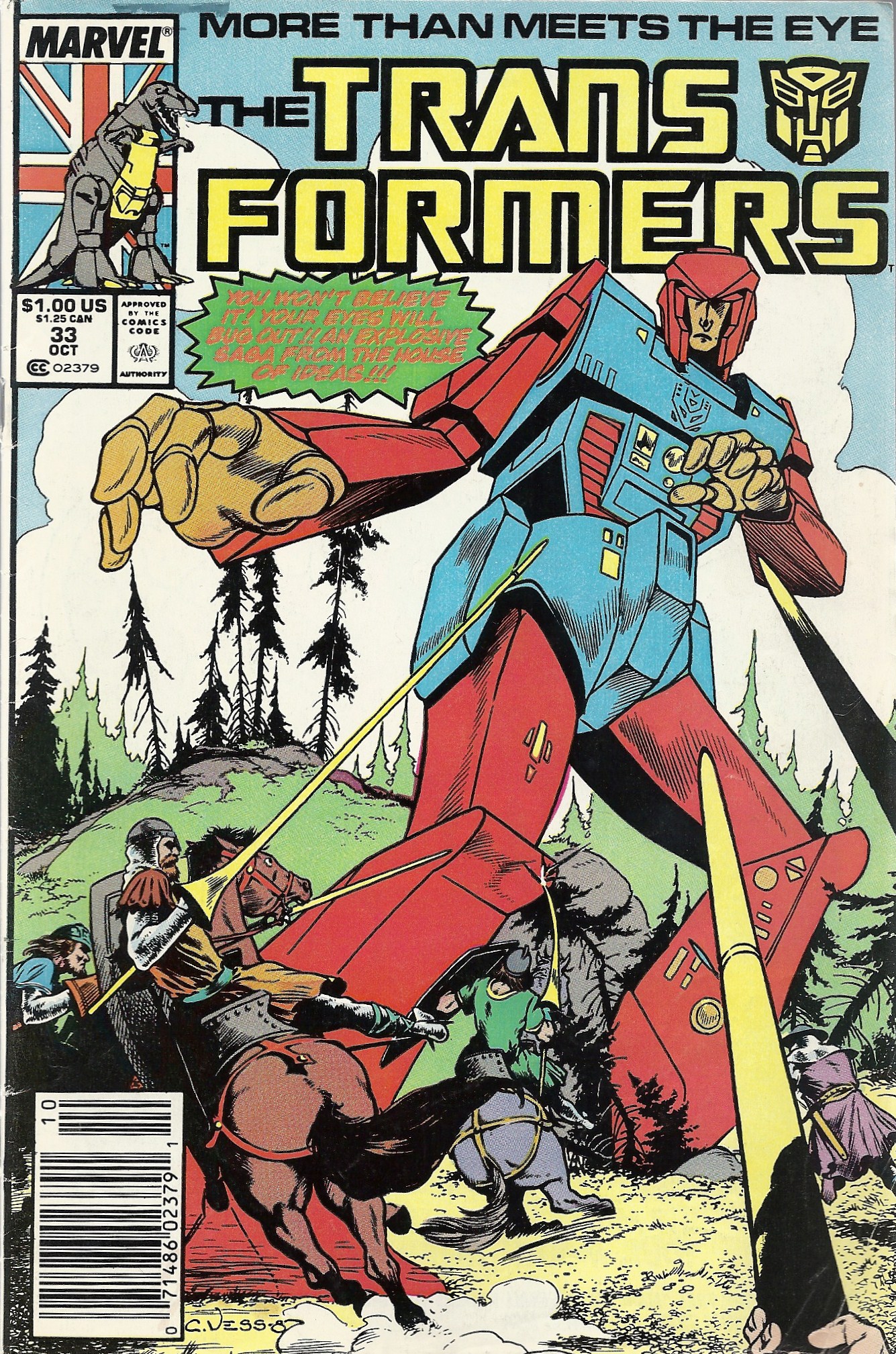
I loved getting mail when I was a kid. It was great to go into the post office and open up the mailbox with the hope that something would be coming for me, usually a children’s magazine like Electric Company, Sesame Street, or Ranger Rick. There were no worries about bills back in those days. Maybe the favorite subscription I ever had, though, was to the Transformers comic book. It was the only comic book subscription that I ever had.
God, how I loved the Transformers back then. I was one of the five or six people that saw Transformers: The Movie in the theater (it played to a packed house of two people if I recall correctly, including my mother and me) and I was one of those kids that wept openly when Optimus Prime died:
I’d be lying if I said that that scene doesn’t still moisten the ol’ peepers.
I loved those toys — they were one of the great obsessions of my early life. I suppose I still “have” them, though they’re stashed in a big garbage bin above my parents’ garage. I was deep into that whole universe. One of my buddies and I even started our own two-man Transformers fan club when we were about 8 years old, complete with a membership questionnaire and paraphenalia stashed in my treehouse.
Good times.
I look back on the fictions associated with the Autobots and Decepticons — both the animated and comic book forms — with fond nostalgia, though a lot of the stories are better in the remembering than in the rereading. I’m not going to dismiss them — as many cynics would — simply as crass commercials for plastic toys. There was some serious storytelling going on, and you can’t tell me that the writers and artists weren’t working their tails off to forge the best stories that they could.
There’s one Transformers story from the comics that has always stuck with me. It’s kind of an oddball because it’s a reprint of a U.K. Marvel storyline — the U.K. comics were a larger format and therefore required a little more material to fill in the open space each month after the American comics were reprinted. They hence had their own little side-universe going on. For two issues I was greeted with a rude surprise at the mailbox — Transformers comics that didn’t fit in with the ones that I was used to.
In a way, Transformers transformed.
I can’t say that I fell in love with this brief storyline back then. I reacted like all kids do when confronted with something new and strange — with skepticism. But this stories’ very difference was what has kept it rattling around in my noggin for over twenty years. I’m now very happy to share it with you, and I hope that you find it as neat as I now do.
“Man of Iron” was brought to us from across the Atlantic by Steve Parkhouse and John Ridgway (with a cover from Charles Vess). Just an aside… I can recall wondering what the deal with the art was — it only added to the “foreigh-ness” of the whole thing. I didn’t know until years later that U.K. comics had larger dimensions and, when condensed for U.S. size restrictions, took on a more detailed appearance. I had the same reaction to the Eclipse Miracleman reprints. I think you’ll see some of that difference in the scans.
The story opens at a sleepy medieval castle. The dull tours are interrupted by a squadron of Decepticons dropping… well, something, into the ground. Hmm. The castle curator is called out to size things up, and his son, Sammy, is out playing cowboys and Indians in the woods. A stray arrow leads him to a rather startling encounter:
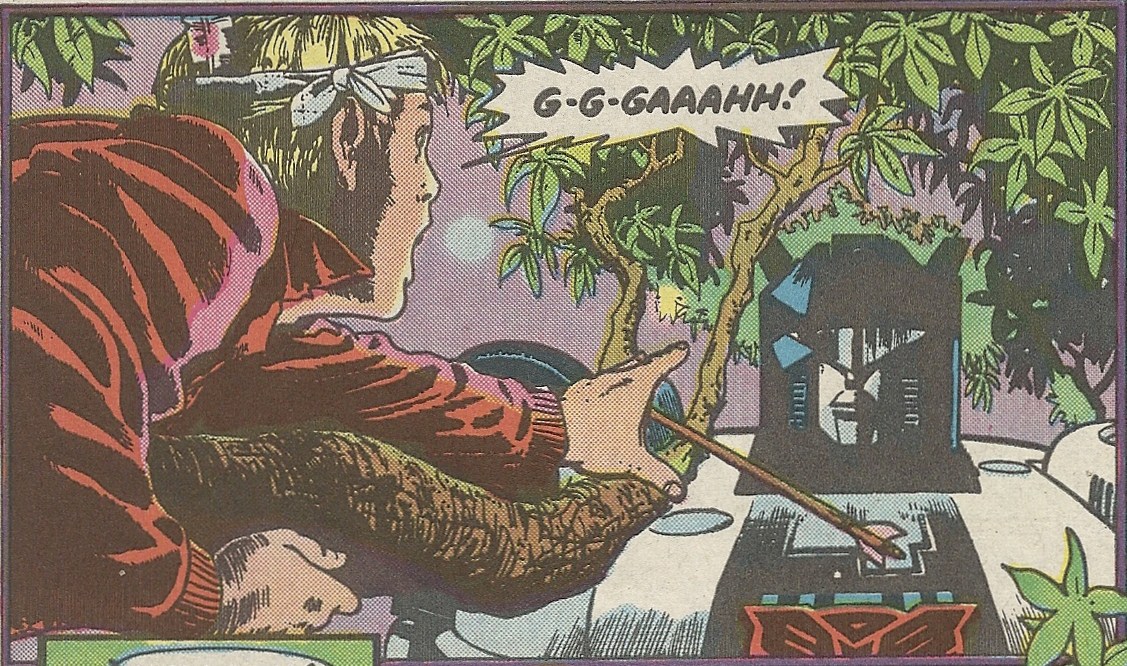
Sammy runs for his dear life, while the Autobot Jazz sets up a clandestine surveillance of Sammy in his Porsche guise. That night, Sammy’s dad tells him a story of a 1017 seige at the local castle, one that was broken by a strange visitor:
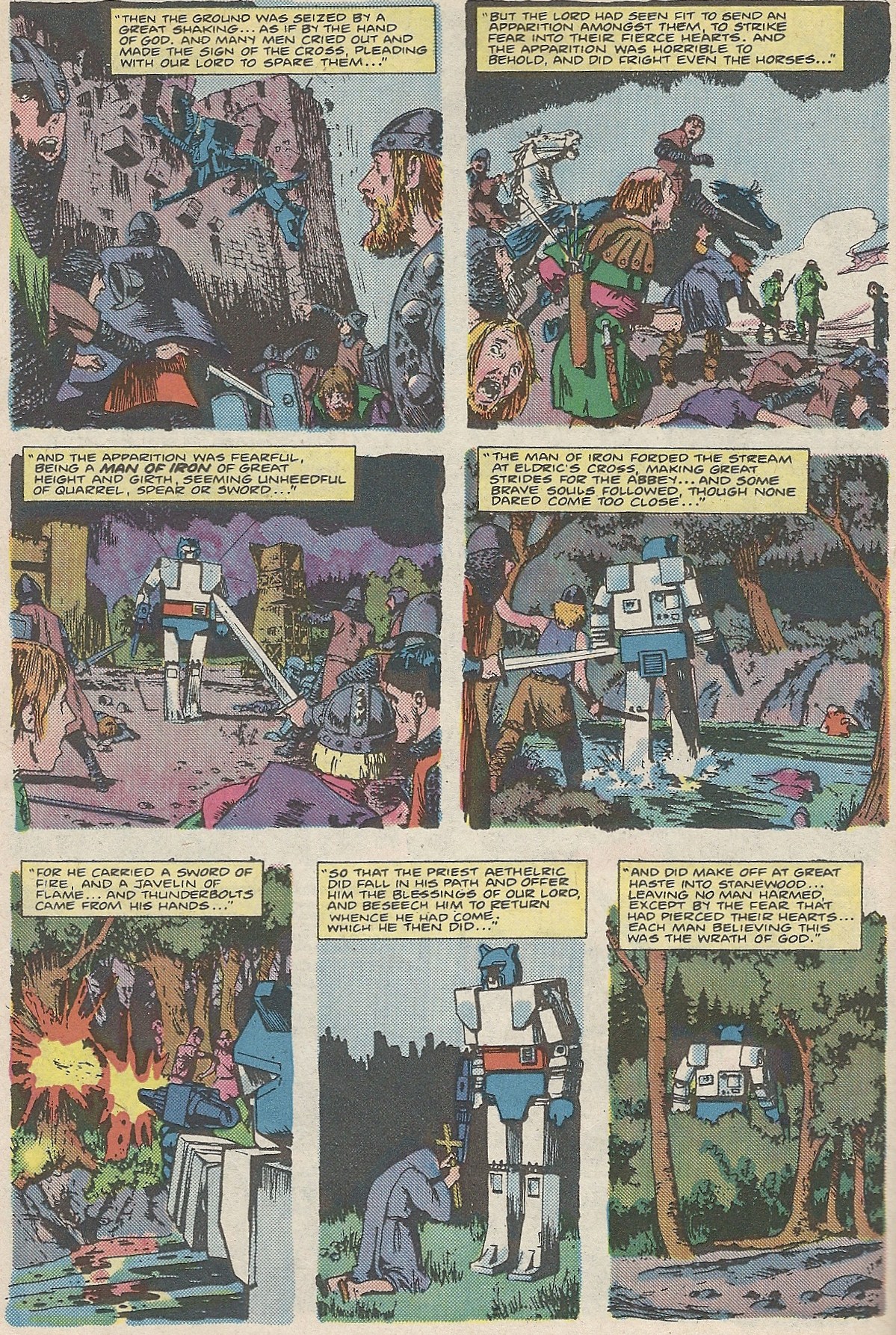
Dad even has a visual aid:
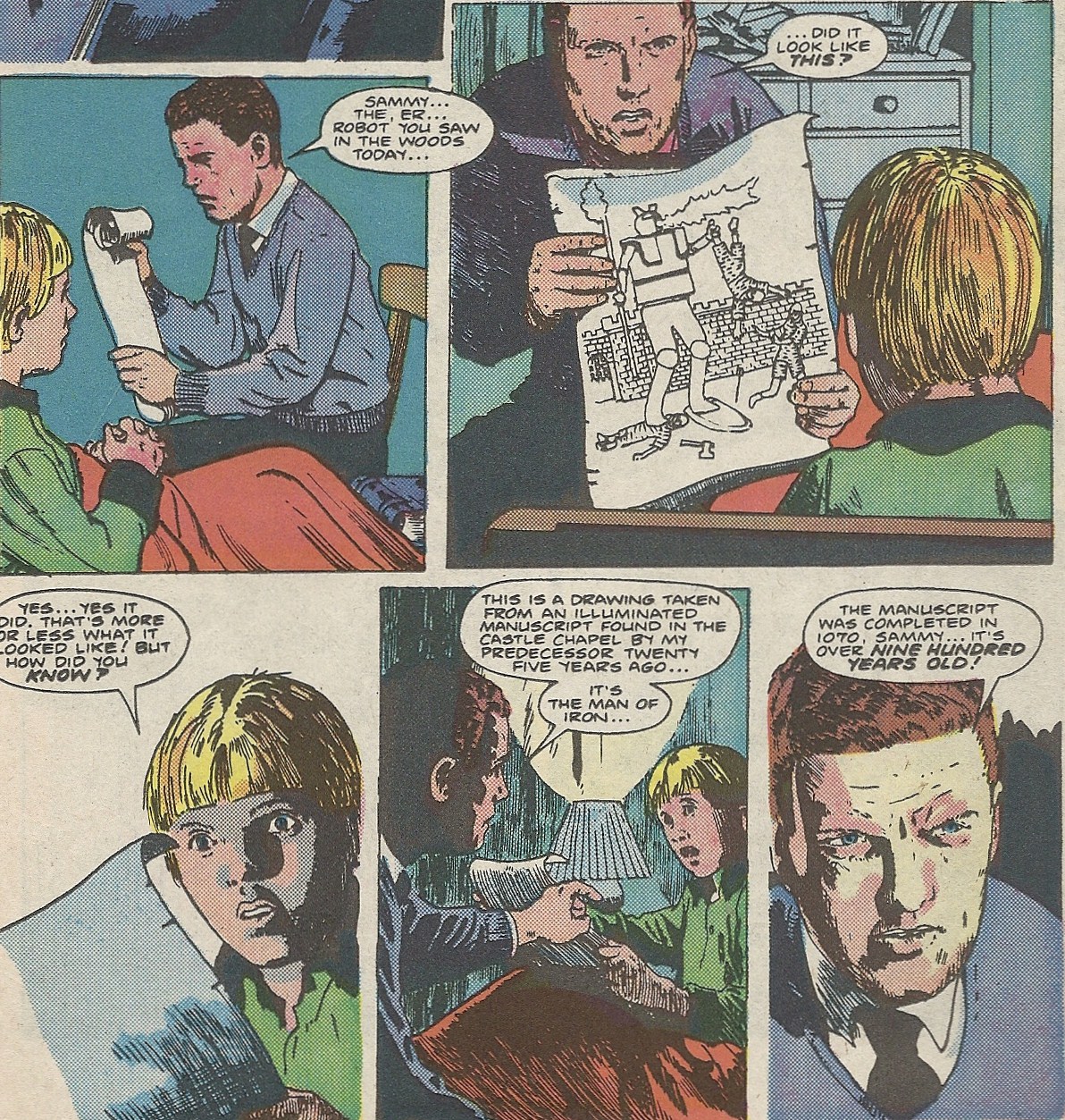
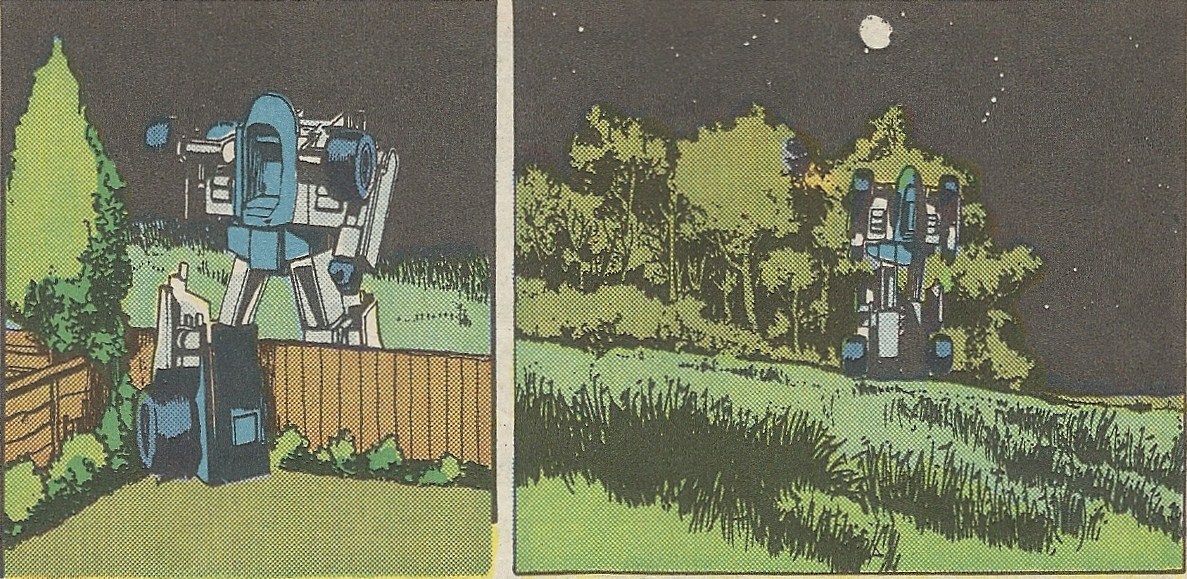
Later on, Sammy is having what we’re supposed to believe is a dream. The Autobot Mirage peers into Sammy’s window, and things in Sammy’s bedroom, including Sammy, float around in a scene reminiscent of a Hollywood alien abduction. Mirage takes the drawing that Sammy was shown earlier. Was it really a dream? Sammy’s dad looks out the window when he checks on his son and sees something indicating that it wasn’t:
The next morning Sammy’s dad learns that there’s something huge buried underneath the castle. Hmm again. Sammy has a strange encounter as well, this time with Jazz’s car form. Jazz comes off like a sexual predator:
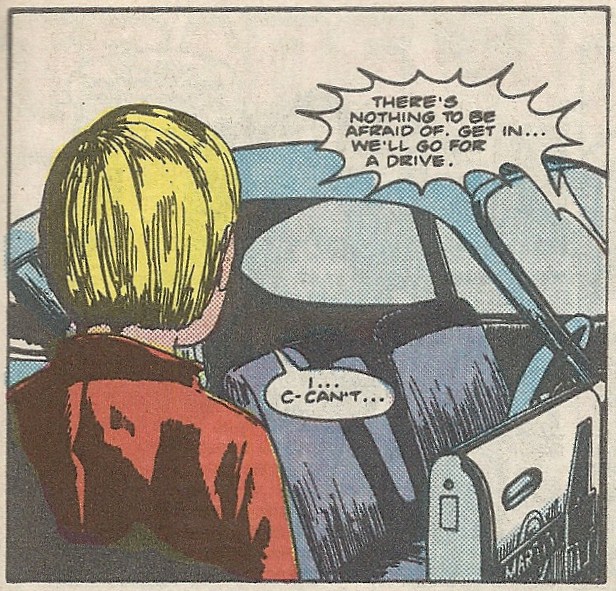
Where’s Chris Hansen from Dateline when you need him?
Our issue ends with every parent’s worst nightmare and a tacked on warning to youthful readers:
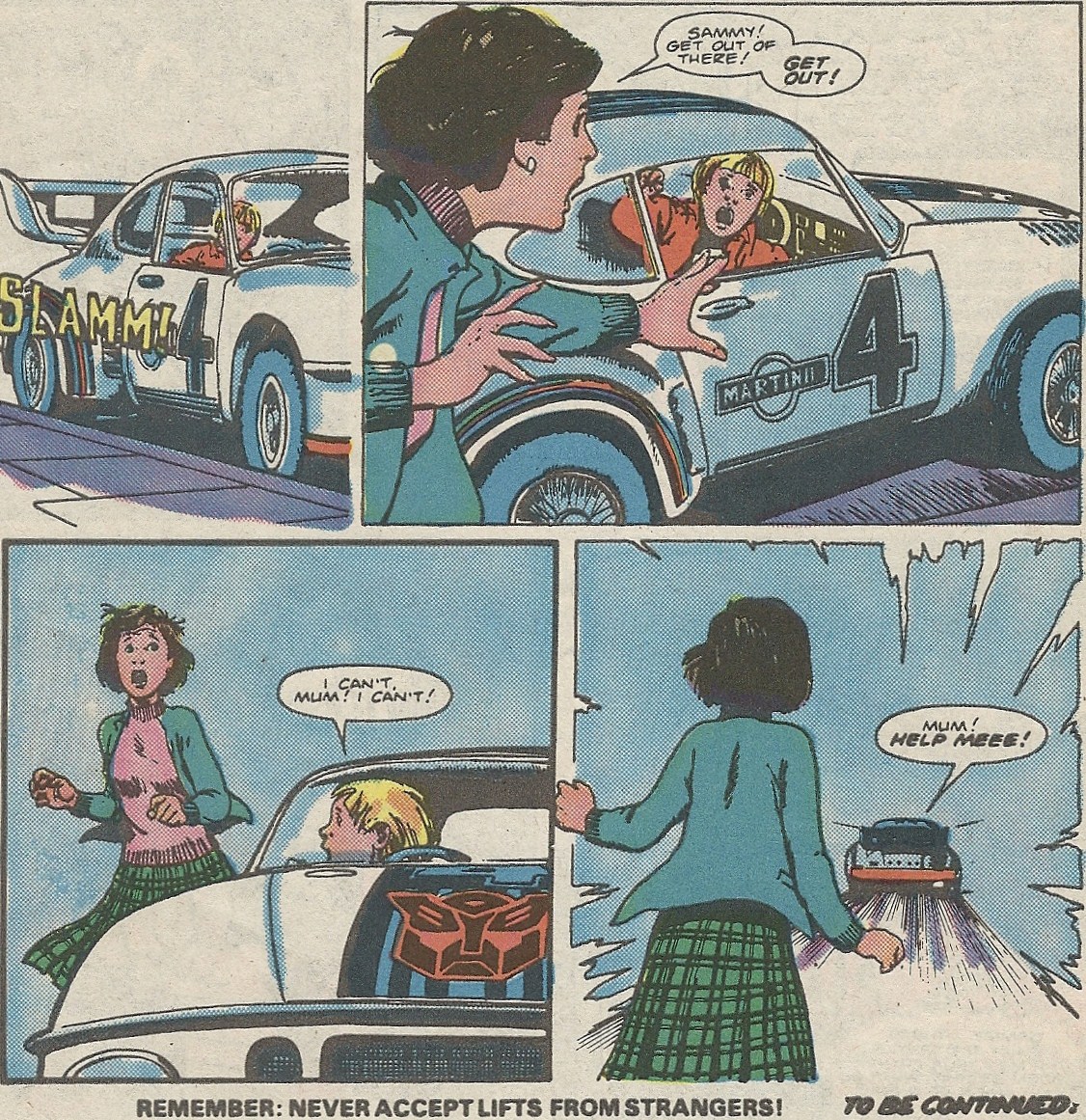
In revisiting this issue I’m struck with the willingness of the U.K. creators to use a bit of silence in their storytelling. It’s refreshing — the U.S. Transformers books of this time had every panel crammed with dialogue, and sometimes it’s nice to just sit back and watch a story breathe. The “dream” sequence is especially delicate and interesting. And the whole business with alien visitors and something weird going on underground gives the book a very Close Encounters of the Third Kind vibe. Since I love that movie with every bit of my heart, that’s a very good thing.
So how does it all end? What did the Decepticons drop near the castle? What’s buried down there? Will Jazz molest Sammy? Stay tuned for Part 2, coming relatively soon to a computer screen near you!
Talk about voices in your head… – Astonishing Tales 32

When I was younger I used to get Deathlok confused with a lot of other characters with similar sounding names. Deathlok, Deathstroke, Deadshot, Deadpool, Death’s Head… they all had one unifying factor for me — I couldn’t have cared less about any of them.
Did this book change my mind about Deathlok? Does he still look like a washed out version of DC’s Cyborg to me?
Well, I wouldn’t say that my mind has been changed, but I do have a little more appreciation for the character.
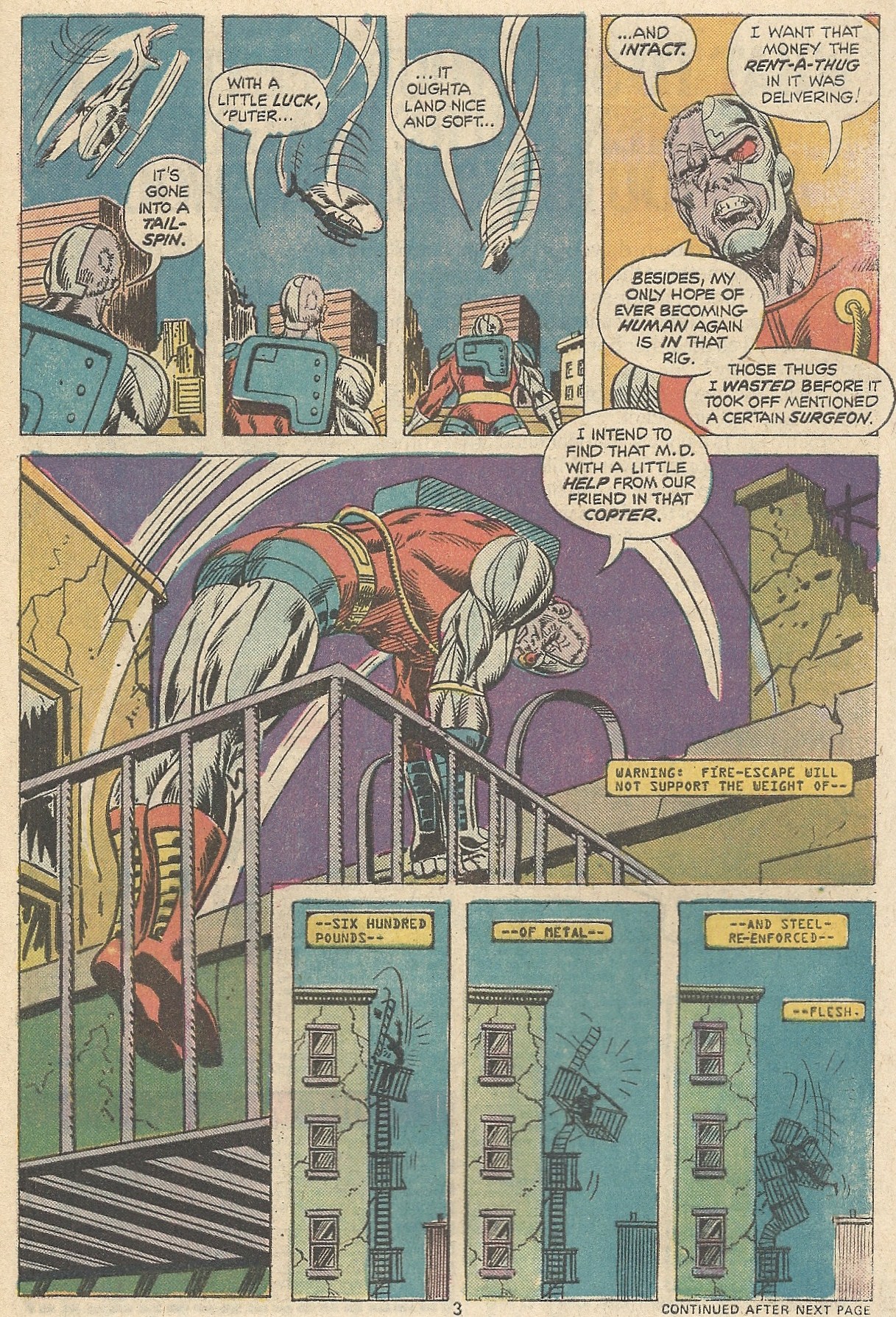
“The Man Who Sold the World!” was produced by what appears to be a cast of thousands, with multiple writers and artists tackling one solitary story. The plot is filled with characters and developments that are utterly foreign to me, so I can’t really criticize any of the storytelling. I really know nothing about the character, only what I could glean from his Wikipedia entry before I tackled this post. I never realized that Deathlok had his origins in a dystopian near-future, and that he wasn’t originally part of the mainstream Marvel continuity. Color me ignorant on that, I suppose. I also never knew that he had a matter-of-fact computer voice always chiming in inside of his head. Now that… that’s something I can get behind. It sets up a whole slew of opportunities for Odd Couple-like bickering.
Here we have good ol’ ‘Puter giving the leap-first Deathlok a too-late warning:
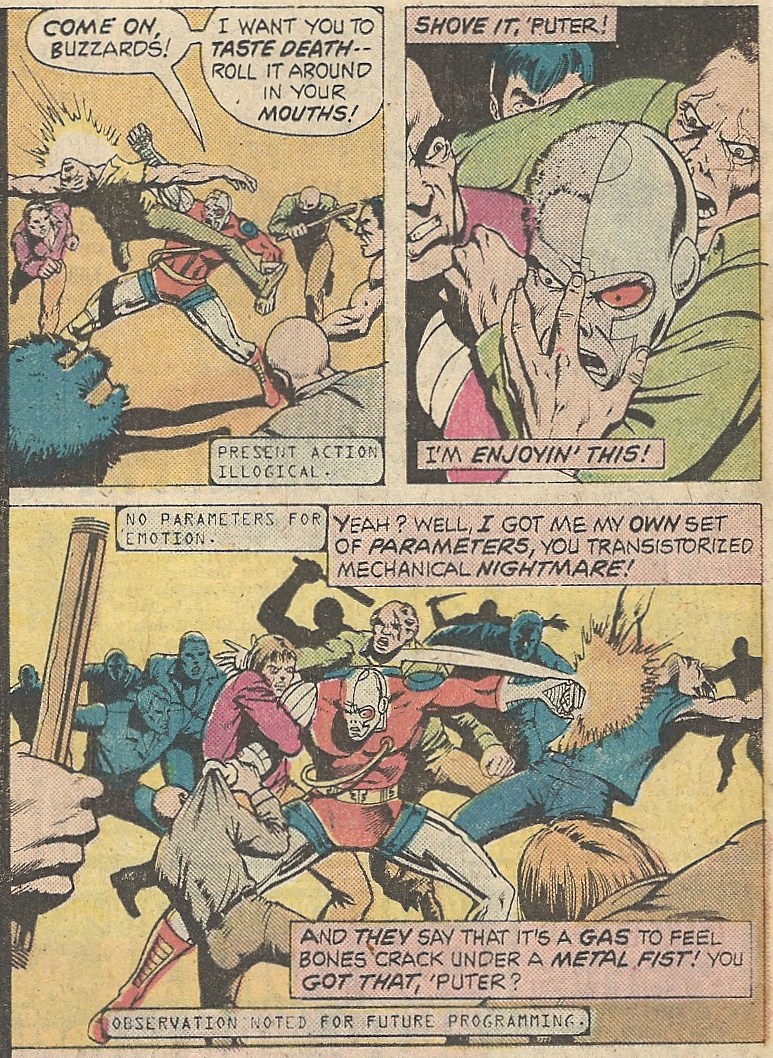
‘Puter doesn’t even shut up when Deathlok is caught in a deadly struggle:
Their prickly relationship also gives every story a chance to end with a humorous coda:
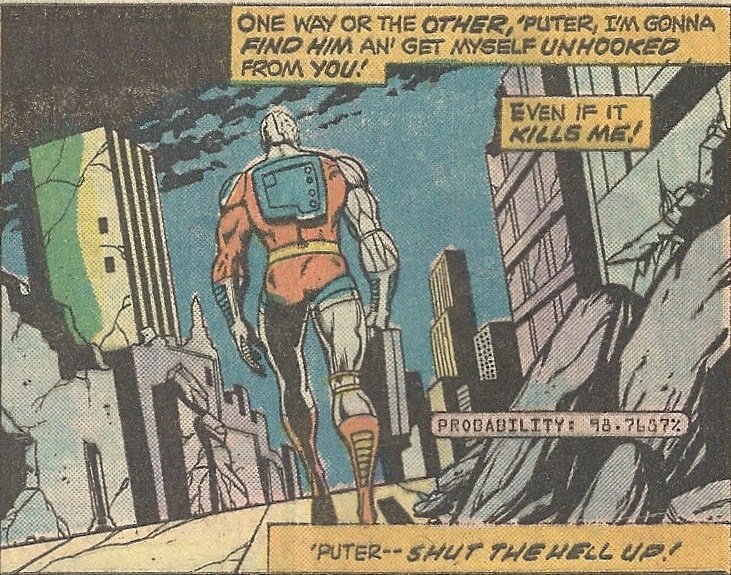
I’m still not a Deathlok fan — I’m not going to have a life-sized Deathlok bust on my mantle anytime soon. I do like his unwilling partnership with the voice in his head, though. You can almost imagine ‘Puter sighing with weary resignation and muttering “Oscar, Oscar, Oscar…”
That makes me smile.
They are women, hear them roar – Adventure Comics #368

This one seems like an example of comics writers working out some sexual kinks in their craft and trying to masquerade it as a parody of feminism run amok.
“The Mutiny of the Super-Heroines!” is written by the Legion’s own Jim Shooter — he also did the breakdowns, with the great Curt Swan handling the finished art. And it’s a Neal Adams cover, for all you Adams-ites out there.
The action ramps up as the Legion rushes to the site of an alien spaceship’s crash landing — it turns out the spaceship is extra important because it’s carrying a new ambassador. When they find the legate they make what’s for them a shocking discovery:

The ambassadoress soon puts her cards on the table:

Uh oh. Here we go. And, not to nitpick, but the anonymous Legion voice that says that Earth believes in gender equality… really? A second ago they were all literally gasping at the ambassador being a woman.
Just saying.
To drive home the point that Earthwomen are all girly and stuff, we’re soon given a few panels where the gals flop around their shared digs doing housewifey things:

No word yet on whether their menstrual cycles are synced at this point.
Soon the alien ambassador (Thora is her name) goes all uber-Gloria Steinem and uses an irradiated bracelet and voodoo dolls to amplify the powers of the female members of the Legion and in so doing hopefully start a new matriarchy. We’re then treated to a seemingly endless run of scenes of the women saving, trouncing and in general totally emasculating their Y-chromosomed counterparts. Here’s one, just to give you a taste:

I think you get the picture.
Thora soon starts to fiddle with the ladies’ minds, but Supergirl’s love for Brainiac 5 is enough for her to overcome her conditioning and sabotage the radiation-bracelet. This dooms the ambassador and returns everything to normal:

Take that, feminazi! Everything is once again right with the universe! The men are back in charge! The women can go back to making curtains for their dorm!
Well.
I enjoyed reading this issue — Shooter and Swan both knew how to handle the Legion — but a lot of my enjoyment was of the head-shaking, eye-rolling variety. I have to think that there are more than a few people out there that would, how shall I say, get off on this one. I mean, all the bits with the girls roughing up the boys, binding them up, tossing them around… It’s a bit much. It’s not up to an R. Crumb level, but it’s something.
Then again, so much of superhero comics is sexual in nature. Everybody knows that. We’re talking about beefy guys in tights and women with ever-increasing breast sizes. Sometimes the sexuality is buried deep, sometimes it’s close to the surface, sometimes it’s pretty straightforward, sometimes it’s crazy out there stuff. I guess whatever sexual subtext there is here lies somewhere in that admittedly broad range.
“*Gasp!* The ambassaodor … a woman!”
Hulk like fruit pies! – The Incredible Hulk and Hostess
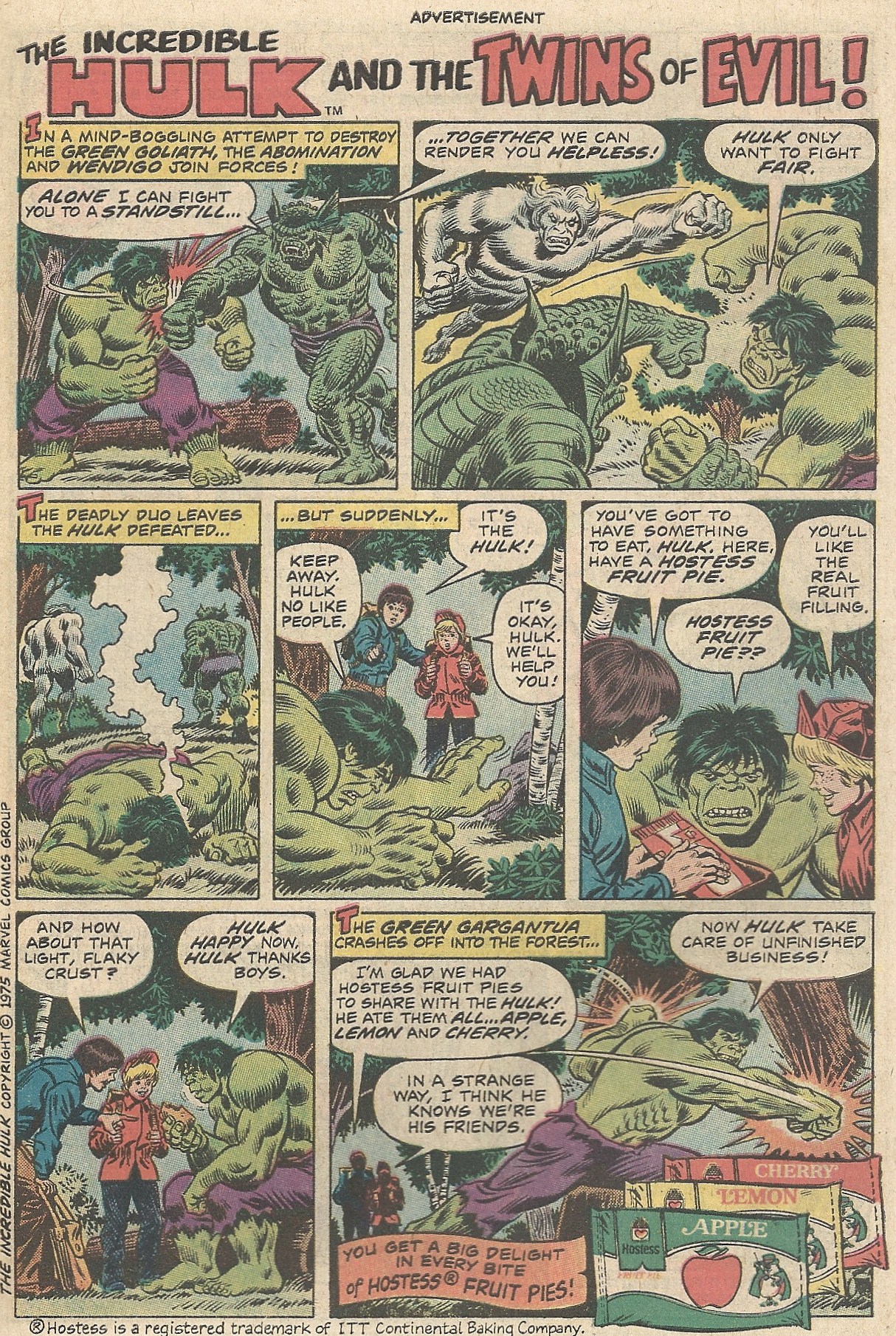
I always see these ads — I swear there were a million of them — but I hadn’t ever spotted this one before until the other day. Or maybe I’ve seen it, but just never really took the time to look at it. Anyway, it’s kind of neat. I like how the sugar-rushed and rejuvenated Hulk immediately embarks on a savage program of deforestation. I guess he’s not as “green” as we thought.
Eat your empty calories, kids! Grow up to be big and strong like the Hulk!
Here’s one straight from the WTF file – Time Beavers
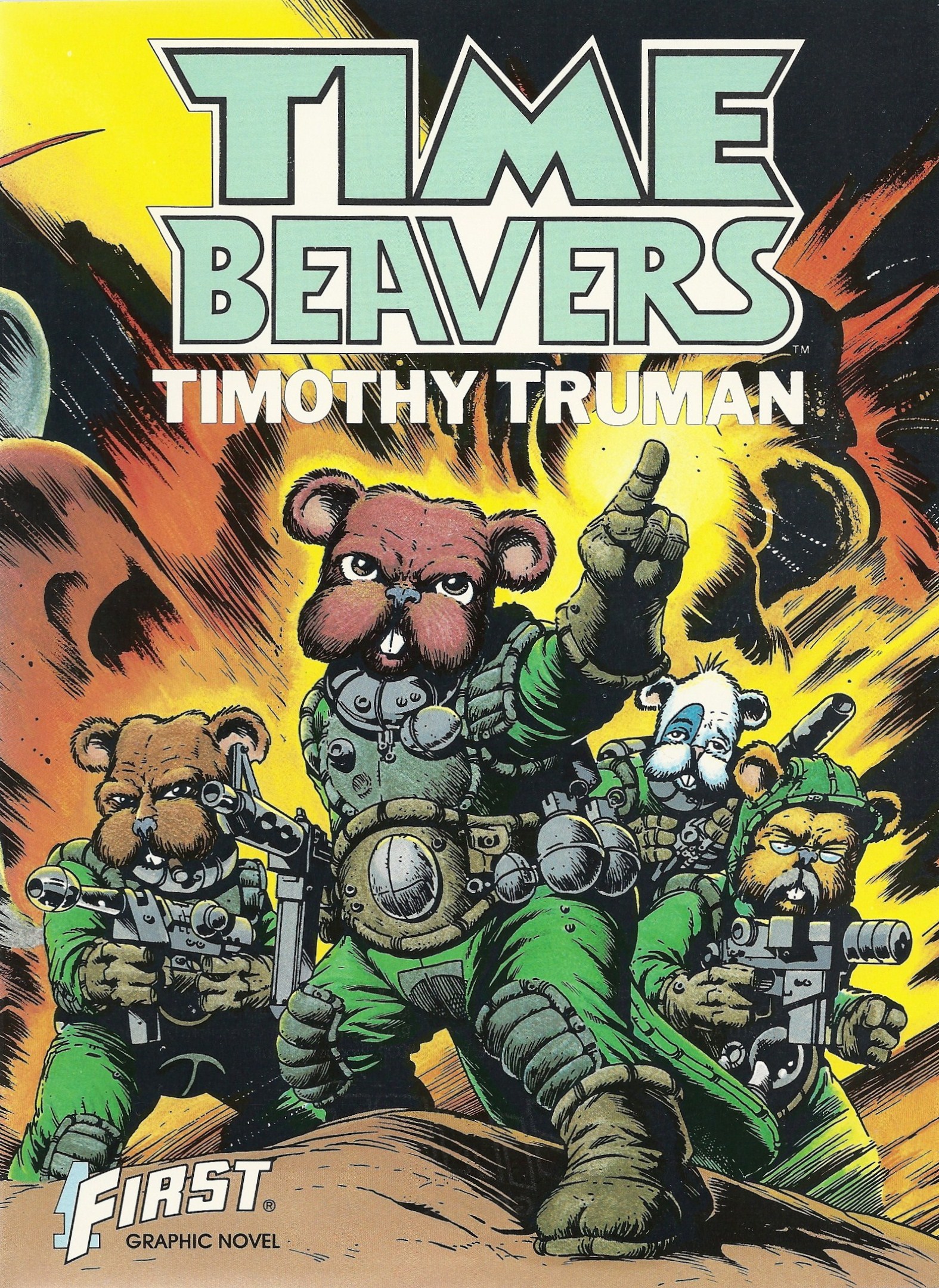
Those aren’t Ewoks. Yes, they’re beavers. They’re beavers with guns. And grenades. In space.
This one’s is out there, Jerry.
I saw this magazine-sized book in a friend’s store the other day and had to have it. It’s a bit off the beaten path, but I just had to know what in the holy hell was going on with this thing. I associate writer/artist Timothy Truman and his detailed work with grittier material (Grimjack, Jonah Hex), not short anthropomorphic rodents. That makes this book, published in 1985, a bit of an anomaly, and consequently worth a look.
From left to right on the cover, our beavers are named Mac, Slapper (nyuk nyuk), Shiner and (the Teddy Roosevelt-looking) Doc. Here’s another view of all of them:

The plot of the book follows this task force of beavers as they work to protect the Dam of Time. Yes, that’s right, the Dam of Time. They’re in a war against evil rats that try to sabotage events in the past and destroy the Dam. During the course of the story our beavers travel to the France of Cardinal Richelieu, interrupt Adolf Hitler’s final moments in his Berlin bunker, and in between stop off in Gettysburg and encounter Honest Abe before his brief but soaring rhetorical flourish:

Everything builds up to a final Star Wars-y battle at the Dam of Time, and one of the beavers makes the ultimate sacrifice to save it. The story has a lot of Time Bandits in it and it isn’t terribly original, but… Wait, what am I saying? Not original?
It’s beavers with f***ing guns, people!
That’s what they call “worth the price of admission.”
A.I.M. has finally found a weapon that can defeat Nick Fury…stink lines! – Strange Tales #147

This is the first issue of Strange Tales to come out after Steve Ditko’s departure from the Doctor Strange half of the book. More on that in a second. First we have the grizzled Nick Fury story — now there’s a man that knows how to sport a cigar, eyepatch, and five o’clock shadow. I know he’s got it together as a man and a hero, but to me he’s always had the harried look of someone who’d appreciate a deep gulp of A.M. Ale:
Vodpod videos no longer available.
“The Enemy Within!” comes to us from the able hands of Stan Lee, Jack Kirby (cover and layouts), Don Heck and Dick Ayers (Mike Esposito is credited as the inker but the Grand Comics Database indicates that this is an error). Fury and the boys return from a mission, Fury catches hell from a superior, and soon A.I.M. agents raid S.H.I.E.L.D.’s barber shop HQ — quite a day, and this last event sends Fury and his boys into action. In the battle to recapture the shop Dum Dum Dugan shows that not every S.H.I.E.L.D. gadget has to be high tech:

Who needs helicarriers and gizmos when you have a metal cap on your noggin?
The A.I.M. agents are soon sent packing (and btw, those aren’t stink lines on the cover, they’re emanations from a vibration weapon — but they look like stink lines to me). The captured S.H.I.E.L.D. agents are freed, and this provides an opening for some light-hearted sexist banter:

I’ve always had a mental image of Flo Steinberg running around the 60’s Marvel offices as if she were being chased in a Benny Hill sketch. Panels like those only reinforce that. I’m guessing Flo’s bottom was piched a few times back in those days.
The Doctor Strange half of this book, “From the Nameless Nowhere Comes… Kaluu!” is a bit of an oddity. The script duties are split between Stan Lee and Denny O’Neil and Bill Everett debuts as the new Doctor Strange penciller. The entire story has the feel of a sitcom clipshow. You know what those are — when the writers are out of ideas or out of time and they toss together a few framing segments and recycle old clips from previous episodes. They’re sort of lame and hollow.
This story isn’t that bad, but there’s not much to it. It’s kind of a buffer chapter between two longer arcs, so I suppose that’s part of the problem. A lot of old Ditko panels are shoehorned in as Strange recalls some prior experiences, and there’s some nuttiness about money troubles and maybe becoming a nightclub act. There’s also a nice sequence in the beginning that has the good Doctor foiling an everyday mundane robbery with his magic. It’s overkill on his part and it leaves the crooks thoroughly befuddled, but it’s kind of neat to see him do some regular crimefighting. Plus there’s this opening page:

That little bit (maybe it’s the red cape and blue outfit) reminds me of this amusing moment from the original Christopher Reeve Superman:
Woo!
I suppose there’s also an element of this in there:
I’ve always liked the double feature aspect of these old Marvel titles and this issue is no exception. You can’t pick two characters more different than Nick Fury and Doctor Strange, but variety is indeed the spice of life. Add to that the volume of talent on display and you get a scenario where, even when the pistons aren’t firing at full capacity, there’s a lot of fun to be had.
Not even the Hoary Hosts of Hoggoth can negate that.
Not bad for a mashup – The Avengers, old timey style
Every now and then when I’m wasting time on YouTube I see movie trailers that are “fanmade.” They’re always junk cobbled together from various movies and TV shows and passed off as something else. I haven’t watched many, but the few that I have seen are stupid wastes of time both for me and for the poor misguided souls that birthed them.
They’re almost as pointless as writing a comics blog. Hey, wait a second…
This trailer? This one is kind of fun.
I saw a post about it over at Aintitcool.com. It’s basically a trailer for The Avengers if that film had been made in the days of black and white and serials and double features. Just ignore the fact that the Avengers didn’t exist in 1952 and enjoy this rough assemblage of a bunch of different properties. And count the “Marvel” characters that you can spot:
I like the “Iron Man.” And “Thor” isn’t too shabby either.
An Ode to a Licensed Character, Part 7 of 8 – Rom #74

We’re almost at the end of this series. After this issue Rom only had one more appearance before he made his exit from the Marvel Universe. Then his silver armor disappeared, never to be seen again. Where do we stand? Rom and his Spaceknight companions have returned to Galador, their homeworld, only to find that a new generation of Spaceknights has gone rogue and enslaved the human population. Brandy Clark, Rom’s Earthwoman paramour, has been transported to Galador by the Beyonder, and moments ago the bad Spaceknights destroyed the containers which housed every Spaceknight’s humanity.
Things look pretty grim for our heroes.
“The Bargain!” is scripted and pencilled by the same duo as in the other installments in this series, Bill Mantlo and Steve Ditko, while the omnipresent John Byrne takes up the guest inker duties. He and Ditko make for a pretty good combo, and this may very well be their only collaboration [Edit: I was, of course, wrong — see the Comments section for other teamings of these two talents]. Byrne adds a depth and darkness to Ditko’s art that meshes very nicely with the content of this issue — I think you’ll see some of that in the panels I’ve scanned.
We start right where the previous issue ended, and Rom is aghast at what these new Spaceknights have done. His companions are rightly pissed off, and Seeker and Trapper give these young whippersnappers battle. Trapper takes no prisoners — she’s as brutal as they come:

Finally Rom’s abhorrence of harming fellow Spaceknights is overcome and he joins the combat, along with a few surviving humans. Things get ugly, and Ditko crafts a spectacular two-page spread to depict the carnage — this is one of those instances where Byrne’s inks amplify Ditko’s efforts:
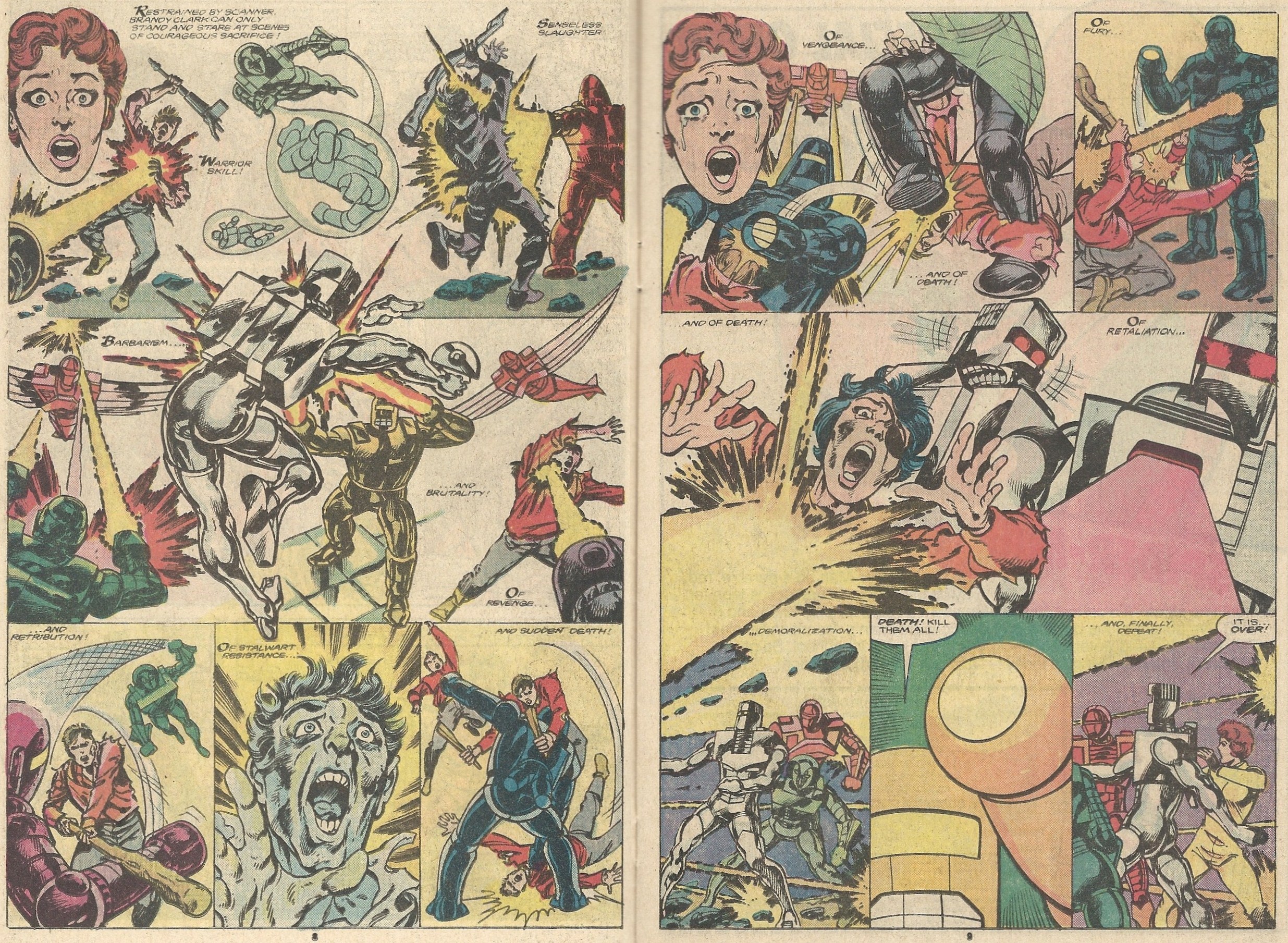
Our heroes are overcome by sheer numbers and, after the remaining humans are tragically killed, are forced to use subterfuge to make their escape. It’s a dark time for them all as they contemplate their destroyed humanity and the destruction of their world, and Rom and Brandy share a quiet and rather touching moment in the subterranean passageways where they’ve taken refuge:

The Spaceknights concoct a desperate plan. Other comrades of theirs are still in space, trying to find Galador.* Scanner thinks that if she can get to some amplification equipment she can use her communication powers to send a signal to their friends, and hopefully they’ll get the message in time to come and help them. To get to that equipment, thought, they’ll have to break into the evil Spaceknights’ stronghold.
Hey, nobody said it was going to be easy.
They bust their way in, and Scanner makes for the equipment while Trapper and Seeker cover her. Rom heads off to confront the leader of the rogues, the menacingly named (and vaguely Darth Vader-ish) Lord Dominor. Dominor relays to Rom his dissatisfaction with the rash deeds of his underlings and reveals his own rather Hitlerian schemes:
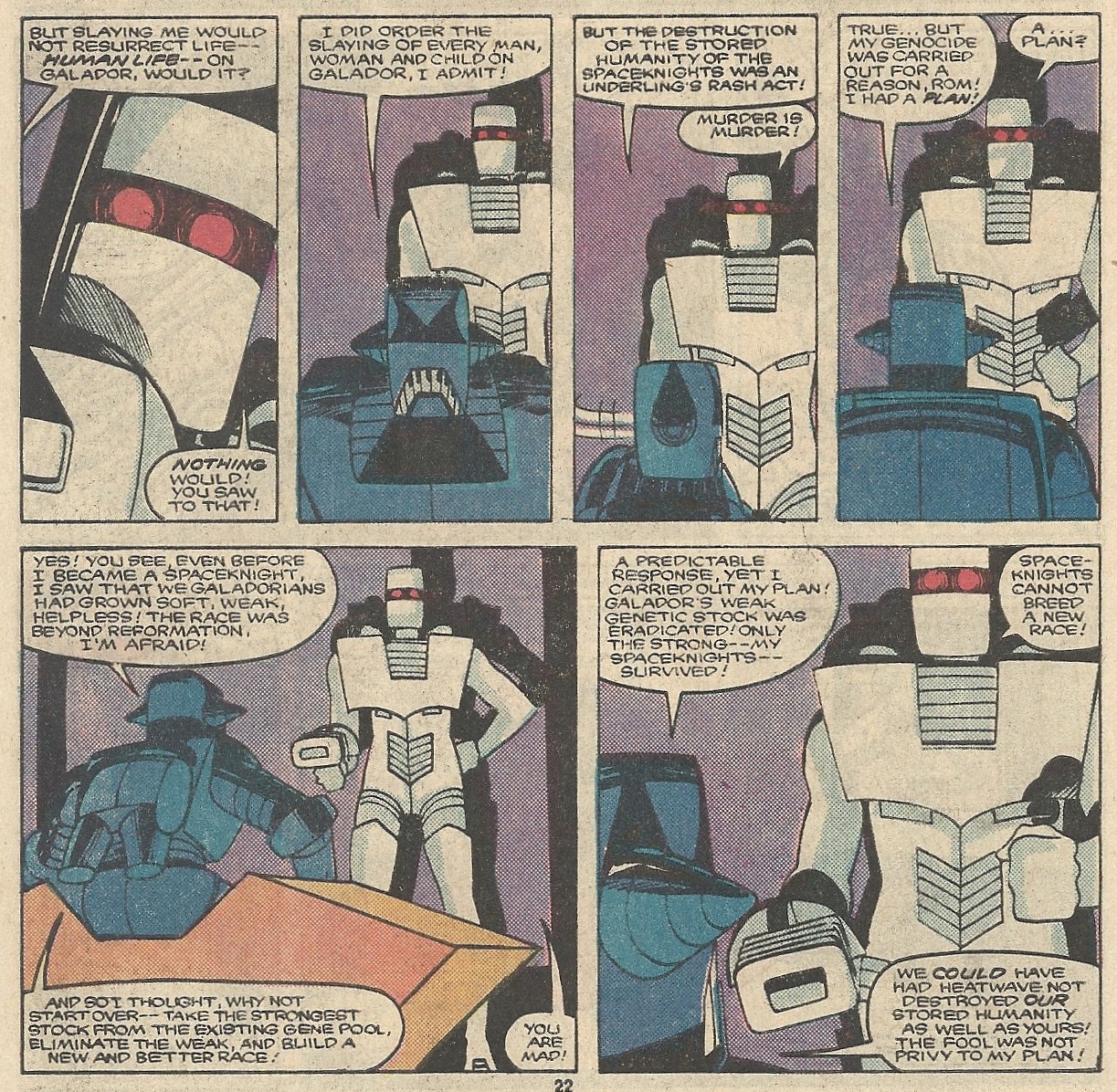
Then Dominor makes an indecent proposal, and he ain’t no Robert Redford:
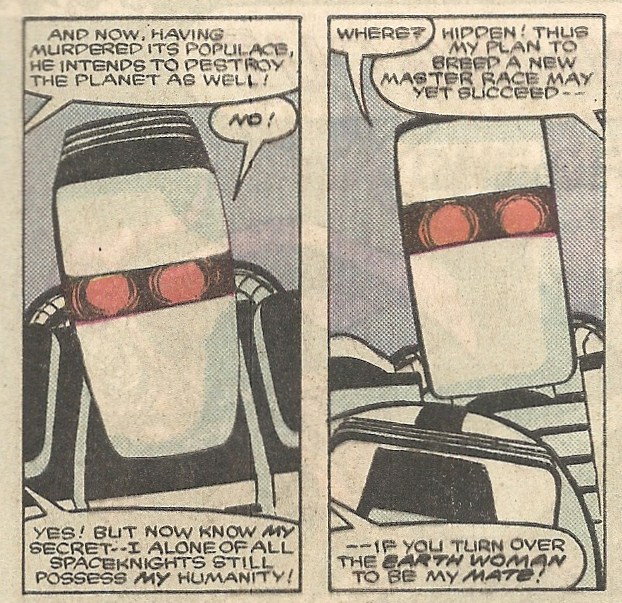
So Rom has to decide whether to join with Dominor, give him Brandy and in so doing preserve his species, or…
Well, I guess there’s no other choice. The other option is to fight to the end in a hopeless, nihilistic struggle. What does Rom choose?
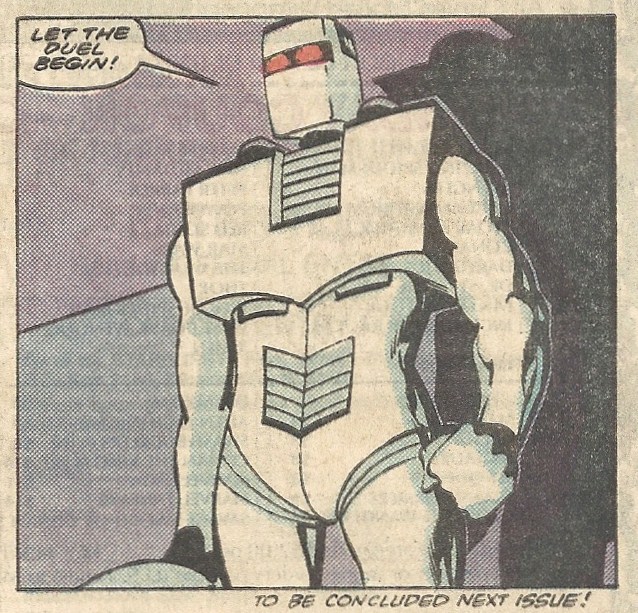
Nobody’s touchin’ Rom’s woman! And that, my friends, is why I love the guy.
This is another great issue in this last run. I’ll say it again — Ditko and Byrne made for a good combo, especially in an issue where savage action played such a critical role. And I especially appreciate the final sequence between Rom and Dominor — the simplicity of the layouts, the cramped construction of the panels and the shadows give it a very noir-y feel.
Needless to say, the next and final installment in this series will be bittersweet. Until then…
*Galador was hidden by Galactus in an earlier issue. — Jolly Jared
It’s not the pages, honey, it’s the mileage – The Further Adventures of Indiana Jones #19

That’s a pretty neat cover, one of those images that makes you look twice. Kudos to Bret Blevins. At first glance you just see Indy clinging with his whip to, well, whatever he’s clinging to. Then you see the title and you take a second look and that’s when you see the unmistakable shadow beneath him.
Or maybe you see all of that at first blush and I’m just an unobservant idiot.
I love me some Indiana Jones (though Kingdom of the Crystal Skull does not exist in this dojo). Raiders of the Lost Ark is the greatest adventure film of all time, and the next two sequels’ only sin was not being the original. Indy’s a cinematic icon. I love that guy. I mean, when I first saw his fedora in the Smithsonian my heart skipped a beat. It’s Indiana f*%$ing Jones, people!
So I must like the comics, right? Well, sort of. Let’s look at this one. While it’s a fun ride, I think it illustrates some of what doesn’t work when this character is thrown into the newsprint medium.
“Dragon by the Tail” is brought to us by Larry Lieber (script and pencils), Vince Colletta and Jack Abel. It finds Indiana parachuting into the Himalayas to put a stop to a Japanese plot. An old friend of Indy’s has written him and informed him of his (the friend’s) discovery of a primitive people living in the mountains. These folks run around in the snow half-naked, but the really remarkable thing is that they worship the frozen body of a dragon. This Japanese archeologist wants to let sleeping dragons lie, but the military caste in his country has different ideas about what to do with Fin Fang Fo-, wait, I mean the dragon:
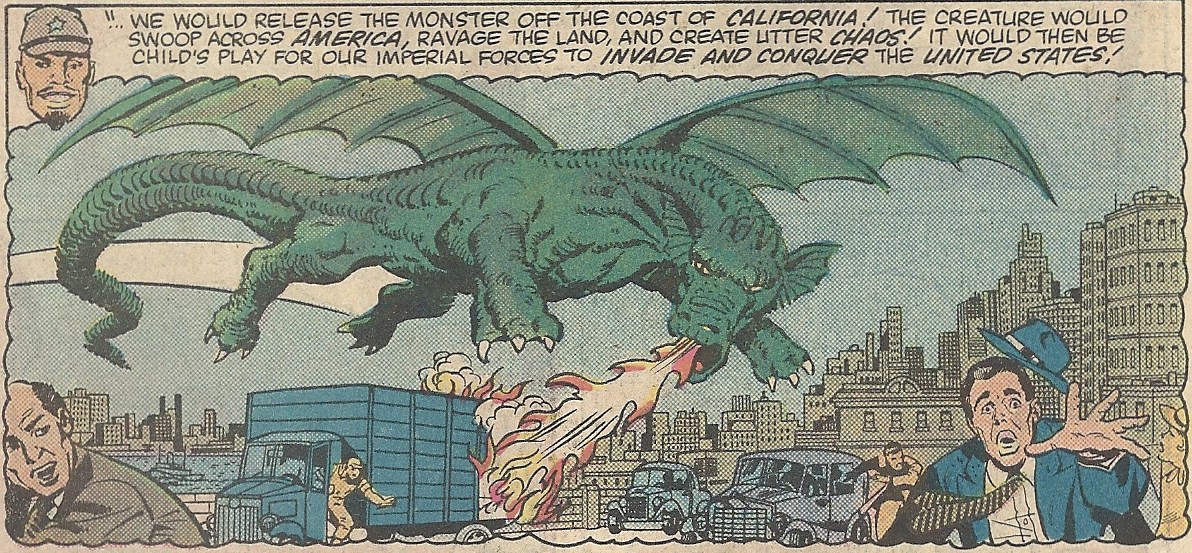
Indy’s out to nip this in the bud before the dragon can be revived, hence his current mission. He sneaks up on a Japanese guard with internal and external dialogue that rings very, very false to my trained Indy ears:

Can you picture Harrison Ford uttering those lines?
He then drops a comment that seems like a bit of an anachronism:
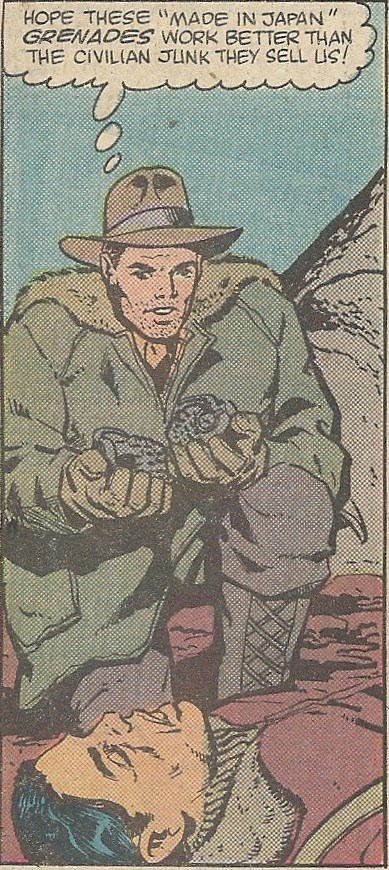
Was the U.S. really importing a lot of commercial products from Japan in the 30’s? Enough so that Indy would feel compelled to mock their wares’ inferior quality? That sounds more like something from the mid-80’s zeitgeist that surrounded this comic’s inception.
Indy fails miserably at stopping the Japanese and they cart the frozen dragon back to Japan by zeppelin. He does manage to make nice with the natives and gets an ancient scroll from them that will come in handy later on.
We jump cut to Japan, where Indy skulks his way to the home of his archeologist friend. We’re soon given proof that he never fails to get off on the wrong foot with women:

The ol’ Indy charm calms things down, but he learns that his friend comitted ritual suicide because, though he felt he did the right thing by warning Indy, he still betrayed his country by doing so. His daughter helps Indy by showing him a temple where she suspects the Japanese military may be hiding the dragon.
Indy sneaks in and battles an out of place but I suppose obligatory-in-a-comic-book-world samurai and a sumo wrestler’s ginormous ass cheeks:

After whooping them like the guy with the swords in Raiders, Indy finds Fin Fang Fo-, I mean the dragon. The Japanese are gradually reviving it so that it will eventually come to over the U.S.A., but Indy speeds up the awakening process through some quick sabotage:

Now America won’t be menaced, but our dashing hero suddenly has an out of control dragon on his hands, one that could harm Japanese civilians. After lassoing it and then riding it like Slim Pickens astride the bomb in Dr. Strangelove, Indy reads the incantation he got from the natives and the big beastie dissolves. Fin Fang Fo-, I mean the dragon returns to his icy slumber with the natives who in turn feel gratitude towards their stubbly friend:

Indy says his goodbyes to his fetching Japanese babe and reflects on the precarious nature of the peace he’s preserved:

A few observations…I kind of like the use of the Pacific portion of the future Axis in this story — it turns out Hitler wasn’t the only one who was jonesing (forgive me) to use some mystical hazarai in his march to conquest. The dragon isn’t really a story problem — if we can have the Ark, the Grail, and some glowing stones, we can have a giant flying magic lizard, and I like Lieber’s depiction of the monster. But the use of thought balloons with Indy seems to be a little much — he’s such a man of action in the movies, with entire sequences happening with nary a peep from him, hearing (reading) his thoughts is awkward. And the one liners and general glibness, like Indy is Spider-Man…woof. That does not, I repeat, DOES NOT work with Indiana Jones.
It could be that I’m just set in my ways, that I’m too enamored of the silver screen version. Or maybe this depiction just blows. It’s not a terrible comic — it’s just not a great Indiana Jones comic. I’ll have to check out some other Indy books at a later date to see if they handle him better, and to see if Indiana Jones can be successfully translated to my beloved comics medium.
“Snakes…Why did it have to be snakes?”
Now there’s a duo that never made it into Marvel Team-Up – Spider-Man and Cap’n Crunch
I pulled this ad out of an old Rom comic that I looked at the other day. I had forgotten all about the “Where’s the Cap’n?” promotion from back in the 80’s, which was just another cheap ploy to get kids to buy more sugar-loaded cereal. This ad flipped a switch in my head, mainly dredging up remembrances of sitting in front of the TV on Saturday mornings and watching cartoons and the endless commercials for toys and junk food. It even brought back the memory of the time Lucky Charms was adding a new marshmallow and there was a mystery as to what it would be (It was purple horseshoes, btw).
Ah, the base lengths Madison Avenue goes to in order to keep kids hooked on high-fructose corn syrup. But you know what I was ususally munching while I watched those cartoons with their endless commercials? You guessed it, sugar-loaded cereal. So I suppose the least you can say about the ad agencies is that they know a thing or two about their craft.
In this particular promotion the Cap’n even went missing from the front of his own cereal boxes and was replaced by the question mark design that you ssee in the ad. Our friend Spidey joined the search for him:


I have a feeling that the secret code is something along the “Drink more Ovaltine” lines. And, if you’re wondering, the Cap’n was hanging out in the Milky Way. Get it? Nyuk nyuk nyuk. I guess that sells more cereal than “He pissed off the wrong people, kid.”
This wasn’t the only time Spider-Man crossed paths with this seafaring cereal peddler. Some hasty internet research revealed another occasion where he battled the Sogmaster and the Soggies in Sogland while they held Cap’n Crunch prisoner.
But we’ll save that epic for another time. As Mako said at the end of Conan the Barbarian, “This story shall also be told.”

The Reverse-Flash has always had a disproportionate importance to me. That’s probably due to his key role in the final arc of the original Flash series, when the Scarlet Speedster went on trial for his arch-nemesis’ supposed murder. And the negative, switched colors version of Flash’s costume might normally get an eye-roll, but I give the whole thing a pass. I like him as a villain.
So, it was no surprise that I picked this book up despite its in fairly rough shape. It fits firmly into that Good+ condition category. It’s intact, but it has creases and chips and a big ass tear on the back cover.
But it’s the origin of the Reverse-Flash!
A note on Carmine Infantino and his art — I’ve always enjoyed his take on futuristic cityscapes, with their soaring towers and the spiralling ramps, along with the tiled groundlevels that are always devoid of people. Have you ever noticed that? There’s hardly anybody on the streets in these futuristic settings. They’re as barren as North Korean thoroughfares. Just an observation. You can see some of this on the above cover as well as in the backgrounds of a few of the panels I’ve pulled out.
“The Menace of the Reverse-Flash” is scripted by John Broome with art from Infantino and Joe Giella, and it’s a wonderful Silver Age effort. The trouble starts when a scientist sends a time capsule into the future — no more using spades and shovels to bury them behind schools and then forgetting about the damn things! Unfortunately the scientist sends an atomic clock as part of the capsule’s inventory (along with one of Flash’s costumes) and he realizes after the fact that, to do such a thing, well, as Egon Spengler would say, “It would be bad”:

Flash volunteers to save the (future) day, and, luckily for them both, he has his iconic suped-up piece of exercise equipment handy:

All Infantino’s floors have those huge tiles!
Meanwhile (or futurewhile), the time capsule has arrived in the 25th century. A hood (who will soon name himself “Professor Zoom”) makes off with the Flash costume and, after some experiments and adjustments, reverses the costume’s colors and duplicates Flash’s super-speed powers for himself:

Zoom immediately goes on a crime spree, stealing priceless alien artifacts. Flash arrives in the 25th century and reads about Zoom’s deeds in a newspaper that’s *gasp* in color!:

Surely this must be THE FUTURE! As if newspapers are going to be around in 4 years, much less 400.
The two of them soon square off in a vroomy battle, replete with Infantino’s marvellous speed-lines:

Flash finally figures out that the only way to defeat this foe is to overwhelm the chemical shield that’s protecting him at high speeds:

The squat, page-wide panels are really handy when it comes to depicting Flash’s speed — and fortunately he has more streets with a Pyongyang-level of desertion to rocket through. Handy.
Hey, what about the atomic clock? With Zoom taken care of, Flash finally gets around to the whole point of this trip, and the clock has somehow wound its way into the possession of a random old biddy:

Flash returns to the present, his mission complete.
This was a very fun issue, though I’m a sucker for anything Infantino. There was something about The Flash in this time period that made it one of the better books — something about the adventures of Barry Allen made him a prime specimen of the Silver Age at DC. Even my jaded modern sensibilities can lap this stuff up. I think a lot of it simply has to do with Infantino and his rapid red creation — no shocker here, but they were made for each other. When it comes to drawing the Flash, Carmine is the best there is, the best there was, and the best there ever will be.
Great stuff.
Who would ever have thought that this little comic could cause such a huge ruckus – Spawn #9

I lost touch with Spawn a long, long time ago, but when it first came out my youthful interest in comics was definitely in its waxing phase. Image was exciting and new, and in my enthusiasm I didn’t really grasp how hollow a lot of their stories were. I didn’t care — the pictures were pretty! But for a few early issues of Spawn Todd McFarlane had the wisdom to open up his sandbox and let a few established writers come in and play. Alan Moore, Neil Gaiman, Dave Sim, Frank Miller — not a bad lineup.
I can’t believe how contentious the Gaiman collaboration has become.
I won’t rehash all the rancor over the ownership of Cogliostro, Medieval Spawn and Angela, all the litigation, or the way the Miracleman rights played into the whole damn thing. Some simple research will fill in the holes in anyone’s knowledge. And I won’t point out the obvious ironies involving Image’s founding principle and the character ownership arguments between McFarlane and Gaiman — they’re pretty obvious. But I had no idea that those two guys were still fighting, this time over derivative characters in the Spawniverse, until I saw an article about a decision in the most recent case. For an account of the latest round, go here. I warn you, it’s a long read, but it’s an interesting one.
I don’t have much to add. This post is just this my way of shaking my head in amazement — this thing has dragged on longer than that Roddy Piper/Keith David fight in They Live. And though I’m on Gaiman’s side and have been for a while, I do have some sympathy for McFarlane. He has to wish that he could travel back in time and write that stupid issue himself and erase this page of credits from history:

He might even make a deal with the devil to do it.
 Jared
Jared


 blog into mystery