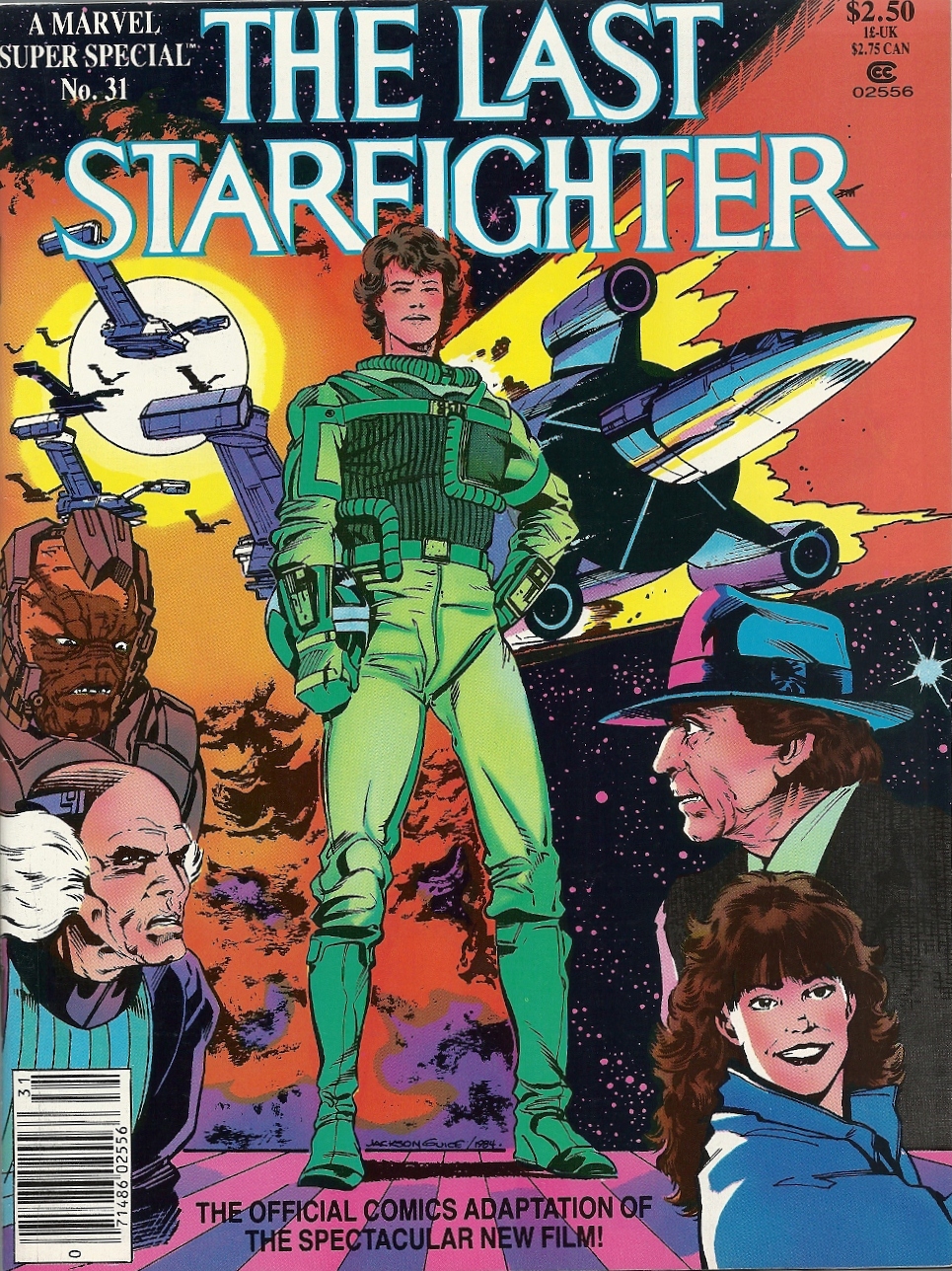
The Marvel Super Special March continues with a trip into the cosmos.
The Last Starfighter is one of the “classic” 1980s films that hasn’t aged well. That’s not to say that it has become a bad film. Far from it. Its heart, its adolescent wish-fulfiment — that the dopey video game you’re playing will one day pay off AND HOW — still resonates in the days of Wiis and Playstation3s. Perhaps your video game crap is really an SAT test from some alien race. KEEP DREAMING, DWEEBS.
There’s a time capsule element to it too, a reminder of the days when video games weren’t in front of your couch or in some handheld device, but were down at the corner store, right next to that hook thing that you used to pull the cap off a soda bottle.
“You see, junior, back in the day we had to go to these things called arcades with pockets filled like saddlebags with quarters to plop into the video games that were in these big box things with art on the sides.”
“What are saddlebags?”
“…”
It’s the effects that are the problem. TLS’s effects weren’t all that great at the time. You can look back at the space battles in the contemporary Return of the Jedi and not feel like you’re slumming it. They hold up, and were nigh unbelievable at the time. Not so with Starfighter, whose ships and graphics and lasers look even worse with several decades of FX evolution in between. (I’m not advocating a Special Edition. DEAR GOD I’M NOT ADVOCATING THAT.) In Starfighter the effects look horribly dated, which is a crippling failure in a film that’s supposed to transport you, alongside the young gamer hero, on a thrill-ride to the stars. They’re reminiscent of another cinematic peer’s, Disney’s Tron, though that movie has an excuse in that it took place within a 1980s computer mainframe. Starfighter is supposed to exist in a “real” world of highly advanced technology, but the ships look unreal, like they don’t even exist, like you couldn’t put your hand on one even if it was right in front of you.
This actually presents a unique opportunity for the comic adaptation: a chance to work better than the source material, a chance that’s increased with every passing year and every bit of FX decomposition. Adapted by Bill Mantlo, with art by Bret(t) Blevins and Tony Salmons (and a Jackson Guice cover), the adaptation has an opening not often presented by to the bastard-other-medium film adaptations.
Sounds good. In theory. But the space ships and lasers and odd alien broads with Larry Fine haircuts aren’t the takeaway feature of the Super Special. No, it’s the protagonist’s girlfriend’s Daisy Dukes-sheathed ass:
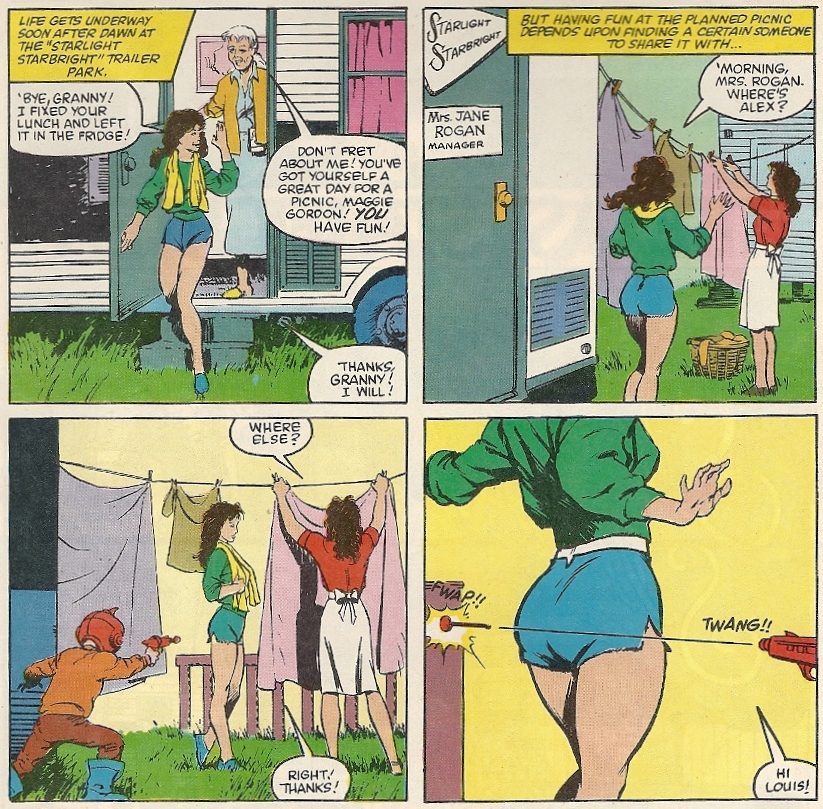
Who wouldn’t want to fire a suction cup gun at that thing? HOT TRAILER PARK ACTION.
Though this young, taught posterior takes the place of the spaceship, the Gunstar, as the takeaway image of the story, the comic presents a straightforward retelling of what found its way onscreen. Here’s our hero, Alex Rogan, with the pasty, wide-eyed, open-mouthed, utterly absorbed fervor known by so many video game addicts (or more likely, their long-suffering friends, families and significant others):

Does the outer space stuff work better in the book? Not really. It’s not all that exciting, and it’s perhaps foolish to think that static images could match even the lamest effects. Fool on me. It’s an uphill challenge in any event. Just for comparison’s sake, here’s the climax of the final one-against-hordes battle — when Alex deploys the devastating Death Blossom — in comic and movie forms:

I realize that the Star Alliance fleet was wiped out and Alex is fulfilling his video game training prophecy whatever blahblahblah, and this Death Blossom thing was some lethal prototype experimental doohickey, but did anyone else ever have the thought that maybe they should have equipped their whole armada with it, with a Manhattan Project intensity to its development? So that intergalactic recruitment wouldn’t have been all that necessary? Like the old Seinfeld routine said: “Why don’t they just make the whole plane out of the black box?”
Anyway. Forget that. All the spaceships and all the Death Blossoms in all the universe can’t keep Alex away from his girl’s piping hot trailer park ass — ALL ROADS LEAD TO ASS:

Now they can go out into the galaxy, park Alex’s Gunstar on cement blocks and have about 10 kids. TO THE FARTHEST STAR.
I still have affection for The Last Starfighter. Though I prefer the lunacy of its 1980s genre co-traveller, Krull, and though it may have lost much of its appeal, its heart is still there all these years later. (It easily wipes the floor — and other, more disgusting things — with the atrocious Santa Claus: The Movie) The creature and alien work is certainly much better than the CGI crap rammed down our throats these days. Grig, the quirky alien navigator in the last panel above, who’s a less prickly version of Admiral Ackbar and Jeriba from Enemy Mine, remains a small treasure.
The comic, while not rescuing the film experience from its vanishing relevance (an impossible task), is worthy. It’s a decent nostalgia companion piece. And that does indeed count for something in these parts.
There’s much more — and much better — to come in this Marvel Super Special March. Stay tuned. AND KEEP WATCHING THE ARCADE GAMES…
The Thing, Mr. Fantastic, the Invisible Woman, the Human Torch, She-Hulk, Willie Lumpkin and John Byrne want your money.

What, no giant signature, John? HOW WILL WE KNOW FOR CERTAIN THAT THIS IS YOUR ART?
If you have a time machine and would like to travel to 1984 to get that Dazzler bargain you’ve always dreamed of, here you go. Feel free to print the savings certificate and take it with you in your DeLorean.
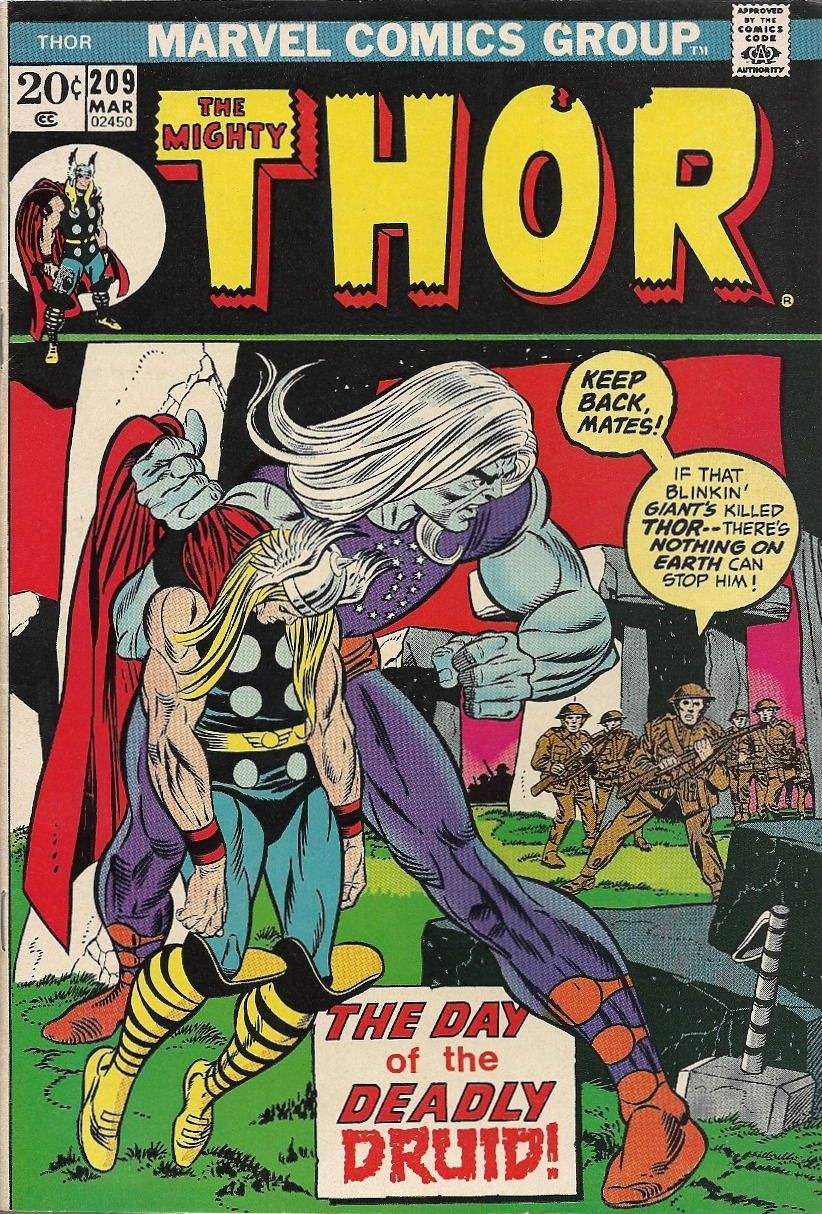
No one knows who they were, or what they were doing…
If you had to pick one real-life obelisk prop that’s been done to death in fiction, you’d probably have to go with Stonehenge. The assemblage of rocks that so fascinated Nigel Tufnel seems to be trotted out by every fantastical tale that traipses through the U.K. countryside, with any number of ludicrous theories on their origins to go along with their appropriation. But has any of them ever incorporated a giant blue-skinned guy with white hair and an affinity for spandex? I think not.
This comic, scripted by Gerry Conway with art from John Buscema and Vince Colletta, posits an origin that may take the ludicrous cake. AND IT HAS THOR. AND COCKNEY GITS. Pagan symbolism clashes with Norse mythology within. It’s a dream come true. Or something.
To let us know that yes, indeed, we are in jolly ol’ England, here’s Thor (on one of his many Odin-bidden exiles) flying high above London’s Tower Bridge:

In case readers are slow on the geographic uptake, Parliament and Big Ben and other landmarks are thrown in to drive home the locale. WE ARE IN LONDON, YOU DOLTS.
One of the most obnoxious things — and it’s possibly the best — about this issue is the thickly accented and slangified verbiage of Britannia. Conway crams in every last bit of it, like a man dying of thirst wringing out the last drops of moisture from a wet towel. You can get a glimpse of this barrage here, as Donald Blake, so hungry he can’t even include the “e” in “sandwiches,” orders some of that famous beige English cuisine:
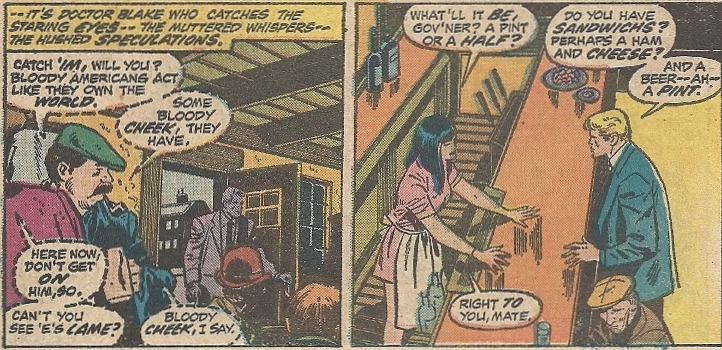
Believe me, there’s more. Just about every character in this story not named Thor or Druid talks like a Victorian chimney sweep. I’m not complaining, mind you. But there’s a lot of it.
Ah yes, the Druid (Full Name:Demon Druid). He was awakened by Thor’s hammer strike when our hero transformed into the famished Blake, and comes crashing up out of the Earth:

“Gor blimey! E’s enormous!” You see what I mean.
The next pages are littered with Thor getting his godly ass handed to him, as the Druid strides toward an unknown destination and slaps and batters him into unconsciousness on multiple occasions. A Lieutenant Prichard helps the God of Thunder back to his feet after the first beat-down, and this member of London’s constabulary, upon seeing the design on the Druid’s chest and getting a clue (convenient) from a passing astronomer that the rock that held him is 3,000 years old(?), pursues his own line of inquiry.
While Prichard runs off to quickly consult a dusty book, Thor battles on, and finally remembers (before the three knockdown rule comes into play and Mills Lane stops this thing) that he has this mystical hammer called Mjolnir that can do all sorts of neat stuff:

The Druid is felled near Stonehenge, but Prichard, instantaneously arriving there (perhaps he has one of those handy 24 teleporters) has a few crackpot theories to stay Thor’s hand. Here’s the good Lieutenant filling the Thunder God in about his half-baked ideas on the Druid’s origins — with a “Next Issue” tease reassuring readers that next month they’ll be getting back to the real storyline:
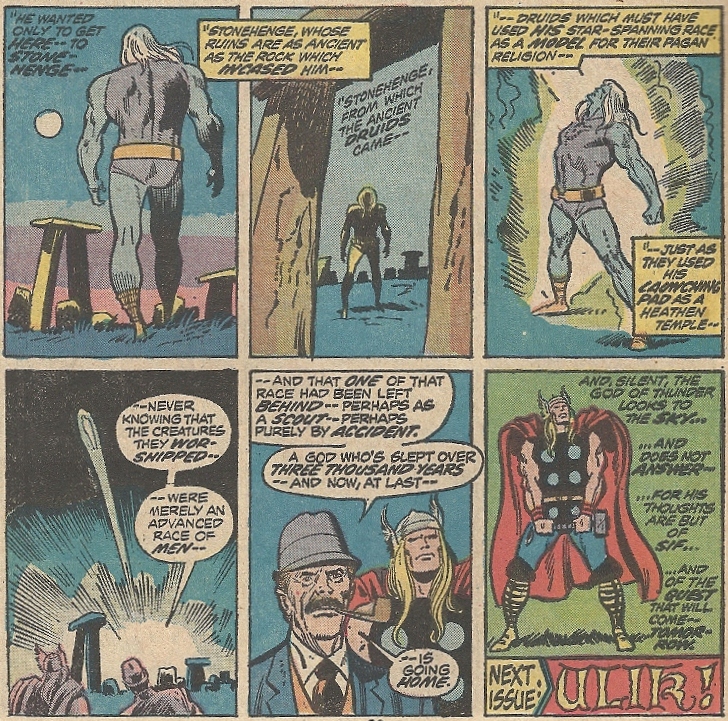
The Druid is an alien. Who landed on Earth. Who had a design on his form-fitting togs. Said design was seen by primitive people who erected stones based on it. On his launching pad. They worshipped him. He was encased in the belly of the Earth for thousands of years only to be awakened by a jolt from Thor’s hammer. And all he wants to do is get back to his launching pad to blast off into space.
[Takes breath/Flexes fingers]
That this fine gentleman is remarkably close to the mark — the Druid was later established as a Kree warrior stranded on Earth — in no way mitigates that this is an EXTRAORDINARILY lucky guess. If this were a math problem, I’d ask Prichard to show his work. You know how science can take a bone unearthed by a paleontologist and extrapolate from it the shape of an entire animal? That’s what this Detective Chief Superintendent Lieutenant Whatever Prichard did, except he didn’t have much of a bone to start with. A toe bone. Maybe.
Perhaps his tweeds give him superhuman mental acuity. Perhaps he smokes a special Columbo/Dr. House/Kreskin/Erich von Däniken blend of tobacco in that pipe of his. Or pure crack cocaine laced with acid. YOU DECIDE.
As for the issue’s merits, if you remember the old X-Files “Monster of the Week” episodes, this feels a lot like one of those. Thor flies into town confronts a menace that isn’t a menace, and next week it’s back to the overarching storyline and this week’s grand threat will be gone and forgotten. It’s filler, though Conway’s “Cup ‘o’ tea, gov’ner?” dialog has its charm, as does the Buscema/Colletta artwork. Buscema’s Thor could never match Jack Kirby’s (examples here, here, here, here, and here), but with longtime inker extraordinaire Colletta backing him, it’s a smooth transition. Buscema has a knack for drawing oversized, serious men (see Conan), and his efforts here are no exception to that rule.
And Stonehenge. We all remain fascinated by it. It’s the pyramids without the mummies and the sand. I’ll never be able to look at the slabs the same way ever again, though. I wonder if any wide-eyed tourist walked through those ruins and thought “Wow, so this is where the Demon Druid had his launching pad. Neat!” Doubtful. But that’ll be in my head.
Richie Rich, the worst spokesperson GRIT has ever had, would like you to consider selling GRIT.
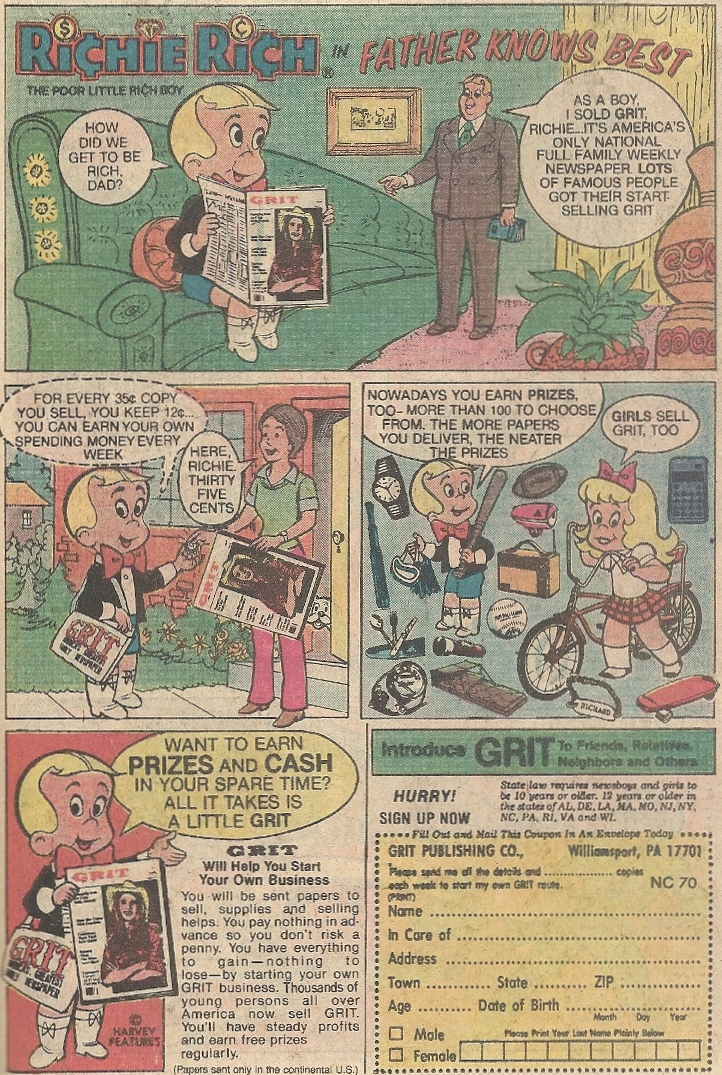
If a real, honest to God class war ever broke out, it’s probable that the Richie Rich proxies of the world would be the first doomed souls tossed onto pikes.
This ad takes the usual plain vanilla GRIT pitch about pluck and hard work, flips it on its side, takes its wallet and boots it out the door. “Sell a dopey magazine and one day you too can have vast wealth and Poor Little Rich Kid children.” (Dad apparently isn’t wealthy enough to cure Richie’s glandular problem, which has given him a GIGANTIC, BULBOUS HEAD.)
So pull yourself up by the bootstraps, America. Sell terrible magazines to your neighbors and realize all your avaricious dreams.
[Insert weak Ed Sullivan impersonation here] – Marvel Super Special #4, “The Beatles Story”

My mother had a Beatles beach towel when I was growing up, a ragged remnant of her adolescence that she’d trot out every summer for sand and surf holidays — I’m pretty sure it was a twin of the one you can see here. I can still see it hanging on the clothesline in the backyard, flapping in the wind as it dried after a washing that miraculously didn’t disintegrate its aged fibers and send it up to towel heaven. I sometimes wonder whatever happened to it, whether it still sits on a shelf somewhere in the old house. Maybe my mother takes it out now and again, looks at it lovingly and remembered the days when she would have screamed her head off and fainted if she ever saw the Fab Four in the flesh. DEAR GOD I HOPE SHE DOESN’T.
All that is a roundabout way of saying that the Beatles belong to my mother’s generation, not mine. I recognize their preeminence in the music world, and gape in awe at the artistic/financial colossus that is their catalog. I appreciate their music. But I wouldn’t call myself a fan. I have only one song of theirs on my iPod, the over-in-an-instant “We Can Work It Out.” (It’s a song I truly love, and one I like to belt out whenever I’m in the middle of a heated argument. It’s a tremendous tension diffuser. Try it sometime.)
It boils down simply being born to late. I can no more fully grasp the fever of Beatlemania than I can internalize the national shock of JFK’s assassination.
It’s this from-a-distance eye that I’m forced to bring to the Beatles’ 1978 Super Special classic, which marks a sharp right turn away from the Krull and Santa Claus efforts that started of the Marvel Super Special March.
Before even getting to the boys and their story, we should pause to note the artists, as they both went on to work on books with great critical and box office acclaim. The penciller, George Perez, needs no introduction. Nor does Klaus Janson, though his inks here don’t stretch back in time as far as those in the senses-shattering introduction of Woodgod. (John Lennon. Woodgod. Paul McCartney. Woodgod. George Harrison. Woodgod. Ringo Starr. Woodgod. Okay, Ringo and Woodgod might go together, I admit.) If you’re looking forward to seeing some young Perez running wild, I think in the following scans you’ll see a lot more young Janson. His inks were by this point developing their trademark all-consuming force. BE WARNED.
Reading this biography of a band (scripted by David Kraft), I was struck by the similarities between it and the R.E.M. comic that was featured here the day that group broke up. Both aren’t the best reads, unless going through a graphic timeline checklist is something that you’d queue up for. This happened, and then this happened, and then this happened. You get the idea. This structure is perhaps unavoidable with the constraints imposed by space and the medium, but that fundamental critique remains. And much of the behind-the-scenes business chicanery is glossed over in a way that makes your eyes gloss over. It’s an overload — too much at once.
When a book has “Unauthorized” on the cover, you’re conditioned to expect some salacious Kitty Kelley scandal-mongering, but there’s none of that. This is unauthorized hagiography, if such a thing isn’t an oxymoron.
That said, I can see how a band aficionado would have fun with this book, as there’s an undeniable kick in seeing music history rendered in the comic book medium. There’s also a “before the fall” spirit when read at this late date, as the final, irrevocable sundering of the group — the tragic murder of John Lennon that made any reunion impossible — was still two years away when the comic was published. That sad foreknowledge is always on your mind.
A casual reader like myself goes through searching for the events that have seared their way into our societal pop consciousness. And they’re there. Aplenty. Here’s the Beatles’ Ed Sullivan introduction (which ranks someplace just behind the Moon landing on the BIG MOMENTS list), with some brief lead-in and follow-up:

If there’s one panel, that I’m glad was thrown in, it’s this one, representing the clash of civilizations that was the meeting between the four Brits and Elvis Presley:

I think I’d read a whole mag devoted to some fanciful imaginings about that encounter. Nothing about Monopoly games, though.
The book is split into two parts. It’s in the second, with the psychedelic influences of the counterculture, that the artwork breaks boundaries and comes out to play. There are some Technicolor LSD hallucination rainbows involved — BIG SURPRISE:

Of course, these end times also mean the introduction of rock’s great villainess. LO, THERE SHALL BE A YOKO:
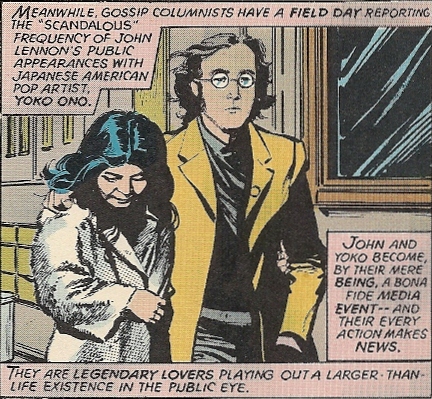
A little over a month ago I posted a couple of ads for this mag, and a comment pointed out that Ringo looked odd. That’s not so much the case in the comic proper, though later in this chronicle of the Beatles’ career, when they all started sprouting facial scruff, Mr. Starr bears a passing resemblance to Baba Booey. Most of the likenesses, however, are passable at worst, and excellent at best. The photographic reference work is mentioned in a portion of the extra materials (which are the obvious discographies and fluff articles, nothing too astonishing). That morsel can be found in the Marvel biographies below, as well as a few other items of interest:
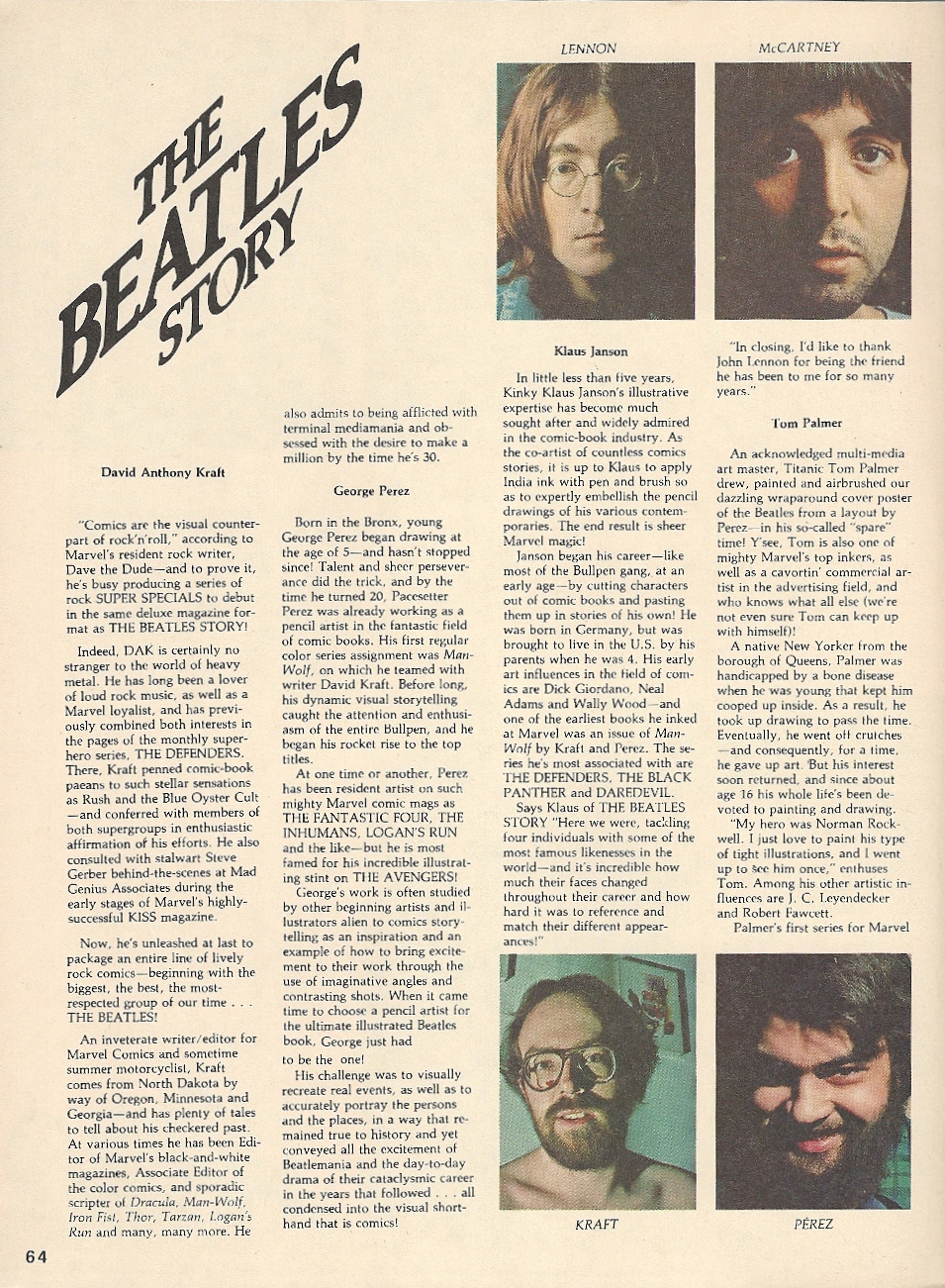
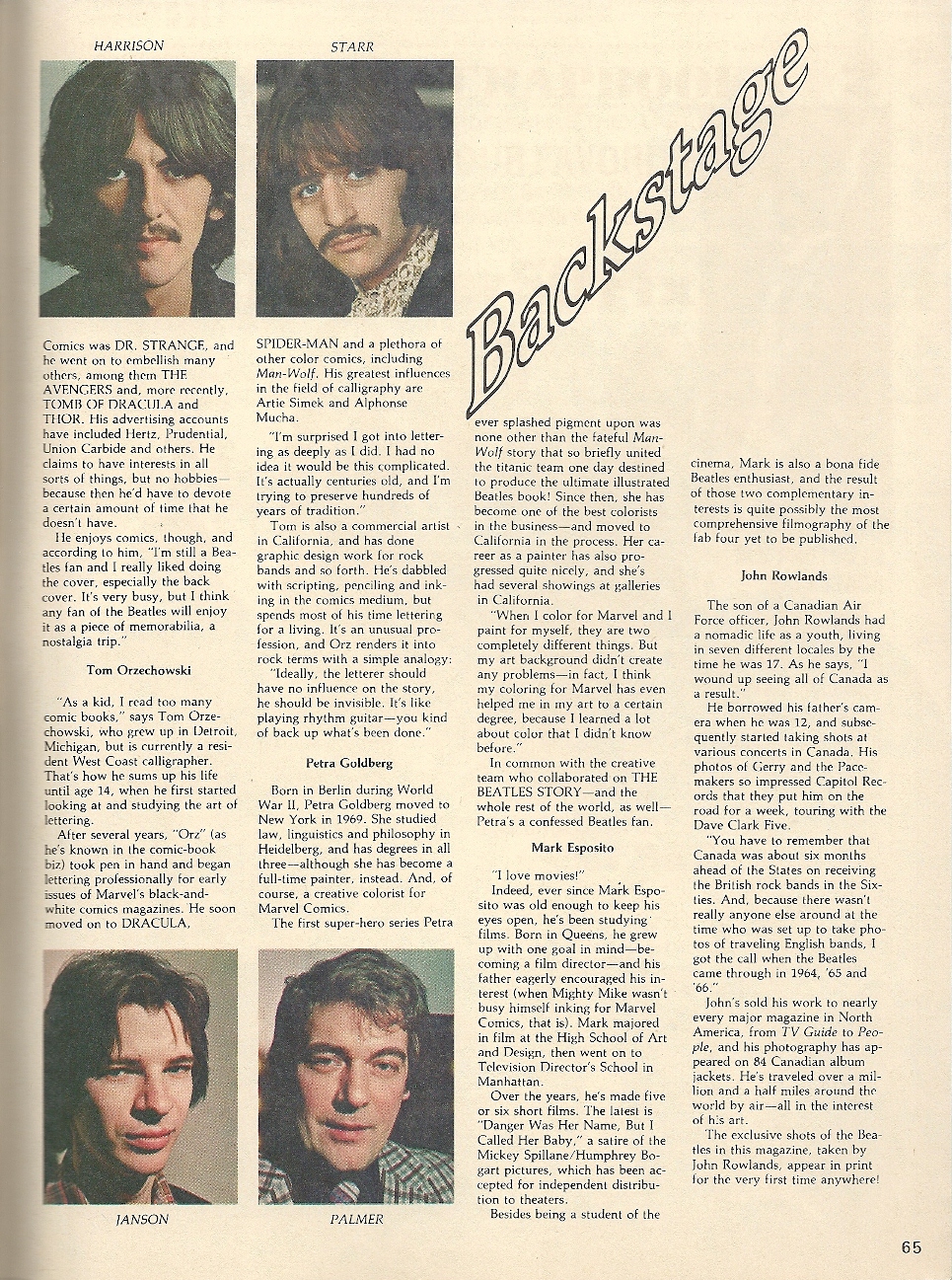
A) Perez looks like Charles Manson or something. B) I wonder what the extent of Janson’s friendship with John Lennon was. Pals? C) Is Kraft nude in his picture? It reminds one of Khalid Sheikh Mohammed’s capture photo.
And there you have it. If you love the Beatles — if you have a ratty Beatles beach towel hidden somewhere — than this is manna from heaven. If you’re not a fan, it’s a bit of a bore, even with two big industry names illustrating it. I found it boring. If you disagree, try to see it my way. Only time will tell if I am right or I am wrong.

“You can get an idea from anything if you are willing to think hard enough and long enough.”
— Isaac Asimov, Nightfall and Other Stories
There exists no greater proof of the late, great Mr. Asimov’s truism than the Madballs, lumps of smelly plastic that were shoe-horned into not just a comic book series (which I assure you will one day be lovingly covered here), but also a cartoon. Unbelievable. It’s a good thing that they were able to diversify, because I never quite got the appeal of the original toy. They were ugly to look at, and their irregular shapes made them useless for the simple bouncing that normally forms the sum total of a ball’s purpose in life. I’d think that looking at a ball with a bloody head bandage would rapidly lose its lustre, but hey, WHAT DO I KNOW?
Something tells me the folks behind the fictional Madballs universes had to think real hard and real long to weave anything out of this straw.
A smiling Ming the Merry offers you this expensive-looking yet slapdash 1970s fanzine. ENJOY. – Heritage: Flash Gordon 1b

Ming looks rather cheery in this Al Williamson/Gray Morrow cover, right? Maybe he’s gloating in a most sinister manner, but that’s not the vibe I’m picking up.
I admit that I’m no great Flash Gordon fan (though I sometimes see him in strange places), so I’m perhaps the last person in the world who should own this meaty 1970s Flash Gordon fanzine. Yet here it sits on my desk. There’s a short, pointless story about how it came into my possession, and I shall favor you with it. I was at a small local show, perusing a deeply discounted bin of magazines. I found this mag. It’s listed price was $150, which I found, to put it mildly, insane. But, thanks to the discount, it’s actual cost was low two-figures. But I wasn’t going to get it. I had taken it out to look at its contents, and I was about to slip it back into its protective sleeve and its place in the bin, when one of the old alter kocker artists that frequents the show (I don’t know his name) came over and asked if he could see it. I handed it to him, he flipped through it, muttered “Beautiful stuff” or something similar, handed it back to me, and asked me if I was going to get it. I said I wasn’t sure. He said I should, and then walked away. I put it in the pile of things I was going to buy from this particular dealer. And here it sits.
I guess the point is that I’m far too malleable. Anyway, onto the magazine.
The first thing you notice about it is its physical aspect. Its paper is that thick, shiny stuff that you’d find in a catalog that goes along with a museum exhibit, and has the feel of something the I-drink-with-my-pinky-sticking-out set would deign to read. CLASSY, BABY. But this is offset by print that looks to be mimeographed from a typewriter original, a standard feature of most fanzines, which normally look like they were printed in a guy’s basement right next to where he keeps the lime for the dead bodies. C’est la vie.
We won’t even discuss the odd 1a/1b numbering of the respective editions.
But content is king, and is all that truly matters. The insides are filled with brief retrospectives and artwork from people who toiled on the Flash Gordon strip over the years, from the 1930s down to the (1972) present. One of the most stunning aspects of this ‘zine’s art is the sheer number of bare boobs on display. Maybe it’s the prudish American in me noting it, but this must stand as one of the more jugalicious Flash Gordon publications ever put out. Seriously, there are a metric ton of aureolas per capita. Not that I’m complaining. Just saying.
Though this makes many of the images NSFW, there are plenty that would pass the censors in the breast patrol and give you a sense of what’s going on. I don’t have immediate recall of Queen Azura or her fictional biography, but since she’s rather hot, and since the same image is repeated twice in these pages (another demerit in the mag’s quality), I offer you this very slinky, very chesty Mike Royer selection from “The Girls of Mongo”:

Nice slippies.
I was odly taken with this non-erotic page from Stanley Pitt, which has a Sherwood Forest/Robin Hood/Maid Marian feel — and a space squirrel:
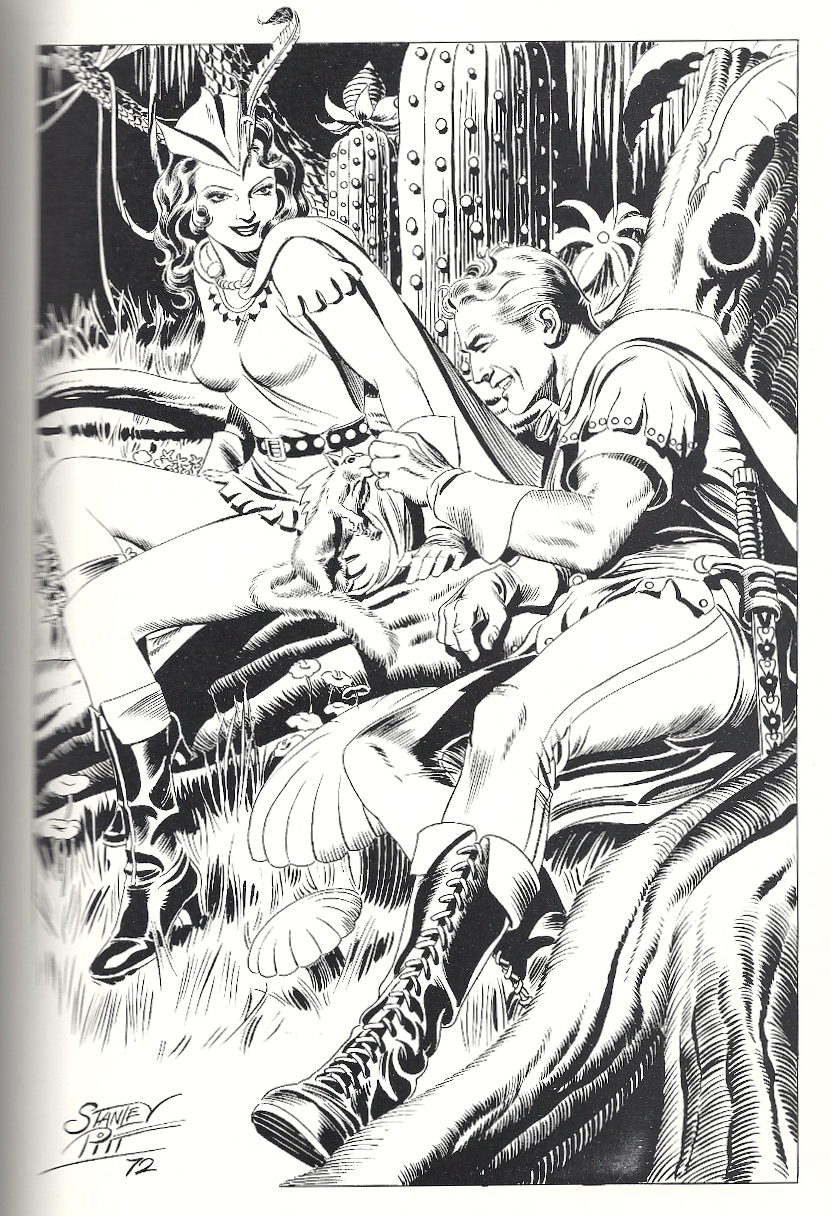
Doesn’t Flash know that if you feed one, hundreds more besiege you?
One of the most noteworthy features (also printed twice) is a one-page look at the work and private lives of Flash Gordon creator/artist Alex Raymond. (Sorry that some of the text on the right is obscured. I’m afraid I have neither the time nor the will to transcribe the blurred words, though I’m fairly certain you can get the gist.) I thought it was a rather charming look at a craftsman plying his trade, and then I looked closer at the model work in the upper half:
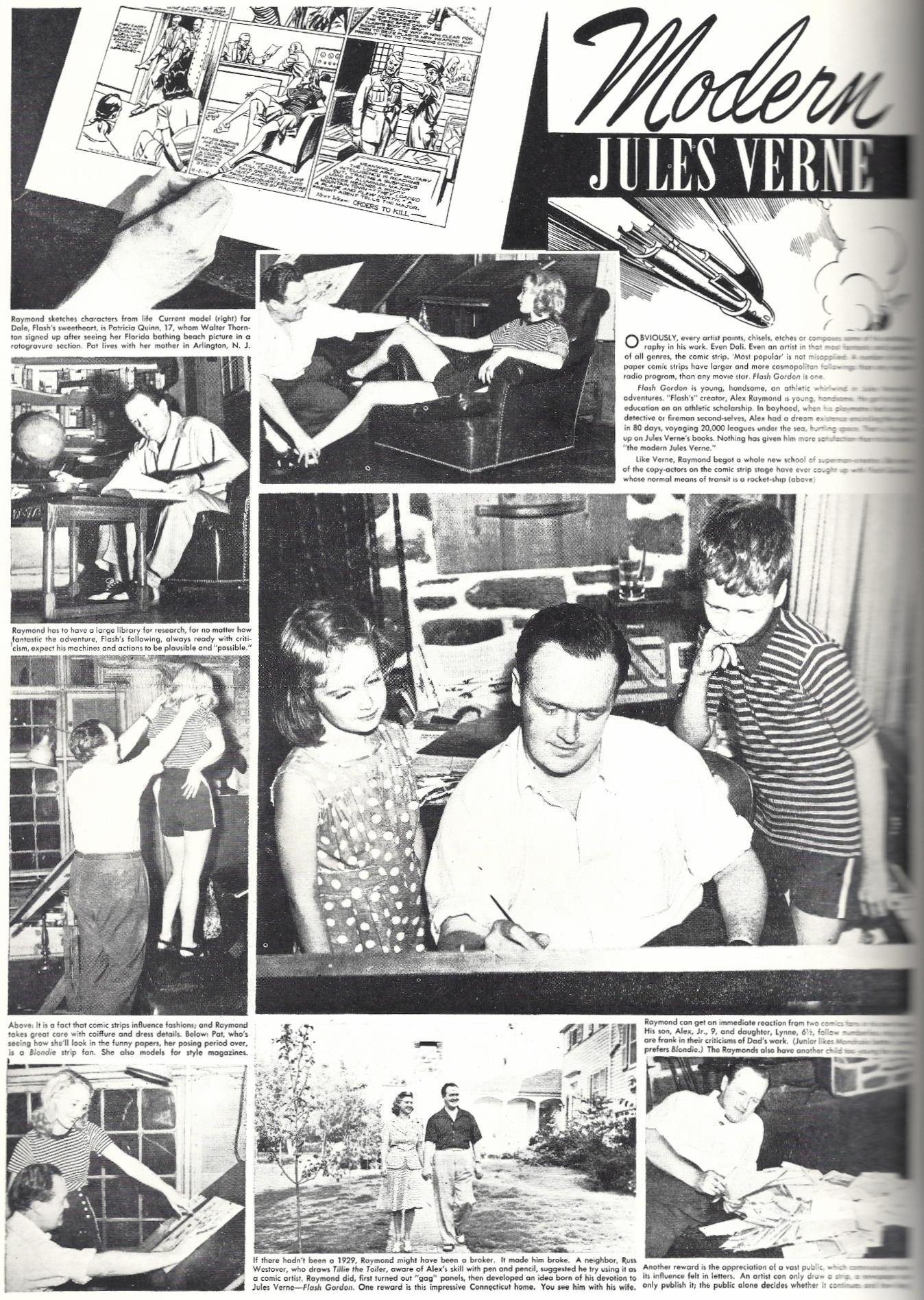
The girl is 17. The girl whose spread legs Raymond is closely inspecting is 17. It looks like he’s giving her a gynecological exam. Get the stirrups! Once again, my ingrained prudish American sensibilities may be coming out here, and I’m sure Mr. Raymond was a fine, upstanding member of his community, and was only posing her, but THIS IS CREEPY TO ME.
Ickiness aside, there are also some Neal Adams pages that I’m sure would throw Adamsophiles that are also Flash Gordonophiles into throes of sublime ecstasy. There’s an incentive for folks to try to track down a copy.
So the codger at the show was right. The art, of which I’ve barely scraped the surface, is fantastic, and it’s lovingly reproduced on paper that feels like it’ll last for about a thousand years. These things elevate the mag above its fanzine cousins. I have no regrets about buying it, though it’s too bad the folks publishing it couldn’t perform a little quality control, what with the repeated material and all. What, did they think they were working on a blog or something?
I’ll leave you with this back cover illustration by Wally Wood, which is about as Wally Woody a Flash Gordon pic as you can get:

Bulletman, Eagle-Eye G.I. Joe and Mike Power have absolutely nothing in common. LET’S TEAM THEM UP.
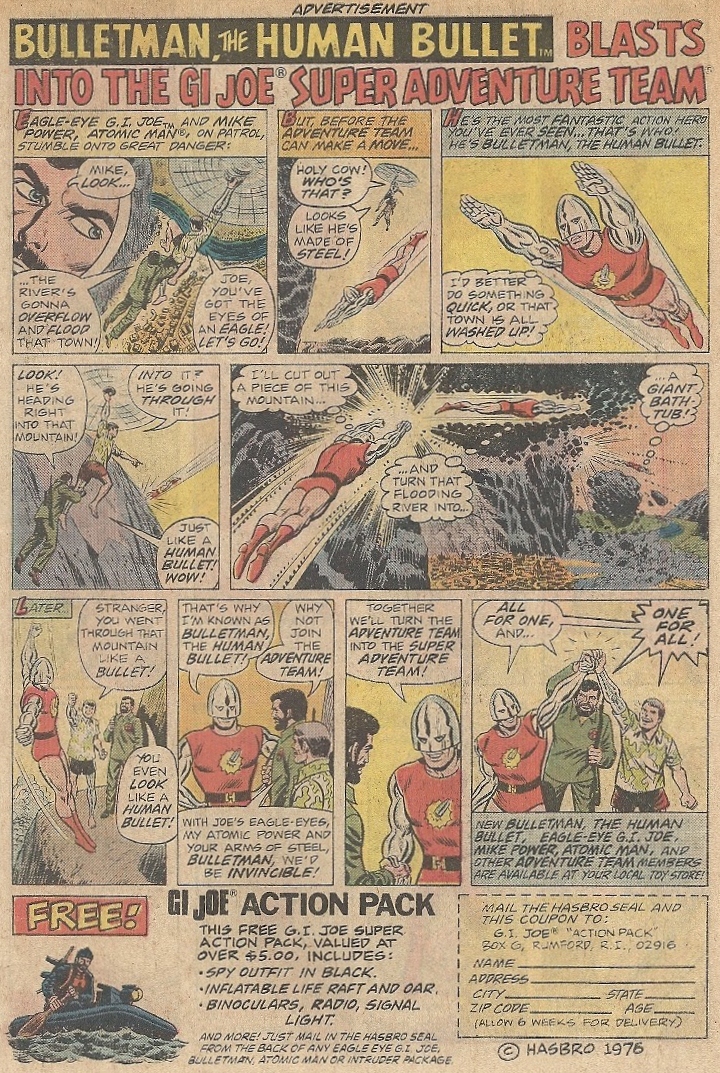
I was familiar with the old Fawcett character Bulletman, whose head-first powers would have made him ideally suited for today’s concussion-ridden NFL. The other two members of the Super Adventure Team trio, Mike Power (the Atomic Man — I wonder if there’s any relation to Conan O’Brien’s Molecular Man) and Eagle-Eye G.I. Joe, were new to me. At first blush I thought “Eagle Eye” was a codename for a guy whose eyesight was especially keen, one to differentiate him from the regular, ass-kicking, tough as nails Joe. Little did I know it referred to a toy feature that has to rank as one of the most unintentionally freakish of all time. This Joe’s eyes moved, thanks to a lever at the back of his skull, and this gave him the same disturbing quality as an old portrait of a formidable and forbidding great-aunt, one with eyes that follow a person around a room, judging all the while.
Buy this Joe! Make your bedroom feel like a Scooby-Doo haunted mansion!
In the roster of dolls that might come alive and kill you in your sleep, Eagle-Eye has to be in the starting lineup. Store him in a drawer. Out of sight. With a padlock.
Come play with us, Santa. Forever. And ever. And ever. – Marvel Super Special #39, “Santa Claus: The Movie”
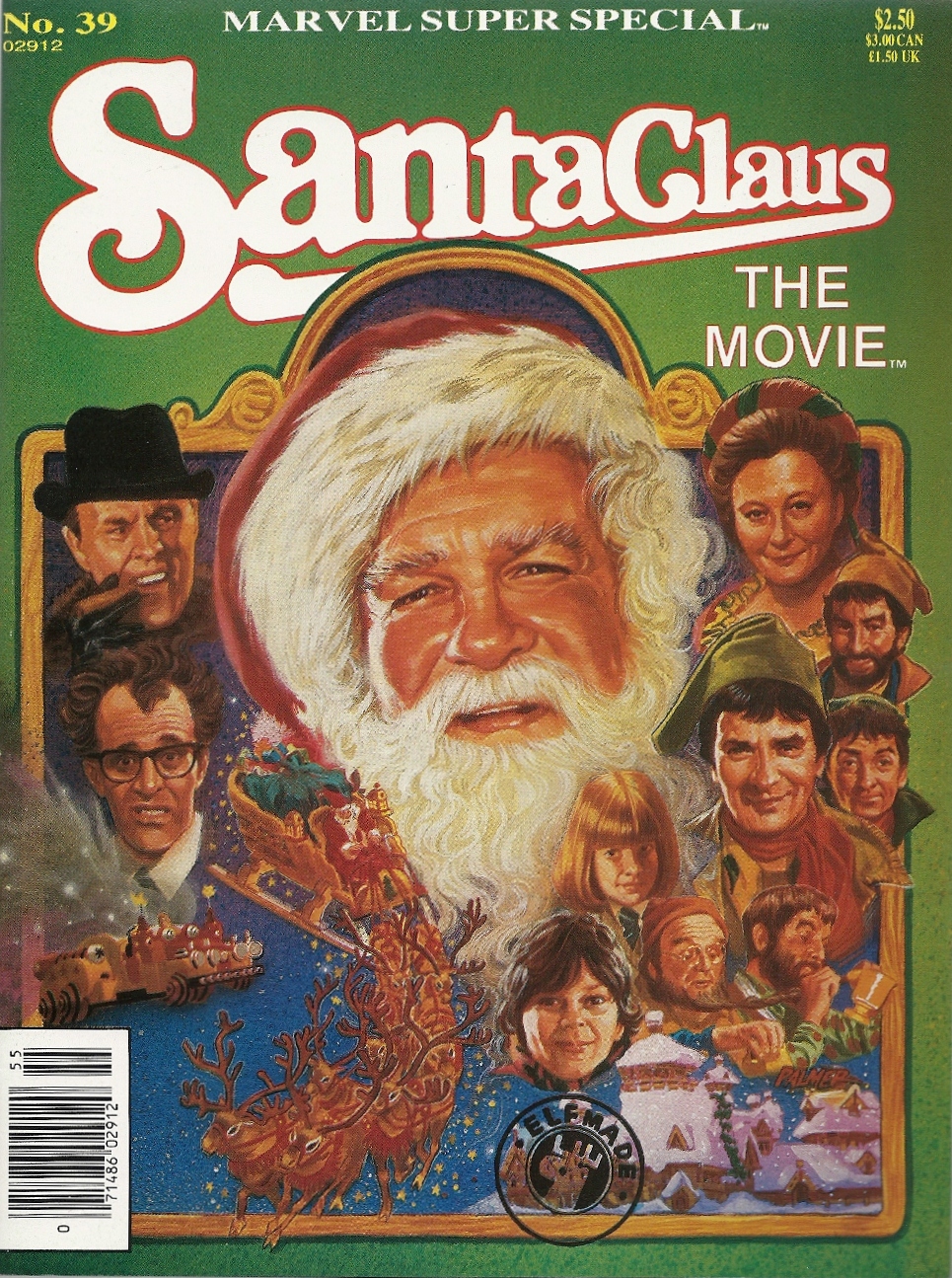
We’re plumbing the Yuletide depths in this Marvel Super Special March installment, with a 1980s cinematic offering that’s even more forgotten than Krull. Santa Claus: The Movie dipped its toes into the crowded Christmastime glut, whose rotation is harder to crack than the Augusta Country Club rolls. If you’re not Rudolph, Frosty, Linus, or a Fred Astaire narrated Santa biopic, YOU NEED NOT APPLY.
But Alexander and Ilya Salkind — who brought the world the Christopher Reeve Superman, and thereby escaped the gallows for crap like this — defied the odds and vomited out an atrociously mundane Santa movie, which tried and failed to tell the story of how Santa came to deliver toys to children all over the world. The senses-shattering origin of Kris Kringle, as it were. And that, in a nutshell, is it — all you need to know. There isn’t even a Santa Claus Conquers the Martians angle to this thing. No, it’s just straight-forward tripe. One of the few remarkable aspects to it was that it was a Dudley Moore vehicle, at the stage of his career where he was rapidly tobogganing down the backslope of his post-Arthur fame. If you get caught between the moon and a crappy Christmas movie…
I missed it when it was released back in 1985, though I remember quite clearly the associated McDonald’s advertising campaign. I had one of the related storybooks hawked in the following video — it was always kept at the very bottom of the attic’s Christmas Decorations box, to be lifted out at the end of every November and immediately chucked back in:
I actually watched SC:TM for the first time before writing this post. THE THINGS I DO FOR THIS BLOG — YOU”RE WELCOME, EARTH. “Watched” might be too strong a word. There was a lot — A LOT — of skipping involved, as I’d read the Super Special adaptation before my laptop screening, and the comic hews closely to its celluloid cousin. And what a cousin it is. Santa Claus: The Movie is that most toxic brand of family fare, one guaranteed to A) get parents looking at their watches and dreaming of the days when they didn’t have children that needed to be entertained, and to B) get kids squirming in their seats, bored out of their damn minds.
It’s awful. It’s not even entertainingly bad. It’s dull awful, which is the worst kind of awful that there is.
But there is one thing I found mildly entertaining, in a completely unintentional way. And I shall share it with you, as part of my catharsis.
Santa (played by David Huddleston, the Big Lebowski in The Big Lebowski) starts out as a common man named Claus, a childless fellow from a much earlier century who brings toys to children in his neck of the woods, wherever on the globe that may be. (The locale isn’t really clear, though judging by the darkness and horrific snow he may have been exiled to Siberia by an angry Tsar.) It’s after one of these cheery deliveries that he and his wife try to return home through a blizzard, despite the pleas of saner adults that he wait it out. Of course he gets stuck in a drift and faces certain death, dragging his wife and his reindeer, Donner and Blitzen, down with him:
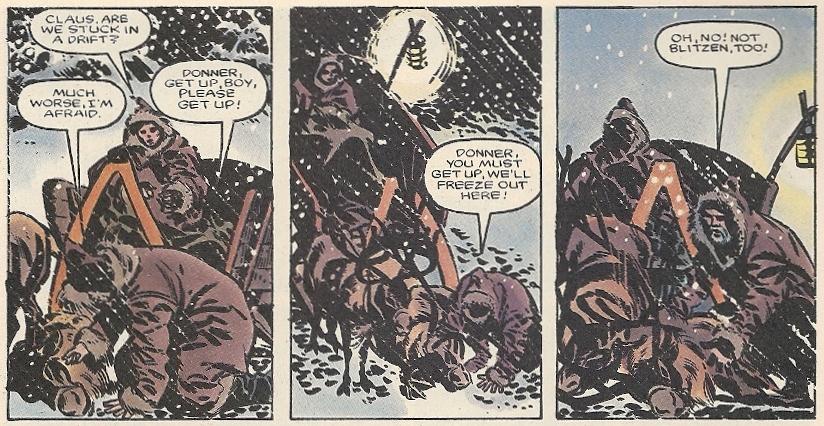
Ah, reindeer laying down in the snow to die. Enjoy, kids!
Alas, it’s not their fate to become popsicles. Their deliverance is an elfy one:
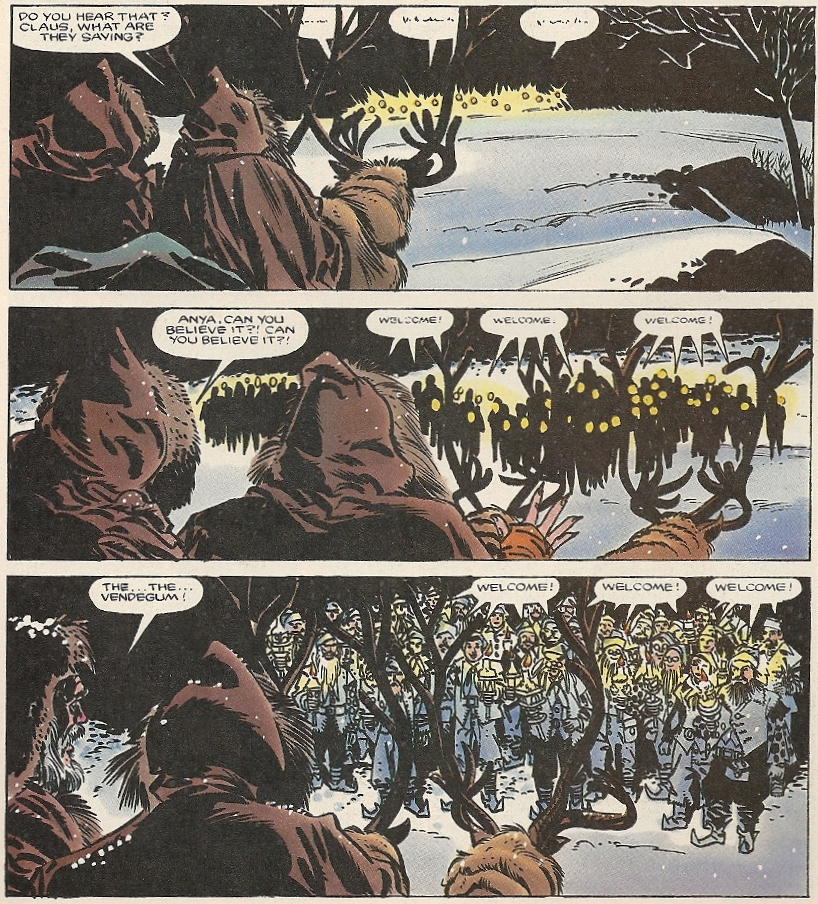
“Vendegum” is this universe’s needlessly elaborate term for the mythical creatures that live in the frozen reaches of the world. I suppose it works better than “Annoying Creepy Ice Goblins, ” which admittedly has far too many syllables.
They show up out of nowhere, with big, scary Stepford Wives smiles plastered on their miniature faces, and drag the befuddled Claus and wife (and their still-living animatronic fakey reindeer) back to their hidden realm, which is your rote North Pole toy factory (lots of wood grains and bright paint):
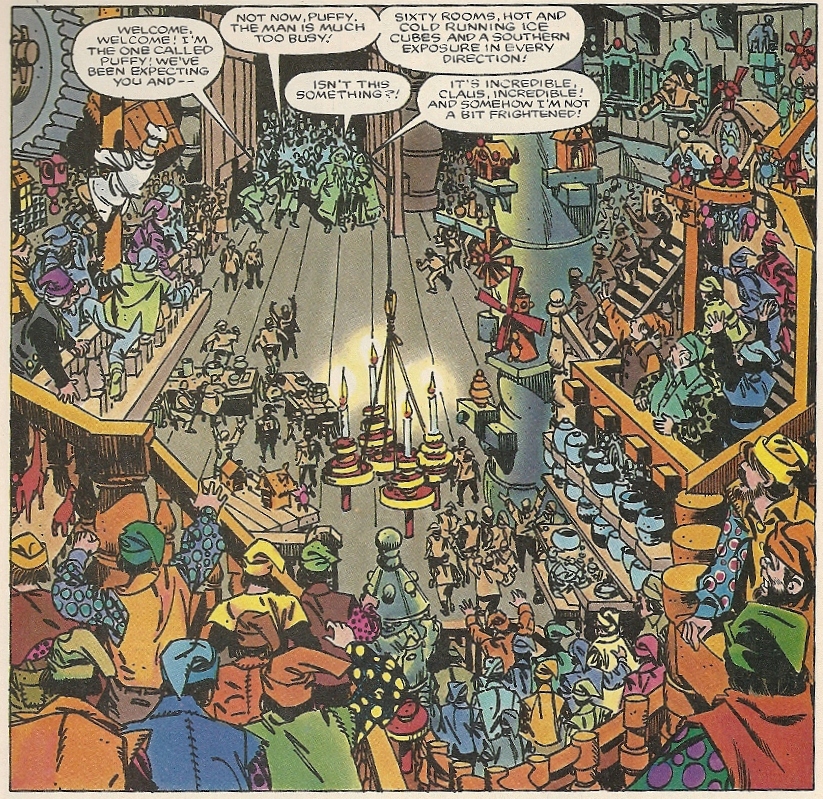
In the movie there’s a lot more plywood on display. And I should note that they churn out the same stereotypical generic wooden toys always produced at the North Pole, which no self-respecting spoiled American child would ever accept.
The creepiest thing about this — and this is where the mild interest comes in — is that Claus’ coming has been foretold (by a Burgess Meredith elf, no less — GET UP, YA BUM), and his childless self is going to deliver the toys made by the Vendegum to children all over the world. Forever. (“Whether you like it or not” is left unsaid.) I think the look on Claus’ face in this last panel says it all:
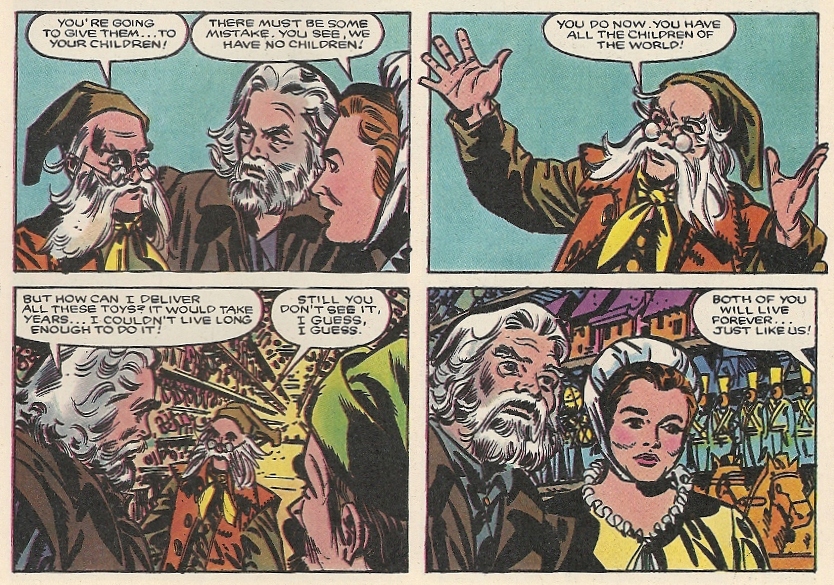
If you’re having visions of Jack Torrance, the Overlook Hotel, Grady and his twins, you are not alone. “You have always been the caretaker here.” Claus has been rescued, but it’s rapidly taking on the dimensions of an abduction, and, though giving toys to kids has been his gratis pleasure for many years, now he’s going to be yoked to it for all time. I enjoy writing this blog, but if freaky little dudes popped out of the snow and told me they’d help me write it until Armageddon, I’d start looking for the the nearest exit.
Nevertheless, Claus embraces the elf lifestyle, bids goodbye to his mortal self, and sets in motion one of the more soporific Christmas stories ever forged. And we’re all so grateful.
I can’t even begin to relate how dumb the story is, with magical dust that makes reindeer (and people) fly, an evil toy manufacturer (played by John Lithgow) straight out of the Stock Christmas Cigar-Chomping Villain Depository, and Moore’s elf character Patch (an engineer), whose purported lovability is utterly unlovable.
And there are (OF COURSE) two kids that those in the target demographic can relate to, a rich girl and an urchin boy, the latter glimpsed in these depressing panels:
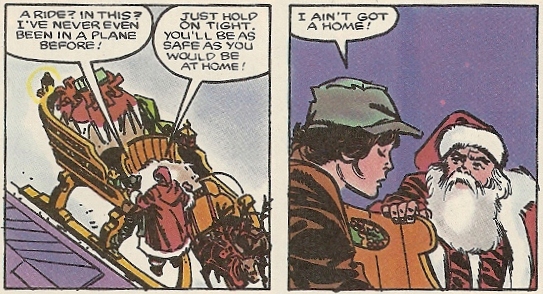
Don’t feel too bad for him, because in the film he’s remarkably healthy for living on the streets in the middle of winter and eating out of dumpsters. Only in Hollywood. Only in Christmas Hollywood. And only in comics, too.
Oh, and he and the girl in the end wind up living with the Vendegum as well. Which adds to the creep factor.
Sid Jacobson was saddled with the adaptation chores on the comic. Since it follows the film closely, he shouldn’t take any of the blame shrapnel for the dumbosity on display. Frank Springer tackled the art, and his work is actually a bright spot. It’s strong and bold, and receives the highest compliment from a reader: “I wish I could see this guy illustrating anything else besides this.”
So don’t blame the messengers.
As a final, back-breaking straw, there’s a propensity in the movie and the comic to use “cute” puns like “elf-reliance,” “elf-assurance,” “elf-made,” “elf-starter,” which is repeated in the adaptation. It’s so annoying all you want to do is commit (s)elf-strangulation. I’ll leave you with that. Yes, this Christmas movie makes you want so inflict greivous bodily harm on yourself.
I promise you, the next stop in the Marvel Super Special March will be much better.
Spider-Man and Power Pack would like to pause a moment for some sexual abuse PSA bewilderment
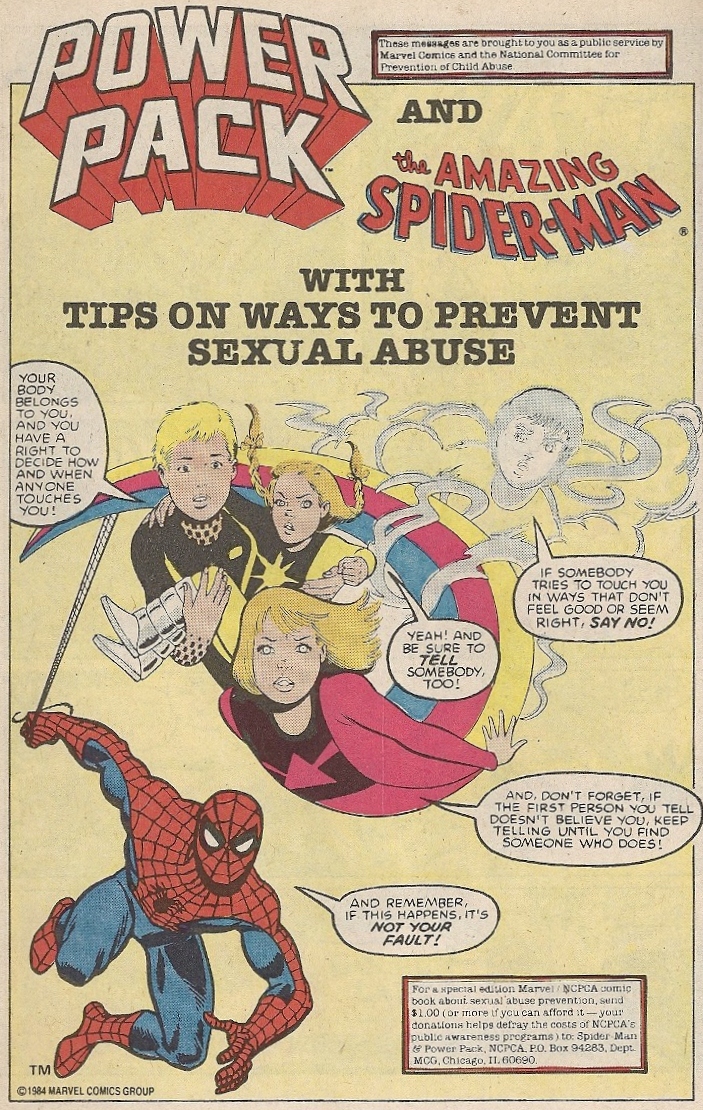
I referenced this ad in a Power Pack/Spider-Man post from about a month ago, and thought I’d put it up for completeness’ sake. I remember it quite well. I was smack dab in the middle of its target audience, but its (necessarily) vague wording left young me totally confused about what I was supposed to be guarding against. So if I’m in a bitchy mood, and one of my parents pats me on the shoulder, I should report that to the nearest constable? Is that it?
That there are adults out in the world that like nothing better than fondling children — and much, much worse — is a hard thing to explain to a kid. This well-intentioned PSA does a little to get the ball rolling, but it may raise more questions in youthful minds than it answers. It did for me. That’s all I’m saying.
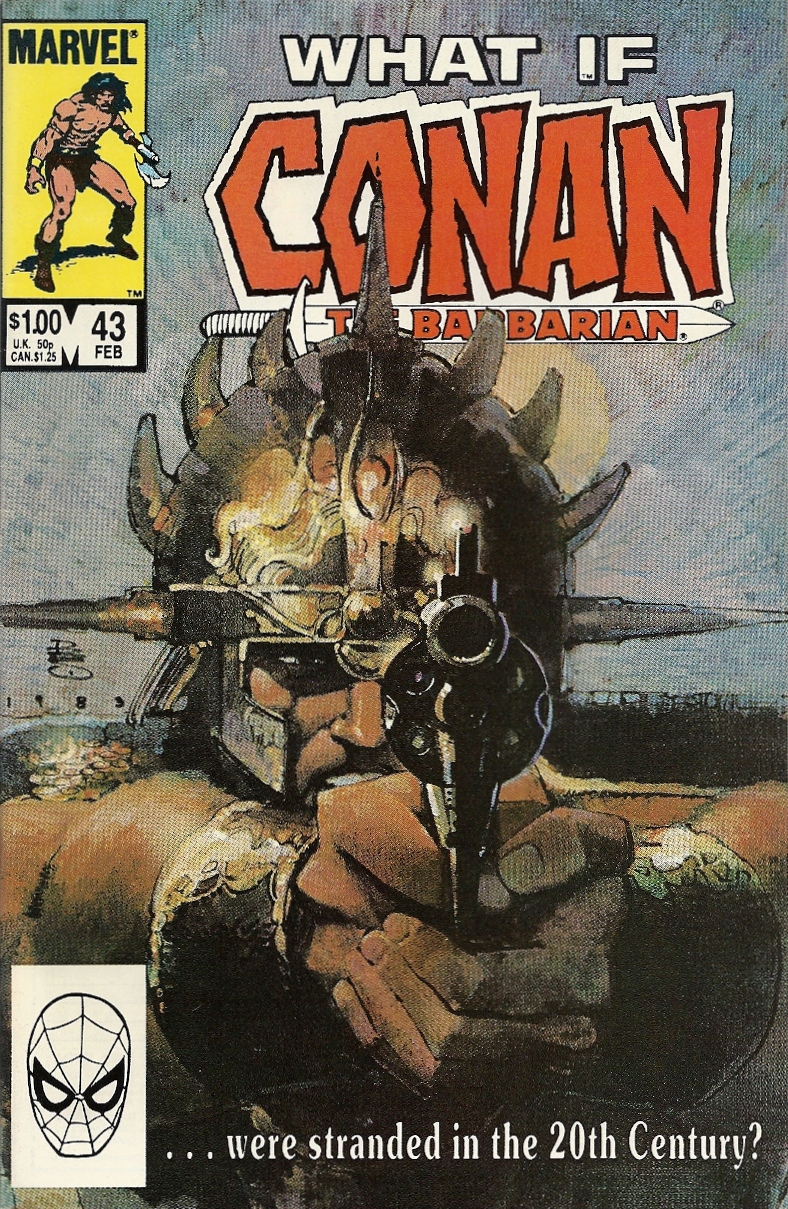
Okay. Does this “Conan with Gun” cover beat out the classic “Apes in Coonskin Caps” masterpiece? Heresy, I know, but I’m having an existential-level crisis over which would be more worthy to go above my theoretical mantel. It might come down to a coin flip. The one thing I’m certain of? That Bill Sienkiewicz must have been smiling from ear to ear when he was slapping his brushes on this sumbitch.
This comic is that rarest and most fragile of things: a What If? sequel to a What If? story. In the original tale, chronicled here a little over a year ago, Conan was shot forward to 1977 New York City, during that year’s infamous blackout. In the midst of that metropolitan darkness, he pummeled rioters with sofas and bedded a hot lady taxi driver. It was a fun ride to say the least. This sequel posits that the rooftop Guggenheim lighting bolt, which shot Conan back to his own time in that story, didn’t work, and Conan was thus stuck in the (old) present.
There’s an old Jack Handey “Deep Thought”: “If you ever discover that what you’re seeing is a play within a play, just slow down, take a deep breath, and get ready for the ride of your life.” This is a What If? within a What If?, so perhaps that counsel applies. Perhaps not. Deploy the wisdom at your own discretion.
Peter B. Gillis scripted and Bob Hall artified this follow-up. The lightning bolt that rocketed Conan back to his ancient environs in the other reality, in this one zaps him into unconsciousness, making him easy pickings for the don’t-know-how-lucky-they-are gendarmes. A tight shirt and some even tighter slacks later, and a believed to be insane Conan is ready for his arraignment — but no mere Night Court set can hold him:
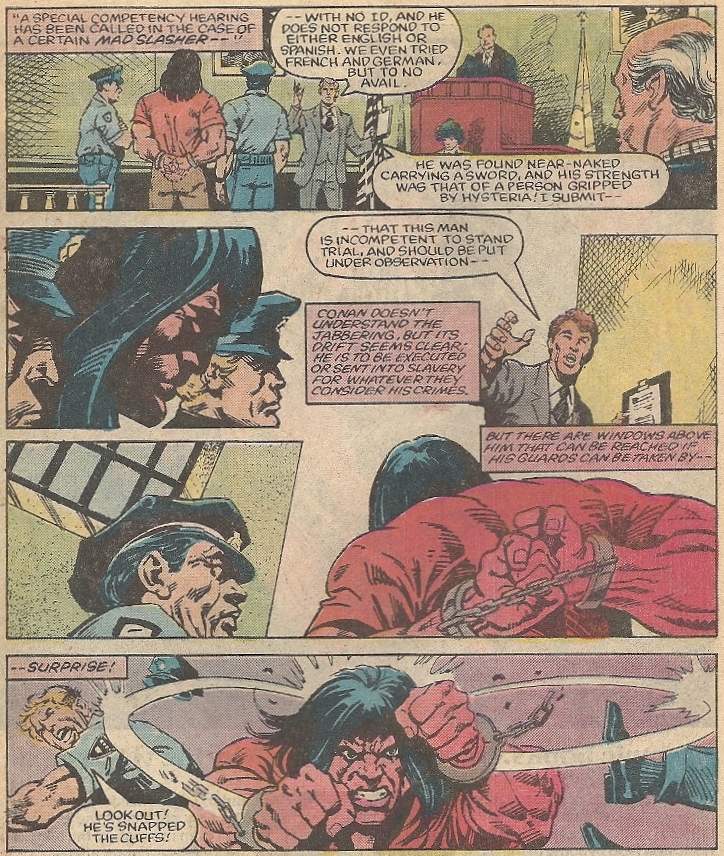
And out the window he goes. He takes a bullet in the escape, so he steals a giant knife from a pawn shop to do some rooftop self-surgery, Rambo-style:
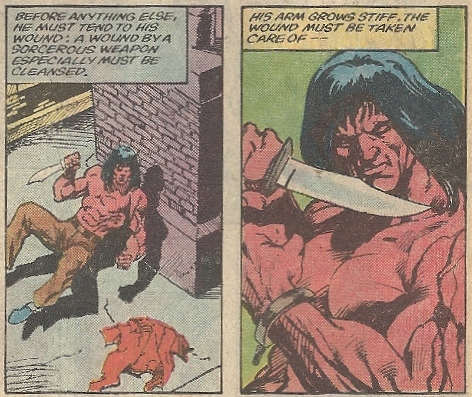
AND WE’RE OFF. A nice effort, but Rambo, who cauterized his wound with flaming gunpowder, is still the king.
Conan starts his new life by making the best of things within the New York underworld, starting off by pickpocketing (keeping the coins while tossing the green paper is his first rookie mistake) and becoming (Warning: More Stallone Ahead) what Mickey Goldmill once gutturally called “a cheap, second-rate loan shark!” No surprise, he’s pretty good at it (no “waste of life” for him), and his English becomes fluent in no time.
With this success (which transpires in less than a page) comes a measure of prosperity, and Conan has his Scarface moment as one of the criminally nouveau riche, buying gaudy crap that he thinks conveys his bigshot-ness. And Danette, the hot broad from the first installment? He pays her a visit:
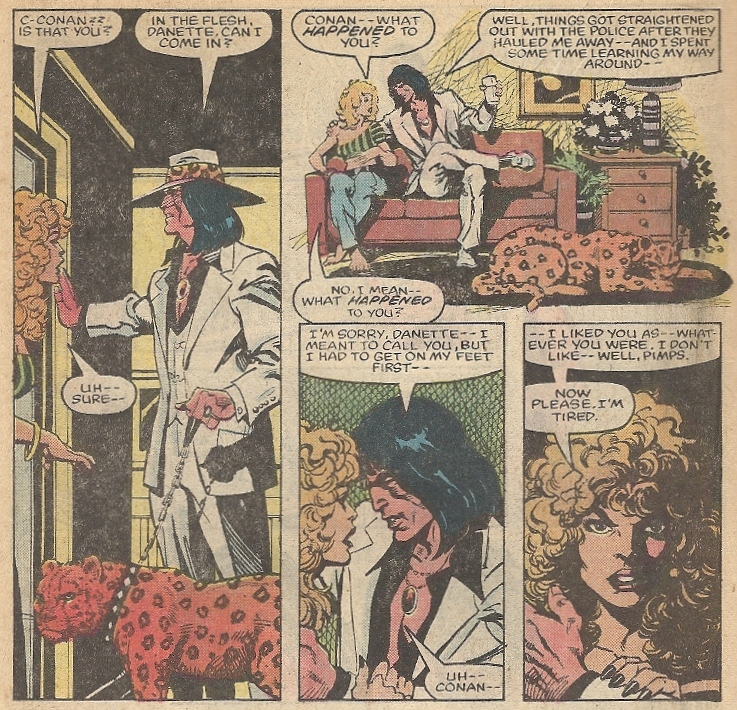
And that’s the last we see of her.
If there’s a bright side to this rejection, it gets Conan out of those God-awful clothes. (No idea what he did with the leopard. Maybe he ate the damn thing.) He decides to get back to his badass roots, while still working in the realm of crime. To this end he recruits some (literal) muscle at a Black Power gym, and forms his new gang. Ladies and gentlemen, I GIVE YOU THE BARBARIANS:
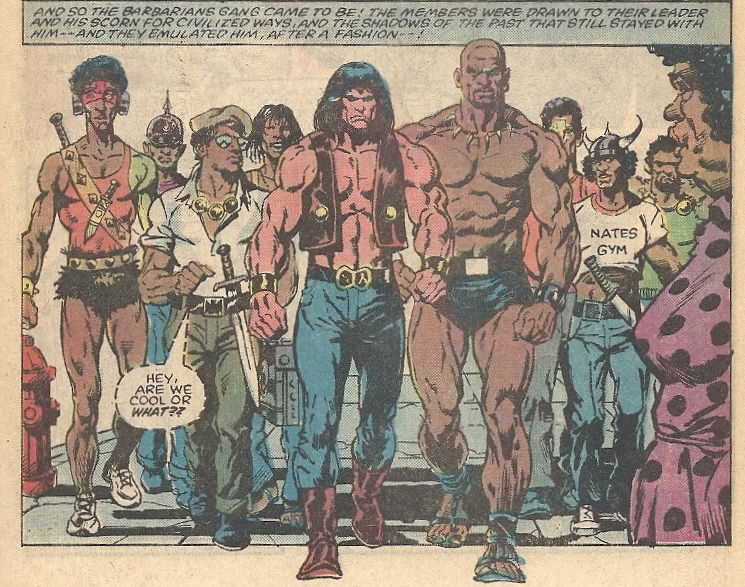
And the Jets and the Sharks just wet themselves.
They stake out their turf, running the protection rackets and low-level organized crime long favored by neighborhood toughs. But this bores Conan, and he decides to go for a big score at one of New York’s fine museums. This gets the attention of none other than Captain America:
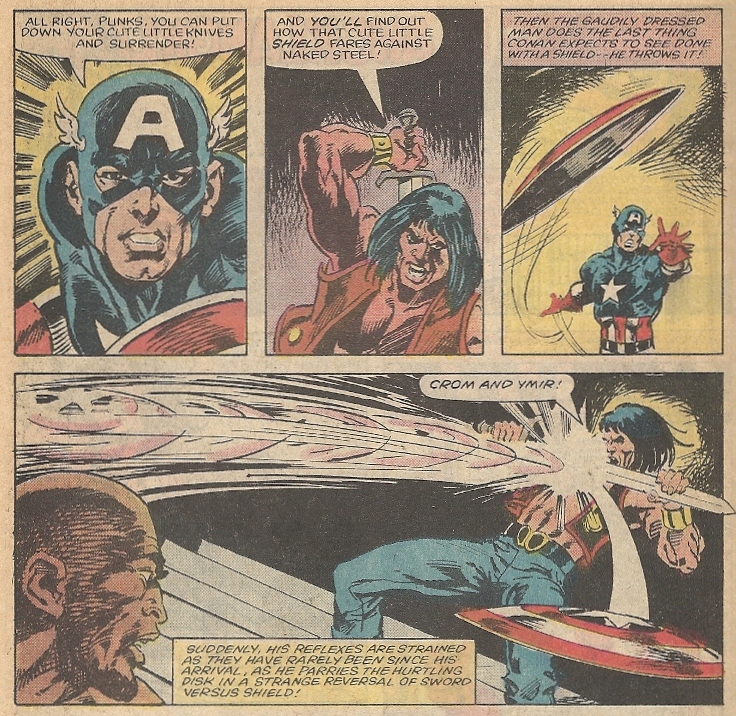
For those of you who always longed for a Conan vs. Captain America slugfest, this comic delivers. Who wins? It’s mainly a stalemate, though Conan ends hit BY CUTTING THE GOOD CAPTAIN IN TWAIN:
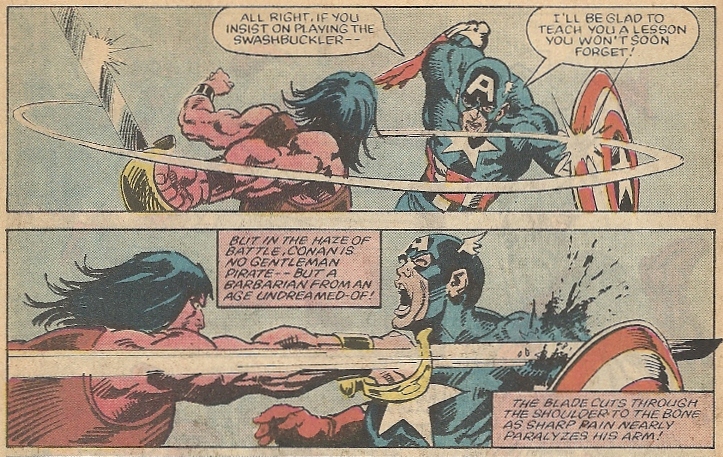
Yet Cap lives to fight another day, and his arm still functions. The world of comics, you know?
All this has done is necessitate a second showdown, and the two combatants agree to meet alone, where Conan lays out his anti-authority motivations and CA gives his “I feel the good in you, the conflict” rejoinder:
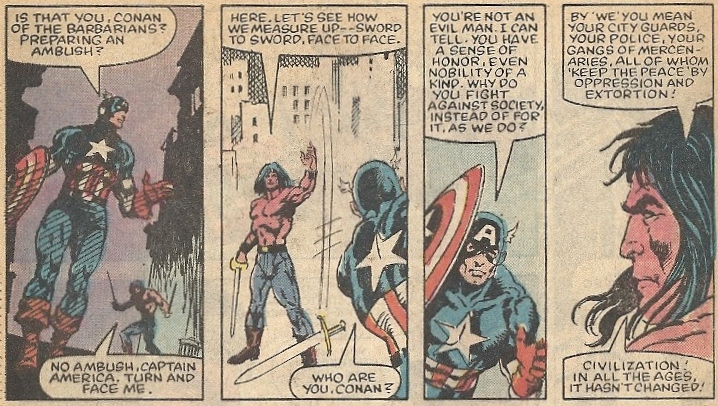
But the cops and the Barbarians show up and make a mess of things before this mutual admiration society can resolve anything. Conan’s number 2 gets gunned down, and the out of time Cimmerian has to go on the run. Cap lets him flee, yelling to Conan that the Avengers are in the phone book, and that’s something that Conan ponders as the story comes to an end(?):
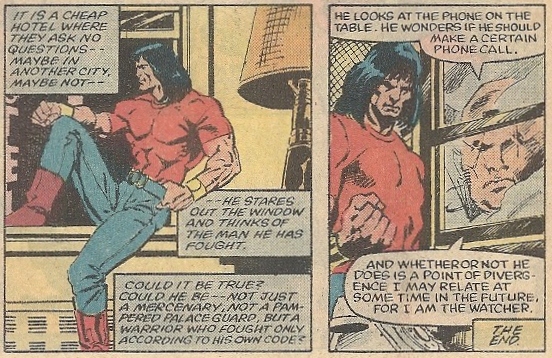
Conan in the Avengers. Commence imagining.
This story is a disappointment, an example of a sequel that should never have been made. The first, with a script by Roy Thomas and art from John Buscema, obviously had bigger names on the marquee, though past success is never a guarantor of the same in the future. What this one most lacks is Thomas’ sense of fun, of when to ramp up the ridiculous and when to pull it back. There’s a remarkable through-the-motions feeling in this second go-around. It might boil down to lack of freshness, though Conan’s transformation to gang-leader would have to be considered by most readers as being too quick.
Also, I remember reading once how upset James Cameron was that characters he had created for Aliens (Hicks and Newt) were casually discarded for Alien³. There’s a taste of that with Danette, who gets the perfunctory Elizabeth Hurley/The Spy Who Shagged Me dismissal. Gone and forgotten. Perhaps Mr. Gillis wasn’t comfortable writing sex scenes for a character who was modeled on Thomas’ wife. Whatever the reasoning, her grounding presence is missed. (I can’t believe I just wrote that about a comic book love interest. Most of the time I want to jettison them out the nearest porthole.)
We’re left with Conan as (un)common crook, which, if logical, makes for dull storytelling. Conan shaking down local deli owners for protection money is less than compelling. And the Captain America insertion, while welcome and intriguing, is too little, too late. In the end, this is more Descent 2 than The Empire Strikes Back. And I’d like to point out, at no point does he hold a gun.
Ah yes. That cover.
I’ve decided between the cover painting and the Planet of the Apes offering. I’d keep the apes above the mantel, as that’s just too stupendous a conversation piece. I think I’d hang the Conan in a room where, when you turn the light on, it would be the first thing that you see. Conan and his revolver and his terrifying spikey helmet: THAT’LL CLEAR THE SINUSES.

Remember when the toothpaste pump was introduced? The innovation that was going to make the dreaded “squeezing toothpaste from the top of the tube” a thing of the past? It wasn’t quite the game-changer that it was pitched as being, and certainly not worthy of a King Kong cameo and a smiley-faced moon (or giant floating cheese-wheel, whatever that thing is). Save that red carpet for things that are worthy, like Pac-Man watches (well…).
Let’s kick this Marvel Super Special March off with a Glaive – Marvel Super Special #28, “Krull”
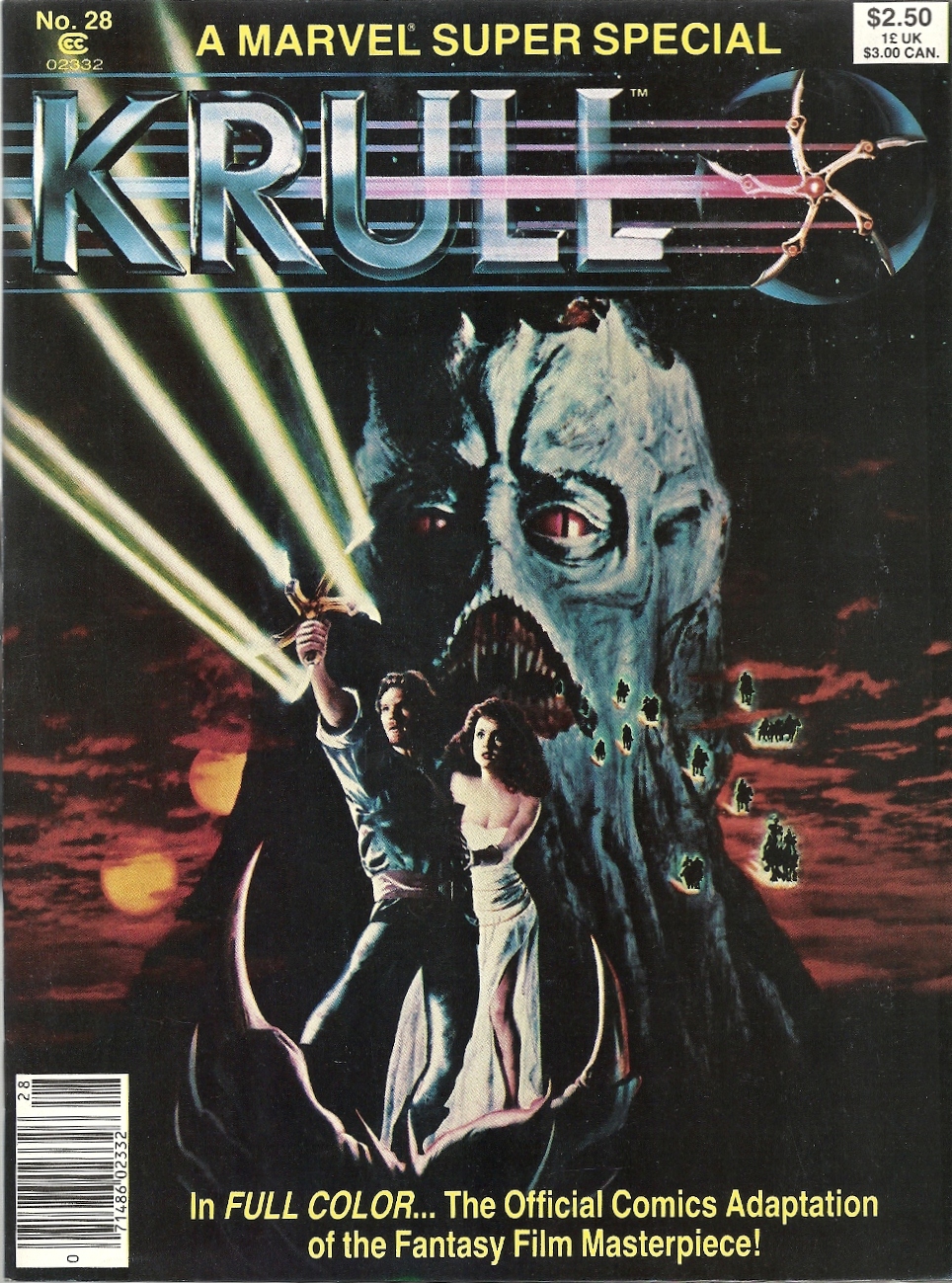
“Have you ever seen Krull?”
“No.”
“Yeah, you don’t need to see Krull.”
— Family Guy, Season 7, Episode 4, “Baby Not on Board”
I have a stack of the Marvel Super Specials sitting on my desk, and I thought, what with it being an alliteratively convenient month, March would be as fine a time as any to take a look at them here on the blog. Several others (Close Encounters, Dune, Rock & Rule) have been featured here before, and it’s always been fun (for me, at least) to see how films great and small were adapted to magazine-sized sequential art, the VHS/DVD/Blu-ray of prehistory. It helps that the Super Specials are largely products of the 1980s, meaning they were right in the wheelhouse of stupendous movie magic, when so many of the great films of my youth were being churned out on a regular basis, films that we’d never forget and would revisit year in and year out down to the present day.
And, in an inverse way, that’s why I decided to start this month off with Krull. Released in 1983, when I was five years old, the widest-eyed of wide-eyed ages, it COMPLETELY flew past me. Perhaps I was spoiled Spielberg and Lucas in the days when they could seemingly do no wrong. On the face of it, Krull has everything going for it that would have drawn me in, even if it didn’t make me a devoted lifelong fan. But no. I first stumbled onto it in the early 1990s, when after mowing my grandmother’s lawn I settled onto her couch with a cool glass of lemonade to watch some TV until my folks could come and pick me up. And Krull came on right as I sat down. I remember the moment quite clearly, because it was science/fiction fantasy, quite obviously from the not too distant past judging by the effects work, and I had never heard of it. Not a peep. Where had this “World invaded, Princess kidnapped, Hero seeks to put right” flick been all my life?
And you know what? I enjoyed it quite a bit that warm afternoon, and I do to this day.
A lot of it blows hard. There are enormous, chasmish faults in the film, which I won’t belabor. Well, I’ll mention a couple. One that has always vexed me is that Krull was a planet populated by a longstanding, cultured civilization with a population measured in the dozens. No budget for extras, I suppose. And Lyssa, the captive princess, is a weak broth, and hardly worthy of mobilizing most of the planet’s 40-man populace to rescue her. I never quite got what Colwyn, our royal protagonist, saw in her. I would have fought the invasion of the invading Slayers, but rescuing her would have been deep, DEEP on my agenda.
And yeah, though it wasn’t a complete ripoff of Star Wars, it was certainly following dangerously close in its wake.
But there was so much to love. The Glaive. Rell, the kind, badass Cyclops. The evil Black Fortress, which shifted position on the globe every day and had innards modeled after the body of its overlord, the Beast. James Horner’s uplifting, self-plagiarizing score. A young Liam Neeson cutting his acting teeth. The great sound that the Slayers made when they were killed. A motley assemblage of guys going on a quest, which, for the 12-year olds that live even in the oldest of men, NEVER gets old.
Most importantly, it was a movie that tried. DARED TO BE DIFFERENT. The mixed reactions that it generates remind me of David Lynch’s Dune, another film that was off-kilter but at least gave it a whirl, though Krull lacked the established universe of Frank Herbert’s creation. (This association is helped along by the two features sharing two supporting actors: Freddie Jones and Francesca Annis.) I’m not sure if the freshness of Krull was a help or a hindrance. Either way, it turned out that neither picture was in tune with the tastes of moviegoers, but each should get deserved props for creating unique aesthetics.
The Super Special adaptation of Krull (Script: David Michelinie, Pencils: Bret Blevins, Inks: Vincent Colletta) is faithful, glossing over bits and pieces but leaving nothing too big out. The first part of the movie that really grabs you are the opening credits, as the Black Fortress flies through space and descends on the unsuspecting Krull. It’s darkly majestic. If only the comic had the accompanying Horner fanfare, with all the beats that he cribbed from his own Wrath of Khan score:

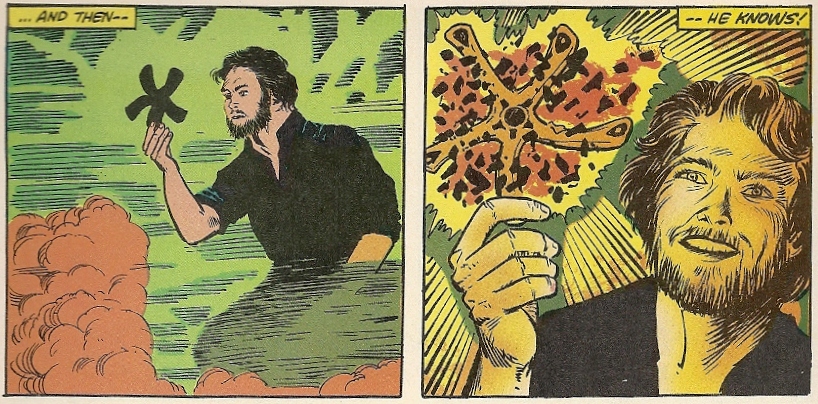
One complaint with the art is that Colwyn sometimes looks excessively shaggy, with creepy shadows obscuring his eyes and making him look more sinister than the virtuous gallant on the screen. Here he is finding the film’s superweapon, the Glaive, his Righteous Golden Switchblade Starfish of Justice:
One of the big differences between the film and the comic is the fate of Rell. In the latter, after the boys gather up the Fire Mares that will speed them to the Black Fortress before it changes locations, the noble Rell stays behind, as his destiny lies elsewhere. (If you’re unfamiliar, the Cyclopses are a race who once made a bargain with the Beast, getting knowledge of the future in exchange for one of their eyes. Except the Beast gave them knowledge of when and how they would die, and to try to escape that foreseen end brings them unspeakable pain. Which makes the Beast not only evil, but a complete douche.) He then charges in at just the right time to get the pinned down fellas into the Fortress, though he’s then crushed slowly and painfully while holding open a closing portal.
In the comic he comes along for the ride, thereby foregoing all the last-minute heroics, and his death is, how shall we say, A TAD SUDDEN:
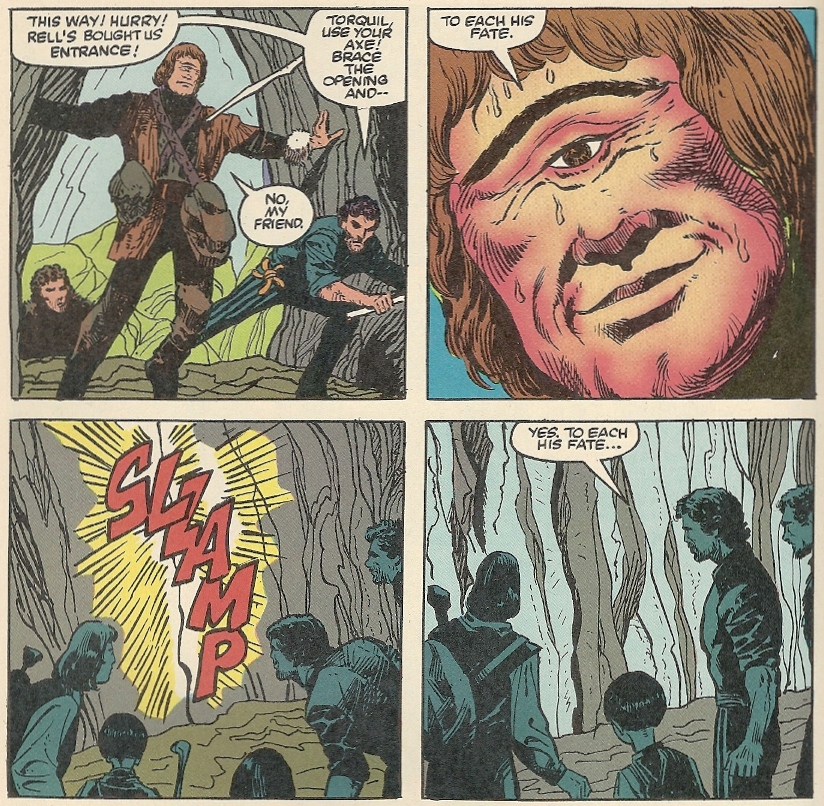
I almost fell out of my chair laughing when I read that. L. O. L.
The Beast himself, who, when finally shown in full in the movie had a strange and distracting anamorphic stretching effect distorting and widening his features, is here presented in his slender, au naturel glory:
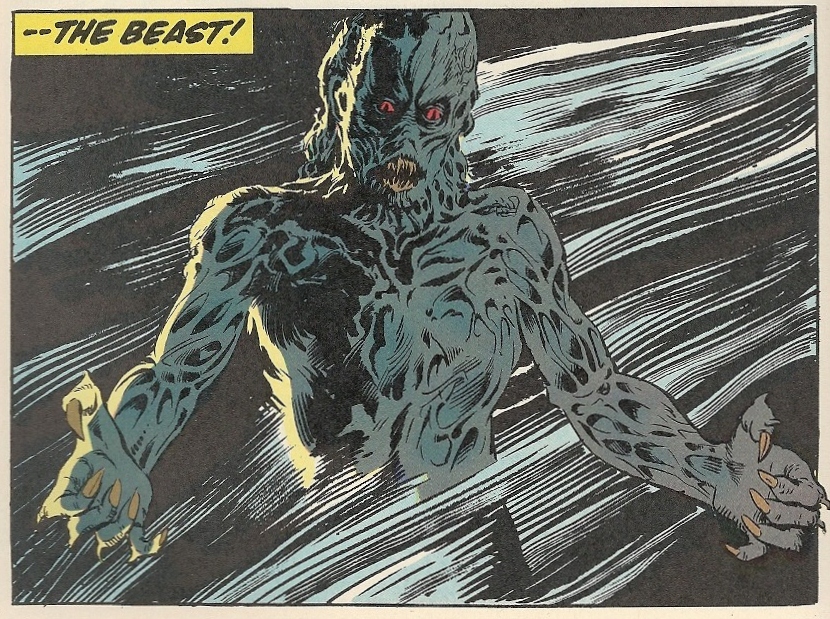
Perhaps the stretching business was a late post-production decision. Here he is in the film, so you can make an informed decision on which you prefer:

Sadly, the death of the Beast is still presented in the same disappointing way as the movie. Remember the Glaive, the magic device that forms part of the logo? YEAH, THAT. It comes out to play in the finale and puts the Beast down, but not out, but then gets stuck in his chest, meaning that the two young lovers have to resort to using their feu de l’amour to cook him:
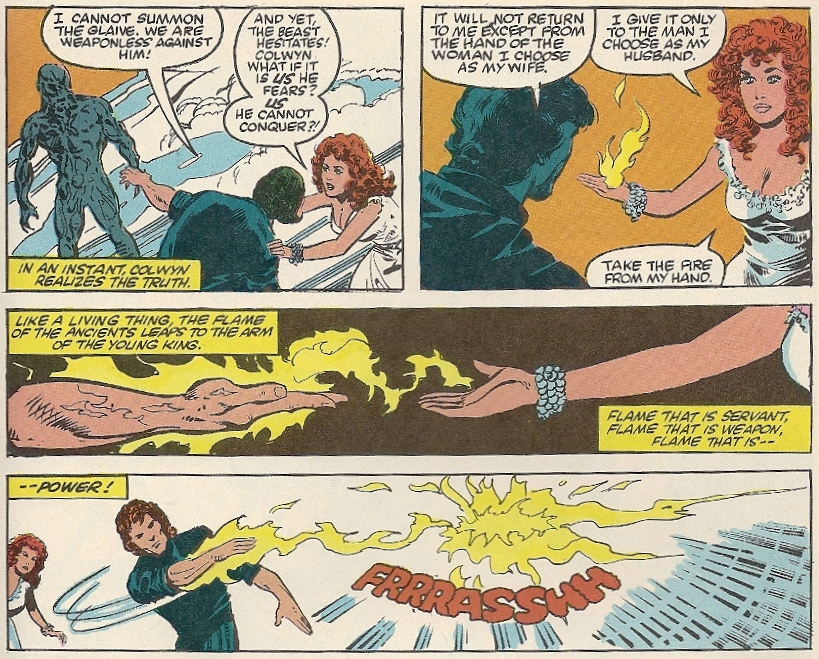
In the movie you’re left wanting a little more Glaive. Same here. I mean, Colwyn tosses it up, it spins around, blowtorches Lyssa’s cell, and hacks up the Big Bad. And then it’s stuck in the Beast’s chest and gone. Young love saving the day made me like what had been an up to that point crappy Rock & Rule, but here it made (and makes) me want to tear my nonexistent hair out. I WANT GLAIVE. I PAID TO SEE GLAIVE. IT’S IN THE DAMN LOGO.
You cannot win them all.
The extra features in the back include the rote behind-the-scenes stuff, all of which you can now read ad nauseam on the Net. There’s also a story about one of the most bewildering movie promotions of all-time, a national essay contest run through bridal stores(!) where the winners would wed like Colwyn and Lyssa in the movie. (You can read more about this and see the few associated pictures — MUST SEES — here.) I’m not sure what to make of this. If you have a woman in your life willing to marry you in a B-grade sci-fi/fantasy style, you should either lock that down immediately, or leave the house, get in the car, peel out and start a new single life someplace else, preferably under an assumed name. I’m unsure of which way to go. I leave it to your discretion, if you’re someday confronted with such a dilemma.
I thought this knick-knacks article would be of most interest to the Krull and non-Krull communities — I’ll take one lunchbox, please:
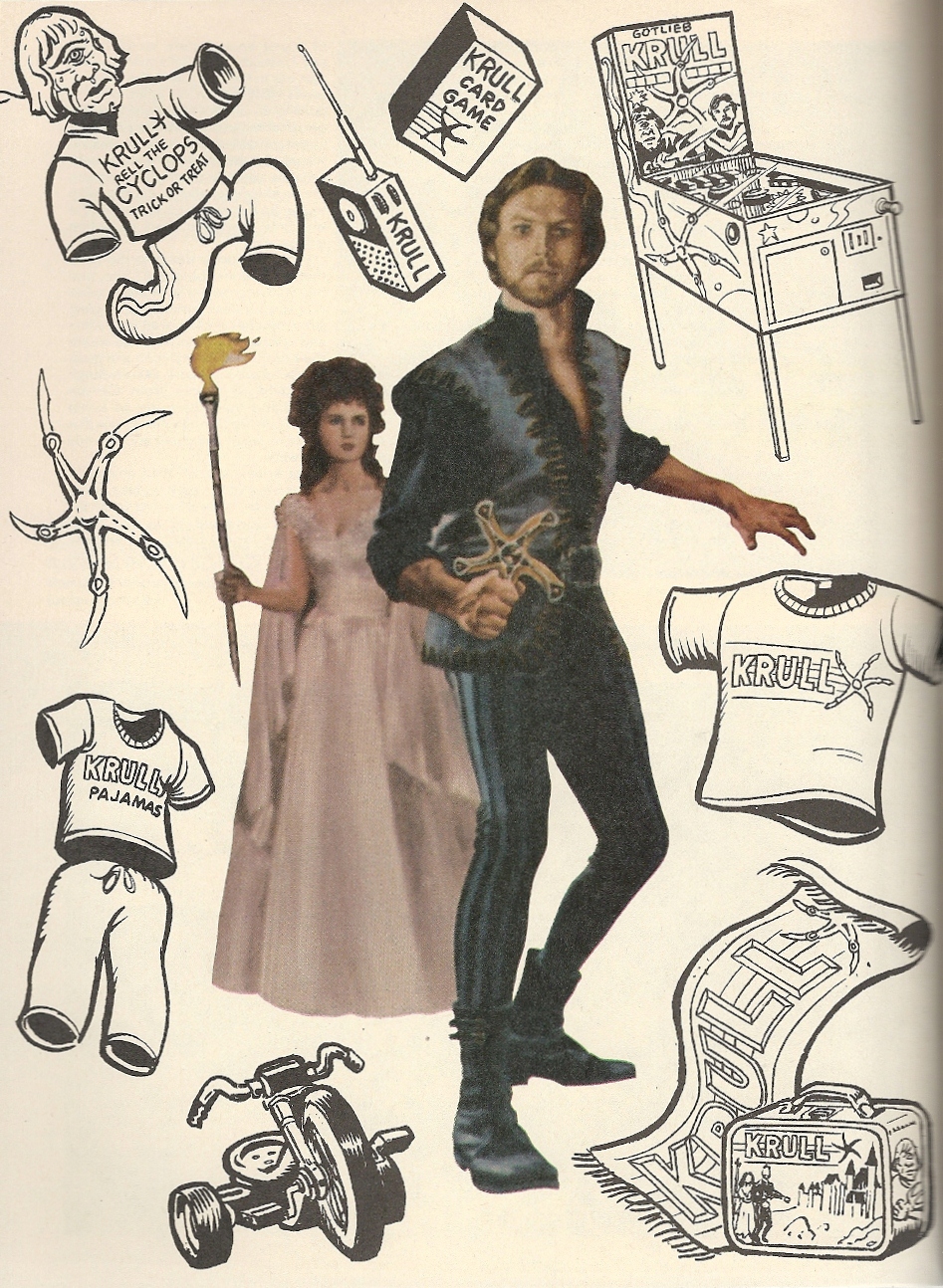

Of particular note is the pinball machine, just to the right of Colwyn’s noggin. It was never mass-produced, though a select few were manufactured as prototypes. You can find photos of the finished product here. I’ll say this: There was a pinball machine in a favorite bar of mine while I was in college. It was your typical “babes draped over cars with lots of lights” model (the machine, not the bar), but I’d drop a bunch of quarters into it every time I was in there (it helped that beers were priced so you’d get quarters back in change). So I have a weakness for pinball. And if there was a Krull machine in that bar, I’d still be in front of it. I might actually grow into it, like those people who spend years sitting on the toilet and the seat gets swallowed up by their thighs.
Really, who wouldn’t want to live a “Krull lifestyle,” at least for a little while?
Krull-Mania never took off, which is humanity’s loss, I suppose. The film was a critically panned box-office flop, which gave the associated merchandising a lingering cringeworthiness. That means that there are no loving hardcover reprints of this adaptation for purchase on Amazon, Barnes and Noble, or the brick and mortar outlet of your choice. If you want to track this mag down, you’ll have to do some Google searching, some eBay bidding, or pound the pavement to your local comic book emporium. It was also published as a two-issue regular sized comic (sans extras), so at least there’s that to double your odds of tracking it down. Make it your own Cyclops and Fire Mare infused quest.
Can Ms. Pac-Man’s gams seduce you into buying a crappy watch?

That ghost is getting himself an eye-full.
I’ve never before thought of Pac-Man as a potential cuckold. That changed today. Would Ms. Pac-Man be a full-fledged, bar-hopping cougar by now?
By they way, telling time has never been fun, nor will it ever be fun. Best to drill for fun in other fields.
New Avengers trailer released. Pants everywhere soiled.
For a while I’ve been wanting to post some thoughts on comic book film trailers as they’re unleashed, and since Marvel finally flung out an Avengers trailer that made me think that they might have nailed the damn thing, this is as good a time as any to begin. (Besides the numerous illicit mirrors on YouTube, you can also watch it at the Apple site.)
So they might have nailed it.
Do I still have concerns? Does Samuel L. Jackson seem to be bringing his Mace Windu intonation to this affair? Do Black Widow, the dame with lethal legs and a gun, and Hawkeye, the dude with arrows, not seem to belong with the guys with superpowers? Do I wish Norton could have made it into the cast for continuity’s sake? Do the enemy (Skrull/unSkrull/Whatever) vessels look like they were copied and pasted from the last Transformers movie? Yes to all. These quibbles remain. But late in this trailer, when the Hulk saves a plummeting Iron Man by grabbing him and then crashing into a building, I almost stood up and cheered.
This is an effective trailer, people. There’s so much to devour, it boggles the mind to think of the feast we could be getting in May. We’re talking a “Thanksgiving heaping plate, eat slices from three different pies to decide which kind you want” feast. Two months have never gone by as slowly as the next two will.
I’m so glad the almighty genius Christopher Nolan (whose wisdom we peons are not allowed to question) has quarantined Batman and Superman, dictating that they shall never cross paths in cinemas. “NOT ON MY WATCH.” We’ll never have to be subjected to a DC spectacle quite like this one. Yeah, that would be terrible.
 Jared
Jared


 blog into mystery