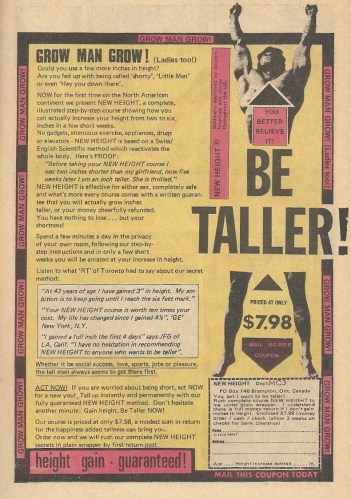
There are two masculine shortfalls that men will empty their bank accounts to remedy: hair loss and short stature. There isn’t a great deal that can be done about the latter, though the quackery promised in this ad would like to take a stab at it.
Surely torture racks or human growth hormone have to be a part of this. Or Stilt-Man boots.
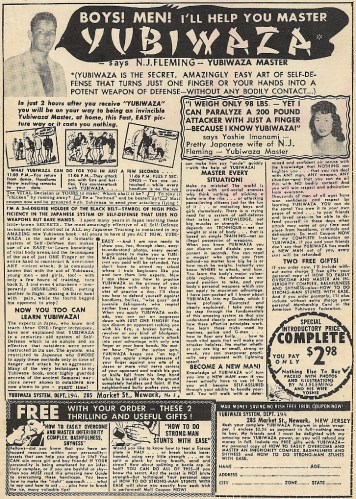
Color me skeptical of the 98 lb. woman who can immobilize a 200 lb. attacker with one little finger, sensei’s wife or not. Unless she jabs that finger up where the sun don’t shine. Then… (And the sensei must really be a martial arts master — HE HAS A PRETTY JAPANESE WIFE.)
The outlandish claims in this common 1960s promo definitely raise it above the standard martial arts comic book ads, and the use of the illustrations to depict the taming of “hoodlums” might put it up in the classic Charles Atlas “Hero of the Beach” stratosphere of self-improvement puffery. It’s a doozy.
BOYS! MEN! BRANDISH YOUR LETHAL FINGERS AND THEN GET A NUNCHUCK TO THE BACK OF YOUR SKULL!
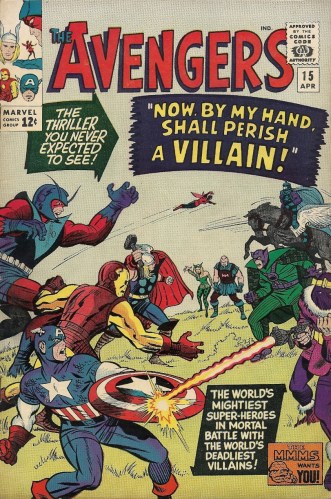
Here’s your zOMG THE AVENGERS MOVIE OPENS IN LIKE TWO WEEKS GAAAHHH post – The Avengers #15
We are all standing on the precipice of a marvellous — no pun int-, aw what the hell, pun intended — and bright new day. I don’t know if we’re ready for it, or if we’ve given it sufficient thought. Do we really realize what we’re about to have drop in front of us? Does there needs to be a contemplative moment carved out here, a chance for all of us to take a deep breath and reflect on what we’re all about to see.
Maybe I’m the only one that needs this time-out. If so, bear with me as I wax nostalgic for a minute.
I recall reading Wizard in its earliest days (it was like Time for idiot teens like me back then), when they’d have a monthly feature on potential comic book movies in the pipeline. It was speculative hype from the hype-masters, movie rumors and gossip before there were websites out in the ether that could spoil movies months before they opened, and most of it sounded made up. This was when Charlie Sheen could lobby openly to be the first movie Spider-Man, when James Cameron was attached to the property and Michael Biehn wasn’t considered too old for the role of Peter Parker. (He was, btw, even back then.)
Maybe the rumor-mongering was pointless. Maybe it was wildly inaccurate and poorly informed. But it could really gin up the imagination of an early-teenage years kid one who’d sit in bed and devour line by line of these tales of futile efforts to get his favorite characters onscreen, who’d dream that one day the effects would match the visions, and that the MY GOD WHAT ARE YOU PEOPLE WAITING FOR producers would have the guts to greenlight some of these things. And that — this was the biggest pipe dream of all — somebody would be willing to actually, you know, put some characters together. Together like they’ve been in the comics for decades, because they don’t exist in damn vacuums. A team movie. A clash of civilizations, as it were.
Then, at the dawn of this new millennium, we had X-Men. Spider-Man. Hulk. The (un)Fantastic Four. Batman Begins. A misfire of a Superman movie. And some absolute garbage like Daredevil and Ghost Rider. It was all rather incredible, even the dregs. All well and good. There were even some team movies in there, but from properties that were about the team, not about established icons coming together. (Note: For our purposes I do not count that TV movie that had the Ferigno Hulk fighting the lamest Thor ever. That’s Marvel’s Star Wars Christmas Special.)
And then we got Iron Man in 2008 (an IRON MAN movie!), and that started us down the Yellow Brick Road. With the Samuel L. Jackson Nick Fury cameo at the end of the credits, there was no looking back. The success of that film, which vaulted us into Captain America and Thor movies and a reboot for Hulk later that summer (when Tony Stark showed up there, that was the moment when it all became oh so real), put us into a long, drawn out thrill ride. And an excruciating wait. SOMEONE WAS GOING TO ACTUALLY PUT CHARACTERS TOGETHER. SOMEONE GOT IT. AT LAST. It’s not all about keeping properties separate because they can make more money on their own. You don’t have to listen to the studio bean counters. Sometimes things can be more than the sum of their parts. Someone out there could actually say the word. A-v-v-v…A-v-v-v…Avengers.
The excruciating wait, with its delectable pain, is almost over. Almost. Over. We’re almost done with the agony (which for me ramped up with that second trailer) and we’re about to get the (fingers crossed) ecstasy.
And we have come a long way from curling up with the latest issue of Wizard and relying on the theater of the mind to provide us with our superhero movie magic.
So, without further ado, here’s a random Silver Age issue of The Avengers, from early in the history of the team. I thought this would be a good way to celebrate the last days of the build to Avengersmas, or whatever you want to call May 4th, 2012. No, it’s not the lineup from this movie. You’re going to have to squint and pretend that Giant-Man is the Hulk. Swap out token broad Wasp for token dame Black Widow. And just pretend that Hawkeye is firing arrows in there someplace. But it’s close enough. It’s from the greatest era that comics have ever known. And in a way it seems that we’ve been building to May 4th since those special days.
Stan Lee scripted, Jack Kirby laid out, Don Heck pencilled and Mike Esposito inked today’s thriller. (Poor Heck. It seemed he was always the guy pencilling Kirby’s layouts. And, while Heck is on the Marvel Mount Rushmore of this era, seeing that you’re not getting full Kirby — especially after a Kirby cover — always feels like getting the understudy at a hit Broadway show. Which is terribly unfair.) It’s a pretty good one, with the action and downtime that defined this period. A lot of the preliminaries involve the Avengers roster adjourning a meeting and going their separate ways, and I’ve always enjoyed the relaxed domesticity that was pumped into their relations:
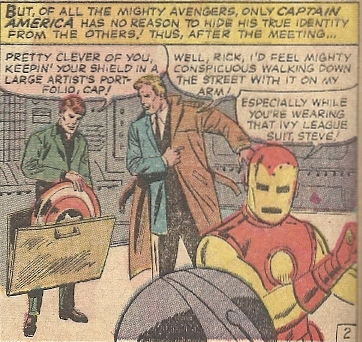
The artists folio makes a lot more sense than wearing the shield on his back under his suit, that’s for sure.
Though this comic gives readers a potpourri of secondary villains (The Melter, folks. The Melter.), the main antagonist is (the first) Baron Zemo. How bad a guy is he? He uses Latin American natives as litter bearers and stairs:
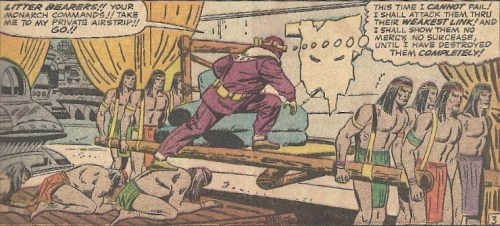
I don’t even think Mengele went that far. And kudos to Stan for incorporating “surcease” into a sentence. Who said comics are for dummies?
You want something that will pull at your heartstrings? Like in the upcoming film, Nick Fury is the father figure that Steve Rogers latches onto to help him re-enter the world, and here he seeks him out with a handwritten missive (note that he follows Marvel dialogue conventions of the time by ending sentences with exclamation points):

I’m not sure about this “You won’t remember me” business. Was Cap incognito when he met Fury? Were guys in garish red, white and blue costumes with shields and feathers on the sides of their heads common in combat zones? I didn’t see any of that in The World at War or that Ken Burns PBS documentary, but then again, all the images were in black and white. Could have missed them.
Things start to ramp up when CA heads to a mailbox to mail the letter:
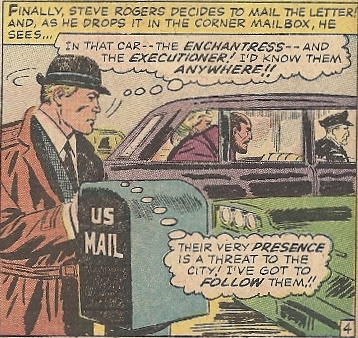
God, I love it when superpowered characters ride around in cars. I remember an old issue of Thor where he took a cab ride and stiffed the cabbie on the fare. EXCELSIOR.
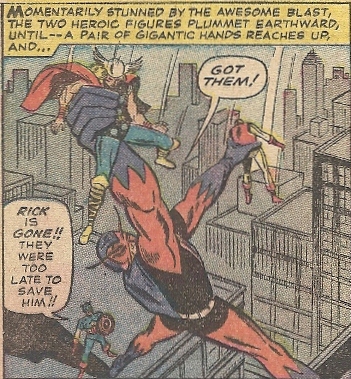
New York City-bounded battle soon begins, with all the repulsor rays and hammer throws and high-flying hijinks that you expect. You also get Avengers lending one another helping hands — literally. The best moment of that aforementioned second trailer was the Hulk saving a free-falling Iron Man, and here you get something similar:
Not only can Giant-Man save his teammates with his building-spanning limbs, he can also scan crowds with his oversized eyes — oh, and theater marquees (which advertise Merry Marvel Marching Society features) MEAN NOTHING TO HIM:
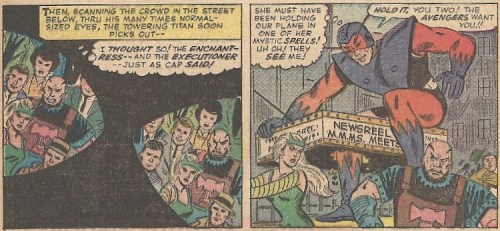
“UH OH! THEY SEE ME!” That’s the funniest thing I’ve read in a while. It’s up there with Peter Griffin peeping in the girls’ locker room.
The broader significance of this issue (the NYC brawl between the bulk of the team and the motley assemblage of villains concludes in the next issue) comes with Cap chasing Baron Zemo — who’s kidnapped Rick Jones, bringing up terrible Bucky flashbacks for the Star-Spangled Avenger — all the way to his South American dominion. He bites the four color dust in a most stupid manner:
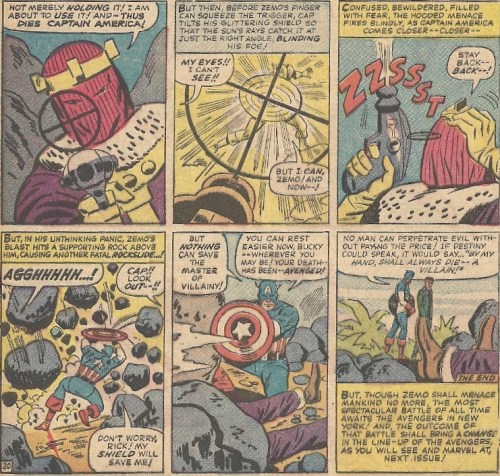
You have to love the good Captain’s disdain for his fallen foe — Bucky’s murderer. He may be all sunshine and light and good feeling, but he is NOT a man you want to screw with.
Words cannot describe how enjoyable it is to read a comic like this for the first time, an enjoyment that’s perhaps multiplied for someone like me who reads it almost fifty years after its publication. All the years where Avengers lore (and comic lore in general) has aged and fermented and percolated have turned vintage material like this into the finest of fine delicacies. The teamwork. The little stuff. The interactions, the way each character fills narrative gaps. What more can you say?
Enough from me for today. This Avengers issue — along with many others — was recently reprinted in one of those gigantic, glorious Omnibus volumes. I wasn’t planning on buying it. Now I might have to. Enjoy the final days of the wait, people. And of the daydreaming.
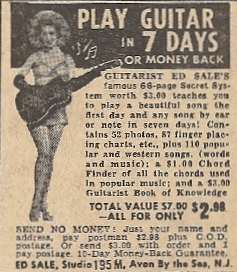
One wonders if the babe was shipped to you as part of the deal, like squirrel monkeys. What a wonderful world that would be.
“Fat Track” does not involve overstretched running attire. In case you were wondering.

If you’re like me, the words “Fat” and “Track” put together conjures up images of some unmade 1980s madcap comedy, where John Candy and Louie Anderson became improbable track and field coaches at a small high school and much wackiness ensued.
Or cars on a little electric race track. Whatever.
When the Savage Land is threatened, NO BAMBOO CAGE CAN HOLD KA-ZAR – Astonishing Tales #10
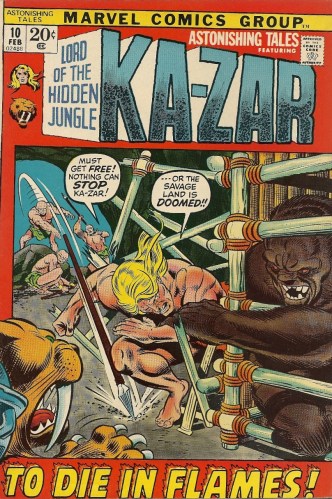
Ka-Zar. A big, dumb, primitive blond who talks about himself in the third person. Whose origin tale borrows liberally (or, more accurately, outright steals) from Rudyard Kipling’s The Jungle Book. What else can you really say about the guy? Not that I don’t think that he has his charm, mind you. He’s noble. He has his own dinosaur-infested realm, the Savage Land. And, lest we forget, HE HAS A SABER-TOOTHED TIGER PAL/PARTNER. Zabu trumps your lapdog. Or anything that can fit in a purse.
I was never much of a fan of Ka-Zar when he’d be thrown into more modern settings (I reserve that enthusiasm for Conan when he’s vaulted into a megalopolis like 1970s NYC). But him defending his native domain against the never-ending phalanx of douches that sought to plunder/purloin/colonize it never gets all that old for me. I should get bored to death with this trope, but I don’t. (I think I know the reason for that. I’ll get to it towards the end of this.) And this comic has more of the same.
This issue (written by Roy Thomas and Gerry Conway, with art from Barry (Windsor-) Smith and Sal Buscema) presents a new twist on an old thoroughly mined historical oddity. Remember those Japanese soldiers on isolated Pacific islands that didn’t know that World War II had been over for years? The gaunt, die-hard true believers that crawled out of holes like Morlocks and squinted at the unfamiliar rising sun (OH THE IRONY) and found out that all that they had held out for was gone? This comic doubles down on that, presenting us with U-Boat and British crews that destroyed each other’s vessels, found themselves marooned in the Savage Land (which is in Antarctica, which means World War II truly deserved that moniker), interbred with the natives, and now carry the war on to the next generation.
But there’s a twist — yes, a twist on a twist. Before that, though…
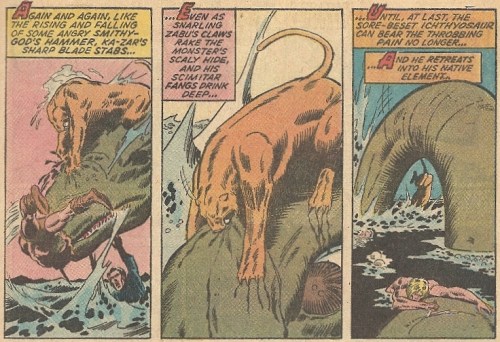
OMG HERE’S KA-ZAR AND ZABU STABBING AND BITING A SEA-MONSTER:
The spent Ka-Zar and companions wash up amongst the German contingent. How can you tell they’re German? Well, they say so, but apart from the Meins and such, the head Hun wears a monocle. Monocles don’t necessarily equal “German,” but there’s a good chance that anyone wearing one has some lederhosen in a drawer somewhere:
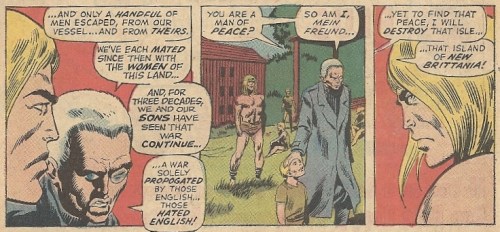
Note: The word “Nazi” is never mentioned in this story. Nor is there ever a swastika on display. Just saying.
The twist in this whole thing is that the two sides aren’t necessarily the enemies that they make themselves out to be, as the older members of both sides have lost their marbles Bridge on the River Kwai-style and have perpetuated the war amongst their children to toughen them up (or something). And this twist is, to harken to another bridge movie, a bridge too far. It’s preposterous. It’s unacceptable to the reader — at least this one. But it does give us Ka-Zar (who stumbles onto these shenanigans and gets thrown into the bamboo hoosegow) straining against his bonds in a most muscular manner, as earlier seen on the Gil Kane/Joe Sinnott cover:
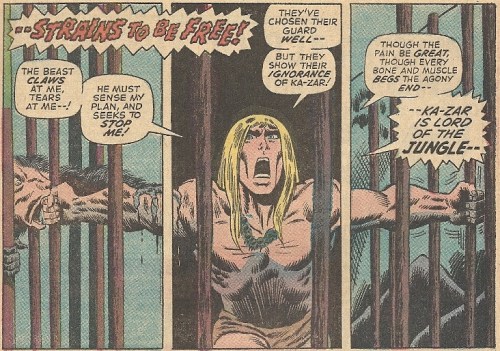
Okay, okay. We hear you.
The story ramps up to a doubly unlikely ending, with the Savage Land threatened with destruction and a confrontation on the edge of a volcano (Volcanoes are treacherous story elements. See: Joe Versus the Volcano.). Zabu is the one to save the day, but then almost falls into the fiery magma. This sends Ka-Zar into a ohmygodohmygod tizzy, and leads us into our tear-inducing rescue:
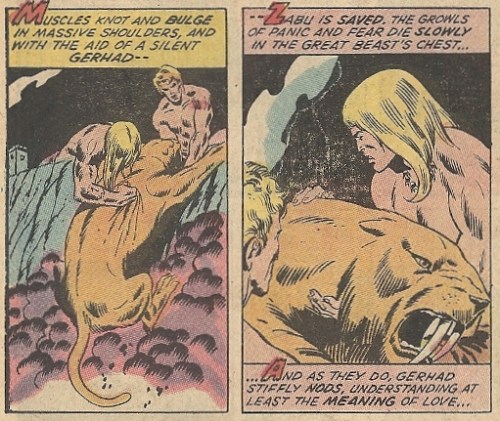
Gerhad is one of the German second generation. I worry about what meaning of love he learned from this, as love can be a pretty broad term. I have images of Canis: Cologne for Dogs dancing in my head.
If there’s one thing that you can learn from this comic, it’s that Zabu is the goddamn star of this show. The STAR. Animals are always the stars. People cry during Dances with Wolves when Two Socks gets killed by the loutish soldiers about a trillion times more than over any of the hellish suffering of the human characters. Put a tame, loyal animal in your plot, especially one that in a normal setting would be dangerous and terrifying, and you have some potential story arc dynamite in your hands. Star dynamite. Like when Shatner was the purported star of the original Star Trek, but then got insanely jealous when he saw the bags and bags of fan mail that Nimoy was getting. (Not that Spock was a tiger or a wolf. Nor was Nimoy. I don’t think. Anyway, you get the picture.)
I like Zabu, and I wonder if Ka-Zar’s love would allow him to weather the legions of Zabu fans out there, or if he’d bite his fist as he choked on his envy. FOOD FOR THOUGHT.
On the artistic side, this story falls far short of what Roy Thomas can usually offer. Perhaps too many cooks in the kitchen. And there seems to be a lot more Sal Buscema in the art side than the stylings of Barry Windsor-Smith, back in the halcyon days before the latter added the regal middle moniker. If you look close you can see his stuff, though. Get out your magnifying glass.
So. There you go. A random Zabu comic book from the 1970s. With some Ka-Zar in it.

I imagine you could devise a litmus test of sorts based on how many of these headshots you can name. There’s probably a magical tipping point, a fulcrum that divides one side (insufficient comics based knowledge) from the other (GET OUT OF THE HOUSE AND DO SOMETHING YOU SLUG). I’m definitely more on the first half of that teeter-totter, and though that may undermine whatever minimal authority I have in this arena, it’s probably better for me in the long run. I’M HOPING.
By the way, I’m not seeing Captain Rumble anywhere in there. A very un-groovy oversight.
Only your Lee Jeans can prevent forest fires

I always thought dressing from head to toe in denim was utterly dorky and useless, but, according to this, you can make Smokey the Bear happy by smothering wilderness-consuming flames with your Lee regalia. AIN’T I ASHAMED. And here I was under the impression that Lees were just for foiling cattle rustlers.
When I was little there was a bad fire around our forest-sheathed house, and my father and I were the only ones there to fight it until the red trucks showed up. I wasn’t much help. If I’d only known that all I had to do was peel off my jeans and battle the damn thing starkers…
Fess Parker’s broad shoulders have a frontier to win. And some Indians to slay. – Walt Disney’s Davy Crockett, Indian Fighter
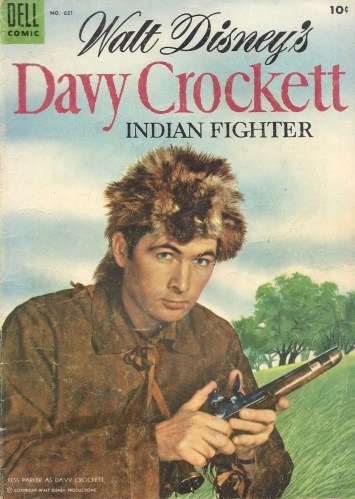
If there was one man who was tailor-made for tall tales, it was Davy Crockett. The rugged bear-killing martyr of the Alamo, whose sartorial sense would one day inspire such artistic treasures as “Apes in Coonskin Caps,” stands at the forefront of American icons. It’s therefore no surprise that the fine folks at Disney — soulless succubi that they are — would at one point sink their corporate hooks into his meaty patriotic flanks. And so they did, casting the monumental Fess Parker (who’d go on to play Crockett frontier predecessor Daniel Boone a lot more — quite a two-fer, one that indirectly gave Johnny Carson one of his greatest Tonight Show moments) in the title role for a brief series of wildly successful teleplays in the 1950s. If nothing else, we can thank it for the Bieber-esque frenzy that made those trademark chapeaux all the rage.
This Dell comic (Four Color #631, for those keeping score at home) was just riding that wave, and “Indian Fighter” roughly adapted the first of those popular Crockett serials.
There was a time when every kid learned the Davy Crockett bio-song. I don’t know if that’s still the case. It definitely was for my father’s generation, and it was for mine too. Now, though… If it isn’t, here’s a refresher course (art: John Ushler):

The story follows Crockett and a pal as they join up with regular military forces to fight Indians that have attacked an outpost. Tonally, it’s a lot like the Hopalong Cassidy book that we looked at here a few months ago. Both have the good vs. evil dynamic of pristine white pioneers against savage, sinister Native Americans, a narrow, myopic, but once popular worldview that makes audiences in this century cringe. Nowadays we only allow “Redskins” to be tossed about casually on NFL Sundays. Way back when, it was kosher for a kid’s comic:
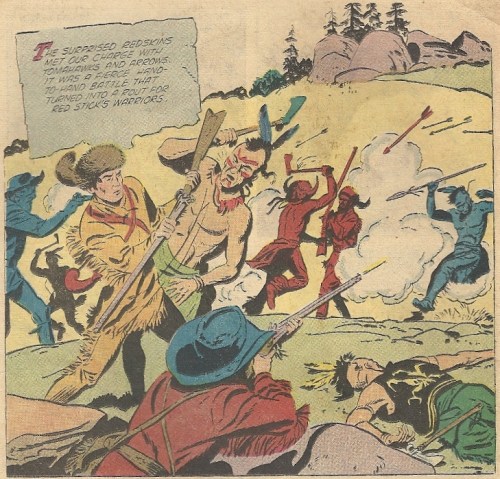
Andrew Jackson, the most powerful enemy that the American Indian has ever known, is also featured in these pages, as the head of the troops that Crockett more or less joins up with. Old Hickory is all the “The only good Indian is a dead Indian!” that the most cynical of revisionist historians would imagine him to be:
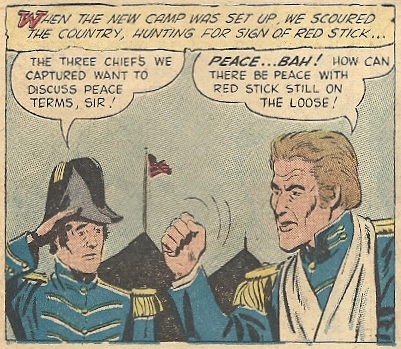
That right there is Jackson’s “Richards…Bah!” Dr. Doom moment.
(A side note: I recall seeing Jackson’s uniform from the Battle of New Orleans over in the Smithsonian. It gives you an appreciation for all he did, good or ill, because you can’t imagine how he walked around. HE WAS THE SKINNIEST HUMAN BEING IN HISTORY. Seriously. His chest was about the size of my calf muscle.
Aside over.)
Perhaps Jackson’s presence helps Crockett seem like more a middle of the road character. Though he kills his share of, yes, “Redskins,” by the end, when locked in mortal combat with Chief Red Stick (also a genuine historical figure from the Creek War), he’s the one to make peace:
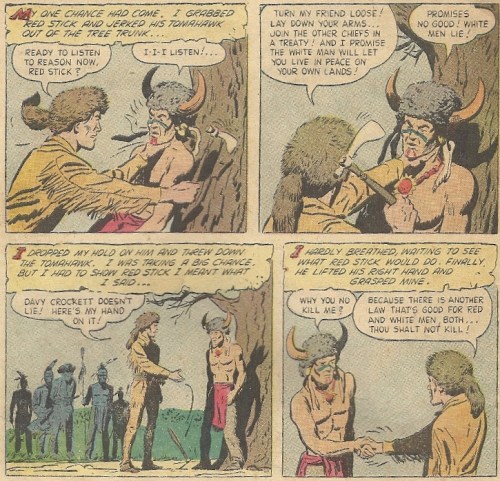
What, no “White man speak with forked tongue”?
Once again, a cynic would say that of course it’s the white man who’s big-hearted enough the literally bury the hatchet. But hey, at least he buried it, you know?
Fess Parker was no Olivier. His performances as both Crockett and Boone are stiff as a rifle’s barrel, but he brought an earnest charm to his characters, and gave them both a larger than life goodness. Both roles gave audiences no-warts versions that couldn’t possibly have any basis in reality, but that’s what you got in that genre in that era. This comic, with its rough approximation of the events in the serial, which were themselves a rough approximation of history, fits right in with the hagiography. There are no shades of gray with Crockett, just a good guy who’s pure as the driven snow — even if we today might not think so. Take that for what it’s worth, inaccurate or no.

Today in “Nineties Nicole Kidman Movie Ads that Now Eerily Sum Up the State of Her Career”
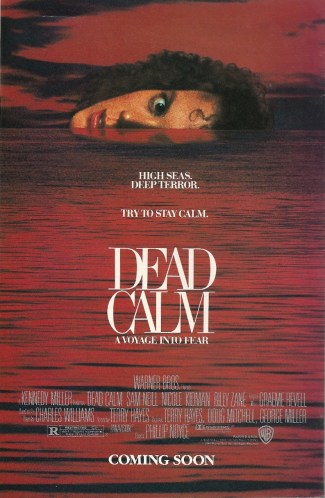
If the above Dead Calm subtitle had been A Voyage into Painful Irrelevance, I think it would apply quite well to the sorry condition of Ms. Kidman’s post-Tom “Nutcase Who Stars In Some Real Good Movies” Cruise oeuvre.
Some useless trivia: There was a time when this movie had the highest box office take of any water-centric Billy Zane film.
No glue. No paint. No point.
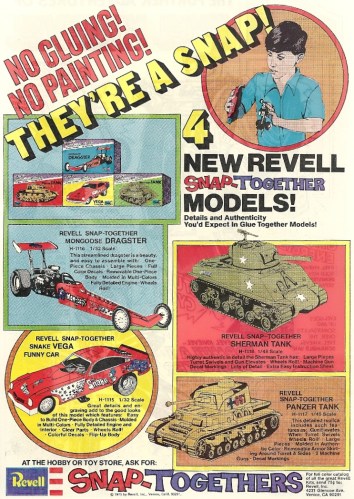
We’ve seen these “No Glue, No Paint” type things before. I stand by my assertion that, while they skip the infuriating steps that would send me into a purple, impatient rage, that’s kind of the whole point of the model assembly enterprise.
In that vein, I suppose the Powerline is the fishing cousin of these.
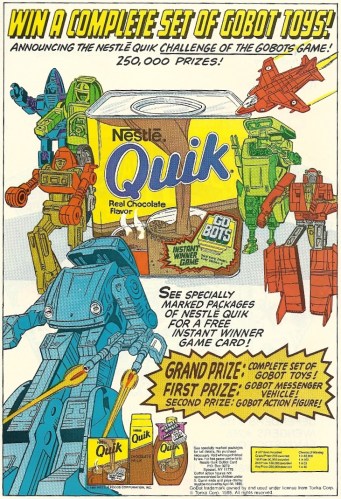
It always struck me that this ad’s sole purpose was to say that, if the Gobots were lower than the Transformers, they weren’t that low. “Robotix don’t have a sugary milk additive tie-in, NOW DO THEY?” That sort of thing.
The Golden Age/Silver Age Diana in one last bondage-infused pre-Crisis fling – The Legend of Wonder Woman

A while back I posted an old advertisement that hawked this (at the time) upcoming series. In my stupid, still embarrassingly adolescent zeal, I of course focused on and made a joke of Wonder Woman’s prominently displayed breasts. HA HA. Then I finally got around to reading the actual four issue miniseries, and now I feel a bit ashamed. Ashamed like a lunch-eating construction worker who whistles at a passing long-legged hottie, and said hottie then turns around and gives him a terrible tongue-lashing, calling him a pig and a moron and everything else in the book while his hard-hatted buddies drink their coffee and eat their sandwiches and laugh at his sorry ass.
You see, this series, a final adieu to the old Wonder Woman, is an unexpected delight. A significant delight.
It’s the original Wonder Woman’s equivalent of the sublime Alan Moore/Curt Swan Whatever Happened to the Man of Tomorrow?, the non-canonical tale which pulled the curtain on the Silver Age Superman. It’s not up to that level, but it’s worthy of being mentioned in the same breath, which is still a high compliment. But, unlike that rightly hallowed story, there’s an actual void at play here. Whereas the Silver Age Supes just sort of faded away, morphing into the square-jawed hero of John Byrne’s reinvention, the Silver Age Wonder Woman was actually eliminated by the Crisis on Infinite Earths. This mini, which was published in the interregnum between WW volumes one and two, hence offers more definite, and thus more effective, closure.
While that Superman door-shutter fiddled liberally with Kal-El’s colorful rogues gallery, utilizing everyone from the Toyman to the Parasite, Wonder Woman’s list of villains has never had that cachet (*cough* Egg Fu *cough*). Solution? Delve deep into forgotten plots and strip-mine them for all they’re worth, with pitch-perfect artwork from Trina Robbins (more on her — and her art — in a moment).
(Let me get a quibble out of the way in another parenthetical. As I’m about to lay out, this comic makes liberal use of 1940s Wonder Woman comic mythology, well within any definition of what constitutes the Golden Age. But this series memorializes the Silver Age WW, who was the one who “died” during the Crisis, getting thrown back in time and becoming one with the Paradise Island clay. A little confusing. Though, in defense of this jumbling, the Silver Age Wonder Woman didn’t have a set “1st appearance.” There was no magic moment when the old bloomers broad became the new one. It was just that one day the Earth-2 WW showed up, and you realized that the current lady was a denizen of Earth-1. So whatever. Go for it, comic book. Take whatever you want from the WW grab bag.)
Remember the Land of Mirrors, from Sensation Comics #79? No? Well, it’s in there:

I was inordinately gratified to see that Atomia, the queen bee of the Atomic Galaxy, was the main villainess of this farewell story. Her sole appearance was in Wonder Woman #21, an ancient comic with a nifty cover that was featured all too briefly here a spell ago. This coincidence — that the only Golden Age Wonder Woman book I own would be revived for this mini — is blog kismet of some sort, I suppose. I’m self-centeredly tickled about it. Here’s Atomia on the cover of the third issue, along with some good ol’ Wonder Woman bondage:

Even the minor stuff, like the gigunda kangaroos that the Amazons ride around Paradise Island on, are on prominent display (they’ve also made an appearance before in these parts):

The story? There’s an aura of melancholy at play, as the Amazons, whose Paradise Island is about to vanish into the post-Crisis ether, are packing up like graduating seniors sad about the end of their four-year college idyll. Hippolyta is, of course, the saddest, as she’s still mourning the recent loss of her daughter:

That Magic Sphere, another Golden Age relic, is the View-Master through which we experience this final journey. We watch alongside Hippolyta and the Amazons as Wonder Woman, with allies like Steve Trevor and young Wonder Woman fan Suzie, whom WW befriends (an obvious insertion of once-young fan Robbins into the story), battle freedom’s foes in a 1950s (new) flashback. It’s a fun, meandering all-over-the-place romp. Oh, and the Holliday Girls are referenced too, including the never-far-from-sugary-calories Etta Candy:

Kurt Busiek, who would go on to great renown for nostalgic walks through comic lore (see: Marvels) co-plotted and scripted this together with the indispensable Robbins. More known for her underground comics work, Robbins brought her life-long love for the old-timey Wonder Woman to this series, employing a Golden Age style that at no point rings false or cloys. It evokes while still feeling fresh, which is an incredible achievement. She invests the sometimes stiff old way of drawing figures and action with such zest, you find yourself wanting to go back and read through some of those clunky, musty tomes.
Mimicking an older style can be tricky business, and in lesser hands it can fall flatter than a wet pancake. When done right, though, the rewards are high. This mini is one long reaping of said rewards.
You can tell that Robbins poured a lot of love into her half of the work, love which she addresses quite well in an essay/paean at the end of the second issue:


From what I can tell, this story has never been reprinted, nor has it ever been collected in a trade. It should have been, and it still should be. It’s a story that honors what has come before as it elevates and refines it, and you can ask nothing more from such a tribute, especially one that deals so intimately with one of DC’s holy trinity.
If you see these four issues in a bin somewhere, pick them up. Wonder Woman’s cleavage (OH MY GOD I DID IT AGAIN) commands it.
Billy, you can either have a seat cover or a stylish jacket. I know this’ll be a tough choice.
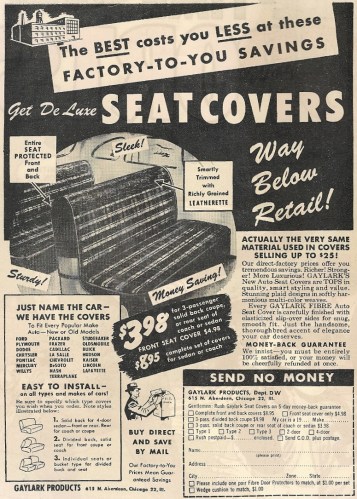
I present you two diametrically opposed 1940s comic advertisements, which bookended the All-Time Sports Comics entry featured here last week. The above seat covers — every child’s wildest fantasy — were found on the inside of the cover. Then, at the back, you have this jacket:
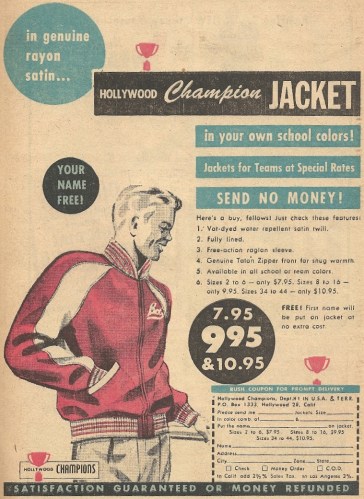
GENUINE RAYON SATIN. Presumably it came with a tube of Brylcreem so your hair would be appropriately styled and shiny.
So, which would you think would have more appeal to the young male eyes that formed the vast majority of the book’s audience?
The lily-white Dusty, with her oddly twisted body, of course takes precedence over the black, untwisted Skye

The Sister always gets short shrift, doesn’t she? Even in the doll world. Poor Skye even appears half as much in this ad as her white pal. But Dusty’s the one who has to wear an outfit made from fabric that you normally find draped over a picnic table, so…
I wonder if Skye gets her hair done at the same place that handles Black Lightning’s afro-helmet. And I also wonder of she ever gets to ride the Palomino.
 Jared
Jared


 blog into mystery