We’re going to need a bigger cape – Action Comics #456

Do you think a Universal Studios exec considered suing over this? I mean, maybe this cover could have passed muster if it didn’t have a big emblazoned “JAWS” right there for all to see. As it is, I’m sure some suit had this brought to his attention and muttered “Those dirty bastards.”
Or maybe he just smiled lovingly at this homage. I doubt it, though.
I thought this would make for a nice post to commemorate this weekend’s 35th anniversary of the first summer blockbuster. There are two stories in this issue, but we’ll focus on “Jaws of the Killer Shark” since that’s the one that flirts so closely with copyright infringement. From Cary Bates and Curt Swan (Mike Grell did the cover), the story finds Superman battling — no surprise here — the Shark. Captain Strong, the parody/ripoff of Popeye, also shows up just to tilt the intellectual-property-theft scales. Hey, come on in, the water’s fine!
The Shark robs a young boy of his humanity (or something) which reduces the boy to lifeless goo, and he then proceeds to terrorize Metropolis, using his super-strength and fear-inducing mental powers to give Supes a run for his money. Eventually Kal-El finds a way to defeat him (some nonsense about ozone that I couldn’t wrap my head around) and forces the Shark back into his primitive tiger shark form.
And nobody seems to care that the kid is still goo.
That’s about all there is to this one. It seems to be just one of those situations where the editorial staff sat around and said “Hey, Jaws made a lot of money, right? Let’s do something like that!”
“Farewell and adieu to you fair Spanish ladies…”
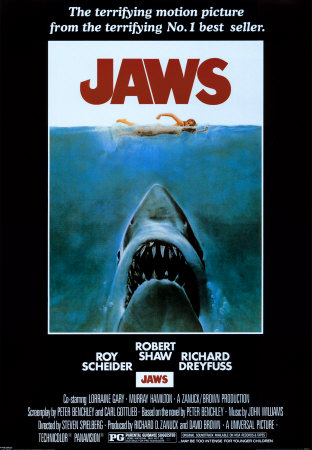
An Ode to a Licensed Character, Part 6 of 8 – Rom #73
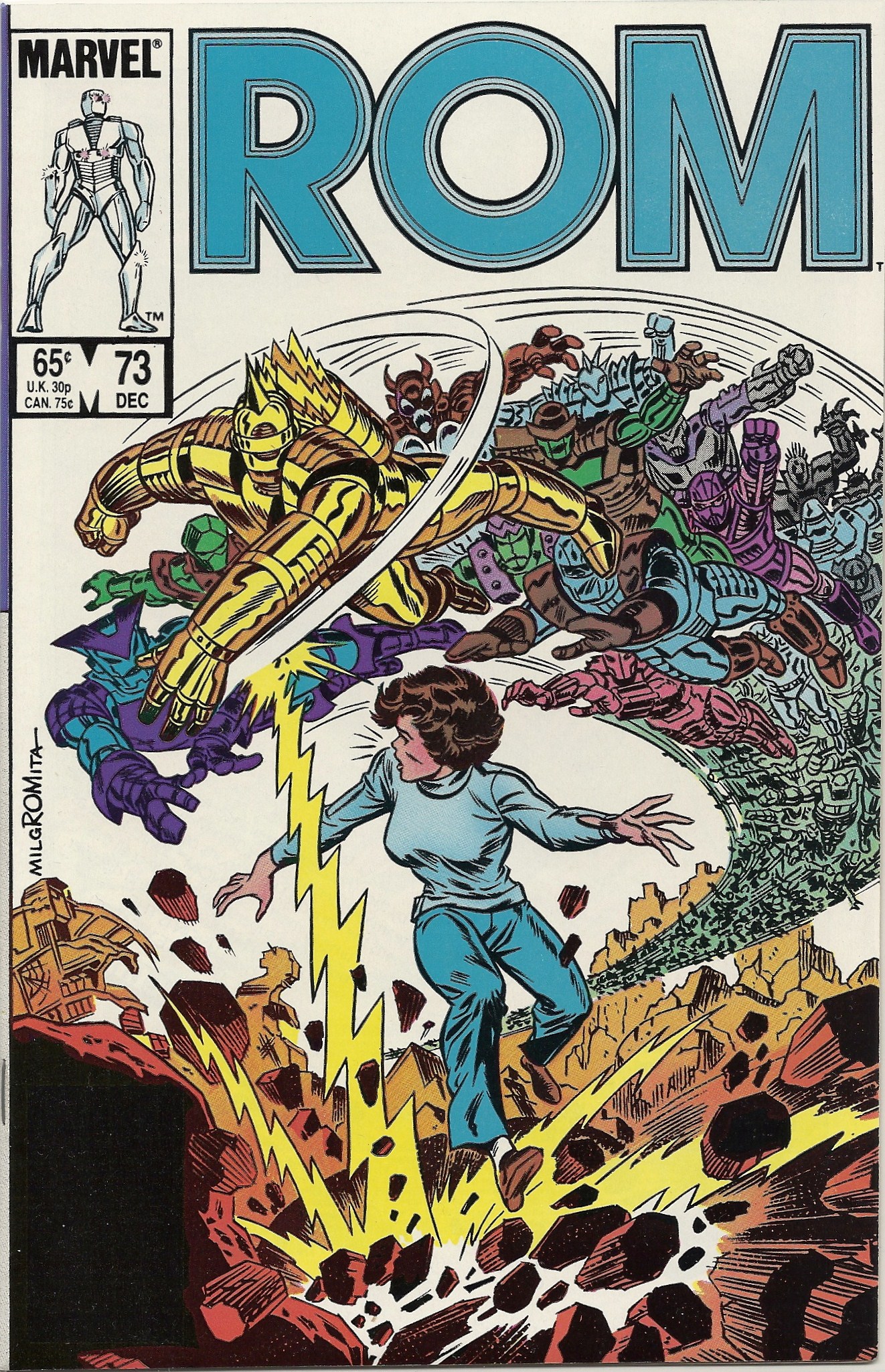
We’re getting towards the end of this look at the final arc of Rom, which was ably brought to us by Bill Mantlo and Steve Ditko. This issue is a bit of a letdown after Rom’s run-in with the Shi’ar Empire in the last installment, as our titular hero only shows up at the very end. That might dampen some of the interest, but we’ll roll with it anyway.
A couple of issues ago Brandy Clark, Rom’s human paramour, bumped into the Beyonder and was transported to the Spaceknight homeworld, Galador. She finds out that, instead of the peaceful advanced paradise that Rom had described to her, it’s been ravaged by war:
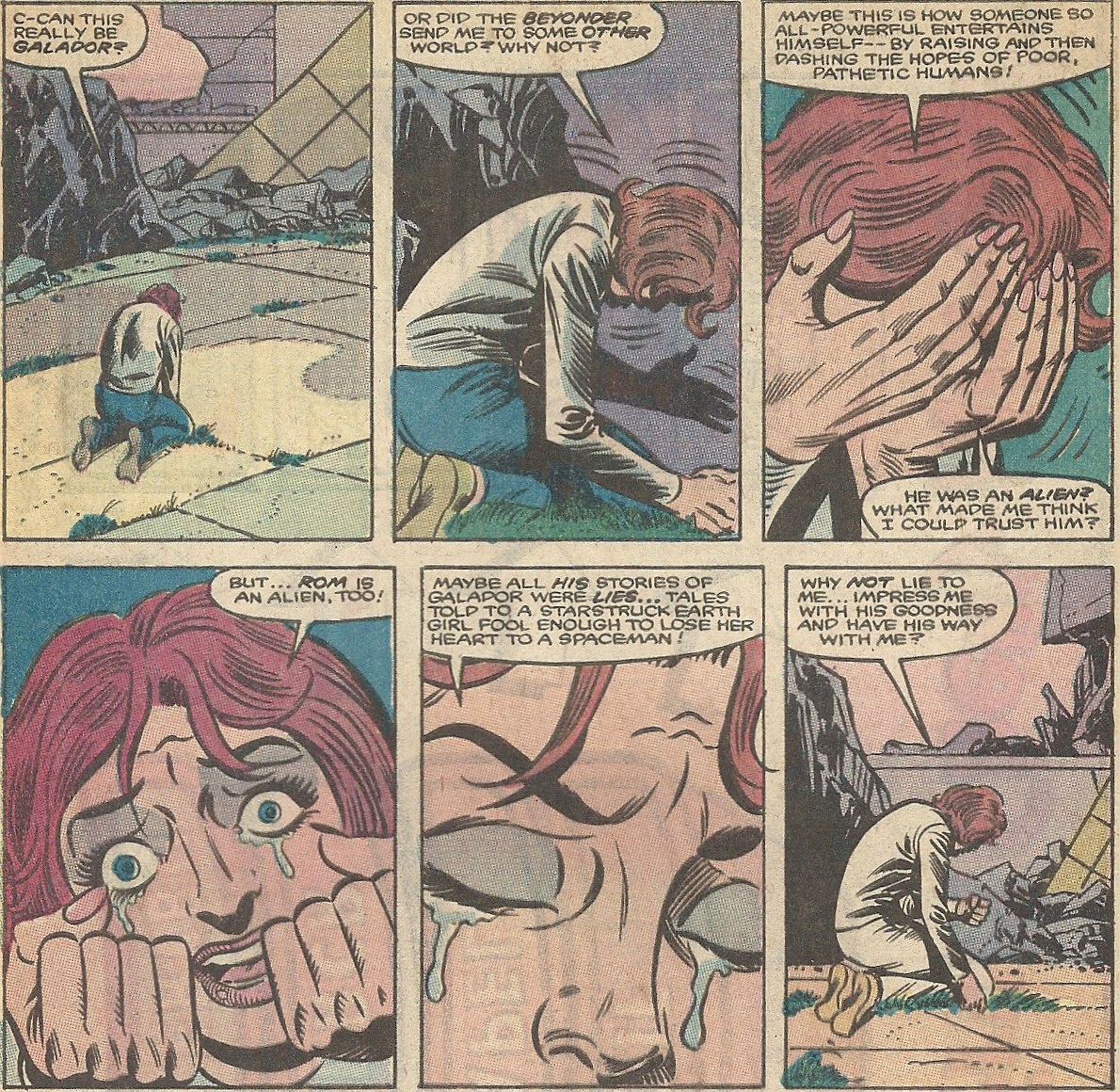
It turns out that a second wave of Spaceknights was created, stronger than Rom’s generation, in case Galador was menaced by another threat while the originals were off battling the Dire Wraiths. These new protectors eventually turned on their flesh and blood creators and killed most of them, leveling much of the planet in the process.
Brandy manages to down one of these Spaceknights using a Horn of Heaven that she finds (these devices were used by the Angel Elite, Galador’s winged and genetically modified protectors — the rent-a-cops to the Spaceknight constabulary, if you will) and a small band of humans finishes the villain off. They take Brandy back to their base, where Brandy comes up with a scheme of sneaking into the building where every Spaceknight has his or her humanity stored and threatening to destroy it:
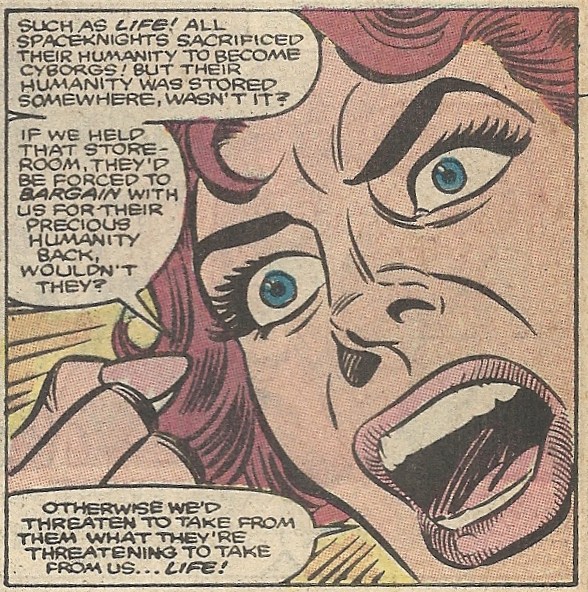
That will force these new Spaceknights to come to terms, though apparently the Galadorian resistance hadn’t thought of this before. They could really have used a John Connor or two in their ranks, it seems.
So they sneak in, but the evil Spaceknights find them. There’s a standoff, but then Rom and his companions materialize. He’s horrified to see what’s taking place — Spaceknights killing those they’re sworn to protect (they kill the last living Galadorians right in front of him). Then the bad guys say “To hell with it!” and destroy the vessels containing the humanity of every single Spaceknight:
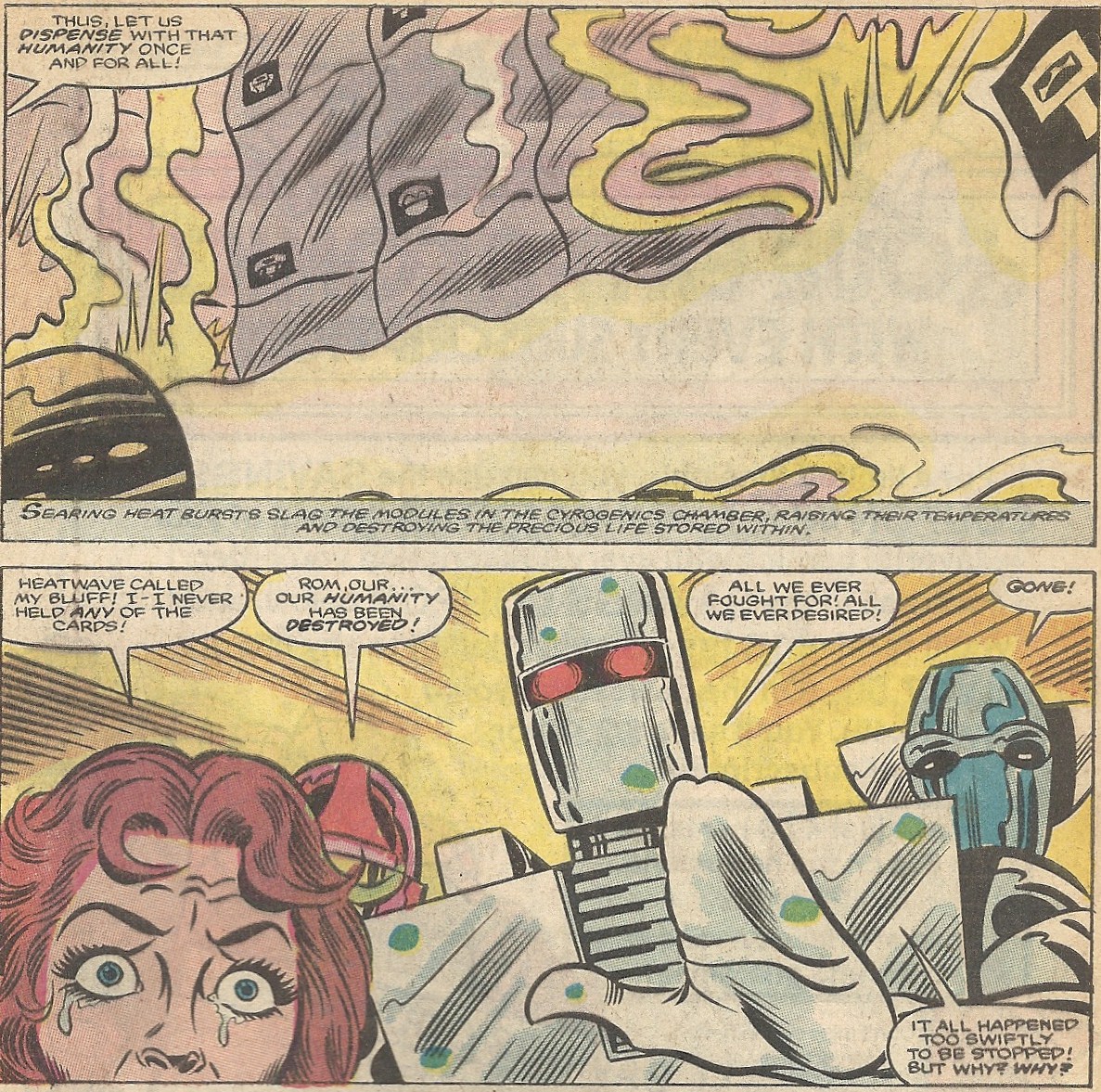
Great plan, Brandy.
The issue ends with the baddies giving Rom the ol’ “Join us or die!” ultimatum.
What will Rom do? Will he cave in or will he kick mechanized ass? Stay tuned for next time!
Just look at those fat slobs – Judge Dredd #33
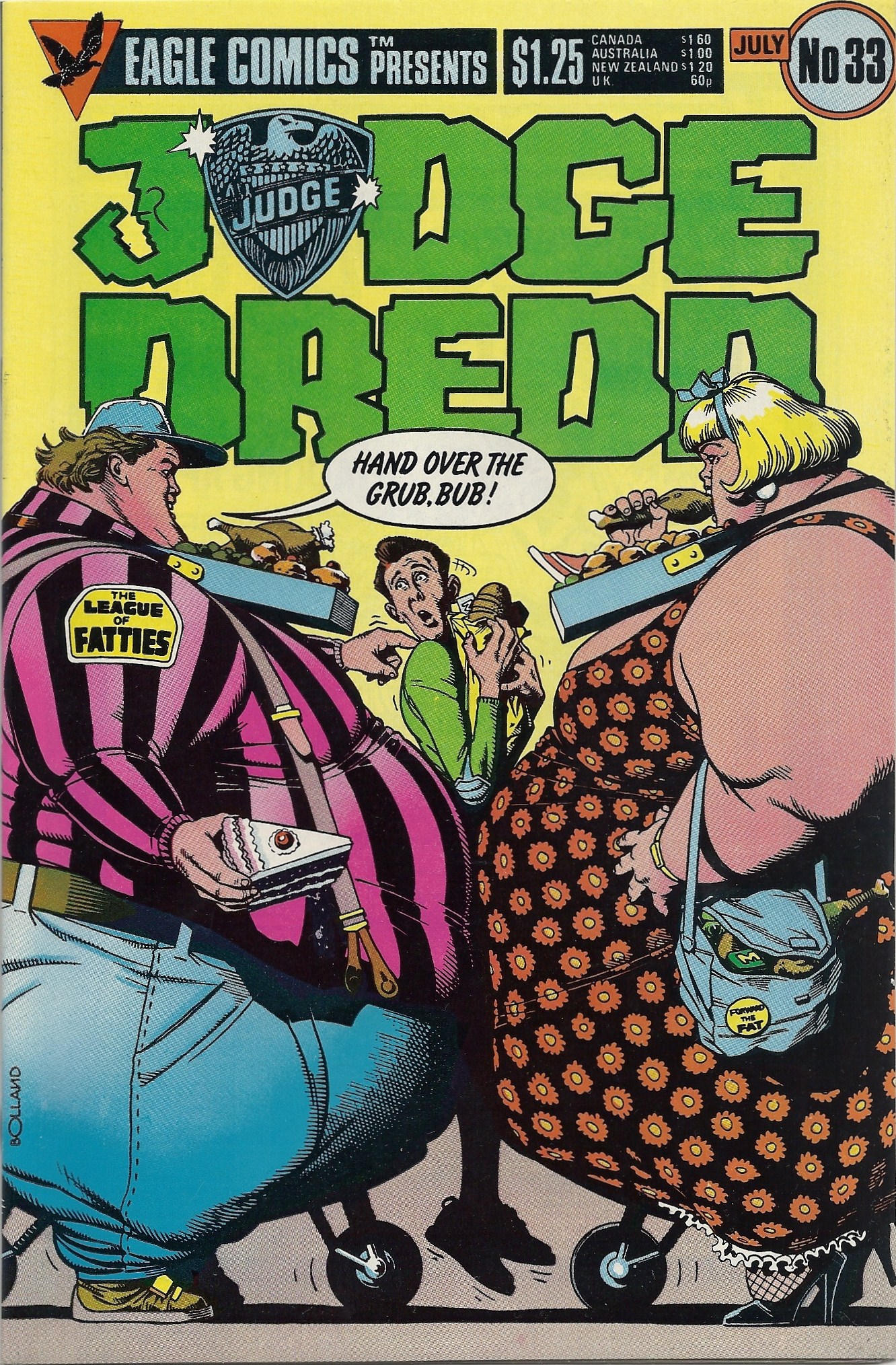
I know nothing about Judge Dredd. The only factoids I once knew were blotted out in mental self defense after I suffered through the Sly Stallone interpretation of the character and his environs.
But I do like the art of Brian Bolland. You have to appreciate his attention to detail. His faces have stubble, for criminy’s sake.
The main reason I bought this comic this past week was his depiction of the two fat tubs on the cover and the poor guy sandwiched between them. I feel for that poor dude. About ten years ago, when I was in my first year of law school, I’d occasionally shut my law textbooks (who am I kidding, I never cracked the damn things open) and would head out for a nice run on the D.C. streets. In that first year I lived in an apartment right next to the Smithsonian’s National Zoo, and there was always a lot of pedestrian traffic on sidewalks going to and from there. Everyone was excited to see those stupid giant pandas. It was during those runs that I realized how fat and disgusting we are in this country. When I had to go around people on the sidewalks, I had to go around them, if you catch my drift. It was like running through a gauntlet of boulders. We’re talking people with fat rolls that make them look like the Michelin Man.
It got on my nerves, and those blimps on Bolland’s cover made me think of that.
I’ll climb down off of my high horse now. I don’t like making fun of people with weight problems. Hell, 90% of the people in my family have issues with their weight. So please, pardon my belated venting.
I will admit, though, that the trays that those two slugs are wearing like necklaces would come in handy during football season. I wouldn’t even have to lean forward to grab food off of the coffee table. Convenient.
Peekaboo – Wonder Woman #29
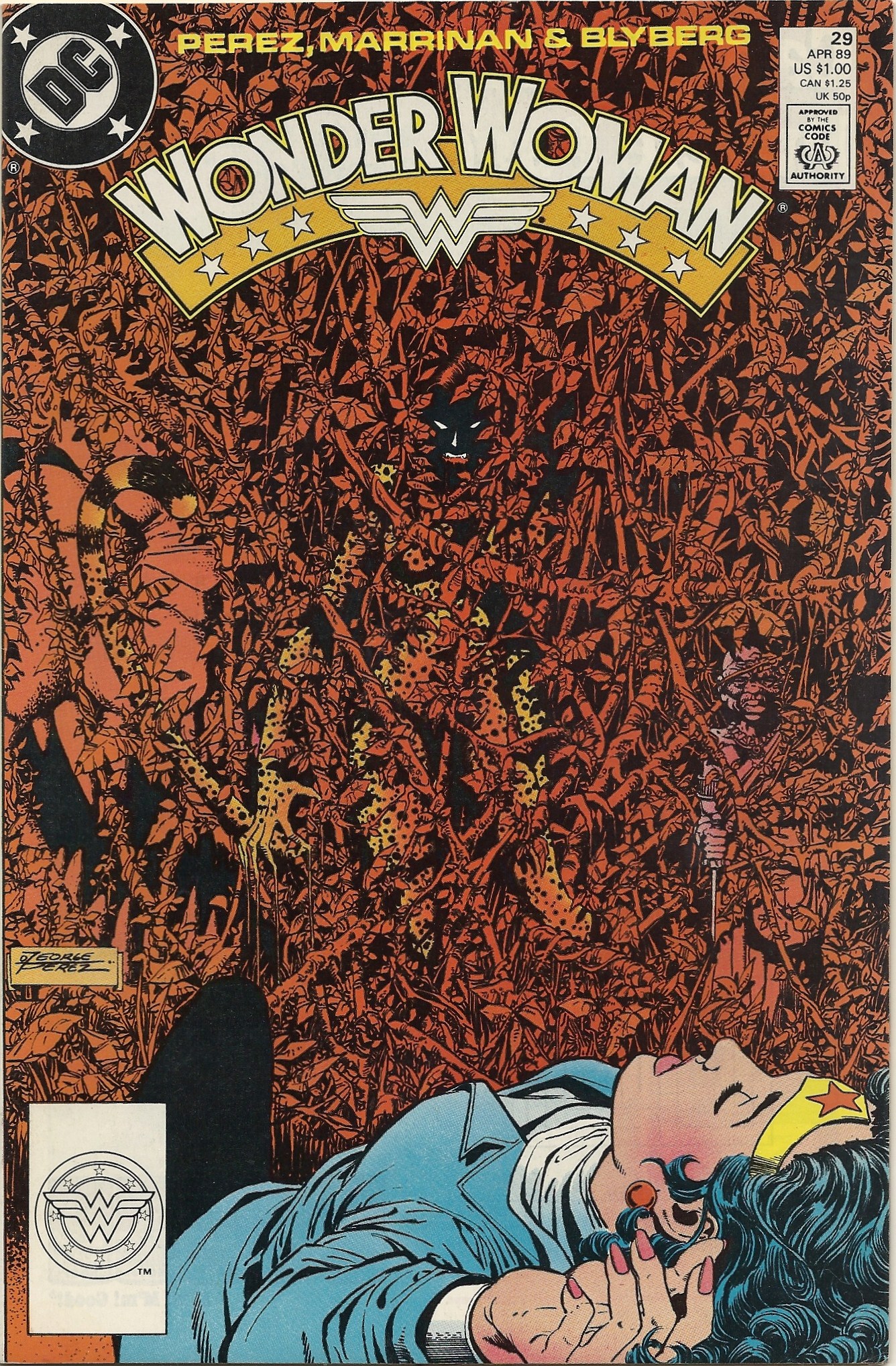
The George Perez run on Wonder Woman was a long and successful one, but this issue was a bit of a mess. There was a pygmy, human sacrifice, flashbacks within flashbacks, sorcery, and more general nonsense than you could shake a stick at. Perez has never had much reknown as only a scripter (which he was in this issue), and it’s always been his detailed and crisp art that has brought him accolades. Because of that I’ll let him pass for this ink and paper goulash.
I do like his cover, though. Cheetah camouflaged by the jungle foliage gives the whole thing a Cheshire Cat vibe, which in turn calls to mind for me a scary movie from my childhood. Back in the 70’s, before he found mega-success on the silver screen, Steven Spielberg was cutting his teeth in the world of television. He did some series work (an episode of Columbo, for instance) and TV movies like Duel. Duel has become a classic — I harken back to it every time a semi roars past me on the interstate — but he did another largely forgotten little flick called Something Evil.
A horror story, it starred the late, great Darren McGavin as an ad-biz patriarch who moves his family out to the country. Most know McGavin as the grumpy, leg-lamp loving father from A Christmas Story and as the eponymous Kolchak: The Night Stalker, but if you ever get the chance, check him out in his old Mike Hammer series — it’s a fantastic little show. But I digress. Something Evil is an Exorcist-y tale, with possessed kids and books flying off shelves and all that sort of thing.
I watched it again a couple of years ago and it doesn’t hold up well at all, but it terrified me when I saw it as a kid, mainly for one scene that was seared onto my memory like a cattle brand. McGavin’s character is a bit skeptical of the whole “haunted house” business, right up until he examines some film taken at his house (his agency lensed a commercial on his property). A technician finds a “flaw” on the film, and shows it to McGavin. There’s something in the window of his home:

That scared the bejesus out of the younger version of me. It still kind of does.
I saw this movie sometime in the 80’s when it was broadcast as a random afternoon movie. It took me years to track down what its title was (where was the Internet Movie Database all of my life?), though I always remembered that one image. If you want to watch this flick, don’t expect to Netflix it or order it off of Amazon — it’s never been released for sale. That’s kind of hard to believe with Spielberg’s imprimatur, but those are the breaks. You’ll have to catch it as a cable rerun or watch it on YouTube, which is where I took that screencap.
I know I kind of got off the “comics” topic with this rant. I hope you’ll forgive me. It’s just that Cheetah’s eyes brought back a ton of memories. Scary ones.

I was flipping through my archives over the weekend, digging for material for a post highlighting a particular Batman artist of my youth, when I pulled out this issue. I really love this cover from Jose Luis Garcia-Lopez — we all know of Two-Face’s slavish devotion to duality and the number 2, but you have to stand with mouth agape at how far he takes it. I mean, geez, talk about taking your work home with you. As if the custom tailoring of his suits wasn’t enough.
I especially appreciate the stains on the lampshade. Now that’s a home in search of a maid.
And stay tuned for that other Batman post. You know, “Same Bat Channel” and all that jazz. I’m sure I’ll get it done at some point.
I’ll take “Bizarre Sexual Fetishes” for a thousand, Alex – Superman’s Girl Friend Lois Lane #73

I’m not even going to read this one. I don’t want anything to impinge on the wonderful idea that this cover (drawn by Kurt Schaffenberger) is a sort of weird turn on for somebody. I mean, I’ve heard of some odd predilections, but “Tie me up on a slab and whip a Howdy Doody-esque effigy of me” is definitely a new one. And I’m certain that the associated story involves a possessed dummy or something, and that can never live up to the sex angle.
Of course, Freud once said this: “The only abnormal sex is no sex at all.”
Whip away, Lois.
Let’s rap with Spidey about child abuse – The Amazing Spider-Man and The New Mutants featuring Skids

I see these sorts of things cropping up every once in a while in dealers’ longboxes. I’m sure I had some of these free giveaways when I was a youngster, though I can’t remember where and when I picked them up. More often than not they were silly little pieces that tried to get educational messages across to kids — I seem to remember one where Spider-Man battled the lethal duo of Doctor Octopus and tooth decay. Brush and floss, kids! Usually they were anti-drug pieces filled with lines like “Groove on life instead of drugs, you hepcats.”
As I said, they were often silly.
This one? This one is, obviously, a bit more serious.
At first I thought that this comic, published in 1990, might deal with sexual abuse, like that old episode of Diff’rent Strokes where Dudley almost got groped by the bike shop owner. It actually tackles the garden variety hitting kind of abuse, which makes my blood boil just as much.
So we’re denied the pleasure of watching Spidey work over a pedophile. I can live with that.
There are two short stories inside. In the first, written by Walt Simonson and pencilled by Alex Saviuk, Spider-Man chances upon a schoolyard rumble. When he asks the main troublemaker why he’s fighting with the other kids, he finds out that the young boy thinks that that’s the way to resolve disputes. Spidey picks him up and slings his way back to the kid’s house. There he meets the parents and the boy — named Billy — reveals a sad secret:

The father wonders if Billy might have done something to prompt that sort of punishment (Dad’s from a different era, after all) and Spider-Man gently suggests that there are other ways to discipline apart from fists. Billy insists that he didn’t do anything bad to deserve it. The parents resolve to have a talk with the teacher.
I don’t have kids, but if I did and I ever found out that one of their teachers hit them, there would be hell to pay. HELL. TO. PAY.
The second short, from Louise Simonson and Bret Blevins, has New Mutant Skids doing some grocery shopping. In the aisles there’s a mother with her kids, and the children are acting up. They eventually get into a mini-fracas, and that sends Mom over the edge:

This prompts a flashback for Skids. She remembers how her father beat her when she was little, and how her force field power was what kept her physically safe, but it was the emotional pain that she couldn’t block out. She envelops the kids in a shield before their mother can lay hands on them, and then she calms things down. There’s some talk about how hitting just makes the kids feel awful and makes them mind even less, and there’s a suggestion that the mother should take a class about how to better deal with the stresses of parenting. Skids even volunteers to watch the kids while Mom goes to the class. I’m guessing having a superhero babysit your kids while you get your act together isn’t a frequent real world option, but it’s the thought that counts in these things, I reckon.
I found this little comic very affecting. Billy revealing that his teacher hits him, with Spidey backing him up and telling him that it’ll be all right, got to me. I’m not ashamed to admit it.
Just a side note… I can recall being over at a friend’s house when I was a kid — I was probably 9 or 10 at the time. My friend had a younger brother, and that weekend the younger brother was acting up. My friend’s father had finally had enough and then proceeded to beat. The living. $#!+ OUT OF HIM. I mean, he wailed on that kid like you would not believe — I can still hear that awful sound when the fist came down on the younger brother’s back. And I remember the father coming into their room (the brothers shared a bedroom and I was in a sleeping bag on the floor) and tearfully apologizing that night. He was actually a really nice, funny guy, or so I always thought and so he always seemed whenever I saw him thoughout my later days. But not in that one moment.
Anyway.


Look! It’s the Metal M-, no wait the Freedom Fi-, no wait, it’s the Doom Patrol. Yeah, that’s the ticket. The Doom Patrol.
All these B-list DC superhero teams bleed together for me. I’m not trying to disparage them. I’m just saying…
“Videx — Monarch of Light,” written by Arnold Drake with art from Bruno Premiani, opens with the Doom Patrol training in their rumpus room or whatever. They keep floundering over the random stuff of Chief’s paramour, Madame Rouge, and this provides the impetus for Robotman to kvetch and use the word “dame” a lot. Meanwhile, their archnemisis, the Brain, wants his old pawn, Madame Rouge, back, and threatens all kinds of bad stuff if they refuse to hand her over.
The action starts when a power outage knocks out the electricity in the Doom Patrol HQ and in the city at large. Beast Boy investigates and finds a gentleman named Videx, who has invisible skin (yuck) and has caused the disruption. Videx apparently has powers over light and photons. Beast is beat up and slinks back home.
It has to be sort of embarassing to get whooped by light. I mean, really. Next up — feathers. Or lint.
Soon the lights are back on for no apparent reason and the Patrol is left wondering when the next shoe will fall.
The next day Chief pieces together who the villain is — an old colleague of his — and the Doom Patrol sets out to take him down. They get the same treatment that Beast Boy did and Negative Man gets a hole blown in him for his efforts. Once they slink back to the HQ to regroup, Chief remembers his Anti-Invisibiliy Gun. Convenient. The gun does the trick. Videx is reduced to his normal human self, N-Man recovers, and Chief prevents Madame Rouge from leaving (she knows that she’s coming between Chief and the Patrol and endangering them in the process).
I was surprised how little the cover had to do with the story inside — the relationship between Chief and Madame Rouge is very much relegated to the background, and there’s certainly no mind-control as it would seem to imply. Perhaps the editors were a little squeamish about putting a skinless man (Videx) on the cover. I don’t know.
I’m not sure of my feelings on this ish. It wasn’t terrible, but it certainly didn’t blow me away. I guess the worst that can be said of it is that it’s run-of-the-mill Silver Age DC fare, with all the silly dialogue and characterizations that that categorization implies. I don’t think I’ll ever become a rabid Doom Patrol fan, but I won’t turn my nose up at them in the future. I very often like the interactions that team books offer, so there will always be that working in their favor.
That’s all wishy-washy, I know, but it’s as definite as I can get with this one.
Don’t trust him, Leia! – Star Wars #86

A long time ago, in a comic book series far, far away, there were some wonderful little stories that were unbounded by corporate overlords. Back then there wasn’t the gigantic mutant Lucasfilm licensing machine keeping a watchful eye on what was being done with valuable intellectual properties. Creativity was unfettered.
Really, back in the 80’s, Star Wars fandom was relegated to the toys and the comics. Anything else was tangential at best. And I can remember when the comic series came to an end with issue #107, Star Wars came to an end in a lot of ways. There was nothing left. Not until books started to be published in the early 90’s did the franchise revive and eventually bless us with a horribly turgid new trilogy of films.
But back in the halcyon early days, we were gifted with some deft out-there tales. Now relegated to the dustbin of “not-in-continuity,” these comics often included concepts that were later overwritten by the movies. These stories were coming out as the original trilogy films were released, and stuff like “I am your father” often threw things for a loop, but the creative teams always regrouped and offered up more helpings of satisfying material. The old Carmine Infantino run was a wacky treat, but I came along later in the game, so a lot of the stories I read came out after The Return of the Jedi put a bow on the cinematic offerings. I always thought of these stories as “real,” that is, that they were what truly happened to Luke, Leia, Han and the gang after that whiz-bang shindig on Endor.
Then those dreadful prequels came along and crapped all over certain concepts. Thanks, George.
Issue #86 is an exception to that — there’s nothing in it that later fiction (to my knowledge) supersedes. It’s a nice done-in-one story. Published after RotJ was released, “The Alderaan Factor,” written by Randy Stradley and pencilled by Bob McLeod, takes place between the events of that film and The Empire Strikes Back. A shuttle that Leia is travelling in is shot down on a desert planet that’s occupied by the Empire. A Stormtrooper pilot of a Tie Fighter that also crashed “rescues” the Princess from the wreckage. He takes off his helmet and reveals that he was once a lowly servant in Leia’s home on Alderaan. They bicker and argue — he betrayed his people, she’s a haughty rich bitch, you get the picture — but are forced to team up Defiant Ones-style to survive in the harsh environment:

Along the way they start to understand each other a little better, bonding over a small chunk of rock from Alderaan that the Stormtrooper wears on a necklace, but the nameless soldier nevertheless turns her over to his Empire superiors. When Luke and Lando show up in the Millenium Falcon to rescue her, he has a change of heart (reminiscent of Darth Vader at the end of RotJ) and helps her get to the ship. He’s shot in the back and falls to his death as the Falcon makes its escape in a reversal of the above-pictured rescue:
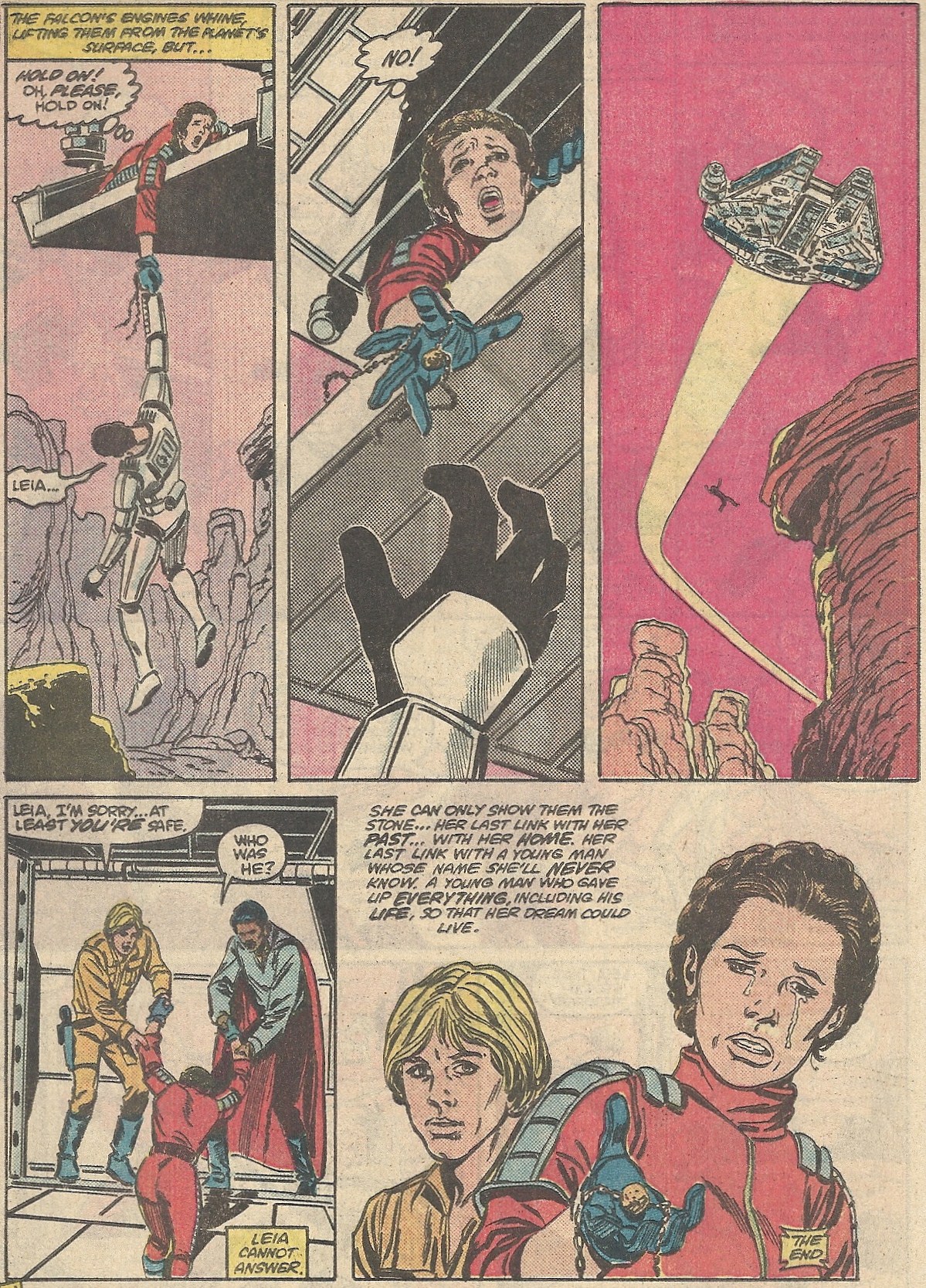
I liked this story a lot as a kid and it still has a good deal of resonance. The redemption of the Stormtrooper (an “uknown soldier” in some ways) echoes the redemption theme that was at the heart of the original trilogy. It’s the best of Star Wars, the type of stuff that makes you proud to be a fan of those old adventures.
I suppose all those new books and cartoons and comics have rendered moot a lot of the post-Jedi Marvel run, but I like to think that this one st0ry remains untouched.
In my mind, it’s “real.”

In recent years Frank Miller’s work has slipped into that most dangerous of ruts — unwitting self-parody. He made popular the oft-imitated (aped ad nauseum in the opinion of many) “dark and gritty” style with landmark works that I don’t have to list. Everyone knows the titles and characters that he took into the stratosphere of popularity, and that oeuvre makes lines like “I’m the Goddamn Batman” all the more painful. Now he’s floundering in a style that he once made his own, and I’m not buying that he’s operating on some higher intellectual level where we mere mortals don’t get the meta effects of what he’s doing.
It’s like watching Willie Mays fall down at home plate. It’s painful.
But that doesn’t diminish what came before. I arrived too late to the comics world to absorb Miller’s runs on Daredevil as they unfolded, but I can look back and appreciate the noir-y visual vocabulary that he brought to those stories. By this issue, #188, he had handed over the bulk of the artistic chores to his inking partner, Klaus Janson, contributing layouts in the way Jack Kirby did on titles back in Marvel’s glory days. Janson’s inks are so bold, though, they often consume the lines of his penciller teammate, so the transition to him merely bringing life to Miller’s designs is very smooth. The art looks and flows like it did when Miller handled the full pencilling chores.
The Man Without Fear takes a backseat in this issue, appearing sparingly as the Black Widow chops and kicks her way through the underworld of New York City, poisoned by the Hand and looking for a way to stay alive. This issue falls in mid-arc, so I won’t go too deeply into the story. Let’s just say that it’s still a treat, all these years later, to sit back and enjoy the quality of the action sequences. Wonderful stuff.
There’s just something about a sassy redhead in a skintight bodysuit that oftentimes displays just enough decolletage wailing on a phalanx of baddies that’s sure to get every man’s blood pumping (and it’s worthy of a breathless run-on sentence, at that):

I guess we should thank the geek gods for the casting of ScarJo as the flesh and blood Natasha.
And I suppose that, while we’re at it, we should also give thanks to a younger Frank Miller for not having Natasha utter a line like “I’m the Goddamn Black Widow.”

I had this comic as a kid, and I seem to recall that it was one of few Green Lantern books that I owned. In fact, it may have been the only one. There’s a cool cliffhanger ending, as Hal is duped into thinking he has a power battery with him in space, but when he needs to recharge his ring it turns out that it was just an illusion. He promptly explodes, or so we’re led to believe.
A lot of times I’d have an issue that ended like this, and I’d miss out on what the resolution to the story would be. My childhood comics were kind of spread out — trips to stores that sold them must have been intermittent. It’s only in recent years, as I’ve plunged head first into buying back issues, that I’ve finally learned the endings of many a dangling plot thread.
A fly on the wall at my place would often hear me saying “So that’s how he made it out of that! Huh…”
But it wasn’t just the “How did Hal survive?” factor that made this issue memorable. It was the following sequence:

Looking at the cover date, I was a whopping nine years old when this came out. And I’m not going to claim that this comic book brought out a sudden *ahem* awareness of the opposite sex. I’ll simply say this — over two decades have passed, and I can still remember that page. So it must have flipped some sort of switch.
So thank you, Steve Englehart and Joe Staton, for having Star Sapphire peel her clothes off in front of a sweaty, wide-eyed Hector Hammond like some common strumpet.
And no, I won’t make a ribald double entendre about the size of Hector’s head. Or maybe I just did.
Recently I talked about how little I care little for the Marvel Universe’s premier aquatic champion. He’s never floated my boat, if you pardon the ever so cringe-inducing expression. I’m not alone in this, but a reader left a comment lamenting that no one shared his love for Namor. And I thought to myself, You know what? Maybe I should give this guy another try. With an open mind. Leave my baggage at the front door.
So here I am. Back for Round 2.
I though that, to better focus on Namor, it would be wise to get one of his solo adventures. It’s very possible that he suffers in comparison with the Hulk, one of my childhood favorites and his Tales to Astonish cohort for a good chunk of the Silver Age Marvel era. So this week I resolved to buy one of his own books (books I’ve in the past avoided like the plague) and, after I hemmed and hawed for a bit, I picked this one:

I’ll tell you whatit was about this cover that got me. I can imagine serving on a sub can be a pretty claustrophobic experience — how could it not be? It has to put people on edge, even in the calmest, most normal conditions. So imagine one day you up periscope and see this pissed off guy stroking his way at you?
I have to think that that would be a “$#!+ your pants” moment.
So I like the cover. Put that on the positive side of the ledger.
The story, from writer Roy Thomas and artist Gene Colan, opens with Namor as he saves a naval station from a torpedo attack by the pirate Barracuda. In the process he’s mistaken for an attacker. This misunderstanding leads to Namor battling the U.S. Navy, and gives him plenty of chances to hurl imprecations at the surface dwellers. It also provides him with an opportunity to utter his catchphrase, his version of “Dyno-MITE!”, in a cool full-page image:

At one point during the fight he even scoffs at those who think that he’s weaker than the Hulk — who think him a lesser man, if you will:

I guess that’s directed at me — sorry, Namor.
So the Sub-Mariner tears the ship apart and throws its crew all around, all the while wishing they would just stop fighting him so he could talk to their captain and resolve this confusion. I suppose he could just let their bullets bounce off him as he talks and explains things, but I’m not going to argue strategy with the guy. Eventually he gets tuckered out and has to return to the water to power up, and when he does a sub fires on him. But neither Namor nor the Navy are aware that Barracuda used the distraction of their fight to sneak on the base and steal some gizmo called the Sonic Magno-Directoid. The thing accidentally draws the sub’s torpedo to Barracuda and his ship as he tries to escape and he gets blown all to pieces. Oops.
Namor swims off, the Navy realizes that Namor might not have been their true enemy, and our story ends.
My thoughts? Has Namor won me over? Not quite, but I have to say that I enjoyed this issue quite a bit. Namor’s dialogue, with its “yons” and the like (reminiscent of Thor, in a way), was entertaining, and the action on the whole crackled nicely. I was less than taken with Colan’s art — usually I really like his stuff, but for some reason I found his panel construction here too scattershot and distracting. Oh well. But taking it all together, this thing was a positive experience for me.
So maybe I’m softening on Namor. I wouldn’t call myself a fan yet, but things are always in flux. As it is, I’m half expecting a pig to fly by my window at any moment.
And I’ll try not to compare him to the Hulk too much from now on. I promise.
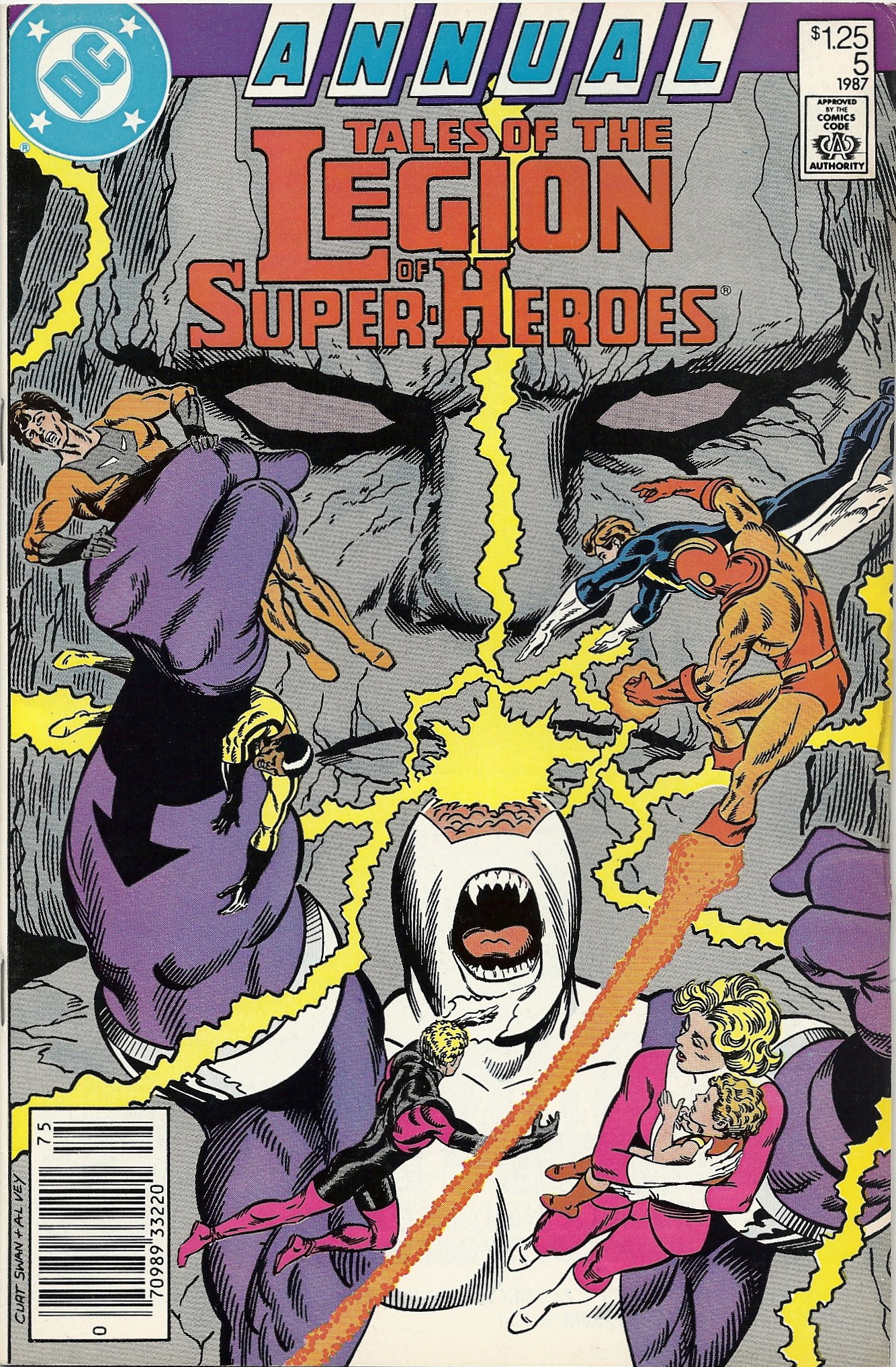
I know that the Legion has been a popular team over the years, but I’ve never shared in that enthusiasm. That’s not through informed disdain, but more from my ignorance of the characters. By the time I became literate enough to buy comics — in the 80’s — the Legion weren’t occupying the same lofty level where they once were perched. And, woefully behind in my Legion lore, I’ve never been able to keep the myriad Boys, Girls, Lads and Lasses straight.
So I don’t get along very well with the Legion. It’s my fault. I admit it. I’m so ignorant, I can’t even begin to properly analyze an issue. I just don’t get the whole vibe from these far-future youths. But there’s one dude I can get.
Darkseid.
Perhaps the greatest villain in the DC Universe, the stone-faced ruler of Apokalips is the big bad of all big bads. He rules the rogue roost, if you will. He’s so tough, he’s still menacing all of creation in the far-future of the Legion.
Now, I have to confess, I’ve never read “The Great Darkness Saga.” I hope to correct that soon, but this annual (actually a reprint of a regular Legion of Super-Heroes Annual) serves as a sort of epilogue to that classic from The Legion of Super-Heroes. While I liked the writing style of scripter Paul Levitz, not being familiar with that earlier story (or the characters, for that matter) I was a bit bewildered by all the goings on. The plot involves Darkseid secretly kidnapping one of Saturn Girl’s twins at the child’s birth, sending the kid back and time, making him a villain, and trying to get Saturn Girl and the child’s father, Lighting Lad, to unwittingly kill their own offspring.
At least I got that part.
The treat for me was the pleasant contrast between the two pencillers for this issue. Curt Swan handled the bulk of the story, while Keith Giffen tackled a few framing pages at the beginning and the end. While I’m pretty dumb when it comes to the Legion, I know enough to grasp that these two gentlemen are very closely tied to these characters because of their long associations with them. And you couldn’t pick two artists whose styles are more different. Swan’s has a softness to it, an elegance, while Giffen’s is harder, all sharp lines and deep shadows.
For example, there are the different ways that they draw Saturn Girl. Here’s a page from Swan:
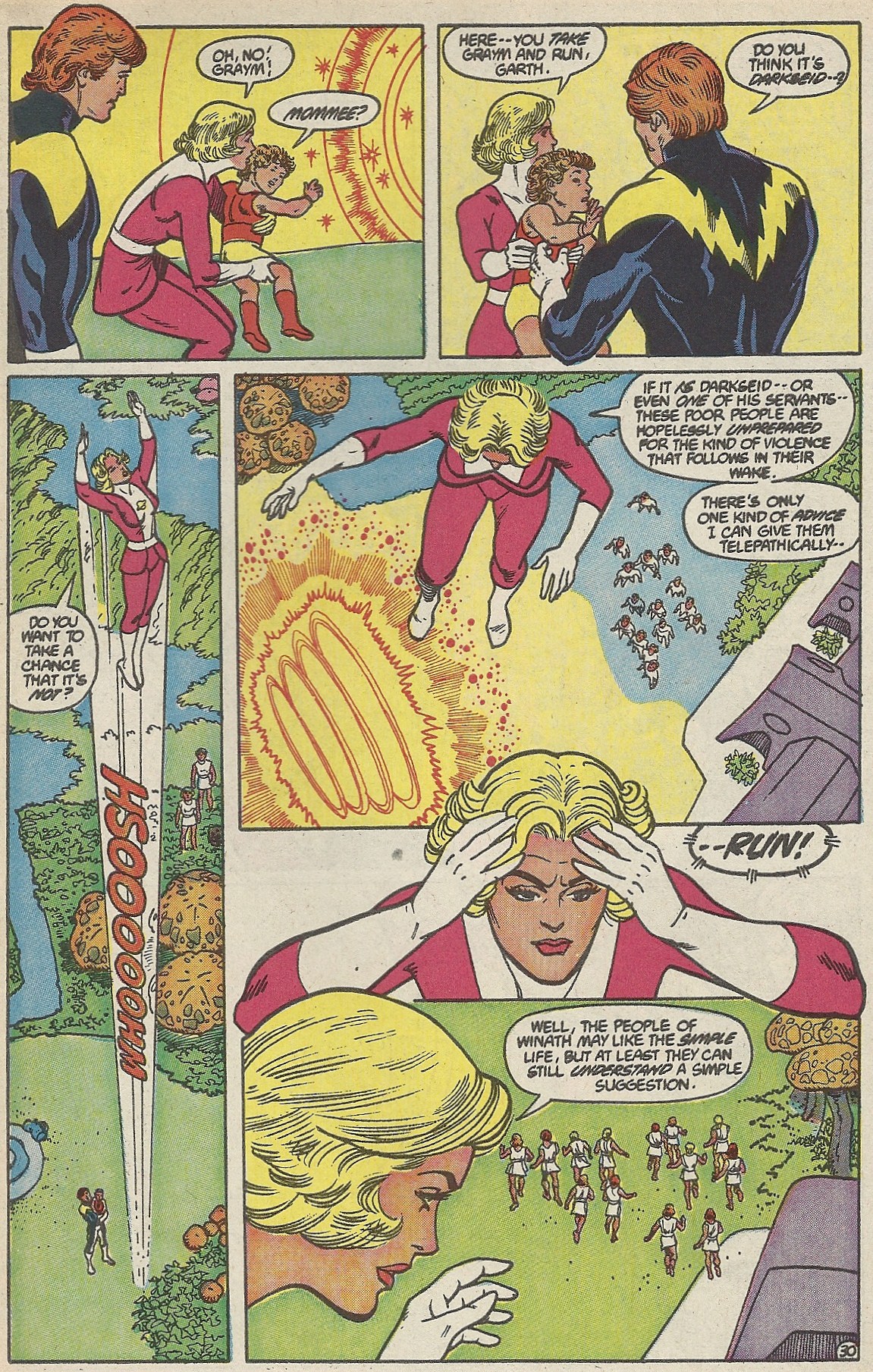
And here’s one from Giffen:

There’s a definite contrast, but the way it’s handled in the story works. Kind of like hot fudge and ice cream — one’s hot and one’s cold, but boy oh boy, do they ever go together. The same holds true here. Giffen’s pages deal with Darkseid’s machinations, and his firm style melds nicely with that character’s cold, rocky evil.
Now I need to go track down some of those “Darkness Saga” issues. I’ll have to put myself through a weekend-long cram session on the Legion at some point — this giant gap in my comics knowledge can’t go on. It just can’t.
Shagadelic – Nick Fury, Agent of S.H.I.E.L.D. #5

No deep analysis here — I just wanted to take a second and highlight a Jim Steranko cover that I really enjoy. His work as both writer and artist on the salty, eye-patched Nick Fury character elevated the entire enterprise, and covers like this were so much fun and so reminiscent of the colorful and sexy James Bond credit montages of the time. If it’s good enough for one superspy, it’s good enough for another.
One thing I’ve always liked about Steranko’s covers is how he was never afraid to leave portions of the available space empty. It reminds me of some counsel I once received on public speaking. The advice was this — never be afraid to use silence as a tool to get your point across. Don’t feel like you have to fill up every second with your voice, because a strategic pause can often be as effective as the spoken word in advancing your argument.
Look at all that white — Steranko seemed to grasp this wisdom and apply it to the visual arts. Kudos to him for that. Knowing when to shut up is hard, and so is knowing when to put the pencil and ink down.
I’ll shut up now.
Over the past five years or so we’ve been bombarded by a genre of filmmaking that I’ve never been able to get into — torture porn. Saw and its interminable sequels and imitators are the standard-bearers, and even shows like 24, which I enjoyed, have elements of displaying inflicted human suffering for the sake of displaying inflicted human suffering. If that makes any sense.
If there’s analagous ailment in comics, it’s killing characters. If a character can be created, he or she can be killed — many times over, as is often the case. There’s always been an obsession with killing off characters, so apparently that’s where the bloodlust is sated for the comics-loving public. A lot of times the deaths occur in “imaginary” stories, but sometimes the sanguinary appetites are fulfilled in-continuity.
Case in point — The Infinity Gauntlet.
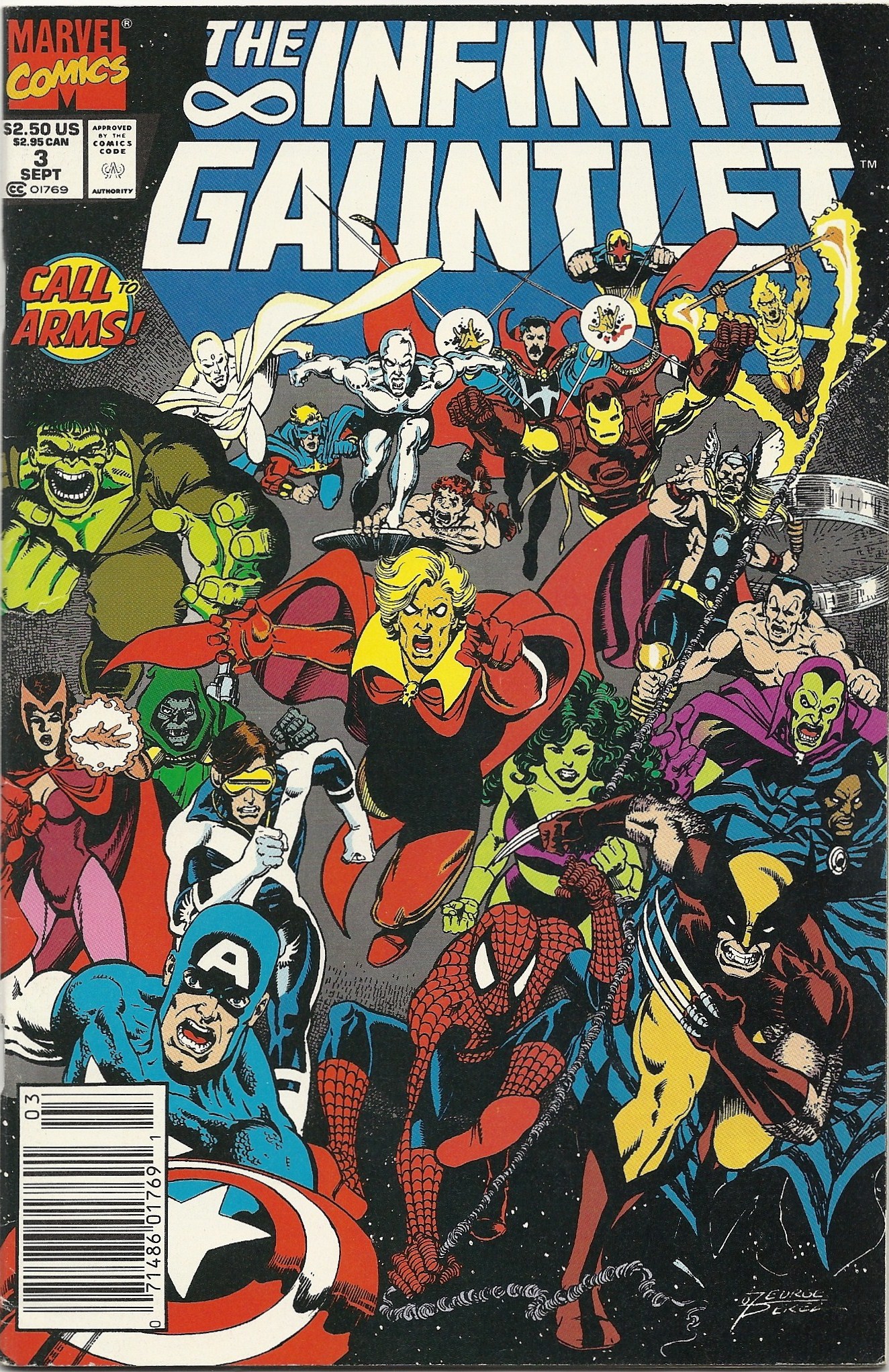
Back in the early 90’s, the demi-god Thanos assembled the Infinity Gems (re-christened Soul Gems), put them on his glove (where the “Gauntlet” comes in) and became all-powerful (where the “Infinity” comes in). In order to impress Mistress Death (not the hip DC version, but the dour Marvel version), Thanos with a thought wipes out half the living things in the universe. This gets the attention of our favorite heroes, and under the leadership of a revived Adam Warlock they assemble to meet Thanos in battle.
The cover of issue #3 sets the table for the big rumble:
And by issue #4, Thanos was ready and waiting:

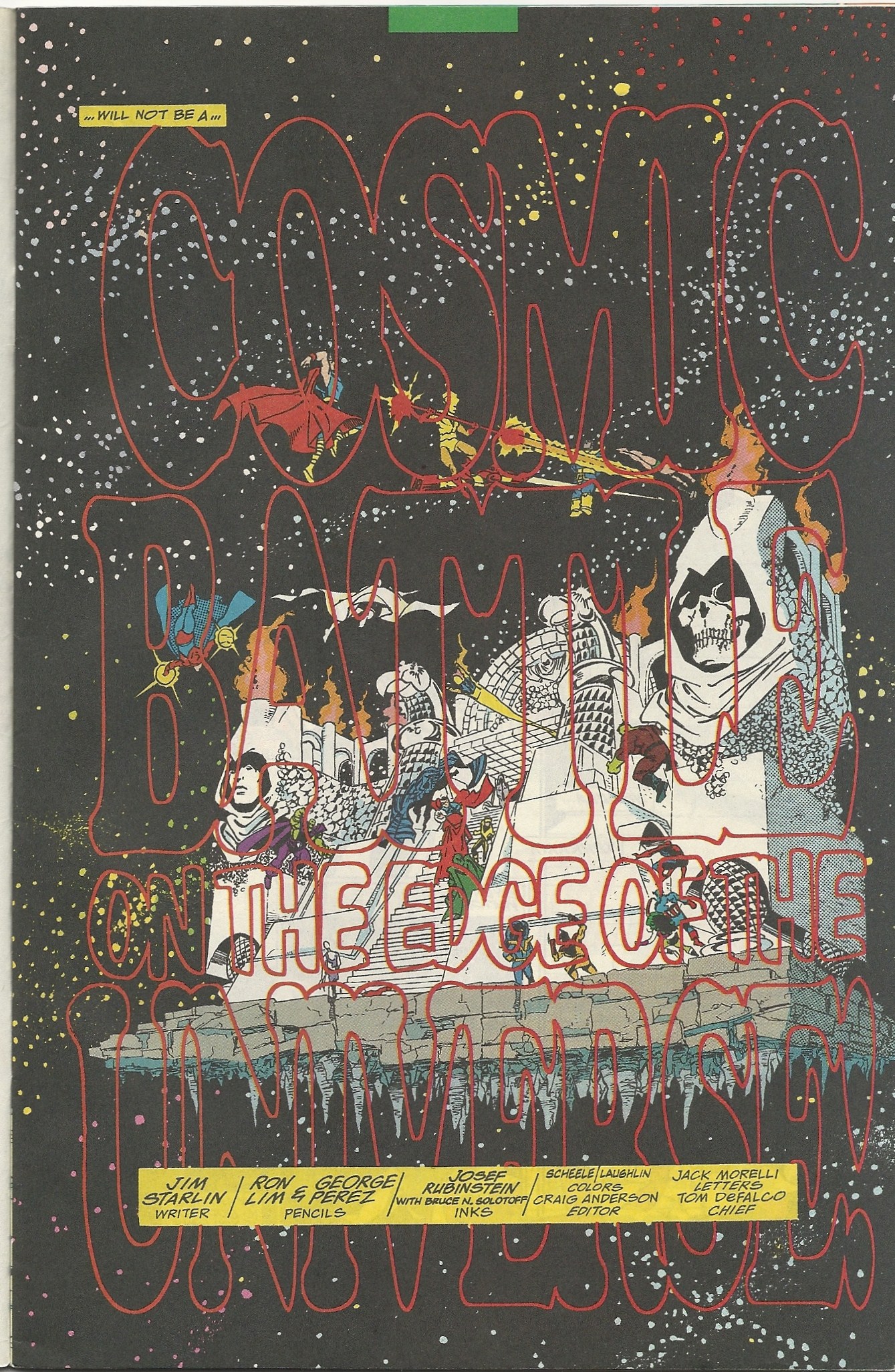
Doctor Strange remained behind on Earth and conjured up a portal to drop the task force off at Thanos’ throne platform (or whatever the hell you want to call it). While Warlock and the Silver Surfer remained off in the distance, the others were thrown right into the thick of things. The title page gives you a good idea of the geography for the battle:
Thanos promptly freezes the heroes in time and contemplates what to do with them, but Mephisto, now a mere lackey to a vastly more powerful being, uses Thanos’ devotion to Mistress Death to clandestinely give the heroes a chance at victory. I guess he doesn’t like being second banana, and those devils can be oh so tricky:

Thanos temporarily limits his own powers, taking away his knowledge of what’s to come. This begs the question, if he had foresight before, wouldn’t he have foreseen that this might be a problem? Hmmm. Let’s not get hung up on that.
Let’s get to the carnage!
Things get started with a bang, as the heroes that were about to strike Thanos when they first appeared go crashing into stone — Thanos has shifted his position, after all. The first to fall victim to Thanos is the Hulk. While not killed, he’s shrunk down in size and is rendered irrelevant for the rest of the action:
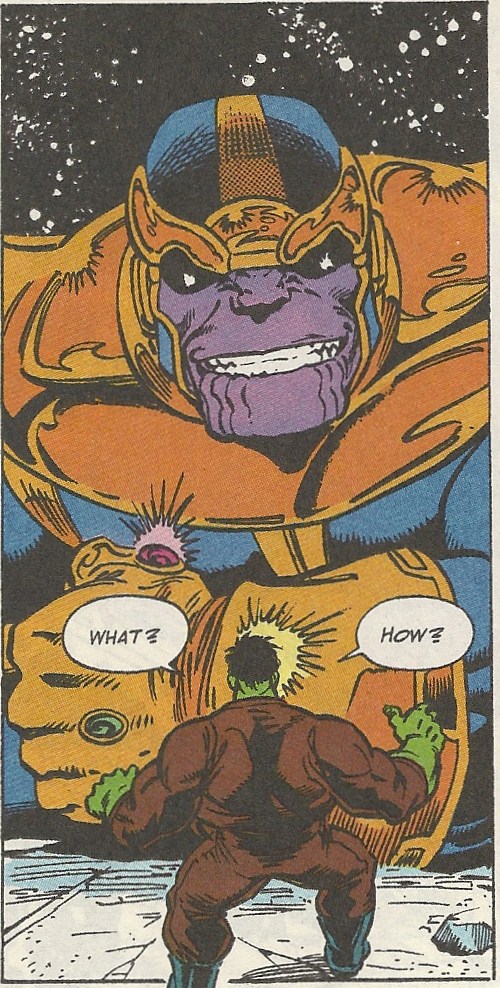
Namor and She-Hulk are the first casualties, suffocated or devoured by some sort of brown mold (and by the way, the narrator is Eros/Starfox, Thanos’ brother):

Thor clobbers Thanos with his hammer, but Doctor Doom (Warlock shouldn’t have trusted him), instead of finishing him off, tries to get the Gauntlet for himself. He pays the price:

A battered Doom shows up again later, but we never see his exact fate, though I assume Thanos killed him. Maybe this was dealt with in one of the innumerable crossovers.
If anyone could stop this guy, it’s Logan, right?:
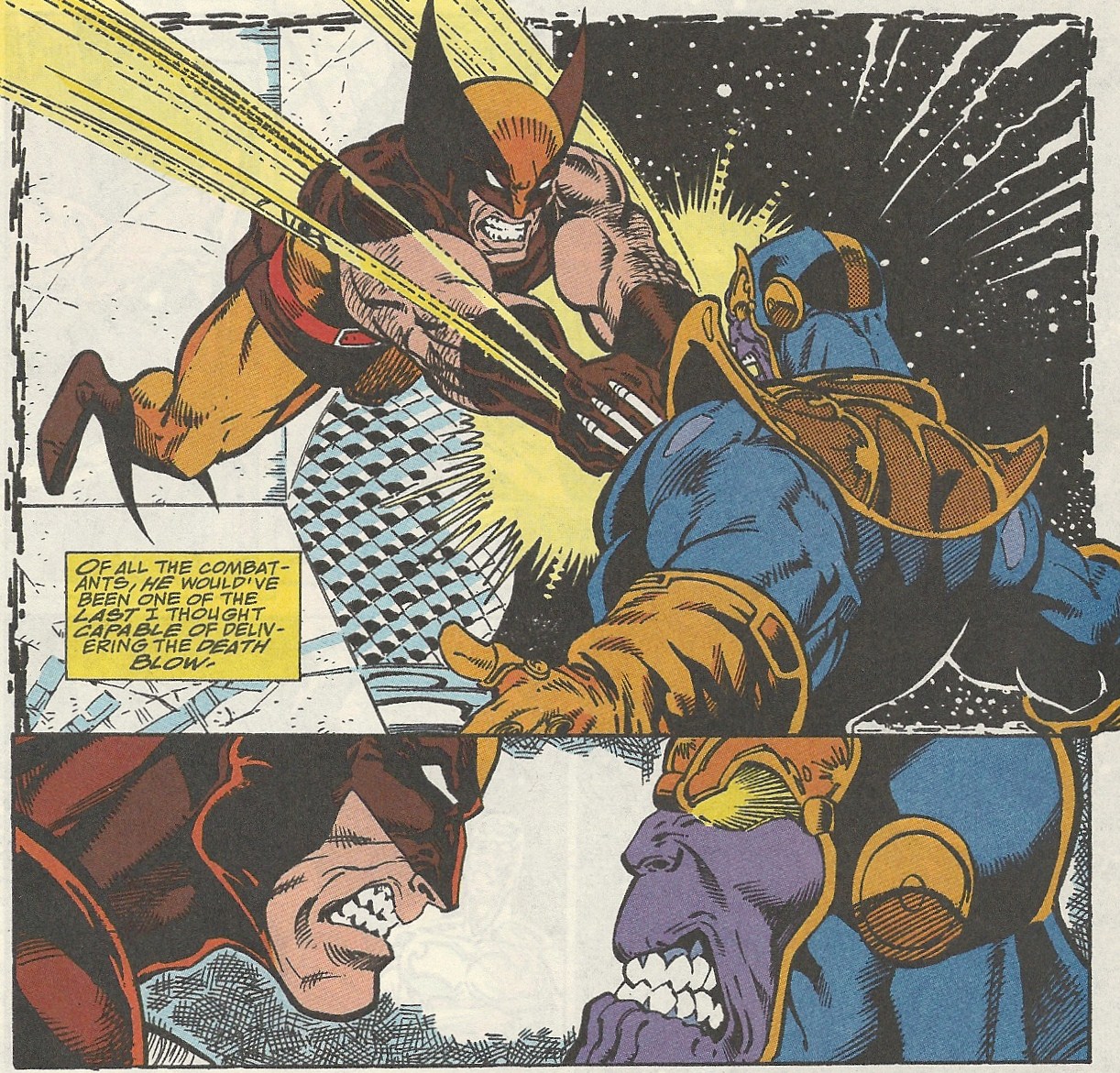
Wrong:

The Scarlet Witch gets fried:

Then, in one page, Iron Man is taken out by Terraxia (a paramour that Thanos created to make Mistress Death jealous), Cyclops gets suffocated by a glass box, and Vision gets his circuits ripped out:

I like poor Cap, endeavoring to free Mr. Summers. He doesn’t.
Next is Cloak, trying and failing to stop Thanos with his own unique power:
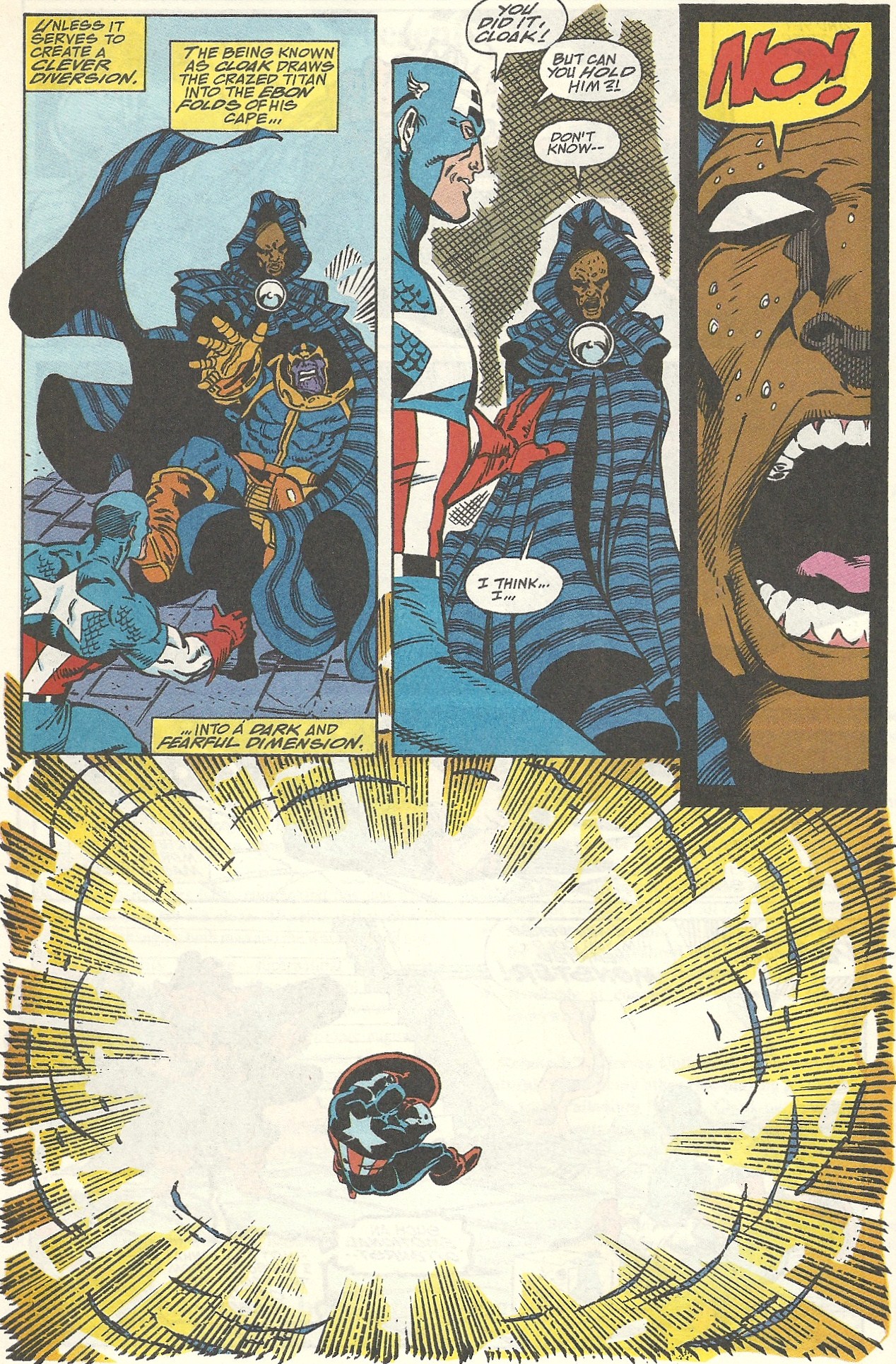
Drax the Destroyer and Firelord are tossed back into dinosaur times (don’t step on any butterflies!) and we’re treated to Tony Stark’s severed head:

The roster is getting pretty thin. Spider-Man and Thor execute a nice one-two punch, with Spidey webbing Thanos’ eyes and giving him a swift kick to the pruney chin while Thor batters him with Mjolnir. They don’t take it very far, though. Spider-Man is brained by Terraxia while Thor is turned to glass:

Nova is reduced to tiny little cubes:

Next we have Quasar facing Thanos in a Leone-esque showdown. Surely the heir to Captain Marvel will put up more of a fight:

Not so fast. He gets in about as much offense as the guy with the swords that Indy shoots in Raiders of the Lost Ark:

There’s only one man left. Who else could it be but Captain America? He faces Thanos with the courage that we’d all expect from the guy. His shield is quickly obliterated, and he stands ready to meet his fate.
But wait — remember the Surfer and Warlock? The Surfer’s been chomping at the bit, desperate to help in the fight, but has been held back. Now we know why. Warlock’s big plan has been to distract Thanos, to hope that he focuses on the combat, on what’s in front of him, and that he fails to notice the Surfer as he swoops in and rips away the Gauntlet. I love what artist Ron Lim did with this two-page spread — I always have the tension music from the old Star Trek shows in my head when I see it:
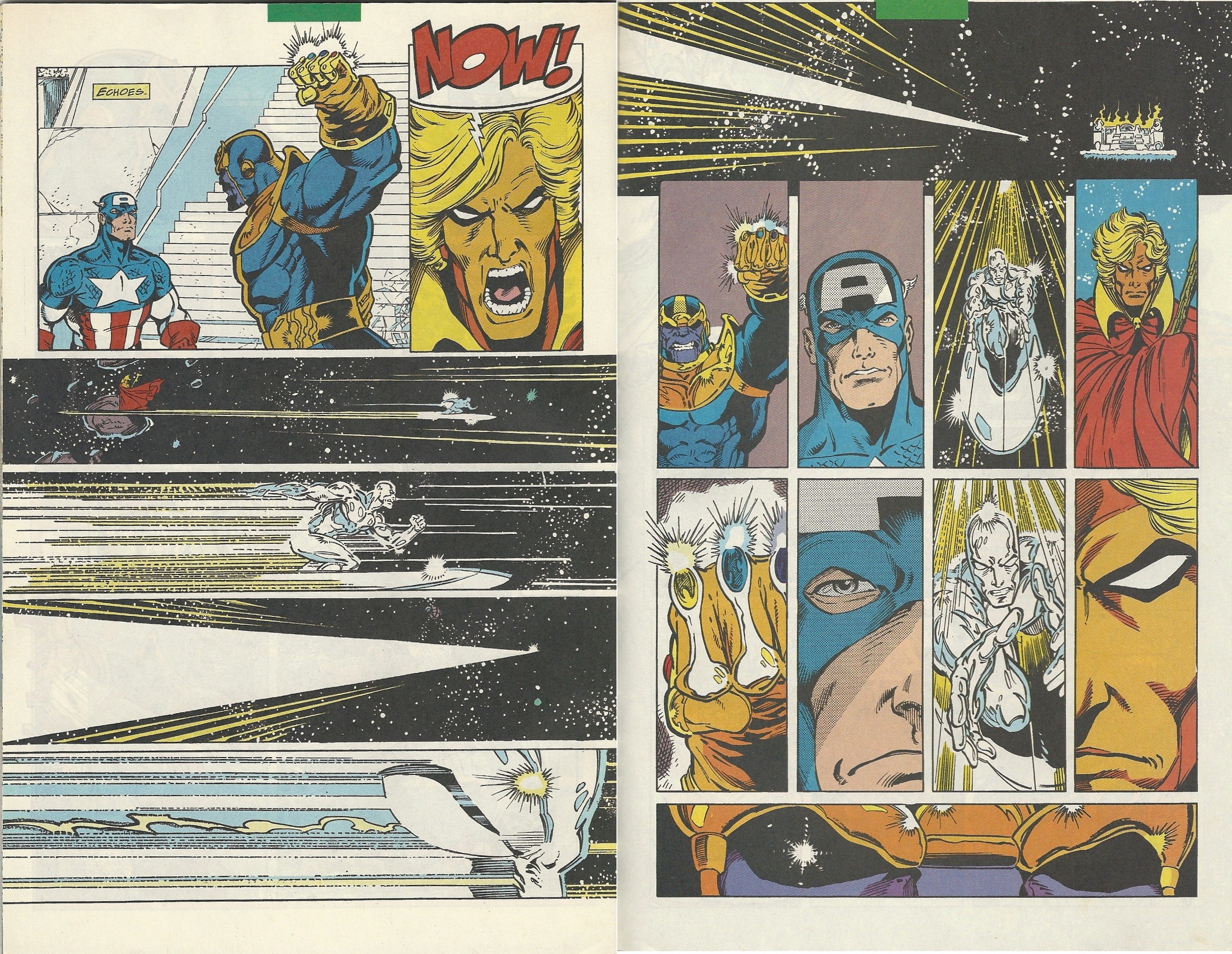
Alas, the ploy doesn’t work, and Steve Rogers is killed as an afterthought:

And thus ends the battle.
A few post-game notes…The next issue was a fight between the cosmic entities and Thanos — a memorable image from that was the Celestials hurling entire planets at him. And a couple of issues later all was set right within the Marvel Universe, as if this whole bloody thing never happened.
Also, this issue was odd creatively. Jim Starlin wrote the series and George Perez started out as the penciller, but halfway through this issue he was replaced by Ron Lim. You’ll see the change after the first couple of scans that I posted above. I think I remember reading somewhere that Perez became ill and that it wasn’t any sort of creative disharmony that prompted the replacement. Still, it’s not very common for that sort of mid-issue handoff to happen.
Boy, I loved, loved this issue when I was a kid. I’m not sure what that says about me, but I did. I’d never really seen anything like it, and, to be honest, I still haven’t. While the heroes were eventually brought back to life, it was still unique to see them killed in such silly and gruesome ways. Like torture-porn, this sort of story appeals to some sort of prurient interest that resides in many of us. Now I roll my eyes at it, but back then? Back then I thought this was the coolest comic ever.
And I still think that two-page Lim spread is boss.
 Jared
Jared


 blog into mystery