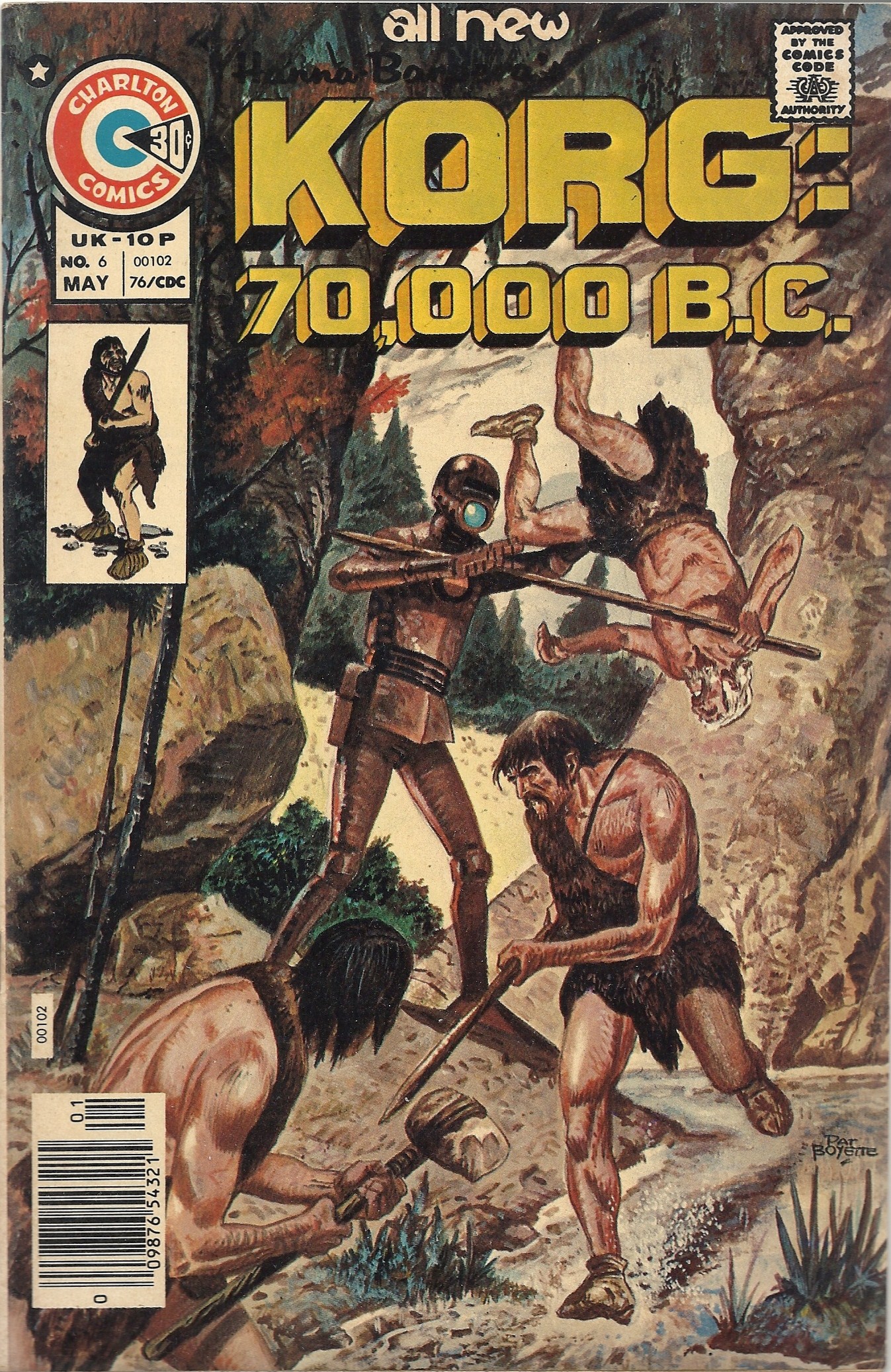
I bought this one just because I liked the cover. A robot beating up some cavemen — how can you go wrong there? It was only after I got home and did a quick Google search that I found out that this wasn’t purely a comic book series, but was actually based on a very short-lived Saturday morning kids show. Here’s the intro:
I gather that it made an effort at being an “educational” series, which made it sort of a Quest for Fire meets G.I. Joe’s “Knowing is half the battle.” I don’t think it’s any surprise, though, that a kids show centered around Neanderthals didn’t take off. Who the hell wants to look at their ugly mugs on a Saturday morning?
On to this issue.
I really dig the fetching cover from Pat Boyette (I might not have bought this book if not for that), and he also handled the writing and artistic chores inside. The story is sort of a Chariots of the Gods-lite, as you can gather from the first page:
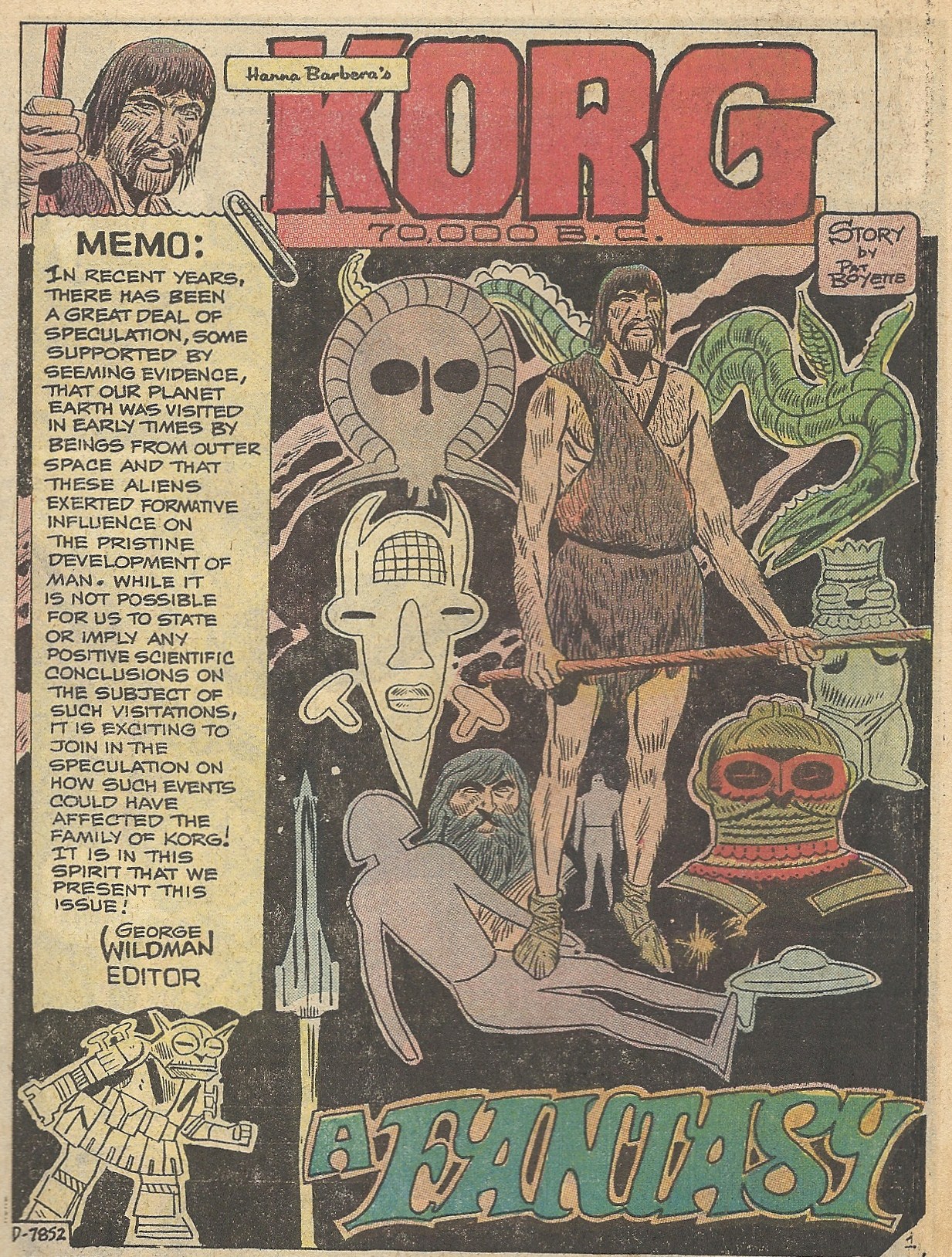
We open with Korg hearing a story from his kinsman Smoog (love the caveman names — where’s Oog? And Boog? And Florg?) about how sometimes stars come down from the sky and carry people away. Korg is skeptical, or at least he is until another of his cohorts describes seeing something odd down by the local watering hole:
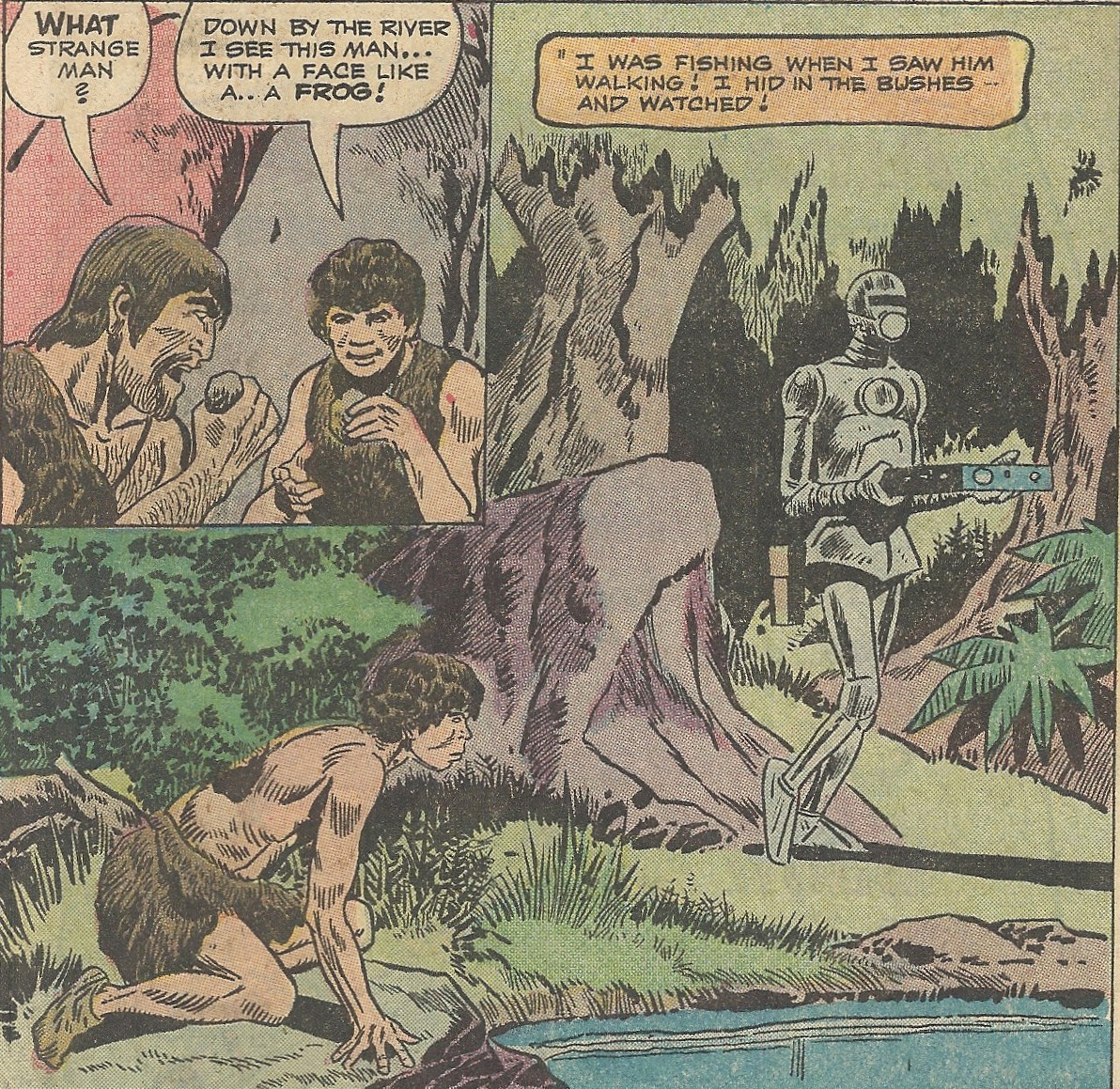
I have to pause here for a minor quibble. Maybe I’m influenced too much by the dialogue-free script from the aforementioned Quest for Fire, but these dudes are communicating a bit too freely for my liking. I realize that it can’t all be grunts and gestures (then again, why not?), but the dialogue is way too smooth. It’s not James Joyce and “Stately, plump Buck Mulligan…” smooth, but it hits a wrong note with me. Maybe I’m just being picky.
But I digress. For the millionth time.
Korg and his brother Bok go out looking for this “demon” and Bok is the one who finds him. Bok is killed — be careful what you wish for. Korg gets his revenge and drops a boulder on the robot, destroying it. Hey, maybe he’s an ancestor of Magnus — call Maury Povich, we need a DNA test! The owners of the robot track Korg down and capture him, and they interrogate him while he’s held in a stasis field or something:
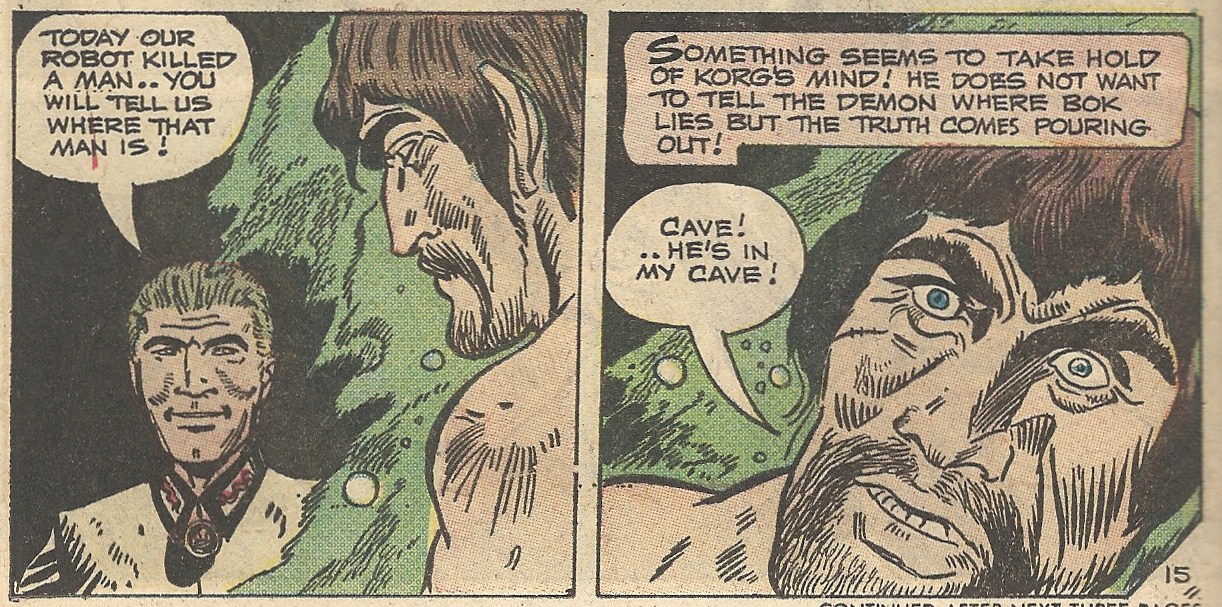
It turns out that they’re not looking for vengeance, but instead want to put Bok back together again, if not Steve Austin “stronger, faster” style, then at least back to where he was. The old adage that no good deed goes unpunished is once again proven true, however, and a reanimated Bok goes nuts in the alien spaceship and wrecks the whole damn thing. A spaceship that can be wrecked by a dead Neanderthal — now that’s a lemon. The lily white aliens and their vaguely Wehrmachtish uniforms are stuck with Korg and his fellow primitives:
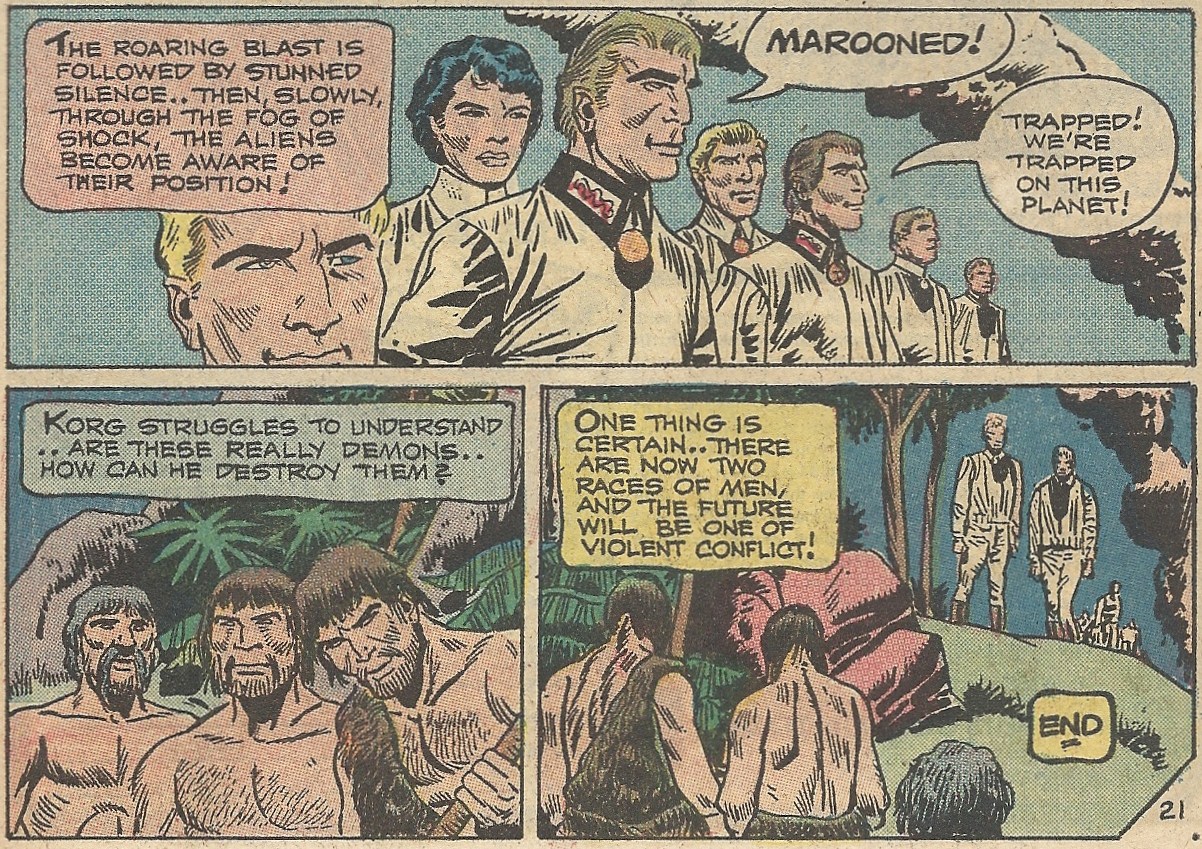
But, since the title page made it clear that this was a somewhat fanciful tale (no kidding), I imagine the next issue continued Simpsons-style as if nothing ever happened.
This was kind of a fun issue, and the great cover image is definitely a big plus. I had no idea that the Korg franchise ever existed. I’m not sure that my life has been enriched by my discovery of it, but this read certainly didn’t drag me down into the depths of despair.
I can live with that.
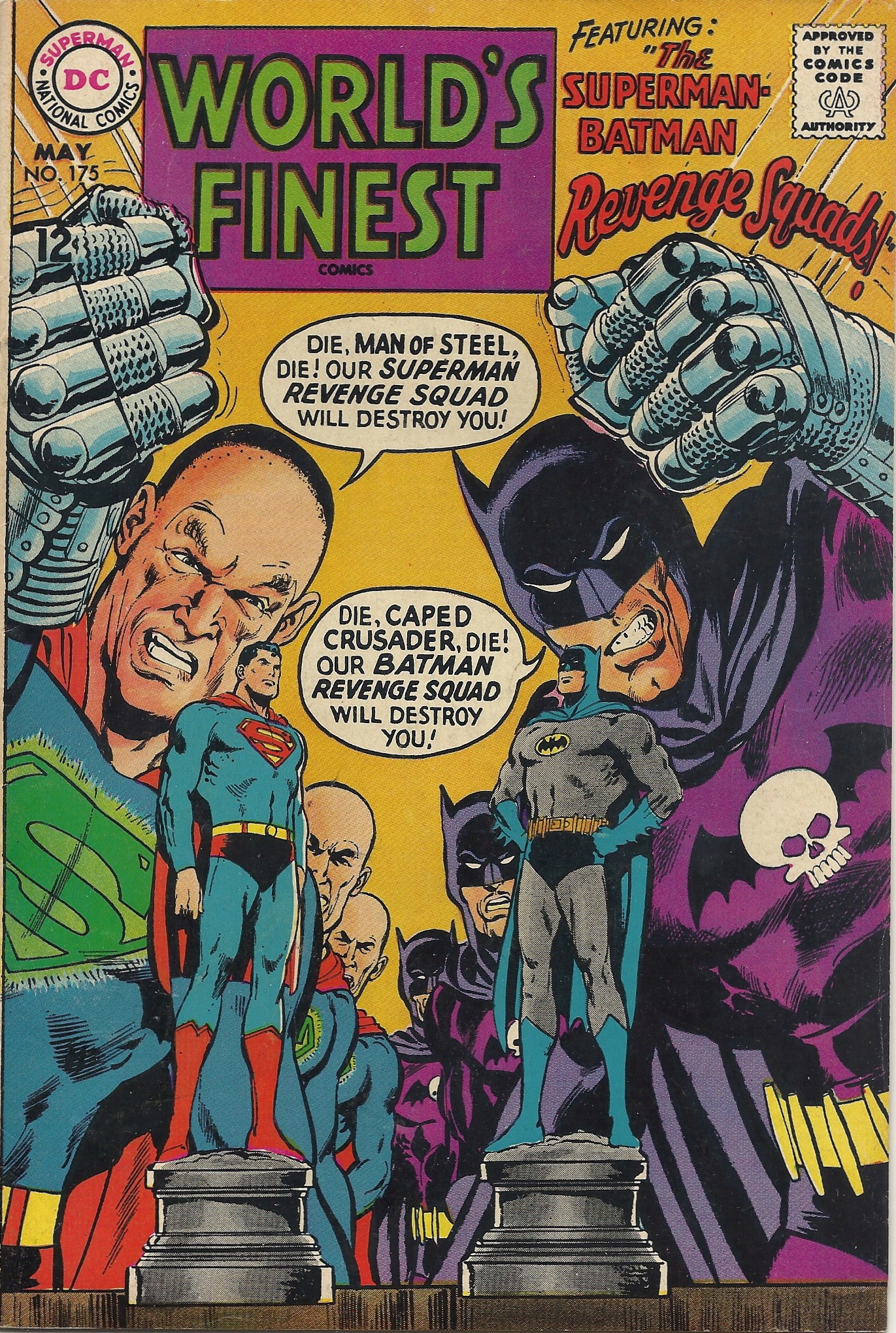
I’m about to utter a terrible comics blasphemy, one that may cause me to be struck down by a lightning bolt from above. Are you ready for this? Are you sure?
I’m not a big Neal Adams fan.
OK, I’m still here.
It’s not that I actively dislike his art. It’s simply that I can take it or leave it. It does nothing for me. It doesn’t excite me, and the only thing that separates him from the pack in my eyes is the fact that I have to pay a premium to add his Batman work to the Blog into Mystery archives. A lot of the art from the 70’s looks the same to me and I’ve never been able to easily distinguish his from the crowd, something I can do with most other A-list artists.
Of course, I could just be a comics heathen with unrefined tastes. A Philistine. I admit that this is a possibility. And now that all that is out of the way, on to the issue at hand…
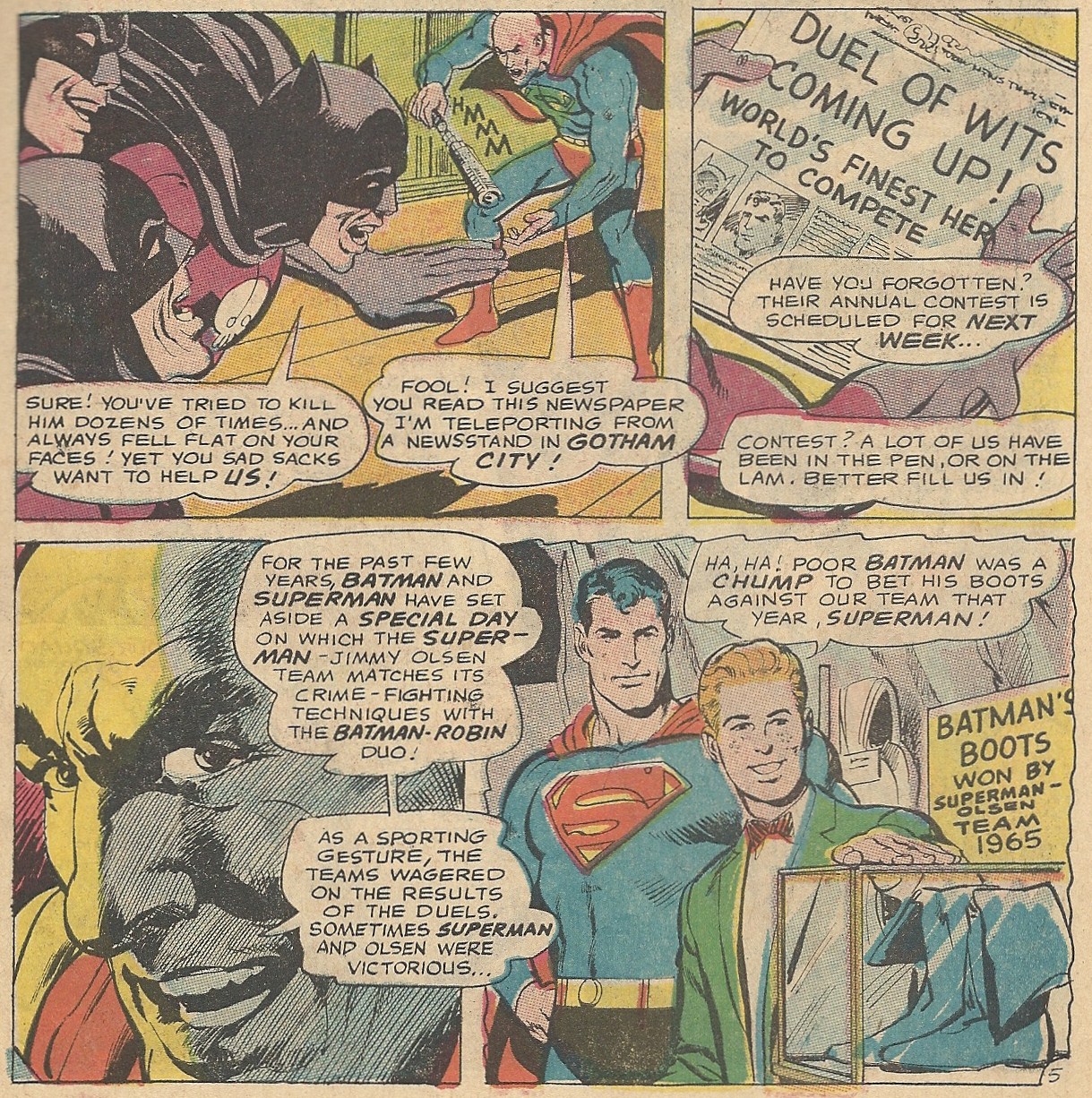
This story, which features the schemes of the Superman and Batman Revenge Squads, is titled — oh so imaginatively — “The Superman-Batman Revenge Squads.” It’s scripted by Leo Dorfman with art from the aformentioned Adams. The Batman Revenge Squad comes together for their first meeting, and they’re barely able to rehearse their motto of “DIE, BATMAN, DIE” before the anti-Superman counterparts bust in. After the introductions are made, the Supes-haters unveil their plan of sabotaging the annual Superman/Batman “Duel of Wits.”
You’ve never heard of this contest? I’ll let the lead villain explain:
Apparently this contest also provides Robin with opportunities to unleash puns that would make Burt Ward proud:
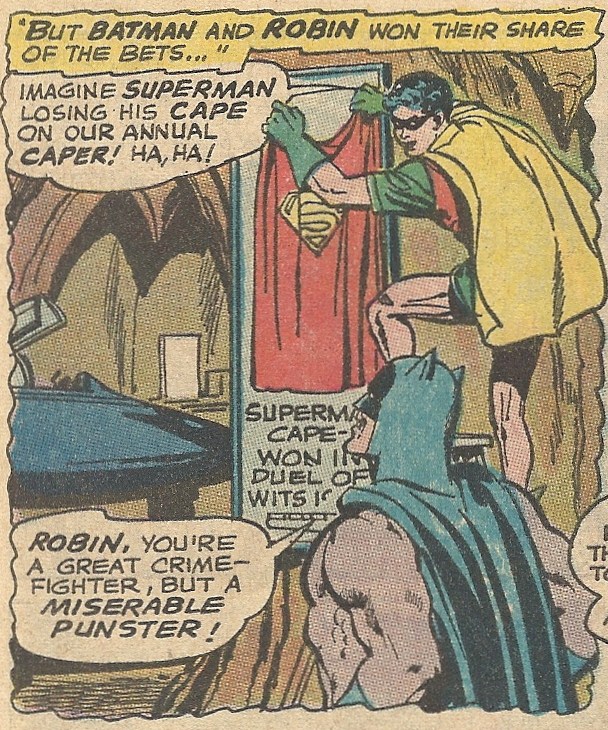
Ugh.
As for the resolution of the story, let’s just say that the ridiculously costumed goons get found out in the end and our heroes bust them up. Fin.
Now let me climb up onto my soapbox for a minute…I find this comic almost offensive in its stupidity. The thought of Batman and Superman taking time out from their busy crime-fighting schedules to engage in some costumed grab ass makes me want to throw up in my mouth. It’s one thing to kick back in your secret identity for a little while — it’s another thing entirely to have public foolishness like this. Maybe if there was some sort of “raising funds for charity” component the hijinks would be more palatable. As it is, it makes me cringe. To put it in current terms, it’s a bit like that British Petroleum exec going off yachting while oil still seeps out into the Gulf of Mexico. Dumb. Irresponsible.
It flies in the face of what I imagine these guys to be all about. Then again, this might be a progenitor of the Elseworlds imprint — maybe this story takes place on “Earth-Stupid” or something.
Most of the time I can roll with the punches when it comes to Silver Age silliness. Not this time. For some reason this one got my blood pressure up. I’m the first to criticize more modern comics for taking themselves too seriously, for being a little too wrapped up in their own stuffy self-importance and for, at times, outright drudgery, but at least I don’t see them reverting to this.
And no, it’s not all Neal Adams’ fault.
On a positive note, this issue does feature a reprint of the Martian Manhunter’s first appearance from Detective Comics #225. So it does have that going for it.
One of the fun things about old comics is the advertisements. I know I’m not revealing some big secret by saying (or writing) that, and I know that I’m not alone in oftentimes skimming through an old issue just to see what wares and services were being peddled inside. BB guns, model kits, video games, etc. — they were, and some still are, staples of a boy’s life.
An old standby in comics for many, many years was the muscle ad, and a nigh-limitless variety of muscle-building programs cropped up in book after book after book. But, unfortunately, they’ve all apparently gone the way of the dodo. It’s kind of sad that we no longer have the likes of Charles Atlas and his ilk selling us exercise snake oil like “Dynamic-Tension” and 15-minute-a-day programs that will make you a rugged he-man that girls will want to crawl all over.
The North Star of this genre was the famous Atlas ad featuring beach embrassment resolved by the training regimen of “The World’s Most Perfectly Developed Man” (though I’ve always been curious who bestowed that honor — Good Housekeeping? Consumer Reports?). It was a comic strip in and of itself:

Thank goodness that beanpole got in shape. It would have been awful for him to lose that fickle bitch of a girlfriend.
Another classic comes from Mike Marvel and his patented “Dynaflex Method”:

The over the top puffery in this ad is really something else, but I most appreciate his claim to build muscles sans exercise. Dynaflex must have involved witchcraft. And add “Mike Marvel” to the list of great fake macho names. I guess “Tank Manmusk” would have been too much — maybe I’ll save that one for myself.
My personal favorite ad is one that I sometimes see crop up in comics from the early 70’s. It features a young, carefree version of California’s gap-toothed Governator:

There’s nothing too outlandish about this one, but it’s impossible for me to read that testimonial and not hear the thickly accented English that gave us such unheralded gems as:
“Get to da choppa!” (Predator, 1987)
“Consida dat a divoace!” (Total Recall, 1990)
“SCREWWWWWWWWWWWWWWW YOOOOOOOOOOOOOUUUUUU!!!!!!!!!!!!!” (Ibid.)
Anyway, it seems that if you follow the Weider program — all you scrawny comics-loving geeks — you too can walk around with a bikini-clad broad propped up on your meaty shoulder. Dreams can come true!
The list of ads could go on, but I’ll stop here. And the current lack of these sorts of ads can lead a person to a few conclusions — either the comics-loving public is now filled with hulking Adonises, ads have simply become to0 oriented towards shilling from large generic corporations, or people are no longer gullible enough to shell out money for these lame programs. From the visual evidence I’ve gathered from seeing other geeks (not me, I’m “The World’s Most Perfectly Developed Blogger” — in my own mind, at least) I think I’ll go with one or a combination of the last two.
And one last note — I’ve never seen one of those mail-in coupons clipped out. So maybe people back then weren’t all that gullible, and maybe our loss of these stupidly magnificent things can simply be chalked up to the winds of change.
[11/14/10 Update: If you want to see the Atlas ad incorporated into a story from DC Comics, check out this post.]
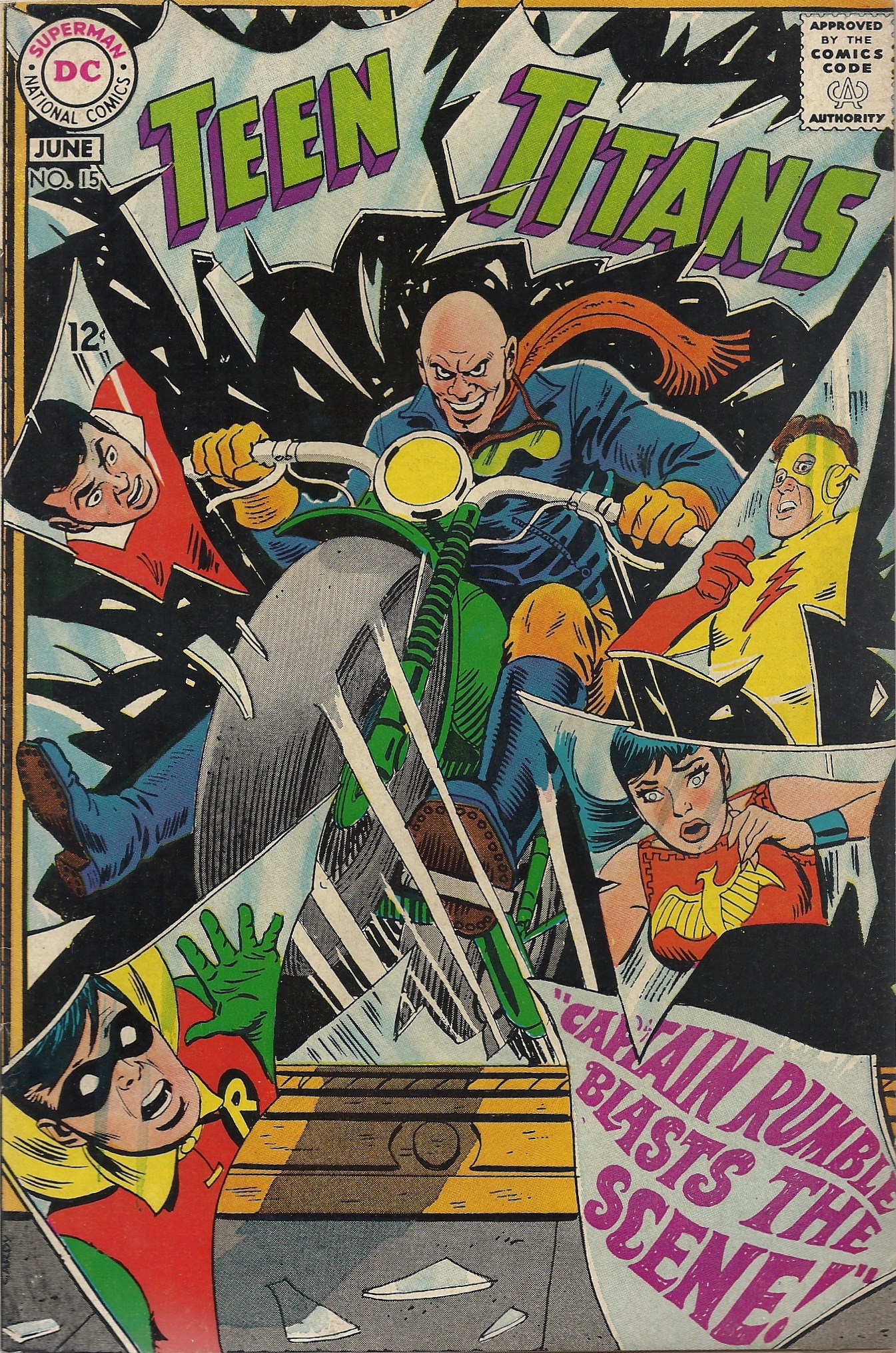
Few series presented as many opportunities as this one for an adult creative staff to pander to a younger audience. Our heroes in this instance are teens, after all — it says so right there in the title! You can almost picture the writers turning a chair around so that they can sit in it backwards, leaning their arms on its back, and saying “Rap with me for a sec, kids.”
This is issue is a prime example of that. And when I say prime, I mean prime.
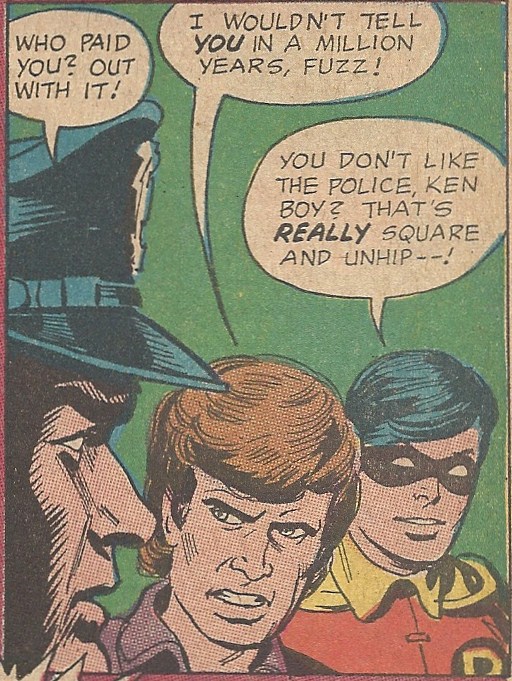
“Captain Rumble Blasts the Scene” was scripted by Bob Haney with pencils from Lee Elias and inks from Nick Cardy (who did the cover as well). All the events in the issue are chronicled by a hairy hipster troubadour (more on him in a second), and we have his running commentary throughout. The Titans make their way to “Hippieville, U.S.A.” (that’s what it says in the comic — I didn’t just make that up) to take in the scene and try to find a runaway named Ken Matthews. Ken is making ends meet as a messenger for some local gangs, and the Titans promptly stumble upon and capture him. This leads to some stiff “groovy” talk from Robin:
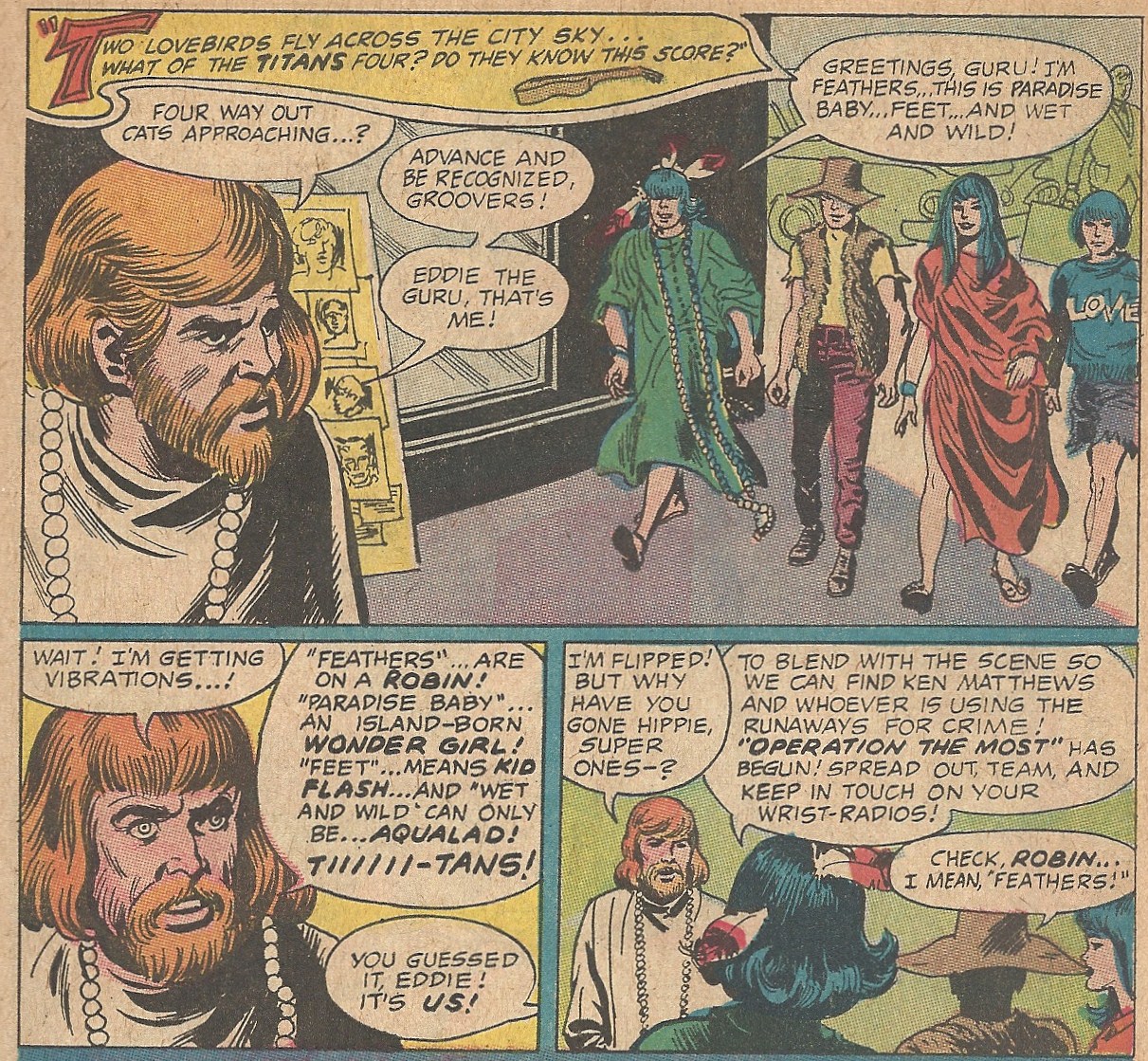
Then the bald motorcycle villain from the cover, Captain Rumble, shows up and he and his gang start terrorizing the hippies — it’s a one-sided showdown between two divergent anti-establishment groups. The Titans break up the fracas but Ken slips away in the confusion. Our heroes realize that Ken is being victimized by a local criminal enterprise and decide to break it up, in the process hopefully killing two birds with one stone. Their bright primary colored costumes will be no help to them in travelling incognito, so they put on disguises and adopt cringe-worthy hippie names:
They find Ken, but he gets away again, this time with his girlfriend, and everybody — Titans, kids, hippies, bikers — winds up in a park. A big brouhaha breaks out and the Titans whip off their god-awful disguises and start kicking ass. The troubadour even gets into the action — he goes all Bluto Blutarsky/El Kabong on Captain Rumble:

The Titans find Ken and he helps them break up the crime ring. Ken decides that he’s not cut out for the non-square life and has a reunion with his folks, and the Titans get in some final unhip hip-talk to end the issue:

This is one of those issues that I just roll my eyes at, but kind of in a good way. I wasn’t alive when flower power swept the land, so I guess it’s not my place to judge whether the dialogue rings true, but it sounds so forced and clunky to me. And I certainly won’t begrudge creators an attempt to connect with their readers, but I can’t picture a kid picking up this book and thinking “Hey, these guys get me! They get my generation!”
It’s still an enjoyable read. I think it fails to form any sort of connection to a younger audience (a younger audience of the time), but its profound failure is what entertains me. I’ll add it to the “so bad it’s good” pile.
“Operation the Most” indeed.
Just a random Captain America cover for the Fourth – Captain America and the Falcon #174

Hey, is that Cobra Commander back there?
Well, it’s not, but it sure looks like him.
I hope everyone has a nice holiday. Enjoy the fireworks.

I think the old Classics Illustrateds are kind of neat, but the labyrinth of different versions and reprints of every single issue is extremely daunting, and I’m never quite sure if I’m over- or underpaying when I buy one. I’d always held off on picking any up for those very reasons (though, honestly, there are proportionately few that are at all expensive), but I was unable to resist when confronted with this adaptation of my favorite Dickens book.
I won’t get into any review of David Copperfield. I read it for the first time five or six years ago, and it’s one of those books that you miss when you finally put it down, a feeling like you get when an old cherished friend leaves after a too-short visit. The eponymous David is your companion for a good long while (this is no quickie read) and you live his life right beside him, along the way encountering a diverse assemblage of characters that run the gamut from endearing to revolting (the former including Mr. Barkis, whose famous quote I appropriated for this post’s title).
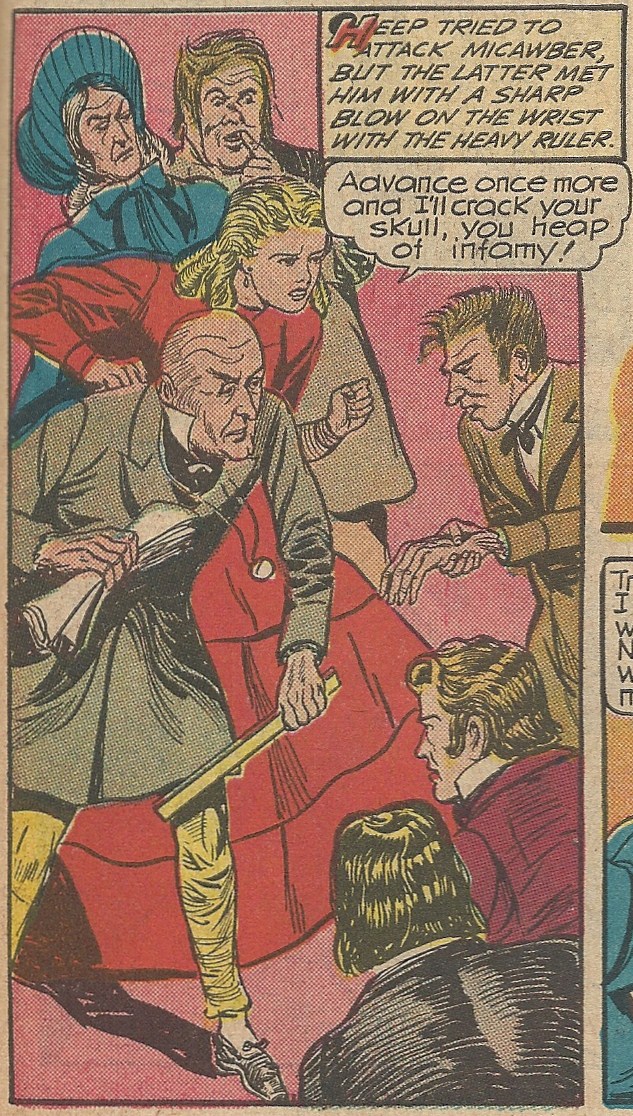
The sheer length of the book means that any comic version is going to have to rocket over the plot’s events and encompass entire chapters in a panel or two. That’s not as much of a problem as it sounds — the chief pleasure from something like this isn’t getting a beat by beat replay of an already told tale, but instead getting the highlights fed back to you. The art may be a little crude (at least in this comic, things might be different in other Classics), but it’s still a hoot to relive certain scenes. For an example, here’s a panel that gives us one of the most memorable moments from the original, the climax of much of the story’s tension, with the always-threatened-with-penury Mr. Micawber meting out some sweet justice to the vile, cloying and not really ‘umble Uriah Heep:
I’ve taken two things away from my purchase of this comic. First, I’ll be more willing in the future to not worry about the multiple versions of each issue and pick up these books when they’re cheap and in good shape. I certainly have nothing to lose. And second, the name “David Copperfield” is now even further distanced from fruity illusions. For that, I am very, very grateful.
All the hullabaloo over the new Wonder Woman costume and origin reminded me of a funny segment from a great Comedy Central show from a little over a decade ago, Dr. Katz. For any of you unfamiliar with this cartoon, it chronicles the fictional life of Jonathan Katz, a psychotherapist whose celebrity (mainly comedian) clients come into his office and confess their troubles. It’s hilarious, and for any of you who’ve never seen it, it’s worth a look.
When Dave Chappelle was a patient on the good doctor’s couch he had a few chuckle-worthy things to say, and one of his observations dealt with WW and her costume (and a few other DC icons get roasted, too):
He also did a funny routine earlier in the episode about the old Bill Bixby Hulk series, but I couldn’t find a sample of that on the web.
I can’t say that I disagree with him, but the horny hormone-riddled 14-year-old that still lurks somewhere inside of me will miss Diana’s long bare gams.
A few weeks ago I featured a Spider-Man giveaway that dealt with the depressing topic of child abuse. Just in case anyone is still down in the dumps about that one, I thought that it might be wise to look at a one-off handout that contains less glum subject matter. So, voila:
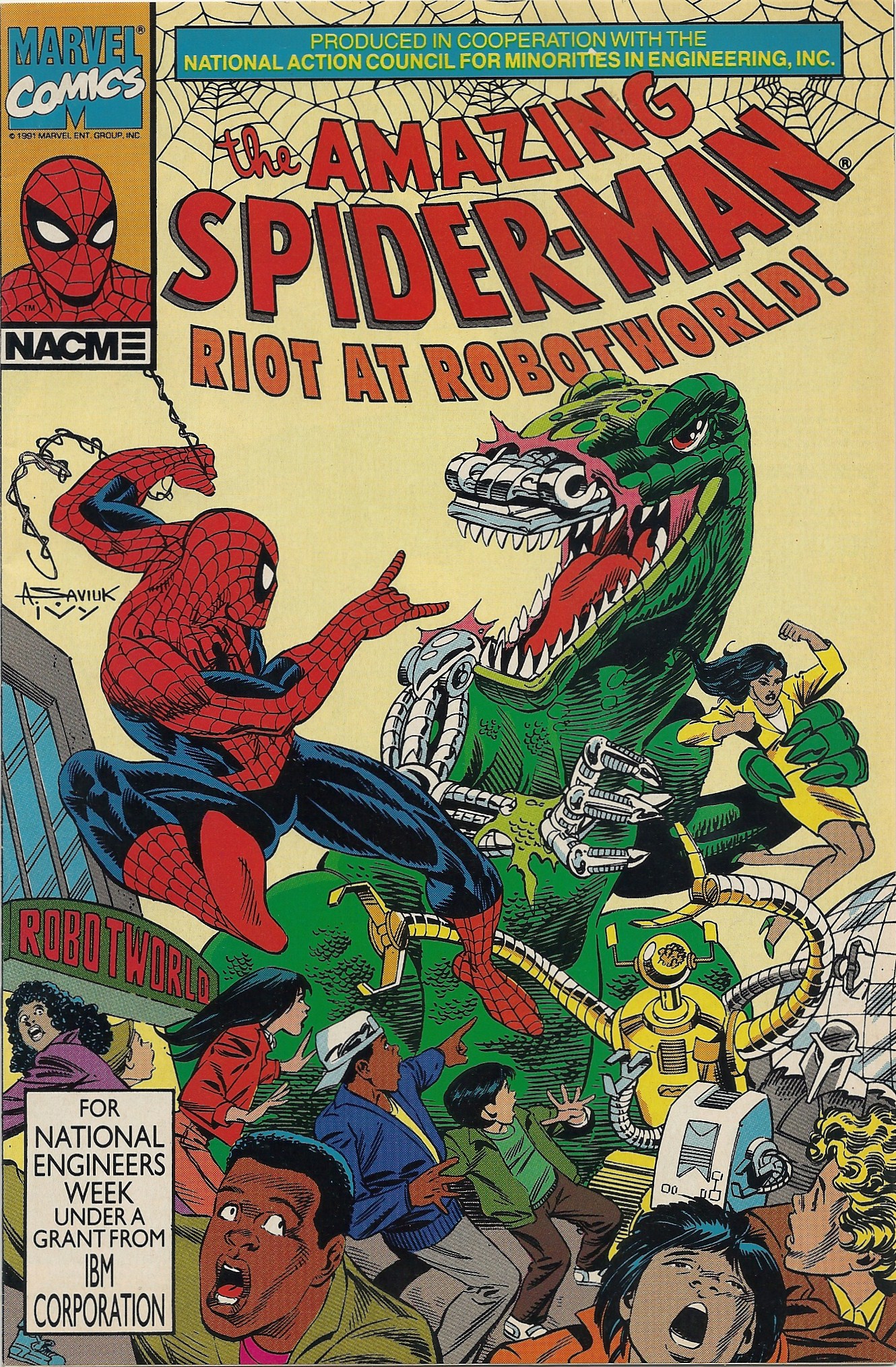
Dwayne McDuffie and Alex Saviuk give us this tale, sponsored by the National Action Council for Minorities in Engineering, Inc., or NACME to its friends. Spider-Man schleps over to the new Epcot Center-y Robotworld so that he can cover its grand opening in his Peter Parker guise. There he’s met by Ana Lopez, a lusty looking latina who’ll serve as his guide:
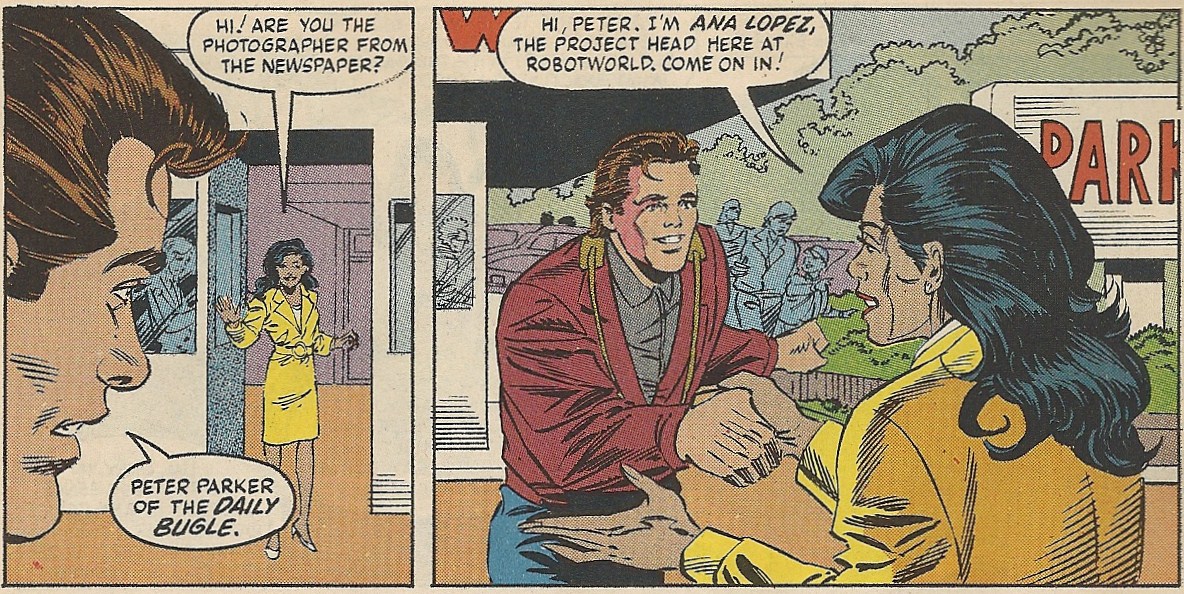
There’s also group of kids that will be accompanying them, an assemblage (not surprisingly) free of any apparent European ancestry:

Off they go, and they’re shown displays of some mind-numbingly boring robots. Soon these inert exhibits come alive and start rampaging about the complex:
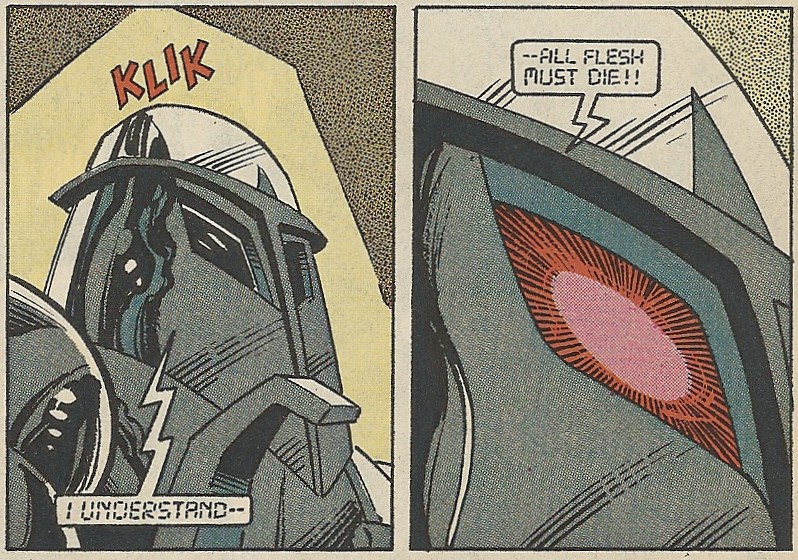
Spidey springs into action as Ana and the kids run off, and in their flight this ad hoc Minority Brigade stumbles across the culprit behind this mechanized mayhem:
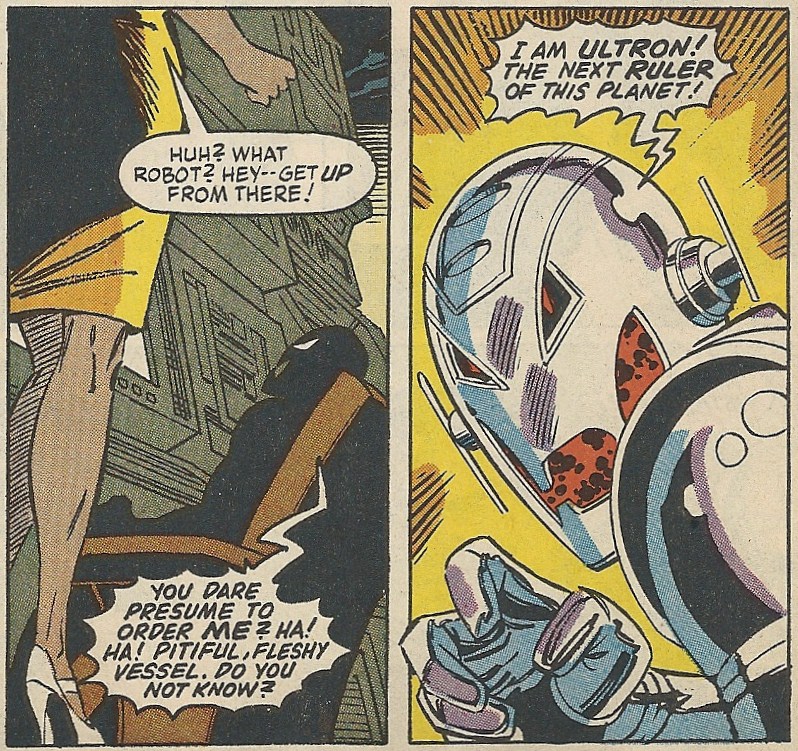
Ultron brings out some familiar faces to fight Spider-Man and flirt with copyright infringement:
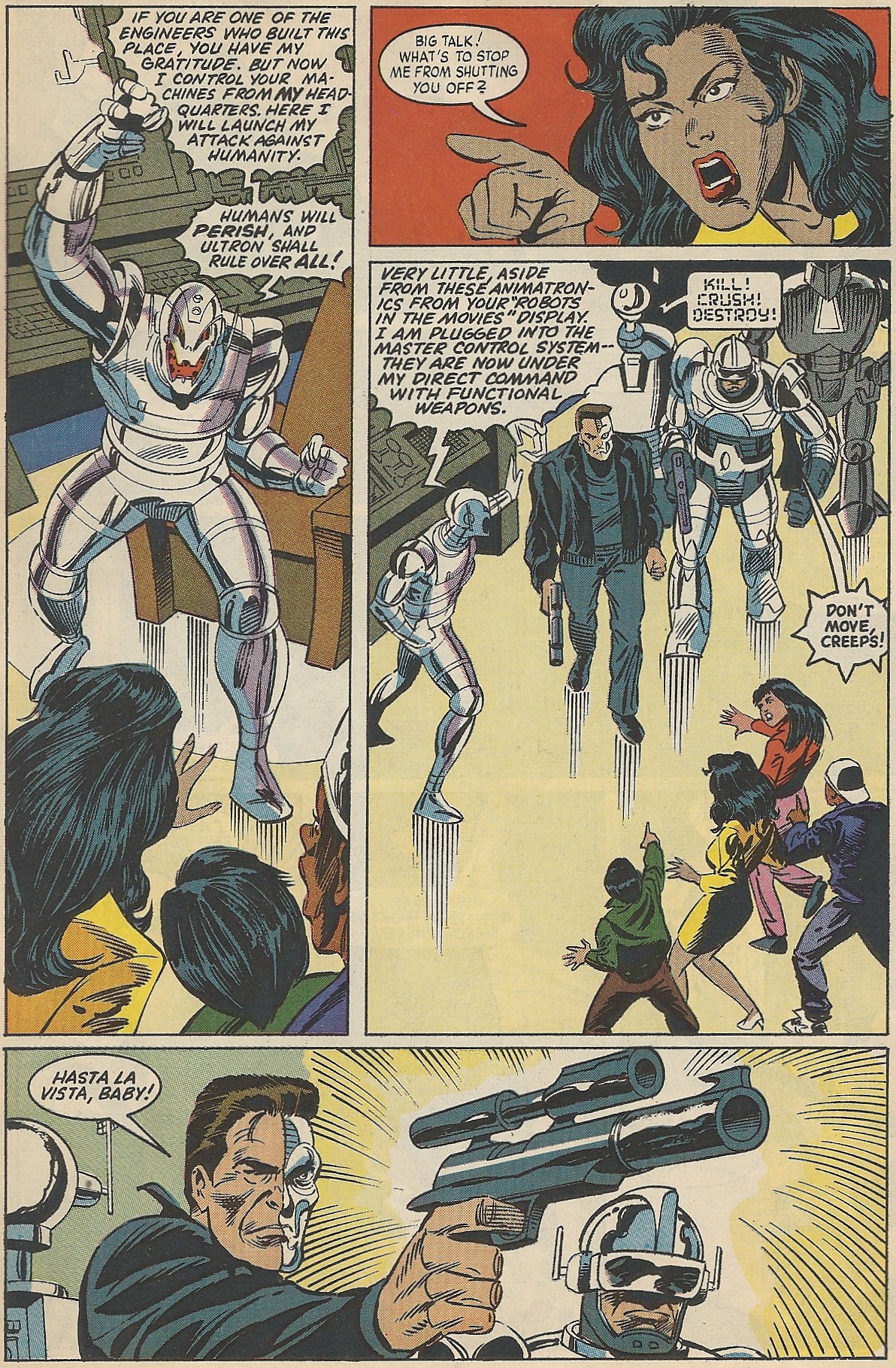
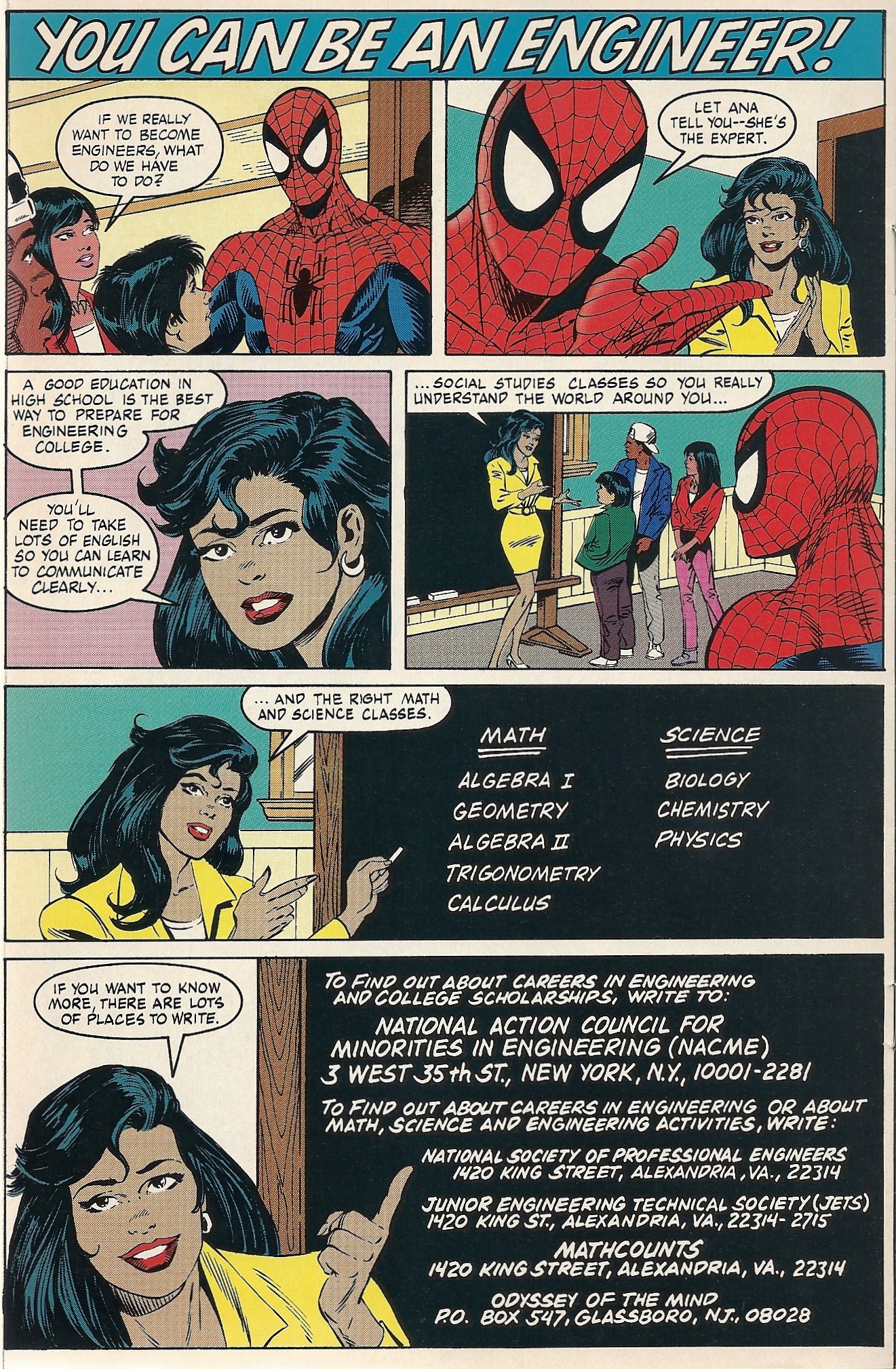
Eventually Ana and her brat pack finagle a way to shut down both the robots and Ultron by remote control, and on the final page we get Ana’s “timeshare hard sell” routine about how to become an engineer:
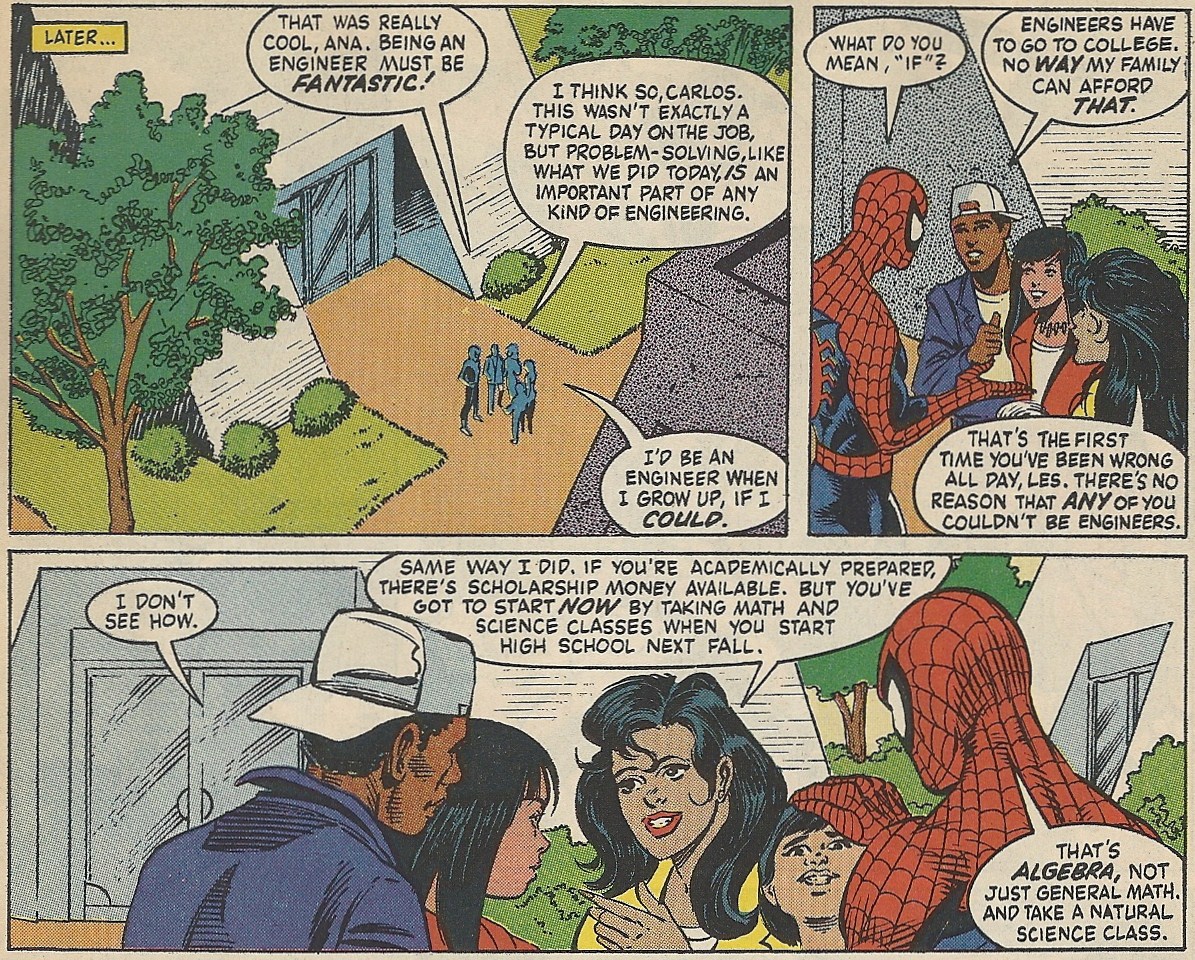
And there you have it. It’s a short, silly little issue, but it’s a relief after that previous plunge into the dark world of kids getting slapped around. Have a good one!
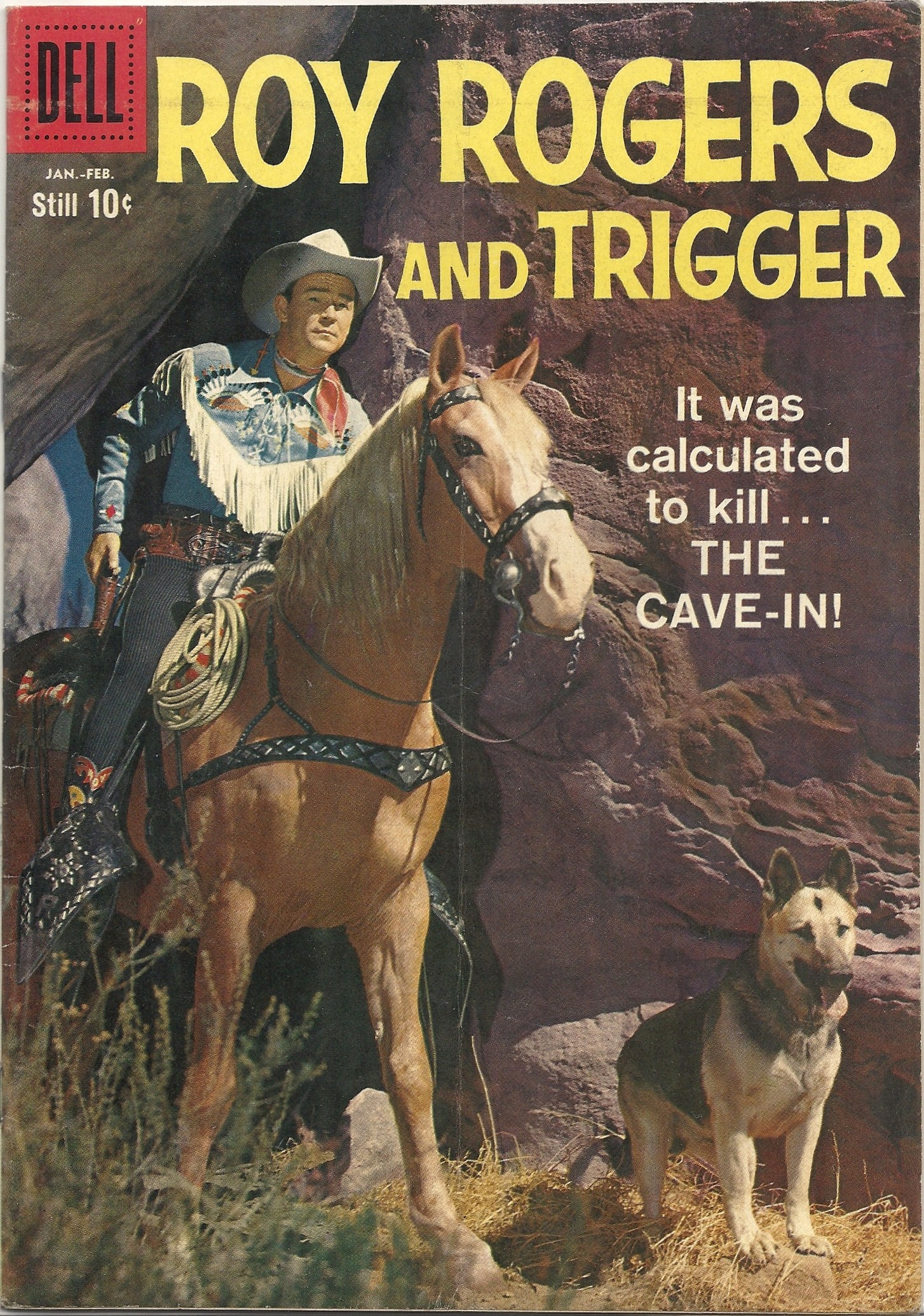
I’m out of my depth here, folks. Out of my depth and the undertow is dragging me out to sea. I know absolutely nothing about Roy Rogers apart from the occasional neon-sign in a mall foodcourt. I couldn’t tell him apart from any of the old cowboy actors like Gene Autry, and the only thing separating him from the Lone Ranger in my mind is a little mask.
But I’m always looking to broaden my horizons, so that’s why I pulled this one out of the stacks.
It actually brought back some memories for me, even though Roy had disappeared from screens well before I was born. When I was really little I had a rocking horse, not one that wobbled like a rocking chair, but one that was framed on some springs. I used to ride that thing like you wouldn’t believe, like I was chasing some outlaw across the plains, and I can remember how my hands would sometimes slip on the handles and my head would rap off the horse’s solid plastic mane.
Ouch.
You may wonder what the hell this has to do with anything. Well, I’ll tell you. You want to know what that rocking horse’s name was?
Trigger.
Now, I doubt that I pulled that name out of the air. It was probably my father who named it, an even more likely scenario in light of his having grown up in Rogers’ hayday.
So I guess there’s a little cross-generational connection going on here which I kind of dig. Honestly, I hadn’t thought about that rocking horse in years, and if I hadn’t seen this comic that memory might have slipped into a hazy area where remembrances go, never to be recalled again. And since it’s Trigger that’s the bridge between Roy and me, let’s have a look at a brief four page Trigger story from this issue.
“Unheeded Warning” finds the son of a friend of Roy’s visiting the Roy Rogers Ranch. The visitor, Roland, wants to go out for a ride and demands to ride Trigger. Chico, a young stableboy, reluctantly agrees and goes with him, though he soon discovers that Roland is quite a prick:
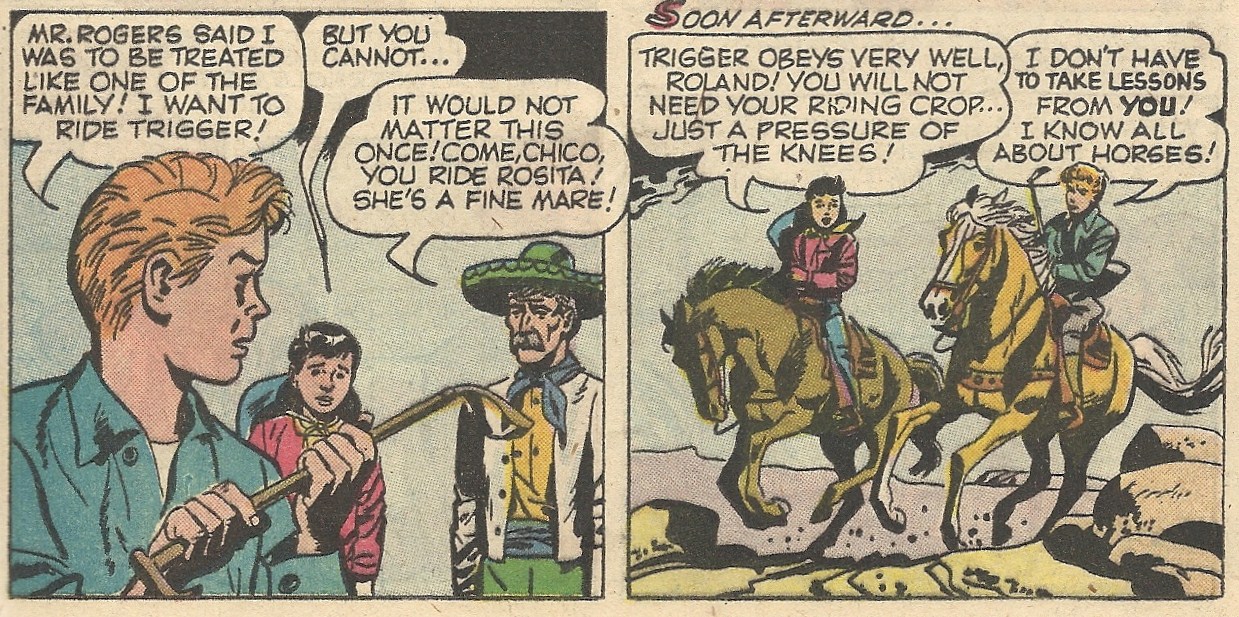
Roland soon breaks out the crop and Trigger quickly puts some distance between them and Chico. Roland works up a thirst wailing on the poor palomino:

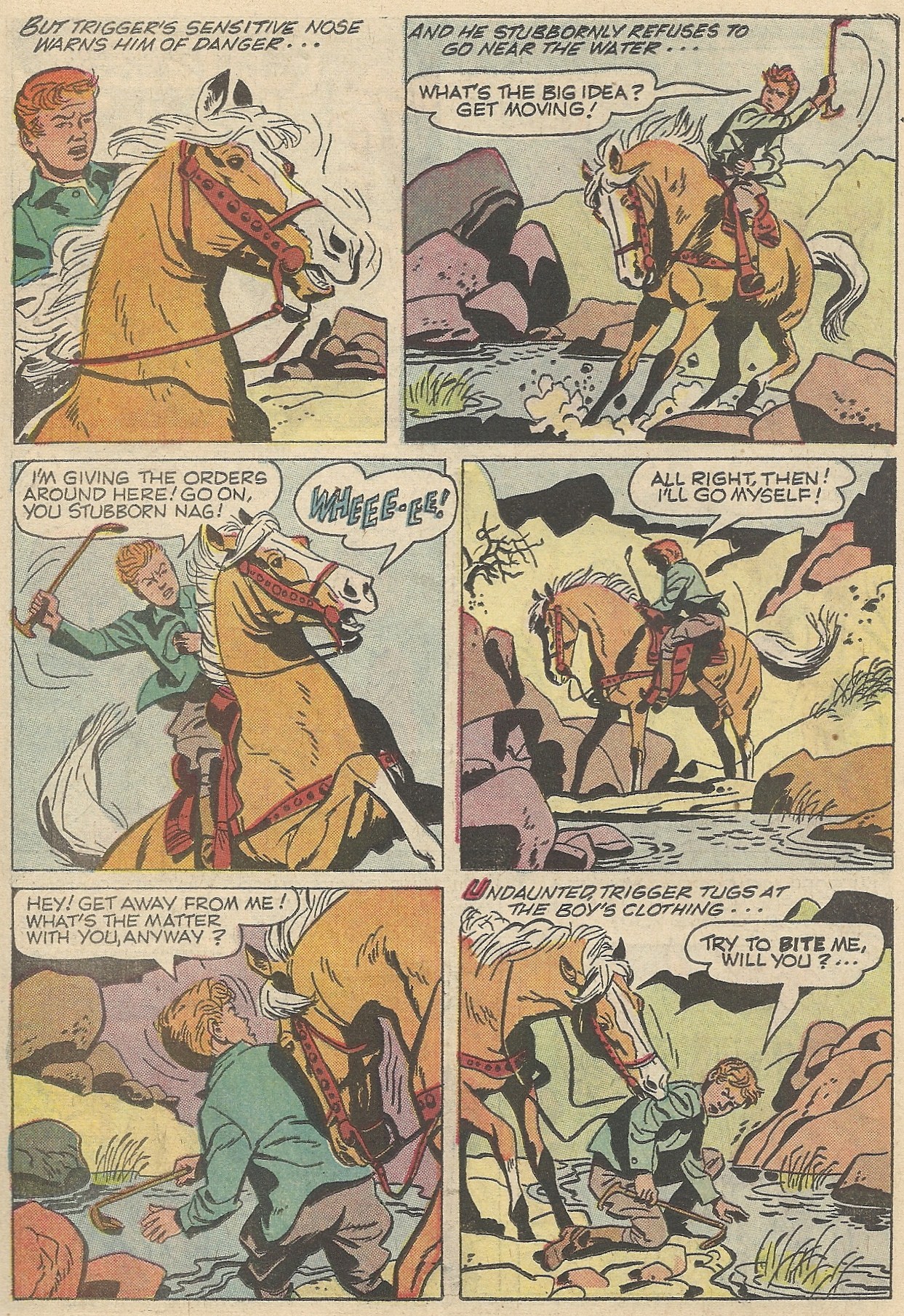
Trigger balks at taking a drink and tries to prevent Roland from having one, which prompts the brat to a new round of lashing:
Finally Chico shows up and explains Trigger’s behavior — the water’s polluted:
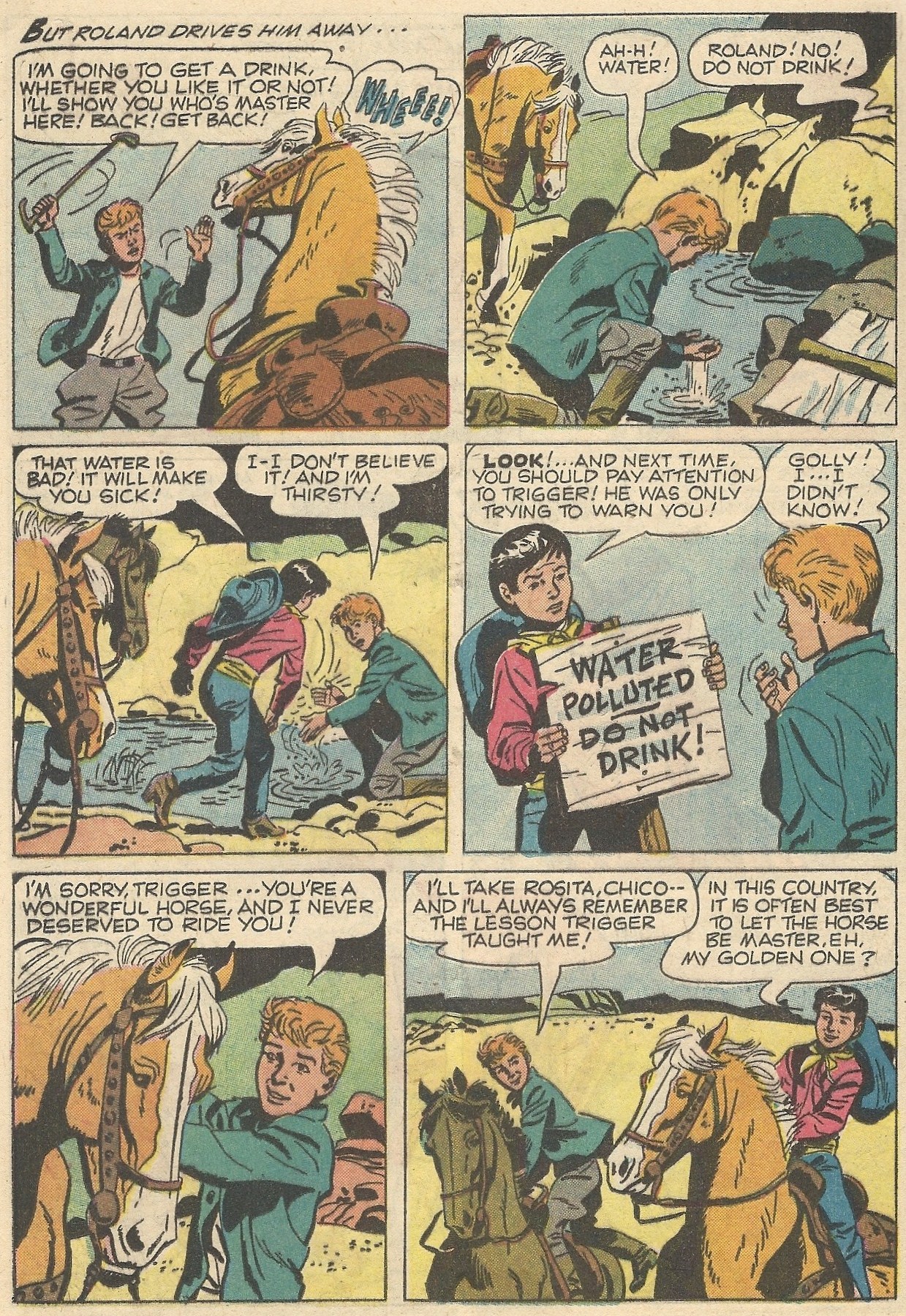
Lesson learned, though if I had been in Trigger’s horseshoes I would have let the little bastard take a real deep draft from the Superfund water.
A nice little story, though I wish I could find rome reliable information about the creative team. I know that Gaylord DuBois was the scripter on many a Roy Rogers tale, but the artist remains a complete mystery to me. Maybe I’m looking in the wrong places. It’s a shame, because I like the artist’s work — the deep shadows on the rocks near the watering hole add a lot of texture to the sere scenery. If anyone has any idea who these folks might be, please feel free to chime in.

As can be guessed by the cover, there are a pair of stories in this issue. Since the Luke Cage installment is the goofy gem of the two, let’s get the Iron Fist half out of the way nice and quick. In “Death Scream of the Warhawk,” written by Mike Barr with pencils from both Rudy Nebres and Frank Miller, Fist tracks down and beats the hell out of a sniper. The only element that makes this story stand out is Frank Miller handling a couple pages of the artwork — action beats, of course:

Enough of that. Now for the main event.
In “The Vampire Strikes Back,” written by Mary Jo Duffy with pencils from Mark Bright, Power Man goes up against a, you guessed it, low-rent Dracula. Cage and his film-buff friend, the presciently named D.W. Griffith, are on their way home after watching a vampire movie when a real one attacks them. What a coincidence. The rather fay looking vampire (most are, though) tries to bite Cage’s neck and gets a rude dental surprise when he finds that he can’t break through the nigh-impenetrable skin. He gets thrown off but uses some of his powers to subdue and rather awkwardly mount our hero:

D.W. saves Cage by forming a makeshift cross, but the vampire puts the hex on the vulnerable human and decides to get a meal from this easier source. In the process he forgets about Cage, who springs into action when his own trance wears off. This all sets up the delightful final page:

Three things. First, Cage punches out the vamp’s teeth. Next, he and D.W. use some stinky garlic bread to finally defeat this bumbling but persistent foe. And, finally, Cage gets a dig in at everyone’s favorite geographic punching bag, New Jersey.
Wonderful.
My only regret is that neither “jive turkey vampire” nor “super-honky” found their way into this script.
Chillaxin’ in the Marvel U. – Sub-Mariner #31

It’s pages like this that made Marvel so much fun in its prime. You have Triton just showing up at the Fantastic Four’s pad, where the ever-lovin’ Thing is kicking back, eating chocolates, almost caving in the couch, and watching Laugh-In. I’ll be in a similar situation the next couple of days, only I’ll be watching ballgames.
When you open up a comic and that first page greets you, how could you not buy it?
And on that note, have a nice weekend.
I think everyone who has read comics in their life, and more importantly in their youth, latches onto certain artists as forever defining what iconic characters and their supporting casts should look like. Sometimes the artists are superstars — how many people still associate Jim Lee with the X-Men? — and other times they’re much lesser known.
As I’ve stated before on this blog (ad nauseum, I’m sure, even though this thing has only been going for a few months) I grew up in the 80’s. That means, of the two big DC icons, I caught the tail end of Curt Swan’s run on Superman and the latter days of Jim Aparo’s work on the Batman books. Their versions of those characters are imprinted on my brain like a mother hen’s face onto a baby chick’s. If I live to be a 100 years old they’ll define what those guys should look like, and no matter how wonderful other artists may be, they just won’t be able to compare.
Well, that’s not entirely true.
I caught Bat-fever in 1989 like the rest of the world. Tim Burton’s film was a mega-hit, and it led me back to comics after a hiatus of some time. But when I picked up a few issues of Detective Comics in that year, it wasn’t Aparo’s work that greeted me — instead it was Norm Breyfogle’s. And you know what? He’s a close second to Aparo for me. So I hope you’ll bear with me as I take a look at a couple of the issues that he handled, because I really like the guys art on the Bat-titles and wish he was remembered a bit more fondly.
I wrestled with what books to tackle. I thought about doing the “Mud Pack” arc with all the Clayfaces from Detective #604-#607, but through sheer laziness I decided to delve into the subsequent two-parter, written by Alan Grant and featuring the introduction of Anarky. Here are the covers:

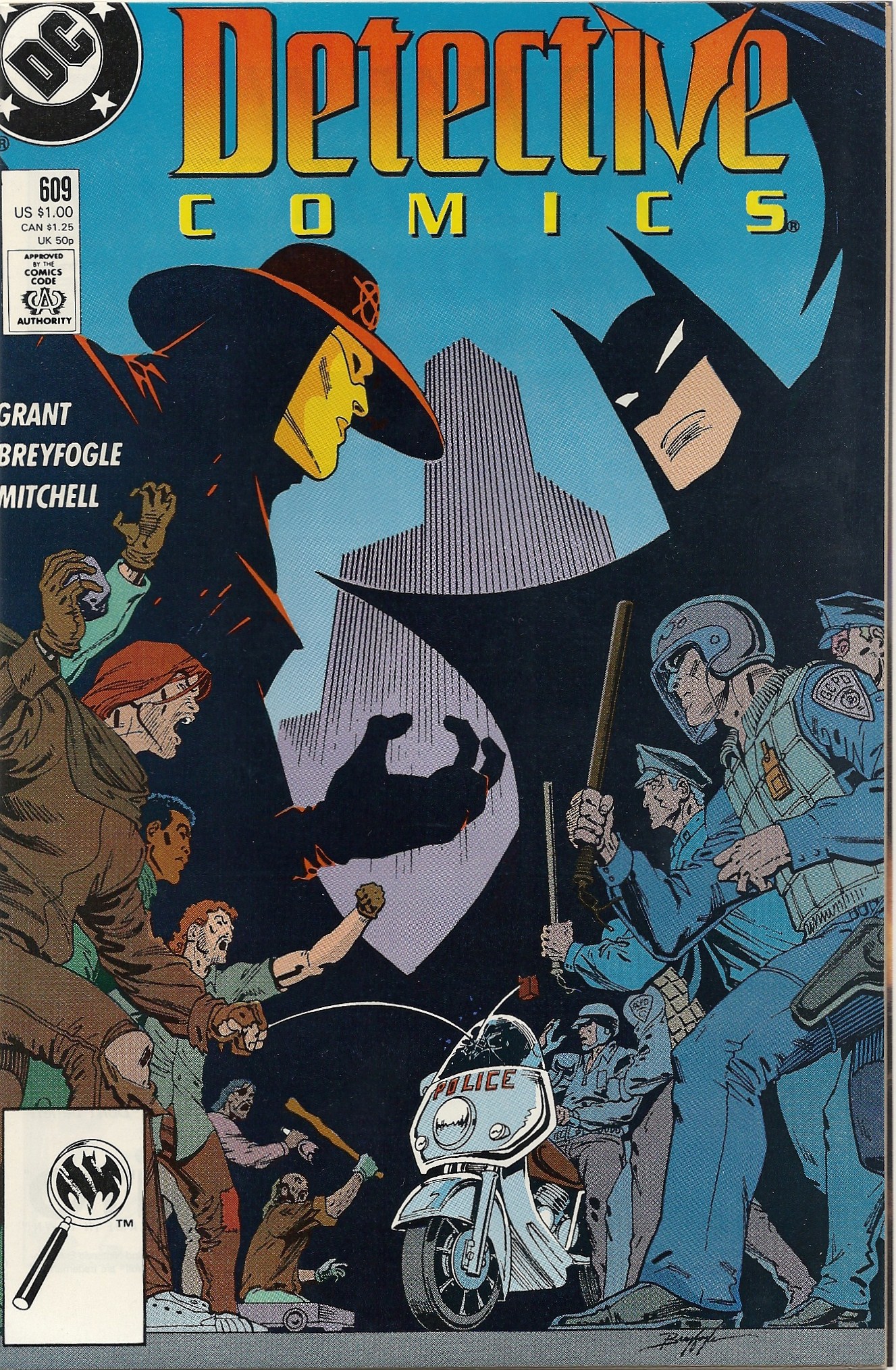
Breyfogle was always wonderful in his use (and sometimes intentional overuse) of perspective, as well as giving Bats a two-dimensionality (if that’s an actual phrase), and I think those covers show a bit of those two facets of his work.
The first issue gives us Batman busting some skulls and introduces Anarky in all his Guy Fawkes-evoking gold mask glory. We first get to know our red-garbed vigilante in this nicely constructed sequence — I never realized that the panels were arranged in an “A”, his Zorro-esque calling card, until I was readying this post:

And just so you know, the secret of the universe is that “The common man is always right.” Glad to know that we humans finally have that figured out, though a lot of philosophers are going to be out of work.
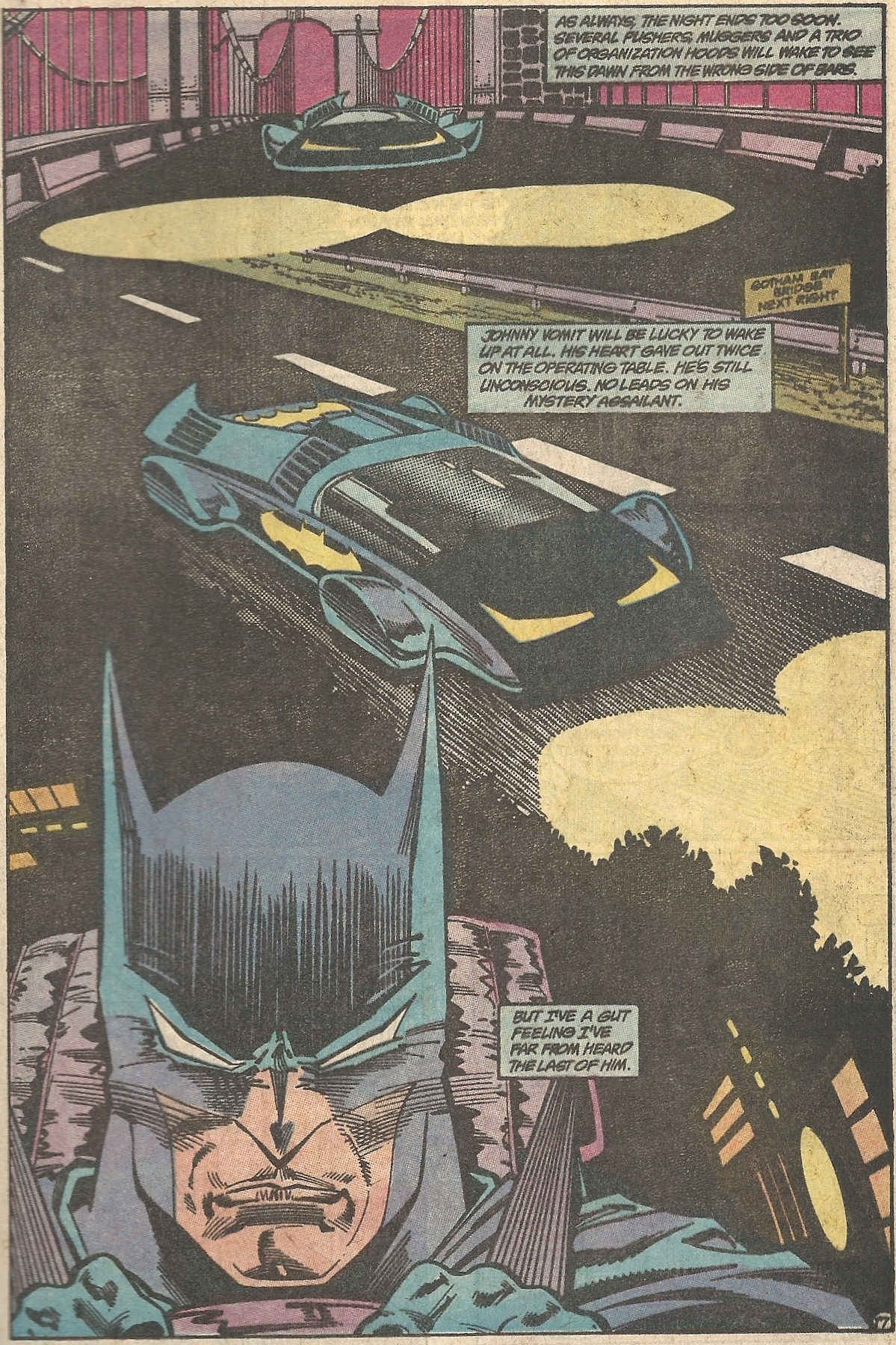
Anarky confronts a drug-dealing punk rocker and uses his weapon of choice, a long staff with a taser on the end, to electrocute the guy (his other weapons are a red can of spray paint for his “A” graffiti and his limitless loquacity). This crime gets the attention of the Caped Crusader, and he ruminates on the situation in this full-page spread (and check out Breyfogle’s sleek Batmobile design):
In this issue we’re also introduced to a Gothamite nuclear family (mother, father, son), the Machins, and we’re led to believe that the tech-savvy Dad may be the man behind the golden mask.
In the second issue Anarky’s rabble rousing is getting out of hand, and Batman is out to put a stop to it. This leads, of course, to fisticuffs:

Batman senses that something is off:
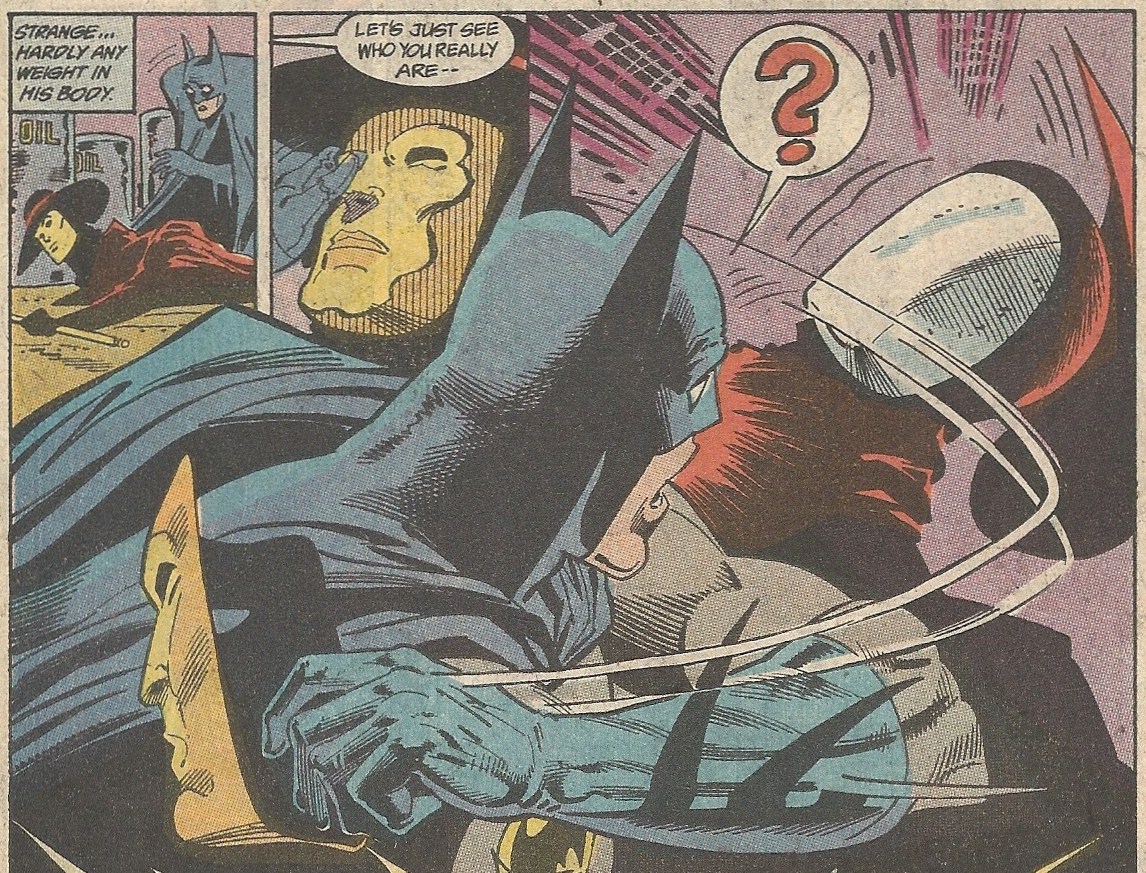
Anarky uses his taser on Batman and beats cheeks out of there. Remember the tech-savvy Dad? Batman tracks Anarky back to the Dad’s office building. Dad (named Mike, by the way), not in costume, tries to confess that he’s the baddie, but Bats isn’t having any of it. He throws open a closet and finds a beaten and unmasked Anarky, who is actually the son (Lonnie) of the elder Machin. Dad had discovered his son’s doings and was just trying to cover for him. The kid is a smart prodigy, and like Batman was trying to fight crime outside of the law. Batman still turns him in despite their common vigilantism, and has a debate with Comissioner Gordon about the merits of Anarky’s deeds:

D’oh! I like Batman’s association of Anarky with Jason Todd — that wound was still fresh at the time of this story, and from my research I gather that there was some thought amongst the editorial staff of making Lonnie/Anarky the new Robin.
I’m not sure if this post has fully conveyed the merits that I find in Breyfogle’s art. I don’t think that it has, mainly since the imprinted preferences of youth are, as I stated above, very much a personal affair. Still, I think the gothic, dreamscape-like qualities of Breyfogle’s pencils meshed very well with Batman and his nighttime exploits. And the design of Anarky was sleek and just a little bit creepy (dark, empty, hollow eyes) — maybe a little to V for Vendetta-y to be classed as original, but still a visually pleasing creation.
And a little epilogue on Anarky… I was surprised by the length of the Wikipedia entry on the character. For a relatively minor Batman villain it was a bit long, and I have to credit that to a lot of subsections crafted by actual anarchists wanting to glom their ideology onto a comic book character. You know anarchists, right? They’re the people who, instead of wanting us to be stifled under the yoke of other people’s laws, smother us under the pompous verbosity of other people’s (theirs) opinions. They annoy me. I may get dynamite thrown through my window for saying that, or at least a Molotov cocktail. Oh well. At least I won’t have to listen to their pretentious bull$#!+ anymore.
And if you are an anarchist reading this, I’m just having some fun with you. All are welcome here! And Breyfogle’s cool, right? Can we at least agree on that?
Go ahead and call me a lecherous male chauvinist, cause I ain’t lookin’ at the snakes – Supergirl #8
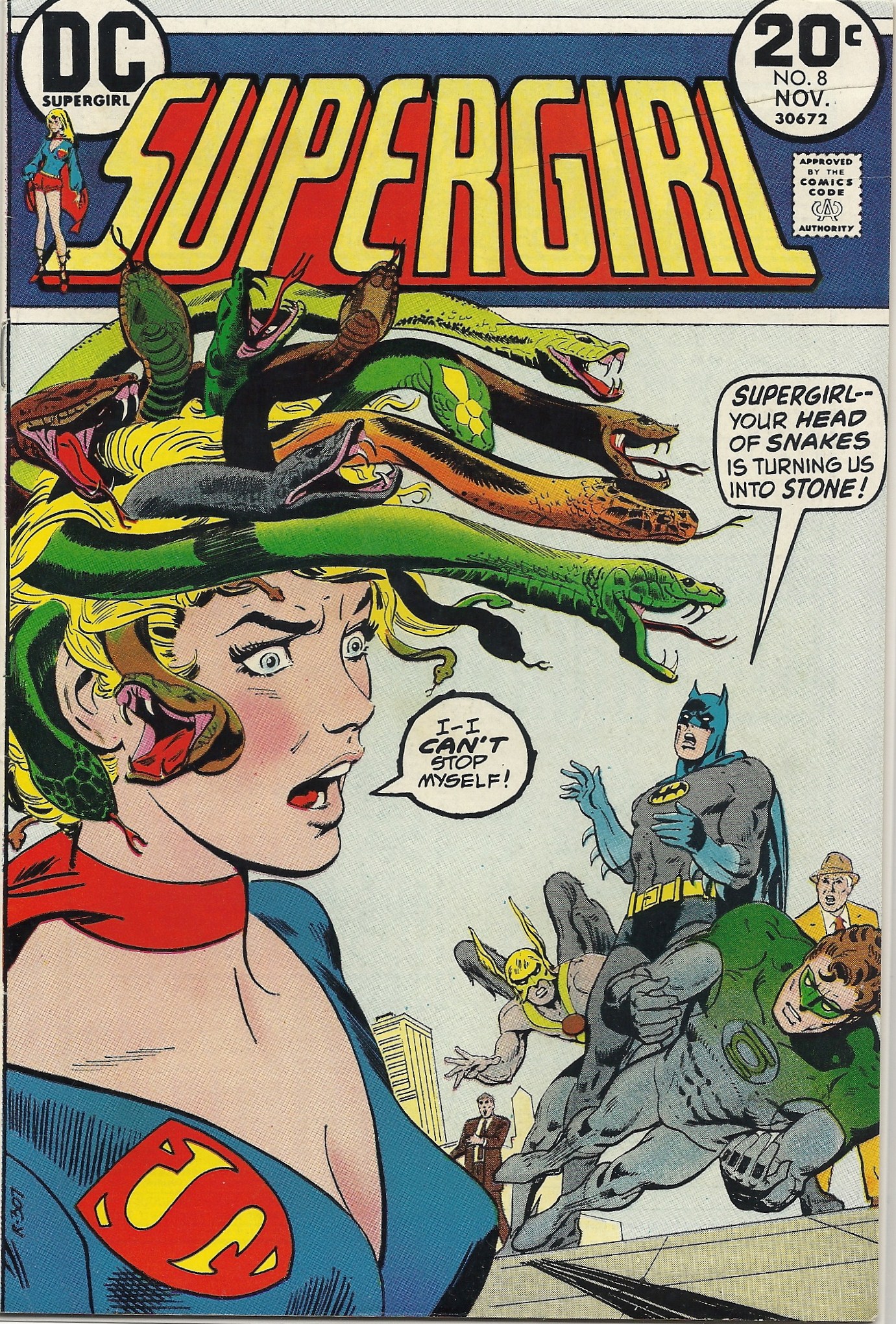
Two things drew my eye to this cover. The second was Supergirl’s head of snakes — usually I think of a Medusa-like hairdo as having one kind and one color of snake. Just an observation. The first thing that drew my eye was, well, I’ll give you two guesses.
I feel like a pig. Fine, I am a pig. Let’s move on.
The story inside (“A Head-Full of Snakes” from Cary Bates and the appropriately named Art Saaf) is typical fluffy Supergirl fare and can be summed up in a few lines. Kara first gets a Medusa-curse thrown onto her and then the Justice League tries to help:

Reading the word “crisis” coming out of her mouth almost brings a tear to my eye.
She resists the League’s attempts to help her and they’re all accidentally turned to stone — so much for the airtight protection afforded by a cape/headscarf. Supergirl learns where Medusa’s body is entombed and goes there to put an end to this hex. On the way she’s intercepted by her friend Mitch, who has in turn been possessed by the spirit of Perseus:
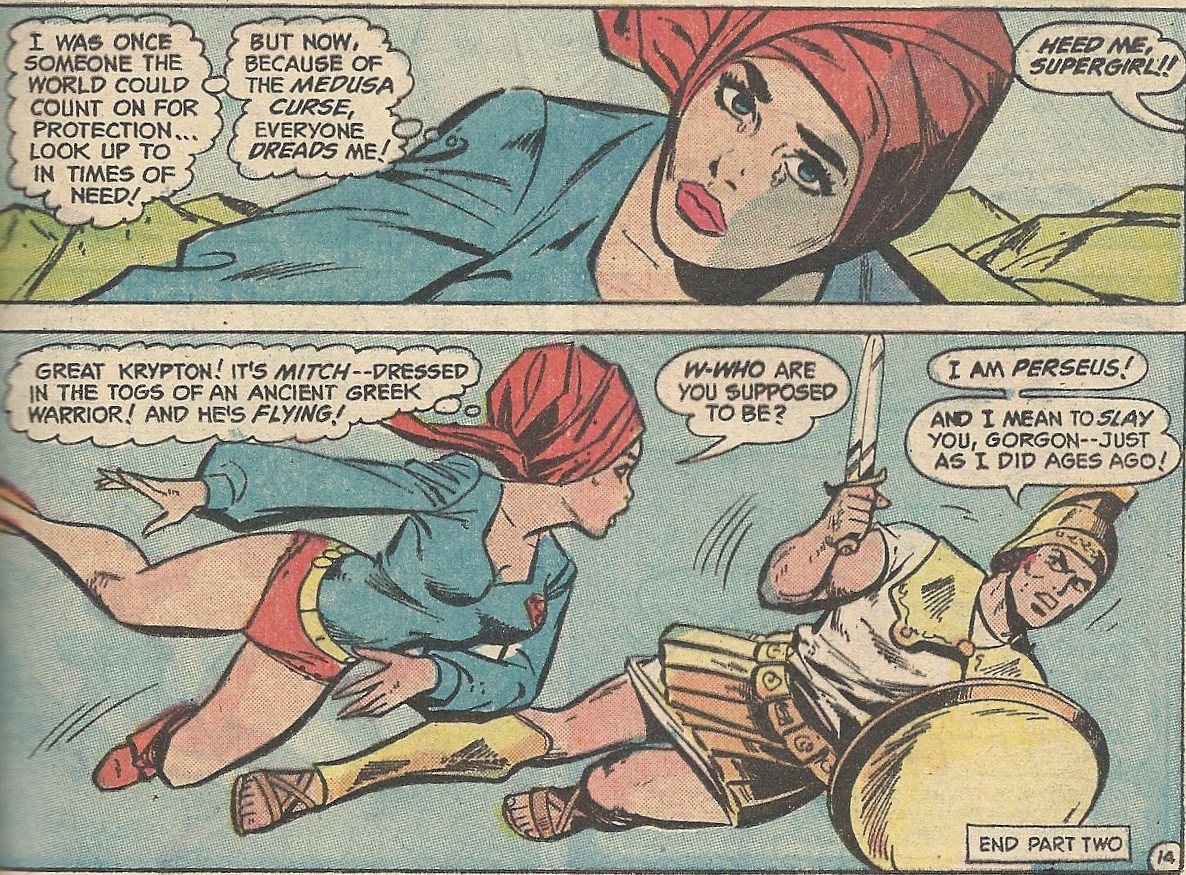
They fight, Perseus tries the old shield-mirror trick, but both of them realize that they’re on the same side and combine to find and defeat Medusa herself. Kara’s golden locks return to normal, Mitch goes back to his old self, and presumably the League and the other petrified souls return to life.
On the whole this is a rather vapid effort and does nothing towards dispelling the perception that Supergirl is just a watered down version of her cousin. To be fair, Superman’s stories from this era often had more than their share of silliness, but at least they had the status of the world’s foremost hero to help buoy them.
Just as an FYI, the outfit Kara sports here is actually my preferred Supergirl costume (though the one with the headband and the symbol that melds with the cape that she had around the Crisis had its sassy merits), and God knows she’s had enough of them over the years. The “S” logo off to the side with its opportunities for a plunging neckline and the kicky scarf effect with the cape are both unique and quite appealing. They make this attire at once sexier than her early matronly garb and somehow more dignified than her contemporary form-fitting and bust-hugging threads.
See, I’m not that much of a pig.
Knock yon braggart’s block off! – The Mighty Thor #126
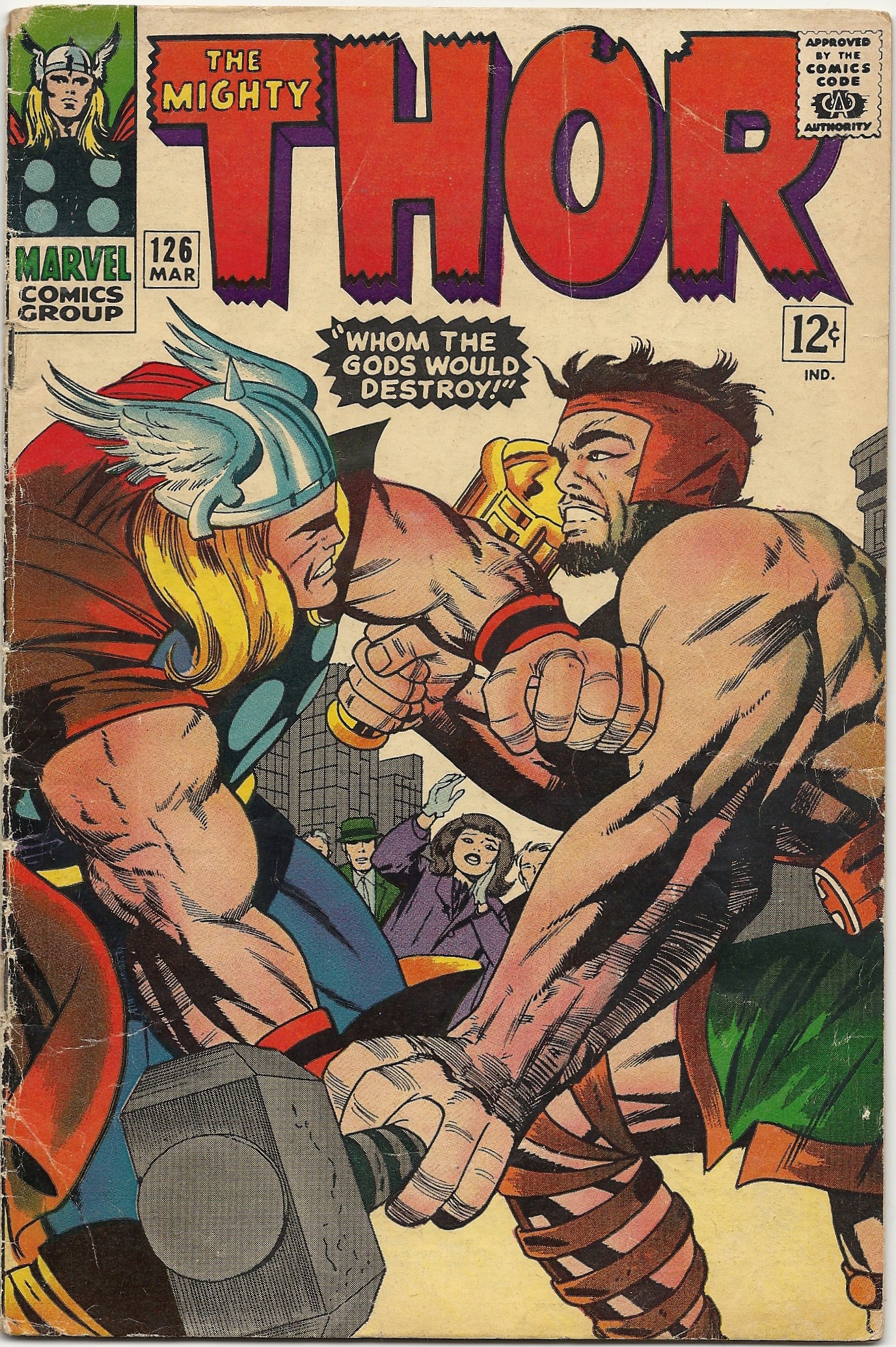
When I first started buying older comics a couple of years ago this was one of the first books that I picked up. At that point I had no knowledge base upon which to evaluate condition, hence the rather tattered status of this copy. But quality control’s loss is my blog’s gain, so let’s have at this fantastic story.
“Whom the Gods Would Destroy” was crafted by Stan Lee and Jack Kirby, and this one issue (the first in which Thor shucked off his Journey into Mystery heading) may very well be tops amongst their many collaborations. Honestly, I could read stories like this until the end of my days. Lee’s take on Thor-speak was never more entertaining than it is here, and Kirby’s muscular action style had well-suited combatants in Thor and Hercules.
The basic setup for this story is jealousy, as Thor sees Jane Foster cavorting with the Olympian and, like males of every species since the beginnings of sexes, they fight it out to determine who’s the alpha. While this is going on, Odin is, for the umpteenth time, upset about Thor defying his will and is fulminating most magnificently in Asgard.
But who cares about all that? To quote Mills Lane, “Let’s get it on!”
In the early going Thor demostrates himself to be the more mature of the two, as Hercules cares little for the damage he causes and the lives he endangers. Though they often use parts of their environment to batter each other, usually they settle for bare knuckles. Kirby fills panels with the two characters, giving us an impression of how vicious this close-quarters clash is:
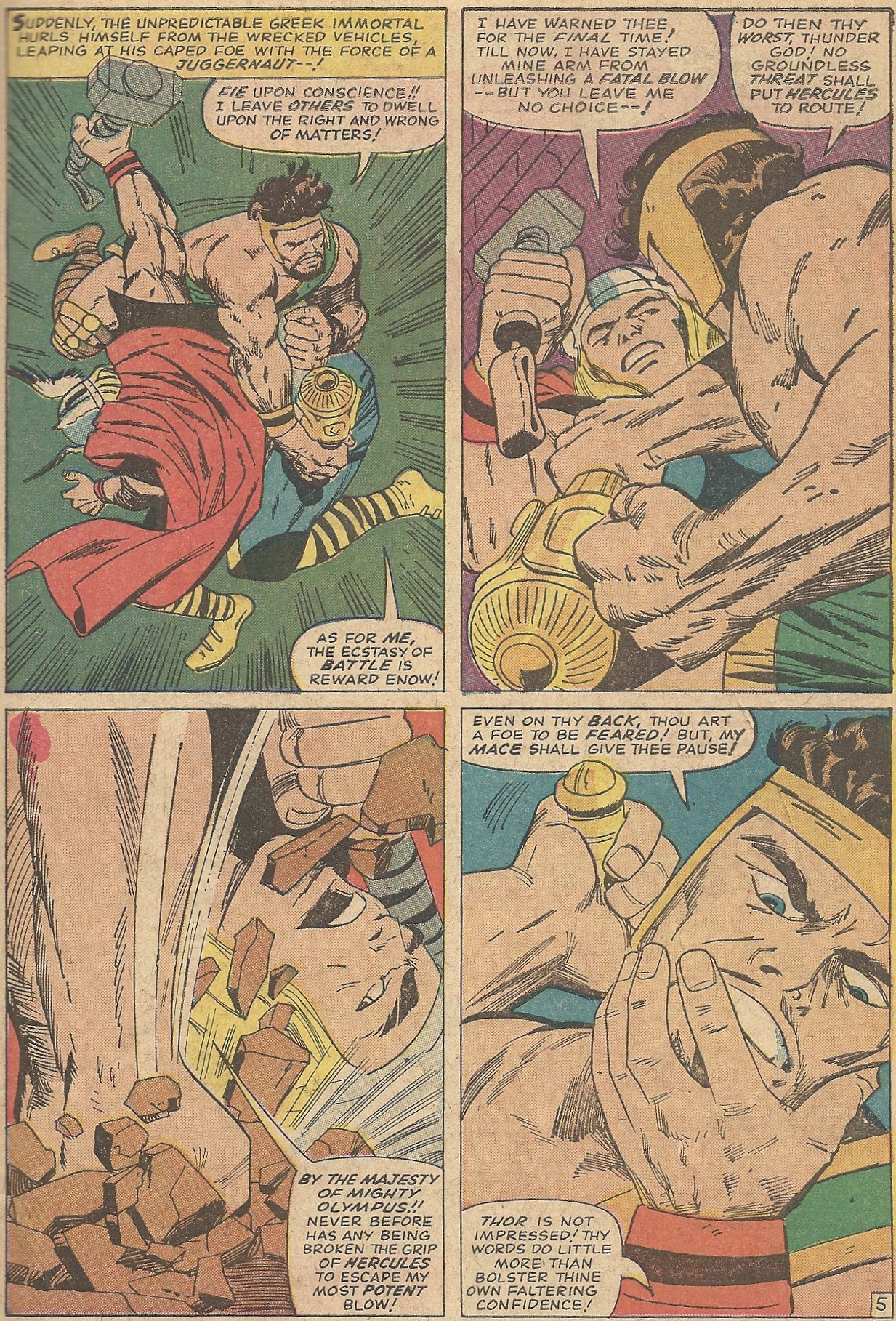
And not only does Thor have his fists and Mjolnir with which to batter the son of Zeus — he also has his fearsome power of alliteration:

This is such great stuff.
Perhaps the highpoint of the action is this full page blast:
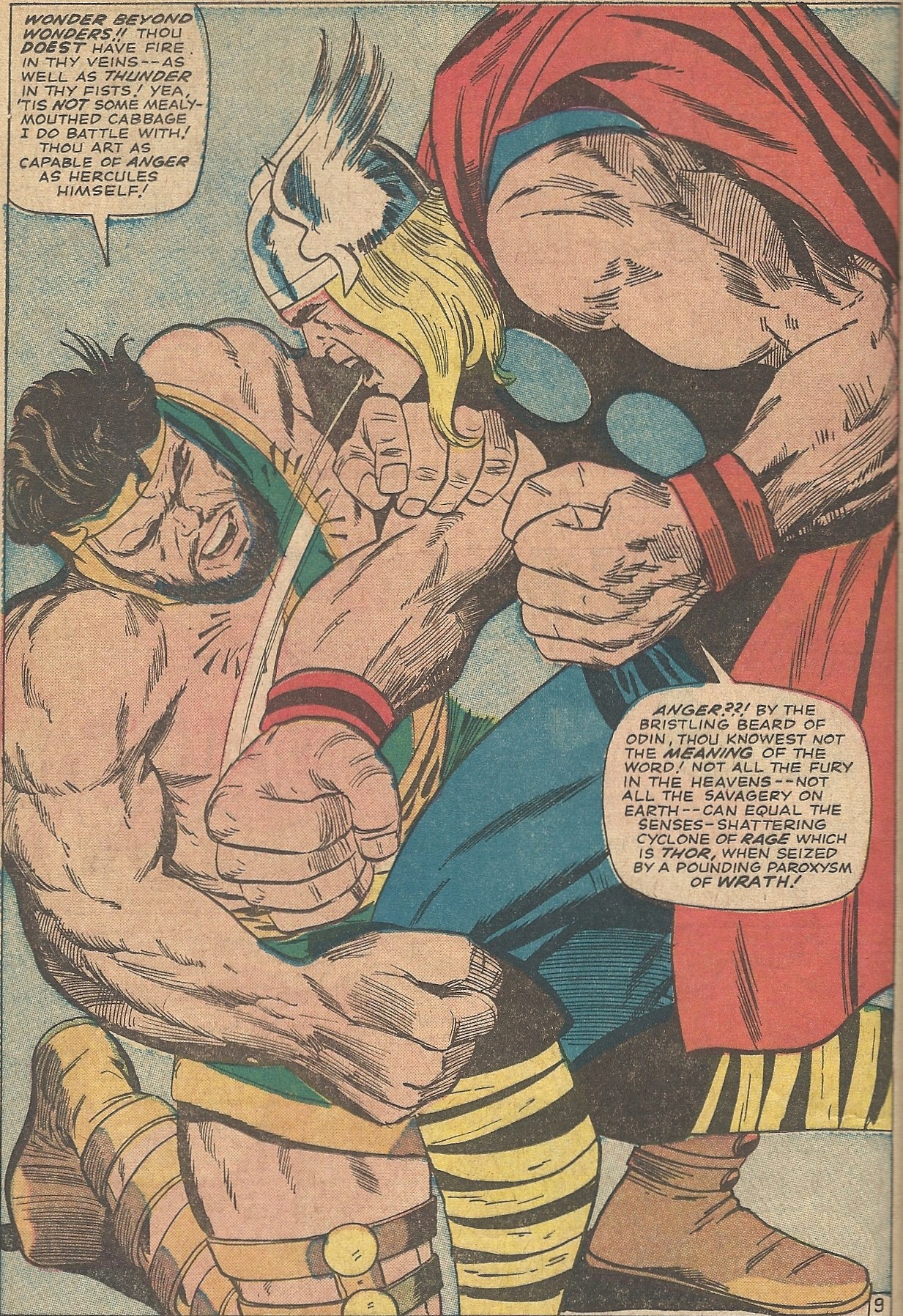
I could do a deep parsing of every word in those two balloons, but I’ll just settle for my three favorite phrases:
“mealy-mouthed cabbage” — Huh?
“bristling beard of Odin” — A lovable old chestnut
“pounding paroxysm of wrath” — My veins are throbbing just typing that.
The story ends with Odin robbing Thor of half of his godly powers, and, since Thor even then won’t surrender, Hercules levels him with a roundhouse right. Herc gets a movie contract out of the fracas from a admiring producer as Thor is openly mocked by pedestrians. Jane tries to let him know that she still loves him, that she was just trying to make him jealous by flirting with Hercules, but Thor sulks off in a deep depression. Then Odin has his millionth change of heart and exhorts Jane to go after him:
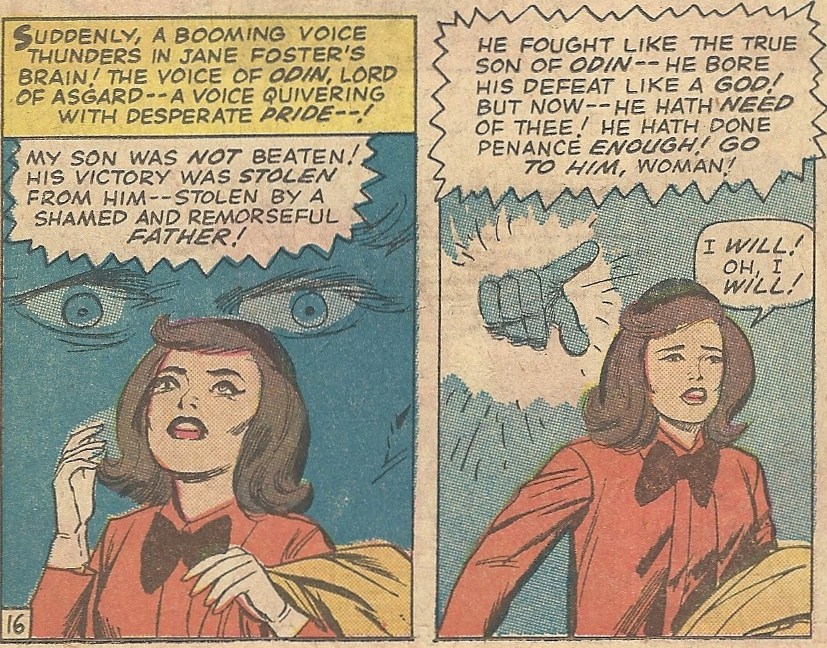
We’ll let Odin get away with the “woman” this time.
This issue certainly didn’t mark the end of the Thor/Hercules entanglements — in fact, it signalled the beginning of a wonderful series of adventures that saw two heroes come to a rapprochement and had Thor rescue Herc from the underworld. But that’s fodder for another post.
This entire issue is everything comics should be — fun and exciting — and I didn’t even get to the “Tales of Asgard” backup story. Perhaps this issue’s sterling quality is why its cover has been aped so many times. I can think of both the Walt Simonson cover with Beta Ray Bill’s intro and a Dark Horse Presents cover off the top of my head, and I know that there are others out there.
But I’m still trying to come to grips with “mealy-mouthed cabbage.” I did a Google search and apparently it’s the only time those words have been strung together in the history of the world. For that great service to humankind, Stan, I thank you.

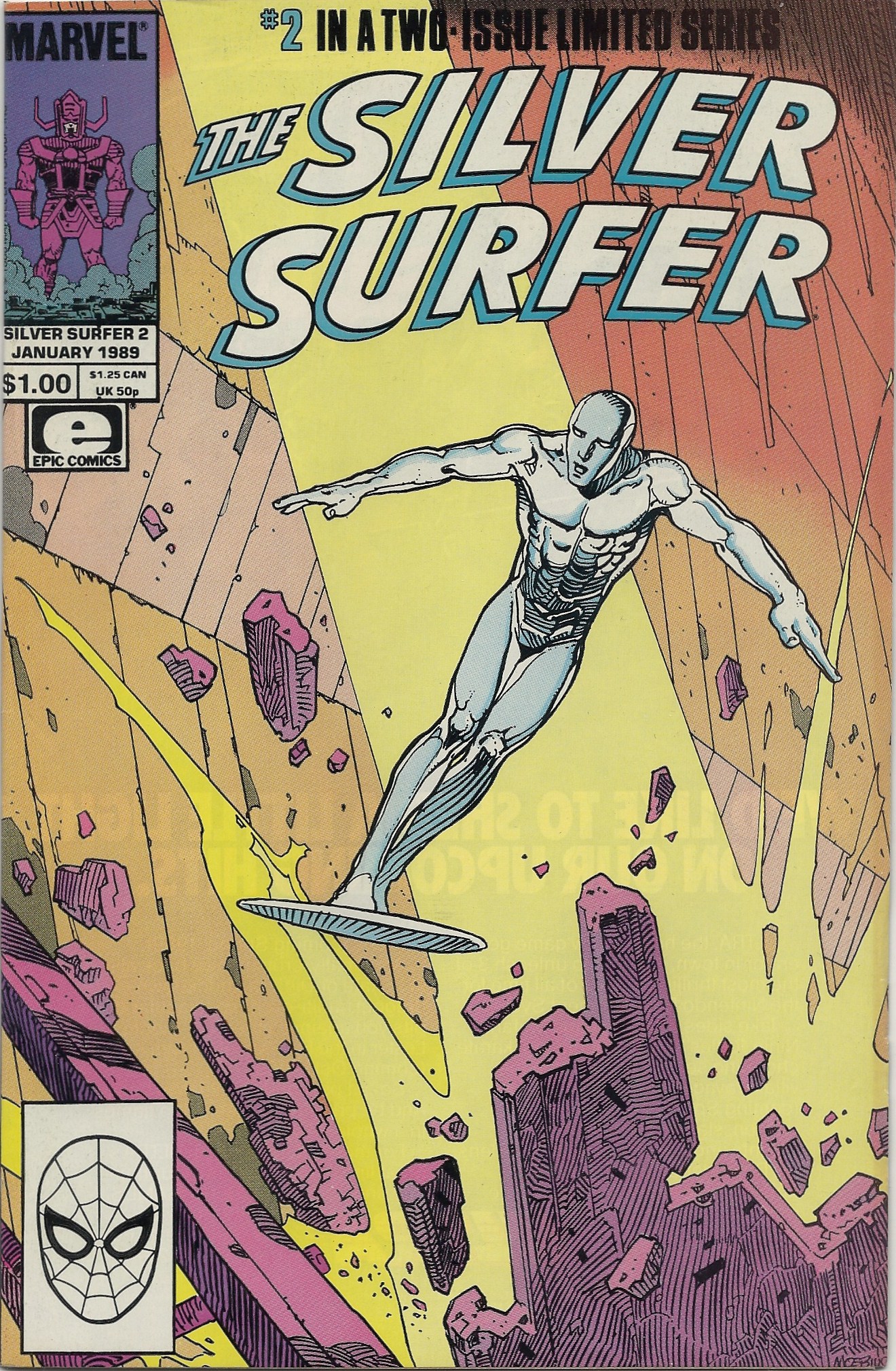
Stan Lee never really recaptured the writing magic that he harnessed so profitably in the 60’s. Some would argue that that’s because masters like Ditko and Kirby were carrying the freight in the respective writer/artist teams, and others would contend that times and tastes changed. But Lee has always said that the Silver Surfer is his favorite character, and maybe it was that select status that helped rouse him to put together a pretty nice little story in collaboration with Jean (Moebius) Giraud.
These two-issues re-imagine the coming of Galactus as the true biblical apocolypse that it should be, complete with raving lunatics and end-of-times hysteria. Moebius employs his elegant artwork to maximum effect as the religious themes are hammered home and the Silver Surfer as messiah challenges Galactus’ evil godhood. Fun stuff, and Lee summoned his A-game to match the beautiful visuals.
An interesting little aside to Moebius’ artistic take on the Surfer is its mention in the 1995 film Crimson Tide. Known to most people as “The submarine movie that isn’t The Hunt for Red October,” Tide featured some crackling dialogue between screen titans and in-film antagonists Gene Hackman and Denzel Washington. Of note to comic fans is a nice little exchange that Denzel’s first officer character has with a couple of bickering sailors. I couldn’t find any video of it (Damn you, YouTube!), but here’s an audio clip:
I’ll never say a negative word about Kirby — well, I might offer a criticism here and there — but as far as the Surfer goes, I kind of like Moebius’ version. He gives him less of a blocky physique, making him more lithe and agile looking (handy when you’re dodging Galactus’ energy blasts). He renders him more as a swimmer and less as a linebacker, and I think that’s a good and appropriate thing.
Sorry, Denzel.
 Jared
Jared


 blog into mystery