Deck the Hall(s) of Justice – Christmas with the Super-Heroes #2

Now that Black Friday has passed us by, with its Yuletide opening round traditions of Wal-Mart tramplings and Best Buy fisticuffs and Drudge Report articles about people getting stabbed over cheap video game consoles, why don’t we settle in with a cup of eggnog and start our end-of-year celebrations with some DC icons? How about it?
This is the second Christmas compendium that DC published at the end of the 80’s. The first issue from the previous year was all reprints of earlier stories, but this one, as the little banner says on the cover, is all new. I was expecting some saccharin infused fluff, but I was quite taken with a few of the stories within.
The first, entitled “Ex Machina,” is darker than you might expect, especially considering its star, the sunshine-and-warm-puppies Superman. Written and drawn by Paul Chadwick with inks from John Nyber, it opens with an elderly motorist stranded and alone on a lonely highway. It’s a bitterly cold night, and he can’t get anyone to stop and help him. When he just can’t take it anymore, he pulls a gun out of the glove compartment, pens a suicide note, and puts the barrel of the gun under his chin.
Then there’s a tap at the window. It’s Superman.
The man lowers the gun and Superman gets inside. He uses his heat vision to thaw the guy out, and starts de-icing the battery while he’s at it. Then Supes asks the question that’s on all of our minds:

It turns out that the driver, who remains nameless throughout, wasn’t simply cold. He’s estranged from his wife, has a degenerative disease, and hasn’t spoken to his daughter in years. That’s a trifecta of misery if there ever was one. Superman suggests that he get in touch with his daughter, adding “I’d like to think I didn’t stop here for nothing.”
The man agrees. Hard to argue with the superpowered guy that saved your life, I guess.
Then Superman gets out of the car and has one last thing to offer:

That he writes the directions on the back of the suicide note is a powerful storytelling flourish, don’t you think? And, in case there’s any doubt as to the identity of that “older couple”:

A nice Batman story follows, which is dialogue free and focuses on the passage of time in the setting of the Batcave, from the start of the Caped Crusader’s career through things like Christmas with Dick and Alfred. A Wonder Woman entry is next — she and a female pastor help each other rediscover their respective faiths while they both visit the Kapetilis household over the holidays.
Then there’s an Enemy Ace tale, “Silent Night,” which might be the best in the bunch. Written and pencilled by John Byrne with inking by Andy Kubert, it’s a completely silent (who would have guessed) issue. I’d like to give you some scans, because Byrne’s and Kubert’s respective styles combine wonderfully, but it’s hard to post a lot without “giving away the store.” Let me just say this: it’s an excellent, piercing little story, that depicts the brotherhood of men and the unbridgeable gap of war. Great stuff.
Then there’s a rather glib Green Lantern/Flash short that I wasn’t overly fond of, but the collection is finished by a Deadman story from writer Alan Brennert and the recently passed Dick Giordano. It has a nice twist. In “Should Auld Acquaintance Be Forgot,” Deadman tries to recapture some of the joys of Christmas and the pleasures of flesh by possessing the bodies of various people. It doesn’t work out, though, because doing so makes him feel like an interloper and a thief. Then, while moping about and wallowing in his misery, he has a strange visitor:

Hmmm. Magic allergy?
This anonymous blonde gives Deadman a lecture about why heroes do what they do:

Biiiiiiig hint.
And as she’s about to leave:

That makes this kind of cool — an appearance by the pre-Crisis Supergirl, who (at this point in the history of the DC Universe) nobody realized ever lived and whose ultimate sacrifice is utterly forgotten.
A lot of short but sweet material in this little book, and the weight of the good more than balances out the weaker chaff. If you see this one in a dollar bin, maybe it’s worth a read. And, if you’re curious, you can find the Enemy Ace story reprinted in a trade called A DC Universe Christmas. Might be worth a look, though some of the other reprints in that particular collection are absolutely dreadful. You’ve been warned.
Enjoy your Cyber Monday.

There was no one better at depicting exaggerated physical combat than Jack Kirby. I don’t think that’s exactly a news bulletin, but I suppose it needs to be said as a means of introduction. His figures would twist and contort in ways that would make acrobats in the Cirque de Soleil green with envy, and would coil and uncoil with such ferocity you had (and have) to suppress the urge to duck when you see them in action. And there was perhaps no better subject for this sort of athletic expression than the mere (enhanced) mortal known as Captain America.
Before I get to Cap, though, I should note that the Iron Man half of this issue is interesting in that it finds ol’ Shellhead over in Vietnam helping the U.S. fighting forces test some ordinance. There’s some nice action in “Within the Vastness of Viet Nam,” but since the story is part of a broader arc I’ll refrain from any deeper comment. But I was struck by this full page blast from Gene Colan and inker Frank Giacoia — there’s something cool about watching Iron Man shake Vietcong out of a tree like a bunch of coconuts:

Look out below!
On to Cap. In “Before My Eyes, Nick Fury Died!” he returns to New York City and, while still at the airport, calls up his pals at Avengers Mansion on his iPhone ancestor:
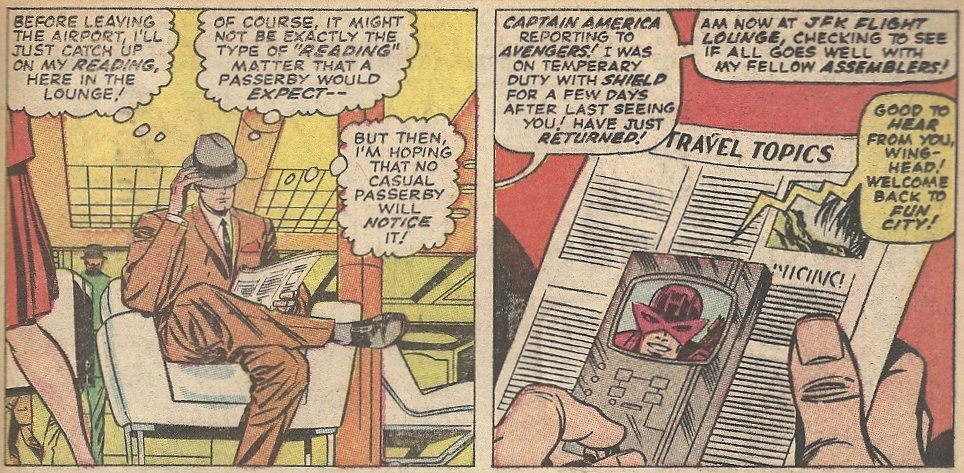
I wonder what kind of apps that thing supports… Does he have unlimited text?
Anyway, as he’s on the way home in a taxicab, he passes by the S.H.I.E.L.D. barbershop. Nick Fury is calmly sitting inside about to get a trim and a shave (or have his stubble reduced, as the case may be), but Cap notices an assailant about to strike. He springs into action, but he’s not in time — the strange cyborg has already zapped Fury:

That lower left hand panel is great — the way Kirby draws Cap reeling backwards with his arms braced in front of him, you can almost feel him absorbing the force of the blast.
Cap recovers, and he and the cyborg/robot/whatever slug it out. As is so often the case, he’s outpowered, but his never-say-die attitude is fun to watch play out, even if it, as always, ends with his inevitable triumph:

He then dishes out the final blow. Remember what I said about the coil and uncoil?:

That’s almost worthy of a Walt Simonson “KRAKATHOOM!”
The best part? The Nick Fury that Cap saw blown to bits was just a decoy, and his hardscrabble do-goodery trampled all over a carefully arranged sting operation. D’oh!
The Gene Colan/Jack Kirby two-fer in these old Tales of Suspense comics, with the Stan Lee scripting, is always a treat. There are still a few out there that I haven’t read, and I’m really dreading the day when I polish off the last one and there aren’t any more of these old brouhahas for me to experience for the first time.
You can “Yap with Cap” and “Rap with Cap,” but don’t mess with him, at least not when Kirby’s doing the drawing.
Do not eat before reading this – My Friend Dahmer
I was going to post this on Thanksgiving, but I thought that might be in bad taste. And now that that pun’s out of the way…
I was wasting time one night, just watching random clips on YouTube, and somehow I stumbled onto some interviews that Jeffrey Dahmer did years ago. I’ve always found Dahmer to be a fascinating character, not because of the absolutely horrific nature of his crimes — and if you somehow harbor any doubts about that, I invite you to Google “Dahmer Crime Scene Photos” — but because of how he slipped through the cracks for years and, when caught, ultimately took full responsibility for his crimes. The latter quality has helped make Dahmer, in the words of someone else (I can’t remember where I first read this description), one of the more pitiable serial killers. That’s certainly a relative comparison, but take two other noted mass-murderes for reference points — Charles Manson and Ted Bundy.
Manson is just flat out unrepentant and nuts, and every time he opens his dumb rambling mouth he makes you wonder how minds could be so weak as to fall under his sway:
You just want to scream “Shut up! Shut up! SHUT UP!”
Bundy, while more clean-cut, always came across as such an arrogant prick, and a murdering one at that:
I’ve always pictured that there was a line of corrections and law enforcement officials that stretched around the block to be the one to don the black hood with him, kind of like the people trying to calm down the hysterical woman in Airplane:
Dahmer?:
You hear that calm accent that smacks of Middle America and the even tones and you start to forget the things that he did. But you can’t. You mustn’t. The nigh unimaginable immensity of the drilling of holes in people’s heads to make zombies(!) out of them and the necrophilia and the dismemberment and the trophies and, most importantly, the waste of life — that counts for more than any amount of “owning up.” But still…
Perhaps the most remarkable aspect of the entire Dahmer story, at least for me, is how close he came to being caught at one point. One of his heavily drugged victims, a 14-year-old boy, somehow managed to drag himself out of Dahmer’s apartment while he wasn’t there. The kid was uncommunicative, naked, and bleeding from a part of the body no one should be bleeding from. A couple of women came across him on the streets and managed to get the attention of two police officers. Dahmer showed up almost simultaneously with the cops and managed to convince them that the kid was 19, his lover and simply drunk out of his mind. The officers even escorted Dahmer and the boy back to his apartment, where he showed them (and another officer who joined the two originals) some explicit pictures of the boy as proof of his “intimate” relationship.
Not wanting to get in the middle of a gay spat, the officers washed their hands of it, and that was that. Unbelievable. The best part? There was a rotting corpse in the bedroom.
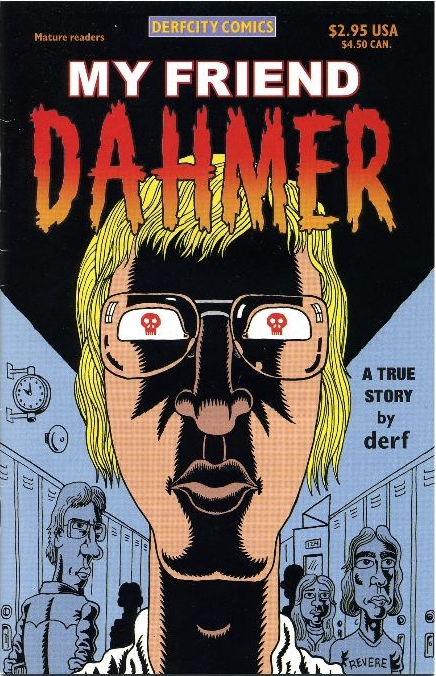
Here’s where the comics angle comes in. This ability of Dahmer — or perhaps it was his curse — to go through life creating hardly any wake at all is one of the underlying themes of My Friend Dahmer. Written, drawn and self-published in 2002 by Derf (John Backderf), who was a classmate of Dahmer’s, it’s 24 pages of brief reminisces from Dahmer’s high school years that are sad and chilling in the magnifying glass that is retrospect. There isn’t a great deal of depth to Derf’s knowledge of his subject, only vignettes from their acquaintance, but that’s a part of the story in itself. No one truly “knew” Dahmer.
There are a lot of moments within that will make you shake your head, but perhaps the saddest thing about young Dahmer was that he was already an alcohlic in his teen years, as we see here:
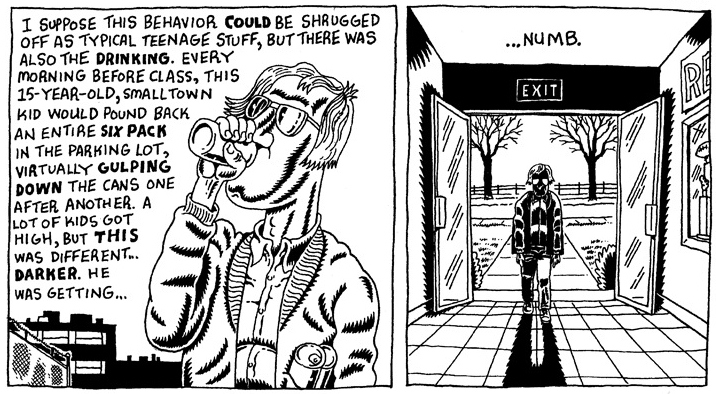
Can that be any more depressing? But, even as we pity him, we’re shown the beginnings of behavior that would one day escalate into bloody infamy. The two go hand-in-hand:
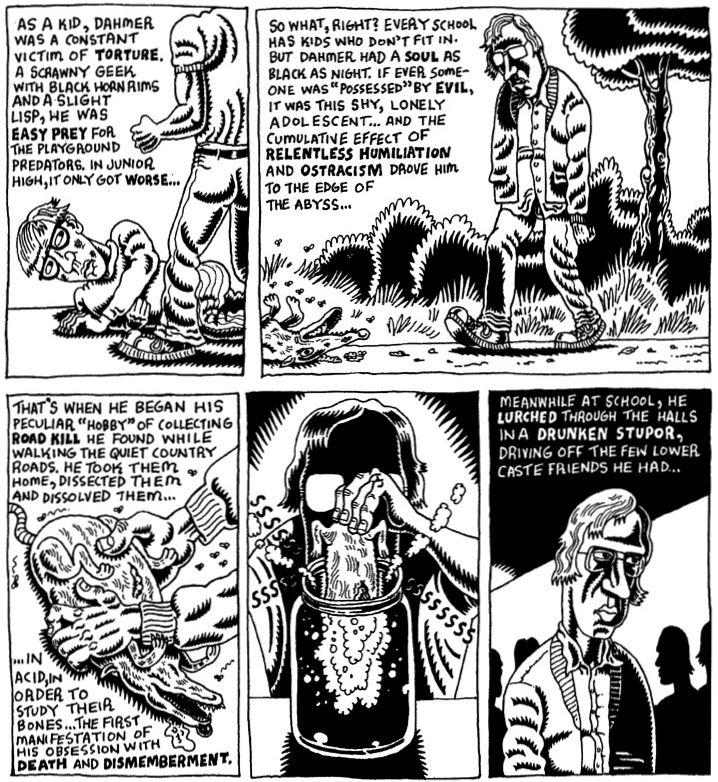
There are strange incidents throughout, most significantly Dahmer’s egged-on impersonation of a woman who suffered from cerebral palsy. He’s often drawn in shadow, indicating both his future descent and his present (at that time, and until his death) outsider status, and there’s a general restraint with the art and the prose that’s so refreshing with subject matter like this. The final pages, with the last encounter of a member of Derf’s clique with Dahmer, are 100% guaranteed to make your hair stand on end. It’s a gripping tale.
If I have one complaint about My Friend Dahmer, it’s a minor one. Derf draws himself and Dahmer in much the same way, which caused some confusion when I was reading the comic. It was confusion that was easily cleared up, so no harm no foul. And — not a criticism, but an observation — doesn’t Dahmer in that last panel above look a bit like James Woods? Maybe?
Derf’s book is a true achievement. I’ve been familiar with his newspaper cartoons for some time, but this was the first comic of his that I read, and I was duly impressed. Not only does it assuredly outdistance the wafer-thin exploitative Dahmer comics that were published only as a means capitalize on his crimes — it also stands as perhaps the best book about Dahmer period. And his whole point, that if someone had just stepped in with Dahmer — and maybe even tried to help him integrate with the world — tragedy might have been thwarted, is ever-relevant. So many times as I was reading the comic I thought back to those policemen, the three blind mice who saw no evil.
A lot of us grew up knowing someone who was like the Dahmer that we find in these pages. I did, a kid I knew for twelve years who always dressed in black and rarely spoke and whose father tried to commit suicide by blowing his brains out in front him. At one point in the comic Derf and his friends, in a scene that takes place years after the core high school events, joke that Dahmer, who had fallen off the radar by that point, probably became a serial killer. I’ve sometimes mused over what happened to that kid that I knew, and I’d be lying if I told you that I never thought that about him. If there had been a “Most Likely to Keep Someone Chained Up in His Basement” category in my high school yearbook, he would have had my vote.
It’s probably the universality of that sort of painful marginalization, and the sort of psychoses that it can spawn, that’s the most frightening thing of all, and that’s what makes this book so powerful.
I feel like I’ve perhaps written too sympathetically about a murderer here. Yes, Dahmer accepted responsibility for what he did, and yes, he was a wounded and shattered young soul. But, lest we forget the toll of his crimes, let’s all keep the victims and their families in mind:
Some final housekeeping… My Friend Dahmer is available at Derf’s website, where you can also view some sample pages, and he’s interviewed in parts one and two of a documentary on this subject that you can see here and here. Jeremy Renner, who’ll be playing Hawkeye in The Avengers, starred as Dahmer in the 2002 film entitled, you guessed it, Dahmer. Use that worthless trivia however you wish. Lastly, I hope it’s a long time before I write another word about this individual — I feel like I’ve been spelunking for a month in the darkest cave on Earth.

A couple of days ago I posted an article about the Marvel Comics Close Encounters of the Third Kind adaptation, in which I was mildly critical of the character likenesses and how close (or not) it stayed to the film.
I was sorting out some things on the blog this morning, and saw that there was a new comment for that post. When I clicked on it, I was more than a tad surprised to see that it was from Mr. Walt Simonson.
Well…
I think his thoughts on this topic deserve a post of their own, so here they are:
Hello, Jared.
The short version here is that back in the day (and it’s probably still true), companies generally paid extra fees to obtain the rights to use actors’ likenesses in their adaptations of movies. I don’t know how it was all worked out at the contract stage but, for example, Marvel did have the rights to use actor likenesses in their Star Wars books. Marvel did not have the rights to use actor likenesses in the Close Encounters adaptation. They also didn’t have the rights to use likenesses in the Planet of the Apes stories (although they could use photos in their b/w magazine about monster/SF movies where such use was considered promotion.) No likeness rights for Battlestar Galactica either. The rights’ situations for movie and TV adaptations are often complex and not necessarily well understood by folks outside various legal departments. Heck, I don’t understand most of them myself.
For Roy Neary, I mostly tried to draw a physical type who wasn’t too different from Dreyfuss.
With Close Encounters, the movie studio was very nervous about releasing any information (including imagery) before the film hit theaters. As a result, Archie and I had a script to work with and little else. We were shown a few stills and a brief clip of the UFOs flying over the country roads scene, none of which we were allowed to keep. It was largely a case of memorize this and then go away. And that was it. I drew a couple of scenes in the beginning of the comic in the fashion I did because, although neither Archie not I were able to see a preview screening of the film, a friend of mine with connections did see such a screening. He described some stuff to me that was different from our script so I was then able to draw certain things right at the beginning of the film/adaptation with some insight. I eventually saw the movie once it was released, and that guided me to some extent as I was still working on the pencils. But generally, working on that title was an exercise in working in the dark. Still came out okay, I thought.
Best, Walter
I’d certainly agree that it came out okay. And, the more I think of it, my criticisms of the likenesses and story beats are more about me than about the creative staff. I internalized Close Encounters over the years to such a degree, my head had (has) impossibly hard standards to live up to. In light of the double-secret probation quality of the production, I’m amazed about how near it does get to the film I’ve loved so much.
A big thanks to Mr. Simonson for sharing these first-person insights on the difficulties and contraints involved in adapting these sorts of projects. I’ve been thoroughly edified.
1979: The Year of Super-Overkill

I try very hard to spread out material on this blog, but I find that the Superman quotient, despite my best efforts at restraint, is always pretty high.
Then I saw this two-page 1979 ad, and I didn’t feel so bad.
I realize that the first Christopher Reeve Superman was still fresh, but this made me wonder whether anyone at DC ever heard of a thing called the “saturation point.” Remember when Who Wants to be a Millionaire? was the biggest thing on prime-time television and they decided to put it on every night? I think they even came up with a new day so it could actually be on eight days a week. Kind of the same thing here. Maybe there was a high level of Superman-tolerance in the comics world back then — and now. I used to buy four Super-books a month way back before he died and came back with atrocious long hair, so who am I to criticize?
It’s all quiet here on the dark side of the moon – Marvel Super Special #3, “Close Encounters of the Third Kind”
My recent post about the abject failure of Bugs Bunny/Looney Tunes stories to translate into the realm of staple-bound newsprint got me to thinking about this adaptation. But before I say anything about the book itself, I need to let everyone know where I stand on Close Encounters of the Third Kind, the film that it — obviously — adapts.
It’s my favorite movie. Ever.
Though the first Christopher Reeve Superman, always a beloved strip of celluloid, has claimed a larger and larger share of my affections as I’ve grown older, CE3K will always have the advantage of not having a Margot Kidder-spoken “Can You Read My Mind” moment. When my age was in the early double digits I used to pop in the VHS tape of Encounters every single weekend, and it’s still a special two hours whenever I dim the lights and plop myself in front of the TV to watch it. Steven Spielberg was young(er) and hungry back when it was made, and while his films today are superbly crafted, they just don’t sing like the movies he made before he was in a higher tax bracket than God.
Close Encounters was a righteous fusion of music, sound, mood, effects, dialogue, locations, casting, and everything else. You name it, it had it. And I love this movie so much — and have loved it for all tha parts of my life that I can remember — it was with some trepidation that I bought this comic. Well, maybe trepidation isn’t quite the word — I was happy to get it, but I figured that it couldn’t ever live up to the film.
So, when I got home the day I purchased it, I opened it up to see who was given the impossible task of adapting this thing. Archie Goodwin handled the scripting, with Walt Simonson doing the pencilling and Klaus Janson the inking. I like both members of the art team — there were two early marks in its favor.
So how is it?
No surprise — it’s a mixed bag.
While I like both Simonson’s and Janson’s work individually, their styles don’t meld all that well. And, while some comic book adaptations have stills from the production to work with, it seems that most of the character designs in this adaptation were crafted out of whole cloth. You aren’t going to find Richard Dreyfuss or Teri Garr of Francois Truffaut anywhere in these pages. And that’s not the biggest problem. Try as they might, it’s an impossible task for these guys to adequately capture the bottled magic that you would see on the screen.
Just for a brief example, let’s have a look at the biggest no-effects takeaway scene in the movie, the one that’s been parodied by The Simpsons and countless other times — the mashed potatoes scene.
First, the film version:
And here’s the comics version:

The adaptation team is trying. They really are. But they can’t replicate the fear and sadness of a family as Dad falls apart before their very eyes. I shouldn’t criticize them for failing to perform an impossible task, but the failure’s still there.
Okay. I have some issues with the art and teh scripting, but I said that it was a mixed bag. So what’s the good stuff? Well, there’s actually quite a lot of it. If I’ve given Simonson and Janson a hard time for not distilling all of the silver screen goodness, I can at least praise them for capturing certain things. I was struck by the posture of Roy Neary in this panel, when he’s being interrogated by Truffaut’s and Bob Balaban’s characters:

The way he’s leaning back with his arm straight and his hand on the table completely sums up Neary’s mental and physical posture at that point in the movie, and made that particular scene flash in front of my eyes. It kind of makes me wonder if the artists really were working from production stills, and that the lack of precise character likenesses was just a conscious “Screw it” choice. Maybe they had some storyboards instead. I don’t know. But this small piece of the project fulfills one of the old pre-VCR goals of comic adaptations of movies — giving a memento to those who watched the flick and want some help mentally replaying it.
Also, while nothing on flat paper can adequately depict that moment when we realize that all the ships at Devil’s Tower are just the prologue and the big momma mothership shows up, this two-page spread makes a noble stab at replicating the grandeur:

And even the final page, though it lacks John Williams’s stirring score, makes for a stylish close:

I’m admittedly predisposed to “geek out” for anything related to Close Encounters, and this book, warts and all, is no exception. Though it could never replace the original, nor did it ever aim to, this book made for a decent read. And, considering my love for the film, the fact that I didn’t open up my window at pitch it out onto the lawn is a good sign.
“This means something…”

Stan Lee: Rock Star?

I saw this ad and had to know what the hell this “Reflections of a Rock Superhero” (or “Rock Reflections of a Superhero” — take your pick) thing was. I’ve seen a couple of variations of this ad, and finally my curiosity overwhelmed me.
To keep it succinct, it’s Spider-Man-as-Rock Opera. Good or bad, that about says it all.
For your listening pleasure, here are some clips — the second one even has that distinctive Stan Lee narration:
Pretty awful, but maybe it spoke to youths of the 70’s. John Romita’s image from the advertisement, with a hangdog Peter Parker and Spider-Man in the mirror, was actually the album cover, and that’s about the only thing that would get me to buy this thing.
I can’t think of any comic book hero “rock” albums from my youth — the closest equivalent my generation had was the Rock-n-Wrestling Connection from the mid-80’s World Wrestling Federation. I actually owned — and forced my parents to play in the car cassette player during trips — The Wrestling Album II, which featured wrestler-sung hits like “Piledriver” (a song that compared the act of love with, you guessed it, a piledriver) and wrestling’s equivalent of “We Are the World,” “If You Only Knew”:
I think the wrestling stuff is funny. The superhero stuff kind of sucks, though I have to admit the “Doctor Oc-to-pus” chorus is catchy. Wrestling wins in this battle. Sorry about that, Spidey.
Chainmail bikini? Check. Flowing red hair? Check. Phallic symbol sword in hand? Check. – Marvel Feature #6

Red Sonja is one of those wonderful creations where people just say “To hell with it!” when it comes to reining in the sexuality and the fetishistic characteristics, and instead opt to simply let it all hang out. So to speak. Me? I’m generally indifferent to both swords and — with all due respect to the young Carrie Fisher — chainmail or metal bikinis.
But red hair? Yeah. I’m into that.
It is with tamped down urges that I present you with this book, one from the early days of Red Sonja’s comics career. Entitled “The Sons of Set!,” with a script from Roy Thomas and art from Frank Thorne, it starts with R.S. doing that “(Wo)Man with No Name” thing, i.e. riding around and looking for some action:

She’s very quickly attacked by half-man, half-jackal hybrids, and Thorne does a great job in showing, just through the look on Sonja’s face, the way blood and sexuality combine in this lady:
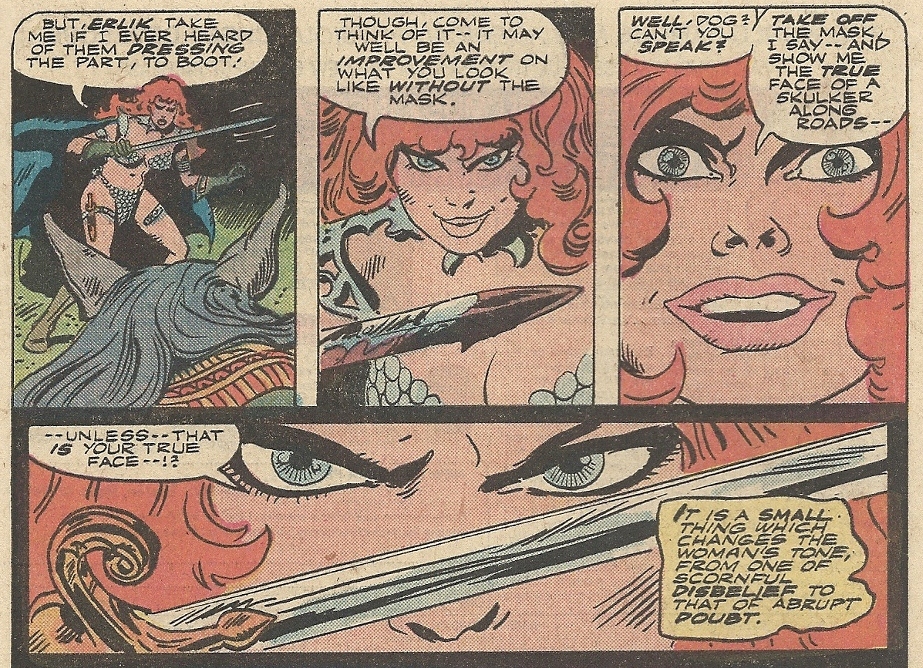
Red also proves that she ain’t squeamish:

Don’t say “aroused,” please!
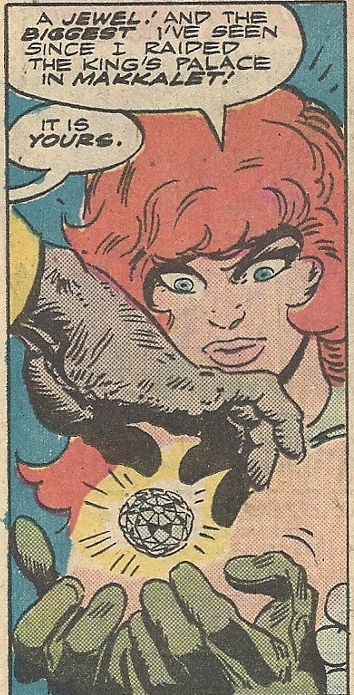
After dispatching her beastly foes, she then encounters a wandering magician or wizard or sorceror or prince or something, who wants her to go to some forsaken land to retrieve a page torn from the Iron-Bound Book of Skellos. And what would make Sonja do this guy a favor? Why, every girl’s — even a savage girl’s — best friend, of course:
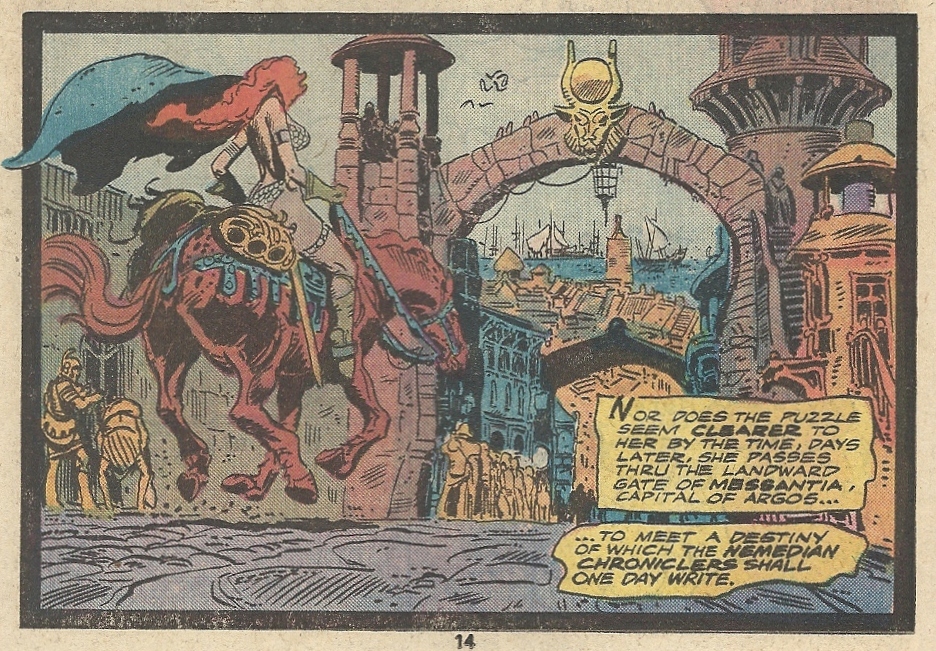
She travels to Messantia, which Thorne renders nicely — I can almost feel the cobblestones under my feet:
While sneaking in through the sewers (They always go in through the sewers, don’t they?), she is once more attacked by bipedal monstrosities, this time half-crocs. They present a bit more of a challene then the jackal-men, but good ol’ Red is up to the task:
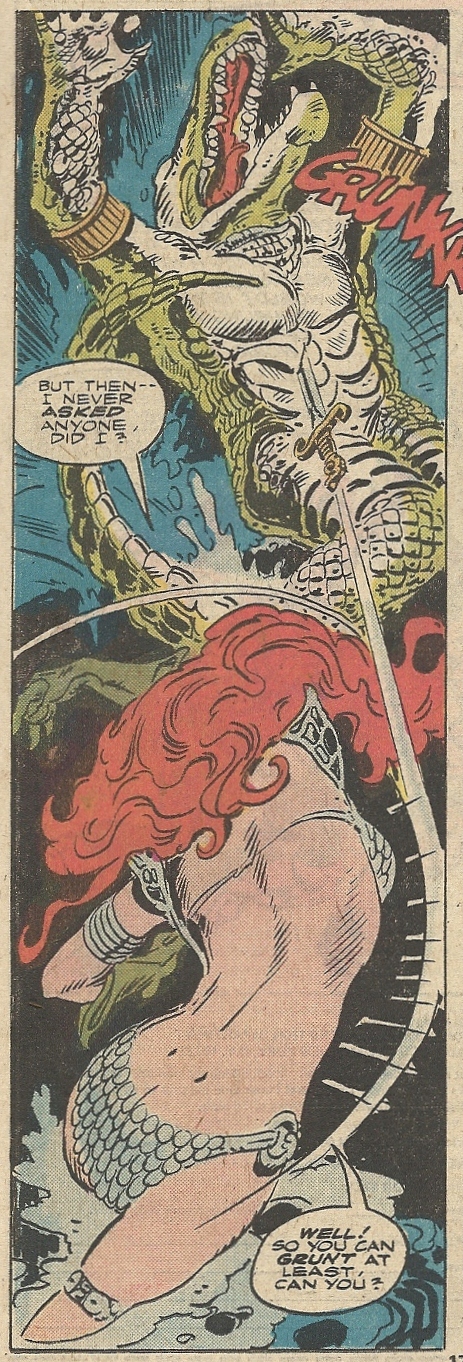
She’s impaling a crocodile-man with a thrown sword AND flashing some ass-cleavage at the same time. My kind of woman.
So she finally gets past all these roadblocks and comes to the room that’s holding the Iron Page of Whatever, and who should she run into?:
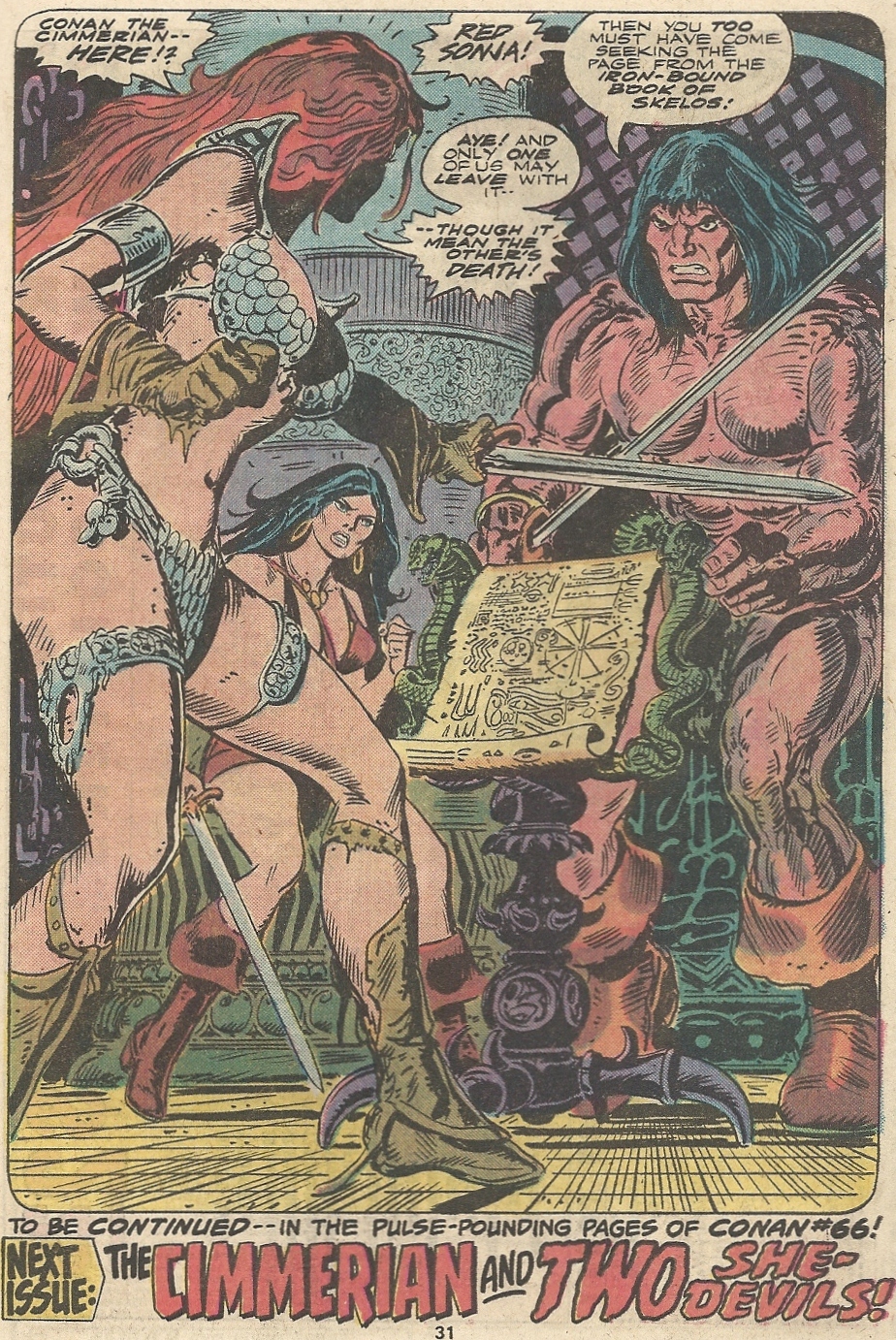
Fin.
I enjoyed reading this book about as much as I have any in recent weeks. Thomas is his usual steady self with the writing chores, but Thorne’s art was what really sold me. He does commendable work in making Sonja both an object of desire and a woman you would NOT want to mess around with, an achievement not surprising in retrospect when you consider his broader erotic oeuvre. That look on her face in the second interior scan says so much about her, and that the art speaks so clearly is the mark of a talented comic book artist. Kudos to you, Mr. Thorne.
It’s made me forget all about this crap:
And one last thing — “The Cimmerian and Two She-Devils!” kind of sounds like a porn.
“Hey Aquaman, do it your goddamn self!” – Super Friends #17

Really Aquaman? You want to go down that route? You want Superman to bail you out of this one? You want him to help you get out of a jam that COMES FROM THE OCEAN?
The Super Friends comic was a more kid-friendly effort from DC, of course tied in with TV show of the same name. In this particular issue — written by E. Nelson Bridwell with art from Ramona Fradon and Bob Smith — Wonder Twins Zan and Jayna have disappeared into different points in the timestream. The heroes, instead of looking at each other and saying “What exactly is the downside those twits being gone?”, decide to go and rescue them. Batman, Robin and Wonder Woman travel to Krypton’s past to retrieve Jayna (while there witnessing the launch of Kal-El’s rocket) and Superman and Aquaman head to an alien world of the future to save Zan. In what must be a great relief to all seven Aquaman lovers out there, Arthur doesn’t prove to be the complete incomeptent that the cover would suggest:
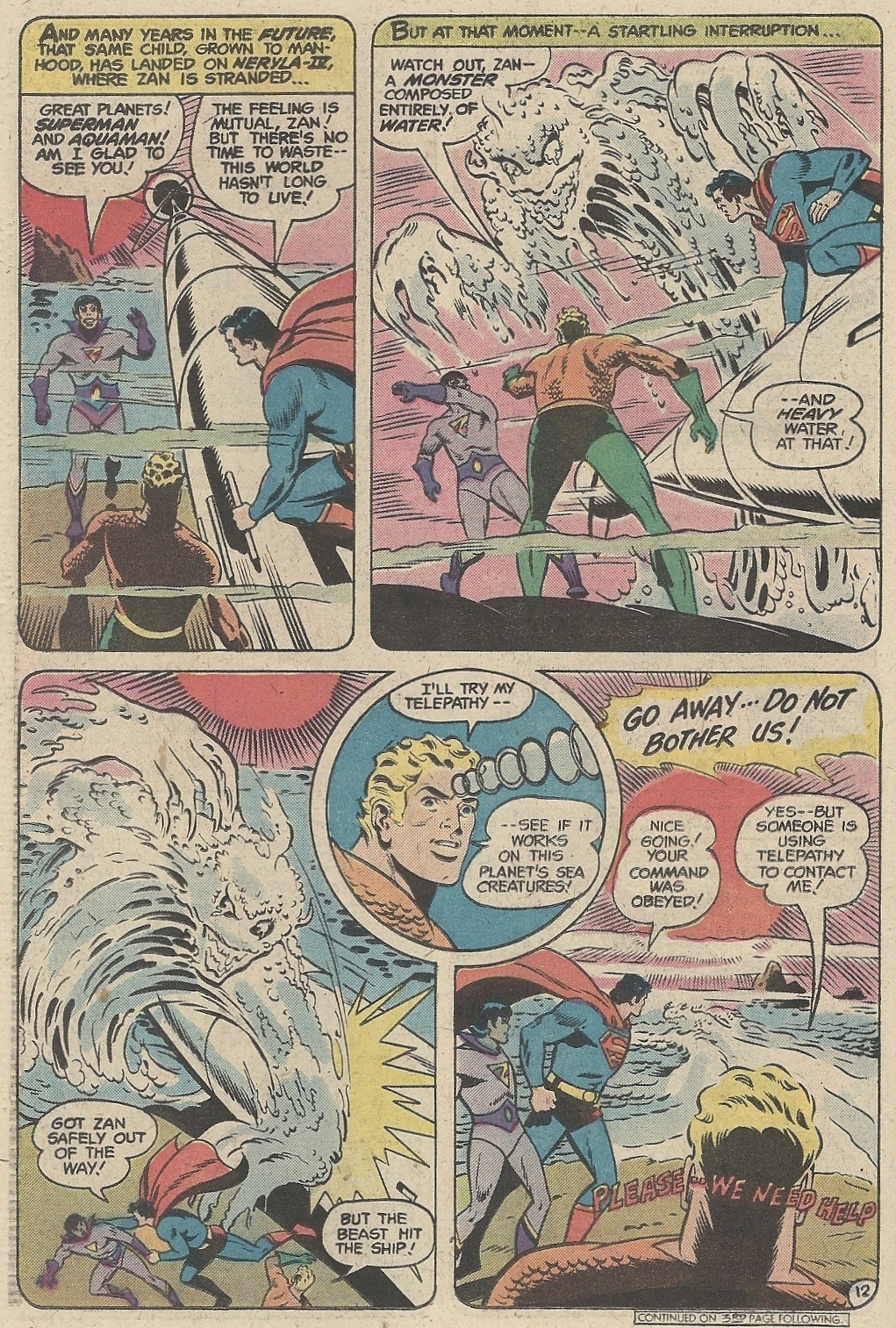
Well done, fish-man.
I actually like Aquaman, and I think that he gets a bad rap. But he’s just so easy to pick on. He really is.
Bugs Bunny through the years – Looney Tunes and Merrie Melodies Comics #57, Bugs Bunny #65 & Bugs Bunny #161
Some properties translate well into comic form. Some don’t.
My youth — and many (most?) others’ — was infused with a steady diet of Looney Tunes cartoons. My grandfather, a confirmed technophile, had a VCR long before my parents shelled out for one, and he had a stack of VHS tapes onto which he’d recorded episode after episode after episode of Bugs Bunny cartoons for me (on the long-form EP setting, no less). I obliterated many a lazy afternoon with them.
You know what? Until this very moment I had never thought of how much work he had to put into that, to record all those cartoons for me, since the clunky first-run VCR he had didn’t have a timer on it, so he had to do it by hand. I don’t think it was self-centeredness that kept me from reflecting on that, just the usual youthful obliviousness. Thanks, Gramp. A bit belated, but maybe you’re up there reading this on some heavenly iPad.
Sorry for that digression. To get to my point, I recently bought a few old Bugs Bunny-centered comics, and, since they were all seperated by spans of decades, I thought it would be kind of fun to look at them and see if the comics depiction of Bugs and the stories within changed at all over the years.
Then I read them and had a change of plans. I’m just going to stick to the covers and skip the guts, with one illustrative exception that will show you why I’m doing that.
We start with the Golden Age, and Looney Tunes and Merrie Melodies Comics #57 from July 1946:

That Porky Pig — what a little devil.
Next up is one from the earliest days of the Silver Age, Bugs Bunny #65 from February/March 1959:

Just to give you an idea of my problem with Bugs Bunny stories translated to graphic form, here’s the very first page from this comic — see if you can spot the most glaring defect:

Where. The [expletive deleted]. Is Porky Pig’s. Stutter? It’s like Santa without a beard.
More on the interior problems in a sec.
Finally, to round out this brief survey, we have the Bronze Age, and Bugs Bunny #161 from January 1975:
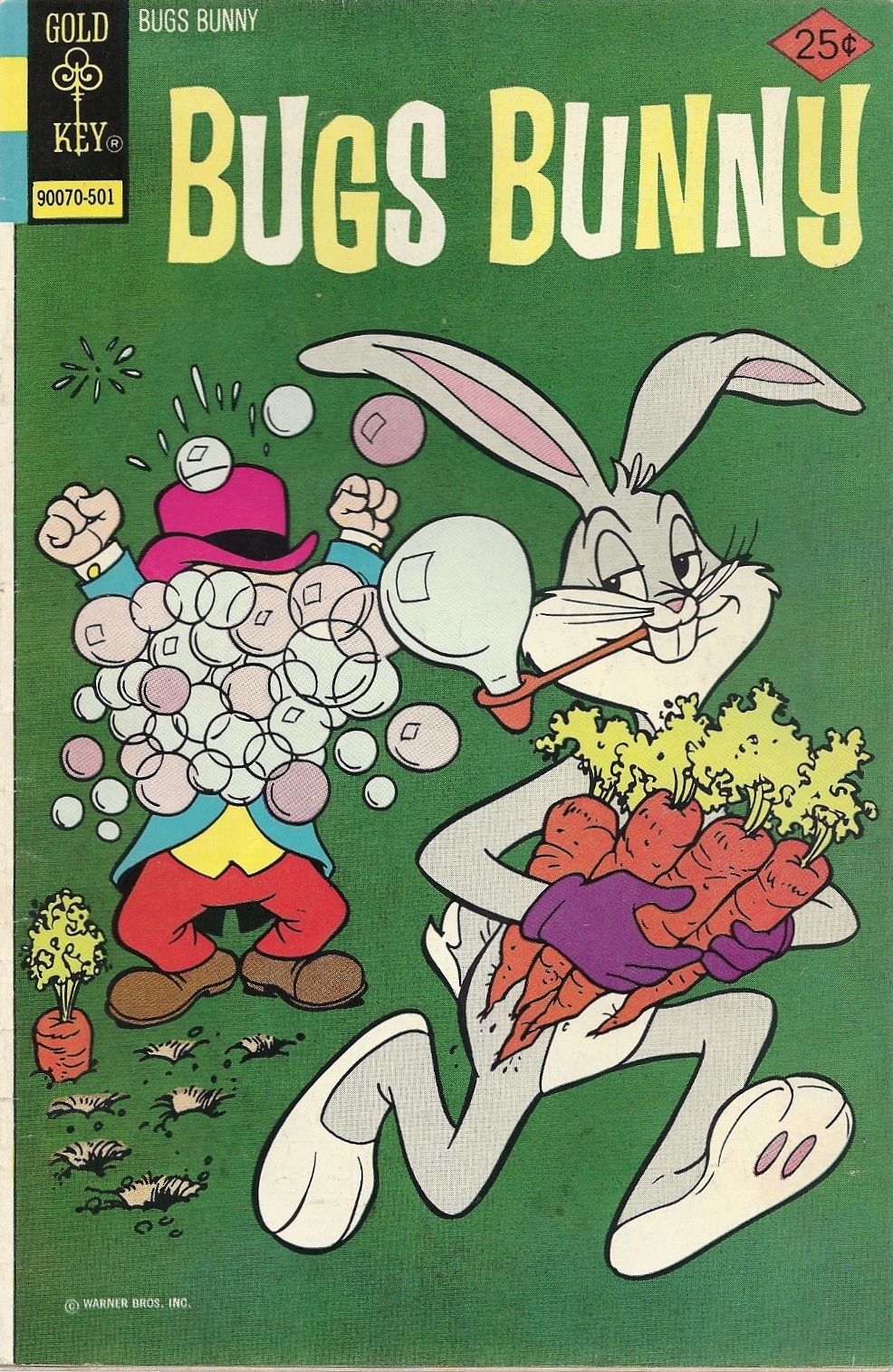
My first thought when I saw this cover was “Why is Bugs smoking a light bulb?”
I know that I’m just presenting you with covers, but I think you can take two things away from them. First, about the only thing that changes about Bugs Bunny is the color of his gloves. Second, Bugs is never far away from carrots.
Now for the problems, and the dicey gripes about the quality of the stories on the inside. The characters and scenarios that they find themselves in are extraordinarily flat without Mel Blanc’s vocalizations and the musical accompaniment and sound effects. That’s plain even from that first page. Sylvester shows up in one of the stories and his spittley lisp is nowhere to be found, and even though Elmer Fudd’s speech impediment makes its way into the scripts in which he appears, reading it is a chore in much the same way that reading Bizarro-speak is. That’s a damned if you do, damned if you don’t conundrum, but both paths are problems. You leave it out, it doesn’t sound right. You put it in, it’s a pain in the tuchus.
All this — no music, no sounds, no voices — kind of leads you to the inescapable conclusion that these things, though assuredly money-makers, just weren’t up to the quality of the source material. I understand that they were a way for kids to enjoy these characters at their leisure before the advent of YouTube, VCRs, or hell, TVs for that matter, but that doesn’t keep them from being substandard. There’s something, I don’t know, unworthy about them. I guess that’s as good a word as any.
There. Griping over.
To remind us all about how great the Bugs cartoons could be, and to keep this from ending on a sour note, here’s one of my favorite shorts of his — to this day, whenever a friend is getting a bit uppity, I lower my voice into my deepest baritone and break out the “Yoooooouuuuuur majesty…” line:
The parody of high-pressure real estate sales once flew way over my young head, but now it adds a whole other layer of amusement.
Stick to the cartoons. That’s all, folks.
Okay. I’ve made my amusement when it comes to old comic book muscle ads clear in this brief post. Chief among that genre of advertising was the Charles Atlas sand-kick ad, which I dutifully scanned and included in that entry. Just for the sake of simplicity, here’s that Atlas ad reproduced once more for your viewing pleasure:
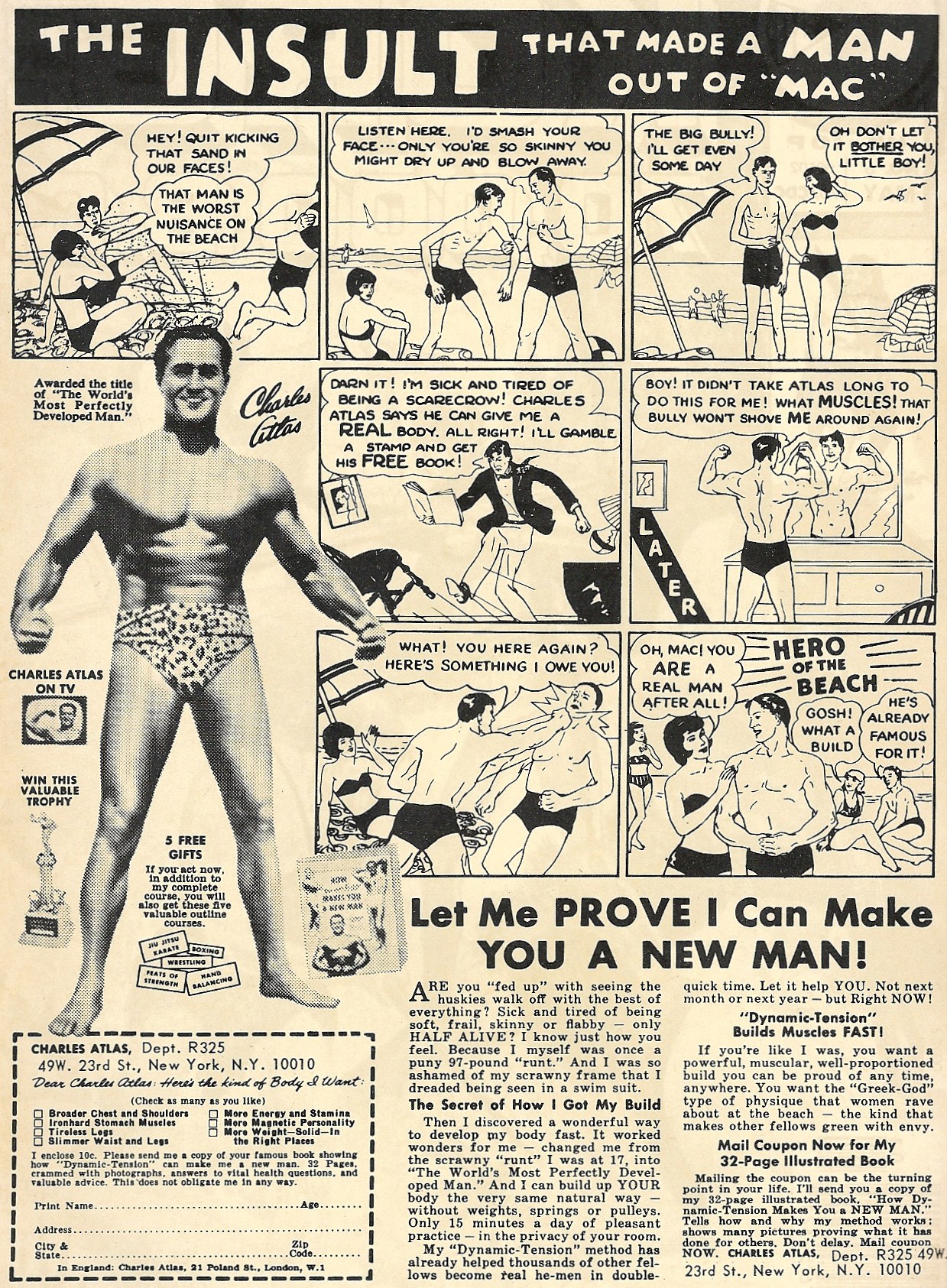
It’s a classic that represents the wish fulfillment of every scrawny string bean boy out there. Having been a string bean in my own days of yore, I can personally attest to that. But, even forgetting this deep-rooted connection to the male psyche, it’s memorable because it’s over-the-top and funny.
Imagine my delight when I discovered that it had been incorporated into DC continuity.
There is a God. And He is just.
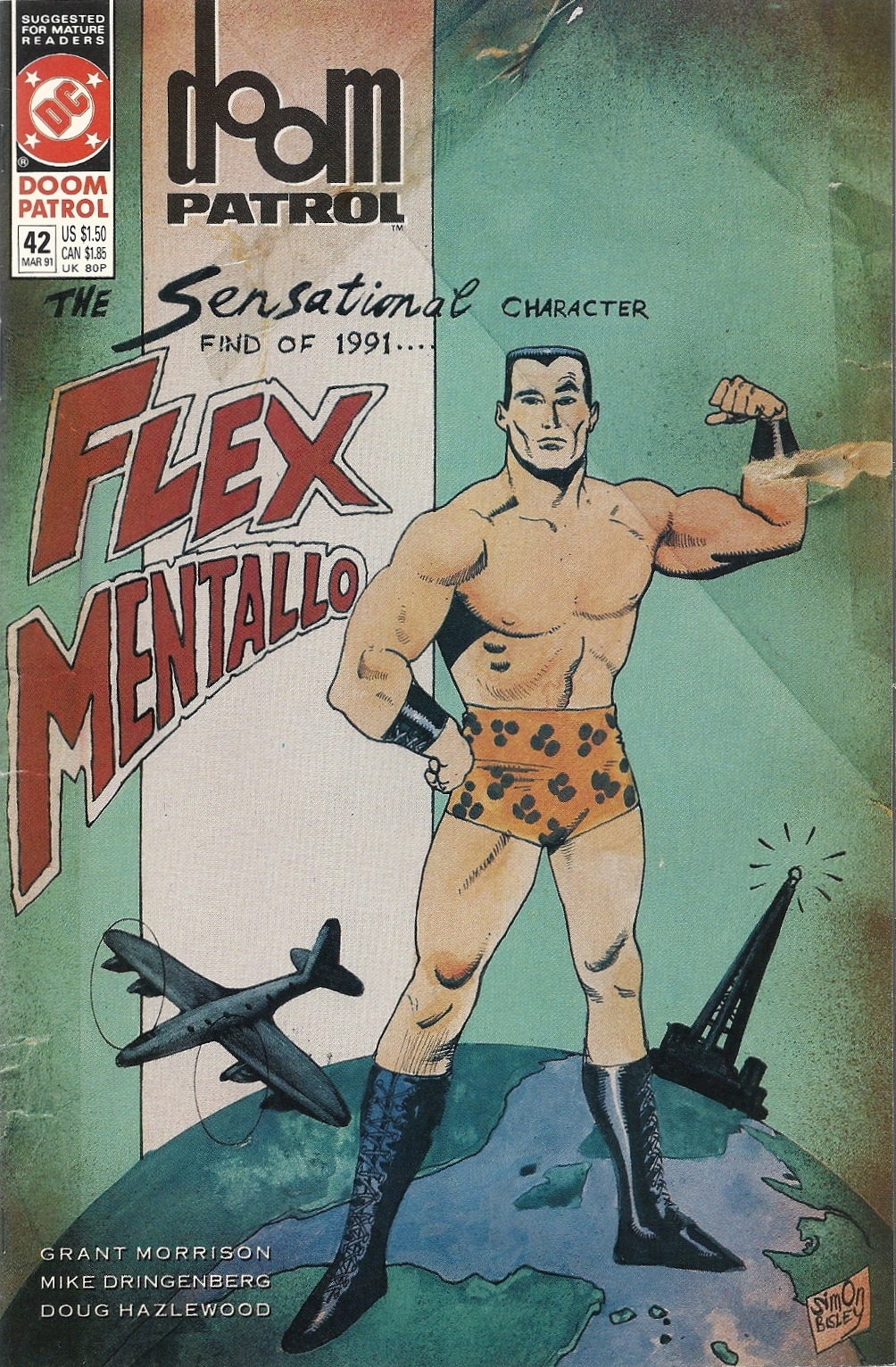
In general I could care less about the Doom Patrol and their various comic book incarnations, but Simon Bisley’s faux-vintage cover, depicting a rather befuddled looking Flex Mentallo, made we want to pick this issue up and take a look inside. I’m glad that I did.
The title page would seem to indicate that Mr. Mentallo is just another preening gym-rat, like so many of the supplement-glutted narcissists I’ve seen grunting and openly checking themselves out in mirrors over at my local Gold’s Gym:
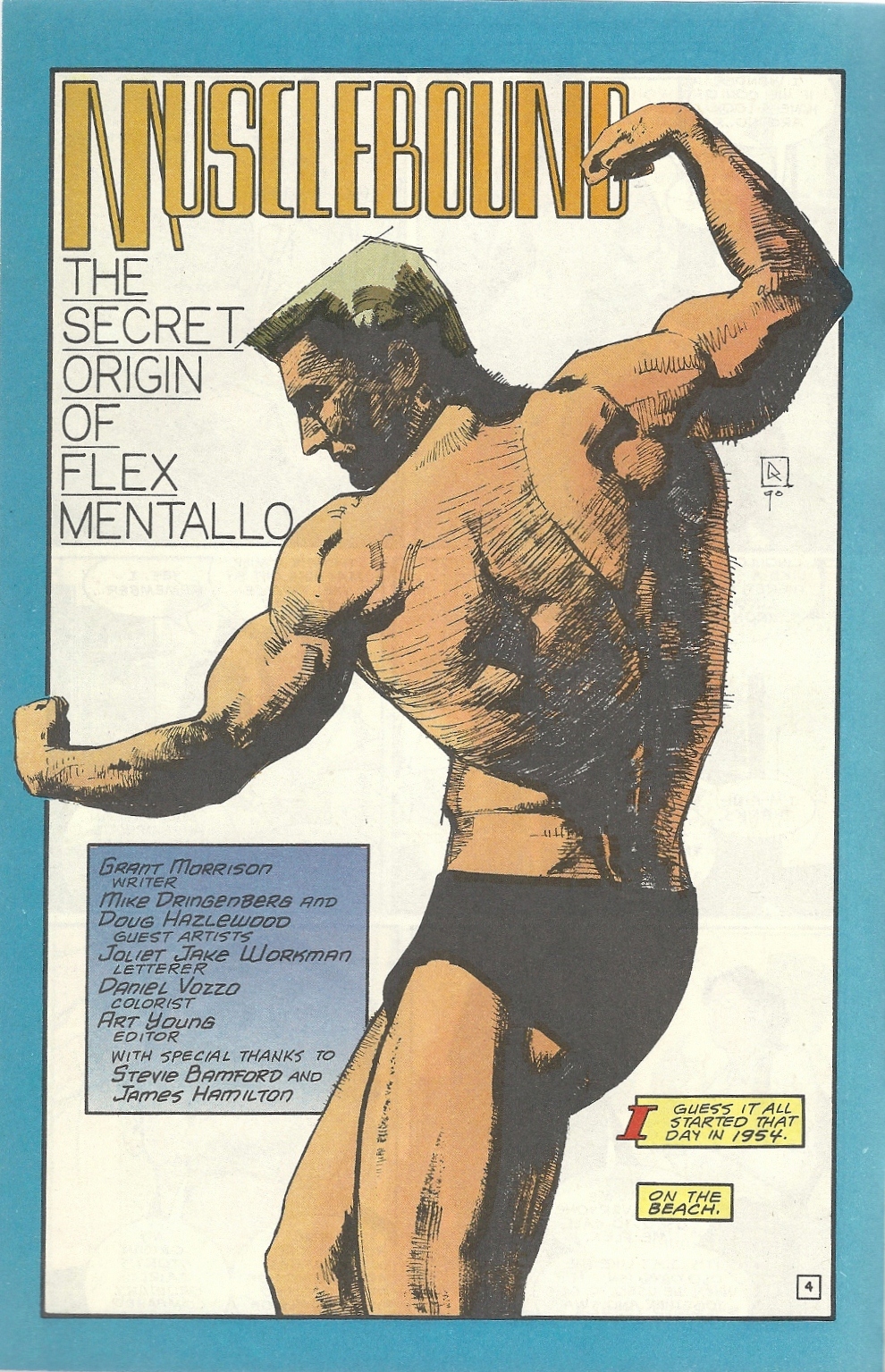
Oh, but there’s so much more. Grant Morrison, Mike Dringenberg (who partnered with Neil Gaiman to craft the only truly terrifying arc of Sandman) and Doug Hazlewood teamed to bring us “Musclebound.” Much of the story’s action occurs in flashback as Flex recounts his origin story. Said origin starts out much like the Atlas ad, and, in fact, the whole birth of Flex revolves around its “original” action:
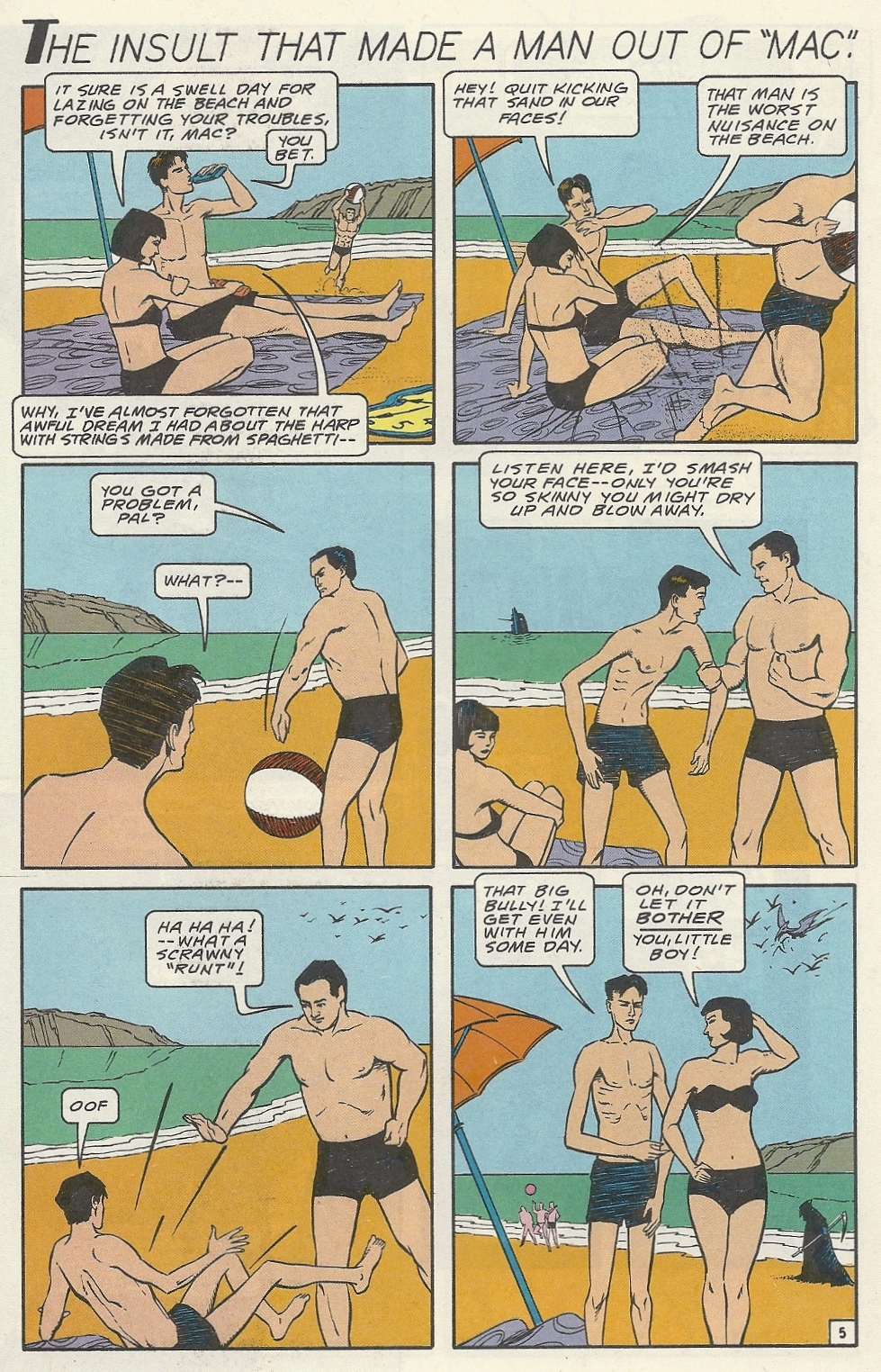
Poor “Mac” reacts in the same way to getting pushed around by a bully and dismissed by his girl:
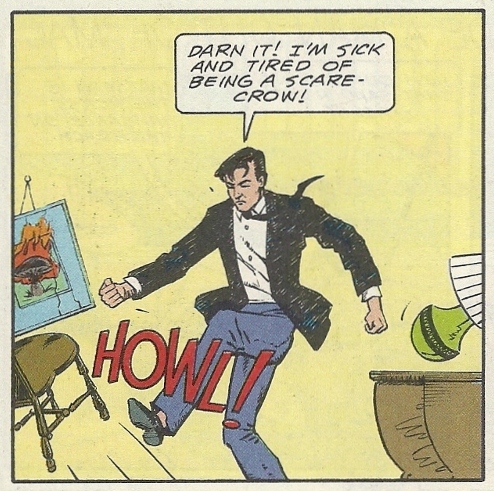
Note the picture of the burning mushroom on the wall. Huh? And “HOWL!”?
Mac meets a man on the street wearing a trenchcoat and certain odd accoutrements, who, through all too familiar puffery, promises to give Mac the physique of his dreams:
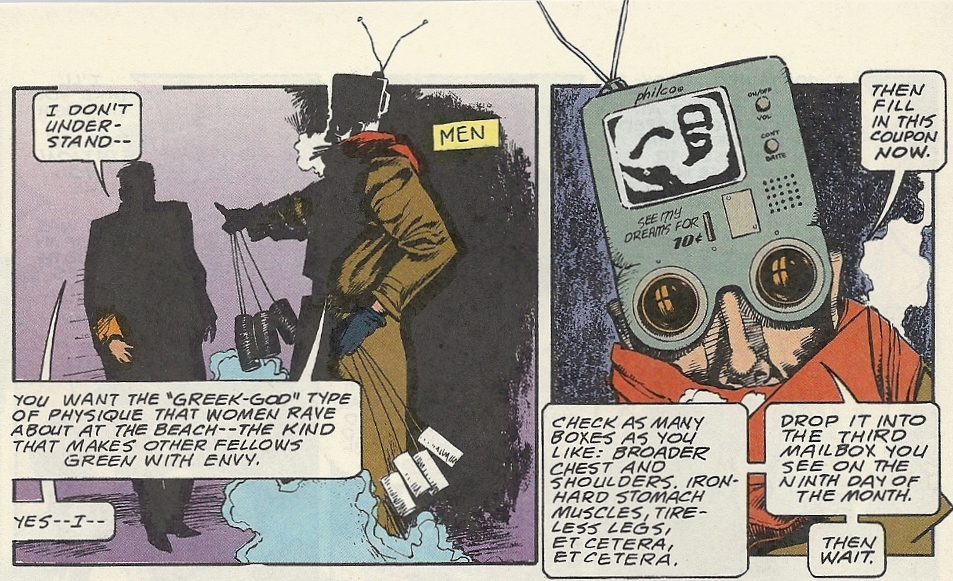
Check out the picture of Atlas on the guy’s “forehead.”
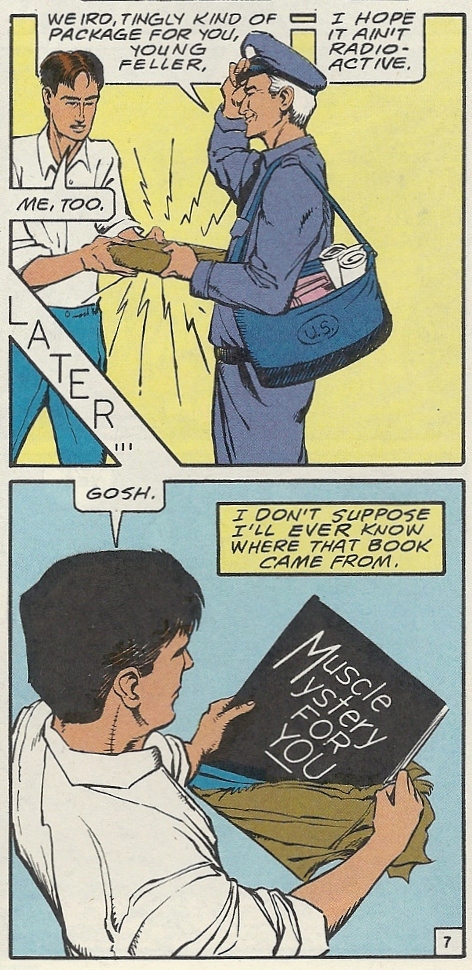
Mac soon receives a parcel in the mail:
The grand climax comes in this two-page spread, where “Mac” morphs into “Flex”:
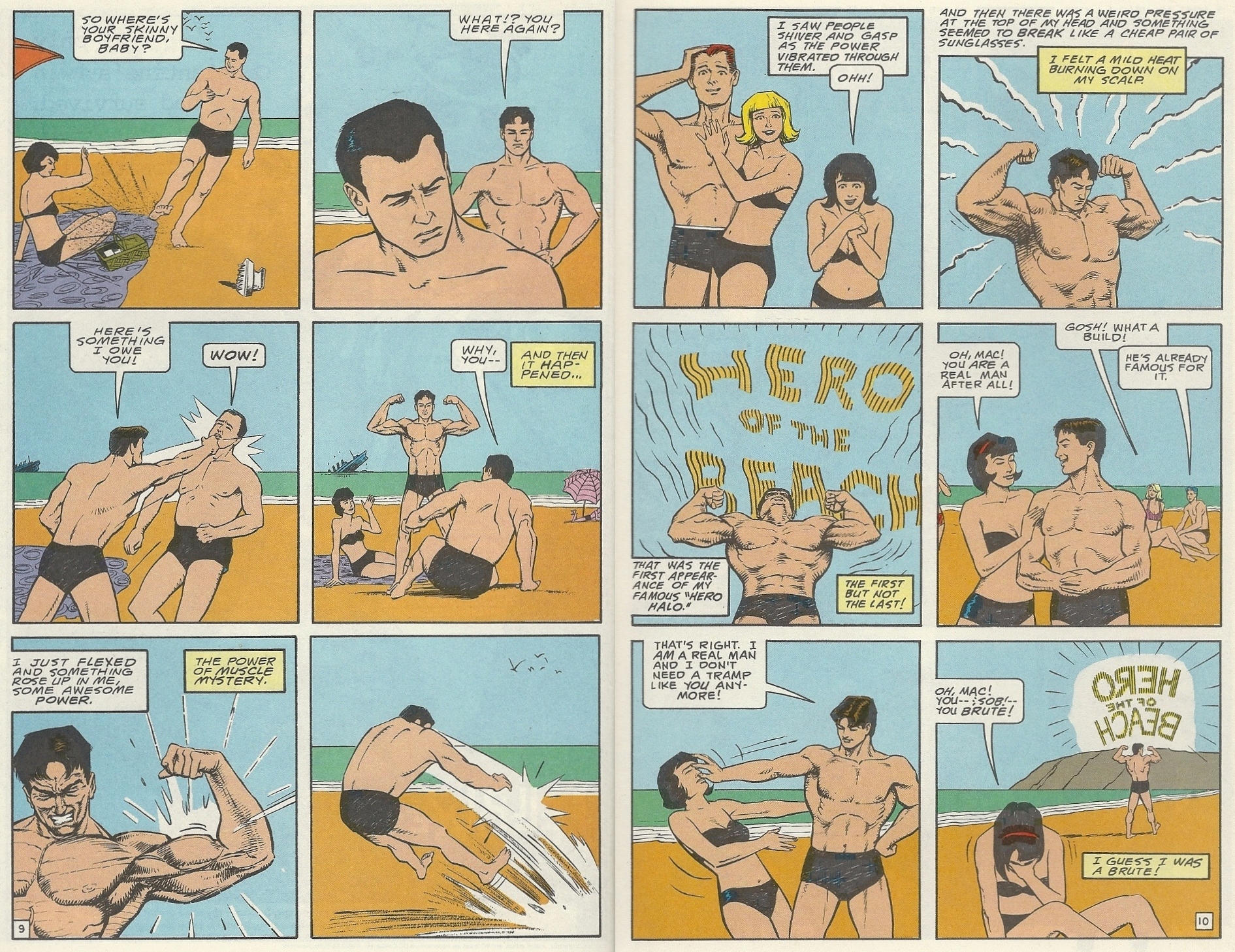
So when Flex flexes, it generates some sort of telekinetic (or kinekinetic, I guess) energy, and he later learns that he can transmute matter with his powers of “Muscle Mystery.” I love how the “Hero of the Beach” from the ad becomes his “Hero Halo,” and really, who can blame Mac/Flex for pushing his fair-weather girlfriend to the side? No, he shouldn’t have laid hands on her, but I think we all sympathize with the impulse. And I got a laugh out of his stiff-legged walk in the last panel, as he struts away while still flexing.
How can a person not be entertained by this?
The whole thing is a really clever incorporation of the Atlas ad into the broader story — and it’s good to know that I wasn’t the only one that got a kick out of that old chestnut. The Atlas heirs, however, were not amused, and sued DC. Thankfully there’s this little thing called “parody” in U.S. copyright law, and the suit was tossed to the curb.
Or maybe Flex flexed it to the curb, who knows?
I was dismissive before about the Doom Patrol, but on the strength of this issue I may delve a little more into Morrison’s run. It looks like a trippy, surreal trek through an odd little corner of the DC world. I feel like I owe this title a closer look just on the basis of the joy I derived from the Atlas stuff — some sort of karmic debt.
Now you’ll have to excuse me. I have some pushups that need doing.
And I love Snoopy!
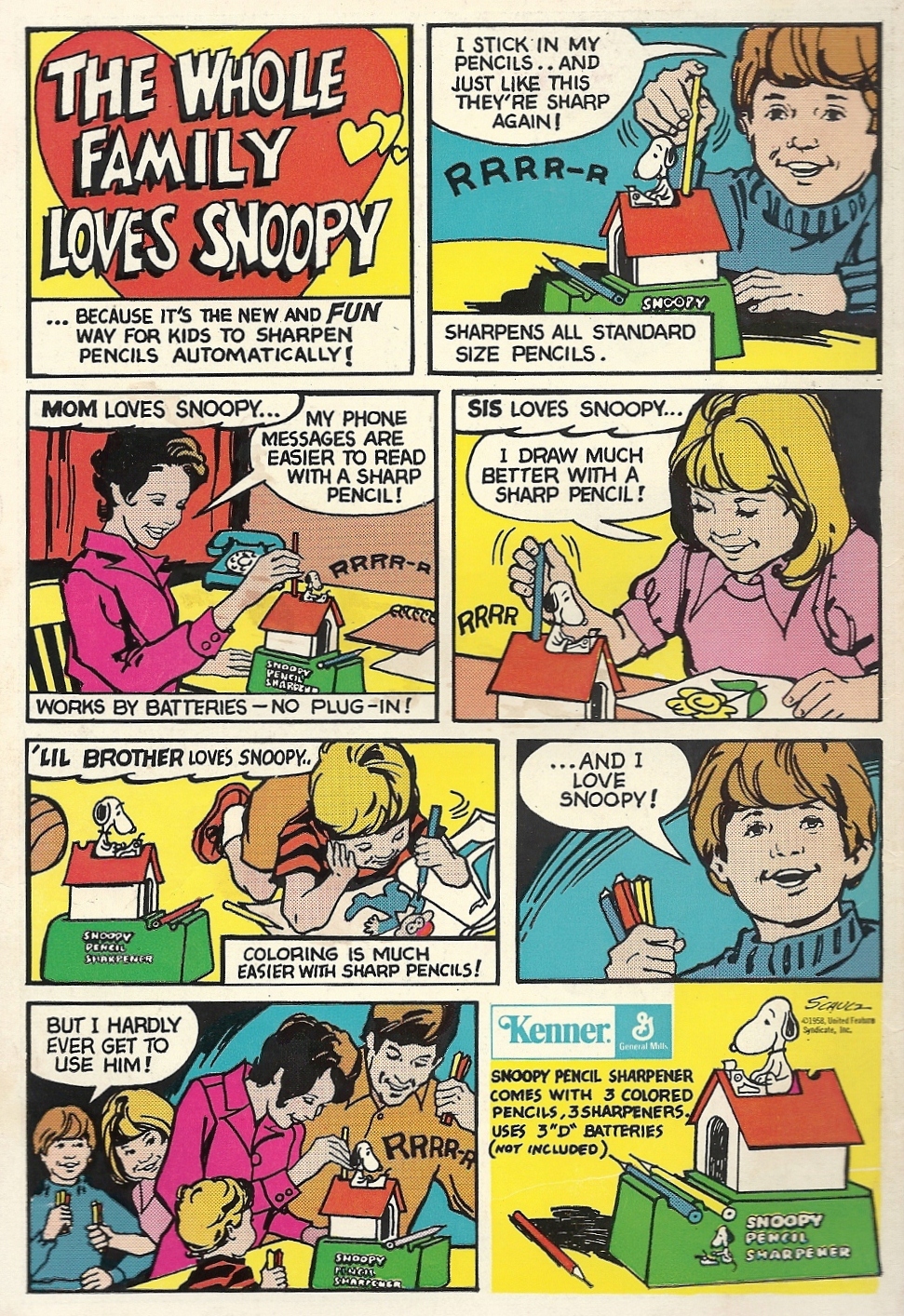
Ah, the days when families would spend a quiet evening gathered around the pencil sharpener. The fun never stopped back then.
My grandfather used to have a Snoopy pencil sharpener in his basement workshop, but the manually-operated wall-mounted variety. It was a bit out of place amongst the hacksaws and chisels, but I liked it. It was something aimed at my young-sprout demo in the middle of that grizzled manly world.
With this particular one, I appreciate the fact that Snoopy is on the roof of his house banging away on his typewriter — that one feature means that I wouldn’t mind having this knickknack on a corner of the Blog into Mystery desk.
“It was a dark and stormy night…”
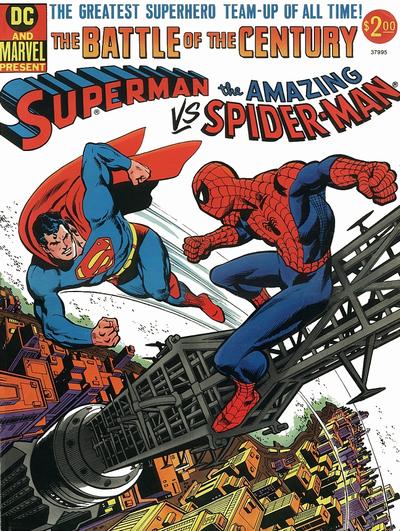
I waited a long time to read this book. My two favorite characters locked in mortal combat and eventually teaming up to defeat two iconic adversaries — how could one ask for more? It’s so big, I couldn’t even scan the cover and had to resort to an image culled from the web. Only a treasury sized binding could hold this action!
And it was a bit of a disappointment. We’re not talking a walking-out-of-The Phantom Menace-and-thinking-that-was-it? level disappointment, but one nonetheless.
The whole problem I have with the story lies in the central conceit that allows these two characters from different companies to coexist. My problem is that there is no conceit. Everybody in this story inhabits the same world, and they apparently always have and always will.
I had no idea about this going in. I had always pictured this story occurring because of a rip in the fabric of reality or something, perhaps a Lex Luthor experiment gone awry or a Doctor Strange spell run amok. Something. I realize that many intercompany crossovers take this tack, but this one vexed me for some reason. Perhaps it was the years of anticipation.
As it is, it all feels as organic as the Harlem Globetrotters showing up on Gilligan’s Island:
I suppose it could be me. Perhaps it’s the comics era that I was raised in. I just expected something, well, more. More than Superman and Spider-Man meeting for the first time and uttering variations of the “I’ve heard a lot about you” line. More than Lois and Clark and Mary Jane and Peter double dating. I’m sure there are a lot of others that are thankful that the story was handled in the way that it was, and that it was free from any rigamarole about getting these two together. I’m not one of those people. My loss, I suppose.
Man, my recent posts have been gripey, this one included. Sorry about that. I concede that there’s a lot in this book to recommend it — the action on the oversized pages being at the top of that list. Some of the panels are so wonderfully huge you could almost fall into them. Sometimes I get hung up things, though.
I’ve been a little under the weather lately — that’s my excuse for the recent negativity, and I’m sticking to it. I’ll make a concerted effort to be more sunny and cheerful in the days to come. I dont want “Blog into Mystery” to devolve into “Blog into Bitching.”
You load sixteen tons, and whaddya get?… – Adventure Comics #360
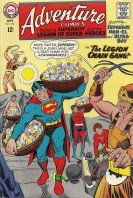
As the orcs sang in the old Rankin/Bass Return of the King: “Where there’s a whip, there’s a way.”
The colorful cover, with its promise of a shackled Superboy and pals slaving in a gem mine, belied the numbingly predictable story inside. Jim Shooter, Curt Swan and George Klein crafted “The Legion Chain Gang,” and I was going to summarize it in my usual fashion, but there just didn’t seem to be anything unique or noteworthy about the plot. Here are the brief bullet points:
The Legion of Superheroes is outlawed.
Superboy, Mon-El and Ultra-Boy are exiled to the aforementioned gem mine.
The President of the United Planets has been replaced by a masquerading villain (Universo) and he’s mind-controlling people.
The Legion, with help from the Universo’s son (Rond Vidar), exposes the plot.
There are a select few highlights in this one. Here’s the on-the-run Legion discovering an “ancient” and convenient underground hideout of Lex Luthor:
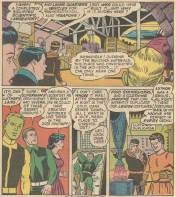
The forlorn exiles look pretty glum in this panel (just in case you wanted more shackled Legionnaires):

Here we have the unmasking of Universo:
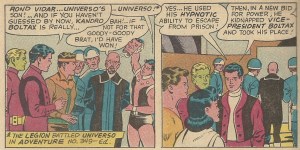
Finally, we have the thing that gives this book some broader significance, the (honorary) admission of Rond Vidar into the Legion:
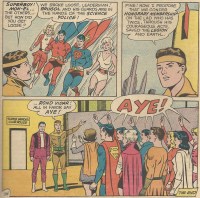
Swan provides his usual soft and eye-pleasing art issue, but this story just left me cold. Shooter’s best days with the Legion were still to come, it would seem. Or maybe I’m just being a little bit cranky today — a distinct possibility. It’s not that the plot is bad — if it was, that would have been great, because bad comics are just as wonderful as good comics. But it’s the definition of average.
Anyway, enough of this.
“Another day older, and deeper in debt.”

The merits of “We Are Gathered Here” don’t lie in the nuptials between Rick Jones and his blushing bride, Marlo. Though, to be fair, Marlo and her scarlet tresses look buxomly resplendent in her trampy wedding dress:

Throughout this special day an assortment of friends and enemies come to share in the merry-making, and Mephisto himself tries to foul things up. All that hazarai can be overlooked. The fun in this comes from the walk-on appearances by an assortment of characters, including the portly Peter David as the presiding minister.
For starters, I had totally forgotten who the hell the Pantheon were, and that Hector was an openly gay member of that team. But this little bit with Northstar compelled me to look them up and refresh my memory:

Gay flirting isn’t something that you see all that often in comics. Just an observation, not a judgment.
The real treat for me was this guy showing up for his old buddy Rick:

Hey everybody — it’s Rom! And his blue hair! It’s good to see that he and Brandy could take time out from repopulating Galador to come to Earth. And is it just me, or does the middle panel in the bottom row of that scan kind of look reminiscent of Ditko’s stuff? It seems that artist Gary Frank (or inker Cam Smith) might have been paying a little tribute to Ditko’s long run on the final issues or Rom, but I might be reading something into one little panel that just isn’t there.
The kookier cameo comes after the “I dos” have been said. Marlo bumps into someone that we recognize, but she doesn’t:

Just in case we still doubt that this is Neil Gaiman’s Death, we see that she’s wearing a familiar necklace (with the ankh strategically concealed) and that she also departs with her usual farewell phrase:

What’s in the box? You want to know? Okay:

I invite you to ponder what the brush is for. I thought it might have some story significance. It doesn’t. I don’t know if I’m stupid for not getting it at first or if Peter David is stupid for putting it in. That’s all I’ll say.
Death as a wedding crasher. Gotta love it.
Be seeing you.
 Jared
Jared


 blog into mystery