Rod Serling’s dimension not only of sight and sound but of mind also has ample room for goofy aliens – Twilight Zone #26

If you were stocking some pop culture Ark to preserve assorted entertainment icons for future generations, Rod Serling’s Twilight Zone would have to be one of the first television series included. If you narrow the category down to genre anthologies, it’s the unquestioned champion of the field, the Charlemagne of its species. I remember years ago devouring episode after episode during the many holiday marathons and never tiring of the show. Though, as Jerry Seinfeld once pointed out, all the episodes were pretty much the same thing, it was amazing the amount of gold that could be mined from those simple black and white veins. There were no (or very few) effects. There were no sweeping scores. There was just a script and acting and your own imagination, making it sublime theater of the mind.
Serling was the kingmaker of this realm. Even the lesser Night Gallery, with its hokier stories but creepier opening montage, had its share of genius (and most of that share came from the less-involved Serling). He didn’t catch lightning in a bottle twice with that second foray into televised suspense, but that he came so close, without hands-on supervision, stands as a testament to his dramatic sensibilities. Even his scripted twist ending for the classic Planet of the Apes makes that film nothing less than a feature-length Twilight Zone episode, and that’s what makes the PLANET WHERE APES EVOLVED FROM MEN all the more grand. (And also means that, in an indirect butterfly effect way, he’s responsible for perhaps the greatest painted cover of all time.)
And then there were the Twilight Zone comics books, first from Dell, then from Gold Key, and then on from there. (If Ripley’s Believe It or Not! can have a comic, then by God The Twilight Zone deserves one.) The format of the show was theoretically replicated by the one-off shorts within, including opening and closing “narration” from a four-color Serling. Like the show, you can pull one out of the pile and enjoy it (or not) on its own merits. I chose this post’s issue for its sci-fi leanings — it has one of those “flying saucer” covers that the Overstreet guide loves to note.
The comic has Rod Sterling’s name on it. His headshot is right there on the front cover. He makes several appearances. But the contents inside (both Twilight Zone entries are reprints from the earlier Dell series) read like what lesser talents would imagine Rod Serling stories to be. And that’s what they are, the mimicked threads of Serling’s tales.
Let’s take a look. Consider if you will…
The first story (Art: George Evans) has a scammer of lonely hearts getting his spectral comeuppance. Here’s Rod, with his sartorial finery, to open it up:

This one starts out with promise but peters out at the end, with a climactic scene that could be incredibly creepy but instead lays stillborn on the page. The less said, the better. And we all want to get to the flying saucer.
Before that, though, there’s some filler. “Journey into Oblivion,” which sounds like an abandoned 1950s Atlas book, chronicles voyages — lost ships, lost planes, etc. — that vanished without a trace. The last segment, relating the story of a disappearing Chinese army in the Second World War (a story that may or may not be garbage), has some of the yellowest Asians ever to be found in a comic:

And now, at last, we come to the flying saucer tale (Pencils: Reed Crandall, Inks: George Evans). Poor Alvah Petty not only has a crappy job and a fat, domineering wife who makes him wear a frilly apron while doing dishes, but also a fat hippie son (Clyde) who won’t let him watch his Westerns — making his life one of Dante’s circles of Hell:

But Alvah has his diversions. He’s an inveterate sucker for any pointlessly hierarchical club. Elks. Knights of Columbus. What have you. (One wonders if he ever crossed paths with Ralph Kramden and Ed Norton at a Raccoon Lodge convention.) It’s in these environs that he finds release from his servile days:

Does anyone under the age of sixty belong to any of these things any more? Do they still recruit new members? Has the internet done away with them? Do people join kickball leagues instead? Most importantly, if they disappear, where will we find halls to rent to host depressing wedding receptions?
Alvah’s loathsome wife and son can’t stomach the poor guy having any sort of happiness, so they decide to play a prank on him, placing an ad in the newspaper for a new “Knights of the Galaxy” fraternal order, one that the old man can’t resist. He goes off to the address listed for the meeting, while bitch-wife and dickwad-son snigger at home and eagerly await his slinking return. But instead he comes back with a card signifying him as a new member of the Knights. And he keeps going to meetings, now while wearing a vaguely effeminate space suit — making one think that dressing up is a BIG part of his deal, and that the frilly apron might have been his contribution to his chores (and please note that the son is sporting the same shirt — SMELLY HIPPIE):

After one of these meetings, Alvah tracks some dirt on the carpet, and one-shirt Clyde gets the idea to have said dirt tested to see where Alvah is going at night (yes, the hippie son IS STILL WEARING THAT SAME SHIRT):

Ah, the days when you could just waltz into a lab run by a frazzled scientist in a white coat, with tables stocked with Bunsen burners and beakers filled with mysterious contents, and get stuff tested while you wait. WHERE HAS THIS AMERICA GONE? (Also, this story was first published before 1969’s Moon landing, so our meek patriarch was the first man to walk on the lunar surface, and not simply the first one to dirty clean carpets with moon dust.)
Finally we get to see the aliens (sparing us a Contact cock-block), as Alvah carpools to a Knights convention:

Really, there’s no downside. And yes, THE SON IS STILL WEARING THE SHIRT. There’s no amount of patchouli that’s going to exorcise that funk.
The stories in the Twilight Zone comics are standard for the genre. They’re okay. They don’t set the world on fire, but few did in these old anthologies. Compare them to the best that the television show had to offer, though, and they’re dreadful. They’re painful and obvious (with art, though, that looks fairly sharp). They aren’t a blight on Serling’s good name, but they don’t live up to his high standard. Not a crime. But not a feather in the cap, either. What else is there to say?
Now, time to go watch William Shatner mug and sweat while trying to convince everyone else on the plane that “there is something out there…”
Barq’s Root Beer getting into the temporary tramp stamp business was once worthy of a faux-1950s movie poster ad
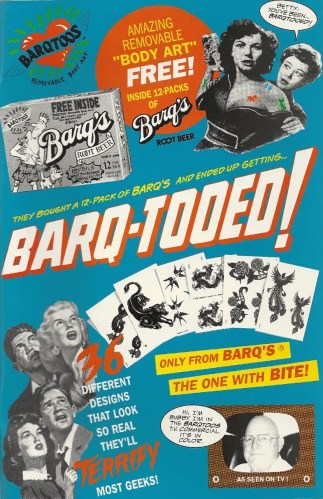
My father always calls Barq’s root beer “Barf’s.” I can’t say that I disagree with the essential truth of that malapropism, though I confess to washing down a tortilla-stretching Chipotle burrito with a towering cupful from time to time. Not sure what Dad made, if anything, of the 1993 Barqtoos, or the Mars Attacks! marketing that went with them.
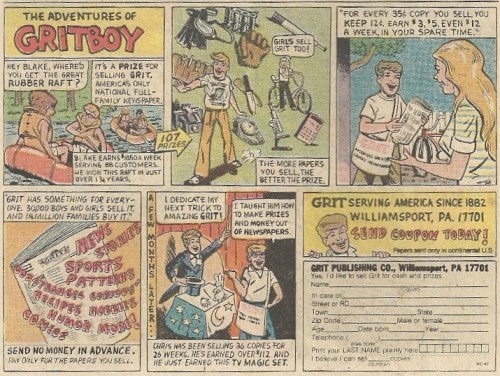
Was there ever a GRIT hot air balloon? Because that’s the only thing I’d have less confidence in than the raft. Hopefully there’s a bilge pump in that panoply of prizes. ROW ON, GRITBOY.
Somehow I blame Richie Rich for all this.
Bane and Catwoman are in The Dark Knight Rises. They’re also on this cover. How about that. – Batman #498
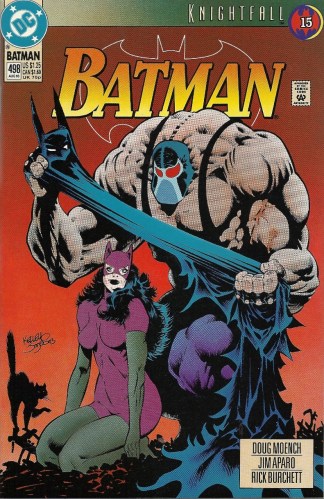
I’ll hold off on commenting on the most recent onscreen depictions of Bane and Catwoman until next week. Keep my powder dry. Will The Dark Knight Rises trump the stellar Avengers, or sink down to the maudlin depths of The Amazing Spider-Man? We shall see. But, to help us ring in the final week of anticipation for the culminating chapter of Christopher Nolan’s Batman trilogy, I thought it would be a good idea to go back to Bane’s initial arc, the infamous “Knightfall,” and him crossing paths with Ms. Kyle. And here we are.
Remember “Knightfall”? That entire “Batman Goes Down, New Batman, Return of Old Batman” multi-part tome dragged on forever. Seemingly spurred on by the craven impulses stemming from the “Death of Superman” receipts and a BIG ANNIVERSARY ISSUE EVEN NUMBER on the horizon, the Bat-titles were roped into a storyline that seemed to stretch for years. I remember seeing the trades now and then in bookstores, and the spines were like phone books. I mean, Dragonball Z plots unspooled at a faster pace. GLACIAL. Tolstoy without Tolstoy. But hey, we got goofy new batsuit armor with claws and a new pumped up villain along the way. Huzzah.
Last year, as the direction of Rises started to coalesce and we learned that Bane would be the big bad with Catwoman along for the ride, the above cover kept popping into my head. I probably hadn’t read the book itself since it came out, but the Kelley Jones frontispieces from this run, which seemed obsessed with augmenting Bane’s trapezius muscles with every issue (and adding more and more ab-ribcage globules as well), stuck. I wasn’t nuts about them back then. I’m still not. They were a little too cartoony for my Bat-palate, though, to be sure, I have no beef with Jones’ art. The collected Sandman tomes which feature his work sit proudly on my home’s bookshelves. But when it was clear that Bane and Catwoman were the dramatis personae for Nolan’s final chapter, what you see up there was what sprang to mind with the quickness of a word association test. For better or for worse.
And as for the comic, it’s now or never in terms of ever again cracking it open. If not now, when? I offer no grander commentary on the “Knightfall” arc, other than that I found it a boring waste of time, as there might as well have been a countdown at the bottom of every page for the inevitable return of the original Bruce Wayne version we know and love. I’m just making some observations about this one single book, taken on its own. For what that’s worth (not much, I know). And there’s actually some significance to this issue, a part of the lead-up to the big deal OMG ISSUE 500, and a few things that merit our attention.
You know what? This chapter, from scripter Doug Moench, penciller Jim Aparo and inker Rick Burchett, could be a lot worse. But it’s not. It’s actually, in a mild miracle, halfway decent. CALL THE VATICAN.
There are pro forma storyline beats, like Bane establishing his control over Gotham’s underworld — not with his guns (Venom-pumped biceps), but with his guns (guns):
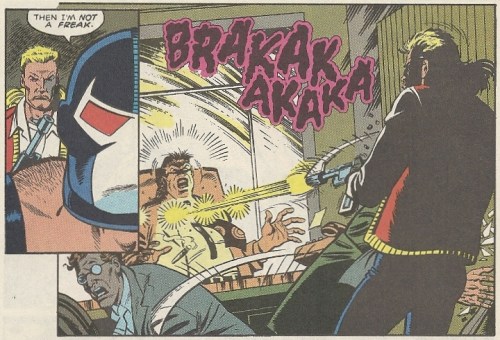
(On a side note, did Marvel’s lawyers ever get ramped up over Bane’s Spider-Manish eyes and his use of a substance called “Venom”? I can’t recall. One wonders.)
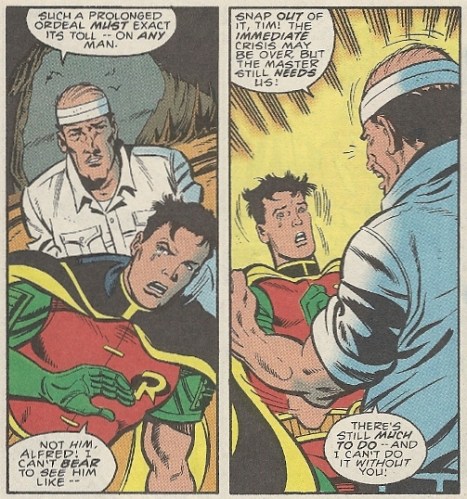
There’s a ton of “Sad Batman” on display in these pages, as the out-of-the-woods Bruce Wayne enters into the full-on depression stage of his long (LOOOONNNNGGGG), painful recovery. His musings on how Bane kicked his weak little ass are too much for the overwrought Robin:

I don’t think any of us like to see Batman whiney, in a neck brace and on his back (in two years Christopher Reeve’s riding accident would bring a terrible reality to superhero paralysis), and Tim Drake’s tears probably echoed the reactions of many people in the reading audience. Which makes Alfred’s Airplane!-esque SNAP OUT OF IT advice to young Master Tim applicable on a meta level:
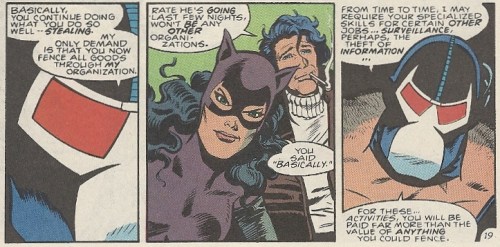
Off they go, inventing the cover story for Bruce’s injuries (a car wreck), setting up an in-house medical ward and calling in a private physician (Sondra Kinsolving) to care for him. As for Bane’s violent consolidation of the criminal element? He ropes in a skeptical Catwoman by issue’s end:
The most important part of this book is Batman’s other protegé of the time, Azrael (Jean-Paul Valley to his friends), donning the cape and cowl so that Gotham won’t feel abandoned in her hour of need — all with Bruce’s blessing. It’s apparently good enough to fool Jim Gordon, at least at first glance:
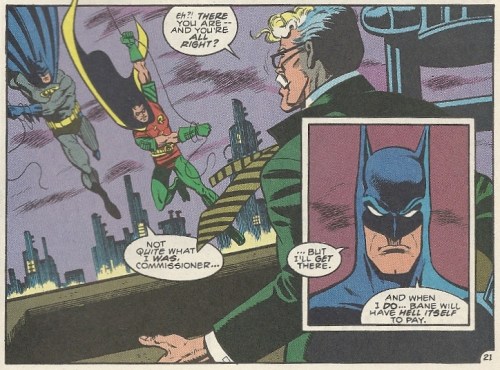
I think I once remarked that, as much as I love Aparo’s Batman, and I do, his male characters often had a sameness to them. I realize the cowl doesn’t leave a great deal of room for facial differentiation, but the Azrael-Batman looks EXACTLY like Batman-Batman. This isn’t a huge complaint, but it is kind of funny. Of course, this is a universe where a suit and a pair of glasses makes one an UNDETECTABLE MASTER OF DISGUISE, so…
I have terrible memories of “Knightfall” and everything about it. As soon as it started, I wanted it to end, because you could tell from solicitations where it was headed, and the concurrent Superman/Doomsday sturm und drang was leaving a bitter, pointless taste in my mouth. All that hazarai and you’re right back to where you started, you know? And God forbid any of the “major changes” to these flagship characters had actual permanence, like the real Superman being that snotty little earring-wearing punk Superboy, or the New Batman wearing embarrassing, garish armor that would make Tony Stark blush (WHY BOTHER WITH THE CAPE?). That would suck even worse.
It just seemed like a lot of wheel-spinning. Money-making wheel-spinning. Still does.
But, if you carve out this one comic from that whole, it actually has some quality. Batman’s dire straits, while extreme, do grab the reader. Moench’s script doesn’t set the world ablaze (the dialogue in the Bane-Catwoman sequence above isn’t exactly Mametian in its pop and intensity), but it doesn’t give you a headache, like a terrible Todd McFarlane script that makes you feel like you’re living inside a goddamn bass drum. And Aparo, though he was losing his fastball at this point (there’s a stiffness to the sequencing that I can’t quite describe, but I know it’s there), is still the definitive Batman artist of my generation, and his visual conception of everything in that orbit will always be held dear. Really, could anyone draw a stern, glowering Caped Crusader better? Even if the person behind the mask is (supposedly) different?
And Bane and Catwoman. I didn’t care about either of them then. I really don’t care now. Does this bode well for next week? We shall see. Maybe we’re all ready for a fresh take. YOUR MOVE, NOLAN.
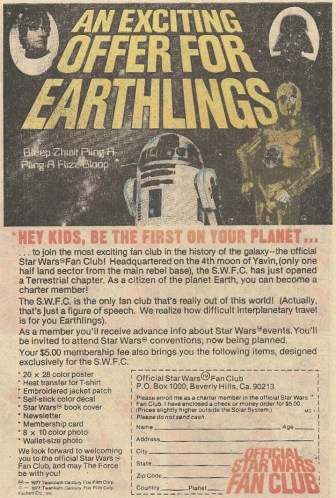
Joining a Star Wars Fan Club way back in that nebulous time before non-canonical Expanded Universe stories — heck, before The Empire Strikes Back, for that matter — must have been somewhat akin to buying Apple stock in 1980. Except for the “vast wealth” angle. But hey, you got an embroidered jacket patch!
Dorkier than the Jimmy Olsen Fan Club? YOU DECIDE.
The Spark Man was the Nazi-killing Inglorious Basterd of his day – Sparkler Comics #30
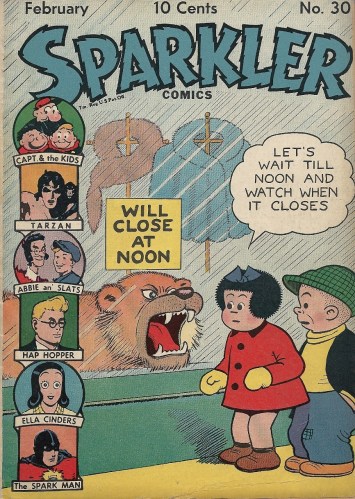
Sparkler Comics was a United Features strip cornucopia in the 1940s, a place where someone could catch up on any number of that syndicate’s properties as they worked their way through fresh stories. The left-hand headshots on this Nancy-dominated cover give you an idea of the roster in this issue, from forgotten characters like a Cinderella clone — Ella “Switch to Decaf” Cinders — and Hap Hopper, to timeless titans like Edgar Rice Burroughs’ Tarzan. And then there’s that guy at the bottom of the totem pole, the lone representative of the costumed hero demo. The Spark Man, just as forgotten as Ms. Cinders, fills the cape and tights quota, and rightfully so, since this is kind of his book. Spark Man. Sparkler. CAPISCE?
We’ll get to him in a moment. First, we have to note that World War II, which features in that character’s story, was still raging when this comic was released in 1944. That conflict permeates the entire book, even working its way into the advertisements (a couple of which have already been shown here) that hawk ancient wares. Lest we forget, here are two pages of text describing assorted acts of bravery and valor by American soldiers, pilots and sailors:
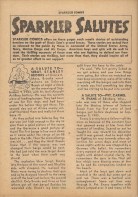
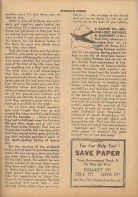
Please note the recycling plea in the lower right-hand corner of the second page. We can thank such patriotic appeals for the scarcity of War and Pre-War comics, so that the war machine had plenty of paper products. (I’ve always wondered what items were made out of recycled newsprint. No bombs, sadly.)
Now. Spark Man. He was at one point a normal gentleman by the name of Omar Kavak, but once he discovered that he could absorb and eject electricity, he decided to use this zappy power to battle evil WHEREVER IT MIGHT LURK. He started out wearing a costume, then began having out-of-costume-but-in-uniform adventures when the War broke out (in racially tinged fights with the Japanese), then returned to costumed hijinks by the time this issue rolled around.
The war was by no means over in 1944, but Churchill’s “end of the beginning” was long in the rearview. That endgame mentality finds expression in the Spark Man story here, as our hero, behind enemy lines, contemplates ways to make sure that the Nazi menace never rises again. Here he is with pal and cohort Voz, getting the idea to cull the Nazi herd (Script: Fred Methot, Art: R. Greenwood):
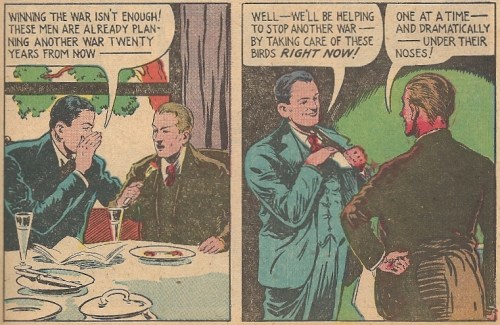
Their closeness, the nice dinner, the fancy clothes — all these things would probably send Fredric Wertham into a homophobic THEY ARE POISONING OUR YOUTH AND SEDUCING THE INNOCENT conniption. And that’s not even getting into their diabolical “fight fire with fire” plot to psychologically torture and brutally murder Nazi beasts.
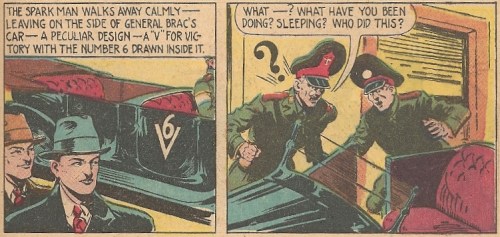
Ah, that plan. The first target in their assassination spree is an high-ranking functionary named Von Brac. Spark Man and his pal start off small, inaugurating their reign of terror with a gambit usually employed by drunken jilted lovers. Yes, they key Von Brac’s car (also, check out the GIANT POOFY ELMER FUDD NAZI HATS):
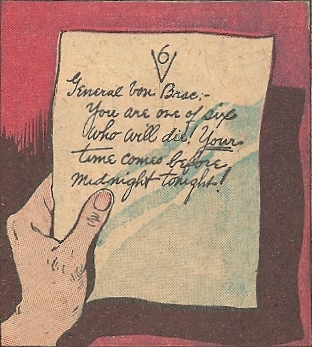
The torment continues with an anonymous threatening note (they should have used X-Acto knives to cut out some newspaper letters):
Von Brac doubles and redoubles his security detail, but that’s to no avail when up against the cunning of Spark and Voz. The latter creates a smokey diversion, while the former readies the coup de grâce. How does the Spark Man dispatch this Nazi butcher? No, he doesn’t fry him with his powers, nor is it clean and quick. A noose and some neck-stretching is just what the doctor ordered:
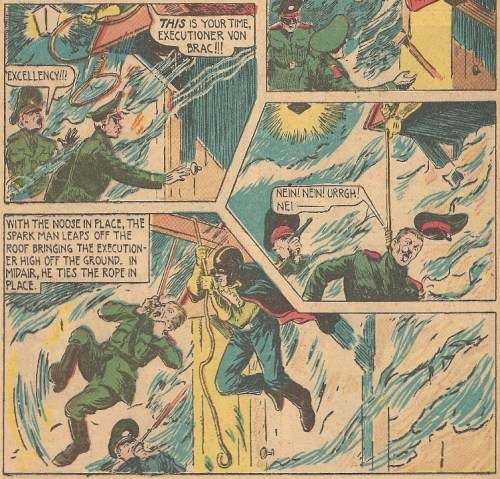
The Bear Jew has nothing on Spark Man. HE DOES NOT MESS AROUND. (And he also had to tie that noose’s loop pretty big to get it around one of those giant hats.)
And it’s not over. Monocles, mustache wax and steins are on full display when the next note is delivered:
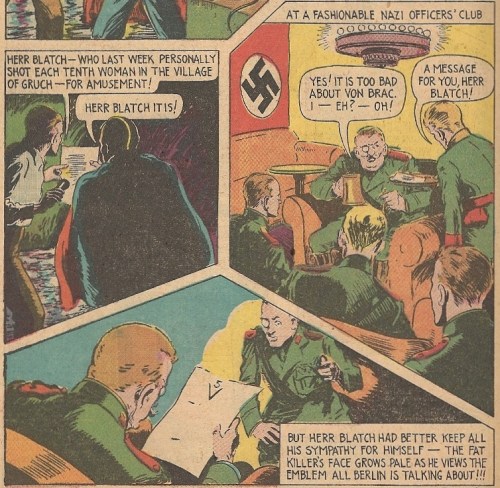
And there the slaughter ends, at least until the next issue.
It’s quite striking to juxtapose the Nazis in this story with those from subsequent decades, or more specifically, how they’re dealt with by the forces of good. When Nick Fury and his Howling Commandos would square off against their goofy mirror images or broke out of a prison camp, it seemed that no one would ever get hurt, not good guys, not Nazis, no one, and certainly not in such a gruesome manner as you see here. That’s the Comic Code Authority effect to be sure, but it’s at moments like this where the change really, REALLY stands out. I’m not complaining. I’m not wringing my hands. Just observing.
Incidentally, after Von Brac’s neck is snapped, Spark Man notes that just that morning he (Von Brac) had signed the death warrants of 100 souls. It’s as if the people behind this comic decided towards the end that they might need an extra dollop of justification for this brutality, another finger on the scale. Maybe hanging someone from a wooden beam was a bit much even back in those uncensored days.
If you put the carnage to the side, the art is quite good for the era. The panel construction is a tad busy, but the use of shadow and the lost craft of knowing when to keep it simple (like the note panel above) make for dramatic reading. There’s a delicious pulp feel to everything, a sheen that would make you want to revisit Spark Man in the future. Granted, it didn’t keep the character in the hearts of minds of comic fans for long. But you could do a lot worse.
I suppose the Spark Man is public domain by now, and I’m a tad surprised that Alex Ross hasn’t appropriated him for some ballyhooed crossover series with characters that nobody cares about which no one will ever read. His forte. Now that we’re in the post-Code era, 21st century Spark Man would at least have a chance to be worthy of the Nazi-hanging original.
Learn to play the piano under the tutelage of the most forbidding looking Big Brotherish instructor EVER
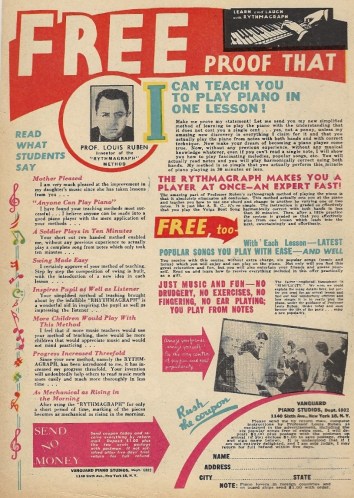
Perhaps Professor Louis Ruben was a kind, gentle, bespectacled man, a generous giant who passed his love of music on to subsequent generations. Or maybe he was a knuckle-rapping tyrant whose resemblance to Orwell’s Big Brother is anything but coincidence. Your guess is as good as mine.
Anyway, if you want to take a break from your no-effort workout regimen to learn the piano with little to no effort, it sounds like the Rhythmagraph method is right up your alley. THE UNATTRIBUTED BLURBS OF PRAISE HAVE CONVINCED ME.
X-Acto: The perfect knife brand to cut letters out of magazines for your ransom notes. IN ANY DECADE.
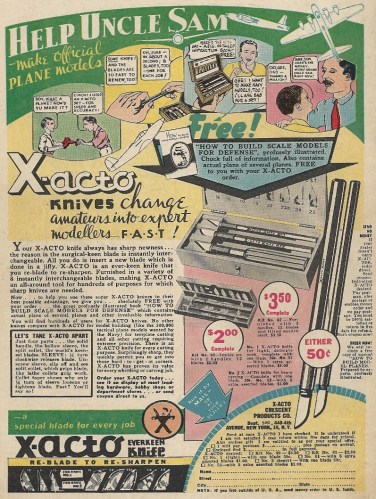
I think the “Help Uncle Sam” aspect of this 1944 ad for X-Acto knives is a bit tenuous, and one not helped at all by the primitive, cave-painting-level artwork. (It’s like something out of a Revolutionary era political cartoon. DON’T TREAD ON ME.) Not sure that building plane models was really going to be the tipping point against the Axis or any other future foes. Kid, buy a Victory Bond if you’re that concerned about Hitler and Tojo. Leave Mustache Dad to his pipe and evening newspaper.
And make sure to use the knives for wholesome, painstaking model work, and not for stocking your own private torture porn studio.
Pete Rose’s All-Star Game home plate collision, IN THRILLING BLACK & WHITE – Baseball Superstars Comics #4
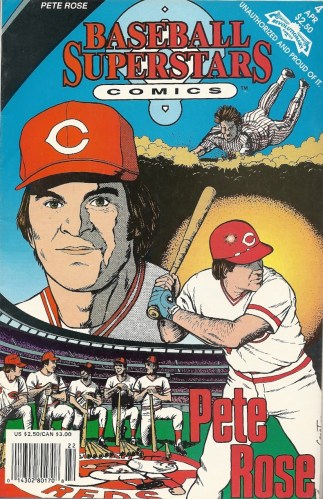
It’s that time a year again, when countless sports radio shows dredge up the infamous Pete Rose/Ray Fosse collision in the 1970 MLB All-Star Game as the paragon of either A) sublime hustle or B) stupid overkill. It’s become a tired sportstalk trope, an artifact from a decades old exhibition that refuses to die — much like the infinite “Does Pete Rose belong in the Hall of Fame” debates. They’re both worn but inescapable rites of summertime.
Which makes this as good a time as any to dredge up a hastily assembled, whimsically hagiographic biocomic of Mr. Rose.
Revolutionary Comics published a number of these baseball-themed books in the 1990s to go along with the rest of their “unauthorized” biographical accounts of celebrities, rock groups, politicians, etc. (An R.E.M. book was featured in a melancholy post here on the day that that band broke up.) They’re all of varying — but mostly terrible — quality. They all have a slapdash feel to them, like those scandal books you’d find at the checkout aisle in a Wal-Mart while said scandal is still fresh. JonBenet Ramsey: Now the Truth Can Be Told. Crap like that.
Most of the time the comics took on the sunshiney p.o.v. of hagiography, embracing wholeheartedly the tack that everyone is the hero of their own story. All well and good for most, but in Rose’s case it’s a bit harder. He’s spent time in the hoosegow. He never passed up a chance to make a quick buck hawking useless junk (the American Way, but still…). He has a lifetime ban from baseball. He was never a model of virtue. And these are the things that were established before this comic’s publication date. Now there are two more decades of embarrassing crap, from his appearances in pro wrestling to his rather pathetic baseball signing habits. It’s a tough retro sell to convince any reader that Rose is a marble model, a hero for our times. But here this comic stands, a varnished and very stilted take on the life and times of Charlie Hustle.
The story (Script: Mitsuko Herrera, Art: Greg Fox) starts on maybe the most awkward note I’ve ever encountered in a comic book:
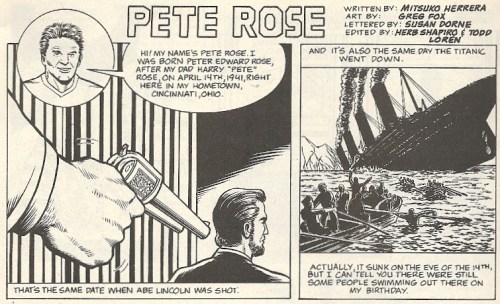
What do I take away from those two panels? That Pete Rose is somehow responsible for both the Lincoln assassination and the sinking of the Titanic, that’s what. PLAY BALL!
The story begins with Rose’s birth, travels through the fits and starts of his athletic career, up through the minors and into the bright lights and big cities of the big leagues. All the big names (like Mickey Mantle and Johnny Bench) and all the highlights are in there, including the aforementioned Midsummer Classic collision:
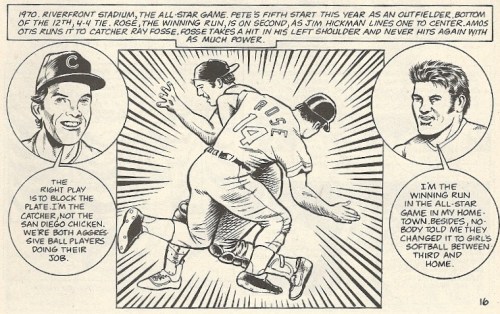
I’m sure Fosse was fine with Rose going all out, but it would nice of there was more perspective in here. The point and counterpoint leaves a little objectivity to be desired. “It’s fine.” “Yeah, it’s fine.” Okay then.
Here’s the moment when the all-time hit record of Ty Cobb (another subject of comic book biography) was broken — note the OMINOUS GAMBLING FORESHADOWING:
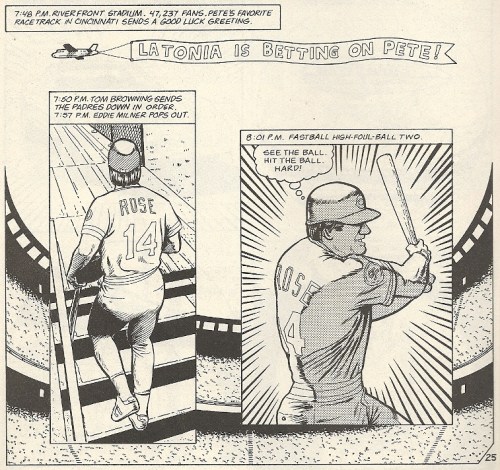
It was the betting that undid Pete, leading to both his exile from the game he was so skilled at as well as some time in prison (it looks like the late William Rehnquist was the jurist who sent him there):
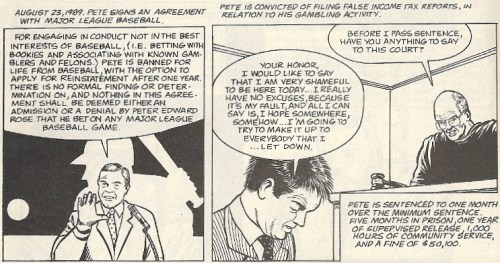
And that’s pretty much where it ends.
The book reads like a third-grader’s book report. This happened, and then this happened, and then this happened… It’s numbing in that regard. The art, while at times looking sharp (like the “hit record” panels above), isn’t enough to pull it out of the dive. There are sequences where the storytelling is horrendously bad. The death of Rose’s father is so stilted, I found myself laughing out loud. Which made me feel bad, because it’s talking about a guy’s Dad passing on. Which made me dislike this book, WHICH MADE ME DO IT.
It doesn’t help that the comic trips over itself to praise. It makes itself look foolish, devoting a significant amount of time to make the point the PETE ROSE NEVER BET ON BASEBALL, which rings doubly false since Rose finally admitted to that in recent years. That’s hindsight, but it’s unavoidable. Posterity’s a bitch.
I’ve always — in between eye rolls — felt great waves of sympathy for Rose, a man born to play a child’s game, but someone who never seemed to settle into the human thing called life. But whatever inclinations one has towards Mr. Hustle’s cause (and I have very few, just that sympathy thing), this comic will do nothing to further them.
Enjoy the game tonight. For once, my home town Washington Nationals are good and don’t have a single token “we have to have one rep from these dogs” player on the National League roster, but actual STARS like Bryce Harper and Stephen Strasburg, so I’ll watch closely for the first time in years. And hopefully no one will get their bells rung at the plate.
Hey, fellers! Learn Ju-Jitsu! Tear a bully’s arm off! Freeze your face in a terrifying Joker rictus grin!

This 1940s advertisement takes the more modern self-defense course promos and puts in somewhat unique elements, chiefly THE SCARIEST KID IN THE HISTORY OF COMICS. If you see that face, run the other way — there’s your self-defense. (And I, for one, would not want to see Jimmy “Lick Big Butch.” It sounds like prison sodomy.)
So Lighting Ju-Jitsu gives you the strength and leverage manipulation to slam a bully around like She-Hulk pummeling the Man-Elephant. Huh. Good to know, but we in the 21st century prefer to savagely powerbomb our bullies into oblivion, thank you very much.
Are Jack Kirby’s Black Musketeers hideously insulting? Inspirationally stupid? Neither? Both? – Black Panther #9

Oh Jack. Oh oh Jack.
The unfettered creation of Jack Kirby’s post-Silver Age period is an amazingly mixed bag. While his artwork was unleashed, entering into what may be argued to be his most fantastic, eye-poppingly delicious span, some of his story ideas crashed like the Hindenburg — all that was lacking was the pained voice of a shocked radio announcer. The pulpish “anything goes” attitude was sometimes undermined by words that simply didn’t live up to the pictures. Some might label this career epoch, thanks to the quality of the scripting, “Hack Kirby.”
I wouldn’t go that far. There’s an irrepressible joy in Kirby’s work from the 1970s, like a kid at play in the world’s biggest, most colorful sandbox. There’s a “Why not?” ethos behind so many of the work (a corollary to “Anything goes”), an optimism. But no one can deny that, at times, Kirby shot airballs. Swung at a ball in the dirt. Shanked it. Threw a pick 6.
It was one thing when his hit and miss sorcery was worked with characters like OMAC, Kamandi, or Devil Dinosaur, or, in the next decade, barely remembered titles like Captain Victory and the Galactic Rangers. But the title that’s a part of this post, Black Panther, was a departure from that purely experimental pattern. Yes, this was a character that he had, along with Stan Lee, created. But the Panther was well established by the time Kirby’s series hit the newsstands. T’Challa had solo stories (quite accomplished ones, actually) in Jungle Action to go along with his stints among the Avengers and in his original Fantastic Four stomping grounds. There’s sacred ground here too, because the Black Panther was the first black costumed superhero to grace the bigtime comic book scene in the United States. He’s a character with a pre-installed dignity, and a fictional self, as the benevolent ruler of an African kingdom, who’s not to be trifled with. He’s Aquaman without the suck.
So Kirby’s craziness had to mind its steps when going through this hallowed territory.
And?
This is one of those cases where there’s stuff that I just don’t know how to categorize. Is it unbelievably terrible, a blight to the newsprint upon which it’s emblazoned? Or is it exactly the sort of thing that makes people gravitate towards comics in the first place?
What am I referring to? THE BLACK MUSKETEERS, THAT’S WHAT.
This issue (inked by Mike Royer) is the costumed apex of the Black Musketeers arc. As T’Challa was away and Wakanda was menaced by an unstoppable mutated beast (wearing Fruit of the Foom underwear, of course), other members of the ruling family were called in to help defeat this foe. The roster included Ishanta, an older money-man, Zuni, a big fat lady, Joshua Itobo, a young Doogie Howser-esque doctor, and Khanata, a racecar driver. An eclectic foursome. As alluded, their unifying glue was that they were all cousins of T’Challa, making them the Wakandan Dukes and Duchesses of York. The Fergies. One imagines that if Wakanda had tabloids, their back pages would have a field day with these clowns.
And in this issue they finally get to cram themselves into goofy tights and headgear and hurl themselves into action. Most of their heroic derring-do comes in one page, after Khanata rams the villain, Jakarra, with his car (they needed to call in a specialist to do this?):

I’m not going to quibble with their results. They stepped in where angels fear to tread and all that. But boy, are they ever proud of themselves after this brief, adrenaline-pumping fight:

Yeah, I’m sure T’Challa would be beaming, and not pinching the bridge of his nose as he shuts his eyes tight against the piercing glare of your ridiculousness. Thinking “Now I know how Jimmy Carter feels.”
Speaking of chagrin, let’s cut to N’Gassi, the man who summoned the Musketeers to help deal with the crisis. I imagine he has the same response as any civilian administrator running up against the spending habits of a monarch’s family:

“Costumes? COSTUMES?”
THE FREE-SPENDING MUSKETEERS ARE EVEN INSUFFERABLE OUT OF SAID COSTUMES:

I’ll say it right now: Let’s cast Tyler Perry as Zuni in any future Black Panther movie. “Tyler Perry is Madea as Zuni in The Black Panther…” And Joshua Itobo looks like Scooby-Doo’s Velma.
Not to burst their bubble, but Jakarra isn’t dead, just immobilized, and he awakes more powerful and mindlessly hell-bent on destruction than before. So they just threw fuel on the fire. SO THEY SHOULD SHUT UP.
Remember the Black Panther? T’Challa, the star of the show? Wondering what he’s up to during these shenanigans? Well, it’s actually worthy of note. He’s wandering through the desert, trying to get back to his besieged realm. He passes out under the pounding sun, but is rescued by a film production. Yes, a film production. Let’s see if you can guess which mid-70s sci-fi/fantasy flick that was partially filmed in an African desert is referenced here:

There’s even a little dude inside the trashcan-looking white robot on the left. Jack might as well have named this diminutive actor “Lenny Baker” or something. And one wonders of the green dude next to him shoots first and misses the guy sitting right in front of him at point blank range. (YES, GEORGE, I’M STILL PISSED.)
Here’s the vaguely Mos Eisley-ish set:

Whatever. T’Challa eventually busts out of there and starts his journey back to Wakanda and his weirdo cousins.
Objectively, this isn’t that bad. It really isn’t. The story structure is standard, and the faux Star Wars is neat. But you never get a second chance to make a first impression, and it’s the cover blurb that bothered me most going in. “Black” Musketeers. The old impulse to slide “black” into every black superhero’s proper name is a grating one, and Kirby, with his Black Racers and whatnot, wasn’t alone in that. See Black Goliath, Black Lighting, etc., etc. And when I saw that little circle on the cover and thought ill of this thing at first glance. They looked more like doughy overgrown Mouseketeers than anything else. It’s like they come with ready-to-roll derision, you know? (We’ll let their lack of muskets slide. Apparently Wakanda has been thoroughly penetrated by the ideals of swashbuckling camaraderie found in the works of Alexandre Dumas.)
Never once in the comic itself is the “Black” appended to the “Musketeers,” and it’s odd to think that, had that small bit of copy been edited out, the entire outlook would have been altered.
But it wasn’t. Maybe I’m being too hard on this comic and the Musketeers, but they rub me the wrong way. They’re a bridge too far in Kirby’s 70s oeuvre. T’Challa deserves better, and so do the rest of Wakanda’s royals. Yes, even the dopey cousins, whether they’re fat, old, short or what have you. The Fergies. Even if they’re intended for comedic purposes, they stand out like sore thumbs. Some might see this as a low point of Jack’s solo period. A Black Mark, if you will. Put me in that club.
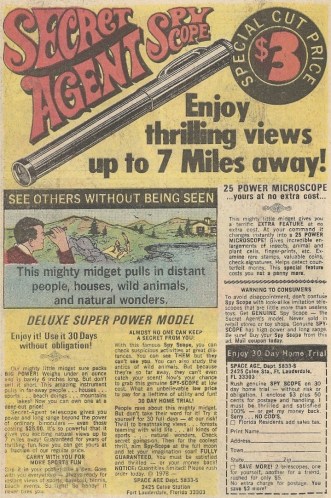
This ad takes the regular spy scope dynamic and piles on a new layer of creepiness. I guess you never know when in your secret agent spy duties you’ll have to peep on a young sunbathing couple at a respectful, restraining order compliant distance.
And I’d bet the mortgage money that Mr. Sweater is boxing the clown with his free hand.

Yes, at one point human minds decided that this was a story that needed to be told. Which is why people should love comics.
I confess to being no connoisseur of either the Oz or Wonderland fictional universes. My familiarity with the former begins and ends with the old Judy Garland movie, while I can’t remember the last time I ever sat through a pillar to post telling of Alice’s adventures through the Looking Glass. So perhaps I’m not fully primed to appreciate this series. There are surely levels that are flying completely over my head. People who are into either of these fantasy realms would surely go crazy with delight at the madness you see on the above cover, far beyond anything I could reap.
Yet I enjoyed it. More on that in a moment. First, a word about the caught-in-the-middle star(s) for those that might not be blessed with this utterly useless information.
Captain Carrot and his furry compatriots, including this series’ Zoo Crew, are firmly entrenched in the penumbra of DC’s Multiverse (on Earth-C under the old interdimensional mapping). They ran originally as an insert in The New Teen Titans before getting their own book, and their earliest crossover with a familiar character came in the first issue of their eponymous series, when Superman shifted dimensions to their world. That DC could so easily incorporate such silly, bizarre elements into their continuity proper — granted, at the distant fringes — has always been one of the better things about that imprint. Could Marvel sustain that? Probably not. It most certainly helps that the Man of Steel, DC’s pre-eminent champion, is an alien.
Also, the vast history of the imprint, which has swallowed other companies’ intellectual property whole at various stages (as we shall see in this very mini) makes it ripe for crazy cross-pollination. Rabbit heroes? WHY NOT? And, come to think of it, why not throw the colorful Oz and Wonderland pantheons into the pot. A righteous goulash indeed.
(It’s worth noting, all of this connectivity means that, in a Tommy Westphall chain reaction, Dorothy and the Cheshire Cat could cross paths with Batman. And the (Mad) Hatter could meet the Mad Hatter and cause a fissure in the space-time continuum or something.)
The Oz-Wonderland War was a long-gestating project growing out of the cancelled Captain Carrot comic book. Let’s let Roy Thomas, comic book eminence grise and Captain Carrot co-creator, explain the motives for putting it together — it’s a tale of Marvel/DC rivalry and cooperation, and of people who like telling stories wanting to have a good time:


You have to love Roy. If he’s not putting Conan in the greatest What If? ever, he’s trying to sink his meat hooks into Oz.
In case you don’t get to it up there, the creative staff behind this mini is E. Nelson Bridwell lobbing in the plot, Joe Cavalieri banging out the words, and Carol Lay (the star of the show) filling things in with the pens and inks. On to the story.
The premise for this clash of fictional planes (it’s not actually a clash, it’s more a mutual jumbling, so you won’t get Braveheart scenes with lines of gaudy characters screaming at each other across a field) is a villain, Nome King Roquat, who’s taken over Oz and cast its familiar characters into exile. Captain Carrot is roped into adventure by the Cheshire Cat, who explains the dire peril and its potential to spill over into his litter box, as it were:
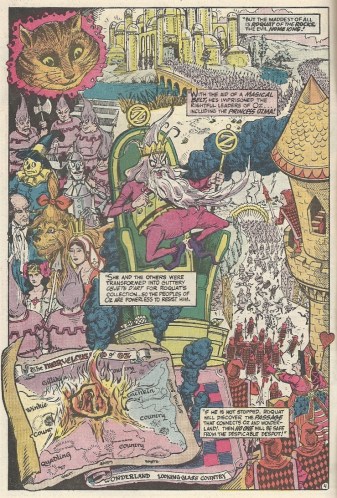
(Note: King Roquat took his throne-sitting cues from Loki and Mephisto. Or vice versa.)
If that’s not enough info for you, here’s a Star Warsish briefing, as Oz’s H.M. Woggle-Bug, T.E. fills the Zoo Crew in on their mission parameters:

No exhaust vent in sight. IT AIN’T GONNA BE THAT EASY. (They couldn’t have thrown Admiral Ackbar in there? He’d fit right in.)
This quest to free Oz’s luminaries is nothing if not fun, as the interactions between the characters, especially the inter-species affinities and rivalries amongst the menagerie of anthropomorphic critters, make for lively reading. I was most taken with a brief interlude in the second issue, as Captain Carrot finds himself interned with other bucktoothed and floppy-eared folks, including the Easter Bunny and the White Rabbit. Of most interest to comic book fans would be fellow hero prisoners Hoppy the Marvel Bunny and Wonder Wabbit, seen here:

It should be pointed out that, while Marvel Bunny was a pre-existing character in the Captain Marvel universe acquired in the Fawcett purchase, Wonder Wabbit is a fictional creation of Captain Carrot’s comic-book-writing alter ego and part of his fiction within a fiction JLA proxy, Just’a Lotta Animals. But she’s “real,” residing on Earth-C-minus, an adjunct of Captain Carrot’s OKAY MY F–KING HEAD FEELS LIKE IT’S GOING TO EXPLODE. If you want to know more, look around on the internet. That’s why it’s there.
Anyway, for a non-initiate like me, someone having only that aforementioned passing familiarity with the two venerable universes on display, the never-ending parade of characters can be numbing. In fact, now that I think of it, it’s probably what a person wading into comics for the first time at a late stage would feel. (And, oddly enough, why DC trashed the multiverse not long after this book’s 1986 publication date. The Crisis on Infinite Earths existed solely to wipe confusion like that off the map. I digress…) There’s a League of Extraordinary Gentlemen grandiosity to it that calls out for a deft hand to guide it home, and I’m not certain that Cavalieri, while game, is totally up to the task. But Lay’s stellar artwork more than makes up for any confusion. She manages to mix and match the populaces and recreate them so that nothing feels shoehorned in or out of place. Little things like Dorothy’s reaction to the Queen of Hearts — noting her bitchy similarities to the Wicked Witch of the West — come alive by her hand. She’s admirably faithful to the original conceptions of the Oz and Wonderland lineups, and I have a true admiration for her rendition of the Scarecrow. I’ve always felt for that poor bastard and his flammable flesh, and she invests him with the appropriate lovability, like your favorite childhood plush toy come to life.
Bottom Line: You can tell that those behind this had fun cavorting in these playgrounds. Consequently, you can see why DC published this even after putting the kibosh on the parent title. In an odd way this reminds me of the sendoff to the Golden Age/Silver Age Wonder Woman, something beyond their temporal proximity. Maybe because it’s so obvious that people cared about them both.
Captain Carrot and pals have popped up sporadically in the last decade, most recently in the Final Crisis series, but nothing has ever approached the endearing wackiness of this mini. If you find these three oversized issues in a bin somewhere, pick them up. At the very least, your eyes will thank you. And it might put a big Cheshire Cat smile on your face.

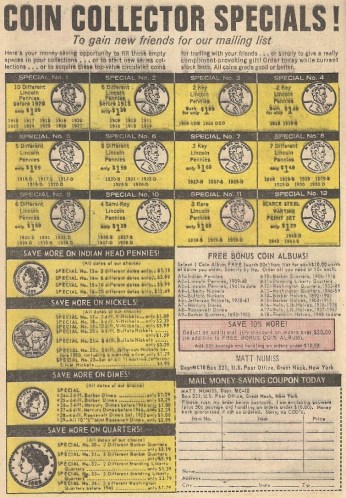
Whenever I see a coin collecting ad in a comic book (or one for stamps, or models, or anything else), I’m always reminded of that South Park where the boys were out playing Lord of the Rings and they came upon some other kids playing Harry Potter and Cartman let out a homophobic slur. Many hobbies seem silly (at best) to collectors of other things. For instance, models seem to me to be one of the most colossal wastes of time ever (some worse than others). I’d rather just skip to the part where I start bashing my head against a wall. But coins escape my derision, since I still have a box where I keep wheat pennies and bicentennial quarters, and still delight when some random foreign coin gets mistaken for a dime and is given to me as change. It’s from Malaysia. MALAYSIA.
So no slurs coming from this quarter — and no pun intended. Numismatists may go about their business unmolested.

I think you would be forgiven for glancing at this ad, mixing the soldier “Tongue Teaser” with the “Tongue Pleaser” and coming away thinking you should please a shy soldier with your tongue. Or maybe not. Whatever.
The above image was one of a series of bottom-of-the-page Tootsie Roll ads in the Blackhawk book reviewed here recently. Not only could you trick your eyes while pondering the Tootsie Roll center of a Tootsie Roll Pop:

But you could also appreciate the art of Rembrandt:

I wonder if that self-portrait was in his Superman phase.
Anyway, if you’re in the U.S., enjoy the Fourth. With or without chocolate rod.
 Jared
Jared


 blog into mystery