They never warned me about this at the Academy… – Adam-12 #8
Over the last year I’ve been watching occasional episodes of Dragnet and Adam-12 on either TV or Hulu. They’re the kinds of shows that don’t hold up all that well to more modern sensibilities, but they definitely still retain a certain enjoyment factor. While both programs labor under the straight law and order ethos of any Jack Webb production, there’s something very endearing about watching the two cop duos navigate the changing world of late-60’s/early 70’s Los Angeles. Of the two shows, Adam-12 is definitely more palatable to today’s audiences – unlike Dragnet it isn’t weighed down by Webb’s stiff editing techniques or his stolid narration (though I have warm affection for both of those “flaws”).
So I was happy today when I stumbled across this comic:
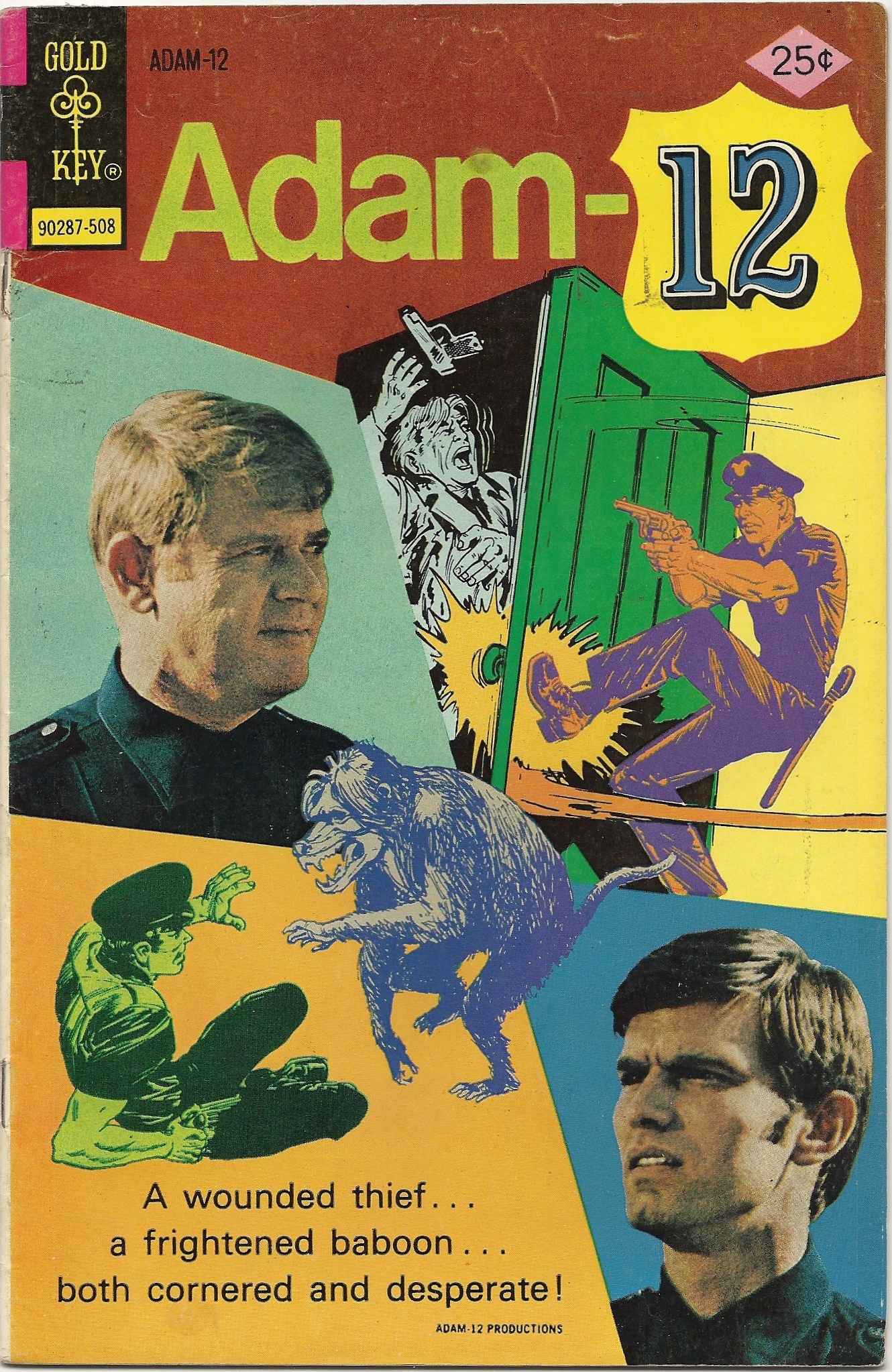
I’ve been looking to pick up an issue or two of this series for a while now, so I when I saw this one I snatched it right up. I laughed out loud at the idea of Officers Malloy and Reed confronting “a frightened baboon” – I don’t know what it is about that line, but it makes me chuckle. Maybe “baboon” is just a funny sounding word. Whatever. I’m even laughing a little bit as I write this. Though I guess if you’ve seen the pictures of the poor lady who was torn apart by that chimp up in Connecticut last year, being attacked by a pissed off primate is no laughing matter. So I might be tempting fate here.
As it turns out, the cover nemesis is a lady baboon named Godiva. Malloy and Reed manage to subdue her without killing her and at the same time catch a bad guy and save a passed out girl. Not bad for a day’s work. In the other story they crack a case with the help of an aging actor. Neither plot really grabbed me, but I enjoyed flipping through this ish – like I said, I’ve been wanting to pick one up from this run. Jack Sparling was the artist on this title, and while I’m not overly enthused about his work, I do think he handles action (cars swerving, etc.) quite well. But the whole endeavor kind of suffers from the Gold Key Star Trek diffculty- it’s hard to divorce the actors’ faces from what your mind tells you their comic depictions are supposed to look like. I didn’t really see Malloy and Reed in the faces as drawn by Sparling, and it doesn’t help matters that their flesh and blood mugs are right there on the cover. I know that this is my problem, not the artist’s, but still, it’s a problem.
In a cursory internet search I found that there was a Dragnet comic strip in the 50’s, but it doesn’t seem that there was ever a comic book based on the show. I love watching the later Dragnet episodes and seeing poor Jack Webb as the well-intentioned but stiff as a board Joe Friday trying to deal with the societal maelstrom that was the counterculture. Something tells me a Webb-penned comic from the 70’s would provide me with a few more warm chuckles. And it’s likely he wouldn’t even have to have a baboon in the mix to do so.
*sniff, sniff* I just love weddings *sniff* – Aquaman #18
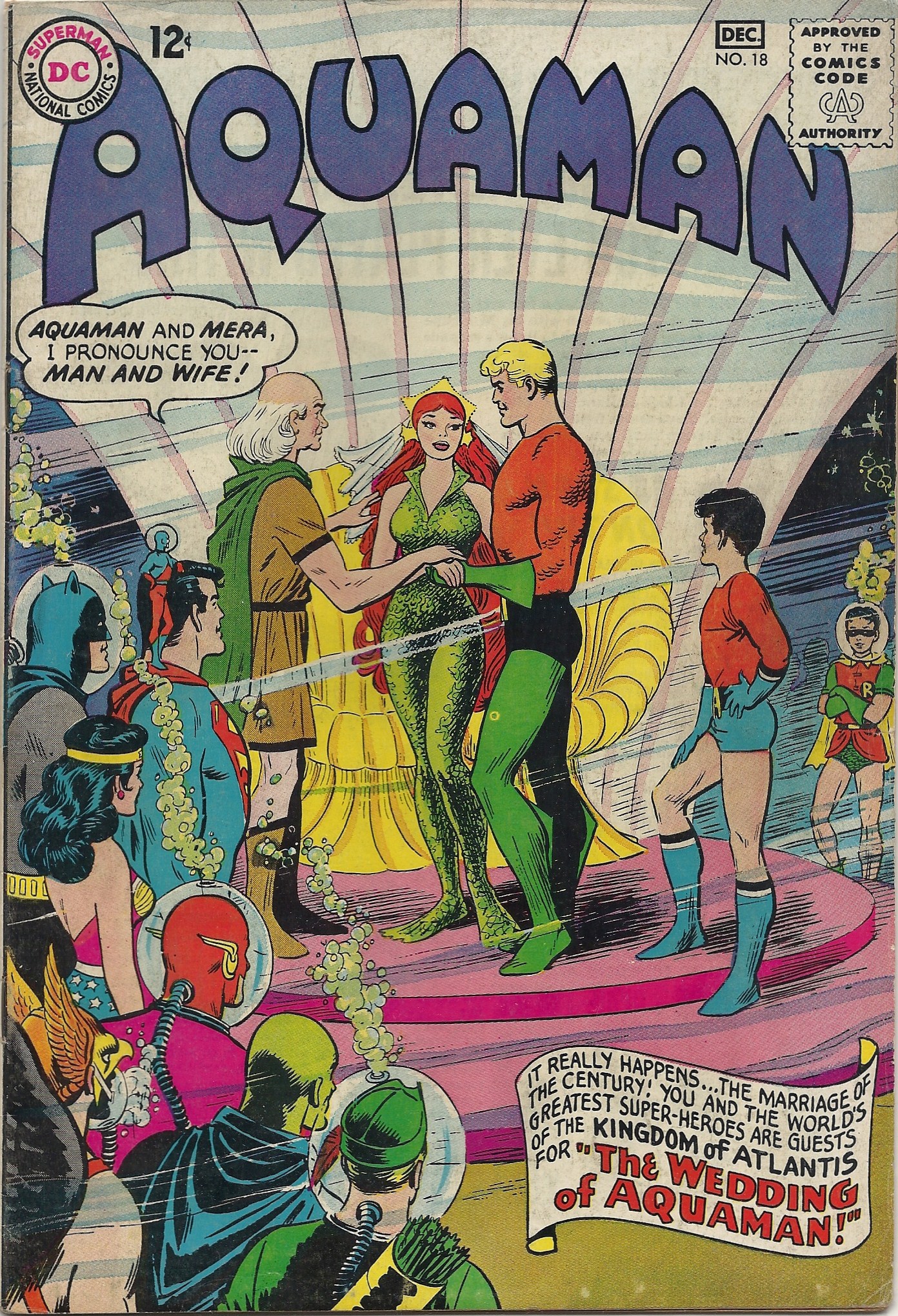
I was flipping through a dealer’s longboxes last weekend when I came across this gem. Let me amend that – I had come across this issue in the same dealer’s boxes a month beforehand, but for budgetary restrictions (i.e. I had already blown my cash) I couldn’t pick it up at that time. I was glad to see that he still had it on Sunday, and I’ve now rectified my earlier mistake.
Since the interior plot is a bit thin the selling point of this baby is definitely the cover. The story as written by Jack Miller can be summed up rather succinctly – Aquaman is named King of Atlantis but can only choose an Atlantean as his Queen and since Mera is from another dimension (I hate it when that happens) she has to prove herself by helping Aquaman defeat an usurper of his throne which she does and then Aquaman names her an honorary Atlantean and they get married.
There. That was easy.
Now for artist Nick Cardy’s great cover. And I mean GREAT. First and foremost, it’s just so damn colorful – it’s like a bowl of Froot Loops. For me one of the selling points for a lot of the early JLA covers was that they had so much going on palette-wise, and we certainly have that here. Every color of the rainbow is ably represented. It brings out that childlike “ooh pretty colors” response where you just want to lay your hands on the thing. Or, at least, it does for me.
Second, your eyes are drawn to the helmets some of the heroes are wearing so that they can breathe. This brings up two distinct thoughts in my muddled brain. On the one hand, I think it’s awfully nice of the Atlanteans to keep a golf ball sized helmet around for the Atom and one one that just fits over the mouth for Hawkman. You have to love considerate hosts, and I wonder if the two of them had to mention their needs when they RSVP’d, like someone who needs a vegetarian meal. My other thing is that I’m a little curious about what Superman, Wonder Woman and the Martian Manhunter are doing without helmets. Of course I realize that they’re the uber-powered members of the group and scoff at mortal needs like oxygen, but do they hold their breath the whole time they’re down there? Do they not regularly breathe when they’re up on the surface world? Can they breathe water? These are the kinds of questions that keep me tossing and turning in bed all night.
And finally – a true last but not least – I wish that I could find a hot redhead that would look at me the way Mera is looking at Aquaman. I’d even be OK with her wearing that green scaly getup of hers. Look at her eyes – to paraphrase Tenacious D and a certain SportsCenter anchor, “That’s adoration, Holmes!”
So I’m happy I bought this ish just for the cover, but I was kind of hoping for the DC equivalent of the Reed Richards/Sue Storm nuptials. You know, complete with the Justice League fending off super-villains attempting to sabotage the ceremony and all that jazz. Alas, I was disappointed. The JLA only appears in the last panel, which is basically just a recreation of what we see on the outside. But like I said, I’m content.
And don’t you think Robin looks a little cold?
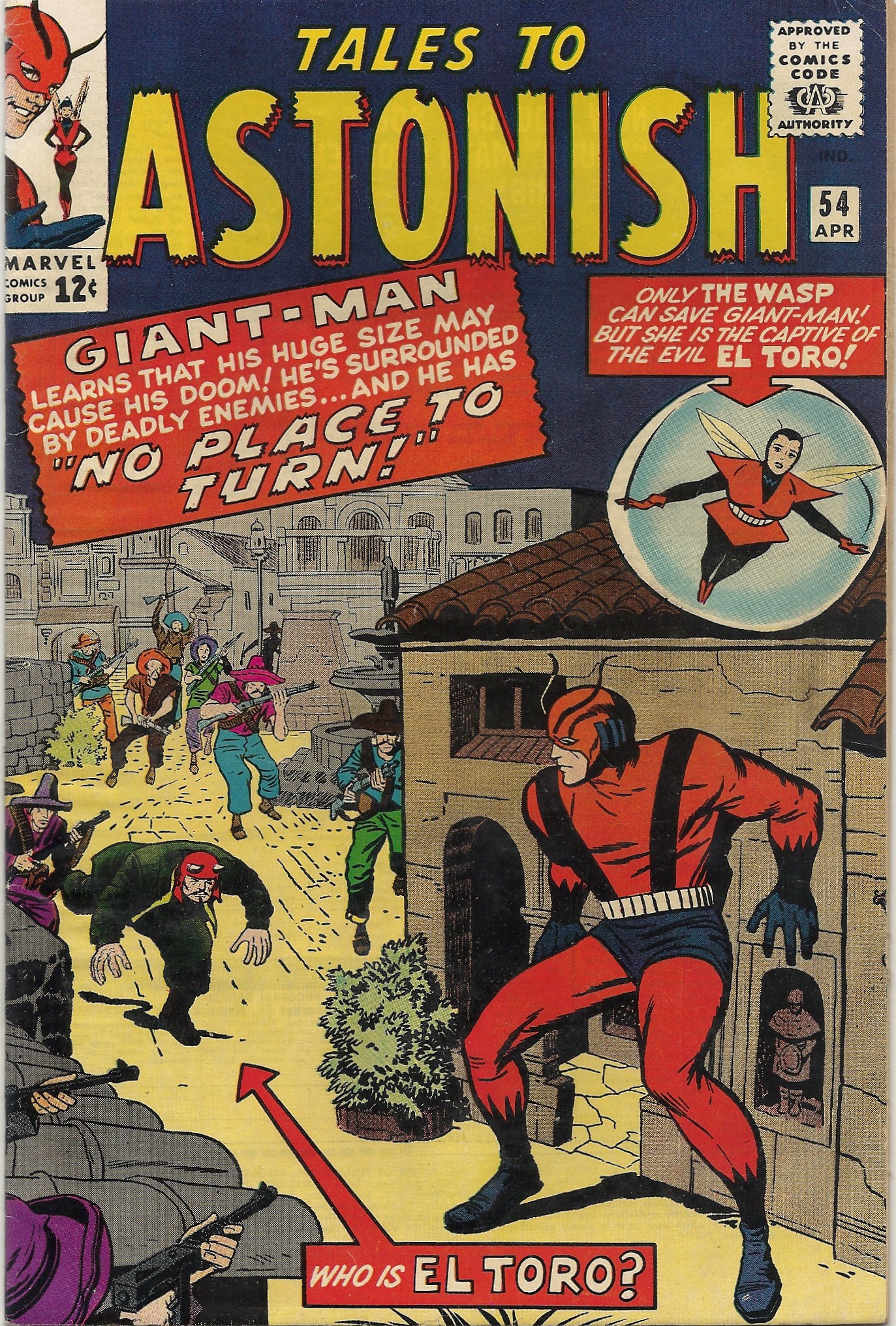
There was one thing that leapt to my mind when I first looked at this cover (sadly the cover is Jack Kirby’s only contribution to this ish), and it’s in answer to the question posed on the bottom, “Who is El Toro?” My reply is another question – “Who the hell cares?”
I’m not a huge Hank Pym fan – in fact, this is currently the only pre-Hulk Tales to Astonish that I own. But I bought it because, well, it’s Silver Age Marvel. How bad can it possibly be?
It turns out El Toro is a super-villain/Latin American dictator, sort of a Rhino/Hugo Chavez hybrid, since, as Hank notes when seeing a news report on this guy, he’s a “Red.” Plus he’s a little on the husky side, much like dear old Hugo. I guess because he’s a bad guy and a head of state (of the fictional Santo Rico) in the Marvel Universe this makes him a poor man’s Doctor Doom. A really poor man’s Doctor Doom, seeing how he’s rarely been heard from since this first appearance. And the “super-villain” label might be a stretch on my part, since all El Toro does is place a pointy hat on his noggin and headbutt people.
With an ability like that, it’s really no wonder he was able to grind an entire nation under his heel.
So what’s the story in this Stan Lee and Don Heck effort? Giant-Man/Ant-Man and the Wasp are called to Washington. The Feds suspect that the election down in Santo Rico was crooked. It’s not mentioned what made them believe this – apparently the fact that a man with a horned hat won was reason enough to think that there might have been shenanigans. Our couple (and I like the idea of a romantically involved crime-fighting duo) heads down and they’re quickly identified by El Toro’s security forces. Jan is captured and Hank is only able to swallow one growth capsule before the baddies get to him. This cues a long fight and chase as El Toro’s henchmen try to gun a stuck-at-huge-size Giant-Man down. El Toro even gets a solid headbutt in on our hero. The whole scenario gives Stan the Man an opportunity to show off his vast Spanish vocabulary of gringo, carremba, viva and si.
Eventually Giant-Man uses his ant friends to locate and free Jan. Utilizing the size-altering pills she had hidden in her purse they both break into El Toro’s HQ. The villain tries one more headbutt – no one warned him, I guess, that you can’t fool Hank Pym twice – but winds up crashing through a window and getting hung up on a flagpole. The indignity of that fate seems somehow fitting for this clown. Giant-Man takes El Toro’s secret documents which show the commies bought the election and flings them out the shattered window, and the people of Santo Rico vow to overthrow the guy. All is right with the world.
The backup stories are two Lee/Lieber shorts, one dealing with an art thief stealing a cursed painting and the other the Wasp telling a story to a kid she’s babysitting. The former is pretty cool, the latter not so much. I find that a lot of the backups in these old Marvel anthologies can be pretty hit and miss – these were no exception.
Despite my aforesaid indifference to the adventures of Hank and Jan, I liked this issue’s feature story a lot for the interplay between the hero duo and the fun of watching Giant-Man rumble around, but mainly for the preposterously stupid villain. The phrase “so bad it’s good” seems quite apt here. A cursory google search indicates that El Toro showed up years later in a few issues of West Coast Avengers. I may have to hunt those down.
Oh. My. God. I think I’m becoming an El Toro fan.
An Ode to a Licensed Character, Part 4 of 8 – Rom #72

We’re back for another go at the final issues of one of my childhood favorites, Rom the Spaceknight. In previous posts I’ve added some scans showing important moments in each story and highlighting Steve Ditko’s wonderful artwork. I won’t be doing that this time around, and there’s one main reason for that – Bob Layton, the inker in this ish. I mean no offense to him – I’ve enjoyed much of his work, but in this instance his inks totally overwhelm Ditko’s pencils, and since Rom and his cohorts don’t make appearances in this issue, I’m even less inclined to put in that extra effort.
So I’m being a lazy slug on this one. Sorry.
As you may notice from the cover, this is one of the innumerable Secret Wars II cross-overs that plagued Marvel back in the day. And yes, we’re treated in this issue to a huge slab of the Beyonder in all his jheri curled glory. He shows up at a mountain cabin where three characters are hanging out. We have the omnipresent Rick Jones, who’s suffering from cancer he developed while trying to absorb gamma rays to become a hero like his pal Bruce Banner. Brandy Clark is Rom’s human love and a one-time Spaceknight named Starshine. Rounding out the trio is Cindy Adams, a young girl whose parents were apparently killed by Dire Wraiths.
The Beyonder, in his desire to understand humanity – or whatever the hell it was that motivated him – grants Rick and Brandy their deepest desires. He turns Brandy back into a Spaceknight so that she can be at Rom’s side among the stars, and he makes Rick into a super-hero, so that he can fight for truth and justice and all that good stuff. Rick’s hero look is sort of nifty – an amalgam of the Hulk and Captain Marvel, two of Rick’s foremost super-powered acquaintances.
Cindy, of course, wants her parents back. And lo and behold, the Beyonder informs her that they’re not really dead. Their souls were taken by a Wraith, a Wraith that Rom banished to Limbo. The Beyonder sends Brandy and Rick to Limbo to go get their spirits, and in short order they succeed in yanking them out of the Wraith in question. They bring back two big pink pearls that represent Cindy’s parents, and the Beyonder reanimates them. Bring on the happy music.
This cues up a mind-numbingly boring conversation between the Beyonder and Rick about the nature of desire and getting what you wished for. It turns out Rick doesn’t really want the responsibility of being a full-fledged hero, and Brandy doesn’t want to be a Spaceknight. Rick just wants to be a regular cancer-free guy; Brandy just wants to be with Rom. The Beyonder makes it so. Rick walks off a healthy, normal man. Brandy is de-armored and teleported across the galaxy (we’ll learn later she’s headed to Galador). Cindy goes off with her parents. The Beyonder leaves to plague other Marvel titles with his presence.
There we go.
As much as I love this run of issues as a whole, this particular one leaves me a bit cold. Between Ditko’s overwhelmed art, the Beyonder’s unwelcome presence, and the lack of the Spaceknight Squadron, it’s definitely the weak link in the chain. But next time we’re in for some fun – Rom and his pals get to face off with a little thing known as the Shi’ar Empire. The action’s so big, a double-sized annual is barely able to contain it. Until then…
Hand that man some Gatorade! – Green Lantern #65
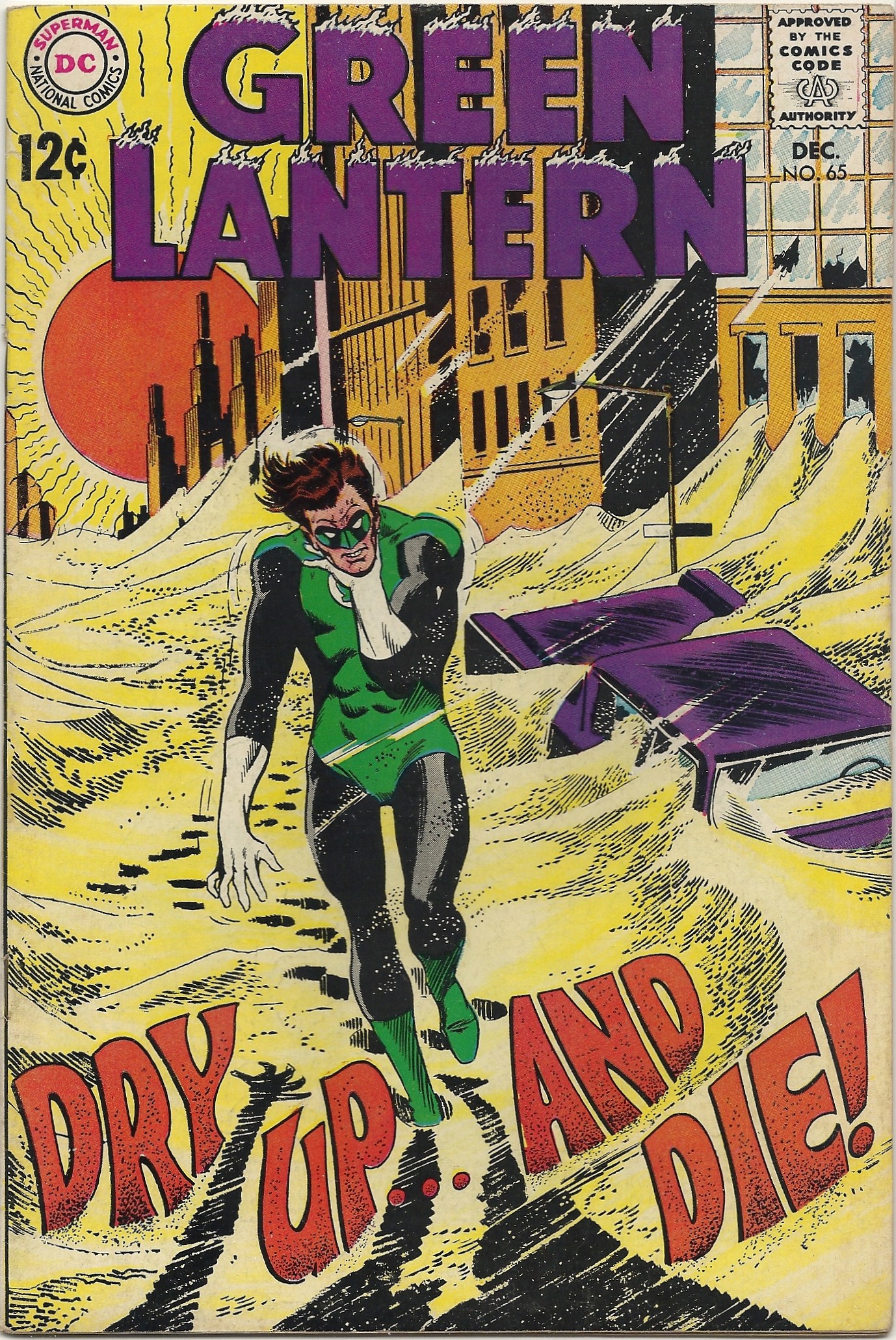
This one is a case where the story inside just doesn’t live up to the well-conceived cover hype. To boil it down …
Doctor Neal Emerson, the human and nice guy alter-ego of the evil Doctor Polaris is rummaging around the Arctic researching the magnetism of the North Pole when he stumbles upon a blue glowing globe. This orb increases his mental powers, sucks the water out of him and simultaneously warns him that it will eventually suck all the water out of the Earth, rendering it an arid wasteland. I guess we should all thank it for the heads up. Nice guy Neal decides to use his new telepathic abilities to warn Green Lantern so that he can stop it.
Comedy hijinks then ensue. Green Lantern keeps getting mentally and physically dragged in the direction of the good doctor, which interferes in a confrontation GL has with a few thugs. He gets roughed up but eventually overcomes them. (And at one point he stretches his arm Elongated Man-style. It’s not noted in the story that this is something weird, so I guess this is part of his normal powers, which I find bizarre. I don’t have a lot of familiarity with Silver Age GL stories, so maybe this is par for the course, but his ring having the ability to morph his own body seems a little much for me. But I digress.)
Soon nice guy Neal’s sinister mental alter-ego comes to the fore and gets into the obligatory fight with our hero. The Doc’s reasons for fighting GL are a little odd – he wants to let the orb work its magic because he’s not a physical being and once all the water is gone and everyone is dead, he’ll rule the world. I don’t think he’s thought that plan all the way through, but hey, he seems enthusiastic about it, so more power to him.
Anyway, Doctor Polaris puts a magnetic force field around Lantern’s ring which prevents Hal from using it (?), and then we’re treated to watching GL try to figure out how he can get his ring working again. Yawn. Guess what. He does. So he finally beats Doctor Polaris and triumphs over evil. He helps out the dehydrated Doctor Emerson and casually destroys the blue orb. Issue over. There’s also a side-story about Hal worrying about his girlfriend Eve discovering his secret identity, but that was lame too, so the less said about it the better.
I suppose that my main problem here is the unknown nature of this blue thing in the Arctic. So it’s going to dehydrate the Earth? WHY? And why does it arbitrarily increase Emerson’s mental powers? And thanks to GL obliterating it as soon as he comes into contact with it, the world will never know the answers. I guess the JLA didn’t have any good research facilities back in those days. Maybe they needed a HUD grant or something.
So that nicely fashioned cover is just speculation about what might happen if the orb runs wild. At no point in the plot is Hal left parched on a dry world covered in yellow sand. It’s a shame, but I guess it would be hard to fulfill that post-apocalyptic promise.
Mike Sekowsky, mostly known in the super-hero genre for his association with the early JLA books, handled both the cover and the interior art on this issue. I’m not usually that big of a fan of his art, but this cover in particular I enjoy very much. It might be due to the color design. I like it when the colors of the title and the “puffery” match up with items in the scene – in this case the purple “GREEN LANTERN” with the car and the orange “DRY UP AND DIE!” with the sun. It makes the whole tableau more pleasing for the eyes, or at least it does for me.
In closing – I like GL. I was happy to pick up this issue, mostly because it was in really nice shape and I got it at a good price. So I’ll overlook my problems with the story. This time.
You’ve been warned, Hal.
I was over in D.C. this past weekend and I stopped in one of my favorite used book stores, a little hole in the wall place that operates as a non-profit and donates money and books to local schools. Low prices, good cause – you know, all that stuff. The place has some nice out of print books, and for the cherry on top they also – sometimes – have a longbox or two of comics for sale at a quarter a pop.
Now, a lot of the comics are beat up and most of them are undesirable titles, but many a time while I’m picking through I’ll find some comics I can check off of my lists, for instance something like Batman comics from the 90’s. For that low price, I’m happy.
Now the way I see it, there are three prime joys in buying comics. One, there’s the nostalgia factor, buying comics you remember reading as a kid. Two, there’s the discovery factor, where you buy comics from areas outside your childhood window and learn the history of characters and titles. For me that’s comics in the Silver and Golden Ages. And three, there’s the rediscovery factror, where dormant nostalgia is awakened when you find something you had and enjoyed as a kid and say to yourself “Oh man, I can’t believe I forgot about this one.”
I had a bit of number three this past weekend with this comic:
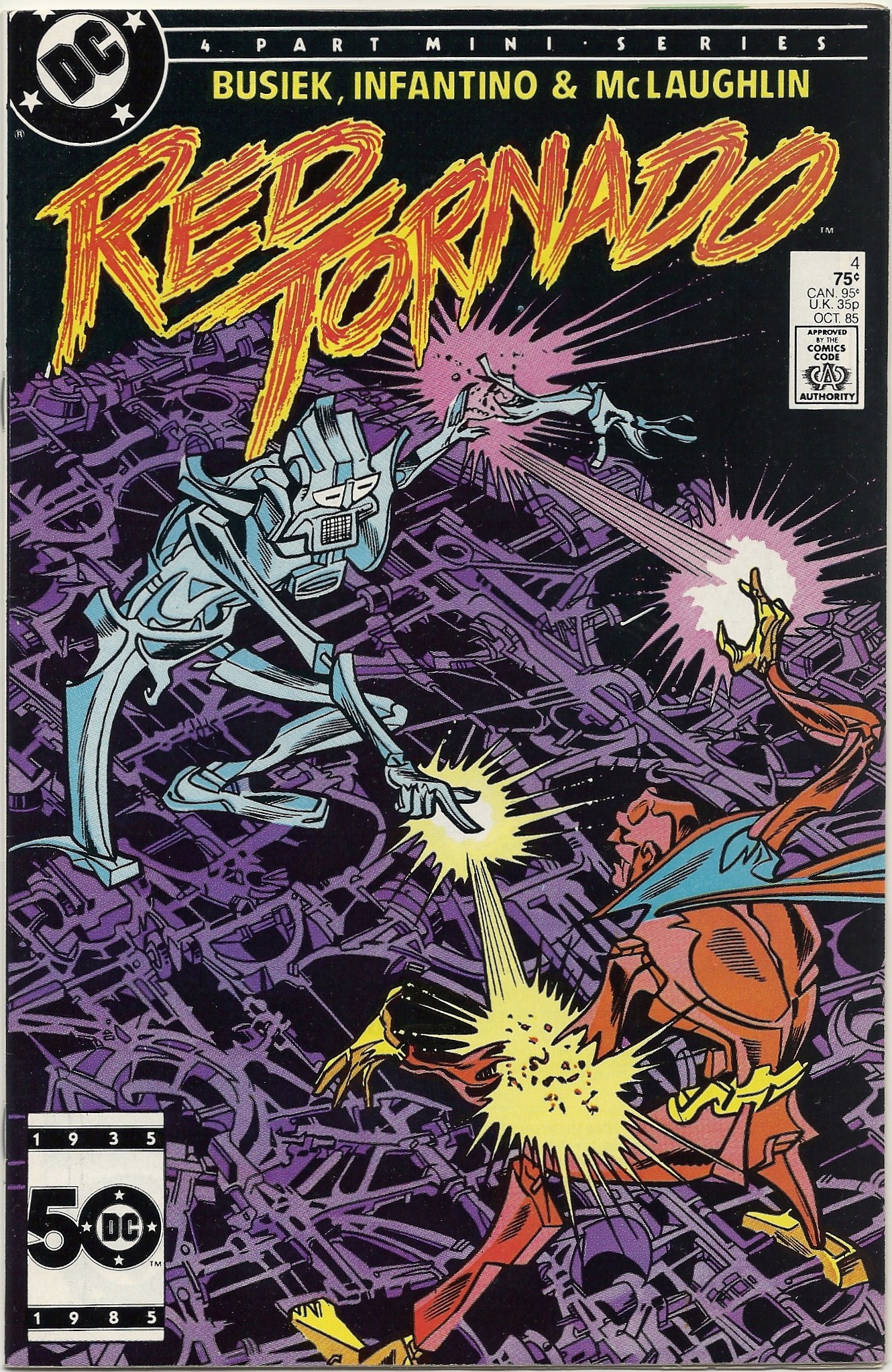
I had this book and I had forgotten all about it. I picked through the long-box and also found issues 2 & 3 of the series, but not #1. Oh well. Still, the only one I had as a kid was this one, #4, and that’s the one that made my day – like I said, that whole rediscovery thing. I can remember reading it and loving the artwork that Carmine Infantino put on each and every page. But it was the fact that I only had this last issue back in the day that started me pondering what it was that made me grab that particular comic off the rack all those years ago.
I had no idea. Then I looked more closley at the cover and specifically at the Red Tornado. You see, the cover is a representation of a fight he has in the story with a villain called “The Construct,” an entity that exists primarily in the world of circuitry. The Red Tornado meets his enemy on the enemy’s home turf, hence the odd appearance of his body on the cover.
Does his body remind you of anything? Something Infantino might have drawn a few times? Here’s an Infantino cover that might clear things up:

Am I nuts to think that the Red Tornado kind of looks like an empty Flash costume? The Tornado is especially reminiscent of the Flash’s costume when it would emerge from Barry Allen’s ring. The only cover image I could find of the costume-ring that Infantino drew is this one, though it’s not a very large (or very good, I admit) example:
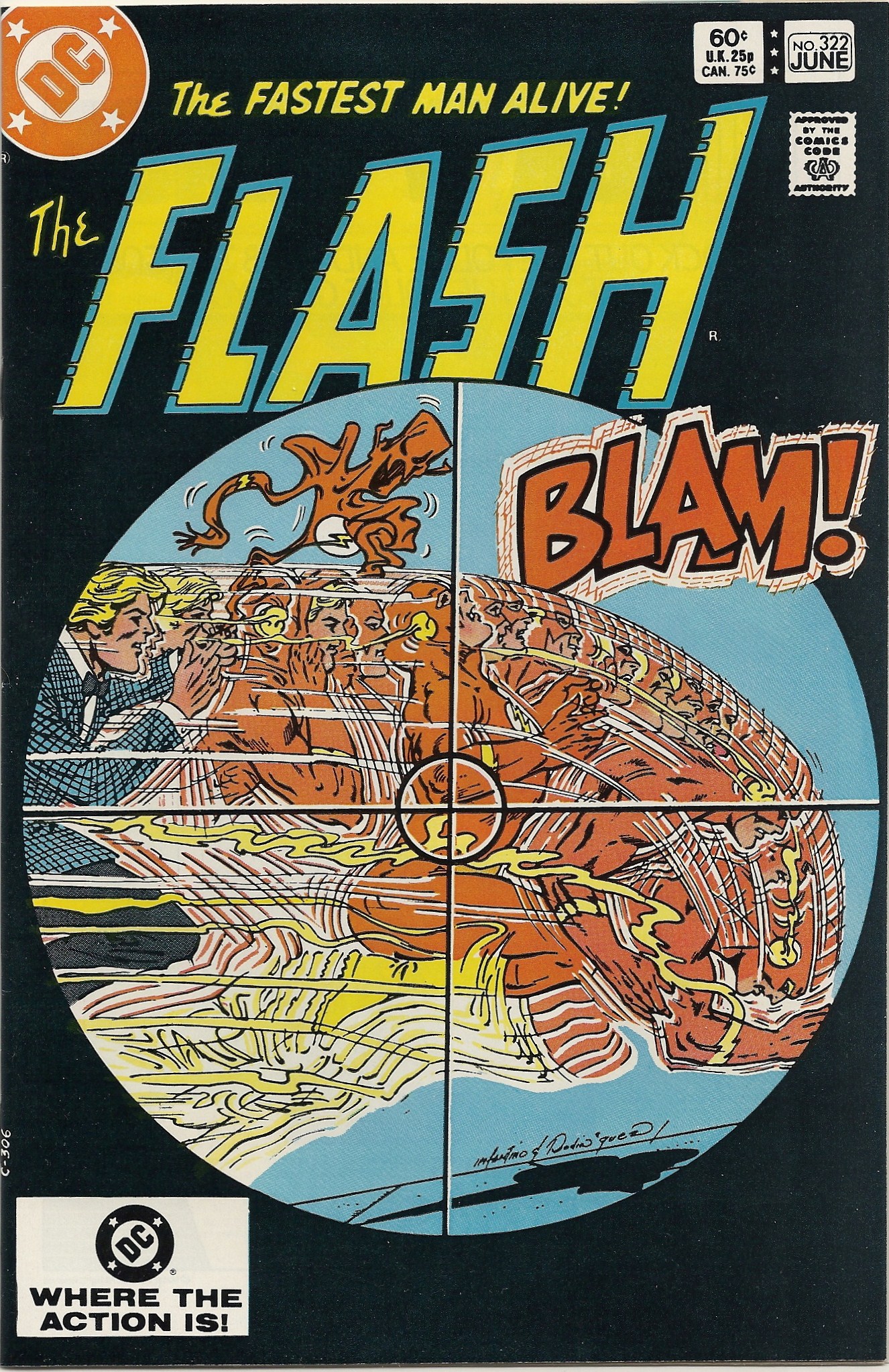
Beyond the obvious color pattern similarities between the two costumes, the Tornado’s “belt” – I’ll call it a belt for the lack of a better term – looks a lot like the lightning bolt belt that the Flash sports.
So getting back to my curiosity about why I bought that particular comic, all I can come up with is that the Infantino Tornado made me think of the Infantino Flash. And as a side note, Red Tornado #4 came out the same month as The Flash #350. I can remember how much the whole “Trial of the Flash” storyline meant to me, and maybe in that time period I was just crazy for everything that even remotely looked like the Scarlet Speedster. Then again, I’ve mentioned before how sometimes I’ve got Infantino on the brain. Maybe I did back then, too.
That Sure Looks Fun – Miracleman #16
Back in my youth – a time period that simultaneously feels like a thousand years ago and just yesterday – I used to occasionally order comics from one of the mail-order businesses that advertised in the books. If you’ve ever read a comic from the late 80’s and early 90’s, I’m sure you’ve seen the full-page ads for American Comics, which morphed into American Entertainment, which in turn morphed into Entertainment this Month, and finally I guess morphed its way right out of business. I think it’s safe to say that buying those huge ads every month wasn’t the best of ideas for them, but, not having a true local comic store nearby, they were the only way I could get a lot of titles.
For whatever reason – I guess to sweeten the pot – they’d often toss in a couple of comics for free with a purchase. Nothing of any great value, and it was usually stuff I had never heard of. With one order Miracleman #s 1 & 2 from Eclipse Comics were included. My first thought was probably the 11 year old equivalent of “What the hell is this crap?” And then I read them. I was blown away. It was my first encounter with Alan Moore, and this revival of Miracleman (Marvelman in his original UK run, the British Captain Marvel equivalent) was unlike the other things I was reading. It was serious and frightening – I still haven’t encountered a character as terrifying as the all grown up and completely evil Kid Miracleman. The device of imagining “Hey, what if super-powered beings existed in the real world?” has been cliche for a long time now, but it felt right with this title.
Issue #2 (each of the early American issues collected short bits that appeared in the UK anthology Warrior) ended in a cliffhanger, and because of rights issues preventing widely available reprints and also due to my absence from the hobby for a long while, I had to wait until a couple of years ago to find out how Moore resolved things, resorting to scanned issues found on the internet. And even now I’m still left in the lurch, since the series was cancelled midway through a story-arc from Moore’s replacement as scripter on the title, a young pre-Sandman Neil Gaiman.
So I’m still hanging.
Now Miracleman stands as one of the great unfinished works in comics, but in spite of being stopped dead in its tracks there were so many fantastic facets to the story. Miracleman forsaking the fragile body of his alter-ego, Mike Moran. Kid Miracleman razing London to the ground while Miracleman is off-world. Earth falling in line behind its new overlords. The birth of the Children of the Damned-esque Miraclebaby. The gradual distancing of Miracleman from Mike Moran’s wife and his coupling with Miraclewoman. It was all just so well-crafted.
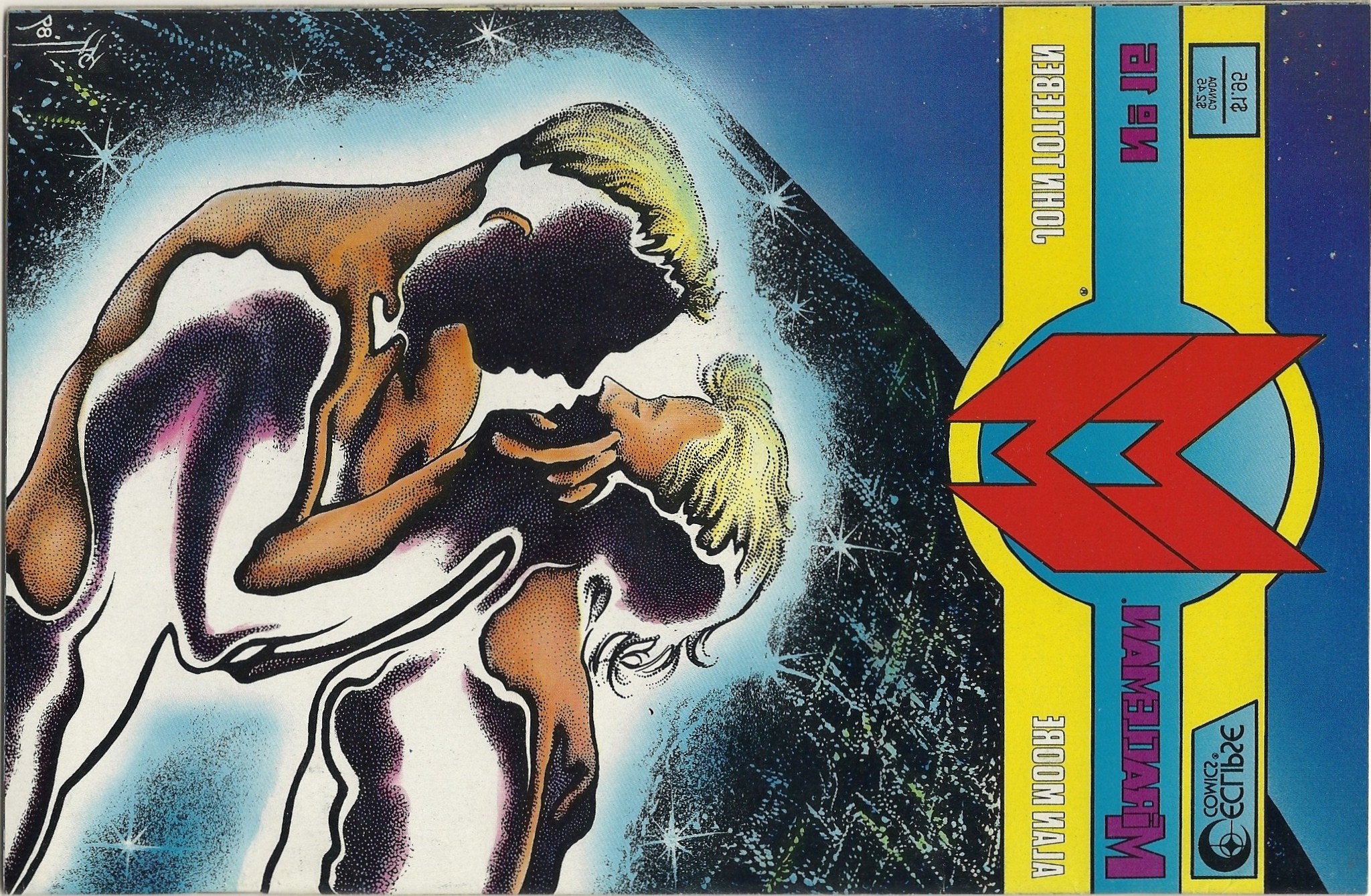
It’s that last moment, the consummation of the super-powered union, that generated the most memorable and most elegant cover of the series. I’ve been able to pick up some of the individual issues in the last couple of years, and this one takes the cake:

It’s a gorgeous image from artist John Totleben – the Miracle Mates, Miracleman and Miraclewoman, over London. Sex is great, but I’m guessing that Miraclesex would be a whole lot better. Just a hunch.
The cover always gave me a little bit of deja vu – where had I seen this before? Somewhere. So I was thinking on it a couple of days ago, and then this popped into my brain:

I’m probably stretching a little bit here. I’m not saying that Totleben was lifting from Gustav Klimt’s The Kiss. I’m just saying that that’s what it evoked for me. The tingly sparkling auras of Miracleman and Miraclewoman aren’t all that dissimilar from the blankets enveloping Klimt’s lovers, and the body positions, while not exactly alike, are analagous. The placement of the man’s and Miracleman’s hands are very much the same – that might be the clincher for me.
Here’s the cover rotated and flipped, if that helps at all:
Maybe I’m just seeing things. It wouldn’t be the first time. I’ll shut up now, but someday I’d like to talk some more about Miracleman. It’s a pretty rich topic – even the rights issues are interesting with this guy, and he was in the hands of two heavyweight comic book writers. And to think, I have a defunct mail-order store with a terrible business model to thank for introducing me to him.
Everybody’s Favorite Super-Pooch
Over at Supermanfan.net there’s a nice little post highlighting the various super-powered animals that Superman has befriended or fought over the years. All of the super-pets have their respective advantages, but being a dog lover myself, there’s really no substitute for Krypto. That got me to thinking, so I delved deep into my archives and came up with a couple old Superboy covers that highlight the world’s mightiest canine. Here’s the first one, from Superboy #109:

Ouch. I mean really. Ouch. Not only is Krypto confronted with the ultimate indignity for any pet, being replaced by another of the same species, but he’s tethered with the shortest leash in the history of comicdom. A kryptonite leash, no less. I didn’t realize that Bad Newz Kennels had their own signature line of merchandise back in those days.
But Krypto’s a loyal dog, as we can see on the cover of #146:
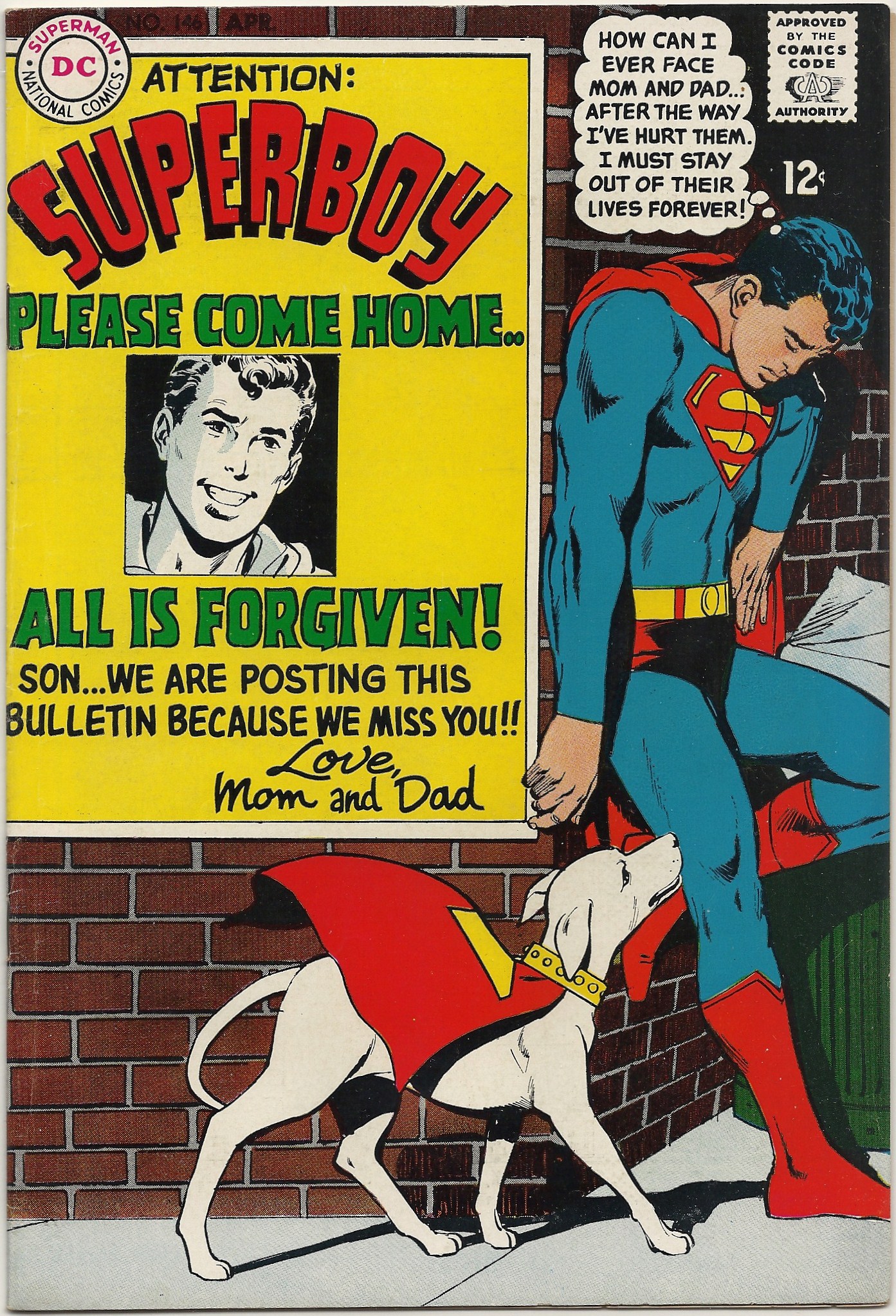
The guy trades him in for a new model and shackles him to a post, but when his master reaches his lowest point, who’s there by Superboy’s side? Krypto.
Good dog.
An Ode to a Licensed Character, Part 3 of 8 – Rom #71
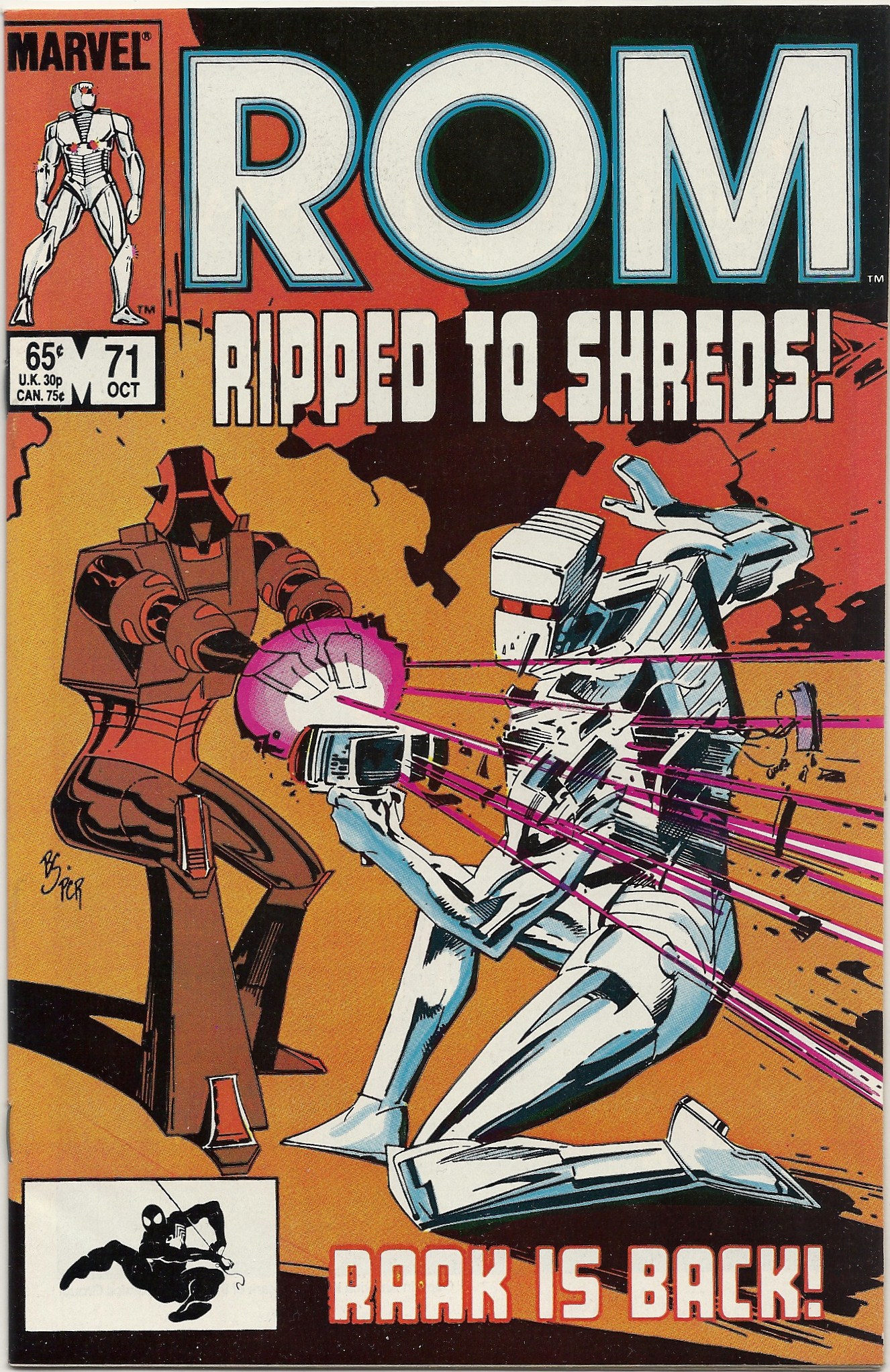
Welcome back to our trip through the final issues of the Rom as written by Bill Mantlo and pencilled by the great Steve Ditko (with inks this time from P. Craig Russell, whose work melds nicely with Ditko’s). In issue #71, we pick up right where we left off, and I mean right where we left off. Our Spaceknights, Rom, Seeker, and Scanner, are walking away from their disgraced and broken former comrade, Unam the Unseen.
Unam pleads with his former friends not to leave him, to not despise him. Rom tells him that they do not hate him, that they are merely shamed and disappointed in his actions. Then Unam relates to Rom his reasons for doing what he did – how his deeds were rooted in fear and his inability to dispatch Wraiths to Limbo like Rom so easily does. I thought that Ditko did his usual elegant and emotive work with the following sequence, as Unam’s plight touches Rom’s cold cyborg soul:
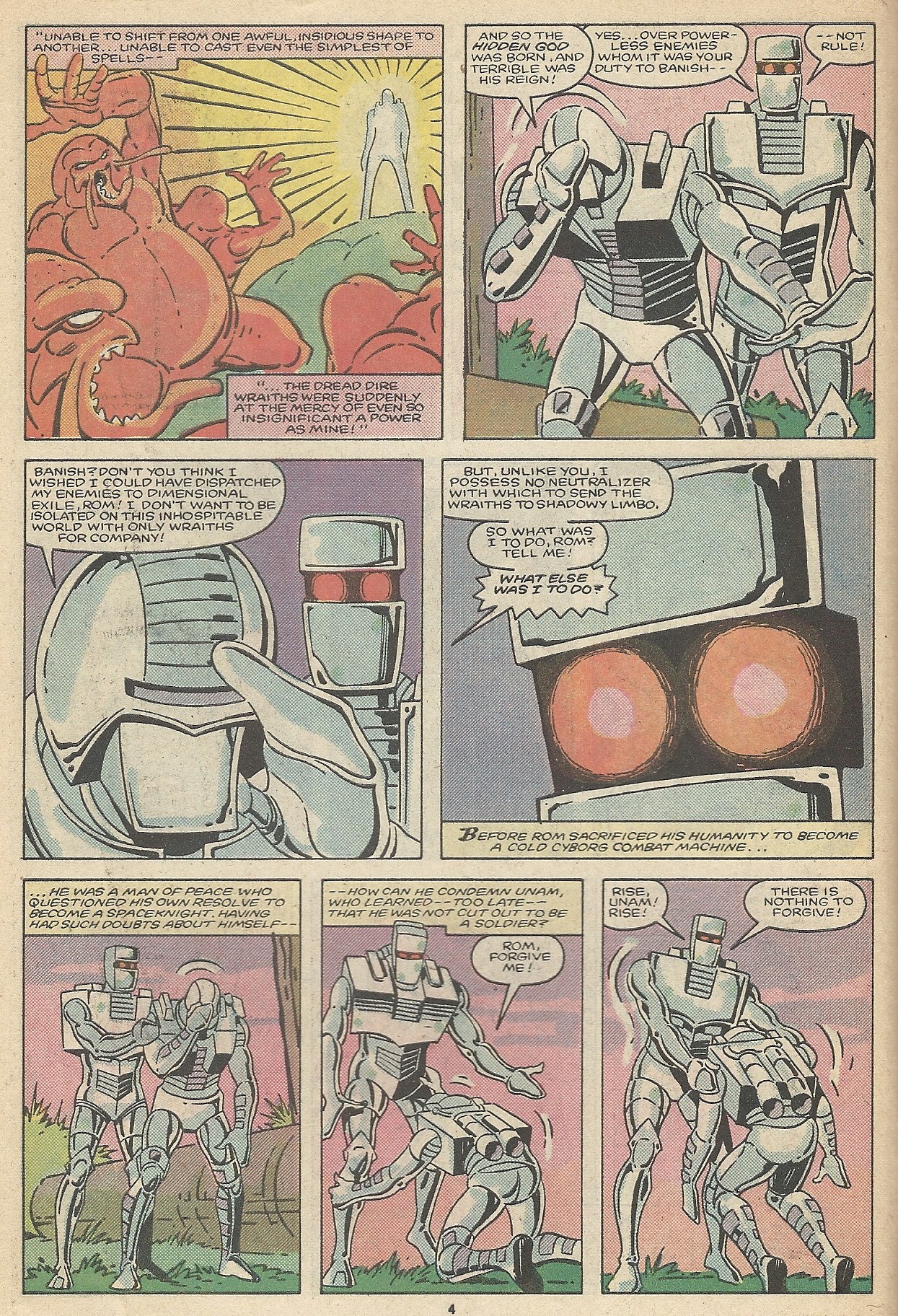
It’s no surprise that Ditko, who was so masterful in conveying emotions in a faceless, fully masked character like Spider-Man, is able to work similar magic with expressionless characters like the Spaceknights. Indeed, the bottom three panels, laid out in the regular even dimensions that he used so often on that classic Spider-Man run, are extremely effective.
So Unam is back in. While not condoning what Unam has done, Rom understands what drove him to it, and off our heroes go, flying away side by side. (Which begs the question – why did Unam feel that he was trapped with the Wraiths if he could fly away at any time? I missed that plot hole when I was a kid, but let’s not let a quibble get in the way of the story.)
We’re diverted to Earth, where we encounter a sort of hodgepodge family of characters touched by Rom and the Wraith’s time on Earth: Rick Jones (yes, that Rick Jones), who was an ally of Rom and is suffering from cancer, Brandy Clark, Rom’s human love who spent time as a Spaceknight named Starshine, and Cindy Adams, a young girl whose parents were apparently killed by the Wraiths. More on them next time, when they encounter a certain jheri curled omnipotent guy.
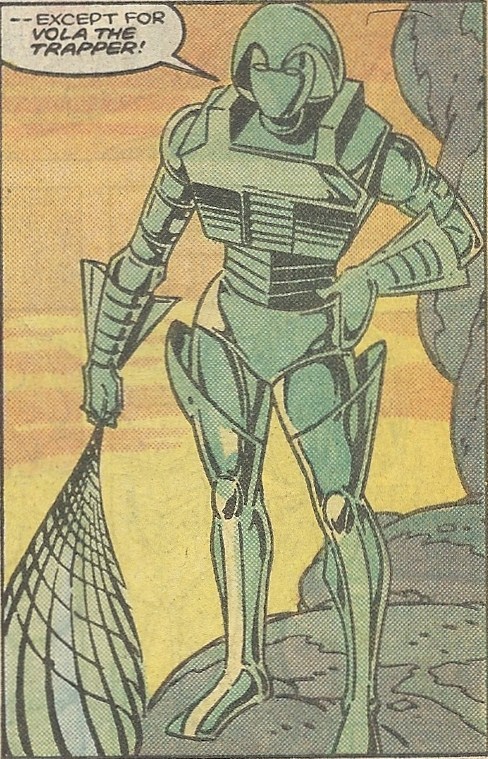
Back to our Spaceknights. Once again Scanner detects – you guessed it – Spaceknight signals from a nearby world, and they go to investigate. They fend off a half-ass ambush by simple humanoids, and it’s revealed that those humanoids are led by a Spaceknight, Vola the Trapper:
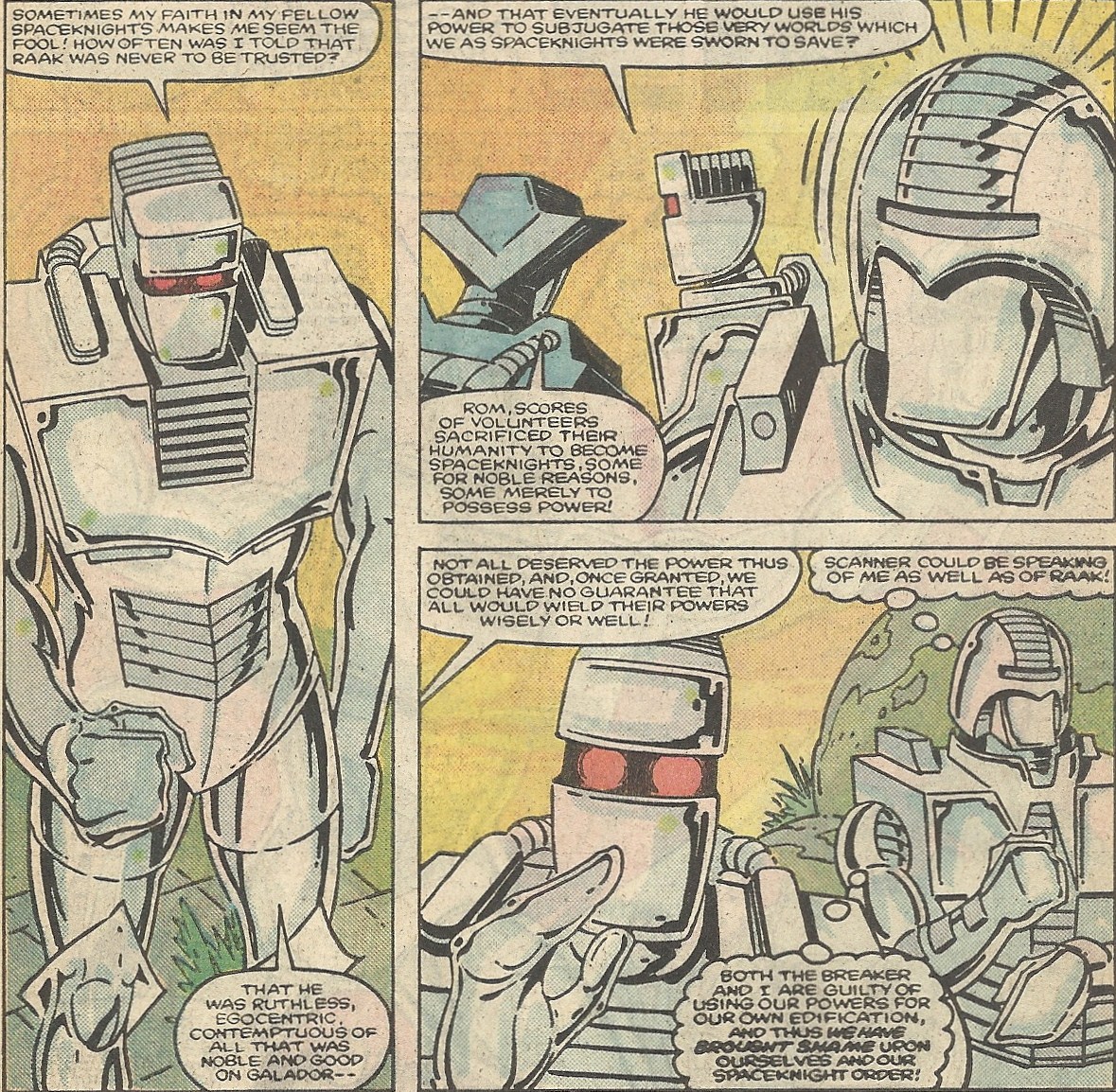
But Vola isn’t a villain, and she explains the situation to Rom. The planet, Clavius, had been besieged by Dire Wraiths, but when the Wraith homeworld was destroyed another Spaceknight arrived and teamed up with the now powerless Wraiths – Raak the Breaker. Raak, like Unam, is corrupted by contact with his former enemies, though Raak’s reasons are not born of timidity but of his lust for power. He wants to use the Wraiths and conquer Clavius for his own ends, but the similarities between their respective downfalls are not lost on Unam:
Vola has been aiding the Clavians in their fight for freedom. All this gets Rom worked up into a righteous anger, and the Spaceknights along with Vola and her Clavian allies attack Raak and his minions. They open the proverbial can of whoop-ass, including Unam, who’s bucked up when Scanner tells him “there is still something of the hero inside you.” Finally it comes down to a mano a mano tangle between Raak and Rom. Raak gains the upper hand, mainly because of Rom’s reluctance to harm another Spaceknight, though Raak’s powerful “microwaves” play a part – I guess that “The Breaker” isn’t an honorary title. It seems that Rom might actually get himself fried, but in steps our Unam ex Machina:
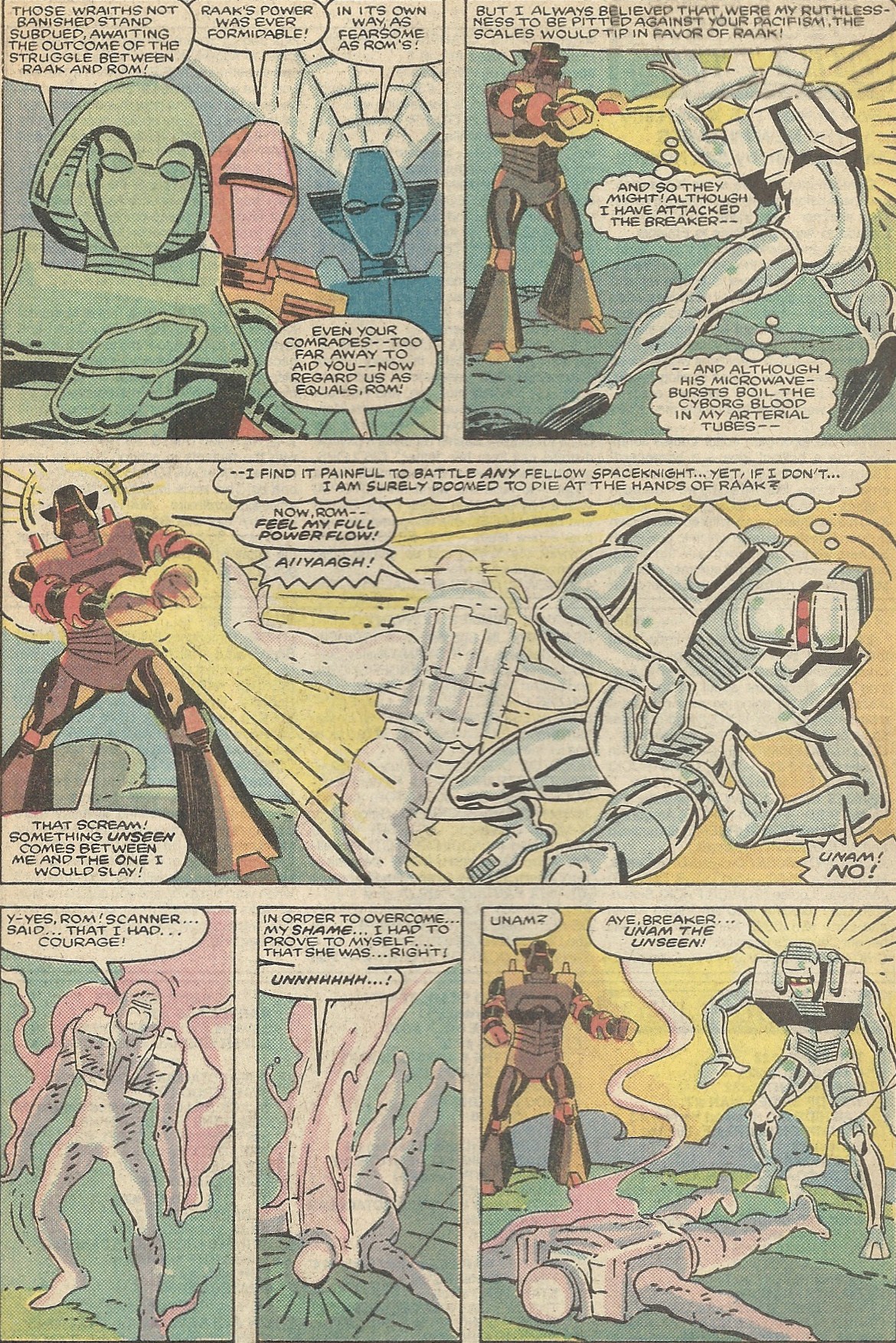
Ah, redemption. It’s a sweet nectar, isn’t it?
Rom, moved by Unam’s final noble act, uses his Neutralizer to banish Raak to Limbo – there he can rot for eternity with his fiendish partners. Rom and his comrades are left to contemplate Unam’s sacrifice:
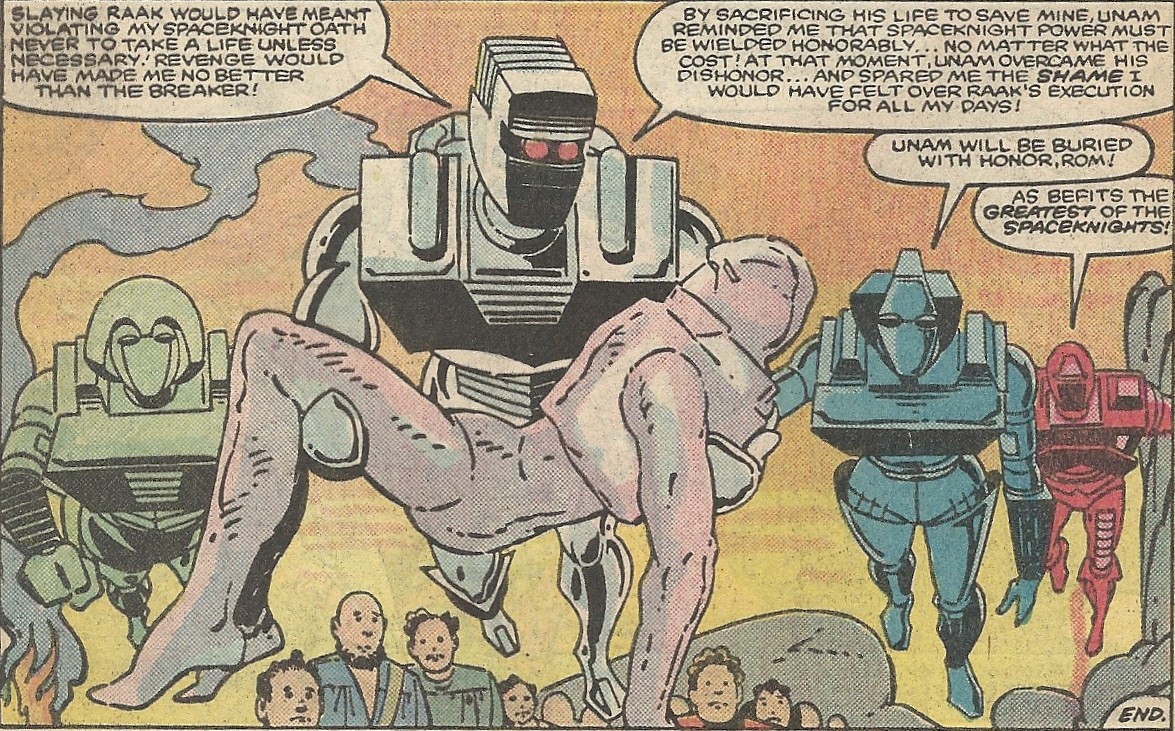
There we go. I can’t tell you how much this story affected me as an impressionable seven-year old. From the dynamic and rhyming “Raak is Back!” cover to the story bookended by Unam shattered first in mind and then in body, this one had it all. And the best part is, the story only gets better from here on home. In the next installment, we make a little diversion back to Earth and visit with some non-Spaceknight characters, one of whom makes a decision that will impact Rom’s final fate.
So the other day I was flipping through my Amazing Spider-Man comics (and it really is a little slice of comic fan heaven to have some nice old ASMs to go through) and I came across this one:
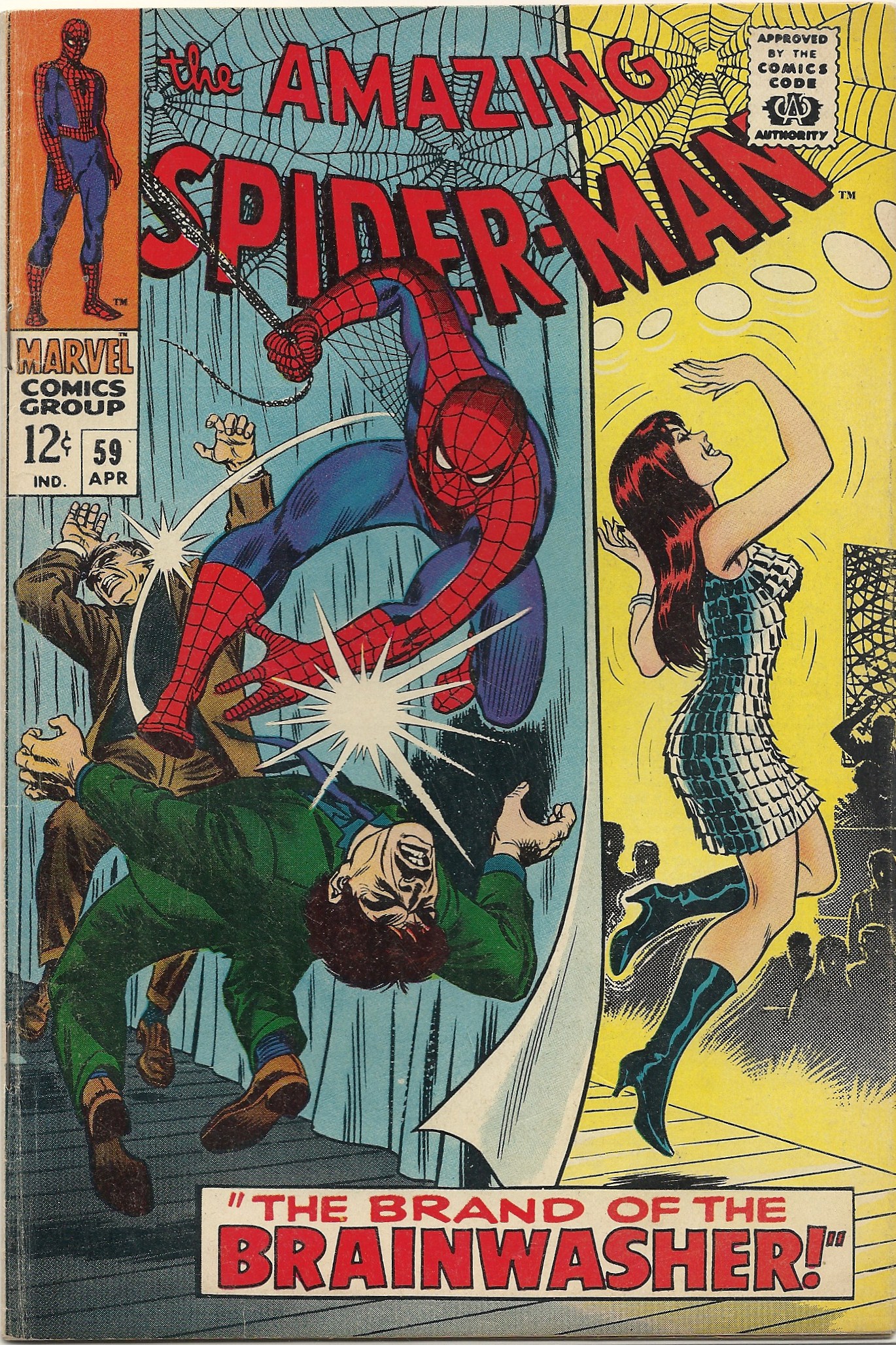
Okay, I’ll fess up to the fact that I’ve always had a thing for redheads. I can remember on my 21st birthday forcing my friends to drag my sotted corpse to a local Irish bar that offered redheads half-off on drinks. You know, in the inebriated belief that an attractive redhead would be thrilled to go home with a guy who could hardly stand on his own. I don’t recall having any success that night, but I don’t know if that’s because of the booze or because of the decade+ that’s gone by. But I digress. The bottom line is, I Like Redheads. Print up the bumper sticker and slap it on my back.
So it follows that I like Mary Jane Watson, the most famous bombshell in all of comicdom. And let me be more specific here – Mary Jane as drawn by John Romita, Sr. He most definitely used his prior time drawing romance comics to full effect in creating her look. She was the fiesty sexpot we could all fall head over heels for, forming one half of Marvel’s version of Archie’s Betty and Veronica and of DC’s Lois and Lana. Poor Peter Parker – he had to choose between Mary Jane and Gwen Stacey. We should all have such dilemmas. Having to tangle with his rogues gallery would seem a lot more bearable with those two in his life.
But let me be clear. I’d choose Mary Jane. Just in case you had any doubt.
I like the above cover (her 1st cover appearance if I’m not mistaken) because it so succinctly distills the quality that gives her such appeal – her zest for life. Only Mary Jane could get lost in a go-go-boot-dancing moment so completely. And only Mary Jane could be shaking it in front of the curtain while you’re slugging it out with some thugs behind the curtain and make you love her for it.
Did I mention that she’s a sexpot? I did? Well, I guess it bears repeating.
Which brings me to my last point – the disappointment that Kirsten Dunst was in the role on the big screen. She just didn’t have, well, it. I remember reading one review of the second film and agreeing with the critic (I can’t remember who) when he described her as “wan.” I can’t think of a better word for her performance. She was like a glass of skim milk when what was needed was some hot cocoa. But enough of my gripe. Here’s hoping that the people casting the reboot of the spider-series bring some of Romita the Elder’s work with them as a reference. And maybe even that cover up there.
Love is in the air – DC Comics Presents #32
So today I was in downtown DC and worked my way to the monuments where the cherry blossoms are in full bloom, and what cover should pop into my head but this one:

It’s a great and memorable image from Ross Andru, who drew so many covers at DC in this time period (and here he’s ably inked by the recently passed Dick Giordano). Being a denizen of the Washington area I really like this one because at no point in the story do the characters find themselves among the famous blossoms, yet our artists saw fit to depict them in this setting. Cool. And I have to admit, it certainly looks to me that Superman and Wonder Woman were made for each other. This issue was one in a long series of efforts (perhaps most notably in Kingdom Come) to make a couple out of them, if only for very brief spells. It seems pretty natural that two righteous super-powered beings would pair up. Don’t get me wrong, I love Lois, but I never really understood what she and Supes would talk about when they both got home from work.
Lois: “I had a rough day working that school board corruption story for the Planet.”
Superman: “I was teleported to Apokolips where Darkseid thrashed the living hell out of me until I narrowly avoided death by turning his Omega Beams back on him.”
Not a lot of common ground there.
If I have a quibble with the cover it’s that in real life the cherry blossoms don’t actually surround the reflecting pool like that – primarily they’d be more to the right over near the Jefferson Memorial. But never let geography get in the way of a great juxtaposition. If Andru put the characters where the cherry blossoms actually are he might not have been able to work in one of the world’s largest phallic symbols, the Washington Monument. And with a cover where two people have been bitten by the love bug (or pierced by love arrows) that would be a shame, now wouldn’t it?
An Ode to a Licensed Character, Part 2 of 8 – Rom #70
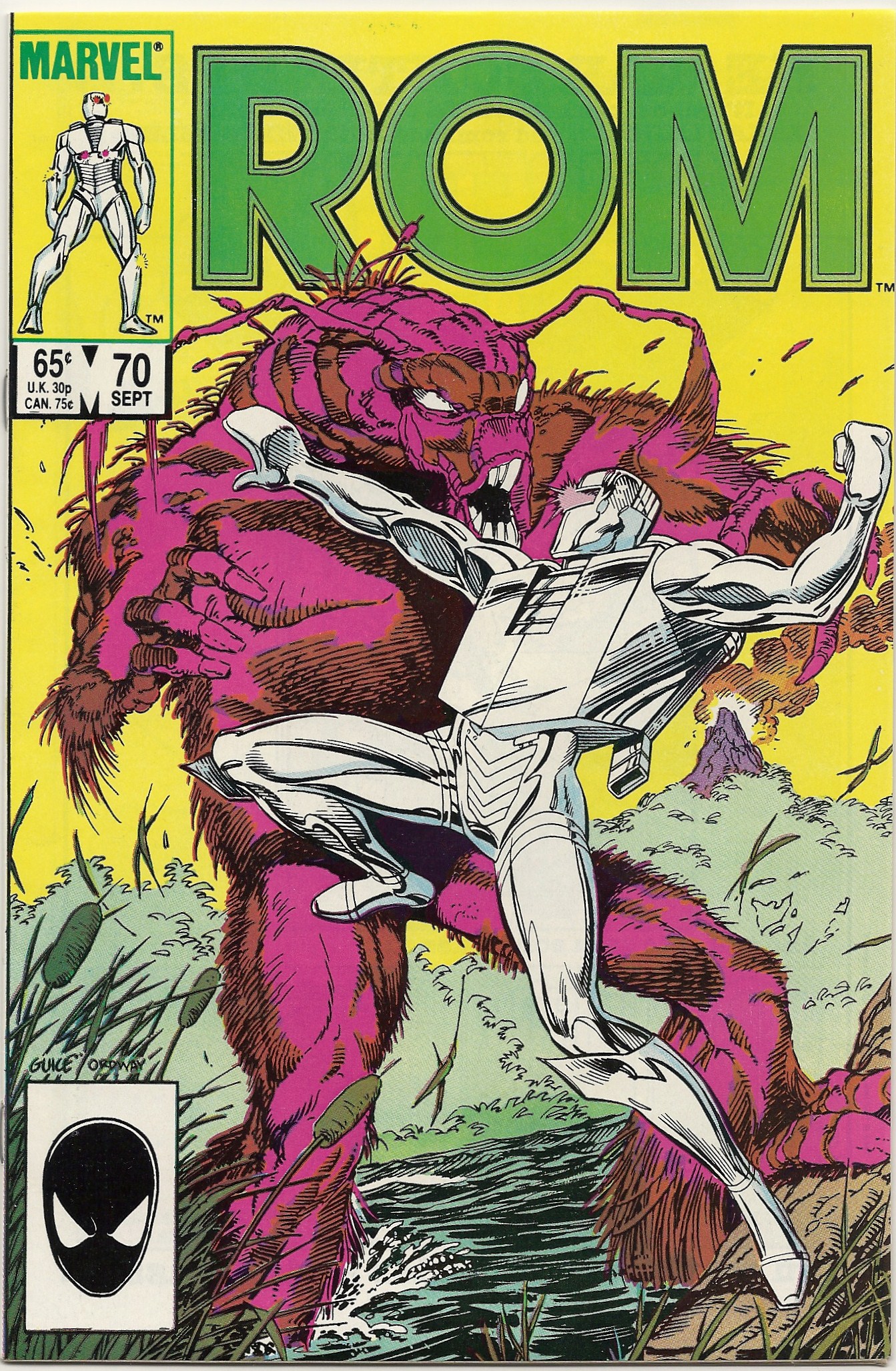
Back to my childhood favorite, Rom. Previously, in issue #69, Rom rescued two of his Spaceknight comrades from the gooey insides of Ego – Scanner, a blue female Spaceknight without offensive weaponry but with highly developed, you guessed it, scanning abilities, and Seeker, a red Spaceknight that can sprout metallic wings, fly around (though he can fly around without the wings, so…) and can fire deadly missiles.
This issue opens with out trio arriving on an alien world after Scanner detects a signal from another Spaceknight. This particular planet is sort of a Dagobah-lite, and I really dug the way that Ditko depitcted it in this two-page spread:
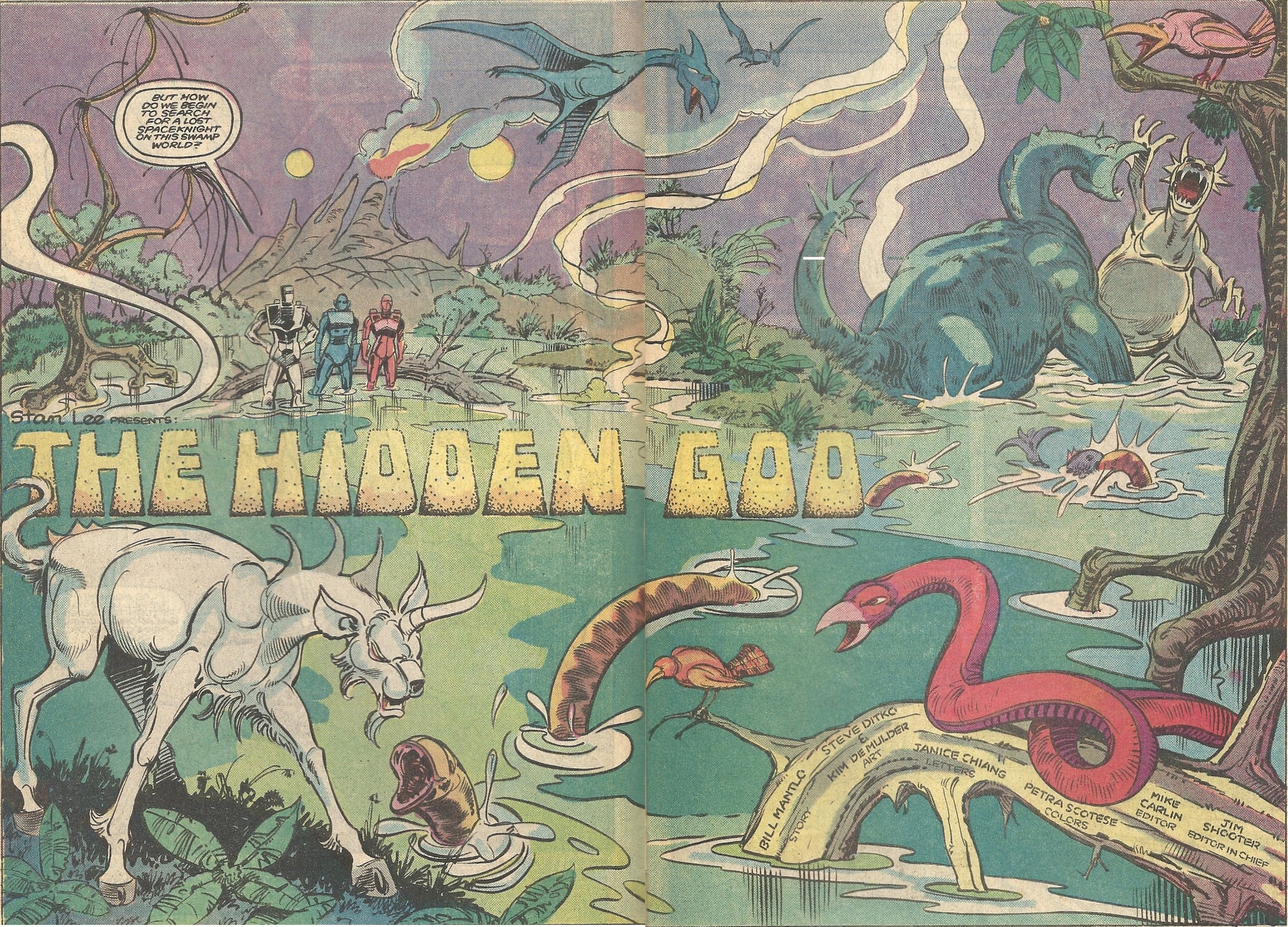
I especially like the two dinosaur thingies squaring off in the upper right corner and the mean looking wolf/unicorn (wolficorn?) in the lower left. (And please note the distinctive water-splashing effects, as highlighted back here.) Our heroes tangle with one of the beasties – another chance for Rom to display his distaste for taking life – and soon are back on the Spaceknight scent.
They soon find an improbable sight – enslaved Dire Wraiths laboring in constructing a fortress for the titular “Hidden God.” As Rom asks them what’s going on, lightning bolts strike out from the sky and cut down the powerless Wraiths. The “Hidden God” speaks to the Spaceknights and tells them to enter the temple at the center of the under-construction fortress. There they discover the Wraith master – Unam the Unseen, the Spaceknight that they were looking for.
Unam tells his tale. During the war against the Wraiths he pursued some to this world and then, when the Wraith homeworld was destroyed and they were rendered powerless, Unam reveled in his new-found capability to utterly terrorize his enemies. He bent them to his will, always using his one unique Spaceknight power, his invisibility, to remain hidden from view. He’s really quite pleased with himself for all this – how he, the meekest of his comrades, became so powerful.
Rom is, shall we say, not so pleased. He’s revolted that a Spaceknight has taken up the evil ways of the Wraiths, becoming no better than they enemies they all swore to defeat. This rebuke sends Unam over the edge, and he summons his Wraith minions to come and attack his fellow Spaceknights. The Wraiths surround them, but instead of attacking they beg Rom for release from their bondage. Rom agrees to use his Neutralizer to exile them to Limbo. At this Unam goes totally Cookoo for Cocoa Puffs and attacks Rom himself, but our hero easily dispatches him and banishes the Wraiths. Unam is left emotionally broken, pounding the ground as Rom and his companions, saddened and disgusted by what the war has done to him, walk away:
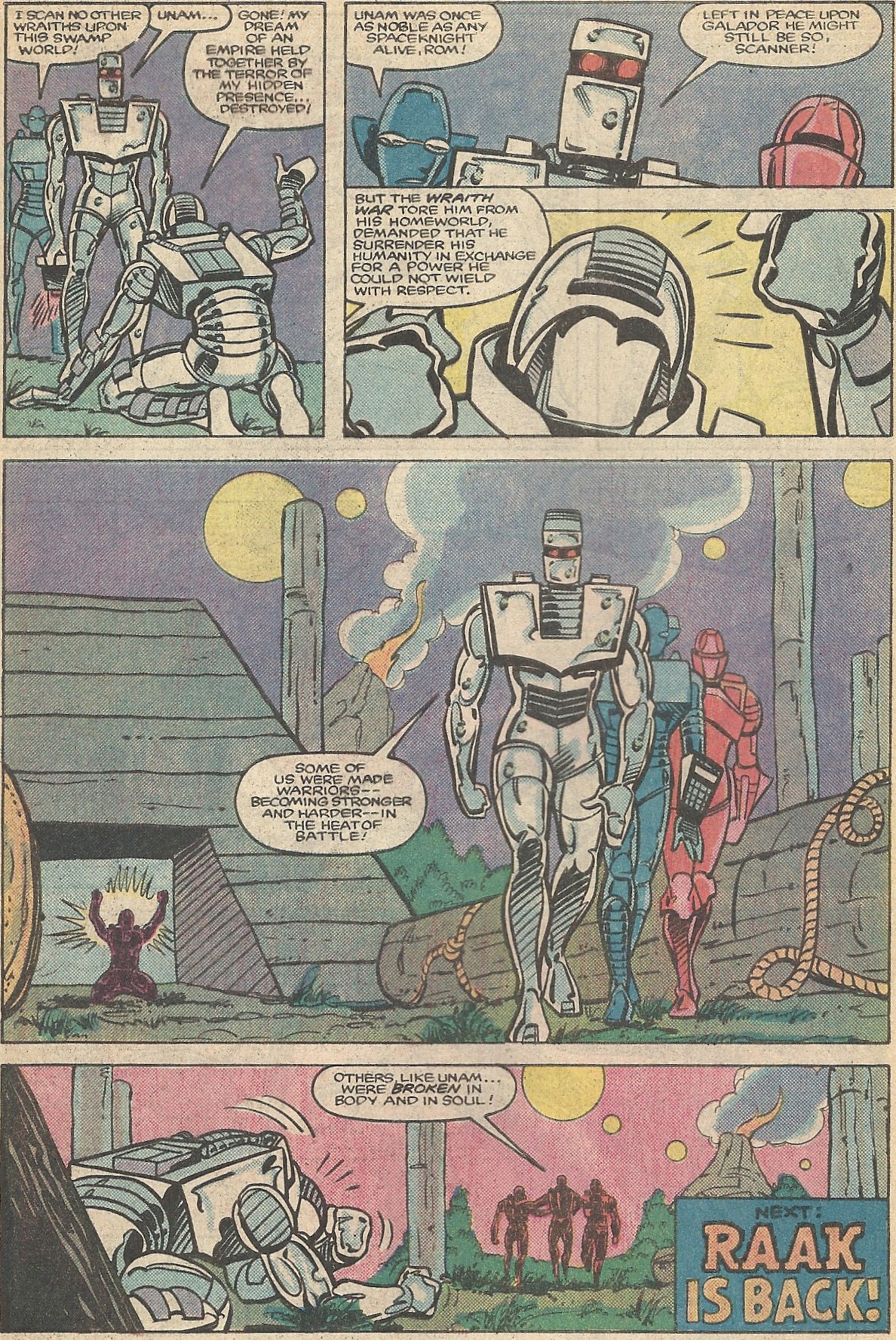
So the issue ends, but Unam’s story is not yet finished. For that stay tuned for next time.
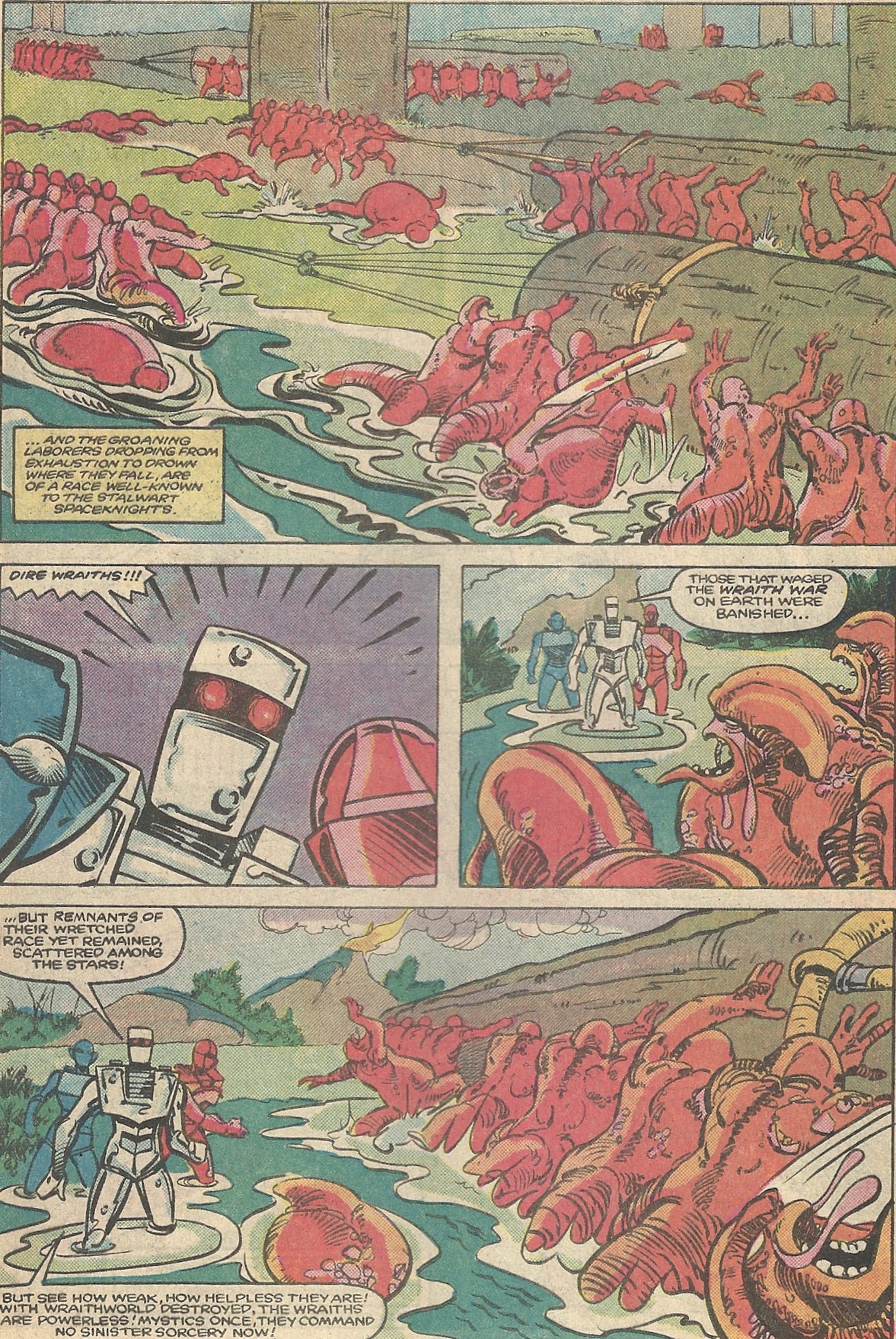
I can remember this story having quite an impact on me as a kid. The thought of a hero descending into evil because of a sudden change in the power equation between himself and his foes was novel for me and struck home, and Ditko’s always elegant artwork (with inker Kim DeMulder) gave a dark, grey oppression to the swamp setting. The images of the villainous Wraiths reduced to a pitiable condition and dying in the muck were memorable:
I also really need to say a word about the writer, Bill Mantlo. He spent a long time working on the Rom character and it shows – like Larry Hama with G.I. Joe, another licensed property, he brings depth and pathos to material that in other hands might be all too shallow. I’ll have more kind words to say about his work in the future, but until I began writing these Rom posts I never knew about the tragic fate that befell him almost two decades ago. It makes me very sad to know that someone who touched my young heart so wonderfully was cut down at a relatively young age. Very sad indeed, but I’m pleased that I’m at least able to celebrate some of the man’s work.
On we go. In the next issue we’re introduced to yet another of Rom’s old comrades, and this guy has one of the toughest sounding names of all time – Raak. Raak the Breaker. Until then.
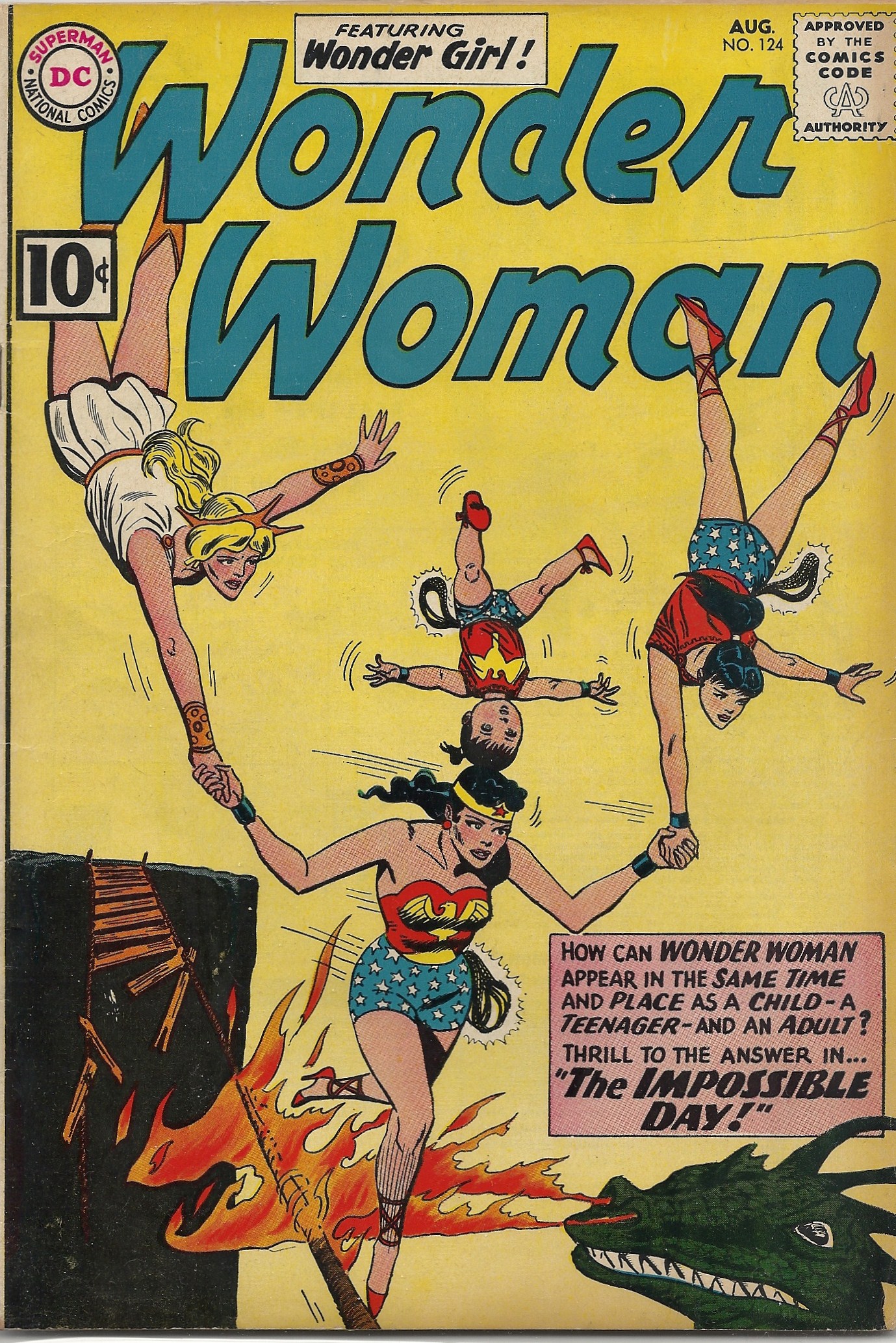
I’m always happy to pick up some old Wonder Woman comics, mainly because I never really see a lot of them when I’m flipping through a dealer’s stock. For a character that’s part of the Big Three in DC’s pantheon along with Superman and Batman, it’s kind of hard to find quality back issues of everyone’s favorite Amazon. I’m not sure of the reason for that. I realize that comics are mainly a man’s world, and not many young boys imagined themselves to be Diana in their daydreams. Or maybe they did. Not that there’s anything wrong with that, as Seinfeld would say. But my guess is that the demand is just lower.
So when I find some WWs, I pick them up if they’re in good shape. Like this one. Plus I kind of liked the cover. I mean, they had her doing everything but spinning plates on the Ed Sullivan Show. Also I didn’t really know what the deal was with “Wonder Tot.” Wonder Girl I thought I was familair with, though I didn’t realize that here she was just a younger version of Wonder Woman, a la Superman and Superboy (not the Connor Kent version). And it turnes out Wonder Tot is an even younger version of Wonder Woman. Okay. I guess I could have picked that up by, oh, I don’t know, reading the cover, but sometimes I’m slow on the uptake.
The answer to the cover question of how they could be together is, in my ever so humble opinion, profoundly stupid. They aren’t. It turns out Queen Hippolyta, in answer to fan mail, decides to splice together home movies she has of Diana as a little girl, a teen and a buxom adult. So it’s all put together using the Paradise Island version of George Michael’s Sports Machine and through cinematic alchemy the three versions plus their mother can have adventures together on film. There they meet Mer-Boy. They fight Multiple Man in the present and in the past. Fantastic. Good for them.
Here’s where it gets stupid. The imaginary story is framed by a few “real” panels. Diana and Steve Trevor are on vacation and inspecting cave paintings. Give me a beach and a beer on my vacation, but to each their own. Anyway, they find a cave painting depicting the “Wonder Woman Family” fighting a T-Rex. Trevor points out that this is impossible since Wonder Woman can’t appear at the same time with the younger versions of herself, to say nothing of doing so in the past. This sets Diana to remembering the film strip scenario I described above, when she and her mother spliced things together, and she eventually realizes this is the reason why the cavemen created a remembrance. In the film scenario the Wonder Woman Family saved the cavemen from the Multiple Man who was in the form of a dinosaur and the nice cavemen paid tribute this way.
Let me go over this again. The film strip stuff never happened. But they find evidence of it in a cave painting. Do you see the problem here? And do you see why it’s driving me insane? Even the cavemen who we’re supposed to believe made this “real” painting were in the “imaginary” story. Now you see why this is on the way to sending me to the loony bin? This is all impossible in in the same way that swallowing your own head is impossible. It’s the sort of conundrum that the crew of the Enterprise would feed the Borg to destroy them. I can’t even talk about this anymore it’s so maddening.
At the end of the issue there’s a note asking readers to write in and say whether they’d like to see more “impossible adventures.” I know I’m 50 years too late, but please allow me to cast my vote for no. Good Lord, no. This one gave me a headache, and now I need a nap. Though maybe I’ve figured out why there aren’t a lot of old WW comics in the bins…
An Ode to a Licensed Character, Part 1 of 8 – Rom #69

I love Rom. I’m not ashamed to admit it. In the same magical summer of 1985 when I discovered the Easter Island statues as interpreted by Jack Kirby I was also introduced to the interstellar Spaceknight Squadron as drawn by a guy named Steve Ditko.
It was love at first sight.
I arrived late in the game. My first Rom comic was Rom #69, and I had no idea that the series would come to an end a mere six issues plus an annual later. But if I was tardy in getting on board with this character, I couldn’t have joined up at a better time storyline-wise. You see, Rom had finally defeated his archenemies, the Dire Wraiths, hideous evil sorcerors that had attacked his homeworld of Galador and whom he had pursued all the way to Earth. Now he was on his way back to his native planet. There was a sadness to the character because his humanity, which he had sacrificed to take on his cyborg body, had been destroyed long before. His Spaceknight allies could hope to reclaim their flesh and bone selves, which had been carefully preserved. Not Rom. But still, the greatest Spaceknight of them all just wanted to get home. I think every one of us can identify with that.
So that’s where I came in.
I can still remember where I bought this issue. My parents and I were in vacation in Old Orchard Beach, Maine. In between bouts of swimming in the frigid ocean we made a trip to a convenience store. I can’t remember why I picked up this particular comic – it wasn’t in my usual Superman/Batman/Spider-Man wheelhouse. Whatever the reasons, I bought it. I’ve always been glad that I did.
What’s the plot of this first installment? Rom detects signals on an alien world eminating from some of his Spaceknight colleagues. Weak signals. He decides to investigate and is quickly swallowed up by the planet itself. It’s alive, you see. We’re treated to watching Rom battle digestive enzymes and bipedal thug antibodies and using his Neutralizer to send to Limbo some powerless Dire Wraiths being digested slowly (Sarlacc Pit style, I guess) in the planetary stomach. It’s then that he comes face to face with Ego, the Living Planet.
I learned two very important things about the Marvel Universe here, since this was my introduction to Ego. One, planets can be living things. Second, living planets have moustaches. Who knew?
Ego is holding captive Seeker and Scanner, the two Spaceknights whose life-signs Rom detected earlier. The bewhiskered living planet has been studying them since absorbing both Spaceknights and Dire Wraiths during a battle they were fighting on his surface. After some back and forth, Ego threatens to absorb Rom, so our hero, ever-hesitant to harm other creatures, reluctantly pimp-slaps Ego with his Neutralizer. Ego promptly gives in and ejects our Spaceknights from his insides and flies off. And on we go to the next issue.
We’re just getting started here – the stories by Ditko and scribe Bill Mantlo that made me fall for the Rom mythos are coming in subsequent installments. But this one hooked me with the art. Ditko and his inker, the great-in-his-own-right P. Craig Russell, really did fantastic work together. The opening page, with the patchwork quilt of Ego’s surface, kind of reminds me of the LSD-trips that Ditko would take Doctor Strange on – and not hurting that association is the use of the word “strange” twice in the first sentence:
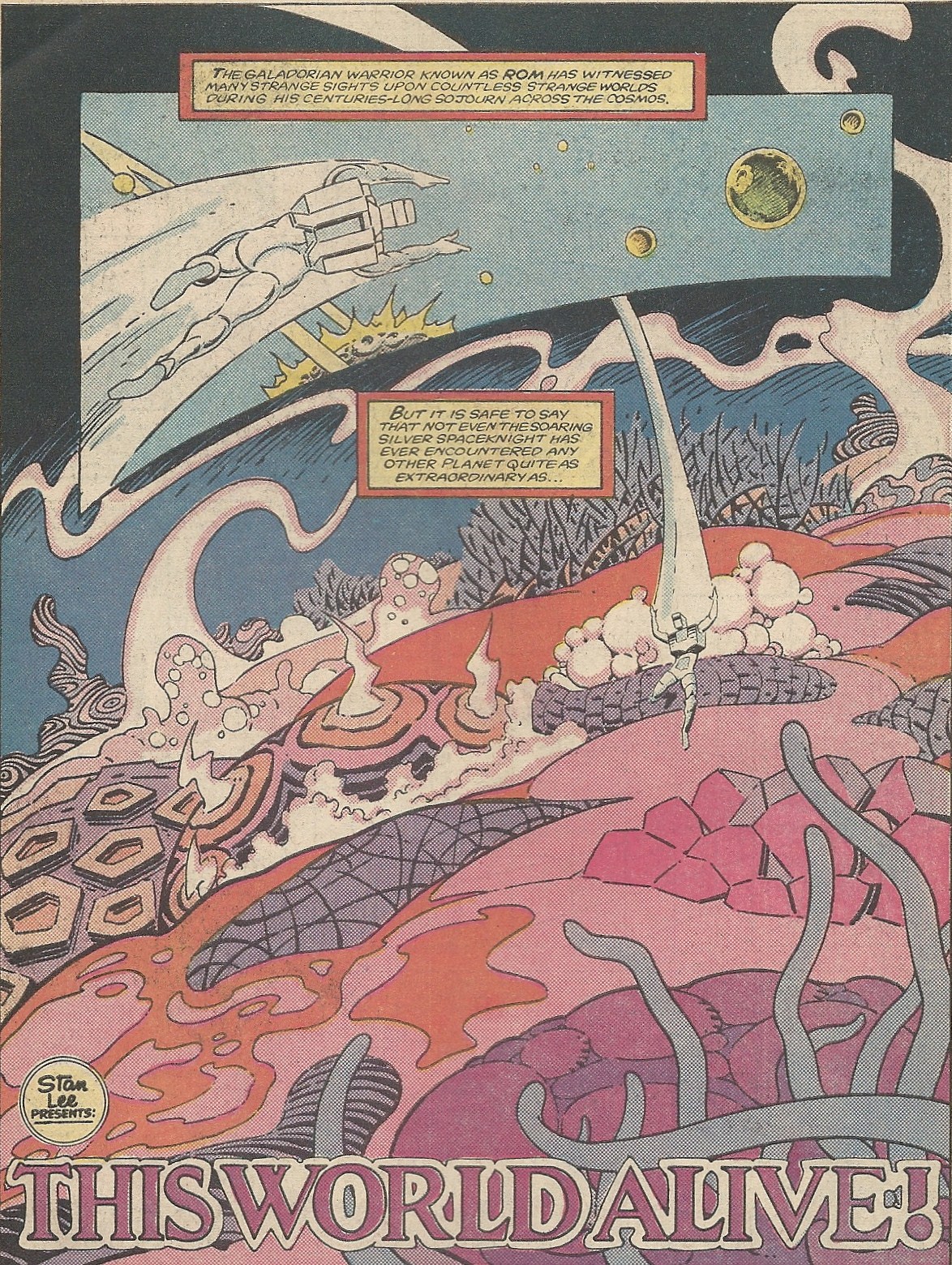
Ego’s insides were a combination of Journey to the Center of the Earth and Fantastic Voyage:

And finally there was the rendering of our planetary villain – at least he didn’t have hands to twirl his moustache before Rom gave him a beating:

There we go. One down. I hope you liked reading this. I certainly enjoyed talking about one of my favorite heroes who, unfortunately, is largely forgotten these days thanks to lapsed licenses. I plan to go over each remaining issue of Rom in subsequent days and weeks (when I can get to them), right up until his final farewell in #75. Like I said up above, I just love this last arc. I’m going to savor walking through it. See you next time, when we meet another Spaceknight in “The Hidden God.”
Uhhh, guys? Batman #165, “The Man Who Quit the Human Race”
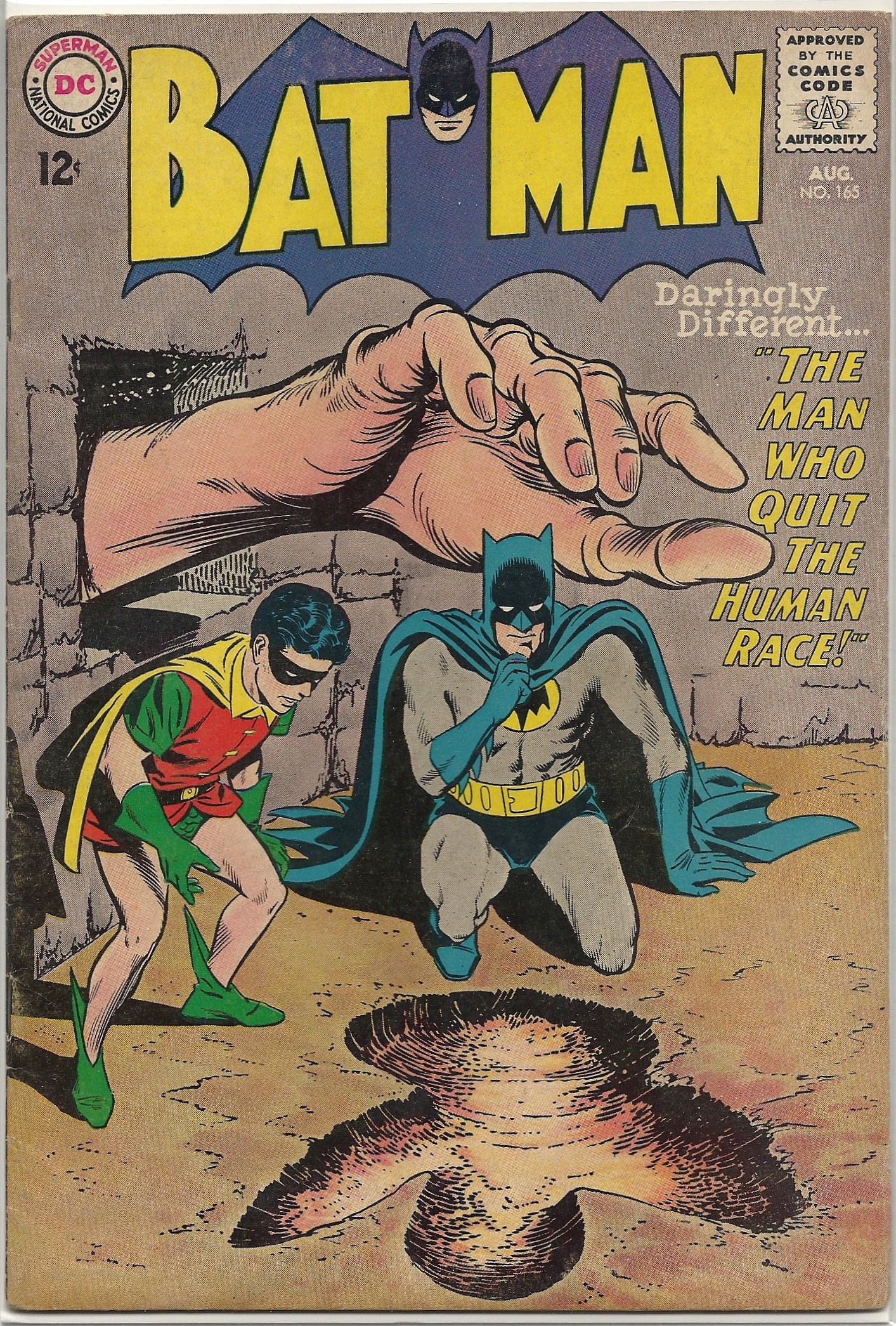
I picked this one up late last summer. It had a little more wear on the spine than I normally like in books from this era, but I just couldn’t resist. What an image – it works for me on so many levels. First and foremost it’s a Carmine Infantino cover. When I was a kid I read a lot of Flash comics, towards the end of the original run of the Barry Allen Flash. I had no clue who Infantino was or that he had created the Silver Age Flash many moons beforehand, but I liked his art. Still do. He was superb when it came to drawing motion, an ability that’s oh-so-critical when it comes to a character like the Flash. Oddly enough, it was that old run on the Fastest Man Alive that helped me identify this as an Infantino cover. You may notice that there’s no signature, and on the inside a different artist illustrated the story (some hack nobody by the name of Bob Kane — well, not really Kane, but that’s another story). But I searched through my memory banks and came up with this book, which I had as a fresh-faced young lad:
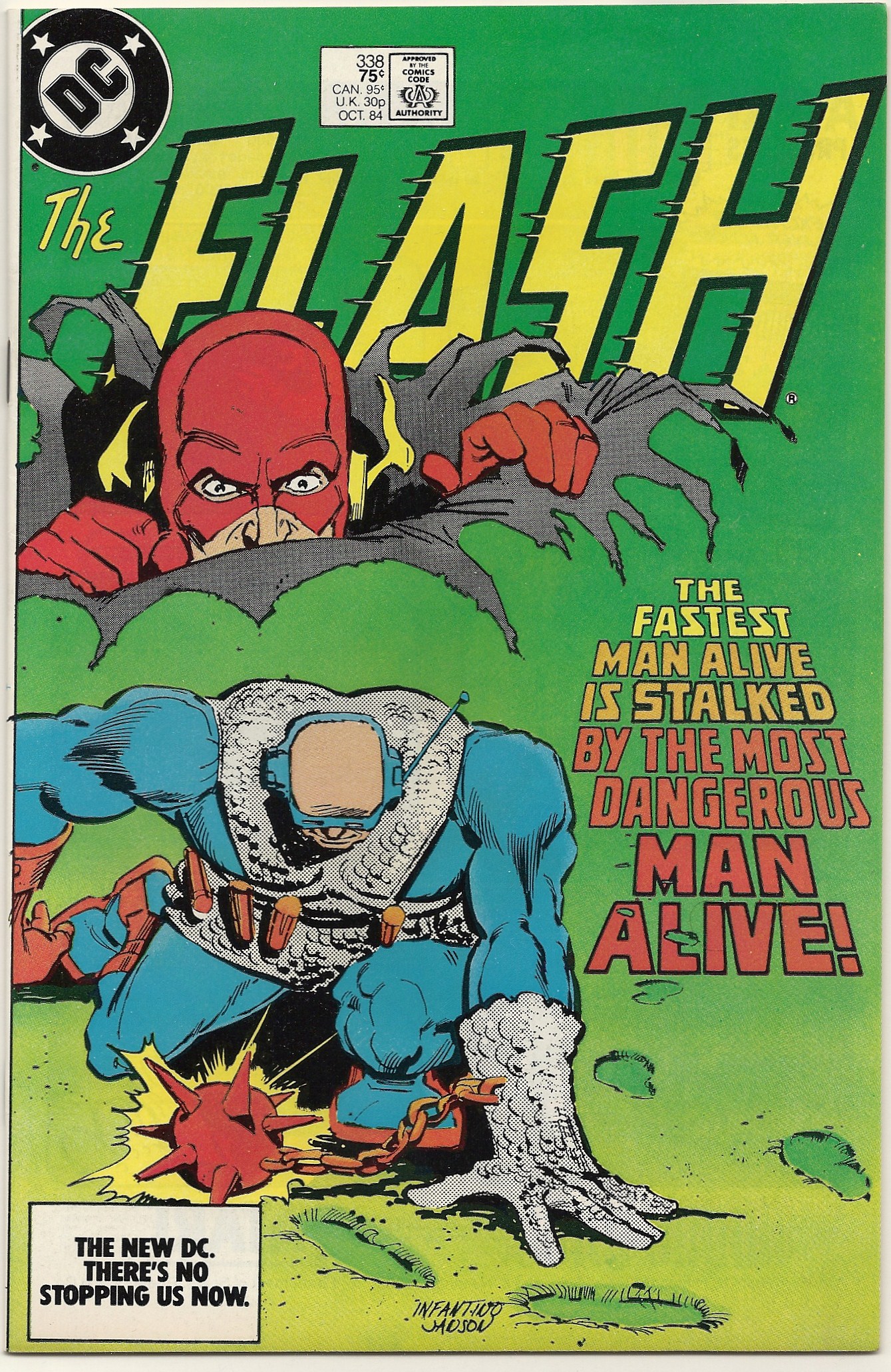
The way Big Sir was kneeling down on The Flash #338 for some reason got stuck in my head, and Batman in a similar position (kneeling to look at the footprint, dirt angel or whatever) dredged up the memory. Flash looming in the background like the giant hand on the Batman cover didn’t hurt the association either. I just knew it had to be Infantino’s work. And I wonder if Infantino made a similar connection while he was drawing the Flash cover, if he was referencing his work from two decades beforehand. I doubt it, but I wonder.
The other level that made this work for me came from a nightmare I had a long time ago, for all I know around the same time I was reading that old Flash comic. So I don’t bore you with too many of my personal memories here and to make a long story short, let’s just say that the nightmare ended with a giant hand reaching through my bedroom window at night to grab me. That’s when I woke up. The nightmare was vivid enough for me to remember it a quarter of a century later, and the hand on the Batman cover isn’t so different from what I saw in my head all those years ago. Still kind of scary, even though I lay claim to being an adult these days.
Lastly, I should say something about the book’s plot. The story is your typical Silver Age fare. A recently retired governor (a bizarre choice, don’t you think?) evolves at an exponentially accellerated rate and turns into a giant future-man. The Dynamic Duo of course thwart him (with the mutant’s sub-conscious help) and shoot him into space where he can wait it out until mankind catches up with his development. So I guess the guy is still up there. Maybe they can bring him back – how about it, DC editorial staff? Final Brightest Man Who Quit the Human Race Crisis?
 Jared
Jared


 blog into mystery