
My grandparents used to buy me comics when I was little, and usually it worked out pretty well. I’d go to their house and they’d have some Spider-Man and Superman books and the like for me to flip through. But sometimes they’d buy something a little bit off the radar. I remember a few of the Marvel New Universe titles that fit that bill, and being the ungrateful little brat that I was, I’d think to myself “What the hell is this crap?”
That’s a disdain that I’ve never really shaken, even though I’ve heard that some of the New Universe comics were well handled and I understand there was a bit of a revival in recent years. But I thought I’d pick this one up because of the involvement of the “X-Men” as seen on the cover. The prolific John Byrne handled the writing and pencilling chores and on this “Farewell, Pittsburgh” and was inked by Tom Palmer. No surprise, much of the action takes place at a comic book convention and Byrne, of course, throws himself into the action:

It’s funny, that’s kind of how I expect him to act. Throttling a geek — seems to be par for the course for Mr. Byrne. I’ve never met the man, but the preponderance of anecdotal evidence would seem to indicate that he’s a bit of a jerk (just Google “John Byrne jerk” or any variation thereof for evidence). It’s good to see that he’s his usual cantankerous self on multiple worlds.
Star Brand is the convention’s guest of honor, but Byrne and Howard Mackie can’t resist raining on his parade:
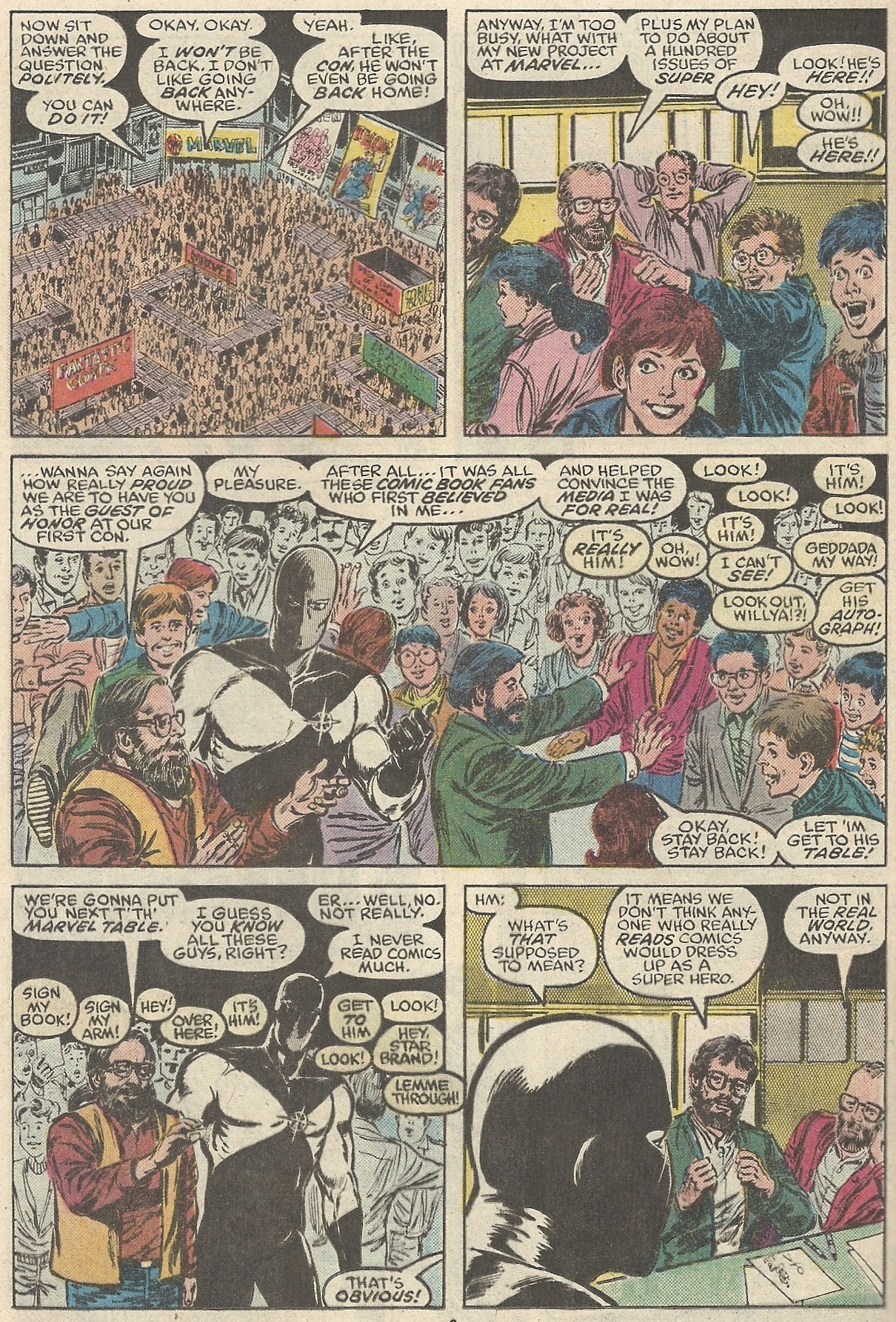
They proceed to lecture him on the intricacies of his profession and the failings of his costume:

A super-powered opponent mercifully shows up to drag Star Brand away from his tormentors, and their brawl tears through the convention hall. Even a few doughy geeks in X-Men costumes have to scatter:

Mind the comics!
Star Brand’s throwdown with his enemy causes the entire convention to get blown to hell, Byrne included. At least he’s not afraid to off his fictional self, I’ll give him that.
I don’t really have the knowledge base to critique the story since the New Universe reality is so foreign to me, and terms like “The White Event” and “The Pitt” might just as well be gibberish, but I know enough of Byrne’s art to say that this issue’s pencils seemed very un-Byrne-y to me. I suppose it’s the inker, but if he hadn’t been credited as the artist I never would have recognized his work, and usually his art is very, very easy for me to spot.
I just wanted to highlight this book’s trip into the world of comic fandom — or comic fandom in an alternate reality. It’s not up to the level of Julius Schwartz meeting DC heroes, but it’s sort of amusing.
And here’s a brief profile of Byrne from this issue — for his defense, I suppose:

I have a feeling that I qualify as one of the “Get-a-lifes” that he loathed (and probably still loathes) so much.
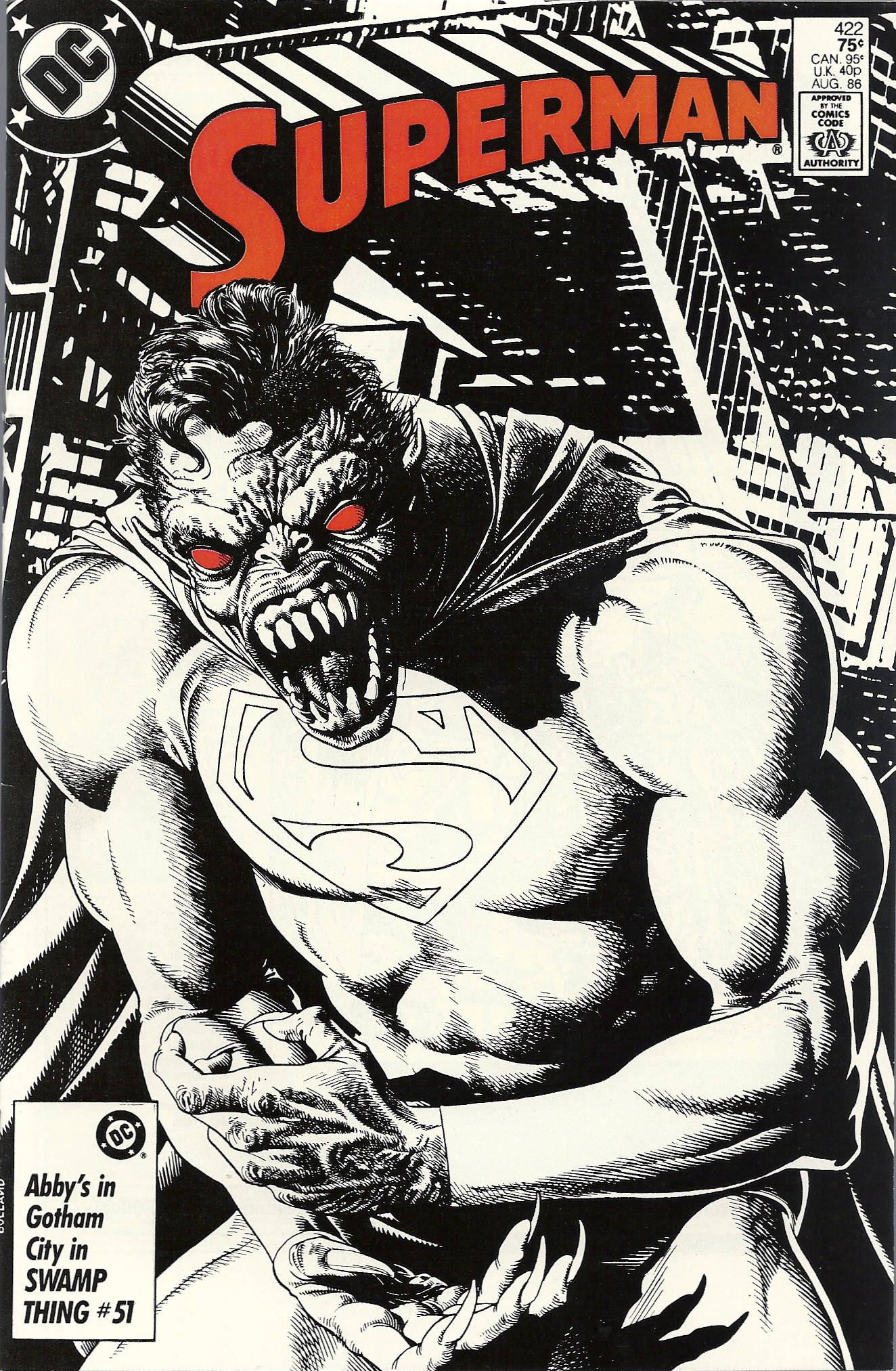
Brian Bolland has always drawn a mean cover, but this one may take the cake. I mean it. This is pure nightmare fodder. I love the black and white and the way the beastie’s eyes are red just like the “Superman,” but the teeth are what makes your heart skip a beat. They look like they’ll pop right off the paper and bite your fingers off.
Marv Wolfman, Curt Swan, Larry Mahlstedt and Tom Yeates bring us “Bad Moon Rising!” in this penultimate issue of the original Superman volume. We open with a Howling-esque transformation sequence:

The werewolf goes on a rampage — how predictable — and this draws Superman’s attention. When he tries to put a stop to the monster’s doings he gets his clock thoroughly cleaned. The werewolf makes his escape, but not before displaying a surprising regard for human life:

Remember that. It’s kind of important.
Superman takes a sample of blood left by the werewolf back to his Fortress of Solitude. His analysis falls into the “Well duh!” category:

He had to analyze the blood to tell if that thing was a werewolf? And that werewolf’s are supernatural? Come on, Kal. You’re better than that.
There are some scenes of the werewolf robbing armored cars and killing, and when Supes gives chase it escapes him yet again. He goes to see a group of scientists who say that they can answer his questions as to the origins of the creature:

Pretty soon Superman is again squaring off with the werewolf. It kicks his ass, and that’s putting it mildly:

Good…Lord. I guess Supes should consider himself lucky that he wasn’t sexually assaulted on top of everything else. I have to think that getting beat up and left nude and unconscious has to rank as one of his lowest moments. And to top it off that requisitioned outfit looks like something Paulie Walnuts from The Sopranos would wear.
Superman collects himself and uses some of his sleuthing skills to track down the human altar-ego (Thomas Lawrence) of the werewolf. Luckily for Superman the guy is in his human form, so don’t worry — our hero won’t get curb-stomped or anything. Thomas does some explaining, and the two of them go back to the lab to confront the group of scientists:

So it turns out Thomas was the “nice” werewolf from the beginning of the story that saved the woman’s life and spared Superman, while the evil scientists were the ones doing the dirty deeds. Thomas just wants to be cured, while the others are just looking to get rich. Go figure.
The were-scientists quickly overwhelm Superman, but before they can wreak fresh indignities upon him the good one channels some lightning onto them all:

Apparently electricity is a cure for werewolfitis, and they all turn back to normal. And Superman gets to keep his clothes this time.
Throughout the issue there had been allusions at the Daily Planet offices to Lois going out on a date wth a dashing Hollywood star. That sets up this groan-worthy final exchange:

It seems that this was the final appearance of the in-continuity Silver Age Superman in his self-named title, since the half of “Whatever Happened to the Man of Tomorrow?” that came in #423 was part of one of the old “imaginary” stories. Seen in that light, this is kind of an odd swan song for the guy — beaten up and stripped nude doesn’t seem like the best way to go out. But who am I to judge? I suppose it fits right in with the classic Silver Age goofiness.
A final personal aside — I can remember when and where I first read this issue. My parents and I were camping on a lake and it was amongst the comics I had brought with me. On that trip I went fishing with my father, and that was one of the few times he and I ever did that. I caught two rainbow trout that day and I wondered if it was really just one colossally stupid one that I managed to catch twice. We threw them both (or just the one) back.
Just a small memory.
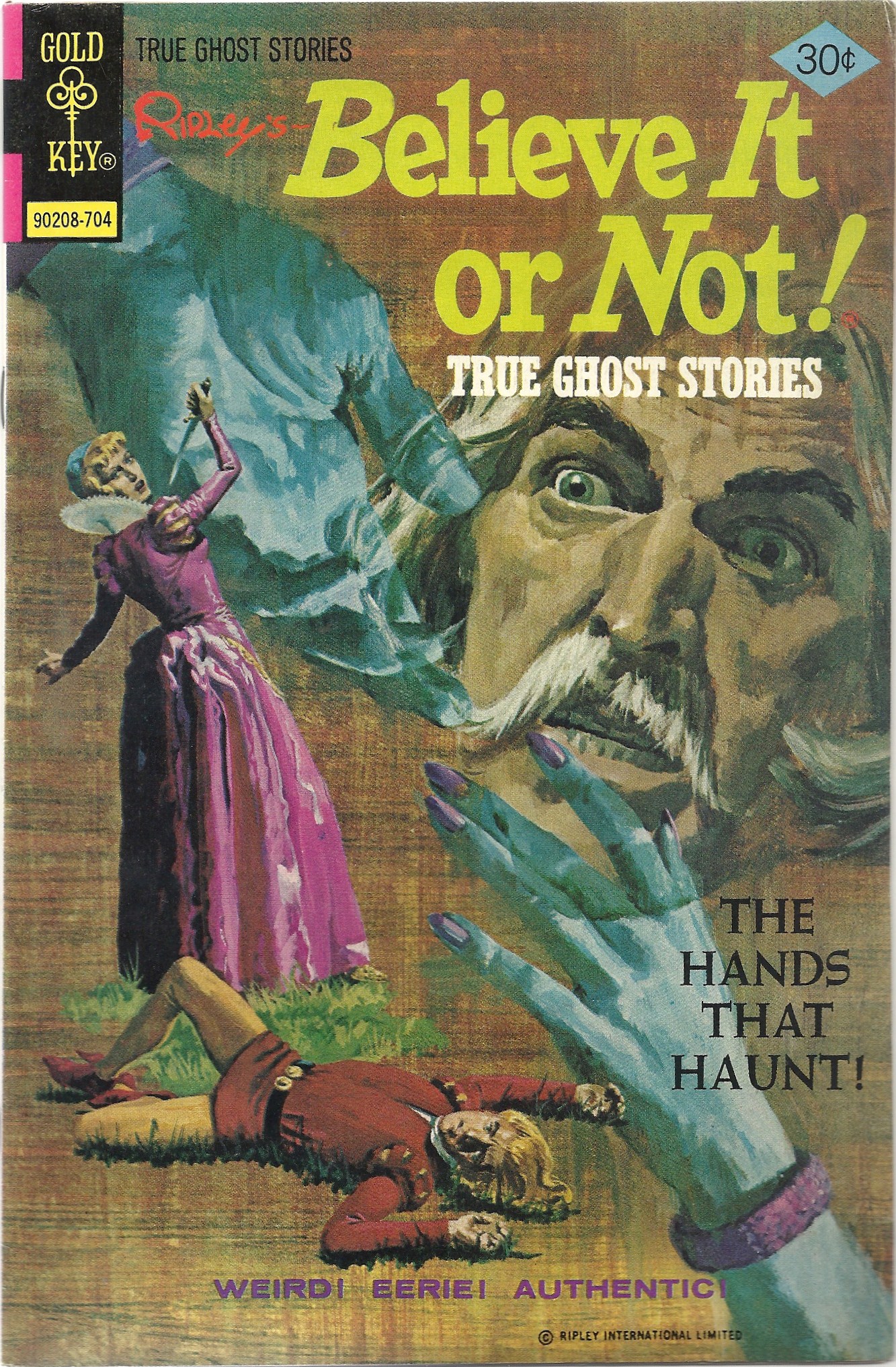
I associate the Ripley’s franchise with one thing — the distinctive, breathy verbal cadence of Jack Palance. Here’s the intro of the early 80’s TV show with a little taste of Jack’s diction, plus some cool music from Henry Mancini (please pardon the commercials at the end):
And here’s a clip of Palance at his Palance-iest with some funky foreign subtitles:
The weird thing about Ripley’s was that Palance was in some ways the most unbelievable thing on a show about unbelievable things. And I loved him for that. When he showed up years later in the first Tim Burton Batman movie, my reaction was “Hey, it’s the Ripley’s guy! Cool!” I could listen to that guy read soup ingredients. Seriously.
On to the comic.
“When Hands Reach Out” is our first story and it’s illustrated by Jack Sparling (I could only find art credits, so that’s what you’ll see for all the stories here). A 15th century nobleman is haunted nightly by phantom hands:
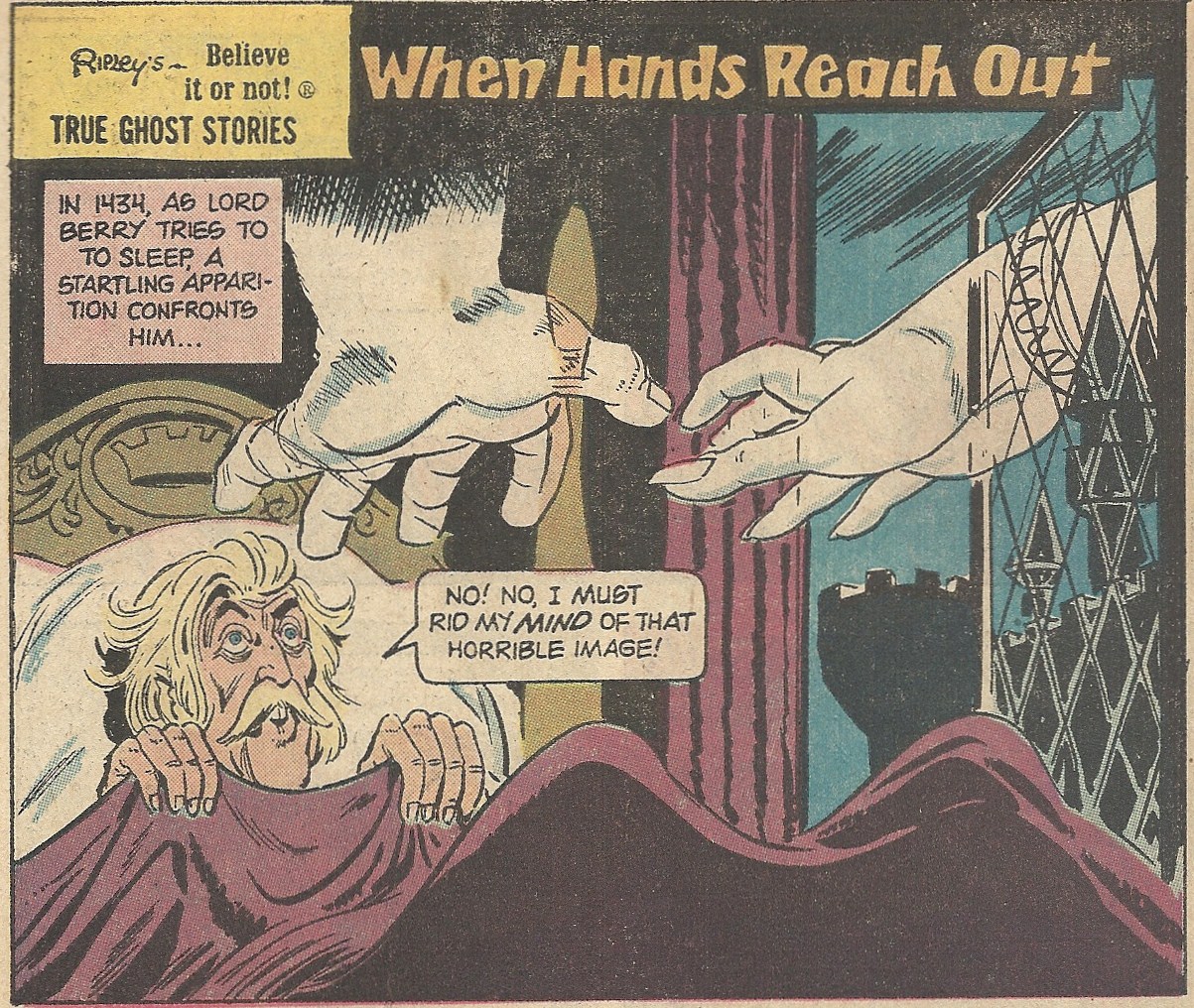
Lord Berry confesses to the local village bishop the source of the hands in the hopes that he’ll get some help from that quarter. He had romantic feelings for his cousin (incest is best), but found her with another man. In what Inspector Clouseau would call “a rit of fealous jage,” he killed the man:
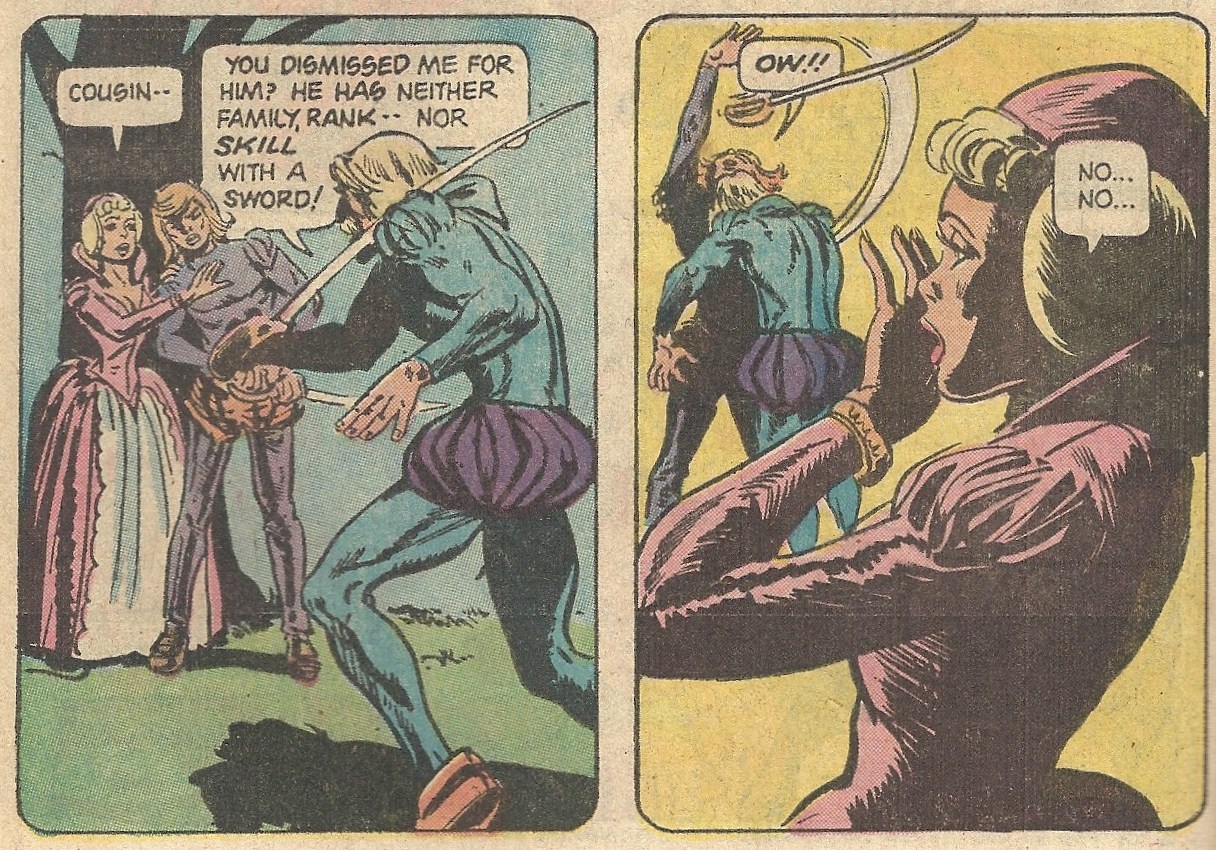
I’m a bit underwhelmed by the “Ow!!” I’d think that getting run through would merit at least an “Argh!!” or “Yee-ow!!”
Lord Berry then watches in horror as his beloved cousin kills herself:
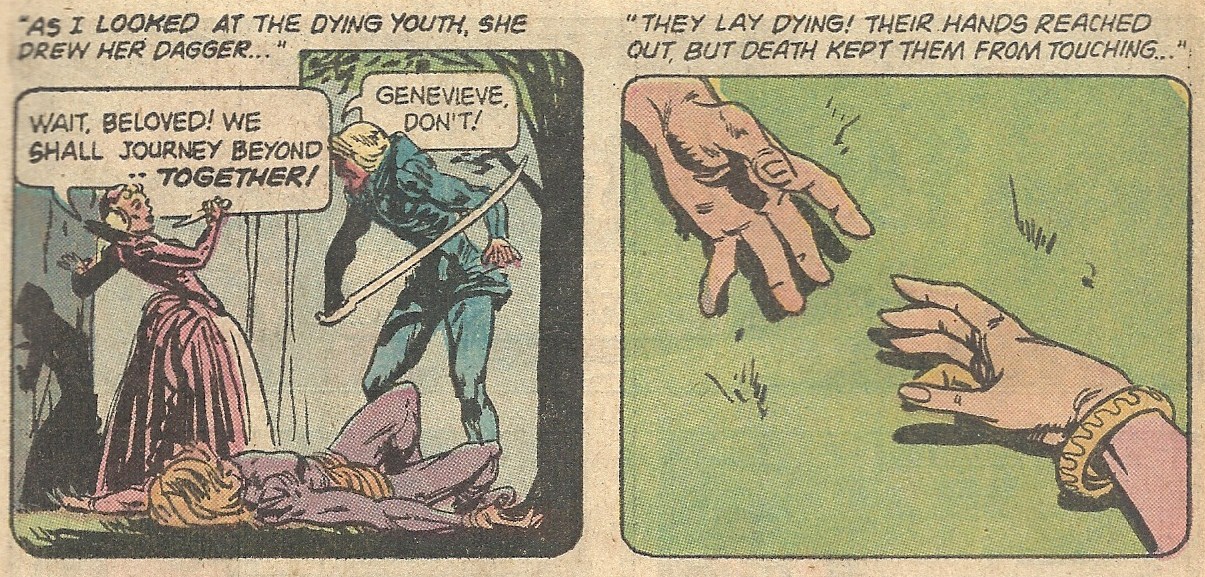
The Bishop, for these evil deeds, condemns Lord Berry to be haunted by these phantom hands for the rest of his life. Thanks for your help, padre.
The next story, “The Tortured Spirit,” is set in Hong Kong (it’s drawn by Amador Garcia). The studious young child of a magistrate becomes possessed, and the magistrate soon guesses the identity of the possessing spirit:

What soon follows may be the easiest exorcism in the history of the spirit world:
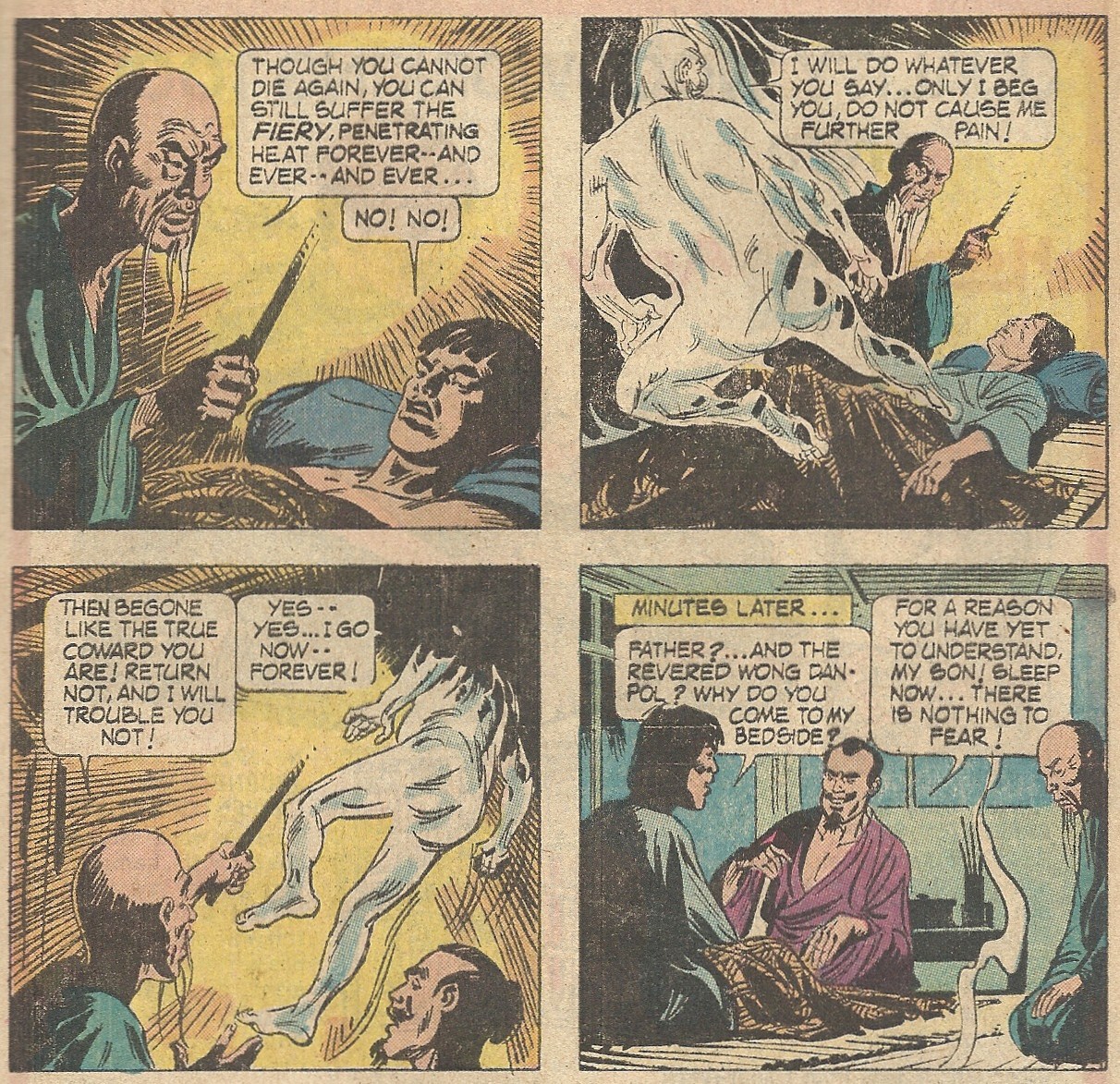
And that’s the end of that. For a guy who was a bigwig in the underworld, the spirit self certainly gave up pretty quickly.
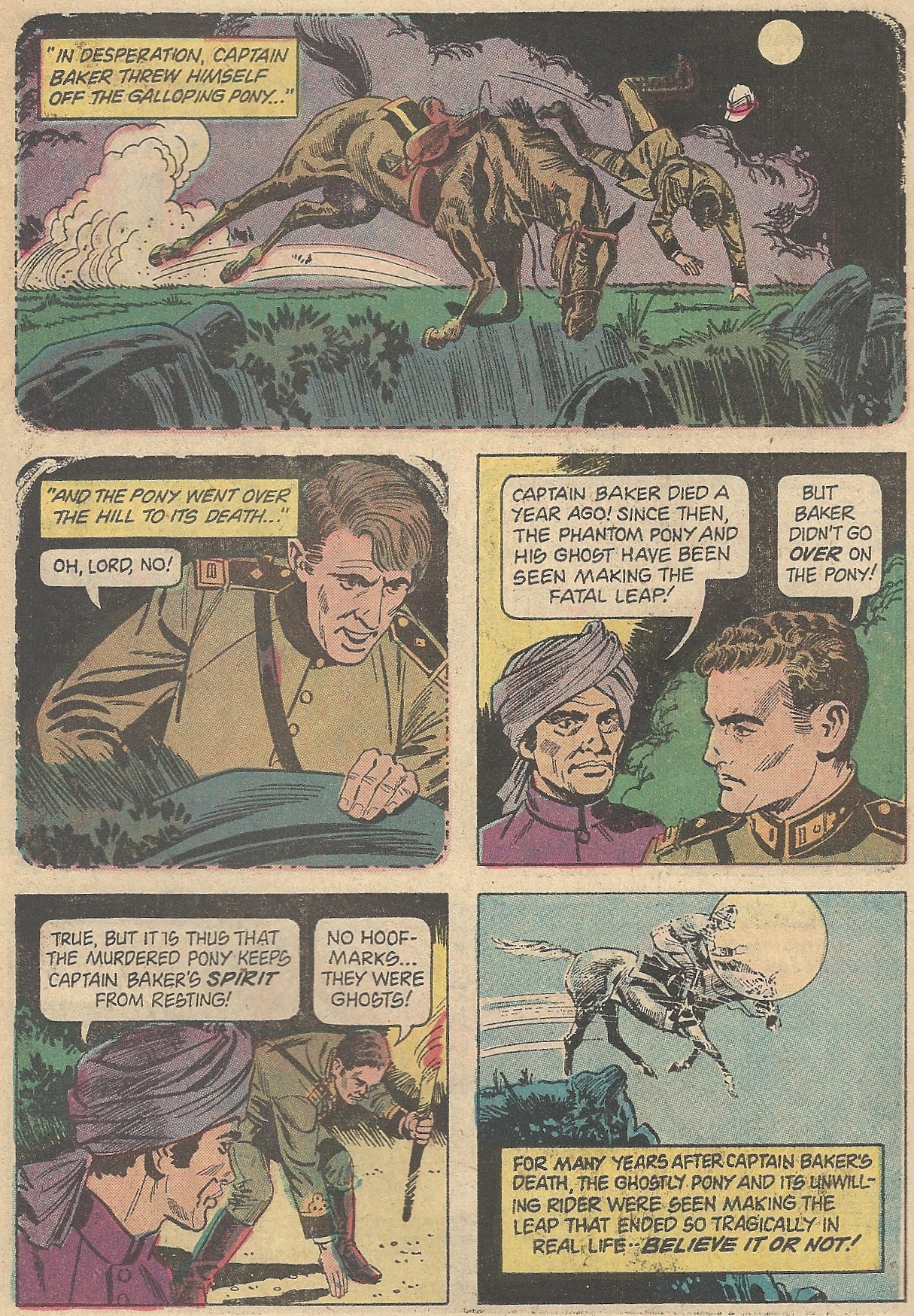
“Death Leap” (Frank Bolle) is set in India. A young British Lieutenant investigates the nocturnal sound of hoofbeats and sees a spectral horse and rider:
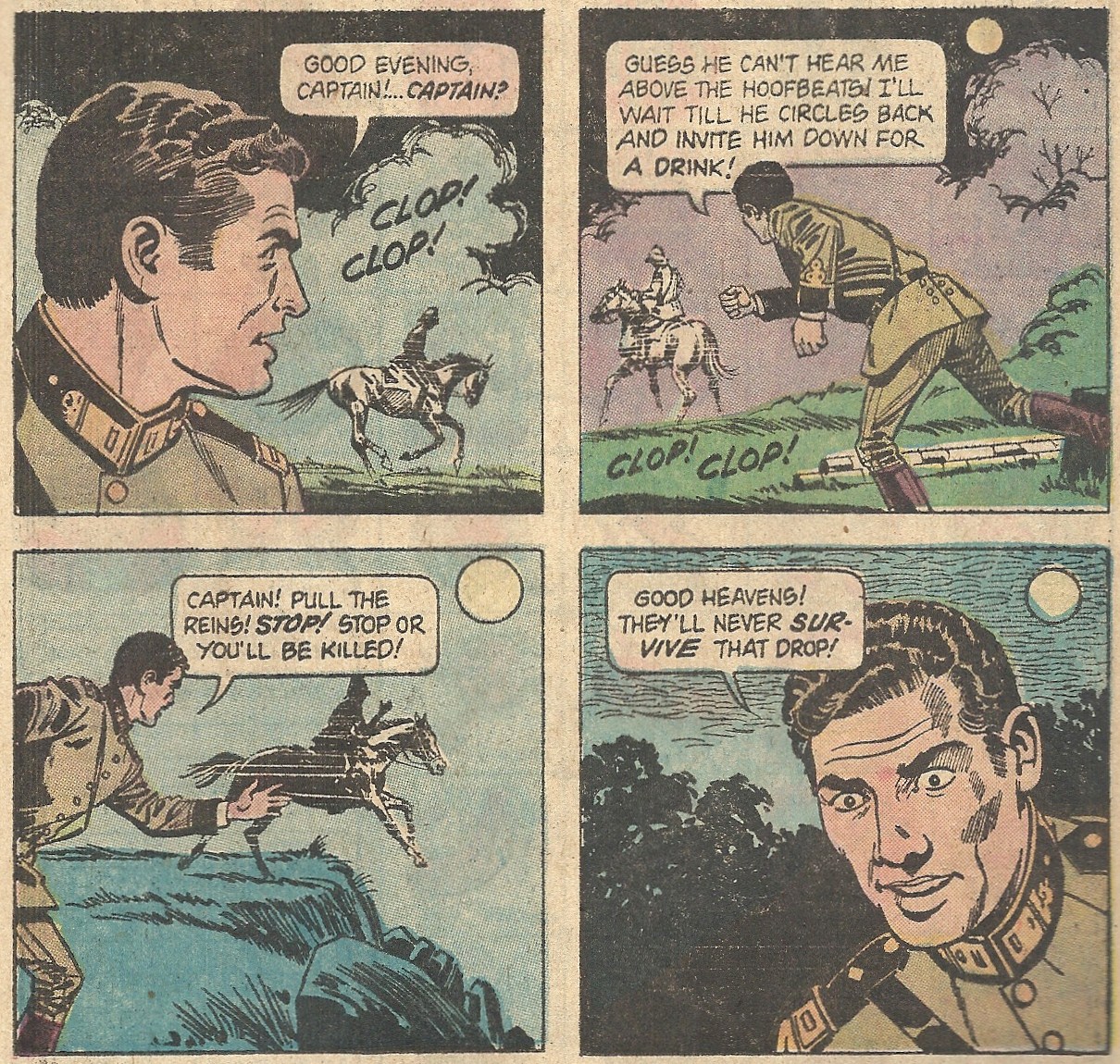
When he returns to camp, one of the native servants clues him in on the identity of the rider and horse. An arrogant captain who had once been stationed at this encampment tried to show off the speed of his horse one day and his showboating had disastrous consequences:
“The Day You Die!” (Jose Luis Garcia-Lopez) is our last story. The foppish son of a wealthy 17th century nobleman wants to know when his father will die and leave him his inheritance. The magician (Layton) whose counsel he seeks informs him that they’ll have to rob a fresh grave to get answers, and the young man reluctantly tags along. Things get all fouled up when the exhumed spirit gets pissed and, instead of relaying the date of death for the wealthy lord, informs Layton that he (Layton) is going to die in a matter of days. Well played, “magician.”
This causes Layton to pace and mutter all the next day:
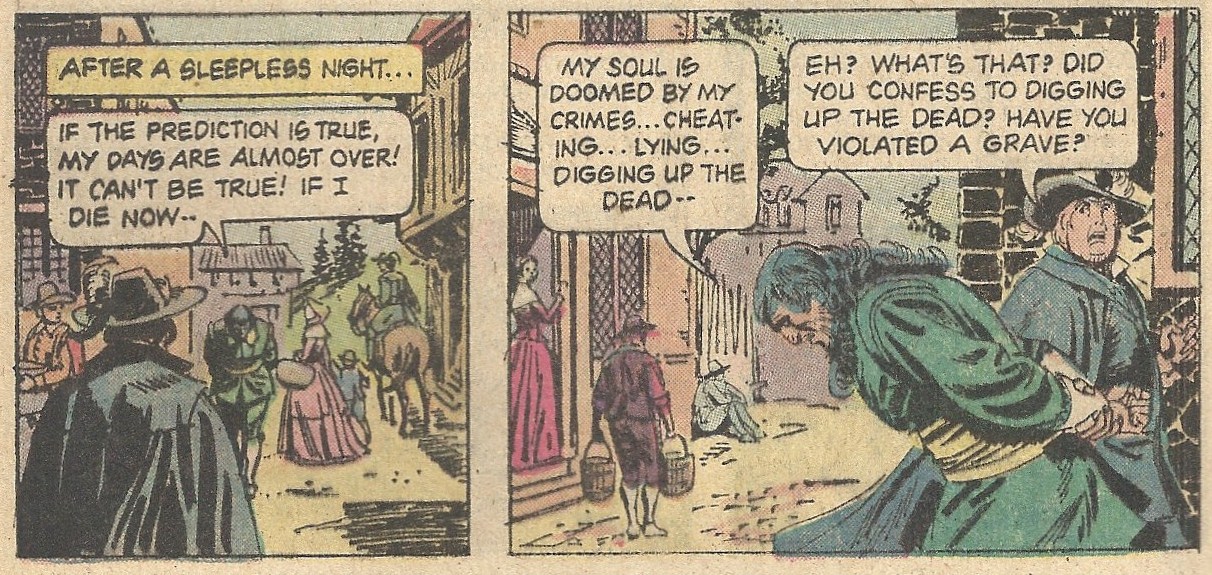
Apparently loose lips don’t just sink ships.
Layton continues blabbering in court and drags his young accomplice into the mix:
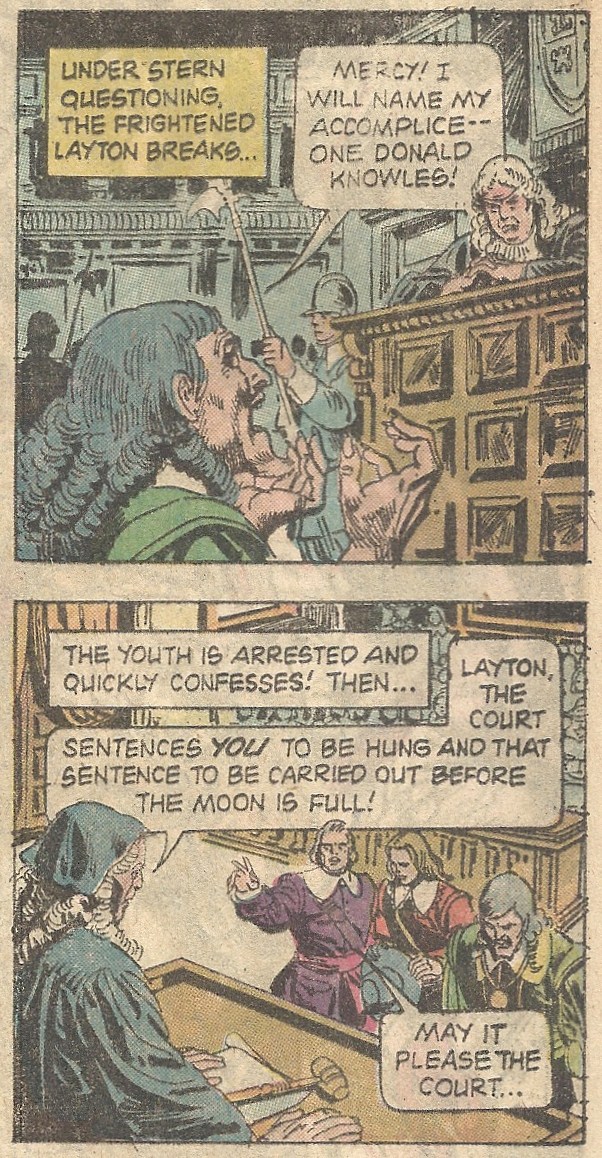
The lord disinherits his son and the court accepts this as a substitute punishment for death. Layton, meanwhile, heads for the gallows.
I wasn’t overly impressed with any of the stories in this book. The core ideas might have worked if they had been a little more fleshed out, but as they are they’re way too brief. I suppose the brevity fits in with the usual Ripley’s presentation — the shows and strips always used brief vignettes instead of long form presentations. But it just didn’t work that well in this medium, at least for me. I needed a chance to catch my breath.
Speaking of breath…Maybe I’ll have to re-read it with Jack’s voice in my head. Now there’s an idea.

This was my re-entry point for Star Trek comics back in the day. I had a bunch from the previous DC run, but I had moved on to other things for a while before I plucked this one off the rack. I was a pretty big fan of the franchise in this time period, which was perhaps the high point of Star Trek fandom in general. I never wore a costume or learned to speak Klingon, but I consumed a lot of material — books, comics, movies, shows, etc.
I’m not sure what it was that made me pick up this book — it’s been close to twenty years (!) since I bought it, and the memory of whatever my motivation might have been is a bit hazy. It may simply have been the cover. Jerome K. Moore handled many of them in those years, and he produced some very striking images, hewing closely to the actors’ very recognizable faces and crafting some wonderful designs.
Yeah, maybe that was it. The cover.
The story is a pretty good one. “Once a Hero!” is brought to us by Peter David, Gordon Purcell and Arne Starr, and in it we find James T. Kirk struggling to draft a eulogy for a fallen crewmember:

He didn’t know much about the young man, and because of that everything he thinks of to say sounds hollow. Bones shows up and offers his usual homespun orneriness:

Kirk starts asking others — those who may have been closer to Ensign Lee — for information about him, but no one seems to know much about the guy. This is all the more frustrating for Kirk because the Ensign, a young security officer, died saving Kirk’s life on an away mission when they were ambushed by some stranded space pirates. Kirk harkens back to that incident as he makes his rounds:

They were unable to get Lee back to sickbay in time to save him, and Spock could only ease his passing:

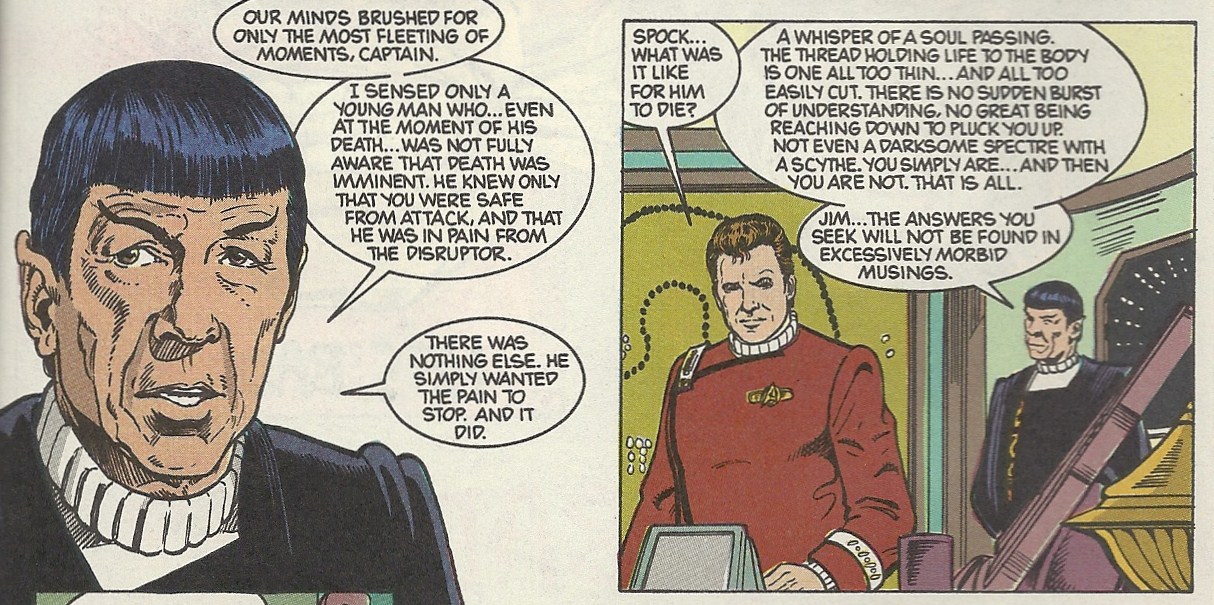
Kirk goes to see his Vulcan first officer, hoping that Spock’s fleeting mental contact with the Ensign was sufficient to offer some clues as to what kind of person Lee was. No dice:
Kirk finally gives up on trying to get to know someone who’s already passed, and at the Ensign’s service delivers a eulogy that reads as a remorseful panegyric for all those anonymous sacrificial redshirts of the past:

I’ve always liked the movie era soulful Kirk, and I can hear William Shatner’s voice saying those words. And at least he didn’t repeat the “Of all the souls I have encountered…” line from The Wrath of Khan. That would be *ahem* a bit tacky.
It’s a nice little issue. David was very much at home in the Star Trek universe, and I can remember reading some of his novels, like Imzadi and Vendetta, and enjoying them very much. And Purcell and Starr were an excellent team — their art combo wasn’t as flashy as many of their contemoraries’, but their likenesses were very good, and the importance of that can’t be underestimated when depicting flesh and blood icons.
I kind of miss being a big Star Trek fan. For a while in my life it was a ton of fun, but there’s been a whole lot of crap in that franchise between 1991 and now. A lot.
Before I go, here’s a pinup/ad that ran in books from this period — I remember liking the depiction of the young Kirk and the evolution from TOS to TNG.

“May your journey be free of incident…”
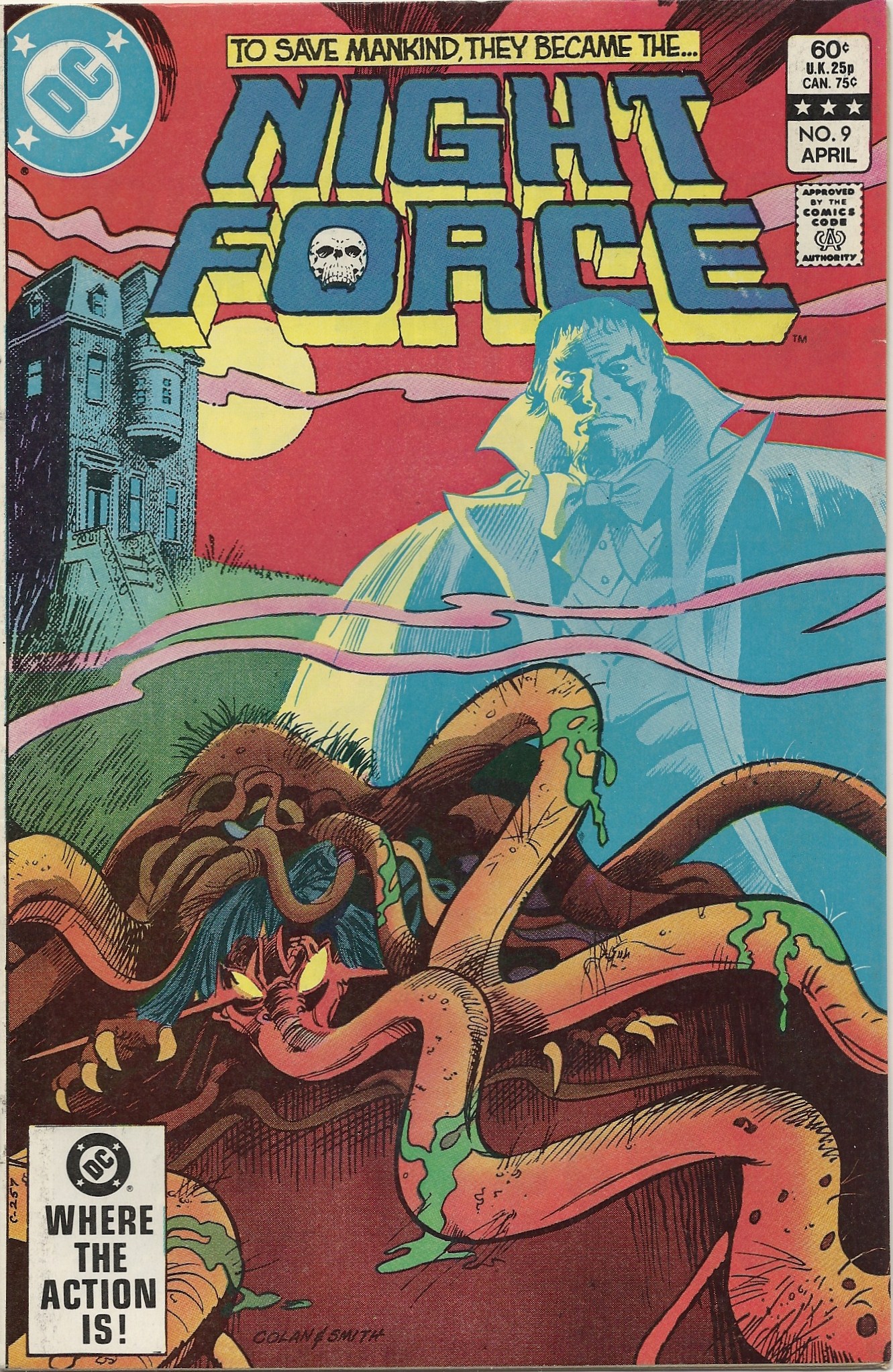
I bought this book for a quarter. Night Force is a title I know nothing about, and even after reading this issue I’m none the wiser. It took a trip to Wikipedia to get the overall gist of the thing. But I saw that Gene Colan was the illustrator, and I thought “Colan+Horror=Me taking a chance and buying it.”
I know, I’m a real high roller.
Night Force had a set stable of characters, but they were largely absent from this tale and only appeared in a few panels far away from the action. Instead, in “Symbiosis,” by Marv Wolfman, Gene Colan and Bob Smith, we focus on one man thrown into the midst of unspeakable horror:
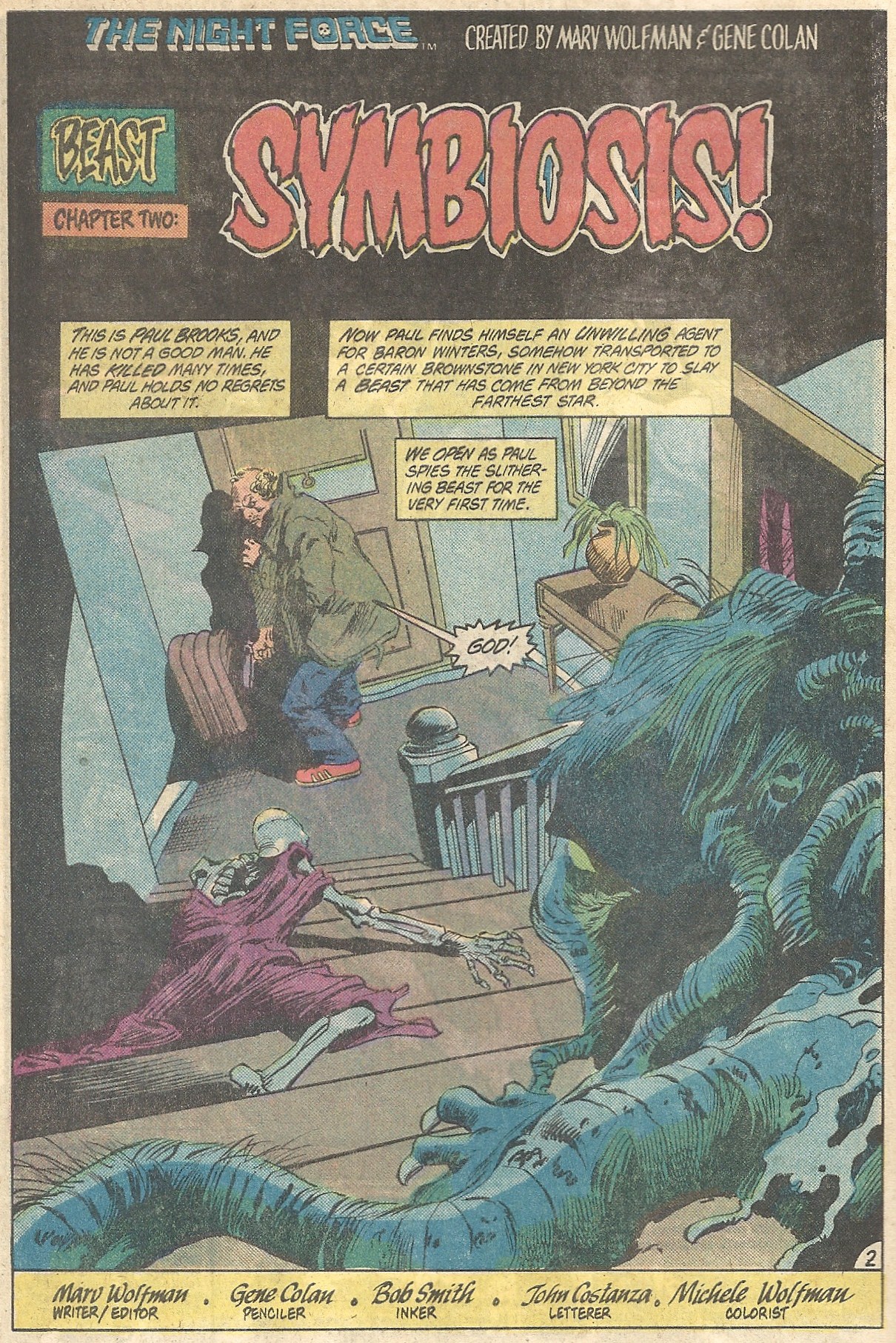
The word “Lovecraftian” has become an overused cliche, but this lumbering beast would seem to fit the bill.
Paul Brooks, our “protagonist,” is a vile criminal, but at least he’s a man of action:
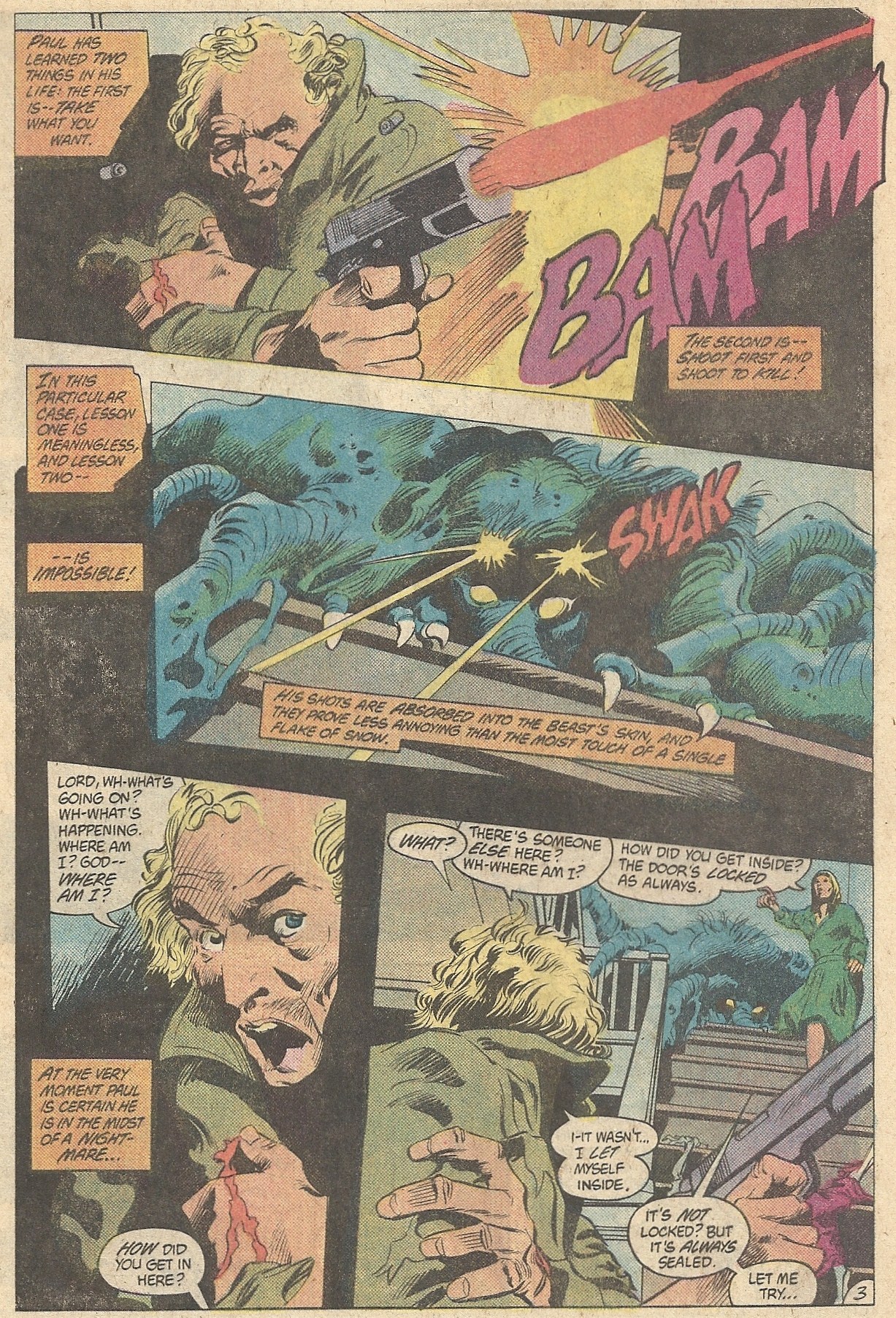
Unfortunately for him, it doesn’t seem that his usual way of solving things (gunplay) is going to work.
So Paul is in this house, but he’s not the only person there. And all these people are trapped, and now he is too:

These folks are in some sort of boarding house/apartment building, and they just walk around the beast like it’s a fixture. It only does one thing — it keeps them there inside:
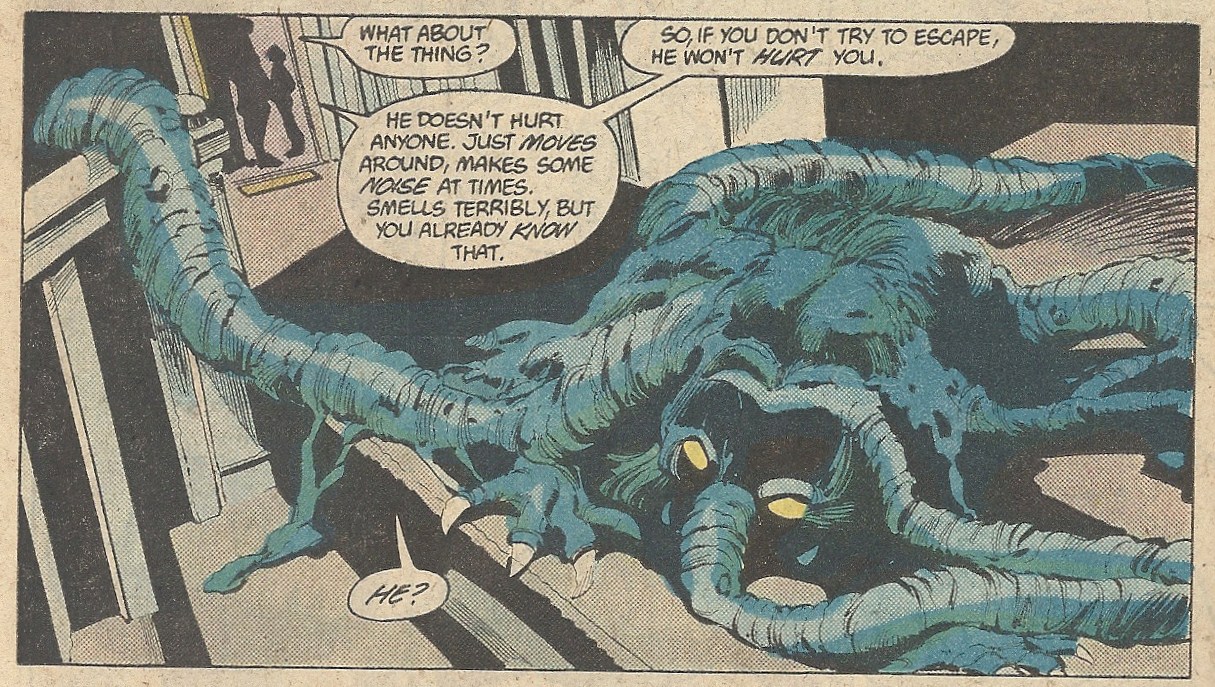
There’s a woman living there (or imprisoned there as the case may be) named Sylvia, and she’s part of a nuclear family (husband, wife, son) that’s trapped. She tells Paul how the creature provides for every need and material desire:
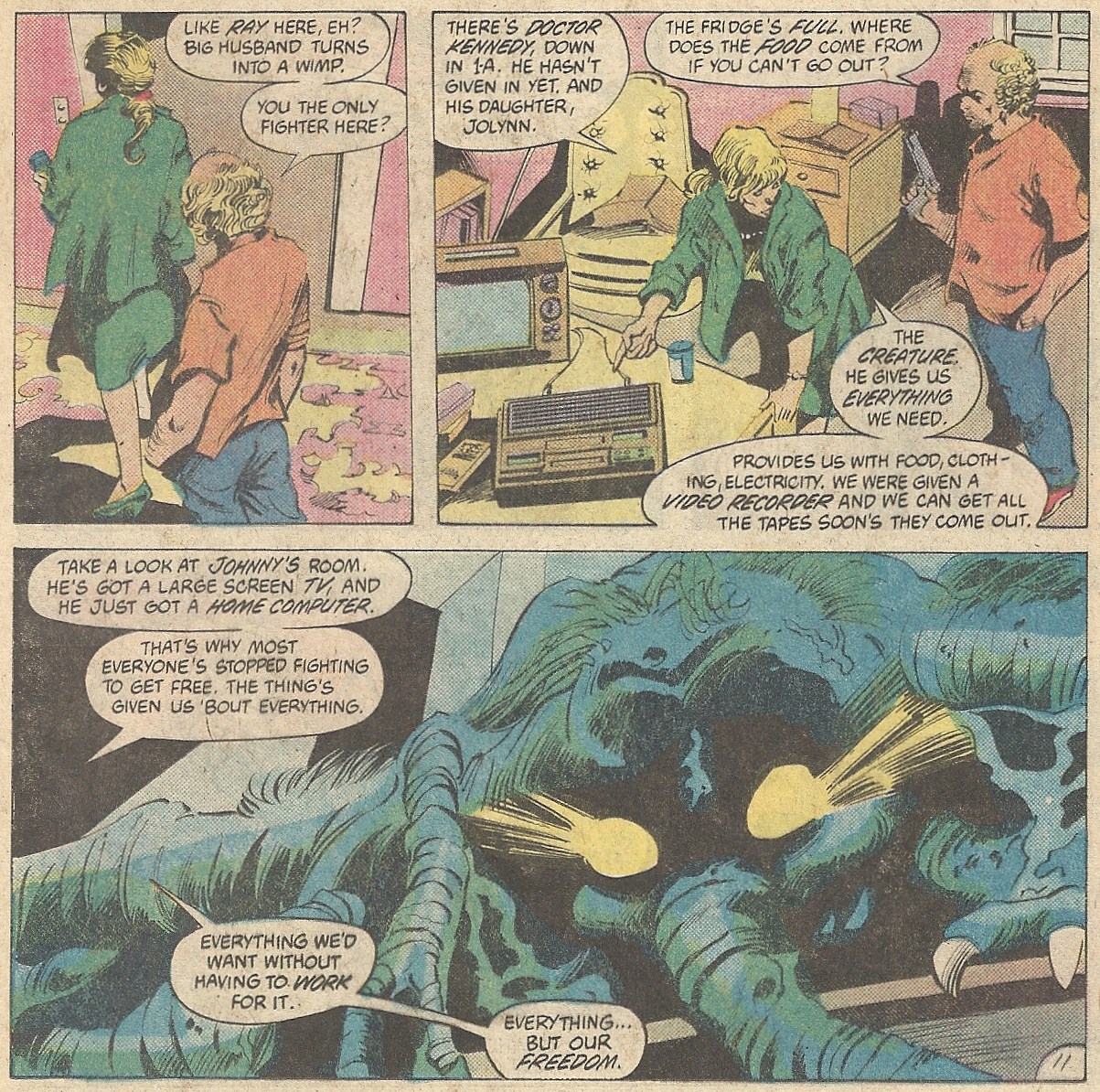
The husband, Ray, just sits in front of the TV — he’s been broken. But Sylvia still has some fight in her, and this gets Paul’s creep juices flowing. He tries to put the moves on her, but she rebuffs him. They end up smacking each other — classy guy, this Paul. Then he stalks off and meets some of the other denizens — or prisoners — of the house, and one dirty hippie meets a juicy end:

Yuck. So we learn that the creature can do more than just sit around.
This display only increases Paul’s resolve to get the heck out of there, but he’s at a loss for how to make his escape. He’s tried everything, including pounding the thing with his bare fists. He still has the gun, but that’s proven useless against the creature. Ray, the broken husband, finds a use for it, though — to end his own life, which he does after bopping Paul over the head and swiping it:
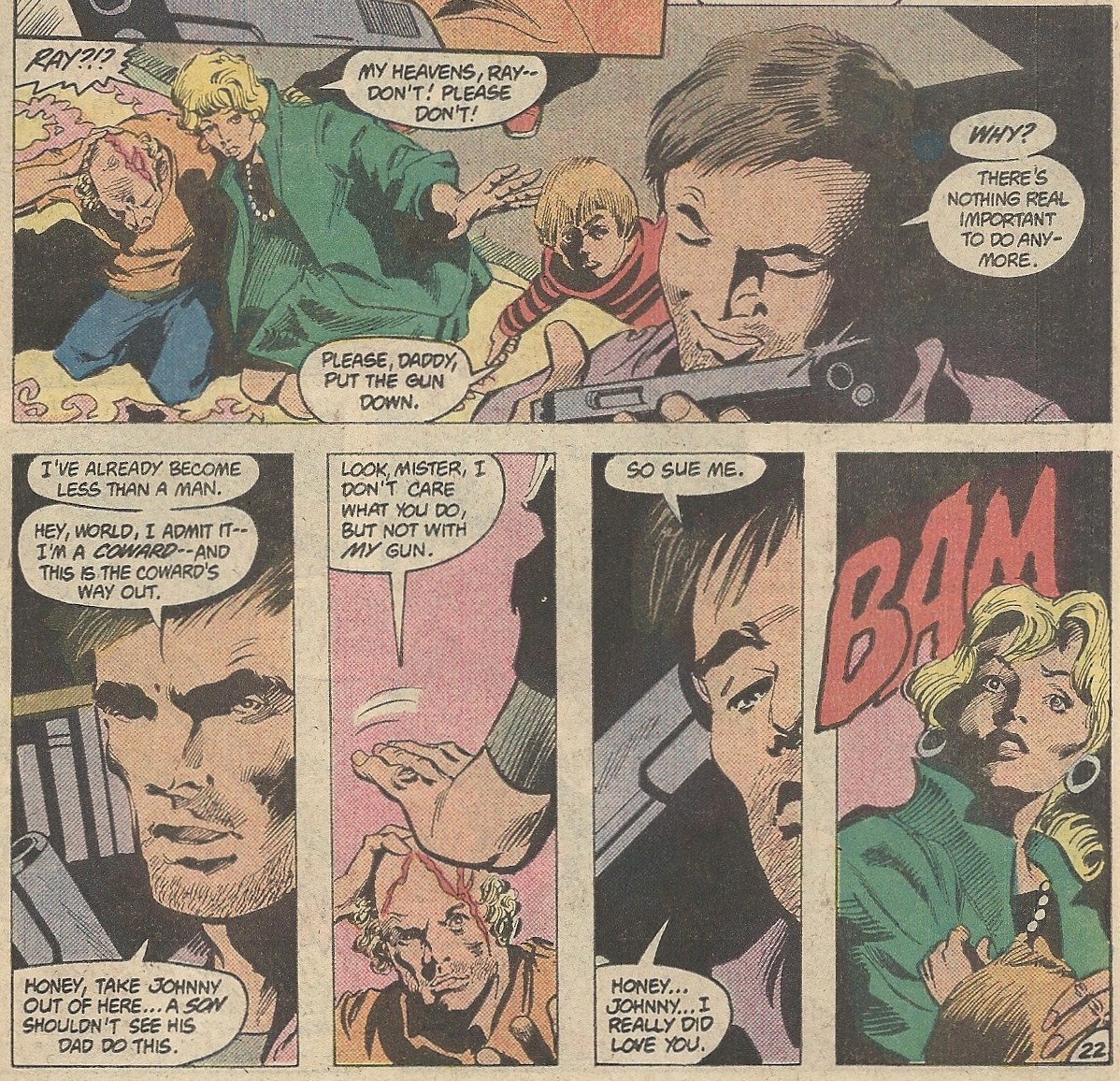
Again it’s snack time for the creature:

And that’s it.
Well…I kind of dig this book. There’s a mystery to the origins of this creature that I really like. There are some allusions in this issue to it having done similar things on other worlds to other sentient species, but its motivations are unknown throughout. Add to that its gobbling up of dead bodies and crapping out bones, which is a nice disgusting touch. Colan’s shadowy artwork has always been well-suited for horror, and that’s on clear display here. And a mentally shattered father blowing his head off in front of his wife and son — I think that qualifies as harrowing.
There are a lot of elements working in this issue’s favor. For a quarter, it was a pleasant surprise.
I don’t know how this story ends (or how it began and how Paul got inside the building), and I think that there’s something to be said for not knowing the ending to some stories. I can remember as a kid reading The Lion, the Witch and the Wardrobe, but only ever having enough time to get up to that first trip into the snow covered forest of Narnia. Then I’d have to put it down, and when I picked it up again I’d start back at the beginning and retrace my steps until roughly the same point in the story. Then the cycle would repeat. Years later, when I finally read the whole thing, some of the magic was lost, the mystery.
I’m not claiming that this is a Wardrobe level story, but I think I’ll let this one lie. I don’t think any answers will increase my enjoyment. The key to horror is not knowing — there’s nothing more frightening than something you don’t (or can’t) understand. So if anyone tries to clue me in as to what the monster is, I’ll just put my hands over my ears and do the “Na Na Na I’m not listening” bit.
Sweet dreams.
Come celebrate Christmas in July with the World’s Mightiest Mortal – Captain Marvel Adventures #42
Boy, it’s hot out there. I have the AC on full blast and the cold glass of water I just poured is schvitzing like a rhinocerous. So, for a little “mind over matter” distraction, why not look at a Christmas-themed comic?
Done:
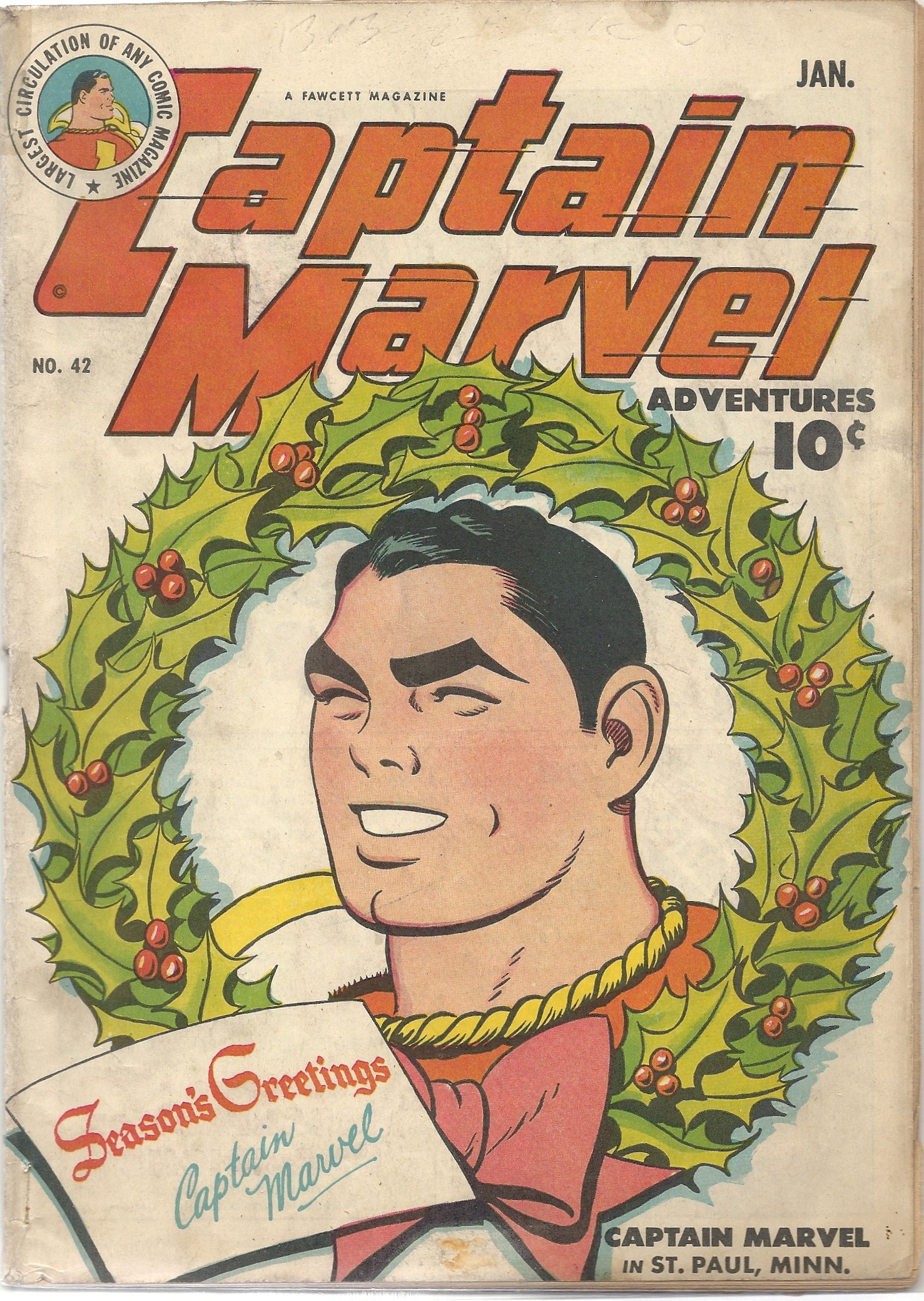
That wreath is cooling me off already.
There are about a hundred stories in this issue, as in all comics from this era — you really got your dime’s worth back in those days. Before we get to the holiday cheer, I should note that this issue was published while World War II was still raging, so we get a de rigueur Nazi-bashing inside. “The World of If” is a silly story, where a scientist invents a machine that shows various future possibilities and a Nazi sympathizer uses it to see if his plan to make Captain Marvel an Axis tool will work. His “plan” is to trick Captain Marvel into signing a document where he pledges his support to Hitler. I won’t go into any further detail, because the story’s thin conceit makes the logic centers of my brain ache. The future machine shows that the plan works for a while, but it, of course, fails in the end.
And then we’re treated to this panel:

Knock that toothbrush moustache right off, Cap!
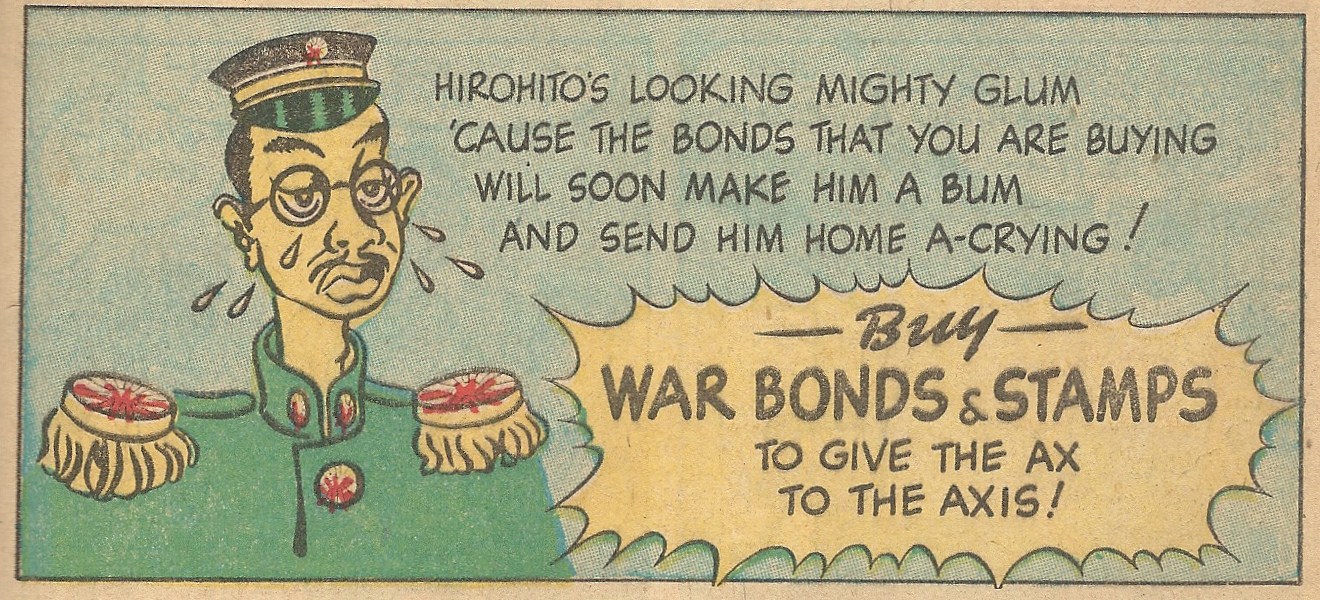
We also get some WW II themed ads. Here we have a semi-racist war bond promotion:
And here’s an exhortation to recycle paper — and in turn make old Golden Age comics even more rare:

Enough of that — let’s get to the cool down.
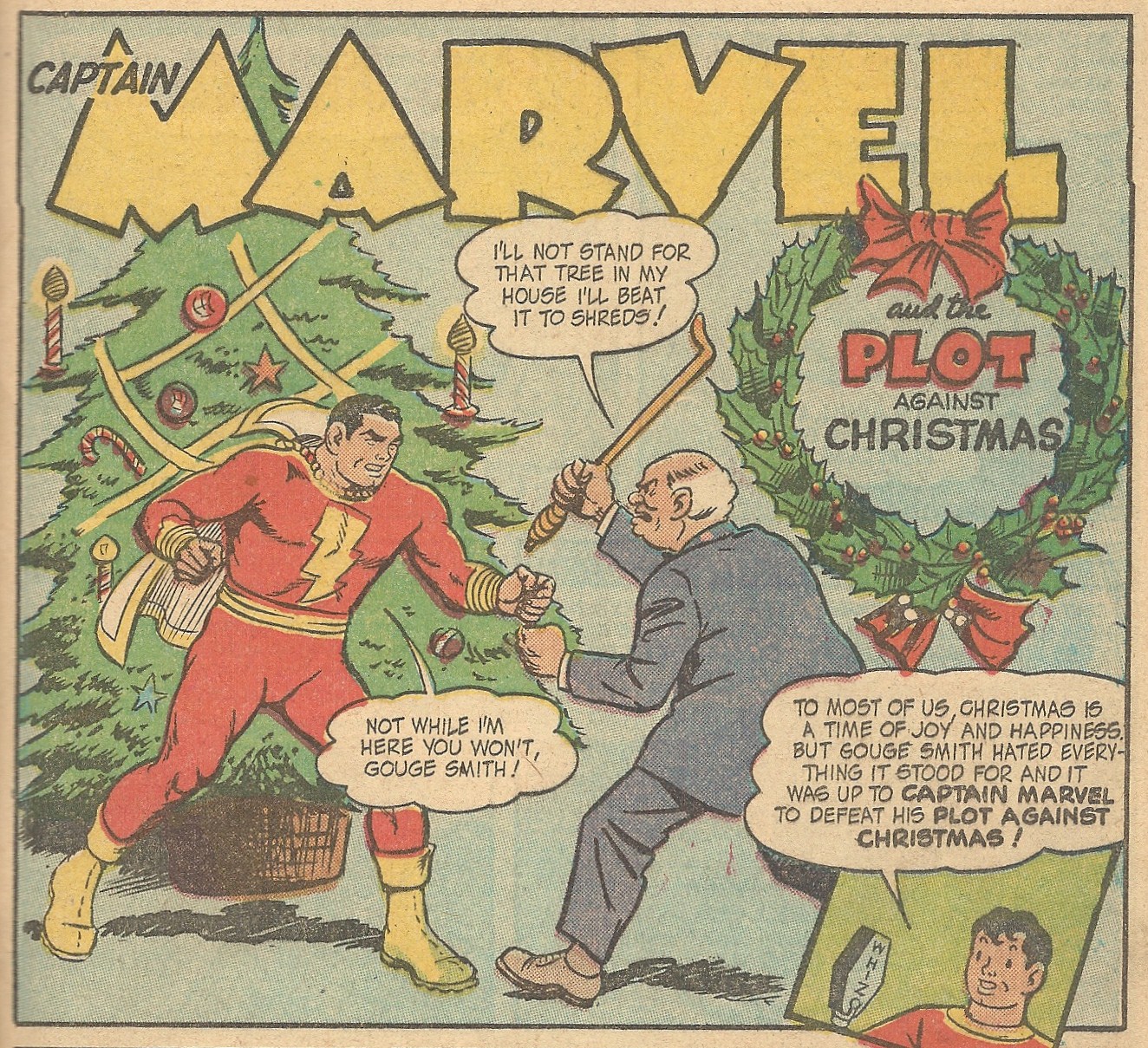
“The Plot Against Christmas” is a Dickensian short that has Captain Marvel showing an old curmudgeon the error of his ways:
Three brothers run a toy company — Happy, Jolly, and Gouge Smith. With names like those it’s no wonder that one turned into a grouch. Gouge — no surprise here — is not enthused about giving toys to poor little orphans:
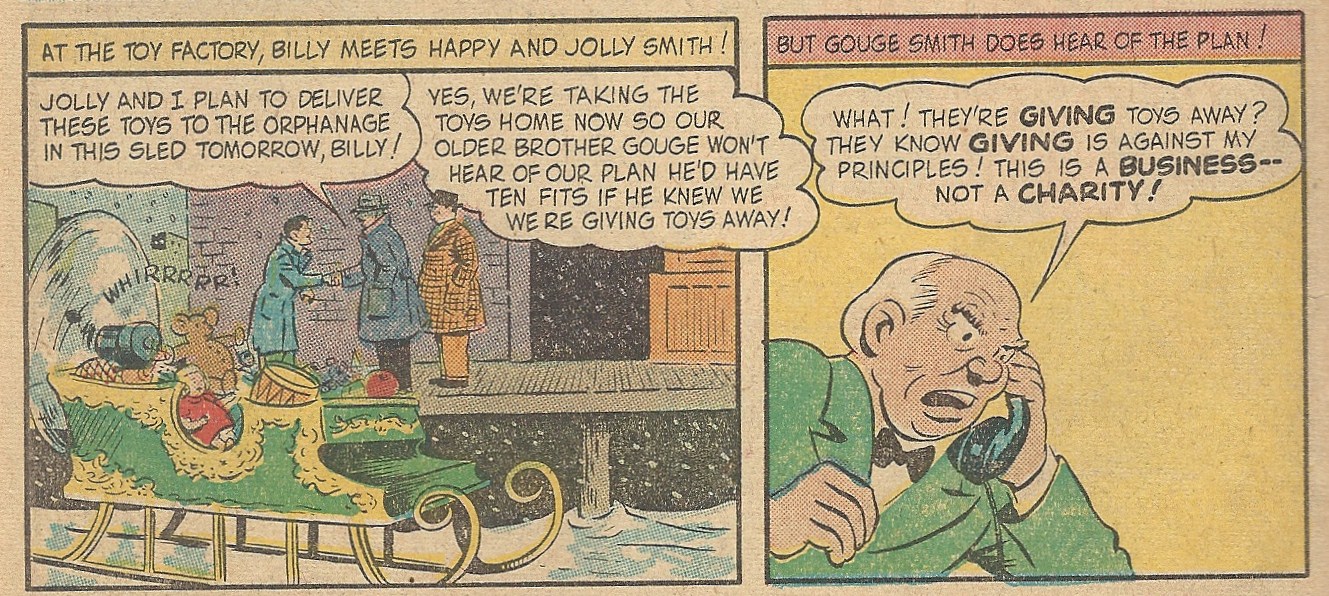
He puts the kibosh on his brothers’ kindly giveaway, but in the process he draws the disapproving attention of Captain Marvel. Our hero sets out mend Gouge’s cruel soul:
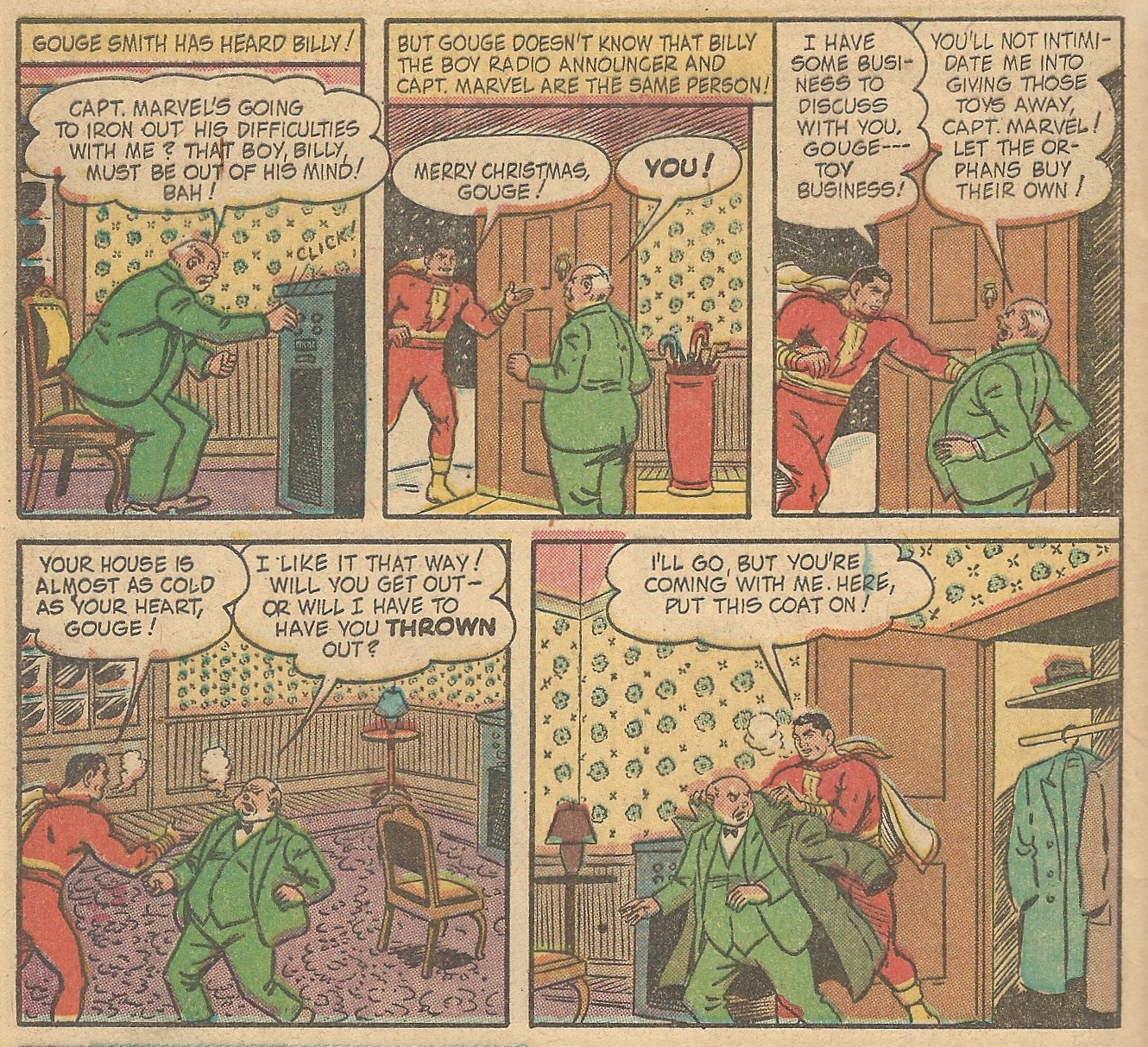
Marvel fills the Christmas Carol “three ghosts” role and carts Gouge to his brothers’ houses. First we stop at Jolly’s, and Cap does his “Abominable Snow Monster from Rudolph” routine in putting the star on the tree — a versatile guy, this Captain Marvel!:
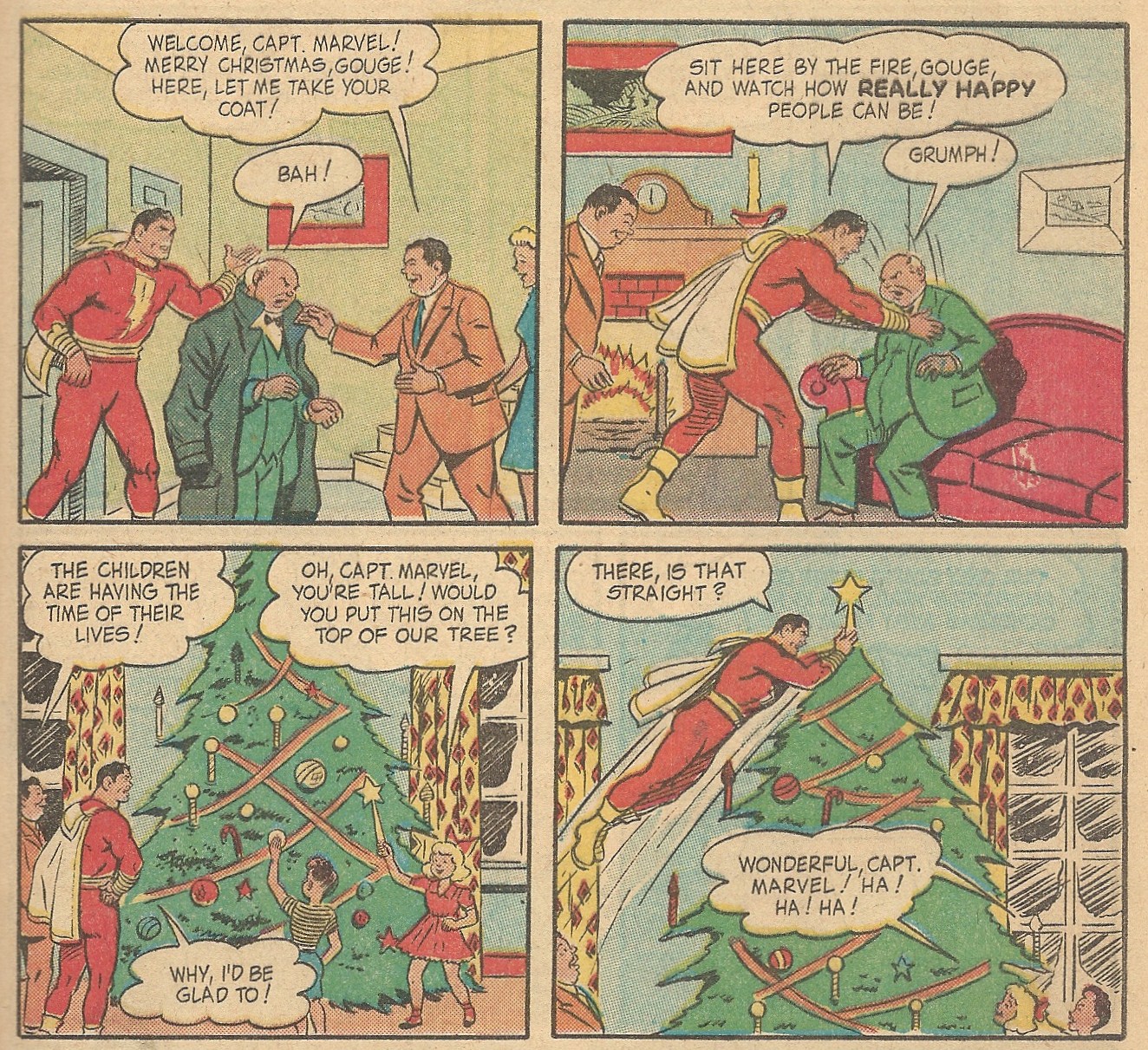
This doesn’t get to Gouge, so next Cap tries Happy’s pad:

Even the selflessness of the Happy Smith household fails to work, so Cap pulls out his trump card — the orphanage:
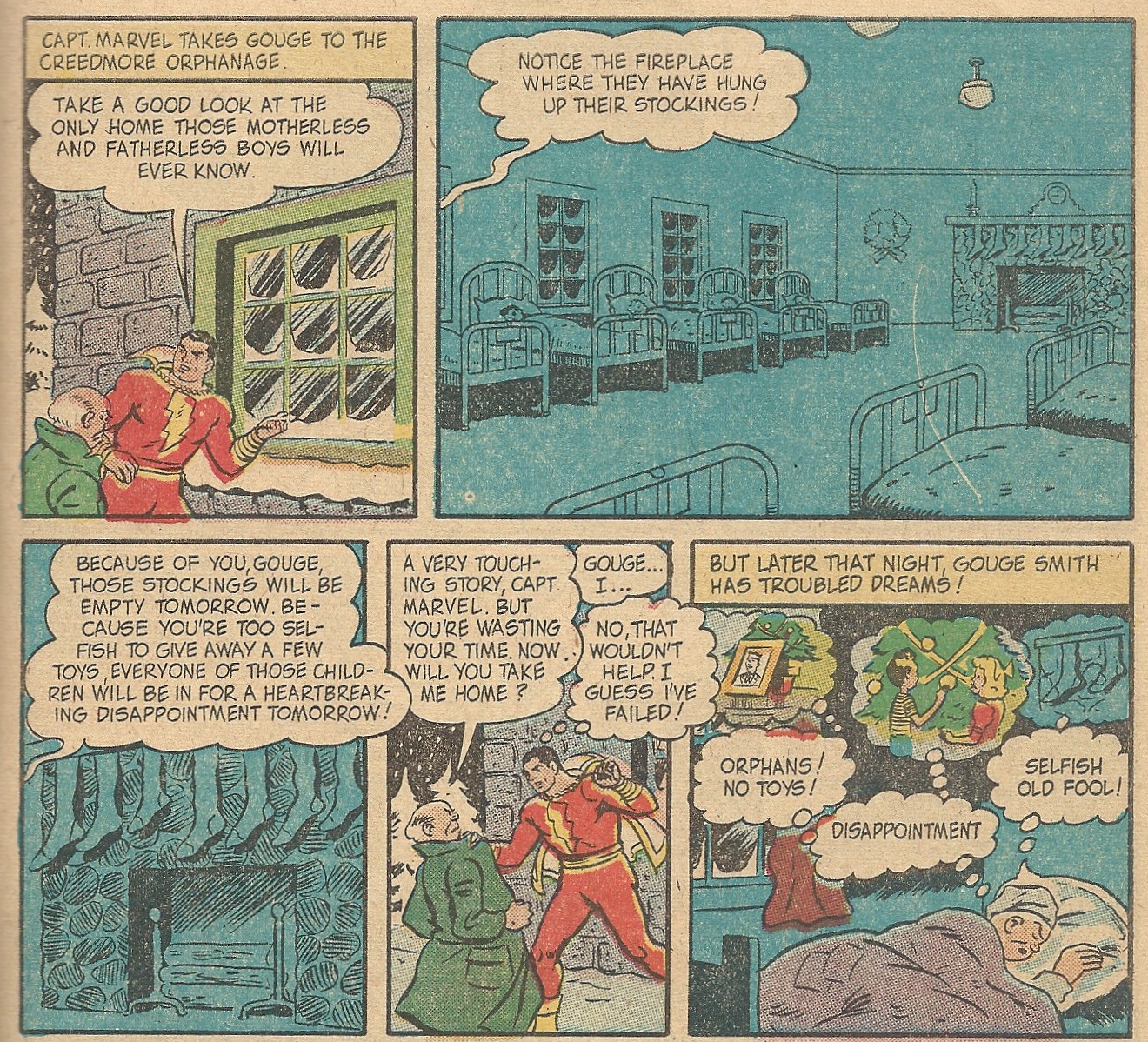
This finally does the trick, and Gouge repents. He agrees to dress up as Santa and give a heck of a Christmas to the orphans:
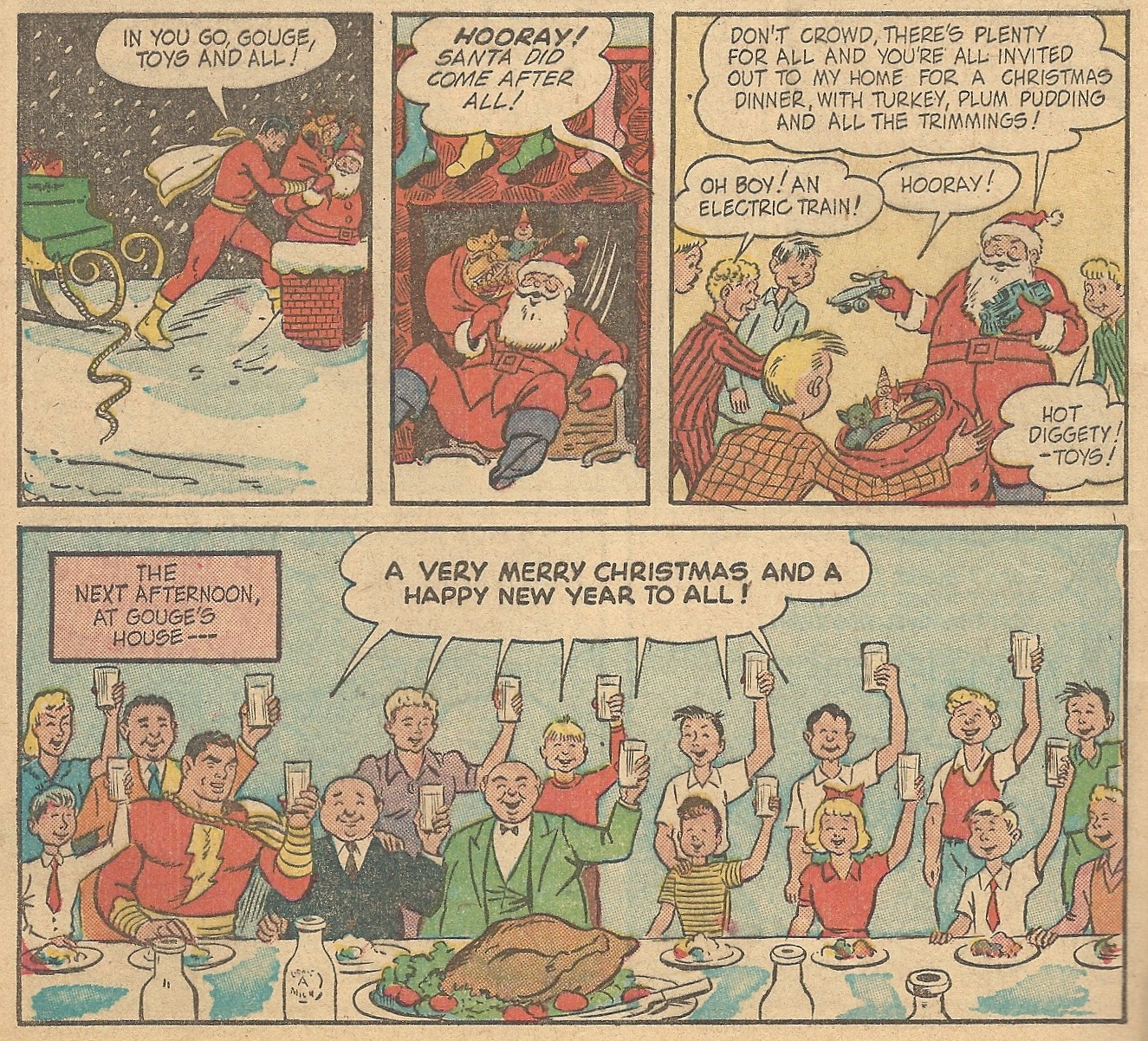
Norman Rockwell, eat your heart out.
I don’t have many Golden Age books, but I get a lot of pleasure out of them despite their generally weak stories. This issue is a prime example of why they work for me — Hitler getting puched, a nice Christmas Carol rip-off, war ads…it has everything. I only wish I could give solid information about all the writers and artists responsible. From what I could gather, the cover was drawn by C.C. Beck, “The World of If” was scripted by Otto Binder, and “The Plot Against Christmas” may have been illustrated by Pete Costanza.
But let’s not get hung up on the anonymity of some of the creators. Their book did the job — it cooled me down quite nicely. Merry Christmas in July to all!
It’s a “Sunsword,” see? Yeah, that’s the ticket, a Sunsword … – Thundarr the Barbarian
When you’re little it’s sometimes hard to distinguish between fact and fiction, and that can take you down two very different roads. Either you can get lost in something delightful or you can be terrified by something not so nice. The intro to Thundarr the Barbarian, an early 80’s cartoon, definitely brought out the latter response in me:
Back when 1994 was in the not-too-distant future, that opening, with its tidal waves, earthquakes, and the moon cracking like an egg, spawned some nightmares for me. The end of the world was only a few years away — according to this show — and that scared me to death.
I grew out of that fear, but the memory of the show stuck with me.
Thundarr was a somewhat trippy mixture of Star Wars, Conan the Barbarian and The Road Warrior. It had for a setting a dark and forbidding far-future filled with familiar (a lot of f’s there) and decaying landmarks. And I’ve always been amused by the titular hero’s “fabulous Sunsword,” which isn’t a lightsaber though it looks and sounds EXACTLY LIKE ONE.
“Hey — isn’t this a blog about comics?” The comics connection comes from the series’ development. Howard the Duck‘s Steve Gerber came up with the idea for the program, and Alex Toth designed the three main characters (Thundarr, Princess Ariel and the Chewbacca-esque Ookla). Jack Kirby, fresh off his work on the post-apocalyptic Kamandi, handled the designs for the vaious ghouls and baddies that our heroes tangled with. In the intro you can spot one fella who bears a resemblance to Darkseid — Jack was never one to pass on recycling concepts. Waste not, want not! Also, comics writers handled some of the scripts — the great Roy Thomas is one notable name from that group.
See, there is a comics connection with this show. And a pretty strong one, at that.
I can’t say that Thundarr holds up very well, but I watched a couple of episodes before writing this post and found them to be fairly enjoyable. And I still think that the intro is boss.
“…a world of savagery, super-science, and sorcery!”
Here’s the first episode with the “Darkseid” villain — just in case you want to check it out:

It’s fifteen years on and the “Amalgam Comics” line still reeks of the industry-wide desperation that spawned it. The comics boom had gone bust — foil-enhanced triple-gatefold die-cut hologram covers had done their damage, and the resulting glut had made the bean counters at both Marvel and DC a bit nervous. And what was the cure for what ailed them? An intercompany cross-over, that’s what!
I was in my last year of high school when the two big titans finally got around to their first real big mixer. Comics weren’t really my thing at that point. Girls, cars and varsity sports had kind of taken over my spare hours by then, so I missed out on the “fun.” Nowadays, whenever I see any of the mash-up titles from this event I just move right along — I can’t get worked up over the mainly lame amalgamations (hey, wait, that’s the title of the merged “company”!) that were truthfully nothing more than brief storytelling cul-de-sacs.
But (there’s always a “but” with me), while I was flipping through a box of cheap books the other day, I came across Super-Soldier #1. For those of you that haven’t guessed the obvious, S-S is a combo of do-gooder Boy Scouts Superman and Captain America. But that melding wasn’t what grabbed me. It was the artist for the book — Dave Gibbons.
I’ve always been a big fan of his art, and that fandom goes far beyond his iconic work on Watchmen. He did some nice stuff on Green Lantern that I enjoyed quite a bit, he collaborated with Alan Moore on one of the great Superman stories of all time, “For the Man Who Has Everything,” and I even like some of his purely solo work, like a black and white novel he did called The Originals. He has a clean, expressive, eloquent style that I appreciate more and more as I get older.
So, with Gibbons on board, I figured “Why not?”
The story in this issue (from Mark Waid, entitled “Secret of the K-Bombs”) is tissue-thin, and everything that occurs happens only to make all the crossover elements fall into place. We get the backstory early on — Super-Soldier was a young man who volunteered for a program in World War II and was injected with cells from a dead alien baby (I guess “Kal-El” didn’t make it in this universe). He serves with distinction, but is done in by “Ultra-Metallo” and gets frozen:

Frozen in ice. Like Captain America. Get it? GET IT?!
We soon learn who the uber-villain is:

Hey…Lex Luthor is green! Sort of like how the Red Skull is red. So he’s sort of a “Green” Skull. And he’s in charge of HYDRA! Get it? GET IT?!
The older-in-this-version Jimmy Olsen brings some bad news to his newspaper colleagues:

Jimmy Olsen is “Chief” now. And Clark Kent is a blond. Like Steve Rogers. Get it? GET IT?!
At least Gibbons didn’t have the watch stop at five ’till midnight. That would have confused things way too much.
So guess who’s off to save the day?:

I’m not sure why the shield is the Superman “S” symbol. I can see that it stands for “Super-Soldier” (and I suppose SS would be a little, how shall we say, inappropriate), but it seems to be an awkward shape for a shield. He’s also invulnerable, so why does he even need one? Unless its sole reason for existence is to tie in a Superman costume element — then it would stimply stand for “Get it?” GET IT?!
I won’t bore you with the action. It’s fairly predictable — Lex Luthor/Green Skull unleashes a dredged up and Kryptonite-powered Ultra-Metallo, S-S stops it, and then he drags our emerald-hued villain to justice. The end.
Well, not quite. We’re even hammered over the head in the letters column, with missives coming from such witty personages as “Simon Shuster” and “Kirby Siegel”:

Get i-
Aw, to hell with it.
I sound like an awful stick-in-the-mud, but I wasn’t really into this thing. I can imagine that it might have been kind of fun when it came out, but after the passage of years it comes across as incredibly predictable. It seems that every page you’re whacked over the head with some new jumbled up arrangement of elements. It gets old fast.
And I usually love Gibbons’ art, but it had sort of a Dan Jurgens-y quality in this title. That’s not the worst thing in the world, and it may just be from the Superman influence of that era, but it took a little something away from things. I’m not sure what it took away, but something.
So I didn’t even have that to enjoy. Poor me.
And I’m still trying to wrap my brain around why he has an “S” shield.
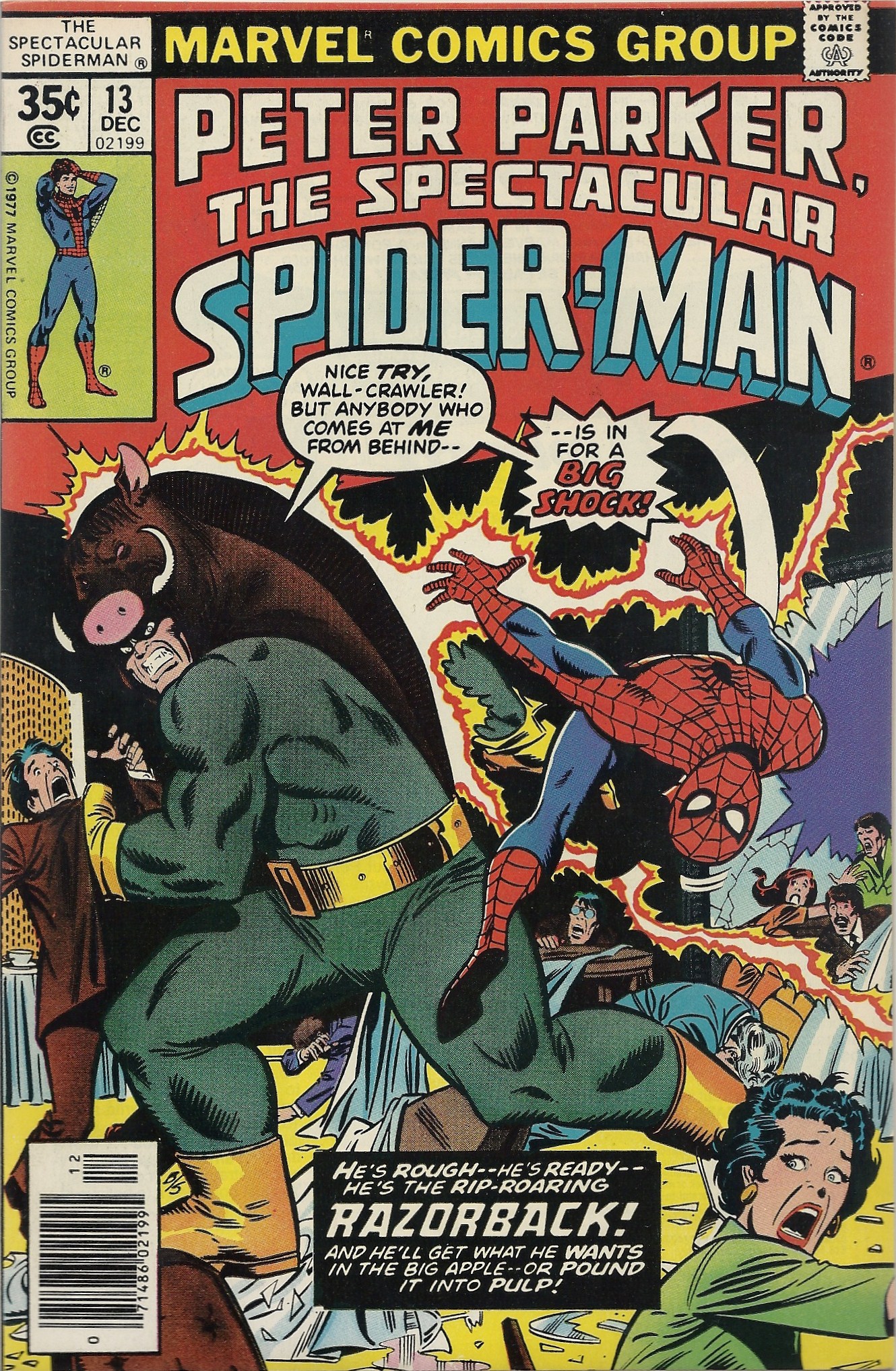
It’s kind of odd that, as much as I love The Amazing Spider-Man, The Spectacular Spider-Man gets little love from me. Maybe it’s a sort of elitism on my part, like I’m so snooty I only stick to the flagship titles or something. There isn’t a big dropoff in the quality of the storytelling, but for some reason it always gets short shrift.
So, to help me atone for this neglect, let’s take a look at this installment.
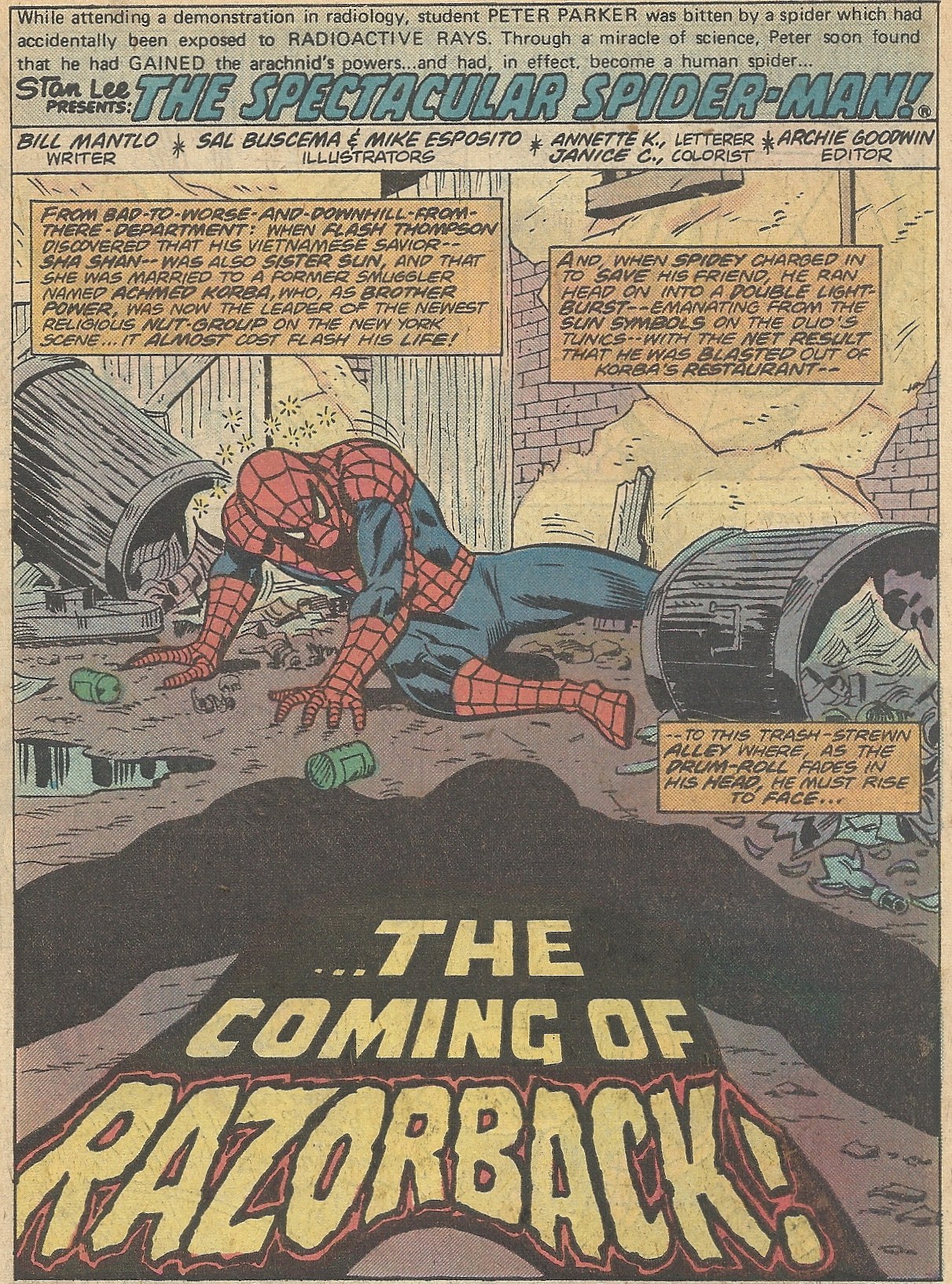
I picked this one out because it features the debut of a character I didn’t even know existed — Razorback. Our story’s title is, appropriately, “…The Coming of Razorback,” and it’s written by Bill Mantlo with art from Sal Buscema and Mike Esposito. This eponymous pig-guy is so goofy I don’t even care that we’re in mid-arc with this issue. Just to get you up to speed, here’s the “story so far” summation from the opening page:
A befuddled Spidey thinks he’s under attack by Brother Power but winds up clocking the wrong guy:
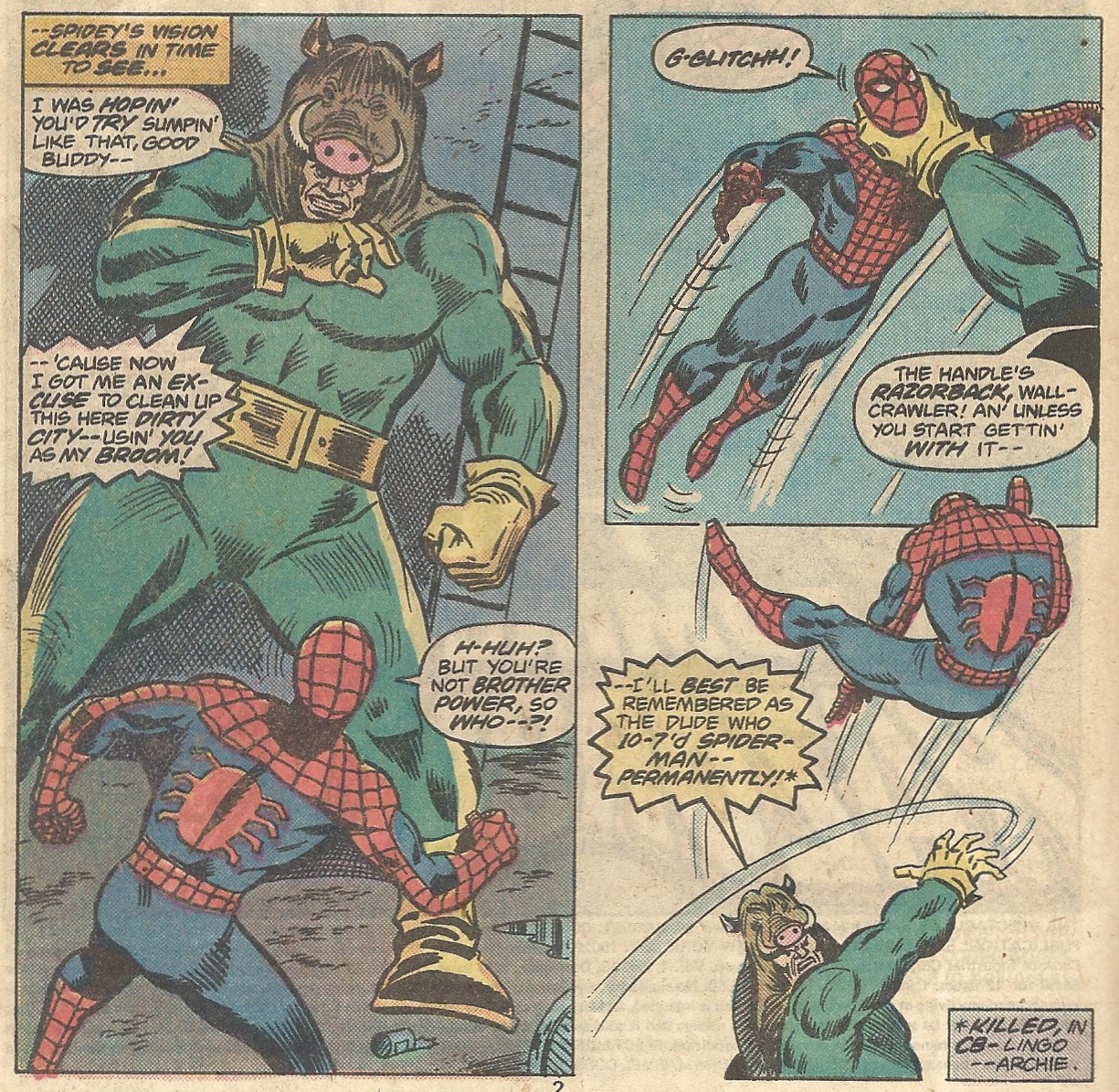
Oops.
They tussle for a little bit, but kiss and make up after Razorback unleashes his electrical powers (I didn’t realize wild boars were known for their eel-like ability to shock attackers):
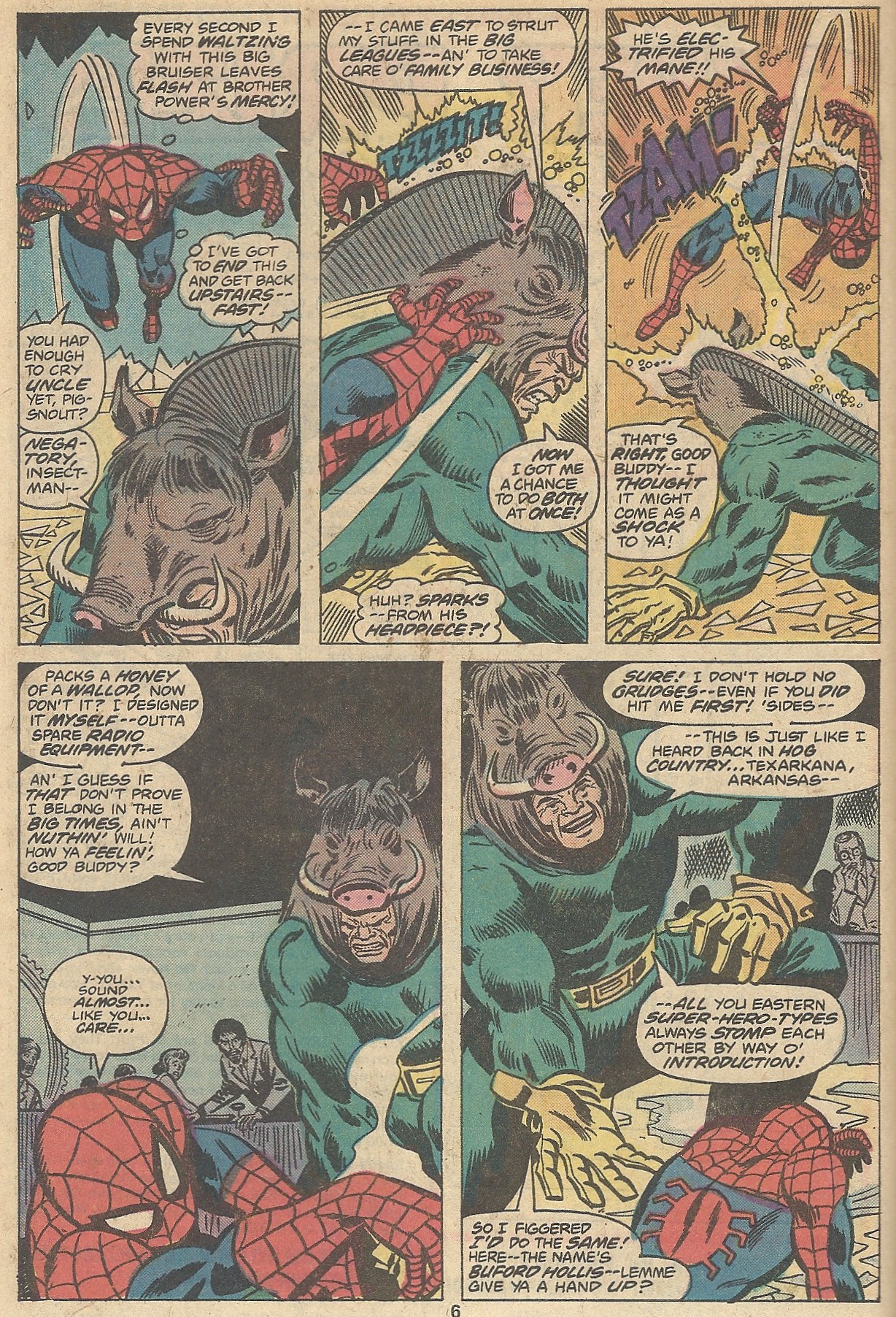
His name’s Buford. Buford Hollis. Seems fitting, doesn’t it?
Spidey doesn’t rest on this rapprochement. He busts into the villains’ hideout and finds that Flash is OK, but Brother Power and Sister Sun have already made their getaway. Spidey moves to go off after them, but good ol’ Buford stops him. The big guy’s placed a tracker on the baddies’ car and has his own spiffy set of wheels for the pursuit:
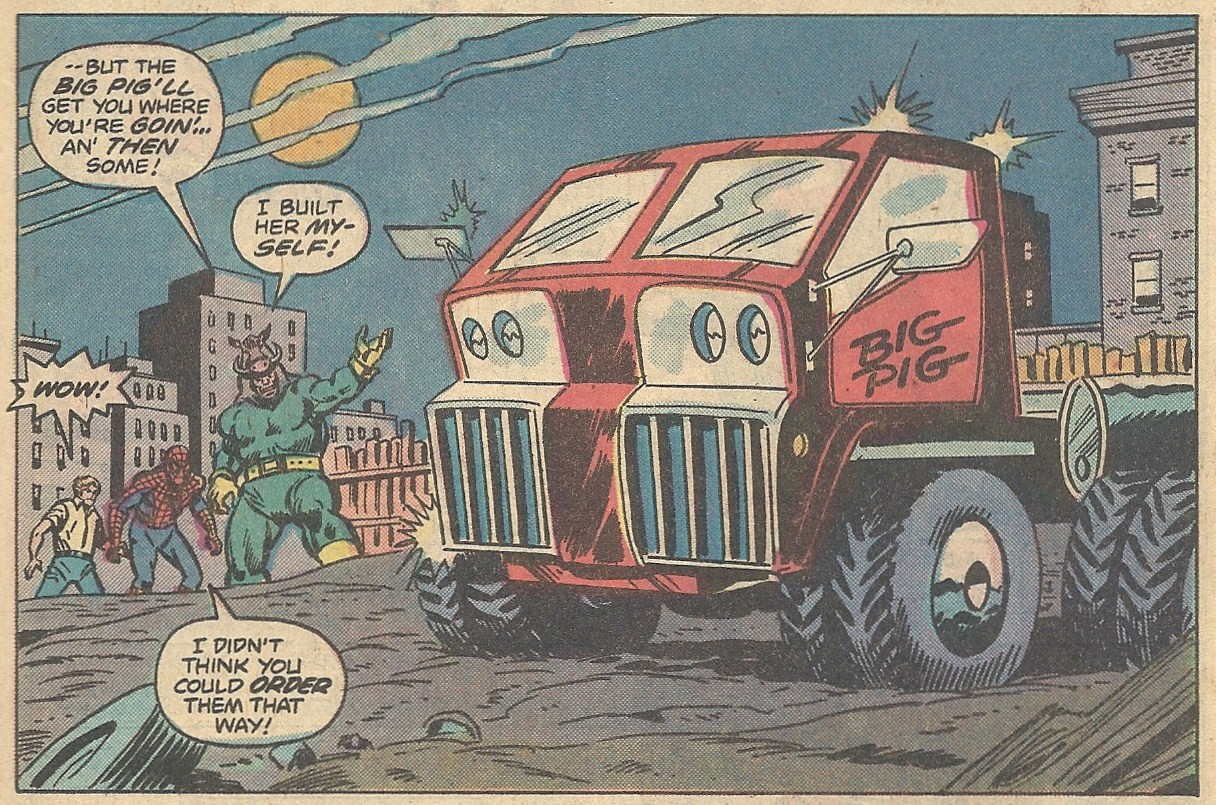
I, for one, would not want to see the Big Pig bearing down on me out on the open highway.
While they’re on the road Buford relays his backstory, and it turns out that he’s after his wayward sister — she’s fallen in with Brother Power’s crazy cult. He’s in NYC to bring her home and hopefully hand out a little payback along the way.
To briefly sum up the rest of the issue, Brother Power and Sister Sun meet up with their boss, the Hate Monger, and Buford, Spidey and Flash wind up captured (Buford is betrayed by his brainwashed sister) at the cult HQ. They all end up like this:
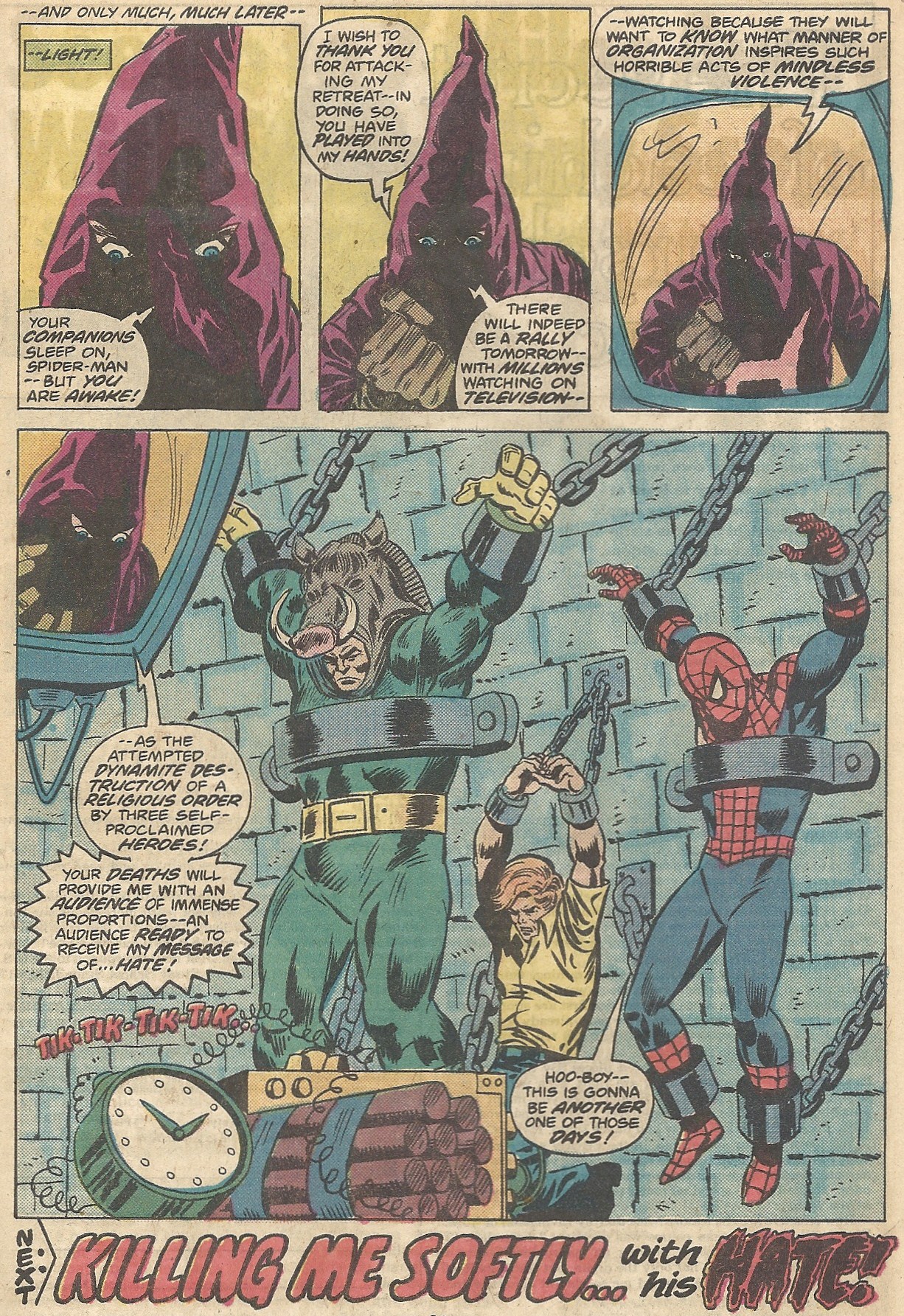
Thanks for the help, Buford.
Since this is mid-arc, I won’t go into any critique of the story — though I should note that I’ve always enjoyed Mantlo’s work as a writer. Razorback, however, can have a little time in the spotlight. I’m not sure what to make of him. His boar headgear/mane is ridiculous, its electrical powers are odd, and the idea of a costumed trucker superhero is a bit bizarre. And I don’t know whether I’d design my own pig costume before going off to save a younger sibling.
And yet…I like the guy. He seems good natured enough once he finishes beating the crap out of Spidey. More importantly, his quest to rescue his sister reminds me of a harrowing but largely forgotten George C. Scott film, Hardcore, where Scott plays an upstanding Michiganite whose daughter disappears into the seedy world of pornography. The parallels are obvious (one young girl swallowed by a cult, the other by porn). For your viewing pleasure, here’s a commercial for the flick:
“Turn it off! Turn it off!“ is one of my more quoted film phrases.
Spectacular Spider-Man is still going to get the $#!+ end of the stick when it comes to my buying priorities, but as I get closer to my perhaps unreachable goal of having a complete run of Amazing, the issues I need from that title are harder and harder to come by. I suppose that will help Spectacular move up in my affections, and with fellas like Buford Hollis lurking about, how could it not?
Stand thee back, stalwart fellows, whilst Thor smashes our problems with his mighty hammer! – The Avengers #12

If the whole “Ed Norton out of The Avengers” bombshell did nothing else, at least it served to remind me that I haven’t yet featured an issue from Marvel’s greatest all-star team. It’s an omission that I’m happy to remedy, and why not do it with the earliest issue that I currently own? And why not one which features my favorite incarnation of the group? Hey, two birds with one stone!
So here we go.
“This Hostage Earth!” is scripted by Stan Lee with art from Don Heck and Dick Ayers. The story opens with Giant-Man/Ant-Man’s ant sentries warning him of something big going down underground, and he wastes no time calling in his partners:

Don’t think that things always go smoothly at the club meetings — this one breaks up pretty quickly:
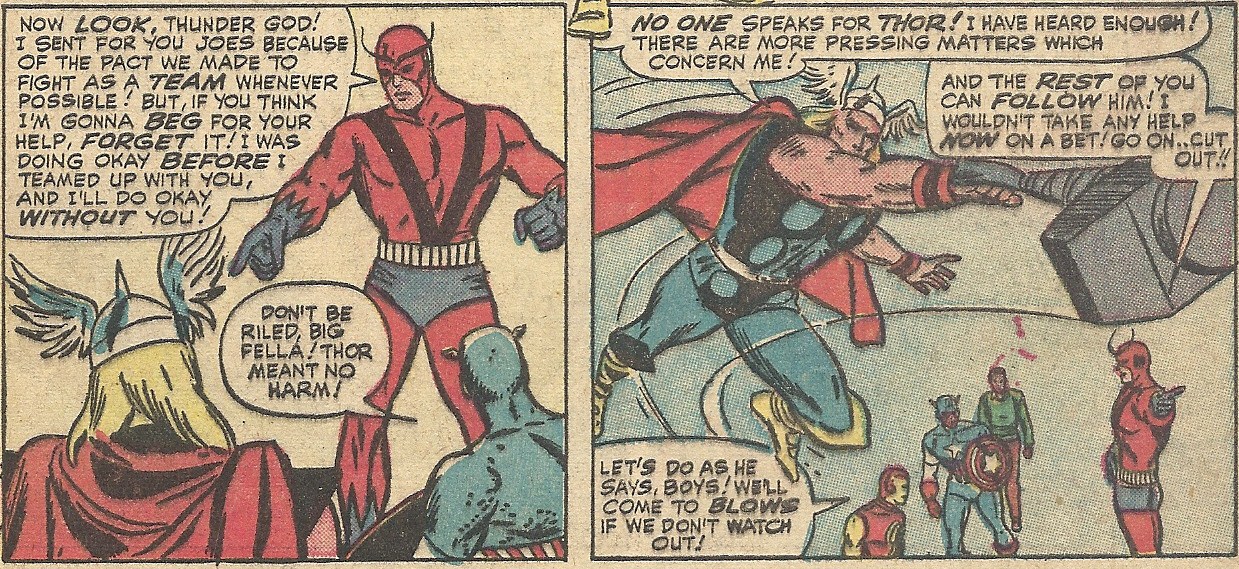
Giant-Man goes off to investigate the trouble all by himself, but he’s soon captured by the Mole Man’s henchmen. That myopic villain is engaged in one of his usual schemes to destroy the surface world, and things soon start shaking and rattling across the globe.
The Wasp reassembles the team, and there’s plenty of regret to go around:

They figure out that Mole Man is behind all the ruckus, but before they can spring into action, his army attacks:

They fight them off with little effort, but all the attckers disappear in a mysterious mist. Hmmm.
The Avengers figure out a way to blast their way down into the Earth to get at the Mole Man and rescue their friend, but they need some parts to get this machine, an invention of Stark’s, to function. Cap and Rick Jones — who shows up out of nowhere — head off to retrieve them, but some thugs are trying to steal Stark’s stuff. Cap springs into action and goes all ape$#!+ when one of the goons tries to beat up Rick. Maybe it’s just me, but this panel is reminiscent of some of Steve Ditko’s concurrent work on The Amazing Spider-Man:

Soon the Avengers are back together under one roof, and Thor reveals a power of Mjolnir that I had never heard of before — if the whole hero-god thing doesn’t work out, he can always get work siting wells in the Midwest:

Meanwhile, in his underground lair, Mole Man discovers who dragged his minions out of their battle with the Avengers — *gasp*, it’s the Red Ghost:

The Avengers get their doohickey running and blast their way to the rescue:

You have to love how Thor refers to Wasp as “female” — at least he didn’t break out a “Hey, you’re lucky I let you tag along, toots!”
Now the big battle begins, and the not-so-fearsome tandem of Mole Man and Red Ghost proves to be no match for our heroes. The Avengers run roughshod over everything, rescue Giant-Man, and use a combat tactic that would make Scooby-Doo and Shaggy proud:

All is, once again, right in the Marvel Universe.
The character beats make this issue for me, especially those from my beloved Thor. His hotheaded exit from the first meeting and his remorseful resolve to rescue his friend fit right in with my conceptions of what this guy is all about. The team dynamics from this era make the entire issue a blast to read, though the Red Ghost appearing out of nowhere (like Rick Jones) added absolutely nothing to the plot.
Here’s hoping that the movie version isn’t a clossal cluster#&%*.
Here’s a puzzler…Who has the most disproportionate head on this cover? – Adventures of the Jaguar #12

I didn’t even know that there was such a character as Jaguar, though I was aware that the Archie line of comics had its own superheroes. For those of you equally ignorant of our feline-themed hero, he’s a fella named Ralph Hardy who, when he puts on a magic belt, becomes super-strong, can fly, and can communicate with the animal kingdom. All handy talents in a pinch.
There are two Jaguar stories in this issue (the first is split into two parts), and both are scripted by Robert Bernstein with art from John Rosenberger. The first one (“The Girl who Knew too Much” and “The Jaguar versus the Mind Monster”) meanders a bit before it gets to the deformed freak on the cover. We open with Hardy — a Tony Stark-ish looking gent — working in his lab with his assistant Jill Ross, who secretly knows his identity. He soon has to make an exit to help combat a local blaze, and his absence gives Miss Ross a chance to fantasize about her boss:
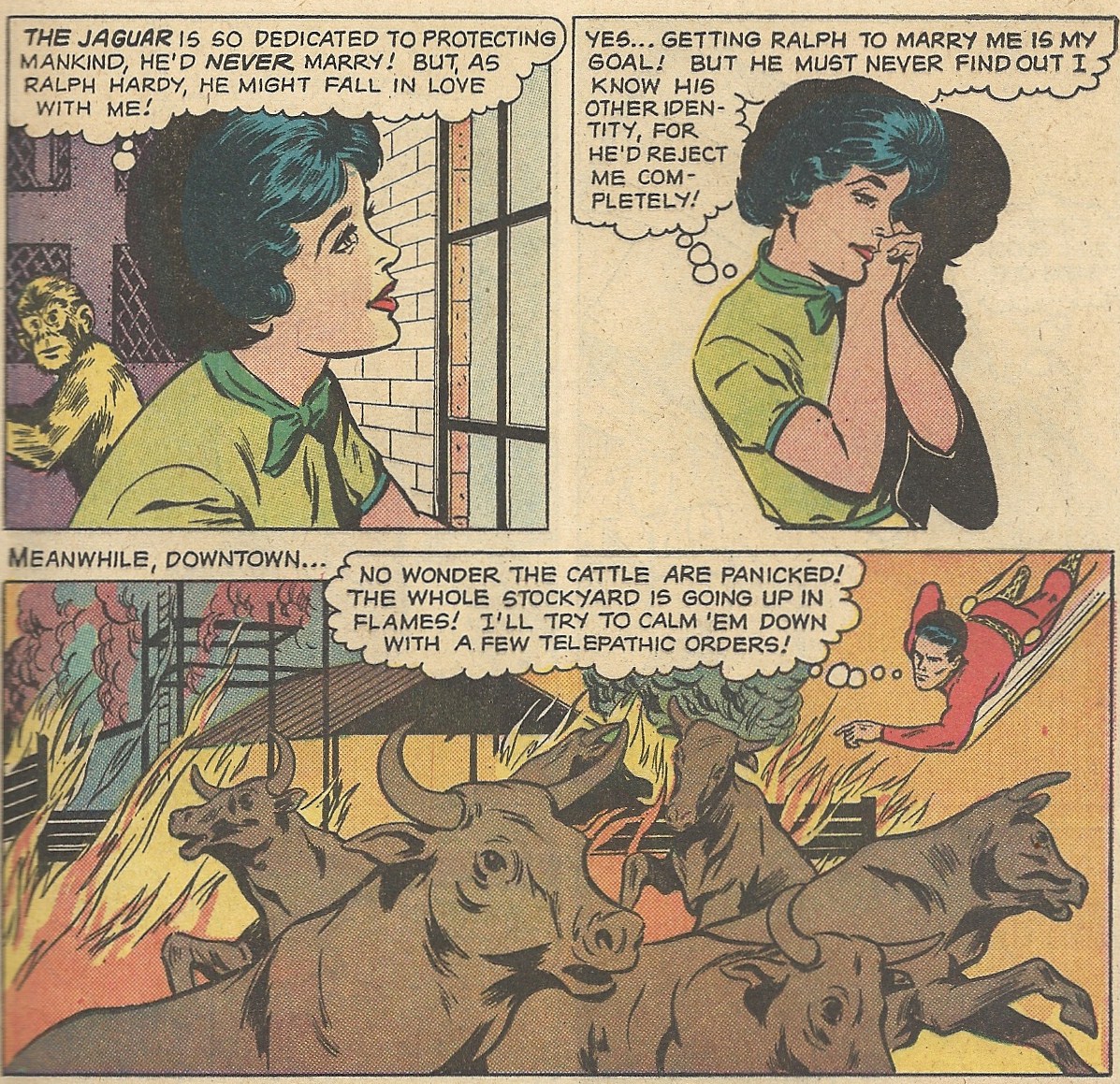
I don’t want to sound callous, but perhaps the best way to deal with a fire in a stockyard would be to bring a giant bucket of BBQ sauce. Just saying.
Jaguar uses his amped up animal powers to put things right. I like a lot of the art in this book, and the action in this scene is a good showcase — it has a very clean style that gives each panel room to breathe:
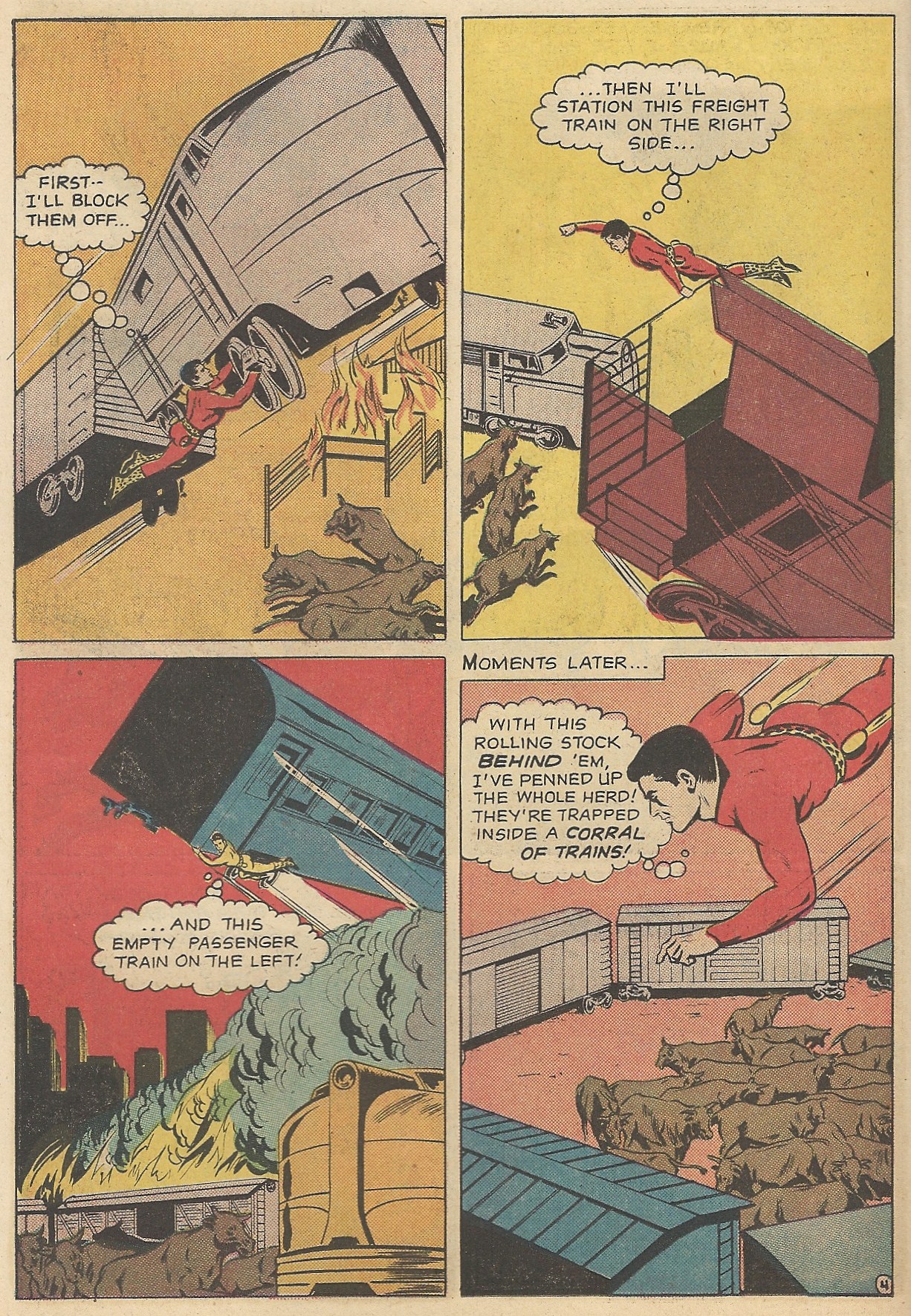
The problems are quickly solved and Jaggy returns to his lab, only to learn that Jill knows his secret:

Fret not, dear readers, because at the outset of the next chapter Hardy uses his experimental “memory ray” to make her forget all about his identity. The bad news comes later, when a low-rent thief breaks into the lab and accidentally triggers the ray, becoming the ultra-smart troll from the cover:

The thief quickly uses his new mental gifts for evil, stealing enough to secure his future (forget the Roth IRAs), and then he wants Hardy to turn him back into a regular guy. It’s hard to get dates looking like that, I suppose, even with hypnosis and oodles of money:
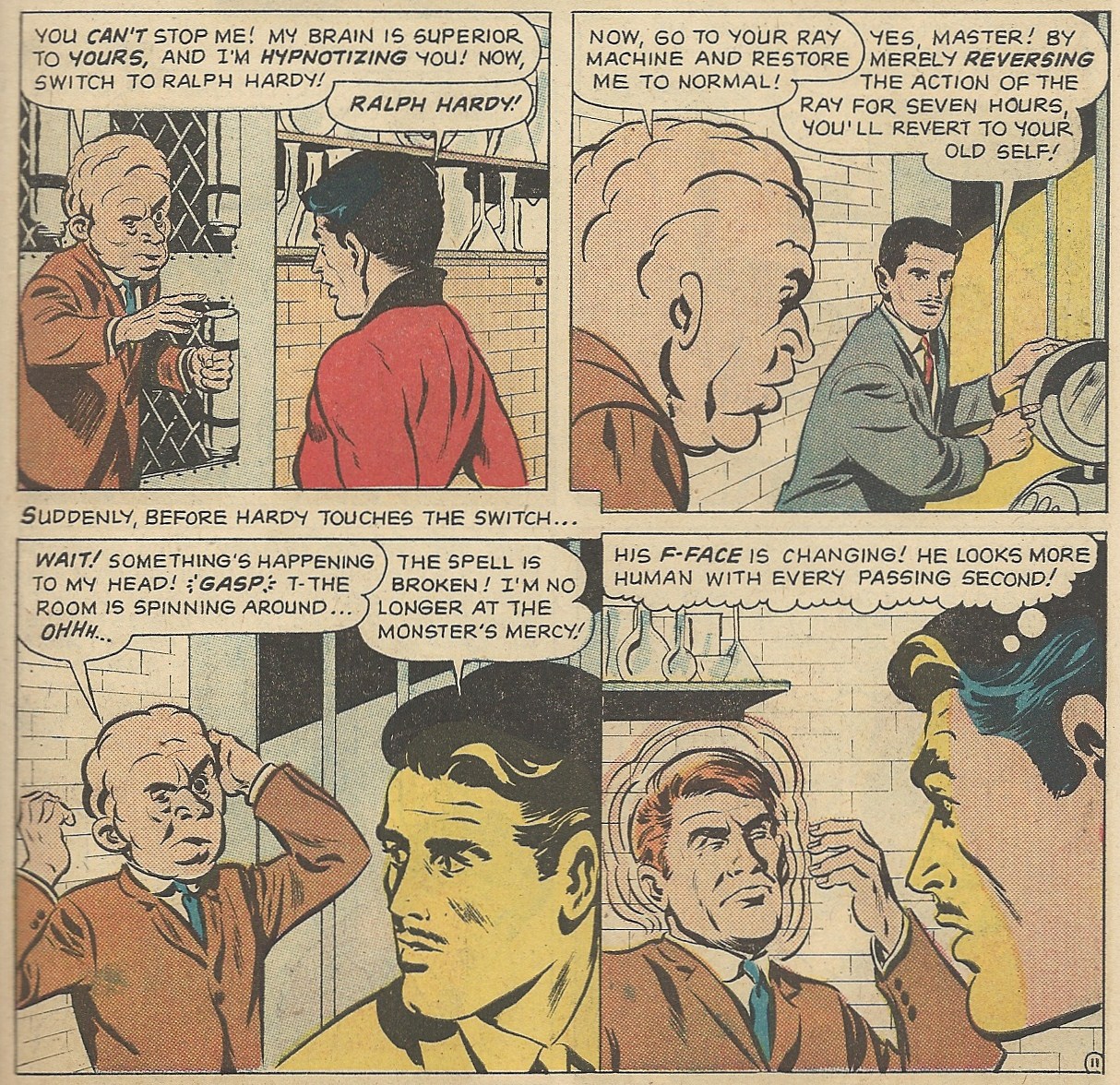
Hardy quickly belts the thief when he returns to normal and the day is saved. Some super-genius that clown was.
The second tale, “The Giant Jaguar Greeting Cards,” is short and sweet. Some — you guessed it — giant greeting cards with Jaguar on them are unveiled:
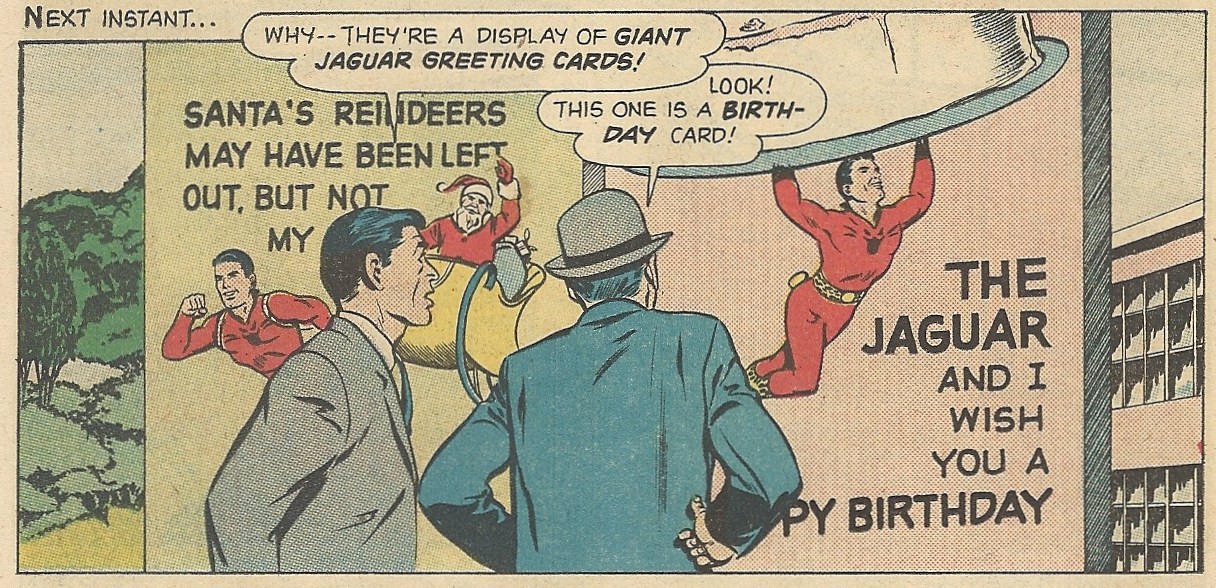
It turns out that they’re all part of a plot by vengeful aliens to kill Jaguar, and they apparently do their job when he shows up and gets squashed in between them. Then he shows up alive and well and explains how he got wise to the aliens’ ruse and tricked them:
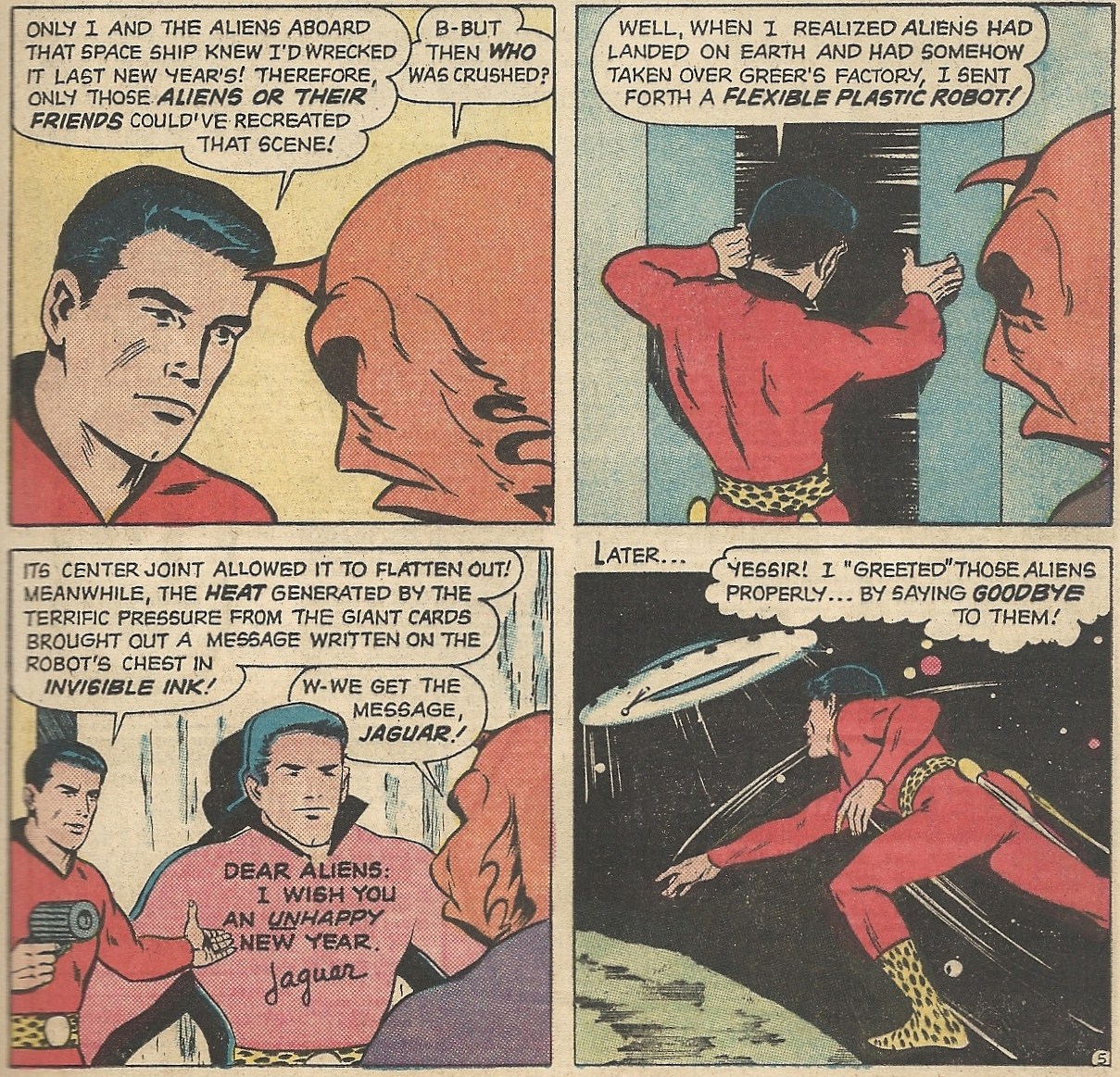
There’s something so spectacularly uncalled for in that “unhappy New Year” message — it’s overkill that made me laugh out loud when I saw it. It’s a final “screw you” to these aliens — I guess it was either that or have him take a leak on their spaceship.
While the stories here were nothing terribly original, I very much liked the art. As I said above, it had a cleanliness to it that I appreciated, and it gave a spacious feel to the entire effort. It’s enough to make me forgive Jaguar’s outsized head on the cover (I mean, just look at that huge melon), and more importantly the art’s sufficient to make me want to come back to the Jaguar-universe (Jaguariverse?) for more.
As an aside, Jaguar reminds me of a movie that was mocked with great fanfare on the classic show Mystery Science Theater 3000 (I’m a big fan). In one episode they riffed on a flick called Puma Man, and this Puma Man guy also got his powers from a South American belt. The belt and the big cat moniker don’t amount to a huge similarity, but bringing it up allows me to post this:
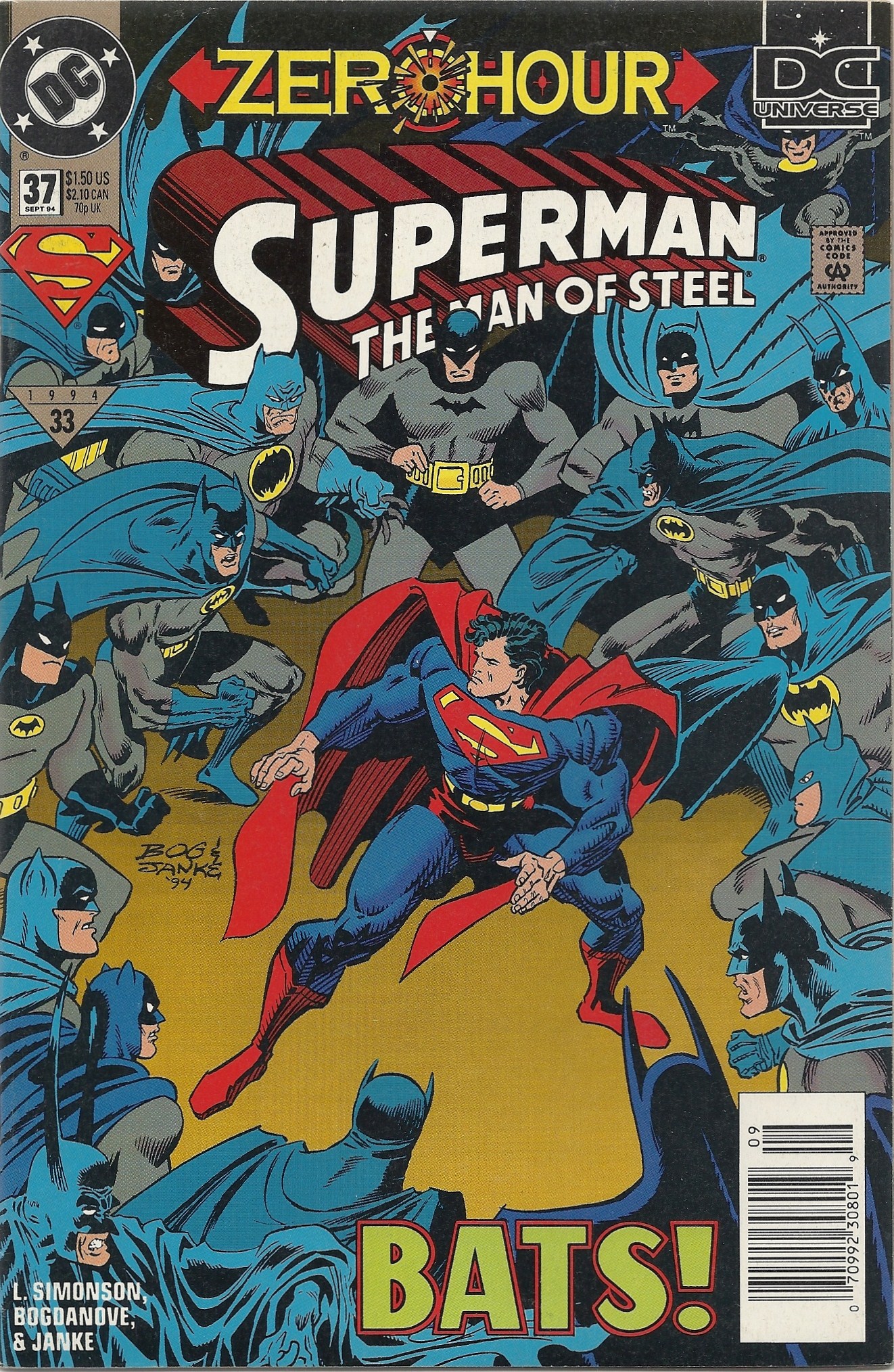
How many of the Batmen can you identify? It’s always a bit dicey when an artist (Jon Bogdanove for this cover) closely interprets the work of others, and most of the Batman versions that I could recognize were picked out based on costume idiosyncracies and not on the style of rendition, but it’s kind of fun to try and figure out who’s who. Some are obvious, some not so much. Thankfully, the editors published a key a few months later in the letters column (remember those?). Here it is:
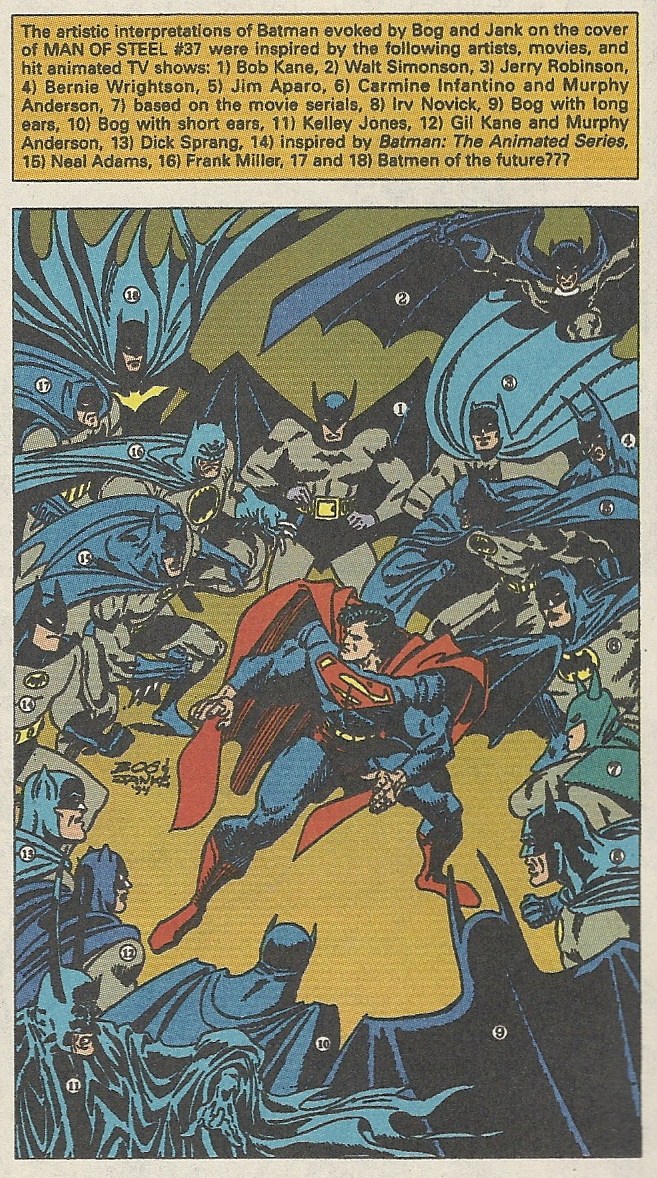
I like how they threw in a couple “yet to be seen” versions.

This is my maiden foray into the dark realm of romance comics. Pray for me.
This issue contains three stories. The first, from an unknown creative staff, is entitled “Can Love Die so Quickly?” Beth and Alan are our fresh-faced newlyweds, and we open with full barrage of male insensitivity:

“Ghastly” may be a bit strong, but you can’t deny that she looks pretty damn frumpy.
The magic has disappeared fairly quickly in their marriage, but they decide to make a half-hearted stab at salvaging things. They each start to go their own ways, and Beth starts to tart herself up quite nicely:

All the looks the Beth keeps getting drive Alan mad with jealousy, and that’s apparently enough to reaffirm their love:

I’m really not sure what the moral is for this one.
Oh, and here’s the horrifying Bobby Sherman pin-up:
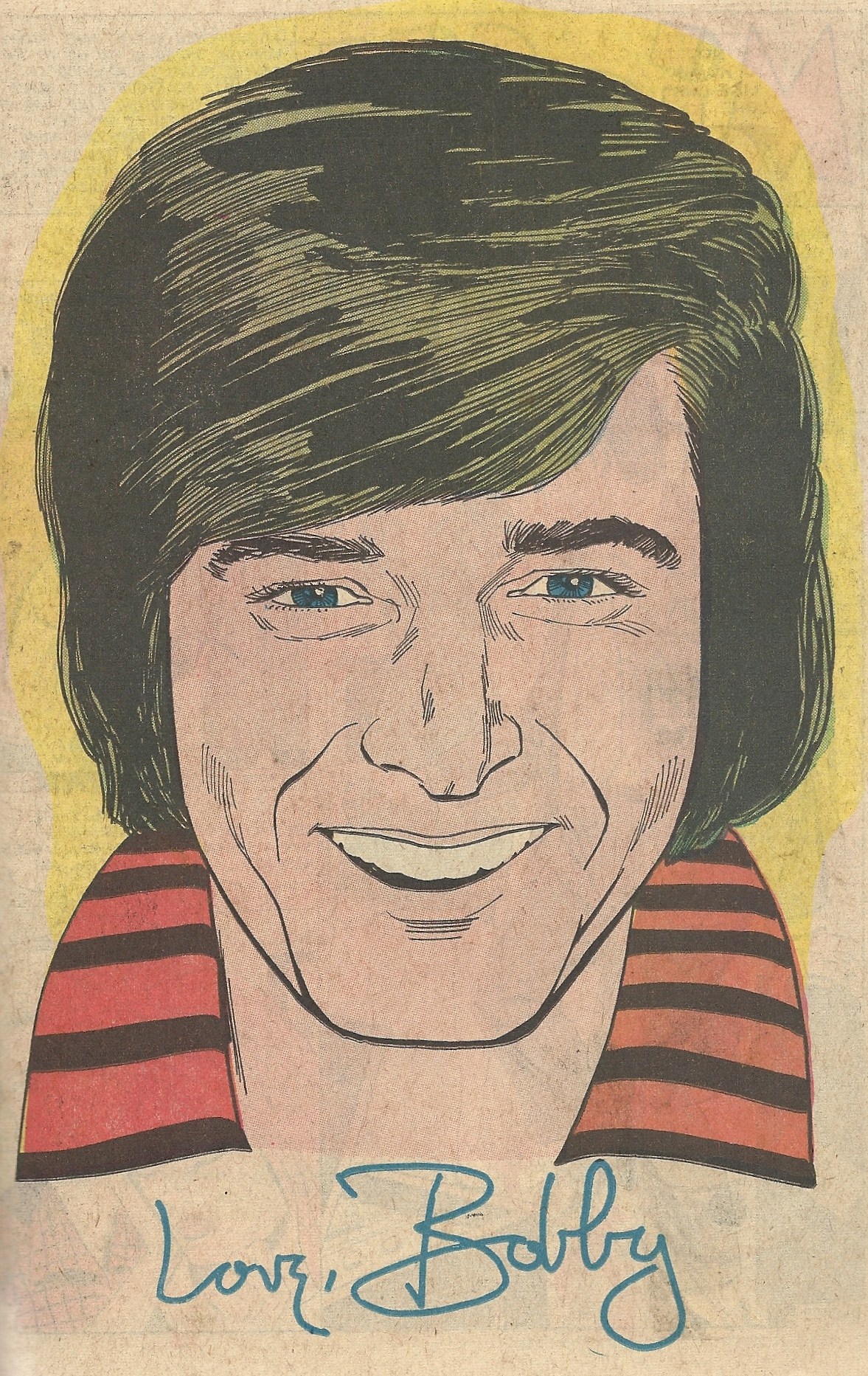
Our second story, “Misfit,” comes from an unknown writer but was pencilled and inked by Charles Nicholas and Vince Alascia — at least I can give you that much. It’s a coming of age story, as a young lass named Ruthie is horribly awkward in social situations and goes off to spend the summer with her more worldly cousin Michelle. While there she meets a young man named Ed who ogles her one day by the pool:

It only takes a short time for her to realize that it’s love:

She returns home a new young woman. Apparently all that was needed was the touch of a man to rid her of all those horrible traits that made her unique. You know, like opinions and things.
Our last tale is the real gem of the three. Once again from unknown authors, “Who Needs Love” chronicles the efforts of a pretty young secretary to snare an eligible executive:

Luella starts off slowly — she’s all-business at first, but after her erstwhile probationary period is over she amps up the sex appeal. Her arsenal of wiles includes presenting like a horny baboon:
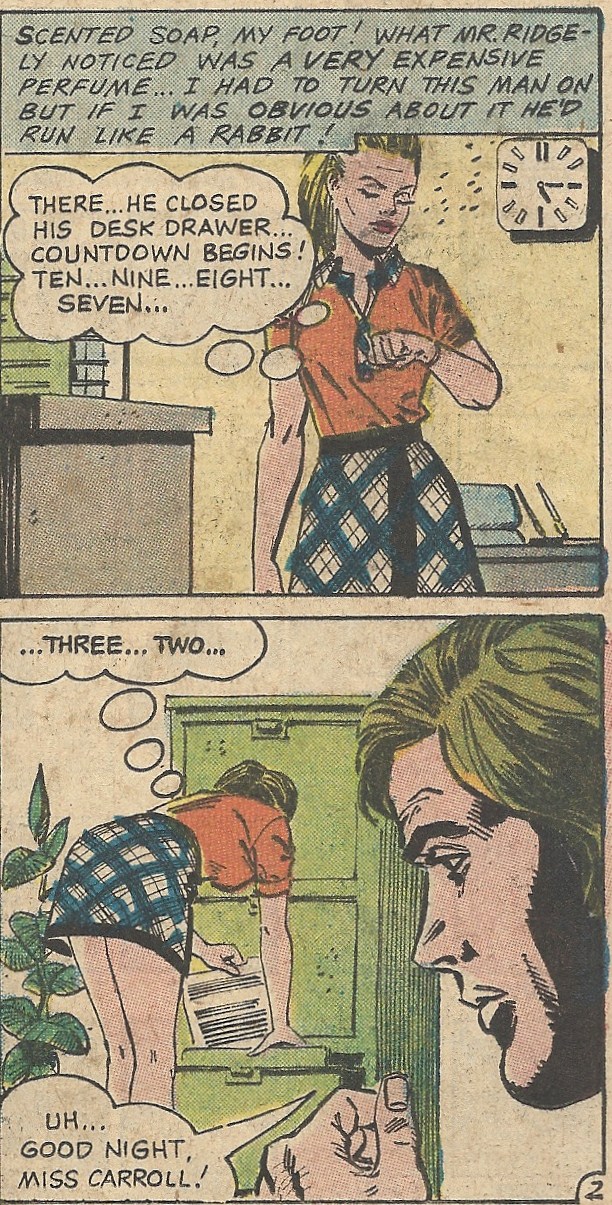
Should we be shocked that Mr. Ridgely soon offers her a ride home?:
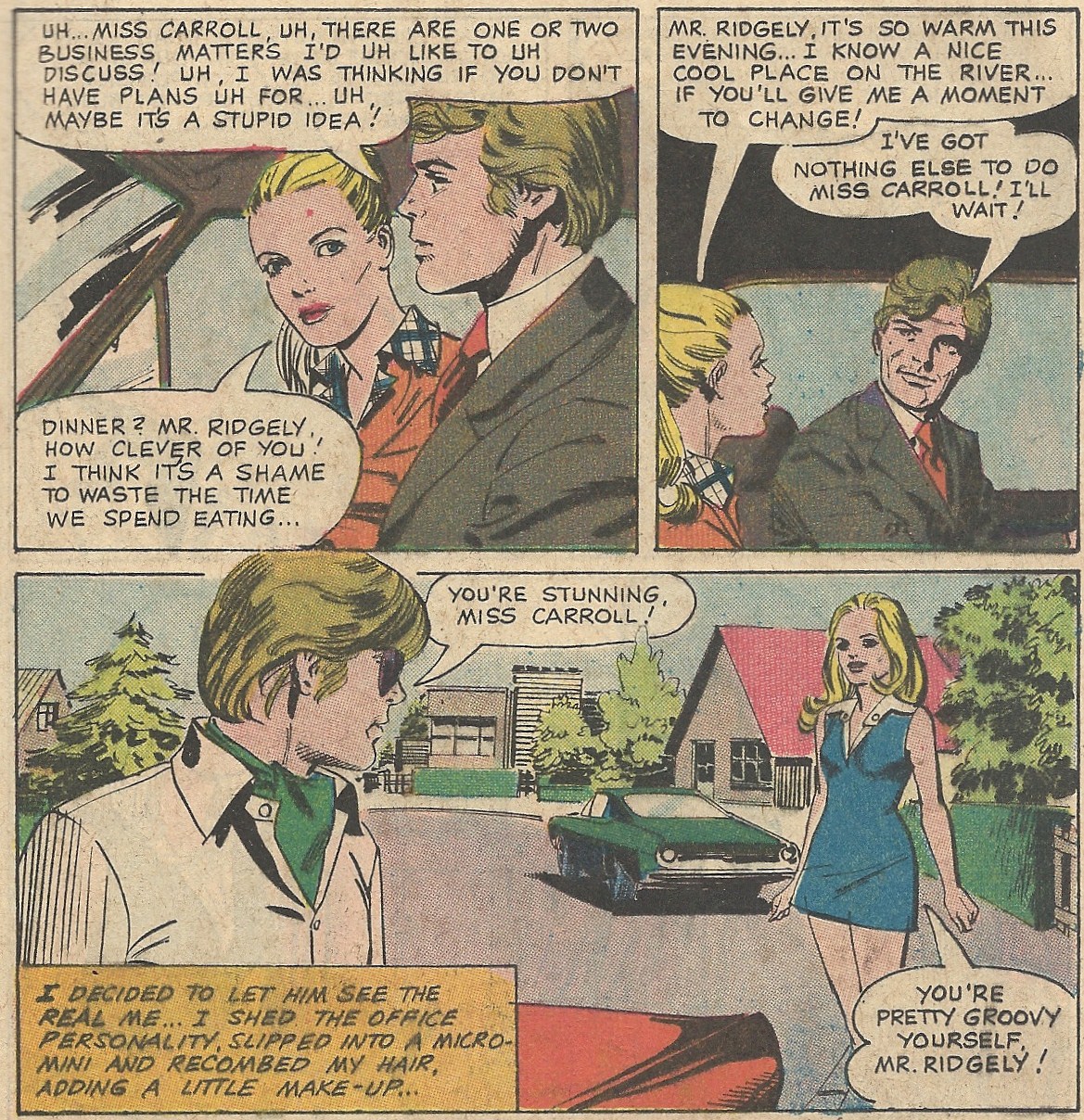
Things are moving along pretty quickly, and at dinner we’re treated to Luella’s greedy internal monologue:

That night they share a kiss, and soon all bets are off at the office:

“Miss Carroll” and “Mr. Ridgely” are out the window — now it’s all “Pete” and “Luella.” Luella soon realizes that she’s been snared by Pete just as much as he’s become enamored of her:

I guess that counts for love.
I liked going through this issue, but I’m not quite sure what to make of it. I wasn’t anticipating deep ruminations on life and love, but this? If I was looking for something to support any misogynist impulses that I might have, then I couldn’t ask for a more successful effort than Teen-Age Love #83. Women (and men, but mainly women) are portrayed throughout as horribly vapid creatures. I realize that there isn’t a enough space to generate a great deal of depth with these folks, but these characters are just so incredibly shallow in every possible way. Only Ruthie, in the second short, has a semblance of humanity about her, and even she’s cured in the end by the simple palliative of a boy’s love.
Then again, what did I expect? It’s par for the course, I suppose.
I had a good time with it, though, and at least I now know who Bobby Sherman is. Thank you, Google.
And for those of you that can’t get enough of romance comics, head over to Sequential Crush. You’re sure to get your fill there — it’s a veritable smorgasbord.
V for…well…V, I guess – V, The Comic Book Series
The new V show puts me to sleep faster than a tranquilizer dart. The original mini-series, however, with its creepy aliens, decent special effects (for its time), and fascist iconography, was a pretty enjoyable ride. And this little scene freaked me out all those years ago (sorry for the low quality):
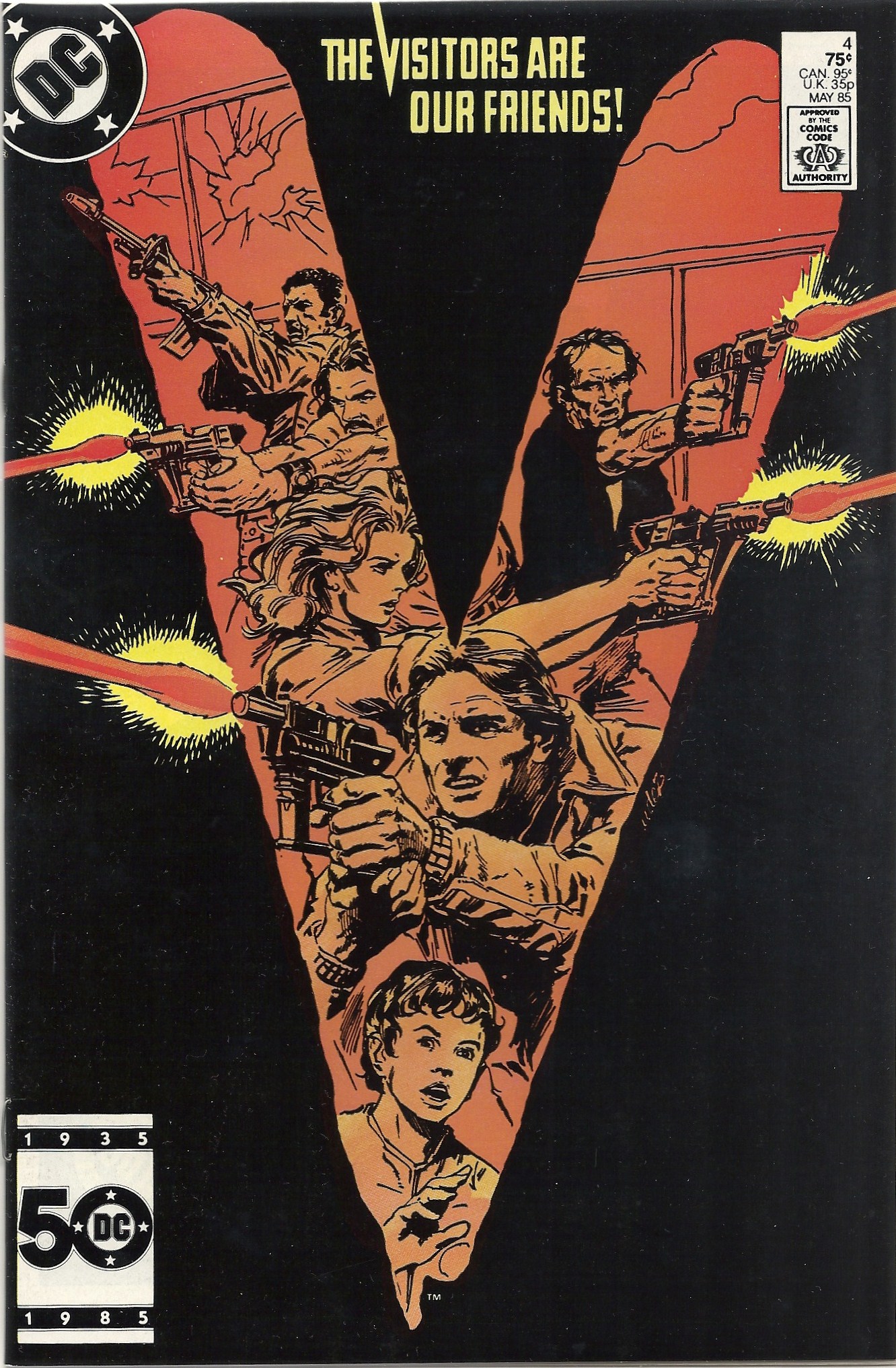
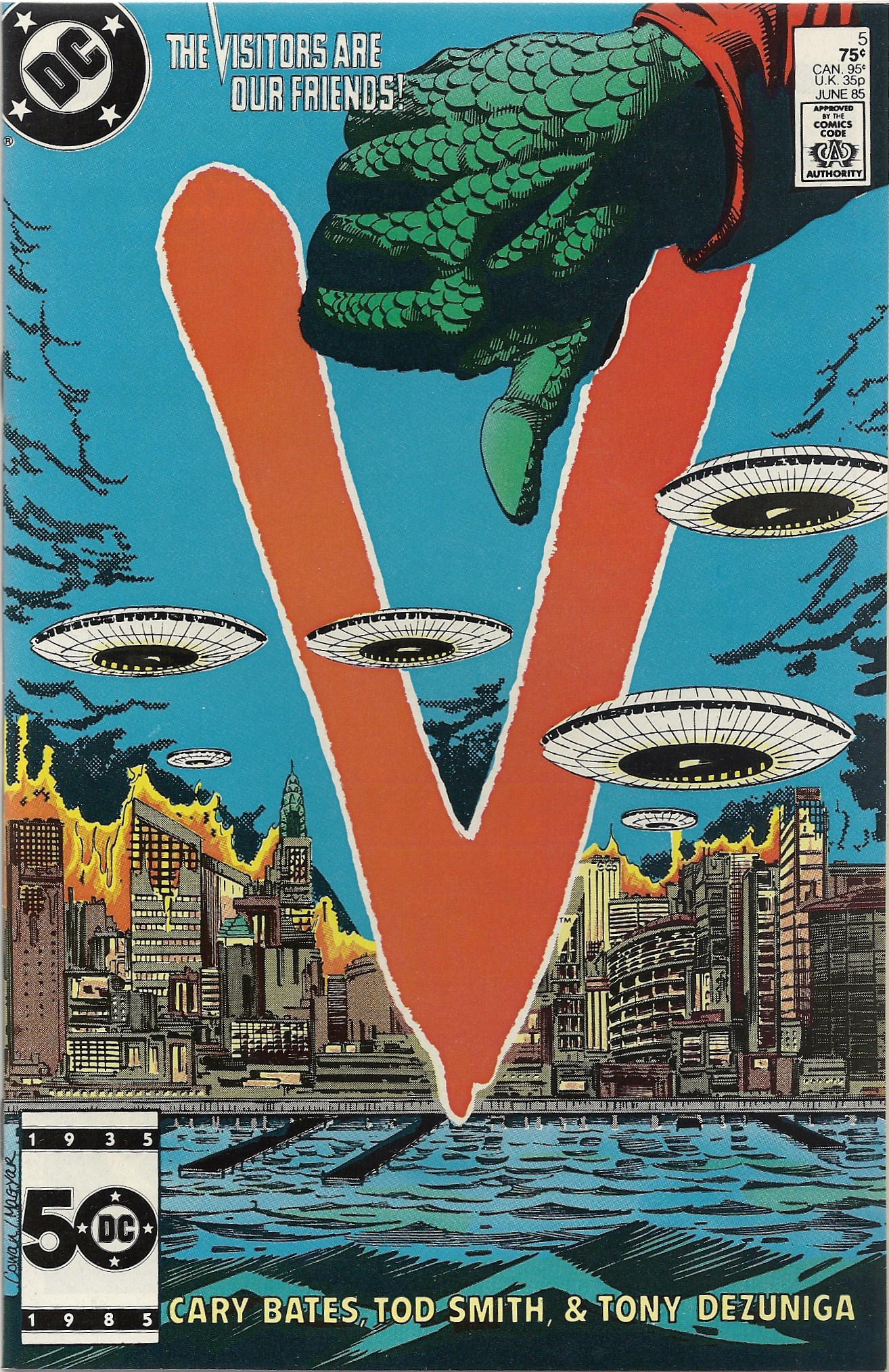
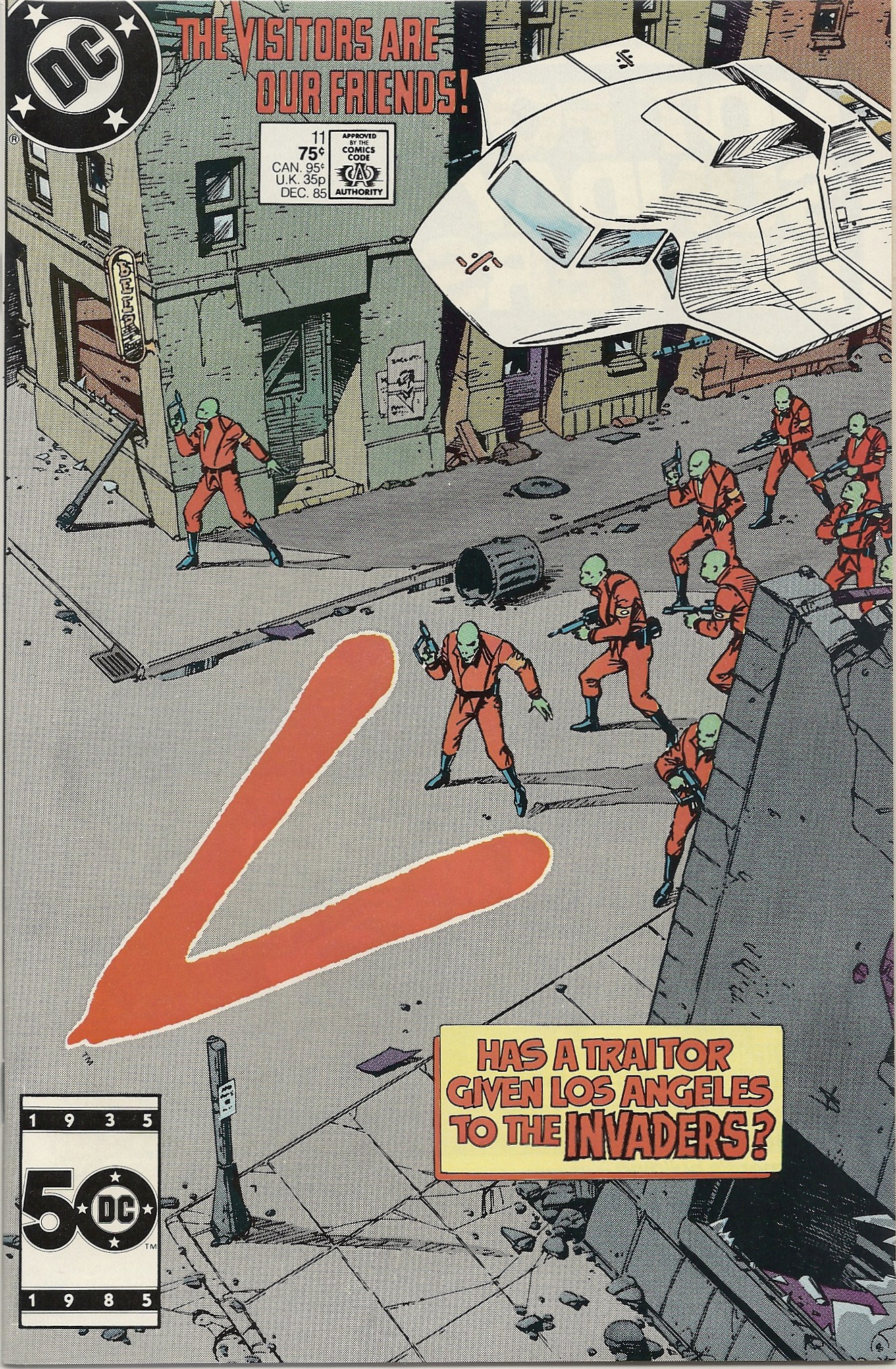
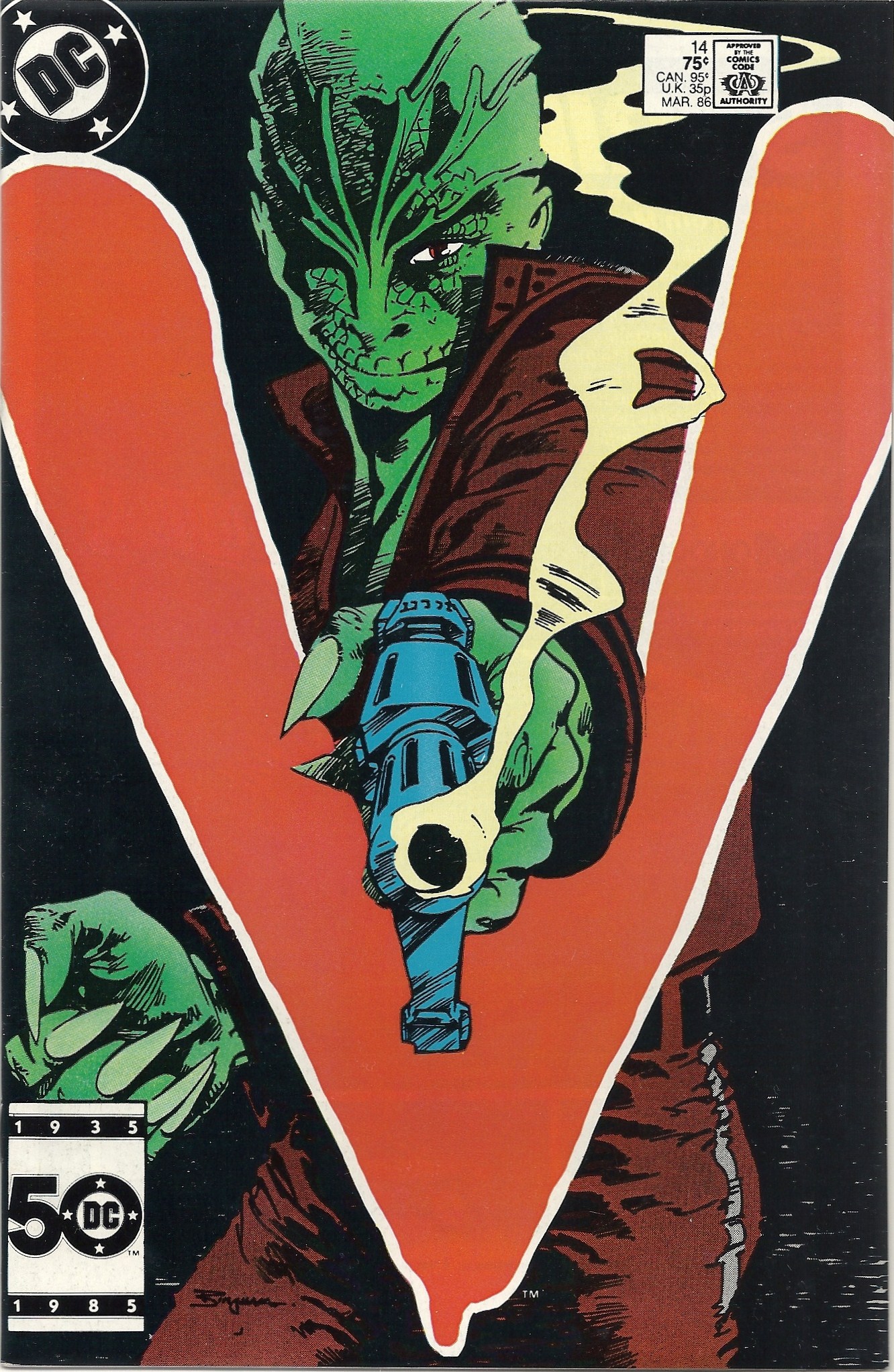
A lot of people forget that there was a comic book series that went along with the show — it turns out that V for Vendetta didn’t have a monopoly on the letter. Several of the issues featured art from the great Carmine Infantino, but when I picked up the whole series about a year ago what most struck me most about the entire endeavor was the high-quality design of some of the covers. Here’s the cream of the crop (I’ll put the artist’s name in parentheses)…
Issue #1 laid the groundwork, and the “V” title would always be incorporated into the cover image from there on (Eduardo Barreto):
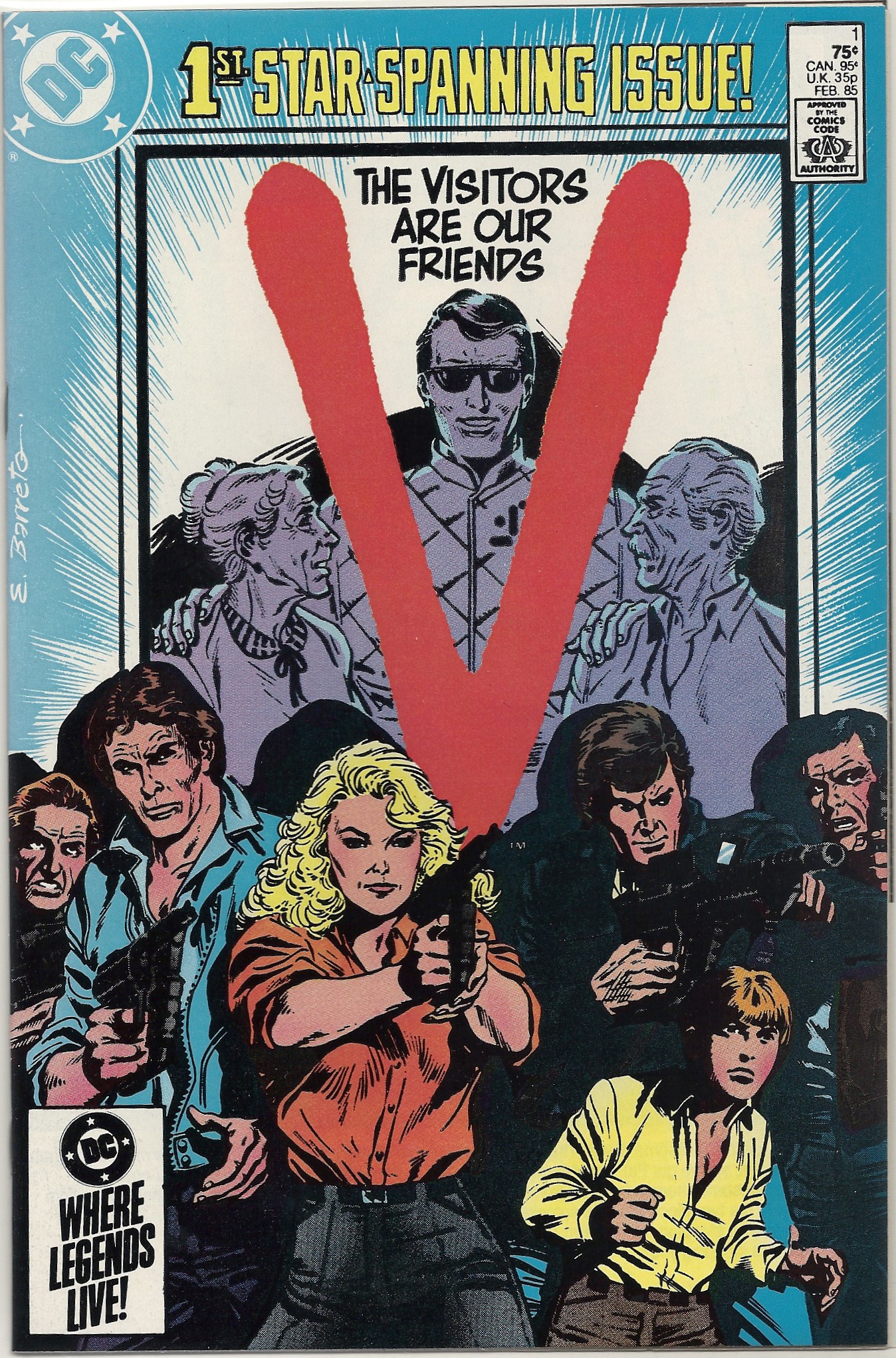
#4 had the human resistance fighters bursting out of a stark black background (Barreto):
The reptilian thumbs down with the hovering ships and burning city was a nice combo for #5 (Denys Cowan):
I like how the “V” is laid flat on the ground and off-kilter for #11 (Jerry Bingham):
#14 had a nice three-dimensionality about it — sort of a response to #4’s resistance cover (Bingham):
And, finally, #16 makes us question where our loyalties should lie (Bingham):
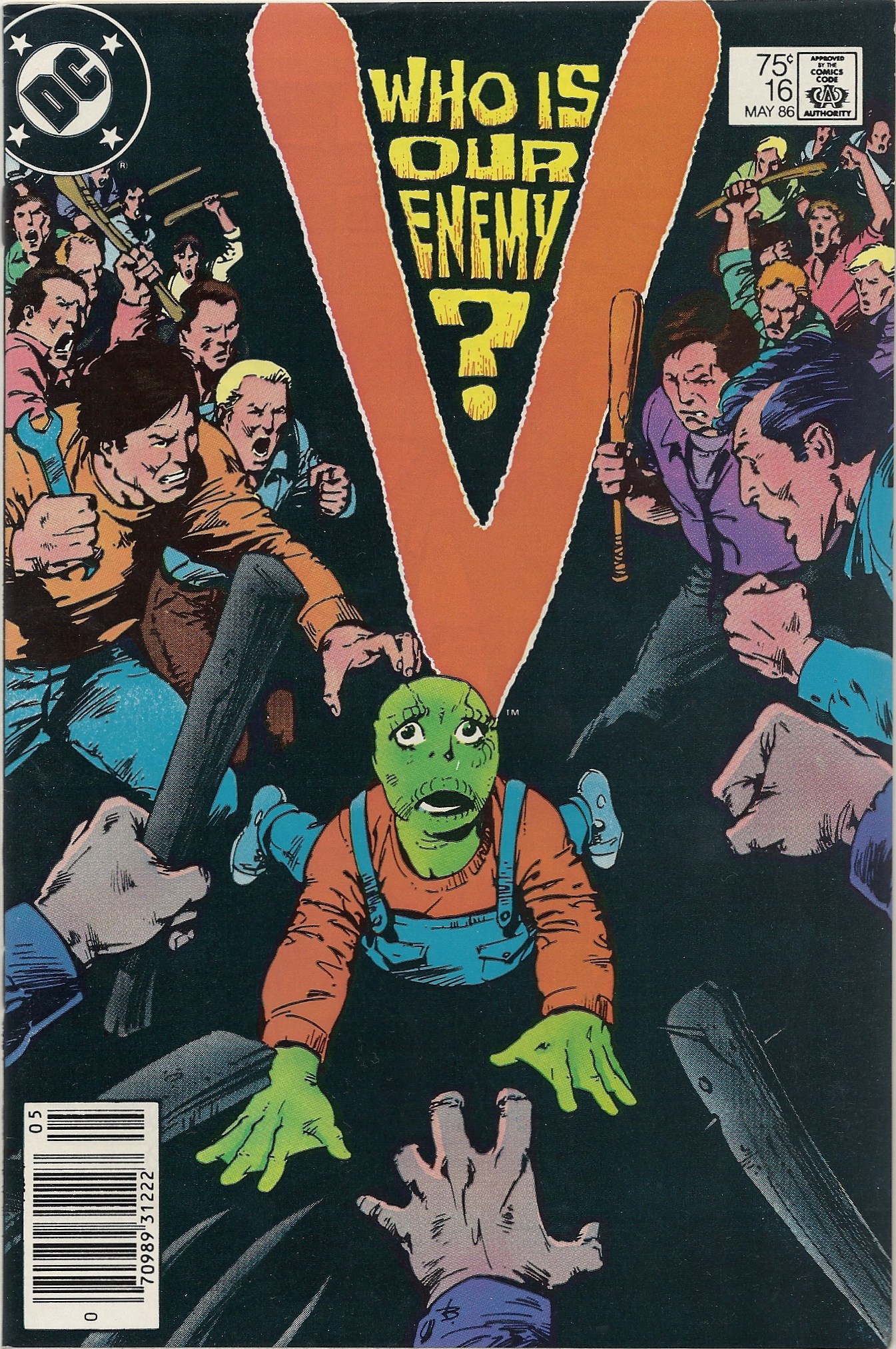
The series only lasted 18 issues, but I think that the excellence of these covers makes up for the brevity of the run. To celebrate their quality, maybe I’ll unhook my jaw and swallow a rodent. Or maybe I’ll just grab a beer. Yeah, I think I’ll go with the latter.
Ladies and gentlemen, let me introduce you to one of my favorite Hulk stories – The Incredible Hulk Annual #13
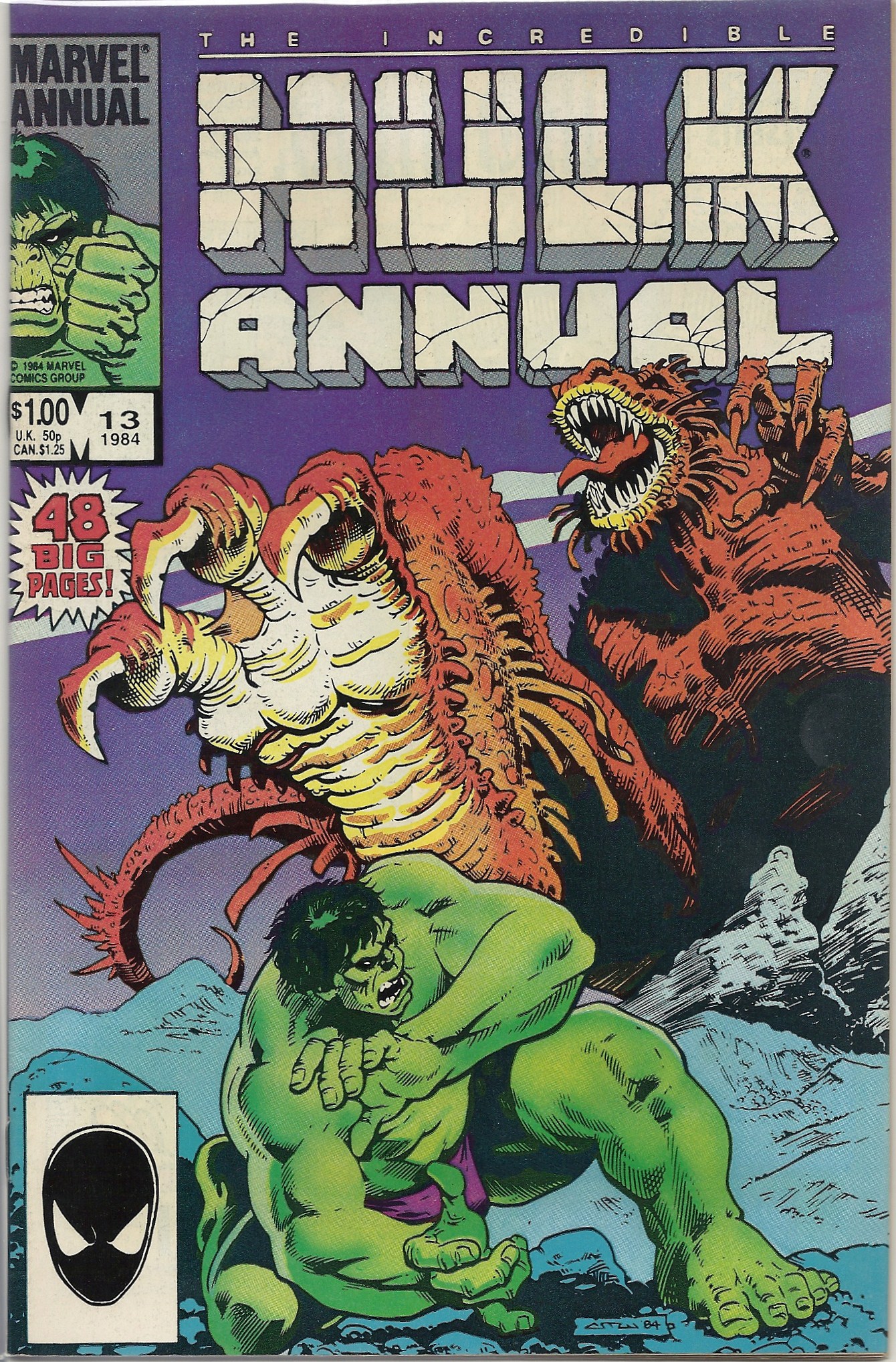
The title of this post says it all. This one is one of my most-loved Hulk stories of all time, if not the most-loved. It stuck in my head for many, many years, long after the copy that I had as a child vanished into a box in an attic. I was ecstatic when I found my current copy in a longbox about a year and a half ago, and now maybe I can share it with some folks who might not be familiar with it.
The story, “Friends,” written by Bill Mantlo with pencils from Alan Kupperberg, begins with a savage Banner-less Hulk banished from Earth by a spell from Dr. Strange. What’s that you say? This whole “Too-dangerous Hulk sent into exile” sounds a little familiar? It should. For those of you who might be unaware, this was a long arc in the Hulk books in the 80’s, as Hulk travelled from reality to reality (through a place called “The Crossroads”) with alien companions, all the while trying to find a place where he’d fit in. It’s a nice saga. While “Planet Hulk” certainly wasn’t what I’d call a ripoff, as Mark Twain once said, “The past may not repeat itself, but it sure does rhyme.”
Anyway, Hulk is bopping around realities and comes to a world that seems pretty normal. He’s hungry, so he decides to have a delicious piece of fruit:
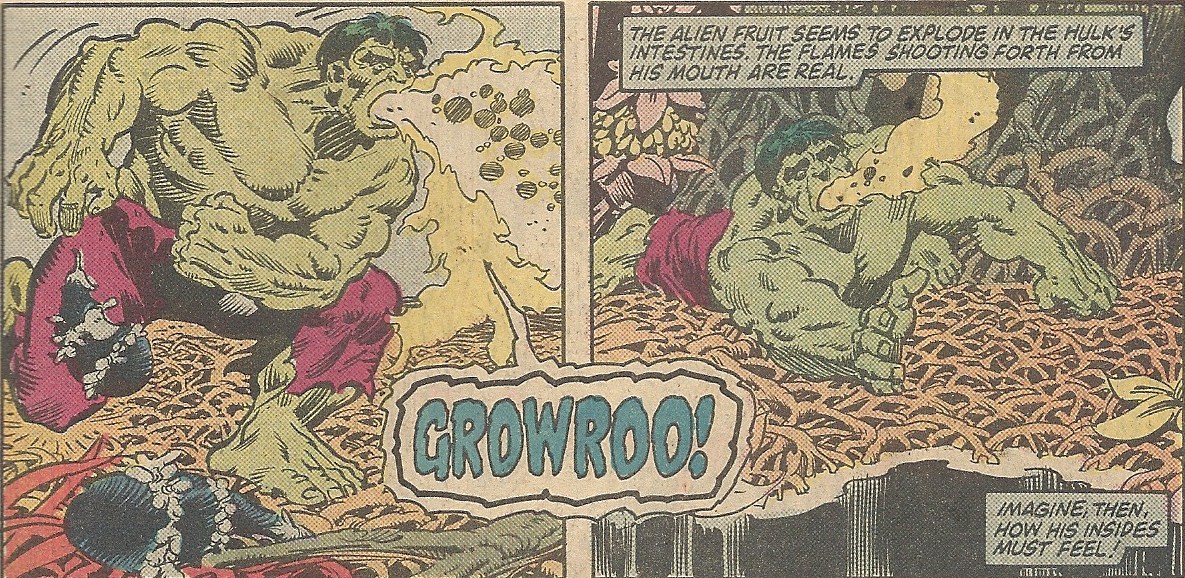
Unfortunately for him, all the food on this world is poisonous to his constitution, and he’s left with scalded insides. Hulk’s hunger eventually overcomes his caution, and he kills an animal for food (this is a savage Hulk, remember, not the kinder and gentler version). D’oh! It’s poison, too:
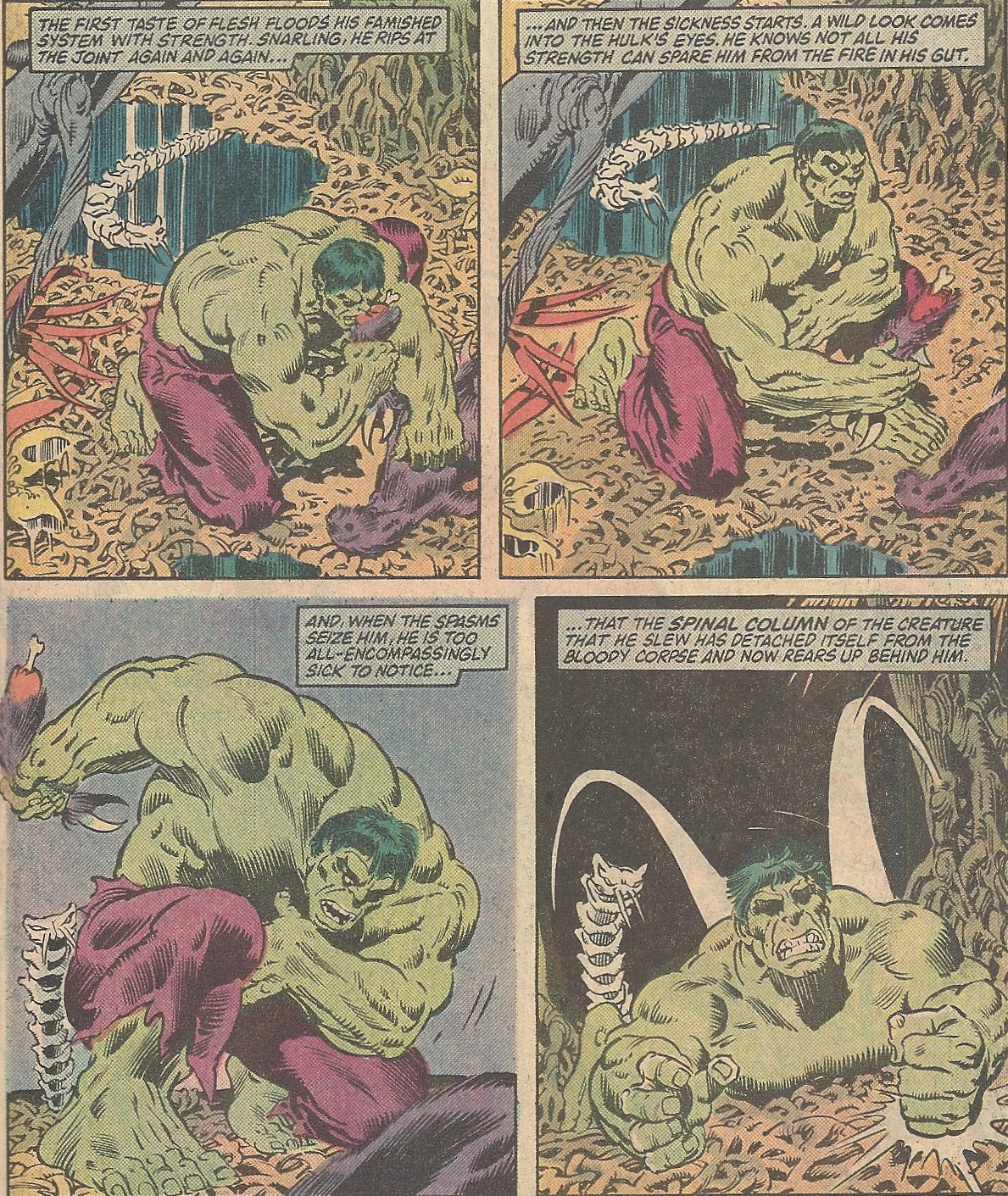
Hulk feels the horrible pain returning, but then it vanishes. His happiness at this turn of events melts away when he sees what just latched onto his back:
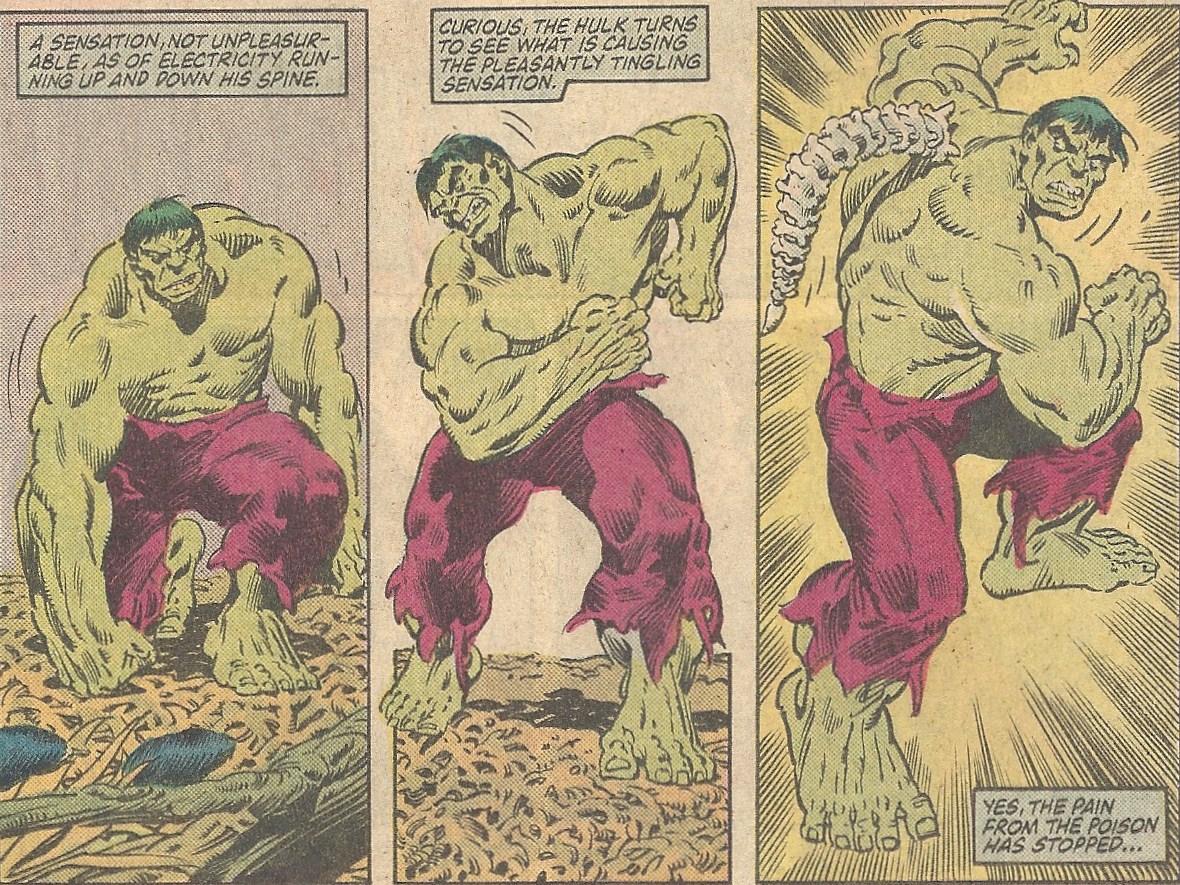
I’ve had huge bugs land on me before (a ginormous praying mantis at a ballgame once gave me a hell of a case of the heebie jeebies) but I have to imagine a spine-monster digging into your neck would take the cake.
The creature communicates with Hulk telepathically and explains that he means him no harm, but since Hulk has killed his former host, he needed a new one, and ol’ greenskin fit the bill. Hulk calms down when he learns that this thing will allow him to eat, and he names the symbiont “Sym.” Not the most creative name, but Sym doesn’t seem to mind this new appellation.
In fact, Sym is thrilled to be with Hulk, because Hulk is unlike anything alive on this world. He can leap in the air and attain heights unreachable by any other animal. And, since it turns out that Sym is a pretty nice companion, Hulk is enjoying himself, too:
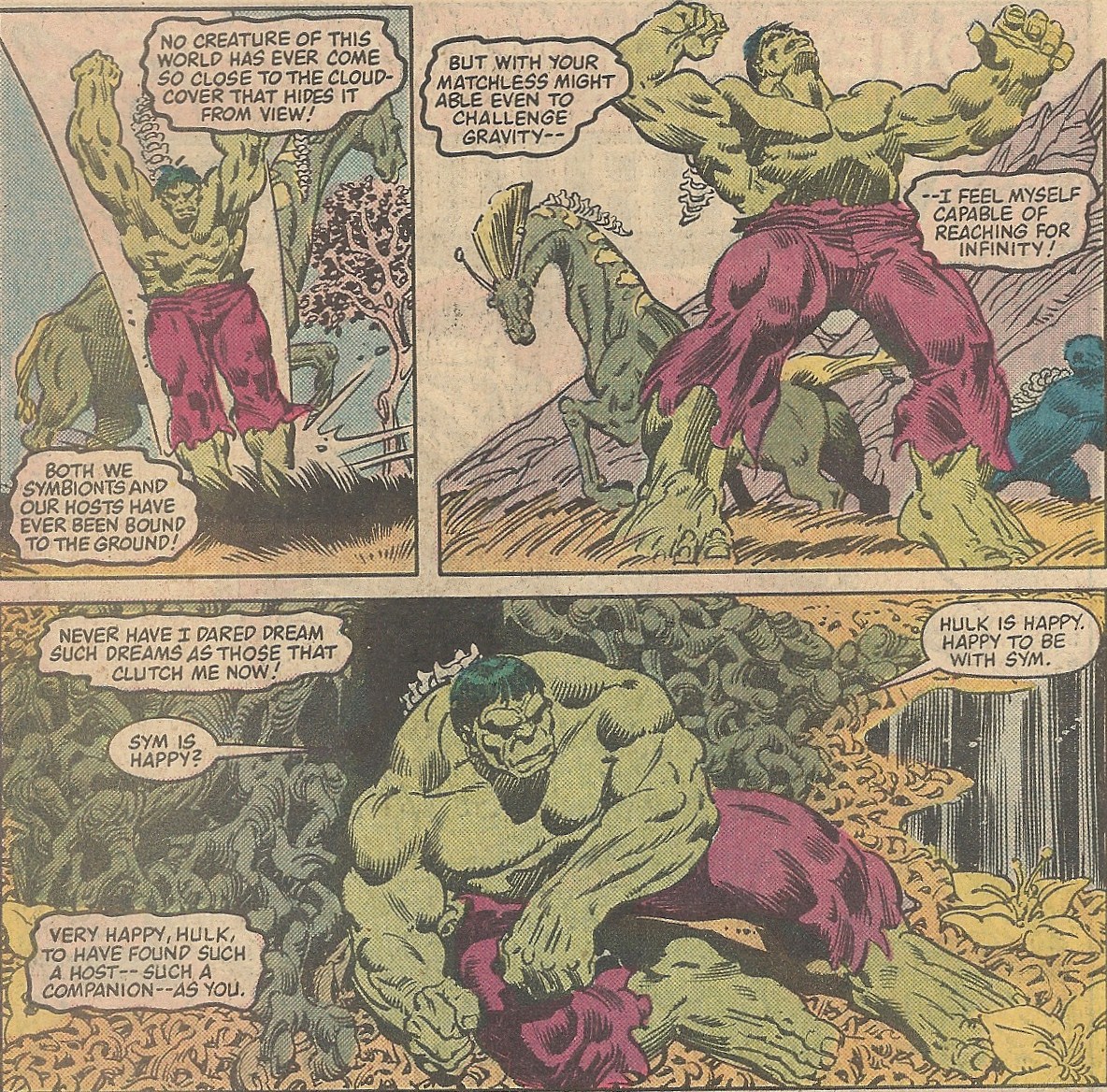
Then society has to go and ruin it for the big green guy. It’s the story of Hulk’s life.
All of the symbionts and their hosts are called to a big town meeting, and a craggly old elder symbiont reveals that, for rather odd reasons , Sym’s melding with the Hulk has to be terminated:
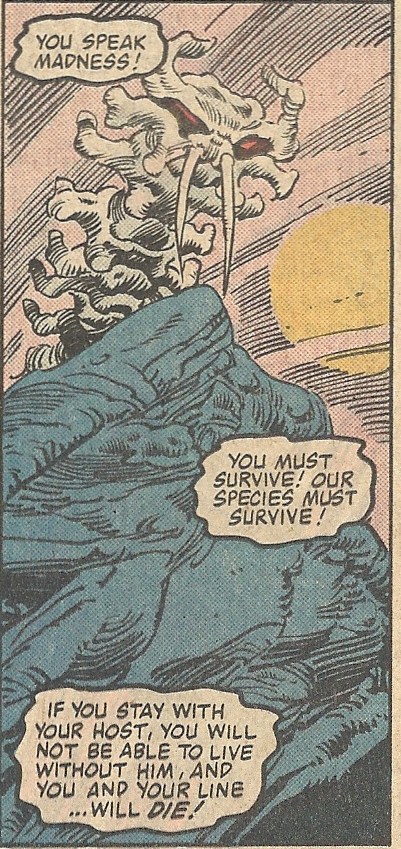
Neither Sym nor Hulk want this, so they hightail it out of there.
Sym guides Hulk to a mountainous region. This world is covered by clouds, and no symbiont has ever seen the stars that lay beyond that shroud. Sym has always dreamed of glimpsing that hidden sight, and Hulk, to make his friend happy, ascends the tallest mountain on this world, one that penetrates the clouds. It’s a difficult climb, even for Hulk. He has to take a break when they reach a snow-swept height, and ignores Sym’s pleas to give up the attempt (he even gets in his trademark “strongest one there is” line):
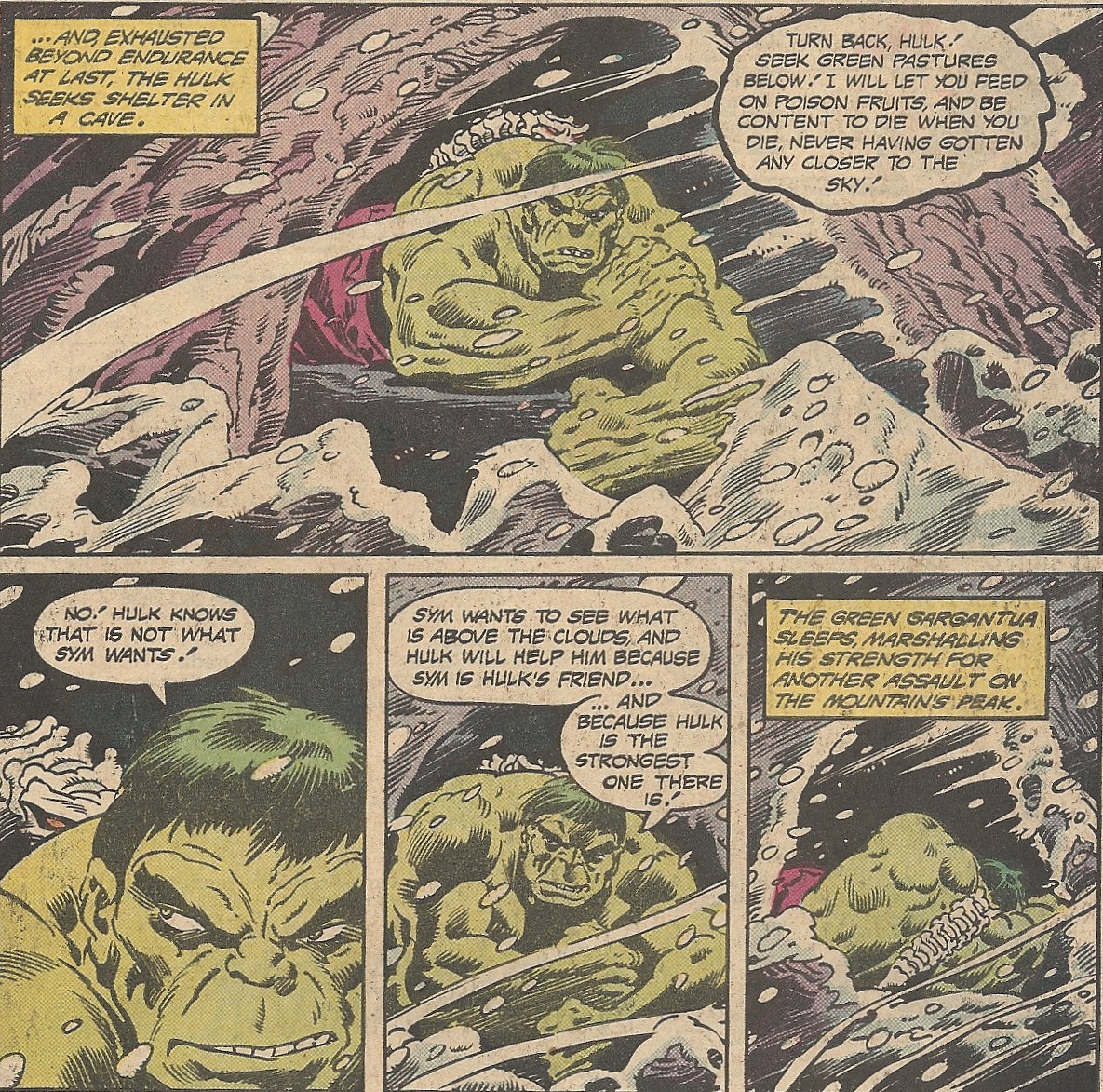
When Hulk awakes he finds that the storm has broken and is enchanted by the revealed night sky, and is doubly thrilled that he could give this gift to Sym. But he discovers to his horror that Sym is no longer hooked into him. There’s a sad end to his brief search:
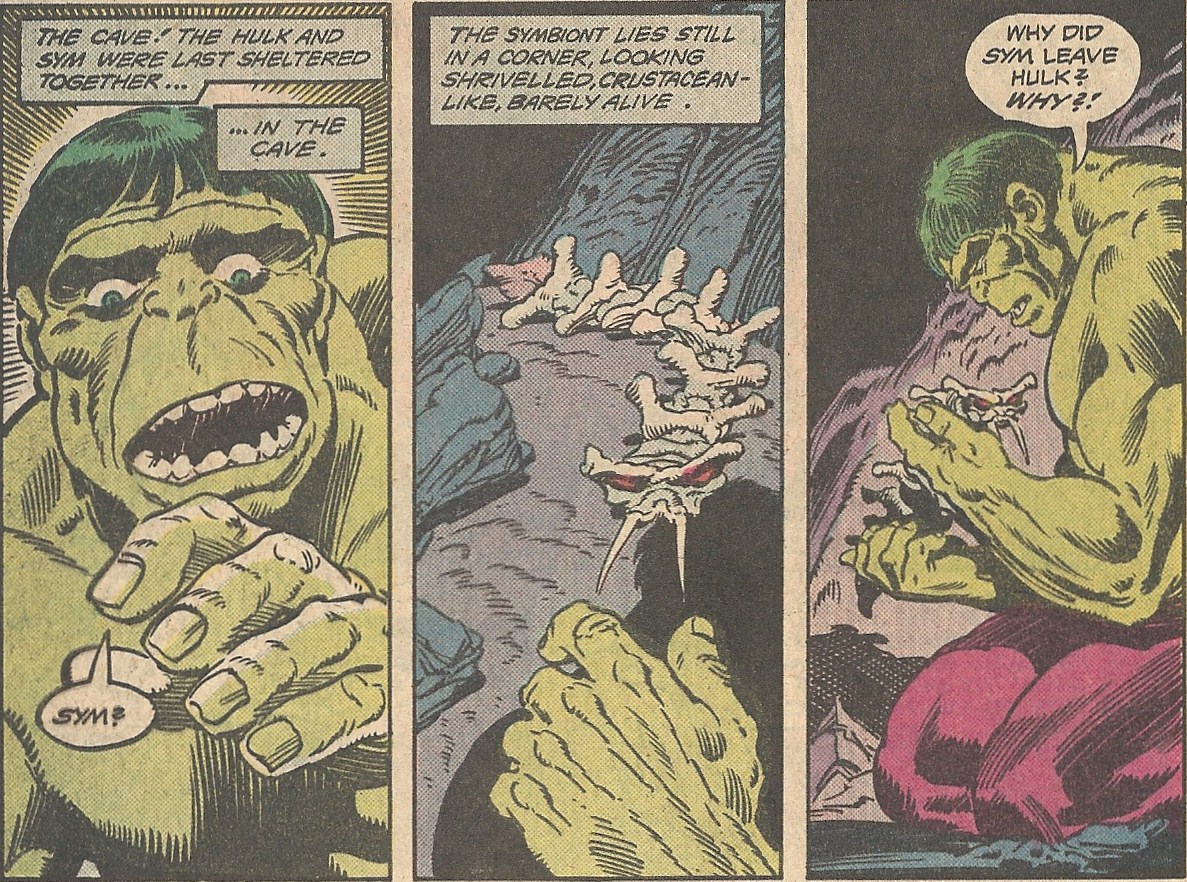
And now we have the emotional crescendo of the piece — ready your handkerchiefs:

Poor little fella. At this moment there isn’t a dry eye in the Blog into Mystery headquarters. I’m not ashamed to say it.
A heartbroken Hulk is mercifully returned by Dr. Strange’s spell to the Crossroads, and we can only hope that his next world won’t torture him emotionally as this one did.
Mantlo, who wrote some wonderful Rom stories that I’ve covered here on this blog, really knocked the ball out of the park with this one, and hit all the right notes that make for a successful Hulk story (outcast, lonely, hunted). Sym is a scary, sinister, and disgusting looking creature, but we quickly learn that there’s more to him than his outward appearance. He’s kind to Hulk and becomes a true friend to him, and some genuine emotion is kindled when we see his shrivelled little body after he’s given up his final host. Hulk’s loneliness is palpable in this tale.
Something has to be said for the artistic design of Sym — Kupperberg’s pencils sealed the deal, giving life to a character that could be frightening at first sight and almost, well, cute by the end. That one panel with a dying Sym in Hulk’s big green paws gets me every time. Every…single…time. It reminds me of my old dog when he was nearing the end — he was still the puppy I had raised, but he got really thin and gray before he died. He could barely get off the ground, and our friendly neighborhood dying symbiont kindles a similar sad reaction inside of me.
There’s about a 0.000000003% chance that I’ll ever write a Hulk story, but I’d love to do one with Sym. There’s something about the guy I really dig. He’s like an ugly E.T., but the ugliness only adds to his appeal.
And that, friends, is a great Hulk story.
 Jared
Jared


 blog into mystery