A daytime soap opera would reject this fake twin for being “too ridiculous” – Daredevil #26
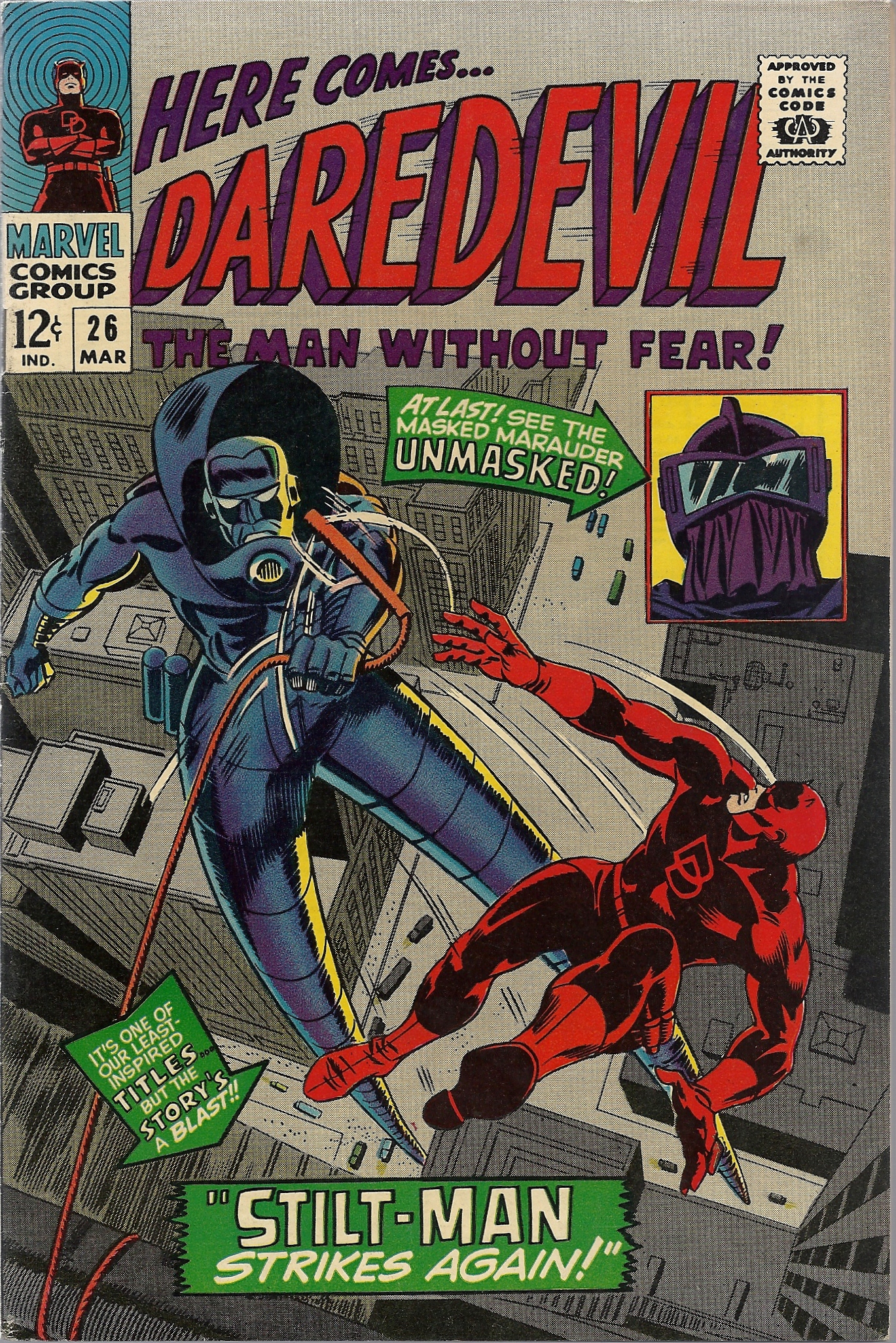
I’ve always pictured Matt Murdock as a man of dignity. Maybe it’s his work in the legal profession — having a J.D. myself, I can respect a hero that put up with the expensive bologna that is law school. Moreover, he’s a champion of the meek and oppressed in both of his personas.
Both personas? Wait, I forgot one.
There’s Matt Murdock’s “twin.”
Yes, his twin brother Mike.
“Mike” was Matt’s way in the previous issue (#25) to draw heat away from himself when it came to protecting his secret identity. Okay, I can understand that. You get caught with your superhero pants down, you panic, and you come up with the lamest scheme possible to cover your tracks. “No, Daredevil isn’t me, he’s my twin.” But, in his quest to differentiate this persona from himself, Matt managed to make Mike the most irritating human being on the face of the Earth. Ever. Of all time.
“Stilt-Man Strikes Again” is brought to us by the able Stan Lee and Gene Colan, and opens with the titular character making a costume change. Here’s Matt putting on his Mike face:
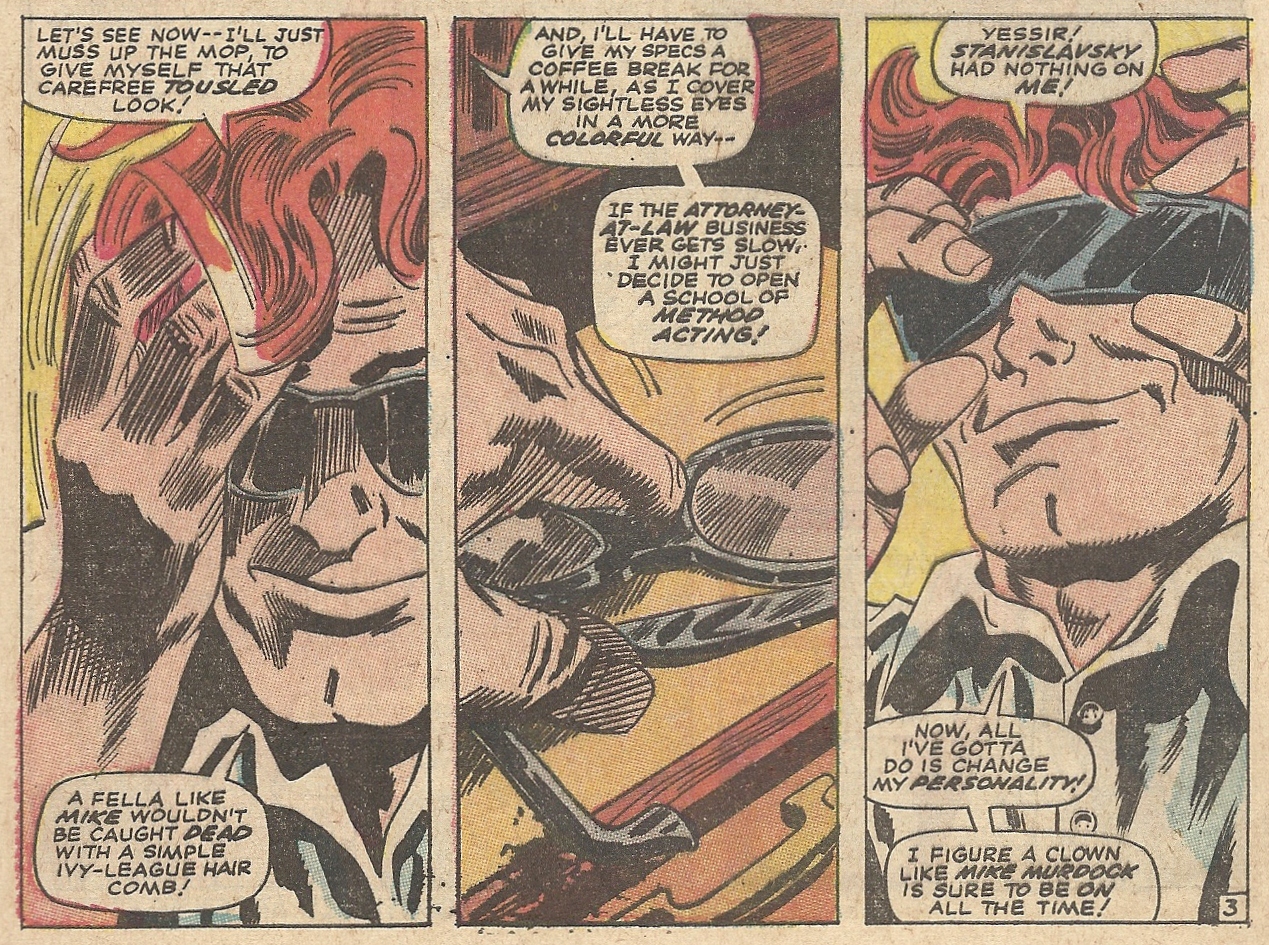
I don’t like where this is going.
When it’s all done, Mike looks like a preppy doofus dressing up as a pimp:
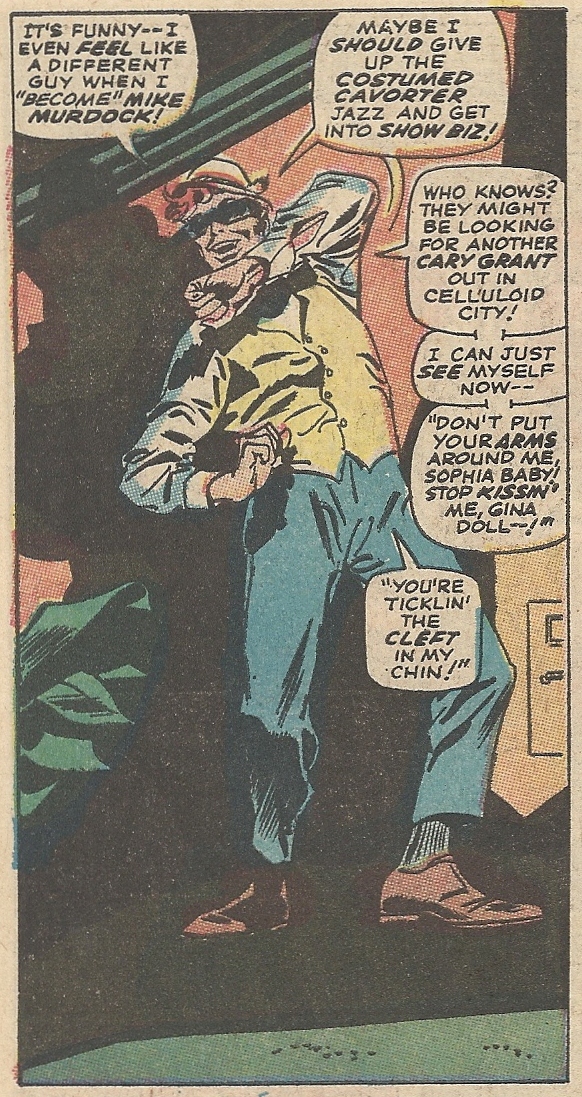
He also looks like he’s ready to walk like the “Wiz” guy in Seinfeld:
For the coup de grâce, Mike also does impressions:
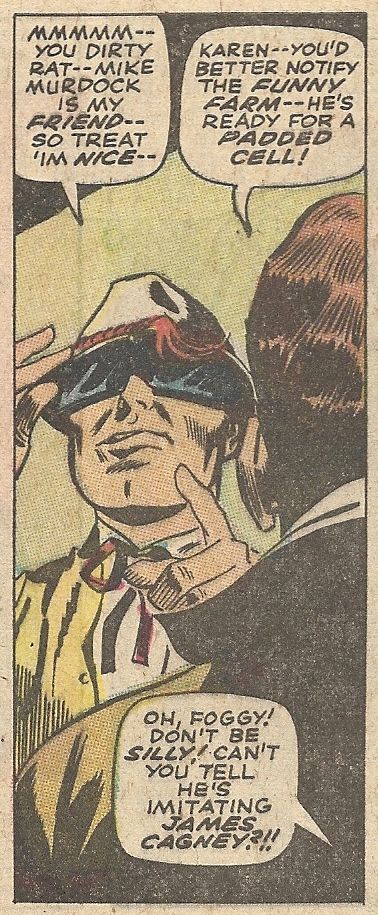
The James Cagney impersonation might be the straw that broke the blogger’s back.
Enough of this guy. It’s with great relief that I note that this book has some real action in it.
Things ramp up at the trial of Leap-Frog. The prosecutors on his case prove that the district attorneys in the O.J. Simpson murder trial might not have been the dumbest ever to step into a courtroom — instead of giving the accused bloody gloves to try on, these dummies HAVE LEAP-FROG TRY ON HIS SUPERPOWERED BOOTS:

He busts out of there faster than you can say “15-minute recess.”
Matt — I mean Mike — changes into Daredevil and goes after him, and Stilt-Man providentially shows up to recruit Leap-Frog to his evil cause. Daredevil and Stilt-Man then battle it out. There’s always been something menacing about this particular villain, something that goes beyond his main “I can adjust my stature” ability. It has to be the primal quality of the height — no one likes having someone looming over them, I guess.
Colan is at is customary best when drawing the vertigo-inducing action scenes:
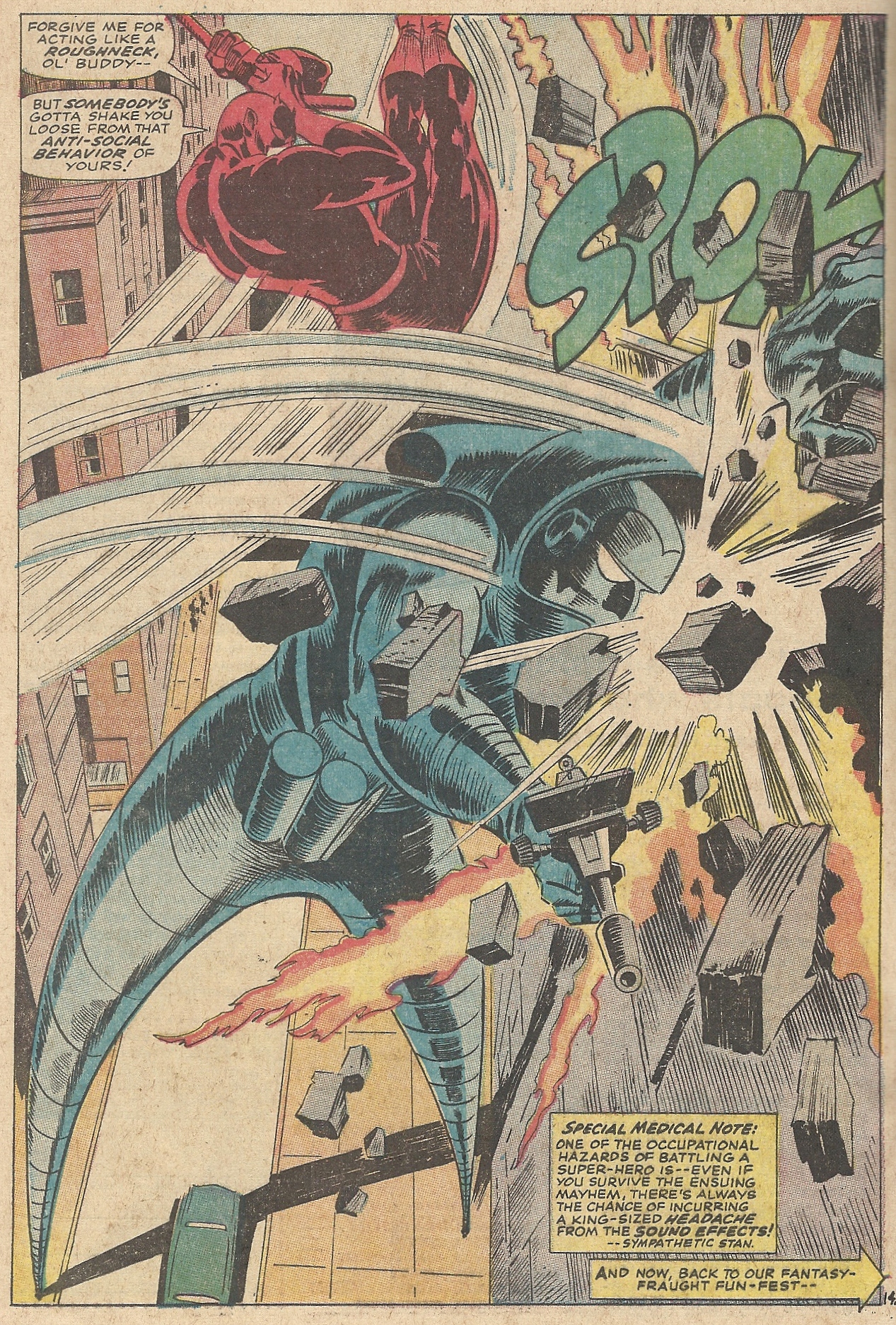
I’ve always liked the things that Colan did (and does) with perspective, and there’s no better character to bring that out than Stilt-Man.
Daredevil finally brings him down with a maneuver perfected by Wedge Antilles on Hoth:
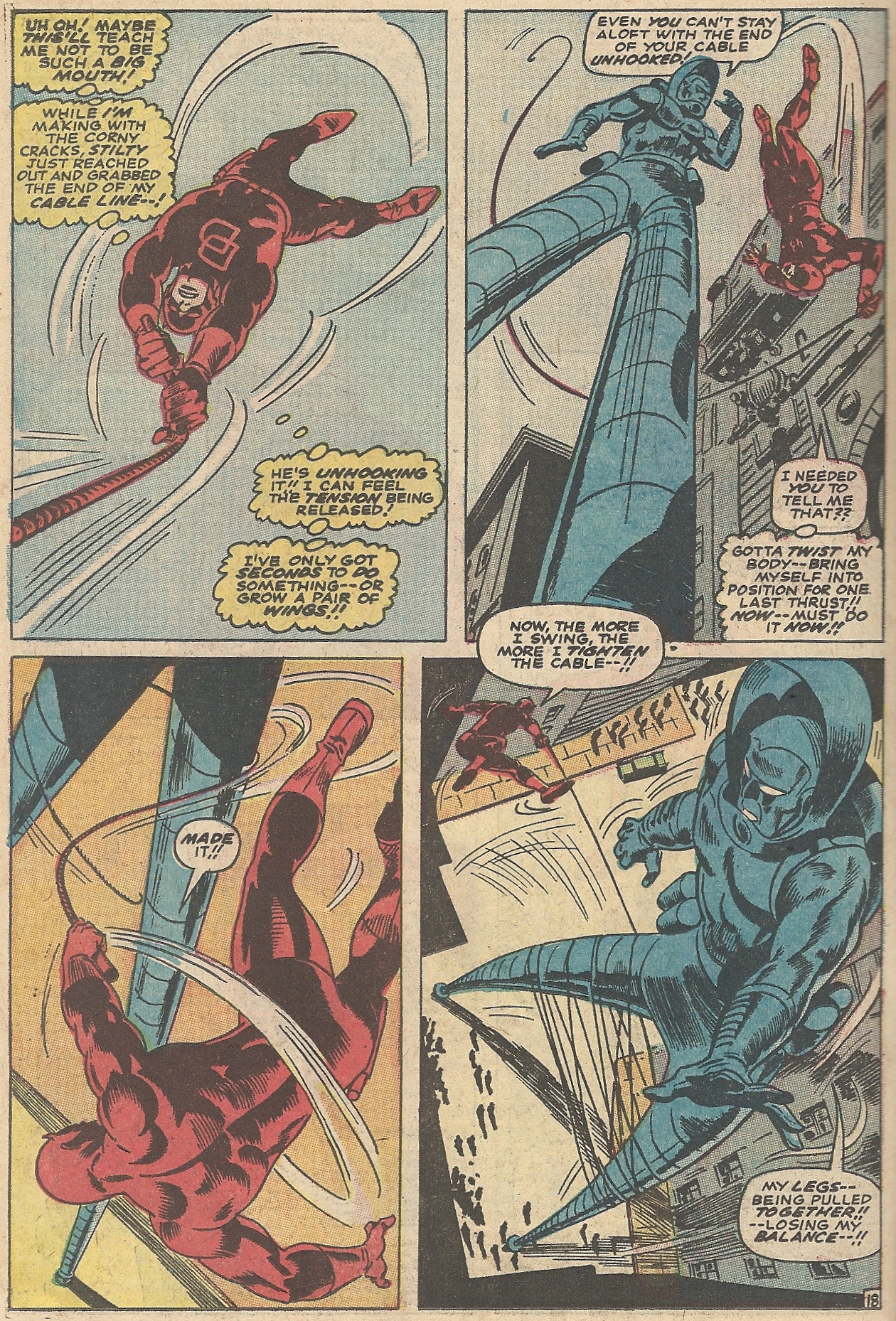
That’s pretty much where the story ends.
The presence of Stilt-Man rescues the outsized silliness of the Matt/Mike stuff. I find that junk to be mildly amusing, but it undermines the legitimacy of the hero that’s at the center of the comics. Or, at least, I think that it does. It makes me question his legal acumen to boot. It forces me to wonder if Murdock is a shyster at heart, the kind of lawyer that they warned us not to become in law school, like my favorite TV-advertising lawyer ever, Jim “The Hammer” Shapiro:
Yes, he was a real lawyer.
A couple of final notes about this issue…
The cover tease about the identity of the Masked Marauder? The reveal’s lame, and Stan even admits that it’s lame in an editorial aside during the story. So let’s leave it at that.
And finally, the horned one had perhaps the best letters column title from this era:
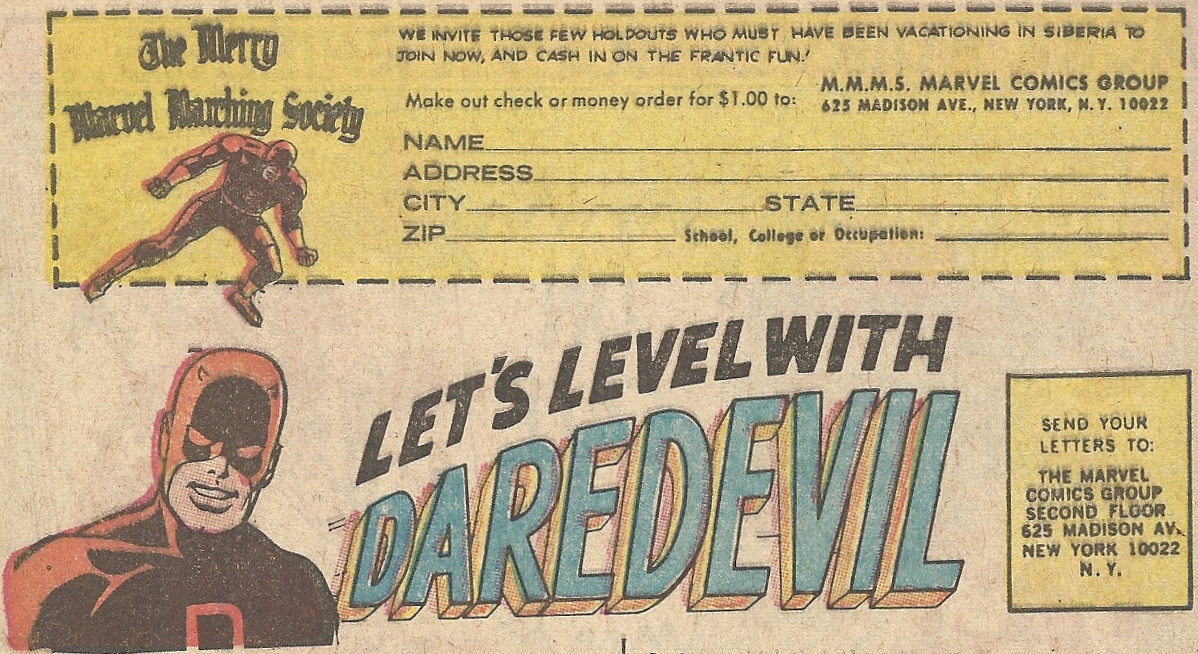
Wasn’t Captain America’s “Let’s Rap with Cap”? That might be a close second.
Anyway, I’ll end with this — I hope that, should anyone ever stumble upon my double life as the head of the Blog into Mystery internet empire, I don’t try to hide behind the facade of my imaginary twin. And if I do go down that dark path, I won’t — I WON’T — do James Cagney impersonations. I promise.
He had it all: a car, a babe, and a sweater – Dropout

This old 60’s ad put a grin on my face. Despite the rosy ending, I have a feeling that Pete Duncan’s pecuniary troubles aren’t quite over yet.
And I like the fact that International Correspondence Schools offered “special booklets for women.” No doubt they were focused on the exciting fields of housekeeping and grocery procurement.
When classic films and DC icons collide – Superman’s Metropolis, Batman: Nosferatu & Wonder Woman: The Blue Amazon
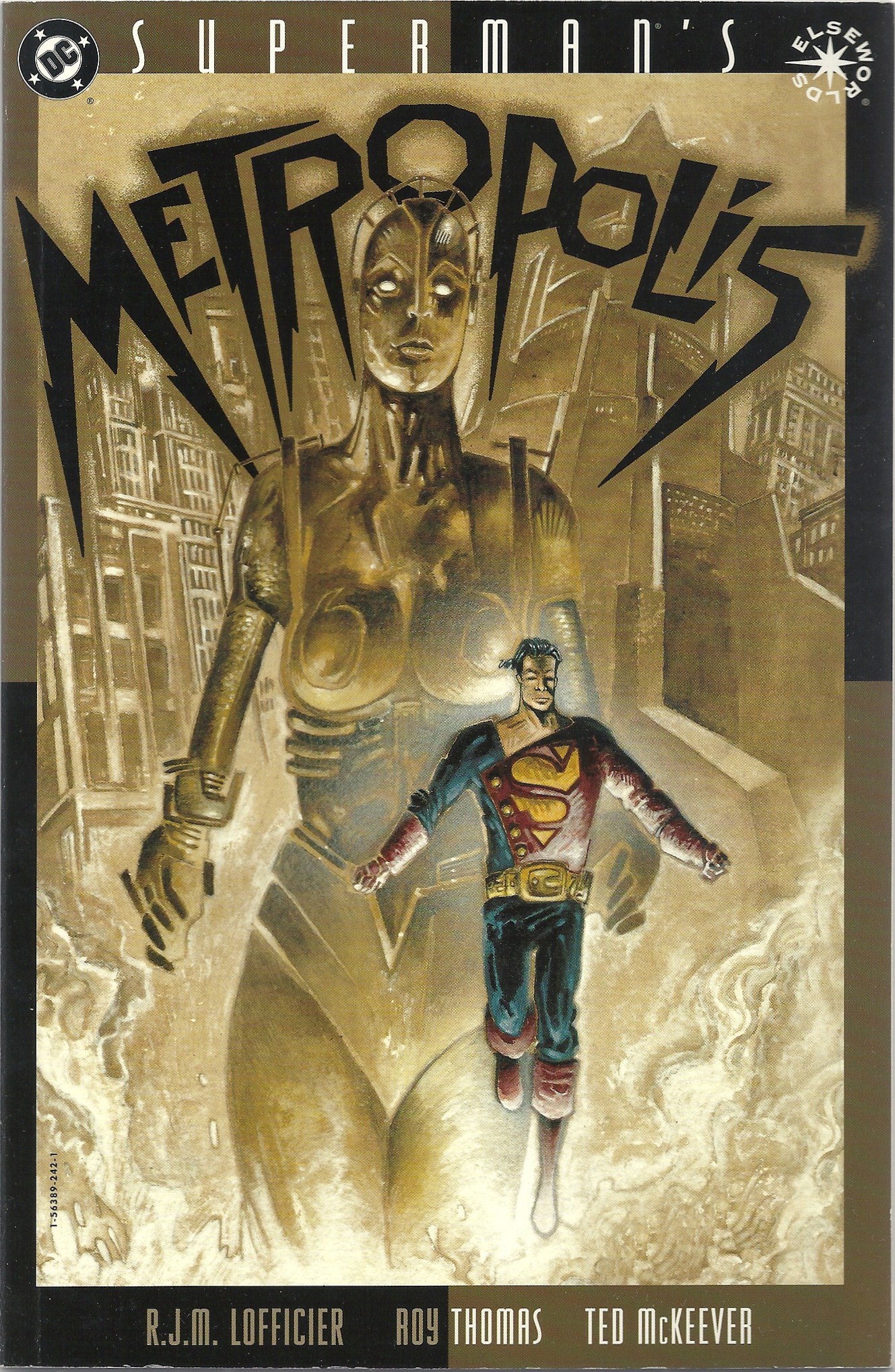
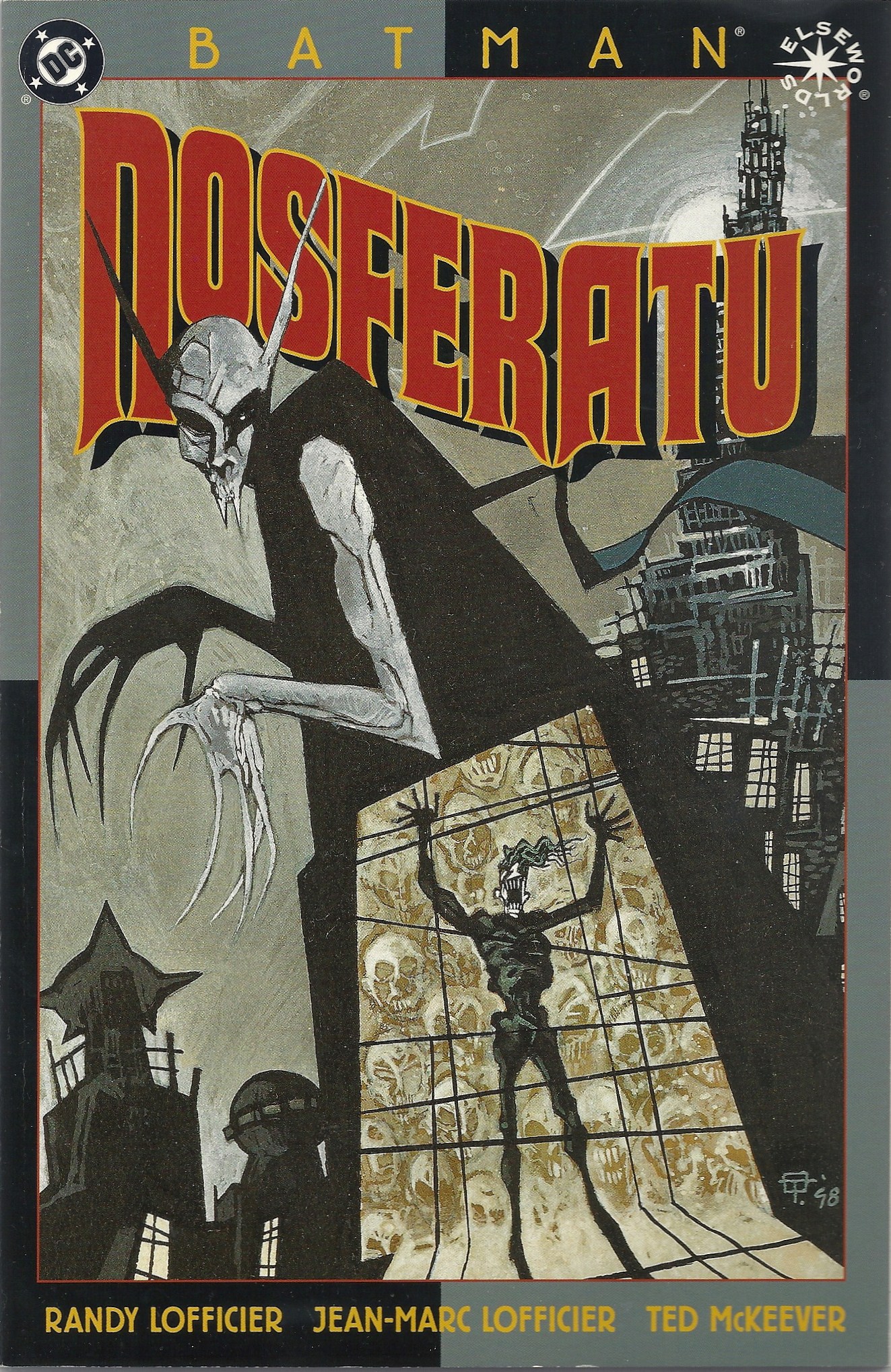
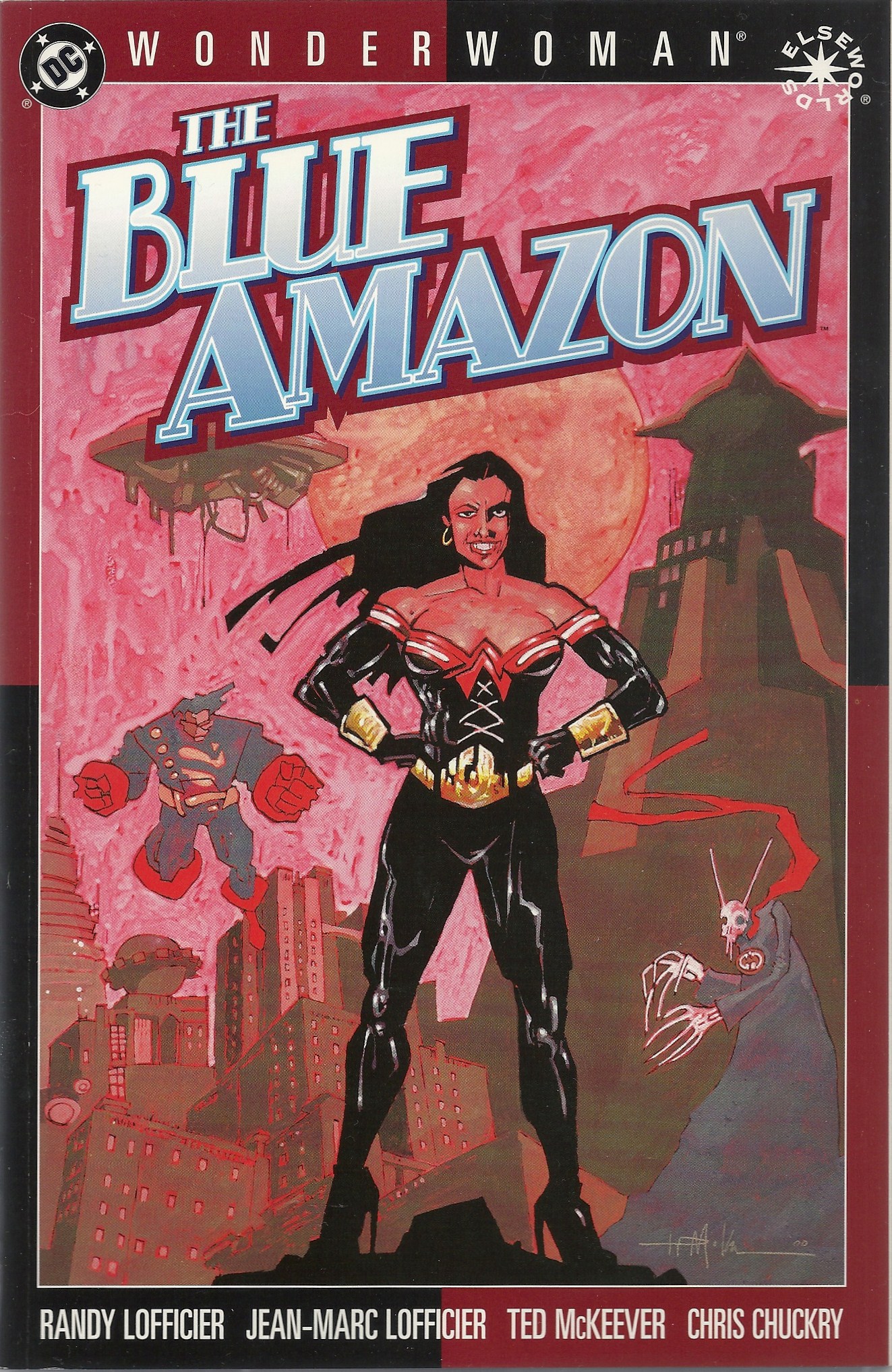
Elseworlds books can either be a lot of fun or they can fall like the proverbial lead ballon. It all depends on the viability of the conceits that are being trotted out. Sometimes they’re clever, sometimes they’re not.
These? I’ll put them on the “clever” side of the ledger, even if two of them are a bit obvious in their associations.
Metropolis, Nosferatu and The Blue Amazon are three sequential chapters of a unified story. All are written by Randy and Jean-Marc Lofficier and illustrated by Ted McKeever, with Roy Thomas participating in the scripting for Metropolis. I can’t say that I’m in love with the artwork — it’s a bit too abstract for my liking, but the meshing of comics with German Expressionist cinema is nothing if not intriguing.
Most everyone know’s about Fritz Lang’s Metropolis — it seems like it’s rejuvenated every few years when more frames of once-lost footage are found in old vaults and spliced back into the picture. I recognize its visionary brilliance as a classic in the realm of science fiction, but it has the dubious distinction of being the only film I’ve ever purposefully watched that’s put me to sleep. If you have a couple of hours to kill, or have insomnia, here’s the whole thing (though not the most recently restored version):
Nosferatu is still one of the finest vampire films ever forged, and Max Schreck’s portrayal of Count Orloff was so frighteningly convincing it actually spawned an urban legend that HE WAS AN ACTUAL VAMPIRE. Now that, my friends, is a tour de force performance. It’s a little late for some Halloween scares, but here it is if you want to generate a nightmare or two:
The source material for Blue Amazon is a bit more obscure, and required a minute or two of research for me to realize what it was. The primary inspiration is The Blue Angel, a 1930 film that brought Marlene Dietrich to the global film consciousness. It’s a tale of repression and the destructive power of lust, and while it lacks the supernatural qualities of Metropolis and Nosferatu, it more than makes up for it with its harrowing portrayal of a man’s tragic descent, one spurred by the charms of a beautiful nightclub dancer. If you’re in the market for a stern warning about “thinking with the wrong head,” I recommend checking it out:
The three books build on the broad themes of the movies and on one another, with some predictable twists and some some surprising turns as DC characters weave in and out of the stories. The Super-Man is the champion of his city. Nosferatu is the protector of the poor souls that live in the city’s shadows and the tortured residents of an asylum called, you guessed it, Arkham. Diana is an amnesiac exotic dancer, with all of the subliminal (and not so subliminal) fetishistic Amazon qualities of the Wonder Woman character brought to the fore. Their underlying friendships and rivalries are all there, but now seen through this unique Expressionist prism. Kind of cool.
The plots don’t cling as closely to the films as you might expect, but they move nicely. They’re different from your normal comics fare, and I mean that in a good way. As I said above, the art is challenging and is what will give most people fits. Some may like it, some will loathe it, but perhaps it simply goes with the material.
On the whole, this is a laudably ambitious project, and “ambitious” isn’t a tag you can stick on most comics.
Apparently there was a fourth v0lume of this “imaginary” saga that was never completed. It would have been called The Green Light and would have introduced more DC characters into this bizarre little pocket universe (and I bet you can guess the identity of at least one of those characters). I would have liked to have read that one. I suppose that’s as good an endorsement as these three could get.
We can be thankful that they’re tackling the Maha Yogi together and not the Kama Sutra – X-Men #47

The pre-cancellation days of the X-Men weren’t all that spectacular — or uncanny, for that matter. The stories could be rather dull, and they didn’t hit their angst-ridden stride until after Marvel had put its 60’s prime in the rearview mirror.
This issue’s main story is no exception. As “The Warlock Wears Three Faces!” begins, the X-Men have been disbanded by order of the F.B.I. and Professor X is (apparently) dead. In the course of this particular plot, Beast and Iceman defeat Maha Yogi/Merlin/The Warlock, who’s using a stage act in the big city to hypnotize an army for himself one paying audience at a time.
This is the opposite of scintillating. Nothing about it grabs you. The only panel that caught my fancy was this one:

I think the verbose Hank McCoy just proposed that they go pick up some broads, but I’m not 100% positive.
I found the backup, a summary of Iceman’s abilities, to be a bit more entertaining, mainly for the pointless ends to which he can direct his powers.
In “I, the Iceman,” by Arnold Drake, Werner Roth and John Verpoorten, we learn that he can make ice-erangs:

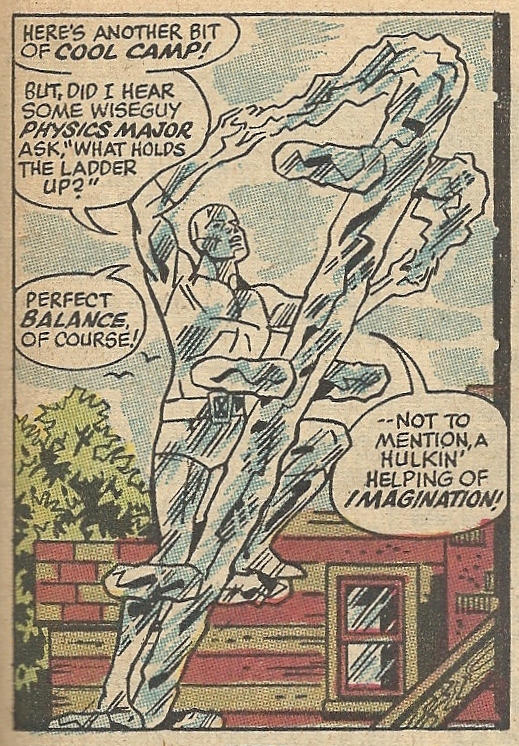
And he can make ice-ladders — don’t step on the top rung! Or any of the rungs, for that matter!:
Here he is metaphorically comparing penis-sizes with the Human Torch:

Since this comic was published in 1968 and the Mets won the pennant and the World Series in the very next year, the Torch’s boast rings pretty hollow.
Finally, Iceman ruminates on how he’d fare in the coldest of environs:

So, after saying that space has no moisture, and that his powers need moisture, he says that he’d still be intrigued by the challenge?
Bobby Drake, you’re an idiot.
If someone wanted me to pick out a prime exemplar of Marvel’s Silver Age, this puppy would be pretty far down the list of options.
(And, in case you’re wondering, the feature was scripted by Gary Friedrich and Arnold Drake, pencilled by Don Heck and Werner Roth, and inked by John Tartaglione. That’s a lot of chefs in the kitchen — and therein might lie the reason for the story’s mediocrity.)
I’m Mervyn Pumpkinhead, and I approve this message – Sandman #46

It wouldn’t be Halloween without a Halloween-themed blog post, so let me join in the fun with a few brief words about the best minor character in the sprawling Sandman mythos, Mervyn Pumpkinhead. If you don’t know him, he’s the gruff handyman around Morpheus’ dream realm, doing all the proletarian duties that keep the wheels greased in that wonderfully strange fairyland. Oh, and his head is a carved jack o’lantern (there’s your Halloween connection) with facial expressions that shift and change quite comically. And he wears overalls. And he smokes. And he was a bus driver for a while.
I love this guy.
His full introduction came during the “Brief Lives” arc, which is the storyline that I connect with most strongly from this series. Perhaps that’s the reason that I like the guy so much. I don’t know. The family dynamics between the Endless reached their touching and tragic turning point in those nine issues, and it always struck me as some of the finest work that Neil Gaiman ever flung out to be enjoyed by the public. I also thought that the art was amongst the best in the entire run. Penciller Jill Thompson has remarked that Vince Locke’s loose inks changed her pencils in ways that she hadn’t expected and wasn’t necessarily fond of, but I always liked the melding of their styles. The result was, for the lack of a better word, dreamy.
Perhaps most importantly, it was perfect for our pal Mervyn.
He appeared in two pages in this particular issue, when Morpheus returned to his realm after a brief sojourn on Earth with his sister Delerium. It’s an amusing little sequence, and it nicely encapsulates this character. Here it is:


The way Thompson and Locke drew his arms and fingers has a pumpkin-y feel to it, sort of like the vines and stems in a real live pumpkin patch. It adds a lot. And Mervyn hanging some wallpaper to add a new wing to Lucien’s library (a library of books that were never written, mind you) is something straight out of a classic cartoon. It’s things like that that made this series so utterly fantastic.
I should disclose that I have a “Brief Lives” poster framed and hung up here in the Blog into Mystery home office. The main reason I bought it was that it had Mr. Pumpkinhead featured prominently — I couldn’t resist. Merv later starred in his own spinoff where he was A #%*$ING SECRET AGENT IN A TUXEDO LIKE JAMES BOND. I really need to track that thing down.
Happy Halloween to one and all.
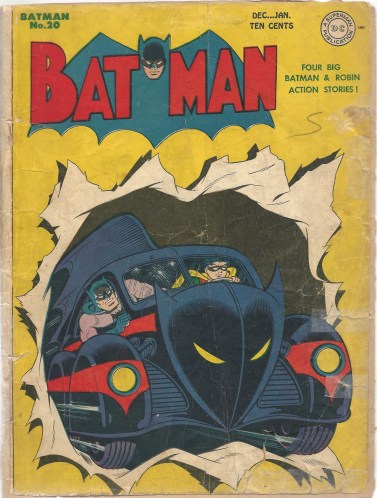
I just bought this old warhorse of a book a couple of weeks ago, and it has its merits despite its dilapidated condition. Don’t worry, I didn’t pay a fortune for it.
Just to list a few of the problems with this comic — tears, bits of the cover missing, creases, tape, writing, stains, and the cover came off and was glued(!) back on. And a partridge in a pear tree. Well, not the last one.
But it’s Batman #20! It’s the first cover appearance of the Batmobile, and the whole thing is intact! There’s a Joker story inside! At least, those were the things I mentally shouted at myself to rationalize shelling out for this thing. I even thought to myself “Hey, since the Batmobile is supposedly bursting through the cover, it kind of makes sense that it’s in bad shape!”
Yes, I actually thought that.
As for the interior, it’s chock full of Golden Age goodness. I didn’t scan much, mainly because I didn’t want to risk having the pages fall apart in front of my eyes, but there was one panel that I couldn’t resist, from the aforementioned Joker story:
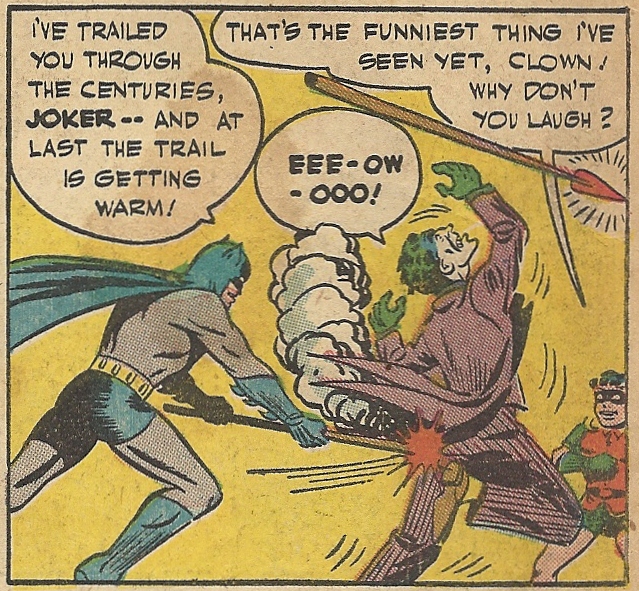
Ahhh, Batman sodomizing Joker with a spear. That’s worth the price of admission in and of itself. Thanks to scripter Don Cameron and artist Jack Burnley for putting something on paper in 1943 that made me chuckle close to seventy years later.
The only big drawback with these old Batman comics is the Caped Crusader’s, how shall we say, interesting relationship with Robin. I’m not saying that The Seduction of the Innocent was justified, but at times you pick up a vibe that makes you wonder if Chris Hansen and the Dateline NBC cameras are going to show up in the next panel.
But let’s not dwell on the negatives. Back to the cover for one sec — that old Batmobile is one hot looking ride. The red stripes are absent from the more modern designs, and I kind of like what they do to the overall look. And it’s nice that Batman lets Robin take the wheel, too. “You drive, old chum! I’ll stick my head out the window like a dog and flash my pearly whites!”
There’s a ton of fun to be had in this old thing. It’s so hard to find Golden Age books — especially prestige titles — that are both affordable and in passable condition. This one meets all the requirements, and that makes it one of the prized treasures in the Blog into Mystery archives.
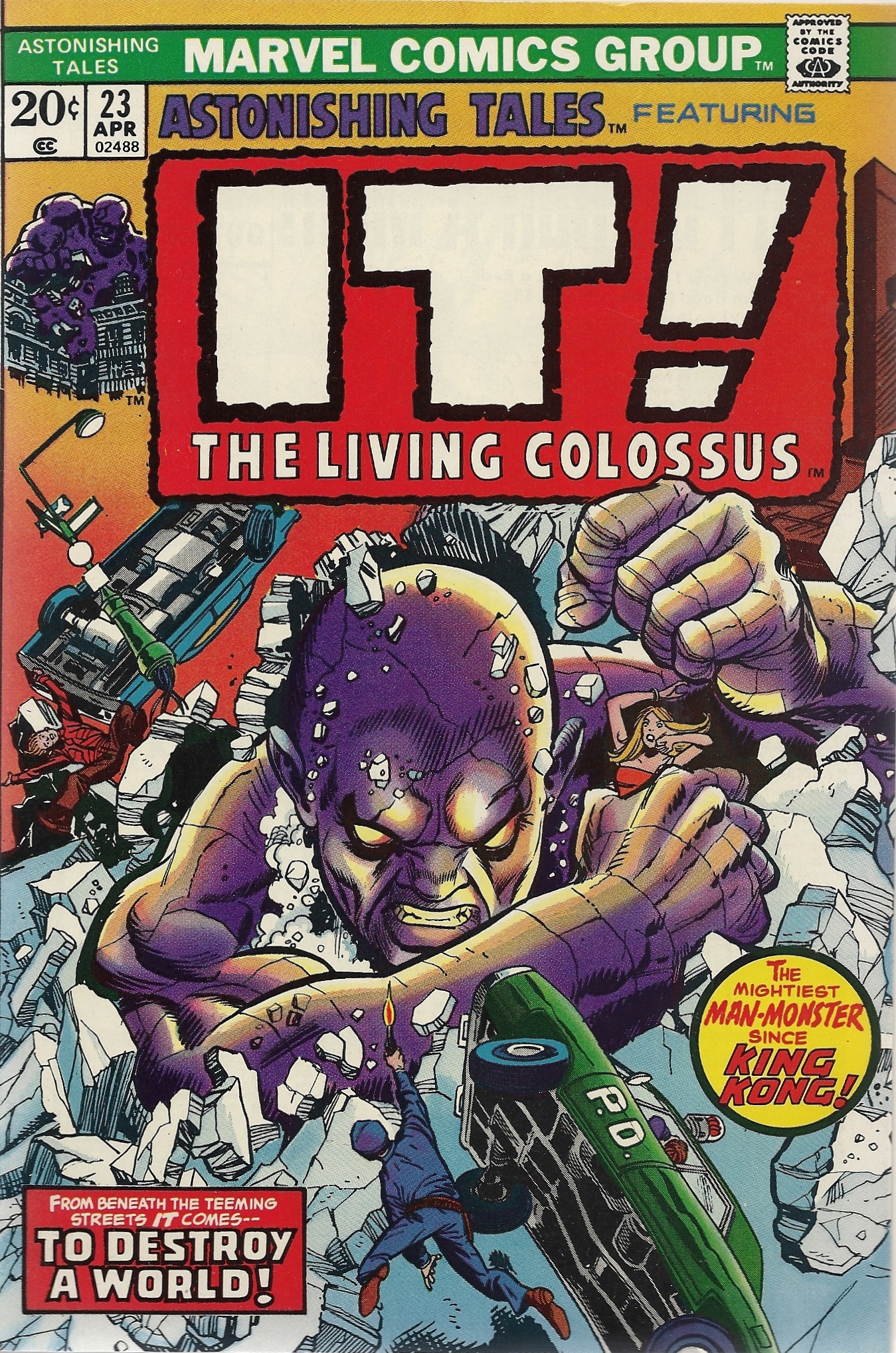
The Living Colossus had a short run in Astonishing Tales. It’s the story of a paralyzed man, Bob O’Brian, who, through mind transference, can inhabit and animate the body of a giant stone statue. There’s little to make it all that unique, but it has its moments.
Here’s a full-body shot of the the Living Colossus, just to give you a taste of the endeavor:

Maybe it’s just me, but the size of our hero, his attire, his bald dome and the palm treed locale remind me of that memorable panel in Watchmen of Doctor Manhattan zapping Vietcong. You know the one.
Anyway, I don’t have a ton to say about the Tony Isabella/Dick Ayers story (with some interspersed reprinted art from Jack Kirby and Ayers) in this issue — it’s not that it’s bad, it’s just it didn’t really grab me. What did get me was the appearance of this fella:

Folks, we have a Fin Fang Foom sighting!
Mr. Foom is, as you might expect, summoned by evil dudes who want the giant and ancient dragon to do all sorts of malevolent deeds. But when he stumbles upon the Living Colussus, who’s caught in the middle of a civil war between alien gargoyle factions (?!), the Foominator has a choice to make:

Whose side does he take?:

There’s something gratifying about watching an evil dragon punch, chop, kick and crunch his way to the side of good, no matter how temporary his white knight act may be.
When I read this, it got me to thinking about what an effective storytelling angle it is to have a villain become a hero. In pro wrestling, it’s called “turning face” — here’s a prime example from the WWF’s heyday, as the Big Boss Man turns his back on his manager, Slick, and the Million Dollar Man Ted Dibiase, and in so doing comes to the aid of Jake “The Snake” Roberts:
It’s so relaxing to watch oversized half-naked men yelling and spitting at each other.
And everyone is familair with this classic “face turn” from the world of cinema:
Usually you need another villain to offer some reproach or insult to the bad guy that’s about to switch sides. You’ll find examples all over the place, so I won’t bog down this post by giving a catalog of them. Suffice it to say, it’s a great technique. It’s oh so basic, but oh so effective. Create a character that people love to hate, and it’s not too hard to make people simply love that same character. I’m not saying people love Fin Fang Foom, but some of the elements of the process are still there.
Silver Age humor, such as it was – Not Brand Echh #3

This comic isn’t as offensively stupid as it would seem, and the silly parodies of prized Marvel properties aren’t quite as lame as their names would suggest. Here are the opening pages from each of these three characters’ “origin” stories, just to give you a taste of what these books were like if you aren’t familiar with them:
The Mighty Sore:

The Inedible Bulk:

Charlie America:

As an added bonus, have a gander at this panel from the “Mighty Sore” tale — spot the famous faces!:

I can’t say that there’s a great deal of substance to be found here, but seeing Jack Kirby parody his own visual style in the “Sore” story was mildly entertaining, and there are sight gags aplenty throughout the entire comic. In the Charlie America scan, you can spot Thing (or whatever the hell Thing’s Brand Echh counterpart is) looking at a book with “Geology Photos.” Ah, the Playboy for the rock-encrusted among us.

Just look at that red-headed little bastard on the cover. There have been many times in the history of comics where that freckled twerp’s deserved a good punch in the face, but this might take the checkered flag. Making Superman cry to harvest his tears? Dirty pool, mister. Dirty pool. That seems like something more up Eric Cartman’s alley:
At least young Olsen never utters the phrase “tears of unfathomable sadness” in these pages.
Leo Dorfman and Pete Costanza bring us the tale of “Superman’s Saddest Day.” It starts with Jimmy off on vacation, where he discovers an old sunken ship while scuba diving and there makes an improbable discovery:
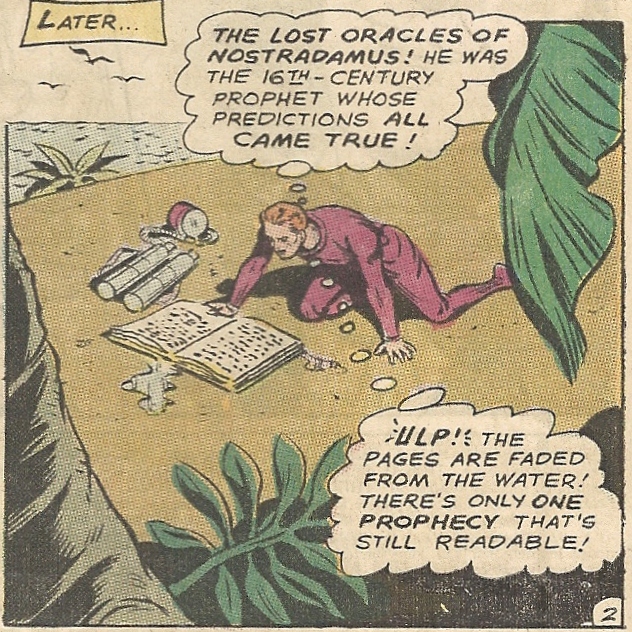
Yes. The book was underwater, but the pages are only “faded.” I could get hung up on this, but let’s move on. The book contains a “prophecy” from Nostradamus that reads more like a witch’s spell:
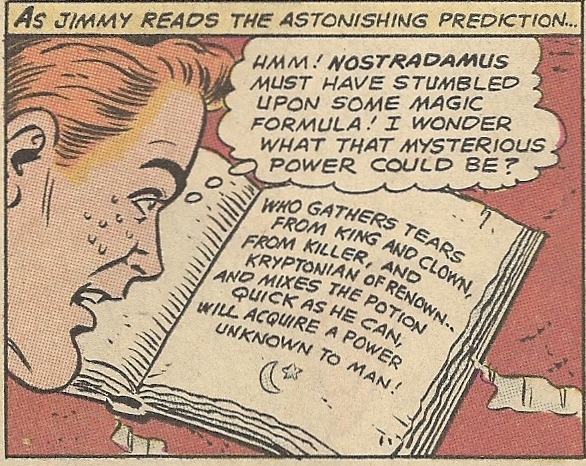
Jimmy launches into fantasies of what this strange power could be — of course it would only be something good. Right? Sure.
He immediately sets out on this quest for treasured tears. His first stop is a minor monarch, and Jimmy plans to use a position in the kitchen to make the head of state weep:
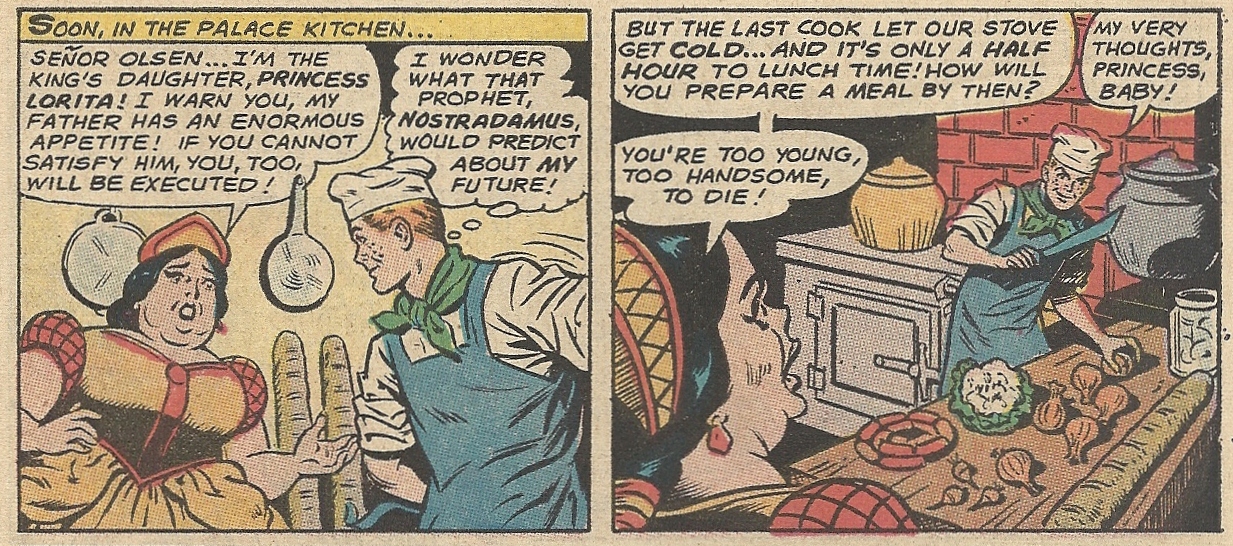
Unfortunately, the father is just as much of a porker as his reubenesque daughter, and gobbles up the spicey, oniony food without a bit of precious moisture flowing. He looks like the king in this old Looney Tunes short, “Shishkabugs”:
Bring me my hossenfeffer!
Jimmy’s luck turns — when the daughter falls for this magnificent cook (the way to a fat princess’ heart is, after all, through her stomach), the father loses it:
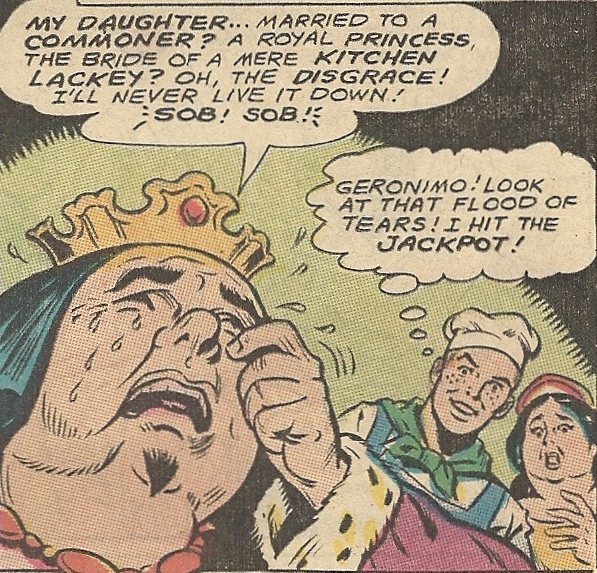
One down. And Jimmy escapes without getting married.
Next is the clown, and Jimmy crosses paths with another DC bigwig:
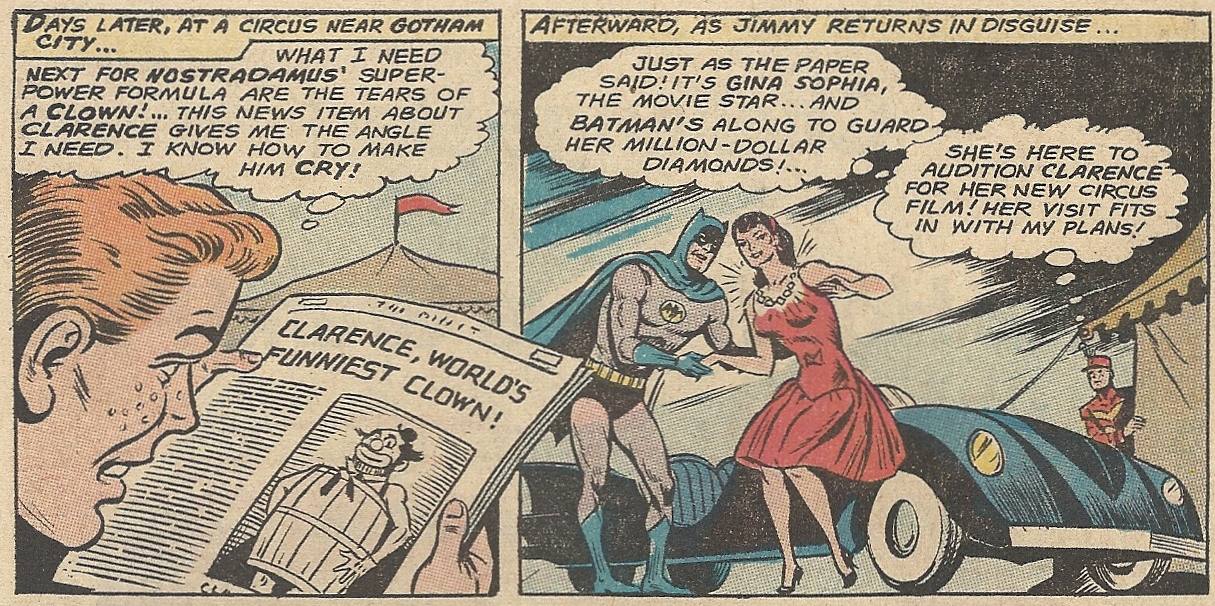
I’m not sure what to make of Batman being a rental bodyguard, but maybe he’s been blowing through the Wayne fortune a little too fast.
Jimmy’s plan to sabotage the clown’s performance and make him cry is itself sabotaged when another clown grabs the lady’s diamonds. I’ll give you one guess as to the identity of this clown. Here’s the unmasking, though it really isn’t necessary:
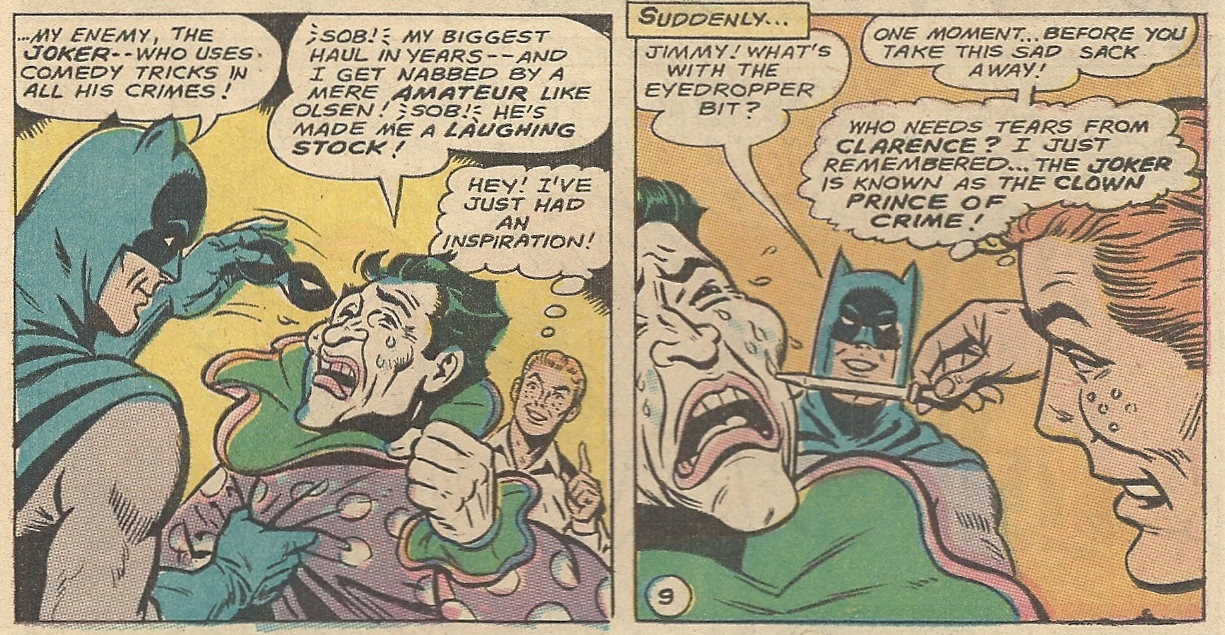
Ah, the days when the Joker’s calling card was jokes and not brutally murdering Batman’s sidekick — a simpler time. And since the Joker passes for a clown, that means that Jimmy’s halfway done.
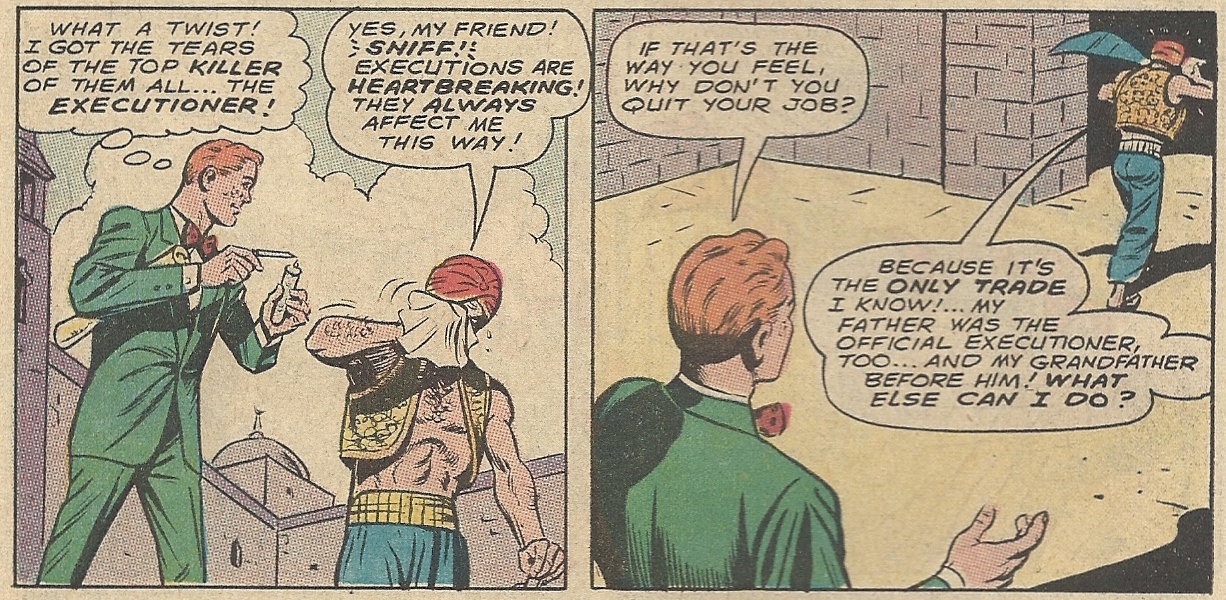
For the tears of a killer, Jimmy travels to a “near-east” nation, where he hopes to get the tears of a hopefully remorseful political assassin. The condemned man is unrepentant, but another gent is obliging — the executioner:
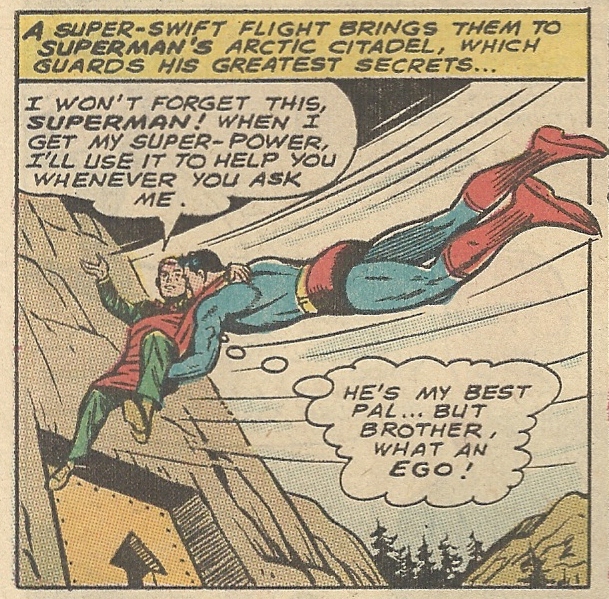
Last we have the Kryptonian. Supes obliges, though he can’t help but inwardly roll his eyes at his pal:
Remembrances of Superman’s Kryptonian heritage don’t start the waterworks, but an old film of Smallville does the trick:

Jimmy mixes the tears and…
The tube glows. That’s it. Jimmy thinks it’s just a light bulb, and doesn’t take a whole lot of consolation when Superman points out that light bulbs were a “power unknown” in Nostradamus’ time. Jimmy had to be thinking “Nostradamus? More like Nostra-dumb-ass!” He lets Superman have the vial, and the big guy keeps the its true nature secret:
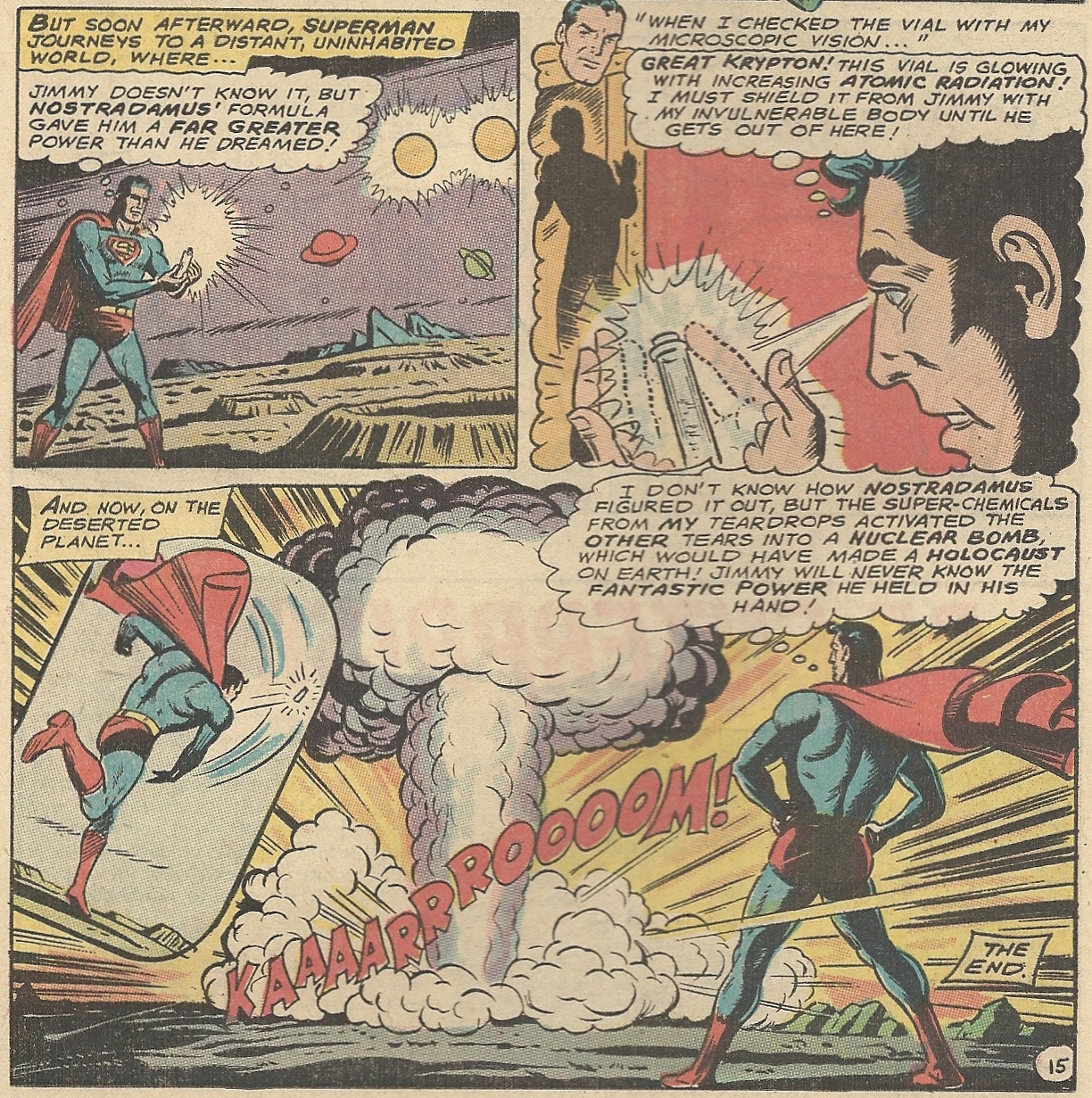
So Jimmy, in his mad yearning for personal gain, created a pocket atom bomb. Olsen certainly isn’t at his most sympathetic here. He’s a jetsetting (where does he get the money?) jerk who looks to profit off of the misery of others, and in the process he creates something that could have killed millions. Yikes. Just stick to the minor misadventures and photojournalism, okay?
Let’s just hope Osama never finds a formula like this one. Lucky for us, I don’t think there’s a lot of scuba diving in Northwest Pakistan.

I realize that these old things are all reprints, but they still provide me with a chance to read some of the old Marvel material that (since I’m not a huge fan of big collected editions) I might not get a chance to see otherwise. This particular issue, as can be seen from the cover, has some of the old Golden Age Human Torch, Namor and Captain America stories. I don’t have much to say about them, but the Namor story — published in 1940, during World War II but before America’s entry — was interesting to me because of this one panel:

That’s cold, fish-man.
Also reprinted are some of the non-hero shorts from the early Silver Age titles like Journey into Mystery and its brethren. One, entitled “Mosteroso!”, from Tales to Astonish #18, really caught my eye, and not just for the Steve Ditko art:

Monsteroso hatches from an egg and immediately grows to an incredible size, big enough to judo chop mountains:

He strides across the surface of his world, master of all he surveys, knowing that, should he ever encounter any other living things, they will he be nothing compared to his might. Oceans are puddles to him. He can lift islands up like we’d lift a plate off of a table. Then something happens:
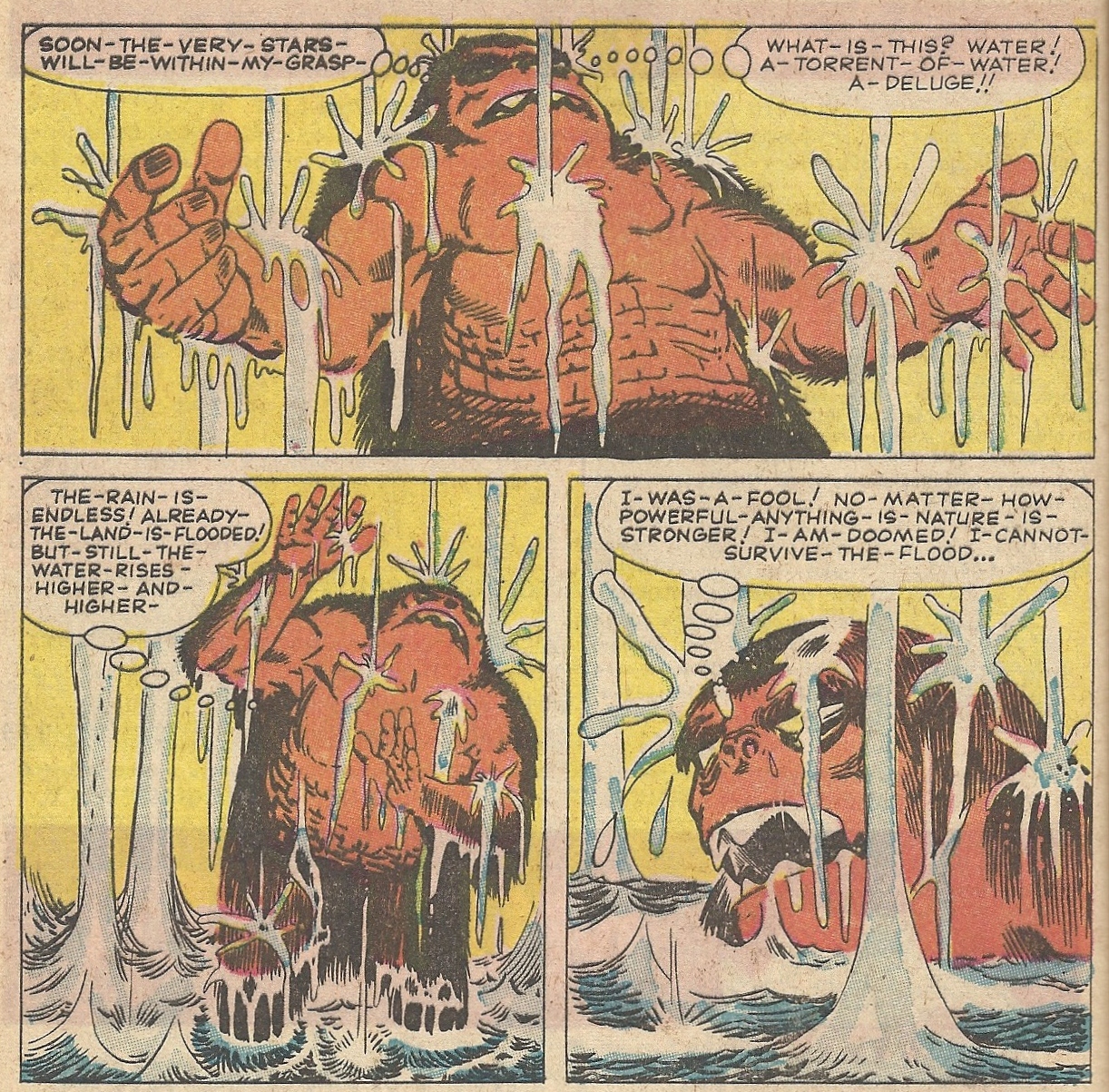
The great beast is done in by the deluge. But the real twist comes when we learn the cause of Monsteroso’s undoing:

Cue the Twilight Zone music.
It’s a neat little story told succinctly in just a few pages, and as an added bonus it has an example of the falling water bit from Ditko that I’ve noted before on this very blog.
Its brevity reminds me of the extraordinarily short vignettes that Rod Serling had on his lesser Zone knockoff, The Night Gallery. They’d sometimes be as brief as a minute, but they’d often outshine the dullsville main event. Monsteroso would have fit right in.
Jane Fonda called, she wants her headband back – Supergirl #23
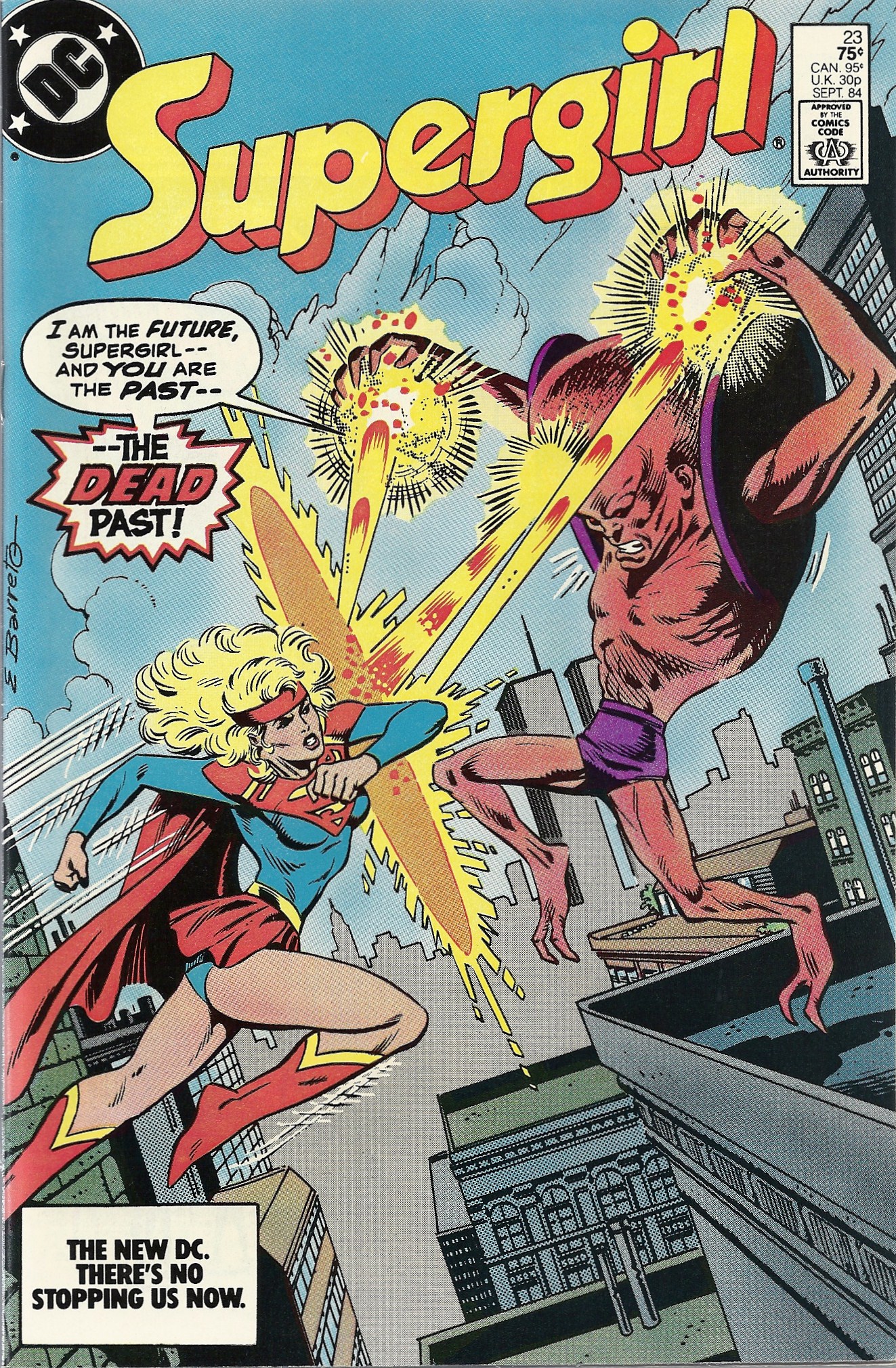
I like Ed Barreto’s art, and his covers are really nice, but this one doesn’t cut the mustard. Why? Because it doesn’t do the story’s villain justice. We’ll leave that to this issue’s penciller. And who’s that?
My man Carmine Infantino, that’s who!:
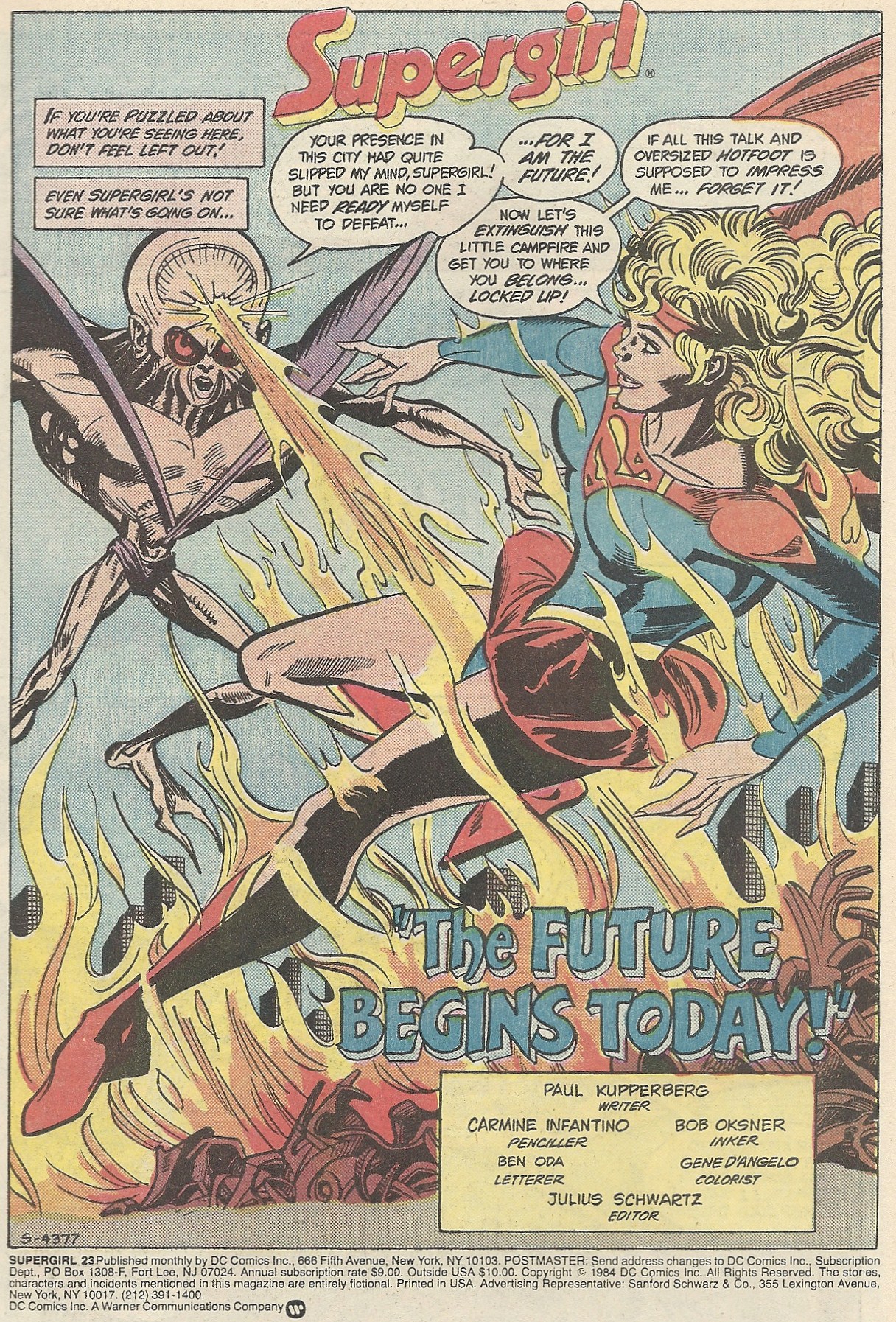
I think this was the only Supergirl book that I had in my youth, and I remember this bad guy making quite an impression. He kind of scared me. Now that I’m older and (generally) beyond getting freaked out by things, I just want his lats. Time to increase the pullups.
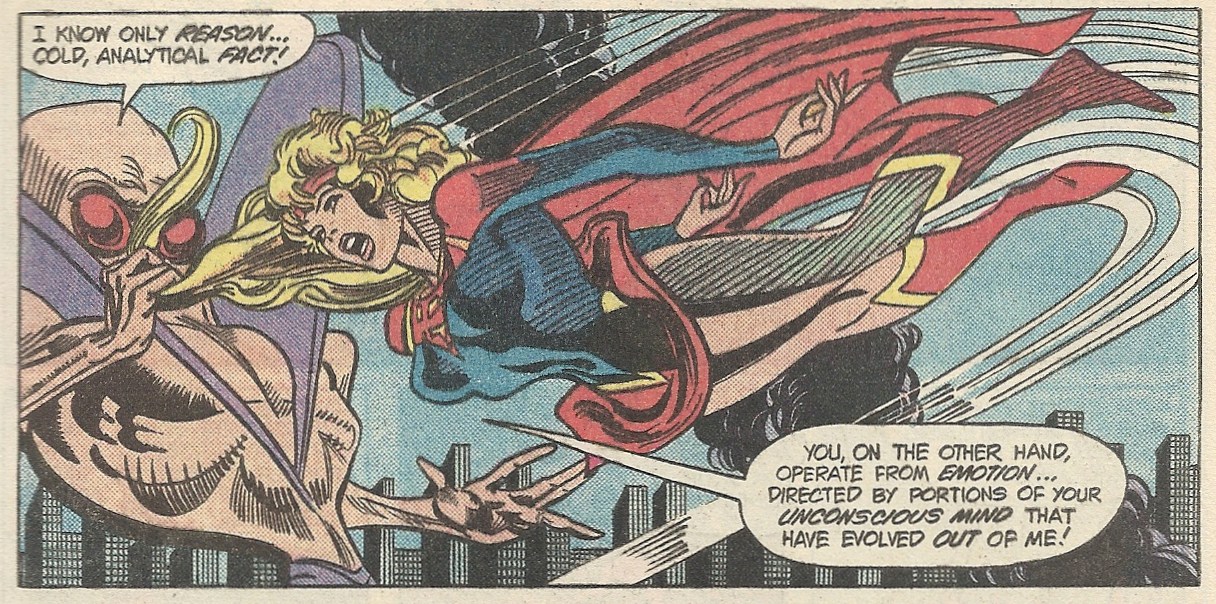
Paul Kupperberg and Bob Oskner joined Infantino in crafting “The Future Begins Today.” The monster you see is actually a super-evolved future-man who represents what humanity will be like a million years hence, with heightened mental acuity and physical prowess to go along with the bizarre looks. As in most comics, “more evolved” roughly translates to “wants to conquer all and wreak untold destruction.” Supergirl stands in his way, and he wastes no time before he shows that he’s not so evolved that he’d turn his nose up at grabbing a woman’s hair like a caveman:
Before we get into just who this guy is, I should point something out — Supergirl’s first battle with this fella takes place in one of Infantino’s patented open, tiled plazas with a cityscape in the background. You can see other instances here and here. It wouldn’t be an Infantino comic without it:
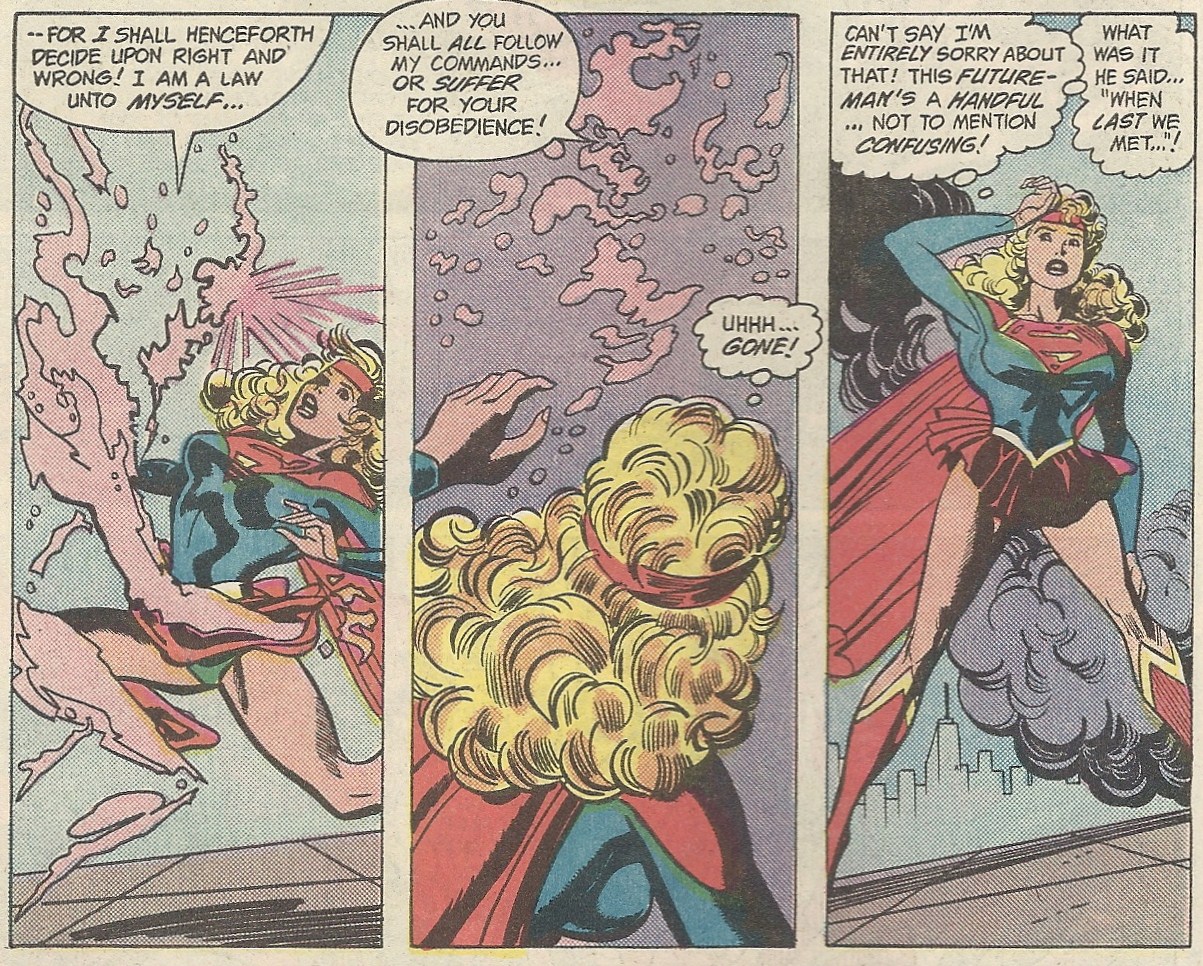
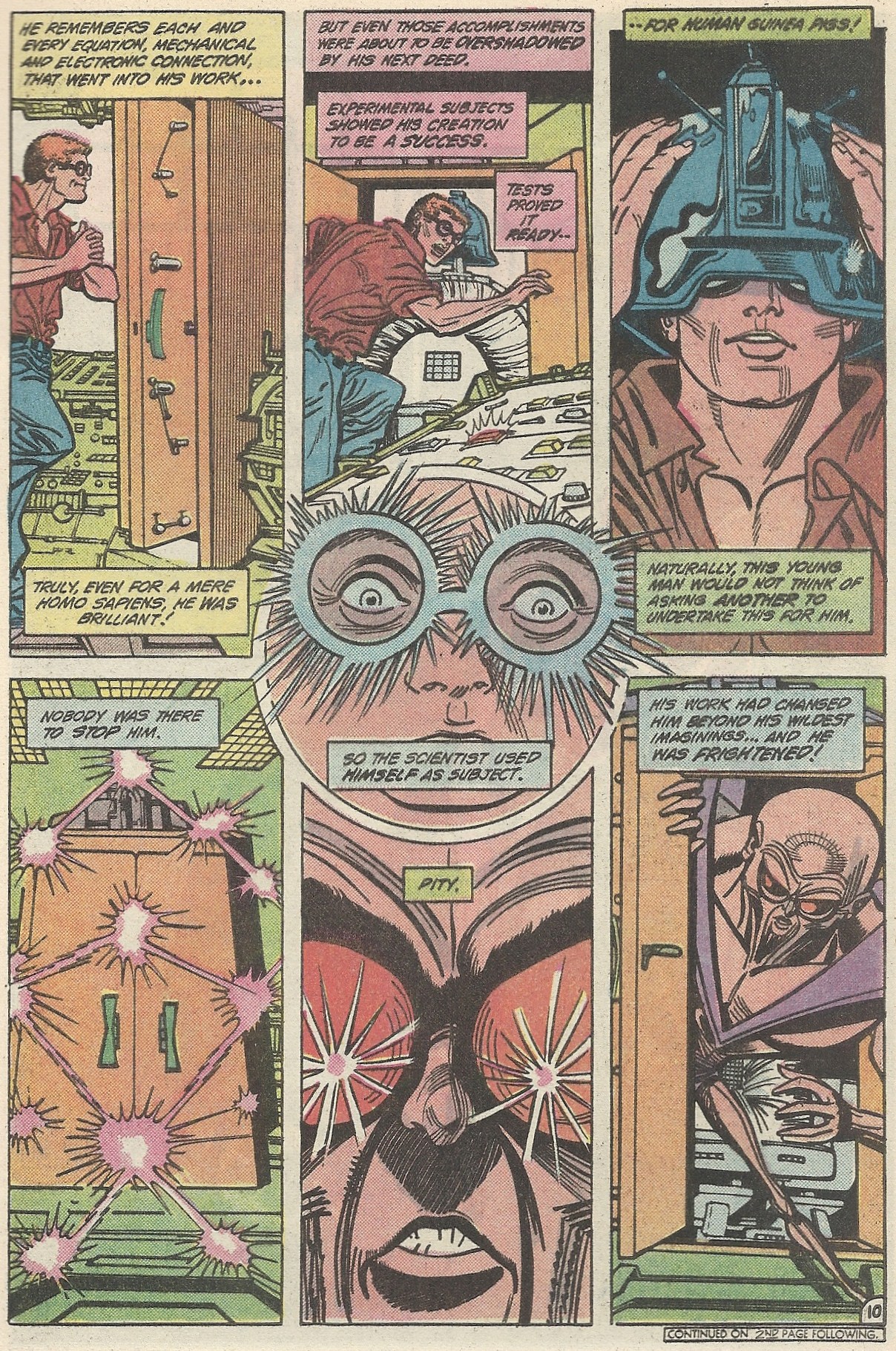
So who is this dude? He’s a scientist (named Barry Metzner) who developed a machine that could hyper-evolve living things, and he decided to use himself for the first human trial (sort of like Sam Beckett in Quantum Leap):
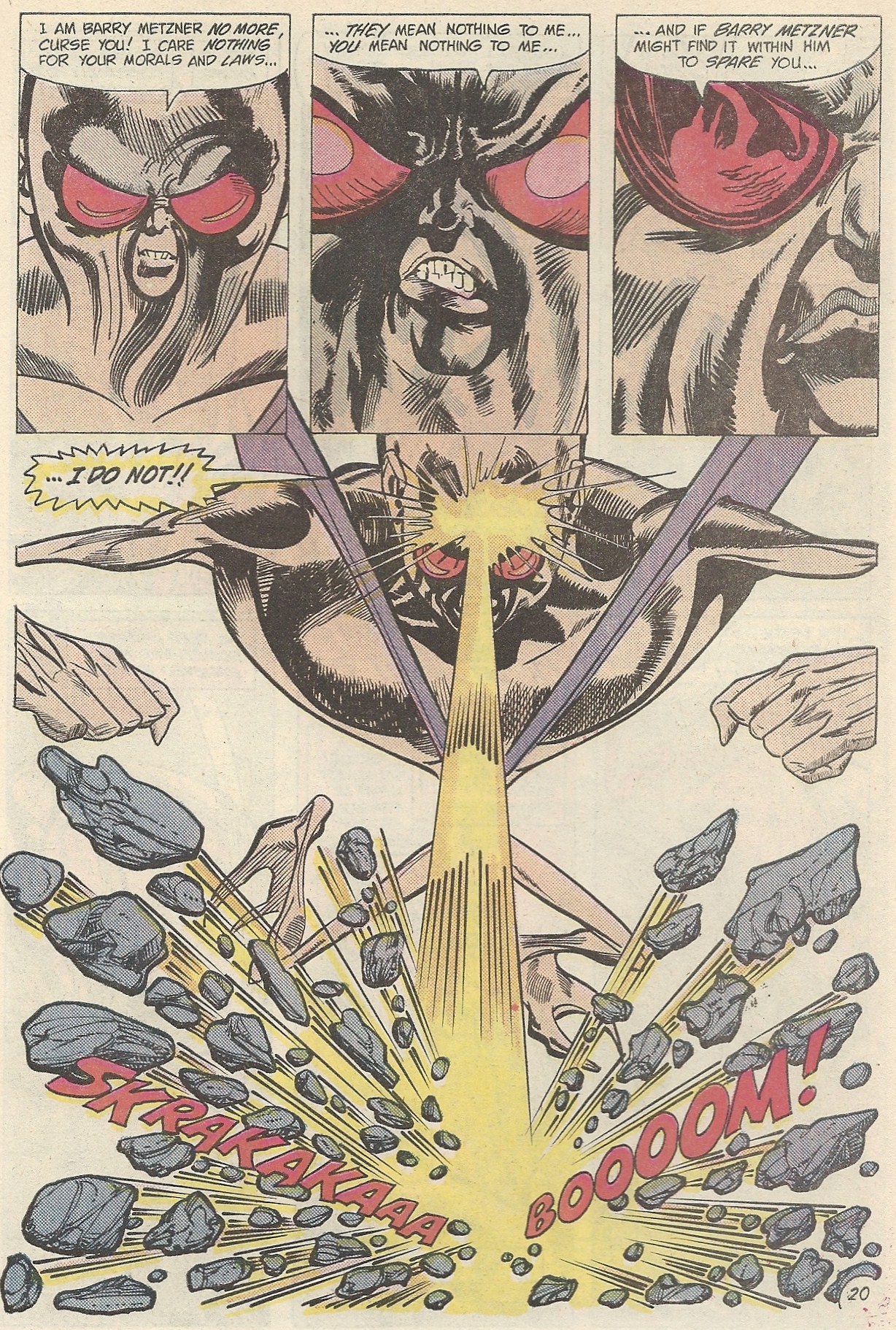
Having suspended their earlier fight so that he could go and brood all futuristically and stuff, he and Supergirl later resume their combat. Supergirl recognizes his heartbeat as belonging to the scientist, a man with whom she was acquainted. She pleads with the regular guy inside to have a heart and repent. This does not go over well:
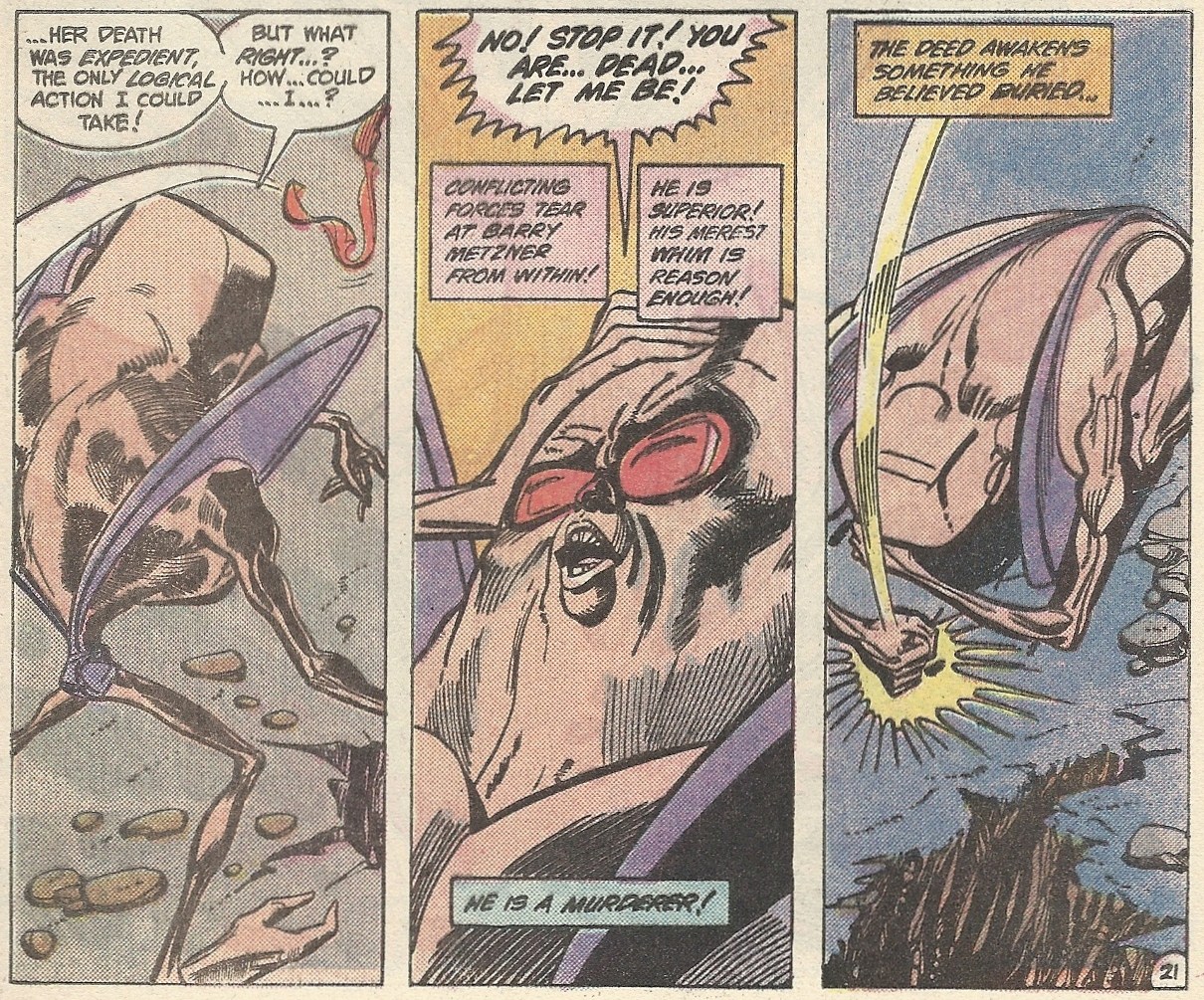
Wouldn’t you know it, soon big-headed-huge-lats-future-man is overcome with grief for having “killed da wabbit”:
Don’t worry, boys and girls — it’s all okay. Something’s triggered inside of Mr. Metzner and he reverts back to his primitive present-day self:
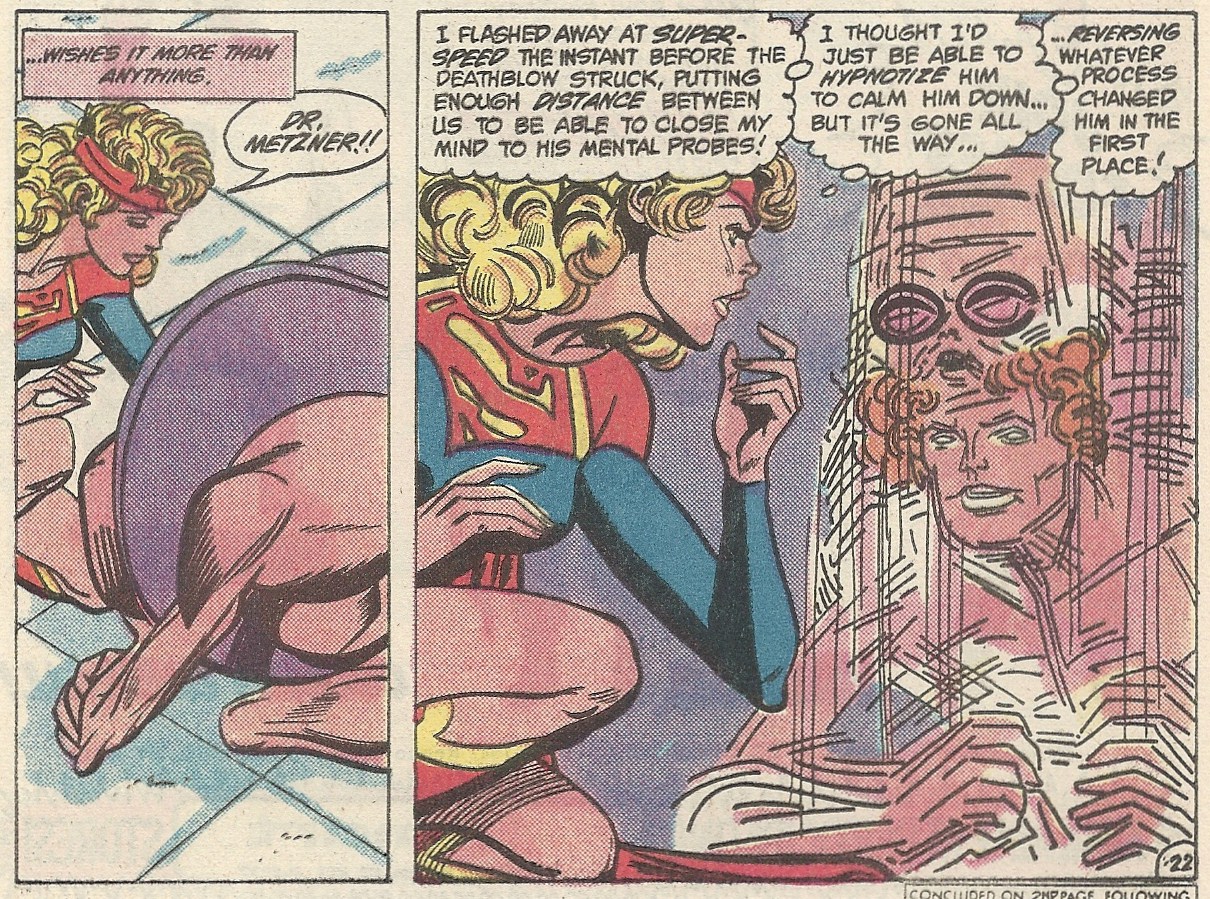
Unfortunately — or perhaps fortunately — the goofy slingshot underwear outfit doesn’t disappear:
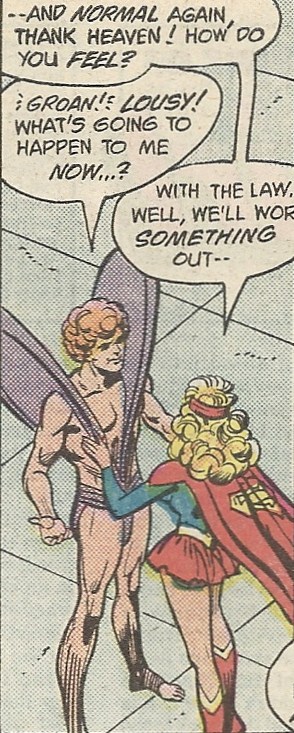
That’s pretty much how it ends.
This was a fun issue with a neat one-off villain, a character that stuck in my head for over twenty years until I stumbled across this issue again this summer. While this iteration of the Supergirl costume may not be everyone’s cup of tea, I kind of like it — the extended S-symbol melds nicely with the cape, and Infantino manages to make the short skirt even shorter and the leggy blonde even leggier. Infantino in general works his usual magic — his future-man design definitely stands out. He even improved on this character’s appearance during his brief cameo in the previous issue. The earlier, smaller-eyed version looked more like the last alien in Close Encounters of the Third Kind, i.e. more cute and a lot less menacing.
Surely all this high quality graphic storytelling must have ushered in a renaissance in the Supergirl mythos, and sent her title on a rocketing ascent to higher sales, right?:
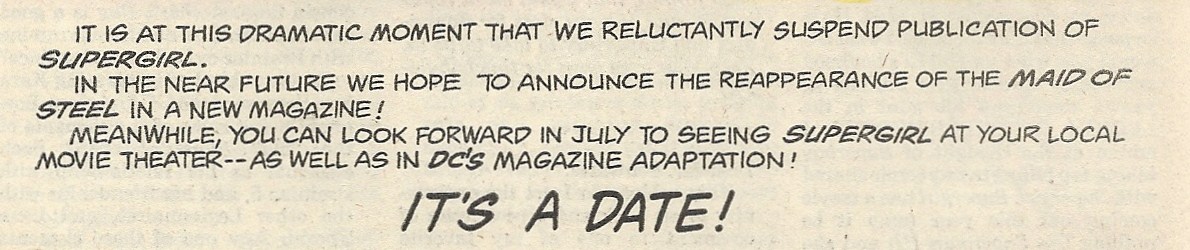
Well, at least she went on to have a long, fruitful life in the broader DC Universe. Ummmm… :
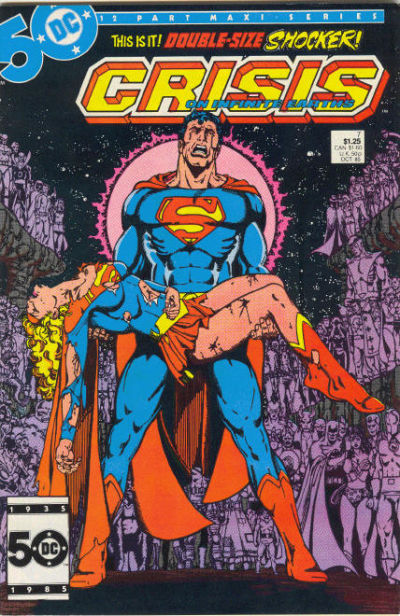
As basketball announcer Bill Raftery would be wont to proclaim — “Dagger!”
It was versatile, you have to give it that – Silly Putty
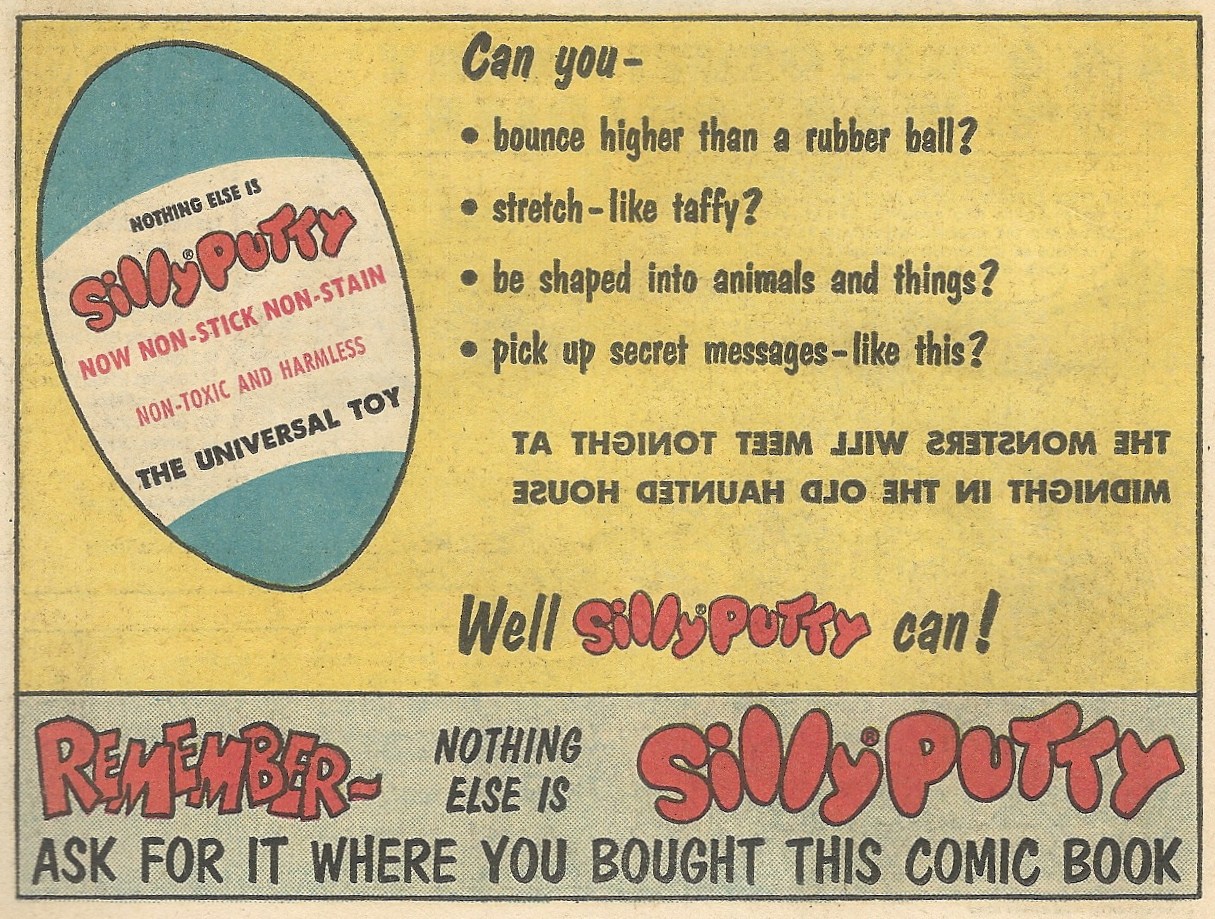
Now that comics have gone away from newsprint and migrated to a higher grade of paper, one of the old uses for Silly Putty has gone by the wayside. I myself, back in olden times, would occassionally pull an image from a book and stretch it and manipulate it — this junk was the Photoshop of prehistoric times. It was durable as all hell — I’m sure mine is still sealed into its little egg-shaped container and tucked into a drawer somewhere in my parents’ house. I’m equally sure that it’ll still be around long after I’m worm food.
What am I trying to say here? Not much. Maybe this — comics don’t seem like comics if Silly Putty can’t pull the ink off of them.
Kitty’s got claws! – The Cat #2
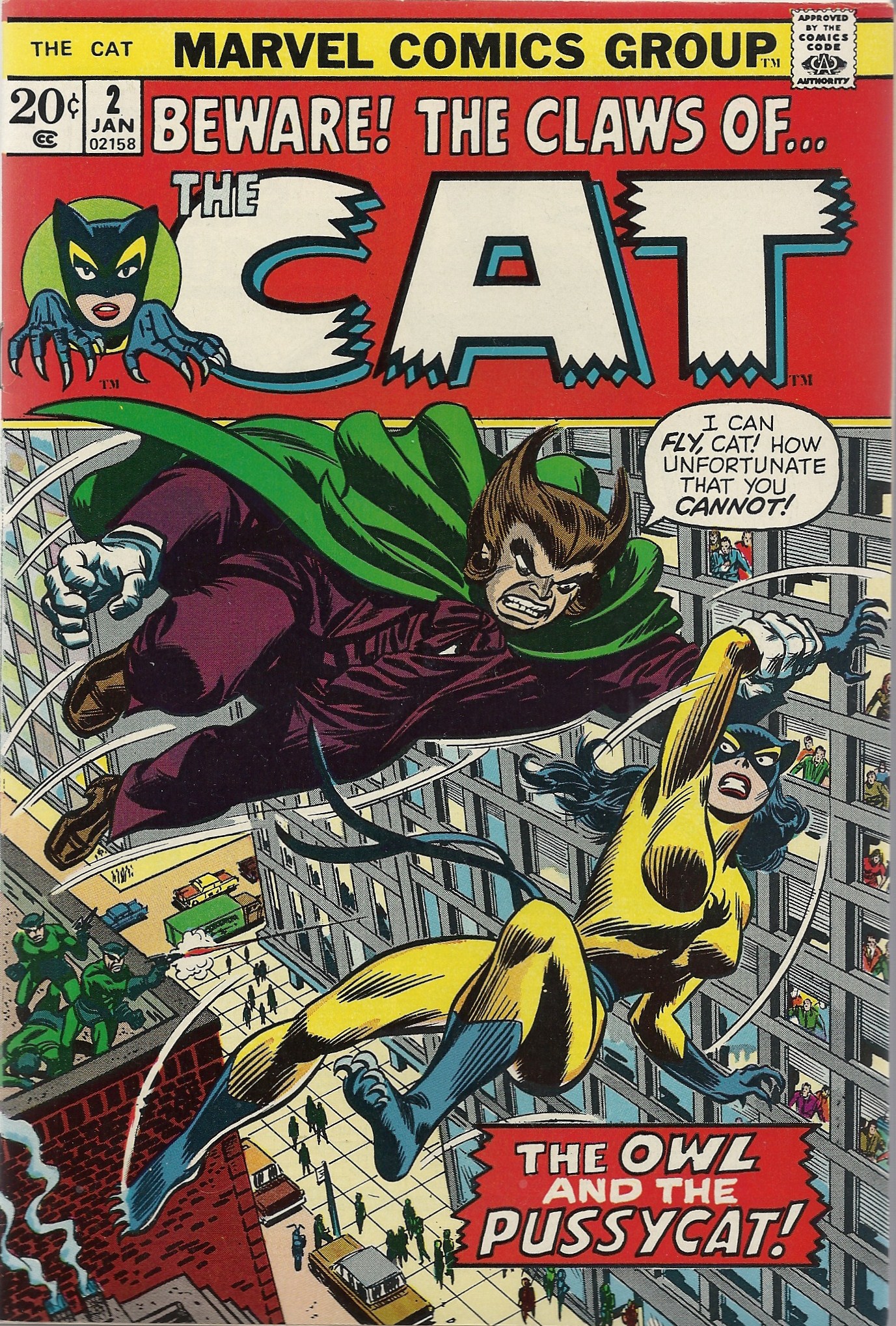
The Cat eventually became the mutated, super-powered Tigra, but here she is in her original incarnation. This series lasted a whopping four issues, and I can understand why. It’s not the most arresting material, but I can understand the motivations (marketing and, well, just plain fairness) behind developing more female superheroines. And I should point out that her blue and yellow costume, complete with retractable claws, is a forerunner to the costume that Wolverine sported in his debut a couple of years later. Coincidence?
This story has the distinction of having two of the three creative positions filled by ladies, Linda Fite on the script and Marie Severin on the pencils (with the rooster in the henhouse being Jim Mooney and his inks). I don’t want to make too much of a deal about that, but it’s cool to see a little more estrogen behind the scenes in a superhero book. It’s sort of refreshing. Sadly, “The Owl and the Pussycat” isn’t all that great, but there are some brief highlights.
Here’s Greer Grant Nelson in her Cat costume kicking some ass:
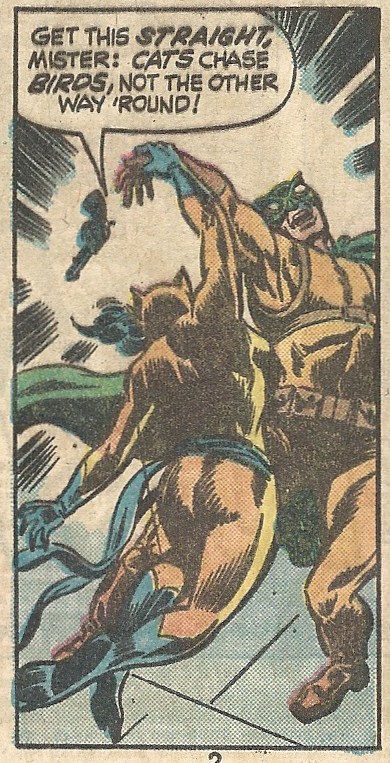
I’m tempted to make a “nice buns” comment, but I’ll refrain. Let’s just say that seeing a hot girl in tights beating on some thugs never gets old. Ever.
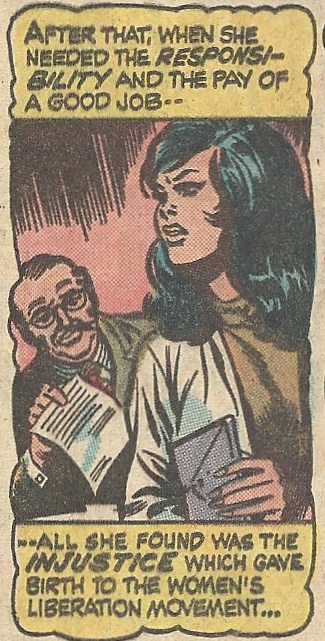
At several points in the story we see the intersection of feminism and comics. Here’s a flashback to Greer’s pre-Cat days, after her husband was killed and she was on her own in the world of men:
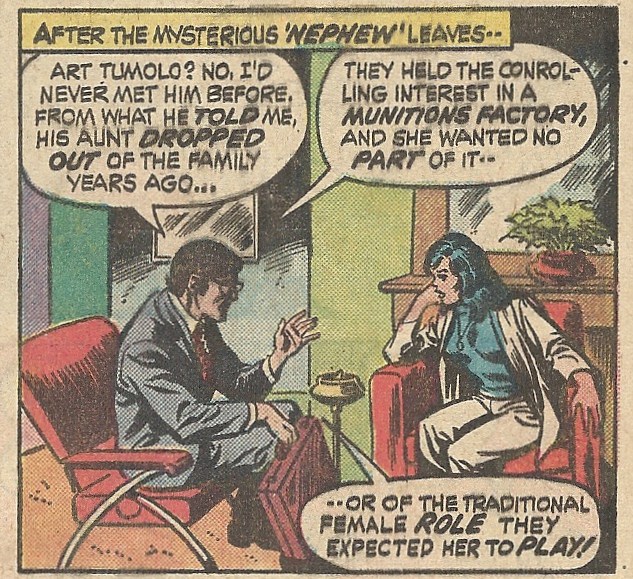
And here she is talking to an attorney about her ailing mentor, Dr. Tumolo:
The villain for this issue, if you couldn’t tell from John Romita’s cover, is the Owl. It’s hard not to like a villain that keeps a real live owl perched on his shoulder:
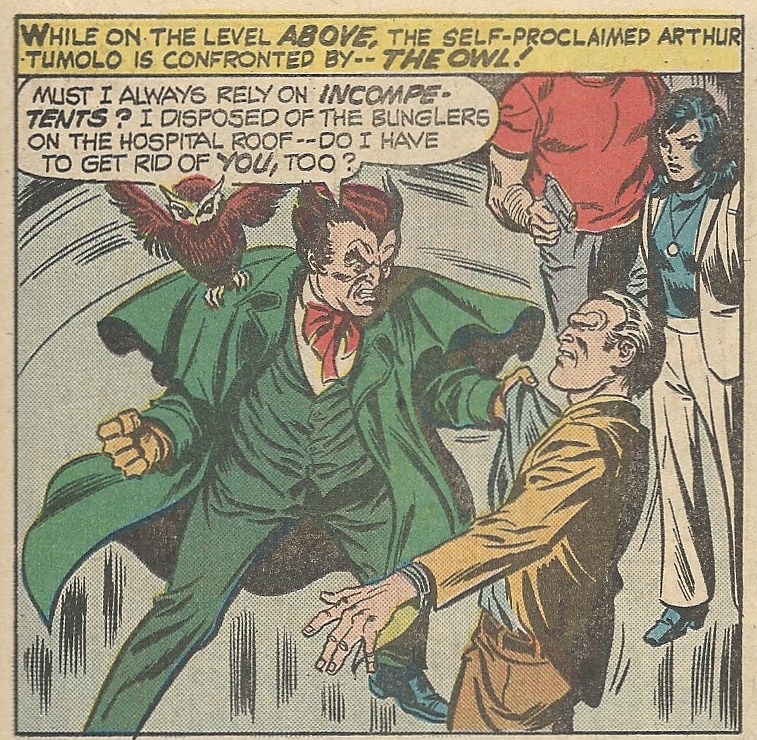
It takes the pirate with a parrot on his shoulder and the James Bond villain with a cat on his lap to a whole new level of awesomeness, doesn’t it?
The owl and the cat do, of course, tussle:
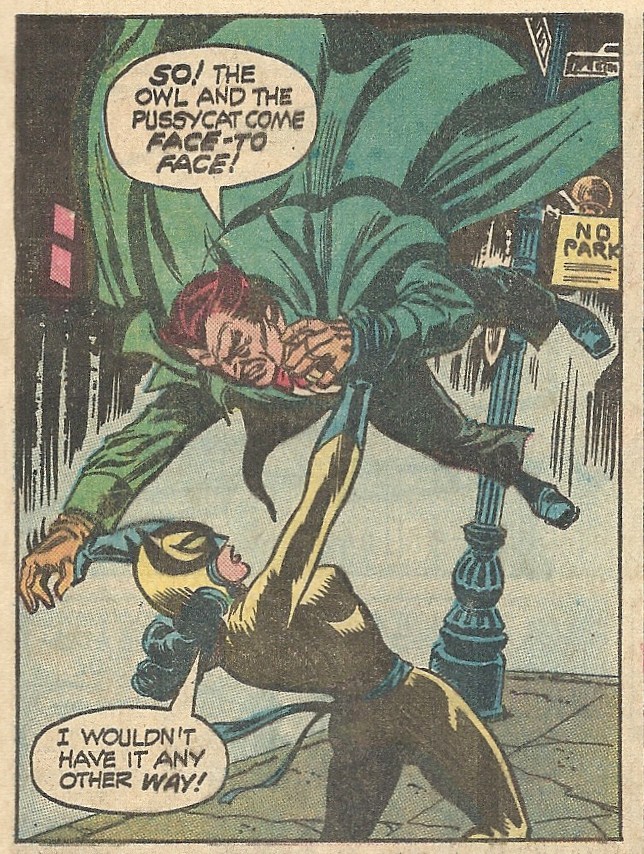
We have a title, ladies and gentlemen!
The story sort of peters out after their confrontation. The title lasted only two more issues, and the Cat character received a drastic revamp in later years. Not an auspicious start for this young lady, but it’s always nice to see a woman trying to break out amid the sausage-fest that is comicdom. It brings a bit of clean air into the locker room.
Meow.

This one always brings back a flood of memories. The Super Powers toys weren’t the best in the world — their “points of articulation” were a bit lacking — but they were action figures for my favorite comic book characters, and they wiped the mat with the Marvel Secret Wars line. I can recall racing the Batmobile along the floor of my kitchen and the time I took Lex Luthor outside and he got gravel in his joints from the driveway and I could hear it rattling around in there from that point on — couldn’t happen to a nicer guy.
There was of course the cartoon tie-in, and while that was fun, one of the more obscure items associated with this line is a short vinyl record that contains a brief adventure for the heroes. I had thought that it was lost in the folds of history and the dense fog that is my memory, but thanks to the magic box known as “The Internet” I’ve been able to track down some pictures of it:
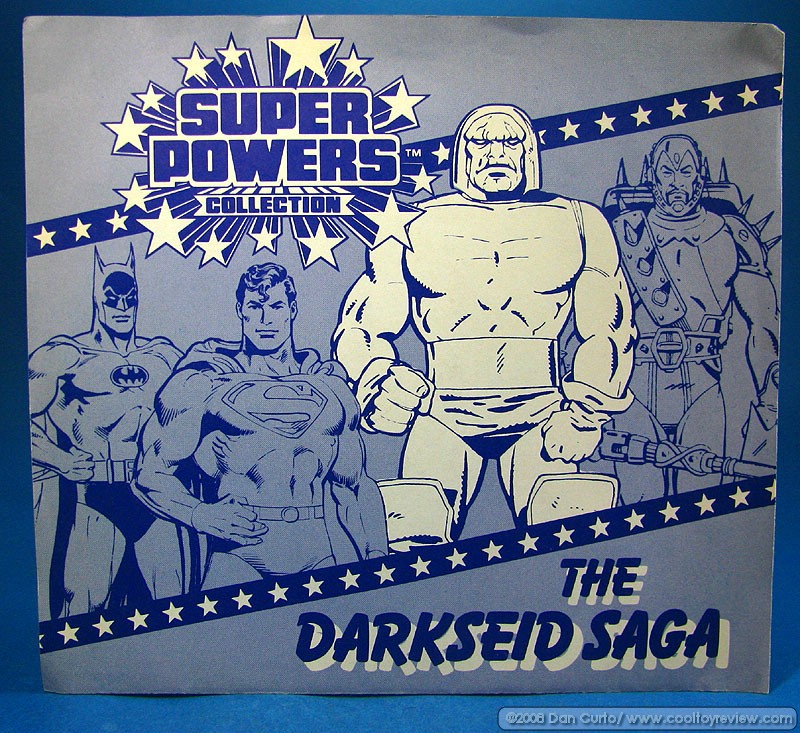

I even found the actual audio. You can listen to a recording of “The Darkseid Saga” here.
While Darkseid sounds cool, and Desaad is as cloying and annoying as I’d imagine him to be, when Superman shows up the whole thing starts to fall apart. He sounds more like a newsreel narrator from the 40’s than a Man of Steel. And the “You Decide!” ending felt like a jip to me when I was a kid, and still feels like one to this day. I realize that it synced with the TV ad campaign, but still — you want some resolution for your six-minute drama.
Here are a couple of the “You Decide!” ads:
I like the first one and how it illustrates the awesome power of these figures by having them chop through stacks of small pine cones and popsicle sticks. Laugh. Out. Loud.
Thanks to supermanhomepage.com and cooltoyreview.com for their postings of the audio and pictures of the record. Quite a trip down Memory Lane.
Perhaps Mr. Fantastic and Plastic Man have a support group that he can join – House of Secrets #68
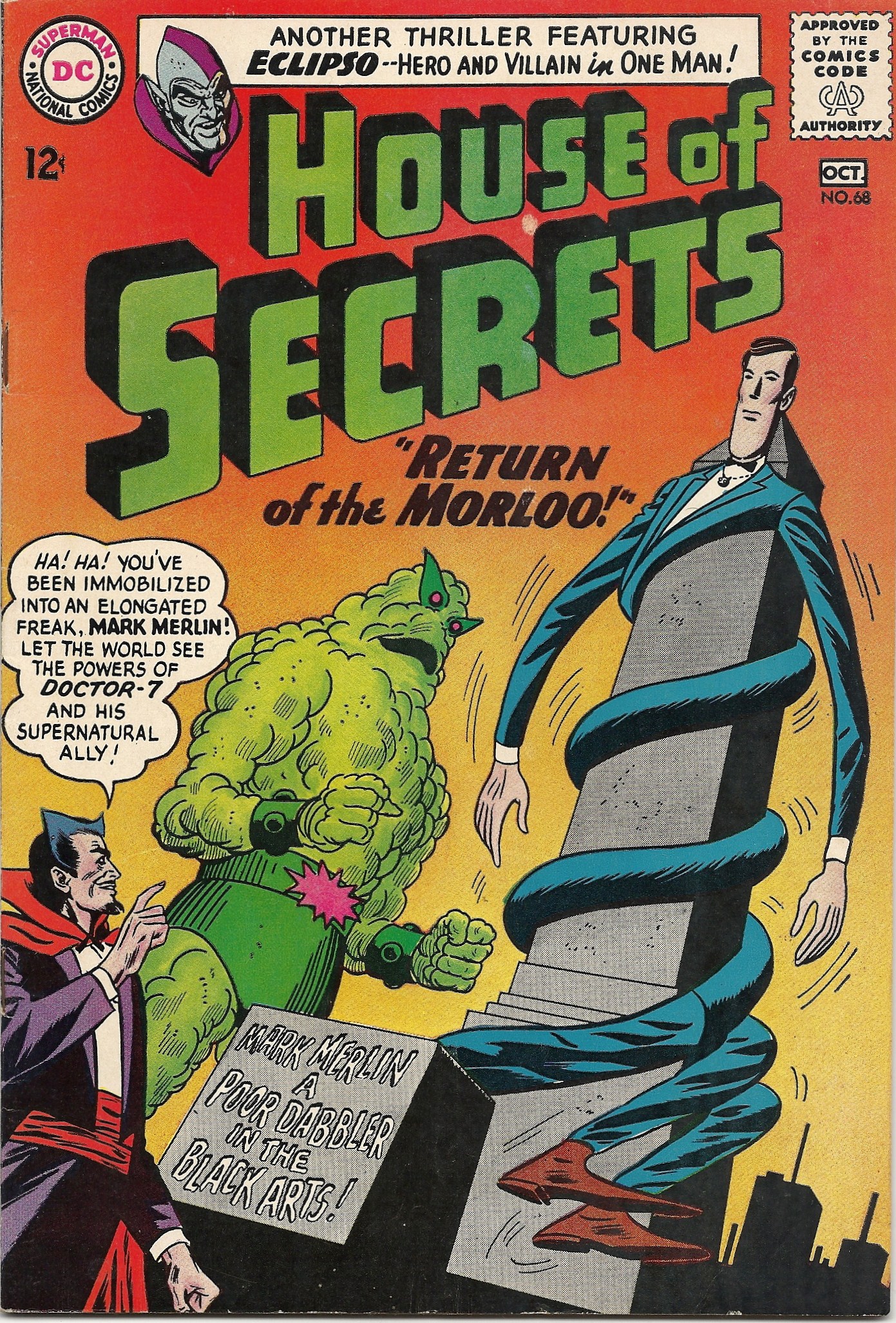
Two stories in this one, and the Eclipso entry comes first. I know Eclipso primarily through his early 90’s summer crossover in the DC annuals, Eclipso: The Darkness Within. If I recall correctly, the anchor two-parter of that event was drawn by Bart Sears, who had a feature running in Wizard around that time called “Drawing Powerful Comics” or something. While I appreciated his efforts to give young saps like me a primer on anatomy and illustration, I always thought that it should have been called “Drawing Hideous Comics.” Not a fan. But I digress.
In “Eclipso’s Deadly Doubles!!” by Bob Haney and Jack Sparling, the cursed and beleaguered scientist Bruce Gordon finally thinks that he’s uncovered away to rid himself of his Eclipso transformations for good:
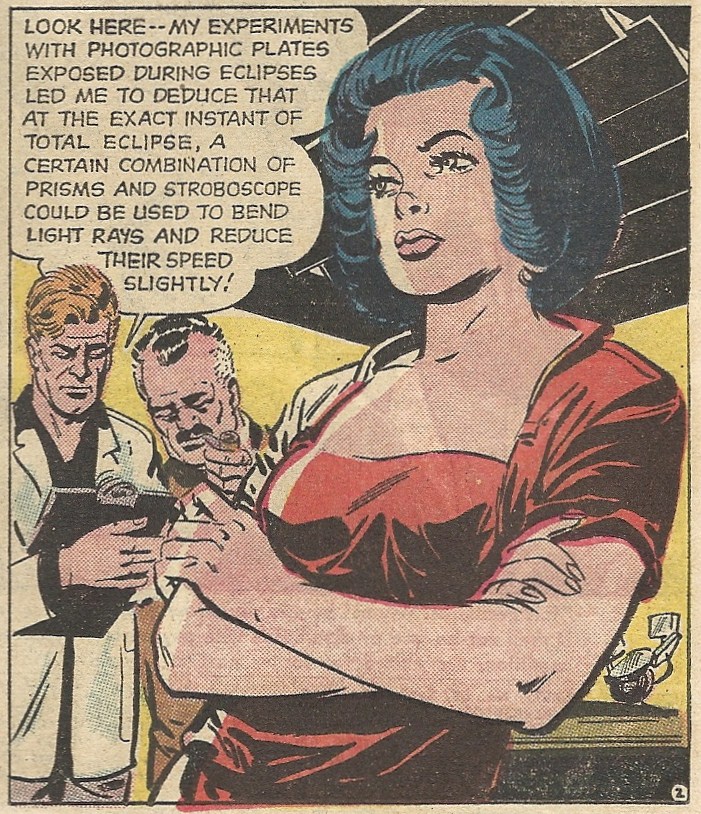
I’ll take your word for it, doc.
He makes good progress on his experiments, and, to celebrate this chance to shuck his villainous alter ego for good, takes his girl to, where else, a science fair:
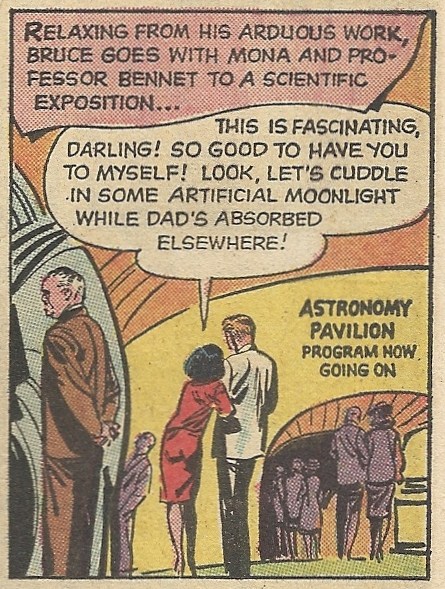
While there he’s exposed to an artificial eclipse, which almost changes him into Eclipso (If that’s true, it kind of begs the question — would Superman draw power from a yellow sun seen on TV? I understand the reasoning behind making his transformations more readily triggered, but “artificial” eclipses seem a bit lame). Though he escapes that thanks to a well-timed camera flash from his partner, Professor Bennet, he decides to get on with his experiment immediately. Eclipso is banished to another dimension, and it seems to be a success. That is, until:
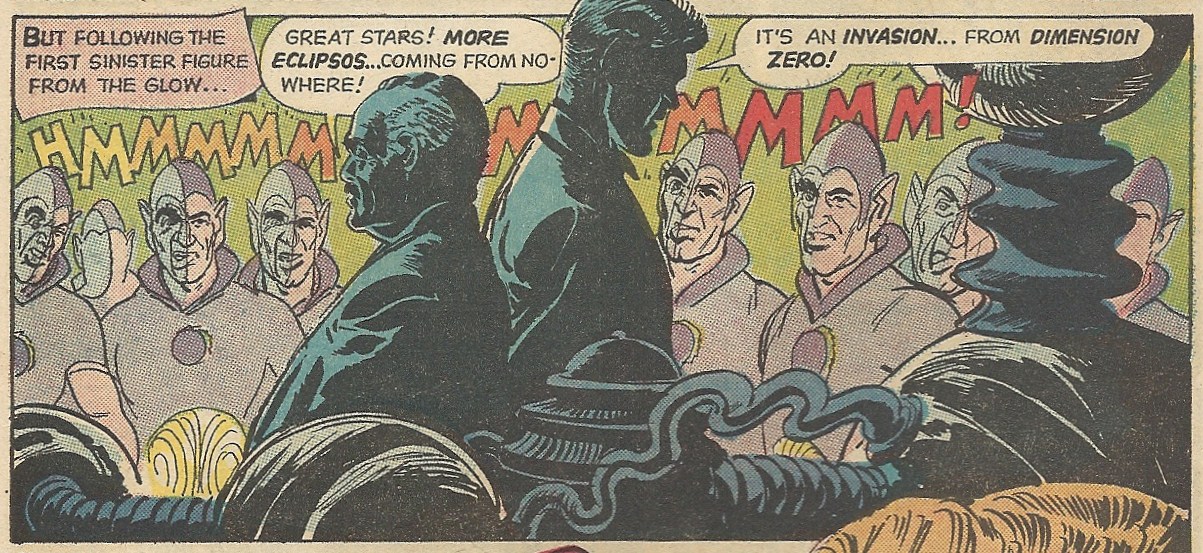
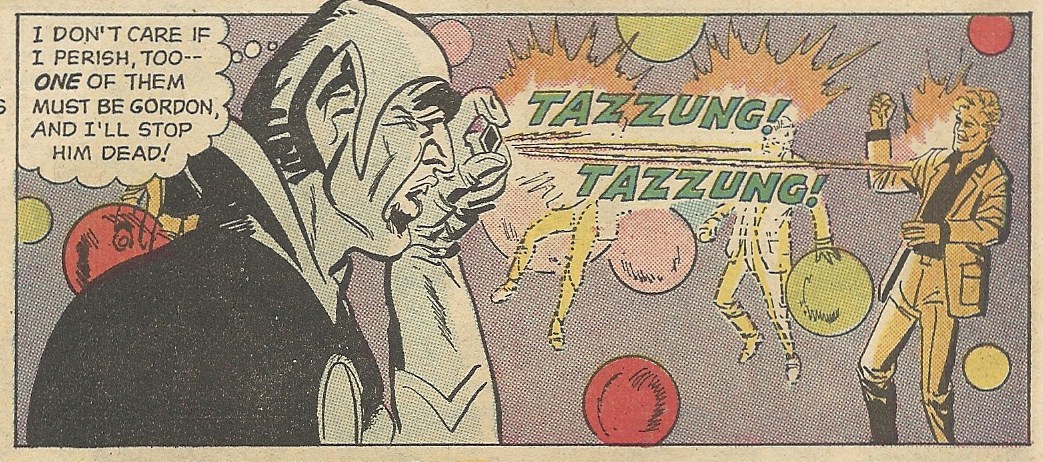
Things fall apart from there, story-wise, and Gordon travels to the alternate dimension, where he defeats the original Eclipso but in the process reattaches him to himself. There’s one thing of note — the way Eclipso wields his sinister black diamond reminds me of the “crushing your head” guy from The Kids in the Hall:
Arnold Drake and Mort Meskin bring us the Mark Merlin tale, “The Return of the Morloo.” The Morloo is a mindless creature from, you guessed it, another dimension, one that screams “Oooyahh!” a lot. This one has been enslaved by the evil Doctor-7 — it kind of looks like a friendly Jim Henson creation:

Mark Merlin’s a combination of Doctor Strange and a WASP-y accountant, whose assemblage of occult artifacts comes in handy when fighting crime (he later became Prince Ra-Man). Here he is dousing the fire with his briefcase full of mystical junk:
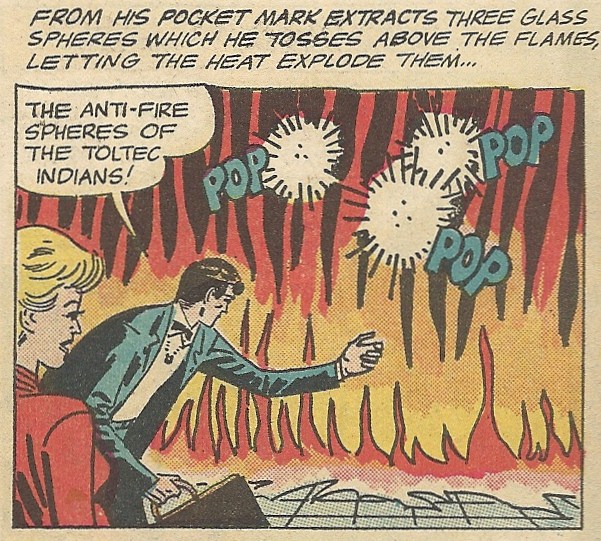
Doctor-7 is looking for radium to make a potion that will upgrade his Morloo into the monster on the cover. He succeeds. Well done, Merlin.
Doctor-7 then begins his reign of, if not terror, at least goofiness. One of his tricks includes making people think they’re beautiful, then turning the tables on them:

I think I’ve been on blind dates with a couple of those broads.
Merlin foils these minor schemes, Doctor-7 wearies of his interference, and our hero is fortunate to transfer his mind into his cat before his body’s placed in the cover predicament:

Once his girlfriend/partner has freed him from this curse, Merlin goes to summon his own “good” Greedo-looking Morloo. Merlin and Doctor-7 battle it out through their proxies like Rock ‘Em Sock ‘Em Robots, and when Merlin’s Morloo starts to return to his own dimension, it grabs Doctor-7’s and takes it along for the ride:

Evil is thwarted again.
I wasn’t really crazy about either of these stories. The Eclipso entry was a bit trite and pointless, but the Merlin escapades were perhaps a little bit better. The pre-transformation Morloo looks like it would make a pretty good kids’ plush toy. Maybe it came from the Fraggle Rock dimension or something.
 Jared
Jared


 blog into mystery