This’ll tide us over. Right? RIGHT?
If the next football season is wiped away by a lockout, surely the wonders of Kenner’s See-Action Football will carry us through:
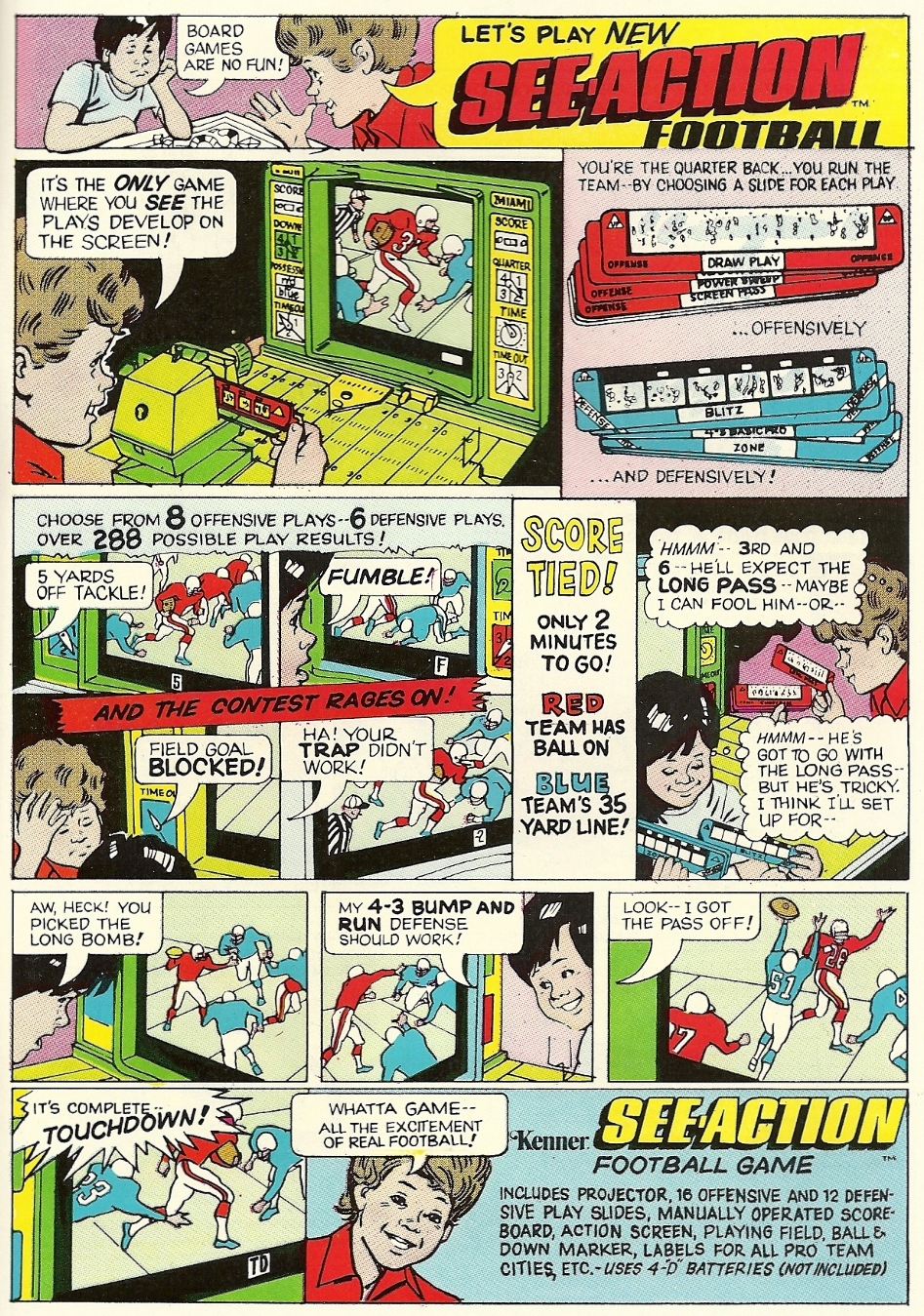
Okay, maybe not. Dear owners and NFLPA, please settle this thing. I’m fretting already. Cold sweat. Sleepless nights. You get the picture.
Always bet on Lightning – Black Lightning #10
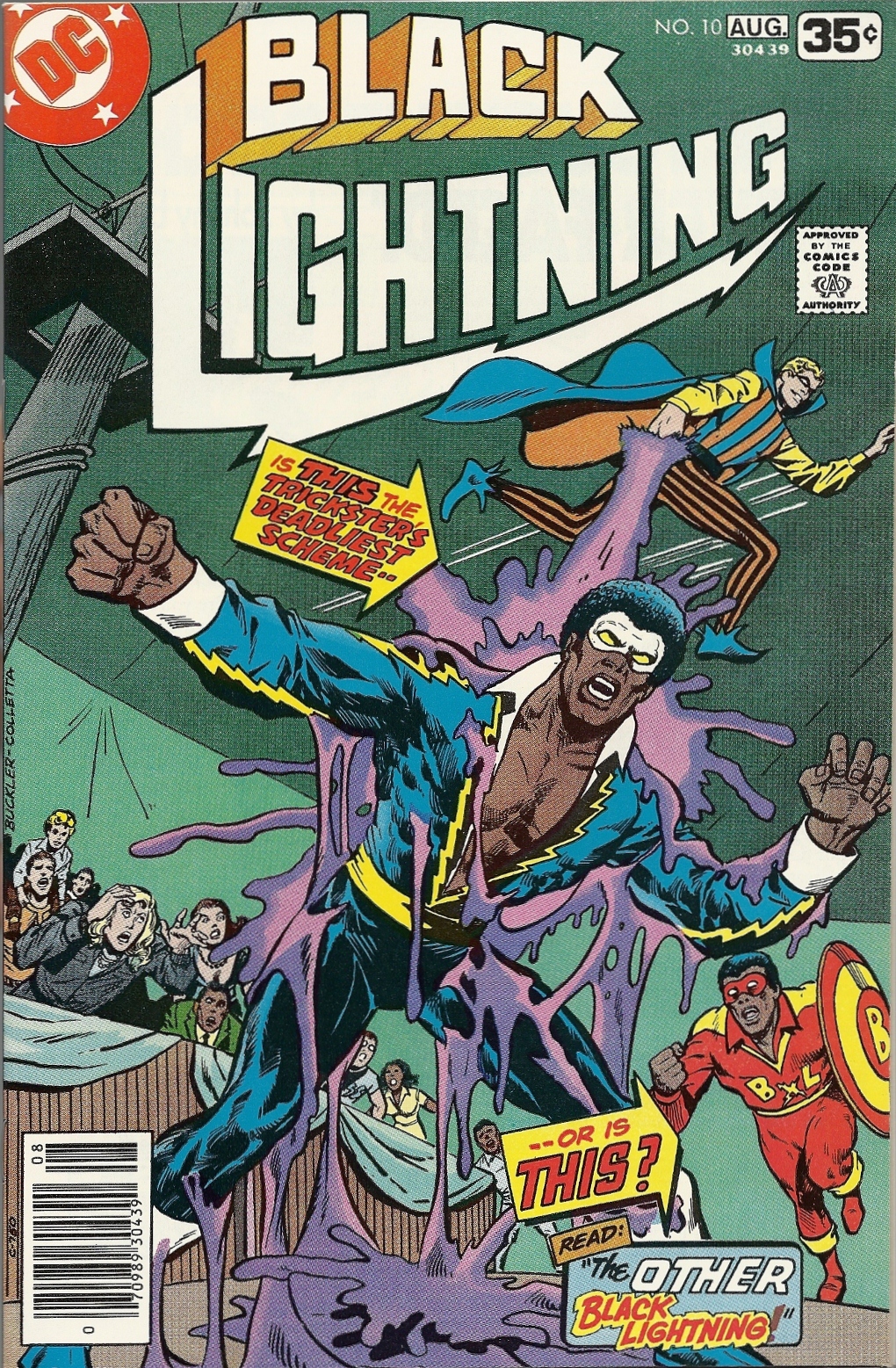
Since it’s Black History Month, I figure it’s about time I took a look one of the paltry number of black superheroes who’ve had their own books. Let’s be honest, folks — it’s a short list. Thankfully their creators made most of them easy to spot by PUTTING BLACK RIGHT IN THEIR NAMES.
Enter Black Lightning, the man known to many people by his Sinbad-portrayed appearance in an old SNL “Death of Superman” skit:
Vodpod videos no longer available.(If the embed is fouled up, here’s a link.)
This one caught my eye because of its promise of two, count em’ two, Black Lightnings, and one with a repainted Captain America knock-off shield to boot. Called “The Other Black Lightning,” this story, written by Tony Isabella with art from Trevor von Eeden and Vince Colletta, isn’t all that bad.
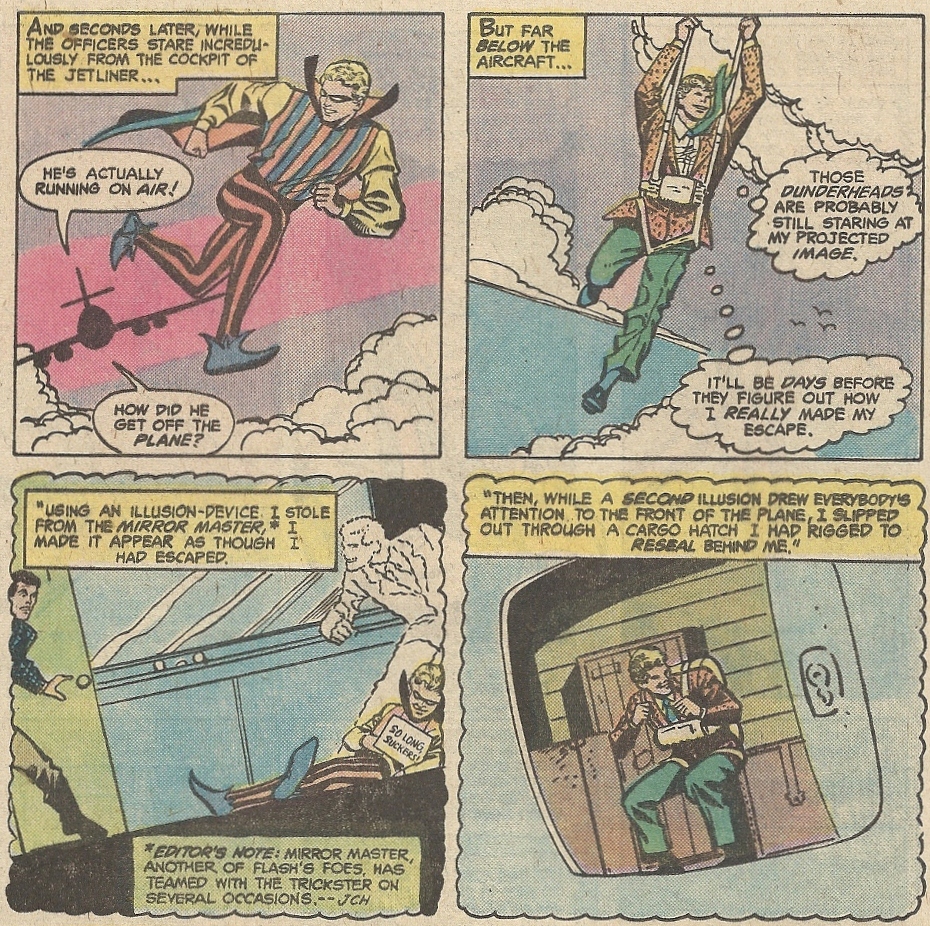
As the cover promises, the Trickster makes an appearance, and here he is using his patented chicanery to make a mid-air escape from custody:
Later on, mild-mannered teacher Jefferson Pierce reads a bit of shocking news in the paper — there’s another Black Lightning lurking out there in the world:

Here’s Jefferson gearing up that night to go confront this usurper of his moniker:
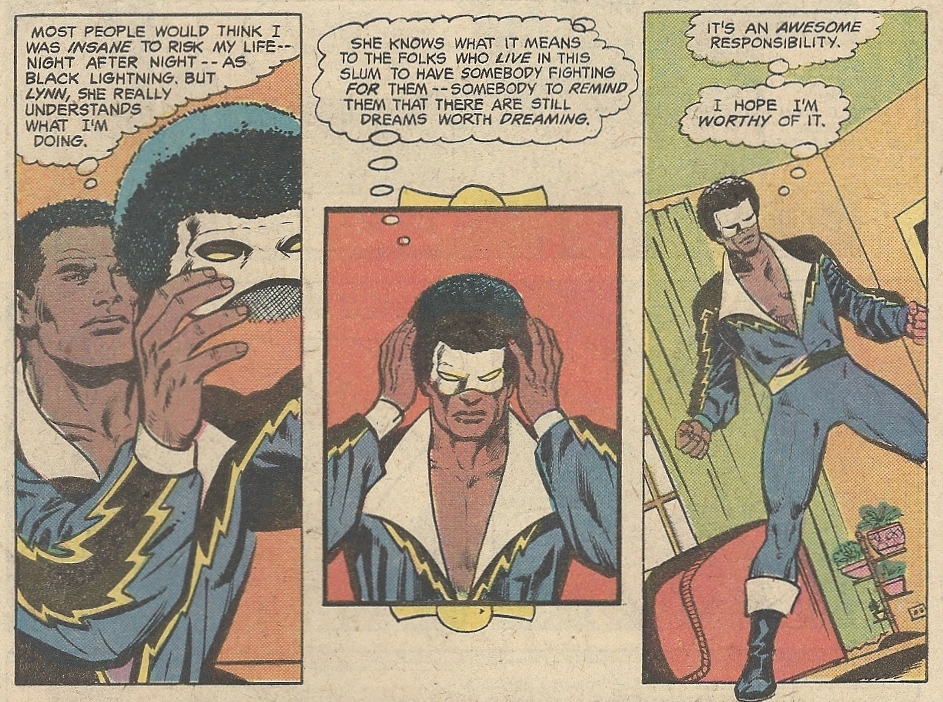
I never realized that his mask had a built-in afro. Was there a storyline reason for this? Did it have something to do with his electrical powers, like grounding or insulation? Was it to better hide his identity by concealing his closer-cropped hair? Or was it a simple artistic touch to better accentuate the “blackness” of this hero?
Anyway, we soon meet the fake “Black Lightning,” who’s in the employ of a P.I. named Barbara Hanna (nyuk nyuk), who’s in turn been contracted to guard a circus’ diamond. The guy isn’t the brightest bulb in the bunch, as evidenced by his use of “dis,” “dat,” “dose” and the like:
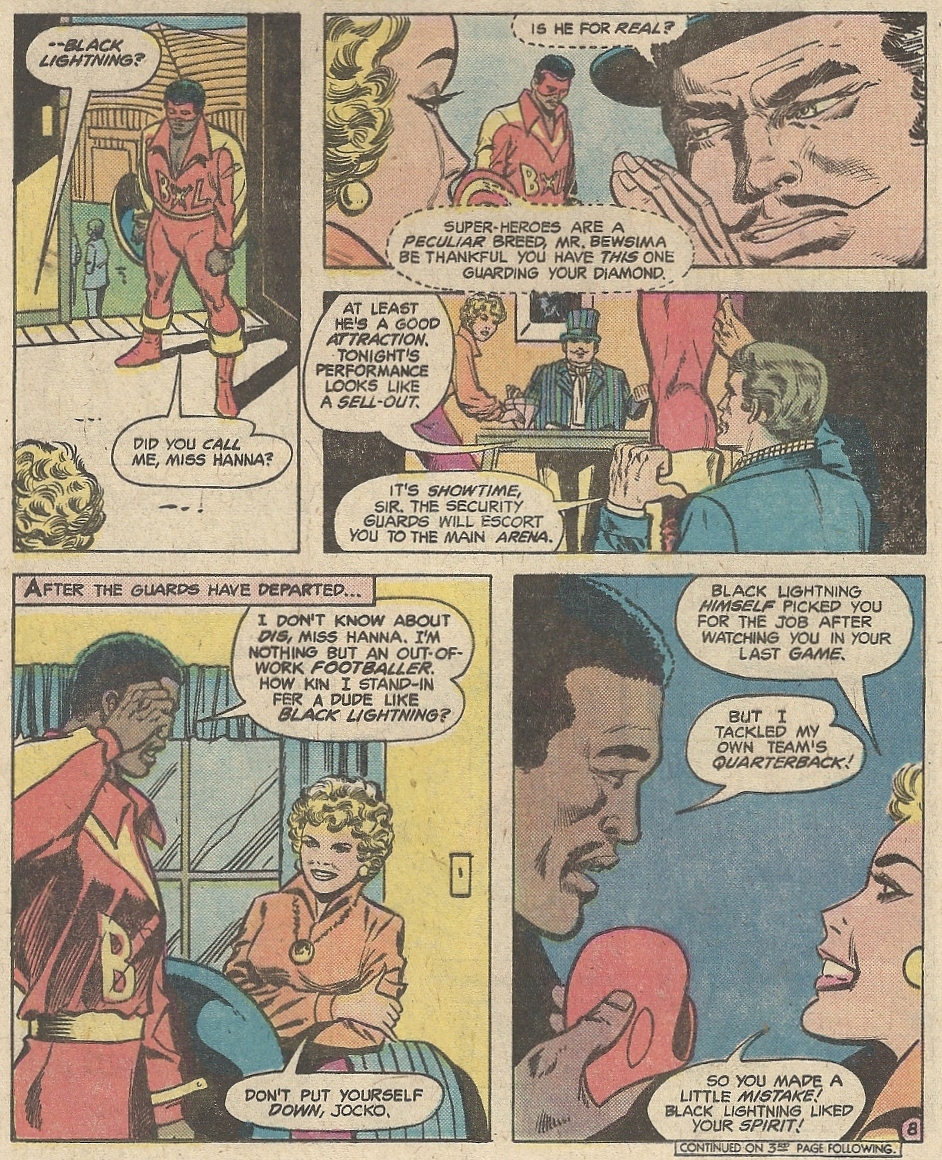
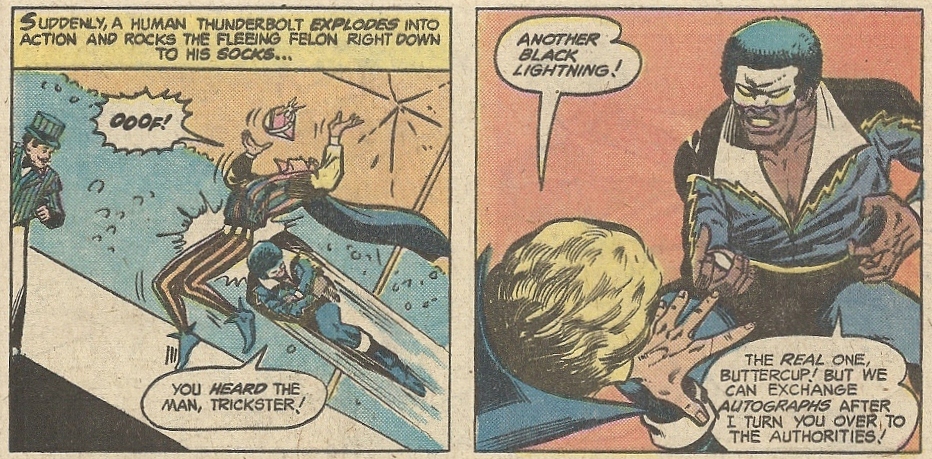
It turns out that “Miss Hanna” is actually out to steal the diamond for herself, and is going to use this lummox as a patsy in her scheme. The Trickster shows up and has designs on the diamond himself, but the real BL steps in to stop him:
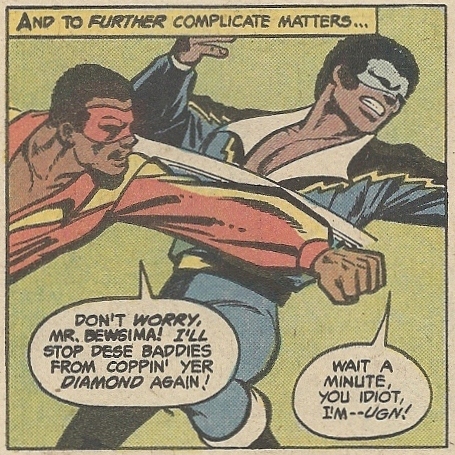
The goofy(er) looking Black Lightning gets in the way, proving that the “tackled my own team’s quarterback” bit was no fluke:
After this initial confusion, he later proves his mettle when the real McCoy is trapped by the Trickster in front of a charging elephant:
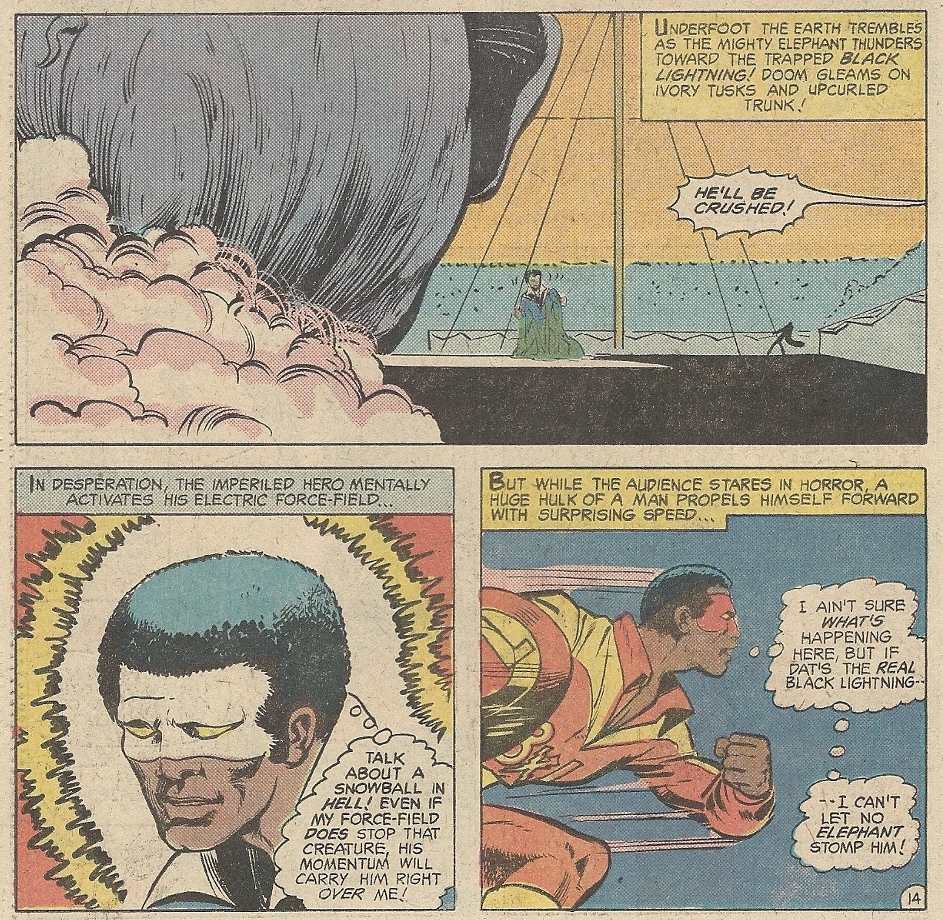
His gambit lacks subtlety, but gets the job done:
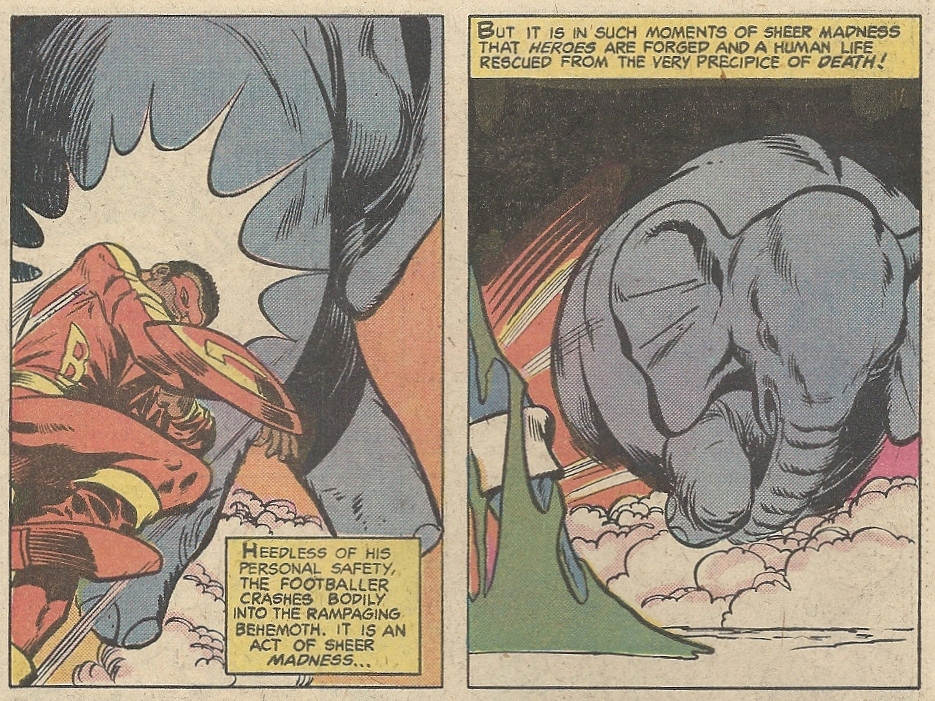
Black Lightning frees himself and captures both the Trickster and the greedy Miss Hanna, and then gives an inspirational pep talk to his imposter/foe/ally:
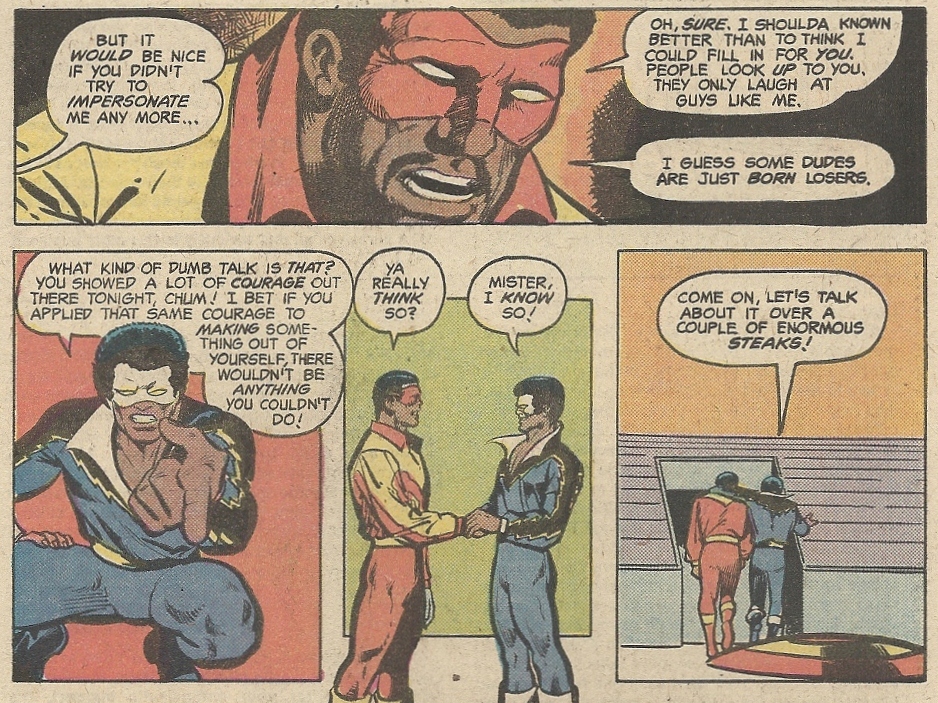
There you go.
I may mock Black Lightning for the first part of his name, but he was a dignified character and a trailblazing one at that. A black hero with his own comic was long overdue in a storytelling form that to this day remains all too white. Perhaps it’s the upright quality of the Black Lightning character that makes the “dumb black athlete” sterotype used in this issue so grating. One expects to hear lines like “Lowdy, I’se jus’ seen a g-g-ghost!” or “Feets, don’t fail me now!” or “I don’t know nothin’ ’bout birthin’ no babies!” to come out of his mouth. That’s not a good thing. Maybe it’s just a generational chasm, and I understand what Isabella was going for in scripting it this way. But my 2011 eyes roll when I read things like that.
Still, it has its moments, with creditable art — I especially liked the work focusing on the greedy, grinning Hanna Bar-, wait, I mean Barbara Hanna.
Hopefully I’ll have a post in the next week taking a look at another African-American-centric comic, this one roughly contemporary to Black Lightning and from the Marvel side of the ledger. Check back in if you’re so inclined.
Gone Spider-Fishin’
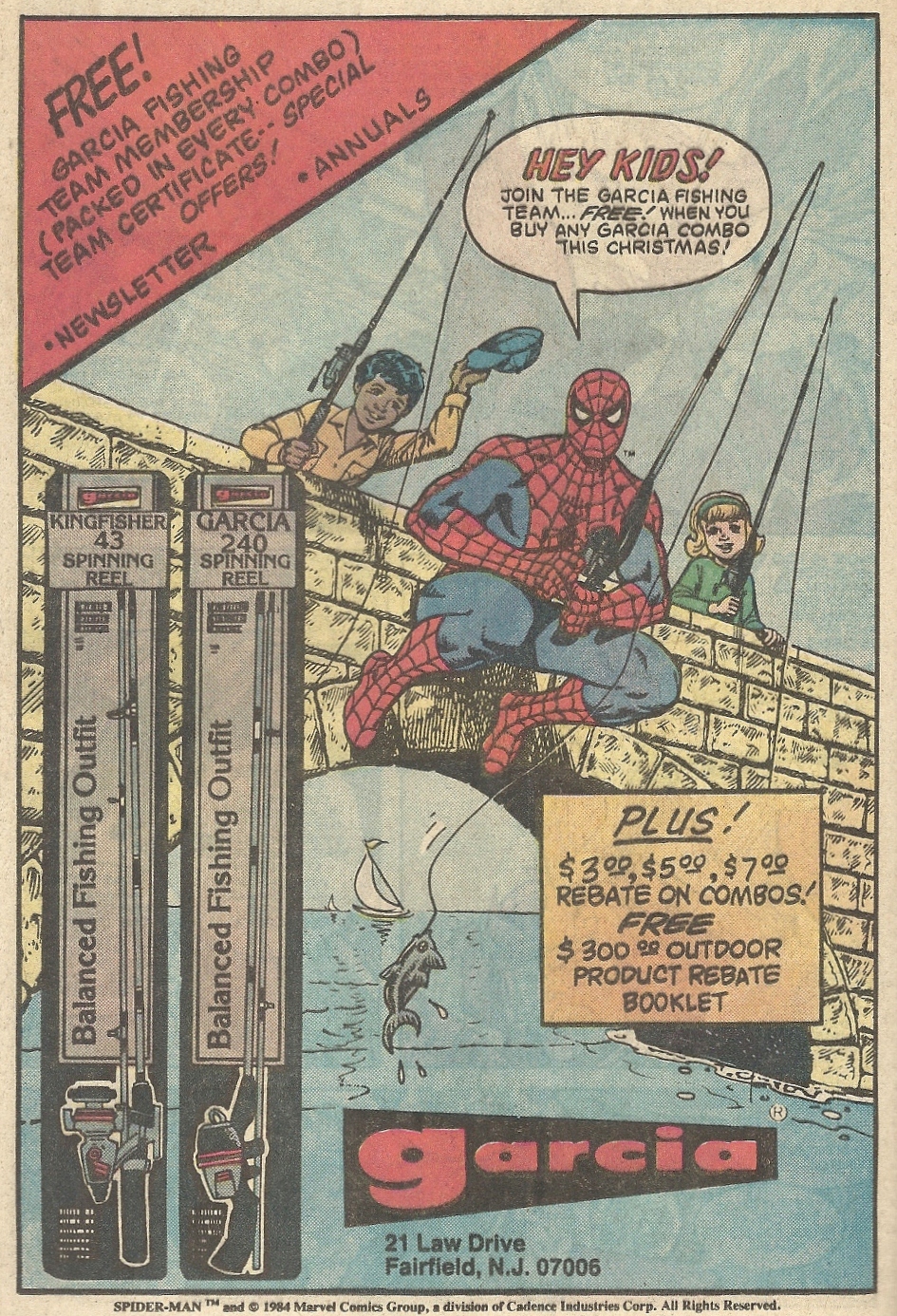
I’m not much for fishing, or for being part of the (ugh) “Garcia Fishing Team,” but I wouldn’t mind — if I was a kid again — spending a few hours working the rod and the reel with Spider-Man. I dig how he fishes like a Spider-Man should, with his feet stuck to the side of the bridge.
Although I suppose this is all one more reason for Namor to get all worked up into a lather. “You have trespassed into my domain for the last time!” and all that jazz.

A couple of times I’ve wanted to take a look at Walt Simonson’s wonderful run on The Mighty Thor, but every time I’ve gone through that box I’ve been sucked back into Jack Kirby’s long and splendiferous originating tenure with the character. It’s like a crack addict when he sees some rocks and a pipe — I can’t resist. But I have at long last beaten back temptation, and I’m happy to share some love for Wily Walt’s reign with Goldilocks.
While Simonson’s work could never match Stan Lee’s and Kirby’s (nor would he ever claim that it did, I’m sure), he managed to carve out his own unique look for the God of Thunder and his Asgardian friends and foes, one that was stylish and energetic, and he was always surging forward with stories that melded fantastic mythological elements with with more understandably human themes. I’ve long thought of Simonson’s Loki as the defiitive Lord of Mischief. He was tall and thin and he looked like he’d stab you in the back without a second thought, and those horns on his helmet were exaggerated to the Nth degree, but it worked.
When I was going through my Simonson Thor‘s, I was tempted by so many individual books. How to choose? How could you not fall for a story where Thor becomes a frog? Or any of the others? But I came up with an angle. I thought that it would be nice to pay tribute to one of my favorite secondary (or tertiary — is their a “fourtiary”?) characters. Hell, he may be my favorite character, period.
Beta Ray Bill.
I realize this alien cyborg, who because of his upright courage was gifted with his own Thunder God powers by Odin himself, has often had his features described as “equine,” but I’ve thought differently since the first time I saw him. To me he looks like my childhood dog grew longer limbs, started walking on just two of them, and got himself a membership at Gold’s Gym. Bad. Ass. Maybe that’s why I love him so much — those mental images of my faithful hound becoming my very own Chewbacca, but one that can speak English. He’s so bleeping cool. I’m not much for action figures or statues or busts, but I’d be tempted to buy a nice looking Beta Ray Bill bit of merch. He even elevates malarkey like the Thor Corps. And he’s also gone hot and heavy with the Lady Sif, for which I tip my cap to him, even though that romance carries the whiff of bestiality.
I chose Thor #352 because of the prominence of Bill. In this, the penultimate issue of the Surtur saga, Thor is M.I.A and Bill has to carry all of the hammer-wielding water. And what does he have to do? Why, only lead the defenders of Earth against untold hordes of Surtur’s demons. And, by God(s), he’s up to the job!
First, here’s Bill’s babe riding a patented Walt Simonson Sound Effect into battle:

The “KARWHOUUM!” is joined in this issue by it’s friends THROUFHOOM!, KRASTHOOM!, SLASHKKKKK!, WHRINNNNNNE!, BLAMMMMMMM!, FA-THISSSSS!, KARASSSHH!!, KRAATHOOUOM, SHRARUKKARAKKK!, SCHRAKAAKKKKK! and KARRAKKKK! — that’s a lot of Simonson sounds for your comics-buying dollar.
Sif later goes missing in the tumult, and it’s only Volstagg’s coprulence that’s able to keep a distraught Bill from going after her:

It’s not all that surprising that with that fearsome visage Bill’s interrogation skills are on par with Jack Bauer’s, and hence able to turn even the most hardened of demons into pudding:

Here’s Bill channeling William Wallace in Braveheart — he’s doing the curcuit of manly icons, I guess. Is there anything this cyborg can’t do?:

Except he leads them all right into a trap:

Nobody’s perfect.
Beta Ray Bill epitomizes Simonson’s Thor in so many ways, which is rather fitting since it was a fearsome looking Bill who ushered in the new era by smashing the old logo on his classic first appearance cover. He was an off the wall take on an aging standard (I can remember first seeing him in a Power Pack comic and wondering “What the hell happened to Thor?”), breathing new life into a character (and costume) that had grown somewhat musty with age, in much the same way Walt came onto the broader title and with his stylish lines and story sense swept up all the dust and pulled down all the cobwebs and ultimately reinvigorated one of the original Marvel titans. Whenever I read one of his Thor comics, by the time I reach the end it’s almost as if I’m a little out of breath. There’s so much energy on display, it’s a real treat to tear through them. The action in this issue is a fine exemplar of that, and Bill’s preeminence makes it all the sweeter.
With the new relentless crop of Marvel films, my hopes of seeing Beta Ray Bill on screen, however dim and slim, are nonetheless growing. I pray to Odin’s beard every night to see such a thing.
To send us out, here’s the cover to Thor #350. It’s a great two-shot of Bill and Thor coming right at us, and it’s one of my favorite Bill images of all. And here’s a puzzler — which hammer would you rather take on the chin, Mjolnir or Stormbreaker?:

The World’s Worst Endorsers
As I was readying my Jonah Hex post the other day, I was struck by the juxtaposition of two ads in that particular comic. They’re real doozies in that wonderful thing known as retrospect. First we have that wife-beating, murdering son of a bitch and friend to children, O.J. Simpson:
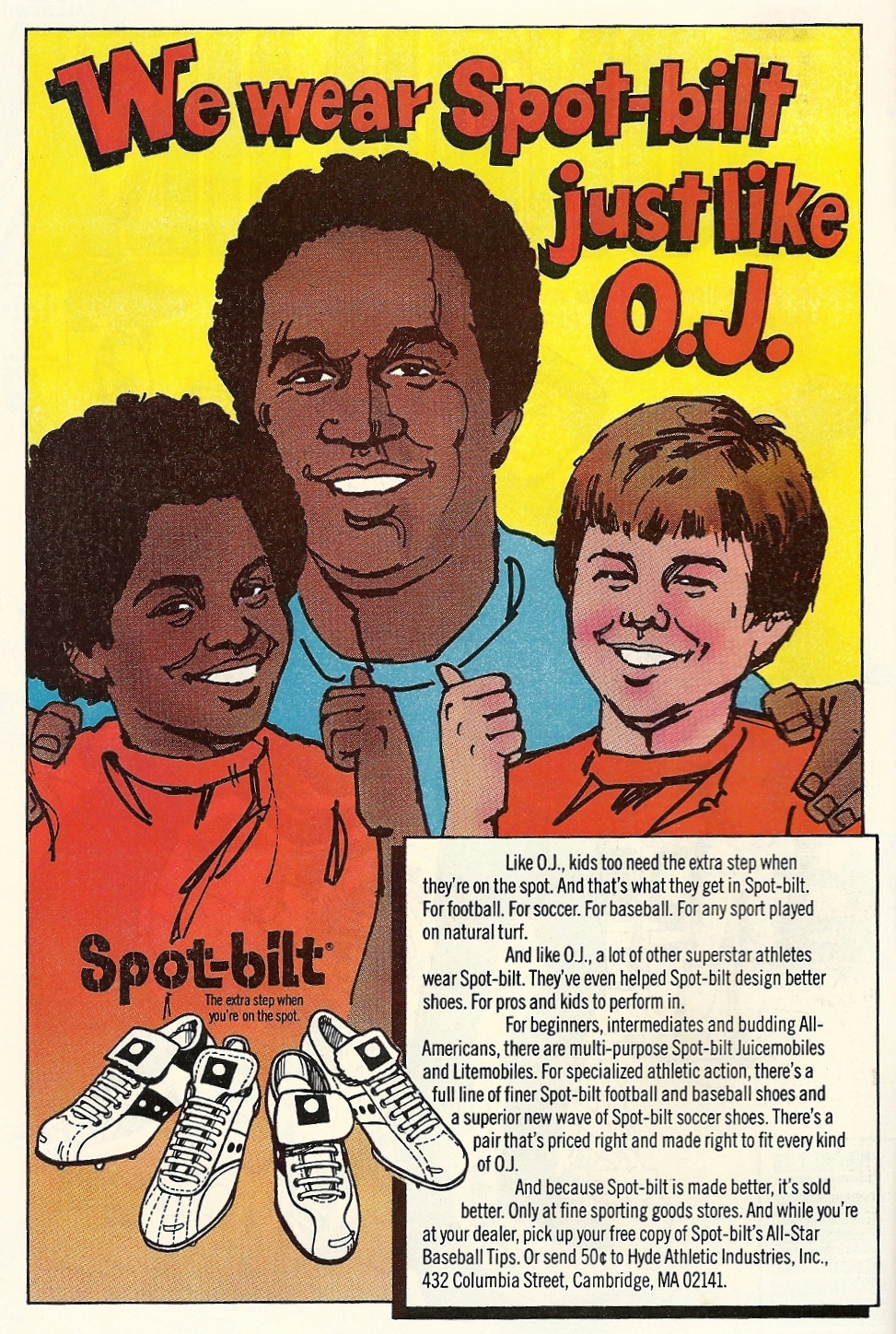
It’s an added bonus that it’s for footwear and one of the most highly quotable lines from his murder trail was “ugly ass shoes.” Remember when O.J. was the nice guy that everybody liked? When he was Nordberg in the Naked Gun movies and was jumping over stuff in Hertz commercials? I do, and I feel old. It’s like being able to remember when Michael Jackson was cool to most people and not a skeevy weirdo.
Next there’s the degenerate gambler and also friend to children (I guess he and O.J. are similar to Gamera in that regard), disgraced hit king Pete Rose:
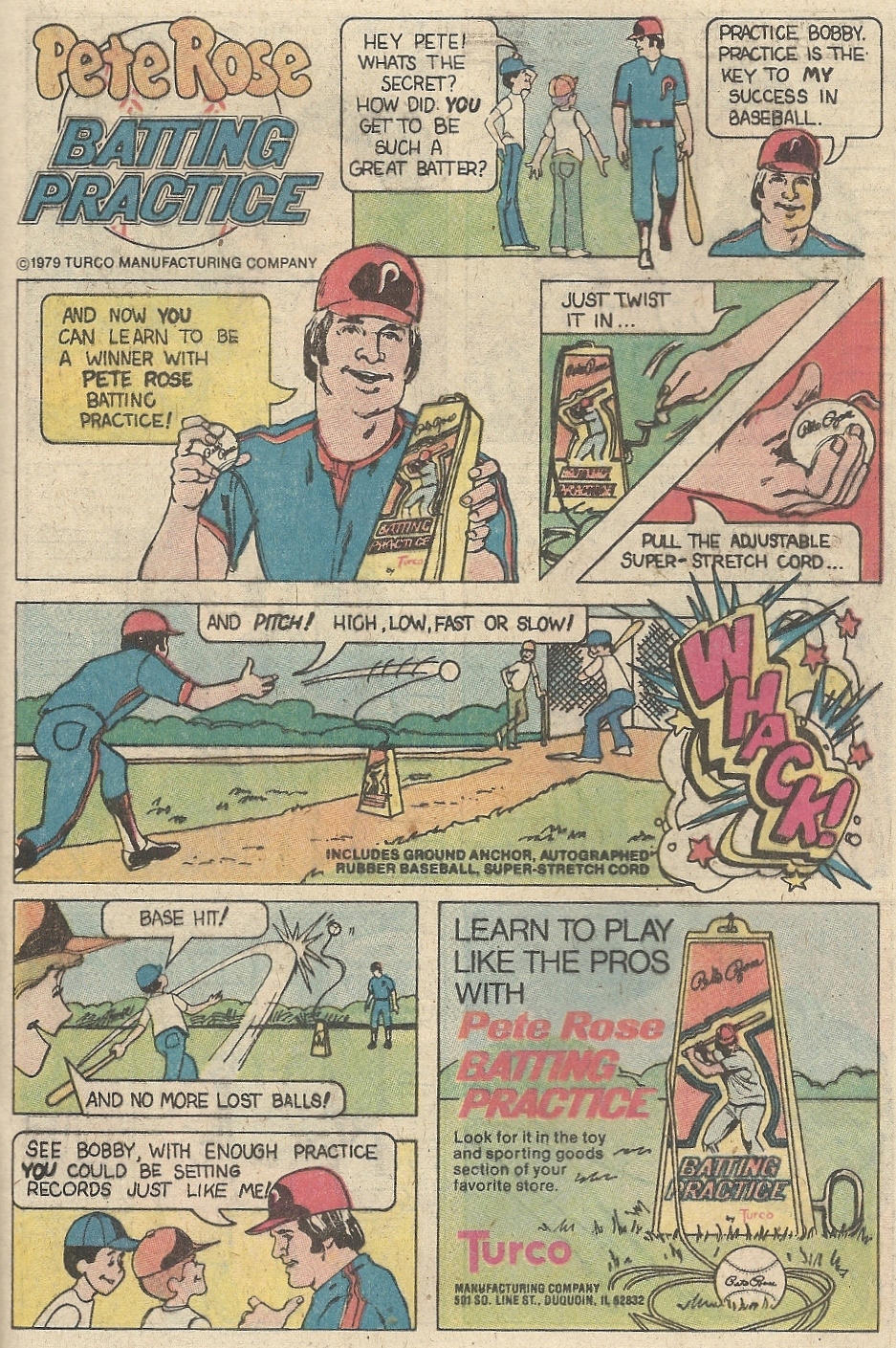
Apart from the jail term and the lifetime ban from baseball, the thing that turns so many people off from Rose is the tawdriness of everything he does. Anything for a buck, like taking a face full of an obese wrestler’s ass:
He’s all class. But at least he never killed anyone. That we know of. Yet.
Just for the hell of it, here’s my favorite goofy celebrity endorsement of all time — a dancing Sam Neill sharing with us the wonders of red meat in a series of spots:
“Red meat. We were meant to eat it.” Indeed.
Have Wooden Gun — Will Travel – Jonah Hex #27
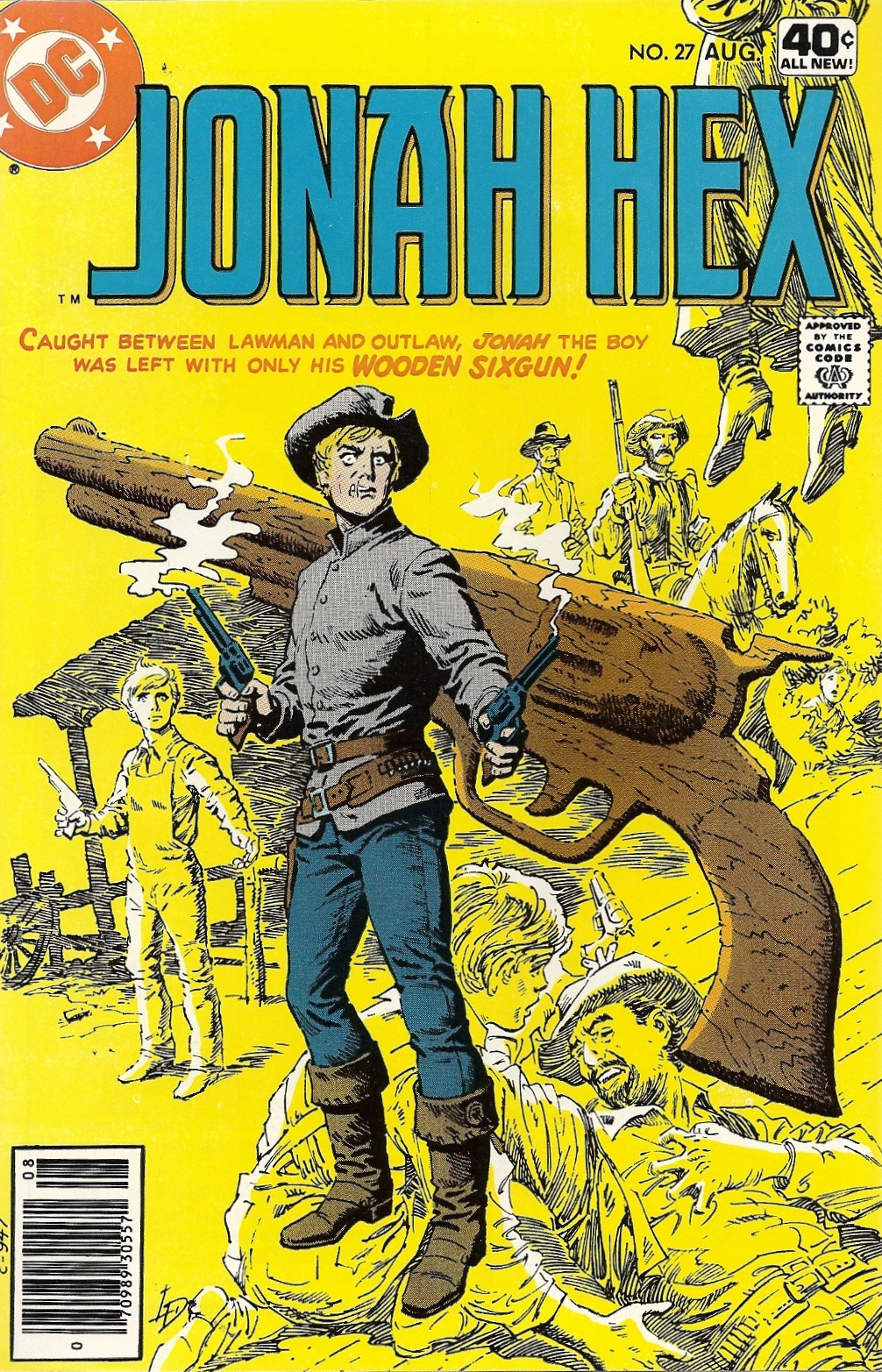
I’ve long had a soft spot for Jonah Hex, though the Hex that I grew up with was the one that lived in some random dystopian future. Seeing him in his natural Western setting always requires a little mental recalibration on my part — that ugly mug of his seems more suited to a radioactive Road Warrior milieu, I guess.
Because of that brain lock of mine, perhaps it’s fitting that this comic is a little off the beaten path, as you won’t find the familiar disfigured face or Mr. Hex on the majority of its pages. You see, most of the issue is told in flashback, in a time well before our gunslinger got his Phantom of the Opera scars. I wouldn’t call this an origin story, but there’s something of a beginning in it. How so? Well, we see how Jonah gets his first gun. I’d say that’s a pretty big moment in the life of any gunslinger, and in the case of Jonah Hex it’s like the first time Earl Woods put a golf club into Tiger’s little hands (or would that be paws?).
“The Wooden Sixgun!” (script: Michael Fleisher, art: Vicente Alcazar) wouldn’t be a flashback worthy of the name without a little framing story. One day a young boy witnesses Hex mow down three desperados with his quick-draw skills, and almost gets himself swiss-cheesed later that night when he tries to get a closer look at his new idol:
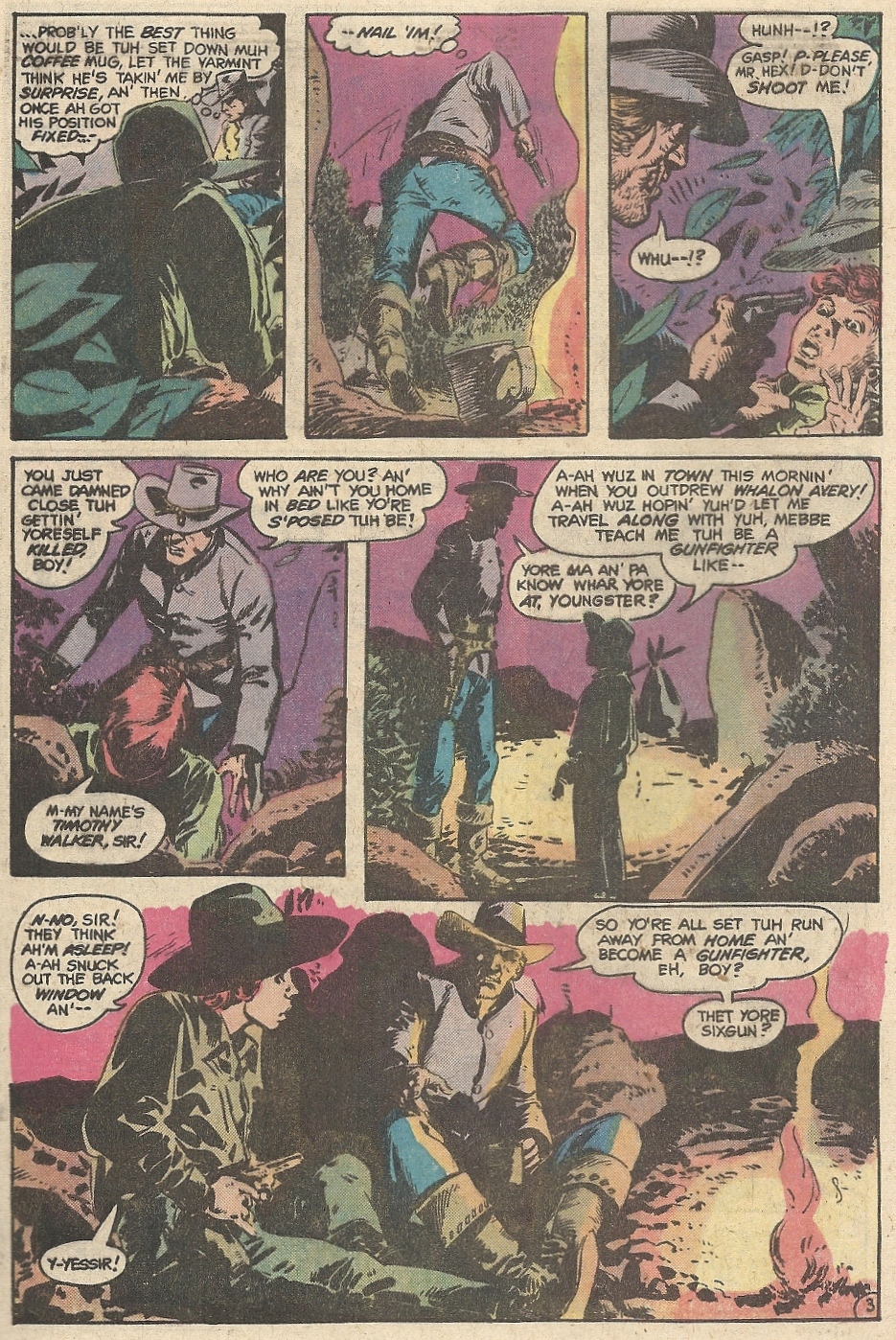
When the kid shows off his meager abilities with his whittled pistol, some memories are kindled inside Jonah’s grisley head:

And now for the flashback. Cue the wavy lines.
Jonah’s father was a cruel man (one who would sell him into slavery in later years — another story for another time), and when his son seems to be spending a little too much time playing around, he gives him the back of his hand:
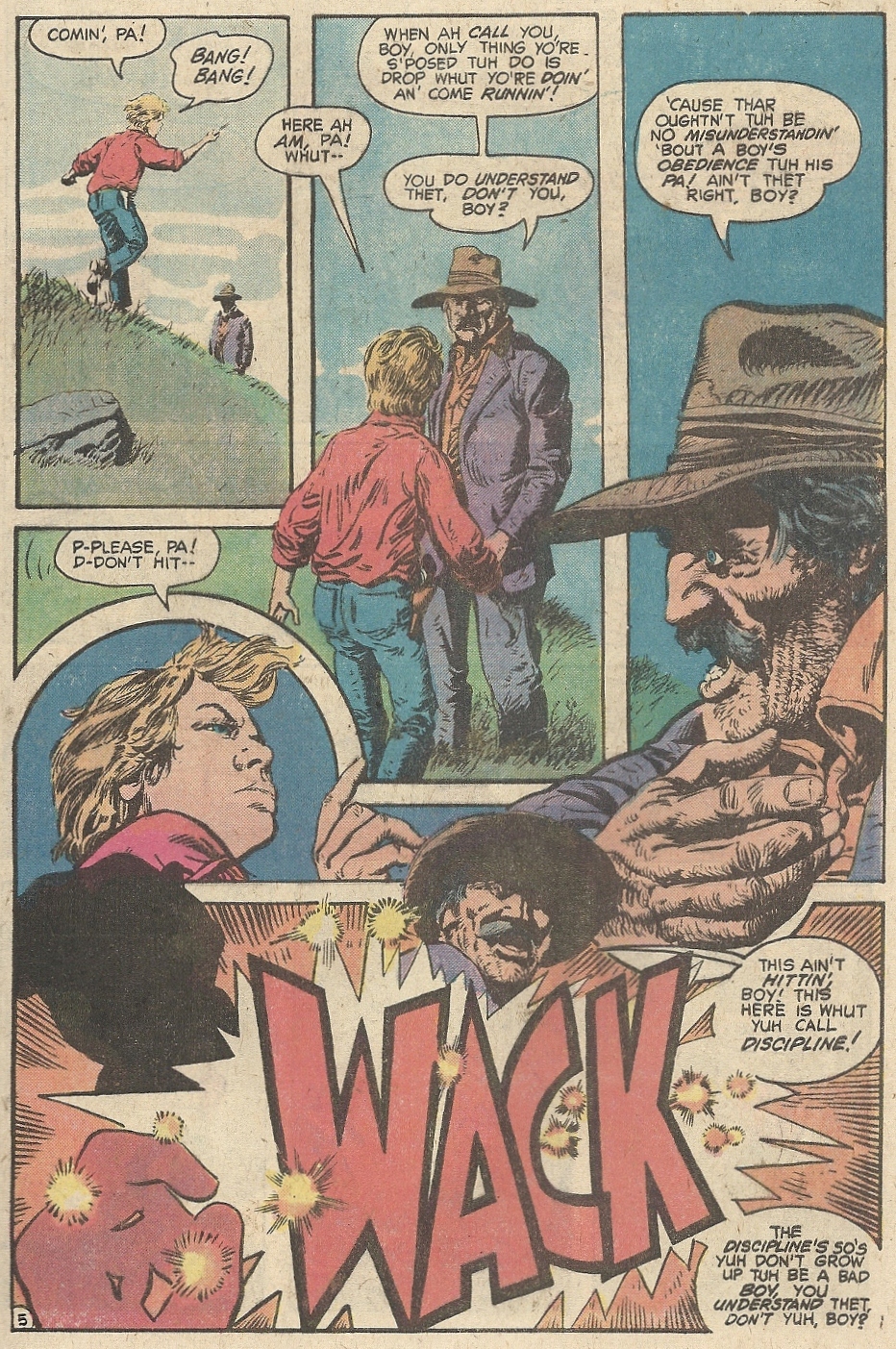
The World’s Worst Father goes off to do some moonshinin’ while Jonah keeps on daydreaming instead of doing his chores. That is, until he finds something unexpected in the reeds:
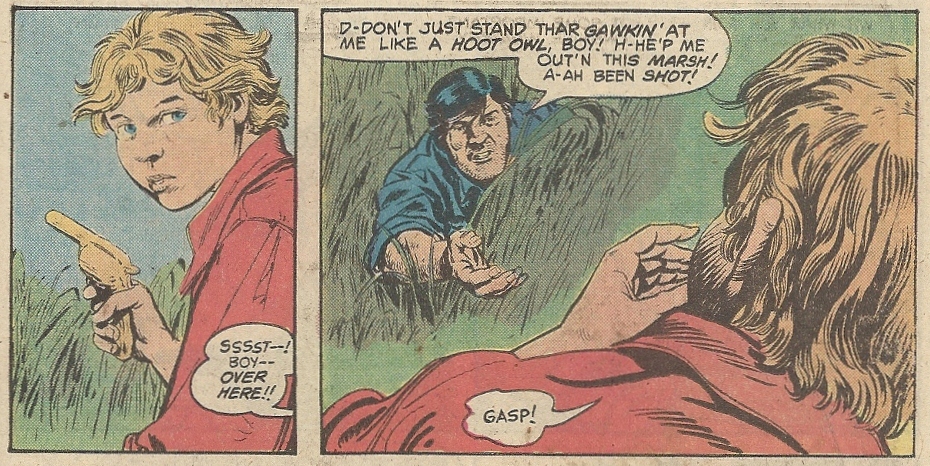
Jonah takes the man back to his house and there bandages him up. Though he recognizes this guy for the notorious robber that he is, he’s still pleased when the fella (Bart Mallory) gives him some brief gunslinging lessons:
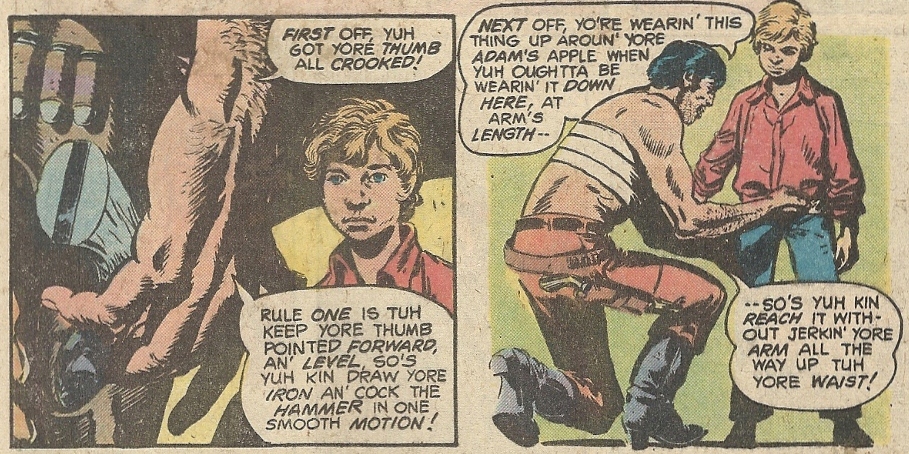
Knowledge for life.
When the posse knocks on the door, Jonah hides this killer who’s been nothing but kind to him, and after they’re gone Mallory repays his deception by making him his partner in a planned bank heist. Jonah goes along. He’s not forced to, mind you, but he seems to be quite taken by this smooth-talking criminal.
And what would an outlaw charmer be without a quick fling with a wench? Not much, because apparently Mallory can’t do any robbing without first getting laid:
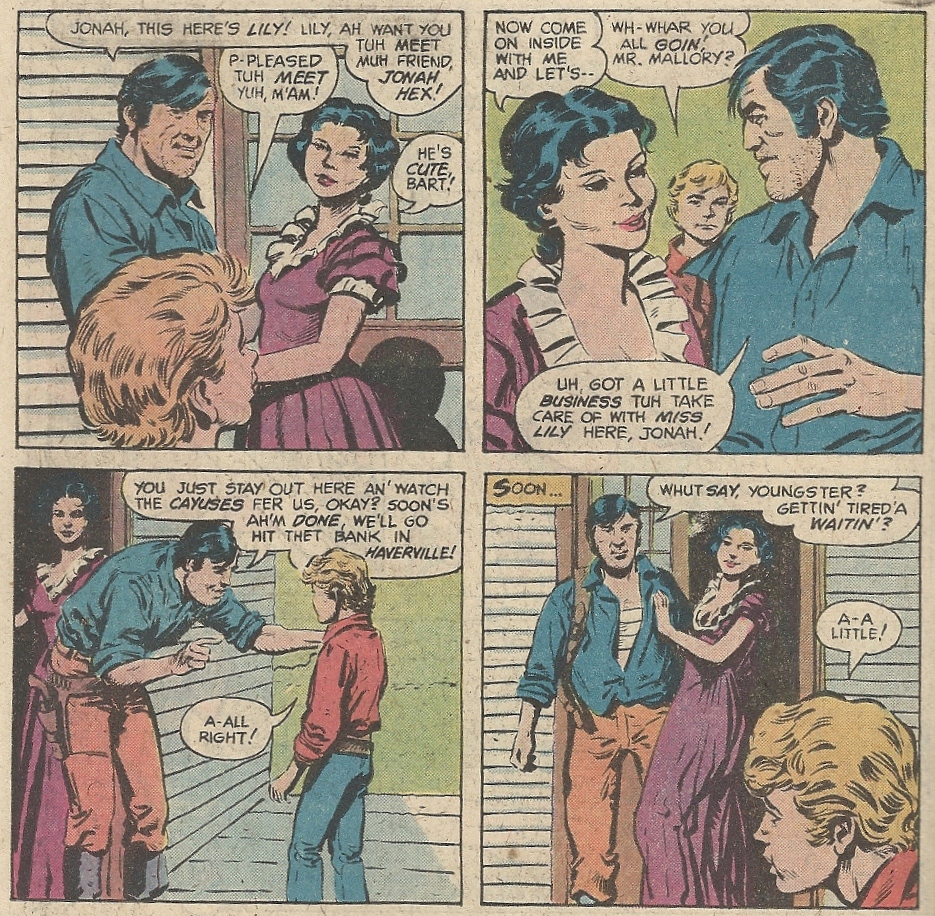
I think a “Fifteen minutes later…” note would have been nice there.
The law is hot on their heels. They show up as soon as Jonah and Mallory have gone and coax out the crook’s destination from the poor lady with the threat of hanging her. What happens? Well, we learn that these lawmen are a bit crueler than is warranted (no pun intended):
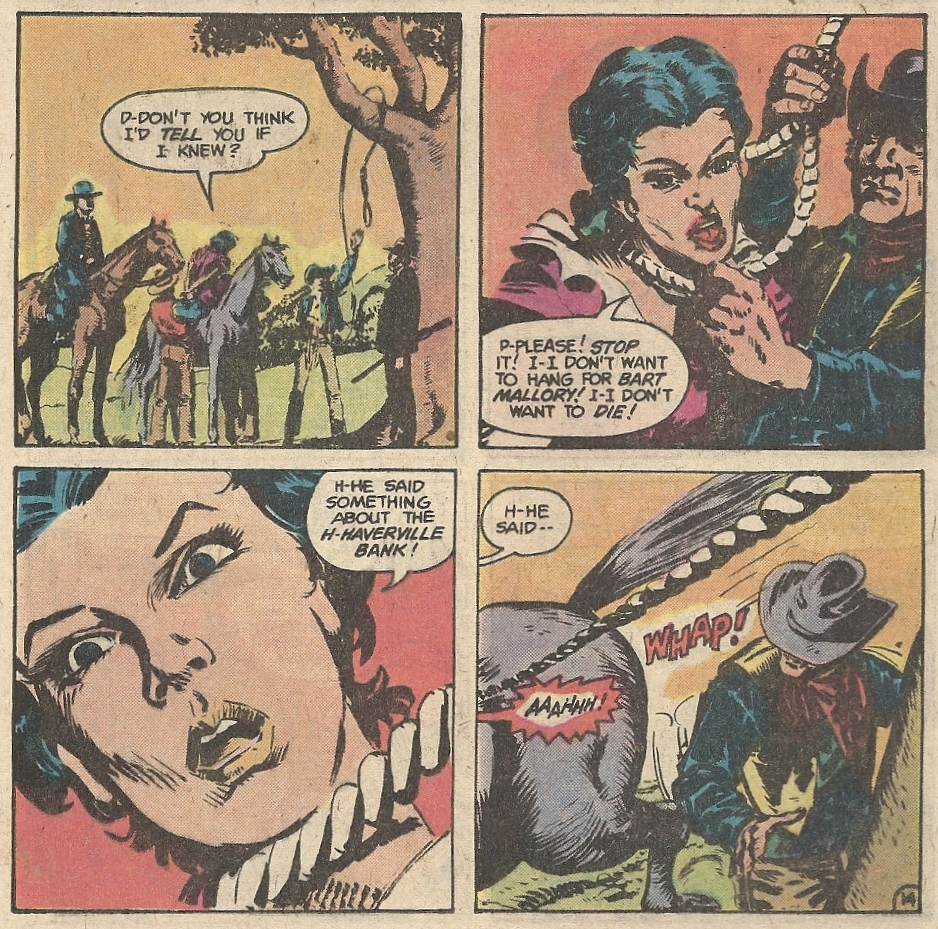
That’s gratitude for you.
Meanwhile, Mallory gives Jonah a little something before the big moment — a real live gun:
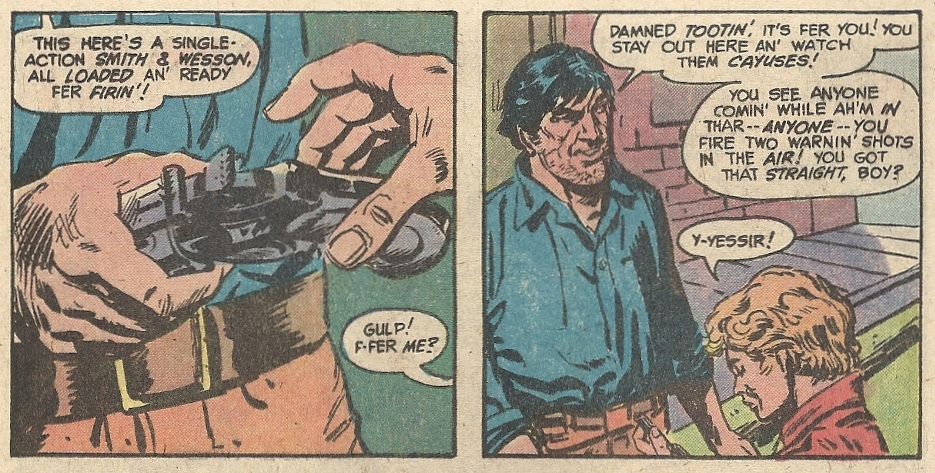
Unfortunately for Mr. Mallory, the posse has beaten him there and are laying in wait for him. After he’s riddled with bullets like Sonny Corleone at a toll booth, he does one last semi-noble thing before he croaks:
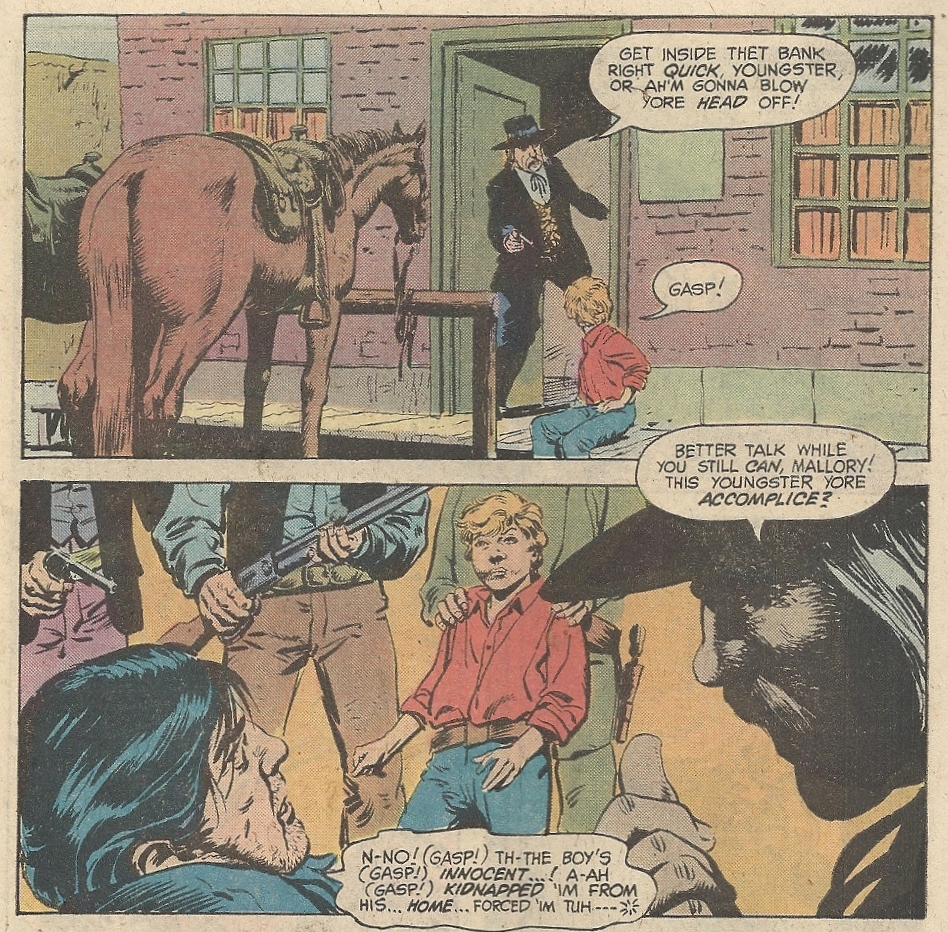
Jonah is free to go, but that means he has to go back to his a-hole drunk of a father, who’s none too happy about the chores not being done:

But Jonah — when he’s alone that night — still has a little something with which to remember his brief friendship with a bad man:

Back in the present, Jonah has bored the poor kid right to sleep. He takes the boy to his parents’ house (it’s unclear how he knew where the kid lived — I don’t think telepathy is part of his normal arsenal):
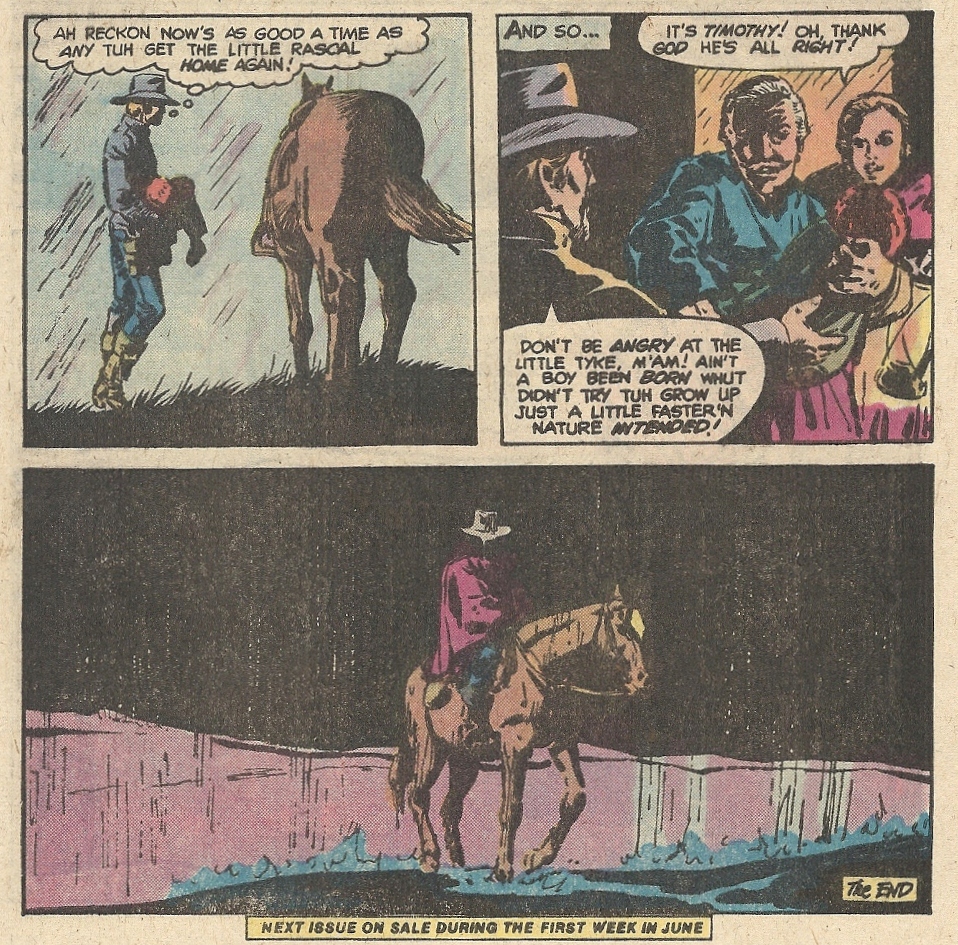
“Come back, Jonah! Come back!”
I liked this story quite a bit. I’ll grant that it’s formulaic, and you can get a lot of the elements found in this one in many of the old TV Westerns of yore, hokey chestnuts like Laredo and The Rifleman and Wagon Train. But the blurred moral lines raise this one out of the multitude. The abusive father and the outlaw, who has a Han-Solo-in-the-original-Star–Wars kind of roguish charm to him, make you question who really is on the side of light, not to mention the lawmen WHO MURDER A WOMAN IN COLD BLOOD. It’s appropriate for a man like Hex, a hero who’s a stone cold killer, to have such a topsy-turvy day in his background. The whole “getting his first gun” bit made me think of that scene in Indiana Jones and the Last Crusade where Indy gets his hat — we’re getting a little heavy with the Harrison Ford references here, but still, there are worse associations to have.
Alcazar’s art, while not the cleanest or easiest on the eye, has a visceral quality that keys into the script’s grim vibe. And the last panel, showing a lonesome Jonah riding into a rainy night, is a such a classic Western visual, one that gets me every time. I love Westerns, but I’m not a big fan of Western comics. Jonah Hex, though, has a hook that I enjoy, and I think this particular comic stands as a good example of why I like him.
Thanks, Hollywood, for making an unbelievably horrible screen adaptation of the character. And yes, Megan Fox and her horrible accent were a wonderful touch.
Take this job and shove it
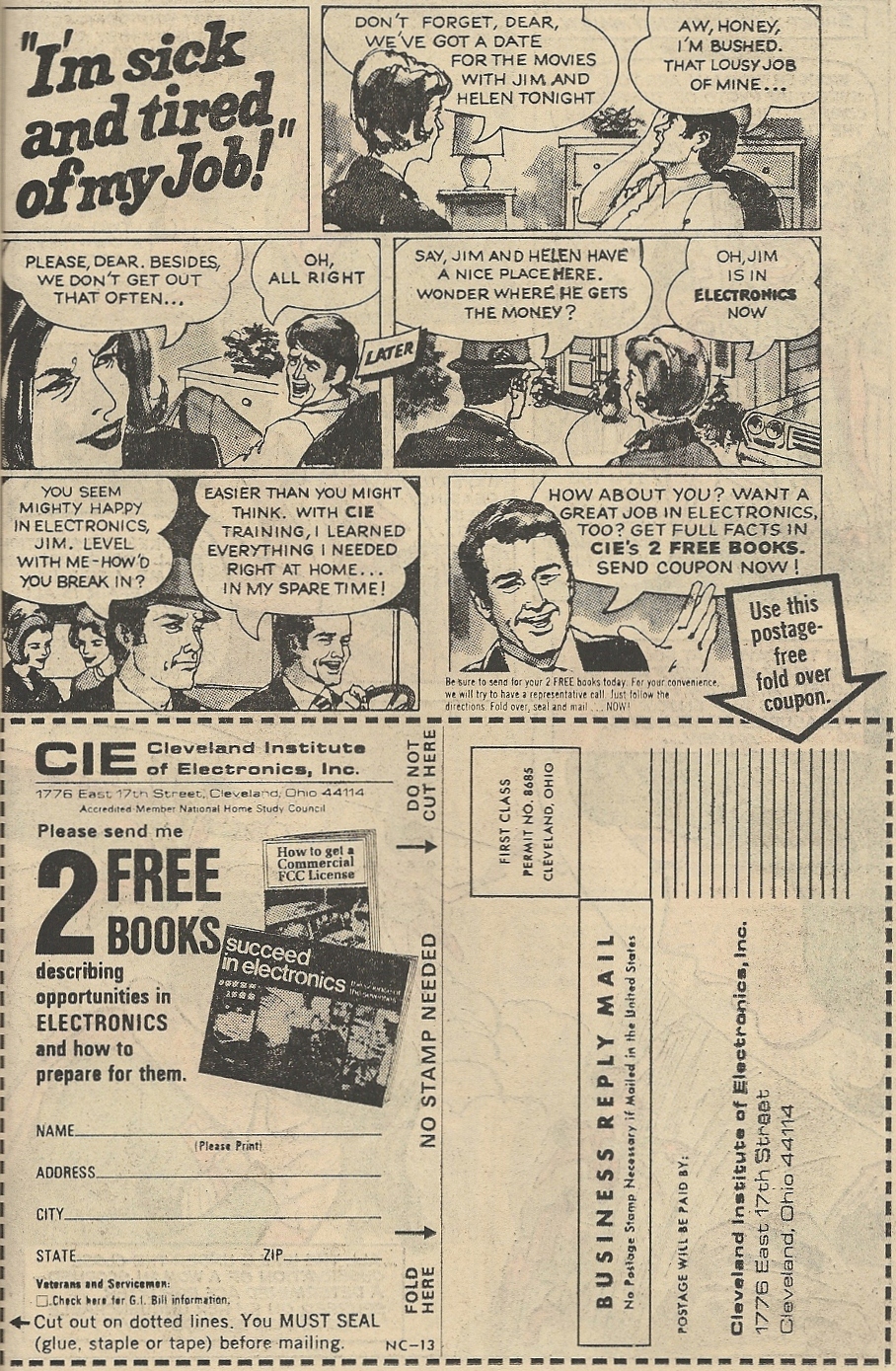
Yes. The lucrative, highly-sexed world of electronics. “Send coupon now!”

I wanted to do a romance comic in honor of the upcoming Valentine’s Day, but I’m fresh out. I’ve already covered every romance book currently housed in the Blog into Mystery World Headquarters. This’ll have to do, even if it does have some tights and capes and lassos.
For a long time I’ve thought that Superman and Wonder Woman belong together. It wasn’t always that way. I remember my youthful mind being scandalized by that passionate but awkward kiss between the two in Action Comics #600, and had a hard time shaking that drilled-in notion that Clark and Lois belong together. But Kingdom Come went a long way to codifying the inevitability of the Amazonian/Kryptonian union. As Superman said to Batman in their final The Dark Knight Returns confrontation, “You’re just meat and bone — like all the rest.” The same goes for Lois. She’s fragile. She’ll die. Perhaps violently, perhaps at a ripe old age. But Kal and Diana may live forever. They may be the last ones standing. As I said, inevitable.
Lois, being the crack investigative reporter that she is, can’t help but notice this, nor can she escape the paranoia that comes with having a perfect woman, if not competing for her love’s attention, at least spending time with him on a regular basis. A long time ago on this blog I looked at a comic where Steve Trevor and Lois commiserated over their ordinariness, and this one is along those same lines. This time, though, Lois is on her own and driven nuts by an apparent union between Superman and Wonder Woman.
The heartache hits pretty early on in “Wonder Woman: Mrs. Superman,” written by Cary Bates with art from John Rosenberger and Vince Colletta. When things go haywire at a race car test drive that Lois is covering (she must’ve drawn the short straw at the Planet), Wonder Woman makes a quick save and shows her assets in the process:
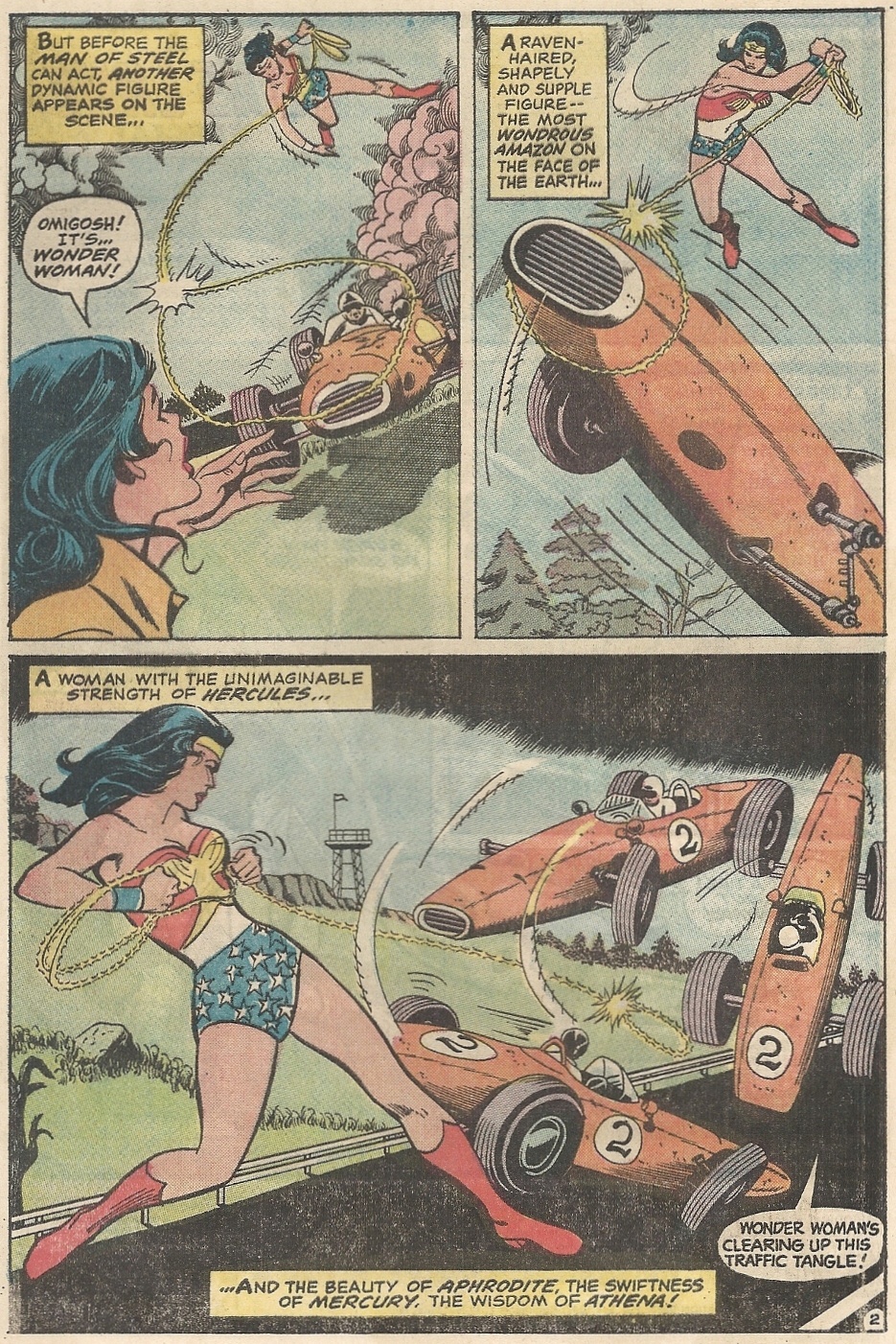
Then Superman delivers the big news:

Dagger.
This (understandably) sends Lois on a bit of a bender. She has an immediate rebound relationship with the daredevil driver that she met at the track — perhaps the fastest rebound in history — but that ends when she realizes how lackluster his adventures are in comparison to Superman’s normal routine. She sunset flips him out of his speedboat when he tries to get fresh, and that’s the nd of that.
Things are not going well for her, but Lois, ever the optimist, thinks of an angle that may mean that things aren’t as bad as they seem:
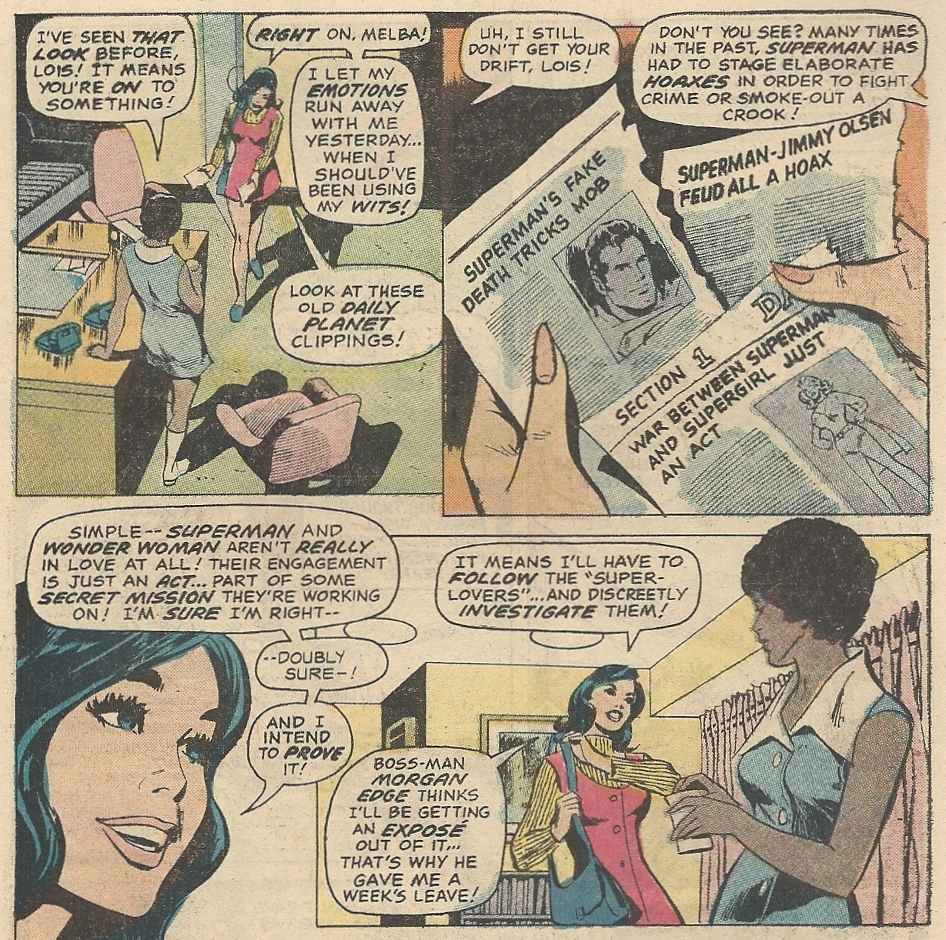
Gal-pal Melba Manton mercifully leaves the “Whatever helps you sleep at night, honey” unsaid.
Lois goes full stalker — wait, I mean, reporter — mode to get to the bottom of all this:

Yes, she has equipment that would make Jimmy Stewart in Rear Window green with envy. But all that her tech does is confirm her worst fear:

When she later sees Wonder Woman in action, fending off attackers with her arsenal of powers, it’s even clearer how meager her offerings are in comparison. This sets off the typically teary “spurned lover” panels:

But that doesn’t stop her stalking — I mean, reporting — and she sees the varied activities that a super-couple enjoys:
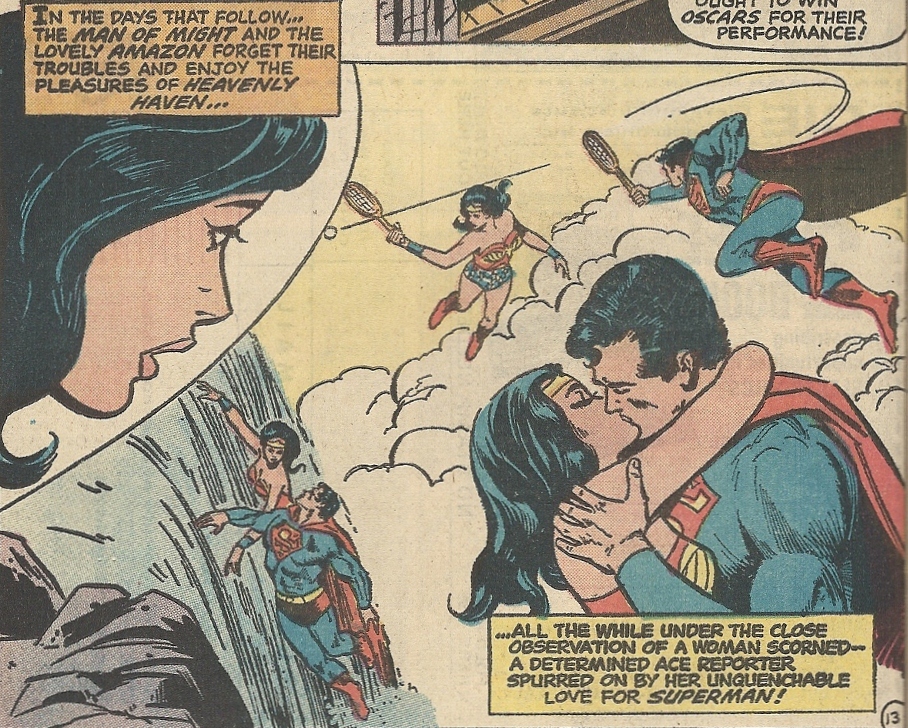
Mid-air super-tennis — I could go for that. Going after mishit balls would be a pain, but still…
Soon we learn that things aren’t (surprise) what they seem. Lois is abducted by a hooded villain, one that wants to inflict grievous harm on Superman and his lady love, that lady love currently being Wonder Woman. Lois makes an escape from this mysterious figure’s lair with the timely help of Melba, but not in time to save Wonder Woman from being trapped by a sinister ruse — that hooded figure, masquerading as Lois, gives the Amazon a deadly bit of jewelry:
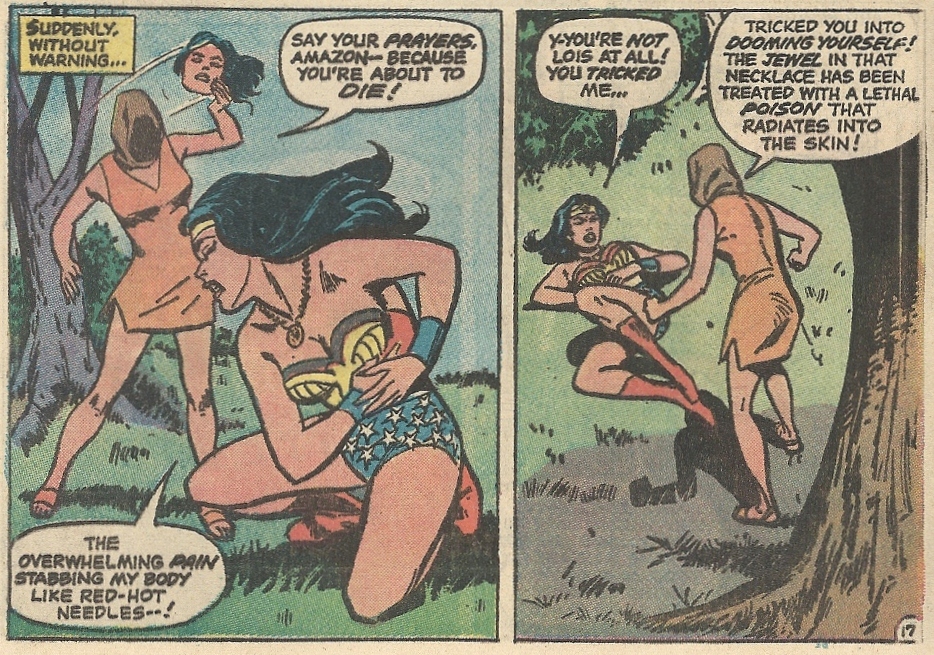
The Belly-Ache-Inducing Necklace of Doom, I guess.
Then we have the Scooby-Doo villain reveal, as the hooded individual is shown to be a deranged woman once rebuffed by Supes, and one in desperate need of hair-care products:
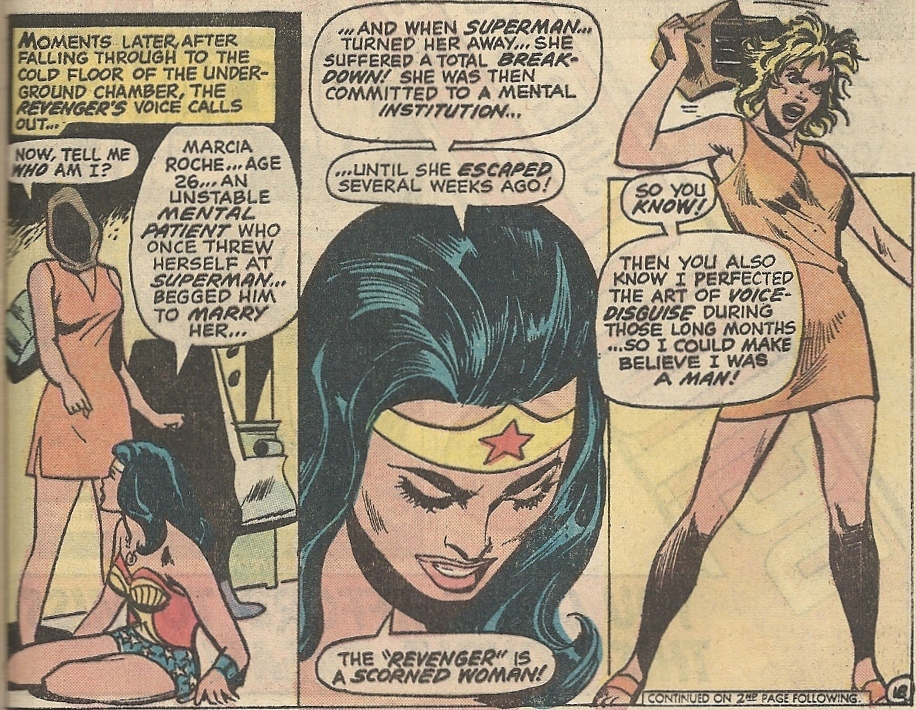
Hood-hair.
Thankfully, Wonder Woman has a couple of Y chromosome-less mortal allies to bail her tush out:

Then we learn that the whole Superman/Wonder Woman thing (they never even had the chance to get an obnoxious “Brangelina”-ish moniker) really was fake:
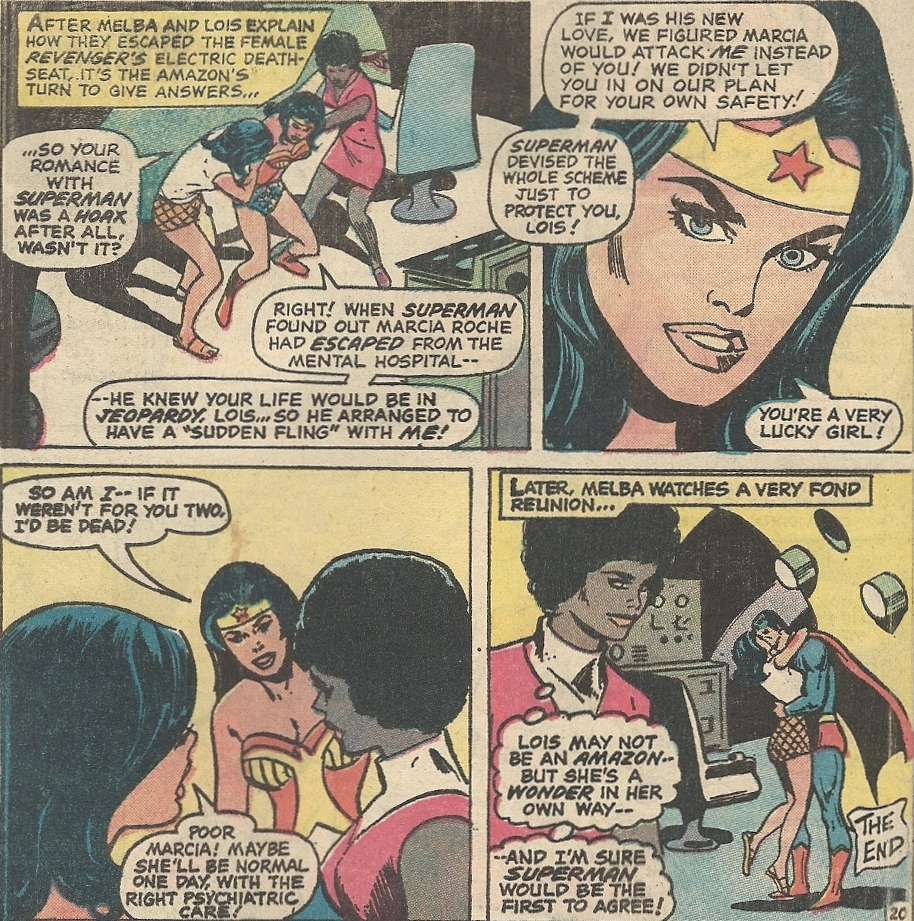
I think we can forgive Lois if she breathes a big, and I mean BIG, sigh of relief.
If you take the costumes and the powers and the scheming villain out of this (I realize that’s a lot, but you get the picture) this is really something along the more traditional romance lines, and would stand right alongside the mortal fare that’s covered so ably by Jacque Nodell over at Sequential Crush. I realize that the romance angle is found in a lot of the Lois Lane books, but it applies moreso with this particular issue than many others, at least it seems that way to me. Perhaps it’s the art and Lois’ tormented lamentations (with the *choke*) that seal the deal.
In a final personal note, I have to mention how strange it is for me to read these old Lois Lane comics from the 70s — that strangeness mainly comes from her looks and the fashions on display. Why? Because Lois (especially as drawn in this one) looks a hell of a lot like pictures of my mother from that decade. She was in her twenties then, around the age Lois is perpetually shown to be, and the hairstyles and attire combine to make me think of old photographs, Kodak memories from that hazy time before I walked the Earth. Considering the fact that Lois has always had — and I’m not alone in this among comics reading maledom — a status as a sex symbol for me, the resulting associations are, as Sgt. Esterhaus of Hill Street Blues might say, disturbing “in the extremis.” Get Freud on the phone.
Maybe that’s why I’d definitely go with the Amazon.
Vodpod videos no longer available.I’m getting indigestion just looking at this
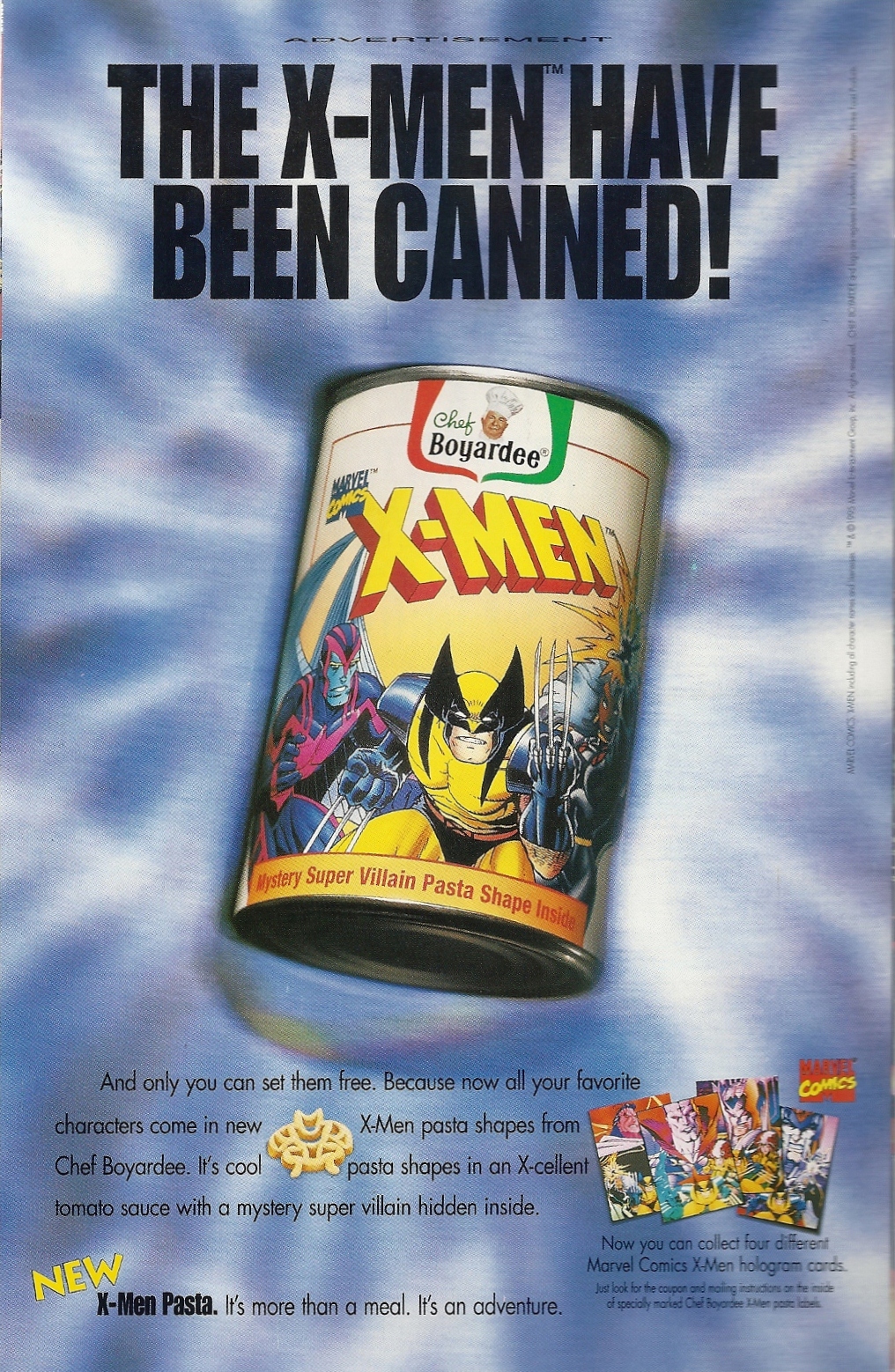
Seriously. I feel like Cyclops is burning a hole in my gut when I merely think about any Chef Boyardee product, much less an X-Men themed one. Did anyone out there ever eat them? Are they still making them (this ad is from the mid-90s)? I think I might have seen some Spider-Man SpaghettiOs over at my local Harris Teeter in recent months, but maybe that was only a fever dream.
And, if my eyes aren’t deceiving me , those are the unmistakable jawlines of Art Adams displayed on the label.
I hate this kid – Dennis the Menace #30

I never cared much for Dennis the Menace, not in any of his various incarnations across multiple media platforms. Maybe that was because I was the well-behaved boy growing up, or perhaps I envied his careless troublemaking whilst I lived in mortal fear of my parents’ wrath. Whatever. I’m not a fan.
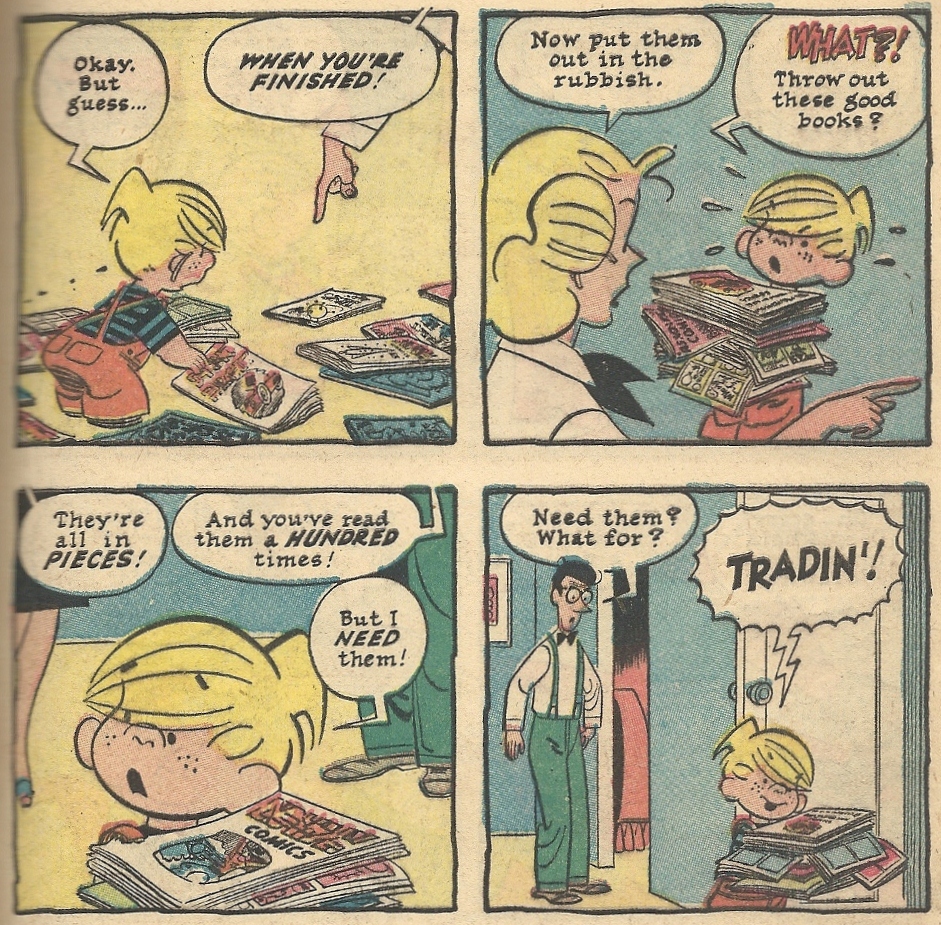
There’s a nice little story in this old issue, one that breaks the fourth wall in the same way those great DC comics would in the future, when the Flash would head to the DC offices and such. This one starts with Dennis in a predicament that many folks who read this blog have found themselves in at some point in their lives:
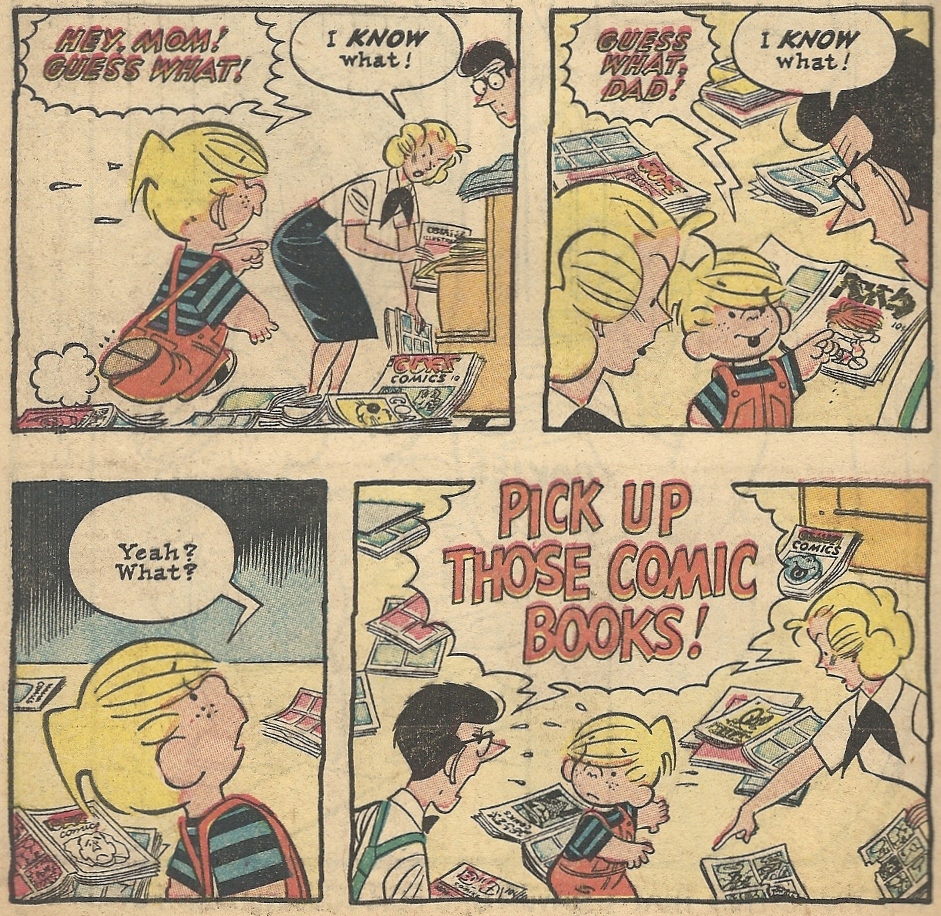
Dennis’ mom (not to mention Dennis’ carelessness) would seem to be part of the reason why I have to pay so much *!&%^# money for old comics:
Later, Mr. Mitchell encourages his bratty son’s grabby interest in drawing and comics while they’re out for a walk:
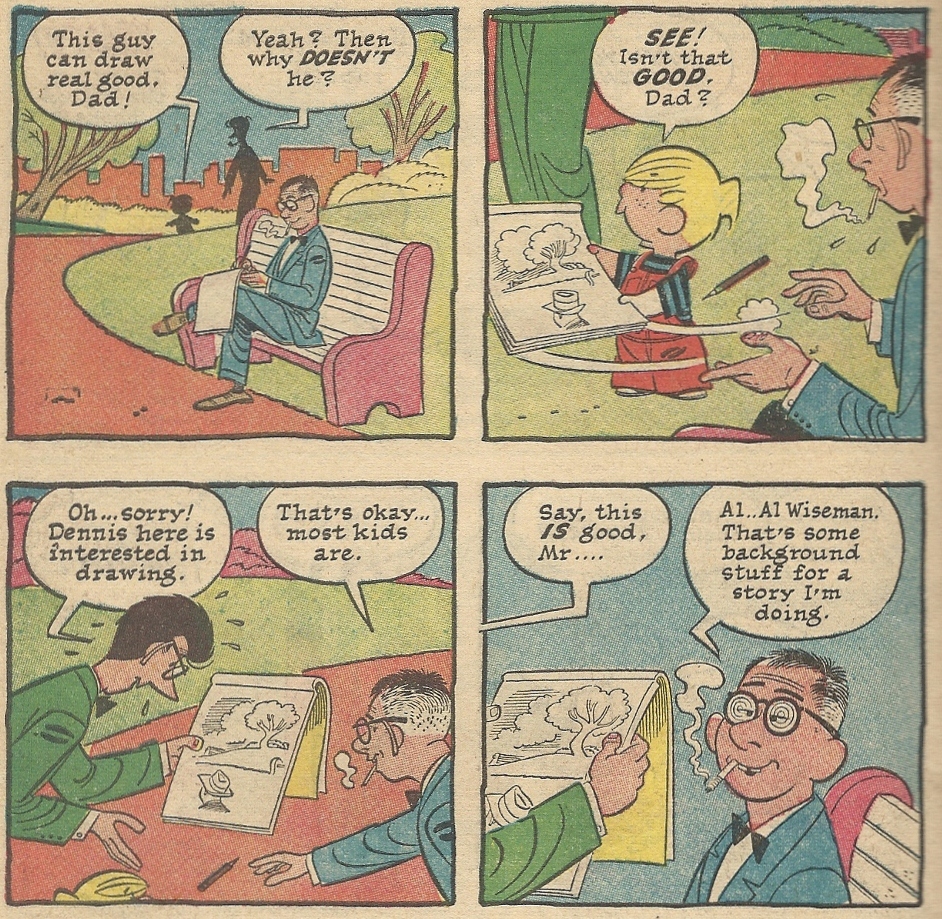
Hey… Isn’t that…?
This kind gentleman takes the two Mitchell men back to his house/office, where he introduces them to his writing partner, who’s horrified by Dennis’ “help”:

I say again, isn’t that…?
After Dennis destroys the work space like some three-foot-tall freckled tornado, he and his father leave and the two comics creators are left to ponder and brainstorm:
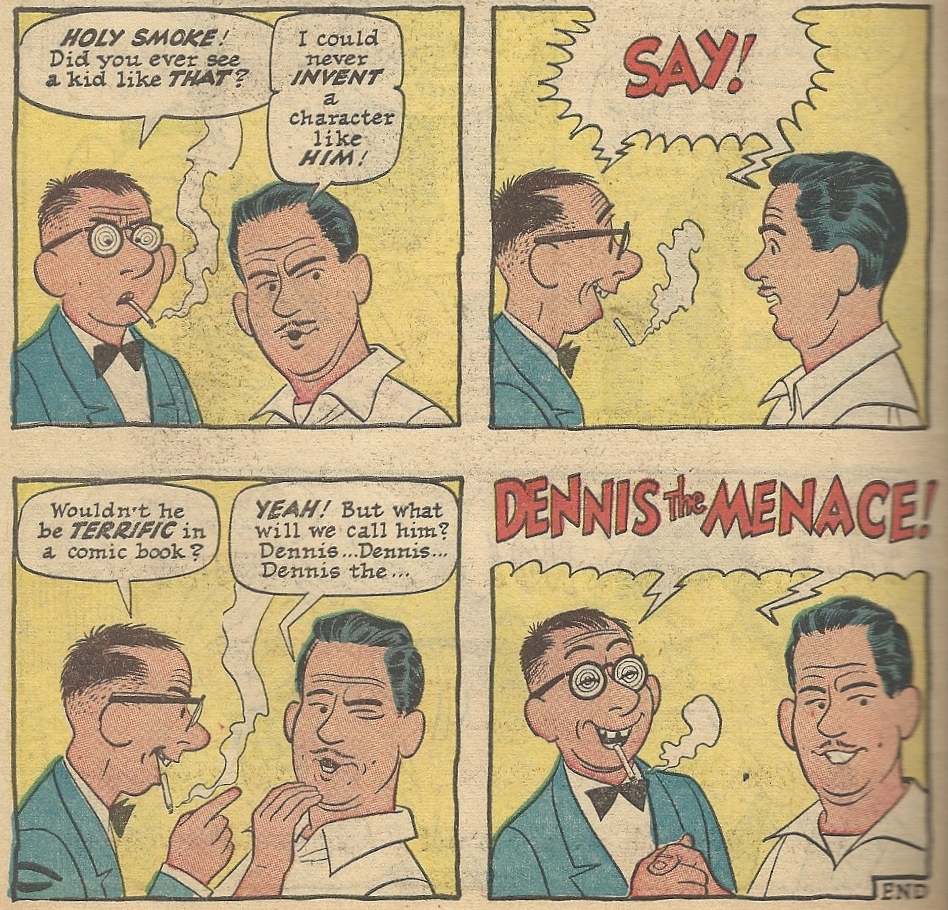
Yes, these were the two Dennis the Menace comic book guys, Al Wiseman and Fred Toole, “meeting” and getting the inspiration for their famous cartoon (though Hank Ketcham was the original creator — Dennis must have wrecked his place at some point). Kind of neat.
For a bit of a bonus, here’s a brief Toole/Wiseman strip from the back of the comic — I think it sums up quite nicely the grandiose plans of childhood and how quickly they’re abandoned:
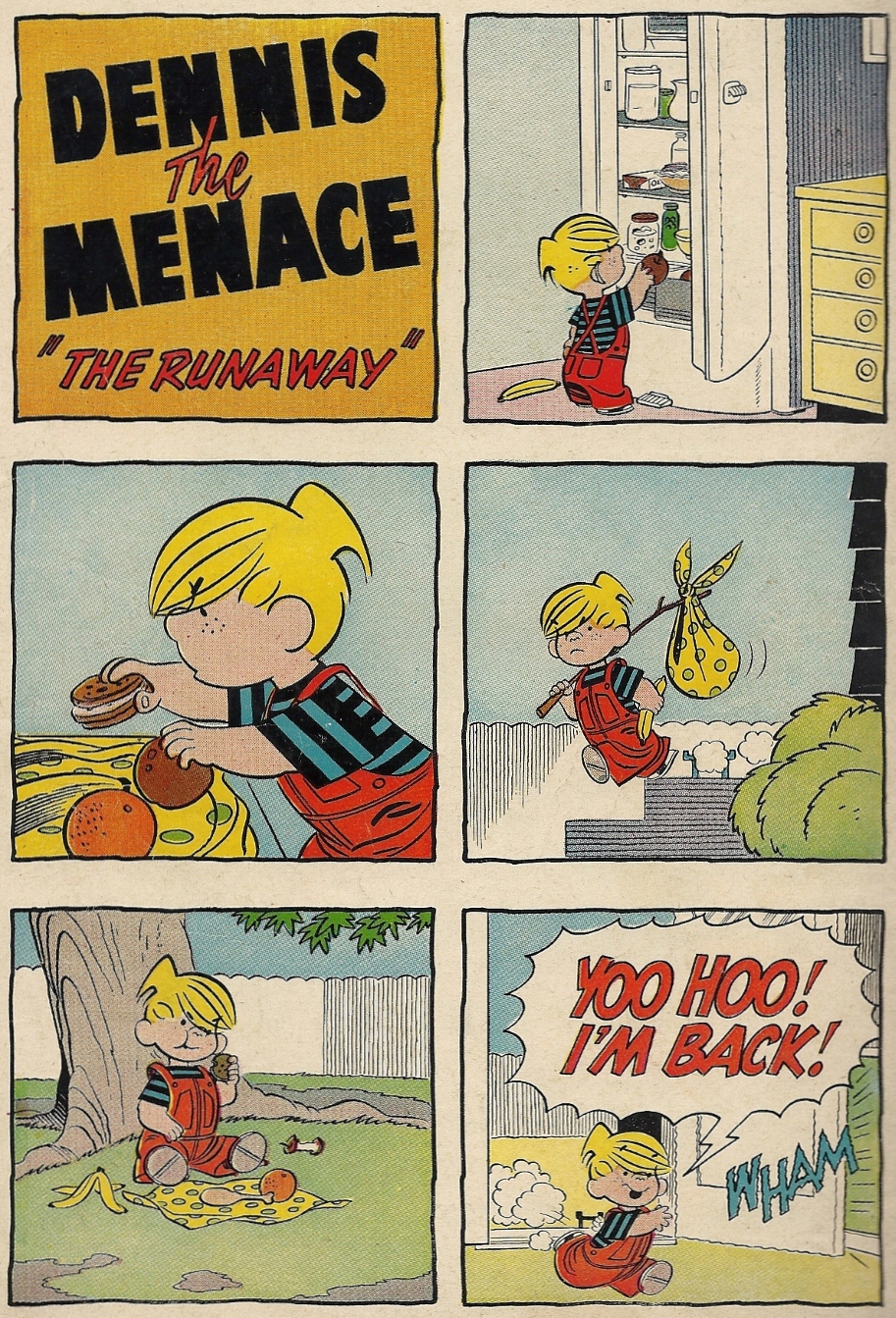
I always wanted Mr. Wilson to give this kid one hell of a spanking, in much the same way I wanted the poor, starving Wile E. Coyote to finally get his hands on that delicious Roadrunner. Or Mr. Wilson could even have eaten Dennis for all I care. Just do something awful to him.
Jim Aparo’s Batman Rules (and Other Affiliated Observations) – Batman: A Death in the Family
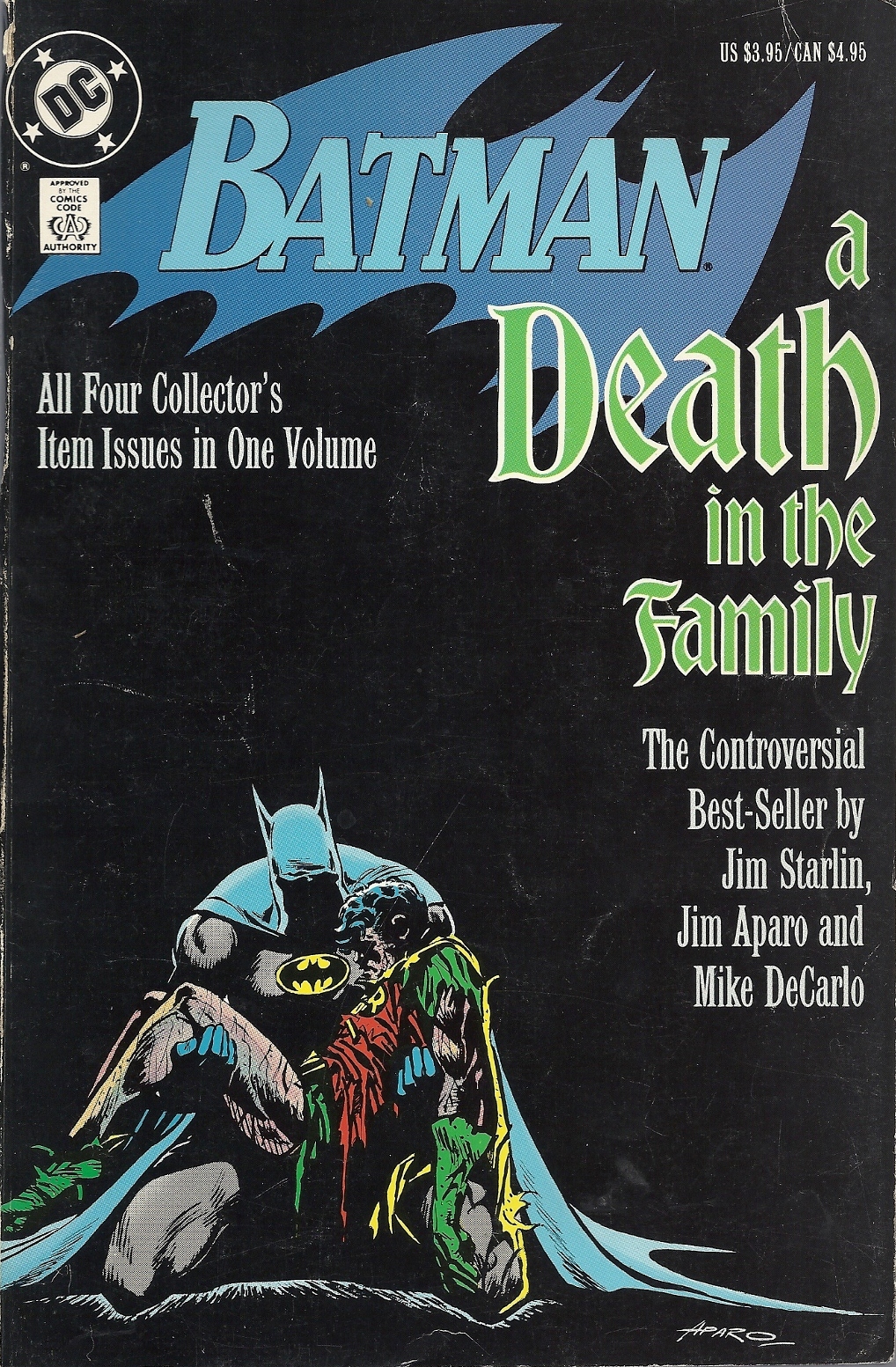
I’ve been kicking around about doing a Jim Aparo post on this blog forever, and it’s long overdue.
Before I delve into the general aura of magnificence that was the Aparo Batman, I should say a few words about the book whose cover you see scanned above and whose subject matter forms the reference points of this post. This was the first trade that I ever owned. I bought it with allowance money back during the Bat-mania that gripped the known universe after the release of the first Tim Burton Batman, and I’m sure it was the promise of the cover that got me to pick it up. I was a youthful dilettante when it came to my comics reading, and the death of the Jason Todd Robin (if I even knew there was a difference between the “Todd” and “Grayson” brands) had passed me by. But there he was on the cover, in Batman’s arms. Dead! And the cover said it was a bestseller. A comic book a bestseller. And a controversial one at that! How could I have resisted?
The real reason I treasure this book, and why it still has a prized place on my library shelves along with the Faulkner and Tolstoy and such, is the journey it’s been on. I’ve carted this bleeping thing to school with me as a kid, through more moves than I care to count, halfway down the Atlantic seaboard, in backpacks, bags, boxes, and Lord knows what else. It’s been dragged around so much I’m amazed it’s not more worn than it is. And I’ve lent it out to various friends and, most memorably, my sixth-grade teacher. He was a hero of my early youth, a big burly guy who’d take us outside on nice days and — his words — “let us run around like dogs,” tossing a aerodynamic nerf football to us all, and sometimes taking us outside to launch one of those mini-rockets off and lettings us chase after it as it parachuted back to Earth. He had a real Kindergarten Cop thing going on with kids. A few years later he was my high school basketball coach, where he gave me my favorite nickname ever, “Laimbeer,” because I had a penchant for flopping to draw charges like Bill Laimbeer and, like that Detroit Pistons great, was wont to gun it from outside even though I was often the tallest guy on the court.
But I’m getting off track. The reason I’ve brought all this up is because on one of those halcyon sixth grade days he saw this very book poking out of my backpack. “Hey Jared,” he said. Then he got real quiet, like he was embarrassed and didn’t want anyone else to hear. “Can I borrow that over the weekend?”
I was as happy that moment as could be. A pig in, well, you know… A guy I looked up to just asked to borrow my Batman book — not only was he letting me do him a favor, he was revealing himself to be a Bat-fan. He rocketed up the ladder of my estimation, and I lent him the book.
So that’s a big part of why I love this thing so much.
Now about this Aparo guy…
Aparo was to Batman in some ways what Curt Swan was to Superman — both were long-term steady hands on flagship characters. Neither was ever as scintillating to the comics reading public as a Jack Kirby or a Neal Adams, but they did their jobs incredibly well and generated images of icons that defined those characters for generations. They were talented workhorses — they never won Kentucky Derbies, but they got the fields plowed in time for one hell of a harvest year in and year out. Aparo didn’t have the length of association with Batman that Swan had with the Big Blue Banana, and he spent much of his time with Batman on secondary Bat-titles like The Brave and the Bold and Batman and the Outsiders. But instead of lessening his legacy, perhaps that makes the permanence of his iconography more remarkable.
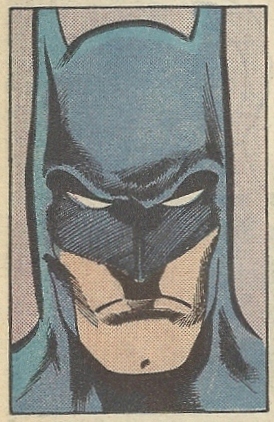
Aparo’s Batman has stood the test of time. It’s been a while since his pencil traced the outline of the Caped Crusader, but I still think his rendition tops all the others I’ve ever seen. That’s my personal opinion, I know, though it’s (justly) shared by many others. We all have our favorites. I’ve waxed nostalgic about Norm Breyfogle’s Batman of my youth, but Aparo’s was the 1A of that time. His was the clear, and I mean CLEAR, numero uno. Batman under his ministrations was grim (isn’t he always?) and ramrod straight, lean and foreboding, with long pointed ears that looked sharp to the touch and had enough length to impale you if you got out of line. And there was that frown — it was a look that could stop you in your tracks and turn you to stone. There was something regal in the Aparo Batman’s bearing, and I always thought I could read the inner workings of that detective mind better when Aparo was on the job.
I could quibble about certain things with his general style. Well, more than a few things. This isn’t pure, unmuddied love we’re dealing with here. His men often looked alike — though that’s a common complaint for many artists, it seemed exacerbated with him. His Bruce Wayne and his Superman were indistinguishable from the neck up. His early work could be a bit dodgy, but it was early work. He was still getting his feet underneath him. And, to be quite frank, I’ve never taken to his style all that much when he’s worked on properties other than the Caped Crusader. He’s like Ron Lim in that regard. Lim drew a spectacular Silver Surfer, one who glistened and glowered like none other ever could, but his non-Sentinel of the Spaceways work left me cold. I’m more tolerant of Aparo’s non-Batman production, but there’s a similar dynamic at play.
Nobody’s perfect, folks. And Aparo drew an incredible Batman, who stands at the top of the comics pyramid, or near it, since I’d put Superman at the apex. But you get the picture. To do such great things with one of the great characters? That counts for a lot.
Let’s have a look at a couple of my favorite Aparo bits.
The Jim-Starlin-penned “A Death in the Family” was a pretty damn big event, so it’s no wonder that it’s widely regarded as the high-water mark of Aparo’s Bat-times. I won’t go into the broader issues that went along with the storyline, how loathed Jason Todd was (though his mother handed him over to the Joker before he was almost beaten to death and then blown up — it’s hard not to feel bad for the guy after all that), how the 900 number (perhaps rigged) sealed his doom, or any of the other associated hoo-ha.
The meat of the series was, of course, this:
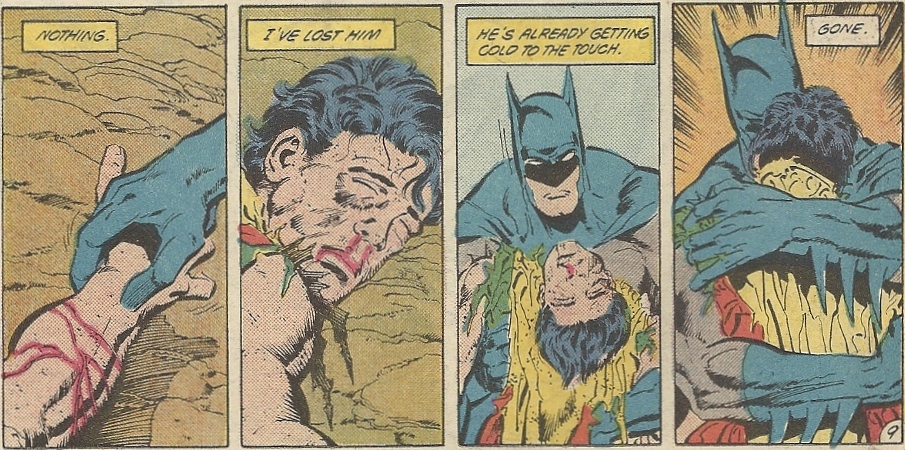
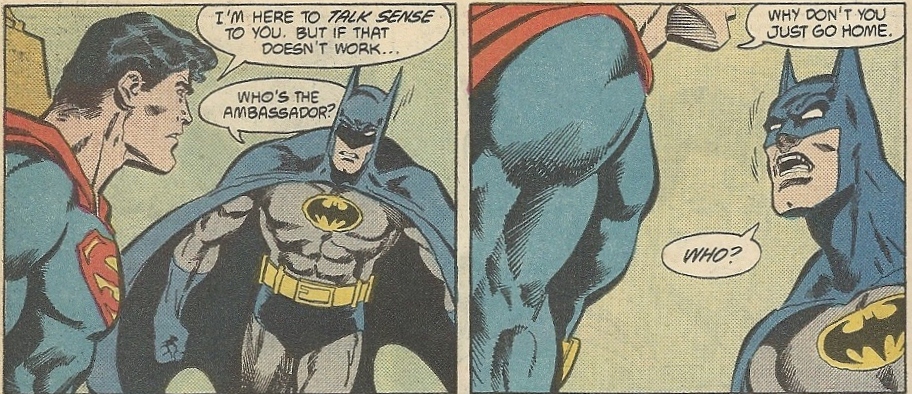
What I remember most about the series came at the end of the third issue of the arc, in Batman #428, when Superman showed up. I’ve always loved the quiet moments that Kal and Bruce have shared, especially after their pre-Crisis chumminess went bye-bye and their deep differences (tempered by profound respect) were magnified. All that crystallizes here in a few pages in a couple of issues.
Robin is dead, and the Joker left a message written in blood for Batman to meet him at the United Nations. Then Superman shows up, offering a cryptic warning that Batman isn’t to accost the new Iranian ambassador. Supes is having a hard timing coming out with who the new ambassador is, and Batman gradually loses his temper:
And then there’s this explosion:
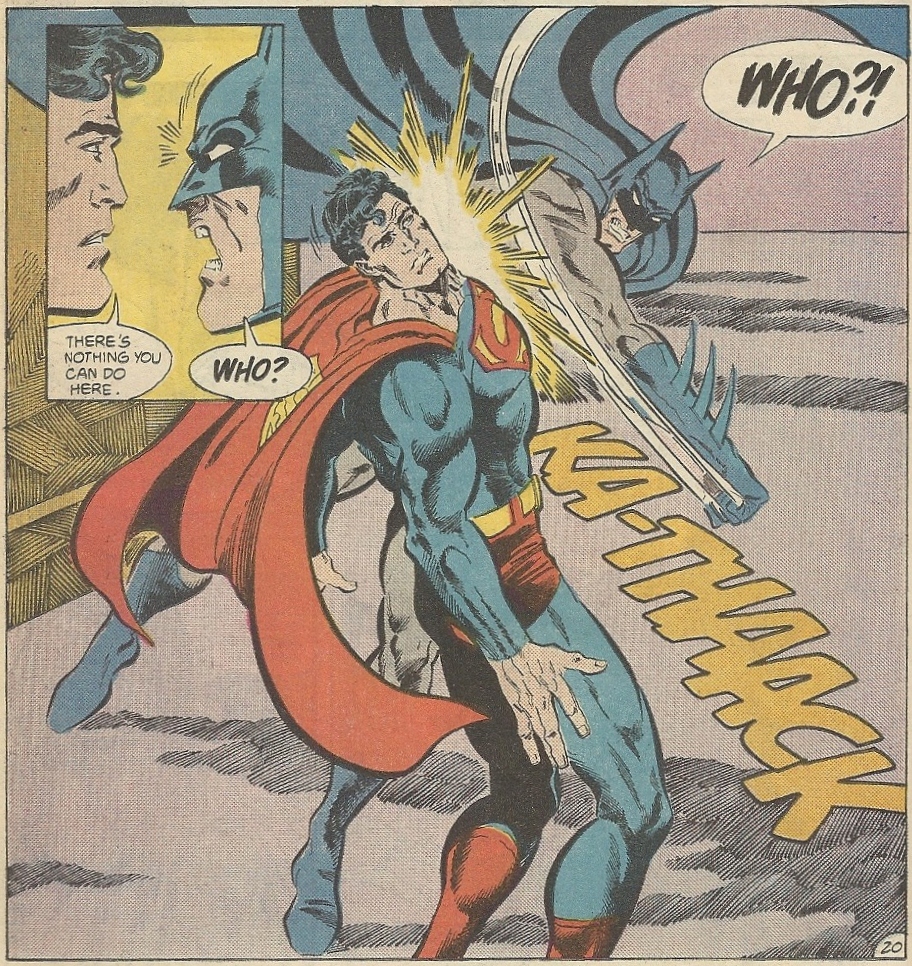
Batman. Just punched. Superman. He might as well have decked me, because that pretty much knocked me over in my chair twenty years ago. I still think it’s a great moment, perhaps not a high point in the relationship of the world’s finest duo, but an emotional one. And then there’s this semi-humorous follow-up:
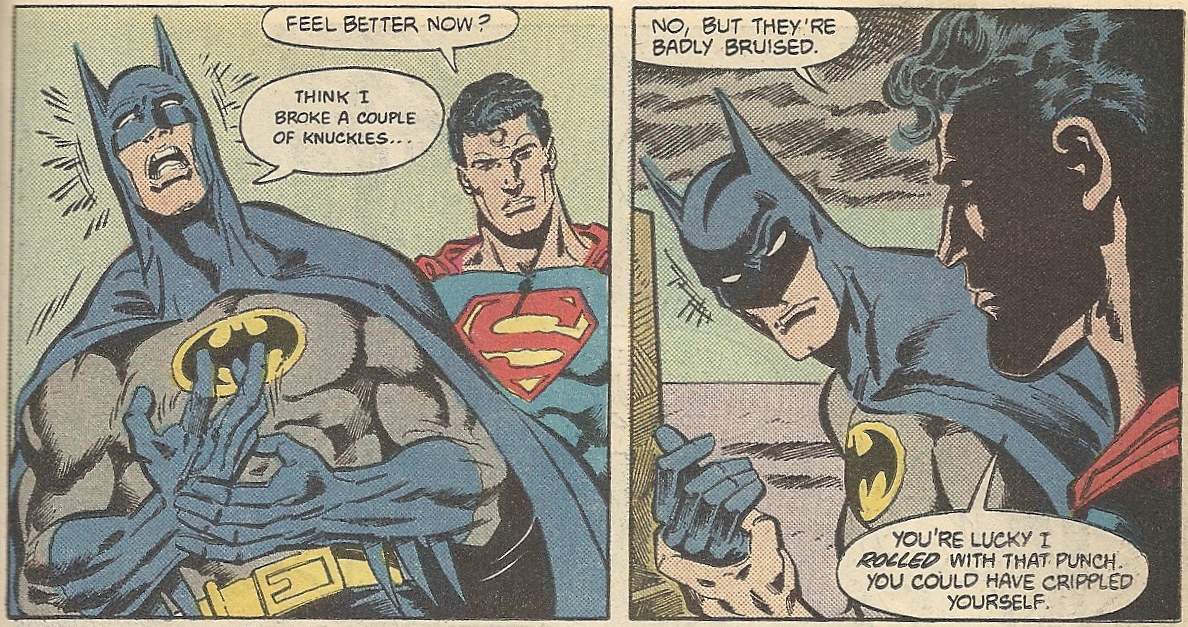
Superman is always rubbing it in. He doesn’t realize he’s rubbing it in, mind you, but he’s still doing it.
The ambassador is, surprise, the Joker, and at the beginning of the next issue our two heroes meet with a flabby State Department flunky. What Aparo did with Batman’s posture and facials in these panels is so great:
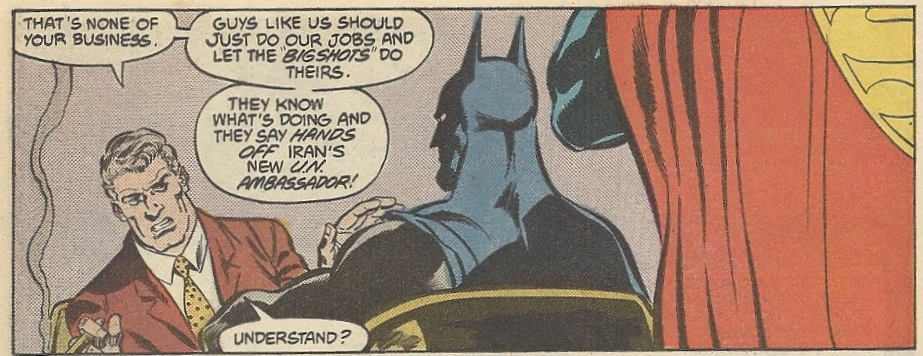
Batman’s response?:
He doesn’t get a whole lot cheerier when he learns that he now has a minder:
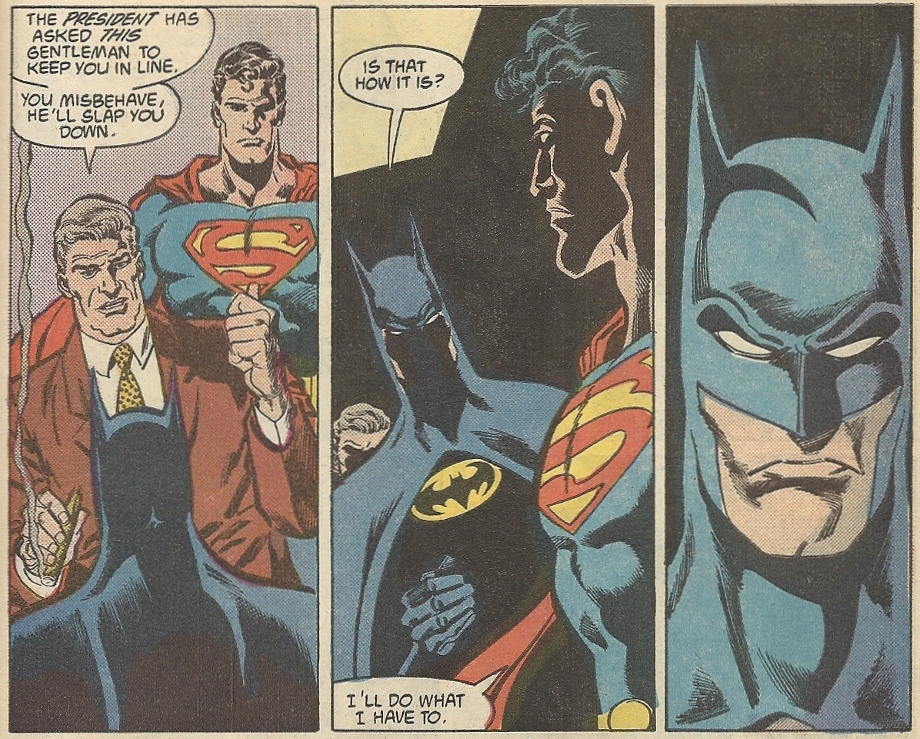
Then there comes the moment when the bureaucrat leaves and our heroes drop the monikers and become Kal/Clark and Bruce. I adore — adore — how Aparo depicts Batman running the gamut of emotions, from suppressed anger to unspeakable sadness to steely resolve:
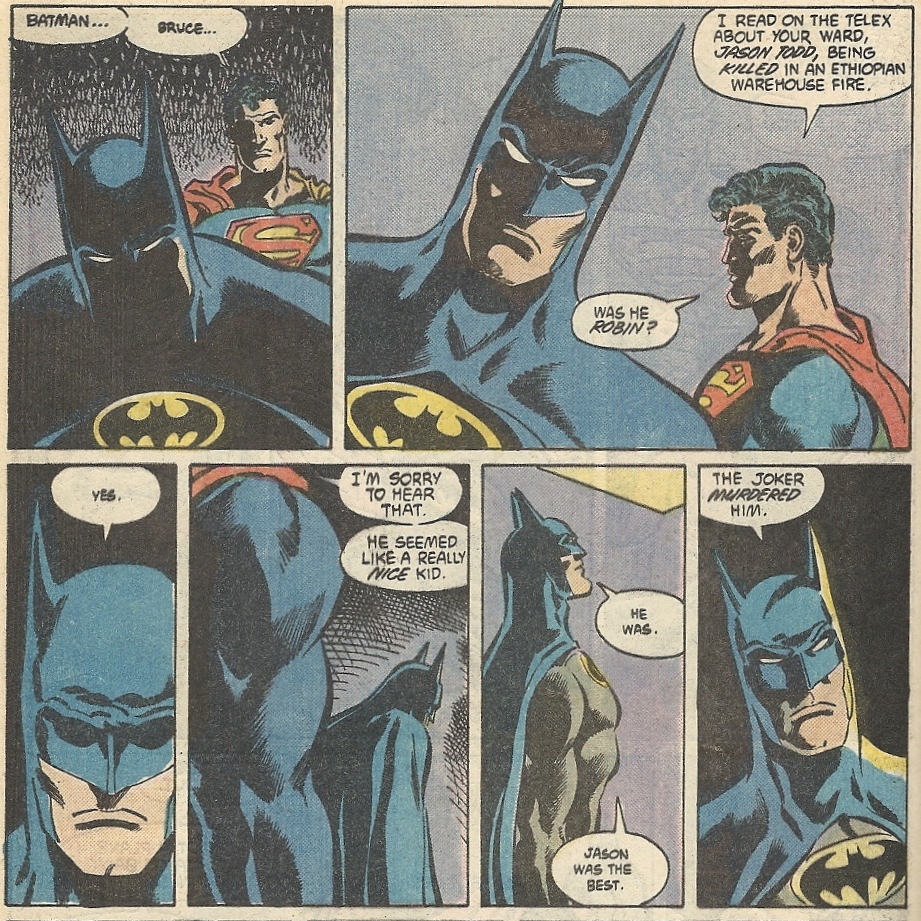
Magnifique.
For me these bits will always be part of Batman’s core definition, and are a big part of the reason why, when I hear the name Batman, Aparo’s art pops into my head. Who cares that the old blue accents and yellow emblem have fallen out of favor?
I have to make an honorable mention of Mike DeCarlo’s inks, which you can’t ignore with all the dark shading of these rather depressing scenes. For much of Aparo’s time on the main Batman titles they were teamed, and they meshed so well together. You can see that in these scans. Kudos.
In one final addendum, check out the back of my old trade, and more specifically Denny O’Neill’s quote at the bottom. Kind of funny in light of recent history:
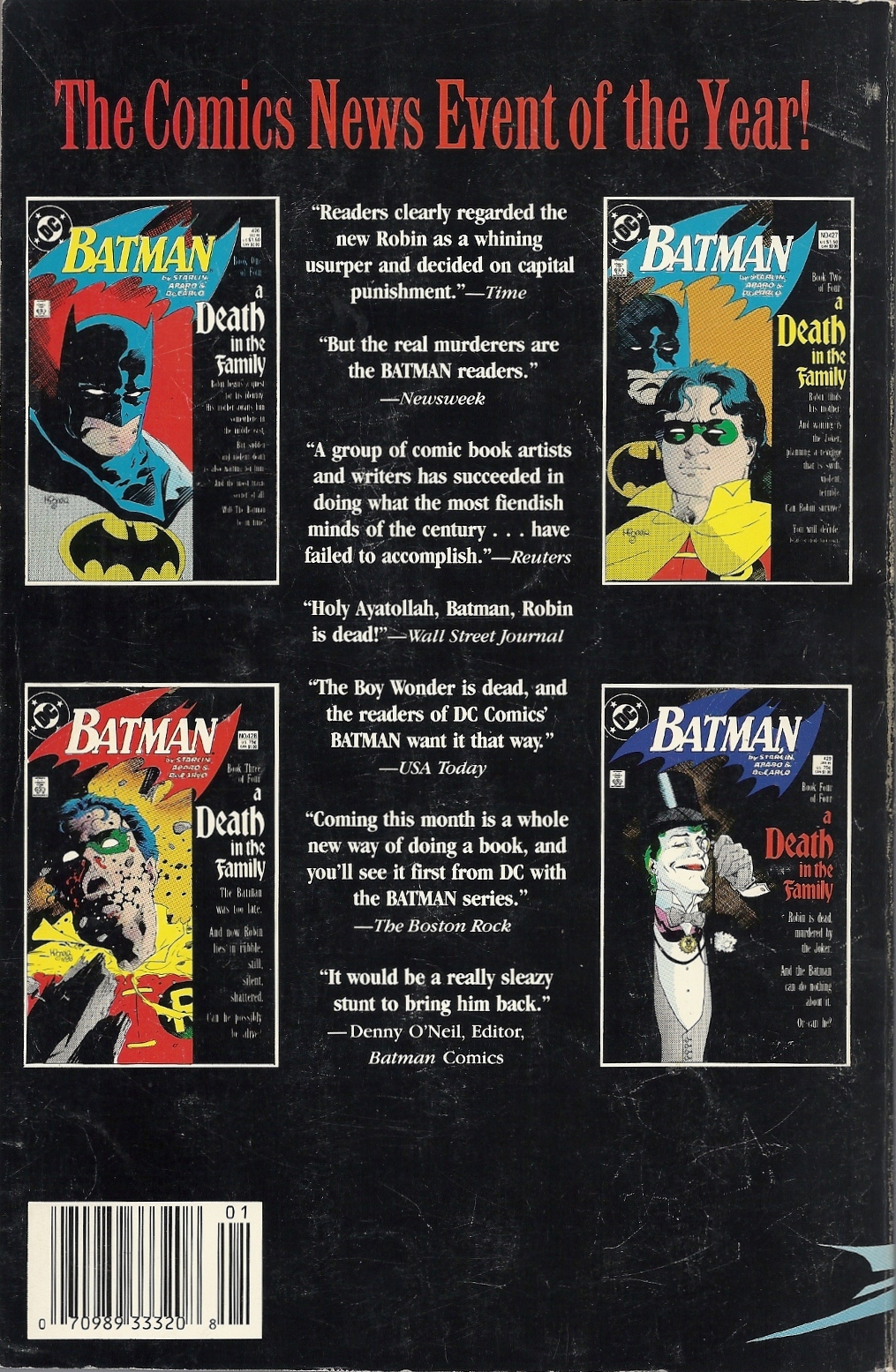
I’ve rambled a bit here, but it’s been fun to hash out some of my Aparo love. It makes me very sad that he’s no longer with us, and sometimes I wish that we could “bring him back” like they did with Jason Todd. I wouldn’t care if that resurrection was a “sleazy stunt” or not. I miss his Batman, and it might be nice if he could have one last go around with the cape and cowl. But all things come to an end, I suppose, and the man deserves to rest in peace. He earned it. He gave me “my” Batman. He gave me a lot.
Thanks, Jim.
Is he waving? Carrying an invisible boombox over his shoulder?

This Remco “energized” look might be the stiffest Spider-Man pose I’ve ever seen. Ah, the days before points of articulation.

I realized as I was about to post this that it would be my second “scantily clad beefy man” themed post in as many days. I guess I’m on a kick.
I confess to knowing nothing about the “Monarch of Monster Isle” before I opened this book (btw, that sounds like a great nickname for a boxer or MMA fighter), and even after finishing the story I don’t really know whether I’m much better informed about his backstory. I won’t waste any keystrokes recounting what can be found elsewhere on the web — others better informed than I have done the work of recounting Kona’s publication and fictional history (the former being somewhat interesting) here and here, so you can find edification in those spots if you so desire.
Kona’s basically a guy who specializes in grappling with oversized beasts and he’s a product of the Dell/Gold Key split. That’s the Cliff Notes version for you.
Let’s plunge right in to “The Unsees Foe,” written by Paul S. “Not Cool Hand Luke” Newman with art from Sam Glanzman:

Kona and his Edgar Winters white hair are in the service of the Dodd family (a scientist father, a daughter and two grandchildren), a well equipped set of folks who dart around in a flying ship. The comparisons to Benton Quest, Race Bannon, Jonny and Hadji come to mind, but all together they’re a more conventional arrangement than that rather odd Jonny Quest grouping, whose homosexual possibilities (not that there’s anything wrong with that) were parodied so hilariously in an episode of Harvey Birdman, Attorney at Law. Yes, a man in fur underwear somehow seems more conventional. But maybe there’s a little of Race in Kona, and a little Benton in Dr. Dodd.
Dodd gets a message from some museum honchos — another scientist, who was investigating a lost city, has gone missing, and it’s up to our subjects to find him. It doesn’t take long for him to find them, as he comes out of the jungle mumbling and bumbling:

Apparently not having heard the old “curiosity killed the cat” adage, Kona and the Dodds head to the “lost” city. It’s a place called Capitolia, which has a futuristic look to it but is devoid of human life. Kona does not like all that he senses there:
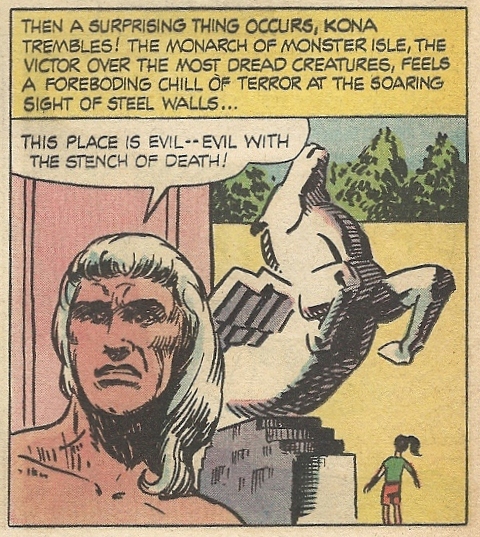
With good reason. During the night vines come and carry away the kids. Kona and Dr. Dodd move to rescue them, with Kona spouting his primitive motivational sayings all the while:
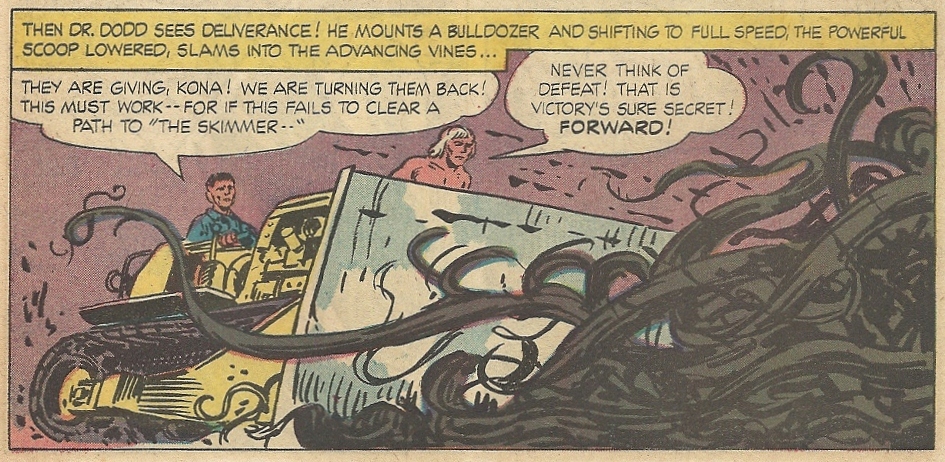
Sort of a Tarzan-like Tony Robbins. A Paleolithic life coach.
They soon get, if not to the root of the problem, at least the pods of it — things straight out of Little Shop of Horrors, but without the obnoxious singing:

And, in case we doubt their lethality:

Bambi! No!
Dr. Dodd surmises that the giant beetles (that they’ve also tangled with along the way, with Kona displaying his wrestling-giant-things skill set) are in a symbiotic relationship with the pods and their vines, and when he tricks the pods into eating their insect partners both groups die off. But when they all head back to Capitolia to rest on their laurels, we cut to those museum honchos:

I was a bit confused by this at first. The lack of a “To be continued…” or anything else made me wonder if there were pages missing or something. But no, that’s the end of the issue (apart from a one page text story and a brief Anak backup) — we’re left with a cliffhanger and also left to wonder how Kona is going to wrestle an earthquake into submission.
Glanzman, whose work based on his own World War II experiences is very, very good (and is definitely worthy of a future blog post), did fine, solid things with the art here. The action was fluid, and the contrasts between the savage jungle (and the rugged Kona) and the clean, lifeless Capitolia were pleasing to the eye. They way the story just lurches to a halt, though, leaves me scratching my head. It’s not that I need some stupid notation to let me know that the adventures will be continued in the next issue, but it nevertheless seems to be lacking something. But I suppose I’m getting too hung up on something trivial. Believe it or not, that can happen.
My bet’s on vegans being the first to die – What If…? #13
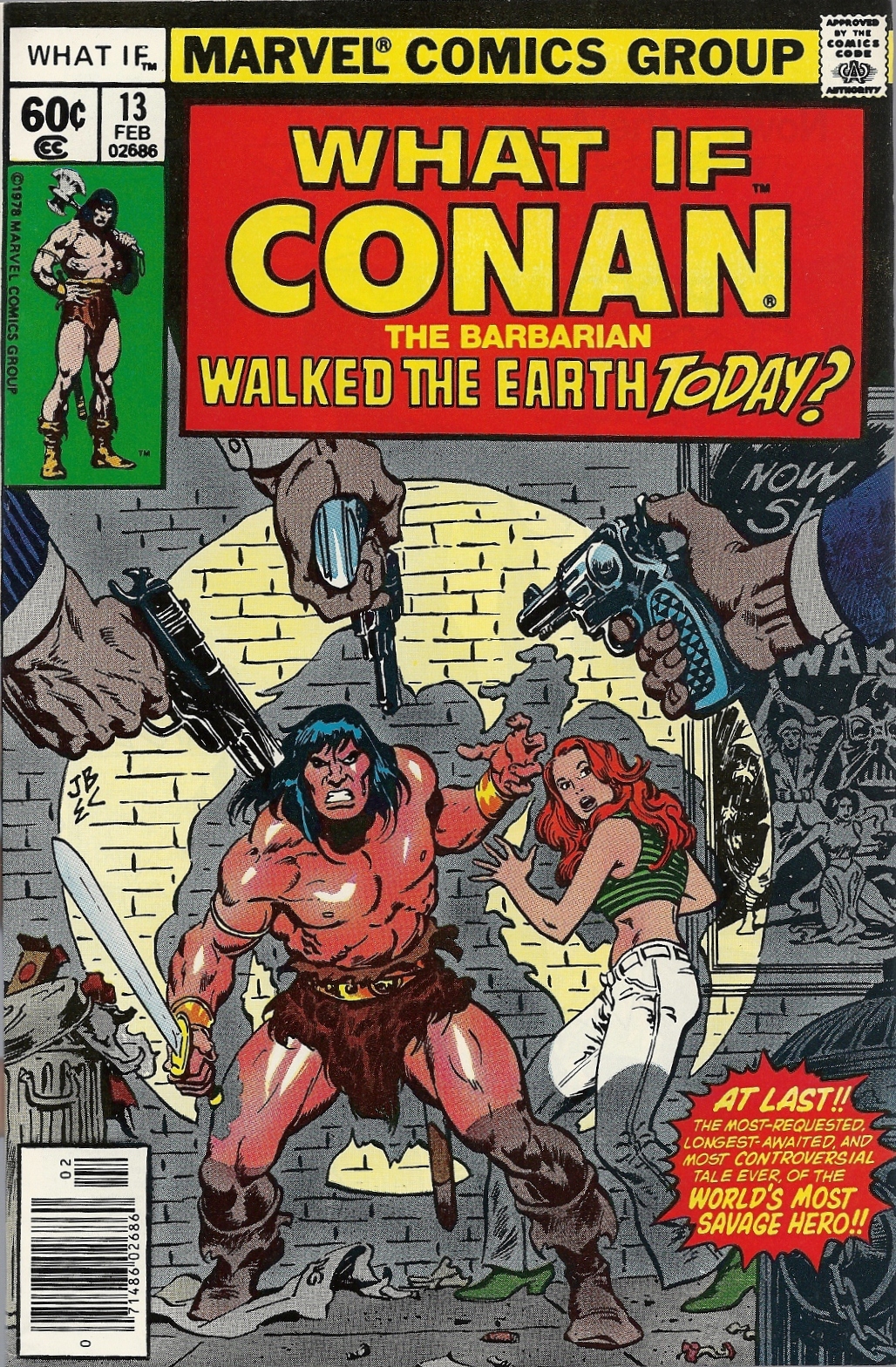
Ladies, he’s pumped, greased and ready for modernity. Not only is that a sort of/kind ancestor of the “Days of Future Past” Uncanny X-Men #141 cover, but check out the partially obscured Star Wars poster on the right.
It’s not often that my dour face breaks into a wide smile while I’m reading a comic book. I enjoy them, but my pleasure usually registers internally. It’s even rarer for me to actually laugh out loud at a comic’s attempts at humor. This comic managed to do both. Throwing Conan the Barbarian into the modern day (1977 in this case) could either be a storytelling disaster or it could be a source of nigh-unending amusement. This is the latter, my dear readers. The latter.
Roy Thomas, John Buscema and Ernie Chan conjured this goofy masterpiece, which answers the burning question of “What If Conan the Barbarian Walked the Earth Today?” I’ll skip any commentary about Uatu the Watcher’s customary opening ramblings (and even he looks rather beefy under Buscema’s ministrations) and how Conan is transported forward in time (it involves his usual mix of wenches and wizards), and simply begin with Conan getting plopped down in Greenwich Village:
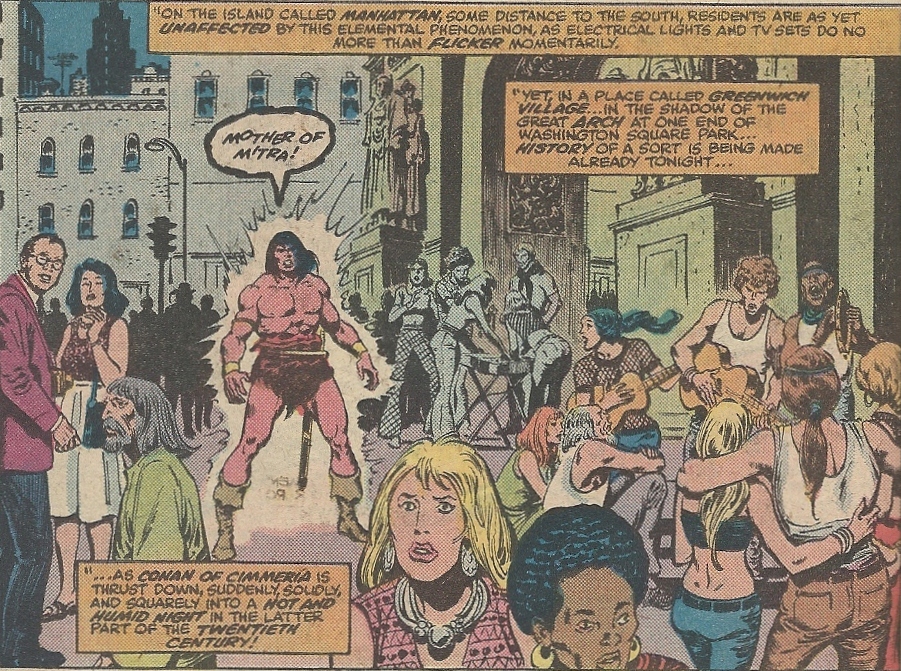
Conan arrives not only in the Big Apple, but the Big Apple on July 13, 1977. That’s the day/night of the infamous real-life big blackout, which is a nice bit of storyline synergy. Since it’s summer and it’s New York and the A.C. is kaput, his attire isn’t that out of place — this is, after all, the burg that would one day give us the Naked Cowboy. Still, his scant clothing and general beefiness draws some comments from those he encounters, including one lady who wonders if he might be Arnold Schwarzenegger. I realize Arnie was one of the few muscle men to have widespread fame at that point, but I’m still impressed by the prescience shown here for the casting of a film that wouldn’t hit theaters until 1983.
Not everyone is so blasé when it comes to his bare skin. While he’s hungrily eyeing some grub, a busybody old bag gives him the business:
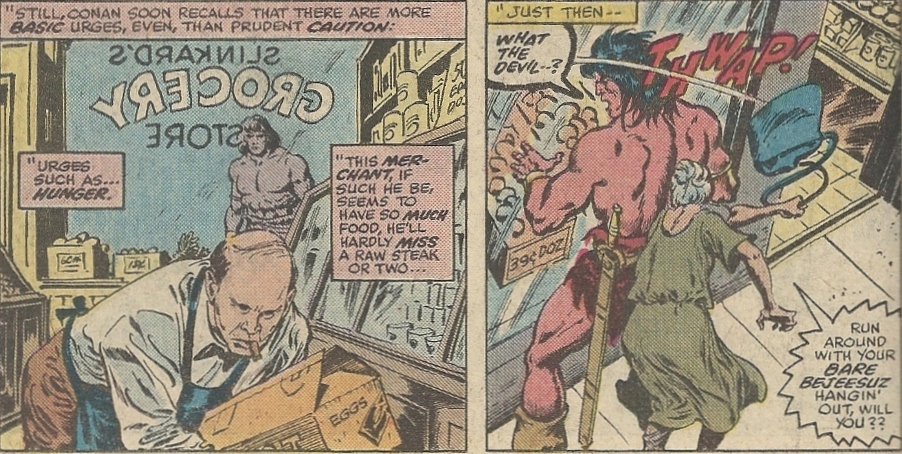
The Cimmerian’s reaction?:
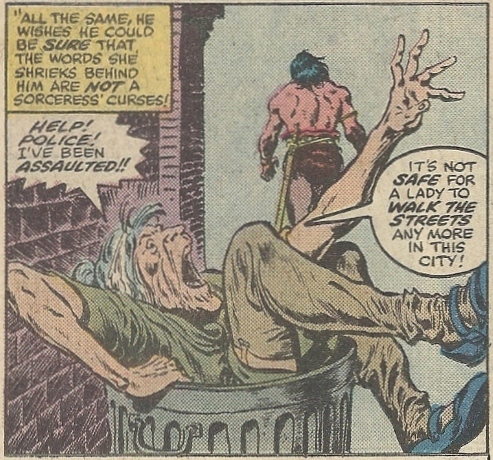
“Give my regards to Oscar the Grouch, bitch.”
Conan wanders around (nearly crossing paths with Peter Parker and Mary Jane) and has the reactions that you’d expect when he confronts automobiles, confusing them with metallic monsters and lashing out as soon as one comes near. But he happens to strike a taxicab driven by what is perhaps the most attractive hack in the history of the universe:
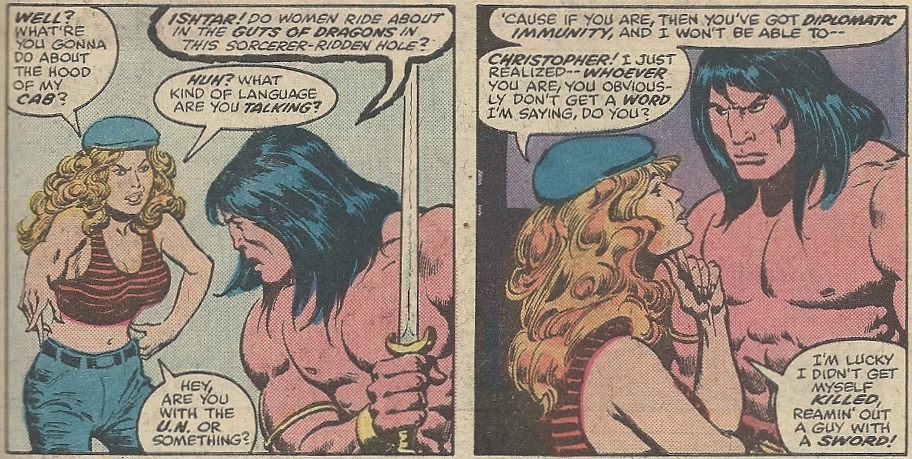
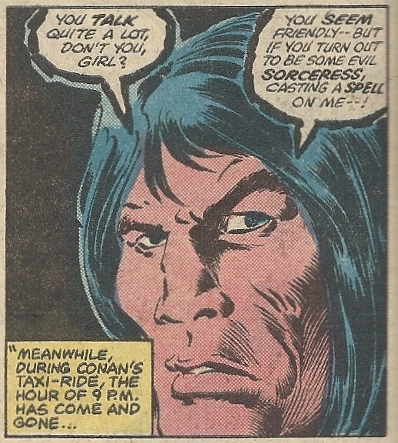
She does what any young woman would do when confronted with a half-naked, sword-bearing man — she decides to take him back to her place. On the way, Conan vocalizes a thought similar to ones I’ve had on certain dates:
When they get to her pad it’s not long before Conan does the other thing he’s good at besides cleaving people in two:
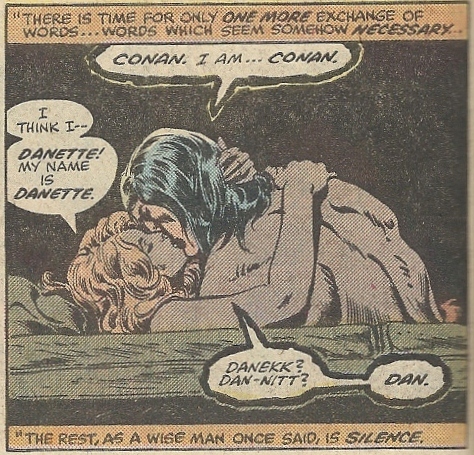
That’s it, big guy. Give her the gift of your love.
As I said above, it’s the night of the big blackout, and the looters are out in force. When some start to break up the store downstairs from his new love’s abode, Conan springs into action. Danette makes it clear that he’s not to kill anyone, much like John Connor did to Ahnuldt in Terminator 2 just before he shot that guard’s kneecaps off. Conan gets the gist of her admonition, but still manages to crunch these 20th century punks in rather comical ways:
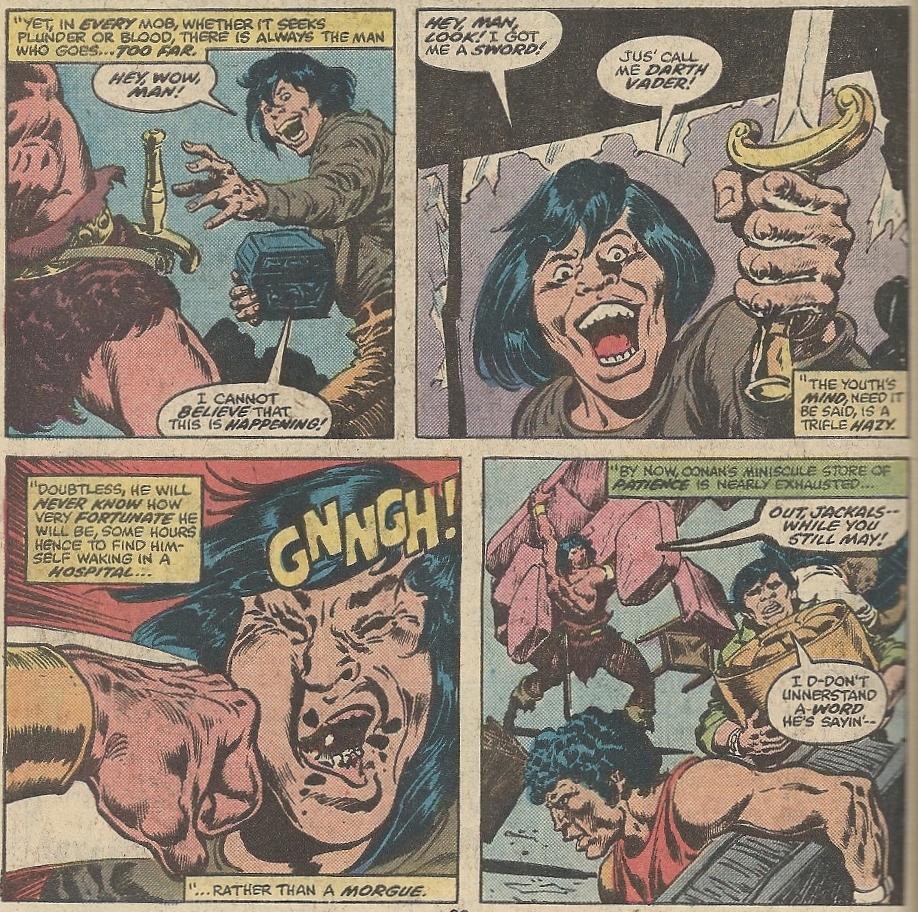
A sofa — that’s an odd thing to wield.
After things calm down, Danette tries to figure out this big galoot’s origins by showing him some pictures of various locales. Perhaps she should have done that before the coitus, but who am I to question true love? When a picture of the Guggenheim Museum reminds Conan of a temple in his own time, the two of them, for the lack of anything better to do, go there in the middle of the night. They aren’t the only ones there — you guessed it, more looters. This is a more sinister and more heavily armed bunch, and things quickly get hairy:
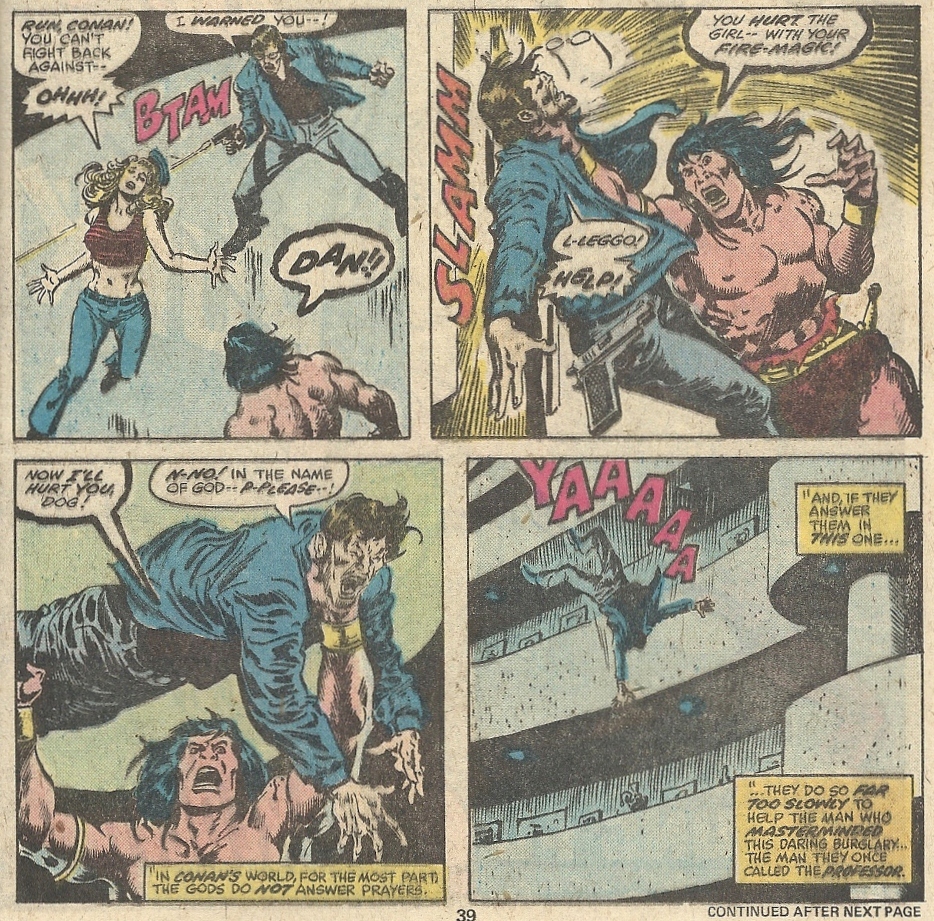
A series of delightful defenestrations, impalings, skull-crushings and stranglings follow, as Conan’s muscular vengeance runs its course. The cops are drawn to the ruckus, and after the two lovers exchange momentos (she gives him her cap, he gives her an armband) Conan climbs King Kong-style to the top of the Guggenheim. There he’s struck by lightning and magically returned to his own time. All the two have are their gifts to remember each other by.
I enjoyed reading this comic more than I have any in recent memory. Really. Seeing and reading Conan’s reactions to modern life was a delight, and while not a whole hell of a lot really goes on in this story, it held my attention. Roy Thomas’s gifts were on full display here — there’s a fine line between stupidly fun and just plain stupid, and he walked it like a circus acrobat. Bravo. And the blending of Buscema’s and Chin’s styles made for some very attractive art. I’m not Buscema’s biggest fan, but I’ve always liked what he does with Conan, both here and in his proper title. The looks on the faces of the poor modern goons when confronted by this hulking dude were priceless, as were the images of their teeth getting knocked out and them being thrown out of buildings.
I realize I’ve already alluded to the Terminator franchise in this post, but some of the vibe of this comic remids me of the original film, with a man travelling through time in an electrical disturbance and spending one night with a woman, a night where their brief dalliance is consummated. As Schwarzenegger would say, “All dat sort of ting.” Perhaps Conan too impregnated his babe in this alternate universe. I guess we’ll never know.
We need a sequel.
Magically delicious
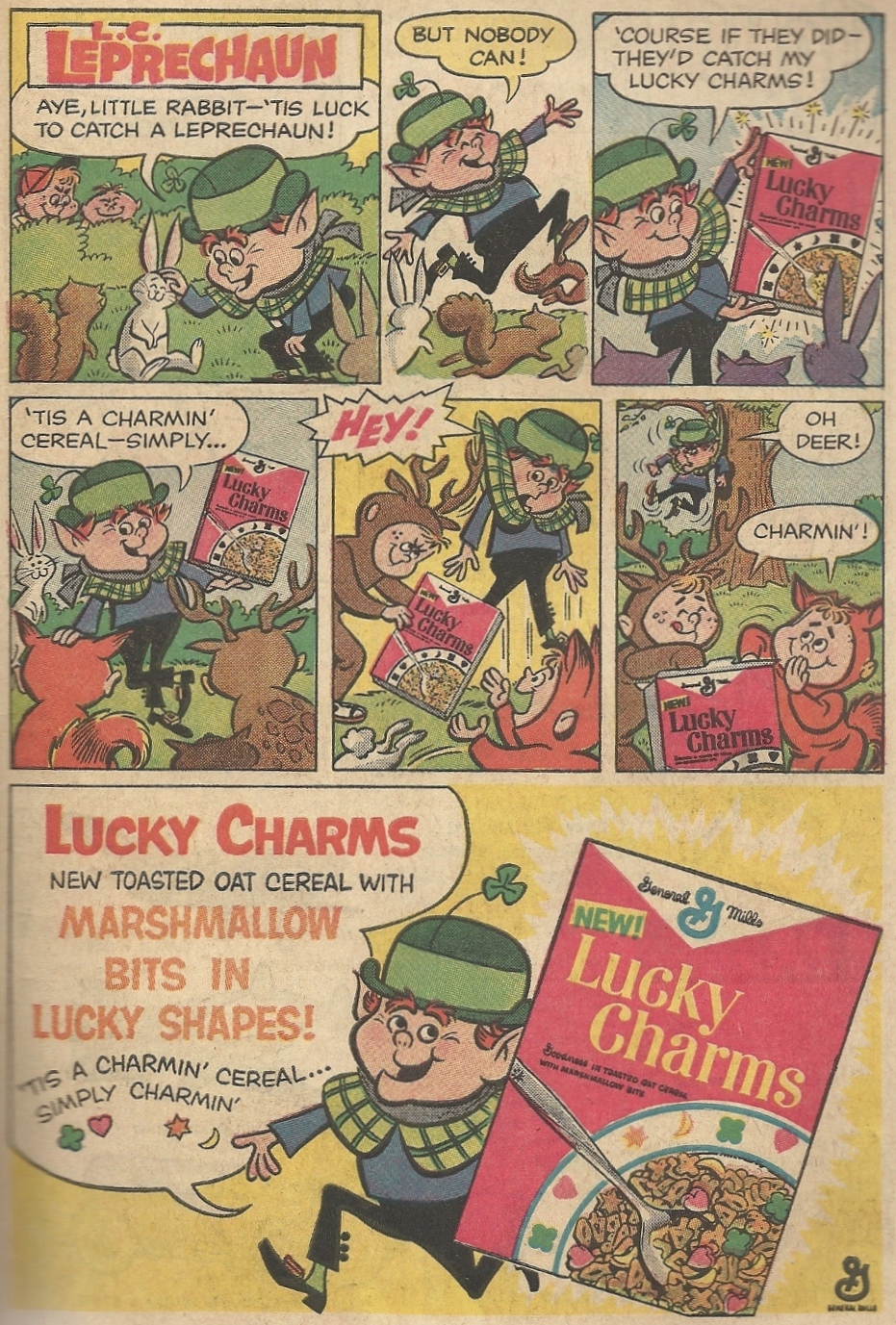
I try hard to feel sympathy for the plight of Lucky or L.E. Leprechaun or whatever other alias he’s going by at the moment, but every time I see him peddling his Lucky Charms, I want to whack him over the head with a stick. I just do.
 Jared
Jared


 blog into mystery